Search Results: "gio"

30 November 2013

Lars Wirzenius: Obnam 1.6.1 (backup software) and larch 1.20131130 (B-tree) releases: serious bug fixes

Backups are fun and exciting! Restores are exciting, in a terrifying and stressful way. Fixing serious bugs is gratifying, in a depressing way. I am glad to announce two software releases: Obnam version 1.6.1 and larch version 1.20131130. Obnam is my backup application, larch is a Python copy-on-write B-tree implementation that Obnam uses. I've uploaded the new versions to Debian unstable and to my own apt repository at [code.liw.fi] (also for wheezy). (I don't have the energy to upload to Debian backports: help is welcome there.) These are mainly bug fix releases, and minor improvements. The larch release fixes serious problems, and everyone should be upgrading. NEWS for larch: NEWS for Obnam (combining versions 1.6 and 1.6.1, both released today): Bug fixes:

16 November 2013

Russ Allbery: Review: Blue Remembered Earth

Review: Blue Remembered Earth, by Alastair Reynolds
Series: Poseidon's Children #1
Publisher: Ace
Copyright: January 2012
Printing: June 2012
ISBN: 0-441-02071-2
Format: Hardcover
Pages: 505
Geoffrey Akinya is one heir to the vast Akinya business empire, which straddles the solar system and has created vast riches from exploration and mining. He wants nothing to do with it. His passion is elephants: long and methodical study of wild herds in Africa, including a slow and careful investigation into their thought processes. His obnoxious and superior cousins have a passion for business and finance and can have the running of the company for all he cares. But Geoffrey's grandmother Eunice, the family matriarch and driving force behind much of their business expansion, has died. Her ashes are brought back to Africa from the Winter Palace in orbit around the Moon where she lived out her final days and scattered in a family ceremony. And, shortly thereafter, Geoffrey's cousins convince him to investigate a safe-deposit box left on the Moon by Eunice to ensure that it doesn't contain anything damaging to the family. What it contains is the first step in a puzzle. Despite himself, Geoffrey and his sister Sunday an artist and family black sheep who lives in a region of the Moon that is one of the sole holdouts against the ubiquitous monitoring common in the rest of the inhabited solar system are slowly pulled into unraveling that puzzle. This leads them into an uneasy alliance with one of the major political forces in the solar system and some startling revelations about their grandmother's actual plans. Blue Remembered Earth is another entry in the currently-popular sub-genre of solar system SF. Interstellar travel is still a dream, but a combination of improved technology, suspended animation, and heavy use of robots and robotic factories has let humans slowly expand into more of the solar system. On Earth, powers have risen and fallen, and the leap into the solar system coincided with a surging and powerful Africa. Extensive undersea colonization has established a new international consortium of sea-floor countries, and Earth politics have realigned into a diplomatic and business struggle between surface and oceanic nations. Unusually for this sort of fiction, most characters of significance in this story are African. The United States and Europe have quietly disappeared in the way that all non-US countries tend to in most other SF. Reynolds doesn't do very much with this setup (and the characters don't seem distinctly African to me). It's just there as the unremarked normal. I liked that. I kind of wish more of African culture had come through in the story, but there are enough SF novels with an assumed and unremarked white (and usually US) future that an assumed and unremarked black African culture is a nice change of pace. I picked up this book in part because it was described as a better 2312. That's a fairly accurate summary (although only helpful to those who have read Kim Stanley Robinson's novel). The scope and setting are similar, although Reynolds's future cuts back on the scope of off-world human colonization, relies more heavily on robotics, and keeps the power base on Earth. Both books are structured as a mystery, although in Blue Remembered Earth that mystery is deliberately planted for the characters. Reynolds is nowhere near as good at set pieces as Robinson, sadly. There's nothing here at the level of some of the scenes on Mercury in 2312. But he is much better at plotting and characterization, and Blue Remembered Earth tells a coherent story with increasing tension and a satisfying ending. Reynolds here uses an interesting strategy for spinning a mystery out of pieces of knowledge and discovery: set the discovery process prior to the novel, use protagonists who were unaware of it, and turn the details into a mystery that they have to investigate. This is an interesting way to address the problem that most discovery processes are slow and not particularly dramatic. It is artificial Eunice creates the plot for the novel but that worked for me. By the end of the book, I think I understand her reasons for doing so, and both Geoffrey and Sunday have good reasons to not be aware of any of the details before they start following the clues that Eunice leaves behind. The mystery of course sends Geoffrey and Sunday on a bit of a tour of the solar system as well as a tour of the past of their family business and the politics of the present. Here, Reynolds draws on an old SF idea: a conflict between groups that want to mechanize space exploration and groups that want to adapt humans for space. Long-time SF readers will be familiar with this approach, and I don't think Reynolds does anything startlingly new with it, but I thought it was a well-executed side plot. And, for once, an SF author realizes that Earth's oceans are as compelling of a place for that conflict to play out as outer space. There are, of course, significant mysteries to be uncovered, but it takes much of the book before those revelations start (even if one of them is almost spoiled in the dust jacket summary). The story up until that point is driven by character, particularly Geoffrey's stubborn annoyance at the rest of his family and his complete lack of interest in being the protagonist of a novel. I should probably warn here that many of the Amazon reviews disliked this book because of the characters, particularly Geoffrey. Apparently he comes across to some as whiny, resentful, and annoying. I, however, didn't have this reaction at all, possibly in part because I wholeheartedly share his opinion of both big business and his cousins. I thoroughly enjoyed reading an SF novel whose main characters are not driven either typical capitalist motives or a desire for personal exploration, but instead are pulled into the plot through a sense of loyalty and an inability to get out of the way of the problem. I also liked the way Reynolds manages to broaden and deepen the reader's appreciation for the characters as the story unfolds, and even salvages some characters I thought were unsalvageable. The last third of the book features some excellent plot twists and some very nicely-handled revelations. This is apparently the first book of a trilogy, and I had a suspicion at the end of the book that sequels were coming, but I think it stands on its own quite well. Most of the questions raised by the plot are resolved by the end of the book, and those that remain are of a size that other books have left unanswered intentionally. Despite not reaching the same moments of awe-inspiring beauty, and despite more workman-like descriptions, the stronger plot and more interesting characters do make Blue Remembered Earth a better 2312 for me. Given that 2312 won a Nebula, that's saying something (although I don't agree with that award). It's a bit deliberate in its pacing, and the plot built around a constructed puzzle can feel a bit artificial, but I think it's a solid and satisfying near-space SF novel. Followed by On the Steel Breeze. Rating: 7 out of 10

13 November 2013

Andrea Veri: Configuring DNSSEC on your personal domain

Today I ll be working out how to properly configure DNSSEC on a BIND9 installation, I ll also make sure to give you all the needed instructions to properly verify if a specific domain is being correctly covered by DNSSEC itself. In addition to that a few more details will be provided about adding the relevant SSHFP s entries on your DNS zone files to be able to automatically verify the authenticity of your domain when connecting to it with SSH avoiding any possible MITM attack. First of all, let s create the Zone Signing Key (ZSK) which is the key that will be responsible to sign any other record on the zone file which is not a DNSKEY record itself:
dnssec-keygen -a RSASHA1 -b 1024 -n ZONE gnome.org


Note: the dnssec-keygen binary file should be part of bind97 (RHEL 5) or bind (RHEL6) package according to yum whatprovides: RHEL 5:
32:bind97-9.7.0-17.P2.el5_9.2.x86_64 : The Berkeley Internet Name Domain (BIND) DNS (Domain Name System) server
Repo : rhel-x86_64-server-5
Matched from:
Filename : /usr/sbin/dnssec-keygen


RHEL 6:
32:bind-9.8.2-0.17.rc1.el6.3.x86_64 : The Berkeley Internet Name Domain (BIND) DNS (Domain Name System) server
Repo : rhel-x86_64-server-6
Matched from:
Filename : /usr/sbin/dnssec-keygen


Then, create the Key Signing Key (KSK), which will be used to sign all the DNSKEY records:
dnssec-keygen -a RSASHA1 -b 2048 -n ZONE -f KSK gnome.org


Creating the above keys can take several minutes, when done copy the public keys to the zone file this way:
cat Kgnome.org*.key >> gnome.org


When done you can clean out the useless bits from the zone file and just leave the DNSKEY records (which are not commented out as you will notice) An additional and cleaner way of accomplishing the above is to use the INCLUDE rule on the zone file itself as follows:
$INCLUDE /srv/dnssec-keys/Kgnome.org+005+12345.key
$INCLUDE /srv/dnssec-keys/Kgnome.org+005+67890.key


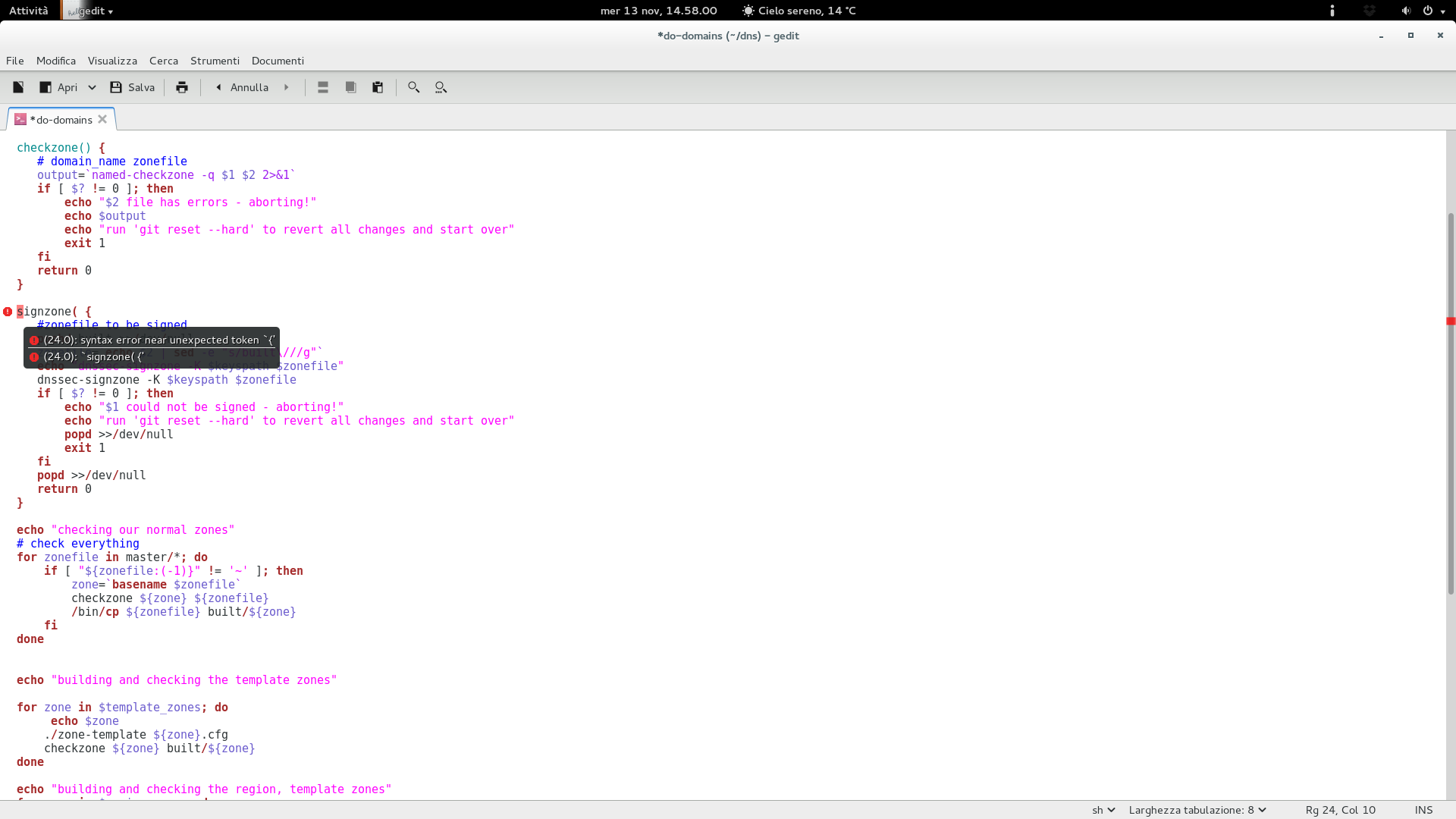
Choosing which method to use is really up to you. Once that is done you can go ahead and sign the zone file. As of myself I m making use of the do-domain script taken from the Fedora Infrastructure Team s repositories. If you are going to use it yourself, make sure to adjust all the relevant variables to match your setup, especially keyspath, region_zones, template_zone, signed_zones and AREA. The do-domain script also checks your zone file through named-checkzone before signing it.
/me while editing the do-domains script with the preview of gnome-code-assistance!

/me while editing the do-domains script with the preview of gnome-code-assistance!

If instead you don t want to use the script above, you can sign the zone file manually in the following way:
dnssec-signzone -K /path/to/your/dnssec/keys -e +3024000 -N INCREMENT gnome.org


By default, the above command will append .signed to the file name, you can modify that behaviour by appending the -f flag to the dnssec-signzone call. The -N INCREMENT will increment the serial number automatically making use of the RFC 1982 arithmetics while the -e flag will extend the zone signature end date from the default 30 days to 35. (this way we can safely run a monthly cron job that will sign the zone file automatically) You can make use of the following script to achieve the above:
#!/bin/sh
SIGNZONE="/usr/sbin/dnssec-signzone"
DNSSEC_KEYS="/srv/dnssec-keys"
NAMEDCHROOT="/var/named/chroot"
ZONEFILES="gnome.org"
cd $NAMEDCHROOT
for ZONE in $ZONEFILES; do
$SIGNZONE -K $DNSSEC_KEYS -e +3024000 -f $ZONE.signed -N INCREMENT $ZONE
done
/sbin/service named reload


Once the zone file has been signed just make sure to include it on named.conf and restart named:
zone "gnome.org"  
file "gnome.org.signed";
 ;


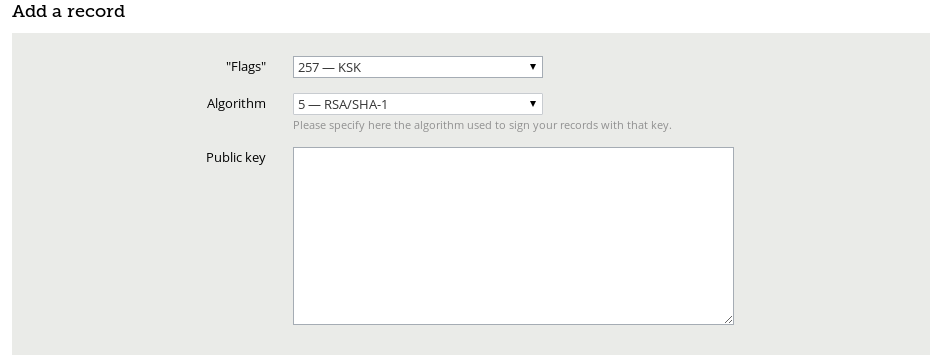
When you re done with that we should be moving ahead adding a DS record for our domain at our domain registrar. My example is taken from the known gandi.net registrar.
gandi

Gandi s DNSSEC interface

Select KSK (257) and (RSA/SHA-1) on the dropdown list and paste your public key on the box. You will find the public key you need on one of the Kgnome.org*.key files, you should look for the DNSKEY 257 entry as dig DNSKEY gnome.org shows:
;; ANSWER SECTION:
gnome.org. 888 IN DNSKEY 257 3 5 AwEAAbRD7AymDFuKc2iXta7HXZMleMkUMwjOZTsn4f75ZUp0of8TJdlU DtFtqifEBnFcGJU5r+ZVvkBKQ0qDTTjayL54Nz56XGGoIBj6XxbG8Es+ VbZCg0RsetDk5EsxLst0egrvOXga27jbsJ+7Me3D5Xp1bkBnQMrXEXQ9 C43QfO2KUWJVljo1Bii3fTfnHSLRUsbRn8Puz+orK71qxs3G9mgGR6rm n91brkpfmHKr3S9Rbxq8iDRWDPiCaWkI7qfASdFk4TLV0gSVlA3OxyW9 TCkPZStZ5r/WRW2jhUY/kjHERQd4qX5dHAuYrjJSV99P6FfCFXoJ3ty5 s3fl1RZaTo8=


Once that is done you should have a fully covered DNSSEC domain, you can verify that this way:
dig . DNSKEY   grep -Ev '^($ ;)' > root.keys
dig +sigchase +trusted-key=./root.keys gnome.org. A   cat -n


The result:
105 ;; WE HAVE MATERIAL, WE NOW DO VALIDATION
106 ;; VERIFYING DS RRset for org. with DNSKEY:59085: success
107 ;; OK We found DNSKEY (or more) to validate the RRset
108 ;; Ok, find a Trusted Key in the DNSKEY RRset: 19036
109 ;; VERIFYING DNSKEY RRset for . with DNSKEY:19036: success
110
111 ;; Ok this DNSKEY is a Trusted Key, DNSSEC validation is ok: SUCCESS

Bonus content: Adding SSHFP entries for your domain and verifying them You can retrieve the SSHFP entries for a specific host with the following command:
ssh-keygen -r $(hostname --fqdn) -f /etc/ssh/ssh_host_rsa_key.pub


When retrieved just add the SSHFP entry on the zone file for your domain and verify it:
ssh -oVerifyHostKeyDNS=yes -v subdomain.gnome.org


Or directly add the above parameter into your /etc/ssh/ssh_config file this way:
VerifyHostKeyDNS=yes


And run ssh -v subdomain.gnome.org , the result you should receive:
debug1: Server host key: RSA 00:39:fd:1a:a4:2c:6b:28:b8:2e:95:31:c2:90:72:03
debug1: found 1 secure fingerprints in DNS
debug1: matching host key fingerprint found in DNS
debug1: ssh_rsa_verify: signature correct

That s it! Enjoy!

11 November 2013

Gunnar Wolf: Talking in Paran : Free Software philosophy / the Debian project. PS: Want to contribute?

I'm very happy: I was finally able to present a talk at a Free Software conference in Paran , Argentina Regina's hometown. Not only in Paran , but at the Vieja Usina culture center, half a block away from her parents' house. So, I must doubly thank Laura: First, for letting us know there would be a Free Software conference there, and second, for taking some pictures :- What was this conference? Conferencia Regional de Software Libre, organized by Grupo de Usuarios de GNU/Linux de Entre R os (GUGLER). Of course, flying to Argentina (and more specifically, to Paran , which is ~500Km away from the international airport) just for a one day conference was out of the question So I gave the talk by videoconference. Of course, given we will be travelling for the December vacations to Argentina, I expect to meet in person the GUGLER guys soon. I gave a single talk, mixing together two different topics: (my very personal take on) the Free Software philosophy and Debian's place in the Free Software universe. I had a very good time giving the talk, and while I was unable to look at my audience, I got reports saying they were happy and interested. I even got some mails from them, which makes me quite happy ;-) Now, one of the recurring points whenever I talk about Debian: I often tell people that I cannot tell them why they should use Debian instead of other distributions. My years testing every distribution I come across are long gone, and I nowadays am familiar with Debian only. But I also tell them that personally I gain nothing by having more Debian users in the world What I want to achieve is the next logical step: To have more people contributing to Debian. So, here is a great opportunity for interested people, specifically a group that often has a hard time finding a way to collaborate with Free Software projects. Today, Paul Tagliamonte published a call for proposals for Debian 8 (Jessie)'s artwork. So, given many people always want to find a way to contribute to Free Software without being a coder, here's a golden opportunity. You can look at the themes sent for Debian 7 as a reference; look also at the technical requirements for your artwork, and... Well, you have until early February to work on it!

7 November 2013

Russ Allbery: Review: Muse of Fire

Review: Muse of Fire, by John Scalzi
Publisher: Subterranean
Copyright: 2012
Printing: 2013
ISBN: 1-59606-639-3
Format: Kindle
Pages: 28
This is another separately-published short work by Scalzi probably a novelette, although I didn't do a word count. Since it's separately published and has its own ISBN, it gets its own separate review page. At present, it's $1 on the Kindle (and probably elsewhere). I've read a variety of these now, and while the quality of Scalzi's short works varies (as with everyone), I've generally enjoyed them. This is the first one I've read that I really didn't like. The premise is promising enough. Ben Patton is a scientist or engineer of some sort (I don't recall if the story is specific) working on plasma physics for a corporation. He has a nervous tic involving playing with a lighter and an obsession with fire, which his co-workers tolerate (and his boss does not tolerate). The reason for that tic is something he keeps secret: he sees a beautiful woman named Hestia in any flames that he's looking at. For him, she's his muse, and his untouchable obsession. He's mangled one hand trying to touch her. But she appears in fire because she's trapped in hell. There are all sorts of great places Scalzi could have gone with this. Musae and inspiration by themselves are fodder for many stories. The woman's name is Hestia, which is immediately recognizable as the Greek goddess of the hearth and who is extremely important to Greek religious life (although she's definitely not a muse, but I'd even let that pass). That raises more story possibilities around the transition of religion and the effect on worshiped gods, including the way Christian missionaries called "pagan" gods and goddesses devils and indeed did claim they were from hell. There are interesting science and magic crossover possibilities between plasma physics and a muse of fire. And there is, of course, the whole rescue from hell angle, which has generated many a story going back to ancient Greek drama. As you might have guessed from this catalog and my disappointment, Scalzi didn't go any of those directions. He provides some good characterization of the passions and discomfort of Ben's life, shows us the practicalities of his relationship with Hestia, and sets up dramatic tension, all well and good. And then takes the most obvious, least interesting, and least satisfying twist possible. I was getting nervous as I got closer and closer to the end of the story and Scalzi had yet to develop any of the interesting possible directions, but even then I didn't expect the train wreck ending. Even a simplistic "happily ever after" ending would have been preferable. He did catch me by surprise, but only because I wouldn't have expected any author to take that easy of a way out of the story. I can't build up a proper rant while avoiding spoilers, but I will say that Scalzi even manages to walk straight into a rather nasty stereotype in the process. I'm not sure what happened here, but it didn't work, and it's far below the normal standards of Scalzi's work. Such a shame, too, since the setting had so much potential. Avoid. Rating: 4 out of 10

3 November 2013

Russ Allbery: Review: The Walls of Westernfort

Review: The Walls of Westernfort, by Jane Fletcher
Series: Celaeno #2
Publisher: Bold Strokes
Copyright: 2004
Printing: March 2005
ISBN: 1-60282-349-9
Format: Kindle
Pages: 320
While this is the first book of the Celaeno series that I've read, it turns out to be the second book in the series. This is somewhat difficult to determine from sources on-line since the first three books in the series were published in the same year, but it's fairly obvious from reading synopses after having finished one of the books. I don't think it does any great damage to the story to read it out of order (indeed, it preserves the suspense around some plot elements), but you may want to seek out The Temple at Landfall first. Natasha Ionadis is a member of the Guard. The military services are divided into three parts in her world: the Rangers, who defend cities against bandits and others in the countryside; the Militia, who maintain law and order in the cities; and the Guard, who are responsible for guarding the temples and protecting the rituals and teachings of the state religion. She is a devout worshiper of Celaeno and delighted to be part of the Guard. But, as this book opens, she gets a very unexpected mission for a young private: a suicide mission into the heart of a heretic group in the wilds, heretics who have successfully defied the official religion and are in danger of setting up a self-sustaining community. The Walls of Westernfort has the surface trappings of a fantasy and does include some magic, but it slowly develops into more of a character story with a medieval (or, more accurately, medieval-inspired) backdrop. At the start, it appears that this mission will be an opportunity for Natasha to find the mentors and companions that she's never had before, but then her encounter with the heretics turns her world upside down. They're not the monsters that she had imagined, although their beliefs are still outrageous to her. One heretic in particular affects her deeply and introduces a strong lesbian romance element to the plot that dominates the rest of the book. I enjoyed the slow emergence of one aspect of the setting (that I'm about to spoil, so skip to the next paragraph if you don't want to hear it, although it would already be spoiled by reading the predecessor book or most of the blurbs). This is a world devoid of men; all the characters are women. This isn't part of the plot; it's just the unremarked normal. Fletcher tosses in a hand-waving explanation about halfway through, but it's only discussed in passing and never mentioned again. I really enjoy this technique, and enjoyed watching how long it took in the book before I noticed. There are so many books out there where men are the unremarked normal that it's a refreshing change to read the opposite (and notice how little it really matters), although it does require throwing in implausible magic to solve the problem of procreation. (That's apparently more the topic of The Temple at Landfall.) Plot-wise, The Walls of Westernfort is not complicated. The shape of the plot after Natasha's first encounter with the heretics is not likely to surprise any reader. But it's a simple plot well-executed, with distinct and fleshed-out characters and steady helpings of people being thoughtful and reasonable. The basic story carries plenty of natural conflict; Fletcher doesn't need to add much additional tension and wisely chooses not to, keeping the focus tightly on Natasha and her conflict between duty and conscience. I liked both of the people involved in the romance and could believe they'd fall in love, and I also liked that the romance was significant but not decisive. It's part of what helps Natasha expand her view of the world, but one could see how she would have made the right decision in the end even if the romance had not been present. The story does force some significant secret-keeping, but it doesn't draw cheap tension from mundane failure to communicate. All of the communication gaps here are believable and honest, driven by the characters' backgrounds, and absolutely necessary. I'm hypersensitive to romance plots based on communication failure, and I wasn't even grumbling. The series this book reminds me the most of is another lesbian romance in a fantasy-style setting: Catherine M. Wilson's When Women Were Warriors. The Walls of Westernfort is not as deep or philosophical, it's a bit more black and white in its morality, and I don't think it's quite as good of a book, but for me it had a similar tone of good people trying to do the right thing and finding one's way through ethical mazes. It's a bit slow to get started, but by the time Natasha's critical decision point arrived, I was fully invested in the story and had a hard time putting it down. Recommended if you're in the mood for a relatively light faux-medieval fantasy romance. I'm not rushing out to grab the other books in the series, but they went on my want list and I'll probably get them at some point. Followed by Rangers at Roadsend in the publication order sense, but apparently it's a prequel. Rating: 7 out of 10

2 November 2013

Russ Allbery: Review: Fantasy & Science Fiction, May/June 2011

Review: Fantasy & Science Fiction, May/June 2011
Editor: Gordon van Gelder
Issue: Volume 120, No. 5 & 6
ISSN: 1095-8258
Pages: 258
The editorial in this issue is about the investigation into the troubling death of long-time contributor F. Gwynplain MacIntyre (which was not his real name). It's disturbing, but to me it underscores one of the things that I love about the Internet: people for whom life isn't working very well can still find an outlet, make friendships, and control how they choose to present themselves to the world on-line. That's something quite valuable, and part of why the pushes for "real names" always gives me pause. Somewhat thematically related, this issue also features a non-fiction essay by Maria E. Alonzo about her investigation of Jesse Francis McComas, her great-uncle but better known to the SF community as one of the founding editors of F&SF and co-editor of the famous classic anthology Adventures in Time and Space. This is mostly a curiosity, but it's fun to read about the sense of triumph in tracking down lost family history. This issue also features a Chris Moriarty book review column, always a plus, as well as a few positive reviews of obscure superhero movies by Kathi Maio (plus the required grumbling about a more mainstream film). "The Final Verse" by Chet Williamson: This is more of a horror story than I would normally like, but I got pulled into the investigation of an old bluegrass song and the guesswork and footwork required to track down where it came from. Williamson does a good job with the tone and first-person narration, and the degree to which the protagonist cares about the song to the exclusion of the horrific happenings of the story blunts the horror. Not quite my thing, but I thought it was well-done and played well with the possible meanings of song lyrics. (6) "Stock Photos" by Robert Reed: This is well-written, like nearly all Reed stories, but it lacked enough clues for the reader for me. It's a very short story about a man who's out mowing his lawn when approached by two strangers who apparently want to take photographs of him for stock image collections. Then things get rather weird, but without any explanation, and the ending lost me completely. Frustrating. (It is partially explained by the later "The Road Ahead" story in this same issue.) (4) "The Black Mountain" by Albert E. Cowdrey: From one of F&SF's most reliable story-tellers to another, and this is a more typical story. Cowdrey offers an abandoned and very strange cathedral for an obscure religion, a conflict over a development project, and some rather creepy results, all told in Cowdrey's entertaining fashion. Some places you just don't mess with. (6) "Agent of Change" by Steven Popkes: Told Dos-Passos-style with news excerpts, web sites, and the transcript of an emergency committee, this story shows the discovery of Godzilla, or something akin to Godzilla, in the Pacific, where it's destroying whaling vessels. I do like this style of storytelling, and here it mixes well with humor and a bit of parody as Popkes shows how each different news outlet puts its own recognizable spin on the story. The story isn't particularly memorable, and it doesn't end so much as just stop, but it was fun. (7) "Fine Green Dust" by Don Webb: This story is dedicated to Neal Barrett, which will give SFF short story readers a warning of weirdness to come. In a near future where global warming as continued to make summers even more miserable, the protagonist happens across a naked woman painted green. The green turns out to be a sun block that claims to assist humans in metamorphosis into animals. Most of the story is the protagonist trying to decide what to think of that, interspersed with staring at his neighbor's naked daughter. It's mildly amusing if you don't think about it too much and don't mind the rather prominent male gaze. (5) "Rampion" by Alexandra Duncan: The novella of the story, this is set in Muslim Spain some time during the long fights between Muslims and Christians in the north. It's told as two parallel stories: one telling the protagonist's first meeting with his love, and the second following him as a blind man, some time later, deciding whether, and how, to re-engage with the world. The style feels like fantasy, but there's very little overt fantasy here, and the story could be read as historical adventure. It's good adventure, though; conventional in construction, but with some romance and some drama and a good ending. (7) "Signs of Life" by Carter Scholz: This is to science fiction what "Rampion" is to fantasy: not really SF in the classic sense, but fiction about the process of science. The protagonist works on gene sequencing and is mildly obsessed with a visualization of junk DNA in an attempt to find patterns in it. Like a lot of fiction about science, it's primarily concerned with office politics, grant funding, and an awful boss. There is a faint touch of the supernatural, but that strand of the story doesn't amount to much. There's a happy ending of sorts, but the story left me with a bad taste in my mouth, and I'd completely forgotten it by the time I sat down to write this review. (4) "Starship Dazzle" by Scott Bradfield: I've never seen much in Bradfield's ongoing series of stories about Dazzle, the talking dog. In this one, he's sent via rocket on a one-way trip into outer space and ends up making a bizarre sort of first contact. Like the other Dazzle stories, it's full of attempts at humor that don't really work for me, even though you'd think I'd be sympathetic to the mocking of our commercialization of everything. The ending is just silly, and not in a good way. (3) "The Old Terrologist's Tale" by S.L. Gilbow: I love the setup for this story. It's set in some sort of far future in which terraforming has become routine, and a group of people are telling each other stories over drinks. The first-person protagonist is a terrologist, someone who designs planets (and the technology is available to do this almost from scratch). The conversation is taking a turn towards the humiliating, with a politician belittling the work of terrologists, when an old terrologist who has been listening quietly starts telling a story about designing worlds, both mundane and dangerously beautiful. Gilbow does a great job here capturing blithe self-importance, the habit of belittling other people's technical work, and revenge via storytelling with a nasty barb. This was my favorite story of the issue. (7) "Altogether Elsewhere, Vast Herds of Reindeer" by Ken Liu: This is a rather odd but quite touching story about mothers, daughters, nature, connection, and uploading. It's set after a singularity, in a time when all humans are uploaded into computers and exploring higher dimensions, digital natives in a much deeper sense than is meant today. But Rene 's mother is an Ancient, from before the singularity and still three-dimensional, and she wants to spend some time with her daughter. That leads to a memorable moment of connection, without pulling Rene entirely out of her father's world. Well done. (7) "The Road Ahead" by Robert Reed: Two Reed stories in one issue! And this one is a sequel to "Stock Photos" from earlier, since apparently I wasn't the only one who found it hopelessly confusing. It provides some backstory and makes a bit more sense of the first story, and that also makes it a more interesting story in its own right. The stock photo concept wasn't entirely a lie, as I had thought it was after the first story. There is analysis, anticipation, and trends behind who the pair take pictures of. But this story explores some internal tension, some conflict between them and some knowledge that the woman has that the man doesn't. And in the process it makes everything creepier, but also more interesting, and provides a hint at a really dark way of viewing the news media. I would say that this salvages "Stock Photos," except that I don't think "Stock Photos" is necessary now that one can read this story. (7) "Music Makers" by Kate Wilhelm: This is another story about investigation of the history of music, mingled with the supernatural, but unlike the story that opened this issue, it's not horror. Rather, it's a gentle and sweet fantasy about the power of music and benevolent ghosts and a community coming together. It's a positive and happy note on which to end the issue. (6) Rating: 6 out of 10

31 October 2013

Daniel Pocock: init systems: what do users want?

The debate about Debian init system replacement continues and many developers have given their opinions. However, what do the users want? What type of features will make it easier for users to adopt and promote Debian and free software in general? Could this even help bring improvements to other distributions too? Some of the possibilities I've previously raised for discussion (and they are not specific to Debian by any means):
  • Better integration with tools for service monitoring (for example, so Nagios can automatically detect all the services on a system and the dependency relationship between them, avoiding any manual configuration of the monitoring system)
  • Better integration with tools for service management (for example, so Nagios can more easily restart a service without having to provide some action script developed by hand)
  • Better support for dependencies in clustering and distributed environments (e.g. Apache on host A should only start after MySQL is running on host B or host C)
  • Support for multiple instances of a service, each with separate configuration files on the same host
Some of the systems up for discussion go some of the way to addressing these types of requirements - none of them go all the way. What other requirements do people have? Should Debian wait a little longer and let the different solutions compete to offer more of these things before any decision is made? My own feeling is that Debian should not commit to something that will involve any loss in current features or support for ports and we should use this opportunity to find the best possible set of features for the future.

30 October 2013

Daniel Kahn Gillmor: getting to TLS (STARTTLS HOWTO)

Many protocols today allow you to upgrade to TLS from within a cleartext version of the protocol. This often falls under the rubric of "STARTTLS", though different protocols have different ways of doing it. I often forget the exact steps, and when i'm debugging a TLS connection (e.g. with tools like gnutls-cli) i need to poke a remote peer into being ready for a TLS handshake. So i'm noting the different mechanisms here. lines starting with C: are from the client, lines starting with S: are from the server. many of these are (roughly) built into openssl s_client, using the -starttls option. Sometimes this doesn't work because the handshake needs tuning for a given server; other times you want to do this with a different TLS library. To use the techniques below with gnutls-cli from the gnutls-bin package, just provide the --starttls argument (and the appropriate --port XXX argument), and then hit Ctrl+D when you think it's ok to start the TLS negotiation. SMTP The polite SMTP handshake (on port 25 or port 587) that negotiates a TLS upgrade looks like:
C: EHLO myhostname.example
S: [...]
S: 250-STARTTLS
S: [...]
S: 250 [somefeature]
C: STARTTLS
S: 220 2.0.0 Ready to start TLS
<Client can begin TLS handshake>
IMAP The polite IMAP handshake (on port 143) that negotiates a TLS upgrade looks like:
S: OK [CAPABILITY IMAP4rev1 [...] STARTTLS [...]] [...]
C: A STARTTLS
S: A OK Begin TLS negotiation now
<Client can begin TLS handshake>
POP The polite POP handshake (on port 110) that negotiates a TLS upgrade looks like:
S: +OK POP3 ready
C: STLS
S: +OK Begin TLS 
<Client can begin TLS handshake>
XMPP The polite XMPP handshake (on port 5222 for client-to-server, or port 5269 for server-to-server) that negiotiates a TLS upgrade looks something like (note that the domain requested needs to be the right one):
C: <?xml version="1.0"?><stream:stream to="example.net"
C:  xmlns="jabber:client" xmlns:stream="http://etherx.jabber.org/streams" version="1.0">
S: <?xml version='1.0'?>
S: <stream:stream
S:  xmlns:db='jabber:server:dialback'
S:  xmlns:stream='http://etherx.jabber.org/streams'
S:  version='1.0'
S:  from='example.net'
S:  id='d34edc7c-22bd-44b3-9dba-8162da5b5e72'
S:  xml:lang='en'
S:  xmlns='jabber:server'>
S: <stream:features>
S: <dialback xmlns='urn:xmpp:features:dialback'/>
S: <starttls xmlns='urn:ietf:params:xml:ns:xmpp-tls'/>
S: </stream:features>
C: <starttls xmlns="urn:ietf:params:xml:ns:xmpp-tls" id="1"/>
S: <proceed xmlns='urn:ietf:params:xml:ns:xmpp-tls'/>
<Client can begin TLS handshake>
NNTP RogerBW (in the comments below) points out that NNTP has TLS support:
C: CAPABILITIES
S: [...]
S: STARTTLS
S: [...]
S: .
C: STARTTLS
S: 382 Continue with TLS negotiation
PostgreSQL I got mail from James Cloos suggesting how to negotiate an upgrade to TLS over the PostgreSQL RDBMS. He points to the protocol docs, and in particular, to multiple protocol flow documents, and SSLRequest and StartupMessage chunks of the protocol spec (and clarification that data is sent in network byte order). It won't work in a text-mode communication, but it's worth noting here anyway: The client starts by sending these eight octets:
0x00 0x00 0x00 0x08 0x04 0xD2 0x16 0x2F
and the server replies with 'S' for secure or 'N' for not. If the reply is S, TLS negotiation follows. The message represents int32(8) specifying that there are 8 octets and int16(1234),int16(5678). All sent in network order. (The non-TLS case starts with a similar message with int16(3),int16(0) for protocol version 3.0. Starttls is essentially pg protocol version 1234.5678.) what else? I don't know (but would like to) how to do:
  • mysql TLS negotiation
  • other reasonable network protocols capable of upgrade
  • other free TLS wrapping tools like openssl s_client or gnutls-cli that can start off in the clear and negotiate to TLS. I am trying to get libNSS's tstclnt into the libnss3-tools package, but that hasn't happened yet.
If you know other mechanisms, or see bugs with the simple handshakes i've posted above, please let me know either by e-mail or on the comments here. Other interesting notes: RFC 2817, a not-widely-supported mechanism for upgrading to TLS in the middle of a normal HTTP session.Tags: gnutls, imap, pop, postgresql, smtp, starttls, tls, xmpp

Joey Hess: license monads

This could have been a blog post about toothbrushes for monkeys, which I seem to have dreamed about this morning. But then I was vaguely listening to the FAIFCast in the car, and I came up with something even more esoteric to write about! License monads would allow separating parts of code that are under different licenses, in a rigorous fashion. For example, we might have two functions in different license monads:
foo :: String -> GPL String
bar :: Char -> BSD Char
Perhaps foo needs to use bar to calculate its value. It can only do so if there's a way to lift code in the BSD monad into the GPL monad. Which we can legally write, since the BSD license is upwards-compatable with the GPL:
liftGPL :: BSD a -> GPL a
On the other hand, there should be no way provided to lift the GPL monad into the BSD monad. So bar cannot be written using code from foo, which would violate foo's GPL license. Perhaps the reason I am thinking about this is that the other day I found myself refactoring some code out of the git-annex webapp (which is AGPL licensed) and into the git-annex assistant (which is GPL licensed). Which meant I had to relicense that code. Luckily that was easy to do legally speaking, since I am the only author of the git-annex webapp so far, and own the whole license of it. (Actually, it's only around 3 thousand lines of code, and another thousand of html.) It also turned out to be easy to do the refactoring, technically speaking because looking at the code, I realized I had accidentially written it in the wrong monad; all the functions were in the webapp's Handler monad, but all of them used liftAnnex to actually do their work in the Annex monad. If that had not been the case, I would not have been able to refactor the code, at least not without entirely rewriting it. It's as if I had accidentially written:
foo :: String -> GPL String
foo = mapM (liftGPL . bar)
Which can be generalized to:
foo :: String -> BSD String
foo = mapM bar
I don't think that license monads can be realistically used in the current world, because lawyers and math often don't mix well. Lawyers have, after all, in the past written laws re-defining pi to be 3. Still, license monads are an interesting way to think about things for myself. They capture how my code and licenses are structured and allow me to reason about it on a more granular level than the licences of individual files. (I have a vague feeling someone else may have written about this idea before? Perhaps I should have been blogging about monkey toothbrushes after all...)

27 October 2013

Charles Plessy: Debian-Installer in the Amazon cloud.

I prepared machine images of the Debian Installer in each region of the Amazon Elastic Computing Cloud, following the method that I described earlier, and that I updated and documented in Debian's wiki. Started with a preseed file, these images install Debian la carte on a storage volume that can then be registered as a new machine image. This is not yet automatic, but I am working on it. In the meantime, it is possible to install Debian interactively using the network console.

25 October 2013

Enrico Zini: A vision wanted

A vision wanted Today Richard Stallman mailed all Italian LUGs asking that tomorrow's LinuxDay be called "GNU/Linux Day" instead. I wonder how that is ever going to help a community so balkanised, that the only way Italian LUGs manage to do something together, is to say "let's not care what we all do, let's just do it on the same day and call it a national event". Of course a few LUGs still make a point of not doing anything on that day, because you know, Judean People's Front. Cawk. Today a friend asked me if I could help her support people in installing Citrix Whatsit to set up a video conference to network meetings that will take place in a month in different cities. Those meetings are something I look forwad to. It wasn't much of a problem to say "no, I can't do that"; it was a problem to be unable to come up with some viable, Free alternatives. I sometimes have to use Skype to talk with friends who also are Debian Developers, because I still haven't managed to make VoIP work unless I go through a commercial proxy. There was the happy news that our regional administration is switching from MS Word to OpenOffice. It soon became a flamewar, because some people loudly complained that they should have used LibreOffice instead. At DebConf, after spending an hour getting frustrated with the default formatting of bullet points in WhateverOffice Impress, I did my Debian Contributors talk using a text file in vim. And it was a success! Thanks Francois Marier for maintaining cowsay. I can't sync contact lists and appointments between my N900, which runs a Debian derivative, and my laptop, because I don't want to have a Google account, and nothing else would work out of the box. I don't even know how to keep a shared calendar with other DDs, without using a 3rd party cloud service that I don't want to trust with my life's personal schedule. I need to do a code review of every vim plugin I need to use, because you can only get them by cloning GitHub repositories over plain http, and they don't even provide signed tags. That code is run with my own privileges every time I start a text editor, which is, like, all the time. I'm frightened at the idea of how many people blissfully don't think about what that means. Vim users. Programmers. Cool chaps. Yet the most important thing in Debian today seems to be yet another crusade between upstart and systemd. But we haven't had a lengthy discussion on why, although the excellent OpenStreetMap exists and many of us contribute to it, it seems to still be more immediate to hit Google Maps to get a route computed. How can we change that? We haven't had a lengthy discussion on what can we offer to allow anyone to set up some social platform that won't get swamped with spam the first day and cracked open the second; that would allow people to share some photos with their friends only, and some with the rest of the world; that won't required a full-time paid person to maintain. That won't be obsolete and require a migration to a new platform in a year. That isn't Facebook or Google Plus. I stopped taking photos because it's too much work to show them to people. Other people use Instagram. Whatever the hipster trend is for photo sharing today, October 25, 2013, I'm pretty sure it's not a Free platform. But we can do something. We technology leaders. We are those who drive technological change! For example, today I invested two hours of hard effort trying to figure out why libbuffy's test suite fails on kfreebsd. All while wondering why I was doing that, since I know all buffy's users personally, and none of them uses kfreebsd. And I will take a day off work to study the library symbols file specification, so that next time I'll know right away if the new version of a C++ compiler decides that a template-generated symbol isn't worth adding to a library anymore. What is this effort really about? It sometimes feel like micromanaging to me. It's good to have excellent quality standards. But not without a vision. Not until "reliable network printing with all PDF viewers and print servers we ship" is among our release goals. Not until we commit to making sure that "sharing files between Debian users" will work out of the box, without the need of going through a 3rd party website, or email. I'm not interested in spending energy discussing init systems. I'm interested in spending energy sharing stories of what cool stuff we can do in Debian today, out of the box. And what cool stuff we'll be able to do tomorrow. Let's spend time on IRC, on mailing lists, and at the next Debian events, talking about why we are really into this. Talking about a vision! Note: Please don't spend time telling me how to fix the problems I mentioned above. I'm not interested in help fixing some problems for me today. I'm interested in asking help fixing problems for everybody, right in the next stable release. Remember, remember, the 5th of November, 2014.

14 October 2013

Brett Parker: Just in case you missed it...

So, I've changed jobs, I now work for the incredibly awesome Mythic Beasts, So far it's been great, we've hit a few problems, we've made sane plans, and we're moving forwards and making things easier to manage long term. I've mostly been involved with debugging mac-mini boot problems, and getting them working with (as far as possible) stock kernels, rather than our previous set of custom compiled kernels, so that it's easier to upgrade later, and so that we're not having to maintain a whole set of patches that we shouldn't need to! We're also starting to package our own software that we use internally so that actually deploying new servers is becoming a lot easier, and configuration of our previous packages is now (mostly) handled by debconf, meaning that actually setting up backups is becoming much easier. We've also changed out main backup strategy from using a (slightly flaky) openvpn connection with loopback mounted ext3 filesystems to using rsync with the --fake-super option - the only thing that we've found slightly wrong with this so far is that --fake-super can't reconcile symlinks (it uses user level xattr to store the origional permissions, and with symlinks this doesn't work, because, apparently, symlinks should store user xattr attrbutes!). We also offer ipv6 for all our dedicated and vps customers, as per the mythic blog - and our 2 authoritative name servers are both v6 enabled. We're working towards making all of our core services available over both ipv4 and ipv6, and we should be there soon. It's fantastic to work for a company that has the technical knowledge and no-shit stance that Mythic Beasts has, we will hold our hands up if we do something wrong, and we'll tell you exactly what happened, why, and what we're doing to stop it from happening again. So, 1 month in, and I'm absolutely loving working for them, and I've been a customer of theirs since black cat networks sold their domain name side to them, and shortly afterwards bluelinux sold their virtual servers service to them. Our new VDS lite service is reasonably priced, and well spec'd. I thoroughly recommend our services, and obviously, we actually use our own vds service to provide some of our services - so it's as important to us that it keeps working as it is for our customers. Wow, so that was a very salesy post. Erm, next time, back to whinging about authors not having written the books I'm waiting for yet! :)

11 October 2013

Petter Reinholdtsen: Oslo community mesh network - with NUUG and Hackeriet at Hausmania

Wireless mesh networks are self organising and self healing networks that can be used to connect computers across small and large areas, depending on the radio technology used. Normal wifi equipment can be used to create home made radio networks, and there are several successful examples like Freifunk and Athens Wireless Metropolitan Network (see wikipedia for a large list) around the globe. To give you an idea how it work, check out the nice overview of the Kiel Freifunk community which can be seen from their dynamically updated node graph and map, where one can see how the mesh nodes automatically handle routing and recover from nodes disappearing. There is also a small community mesh network group in Oslo, Norway, and that is the main topic of this blog post. I've wanted to check out mesh networks for a while now, and hoped to do it as part of my involvement with the NUUG member organisation community, and my recent involvement in the Freedombox project finally lead me to give mesh networks some priority, as I suspect a Freedombox should use mesh networks to connect neighbours and family when possible, given that most communication between people are between those nearby (as shown for example by research on Facebook communication patterns). It also allow people to communicate without any central hub to tap into for those that want to listen in on the private communication of citizens, which have become more and more important over the years. So far I have only been able to find one group of people in Oslo working on community mesh networks, over at the hack space Hackeriet at Husmania. They seem to have started with some Freifunk based effort using OLSR, called the Oslo Freifunk project, but that effort is now dead and the people behind it have moved on to a batman-adv based system called meshfx. Unfortunately the wiki site for the Oslo Freifunk project is no longer possible to update to reflect this fact, so the old project page can't be updated to point to the new project. A while back, the people at Hackeriet invited people from the Freifunk community to Oslo to talk about mesh networks. I came across this video where Hans J rgen Lysglimt interview the speakers about this talk (from youtube): I mentioned OLSR and batman-adv, which are mesh routing protocols. There are heaps of different protocols, and I am still struggling to figure out which one would be "best" for some definitions of best, but given that the community mesh group in Oslo is so small, I believe it is best to hook up with the existing one instead of trying to create a completely different setup, and thus I have decided to focus on batman-adv for now. It sure help me to know that the very cool Serval project in Australia is using batman-adv as their meshing technology when it create a self organizing and self healing telephony system for disaster areas and less industrialized communities. Check out this cool video presenting that project (from youtube): According to the wikipedia page on Wireless mesh network there are around 70 competing schemes for routing packets across mesh networks, and OLSR, B.A.T.M.A.N. and B.A.T.M.A.N. advanced are protocols used by several free software based community mesh networks. The batman-adv protocol is a bit special, as it provide layer 2 (as in ethernet ) routing, allowing ipv4 and ipv6 to work on the same network. One way to think about it is that it provide a mesh based vlan you can bridge to or handle like any other vlan connected to your computer. The required drivers are already in the Linux kernel at least since Debian Wheezy, and it is fairly easy to set up. A good introduction is available from the Open Mesh project. These are the key settings needed to join the Oslo meshfx network:
SettingValue
Protocol / kernel modulebatman-adv
ESSIDmeshfx@hackeriet
Channel / Frequency11 / 2462
Cell ID02:BA:00:00:00:01
The reason for setting ad-hoc wifi Cell ID is to work around bugs in firmware used in wifi card and wifi drivers. (See a nice post from VillageTelco about "Information about cell-id splitting, stuck beacons, and failed IBSS merges! for details.) When these settings are activated and you have some other mesh node nearby, your computer will be connected to the mesh network and can communicate with any mesh node that is connected to any of the nodes in your network of nodes. :) My initial plan was to reuse my old Linksys WRT54GL as a mesh node, but that seem to be very hard, as I have not been able to locate a firmware supporting batman-adv. If anyone know how to use that old wifi access point with batman-adv these days, please let me know. If you find this project interesting and want to join, please join us on IRC, either channel #oslohackerspace or #nuug on irc.freenode.net. While investigating mesh networks in Oslo, I came across an old research paper from the university of Stavanger and Telenor Research and Innovation called The reliability of wireless backhaul mesh networks and elsewhere learned that Telenor have been experimenting with mesh networks at Gr nerl kka in Oslo. So mesh networks are also interesting for commercial companies, even though Telenor discovered that it was hard to figure out a good business plan for mesh networking and as far as I know have closed down the experiment. Perhaps Telenor or others would be interested in a cooperation? Update 2013-10-12: I was just told by the Serval project developers that they no longer use batman-adv (but are compatible with it), but their own crypto based mesh system.

2 October 2013

Jan Wagner: Nagios Plugins 1.5 released

Today the Nagios Plugins Development Team released the long awaited version 1.5 of the Nagios Plugins. It contains several bug-fixes as well as new features. The project moved to a new home at nagios-plugins.org, the SCM and issue tracker moved to github. If you want to contribute to the project, please have a look into the updated development documentation. Many thanks guys, you rock! The package was uploaded already into Debian unstable and it should hit the Backports repository soon. If you are impatiently, you could install the package from our repository.

22 September 2013

Russ Allbery: Review: Throne of the Crescent Moon

Review: Throne of the Crescent Moon, by Saladin Ahmed
Series: Crescent Moon Kingdoms #1
Publisher: DAW
Copyright: January 2013
ISBN: 0-7564-0778-8
Format: Mass market
Pages: 367
Doctor Adoulla Makhslood is the last ghul hunter in Dhamsawaat. He's an old man, and tired, and increasingly uncertain whether he wants to continue putting his life in danger to fight one more fight. But there are no replacements; his young and idealistic dervish apprentice, despite obvious skill, is too inexperienced and uninterested in the knowledge and investigation that makes Adoulla so good at what he does. So, when a young boy shows up on his doorstep, a survivor of a vicious ghul attack, he goes hunting once again. And both finds something much darker and stronger than he expected and meets an unexpected ally: a shape-shifting girl who is herself a survivor of something far worse than ghuls. Throne of the Crescent Moon is a first-novel fantasy that has made quite a splash, including a Hugo nomination (although I thought a win was unlikely, and I was right). One of the more interesting comments I've read about it was the observation by Jo Walton that if it had come out in 1980, it would have been an amazing, unusually wonderful, non-normative book. That it isn't is evidence of the changes in fantasy since then. The field has grown. As you might guess from the publisher's insistence on comparing it with The Arabian Nights, and from the names mentioned above, this book is set in an unspecified Middle Eastern culture and draws heavily from its mythology. It does not contain any western characters; the entire story is native to its region. The same is true of the mythology, which gave it a refreshing originality for me. And while I'm not the best one to judge, the presentation of that setting seemed free of the tint of the exotic. People live here, there are factions and multiple cultures, and the supernatural is a backdrop to most of the city. This would be very unusual decades ago. It's a bit less unusual now, and the story itself is a familiar ensemble fantasy, if refreshingly free of extended map exploration journeys. Ahmed brings together five characters with very different backgrounds and throws their varying talents at a problem. A few of those elements are a bit too familiar: female sexuality as a threat to male power is a world-building element that I could do without, for example. I also found the villain completely inadequate in its unidimensional evil (reinforced with a few more torture scenes than I needed to read), and even the attempted complication felt too predictable to me. Except for one touch of perspective, I'd call Throne of the Crescent Moon a competent, enjoyable, but somewhat forgettable fantasy novel, albeit one that's refreshingly concerned with a city instead of countrysides and travel. That touch is in the age of several of the protagonists. We get sections following several of the main characters in tight third person, but Adoulla is the first protagonist and the focus of much of the book. And Adoulla is neither young nor inexperienced, and is not going through the typical fantasy bildungsroman. He's old, experienced, a bit set in his ways, cranky, cantankerous, and deeply in love with his city. In tone, this shifts the story towards Star Wars as seen through the eyes of Obi-Wan Kenobi instead of Luke Skywalker. And that change I really liked, and would be happy to see become more common in fantasy. There was a bit of a downside for me in three of the five main characters being older. At times, Throne of the Crescent Moon has an elegiac tone, a feeling of life, power, and time slipping away and cultures and ways of life being lost. That's not my favorite thematic element. I tend to find it more depressing than I really want in my reading. But, here, the mature perspective more than makes up for some occasional negativity. I particularly liked how the older characters treated the likely budding young romance, which would have been the center of many books in this genre, with bemused detachment and playful encouragement without giving it more significance than it deserves. There's another romance that ends up being more significant, and which needs the weight of time and well-lived lives to become so. I don't think this book deserves a Hugo, but it is an enjoyable fantasy with some interesting characters and a refreshing perspective and setting. The villain really isn't adequate to the story, there's a bit too much torture for my liking, and I could have done without a few of the tropes, but it's a solid entry in its genre and a pleasant few hours of reading. And despite being advertised as the first of a series, it comes to a satisfying conclusion. Rating: 7 out of 10

16 September 2013

Debian Med

DebConf 13 report (by Andreas Tille) General impression unofficial  Scenic Hacklab I'm beginning my DebConf report in an unofficial "Scenic Hacklab" right at the edge of the lake in Yverdon. This is the right place to memorise the last days. When I started from this place cycling to Le Camp 12 days ago I was full of great expectations and what should I say - the reality has even beaten these. Once it comes about comparing DebConfs even if it is an unfair comparison due all the differences my secret long term favourite was Helsinki very closely followed by Argentina and also very closely followed by all the other great DebConfs I joined (and I joined all in Europe). Would Le Camp be able to beat it? The short answer is: Yes, it is now my favourite DebConf while I think I do not suffer from the last-Debconf-was-the-best-DebConf-syndrome (and I realised there are others thinking the same). As you might probably know I'm a bit addicted to swimming. While Helsinki had admittedly the better conditions I was at least able to fix the distance issue using my bicycle. (Hey, those Le Camp photographers did a great job in hiding the fact that you can not actually touch the lake right from the meadow of Le Camp.) Being able to have my bicycle at DebConf scored some extra points. However, the really great view of the lake, the inspiring "Scenic Hacklab" which was my favourite place has bumped DebConf13 at first place in my personal ranking. So it comes quite natural to say: "Kudos to the great organisation team!" They did a Swiss-like precise work and perfectly succeeded in hiding any problems (I assume there were some as always) from the attendees so everything went smooth, nice and shiny for the attendees. The local team was even precise in setting up great weather conditions for DebConf. sunrise over  the lake While saying thanks to the local team I would like to also explicitly thank Luca Capello who has quite some share that this DebConf was possible at all (while I have to decrease my DebConf score one point because he was not really there - Luca to bad that you were not able to come full time!) Also thanks to Gunnar and Gannef who helped remotely (another score down because I were missing them this year as well). Even if it was my favourite DebConf I was not able to work down my todo list fully (which was not only uploading one package per day which I at least statistically fullfilled). But that's probably a general feature of todo lists anyway. One item was definitely done: Doing my daily swimming BoF. I actually was able to do the other parts of the triathlon which was skipped by Christian and have done in summary about 150km cycling with 3500m elevation and estimated 7-8km swimming (0m elevation ;-)). Considering the great view at sunrise over the lake I was not hating my "Senile bed escape" disease too much (I was every day waking up at sunset) - it was simply a great experience. I will never forget seeing water drips glimmering like gold inside the morning sun while seeing the Alps panorama in the distant. I hope I was able to help all interested swimmers with the DebConf Beach Map which was just a by-product of my activities in DebCamp. Speaking about OSM: I was astonished that the area was way less covered than I expected. Thanks to several DebConf attendees the situation became better and the map does not only show random trees in the wild but also the tracks leading to these. (Remark: It was no DebConf attendee who is responsible for plastering the map with single trees.) While I had my mapping focus basically close to the edge of the lake I was also able to even map my very own street. :-) I clearly remember one specific mapping tour when I was invited by the DPL: He convinced me to join him on a bicycle tour and since I was afraid to get fired I joined him instead to keep on hacking. Also Sorina was brave enough to join us on the tour and she did quite well. (Sorina, do you remember the agreement about your work on the installer? ;-)) Lucas described the tour as: going uphill on only asphalted roads. Sorina and me were witnessing the mighty DPL powers when we left the wood around Le Camp to reach the described road: The asphalt was just put onto the road - no doubt that it was done on the immediate demand of mighty DPL. :-) DebCamp time was flying like nose dive and a lot of known (and unknown) faces arrived at Le Camp. What I really liked a lot this year was that several really young children has pulled down the average age of DebConf attendees. I clearly remember all the discussion one year ago what to do about children. As always the issue was solved in a typical Debian way: Just do it and bring your children - they had obviously a great time as well. I think the youngest child was 2 months and the oldest "child" above 20. ;-) Actually Baptiste Perrier did great in making the C&W party a success and had obviously a nice time. (I wished my son would have been able to come as well but he needs to write his bachelor s thesis in physics. :-() It was nice to see the kids using all playing facilities and communicating with geeks. Also I would like to point out that even the very young attendees had their share at the success of DebConf: Just think of the three "bell ringing assistants" who helped me ringing the bells for lunch and dinner. I've got this cool job from Didier in the beginning of DebCamp. I must say having some real bells ringing is by far nicer than just the "lunch / dinner starts in 10 minutes" from IRC bot. The only thing I did not understand was that people did not considered ringing the bells at 8:00 for breakfast as a good idea. Regarding the food in general I would also like to send kudos to the kitchen: It was tasty, freshly prepared, regional food with a good change rate. I really liked this. Extra points for having the chance to sit outside when eating. Talks But lets have a look into the conference programme. I'd really recommend watching the videos of the talks Bits from the DPL (video) and Debian Cosmology (video). I considered both talks as entertaining and interesting. I also really hope that the effort Enrico Zini started in Debian Contributors (video) will be successful. I had some talks and BoFs myself starting with Why running a Blend (video) and I admit that (as usual) the number of attendees was quite low even if I think there is some proof (see below) that it is interesting for way more people who should consider working more "blendish" in their team. Do you know how to recruit one developer per year and relax the man power problem in your team? Feel free to watch the video. We have confirmation that ten DDs of our team have considered to join Debian only because Debian Med exists. Admittedly biology and medicine are really leaf topics inside the Debian universe. So if even this topic that has a very tiny share of the Debian users is able to attract this level of attention - how many more people could we win for multimedia, games, GIS and others? So if you feel you are quite overworked with your packaging and you have no time this is most probably wrong. The amount of time is basically a matter of priorities you set for your tasks. Try to put some higher priority onto using the just existing Blends tools I explained in my talk to attract more users and developers to your team and by doing so spread the workload over more people. It works, the prove was given in my main talk. So before you start working on a specific package you should wonder who else could have an even stronger interest to get this work done and provide him with some additional motivation and help to get the common goal done. The interesting thing is that my BoF about How to attract new developers for your team (video) - which was a simple report about some by-product of the Blends work - made it into the main talk room and got way more attention. For me this is the proof that the Blends concept itself is probably badly perceived as something like "a few outsiders are doing damn specific stuff which is not really interesting for anybody else" instead of what is really is: Smoothing the way from specific upstream applications to the end user via Debian. Once you see the video of this BoF you can observe how my friend Asheesh Laroia became more and more excited about the Blends concept and admitted what I said above: We should have more Blends for different fields. Funnily enough Asheesh asked me in his excitement to talk more about Blends. This would have been a really good suggestion ten years ago. At DebConf 3 in Oslo I had my very first talk about Blends (at this time under the name "Debian Internal Projects"). I continuously kept on talking about this (MiniDebConf Peking 2005, DebConf 5, Helsinki (video), DebConf 7, Edinburgh (video), DebConf 8, Mar del Plata (video), DebConf 9, C ceres (video), MiniDebConf Berlin 2010 (video in German), MiniDebConf Paris 2010 (not video recorded), DebConf 11, Banja Luka (video) ... and these are only (Mini)DebConfs my talks page is full of this topic) and every new year I try different ways to communicate the idea to my fellow Debianistas. I'm wondering how I could invent a title + abstract avoiding the term Blends, put "Git", "release" and "systemd versus upstart" in and being able to inform about Blends reasonably by not becoming to off topic with the abstract. I also registered the Debian Science round table. I admit we were lacking some input from remote via IRC which used to be quite helpful in the past. The attendees agreed upon the handling of citations in debian/upstream files which was invented by Debian Med team to create even stronger bounds to our upstream developers by giving their work extra reward and providing users with even better documentation (see my summary in Wiki). As usual I suggested to create some Debian Science offsprings like "Debian Astronomy", "Debian Electronics", "Debian Mathematics", "Debian Physics" etc. who could perfectly leave the Debian Science umbrella to get a more fine grained structure and a more focused team to enhance the contact to our users. Unfortunately there is nobody who volunteers to take over the lead for such Blends. I have given a short summary about this BoF on the Debian Science mailing list. In the Debian Med meeting I have given some status report. No other long term team members were attending DebConf and so I gave some kind of introduction for newcomers and interested people. I touched also the DebiChem topic which maintains some packages that are used by biologists frequently and so we have a good connection to this team. Finally I had registered three BoFs in Blends I'm actually not (or not yet) active part of. My motivation was to turn the ideas I have explained in my main talk into specific application inside these teams and helping them to implement the Blends framework. In the first BoF about Debian GIS I have shown the usual team metrics graphs to demonstrate, that the one packaging team Pkg-OSM is in danger to become MIA. There are only three persons doing actual uploads. Two of them were at DebConf but did not joined the BoF because they do not consider their contribution to Pkg-OSM as a major part of their general Debian work. I will contact the main contributor David Paleino about his opinion to move the packages step by step into maintenance of Debian GIS packaging team to try to overcome the split of two teams that are sharing a good amount of interest. At least if I might become an Uploader for one of the packages currently maintained by Pkg-OSM I will move this to pkg-grass-devel (which is the name of the packaging team of Debian GIS for historical reasons). The attendees of the BoF have considered this plan as sensible. Moreover I talked about my experiences with OSGeo Live - an Ubuntu derivative that tries to provide a full tool chain to work on GIS and OSM problems ... basically the same goal as Debian GIS has just provided by the OSGeo project. I'm lurking on OSGeo mailing list when I asked explicitly I've got the answer that they are working together with Debian GIS and are using common repository (which is IMHO the optimal way of cooperation). However, it seems that several protagonists of OSGeo Live are underestimating the resources provided by Debian. For instance there was a question about Java packaging issues but people were not aware about the existence of the debian-java mailing list. I was able to give an example how the Debian Med team managed to strengthen its ties to BioLinux that is also an Ubuntu derivative for biologists. At our first Debian Med sprint in 2011 we invited developers from BioLinux and reached a state where they are using the very same VCS on Alioth where we are maintaining our packages. At DebConf I was able to upload two packages where BioLinux developers did certain changes for enhancing the user experience. My "work" was just bumping the version number in changelog and so we did profit from the work of the BioLinux developers as well as they are profiting from our work. I plan to dive a bit more into Debian GIS and try to strengthen the connection to OSGeo Live a bit. The next BoF was the Debian Multimedia meeting. It was nice that the current leader of Ubuntu Studio Kaj Ailomaa joined the meeting. When I was explaining my ideas about cooperation with derivatives I repeated my detailed explanation about the relation with BioLinux. It seems every topic you could cover inside Debian has its related derivative. So to me it seems to be quite natural to work together with the developers of the derivative to join forces. I actually consider a Blend a derivative done the right way = inside Debian. The final work for the derivers that might be left for them is doing some shiny customising of backgrounds or something like this - but all the hard work could and should be done in common with the relevant Debian team. My dream is to raise such relevant teams inside Debian ... the Blends. Finally the last BoF of this series was the Debian Games meeting. As always I presented the team metrics graphs and the Debian Games team members who attended the BoF were quite interested. So it seems to be some unknown fact that team metrics are done for several teams in side Debian and so I repeat the link to it for those who are not yet aware of it. As a result of the BoF Debian Games team members agreed to put some more effort into maintaining their Blends tasks. Moreover Miriam Ruiz wants to put some effort into reviving Debian Jr. Regarding Debian Jr. there was an interesting talk about DouDouLinux - in case you might want to watch the video I'd recommend skipping the first 30min and rather watch the nice live demo. There was also an ad hoc BoF about Debian Jr scheduled to bring together all people interested into this cute project and Per Anderson volunteered to take over the lead. I have given a summary about this specific BoF at the Debian Jr list. For some other talks that I'd regard as remarkable for some reasons: I'd regard the talk "Debian-LAN" by Andreas Mundt as some hidden pearl because it did not got a lot of attention but after having seen the video I was quite impressed - specifically because it is also relevant for the Blends topic. Memories I also liked "Paths into Debian" by Moray Allan (and I was only able to enjoy the latter talks thanks to the great work of the video team!) because it also scratched the same topic I was concerned about in my mentoring talk. Related to this was in my opinion also "Women in Debian 2013" were we tried to find out reasons for the lack of woman compared to other projects and how to overcome this issue. Geert hovering  over the grass Besides the talks I will probably never forget two specific moments that make DebConf so special. One of these moments is recorded on an image that clearly needs no words - just see Geert hovering over the grass. Another strong moment in my personal record was in the DebConf Newbies BoF "First time at DebConf" that unfortunately was not recorded but at least for this statement it would have been very great if we would have some reference better than personal memory. Aarsh Shah a GSoC student from India suddenly raised up and said: "Four months ago I was not even aware that Free Software exists. Now I'm here with so many people who are totally equal. If I will tell my mother at home that I was standing in the same queue where the Debian Project Leader was queuing up for food she will never believe me." He was totally excited about things we are regarding as normal. IMHO we should memorise moments like this that might be part of the key to success in cultures, where Debian is widely unknown and very rarely in use. Amongst these not scheduled great moments the scheduled day trip was also a great thing. I had a really hard time to decide what tour I might join but ended up in the "long distance walking (or should I say running) group". Inspired by the "running Bubulle" who was flashing between the walking groups we went uphill with 5.4km/h which was a nice exercise. Our destination the large cliff was an exciting landscape and I guess we all enjoyed the dinner organised by the "Trout cabal". ;-) say goodby to  friends So I had a hard time to leave Le Camp and tried hard to make sure my memories will remain as long as possible. Keeping some signs attached to my bicycle, conserving the "Scenic Hacklab" sign for my private "scenic hacklab @ home" was one part. I also have cut some branches of the Buxus sempervirens in Le Camp and have put them in my garden at home (where I create some hedgerow from places where I spent some great time). These will probably build a great part of the hedgerow ... Thanks for reading this longish report. Looking forward to see you all in Germany 2015 (or earlier) Andreas. Scenic Hacklab  @ home

10 September 2013

Petter Reinholdtsen: Recipe to test the Freedombox project on amd64 or Raspberry Pi

I was introduced to the Freedombox project in 2010, when Eben Moglen presented his vision about serving the need of non-technical people to keep their personal information private and within the legal protection of their own homes. The idea is to give people back the power over their network and machines, and return Internet back to its intended peer-to-peer architecture. Instead of depending on a central service, the Freedombox will give everyone control over their own basic infrastructure. I've intended to join the effort since then, but other tasks have taken priority. But this summers nasty news about the misuse of trust and privilege exercised by the "western" intelligence gathering communities increased my eagerness to contribute to a point where I actually started working on the project a while back. The initial Debian initiative based on the vision from Eben Moglen, is to create a simple and cheap Debian based appliance that anyone can hook up in their home and get access to secure and private services and communication. The initial deployment platform have been the Dreamplug, which is a piece of hardware I do not own. So to be able to test what the current Freedombox setup look like, I had to come up with a way to install it on some hardware I do have access to. I have rewritten the freedom-maker image build framework to use .deb packages instead of only copying setup into the boot images, and thanks to this rewrite I am able to set up any machine supported by Debian Wheezy as a Freedombox, using the previously mentioned deb (and a few support debs for packages missing in Debian). The current Freedombox setup consist of a set of bootstrapping scripts (freedombox-setup), and a administrative web interface (plinth + exmachina + withsqlite), as well as a privacy enhancing proxy based on privoxy (freedombox-privoxy). There is also a web/javascript based XMPP client (jwchat) trying (unsuccessfully so far) to talk to the XMPP server (ejabberd). The web interface is pluggable, and the goal is to use it to enable OpenID services, mesh network connectivity, use of TOR, etc, etc. Not much of this is really working yet, see the project TODO for links to GIT repositories. Most of the code is on github at the moment. The HTTP proxy is operational out of the box, and the admin web interface can be used to add/remove plinth users. I've not been able to do anything else with it so far, but know there are several branches spread around github and other places with lots of half baked features. Anyway, if you want to have a look at the current state, the following recipes should work to give you a test machine to poke at. Debian Wheezy amd64
  1. Fetch normal Debian Wheezy installation ISO.
  2. Boot from it, either as CD or USB stick.
  3. Press [tab] on the boot prompt and add this as a boot argument to the Debian installer:
    url=http://www.reinholdtsen.name/freedombox/preseed-wheezy.dat
  4. Answer the few language/region/password questions and pick disk to install on.
  5. When the installation is finished and the machine have rebooted a few times, your Freedombox is ready for testing.
Raspberry Pi Raspbian
  1. Fetch a Raspbian SD card image, create SD card.
  2. Boot from SD card, extend file system to fill the card completely.
  3. Log in and add this to /etc/sources.list:
    deb http://www.reinholdtsen.name/freedombox wheezy main
    
  4. Run this as root:
    wget -O - http://www.reinholdtsen.name/freedombox/BE1A583D.asc   \
       apt-key add -
    apt-get update
    apt-get install freedombox-setup
    /usr/lib/freedombox/setup
    
  5. Reboot into your freshly created Freedombox.
You can test it on other architectures too, but because the freedombox-privoxy package is binary, it will only work as intended on the architectures where I have had time to build the binary and put it in my APT repository. But do not let this stop you. It is only a short "apt-get source -b freedombox-privoxy" away. :) Note that by default Freedombox is a DHCP server on the 192.168.1.0/24 subnet, so if this is your subnet be careful and turn off the DHCP server by running "update-rc.d isc-dhcp-server disable" as root. Please let me know if this works for you, or if you have any problems. We gather on the IRC channel #freedombox on irc.debian.org and the project mailing list. Once you get your freedombox operational, you can visit http://your-host-name:8001/ to see the state of the plint welcome screen (dead end - do not be surprised if you are unable to get past it), and next visit http://your-host-name:8001/help/ to look at the rest of plinth. The default user is 'admin' and the default password is 'secret'.

4 September 2013

Russell Coker: Ownership of a Club

Last night at the Annual General Meeting we had a motion to disincorporate The Linux Users of Victoria (LUV) [1]. The proposal was for LUV to cease being an incorporated society on condition that Linux Australia (LA) [2] accepts us as a sub-committee. As a sub-committee of LA we would elect our own committee to run things locally but have LA hold the finances, deal with all the paperwork that the government demands, and generally do as many of the non-core tasks associated with running a users group as possible. When we discussed this at the LUV committee meetings it didn t seem like a big deal. But as is often the case with political discussions it turned out to be difficult. There was a lot of discussion about LUV supposedly ceasing to exist, people seem to think that LUV is defined by having an incorporated society. My impression was always that it was defined by a mailing list and having meetings and I was involved in both before there was an incorporated society. Lurkers and Ownership During the discussion we had some input from members who were typically lurkers who seemed to feel that their property rights towards LUV were being infringed, this annoys me. I think that if someone chooses not to be involved in running an organisation then they should choose not to concern themselves with the details of how the organisation is to be run. People who attend the meetings should have a say in how the meetings are run and have reason to be concerned about anything that might affect them and the opinions of speakers also matter. People who are involved with mailing list discussions should have a say in how the lists are run. But people who have never volunteered for a position on the committee shouldn t be greatly concerned about the internal issues of how things are run. Finance Some concern was expressed about the financial situation of LUV and whether we would still get enough donations to keep it running when combined with LA. There was even some FUD suggesting that LA would just take our money (they had assured us that all funds and donations would be ear-marked for us). The current LUV financial situation is that Red Hat pays for the venue for the monthly meetings and the rent for the venue comprises about 2/3 of all donations. The remaining 1/3 comes from one company. So in the current situation if Red Hat ceased donating then we would have 18 months to find another donor or cease holding meetings before our bank balance became unreasonably low. If the company which gives the other significant annual donation was to cease doing so then we could operate for a few years on savings but we would need to find some other source of funding. It seems to me that joining LA would give us more financial security. Then if Red Hat ceased paying for the venue then LA could keep things running until we found another donor, I m confident that LA wouldn t allow LUV to just shut down because of a shortage of donations. If people are really concerned about the financial situation of LUV then they should urgently seek further donations such that if any one donor decided to stop giving then we could still operate as normal. To achieve that goal I think we need at least another $1,000 per annum. This issue of redundancy in donations is something I raise every time that LUV finances are discussed. My conclusion is that people aren t really bothered about the financial security of LUV except when they are looking for reasons to avoid change. Doing New Things During the course of discussion about the future of LUV there were a number of requests for improvement. One significant request was for more support for regional Linux users. Some years ago we held a mini-conference in Ballarat which went well. I think it would be good to do such things again, the cost is not particularly great and I m sure it would be accepted by LA for funding, but we need to organise it. Organising such events is something that anyone can do. Any LUV member can plan an event, get costs for everything that is needed (food, accommodation, travel, etc) and then pitch it to the LUV committee in terms of which things should be paid by LUV and which by the members concerned. We could then work on getting additional funding from LA if necessary. But planning an event takes some effort and it s often effort that can only be done by a local. Finding a suitable venue and getting some assurance that a large enough audience will attend is something that can t be done remotely. I think that the problem for LUV in regard to such things isn t a lack of money or independence. I think that the problem is that the committee spends too much volunteer time on administrative tasks and not enough time directly doing things that benefit members and the community in general. In the past I have declined nomination to the LUV committee because I felt that I could contribute more by giving lectures, finding other speakers, and doing other things to directly improve the group. I was on the committee last year and have now been elected to it again, but I m starting to think that I made a mistake. Maybe I should have declined and let others work on the new model rules and other paperwork. One committee member has claimed that the time taken on administrative tasks isn t taking time away from other LUV related tasks, I invite any committee members who feel that way to address some of the services that members are requesting. Speaking for myself my lack of time directly impacts that I can do for the club. I think that ownership of a club should be related to what people do for the club. If you have a feeling of ownership and lack ideas for how to contribute then you can ask the LUV mailing list, there are lots of people with suggestions for things to do.

3 September 2013

Jan Wagner: nagios-plugins: Call for testing

Some of you might have noticed there is a new nagios-plugins version in the row. To support upstream in evaluating bugs and bringing the code to a wider audience, I uploaded the latest development version into Debian unstable. Since this package version contrib/ is dropped by upstream. But we stopped shipping the latest plugins of contrib/ with Debian wheezy. We also removed perlmods/ from the upstream tarball, as this was never used by our package. The packaging changes are:
* New upstream git snapshot (b15adb7762)
  - Adjust debian/copyright
* Droped the following upstream integrated patches
  - 05_fix_gets_undefined_in_iso_c11.dpatch
  - 10_check_apt_perfdata.dpatch
  - 11_check_nt_npe.dpatch
  - 12_check_smtp_double_threshold.dpatch
* Fix removing empty /usr/include
* Add new check_dbi into nagios-plugins-standard
* Remove whois from Recommands, as check_bgpstate is removed
* Cleanup debian/rules from unused stuff
* Provide information about repackaging
  - Extend debian/README.source
  - Add debian/bin/repack.sh
* Updating standards version to 3.9.4 (no changes needed)
* Add libfreeradius-client-dev to build-deps and remove libradiusclient-ng-dev
  (Closes: #721621)
* Remove traces of contrib/ from debian/copyright
* Remove command.cfg from examples in nagios-plugins-common, it was removed
  upstream
The Debian Nagios Maintainer and Upstream Developer are asking you to try out this new package on non production systems. Not that we think there might be a high risk for damage, but you know .. :) The latest version of the plugins are running on several systems already, but it is nearly impossible to test all scenarios even automated. If you find bugs, please report all packaging bugs into the BTS. Upstream bugs you might consider to report in the upstream bugtracker. If you want to give it a try on Debian wheezy, you could install the packages from our wheezy-backports repository:
    # wget "http://ftp.cyconet.org/debian/sources.list.d/wheezy-backports-cyconet.list" \
        -O /etc/apt/sources.list.d/wheezy-backports-cyconet.list
    # aptitude update
    # aptitude -t wheezy-backports install nagios-plugins
For adding our archive key, you can just install the package "debian-cyconet-archive-keyring"

Next.

Previous.