Search Results: "edd"

31 October 2022

Dirk Eddelbuettel: RcppBDT 0.2.6 on CRAN: Maintenance

A minor maintenance release for the RcppBDT package is now on CRAN. The RcppBDT package is an early adopter of Rcpp and was one of the first packages utilizing Boost and its Date_Time library. The now more widely-used package anytime is a direct descentant of RcppBDT. This release accomodates, just like so many other releases this week, the more stringent views of clang-15 about what a correct function prototype is. While we were at it, an updatet to GitHub Actions was made as well. The NEWS entry follows:

Changes in version 0.2.6 (2022-10-30)
  • A function prototype was updated for clang-15.
  • GitHub Actions were updated to checkout version 3.

Courtesy of my CRANberries, there is also a diffstat report for this release. If you like this or other open-source work I do, you can now sponsor me at GitHub.

This post by Dirk Eddelbuettel originated on his Thinking inside the box blog. Please report excessive re-aggregation in third-party for-profit settings.

Dirk Eddelbuettel: RApiDatetime 0.0.7 on CRAN: Maintenance

A new release of our RApiDatetime package is now on CRAN. RApiDatetime provides a number of entry points for C-level functions of the R API for Date and Datetime calculations. The functions asPOSIXlt and asPOSIXct convert between long and compact datetime representation, formatPOSIXlt and Rstrptime convert to and from character strings, and POSIXlt2D and D2POSIXlt convert between Date and POSIXlt datetime. Lastly, asDatePOSIXct converts to a date type. All these functions are rather useful, but were not previously exported by R for C-level use by other packages. Which this package aims to change. This release accomodates, just like so many other releases this week, the more stringent views of clang-15 about what a correct function prototype is. While we were at, updates to GitHub Actions and https URL were made as well.

Changes in RApiDatetime version 0.0.7 (2022-10-30)
  • A function prototype was updated for clang-15.
  • GitHub Actions were updated to checkout version 3.
  • Several remaining http:// URLs were converted to https://.

Courtesy of my CRANberries, there is are comparisons to the previous release. More information is on the rapidatetime page. For questions or comments please use the issue tracker off the GitHub repo.

This post by Dirk Eddelbuettel originated on his Thinking inside the box blog. Please report excessive re-aggregation in third-party for-profit settings.

29 October 2022

Dirk Eddelbuettel: littler 0.3.17 on CRAN: Maintenance

max-heap image The eighteenth release of littler as a CRAN package just landed, following in the now sixteen year history (!!) as a package started by Jeff in 2006, and joined by me a few weeks later. littler is the first command-line interface for R as it predates Rscript. It allows for piping as well for shebang scripting via #!, uses command-line arguments more consistently and still starts faster. It also always loaded the methods package which Rscript only started to do in recent years. littler lives on Linux and Unix, has its difficulties on macOS due to yet-another-braindeadedness there (who ever thought case-insensitive filesystems as a default were a good idea?) and simply does not exist on Windows (yet the build system could be extended see RInside for an existence proof, and volunteers are welcome!). See the FAQ vignette on how to add it to your PATH. A few examples are highlighted at the Github repo, as well as in the examples vignette. This release, coming just a few weeks since the last release in August, heeds to clang-15 a updates one signature to a proper interface. It also contains one kindly contributed patch updating install2.r (and installBioc.r) to cope with a change in R-devel. The full change description follows.

Changes in littler version 0.3.17 (2022-10-29)
  • Changes in package
    • An internal function prototype was updated for clang-15.
  • Changes in examples
    • The install2.r and installBioc. were updated for an update in R-devel (Tatsuya Shima and Dirk in #104).

My CRANberries service provides a comparison to the previous release. Full details for the littler release are provided as usual at the ChangeLog page, and also on the package docs website. The code is available via the GitHub repo, from tarballs and now of course also from its CRAN page and via install.packages("littler"). Binary packages are available directly in Debian as well as soon via Ubuntu binaries at CRAN thanks to the tireless Michael Rutter. Comments and suggestions are welcome at the GitHub repo. If you like this or other open-source work I do, you can now sponsor me at GitHub.

This post by Dirk Eddelbuettel originated on his Thinking inside the box blog. Please report excessive re-aggregation in third-party for-profit settings.

Dirk Eddelbuettel: gettz 0.0.5 on CRAN: Maintenance

A minor routine update 0.0.5 of gettz arrived on CRAN overnight. gettz provides a possible fallback in situations where Sys.timezone() fails to determine the system timezone. That happened when e.g. the file /etc/localtime somehow is not a link into the corresponding file with zoneinfo data in, say, /usr/share/zoneinfo. Since the package was written (in the fall of 2016), R added a similar extended heuristic approach itself. This release updates a function signature to satisfy the more stringent tests by clang-15, updates the GitHub Action checkout code to suppress a nag, and changes a few remaining http documentation links to https. As with the previous releses: No functional changes, no new code, or new features. Courtesy of my CRANberries, there is a comparison to the previous release. More information is on the gettz page. For questions or comments use the issue tracker off the GitHub repo. If you like this or other open-source work I do, you can now sponsor me at GitHub.

This post by Dirk Eddelbuettel originated on his Thinking inside the box blog. Please report excessive re-aggregation in third-party for-profit settings.

28 October 2022

Antoine Beaupr : Debating VPN options

In my home lab(s), I have a handful of machines spread around a few points of presence, with mostly residential/commercial cable/DSL uplinks, which means, generally, NAT. This makes monitoring those devices kind of impossible. While I do punch holes for SSH, using jump hosts gets old quick, so I'm considering adding a virtual private network (a "VPN", not a VPN service) so that all machines can be reachable from everywhere. I see three ways this can work:
  1. a home-made Wireguard VPN, deployed with Puppet
  2. a Wireguard VPN overlay, with Tailscale or equivalent
  3. IPv6, native or with tunnels
So which one will it be?

Wireguard Puppet modules As is (unfortunately) typical with Puppet, I found multiple different modules to talk with Wireguard.
module score downloads release stars watch forks license docs contrib issue PR notes
halyard 3.1 1,807 2022-10-14 0 0 0 MIT no requires firewall and Configvault_Write modules?
voxpupuli 5.0 4,201 2022-10-01 2 23 7 AGPLv3 good 1/9 1/4 1/61 optionnally configures ferm, uses systemd-networkd, recommends systemd module with manage_systemd to true, purges unknown keys
abaranov 4.7 17,017 2021-08-20 9 3 38 MIT okay 1/17 4/7 4/28 requires pre-generated private keys
arrnorets 3.1 16,646 2020-12-28 1 2 1 Apache-2 okay 1 0 0 requires pre-generated private keys?
The voxpupuli module seems to be the most promising. The abaranov module is more popular and has more contributors, but it has more open issues and PRs. More critically, the voxpupuli module was written after the abaranov author didn't respond to a PR from the voxpupuli author trying to add more automation (namely private key management). It looks like setting up a wireguard network would be as simple as this on node A:
wireguard::interface   'wg0':
  source_addresses => ['2003:4f8:c17:4cf::1', '149.9.255.4'],
  public_key       => $facts['wireguard_pubkeys']['nodeB'],
  endpoint         => 'nodeB.example.com:53668',
  addresses        => [ 'Address' => '192.168.123.6/30', , 'Address' => 'fe80::beef:1/64' ,],
 
This configuration come from this pull request I sent to the module to document how to use that fact. Note that the addresses used here are examples that shouldn't be reused and do not confirm to RFC5737 ("IPv4 Address Blocks Reserved for Documentation", 192.0.2.0/24 (TEST-NET-1), 198.51.100.0/24 (TEST-NET-2), and 203.0.113.0/24 (TEST-NET-3)) or RFC3849 ("IPv6 Address Prefix Reserved for Documentation", 2001:DB8::/32), but that's another story. (To avoid boostrapping problems, the resubmit-facts configuration could be used so that other nodes facts are more immediately available.) One problem with the above approach is that you explicitly need to take care of routing, network topology, and addressing. This can get complicated quickly, especially if you have lots of devices, behind NAT, in multiple locations (which is basically my life at home, unfortunately). Concretely, basic Wireguard only support one peer behind NAT. There are some workarounds for this, but they generally imply a relay server of some sort, or some custom registry, it's kind of a mess. And this is where overlay networks like Tailscale come in.

Tailscale Tailscale is basically designed to deal with this problem. It's not fully opensource, but pretty close, and they have an interesting philosophy behind that. The client is opensource, and there is an opensource version of the server side, called headscale. They have recently (late 2022) hired the main headscale developer while promising to keep supporting it, which is pretty amazing. Tailscale provides an overlay network based on Wireguard, where each peer basically has a peer-to-peer encrypted connexion, with automatic key rotation. They also ship a multitude of applications and features on top of that like file sharing, keyless SSH access, and so on. The authentication layer is based on an existing SSO provider, you don't just register with Tailscale with new account, you login with Google, Microsoft, or GitHub (which, really, is still Microsoft). The Headscale server ships with many features out of that:
  • Full "base" support of Tailscale's features
  • Configurable DNS
    • Split DNS
    • MagicDNS (each user gets a name)
  • Node registration
    • Single-Sign-On (via Open ID Connect)
    • Pre authenticated key
  • Taildrop (File Sharing)
  • Access control lists
  • Support for multiple IP ranges in the tailnet
  • Dual stack (IPv4 and IPv6)
  • Routing advertising (including exit nodes)
  • Ephemeral nodes
  • Embedded DERP server (AKA NAT-to-NAT traversal)
Neither project (client or server) is in Debian (RFP 972439 for the client, none filed yet for the server), which makes deploying this for my use case rather problematic. Their install instructions are basically a curl bash but they also provide packages for various platforms. Their Debian install instructions are surprisingly good, and check most of the third party checklist we're trying to establish. (It's missing a pin.) There's also a Puppet module for tailscale, naturally. What I find a little disturbing with Tailscale is that you not only need to trust Tailscale with authorizing your devices, you also basically delegate that trust also to the SSO provider. So, in my case, GitHub (or anyone who compromises my account there) can penetrate the VPN. A little scary. Tailscale is also kind of an "all or nothing" thing. They have MagicDNS, file transfers, all sorts of things, but those things require you to hook up your resolver with Tailscale. In fact, Tailscale kind of assumes you will use their nameservers, and have suffered great lengths to figure out how to do that. And naturally, here, it doesn't seem to work reliably; my resolv.conf somehow gets replaced and the magic resolution of the ts.net domain fails. (I wonder why we can't opt in to just publicly resolve the ts.net domain. I don't care if someone can enumerate the private IP addreses or machines in use in my VPN, at least I don't care as much as fighting with resolv.conf everywhere.) Because I mostly have access to the routers on the networks I'm on, I don't think I'll be using tailscale in the long term. But it's pretty impressive stuff: in the time it took me to even review the Puppet modules to configure Wireguard (which is what I'll probably end up doing), I was up and running with Tailscale (but with a broken DNS, naturally). (And yes, basic Wireguard won't bring me DNS either, but at least I won't have to trust Tailscale's Debian packages, and Tailscale, and Microsoft, and GitHub with this thing.)

IPv6 IPv6 is actually what is supposed to solve this. Not NAT port forwarding crap, just real IPs everywhere. The problem is: even though IPv6 adoption is still growing, it's kind of reaching a plateau at around 40% world-wide, with Canada lagging behind at 34%. It doesn't help that major ISPs in Canada (e.g. Bell Canada, Videotron) don't care at all about IPv6 (e.g. Videotron in beta since 2011). So we can't rely on those companies to do the right thing here. The typical solution here is often to use a tunnel like HE's tunnelbroker.net. It's kind of tricky to configure, but once it's done, it works. You get end-to-end connectivity as long as everyone on the network is on IPv6. And that's really where the problem lies here; the second one of your nodes can't setup such a tunnel, you're kind of stuck and that tool completely breaks down. IPv6 tunnels also don't give you the kind of security a VPN provides as well, naturally. The other downside of a tunnel is you don't really get peer-to-peer connectivity: you go through the tunnel. So you can expect higher latencies and possibly lower bandwidth as well. Also, HE.net doesn't currently charge for this service (and they've been doing this for a long time), but this could change in the future (just like Tailscale, that said). Concretely, the latency difference is rather minimal, Google:
--- ipv6.l.google.com ping statistics ---
10 packets transmitted, 10 received, 0,00% packet loss, time 136,8ms
RTT[ms]: min = 13, median = 14, p(90) = 14, max = 15
--- google.com ping statistics ---
10 packets transmitted, 10 received, 0,00% packet loss, time 136,0ms
RTT[ms]: min = 13, median = 13, p(90) = 14, max = 14
In the case of GitHub, latency is actually lower, interestingly:
--- ipv6.github.com ping statistics ---
10 packets transmitted, 10 received, 0,00% packet loss, time 134,6ms
RTT[ms]: min = 13, median = 13, p(90) = 14, max = 14
--- github.com ping statistics ---
10 packets transmitted, 10 received, 0,00% packet loss, time 293,1ms
RTT[ms]: min = 29, median = 29, p(90) = 29, max = 30
That is because HE.net peers directly with my ISP and Fastly (which is behind GitHub.com's IPv6, apparently?), so it's only 6 hops away. While over IPv4, the ping goes over New York, before landing AWS's Ashburn, Virginia datacenters, for a whopping 13 hops... I managed setup a HE.net tunnel at home, because I also need IPv6 for other reasons (namely debugging at work). My first attempt at setting this up in the office failed, but now that I found the openwrt.org guide, it worked... for a while, and I was able to produce the above, encouraging, mini benchmarks. Unfortunately, a few minutes later, IPv6 just went down again. And the problem with that is that many programs (and especially OpenSSH) do not respect the Happy Eyeballs protocol (RFC 8305), which means various mysterious "hangs" at random times on random applications. It's kind of a terrible user experience, on top of breaking the one thing it's supposed to do, of course, which is to give me transparent access to all the nodes I maintain. Even worse, it would still be a problem for other remote nodes I might setup where I might not have acess to the router to setup the tunnel. It's also not absolutely clear what happens if you setup the same tunnel in two places... Presumably, something is smart enough to distribute only a part of the /48 block selectively, but I don't really feel like going that far, considering how flaky the setup is already.

Other options If this post sounds a little biased towards IPv6 and Wireguard, it's because it is. I would like everyone to migrate to IPv6 already, and Wireguard seems like a simple and sound system. I'm aware of many other options to make VPNs. So before anyone jumps in and says "but what about...", do know that I have personnally experimented with:
  • tinc: nice, automatic meshing, used for the Montreal mesh, serious design flaws in the crypto that make it generally unsafe to use; supposedly, v1.1 (or 2.0?) will fix this, but that's been promised for over a decade by now
  • ipsec, specifically strongswan: hard to configure (especially configure correctly!), harder even to debug, otherwise really nice because transparent (e.g. no need for special subnets), used at work, but also considering a replacement there because it's a major barrier to entry to train new staff
  • OpenVPN: mostly used as a client for [VPN service][]s like Riseup VPN or Mullvad, mostly relevant for client-server configurations, not really peer-to-peer, shared secrets or TLS, kind of an hassle to maintain, see also SoftEther for an alternative implementation
All of those solutions have significant problems and I do not wish to use any of those for this project. Also note that Tailscale is only one of many projects laid over Wireguard to do that kind of thing, see this LWN review for others (basically NetbBird, Firezone, and Netmaker).

Future work Those are options that came up after writing this post, and might warrant further examination in the future.
  • Meshbird, a "distributed private networking" with little information about how it actually works other than "encrypted with strong AES-256"
  • Nebula, "A scalable overlay networking tool with a focus on performance, simplicity and security", written by Slack people to replace IPsec, docs, runs as an overlay for Slack's 50k node network, only packaged in Debian experimental, lagging behind upstream (1.4.0, from May 2021 vs upstream's 1.6.1 from September 2022), requires a central CA, Golang, I'm in "wait and see" mode for now
  • n2n: "layer two VPN", seems packaged in Debian but inactive
  • ouroboros: "peer-to-peer packet network prototype", sounds and seems complicated
  • QuickTUN is interesting because it's just a small wrapper around NaCL, and it's in Debian... but maybe too obscure for my own good
  • unetd: Wireguard-based full mesh networking from OpenWRT, not in Debian
  • vpncloud: "high performance peer-to-peer mesh VPN over UDP supporting strong encryption, NAT traversal and a simple configuration", sounds interesting, not in Debian
  • Yggdrasil: actually a pretty good match for my use case, but I didn't think of it when starting the experiments here; packaged in Debian, with the Golang version planned, Puppet module; major caveat: nodes exposed publicly inside the global mesh unless configured otherwise (firewall suggested), requires port forwards, alpha status

Conclusion Right now, I'm going to deploy Wireguard tunnels with Puppet. It seems like kind of a pain in the back, but it's something I will be able to reuse for work, possibly completely replacing strongswan. I have another Puppet module for IPsec which I was planning to publish, but now I'm thinking I should just abort that and replace everything with Wireguard, assuming we still need VPNs at work in the future. (I have a number of reasons to believe we might not need any in the near future anyways...)

Dirk Eddelbuettel: RcppAnnoy 0.0.20 on CRAN: Maintenance

annoy image Another minor maintenance release, now at version 0.0.20, of RcppAnnoy has arrived on CRAN. RcppAnnoy is the Rcpp-based R integration of the nifty Annoy library by Erik Bernhardsson. Annoy is a small and lightweight C++ template header library for very fast approximate nearest neighbours originally developed to drive the Spotify music discovery algorithm. This release only contains internal changes to please, respectively clang-15 and (macOS) Xcode 14 (one of which PRed upstream too). No changes in package functionality. Detailed changes follow.

Changes in version 0.0.20 (2022-10-27)
  • Minor tweaks to appease clang-15 and Xcode 14

Courtesy of my CRANberries, there is also a diffstat report for this release. If you like this or other open-source work I do, you can sponsor me at GitHub.

This post by Dirk Eddelbuettel originated on his Thinking inside the box blog. Please report excessive re-aggregation in third-party for-profit settings.

26 October 2022

Dirk Eddelbuettel: RQuantLib 0.4.17 on CRAN: Maintenance

A new release 0.4.17 of RQuantLib arrived at CRAN earlier today, and has been uploaded to Debian as well. QuantLib is a very comprehensice free/open-source library for quantitative finance; RQuantLib connects it to the R environment and language. The release of RQuantLib comes five months after the previous maintenance, and brings a somewhat humurous upgrade from a default C++ standard of C++11 to C++14. We waited so long for C++11 to become available for R (which happened eventually when g++ 4.9 was no longer the default on Windows) and now it has become a constraint!! QuantLib 1.28, released today actually switched to C++14 as a minimum required. R also supports this as the default, but we still had C++11 hardwired so this quick maintenance release does away with that.

Changes in RQuantLib version 0.4.17 (2022-10-25)
  • Switch compilation to C++14 which is required by QuantLib 1.28 and, while standard with R 4.2.*, may be needed for R 4.1.*

Courtesy of my CRANberries, there is also a diffstat report for the this release. As always, more detailed information is on the RQuantLib page. Questions, comments etc should go to the new rquantlib-devel mailing list. Issue tickets can be filed at the GitHub repo. If you like this or other open-source work I do, you can now sponsor me at GitHub.

This post by Dirk Eddelbuettel originated on his Thinking inside the box blog. Please report excessive re-aggregation in third-party for-profit settings.

25 October 2022

Dirk Eddelbuettel: nanotime 0.3.7 on CRAN: Enhancements

A new version of our nanotime package arrived at CRAN today as version 0.3.7. nanotime relies on the RcppCCTZ package (as well as the RcppDate package for additional C++ operations) and offers efficient high(er) resolution time parsing and formatting up to nanosecond resolution, and the bit64 package for the actual integer64 arithmetic. Initially implemented using the S3 system, it has benefitted greatly from a rigorous refactoring by Leonardo who not only rejigged nanotime internals in S4 but also added new S4 types for periods, intervals and durations. This release adds a few more operators, plus some other fixes, that were contributed in several PRs by Trevor Davis. The NEWS snippet has the full details.

Changes in version 0.3.7 (2022-10-23)
  • Update mkdocs for material docs generator (Dirk in #102)
  • Use inherits() instead comparing to class() (Trevor Davis in #104)
  • Set default arguments in nanoduration() (Trevor Davis in #105)
  • Add as.nanoduration.difftime() support (Trevor Davis in #106)
  • Add +/- methods for nanotime and difftime objects (Trevor Davis in #110 closing #108, #107)

Thanks to my CRANberries there is also a diff to the previous version. More details and examples are at the nanotime page; code, issue tickets etc at the GitHub repository and all documentation is provided at the nanotime documentation site. If you like this or other open-source work I do, you can now sponsor me at GitHub.

This post by Dirk Eddelbuettel originated on his Thinking inside the box blog. Please report excessive re-aggregation in third-party for-profit settings.

23 October 2022

Dirk Eddelbuettel: RDieHarder 0.2.4 on CRAN: Packaging Updates

An new version 0.2.4 of the random-number generator tester RDieHarder (based on the DieHarder suite developed / maintained by Robert Brown with contributions by David Bauer and myself along with other contributors) is now on CRAN. This release comes ten months after the previous release 0.2.3. It is once more related to R and requested CRAN changes as clang-15 brings additional warnings concerning -Wstrict-prototyping. This make use of C more solid, but it was a metric ton of work (see pull request #8). Thanks to CRANberries, you can also look at the most recent diff. If you like this or other open-source work I do, you can now sponsor me at GitHub.

This post by Dirk Eddelbuettel originated on his Thinking inside the box blog. Please report excessive re-aggregation in third-party for-profit settings.

20 October 2022

Dirk Eddelbuettel: qlcal 0.0.3 on CRAN: Maintenance and Updates

The third release of the still pretty new qlcal package arrivied at CRAN today. qlcal is based on the calendaring subset of QuantLib. It is provided (for the R package) as a set of included files, so the package is self-contained and does not depend on an external QuantLib library (which can be demanding to build). qlcal covers over sixty country / market calendars and can compute holiday lists, its complement (i.e. business day lists) and much more. This release fixes a small bug affecting one function, brings calendar updates from QuantLib 1.27 and 1.28, and applies a little bit of polish to appease clang++-15.

Changes in version 0.0.3 (2022-10-19)
  • Correct the isBusinessDay() functionality (Fixes #2)
  • Update Australia and Saudi Arabia calendars from QuantLib 1.27
  • Update United Kingdom calendar from QuantLib 1.28
  • Convert one source file to utf-8 to appease clang-15

See the project page and package documentation for more details, and more examples. If you like this or other open-source work I do, you can now sponsor me at GitHub.

This post by Dirk Eddelbuettel originated on his Thinking inside the box blog. Please report excessive re-aggregation in third-party for-profit settings.

Dirk Eddelbuettel: RcppQuantuccia 0.1.1 on CRAN: Maintenance

A minor release of RcppQuantuccia arrived on CRAN today. RcppQuantuccia started from the Quantuccia header-only subset / variant of QuantLib which it brings it to R. This project validated the idea of making the calendaring functionality of QuantLib available in a more compact and standalone project which we now do with qlcal which can be seen as a successor to this. This release merely updates a source file to proper encoding as clang++-15 would otherwise warn. The complete list changes for this release follows.

Changes in version 0.1.1 (2022-10-19)
  • Minor code reorganization splitting off calendars.cpp
  • Convert the Argentinian calendar sources files as utf-8 to appease clang++-15
  • Advertise the qlcal package as an alternative

Courtesy of CRANberries, there is also a diffstat report relative to the previous release. More information is on the RcppQuantuccia page. Issues and bugreports should go to the GitHub issue tracker. If you like this or other open-source work I do, you can now sponsor me at GitHub.

This post by Dirk Eddelbuettel originated on his Thinking inside the box blog. Please report excessive re-aggregation in third-party for-profit settings.

19 October 2022

Shirish Agarwal: Pune Rains, Uncosted Budgets, Hearing Loss Covid, Fracking

Pune Rains Lemme start with a slightly funny picture that tells as much about Pune, my city as anything else does.
Pune- Leave your attitude behind, we have our own
This and similar tags, puns and whatnot you will find if you are entering Pune from the road highway. You can also find similar similar symbols and Puns all over the city and they are partly sarcasm and ironic and partly the truth. Puneities work from the attitude that they know everything rather than nothing, including yours truly  . What is the basis of that or why is there such kind of confidence I have no clue or idea, it is what it is. Approximately 24 hrs. ago, apparently we had a cloudburst. What I came to know later is that we got 100 mm of rain. Sharing from local news site. Much more interesting was a thread made on Reddit where many people half-seriously asked where they can buy a boat. One of the reasons being even if it s October, in fact, we passed middle of October and it s still raining. Even today in the evening, it rained for quite a while. As I had shared in a few blog posts before, June where rains should have started, it didn t, it actually started late July or even August, so something has shifted. The current leadership does not believe in Anthropogenic Climate Change or human activity induced climate change even though that is a reality. I could share many links and even using the term above should give links to various studies. Most of the people who are opposed to it are either misinformed or influenced from the fossil fuel industry. Again, could share many links, but will share just one atm. I have talked to quite a few people about it but nobody has ever been able to give a convincing answer as to why GM had to crush the cars. Let s even take the argument that it was the worst manufactured car in history and there have been quite a few, have the others been crushed? If not, then the reason shared or given by most people sounds hollow. And if you look into it, they had an opportunity that they let go, and now most of them are scrambling and yet most of the legacy auto manufacturers will be out of existence if they don t get back into the game in the next 2-3 years. There have been a bunch of announcements but we are yet to see. The Chinese though have moved far ahead, although one has to remark that they have been doing that for the last decade, so they have a 10-year head start, hardly surprising then. But I need to get back to the subject, another gentleman on Reddit remarked that if you start to use boat, and others start to use boat, then the Govt. will tax it. In fact, somebody had shared the below the other day
Different types of taxes collected by GOI
Many of the taxes that I have shared above are by the Modi Govt. who came on the platform, manifesto that once they come to power they will reduce taxes for the common man, they have reduced taxes but only for the Corporates. For the common man, the taxes have only gone up, both direct tax and indirect tax. Any reference to the Tory party who have also done similar things and have also shared that it is labor who had done large expenditures even though they have been 8 years in power, I am sure for most is purely coincidental. Incidentally, that is the same tack that was taken even by the Republican party. They all like to give tax benefits to the 1% while for the rest is austerity claiming some reason, even if it has been proven to be false.
Corporate Tax Rate, Revenue Loss to Govt.
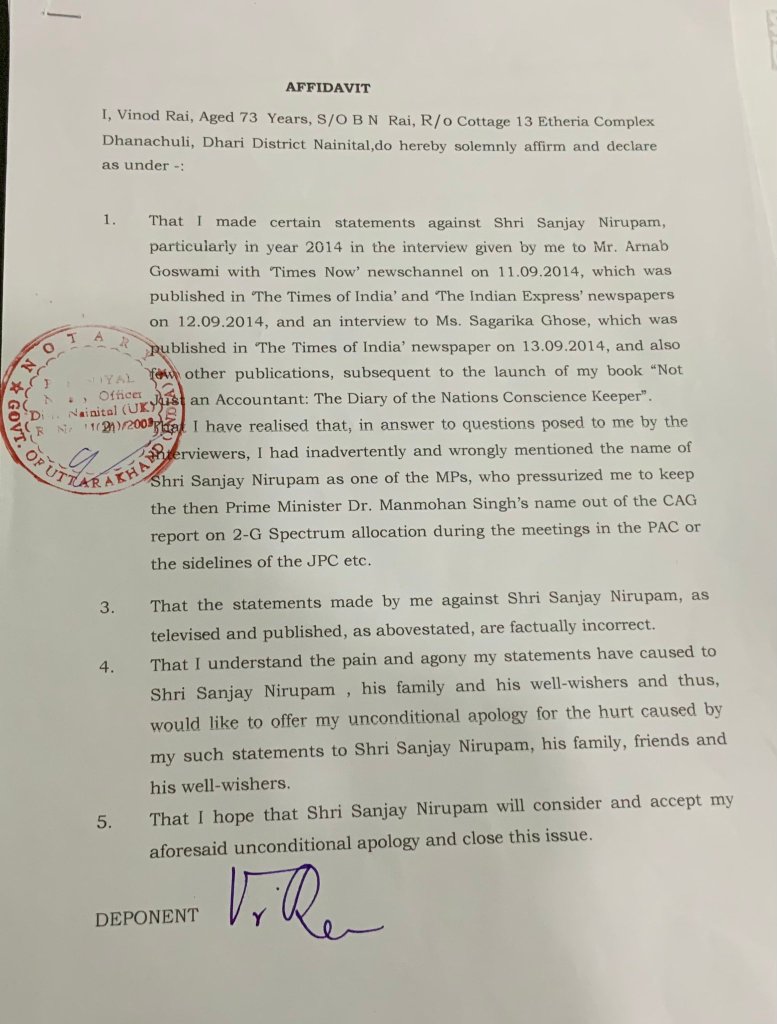
The figures mentioned above are findings of parliamentary panel so nobody can accuse of anybody having a bias. Also, I probably had shared this but still feel the need to re-share it as people still believe that 2G scam happened even though there are plenty of arguments I can share to prove how it was all a fabricated lie.
Vinod Rai Mafinama in Uttarakhand High Court.
Part 2 of the same Mafinama.
How pathetic Mr. Rai s understanding of economics is can be gauged from the fact that he was made Chairman of IDFC and subsequently had to be thrown out. That whole lie was engineered to throw UPA out and it worked. There are and have been many such coincidences happening over the last 8 years, parallel stories happening in India and UK. This was just yesterday, about a year back Air India was given back to the Tatas, There was controversy about the supposed auctions as only Indigo was the only other party allowed to be at auction but not allowed to buy but more as a spectator as they already have 60% of the Indian civil aviation market. And there was lot of cheering from the Govt. side that finally Air India has been bought home to its true owners, the Tatas. The Tatas too started cheering and sharing how they will take down all the workers, worker unions and everything will be happy glory within a year. In fact, just couple of days back they shared new plans. Btw for the takeover of Air India, they had bought loans from the Banks and they are in the category of too big to fail. As I have shared couple of times before, RBI has not shared any inspection reports of nationalized or private banks after 2013/14. While by law, RBI is supposed to do inspection reports every 3 months and share them in the Public domain. And if you ask any of their supporter, for everything they will say UPA did x or y, which only goes to show morally bankrupt the present Govt. is. Coming back to the topic, before I forget, the idea of sharing their plans is so that they can again borrow money from the banks. But that is not the only story. Just one day back, Smita Prakash, one of the biggest cheerleaders of the present Govt. (she is the boss at Asia News International (ANI)) posted how Air India had treated her sister and other 21 passengers. Basically, they had bought business tickets but the whole cabin was dirty, they complained and they were forced to sit in economy class, not just her cousin sister but the other 21 odd passengers too. Of course Ms Smita became calm as her sister was given free air tickets on Vistara and other goodies. Of course, after that she didn t post anything about the other 21 odd passengers after that. And yes, I understand she is supposed to be a reporter but as can be seen from the twitter thread, there is or was no follow up. Incidentally, she is one of many who has calling others about Revdi culture (freebies to the masses.) but guess that only applies to other people not her or her sister. Again, if there are any coincidences of similar nature in the UK or when Trump was P.M. of the U.S. they are just coincidental .

The Uncosted budget India and the UK have many parallels, it s mind boggling. Before we get into the nitty-gritties, saw something that would be of some interest to the people here.
For those who might not be able to see above, apparently there is place in UK called Tufton Street where there are quite a few organizations that are shadowy and whose finances are not known as to how they are financed. Ms. Truss and quite a few of the people in the cabinet are from the same shadowy organizations. Mr. Kwasi Kwarteng, the just-departed chancellor is and was part of the same group. Now even for me it was a new term to learn and understand what is an uncosted budget is. To make it much more easier I share the example using a common person who goes to the bank for a loan

Now M/S X wants a loan of say Rs. 1000/- for whatever reason. He/she/they go to the bank and asks give me a loan of say INR 1000/- The banks asks them to produce a statement of accounts to show what their financial position is. They produce a somewhat half-filled statement of accounts In which all liabilities are shown, but incomes are not. The bank says you already have so much liabilities, how are you gonna pay those, accounts have to be matched otherwise you are not solvent. M/s X adamantly refuses to do any changes citing that they don t need to. At this point, M/s X credit rating goes down and nobody in the market will give them a loan. At the same time, the assets they had held, their value also depreciates because it became known that they can t act responsibly. So whose to say whether or not M/s X has those number of assets and priced them accurately. But the drama doesn t end there, M/s X says this is the responsibility of actually Mr. Z ( cue The Bank of England) as they are my accountant/lawyer etc. M/s Z says as any lawyer/accountant should. This is not under my remit. If the clients either gives incomplete information or false information or whatever then it is their responsibility not mine. And in fact, the Chancellor is supposed to be the one who is given the responsibility of making the budget. The Chancellor is very similar to our Finance Minister. Because the UK has constitutional monarchy, I am guessing the terms are slightly different, otherwise the functionality seems to be the same. For two weeks, there was lot of chaos, lot of pension funds lost quite a bit in the market and in the end Mr. Kwasi Kwarteng was ousted out of the job. Incredibly, the same media and newspapers who had praised Mr. Kwarteng just few weeks back as the best Tory budget, they couldn t wait to bury him. And while I have attempted to simplify what happened, the best explanation of what has happened can be found in an article from the guardian. Speculation is rife in the UK as to who s ruling atm as the new Chancellor has reversed almost all the policies that Ms. Truss had bought and she is now more or less a figurehead. Mr. Hunt, the new chancellor doesn t have anybody behind him. Apparently, the gentleman wanted to throw his hat the ring in the Tory leadership contest that was held about a month back and he couldn t get 20 MP s to support him. Another thing that is different between UK and India is that in UK by law the PM has to answer questions put up to him or her by the opposition leaders. That is the way accountability is measured there. This is known as PMQ s or Prime Minister Questions and Answers. One can just go to YouTube or any streaming service and give Liz Truss and PMQ s and if they are interested of a certain date, give a date and they can see how she answered the questions thrown at her. Unfortunately, all she could do in both times were non-answers. In fact, the Tories seem to be using some of Labor s policies after they had bad-mouthed the same policies. Politics of right-wing both in the UK and the US seems so out of touch with the people whom they are supposed to protect and administer. An article about cyclists which is sort of half-truth, half irony shows how screwed up the policies are of the RW (right-wing). Now they are questions about the pensions triple-lock. Sadly, it is the working class who would suffer the most, most of the rich have already moved their money abroad several years ago. The Financial Times, did share a video about how things have been unfolding

Seems Ms. Truss forgot to add Financial Times in the list of anti-growth coalition she is so fond of. Also, the Tory party seems to want to create more tax havens in the UK and calling them investment zones. Of course, most of the top tax havens are situated around the UK itself. I wouldn t go more into as that would probably require its own article, although most of that information is all in public domain. Fracking I don t really want to take much time as the blog post has become long. There have been many articles written why Fracking is bad and that is why even the Tories had put in their Manifesto that they won t allow Fracking but apparently, today they are trying to reopen Fracking. And again how bad it is and can be found out by the article in Guardian.

18 October 2022

Dirk Eddelbuettel: RcppSimdJson 0.1.8 on CRAN: Maintenance

The RcppSimdJson package was just updated to release 0.1.8 today. RcppSimdJson wraps the fantastic and genuinely impressive simdjson library by Daniel Lemire and collaborators. Via very clever algorithmic engineering to obtain largely branch-free code, coupled with modern C++ and newer compiler instructions, it results in parsing gigabytes of JSON parsed per second which is quite mindboggling. The best-case performance is faster than CPU speed as use of parallel SIMD instructions and careful branch avoidance can lead to less than one cpu cycle per byte parsed; see the video of the talk by Daniel Lemire at QCon. This release simply changes one statement to not trigger a warning under clang++-14. The very short NEWS entry for this release follows.

Changes in version 0.1.8 (2022-10-18)
  • Use the ' ' operator instead of ' ' on a set of booleans to appease 'clang-14'.

Courtesy of my CRANberries, there is also a diffstat report for this release. For questions, suggestions, or issues please use the issue tracker at the GitHub repo. If you like this or other open-source work I do, you can now sponsor me at GitHub.

This post by Dirk Eddelbuettel originated on his Thinking inside the box blog. Please report excessive re-aggregation in third-party for-profit settings.

Dirk Eddelbuettel: digest 0.6.30 on CRAN: More Package Maintenance

Release 0.6.30 of the digest package arrived at CRAN earlier today, and was just uploaded to Debian as well. digest creates hash digests of arbitrary R objects (using the md5, sha-1, sha-256, sha-512, crc32, xxhash32, xxhash64, murmur32, spookyhash, and blake3 algorithms) permitting easy comparison of R language objects. It is a mature and widely-used as many tasks may involve caching of objects for which it provides convenient general-purpose hash key generation to quickly identify the various objects. This release contains two tiny changes on old standard C code to appease the new / upcoming clang-15 release now used by CRAN in their forward-looking checks. My CRANberries provides the usual summary of changes to the previous version. For questions or comments use the issue tracker off the GitHub repo. If you like this or other open-source work I do, you can now sponsor me at GitHub.

This post by Dirk Eddelbuettel originated on his Thinking inside the box blog. Please report excessive re-aggregation in third-party for-profit settings.

14 October 2022

Gunnar Wolf: Learning some Rust with Lars!

A couple of weeks ago, I read a blog post by former Debian Developer Lars Wirzenius offering a free basic (6hr) course on the Rust language to interested free software and open source software programmers. I know Lars offers training courses in programming, and besides knowing him for ~20 years and being proud to consider us to be friends, have worked with him in a couple of projects (i.e. he is upstream for vmdb2, which I maintain in Debian and use for generating the Raspberry Pi Debian images) He is a talented programmer, and a fun guy to be around. I was admitted to the first cohort of students of this course (please note I m not committing him to run free courses ever again! He has said he would consider doing so, specially to offer a different time better suited for people in Asia). I have wanted to learn some Rust for quite some time. About a year ago, I bought a copy of The Rust Programming Language, the canonical book for learning the language, and started reading it But lacked motivation and lost steam halfway through, and without having done even a simple real project beyond the simple book exercises. How has this been? I have enjoyed the course. I must admit I did expect it to be more hands-on from the beginning, but Rust is such a large language and it introduces so many new, surprising concepts. Session two did have two somewhat simple hands-on challenges; by saying they were somewhat simple does not mean we didn t have to sweat to get them to compile and work correctly! I know we will finish this Saturday, and I ll still be a complete newbie to Rust. I know the only real way to wrap my head around a language is to actually have a project that uses it And I have some ideas in mind. However, I don t really feel confident to approach an already existing project and start meddling with it, trying to contribute. What does Rust have that makes it so different? Bufff Variable ownership (borrow checking) and values lifetimes are the most obvious salient idea, but they are relatively simple, as you just cannot forget about them. But understanding (and adopting) idiomatic constructs such as the pervasive use of enums, understanding that errors always have to be catered for by using expect() and Result<T,E> It will take some time to be at ease developing in it, if I ever reach that stage! Oh, FWIW Interested related reading. I am halfway through an interesting article, published in March in the Communications of the ACM magazine, titled Here We Go Again: Why Is It Difficult for Developers to Learn Another Programming Language? , that presents an interesting point we don t always consider: If I m a proficient programmer in the X programming language and want to use the Y programming language, learning it Should be easier for me than for the casual bystander, or not? After all, I already have a background in programming! But it happens that mental constructs we build for a given language might hamper our learning of a very different one. This article presents three interesting research questions:
  1. Does cross-language interference occur?
  2. How do experienced programmers learn new languages?
  3. What do experienced programmers find confusing in new languages?
I m far from reaching the conclusions, but so far, it s been a most interesting read. Anyway, to wrap up Thanks Lars! I am learning (although at a pace that is not magically quick But I am aware of the steep learning curve of the language) quite a bit of a very interesting topic, and I m also enjoying the time I spend in front of my computer on Saturday.

13 October 2022

Dirk Eddelbuettel: GitHub Streak: Round Nine

Eight years ago I referenced the Seinfeld Streak used in an earlier post of regular updates to to the Rcpp Gallery:
This is sometimes called Jerry Seinfeld s secret to productivity: Just keep at it. Don t break the streak.
and then showed the first chart of GitHub streaking 366 days:
github activity october 2013 to october 2014github activity october 2013 to october 2014
And seven years ago a first follow-up appeared in this post about 731 days:
github activity october 2014 to october 2015github activity october 2014 to october 2015
And six years ago we had a followup at 1096 days
github activity october 2015 to october 2016github activity october 2015 to october 2016
And five years ago we had another one marking 1461 days
github activity october 2016 to october 2017github activity october 2016 to october 2017
And four years ago another one for 1826 days
github activity october 2017 to october 2018github activity october 2017 to october 2018
And three years ago another one bringing it to 2191 days
github activity october 2018 to october 2019github activity october 2018 to october 2019
And two years ago another one bringing it to 2557 days
github activity october 2019 to october 2020github activity october 2019 to october 2020
And last year another one bringing it to 2922 days
github activity october 2020 to october 2021github activity october 2020 to october 2021
And as today is October 12 here is the newest one from 2021 to 2022 one bringing it 3287 days:
github activity october 2021 to october 2022github activity october 2021 to october 2022
As always, special thanks go to Alessandro Pezz for the Chrome add-on GithubOriginalStreak. If you like this or other open-source work I do, you can now sponsor me at GitHub.

This post by Dirk Eddelbuettel originated on his Thinking inside the box blog. Please report excessive re-aggregation in third-party for-profit settings.

6 October 2022

Dirk Eddelbuettel: Rblpapi 0.3.14: Updates and Extensions

bloomberg terminal Version 0.3.14 of the Rblpapi package arrived on CRAN earlier today. Rblpapi provides a direct interface between R and the Bloomberg Terminal via the C++ API provided by Bloomberg (but note that a valid Bloomberg license and installation is required). This is the fourteenth release since the package first appeared on CRAN in 2016. It comprises a nice PR from Robert Harlow extending support to B-PIPE authentication (for those who have it) along with a few fixes made since the last release in January. The last one provided from a kind assist by Tomas Kalibera who pointed out how to overcome an absolute rpath dynamic linker instruction (and as I noticed noticed something I already did in another package ah well) so that we no longer require StagedInstall: yes. The detailed list of changes follow below.

Changes in Rblpapi version 0.3.14 (2022-10-05)
  • Build configuration was generalized to consider local copies of library and headers (Dirk in #362)
  • A ticker symbol was corrected (Dirk in #368 addressing an issue #366 and #367)
  • Support for B-PIPE was added (Robert Harlow in #369 closing #342)
  • The package no longer requires staged installation thanks to an assist from Tomas Kalibera (Dirk in #373)
  • The retired package fts is no longer suggested (Dirk in #374 closing #372)

Courtesy of my CRANberries, there is also a diffstat report for the this release. As always, more detailed information is on the Rblpapi page. Questions, comments etc should go to the issue tickets system at the GitHub repo. If you like this or other open-source work I do, you can now sponsor me at GitHub.

This post by Dirk Eddelbuettel originated on his Thinking inside the box blog. Please report excessive re-aggregation in third-party for-profit settings.

5 October 2022

Dirk Eddelbuettel: RVowpalWabbit 0.0.17: Maintenance

Almost to the week one year since the last maintenance release, we can announce another maintenance release, now at version 0.0.17, of the RVowpalWabbit package. The CRAN maintainers kindly and politly pointed out that I was (cough, cough) apparently the last maintainer who had packages that set StagedInstall: no. Guilty as charged. RVowpalWabbit is one the two packages; the other one will hopefully follow shortly . And while I long suspected linking aspects to drive this (this is an old package, newer R packaging of the awesome VowpalWabbit is in rvw, I was plain wrong here. The cause was an absolute path to an included dataset, computed in an example, which then gets serialized. As Tomas Kalibera suggested, we can replace the constant with a function and all is well. So here is 0.0.17. As noted before, there is a newer package rvw based on the excellent GSoC 2018 and beyond work by Ivan Pavlov (mentored by James and myself) so if you are into VowpalWabbit from R go check it out. CRANberries provides a summary of changes to the previous version. More information is on the RVowpalWabbit page. Issues and bugreports should go to the GitHub issue tracker. If you like this or other open-source work I do, you can now sponsor me at GitHub.

This post by Dirk Eddelbuettel originated on his Thinking inside the box blog. Please report excessive re-aggregation in third-party for-profit settings.

4 October 2022

Russ Allbery: Review: The Dragon Never Sleeps

Review: The Dragon Never Sleeps, by Glen Cook
Publisher: Night Shade Books
Copyright: 1988
Printing: 2008
ISBN: 1-59780-099-6
Format: MOBI
Pages: 449
Canon Space is run, in a way, by the noble mercantile houses, who spread their cities, colonies, and mines through the mysterious Web that allows faster-than-light interstellar travel. The true rulers of Canon Space, though, are the Guardships: enormous, undefeatable starships run by crews who have become effectively immortal by repeated uploading and reincarnation. Or, in the case of the Deified, without reincarnation, observing, ordering, advising, and meddling from an entirely virtual existence. The Guardships have enforced the status quo for four thousand years. House Tregesser thinks they have the means to break the stranglehold of the Guardships. They have contact with Outsiders from beyond Canon Space who can provide advanced technology. They have their own cloning technology, which they use to create backup copies of their elites. And they have Lupo Provik, a quietly brilliant schemer who has devoted his life to destroying Guardships. This book was so bad. A more sensible person than I would have given up after the first hundred pages, but I was too stubborn. The stubbornness did not pay off. Sometimes I pick up an older SFF novel and I'm reminded of how much the quality bar in the field has been raised over the past twenty years. It's not entirely fair to treat The Dragon Never Sleeps as typical of 1980s science fiction: Cook is far better known for his Black Company military fantasy series, this is one of his minor novels, and it's only been intermittently in print. But I'm dubious this would have been published at all today. First, the writing is awful. It's choppy, cliched, awkward, and has no rhythm or sense of beauty. Here's a nearly random paragraph near the beginning of the book as a sample:
He hurled thunders and lightnings with renewed fury. The whole damned universe was out to frustrate him. XII Fulminata! What the hell? Was some malign force ranged against him? That was his most secret fear. That somehow someone or something was using him the way he used so many others.
(Yes, this is one of the main characters throwing a temper tantrum with a special effects machine.) In a book of 450 pages, there are 151 chapters, and most chapters switch viewpoint characters. Most of them also end with a question or some vaguely foreboding sentence to try to build tension, and while I'm willing to admit that sometimes works when used sparingly, every three pages is not sparingly. This book is also weirdly empty of description for its size. We get a few set pieces, a few battles, and a sentence or two of physical description of most characters when they're first introduced, but it's astonishing how little of a mental image I had of this universe after reading the whole book. Cook probably describes a Guardship at some point in this book, but if he does, it completely failed to stick in my memory. There are aliens that everyone recognizes as aliens, so presumably they look different than humans, but for most of them I have no idea how. Very belatedly we're told one important species (which never gets a name) has a distinctive smell. That's about it. Instead, nearly the whole book is dialogue and scheming. It's clear that Cook is intending to write a story of schemes and counter-schemes and jousting between brilliant characters. This can work if the dialogue is sufficiently sharp and snappy to carry the story. It is not.
"What mischief have you been up to, Kez Maefele?" "Staying alive in a hostile universe." "You've had more than your share of luck." "Perhaps luck had nothing to do with it, WarAvocat. Till now." "Luck has run out. The Ku Question has run its course. The symbol is about to receive its final blow."
There are hundreds of pages of this sort of thing. The setting is at least intriguing, if not stunningly original. There are immortal warships oppressing human space, mysterious Outsiders, great house politics, and an essentially immortal alien warrior who ends up carrying most of the story. That's material for a good space opera if the reader slowly learns the shape of the universe, its history, and its landmarks and political factions. Or the author can decline to explain any of that. I suppose that's also a choice. Here are some things that you may have been curious about after reading my summary, and which I'm still curious about after having finished the book: What laws do the Guardships impose and what's the philosophy behind those laws? How does the economic system work? Who built the Guardships originally, and how? How do the humans outside of Canon Space live? Who are the Ku? Why did they start fighting the humans? How many other aliens are there? What do they think of this? How does the Canon government work? How have the Guardships remained technologically superior for four thousand years? Even where the reader gets a partial explanation, such as what Web is and how it was built, it's an unimportant aside that's largely devoid of a sense of wonder. The one piece of world-building that this book is interested in is the individual Guardships and the different ways in which they've handled millennia of self-contained patrol, and even there we only get to see a few of them. There is a plot with appropriately epic scope, but even that is undermined by the odd pacing. Five, ten, or fifty years sometimes goes by in a sentence. A war starts, with apparently enormous implications for Canon Space, and then we learn that it continues for years without warranting narrative comment. This is done without transitions and without signposts for the reader; it's just another sentence in the narration, mixed in with the rhetorical questions and clumsy foreshadowing. I would like to tell you that at least the book has a satisfying ending that resolves the plot conflict that it finally reveals to the reader, but I had a hard time understanding why the ending even mattered. The plot was so difficult to follow that I'm sure I missed something, but it's not difficult to follow in the fun way that would make me want to re-read it. It's difficult to follow because Cook doesn't seem able to explain the plot in his head to the reader in any coherent form. I think the status quo was slightly disrupted? Maybe? Also, I no longer care. Oh, and there's a gene-engineered sex slave in this book, who various male characters are very protective and possessive of, who never develops much of a personality, and who has no noticeable impact on the plot despite being a major character. Yay. This was one of the worst books I've read in a long time. In retrospect, it was an awful place to start with Glen Cook. Hopefully his better-known works are also better-written, but I can't say I feel that inspired to find out. Rating: 2 out of 10

2 October 2022

Dirk Eddelbuettel: RcppArmadillo 0.11.4.0.1 on CRAN: Updates

armadillo image Armadillo is a powerful and expressive C++ template library for linear algebra and scientific computing. It aims towards a good balance between speed and ease of use, has a syntax deliberately close to Matlab, and is useful for algorithm development directly in C++, or quick conversion of research code into production environments. RcppArmadillo integrates this library with the R environment and language and is widely used by (currently) 1023 packages other packages on CRAN, downloaded 26.4 million times (per the partial logs from the cloud mirrors of CRAN), and the CSDA paper (preprint / vignette) by Conrad and myself has been cited 497 times according to Google Scholar. This release reflect as new upstream release 11.4.0 Conrad made recently. It turns out that it triggered warnings under g++-12 for about five packages in the fortify mode default for Debian builds. Conrad then kindly addressed this with a few fixes. The full set of changes (since the last CRAN release 0.11.2.4.0) follows.

Changes in RcppArmadillo version 0.11.4.0.1 (2022-10-01
  • Upgraded to Armadillo release 11.4.0 (Ship of Theseus)
    • faster handling of compound expressions by sum()
    • extended pow() with various forms of element-wise power operations
    • added find_nan() to find indices of NaN elements
  • Also applied fixes to avoid g++-12 warnings affecting just a handful of CRAN packages.

Courtesy of my CRANberries, there is a diffstat report relative to previous release. More detailed information is on the RcppArmadillo page. Questions, comments etc should go to the rcpp-devel mailing list off the R-Forge page. If you like this or other open-source work I do, you can sponsor me at GitHub.

This post by Dirk Eddelbuettel originated on his Thinking inside the box blog. Please report excessive re-aggregation in third-party for-profit settings.

Next.

Previous.