Reproducible Builds: Reproducible Builds in December 2024
 Welcome to the December 2024 report from the Reproducible Builds project!
Our monthly reports outline what we ve been up to over the past month and highlight items of news from elsewhere in the world of software supply-chain security when relevant. As ever, however, if you are interested in contributing to the Reproducible Builds project, please visit our Contribute page on our website.
Table of contents:
- reproduce.debian.net
- debian-repro-status
- On our mailing list
- Enhancing the Security of Software Supply Chains
- diffoscope
- Supply-chain attack in the Solana ecosystem
- Website updates
- Debian changes
- Other development news
- Upstream patches
- Reproducibility testing framework
reproduce.debian.net
 Last month saw the introduction of reproduce.debian.net. Announced at the recent Debian MiniDebConf in Toulouse, reproduce.debian.net is an instance of rebuilderd operated by the Reproducible Builds project. rebuilderd is our server designed monitor the official package repositories of Linux distributions and attempts to reproduce the observed results there.
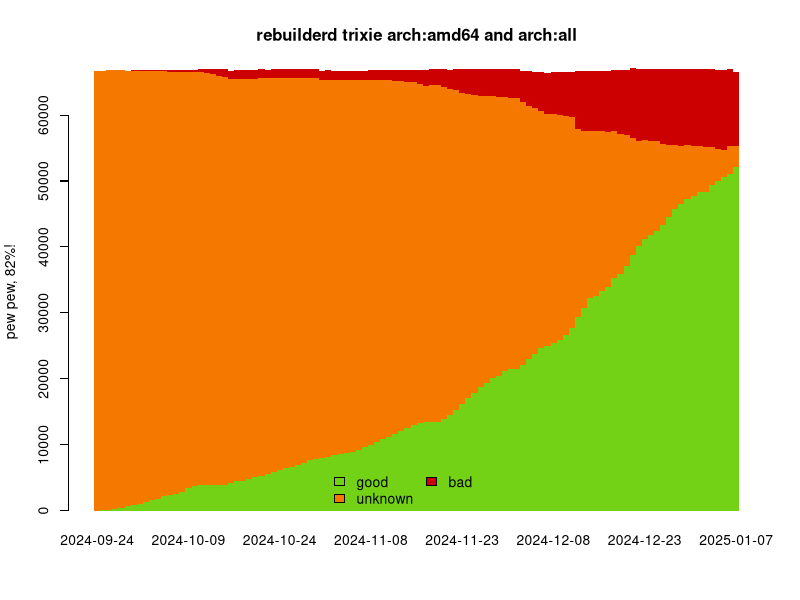
This month, however, we are pleased to announce that not only does the service now produce graphs, the reproduce.debian.net homepage itself has become a start page of sorts, and the amd64.reproduce.debian.net and i386.reproduce.debian.net pages have emerged. The first of these rebuilds the
amd64 architecture, naturally, but it also is building Debian packages that are marked with the no architecture label, all. The second builder is, however, only rebuilding the i386 architecture.
Both of these services were also switched to reproduce the Debian trixie distribution instead of unstable, which started with 43% of the archive rebuild with 79.3% reproduced successfully. This is very much a work in progress, and we ll start reproducing Debian unstable soon.
Our i386 hosts are very kindly sponsored by Infomaniak whilst the amd64 node is sponsored by OSUOSL thank you! Indeed, we are looking for more workers for more Debian architectures; please contact us if you are able to help.
debian-repro-status
 Reproducible builds developer kpcyrd has published a client program for reproduce.debian.net (see above) that queries the status of the locally installed packages and rates the system with a percentage score. This tool works analogously to arch-repro-status for the Arch Linux Reproducible Builds setup.
The tool was packaged for Debian and is currently available in Debian trixie: it can be installed with
apt install debian-repro-status.
On our mailing list
On our mailing list this month:
-
Bernhard M. Wiedemann wrote a detailed post on his long journey towards a bit-reproducible Emacs package. In his interesting message, Bernhard goes into depth about the tools that they used and the lower-level technical details of, for instance, compatibility with the version for
glibc within openSUSE.
-
Shivanand Kunijadar posed a question pertaining to the reproducibility issues with encrypted images. Shivanand explains that they must use a random IV for encryption with AES CBC. The resulting artifact is not reproducible due to the random IV used. The message resulted in a handful of replies, hopefully helpful!
-
User Danilo posted an in interesting question related to their attempts in trying to achieve reproducible builds for Threema Desktop 2.0. The question resulted in a number of replies attempting to find the right combination of compiler and linker flags (for example).
-
Longstanding contributor David A. Wheeler wrote to our list announcing the release of the Census III of Free and Open Source Software: Application Libraries report written by Frank Nagle, Kate Powell, Richie Zitomer and David himself. As David writes in his message, the report attempts to answer the question what is the most popular Free and Open Source Software (FOSS)? .
-
Lastly,
kpcyrd followed-up to a post from September 2024 which mentioned their desire for someone to implement a hashset of allowed module hashes that is generated during the kernel build and then embedded in the kernel image , thus enabling a deterministic and reproducible build. However, they are now reporting that somebody implemented the hash-based allow list feature and submitted it to the Linux kernel mailing list . Like kpcyrd, we hope it gets merged.
Enhancing the Security of Software Supply Chains: Methods and Practices
 Mehdi Keshani of the Delft University of Technology in the Netherlands has published their thesis on Enhancing the Security of Software Supply Chains: Methods and Practices . Their introductory summary first begins with an outline of software supply chains and the importance of the Maven ecosystem before outlining the issues that it faces that threaten its security and effectiveness . To address these:
First, we propose an automated approach for library reproducibility to enhance library security during the deployment phase. We then develop a scalable call graph generation technique to support various use cases, such as method-level vulnerability analysis and change impact analysis, which help mitigate security challenges within the ecosystem. Utilizing the generated call graphs, we explore the impact of libraries on their users. Finally, through empirical research and mining techniques, we investigate the current state of the Maven ecosystem, identify harmful practices, and propose recommendations to address them.
A PDF of Mehdi s entire thesis is available to download.
diffoscope
 diffoscope is our in-depth and content-aware diff utility that can locate and diagnose reproducibility issues. This month, Chris Lamb made the following changes, including preparing and uploading versions
283 and 284 to Debian:
- Update copyright years. [ ]
- Update tests to support file 5.46. [ ][ ]
- Simplify
tests_quines.py::test_ differences,differences_deb to simply use assert_diff and not mangle the test fixture. [ ]
Supply-chain attack in the Solana ecosystem
 A significant supply-chain attack impacted Solana, an ecosystem for decentralised applications running on a blockchain.
Hackers targeted the @solana/web3.js JavaScript library and embedded malicious code that extracted private keys and drained funds from cryptocurrency wallets. According to some reports, about $160,000 worth of assets were stolen, not including SOL tokens and other crypto assets.
Website updates
 Similar to last month, there was a large number of changes made to our website this month, including:
-
Chris Lamb:
-
Holger Levsen:
- Fixed a number of issues on the 2024 Summit page, including fixing the path to a sponsor logo [ ] but also added the event documentation from Aspiration [ ].
- Check and cleanup a presentation formerly linked from the About page on the Debian wiki. [ ]
- Link to reproduce.debian.net on the Involved Projects page. [ ]
- Fix a number of links on the Talks & Resources page. [ ][ ][ ][ ]
-
hulkoba:
- Remove the sidebar-type layout and move to a static navigation element. [ ][ ][ ][ ]
- Create and merge a new Success stories page, which highlights the success stories of Reproducible Builds, showcasing real-world examples of projects shipping with verifiable, reproducible builds. These stories aim to enhance the technical resilience of the initiative by encouraging community involvement and inspiring new contributions. . [ ]
- Further changes to the homepage. [ ]
- Remove the translation icon from the navigation bar. [ ]
- Remove unused CSS styles pertaining to the sidebar. [ ]
- Add sponsors to the global footer. [ ]
- Add extra space on large screens on the Who page. [ ]
- Hide the side navigation on small screens on the Documentation pages. [ ]
Debian changes
 There were a significant number of reproducibility-related changes within Debian this month, including:
-
Santiago Vila uploaded version
0.11+nmu4 of the dh-buildinfo package. In this release, the dh_buildinfo becomes a no-op ie. it no longer does anything beyond warning the developer that the dh-buildinfo package is now obsolete. In his upload, Santiago wrote that We still want packages to drop their [dependency] on dh-buildinfo, but now they will immediately benefit from this change after a simple rebuild.
-
Holger Levsen filed Debian bug #1091550 requesting a rebuild of a number of packages that were built with a very old version of
dpkg.
-
Fay Stegerman contributed to an extensive thread on the
debian-devel development mailing list on the topic of Supporting alternative zlib implementations . In particular, Fay wrote about her results experimenting whether zlib-ng produces identical results or not.
-
kpcyrd uploaded a new
rust-rebuilderd-worker, rust-derp, rust-in-toto and debian-repro-status to Debian, which passed successfully through the so-called NEW queue.
-
Gioele Barabucci filed a number of bugs against the
debrebuild component/script of the devscripts package, including:
-
Gioele Barabucci also filed a bug against the
dh-r package to report that the Recommends and Suggests fields are missing from rebuilt R packages. At the time of writing, this bug has no patch and needs some help to make over 350 binary packages reproducible.
-
Lastly, 8 reviews of Debian packages were added, 11 were updated and 11 were removed this month adding to our knowledge about identified issues.
Other development news
In other ecosystem and distribution news:
-
Jan-Benedict Glaw published the 6th NetBSD Reproducibility Report and reported on our mailing list as well.
-
Developer unmush wrote a long post on the GNU Guix blog on the topic of Adding a fully-bootstrapped Mono to the distribution.
-
The Glasgow Haskell Compiler (GHC) has released a new version of their compiler. This release introduces a new experimental flag,
-fobject-determinism, which enables deterministic object code generation .
-
The IzzyOnDroid Android APK repository published an extensive Review of 2024 and Outlook for 2025 which includes statistics and future plans related to reproducible builds (including having passed the 30% mark this month).
-
The historic Arch Linux reproducibility tests that were hosted at
tests.reproducible-builds.org/archlinux now redirect to reproducible.archlinux.org instead. In fact, everything Arch-related has now been removed from the jenkins.debian.net.git repository, as those continuous integration tests have been disabled for some time.
-
reprotest version
0.7.29 was uploaded to Debian unstable by Vagrant Cascadian. It included contributions already covered in previous months as well as new ones from Rebecca N. Palmer, such as:
-
rebuilderd was updated as follows by kpcyrd:

- Lastly, in openSUSE, Bernhard M. Wiedemann published another report for the distribution. There, Bernhard reports about the success of building R-B-OS , a partial fork of openSUSE with only 100% bit-reproducible packages. This effort was sponsored by the NLNet NGI0 initiative.
Upstream patches
The Reproducible Builds project detects, dissects and attempts to fix as many currently-unreproducible packages as possible. We endeavour to send all of our patches upstream where appropriate. This month, we wrote a large number of such patches, including:
-
Bernhard M. Wiedemann:
cargo-packaging/rusty_v8, cockpit, collectd, deepin-daemon, deepin-file-manager, esbuild, grpc, hyperkitty, icedtea-web, java-atk-wrapper, kdenetwork-filesharing, kicad, kompare, librespeed-cli, lincity-ng, mraa, ollama, opa-fmgui, opencryptoki, opencryptoki, openmpi4:gnu-hpc, openwsman, patterns-microos, portmidi, presage, procps, sad, scons/nst, sendmail, static-initrd, suse-hpc, swtpm, tiny, vtk, xdg-desktop-portal and yast.
-
Chris Lamb:
- #1089011 filed against
pyorbital.
- #1089095 filed against
python-pbcore.
-
Gioele Barabucci:
-
James Addison:
-
Johannes Schauer Marin Rodrigues:
-
Moritz Schlarb:
-
Roland Clobus:
- #1090981 filed against
dictionaries-common.
Reproducibility testing framework
 The Reproducible Builds project operates a comprehensive testing framework running primarily at tests.reproducible-builds.org in order to check packages and other artifacts for reproducibility. In November, a number of changes were made by Holger Levsen, including:
-
reproduce.debian.net-related:
- Add a new
i386.reproduce.debian.net rebuilder. [ ][ ][ ][ ][ ][ ]
- Make a number of updates to the documentation. [ ][ ][ ][ ][ ]
- Run
i386.reproduce.debian.net run on a public port to allow external workers. [ ]
- Add a link to the
/api/v0/pkgs/list endpoint. [ ]
- Add support for a statistics page. [ ][ ][ ][ ][ ][ ]
- Limit build logs to 20 MiB and diffoscope output to 10 MiB. [ ]
- Improve the frontpage. [ ][ ]
- Explain that we re testing
arch:any and arch:all on the amd64 architecture, but only arch:any on i386. [ ]
-
Misc:
- Remove code for testing Arch Linux, which has moved to reproduce.archlinux.org. [ ][ ]
- Don t install
dstat on Jenkins nodes anymore as its been removed from Debian trixie. [ ]
- Prepare the
infom08-i386 node to become another rebuilder. [ ]
- Add debug date output for benchmarking the
reproducible_pool_buildinfos.sh script. [ ]
- Install
installation-birthday everywhere. [ ]
- Temporarily disable automatic updates of pool links on buildinfos.debian.net. [ ]
- Install
Recommends by default on Jenkins nodes. [ ]
- Rename
rebuilder_stats.py to rebuilderd_stats.py. [ ]
- r.d.n/stats: minor formatting changes. [ ]
- Install files under
/etc/cron.d/ with the correct permissions. [ ]
and Jochen Sprickerhof made the following changes:
- Always prefer official
.buildinfo on buildinfos.debian.net files. [ ][ ][ ]
- Add a
rebuilder_stats.py scripts. [ ]
Lastly, Gioele Barabucci also classified packages affected by 1-second offset issue filed as Debian bug #1089088 [ ][ ][ ][ ], Chris Hofstaedtler updated the URL for Grml s dpkg.selections file [ ], Roland Clobus updated the Jenkins log parser to parse warnings from diffoscope [ ] and Mattia Rizzolo banned a number of bots and crawlers from the service [ ][ ].
If you are interested in contributing to the Reproducible Builds project, please visit our Contribute page on our website. However, you can get in touch with us via:
-
IRC:
#reproducible-builds on irc.oftc.net.
-
Mastodon: @reproducible_builds@fosstodon.org
-
Mailing list:
rb-general@lists.reproducible-builds.org
-
Twitter: @ReproBuilds
Reproducible builds developer kpcyrd has published a client program for reproduce.debian.net (see above) that queries the status of the locally installed packages and rates the system with a percentage score. This tool works analogously to arch-repro-status for the Arch Linux Reproducible Builds setup.
The tool was packaged for Debian and is currently available in Debian trixie: it can be installed with apt install debian-repro-status.
On our mailing list
On our mailing list this month:
-
Bernhard M. Wiedemann wrote a detailed post on his long journey towards a bit-reproducible Emacs package. In his interesting message, Bernhard goes into depth about the tools that they used and the lower-level technical details of, for instance, compatibility with the version for
glibc within openSUSE.
-
Shivanand Kunijadar posed a question pertaining to the reproducibility issues with encrypted images. Shivanand explains that they must use a random IV for encryption with AES CBC. The resulting artifact is not reproducible due to the random IV used. The message resulted in a handful of replies, hopefully helpful!
-
User Danilo posted an in interesting question related to their attempts in trying to achieve reproducible builds for Threema Desktop 2.0. The question resulted in a number of replies attempting to find the right combination of compiler and linker flags (for example).
-
Longstanding contributor David A. Wheeler wrote to our list announcing the release of the Census III of Free and Open Source Software: Application Libraries report written by Frank Nagle, Kate Powell, Richie Zitomer and David himself. As David writes in his message, the report attempts to answer the question what is the most popular Free and Open Source Software (FOSS)? .
-
Lastly,
kpcyrd followed-up to a post from September 2024 which mentioned their desire for someone to implement a hashset of allowed module hashes that is generated during the kernel build and then embedded in the kernel image , thus enabling a deterministic and reproducible build. However, they are now reporting that somebody implemented the hash-based allow list feature and submitted it to the Linux kernel mailing list . Like kpcyrd, we hope it gets merged.
Enhancing the Security of Software Supply Chains: Methods and Practices
Mehdi Keshani of the Delft University of Technology in the Netherlands has published their thesis on Enhancing the Security of Software Supply Chains: Methods and Practices . Their introductory summary first begins with an outline of software supply chains and the importance of the Maven ecosystem before outlining the issues that it faces that threaten its security and effectiveness . To address these:
First, we propose an automated approach for library reproducibility to enhance library security during the deployment phase. We then develop a scalable call graph generation technique to support various use cases, such as method-level vulnerability analysis and change impact analysis, which help mitigate security challenges within the ecosystem. Utilizing the generated call graphs, we explore the impact of libraries on their users. Finally, through empirical research and mining techniques, we investigate the current state of the Maven ecosystem, identify harmful practices, and propose recommendations to address them.
A PDF of Mehdi s entire thesis is available to download.
diffoscope
diffoscope is our in-depth and content-aware diff utility that can locate and diagnose reproducibility issues. This month, Chris Lamb made the following changes, including preparing and uploading versions 283 and 284 to Debian:
- Update copyright years. [ ]
- Update tests to support file 5.46. [ ][ ]
- Simplify
tests_quines.py::test_ differences,differences_deb to simply use assert_diff and not mangle the test fixture. [ ]
Supply-chain attack in the Solana ecosystem
A significant supply-chain attack impacted Solana, an ecosystem for decentralised applications running on a blockchain.
Hackers targeted the @solana/web3.js JavaScript library and embedded malicious code that extracted private keys and drained funds from cryptocurrency wallets. According to some reports, about $160,000 worth of assets were stolen, not including SOL tokens and other crypto assets.
Website updates
Similar to last month, there was a large number of changes made to our website this month, including:
-
Chris Lamb:
-
Holger Levsen:
- Fixed a number of issues on the 2024 Summit page, including fixing the path to a sponsor logo [ ] but also added the event documentation from Aspiration [ ].
- Check and cleanup a presentation formerly linked from the About page on the Debian wiki. [ ]
- Link to reproduce.debian.net on the Involved Projects page. [ ]
- Fix a number of links on the Talks & Resources page. [ ][ ][ ][ ]
-
hulkoba:
- Remove the sidebar-type layout and move to a static navigation element. [ ][ ][ ][ ]
- Create and merge a new Success stories page, which highlights the success stories of Reproducible Builds, showcasing real-world examples of projects shipping with verifiable, reproducible builds. These stories aim to enhance the technical resilience of the initiative by encouraging community involvement and inspiring new contributions. . [ ]
- Further changes to the homepage. [ ]
- Remove the translation icon from the navigation bar. [ ]
- Remove unused CSS styles pertaining to the sidebar. [ ]
- Add sponsors to the global footer. [ ]
- Add extra space on large screens on the Who page. [ ]
- Hide the side navigation on small screens on the Documentation pages. [ ]
Debian changes
There were a significant number of reproducibility-related changes within Debian this month, including:
-
Santiago Vila uploaded version
0.11+nmu4 of the dh-buildinfo package. In this release, the dh_buildinfo becomes a no-op ie. it no longer does anything beyond warning the developer that the dh-buildinfo package is now obsolete. In his upload, Santiago wrote that We still want packages to drop their [dependency] on dh-buildinfo, but now they will immediately benefit from this change after a simple rebuild.
-
Holger Levsen filed Debian bug #1091550 requesting a rebuild of a number of packages that were built with a very old version of
dpkg.
-
Fay Stegerman contributed to an extensive thread on the
debian-devel development mailing list on the topic of Supporting alternative zlib implementations . In particular, Fay wrote about her results experimenting whether zlib-ng produces identical results or not.
-
kpcyrd uploaded a new
rust-rebuilderd-worker, rust-derp, rust-in-toto and debian-repro-status to Debian, which passed successfully through the so-called NEW queue.
-
Gioele Barabucci filed a number of bugs against the
debrebuild component/script of the devscripts package, including:
-
Gioele Barabucci also filed a bug against the
dh-r package to report that the Recommends and Suggests fields are missing from rebuilt R packages. At the time of writing, this bug has no patch and needs some help to make over 350 binary packages reproducible.
-
Lastly, 8 reviews of Debian packages were added, 11 were updated and 11 were removed this month adding to our knowledge about identified issues.
Other development news
In other ecosystem and distribution news:
-
Jan-Benedict Glaw published the 6th NetBSD Reproducibility Report and reported on our mailing list as well.
-
Developer unmush wrote a long post on the GNU Guix blog on the topic of Adding a fully-bootstrapped Mono to the distribution.
-
The Glasgow Haskell Compiler (GHC) has released a new version of their compiler. This release introduces a new experimental flag,
-fobject-determinism, which enables deterministic object code generation .
-
The IzzyOnDroid Android APK repository published an extensive Review of 2024 and Outlook for 2025 which includes statistics and future plans related to reproducible builds (including having passed the 30% mark this month).
-
The historic Arch Linux reproducibility tests that were hosted at
tests.reproducible-builds.org/archlinux now redirect to reproducible.archlinux.org instead. In fact, everything Arch-related has now been removed from the jenkins.debian.net.git repository, as those continuous integration tests have been disabled for some time.
-
reprotest version
0.7.29 was uploaded to Debian unstable by Vagrant Cascadian. It included contributions already covered in previous months as well as new ones from Rebecca N. Palmer, such as:
-
rebuilderd was updated as follows by kpcyrd:
- Lastly, in openSUSE, Bernhard M. Wiedemann published another report for the distribution. There, Bernhard reports about the success of building R-B-OS , a partial fork of openSUSE with only 100% bit-reproducible packages. This effort was sponsored by the NLNet NGI0 initiative.
Upstream patches
The Reproducible Builds project detects, dissects and attempts to fix as many currently-unreproducible packages as possible. We endeavour to send all of our patches upstream where appropriate. This month, we wrote a large number of such patches, including:
-
Bernhard M. Wiedemann:
cargo-packaging/rusty_v8, cockpit, collectd, deepin-daemon, deepin-file-manager, esbuild, grpc, hyperkitty, icedtea-web, java-atk-wrapper, kdenetwork-filesharing, kicad, kompare, librespeed-cli, lincity-ng, mraa, ollama, opa-fmgui, opencryptoki, opencryptoki, openmpi4:gnu-hpc, openwsman, patterns-microos, portmidi, presage, procps, sad, scons/nst, sendmail, static-initrd, suse-hpc, swtpm, tiny, vtk, xdg-desktop-portal and yast.
-
Chris Lamb:
- #1089011 filed against
pyorbital.
- #1089095 filed against
python-pbcore.
-
Gioele Barabucci:
-
James Addison:
-
Johannes Schauer Marin Rodrigues:
-
Moritz Schlarb:
-
Roland Clobus:
- #1090981 filed against
dictionaries-common.
Reproducibility testing framework
The Reproducible Builds project operates a comprehensive testing framework running primarily at tests.reproducible-builds.org in order to check packages and other artifacts for reproducibility. In November, a number of changes were made by Holger Levsen, including:
-
reproduce.debian.net-related:
- Add a new
i386.reproduce.debian.net rebuilder. [ ][ ][ ][ ][ ][ ]
- Make a number of updates to the documentation. [ ][ ][ ][ ][ ]
- Run
i386.reproduce.debian.net run on a public port to allow external workers. [ ]
- Add a link to the
/api/v0/pkgs/list endpoint. [ ]
- Add support for a statistics page. [ ][ ][ ][ ][ ][ ]
- Limit build logs to 20 MiB and diffoscope output to 10 MiB. [ ]
- Improve the frontpage. [ ][ ]
- Explain that we re testing
arch:any and arch:all on the amd64 architecture, but only arch:any on i386. [ ]
-
Misc:
- Remove code for testing Arch Linux, which has moved to reproduce.archlinux.org. [ ][ ]
- Don t install
dstat on Jenkins nodes anymore as its been removed from Debian trixie. [ ]
- Prepare the
infom08-i386 node to become another rebuilder. [ ]
- Add debug date output for benchmarking the
reproducible_pool_buildinfos.sh script. [ ]
- Install
installation-birthday everywhere. [ ]
- Temporarily disable automatic updates of pool links on buildinfos.debian.net. [ ]
- Install
Recommends by default on Jenkins nodes. [ ]
- Rename
rebuilder_stats.py to rebuilderd_stats.py. [ ]
- r.d.n/stats: minor formatting changes. [ ]
- Install files under
/etc/cron.d/ with the correct permissions. [ ]
and Jochen Sprickerhof made the following changes:
- Always prefer official
.buildinfo on buildinfos.debian.net files. [ ][ ][ ]
- Add a
rebuilder_stats.py scripts. [ ]
Lastly, Gioele Barabucci also classified packages affected by 1-second offset issue filed as Debian bug #1089088 [ ][ ][ ][ ], Chris Hofstaedtler updated the URL for Grml s dpkg.selections file [ ], Roland Clobus updated the Jenkins log parser to parse warnings from diffoscope [ ] and Mattia Rizzolo banned a number of bots and crawlers from the service [ ][ ].
If you are interested in contributing to the Reproducible Builds project, please visit our Contribute page on our website. However, you can get in touch with us via:
-
IRC:
#reproducible-builds on irc.oftc.net.
-
Mastodon: @reproducible_builds@fosstodon.org
-
Mailing list:
rb-general@lists.reproducible-builds.org
-
Twitter: @ReproBuilds
glibc within openSUSE.
kpcyrd followed-up to a post from September 2024 which mentioned their desire for someone to implement a hashset of allowed module hashes that is generated during the kernel build and then embedded in the kernel image , thus enabling a deterministic and reproducible build. However, they are now reporting that somebody implemented the hash-based allow list feature and submitted it to the Linux kernel mailing list . Like kpcyrd, we hope it gets merged.
Mehdi Keshani of the Delft University of Technology in the Netherlands has published their thesis on Enhancing the Security of Software Supply Chains: Methods and Practices . Their introductory summary first begins with an outline of software supply chains and the importance of the Maven ecosystem before outlining the issues that it faces that threaten its security and effectiveness . To address these:
First, we propose an automated approach for library reproducibility to enhance library security during the deployment phase. We then develop a scalable call graph generation technique to support various use cases, such as method-level vulnerability analysis and change impact analysis, which help mitigate security challenges within the ecosystem. Utilizing the generated call graphs, we explore the impact of libraries on their users. Finally, through empirical research and mining techniques, we investigate the current state of the Maven ecosystem, identify harmful practices, and propose recommendations to address them.A PDF of Mehdi s entire thesis is available to download.
diffoscope
diffoscope is our in-depth and content-aware diff utility that can locate and diagnose reproducibility issues. This month, Chris Lamb made the following changes, including preparing and uploading versions 283 and 284 to Debian:
- Update copyright years. [ ]
- Update tests to support file 5.46. [ ][ ]
- Simplify
tests_quines.py::test_ differences,differences_deb to simply use assert_diff and not mangle the test fixture. [ ]
Supply-chain attack in the Solana ecosystem
A significant supply-chain attack impacted Solana, an ecosystem for decentralised applications running on a blockchain.
Hackers targeted the @solana/web3.js JavaScript library and embedded malicious code that extracted private keys and drained funds from cryptocurrency wallets. According to some reports, about $160,000 worth of assets were stolen, not including SOL tokens and other crypto assets.
Website updates
Similar to last month, there was a large number of changes made to our website this month, including:
-
Chris Lamb:
-
Holger Levsen:
- Fixed a number of issues on the 2024 Summit page, including fixing the path to a sponsor logo [ ] but also added the event documentation from Aspiration [ ].
- Check and cleanup a presentation formerly linked from the About page on the Debian wiki. [ ]
- Link to reproduce.debian.net on the Involved Projects page. [ ]
- Fix a number of links on the Talks & Resources page. [ ][ ][ ][ ]
-
hulkoba:
- Remove the sidebar-type layout and move to a static navigation element. [ ][ ][ ][ ]
- Create and merge a new Success stories page, which highlights the success stories of Reproducible Builds, showcasing real-world examples of projects shipping with verifiable, reproducible builds. These stories aim to enhance the technical resilience of the initiative by encouraging community involvement and inspiring new contributions. . [ ]
- Further changes to the homepage. [ ]
- Remove the translation icon from the navigation bar. [ ]
- Remove unused CSS styles pertaining to the sidebar. [ ]
- Add sponsors to the global footer. [ ]
- Add extra space on large screens on the Who page. [ ]
- Hide the side navigation on small screens on the Documentation pages. [ ]
Debian changes
There were a significant number of reproducibility-related changes within Debian this month, including:
-
Santiago Vila uploaded version
0.11+nmu4 of the dh-buildinfo package. In this release, the dh_buildinfo becomes a no-op ie. it no longer does anything beyond warning the developer that the dh-buildinfo package is now obsolete. In his upload, Santiago wrote that We still want packages to drop their [dependency] on dh-buildinfo, but now they will immediately benefit from this change after a simple rebuild.
-
Holger Levsen filed Debian bug #1091550 requesting a rebuild of a number of packages that were built with a very old version of
dpkg.
-
Fay Stegerman contributed to an extensive thread on the
debian-devel development mailing list on the topic of Supporting alternative zlib implementations . In particular, Fay wrote about her results experimenting whether zlib-ng produces identical results or not.
-
kpcyrd uploaded a new
rust-rebuilderd-worker, rust-derp, rust-in-toto and debian-repro-status to Debian, which passed successfully through the so-called NEW queue.
-
Gioele Barabucci filed a number of bugs against the
debrebuild component/script of the devscripts package, including:
-
Gioele Barabucci also filed a bug against the
dh-r package to report that the Recommends and Suggests fields are missing from rebuilt R packages. At the time of writing, this bug has no patch and needs some help to make over 350 binary packages reproducible.
-
Lastly, 8 reviews of Debian packages were added, 11 were updated and 11 were removed this month adding to our knowledge about identified issues.
Other development news
In other ecosystem and distribution news:
-
Jan-Benedict Glaw published the 6th NetBSD Reproducibility Report and reported on our mailing list as well.
-
Developer unmush wrote a long post on the GNU Guix blog on the topic of Adding a fully-bootstrapped Mono to the distribution.
-
The Glasgow Haskell Compiler (GHC) has released a new version of their compiler. This release introduces a new experimental flag,
-fobject-determinism, which enables deterministic object code generation .
-
The IzzyOnDroid Android APK repository published an extensive Review of 2024 and Outlook for 2025 which includes statistics and future plans related to reproducible builds (including having passed the 30% mark this month).
-
The historic Arch Linux reproducibility tests that were hosted at
tests.reproducible-builds.org/archlinux now redirect to reproducible.archlinux.org instead. In fact, everything Arch-related has now been removed from the jenkins.debian.net.git repository, as those continuous integration tests have been disabled for some time.
-
reprotest version
0.7.29 was uploaded to Debian unstable by Vagrant Cascadian. It included contributions already covered in previous months as well as new ones from Rebecca N. Palmer, such as:
-
rebuilderd was updated as follows by kpcyrd:
- Lastly, in openSUSE, Bernhard M. Wiedemann published another report for the distribution. There, Bernhard reports about the success of building R-B-OS , a partial fork of openSUSE with only 100% bit-reproducible packages. This effort was sponsored by the NLNet NGI0 initiative.
Upstream patches
The Reproducible Builds project detects, dissects and attempts to fix as many currently-unreproducible packages as possible. We endeavour to send all of our patches upstream where appropriate. This month, we wrote a large number of such patches, including:
-
Bernhard M. Wiedemann:
cargo-packaging/rusty_v8, cockpit, collectd, deepin-daemon, deepin-file-manager, esbuild, grpc, hyperkitty, icedtea-web, java-atk-wrapper, kdenetwork-filesharing, kicad, kompare, librespeed-cli, lincity-ng, mraa, ollama, opa-fmgui, opencryptoki, opencryptoki, openmpi4:gnu-hpc, openwsman, patterns-microos, portmidi, presage, procps, sad, scons/nst, sendmail, static-initrd, suse-hpc, swtpm, tiny, vtk, xdg-desktop-portal and yast.
-
Chris Lamb:
- #1089011 filed against
pyorbital.
- #1089095 filed against
python-pbcore.
-
Gioele Barabucci:
-
James Addison:
-
Johannes Schauer Marin Rodrigues:
-
Moritz Schlarb:
-
Roland Clobus:
- #1090981 filed against
dictionaries-common.
Reproducibility testing framework
The Reproducible Builds project operates a comprehensive testing framework running primarily at tests.reproducible-builds.org in order to check packages and other artifacts for reproducibility. In November, a number of changes were made by Holger Levsen, including:
-
reproduce.debian.net-related:
- Add a new
i386.reproduce.debian.net rebuilder. [ ][ ][ ][ ][ ][ ]
- Make a number of updates to the documentation. [ ][ ][ ][ ][ ]
- Run
i386.reproduce.debian.net run on a public port to allow external workers. [ ]
- Add a link to the
/api/v0/pkgs/list endpoint. [ ]
- Add support for a statistics page. [ ][ ][ ][ ][ ][ ]
- Limit build logs to 20 MiB and diffoscope output to 10 MiB. [ ]
- Improve the frontpage. [ ][ ]
- Explain that we re testing
arch:any and arch:all on the amd64 architecture, but only arch:any on i386. [ ]
-
Misc:
- Remove code for testing Arch Linux, which has moved to reproduce.archlinux.org. [ ][ ]
- Don t install
dstat on Jenkins nodes anymore as its been removed from Debian trixie. [ ]
- Prepare the
infom08-i386 node to become another rebuilder. [ ]
- Add debug date output for benchmarking the
reproducible_pool_buildinfos.sh script. [ ]
- Install
installation-birthday everywhere. [ ]
- Temporarily disable automatic updates of pool links on buildinfos.debian.net. [ ]
- Install
Recommends by default on Jenkins nodes. [ ]
- Rename
rebuilder_stats.py to rebuilderd_stats.py. [ ]
- r.d.n/stats: minor formatting changes. [ ]
- Install files under
/etc/cron.d/ with the correct permissions. [ ]
and Jochen Sprickerhof made the following changes:
- Always prefer official
.buildinfo on buildinfos.debian.net files. [ ][ ][ ]
- Add a
rebuilder_stats.py scripts. [ ]
Lastly, Gioele Barabucci also classified packages affected by 1-second offset issue filed as Debian bug #1089088 [ ][ ][ ][ ], Chris Hofstaedtler updated the URL for Grml s dpkg.selections file [ ], Roland Clobus updated the Jenkins log parser to parse warnings from diffoscope [ ] and Mattia Rizzolo banned a number of bots and crawlers from the service [ ][ ].
If you are interested in contributing to the Reproducible Builds project, please visit our Contribute page on our website. However, you can get in touch with us via:
-
IRC:
#reproducible-builds on irc.oftc.net.
-
Mastodon: @reproducible_builds@fosstodon.org
-
Mailing list:
rb-general@lists.reproducible-builds.org
-
Twitter: @ReproBuilds
tests_quines.py::test_ differences,differences_deb to simply use assert_diff and not mangle the test fixture. [ ]
A significant supply-chain attack impacted Solana, an ecosystem for decentralised applications running on a blockchain.
Hackers targeted the @solana/web3.js JavaScript library and embedded malicious code that extracted private keys and drained funds from cryptocurrency wallets. According to some reports, about $160,000 worth of assets were stolen, not including SOL tokens and other crypto assets.
Website updates
Similar to last month, there was a large number of changes made to our website this month, including:
-
Chris Lamb:
-
Holger Levsen:
- Fixed a number of issues on the 2024 Summit page, including fixing the path to a sponsor logo [ ] but also added the event documentation from Aspiration [ ].
- Check and cleanup a presentation formerly linked from the About page on the Debian wiki. [ ]
- Link to reproduce.debian.net on the Involved Projects page. [ ]
- Fix a number of links on the Talks & Resources page. [ ][ ][ ][ ]
-
hulkoba:
- Remove the sidebar-type layout and move to a static navigation element. [ ][ ][ ][ ]
- Create and merge a new Success stories page, which highlights the success stories of Reproducible Builds, showcasing real-world examples of projects shipping with verifiable, reproducible builds. These stories aim to enhance the technical resilience of the initiative by encouraging community involvement and inspiring new contributions. . [ ]
- Further changes to the homepage. [ ]
- Remove the translation icon from the navigation bar. [ ]
- Remove unused CSS styles pertaining to the sidebar. [ ]
- Add sponsors to the global footer. [ ]
- Add extra space on large screens on the Who page. [ ]
- Hide the side navigation on small screens on the Documentation pages. [ ]
Debian changes
There were a significant number of reproducibility-related changes within Debian this month, including:
-
Santiago Vila uploaded version
0.11+nmu4 of the dh-buildinfo package. In this release, the dh_buildinfo becomes a no-op ie. it no longer does anything beyond warning the developer that the dh-buildinfo package is now obsolete. In his upload, Santiago wrote that We still want packages to drop their [dependency] on dh-buildinfo, but now they will immediately benefit from this change after a simple rebuild.
-
Holger Levsen filed Debian bug #1091550 requesting a rebuild of a number of packages that were built with a very old version of
dpkg.
-
Fay Stegerman contributed to an extensive thread on the
debian-devel development mailing list on the topic of Supporting alternative zlib implementations . In particular, Fay wrote about her results experimenting whether zlib-ng produces identical results or not.
-
kpcyrd uploaded a new
rust-rebuilderd-worker, rust-derp, rust-in-toto and debian-repro-status to Debian, which passed successfully through the so-called NEW queue.
-
Gioele Barabucci filed a number of bugs against the
debrebuild component/script of the devscripts package, including:
-
Gioele Barabucci also filed a bug against the
dh-r package to report that the Recommends and Suggests fields are missing from rebuilt R packages. At the time of writing, this bug has no patch and needs some help to make over 350 binary packages reproducible.
-
Lastly, 8 reviews of Debian packages were added, 11 were updated and 11 were removed this month adding to our knowledge about identified issues.
Other development news
In other ecosystem and distribution news:
-
Jan-Benedict Glaw published the 6th NetBSD Reproducibility Report and reported on our mailing list as well.
-
Developer unmush wrote a long post on the GNU Guix blog on the topic of Adding a fully-bootstrapped Mono to the distribution.
-
The Glasgow Haskell Compiler (GHC) has released a new version of their compiler. This release introduces a new experimental flag,
-fobject-determinism, which enables deterministic object code generation .
-
The IzzyOnDroid Android APK repository published an extensive Review of 2024 and Outlook for 2025 which includes statistics and future plans related to reproducible builds (including having passed the 30% mark this month).
-
The historic Arch Linux reproducibility tests that were hosted at
tests.reproducible-builds.org/archlinux now redirect to reproducible.archlinux.org instead. In fact, everything Arch-related has now been removed from the jenkins.debian.net.git repository, as those continuous integration tests have been disabled for some time.
-
reprotest version
0.7.29 was uploaded to Debian unstable by Vagrant Cascadian. It included contributions already covered in previous months as well as new ones from Rebecca N. Palmer, such as:
-
rebuilderd was updated as follows by kpcyrd:
- Lastly, in openSUSE, Bernhard M. Wiedemann published another report for the distribution. There, Bernhard reports about the success of building R-B-OS , a partial fork of openSUSE with only 100% bit-reproducible packages. This effort was sponsored by the NLNet NGI0 initiative.
Upstream patches
The Reproducible Builds project detects, dissects and attempts to fix as many currently-unreproducible packages as possible. We endeavour to send all of our patches upstream where appropriate. This month, we wrote a large number of such patches, including:
-
Bernhard M. Wiedemann:
cargo-packaging/rusty_v8, cockpit, collectd, deepin-daemon, deepin-file-manager, esbuild, grpc, hyperkitty, icedtea-web, java-atk-wrapper, kdenetwork-filesharing, kicad, kompare, librespeed-cli, lincity-ng, mraa, ollama, opa-fmgui, opencryptoki, opencryptoki, openmpi4:gnu-hpc, openwsman, patterns-microos, portmidi, presage, procps, sad, scons/nst, sendmail, static-initrd, suse-hpc, swtpm, tiny, vtk, xdg-desktop-portal and yast.
-
Chris Lamb:
- #1089011 filed against
pyorbital.
- #1089095 filed against
python-pbcore.
-
Gioele Barabucci:
-
James Addison:
-
Johannes Schauer Marin Rodrigues:
-
Moritz Schlarb:
-
Roland Clobus:
- #1090981 filed against
dictionaries-common.
Reproducibility testing framework
The Reproducible Builds project operates a comprehensive testing framework running primarily at tests.reproducible-builds.org in order to check packages and other artifacts for reproducibility. In November, a number of changes were made by Holger Levsen, including:
-
reproduce.debian.net-related:
- Add a new
i386.reproduce.debian.net rebuilder. [ ][ ][ ][ ][ ][ ]
- Make a number of updates to the documentation. [ ][ ][ ][ ][ ]
- Run
i386.reproduce.debian.net run on a public port to allow external workers. [ ]
- Add a link to the
/api/v0/pkgs/list endpoint. [ ]
- Add support for a statistics page. [ ][ ][ ][ ][ ][ ]
- Limit build logs to 20 MiB and diffoscope output to 10 MiB. [ ]
- Improve the frontpage. [ ][ ]
- Explain that we re testing
arch:any and arch:all on the amd64 architecture, but only arch:any on i386. [ ]
-
Misc:
- Remove code for testing Arch Linux, which has moved to reproduce.archlinux.org. [ ][ ]
- Don t install
dstat on Jenkins nodes anymore as its been removed from Debian trixie. [ ]
- Prepare the
infom08-i386 node to become another rebuilder. [ ]
- Add debug date output for benchmarking the
reproducible_pool_buildinfos.sh script. [ ]
- Install
installation-birthday everywhere. [ ]
- Temporarily disable automatic updates of pool links on buildinfos.debian.net. [ ]
- Install
Recommends by default on Jenkins nodes. [ ]
- Rename
rebuilder_stats.py to rebuilderd_stats.py. [ ]
- r.d.n/stats: minor formatting changes. [ ]
- Install files under
/etc/cron.d/ with the correct permissions. [ ]
and Jochen Sprickerhof made the following changes:
- Always prefer official
.buildinfo on buildinfos.debian.net files. [ ][ ][ ]
- Add a
rebuilder_stats.py scripts. [ ]
Lastly, Gioele Barabucci also classified packages affected by 1-second offset issue filed as Debian bug #1089088 [ ][ ][ ][ ], Chris Hofstaedtler updated the URL for Grml s dpkg.selections file [ ], Roland Clobus updated the Jenkins log parser to parse warnings from diffoscope [ ] and Mattia Rizzolo banned a number of bots and crawlers from the service [ ][ ].
If you are interested in contributing to the Reproducible Builds project, please visit our Contribute page on our website. However, you can get in touch with us via:
-
IRC:
#reproducible-builds on irc.oftc.net.
-
Mastodon: @reproducible_builds@fosstodon.org
-
Mailing list:
rb-general@lists.reproducible-builds.org
-
Twitter: @ReproBuilds
- Fixed a number of issues on the 2024 Summit page, including fixing the path to a sponsor logo [ ] but also added the event documentation from Aspiration [ ].
- Check and cleanup a presentation formerly linked from the About page on the Debian wiki. [ ]
- Link to reproduce.debian.net on the Involved Projects page. [ ]
- Fix a number of links on the Talks & Resources page. [ ][ ][ ][ ]
- Remove the sidebar-type layout and move to a static navigation element. [ ][ ][ ][ ]
- Create and merge a new Success stories page, which highlights the success stories of Reproducible Builds, showcasing real-world examples of projects shipping with verifiable, reproducible builds. These stories aim to enhance the technical resilience of the initiative by encouraging community involvement and inspiring new contributions. . [ ]
- Further changes to the homepage. [ ]
- Remove the translation icon from the navigation bar. [ ]
- Remove unused CSS styles pertaining to the sidebar. [ ]
- Add sponsors to the global footer. [ ]
- Add extra space on large screens on the Who page. [ ]
- Hide the side navigation on small screens on the Documentation pages. [ ]
There were a significant number of reproducibility-related changes within Debian this month, including:
-
Santiago Vila uploaded version
0.11+nmu4of thedh-buildinfopackage. In this release, thedh_buildinfobecomes a no-op ie. it no longer does anything beyond warning the developer that thedh-buildinfopackage is now obsolete. In his upload, Santiago wrote that We still want packages to drop their [dependency] ondh-buildinfo, but now they will immediately benefit from this change after a simple rebuild. -
Holger Levsen filed Debian bug #1091550 requesting a rebuild of a number of packages that were built with a very old version of
dpkg. -
Fay Stegerman contributed to an extensive thread on the
debian-develdevelopment mailing list on the topic of Supporting alternative zlib implementations . In particular, Fay wrote about her results experimenting whetherzlib-ngproduces identical results or not. -
kpcyrd uploaded a new
rust-rebuilderd-worker,rust-derp,rust-in-totoanddebian-repro-statusto Debian, which passed successfully through the so-called NEW queue. -
Gioele Barabucci filed a number of bugs against the
debrebuildcomponent/script of thedevscriptspackage, including: -
Gioele Barabucci also filed a bug against the
dh-rpackage to report that theRecommendsandSuggestsfields are missing from rebuilt R packages. At the time of writing, this bug has no patch and needs some help to make over 350 binary packages reproducible. - Lastly, 8 reviews of Debian packages were added, 11 were updated and 11 were removed this month adding to our knowledge about identified issues.
Other development news
In other ecosystem and distribution news:
-
Jan-Benedict Glaw published the 6th NetBSD Reproducibility Report and reported on our mailing list as well.
-
Developer unmush wrote a long post on the GNU Guix blog on the topic of Adding a fully-bootstrapped Mono to the distribution.
-
The Glasgow Haskell Compiler (GHC) has released a new version of their compiler. This release introduces a new experimental flag,
-fobject-determinism, which enables deterministic object code generation .
-
The IzzyOnDroid Android APK repository published an extensive Review of 2024 and Outlook for 2025 which includes statistics and future plans related to reproducible builds (including having passed the 30% mark this month).
-
The historic Arch Linux reproducibility tests that were hosted at
tests.reproducible-builds.org/archlinux now redirect to reproducible.archlinux.org instead. In fact, everything Arch-related has now been removed from the jenkins.debian.net.git repository, as those continuous integration tests have been disabled for some time.
-
reprotest version
0.7.29 was uploaded to Debian unstable by Vagrant Cascadian. It included contributions already covered in previous months as well as new ones from Rebecca N. Palmer, such as:
-
rebuilderd was updated as follows by kpcyrd:
- Lastly, in openSUSE, Bernhard M. Wiedemann published another report for the distribution. There, Bernhard reports about the success of building R-B-OS , a partial fork of openSUSE with only 100% bit-reproducible packages. This effort was sponsored by the NLNet NGI0 initiative.
Upstream patches
The Reproducible Builds project detects, dissects and attempts to fix as many currently-unreproducible packages as possible. We endeavour to send all of our patches upstream where appropriate. This month, we wrote a large number of such patches, including:
-
Bernhard M. Wiedemann:
cargo-packaging/rusty_v8, cockpit, collectd, deepin-daemon, deepin-file-manager, esbuild, grpc, hyperkitty, icedtea-web, java-atk-wrapper, kdenetwork-filesharing, kicad, kompare, librespeed-cli, lincity-ng, mraa, ollama, opa-fmgui, opencryptoki, opencryptoki, openmpi4:gnu-hpc, openwsman, patterns-microos, portmidi, presage, procps, sad, scons/nst, sendmail, static-initrd, suse-hpc, swtpm, tiny, vtk, xdg-desktop-portal and yast.
-
Chris Lamb:
- #1089011 filed against
pyorbital.
- #1089095 filed against
python-pbcore.
-
Gioele Barabucci:
-
James Addison:
-
Johannes Schauer Marin Rodrigues:
-
Moritz Schlarb:
-
Roland Clobus:
- #1090981 filed against
dictionaries-common.
Reproducibility testing framework
The Reproducible Builds project operates a comprehensive testing framework running primarily at tests.reproducible-builds.org in order to check packages and other artifacts for reproducibility. In November, a number of changes were made by Holger Levsen, including:
-
reproduce.debian.net-related:
- Add a new
i386.reproduce.debian.net rebuilder. [ ][ ][ ][ ][ ][ ]
- Make a number of updates to the documentation. [ ][ ][ ][ ][ ]
- Run
i386.reproduce.debian.net run on a public port to allow external workers. [ ]
- Add a link to the
/api/v0/pkgs/list endpoint. [ ]
- Add support for a statistics page. [ ][ ][ ][ ][ ][ ]
- Limit build logs to 20 MiB and diffoscope output to 10 MiB. [ ]
- Improve the frontpage. [ ][ ]
- Explain that we re testing
arch:any and arch:all on the amd64 architecture, but only arch:any on i386. [ ]
-
Misc:
- Remove code for testing Arch Linux, which has moved to reproduce.archlinux.org. [ ][ ]
- Don t install
dstat on Jenkins nodes anymore as its been removed from Debian trixie. [ ]
- Prepare the
infom08-i386 node to become another rebuilder. [ ]
- Add debug date output for benchmarking the
reproducible_pool_buildinfos.sh script. [ ]
- Install
installation-birthday everywhere. [ ]
- Temporarily disable automatic updates of pool links on buildinfos.debian.net. [ ]
- Install
Recommends by default on Jenkins nodes. [ ]
- Rename
rebuilder_stats.py to rebuilderd_stats.py. [ ]
- r.d.n/stats: minor formatting changes. [ ]
- Install files under
/etc/cron.d/ with the correct permissions. [ ]
and Jochen Sprickerhof made the following changes:
- Always prefer official
.buildinfo on buildinfos.debian.net files. [ ][ ][ ]
- Add a
rebuilder_stats.py scripts. [ ]
Lastly, Gioele Barabucci also classified packages affected by 1-second offset issue filed as Debian bug #1089088 [ ][ ][ ][ ], Chris Hofstaedtler updated the URL for Grml s dpkg.selections file [ ], Roland Clobus updated the Jenkins log parser to parse warnings from diffoscope [ ] and Mattia Rizzolo banned a number of bots and crawlers from the service [ ][ ].
If you are interested in contributing to the Reproducible Builds project, please visit our Contribute page on our website. However, you can get in touch with us via:
-
IRC:
#reproducible-builds on irc.oftc.net.
-
Mastodon: @reproducible_builds@fosstodon.org
-
Mailing list:
rb-general@lists.reproducible-builds.org
-
Twitter: @ReproBuilds
-fobject-determinism, which enables deterministic object code generation .
tests.reproducible-builds.org/archlinux now redirect to reproducible.archlinux.org instead. In fact, everything Arch-related has now been removed from the jenkins.debian.net.git repository, as those continuous integration tests have been disabled for some time.
0.7.29 was uploaded to Debian unstable by Vagrant Cascadian. It included contributions already covered in previous months as well as new ones from Rebecca N. Palmer, such as:
-
Bernhard M. Wiedemann:
cargo-packaging/rusty_v8,cockpit,collectd,deepin-daemon,deepin-file-manager,esbuild,grpc,hyperkitty,icedtea-web,java-atk-wrapper,kdenetwork-filesharing,kicad,kompare,librespeed-cli,lincity-ng,mraa,ollama,opa-fmgui,opencryptoki,opencryptoki,openmpi4:gnu-hpc,openwsman,patterns-microos,portmidi,presage,procps,sad,scons/nst,sendmail,static-initrd,suse-hpc,swtpm,tiny,vtk,xdg-desktop-portalandyast. -
Chris Lamb:
- #1089011 filed against
pyorbital. - #1089095 filed against
python-pbcore.
- #1089011 filed against
- Gioele Barabucci:
- James Addison:
- Johannes Schauer Marin Rodrigues:
- Moritz Schlarb:
-
Roland Clobus:
- #1090981 filed against
dictionaries-common.
- #1090981 filed against
Reproducibility testing framework
The Reproducible Builds project operates a comprehensive testing framework running primarily at tests.reproducible-builds.org in order to check packages and other artifacts for reproducibility. In November, a number of changes were made by Holger Levsen, including:
-
reproduce.debian.net-related:
- Add a new
i386.reproduce.debian.net rebuilder. [ ][ ][ ][ ][ ][ ]
- Make a number of updates to the documentation. [ ][ ][ ][ ][ ]
- Run
i386.reproduce.debian.net run on a public port to allow external workers. [ ]
- Add a link to the
/api/v0/pkgs/list endpoint. [ ]
- Add support for a statistics page. [ ][ ][ ][ ][ ][ ]
- Limit build logs to 20 MiB and diffoscope output to 10 MiB. [ ]
- Improve the frontpage. [ ][ ]
- Explain that we re testing
arch:any and arch:all on the amd64 architecture, but only arch:any on i386. [ ]
-
Misc:
- Remove code for testing Arch Linux, which has moved to reproduce.archlinux.org. [ ][ ]
- Don t install
dstat on Jenkins nodes anymore as its been removed from Debian trixie. [ ]
- Prepare the
infom08-i386 node to become another rebuilder. [ ]
- Add debug date output for benchmarking the
reproducible_pool_buildinfos.sh script. [ ]
- Install
installation-birthday everywhere. [ ]
- Temporarily disable automatic updates of pool links on buildinfos.debian.net. [ ]
- Install
Recommends by default on Jenkins nodes. [ ]
- Rename
rebuilder_stats.py to rebuilderd_stats.py. [ ]
- r.d.n/stats: minor formatting changes. [ ]
- Install files under
/etc/cron.d/ with the correct permissions. [ ]
and Jochen Sprickerhof made the following changes:
- Always prefer official
.buildinfo on buildinfos.debian.net files. [ ][ ][ ]
- Add a
rebuilder_stats.py scripts. [ ]
Lastly, Gioele Barabucci also classified packages affected by 1-second offset issue filed as Debian bug #1089088 [ ][ ][ ][ ], Chris Hofstaedtler updated the URL for Grml s dpkg.selections file [ ], Roland Clobus updated the Jenkins log parser to parse warnings from diffoscope [ ] and Mattia Rizzolo banned a number of bots and crawlers from the service [ ][ ].
If you are interested in contributing to the Reproducible Builds project, please visit our Contribute page on our website. However, you can get in touch with us via:
-
IRC:
#reproducible-builds on irc.oftc.net.
-
Mastodon: @reproducible_builds@fosstodon.org
-
Mailing list:
rb-general@lists.reproducible-builds.org
-
Twitter: @ReproBuilds
- Add a new
i386.reproduce.debian.netrebuilder. [ ][ ][ ][ ][ ][ ] - Make a number of updates to the documentation. [ ][ ][ ][ ][ ]
- Run
i386.reproduce.debian.netrun on a public port to allow external workers. [ ] - Add a link to the
/api/v0/pkgs/listendpoint. [ ] - Add support for a statistics page. [ ][ ][ ][ ][ ][ ]
- Limit build logs to 20 MiB and diffoscope output to 10 MiB. [ ]
- Improve the frontpage. [ ][ ]
- Explain that we re testing
arch:anyandarch:allon theamd64architecture, but onlyarch:anyoni386. [ ]
- Remove code for testing Arch Linux, which has moved to reproduce.archlinux.org. [ ][ ]
- Don t install
dstaton Jenkins nodes anymore as its been removed from Debian trixie. [ ] - Prepare the
infom08-i386node to become another rebuilder. [ ] - Add debug date output for benchmarking the
reproducible_pool_buildinfos.shscript. [ ] - Install
installation-birthdayeverywhere. [ ] - Temporarily disable automatic updates of pool links on buildinfos.debian.net. [ ]
- Install
Recommendsby default on Jenkins nodes. [ ] - Rename
rebuilder_stats.pytorebuilderd_stats.py. [ ] - r.d.n/stats: minor formatting changes. [ ]
- Install files under
/etc/cron.d/with the correct permissions. [ ]
.buildinfo on buildinfos.debian.net files. [ ][ ][ ]rebuilder_stats.py scripts. [ ]#reproducible-builds on irc.oftc.net.
rb-general@lists.reproducible-builds.org

 A minor package update, the first in over six years, for the
 I tailed off on blog posts towards the end of the year; I blame a bunch of travel (personal + business), catching the flu, then December being its usual busy self. Anyway, to try and start off the year a bit better I thought I d do my annual recap of my Free Software activities.
For previous years see
 Recently, I'm trying to fix d-i Han-Unification issue for Japanese.
This issue was not fixed for a long time since
 Our Debian User Group met on December 22nd for our last meeting of
2024. I wasn't sure at first it was a good idea, but many people showed up and
it was great!
Here's what we did:
pollo:

 Before we proceed, let's emphasize a few things:
 Another short status update of what happened on my side last
month. The larger blocks are the





















































































 Here are my favourite books and movies that I read and watched throughout 2024.
It wasn't quite the stellar year for books as










 As I was tired of long build times, so I convinced my boss to buy me a Lenovo Legion pro 7. The reason is: this laptop has an AMD Ryzen 9 7945HX that has 16 cores (32 threads). This reduces a lot the time I have to just wait for my laptop to compile, or run unit tests, especially for big packages like Ceph, OpenVSwitch, and so on.
When buying it, I knew it would not be a good fit for Debian, as this type of laptop is aimed at gaming, and the support under Linux is rather bad. I wish Lenovo had other policies, but that is the way it is: if you re a Linux user, you re not suppose to be needing a big CPU, apparently.
Anyways, I slowly have been able to fix all issues over this year. In this blog post I ll explain how I fixed all problems, in the hope it can be useful to others. And I ll explain what the src:lenovolegionlinux package (that I now maintain in Debian) does.
Video
The laptop comes with an nVidia RTX-4080 and a Radeon. I quickly tried the radeon, but couldn t make it work with an external monitor. So I gave up on it, disabled it, and now I m using the proprietary nVidia driver from non-free. I don t like it: the nVidia card drains too much power, and I don t care at all 3D acceleration. I would have prefer an intel board, but no choice: all laptops with this kind of CPU comes with gamer s 3D card. Anyways, apart from the power issue, it works out well.
Fan control
This sounds like a non-issue, but it is a huge one. Indeed, if not controlling the fan, it is impossible to get the full potential of the CPUs that are otherwise throttling. One may end up using the laptop at a few hundred MHz instead of 5GHz+. More on this later.
Sound
It took me a really long time to figure out what to do. Indeed, while the sound card works out of the box, the issue was that my laptop came with a TI (Texas Instrument) speaker firmware that isn t on by default. I suppose the purpose is to save on power when it isn t in use. Anyways, to have sound working, one need in Debian, to run at least kernel 6.10, which means for me, running the Bookworm backport, so that there s a kernel module for the speakers. But that s not it. The speakers also need a proprietary firmware in /lib/firmware/TAS2XXX38*.bin. I was able to find that in the ti.com forum. As I tried so many packages, I wouldn t be able to tell which one was the correct one. Once that was done, the firmware needs to be initialized through the i2c interface. I could find a script that did that, which I pushed in my lenovolegionlinux package (see below).
WiFi
WiFi worked out of the box for me, just it wouldn t wake up if I closed the laptop lead. This fixed it for me in /etc/modprobe.d/rtw8852be.conf:
options rtw89_pci disable_aspm_l1=y disable_aspm_l1ss=y
 At work, I've been maintaining a perl script that needs to run a number
of steps as part of a release workflow.
Initially, that script was very simple, but over time it has grown to do
a number of things. And then some of those things did not need to be run
all the time. And then we wanted to do this one exceptional thing for
this one case. And so on; eventually the script became a big mess of
configuration options and unreadable flow, and so I decided that I
wanted it to be more configurable. I sat down and spent some time on
this, and eventually came up with what I now realize is a
domain-specific language (DSL) in JSON, implemented by creating objects
in