Search Results: "cas"

10 January 2025

Dirk Eddelbuettel: nanotime 0.3.11 on CRAN: Polish

Another minor update 0.3.11 for our nanotime package is now on CRAN. nanotime relies on the RcppCCTZ package (as well as the RcppDate package for additional C++ operations) and offers efficient high(er) resolution time parsing and formatting up to nanosecond resolution, using the bit64 package for the actual integer64 arithmetic. Initially implemented using the S3 system, it has benefitted greatly from a rigorous refactoring by Leonardo who not only rejigged nanotime internals in S4 but also added new S4 types for periods, intervals and durations. This release covers two corner case. Michael sent in a PR avoiding a clang warning on complex types. We fixed an issue that surfaced in a downstream package under sanitizier checks: R extends coverage of NA to types such as integer or character which need special treatment in non-R library code as they do not know . We flagged (character) formatted values after we had called the corresponding CCTZ function but that leaves potentiall undefined values (from R s NA values for int, say, cast to double) so now we flag them, set a transient safe value for the call and inject the (character) representation "NA" after the call in those spots. End result is the same, but without a possibly slap on the wrist from sanitizer checks. The NEWS snippet below has the full details.

Changes in version 0.3.11 (2025-01-10)
  • Explicit Rcomplex assignment accommodates pickier compilers over newer R struct (Michael Chirico in #135 fixing #134)
  • When formatting, NA are flagged before CCTZ call to to not trigger santizier, and set to NA after call (Dirk in #136)

Thanks to my CRANberries, there is a diffstat report for this release. More details and examples are at the nanotime page; code, issue tickets etc at the GitHub repository and all documentation is provided at the nanotime documentation site.

This post by Dirk Eddelbuettel originated on his Thinking inside the box blog. If you like this or other open-source work I do, you can now sponsor me at GitHub.

9 January 2025

Dirk Eddelbuettel: inline 0.3.21: Minor Polish

A fresh minor release of the inline package got to CRAN today, following on the November release which had marked the first release in three and half years. inline facilitates writing code in-line in simple string expressions or short files. The package was used quite extensively by Rcpp in the very early days before Rcpp Attributes arrived on the scene providing an even better alternative for its use cases. inline is still used by rstan and a number of other packages. In the November release we accommodated upcoming R-devel changes on setting R_NO_REMAP by conditioning on the release version. It turns that this does not get when the #define independently so this needed a small refinement which this version brings. No other changes were made. The NEWS extract follows and details the changes some more.

Changes in inline version 0.3.21 (2025-01-08)
  • Refine use of Rf_warning in cfunction setting -DR_NO_REMAP ourselves to get R version independent state

Thanks to my CRANberries, you can also look at a diff to the previous release. Questions, comments etc should go to the rcpp-devel mailing list off the R-Forge page. Bugs reports are welcome at the GitHub issue tracker as well (where one can also search among open or closed issues).

This post by Dirk Eddelbuettel originated on his Thinking inside the box blog. If you like this or other open-source work I do, you can now sponsor me at GitHub.

Reproducible Builds: Reproducible Builds in December 2024

Welcome to the December 2024 report from the Reproducible Builds project! Our monthly reports outline what we ve been up to over the past month and highlight items of news from elsewhere in the world of software supply-chain security when relevant. As ever, however, if you are interested in contributing to the Reproducible Builds project, please visit our Contribute page on our website. Table of contents:
  1. reproduce.debian.net
  2. debian-repro-status
  3. On our mailing list
  4. Enhancing the Security of Software Supply Chains
  5. diffoscope
  6. Supply-chain attack in the Solana ecosystem
  7. Website updates
  8. Debian changes
  9. Other development news
  10. Upstream patches
  11. Reproducibility testing framework

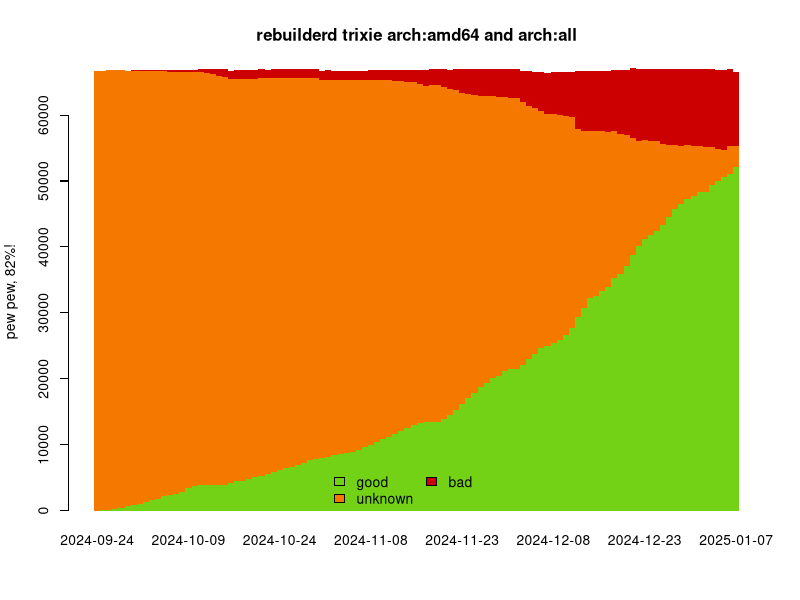
reproduce.debian.net Last month saw the introduction of reproduce.debian.net. Announced at the recent Debian MiniDebConf in Toulouse, reproduce.debian.net is an instance of rebuilderd operated by the Reproducible Builds project. rebuilderd is our server designed monitor the official package repositories of Linux distributions and attempts to reproduce the observed results there. This month, however, we are pleased to announce that not only does the service now produce graphs, the reproduce.debian.net homepage itself has become a start page of sorts, and the amd64.reproduce.debian.net and i386.reproduce.debian.net pages have emerged. The first of these rebuilds the amd64 architecture, naturally, but it also is building Debian packages that are marked with the no architecture label, all. The second builder is, however, only rebuilding the i386 architecture. Both of these services were also switched to reproduce the Debian trixie distribution instead of unstable, which started with 43% of the archive rebuild with 79.3% reproduced successfully. This is very much a work in progress, and we ll start reproducing Debian unstable soon. Our i386 hosts are very kindly sponsored by Infomaniak whilst the amd64 node is sponsored by OSUOSL thank you! Indeed, we are looking for more workers for more Debian architectures; please contact us if you are able to help.

debian-repro-status Reproducible builds developer kpcyrd has published a client program for reproduce.debian.net (see above) that queries the status of the locally installed packages and rates the system with a percentage score. This tool works analogously to arch-repro-status for the Arch Linux Reproducible Builds setup. The tool was packaged for Debian and is currently available in Debian trixie: it can be installed with apt install debian-repro-status.

On our mailing list On our mailing list this month:
  • Bernhard M. Wiedemann wrote a detailed post on his long journey towards a bit-reproducible Emacs package. In his interesting message, Bernhard goes into depth about the tools that they used and the lower-level technical details of, for instance, compatibility with the version for glibc within openSUSE.
  • Shivanand Kunijadar posed a question pertaining to the reproducibility issues with encrypted images. Shivanand explains that they must use a random IV for encryption with AES CBC. The resulting artifact is not reproducible due to the random IV used. The message resulted in a handful of replies, hopefully helpful!
  • User Danilo posted an in interesting question related to their attempts in trying to achieve reproducible builds for Threema Desktop 2.0. The question resulted in a number of replies attempting to find the right combination of compiler and linker flags (for example).
  • Longstanding contributor David A. Wheeler wrote to our list announcing the release of the Census III of Free and Open Source Software: Application Libraries report written by Frank Nagle, Kate Powell, Richie Zitomer and David himself. As David writes in his message, the report attempts to answer the question what is the most popular Free and Open Source Software (FOSS)? .
  • Lastly, kpcyrd followed-up to a post from September 2024 which mentioned their desire for someone to implement a hashset of allowed module hashes that is generated during the kernel build and then embedded in the kernel image , thus enabling a deterministic and reproducible build. However, they are now reporting that somebody implemented the hash-based allow list feature and submitted it to the Linux kernel mailing list . Like kpcyrd, we hope it gets merged.

Enhancing the Security of Software Supply Chains: Methods and Practices Mehdi Keshani of the Delft University of Technology in the Netherlands has published their thesis on Enhancing the Security of Software Supply Chains: Methods and Practices . Their introductory summary first begins with an outline of software supply chains and the importance of the Maven ecosystem before outlining the issues that it faces that threaten its security and effectiveness . To address these:
First, we propose an automated approach for library reproducibility to enhance library security during the deployment phase. We then develop a scalable call graph generation technique to support various use cases, such as method-level vulnerability analysis and change impact analysis, which help mitigate security challenges within the ecosystem. Utilizing the generated call graphs, we explore the impact of libraries on their users. Finally, through empirical research and mining techniques, we investigate the current state of the Maven ecosystem, identify harmful practices, and propose recommendations to address them.
A PDF of Mehdi s entire thesis is available to download.

diffoscope diffoscope is our in-depth and content-aware diff utility that can locate and diagnose reproducibility issues. This month, Chris Lamb made the following changes, including preparing and uploading versions 283 and 284 to Debian:
  • Update copyright years. [ ]
  • Update tests to support file 5.46. [ ][ ]
  • Simplify tests_quines.py::test_ differences,differences_deb to simply use assert_diff and not mangle the test fixture. [ ]

Supply-chain attack in the Solana ecosystem A significant supply-chain attack impacted Solana, an ecosystem for decentralised applications running on a blockchain. Hackers targeted the @solana/web3.js JavaScript library and embedded malicious code that extracted private keys and drained funds from cryptocurrency wallets. According to some reports, about $160,000 worth of assets were stolen, not including SOL tokens and other crypto assets.

Website updates Similar to last month, there was a large number of changes made to our website this month, including:
  • Chris Lamb:
    • Make the landing page hero look nicer when the vertical height component of the viewport is restricted, not just the horizontal width.
    • Rename the Buy-in page to Why Reproducible Builds? [ ]
    • Removing the top black border. [ ][ ]
  • Holger Levsen:
  • hulkoba:
    • Remove the sidebar-type layout and move to a static navigation element. [ ][ ][ ][ ]
    • Create and merge a new Success stories page, which highlights the success stories of Reproducible Builds, showcasing real-world examples of projects shipping with verifiable, reproducible builds. These stories aim to enhance the technical resilience of the initiative by encouraging community involvement and inspiring new contributions. . [ ]
    • Further changes to the homepage. [ ]
    • Remove the translation icon from the navigation bar. [ ]
    • Remove unused CSS styles pertaining to the sidebar. [ ]
    • Add sponsors to the global footer. [ ]
    • Add extra space on large screens on the Who page. [ ]
    • Hide the side navigation on small screens on the Documentation pages. [ ]

Debian changes There were a significant number of reproducibility-related changes within Debian this month, including:
  • Santiago Vila uploaded version 0.11+nmu4 of the dh-buildinfo package. In this release, the dh_buildinfo becomes a no-op ie. it no longer does anything beyond warning the developer that the dh-buildinfo package is now obsolete. In his upload, Santiago wrote that We still want packages to drop their [dependency] on dh-buildinfo, but now they will immediately benefit from this change after a simple rebuild.
  • Holger Levsen filed Debian bug #1091550 requesting a rebuild of a number of packages that were built with a very old version of dpkg.
  • Fay Stegerman contributed to an extensive thread on the debian-devel development mailing list on the topic of Supporting alternative zlib implementations . In particular, Fay wrote about her results experimenting whether zlib-ng produces identical results or not.
  • kpcyrd uploaded a new rust-rebuilderd-worker, rust-derp, rust-in-toto and debian-repro-status to Debian, which passed successfully through the so-called NEW queue.
  • Gioele Barabucci filed a number of bugs against the debrebuild component/script of the devscripts package, including:
    • #1089087: Address a spurious extra subdirectory in the build path.
    • #1089201: Extra zero bytes added to .dynstr when rebuilding CMake projects.
    • #1089088: Some binNMUs have a 1-second offset in some timestamps.
  • Gioele Barabucci also filed a bug against the dh-r package to report that the Recommends and Suggests fields are missing from rebuilt R packages. At the time of writing, this bug has no patch and needs some help to make over 350 binary packages reproducible.
  • Lastly, 8 reviews of Debian packages were added, 11 were updated and 11 were removed this month adding to our knowledge about identified issues.

Other development news In other ecosystem and distribution news:
  • Lastly, in openSUSE, Bernhard M. Wiedemann published another report for the distribution. There, Bernhard reports about the success of building R-B-OS , a partial fork of openSUSE with only 100% bit-reproducible packages. This effort was sponsored by the NLNet NGI0 initiative.

Upstream patches The Reproducible Builds project detects, dissects and attempts to fix as many currently-unreproducible packages as possible. We endeavour to send all of our patches upstream where appropriate. This month, we wrote a large number of such patches, including:

Reproducibility testing framework The Reproducible Builds project operates a comprehensive testing framework running primarily at tests.reproducible-builds.org in order to check packages and other artifacts for reproducibility. In November, a number of changes were made by Holger Levsen, including:
  • reproduce.debian.net-related:
    • Add a new i386.reproduce.debian.net rebuilder. [ ][ ][ ][ ][ ][ ]
    • Make a number of updates to the documentation. [ ][ ][ ][ ][ ]
    • Run i386.reproduce.debian.net run on a public port to allow external workers. [ ]
    • Add a link to the /api/v0/pkgs/list endpoint. [ ]
    • Add support for a statistics page. [ ][ ][ ][ ][ ][ ]
    • Limit build logs to 20 MiB and diffoscope output to 10 MiB. [ ]
    • Improve the frontpage. [ ][ ]
    • Explain that we re testing arch:any and arch:all on the amd64 architecture, but only arch:any on i386. [ ]
  • Misc:
    • Remove code for testing Arch Linux, which has moved to reproduce.archlinux.org. [ ][ ]
    • Don t install dstat on Jenkins nodes anymore as its been removed from Debian trixie. [ ]
    • Prepare the infom08-i386 node to become another rebuilder. [ ]
    • Add debug date output for benchmarking the reproducible_pool_buildinfos.sh script. [ ]
    • Install installation-birthday everywhere. [ ]
    • Temporarily disable automatic updates of pool links on buildinfos.debian.net. [ ]
    • Install Recommends by default on Jenkins nodes. [ ]
    • Rename rebuilder_stats.py to rebuilderd_stats.py. [ ]
    • r.d.n/stats: minor formatting changes. [ ]
    • Install files under /etc/cron.d/ with the correct permissions. [ ]
and Jochen Sprickerhof made the following changes: Lastly, Gioele Barabucci also classified packages affected by 1-second offset issue filed as Debian bug #1089088 [ ][ ][ ][ ], Chris Hofstaedtler updated the URL for Grml s dpkg.selections file [ ], Roland Clobus updated the Jenkins log parser to parse warnings from diffoscope [ ] and Mattia Rizzolo banned a number of bots and crawlers from the service [ ][ ].
If you are interested in contributing to the Reproducible Builds project, please visit our Contribute page on our website. However, you can get in touch with us via:

Freexian Collaborators: Debian Contributions: Tracker.debian.org updates, Salsa CI improvements, Coinstallable build-essential, Python 3.13 transition, Ruby 3.3 transition and more! (by Anupa Ann Joseph, Stefano Rivera)

Debian Contributions: 2024-12 Contributing to Debian is part of Freexian s mission. This article covers the latest achievements of Freexian and their collaborators. All of this is made possible by organizations subscribing to our Long Term Support contracts and consulting services.

Tracker.debian.org updates, by Rapha l Hertzog Profiting from end-of-year vacations, Rapha l prepared for tracker.debian.org to be upgraded to Debian 12 bookworm by getting rid of the remnants of python3-django-jsonfield in the code (it was superseded by a Django-native field). Thanks to Philipp Kern from the Debian System Administrators team, the upgrade happened on December 23rd. Rapha l also improved distro-tracker to better deal with invalid Maintainer fields which recently caused multiples issues in the regular data updates (#1089985, MR 105). While working on this, he filed #1089648 asking dpkg tools to error out early when maintainers make such mistakes. Finally he provided feedback to multiple issues and merge requests (MR 106, issues #21, #76, #77), there seems to be a surge of interest in distro-tracker lately. It would be nice if those new contributors could stick around and help out with the significant backlog of issues (in the Debian BTS, in Salsa).

Salsa CI improvements, by Santiago Ruano Rinc n Given that the Debian buildd network now relies on sbuild using the unshare backend, and that Salsa CI s reproducibility testing needs to be reworked (#399), Santiago resumed the work for moving the build job to use sbuild. There was some related work a few months ago that was focused on sbuild with the schroot and the sudo backends, but those attempts were stalled for different reasons, including discussions around the convenience of the move (#296). However, using sbuild and unshare avoids all of the drawbacks that have been identified so far. Santiago is preparing two merge requests: !568 to introduce a new build image, and !569 that moves all the extract-source related tasks to the build job. As mentioned in the previous reports, this change will make it possible for more projects to use the pipeline to build the packages (See #195). Additional advantages of this change include a more optimal way to test if a package builds twice in a row: instead of actually building it twice, the Salsa CI pipeline will configure sbuild to check if the clean target of debian/rules correctly restores the source tree, saving some CPU cycles by avoiding one build. Also, the images related to Ubuntu won t be needed anymore, since the build job will create chroots for different distributions and vendors from a single common build image. This will save space in the container registry. More changes are to come, especially those related to handling projects that customize the pipeline and make use of the extract-source job.

Coinstallable build-essential, by Helmut Grohne Building on the gcc-for-host work of last December, a notable patch turning build-essential Multi-Arch: same became feasible. Whilst the change is small, its implications and foundations are not. We still install crossbuild-essential-$ARCH for cross building and due to a britney2 limitation, we cannot have it depend on the host s C library. As a result, there are workarounds in place for sbuild and pbuilder. In turning build-essential Multi-Arch: same, we may actually express these dependencies directly as we install build-essential:$ARCH instead. The crossbuild-essential-$ARCH packages will continue to be available as transitional dummy packages.

Python 3.13 transition, by Colin Watson and Stefano Rivera Building on last month s work, Colin, Stefano, and other members of the Debian Python team fixed 3.13 compatibility bugs in many more packages, allowing 3.13 to now be a supported but non-default version in testing. The next stage will be to switch to it as the default version, which will start soon. Stefano did some test-rebuilds of packages that only build for the default Python 3 version, to find issues that will block the transition. The default version transition typically shakes out some more issues in applications that (unlike libraries) only test with the default Python version. Colin also fixed Sphinx 8.0 compatibility issues in many packages, which otherwise threatened to get in the way of this transition.

Ruby 3.3 transition, by Lucas Kanashiro The Debian Ruby team decided to ship Ruby 3.3 in the next Debian release, and Lucas took the lead of the interpreter transition with the assistance of the rest of the team. In order to understand the impact of the new interpreter in the ruby ecosystem, ruby-defaults was uploaded to experimental adding ruby3.3 as an alternative interpreter, and a mass rebuild of reverse dependencies was done here. Initially, a couple of hundred packages were failing to build, after many rounds of rebuilds, adjustments, and many uploads we are down to 30 package build failures, of those, 21 packages were asked to be removed from testing and for the other 9, bugs were filled. All the information to track this transition can be found here. Now, we are waiting for PHP 8.4 to finish to avoid any collision. Once it is done the Ruby 3.3 transition will start in unstable.

Miscellaneous contributions
  • Enrico Zini redesigned the way nm.debian.org stores historical audit logs and personal data backups.
  • Carles Pina submitted a new package (python-firebase-messaging) and prepared updates for python3-ring-doorbell.
  • Carles Pina developed further po-debconf-manager: better state transition, fixed bugs, automated assigning translators and reviewers on edit, updating po header files automatically, fixed bugs, etc.
  • Carles Pina reviewed, submitted and followed up the debconf templates translation (more than 20 packages) and translated some packages (about 5).
  • Santiago continued to work on DebConf 25 organization related tasks, including handling the logo survey and results. Stefano spent time on DebConf 25 too.
  • Santiago continued the exploratory work about linux livepatching with Emmanuel Arias. Santiago and Emmanuel found a challenge since kpatch won t fully support linux in trixie and newer, so they are exploring alternatives such as klp-build.
  • Helmut maintained the /usr-move transition filing bugs in e.g. bubblewrap, e2fsprogs, libvpd-2.2-3, and pam-tmpdir and corresponding on related issues such as kexec-tools and live-build. The removal of the usrmerge package unfortunately broke debootstrap and was quickly reverted. Continued fallout is expected and will continue until trixie is released.
  • Helmut sent patches for 10 cross build failures and worked with Sandro Knau on stuck Qt/KDE patches related to cross building.
  • Helmut continued to maintain rebootstrap removing the need to build gnu-efi in the process.
  • Helmut collaborated with Emanuele Rocca and Jochen Sprickerhof on an interesting adventure in diagnosing why gcc would FTBFS in recent sbuild.
  • Helmut proposed supporting build concurrency limits in coreutils s nproc. As it turns out nproc is not a good place for this functionality.
  • Colin worked with Sandro Tosi and Andrej Shadura to finish resolving the multipart vs. python-multipart name conflict, as mentioned last month.
  • Colin upgraded 48 Python packages to new upstream versions, fixing four CVEs and a number of compatibility bugs with recent Python versions.
  • Colin issued an openssh bookworm update with a number of fixes that had accumulated over the last year, especially fixing GSS-API key exchange which had been quite broken in bookworm.
  • Stefano fixed a minor bug in debian-reimbursements that was disallowing combination PDFs containing JAL tickets, encoded in UTF-16.
  • Stefano uploaded a stable update to PyPy3 in bookworm, catching up with security issues resolved in cPython.
  • Stefano fixed a regression in the eventlet from his Python 3.13 porting patch.
  • Stefano continued discussing a forwarded patch (renaming the sysconfigdata module) with cPython upstream, ending in a decision to drop the patch from Debian. This will need some continued work.
  • Anupa participated in the Debian Publicity team meeting in December, which discussed the team activities done in 2024 and projects for 2025.

8 January 2025

John Goerzen: Censorship Is Complicated: What Internet History Says about Meta/Facebook

In light of this week s announcement by Meta (Facebook, Instagram, Threads, etc), I have been pondering this question: Why am I, a person that has long been a staunch advocate of free speech and encryption, leery of sites that talk about being free speech-oriented? And, more to the point, why an I a person that has been censored by Facebook for mentioning the Open Source social network Mastodon not cheering a lighter touch ? The answers are complicated, and take me back to the early days of social networking. Yes, I mean the 1980s and 1990s. Before digital communications, there were barriers to reaching a lot of people. Especially money. This led to a sort of self-censorship: it may be legal to write certain things, but would a newspaper publish a letter to the editor containing expletives? Probably not. As digital communications started to happen, suddenly people could have their own communities. Not just free from the same kinds of monetary pressures, but free from outside oversight (parents, teachers, peers, community, etc.) When you have a community that the majority of people lack the equipment to access and wouldn t understand how to access even if they had the equipment you have a place where self-expression can be unleashed. And, as J. C. Herz covers in what is now an unintentional history (her book Surfing on the Internet was published in 1995), self-expression WAS unleashed. She enjoyed the wit and expression of everything from odd corners of Usenet to the text-based open world of MOOs and MUDs. She even talks about groups dedicated to insults (flaming) in positive terms. But as I ve seen time and again, if there are absolutely no rules, then whenever a group gets big enough more than a few dozen people, say there are troublemakers that ruin it for everyone. Maybe it s trolling, maybe it s vicious attacks, you name it it will arrive and it will be poisonous. I remember the debates within the Debian community about this. Debian is one of the pillars of the Internet today, a nonprofit project with free speech in its DNA. And yet there were inevitably the poisonous people. Debian took too long to learn that allowing those people to run rampant was causing more harm than good, because having a well-worn Delete key and a tolerance for insults became a requirement for being a Debian developer, and that drove away people that had no desire to deal with such things. (I should note that Debian strikes a much better balance today.) But in reality, there were never absolutely no rules. If you joined a BBS, you used it at the whim of the owner (the sysop or system operator). The sysop may be a 16-yr-old running it from their bedroom, or a retired programmer, but in any case they were letting you use their resources for free and they could kick you off for any or no reason at all. So if you caused trouble, or perhaps insulted their cat, you re banned. But, in all but the smallest towns, there were other options you could try. On the other hand, sysops enjoyed having people call their BBSs and didn t want to drive everyone off, so there was a natural balance at play. As networks like Fidonet developed, a sort of uneasy approach kicked in: don t be excessively annoying, and don t be easily annoyed. Like it or not, it seemed to generally work. A BBS that repeatedly failed to deal with troublemakers could risk removal from Fidonet. On the more institutional Usenet, you generally got access through your university (or, in a few cases, employer). Most universities didn t really even know they were running a Usenet server, and you were generally left alone. Until you did something that annoyed somebody enough that they tracked down the phone number for your dean, in which case real-world consequences would kick in. A site may face the Usenet Death Penalty delinking from the network if they repeatedly failed to prevent malicious content from flowing through their site. Some BBSs let people from minority communities such as LGBTQ+ thrive in a place of peace from tormentors. A lot of them let people be themselves in a way they couldn t be in real life . And yes, some harbored trolls and flamers. The point I am trying to make here is that each BBS, or Usenet site, set their own policies about what their own users could do. These had to be harmonized to a certain extent with the global community, but in a certain sense, with BBSs especially, you could just use a different one if you didn t like what the vibe was at a certain place. That this free speech ethos survived was never inevitable. There were many attempts to regulate the Internet, and it was thanks to the advocacy of groups like the EFF that we have things like strong encryption and a degree of freedom online. With the rise of the very large platforms and here I mean CompuServe and AOL at first, and then Facebook, Twitter, and the like later the low-friction option of just choosing a different place started to decline. You could participate on a Fidonet forum from any of thousands of BBSs, but you could only participate in an AOL forum from AOL. The same goes for Facebook, Twitter, and so forth. Not only that, but as social media became conceived of as very large sites, it became impossible for a person with enough skill, funds, and time to just start a site themselves. Instead of neading a few thousand dollars of equipment, you d need tens or hundreds of millions of dollars of equipment and employees. All that means you can t really run Facebook as a nonprofit. It is a business. It should be absolutely clear to everyone that Facebook s mission is not the one they say it is [to] give people the power to build community and bring the world closer together. If that was their goal, they wouldn t be creating AI users and AI spam and all the rest. Zuck isn t showing courage; he s sucking up to Trump and those that will pay the price are those that always do: women and minorities. Really, the point of any large social network isn t to build community. It s to make the owners their next billion. They do that by convincing people to look at ads on their site. Zuck is as much a windsock as anyone else; he will adjust policies in whichever direction he thinks the wind is blowing so as to let him keep putting ads in front of eyeballs, and stomp all over principles even free speech doing it. Don t expect anything different from any large commercial social network either. Bluesky is going to follow the same trajectory as all the others. The problem with a one-size-fits-all content policy is that the world isn t that kind of place. For instance, I am a pacifist. There is a place for a group where pacifists can hang out with each other, free from the noise of the debate about pacifism. And there is a place for the debate. Forcing everyone that signs up for the conversation to sign up for the debate is harmful. Preventing the debate is often also harmful. One company can t square this circle. Beyond that, the fact that we care so much about one company is a problem on two levels. First, it indicates how succeptible people are to misinformation and such. I don t have much to offer on that point. Secondly, it indicates that we are too centralized. We have a solution there: Mastodon. Mastodon is a modern, open source, decentralized social network. You can join any instance, easily migrate your account from one server to another, and so forth. You pick an instance that suits you. There are thousands of others you can choose from. Some aggressively defederate with instances known to harbor poisonous people; some don t. And, to harken back to the BBS era, if you have some time, some skill, and a few bucks, you can run your own Mastodon instance. Personally, I still visit Facebook on occasion because some people I care about are mainly there. But it is such a terrible experience that I rarely do. Meta is becoming irrelevant to me. They are on a path to becoming irrelevant to many more as well. Maybe this is the moment to go shrug, this sucks and try something better. (And when you do, feel free to say hi to me at @jgoerzen@floss.social on Mastodon.)

5 January 2025

Dominique Dumont: cme: new field in fill.copyright.blanks.yml for Debian copyright file

Hi The file fill.copyright.blanks.yml is used to fill missing copyright information when running cme update dpkg-copyright. This file can contain a comment field that is used for book-keeping. Here s an example from libuv1:
README.md:
comment:  -
  the license from this file is used as a main license and tends to
  apply expat or CC to all files. Which is wrong. Let's skip this file
  and let cme retrieve data from files.
skip: true
You may ask: why no use a YAML comments ? The problem is that YAML comments are dropped by cme edit dpkg. So you should not use them in fill.copyrights.blanks.yml. It occurred to me that it may be interesting to copy the content of this comment in to debian/copyright file entries. But not in all cases, as some comments make sense in fill.copyright.blanks.yml but not in debian/copyright. So I ve added a new forwarded-comment parameter in fill.copyright.blanks.yml. The content of this field is copied verbatim in debian/copyright. This way, you can add comments for book keeping and comments for debian/copyright entries. For instance:
pan/gui/*:
  forwarded-comment: some comment about gui
  comment: this is an example from cme test files
yields:
Files: pan/gui/*
Copyright: 1989, 1991, Free Software Foundation, Inc.
License: GPL-2
Comment: some comment about gui
This new functionality is available in libconfig-model-dpkg-perl >= 3.008. All the best

Enrico Zini: ncdu on files to back up

I use borg and restic to backup files in my system. Sometimes I run a huge download or clone a large git repo and forget to mark it with CACHEDIR.TAG, and it gets picked up slowing the backup process and wasting backup space uselessly. I would like to occasionally audit the system to have an idea of what is a candidate for backup. ncdu would be great for this, but it doesn't know about backup exclusion filters. Let's teach it then. Here's a script that simulates a backup and feeds the results to ncdu:
#!/usr/bin/python3
import argparse
import os
import sys
import time
import stat
import json
import subprocess
import tempfile
from pathlib import Path
from typing import Any
FILTER_ARGS = [
    "--one-file-system",
    "--exclude-caches",
    "--exclude",
    "*/.cache",
]
BACKUP_PATHS = [
    "/home",
]
class Dir:
    """
    Dispatch borg output into a hierarchical directory structure.
    borg prints a flat file list, ncdu needs a hierarchical JSON.
    """
    def __init__(self, path: Path, name: str):
        self.path = path
        self.name = name
        self.subdirs: dict[str, "Dir"] =  
        self.files: list[str] = []
    def print(self, indent: str = "") -> None:
        for name, subdir in self.subdirs.items():
            print(f" indent name: /")
            subdir.print(indent + " ")
        for name in self.files:
            print(f" indent name ")
    def add(self, parts: tuple[str, ...]) -> None:
        if len(parts) == 1:
            self.files.append(parts[0])
            return
        subdir = self.subdirs.get(parts[0])
        if subdir is None:
            subdir = Dir(self.path / parts[0], parts[0])
            self.subdirs[parts[0]] = subdir
        subdir.add(parts[1:])
    def to_data(self) -> list[Any]:
        res: list[Any] = []
        st = self.path.stat()
        res.append(self.collect_stat(self.name, st))
        for name, subdir in self.subdirs.items():
            res.append(subdir.to_data())
        dir_fd = os.open(self.path, os.O_DIRECTORY)
        try:
            for name in self.files:
                try:
                    st = os.lstat(name, dir_fd=dir_fd)
                except FileNotFoundError:
                    print(
                        "Possibly broken encoding:",
                        self.path,
                        repr(name),
                        file=sys.stderr,
                    )
                    continue
                if stat.S_ISDIR(st.st_mode):
                    continue
                res.append(self.collect_stat(name, st))
        finally:
            os.close(dir_fd)
        return res
    def collect_stat(self, fname: str, st) -> dict[str, Any]:
        res =  
            "name": fname,
            "ino": st.st_ino,
            "asize": st.st_size,
            "dsize": st.st_blocks * 512,
         
        if stat.S_ISDIR(st.st_mode):
            res["dev"] = st.st_dev
        return res
class Scanner:
    def __init__(self) -> None:
        self.root = Dir(Path("/"), "/")
        self.data = None
    def scan(self) -> None:
        with tempfile.TemporaryDirectory() as tmpdir_name:
            mock_backup_dir = Path(tmpdir_name) / "backup"
            subprocess.run(
                ["borg", "init", mock_backup_dir.as_posix(), "--encryption", "none"],
                cwd=Path.home(),
                check=True,
            )
            proc = subprocess.Popen(
                [
                    "borg",
                    "create",
                    "--list",
                    "--dry-run",
                ]
                + FILTER_ARGS
                + [
                    f" mock_backup_dir ::test",
                ]
                + BACKUP_PATHS,
                cwd=Path.home(),
                stderr=subprocess.PIPE,
            )
            assert proc.stderr is not None
            for line in proc.stderr:
                match line[0:2]:
                    case b"- ":
                        path = Path(line[2:].strip().decode())
                    case b"x ":
                        continue
                    case _:
                        raise RuntimeError(f"Unparsable borg output:  line!r ")
                if path.parts[0] != "/":
                    raise RuntimeError(f"Unsupported path:  path.parts!r ")
                self.root.add(path.parts[1:])
    def to_json(self) -> list[Any]:
        return [
            1,
            0,
             
                "progname": "backup-ncdu",
                "progver": "0.1",
                "timestamp": int(time.time()),
             ,
            self.root.to_data(),
        ]
    def export(self):
        return json.dumps(self.to_json()).encode()
def main():
    parser = argparse.ArgumentParser(
        description="Run ncdu to estimate sizes of files to backup."
    )
    parser.parse_args()
    scanner = Scanner()
    scanner.scan()
    # scanner.root.print()
    res = subprocess.run(["ncdu", "-f-"], input=scanner.export())
    sys.exit(res.returncode)
if __name__ == "__main__":
    main()

4 January 2025

Kentaro Hayashi: Tips when building debian-installer

Recently, I'm trying to fix d-i Han-Unification issue for Japanese. This issue was not fixed for a long time since Debian 9 (stretch). #1037256 - debian-installer: GUI font for Japanese was incorrectly rendered - Debian Bug report logs
To know about how Han-Unification is harmful for Japanese in some cases, See "Your Code Displays Japanese Wrong". heistak.github.io
When building d-i (GUI Installer), you need to build build_netboot-gtk target. But note that you need recent master because it has nitpick issue with GNU Make 4.4.x. bugs.debian.org After that, need to prepare required packages. See README in details.
apt-get update
apt-get install -y myrepos git libgtk2.0-dev fakeroot
apt-get build-dep -y debian-installer
It seems that Bug#1037256 will be fixed with supporting compressed font. I don't know how to do it furthermore , but I'm sure that Mr. Cyril Brulebois will handle this issue better. :-) (I thought that creating fake fontconfig cache when building image, then decompress compressed font dynamically might work as just an idea, but it didn't work.) If you would like to tackle fixing d-i issues as a newbie, it might be better to execute "make reallyclean" before rebuilding image not to fall-in pitfalls.

3 January 2025

Taavi V n nen: Automatically updating reverse DNS entries for my Hetzner servers

Some parts of my infrastructure run on Hetzner dedicated servers. Hetzner's management console has an interface to update reverse DNS entries, and I wanted to automate that. Unfortunately there's no option to just delegate the zones to my own authoritative DNS servers. So I did the next best thing, which is updating the Hetzner-managed records with data from my own authoritative DNS servers.

Generating DNS zones the hard way The first step of automating DNS record provisioning is, well, figuring out which records need to be provisioned. I wanted to re-use my existing automation for generating the record data, instead of coming up with a new system for these records. The basic summary is that there's a Go program creatively named dnsgen that's in charge of generating zone file snippets from various sources (these include Netbox, Kubernetes, PuppetDB and my custom reverse web proxy setup). Those snippets are combined with Jinja templates to generate full zone files to be loaded to a hidden primary running Bind9 (like all other DNS servers I run). The zone files are then transferred to a fleet of internal authoritative servers as well as my public authoritative DNS server, which in turn transfers them to various other authoritative DNS servers (like ns-global and Traficom anycast) for redundancy. There's also a bunch of other smaller features, like using Bind views to server different data to internal and external clients, and resolving external records during record generation time to be used on apex records that would use CNAME records if they could. (The latter is a workaround for Masto.host, the hosting provider we use for Wikis World, not having a stable IPv6 address.) Overall it's a really nice system, and I've spent quite a bit of time on it.

Updating records on Hetzner-managed space As mentioned above, Hetzner unfortunately does not support custom DNS servers for reverse records on IP space rented from them. But I wanted to use my existing, perfectly working DNS record generation setup since that works perfectly fine. So the obvious answer is to (ab)use DNS zone file transfers. I quickly wrote a few hundred lines of Go to request the zone data and then use the Hetzner robot API to ensure the reverse entries are in sync. The main obstacle hit here was the Hetzner API somehow requiring an "update" call (instead of a "create" one) to create a new record, as the create endpoint was returning an HTTP 400 response no matter what. Once I sorted that out, the script started working fine and created the few dozen missing records. Finally I added a CronJob in my Kubernetes cluster to run the script once in a while. Overall this is a big improvement over doing things by hand and didn't require that much effort. The obvious next step would be to expand the script to a tiny DNS server capable of receiving zone update NOTIFYs to make the updates happen real-time. Unfortunately there's now no hiding of the records revealing my ugly hacks clever networking solutions :(

2 January 2025

Matthew Garrett: The GPU, not the TPM, is the root of hardware DRM

As part of their "Defective by Design" anti-DRM campaign, the FSF recently made the following claim:
Today, most of the major streaming media platforms utilize the TPM to decrypt media streams, forcefully placing the decryption out of the user's control (from here).
This is part of an overall argument that Microsoft's insistence that only hardware with a TPM can run Windows 11 is with the goal of aiding streaming companies in their attempt to ensure media can only be played in tightly constrained environments.

I'm going to be honest here and say that I don't know what Microsoft's actual motivation for requiring a TPM in Windows 11 is. I've been talking about TPM stuff for a long time. My job involves writing a lot of TPM code. I think having a TPM enables a number of worthwhile security features. Given the choice, I'd certainly pick a computer with a TPM. But in terms of whether it's of sufficient value to lock out Windows 11 on hardware with no TPM that would otherwise be able to run it? I'm not sure that's a worthwhile tradeoff.

What I can say is that the FSF's claim is just 100% wrong, and since this seems to be the sole basis of their overall claim about Microsoft's strategy here, the argument is pretty significantly undermined. I'm not aware of any streaming media platforms making use of TPMs in any way whatsoever. There is hardware DRM that the media companies use to restrict users, but it's not in the TPM - it's in the GPU.

Let's back up for a moment. There's multiple different DRM implementations, but the big three are Widevine (owned by Google, used on Android, Chromebooks, and some other embedded devices), Fairplay (Apple implementation, used for Mac and iOS), and Playready (Microsoft's implementation, used in Windows and some other hardware streaming devices and TVs). These generally implement several levels of functionality, depending on the capabilities of the device they're running on - this will range from all the DRM functionality being implemented in software up to the hardware path that will be discussed shortly. Streaming providers can choose what level of functionality and quality to provide based on the level implemented on the client device, and it's common for 4K and HDR content to be tied to hardware DRM. In any scenario, they stream encrypted content to the client and the DRM stack decrypts it before the compressed data can be decoded and played.

The "problem" with software DRM implementations is that the decrypted material is going to exist somewhere the OS can get at it at some point, making it possible for users to simply grab the decrypted stream, somewhat defeating the entire point. Vendors try to make this difficult by obfuscating their code as much as possible (and in some cases putting some of it in-kernel), but pretty much all software DRM is at least somewhat broken and copies of any new streaming media end up being available via Bittorrent pretty quickly after release. This is why higher quality media tends to be restricted to clients that implement hardware-based DRM.

The implementation of hardware-based DRM varies. On devices in the ARM world this is usually handled by performing the cryptography in a Trusted Execution Environment, or TEE. A TEE is an area where code can be executed without the OS having any insight into it at all, with ARM's TrustZone being an example of this. By putting the DRM code in TrustZone, the cryptography can be performed in RAM that the OS has no access to, making the scraping described earlier impossible. x86 has no well-specified TEE (Intel's SGX is an example, but is no longer implemented in consumer parts), so instead this tends to be handed off to the GPU. The exact details of this implementation are somewhat opaque - of the previously mentioned DRM implementations, only Playready does hardware DRM on x86, and I haven't found any public documentation of what drivers need to expose for this to work.

In any case, as part of the DRM handshake between the client and the streaming platform, encryption keys are negotiated with the key material being stored in the GPU or the TEE, inaccessible from the OS. Once decrypted, the material is decoded (again either on the GPU or in the TEE - even in implementations that use the TEE for the cryptography, the actual media decoding may happen on the GPU) and displayed. One key point is that the decoded video material is still stored in RAM that the OS has no access to, and the GPU composites it onto the outbound video stream (which is why if you take a screenshot of a browser playing a stream using hardware-based DRM you'll just see a black window - as far as the OS can see, there is only a black window there).

Now, TPMs are sometimes referred to as a TEE, and in a way they are. However, they're fixed function - you can't run arbitrary code on the TPM, you only have whatever functionality it provides. But TPMs do have the ability to decrypt data using keys that are tied to the TPM, so isn't this sufficient? Well, no. First, the TPM can't communicate with the GPU. The OS could push encrypted material to it, and it would get plaintext material back. But the entire point of this exercise was to avoid the decrypted version of the stream from ever being visible to the OS, so this would be pointless. And rather more fundamentally, TPMs are slow. I don't think there's a TPM on the market that could decrypt a 1080p stream in realtime, let alone a 4K one.

The FSF's focus on TPMs here is not only technically wrong, it's indicative of a failure to understand what's actually happening in the industry. While the FSF has been focusing on TPMs, GPU vendors have quietly deployed all of this technology without the FSF complaining at all. Microsoft has enthusiastically participated in making hardware DRM on Windows possible, and user freedoms have suffered as a result, but Playready hardware-based DRM works just fine on hardware that doesn't have a TPM and will continue to do so.

comment count unavailable comments

1 January 2025

Guido G nther: Free Software Activities December 2024

Another short status update of what happened on my side last month. The larger blocks are the Phosh 0.44 release and landing the initial Cell Broadcast support in phosh. The rest is all just small bits of bug, fallout/regression fixing here and there. phosh phoc phosh-mobile-settings libphosh-rs phosh-osk-stub phosh-tour pfs xdg-desktop-portal-phosh phog Debian git-buildpackage wlr-randr python-dbusmock livi Chatty feedbackd libadwaita phosh-ev Reviews This is not code by me but reviews on other peoples code. The list is incomplete, but I hope to improve on this in the upcoming months. Thanks for the contributions! Help Development Thanks a lot to all the those who supported my work on this in 2024. Happy new year! If you want to support my work see donations. Comments? Join the Fediverse thread

Louis-Philippe V ronneau: 2024 A Musical Retrospective

Another musical retrospective. If you enjoy this, I also did a 2022 and a 2023 one. Albums In 2024, I added 88 new albums to my collection that's a lot! This year again, I bought the vast majority of my music on Bandcamp. To be honest, I'm quite distraught by what's become of that website. Although it stays a wonderful place to buy underground music, Songtradr, the new owner of the platform, has been shown to be viciously anti-union. Money continues to ruin the world, I guess. Concerts I continued to go to a lot of concerts in 2024 (25!). Over the past 3 years, I have been going to more and more concerts, and I think I've reached my "peak". A mean of a concert every two weeks is quite a lot :) If you also like music and concerts, but find yourself not going to as many as you would like, the real secret is not to be afraid to go to concerts alone. Going with friends is always fun, but if I restricted myself to only going to concerts in a group, I'd barely see a few each year. Another good advice is to bring a book or something else1 to pass the time between sets. It can often take 30-45 minutes between sets for the artists to get their instruments ready, which can get quite boring if you just stand there and wait. Anyway, here are the concerts I went to in 2024: Shout out to the Gancio project and to the folks running the Montreal instance. It continues to be a smash hit and most of the interesting concerts end up being advertised there. See you all in 2025!

  1. I bought a Miyoo Mini Plus, a handheld Linux console running OnionOS, for that express reason. So far it's been great and I've been very happy to revisit some childhood classics.

31 December 2024

Fran ois Marier: Monitoring and Time-Shifting YouTube Podcasts

While most podcasts are available on multiple platforms and either offer an RSS feed or have one that can be discovered, some are only available in the form of a YouTube channel. Thankfully, it's possible to both monitor them for new episodes (i.e. new videos), and time-shift the audio for later offline listening. Subscribing to a channel via RSS is possible thanks to the built-in, but not easily discoverable, RSS feeds. See these instructions for how to do it. As an example, the RSS feed for the official Government of BC channel is https://www.youtube.com/feeds/videos.xml?channel_id=UC6n9tFQOVepHP3TIeYXnhSA. When it comes to downloading the audio, the most reliable tool I have found is yt-dlp. Since the exact arguments needed to download just the audio as an MP3 are a bit of a mouthful, I wrote a wrapper script which also does a few extra things: If you find that script handy, you may also want to check out the script I have in the same GitHub repo to turn arbitrary video files into a podcast.

30 December 2024

Russ Allbery: Review: House in Hiding

Review: House in Hiding, by Jenny Schwartz
Series: Uncertain Sanctuary #2
Publisher: Jenny Schwartz
Copyright: October 2020
Printing: September 2024
ASIN: B0DBX6GP8Z
Format: Kindle
Pages: 196
House in Hiding is the second book of a self-published space fantasy trilogy that started with The House That Walked Between Worlds. I read it as part of the Uncertain Sanctuary omnibus, which is reflected in the sidebar metadata. At the end of the previous book, Kira had gathered a motley crew for her house and discovered that she had drawn the attention of some rather significant galactic powers. Now, with the help of her new (hopefully) friends, she has to decide what role she's going to play in the galaxy. Or she can dither a lot, ruminate repeatedly on the same topics, and flail about randomly. That's also an option. This is slightly unfair. By the second half of the book, the series plot is beginning to cohere around two major problems: what is happening to the magic flows in the universe, and who killed Kira's parents. But apparently there was a limit on my enjoyment for the chaos in Kira's chaotic decisiveness I praised in my review of the last book, and I hit that limit around the middle of this book. I am interested in the questions of ethics, responsibility, and public image that this series is raising. I'm just not convinced that Schwartz is going to provide satisfying answers. One thing I do appreciate about this book is that it acknowledges that politics exist and that taking powerful people at face value is a bad idea. You would think that this would be a low bar, and yet it's depressing how many fantasy novels signal the trustworthiness of a character via some variation of "I looked into his eyes and shook his hand," or at least expect readers to be surprised by the inevitable betrayals. Schwartz does not make that mistake; after getting a call from a powerful player in galactic politics, the characters take apart everything that was said while assuming it could be attempted manipulation, which is the correct initial response. My problem comes after that. I like reading about competent characters with a plan, and these are absurdly powerful but very naive characters with no plan. This is realistic for the situation Kira has been thrust into, but it's not that entertaining to read about. I think the root of my problem is that there are some fundamental storytelling problems here that Schwartz is struggling to fix. The basic theory of story says that you need a protagonist, a setting, a conflict, and a plot. Schwartz has a good protagonist, one great supporting character and several adequate ones, and an enjoyably weird setting. I think she's working her way up to having a plot, although usually it's best for the plot to show up before the middle book of the series. What she doesn't have is a meaningful conflict. It's not entirely clear to either the reader or to Kira why Kira cares about what's happening. You would not think this would be a problem given that Kira's parents were murdered before the start of the first book. That's a classic conflict that's driven more books than I think anyone could count. It's not what Kira has cared about up to this point, however; she got away from Earth and has shown no sign of wanting to go back or identify the people who killed her parents, perhaps because she mostly blames herself. Instead, she's stumbling across other problems in the universe that other people would like her to care about. She occasionally feels like she ought to care about them because they involve her new friends or because she wants to be a good person, but they have very little dramatic oomph. "I'm a sorcerer and vaguely want the universe to be a better place" turns out to not work that well as a source of dramatic tension. This lack of conflict is somewhat fascinating because it's so different than most fantasy novels. If Schwartz were more aware of how oddly disconnected her protagonist is from the story conflict, I think there could be a thoughtful, if odd, psychological novel in here about one's ethical responsibilities if one suddenly had vast power and no strong attachments to the world. Kira does gesture occasionally in that direction, but there's no real meat to her musings. Instead, her lack of motivation is solved through one of the hoariest tropes in fiction: children in danger. I really want to like this series, and I still love the House, but this book was not good. The romance that I was delighted to not be subjected to in the first book appears to be starting (sigh), the political maneuvering that happens here is only mildly interesting and not believably competent, and the book concludes in Kira making an egregiously and blatantly stupid mistake that should have resulted in one of her friends asking her what the hell she was doing. Some setup happens, and it seems likely that the final book will have a clear conflict and plot, but this middle book was a disappointing mess. These books are fast to read and lightly entertaining between other things, and the House still has me invested enough in this universe that I'll read the last book in the omnibus. Be warned, though, that the middle book is more a collection of anecdotes than a story, and there's only so much of Kira showing off her power I can take without a conflict and a plot. Followed by The House That Fought. Rating: 5 out of 10

29 December 2024

Emmanuel Kasper: Accessing Atari ST disk images on Linux

This post leverages support for Atari Hard Disk Interface Partition (AHDI) partition tables in the Linux kernel, activated by default in Debian, and in the parted partition editor. Accessing the content of a partition using a user mounted loop device This is the easiest procedure and should be tried to first. Depending if your Linux kernel has support for AHDI partition tables, and the size of the FAT system on the partition, this procedure might not work. In that case, try the procedure using mtools further below. Attach a disk image called hd80mb.image to a loop device:
$ udisksctl loop-setup --file hd80mb.image
Mapped file hd80mb.image as /dev/loop0
Notice how the kernel detected the partition table:
$ dmesg   grep loop0
[160892.151941] loop0: detected capacity change from 0 to 164138
[160892.171061]  loop0: AHDI p1 p2 p3 p4
Inspect the block devices created for each partition:
$ lsblk   grep loop0
If the partitions are not already mounted by udisks2 under /media/, mount them manually:
$ sudo mount /dev/loop0p1 /mnt/
$ ls /mnt/
SHDRIVER.SYS
When you are finished copying data, unmount the partition, and detach the loop device.
$ sudo umount /mnt
$ udisksctl loop-delete --block-device /dev/loop0
Accessing the content of a partition using mtools and parted This procedure uses the mtools package and the support for the AHDI partition scheme in the parted partition editor. Display the partition table, with partitions offsets in bytes:
$ parted st_mint-1.5.img -- unit B print
...
Partition Table: atari
Disk Flags: 
Number  Start       End         Size        Type     File system  Flags
 1      1024B       133170175B  133169152B  primary               boot
 2      133170176B  266339327B  133169152B  primary
 3      266339328B  399508479B  133169152B  primary
 4      399508480B  532676607B  133168128B  primary
Set some Atari-friendly mtools options:
$ export MTOOLS_SKIP_CHECK=1
$ export MTOOLS_NO_VFAT=1
List the content of the partition, passing as parameter the offset in bytes of the partition: For instance here we are interested in the second partition, and the parted output above indicates that this partition starts at byte offset 133170176 in the disk image.
$ mdir -s -i st_mint-1.5.img@@133170176
 Volume in drive : has no label
Directory for ::/
demodata          2024-08-27  11:43 
        1 file                    0 bytes
Directory for ::/demodata
We can also use the command mcopy with a similar syntax to copy data from and to the disk image. For instance we copy a file named file.zip to the root directory of the second partition:
$ mcopy -s -i st_mint-1.5.img@@133170176 file.zip ::
Recompiling mtools to access large partitions With disk images having large AHDI partitions (well considered large in 1992 ), you might encounter the error
mdir -s -i cecile-falcon-singlepart-1GB.img@@1024
init: sector size too big
Cannot initialize '::'
This error is caused by the non-standard large logical sectors that the TOS uses for large FAT partitions (see the Atari Hard Disk Filesystem reference on page 41, TOS partitions size) We can inspect the logical sector size using fsck tools:
$ udiskctl loop-setup --file cecile-falcon-singlepart-1GB.img
$ sudo fsck.fat -Anv /dev/loop0p1
fsck.fat 4.2 (2021-01-31)
...
Media byte 0xf8 (hard disk)
16384 bytes per logical sector
To access the partition, you need to patch mtools, so that it supports a logical sector size of 16384 bytes. For this you need to change the MAX_SECTOR macro from 8192 to 16384 in msdos.h in the mtools distribution and recompile. A rebuilt mtools is then able to access the partition:
$ /usr/local/bin/mdir -s -i cecile-falcon-singlepart-1GB.img@@1024
 Volume in drive : has no label
Directory for ::/
CECILE   SYS      8462 1998-03-27  22:42 
NEWDESK  INF       804 2024-09-09   9:23 
        2 files               9 266 bytes
                      1 072 463 872 bytes free

Russ Allbery: Review: The Last Hour Between Worlds

Review: The Last Hour Between Worlds, by Melissa Caruso
Series: The Echo Archives #1
Publisher: Orbit
Copyright: November 2024
ISBN: 0-316-30364-X
Format: Kindle
Pages: 388
The Last Hour Between Worlds is urban, somewhat political high fantasy with strong fae vibes. It is the first book of a series, but it stands alone quite well. Kembral Thorne is a Hound, a member of the guild that serves as guards, investigators, and protectors. Kembral's specialty is Echo retrieval: rescues of people and animals who have fallen through a weak spot in reality into one of the strange, dangerous, and malleable layers called Echoes. Kem once rescued a dog from six layers down, an almost unheard-of feat. Kem is also a new single mother, which means her past two months have been spent in a sleep-deprived haze revolving exclusively around her much-beloved infant. Dona Marjorie Swift's year-turning party is the first time she's been out without Emmi since she gave birth, and she's only there because her sister took the child and practically shoved her out the door. Now, she's desperately trying to remember how to be social and normal, which is not made easier by the unexpected presence of Rika at the party. Rika Nonesuch is not a Hound. She's a Cat, a member of the guild of thieves and occasional assassins. They are the nemesis of the Hounds, but in a stylized and formalized way in which certain courtesies are expected. (The politics of this don't really make sense; you just have to go with it.) Kem has complicated feelings about Rika's grace, banter, and intoxicating perfume, feelings that she thought might be reciprocated until Rika drugged her during an apparent date and left her buried under a pile of garbage. She was not expecting Rika to be at this party and is definitely not ready to have a conversation with her. This emotional turmoil is rudely interrupted by the death of nearly everyone at the party via an Echo poison, the appearance of a dark figure driving a black sword into someone, and the descent of the entire party into an Echo. This was one of those books that kept getting better the farther into the book I read. I was a bit leery at first because the publisher's blurb made it sound more like horror than I prefer, but this is more the disturbing strangeness of fae creatures than the sort of gruesomeness, disgust, or body horror that I find off-putting. Most importantly, the point of this book is not to torture the characters or scare the reader. It's instead structured a bit like a murder mystery, but one whose resolution requires working out obscure fantasy rules and hidden political agendas. One of the currencies in the world of Echos is blood, but another is emotion, revelation, and the stories that bring both, and Caruso focuses the story more on that aspect than on horrifying imagery.
Rika frowned. "Resolve it? How?" "I have no idea." I couldn't keep my frustration from leaking through. "Might be that we have to delve deep into our own hearts to confront the unhealed wounds we've carried with us in secret. Might be that we have to say their names backward, or just close our eyes and they'll go away. Echoes never make any damned sense." Rika made a face. "We'd better not have to confront our unhealed wounds, or I'm leaving you to die."
All of The Last Hour Between Worlds is told in the first person from Kem's perspective, but Rika is the best character in this book. Kem is a rather straightforward, dogged, stubborn protector; Rika is complicated, selfish, conflicted, and considerably more dynamic. The first obvious twist in her background I spotted so long before Kem found out that it was a bit frustrating, but there were multiple satisfying twists after that. As advertised in the blurb, there's a sapphic romance angle here, but it's the sort that comes from a complicated friendship and a lot of mutual respect rather than love at first sight. Some of their relationship conflict is driven by misunderstanding, but the misunderstanding happens before the novel begins, which means the reader doesn't have to sit through the bit where one yells at the characters for being stupid. It helps that the characters have something concrete to do, and that driving plot problem is multi-layered and satisfying. Each time the party falls through a layer of reality, it's mostly reset to the start of the book, but the word "mostly" is hiding a lot of subtlety. Given the clock at the start of each chapter and the blurb (if one read it), the reader can make a good guess that the plot problem will not be fully resolved until the characters fall quite deep into the Echoes, but the story never felt repetitive the way that some time loop stories can. As the characters gain more understanding, the problems change, the players change, and they have to make several excursions into the surrounding world. This is the sort of fantasy that feels a bit like science fiction. You're thrown into a world with a different culture and different rules that are foreign to the reader and natural to the characters. Part of the fun of reading is figuring out the rules, history, and backstory while watching the characters try to solve the puzzles they're faced with. The writing is good but not great. Characterization was good enough for a story primarily focused on action and puzzle-solving, but it was a bit lacking in subtlety. I think Caruso's strengths showed most in the world design, particularly the magic system and the rules followed by the Echo creatures. The excursions outside of the somewhat-protected house struck a balance between eeriness and comprehensibility that reminded me of T. Kingfisher or Sandman. The human politics were unfortunately less successful and rested on some tired centrist cliches. Thankfully, this was not the main point of the story. I should also warn that there is a lot of talk about babies. Kem's entire identity at the start of the novel, to the point of incessant monologue, is "new mother." This is not a perspective we get very often in fantasy, and Kem eventually finds a steadier balance between her bond with her daughter and the other parts of her life. I think some readers will feel very seen. But Caruso leans hard into maternal bonding. So hard. If you don't want to read about someone who is deliriously obsessed with their new child, you may want to skip this one. Right after I finished this book, I thought it was amazing. Now that I've had a few days to think about it, the lack of subtlety and the facile human politics brought it down a notch. I'm a science fiction reader at heart, so I loved the slow revelation of mechanics; the reader starts the story by knowing that Kem can "blink step" but not knowing what that means, and by the end of the story one not only knows but has opinions about its limitations, political implications, and interactions with other forms of magic. The Echo worlds are treated similarly, and this type of world-building is my jam. But the cost is that the human characters, particularly the supporting cast, don't get the same focus and therefore are a bit straightforward and obvious. The subplot with Dona Vandelle was particularly annoying. Ah well. Kem and Rika's relationship did work, and it's the center of the book. If you like fantasy mechanics but are a bit leery of fae stories because they feel too symbolic or arbitrary, give this a try. It's the most satisfyingly constructed fae story that I've read in a long time. It's not great literary fiction, but it's also not trying to be; it's a puzzle adventure, and a well-executed one. Recommended, and I will definitely be reading the sequel. Content notes: Lots of violent death and other physical damage, creepy dream worlds with implied but not explicit horror, and rather a lot of blood. Followed by The Last Soul Among Wolves, not yet published at the time I wrote this review. Rating: 8 out of 10

28 December 2024

Enrico Zini: Disable spellchecker popup on Android

On Android, there's a spellchecker popup that occasionally appears over the keyboard, getting very annoyingly in the way. See for example this unanswered question with screenshots. It looks like a feature of the keyboard, but it's not, and so I looked and I looked and I could not find how to turn it off. The answer is to look for how to disable the spellchecker in the keyboard section of the android system settings, not in the android keyboard app settings. See for example this answer on stackexchange.

27 December 2024

Wouter Verhelst: Writing an extensible JSON-based DSL with Moose

At work, I've been maintaining a perl script that needs to run a number of steps as part of a release workflow. Initially, that script was very simple, but over time it has grown to do a number of things. And then some of those things did not need to be run all the time. And then we wanted to do this one exceptional thing for this one case. And so on; eventually the script became a big mess of configuration options and unreadable flow, and so I decided that I wanted it to be more configurable. I sat down and spent some time on this, and eventually came up with what I now realize is a domain-specific language (DSL) in JSON, implemented by creating objects in Moose, extensible by writing more object classes. Let me explain how it works. In order to explain, however, I need to explain some perl and Moose basics first. If you already know all that, you can safely skip ahead past the "Preliminaries" section that's next.

Preliminaries

Moose object creation, references. In Moose, creating a class is done something like this:
package Foo;
use v5.40;
use Moose;
has 'attribute' => (
    is  => 'ro',
    isa => 'Str',
    required => 1
);
sub say_something  
    my $self = shift;
    say "Hello there, our attribute is " . $self->attribute;
 
The above is a class that has a single attribute called attribute. To create an object, you use the Moose constructor on the class, and pass it the attributes you want:
use v5.40;
use Foo;
my $foo = Foo->new(attribute => "foo");
$foo->say_something;
(output: Hello there, our attribute is foo) This creates a new object with the attribute attribute set to bar. The attribute accessor is a method generated by Moose, which functions both as a getter and a setter (though in this particular case we made the attribute "ro", meaning read-only, so while it can be set at object creation time it cannot be changed by the setter anymore). So yay, an object. And it has methods, things that we set ourselves. Basic OO, all that. One of the peculiarities of perl is its concept of "lists". Not to be confused with the lists of python -- a concept that is called "arrays" in perl and is somewhat different -- in perl, lists are enumerations of values. They can be used as initializers for arrays or hashes, and they are used as arguments to subroutines. Lists cannot be nested; whenever a hash or array is passed in a list, the list is "flattened", that is, it becomes one big list. This means that the below script is functionally equivalent to the above script that uses our "Foo" object:
use v5.40;
use Foo;
my %args;
$args attribute  = "foo";
my $foo = Foo->new(%args);
$foo->say_something;
(output: Hello there, our attribute is foo) This creates a hash %args wherein we set the attributes that we want to pass to our constructor. We set one attribute in %args, the one called attribute, and then use %args and rely on list flattening to create the object with the same attribute set (list flattening turns a hash into a list of key-value pairs). Perl also has a concept of "references". These are scalar values that point to other values; the other value can be a hash, a list, or another scalar. There is syntax to create a non-scalar value at assignment time, called anonymous references, which is useful when one wants to remember non-scoped values. By default, references are not flattened, and this is what allows you to create multidimensional values in perl; however, it is possible to request list flattening by dereferencing the reference. The below example, again functionally equivalent to the previous two examples, demonstrates this:
use v5.40;
use Foo;
my $args =  ;
$args-> attribute  = "foo";
my $foo = Foo->new(%$args);
$foo->say_something;
(output: Hello there, our attribute is foo) This creates a scalar $args, which is a reference to an anonymous hash. Then, we set the key attribute of that anonymous hash to bar (note the use arrow operator here, which is used to indicate that we want to dereference a reference to a hash), and create the object using that reference, requesting hash dereferencing and flattening by using a double sigil, %$. As a side note, objects in perl are references too, hence the fact that we have to use the dereferencing arrow to access the attributes and methods of Moose objects. Moose attributes don't have to be strings or even simple scalars. They can also be references to hashes or arrays, or even other objects:
package Bar;
use v5.40;
use Moose;
extends 'Foo';
has 'hash_attribute' => (
    is => 'ro',
    isa => 'HashRef[Str]',
    predicate => 'has_hash_attribute',
);
has 'object_attribute' => (
    is => 'ro',
    isa => 'Foo',
    predicate => 'has_object_attribute',
);
sub say_something  
    my $self = shift;
    if($self->has_object_attribute)  
        $self->object_attribute->say_something;
     
    $self->SUPER::say_something unless $self->has_hash_attribute;
    say "We have a hash attribute!"
 
This creates a subclass of Foo called Bar that has a hash attribute called hash_attribute, and an object attribute called object_attribute. Both of them are references; one to a hash, the other to an object. The hash ref is further limited in that it requires that each value in the hash must be a string (this is optional but can occasionally be useful), and the object ref in that it must refer to an object of the class Foo, or any of its subclasses. The predicates used here are extra subroutines that Moose provides if you ask for them, and which allow you to see if an object's attribute has a value or not. The example script would use an object like this:
use v5.40;
use Bar;
my $foo = Foo->new(attribute => "foo");
my $bar = Bar->new(object_attribute => $foo, attribute => "bar");
$bar->say_something;
(output: Hello there, our attribute is foo) This example also shows object inheritance, and methods implemented in child classes. Okay, that's it for perl and Moose basics. On to...

Moose Coercion Moose has a concept of "value coercion". Value coercion allows you to tell Moose that if it sees one thing but expects another, it should convert is using a passed subroutine before assigning the value. That sounds a bit dense without example, so let me show you how it works. Reimaginging the Bar package, we could use coercion to eliminate one object creation step from the creation of a Bar object:
package "Bar";
use v5.40;
use Moose;
use Moose::Util::TypeConstraints;
extends "Foo";
coerce "Foo",
    from "HashRef",
    via   Foo->new(%$_)  ;
has 'hash_attribute' => (
    is => 'ro',
    isa => 'HashRef',
    predicate => 'has_hash_attribute',
);
has 'object_attribute' => (
    is => 'ro',
    isa => 'Foo',
    coerce => 1,
    predicate => 'has_object_attribute',
);
sub say_something  
    my $self = shift;
    if($self->has_object_attribute)  
        $self->object_attribute->say_something;
     
    $self->SUPER::say_something unless $self->has_hash_attribute;
    say "We have a hash attribute!"
 
Okay, let's unpack that a bit. First, we add the Moose::Util::TypeConstraints module to our package. This is required to declare coercions. Then, we declare a coercion to tell Moose how to convert a HashRef to a Foo object: by using the Foo constructor on a flattened list created from the hashref that it is given. Then, we update the definition of the object_attribute to say that it should use coercions. This is not the default, because going through the list of coercions to find the right one has a performance penalty, so if the coercion is not requested then we do not do it. This allows us to simplify declarations. With the updated Bar class, we can simplify our example script to this:
use v5.40;
use Bar;
my $bar = Bar->new(attribute => "bar", object_attribute =>   attribute => "foo"  );
$bar->say_something
(output: Hello there, our attribute is foo) Here, the coercion kicks in because the value object_attribute, which is supposed to be an object of class Foo, is instead a hash ref. Without the coercion, this would produce an error message saying that the type of the object_attribute attribute is not a Foo object. With the coercion, however, the value that we pass to object_attribute is passed to a Foo constructor using list flattening, and then the resulting Foo object is assigned to the object_attribute attribute. Coercion works for more complicated things, too; for instance, you can use coercion to coerce an array of hashes into an array of objects, by creating a subtype first:
package MyCoercions;
use v5.40;
use Moose;
use Moose::Util::TypeConstraints;
use Foo;
subtype "ArrayOfFoo", as "ArrayRef[Foo]";
subtype "ArrayOfHashes", as "ArrayRef[HashRef]";
coerce "ArrayOfFoo", from "ArrayOfHashes", via   [ map   Foo->create(%$_)   @ $_  ]  ;
Ick. That's a bit more complex. What happens here is that we use the map function to iterate over a list of values. The given list of values is @ $_ , which is perl for "dereference the default value as an array reference, and flatten the list of values in that array reference". So the ArrayRef of HashRefs is dereferenced and flattened, and each HashRef in the ArrayRef is passed to the map function. The map function then takes each hash ref in turn and passes it to the block of code that it is also given. In this case, that block is Foo->create(%$_) . In other words, we invoke the create factory method with the flattened hashref as an argument. This returns an object of the correct implementation (assuming our hash ref has a type attribute set), and with all attributes of their object set to the correct value. That value is then returned from the block (this could be made more explicit with a return call, but that is optional, perl defaults a return value to the rvalue of the last expression in a block). The map function then returns a list of all the created objects, which we capture in an anonymous array ref (the [] square brackets), i.e., an ArrayRef of Foo object, passing the Moose requirement of ArrayRef[Foo]. Usually, I tend to put my coercions in a special-purpose package. Although it is not strictly required by Moose, I find that it is useful to do this, because Moose does not allow a coercion to be defined if a coercion for the same type had already been done in a different package. And while it is theoretically possible to make sure you only ever declare a coercion once in your entire codebase, I find that doing so is easier to remember if you put all your coercions in a specific package. Okay, now you understand Moose object coercion! On to...

Dynamic module loading Perl allows loading modules at runtime. In the most simple case, you just use require inside a stringy eval:
my $module = "Foo";
eval "require $module";
This loads "Foo" at runtime. Obviously, the $module string could be a computed value, it does not have to be hardcoded. There are some obvious downsides to doing things this way, mostly in the fact that a computed value can basically be anything and so without proper checks this can quickly become an arbitrary code vulnerability. As such, there are a number of distributions on CPAN to help you with the low-level stuff of figuring out what the possible modules are, and how to load them. For the purposes of my script, I used Module::Pluggable. Its API is fairly simple and straightforward:
package Foo;
use v5.40;
use Moose;
use Module::Pluggable require => 1;
has 'attribute' => (
    is => 'ro',
    isa => 'Str',
);
has 'type' => (
    is => 'ro',
    isa => 'Str',
    required => 1,
);
sub handles_type  
    return 0;
 
sub create  
    my $class = shift;
    my %data = @_;
    foreach my $impl($class->plugins)  
        if($impl->can("handles_type") && $impl->handles_type($data type ))  
            return $impl->new(%data);
         
     
    die "could not find a plugin for type " . $data type ;
 
sub say_something  
    my $self = shift;
    say "Hello there, I am a " . $self->type;
 
The new concept here is the plugins class method, which is added by Module::Pluggable, and which searches perl's library paths for all modules that are in our namespace. The namespace is configurable, but by default it is the name of our module; so in the above example, if there were a package "Foo::Bar" which
  • has a subroutine handles_type
  • that returns a truthy value when passed the value of the type key in a hash that is passed to the create subroutine,
  • then the create subroutine creates a new object with the passed key/value pairs used as attribute initializers.
Let's implement a Foo::Bar package:
package Foo::Bar;
use v5.40;
use Moose;
extends 'Foo';
has 'type' => (
    is => 'ro',
    isa => 'Str',
    required => 1,
);
has 'serves_drinks' => (
    is => 'ro',
    isa => 'Bool',
    default => 0,
);
sub handles_type  
    my $class = shift;
    my $type = shift;
    return $type eq "bar";
 
sub say_something  
    my $self = shift;
    $self->SUPER::say_something;
    say "I serve drinks!" if $self->serves_drinks;
 
We can now indirectly use the Foo::Bar package in our script:
use v5.40;
use Foo;
my $obj = Foo->create(type => bar, serves_drinks => 1);
$obj->say_something;
output:
Hello there, I am a bar.
I serve drinks!
Okay, now you understand all the bits and pieces that are needed to understand how I created the DSL engine. On to...

Putting it all together We're actually quite close already. The create factory method in the last version of our Foo package allows us to decide at run time which module to instantiate an object of, and to load that module at run time. We can use coercion and list flattening to turn a reference to a hash into an object of the correct type. We haven't looked yet at how to turn a JSON data structure into a hash, but that bit is actually ridiculously trivial:
use JSON::MaybeXS;
my $data = decode_json($json_string);
Tada, now $data is a reference to a deserialized version of the JSON string: if the JSON string contained an object, $data is a hashref; if the JSON string contained an array, $data is an arrayref, etc. So, in other words, to create an extensible JSON-based DSL that is implemented by Moose objects, all we need to do is create a system that
  • takes hash refs to set arguments
  • has factory methods to create objects, which
    • uses Module::Pluggable to find the available object classes, and
    • uses the type attribute to figure out which object class to use to create the object
  • uses coercion to convert hash refs into objects using these factory methods
In practice, we could have a JSON file with the following structure:
 
    "description": "do stuff",
    "actions": [
         
            "type": "bar",
            "serves_drinks": true,
         ,
         
            "type": "bar",
            "serves_drinks": false,
         
    ]
 
... and then we could have a Moose object definition like this:
package MyDSL;
use v5.40;
use Moose;
use MyCoercions;
has "description" => (
    is => 'ro',
    isa => 'Str',
);
has 'actions' => (
    is => 'ro',
    isa => 'ArrayOfFoo'
    coerce => 1,
    required => 1,
);
sub say_something  
    say "Hello there, I am described as " . $self->description . " and I am performing my actions: ";
    foreach my $action(@ $self->actions )  
        $action->say_something;
     
 
Now, we can write a script that loads this JSON file and create a new object using the flattened arguments:
use v5.40;
use MyDSL;
use JSON::MaybeXS;
my $input_file_name = shift;
my $args = do  
    local $/ = undef;
    open my $input_fh, "<", $input_file_name or die "could not open file";
    <$input_fh>;
 ;
$args = decode_json($args);
my $dsl = MyDSL->new(%$args);
$dsl->say_something
Output:
Hello there, I am described as do stuff and I am performing my actions:
Hello there, I am a bar
I am serving drinks!
Hello there, I am a bar
In some more detail, this will:
  • Read the JSON file and deserialize it;
  • Pass the object keys in the JSON file as arguments to a constructor of the MyDSL class;
  • The MyDSL class then uses those arguments to set its attributes, using Moose coercion to convert the "actions" array of hashes into an array of Foo::Bar objects.
  • Perform the say_something method on the MyDSL object
Once this is written, extending the scheme to also support a "quux" type simply requires writing a Foo::Quux class, making sure it has a method handles_type that returns a truthy value when called with quux as the argument, and installing it into the perl library path. This is rather easy to do. It can even be extended deeper, too; if the quux type requires a list of arguments rather than just a single argument, it could itself also have an array attribute with relevant coercions. These coercions could then be used to convert the list of arguments into an array of objects of the correct type, using the same schema as above. The actual DSL is of course somewhat more complex, and also actually does something useful, in contrast to the DSL that we define here which just says things. Creating an object that actually performs some action when required is left as an exercise to the reader.

26 December 2024

Kentaro Hayashi: How to check what matches linux-any?

Usually Architecture: any is recommended in debian/control except upstream explicitly doesn't/won't support that architecture. In practical use case, linux-any is useful to exclude hurd architecture. (Previously it is also useful to exclude kfreebsd) Here is the simple script to check whether specific architecutre matches linux-any or not.
2024/12/28: UPDATE I've got feedback that the following command should be used. (Thanks Cyril Brulebois and Guillem Jover)
dpkg-architecture -L -W linux-any
or
dpkg-architecture --match-wildcard linux-any --list-known
NOTE: the following example is wrong, but for a record what I did wrongly, keep it as is:
#!usr/bin/bash
TARGETS="
amd64
arm64
armel
armhf
i386
mips64el
ppc64el
riscv64
s390x
alpha
hppa
hurd-amd64
hurd-i386
loong64
m68k
powerpc
ppc64
sh4
sparc64
x32
"
for d in $TARGETS; do
    dpkg-architecture -i linux-any -a $d
    if [ $? -eq 0 ]; then
    echo -e "[\e[32m\e[40mOK\e[0m] $d is linux-any (dpkg-architecture -i linux-any -a $d)"
    else
    echo -e "[\e[31m\e[40mNG\e[0m] $d is NOT linux-any (dpkg-architecture -i linux-any -a $d)"
    fi
done
screenshot of shell script

24 December 2024

Russ Allbery: Review: Number Go Up

Review: Number Go Up, by Zeke Faux
Publisher: Crown Currency
Copyright: 2023
Printing: 2024
ISBN: 0-593-44382-9
Format: Kindle
Pages: 373
Number Go Up is a cross between a history and a first-person account of investigative journalism around the cryptocurrency bubble and subsequent collapse in 2022. The edition I read has an afterward from June 2024 that brings the story up to date with Sam Bankman-Fried's trial and a few other events. Zeke Faux is a reporter for Bloomberg News and a fellow of New America. Last year, I read Michael Lewis's Going Infinite, a somewhat-sympathetic book-length profile of Sam Bankman-Fried that made a lot of people angry. One of the common refrains at the time was that people should read Number Go Up instead, and since I'm happy to read more about the absurdities of the cryptocurrency world, I finally got around to reading the other big crypto book of 2023. This is a good book, with some caveats that I am about to explain at absurd length. If you want a skeptical history of the cryptocurrency bubble, you should read it. People who think that it's somehow in competition with Michael Lewis's book or who think the two books disagree (including Faux himself) have profoundly missed the point of Going Infinite. I agree with Matt Levine: Both of these books are worth your time if this is the sort of thing you like reading about. But (much) more on Faux's disagreements with Lewis later. The frame of Number Go Up is Faux's quixotic quest to prove that Tether is a fraud. To review this book, I therefore need to briefly explain what Tether is. This is only the first of many extended digressions. One natural way to buy cryptocurrency would be to follow the same pattern as a stock brokerage account. You would deposit some amount of money into the account (or connect the brokerage account to your bank account), and then exchange money for cryptocurrency or vice versa, using bank transfers to put money in or take it out. However, there are several problems with this. One is that swapping cryptocurrency for money is awkward and sometimes expensive. Another is that holding people's investment money for them is usually highly regulated, partly for customer safety but also to prevent money laundering. These are often called KYC laws (Know Your Customer), and the regulation-hostile world of cryptocurrency didn't want to comply with them. Tether is a stablecoin, which means that the company behind Tether attempts to guarantee that one Tether is always worth exactly one US dollar. It is not a speculative investment like Bitcoin; it's a cryptocurrency substitute for dollars. People exchange dollars for Tether to get their money into the system and then settle all of their subsequent trades in Tether, only converting the Tether back to dollars when they want to take their money out of cryptocurrency entirely. In essence, Tether functions like the cash reserve in a brokerage account: Your Tether holdings are supposedly guaranteed to be equivalent to US dollars, you can withdraw them at any time, and because you can do so, you don't bother, instead leaving your money in the reserve account while you contemplate what new coin you want to buy. As with a bank, this system rests on the assurance that one can always exchange one Tether for one US dollar. The instant people stop believing this is true, people will scramble to get their money out of Tether, creating the equivalent of a bank run. Since Tether is not a regulated bank or broker and has no deposit insurance or strong legal protections, the primary defense against a run on Tether is Tether's promise that they hold enough liquid assets to be able to hand out dollars to everyone who wants to redeem Tether. (A secondary defense that I wish Faux had mentioned is that Tether limits redemptions to registered accounts redeeming more than $100,000, which is a tiny fraction of the people who hold Tether, but for most purposes this doesn't matter because that promise is sufficient to maintain the peg with the dollar.) Faux's firmly-held belief throughout this book is that Tether is lying. He believes they do not have enough money to redeem all existing Tether coins, and that rather than backing every coin with very safe liquid assets, they are using the dollars deposited in the system to make illiquid and risky investments. Faux never finds the evidence that he's looking for, which makes this narrative choice feel strange. His theory was tested when there was a run on Tether following the collapse of the Terra stablecoin. Tether passed without apparent difficulty, redeeming $16B or about 20% of the outstanding Tether coins. This doesn't mean Faux is wrong; being able to redeem 20% of the outstanding tokens is very different from being able to redeem 100%, and Tether has been fined for lying about its reserves. But Tether is clearly more stable than Faux thought it was, which makes the main narrative of the book weirdly unsatisfying. If he admitted he might be wrong, I would give him credit for showing his work even if it didn't lead where he expected, but instead he pivots to focusing on Tether's role in money laundering without acknowledging that his original theory took a serious blow. In Faux's pursuit of Tether, he wanders through most of the other elements of the cryptocurrency bubble, and that's the strength of this book. Rather than write Number Go Up as a traditional history, Faux chooses to closely follow his own thought processes and curiosity. This has the advantage of giving Faux an easy and natural narrative, something that non-fiction books of this type can struggle with, and it lets Faux show how confusing and off-putting the cryptocurrency world is to an outsider. The best parts of this book were the parts unrelated to Tether. Faux provides an excellent summary of the Axie Infinity speculative bubble and even traveled to the Philippines to interview people who were directly affected. He then wandered through the bizarre world of NFTs, and his first-hand account of purchasing one (specifically a Mutant Ape) to get entrance to a party (which sounded like a miserable experience I would pay money to get out of) really drives home how sketchy and weird cryptocurrency-related software and markets can be. He also went to El Salvador to talk to people directly about the country's supposed embrace of Bitcoin, and there's no substitute for that type of reporting to show how exaggerated and dishonest the claims of cryptocurrency adoption are. The disadvantage of this personal focus on Faux himself is that it sometimes feels tedious or sensationalized. I was much less interested in his unsuccessful attempts to interview the founder of Tether than Faux was, and while the digression into forced labor compounds in Cambodia devoted to pig butchering scams was informative (and horrific), I think Faux leaned too heavily on an indirect link to Tether. His argument is that cryptocurrency enables a type of money laundering that is particularly well-suited to supporting scams, but both scams and this type of economic slavery existed before cryptocurrency and will exist afterwards. He did not make a very strong case that Tether was uniquely valuable as a money laundering service, as opposed to a currently useful tool that would be replaced with some other tool should it go away. This part of the book is essentially an argument that money laundering is bad because it enables crime, and sure, to an extent I agree. But if you're going to put this much emphasis on the evils of money laundering, I think you need to at least acknowledge that many people outside the United States do not want to give US government, which is often openly hostile to them, veto power over their financial transactions. Faux does not. The other big complaint I have with this book, and with a lot of other reporting on cryptocurrency, is that Faux is sloppy with the term "Ponzi scheme." This is going to sound like nit-picking, but I think this sloppiness matters because it may obscure an ongoing a shift in cryptocurrency markets. A Ponzi scheme is not any speculative bubble. It is a very specific type of fraud in which investors are promised improbably high returns at very low risk and with safe principal. These returns are paid out, not via investment in some underlying enterprise, but by taking the money from new investments and paying it to earlier investors. Ponzi schemes are doomed because satisfying their promises requires a constantly increasing flow of new investors. Since the population of the world is finite, all Ponzi schemes are mathematically guaranteed to eventually fail, often in a sudden death spiral of ever-increasing promises to lure new investors when the investment stream starts to dry up. There are some Ponzi schemes in cryptocurrency, but most practices that are called Ponzi schemes are not. For example, Faux calls Axie Infinity a Ponzi scheme, but it was missing the critical elements of promised safe returns and fraudulently paying returns from the investments of later investors. It was simply a speculative bubble that people bought into on the assumption that its price would increase, and like any speculative bubble those who sold before the peak made money at the expense of those who bought at the peak. The reason why this matters is that Ponzi schemes are a self-correcting problem. One can decry the damage caused when they collapse, but one can also feel the reassuring certainty that they will inevitably collapse and prove the skeptics correct. The same is not true of speculative assets in general. You may think that the lack of an underlying economic justification for prices means that a speculative bubble is guaranteed to collapse eventually, but in the famous words of Gary Schilling, "markets can remain irrational a lot longer than you and I can remain solvent." One of the people Faux interviews explains this distinction to him directly:
Rong explained that in a true Ponzi scheme, the organizer would have to handle the "fraud money." Instead, he gave the sneakers away and then only took a small cut of each trade. "The users are trading between each other. They are not going through me, right?" Rong said. Essentially, he was arguing that by downloading the Stepn app and walking to earn tokens, crypto bros were Ponzi'ing themselves.
Faux is openly contemptuous of this response, but it is technically correct. Stepn is not a Ponzi scheme; it's a speculative bubble. There are no guaranteed returns being paid out of later investments and no promise that your principal is safe. People are buying in at price that you may consider irrational, but Stepn never promised you would get your money back, let alone make a profit, and therefore it doesn't have the exponential progression of a Ponzi scheme. One can argue that this is a distinction without a moral difference, and personally I would agree, but it matters immensely if one is trying to analyze the future of cryptocurrencies. Schemes as transparently unstable as Stepn (which gives you coins for exercise and then tries to claim those coins have value through some vigorous hand-waving) are nearly as certain as Ponzi schemes to eventually collapse. But it's also possible to create a stable business around allowing large numbers of people to regularly lose money to small numbers of sophisticated players who are collecting all of the winnings. It's called a poker room at a casino, and no one thinks poker rooms are Ponzi schemes or are doomed to collapse, even though nearly everyone who plays poker will lose money. This is the part of the story that I think Faux largely missed, and which Michael Lewis highlights in Going Infinite. FTX was a legitimate business that made money (a lot of money) off of trading fees, in much the same way that a casino makes money off of poker rooms. Lots of people want to bet on cryptocurrencies, similar to how lots of people want to play poker. Some of those people will win; most of those people will lose. The casino doesn't care. Its profit comes from taking a little bit of each pot, regardless of who wins. Bankman-Fried also speculated with customer funds, and therefore FTX collapsed, but there is no inherent reason why the core exchange business cannot be stable if people continue to want to speculate in cryptocurrencies. Perhaps people will get tired of this method of gambling, but poker has been going strong for 200 years. It's also important to note that although trading fees are the most obvious way to be a profitable cryptocurrency casino, they're not the only way. Wall Street firms specialize in finding creative ways to take a cut of every financial transaction, and many of those methods are more sophisticated than fees. They are so good at this that buying and selling stock through trading apps like Robinhood is free. The money to run the brokerage platform comes from companies that are delighted to pay for the opportunity to handle stock trades by day traders with a phone app. This is not, as some conspiracy theories would have you believe, due to some sort of fraudulent price manipulation. It is because the average person with a Robinhood phone app is sufficiently unsophisticated that companies that have invested in complex financial modeling will make a steady profit taking the other side of their trades, mostly because of the spread (the difference between offered buy and sell prices). Faux is so caught up in looking for Ponzi schemes and fraud that I think he misses this aspect of cryptocurrency's transformation. Wall Street trading firms aren't piling into cryptocurrency because they want to do securities fraud. They're entering this market because there seems to be persistent demand for this form of gambling, cryptocurrency markets reward complex financial engineering, and running a legal casino is a profitable business model. Michael Lewis appears as a character in this book, and Faux portrays him quite negatively. The root of this animosity appears to stem from a cryptocurrency conference in the Bahamas that Faux attended. Lewis interviewed Bankman-Fried on stage, and, from Faux's account, his questions were fawning and he praised cryptocurrencies in ways that Faux is certain he knew were untrue. From that point on, Faux treats Lewis as an apologist for the cryptocurrency industry and for Sam Bankman-Fried specifically. I think this is a legitimate criticism of Lewis's methods of getting close to the people he wants to write about, but I think Faux also makes the common mistake of assuming Lewis is a muckraking reporter like himself. This has never been what Lewis is interested in. He writes about people he finds interesting and that he thinks a reader will also find interesting. One can legitimately accuse him of being credulous, but that's partly because he's not even trying to do the same thing Faux is doing. He's not trying to judge; he's trying to understand. This shows when it comes to the parts of this book about Sam Bankman-Fried. Faux's default assumption is that everyone involved in cryptocurrency is knowingly doing fraud, and a lot of his research is looking for evidence to support the conclusion he had already reached. I don't think there's anything inherently wrong with that approach: Faux is largely, although not entirely, correct, and this type of hostile journalism is incredibly valuable for society at large. Upton Sinclair didn't start writing The Jungle with an open mind about the meat-packing industry. But where Faux and Lewis disagree on Bankman-Fried's motivations and intentions, I think Lewis has the much stronger argument. Faux's position is that Bankman-Fried always intended to steal people's money through fraud, perhaps to fund his effective altruism donations, and his protestations that he made mistakes and misplaced funds are obvious lies. This is an appealing narrative if one is looking for a simple villain, but Faux's evidence in support of this is weak. He mostly argues through stereotype: Bankman-Fried was a physics major and a Jane Street trader and therefore could not possibly be the type of person to misplace large amounts of money or miscalculate risk. If he wants to understand how that could be possible, he could read Going Infinite? I find it completely credible that someone with what appears to be uncontrolled, severe ADHD could be adept at trading and calculating probabilities and yet also misplace millions of dollars of assets because he wasn't thinking about them and therefore they stopped existing. Lewis made a lot of people angry by being somewhat sympathetic to someone few people wanted to be sympathetic towards, but Faux (and many others) are also misrepresenting his position. Lewis agrees that Bankman-Fried intentionally intermingled customer funds with his hedge fund and agrees that he lied about doing this. His only contention is that Bankman-Fried didn't do this to steal the money; instead, he invested customer money in risky bets that he thought would pay off. In support of this, Lewis made a prediction that was widely scoffed at, namely that much less of FTX's money was missing than was claimed, and that likely most or all of it would be found. And, well, Lewis was basically correct? The FTX bankruptcy is now expected to recover considerably more than the amount of money owed to creditors. Faux argues that this is only because the bankruptcy clawed back assets and cryptocurrencies have gone up considerably since the FTX bankruptcy, and therefore that the lost money was just replaced by unexpected windfall profits on other investments, but I don't think this point is as strong as he thinks it is. Bankman-Fried lost money on some of what he did with customer funds, made money on other things, and if he'd been able to freeze withdrawals for the year that the bankruptcy froze them, it does appear most of the money would have been recoverable. This does not make what he did legal or morally right, but no one is arguing that, only that he didn't intentionally steal money for his own personal gain or for effective altruism donations. And on that point, I don't think Faux is giving Lewis's argument enough credit. I have a lot of complaints about this book because I know way too much about this topic than anyone should probably know. I think Faux missed the plot in a couple of places, and I wish someone would write a book about where cryptocurrency markets are currently going. (Matt Levine's Money Stuff newsletter is quite good, but it's about all sorts of things other than cryptocurrency and isn't designed to tell a coherent story.) But if you know less about cryptocurrency and just want to hear the details of the run-up to the 2022 bubble, this is a great book for that. Faux is writing for people who are already skeptical and is not going to convince people who are cryptocurrency true believers, but that's fine. The details are largely correct (and extensively footnoted) and will satisfy most people's curiosity. Lewis's Going Infinite is a better book, though. It's not the same type of book at all, and it will not give you the broader overview of the cryptocurrency world. But if you're curious about what was going through the head of someone at the center of all of this chaos, I think Lewis's analysis is much stronger than Faux's. I'm happy I read both books. Rating: 8 out of 10

Next.

Previous.