Search Results: "anbe"

15 January 2017

Dirk Eddelbuettel: Rcpp 0.12.9: Next round

Yesterday afternoon, the nineth update in the 0.12.* series of Rcpp made it to the CRAN network for GNU R. Windows binaries have by now been generated; and the package was updated in Debian too. This 0.12.9 release follows the 0.12.0 release from late July, the 0.12.1 release in September, the 0.12.2 release in November, the 0.12.3 release in January, the 0.12.4 release in March, the 0.12.5 release in May, the 0.12.6 release in July, the 0.12.7 release in September, and the 0.12.8 release in November --- making it the thirteenth release at the steady bi-montly release frequency. Rcpp has become the most popular way of enhancing GNU R with C or C++ code. As of today, 906 packages on CRAN depend on Rcpp for making analytical code go faster and further. That is up by sixthythree packages over the two months since the last release -- or about a package a day! Some of the changes in this release are smaller and detail-oriented. We did squash one annoying bug (stemming from the improved exception handling) in Rcpp::stop() that hit a few people. Nathan Russell added a sample() function (similar to the optional one in RcppArmadillo; this required a minor cleanup by for small number of other packages which used both namespaces 'opened'. Date and Datetime objects now have format() methods and << output support. We now have coverage reports via covr as well. Last but not least James "coatless" Balamuta was once more tireless on documentation and API consistency --- see below for more details.

Changes in Rcpp version 0.12.9 (2017-01-14)
  • Changes in Rcpp API:
    • The exception stack message is now correctly demangled on all compiler versions (Jim Hester in #598)
    • Date and Datetime object and vector now have format methods and operator<< support (#599).
    • The size operator in Matrix is explicitly referenced avoiding a g++-6 issues (#607 fixing #605).
    • The underlying date calculation code was updated (#621, #623).
    • Addressed improper diagonal fill for non-symmetric matrices (James Balamuta in #622 addressing #619)
  • Changes in Rcpp Sugar:
    • Added new Sugar function sample() (Nathan Russell in #610 and #616).
    • Added new Sugar function Arg() (James Balamuta in #626 addressing #625).
  • Changes in Rcpp unit tests
    • Added Environment::find unit tests and an Environment::get(Symbol) test (James Balamuta in #595 addressing issue #594).
    • Added diagonal matrix fill tests (James Balamuta in #622 addressing #619)
  • Changes in Rcpp Documentation:
    • Exposed pointers macros were included in the Rcpp Extending vignette (MathurinD; James Balamuta in #592 addressing #418).
    • The file Rcpp.bib move to directory bib which is guaranteed to be present (#631).
  • Changes in Rcpp build system
    • Travis CI now also calls covr for coverage analysis (Jim Hester in PR #591)

Thanks to CRANberries, you can also look at a diff to the previous release. As always, even fuller details are on the Rcpp Changelog page and the Rcpp page which also leads to the downloads page, the browseable doxygen docs and zip files of doxygen output for the standard formats. A local directory has source and documentation too. Questions, comments etc should go to the rcpp-devel mailing list off the R-Forge page.

This post by Dirk Eddelbuettel originated on his Thinking inside the box blog. Please report excessive re-aggregation in third-party for-profit settings.
11 January 2017

Dirk Eddelbuettel: nanotime 0.1.0: Now on Windows

Last month, we released nanotime, a package to work with nanosecond timestamps. See the initial release announcement for some background material and a few first examples. nanotime relies on the RcppCCTZ package for high(er) resolution time parsing and formatting: R itself stops a little short of a microsecond. And it uses the bit64 package for the actual arithmetic: time at this granularity is commonly represented at (integer) increments (at nanosecond resolution) relative to an offset, for which the standard epoch of Januar 1, 1970 is used. int64 types are a perfect match here, and bit64 gives us an integer64. Naysayers will point out some technical limitations with R's S3 classes, but it works pretty much as needed here. The one thing we did not have was Windows support. RcppCCTZ and the CCTZ library it uses need real C++11 support, and the g++-4.9 compiler used on Windows falls a little short lacking inter alia a suitable std::get_time() implementation. Enter Dan Dillon who ported this from LLVM's libc++ which lead to Sunday's RcppCCTZ 0.2.0 release. And now we have all our ducks in a row: everything works on Windows too. The next paragraph summarizes the changes for both this release as well as the initial one last month:

Changes in version 0.1.0 (2017-01-10)
  • Added Windows support thanks to expanded RcppCCTZ (closes #6)
  • Added "mocked up" demo with nanosecond delay networking analysis
  • Added 'fmt' and 'tz' options to output functions, expanded format.nanotime (closing #2 and #3)
  • Added data.frame support
  • Expanded tests

Changes in version 0.0.1 (2016-12-15)
  • Initial CRAN upload.
  • Package is functional and provides examples.

We also have a diff to the previous version thanks to CRANberries. More details and examples are at the nanotime page; code, issue tickets etc at the GitHub repository.

This post by Dirk Eddelbuettel originated on his Thinking inside the box blog. Please report excessive re-aggregation in third-party for-profit settings.

9 January 2017

Dirk Eddelbuettel: RcppCCTZ 0.2.0

A new version, now at 0.2.0, of RcppCCTZ is now on CRAN. And it brings a significant change: windows builds! Thanks to Dan Dillon who dug deep enough into the libc++ sources from LLVM to port the std::get_time() function that is missing from the 4.* series of g++. And with Rtools being fixed at g++-4.9.3 this was missing for us here. Now we can parse dates for use by RcppCCTZ on Windows as well. That is important not only for RcppCCTZ but also particularly for the one package (so far) depending on it: nanotime. CCTZ is a C++ library for translating between absolute and civil times using the rules of a time zone. In fact, it is two libraries. One for dealing with civil time: human-readable dates and times, and one for converting between between absolute and civil times via time zones. It requires only a proper C++11 compiler and the standard IANA time zone data base which standard Unix, Linux, OS X, ... computers tend to have in /usr/share/zoneinfo -- and for which R on Windows ships its own copy we can use. RcppCCTZ connects this library to R by relying on Rcpp. The RcppCCTZ page has a few usage examples, as does the post announcing the previous release. The changes in this version are summarized here:

Changes in version 0.2.0 (2017-01-08)
  • Windows compilation was enabled by defining OFFSET() and ABBR() for MinGW (#10 partially addressing #9)
  • Windows use completed with backport of std::get_time from LLVM's libc++ to enable strptime semantics (Dan Dillon in #11 completing #9)
  • Timezone information on Windows is supplied via R's own copy of zoneinfo with TZDIR set (also #10)
  • The interface to formatDouble was cleaned up

We also have a diff to the previous version thanks to CRANberries. More details are at the RcppCCTZ page; code, issue tickets etc at the GitHub repository.

This post by Dirk Eddelbuettel originated on his Thinking inside the box blog. Please report excessive re-aggregation in third-party for-profit settings.

8 January 2017

Dirk Eddelbuettel: Rcpp now used by 900 CRAN packages

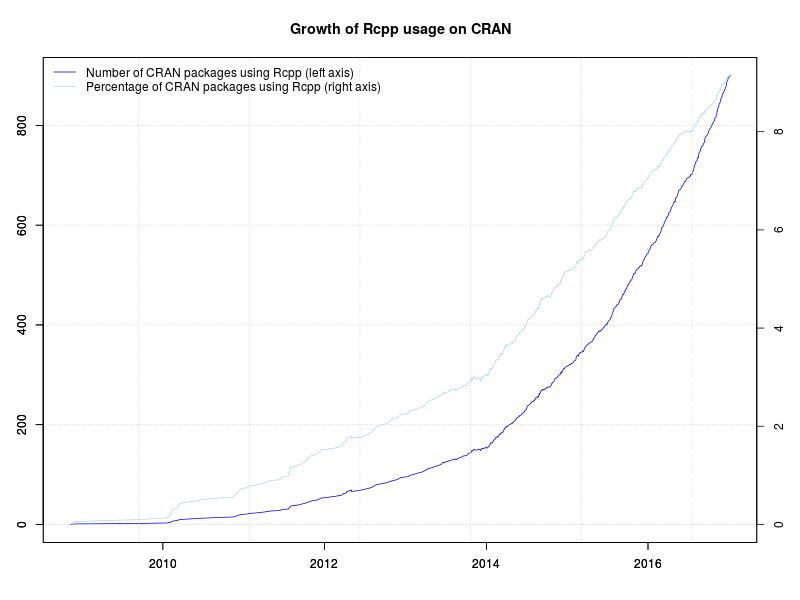
800 Rcpp packages Today, Rcpp passed another milestone as 900 packages on CRAN now depend on it (as measured by Depends, Imports and LinkingTo declarations). The graph is on the left depicts the growth of Rcpp usage over time. The easiest way to compute this is to use the reverse_dependencies_with_maintainers() function from a helper scripts file on CRAN. This still gets one or two false positives of packages declaring a dependency but not actually containing C++ code and the like. There is also a helper function revdep() in the devtools package but it includes Suggests: which does not firmly imply usage, and hence inflates the count. I have always opted for a tighter count with corrections. Rcpp cleared 300 packages in November 2014. It passed 400 packages in June 2015 (when I only tweeted about it), 500 packages in late October 2015, 600 packages last March, 700 packages last July and 800 packages last October. The chart extends to the very beginning via manually compiled data from CRANberries and checked with crandb. The next part uses manually saved entries. The core (and by far largest) part of the data set was generated semi-automatically via a short script appending updates to a small file-based backend. A list of packages using Rcpp is kept on this page. Also displayed in the graph is the relative proportion of CRAN packages using Rcpp. The four per-cent hurdle was cleared just before useR! 2014 where I showed a similar graph (as two distinct graphs) in my invited talk. We passed five percent in December of 2014, six percent July of last year, seven percent just before Christmas eight percent this summer, and nine percent mid-December. 900 user packages is a really large number. This puts more than some responsibility on us in the Rcpp team as we continue to keep Rcpp as performant and reliable as it has been. At the rate things are going, the big 1000 may be hit some time in April. And with that a very big Thank You! to all users and contributors of Rcpp for help, suggestions, bug reports, documentation or, of course, code.

This post by Dirk Eddelbuettel originated on his Thinking inside the box blog. Please report excessive re-aggregation in third-party for-profit settings.

6 January 2017

Dirk Eddelbuettel: RcppTOML 0.1.0

Big news: RcppTOML now works on Windows too! This package had an uneventful 2016 without a single update. Release 0.0.5 had come out in late 2015 and we had no bugs or issues to fix. We use the package daily in production: a key part of our parameterisation is in TOML files In the summer, I took one brief stab at building on Windows now that R sports itself a proper C++11 compiler on Windows too. I got stuck over the not-uncommon problem of incomplete POSIX and/or C++11 support with MinGW and g++-4.9. And sadly ... I appears I wasn't quite awake enough to realize that the missing functionality was right there exposed by Rcpp! Having updated that date / datetime functionality very recently, I was in a better position to realize this when Devin Pastoor asked two days ago. I was able to make a quick suggestion which he tested, which I then refined ... here we are: RcppTOML on Windows too! (For the impatient: CRAN has reported that it has built the Windows binaries, they should hit mirrors such as this CRAN package for RcppTOML shortly.) So what is this TOML thing, you ask? A file format, very suitable for configurations, meant to be edited by humans but read by computers. It emphasizes strong readability for humans while at the same time supporting strong typing as well as immediate and clear error reports. On small typos you get parse errors, rather than silently corrupted garbage. Much preferable to any and all of XML, JSON or YAML -- though sadly these may be too ubiquitous now. But TOML is making good inroads with newer and more flexible projects. The Hugo static blog compiler is one example; the Cargo system of Crates (aka "packages") for the Rust language is another example. The new release updates the included cpptoml template header by Chase Geigle, brings the aforementioned Windows support and updates the Travis configuration. We also added a NEWS file for the first time so here are all changes so far:

Changes in version 0.1.0 (2017-01-05)
  • Added Windows support by relying on Rcpp::mktime00() (#6 and #8 closing #5 and #3)
  • Synchronized with cpptoml upstream (#9)
  • Updated Travis CI support via newer run.sh

Changes in version 0.0.5 (2015-12-19)
  • Synchronized with cpptoml upstream (#4)
  • Improved and extended examples

Changes in version 0.0.4 (2015-07-16)
  • Minor update of upstream cpptoml.h
  • More explicit call of utils::str()
  • Properly cope with empty lists (#2)

Changes in version 0.0.3 (2015-04-27)
  • First CRAN release after four weeks of initial development

Courtesy of CRANberries, there is a diffstat report for this release. More information and examples are on the RcppTOML page. Issues and bugreports should go to the GitHub issue tracker.

This post by Dirk Eddelbuettel originated on his Thinking inside the box blog. Please report excessive re-aggregation in third-party for-profit settings.

4 January 2017

Dirk Eddelbuettel: digest 0.6.11

A new minor release with version number 0.6.11 of the digest package is now on CRAN and in Debian. It is mostly a maintenance release. Sometime last spring we were asked to consider changing the license GPL-2 to GPL (>= 2). Having gotten agreement of all copyright holders, this could finally happen. But it so happens that the last yay just after the last release, so it took another cycle. In other changes, I also made the makeRaw function fully generic and added documentation. The pull request by Jim Hester to add covr support was finally folded in, leading as always to some gaming and improvement of the coverage metrics. A polite request by Radford Neal to support a nosharing option in base::serialize was also honoured; this should help for use with his interesting pqR variant of R. CRANberries provides the usual summary of changes to the previous version. For questions or comments use the issue tracker off the GitHub repo.

This post by Dirk Eddelbuettel originated on his Thinking inside the box blog. Please report excessive re-aggregation in third-party for-profit settings.

24 December 2016

Dirk Eddelbuettel: anytime 0.2.0: Feature, fixes and tests!

A brand new anytime package just arrived at CRAN. This is release number eight, evenly spread with over two per month, since the initial release in September. Needless to say I have been told off not to make this many releases. As they say, no good deed goes unpunished. anytime is a very focused package aiming to do just one thing really well: to convert anything in integer, numeric, character, factor, ordered, ... format to either POSIXct or Date objects -- and to do so without requiring a format string. See the anytime page, or the GitHub README.md for a few examples. This releases does a few things: The following is a quick illustration
R> library(anytime)
R> p <- anytime("2010-01-02 03:04:05.123456")
R> p
[1] "2010-01-02 03:04:05.123456 CST"
R> iso8601(p)
[1] "2010-01-02 03:04:05"
R> rfc2822(p)
[1] "Sat, 02 Jan 2010 03:04:05.123456 -0600"
R> rfc3339(p)
[1] "2010-01-02T03:04:05.123456-0600"
R> 
For symmetry, it also works for dates, but is less detailed
R> jl <- anydate("July 04, 1789")
R> jl
[1] "1789-07-04"
R> iso8601(jl)
[1] "1789-07-04"
R> rfc2822(jl)
[1] "Sat, 04 Jul 1789"
R> rfc3339(jl)
[1] "1789-07-04"
R> 
Of course, all commands are also fully vectorised. See the anytime page, or the GitHub README.md for more examples.

Changes in anytime version 0.2.0 (2016-12-24)
  • Added (exported) helper functions iso8601(), rfc2822() and rfc3339() to format date(time) objects according to standards
  • Conversion to dates is now more robust thanks to improved internal processing (PR #39 closing #36)
  • The ISO 8601 format is now recognised, however the timezone information is not parsed by Boost Date_Time (which is a known upstream limitation) (PR #38 closing #37)
  • The 'allFormats.R' test script was significantly strengthened (#40)
  • Test scripts like 'simpleTests.R' have as also been strengthened (#41); on Windows and in one file two tests need to be skipped.
  • A new 'bulkTest.R' test script was added testing parsing against what R returns

Courtesy of CRANberries, there is a comparison to the previous release. More information is on the anytime page. For questions or comments use the issue tracker off the GitHub repo.

This post by Dirk Eddelbuettel originated on his Thinking inside the box blog. Please report excessive re-aggregation in third-party for-profit settings.

18 December 2016

Dirk Eddelbuettel: RcppArmadillo 0.7.600.1.0

armadillo image Earlier this week, Conrad released Armadillo 7.600.1. The corresponding RcppArmadillo release 0.7.600.1.0 is now on CRAN and in Debian. This follows several of rounds testing at our end with a full reverse-dependency of a pre-release version followed by another full reverse-depency check. Which was of course followed by CRAN testing for two more days. Armadillo is a powerful and expressive C++ template library for linear algebra aiming towards a good balance between speed and ease of use with a syntax deliberately close to a Matlab. RcppArmadillo integrates this library with the R environment and language--and is widely used by (currently) 298 other packages on CRAN -- an increase of 24 just since the last CRAN release of 0.7.500.0.0 in October! Changes in this release relative to the previous CRAN release 0.7.500.0.0 are as follows:

Changes in RcppArmadillo version 0.7.600.1.0 (2016-12-16)
  • Upgraded to Armadillo release 7.600.1 (Coup d'Etat Deluxe)
    • more accurate eigs_sym() and eigs_gen()
    • expanded floor(), ceil(), round(), trunc(), sign() to handle sparse matrices
    • added arg(), atan2(), hypot()

Changes in RcppArmadillo version 0.7.500.1.0 (2016-11-11)
  • Upgraded to Armadillo release 7.500.1
  • Small improvement to return value treatment
  • The sample.h extension was updated to the newer Armadillo interface. (Closes #111)

Courtesy of CRANberries, there is a diffstat report. More detailed information is on the RcppArmadillo page. Questions, comments etc should go to the rcpp-devel mailing list off the R-Forge page.

This post by Dirk Eddelbuettel originated on his Thinking inside the box blog. Please report excessive re-aggregation in third-party for-profit settings.

14 December 2016

Dirk Eddelbuettel: anytime 0.1.2: Another bugfix

Another update, now at release 0.1.2, of anytime arrived at CRAN earlier today. anytime is a very focused package aiming to do just one thing really well: to convert anything in integer, numeric, character, factor, ordered, ... format to either POSIXct or Date objects -- and to do so without requiring a format string. See the anytime page, or the GitHub README.md for a few examples, or just consider the following illustration:
R> library(anytime)
R> anytime("20161107 202122")   ## all digits
[1] "2016-11-07 20:21:22 CST"
R> utctime("2016Nov07 202122")  ## UTC parse example
[1] "2016-11-07 14:21:22 CST"
R> 
Release 0.1.2 addresses a somewhat bizarre Windows-only bug reported at GitHub in #33 and at StackOverflow. Formats of the %Y-%b-%d form, ie 2016-Dec-12 for today would fail on Windows as the contiguous string was apparently getting split by a routine looking for splits on spaces. Really strange. Anyway, I switched to using more helper functions from the Boost String Algorithms library, and things are behaving now. An extra shoutout once more to G bor Cs rdi and the R Consortium for the most awesome R-Builder. I was able to test and fix on Windows during the weekend with no access to an actual windows environment. The NEWS file summarises the release:

Changes in anytime version 0.1.2 (2016-12-13)
  • The (internal) string processing and splitting now uses Boost algorithm functions which avoids a (bizarre) bug on Windows.
  • Test coverage was increased.

Courtesy of CRANberries, there is a comparison to the previous release. More information is on the anytime page. For questions or comments use the issue tracker off the GitHub repo.

This post by Dirk Eddelbuettel originated on his Thinking inside the box blog. Please report excessive re-aggregation in third-party for-profit settings.

12 December 2016

Dirk Eddelbuettel: RcppCCTZ 0.1.0

A new version 0.1.0 of RcppCCTZ arrived on CRAN this morning. It brings a number of new or updated things, starting with new upstream code from CCTZ as well as a few new utility functions. CCTZ is a C++ library for translating between absolute and civil times using the rules of a time zone. In fact, it is two libraries. One for dealing with civil time: human-readable dates and times, and one for converting between between absolute and civil times via time zones. It requires only a proper C++11 compiler and the standard IANA time zone data base which standard Unix, Linux, OS X, ... computers tend to have in /usr/share/zoneinfo. RcppCCTZ connects this library to R by relying on Rcpp. A nice example is the helloMoon() function (based on an introductory example in the CCTZ documentation) showing the time when Neil Armstrong took a small step, relative to local time in New York and Sydney:
R> library(RcppCCTZ)
R> helloMoon(verbose=TRUE)
1969-07-20 22:56:00 -0400
1969-07-21 12:56:00 +1000
                   New_York                      Sydney 
"1969-07-20 22:56:00 -0400" "1969-07-21 12:56:00 +1000" 
R> 
The new formating and parsing functions are illustrated below with default arguments for format strings and timezones. All this can be customized as usual.
R> example(formatDatetime)
frmtDtR> now <- Sys.time()
frmtDtR> formatDatetime(now)            # current (UTC) time, in full precision RFC3339
[1] "2016-12-12T13:21:03.866711+00:00"
frmtDtR> formatDatetime(now, tgttzstr="America/New_York")  # same but in NY
[1] "2016-12-12T08:21:03.866711-05:00"
frmtDtR> formatDatetime(now + 0:4)     # vectorised
[1] "2016-12-12T13:21:03.866711+00:00" "2016-12-12T13:21:04.866711+00:00" "2016-12-12T13:21:05.866711+00:00"
[4] "2016-12-12T13:21:06.866711+00:00" "2016-12-12T13:21:07.866711+00:00"
R> example(parseDatetime)
prsDttR> ds <- getOption("digits.secs")
prsDttR> options(digits.secs=6) # max value
prsDttR> parseDatetime("2016-12-07 10:11:12",        "%Y-%m-%d %H:%M:%S");   # full seconds
[1] "2016-12-07 04:11:12 CST"
prsDttR> parseDatetime("2016-12-07 10:11:12.123456", "%Y-%m-%d %H:%M:%E*S"); # fractional seconds
[1] "2016-12-07 04:11:12.123456 CST"
prsDttR> parseDatetime("2016-12-07T10:11:12.123456-00:00")  ## default RFC3339 format
[1] "2016-12-07 04:11:12.123456 CST"
prsDttR> now <- trunc(Sys.time())
prsDttR> parseDatetime(formatDatetime(now + 0:4))               # vectorised
[1] "2016-12-12 07:21:17 CST" "2016-12-12 07:21:18 CST" "2016-12-12 07:21:19 CST"
[4] "2016-12-12 07:21:20 CST" "2016-12-12 07:21:21 CST"
prsDttR> options(digits.secs=ds)
R>
Changes in this version are summarized here:

Changes in version 0.1.0 (2016-12-11)
  • Synchronized with CCTZ upstream.
  • New parsing and formating helpers for Datetime vectors
  • New parsing and formating helpers for (two) double vectors representing full std::chrono nanosecond resolutions
  • Updated documentation and examples.

We also have a diff to the previous version thanks to CRANberries. More details are at the RcppCCTZ page; code, issue tickets etc at the GitHub repository.

This post by Dirk Eddelbuettel originated on his Thinking inside the box blog. Please report excessive re-aggregation in third-party for-profit settings.

27 November 2016

Dirk Eddelbuettel: anytime 0.1.1: More robust

CRAN just accepted the newest release 0.1.1 of anytime, following the previous five releases since September. anytime is a very focussed package aiming to do just one thing really well: to convert anything in integer, numeric, character, factor, ordered, ... format to POSIXct (or Date) objects -- and to do so without requiring a format string. See the anytime page, or the GitHub README.md for a few examples, or just consider the following illustration:
R> library(anytime)
R> anytime("20161107 202122")   ## all digits
[1] "2016-11-07 20:21:22 CST"
R> utctime("2016Nov07 202122")  ## UTC parse example
[1] "2016-11-07 14:21:22 CST"
R> 
Release 0.1.1 robustifies two aspects. The 'digits only' input above extends what Boost Date_Time can parse and relies on simple-enough pre-processing. This operation is now more robust. We also ensure that input already of class Date is simply passed through by anydate() or utcdate(). Last but not least we added code coverage support, which oh-so-predictably lead us to game this metric to reach the elusive 100% coverage. The NEWS file summarises the release:

Changes in anytime version 0.1.1 (2016-11-27)
  • Both anydate() and utcdate() no longer attempt to convert an input value that is already of type Date.
  • The string splitter (needed for the 'all-digits' formats extending Boost Date_time) is now more defensive about the input argument and more robust. Thanks to Bob Jansen for the heads-up (PR #30 closing issue #29).
  • Code coverage reporting has been added (PR #31).

Courtesy of CRANberries, there is a comparison to the previous release. More information is on the anytime page. For questions or comments use the issue tracker off the GitHub repo.

This post by Dirk Eddelbuettel originated on his Thinking inside the box blog. Please report excessive re-aggregation in third-party for-profit settings.

24 November 2016

Dirk Eddelbuettel: RcppExamples 0.1.8

A new version of the RcppExamples package is now on CRAN. The RcppExamples package provides a handful of short examples detailing by concrete working examples how to set up basic R data structures in C++. This version takes advantage of the updated date and datetime classes in Rcpp 0.12.8 (which are optional for now and being phased in while we deprecate the old ones). A NEWS extract follows:

Changes in RcppExamples version 0.1.8 (2016-11-24)
  • Updated DateExample to show vector addition available under Rcpp 0.12.8 when the (currently still phased in and optional) new Date(time) classes are used via the define in src/Makevars,.win; with fallback code for older versions
  • Other minor edits to DESCRIPTION and README.md

Courtesy of CRANberries, there is also a diffstat report for the most recent release.

This post by Dirk Eddelbuettel originated on his Thinking inside the box blog. Please report excessive re-aggregation in third-party for-profit settings.

19 November 2016

Dirk Eddelbuettel: BH 1.62.0-1

The BH package on CRAN was updated to version 1.62.0. BH provides a large part of the Boost C++ libraries as a set of template headers for use by R, possibly with Rcpp as well as other packages. This release upgrades the version of Boost to the upstream version Boost 1.62.0, and adds three new libraries as shown in the brief summary of changes from the NEWS file which follows below. Special thanks to Kurt Hornik and Duncan Murdoch for help tracking down one abort() call which was seeping into R package builds, and then (re-)testing the proposed fix. We are now modifying one more file ever so slightly to use ::Rf_error(...) instead.

Changes in version 1.62.0-1 (2016-11-15)
  • Upgraded to Boost 1.62 installed directly from upstream source
  • Added Boost property_tree as requested in #29 by Aydin Demircioglu
  • Added Boost scope_exit as requested in #30 by Kirill Mueller
  • Added Boost atomic which we had informally added since 1.58.0

Courtesy of CRANberries, there is also a diffstat report for the most recent release. Comments and suggestions are welcome via the mailing list or the issue tracker at the GitHubGitHub repo.

This post by Dirk Eddelbuettel originated on his Thinking inside the box blog. Please report excessive re-aggregation in third-party for-profit settings.

18 November 2016

Dirk Eddelbuettel: Rcpp 0.12.8: And more goodies

Yesterday the eighth update in the 0.12.* series of Rcpp made it to the CRAN network for GNU R where the Windows binary has by now been generated too; the Debian package is on its way as well. This 0.12.8 release follows the 0.12.0 release from late July, the 0.12.1 release in September, the 0.12.2 release in November, the 0.12.3 release in January, the 0.12.4 release in March, the 0.12.5 release in May, the 0.12.6 release in July, and the 0.12.7 release in September --- making it the twelveth release at the steady bi-montly release frequency. While we are keeping with the pattern, we have managed to include quite a lot of nice stuff in this release. None of it is a major feauture, though, and so we have not increased the middle number. Among the changes this release are (once again) much improved exception handling (thanks chiefly to Jim Hester), better large vector support (by Qiang), a number of Sugar extensions (mostly Nathan, Qiang and Dan) and beginnings of new DateVector and DatetimeVectors classes, and other changes detailed below. We plan to properly phase in the new date(time) classes. For now, you have to use a #define such as this one in Rcpp.h which remains commented-out for now. We plan to switch this on as the new default no earlier than twelve months from now. Rcpp has become the most popular way of enhancing GNU R with C or C++ code. As of today, 843 packages on CRAN depend on Rcpp for making analytical code go faster and further. That is up by eightyfour packages, or a full ten percent, just since the last release in early September! Again, we are lucky to have such a large group of contributors. Among them, we have invited Nathan Russell to the Rcpp Core team given his consistently excellent pull requests (as well as many outstanding Stackoverflow answers for Rcpp). More details on changes are below.

Changes in Rcpp version 0.12.8 (2016-11-16)
  • Changes in Rcpp API:
    • String and vector elements now use extended R_xlen_t indices (Qiang in PR #560)
    • Hashing functions now return unsigned int (Qiang in PR #561)
    • Added static methods eye(), ones(), and zeros() for select matrix types (Nathan Russell in PR #569)
    • The exception call stack is again correctly reported; print methods and tests added too (Jim Hester in PR #582 fixing #579)
    • Variatic macros no longer use a GNU extensions (Nathan in PR #575)
    • Hash index functions were standardized on returning unsigned integers (Also PR #575)
  • Changes in Rcpp Sugar:
    • Added new Sugar functions rowSums(), colSums(), rowMeans(), colMeans() (PR #551 by Nathan Russell fixing #549)
    • Range Sugar now used R_xlen_t type for start/end (PR #568 by Qiang Kou)
    • Defining RCPP_NO_SUGAR no longer breaks the build. (PR #585 by Daniel C. Dillon)
  • Changes in Rcpp unit tests
    • A test for expression vectors was corrected.
    • The constructor test for datetime vectors reflects the new classes which treats Inf correctly (and still as a non-finite value)
  • Changes in Rcpp Attributes
    • An 'empty' return was corrected (PR #589 fixing issue #588, and with thanks to Duncan Murdoch for the heads-up)
  • Updated Date and Datetime vector classes:
    • The DateVector and DatetimeVector classes were renamed with a prefix old; they are currently typedef'ed to the existing name (#557)
    • New variants newDateVector and newDatetimeVector were added based on NumericVector (also #557, #577, #581, #587)
    • By defining RCPP_NEW_DATE_DATETIME_VECTORS the new classes can activated. We intend to make the new classes the default no sooner than twelve months from this release.
    • The capabilities() function can also be used for presence of this feature

Thanks to CRANberries, you can also look at a diff to the previous release. As always, even fuller details are on the Rcpp Changelog page and the Rcpp page which also leads to the downloads page, the browseable doxygen docs and zip files of doxygen output for the standard formats. A local directory has source and documentation too. Questions, comments etc should go to the rcpp-devel mailing list off the R-Forge page.

This post by Dirk Eddelbuettel originated on his Thinking inside the box blog. Please report excessive re-aggregation in third-party for-profit settings.

16 November 2016

Bits from Debian: Debian Contributors Survey 2016

The Debian Contributor Survey launched last week! In order to better understand and document who contributes to Debian, we (Mathieu ONeil, Molly de Blanc, and Stefano Zacchiroli) have created this survey to capture the current state of participation in the Debian Project through the lense of common demographics. We hope a general survey will become an annual effort, and that each year there will also be a focus on a specific aspect of the project or community. The 2016 edition contains sections concerning work, employment, and labour issues in order to learn about who is getting paid to work on and with Debian, and how those relationships affect contributions. We want to hear from as many Debian contributors as possible whether you've submitted a bug report, attended a DebConf, reviewed translations, maintain packages, participated in Debian teams, or are a Debian Developer. Completing the survey should take 10-30 minutes, depending on your current involvement with the project and employment status. In an effort to reflect our own ideals as well as those of the Debian project, we are using LimeSurvey, an entirely free software survey tool, in an instance of it hosted by the LimeSurvey developers. Survey responses are anonymous, IP and HTTP information are not logged, and all questions are optional. As it is still likely possible to determine who a respondent is based on their answers, results will only be distributed in aggregate form, in a way that does not allow deanonymization. The results of the survey will be analyzed as part of ongoing research work by the organizers. A report discussing the results will be published under a DFSG-free license and distributed to the Debian community as soon as it's ready. The raw, disaggregated answers will not be distributed and will be kept under the responsibility of the organizers. We hope you will fill out the Debian Contributor Survey. The deadline for participation is: 4 December 2016, at 23:59 UTC. If you have any questions, don't hesitate to contact us via email at:

13 November 2016

Dirk Eddelbuettel: pkgKitten 0.1.4: Creating R Packages that purr

kitten A new minor release 0.1.4 of pkgKitten just hit on CRAN this morning. One small change is that the package manual page it creates now makes use of the (still new-ish and under-documented and under-used) Rd macros described at the end of Section 2.13 of Writing R Extensions:
See the system.Rd file in share/Rd/macros for more details and macro definitions, including macros \packageTitle, \packageDescription, \packageAuthor, \packageMaintainer, \packageDESCRIPTION and \packageIndices.
By using these macros, and referencing them from the DESCRIPTION file, we can avoid redundancy, or worse, inconsitency, between both files. Or just be plain lazy and describe things just once in the higher-level file: A good thing! Otherwise we fixed a URL to the manual thanks to a PR, and just added some of the regular polish to some of the corners which R CMD check --as-cran is looking into:

Changes in version 0.1.4 (2016-11-13)
  • Utilize newer R macros in package-default manual page.
  • Repair a link to Wrting R Extensions (PR #7 by Josh O'Brien)

More details about the package are at the pkgKitten webpage and the pkgKitten GitHub repo. Courtesy of CRANberries, there is also a diffstat report for this release

This post by Dirk Eddelbuettel originated on his Thinking inside the box blog. Please report excessive re-aggregation in third-party for-profit settings.

8 November 2016

Dirk Eddelbuettel: anytime 0.1.0: New features, some fixes

A new release of anytime is now on CRAN following the four releases in September and October. anytime aims to convert anything in integer, numeric, character, factor, ordered, ... format to POSIXct (or Date) objects -- and does so without requiring a format string. See the anytime page for a few examples. Release 0.1.0 adds several new features. New functions utctime() and utcdate() parse to coordinated universal time (UTC). Several new formats were added. Digit-only formats like 'YYYYMMDD' with or without 'HHMMSS' (or even with fractional secodns 'HHMMSS.ffffff') are supported more thoroughly. Some examples:
R> library(anytime)
R> anytime("20161107 202122")   ## all digits
[1] "2016-11-07 20:21:22 CST"
R> utctime("2016Nov07 202122")  ## UTC parse example
[1] "2016-11-07 14:21:22 CST"
R> 
The NEWS file summarises the release:

Changes in anytime version 0.1.0 (2016-11-06)
  • New functions utctime() and utcdate() were added to parse input as coordinated universal time; the functionality is also available in anytime() and anydate() via a new argument asUTC (PR #22)
  • New (date)time format for RFC822-alike dates, and expanded existing datetime formats to all support fractional seconds (PR #21)
  • Extended functionality to support not only YYYYMMDD (without a separator, and not covered by Boost) but also with HHMM , HHMMSS and HHMMSS.ffffff (PR #30 fixing issue #29)
  • Extended functionality to support HHMMSS[.ffffff] following other date formats.
  • Documentation and tests have been expanded; typos corrected
  • New (unexported) helper functions setTZ, testOutput, setDebug
  • The testFormat (and testOutput) functions cannot be called under RStudio (PR #27 fixing issue #25).
  • More robust support for non-finite values such as NA, NaN or Inf (Fixing issue #16)

Courtesy of CRANberries, there is a comparison to the previous release. More information is on the anytime page. For questions or comments use the issue tracker off the GitHub repo.

This post by Dirk Eddelbuettel originated on his Thinking inside the box blog. Please report excessive re-aggregation in third-party for-profit settings.

Dirk Eddelbuettel: gettz 0.0.3

A minor release 0.0.3 of gettz arrived on CRAN two days ago. gettz provides a possible fallback in situations where Sys.timezone() fails to determine the system timezone. That can happen when e.g. the file /etc/localtime somehow is not a link into the corresponding file with zoneinfo data in, say, /usr/share/zoneinfo. This release adds a second #ifdef to permit builds on Windows for the previous R release (ie r-oldrel-windows). No new code, or new features. Courtesy of CRANberries, there is a comparison to the previous release. More information is on the gettz page. For questions or comments use the issue tracker off the GitHub repo.

This post by Dirk Eddelbuettel originated on his Thinking inside the box blog. Please report excessive re-aggregation in third-party for-profit settings.

30 October 2016

Dirk Eddelbuettel: RProtoBuf 0.4.7: Mostly harmless

CRAN requested a release updating any URLs for Omegahat to the (actually working) omegahat.net URL. The RProtoBuf package had this in one code comment (errr...) and on bibfile entry. Oh well -- so that caused this 0.4.7 release which arrived on CRAN today. It contains the requested change, and pretty much nothing else. RProtoBuf provides R bindings for the Google Protocol Buffers ("Protobuf") data encoding and serialization library used and released by Google, and deployed as a language and operating-system agnostic protocol by numerous projects. The NEWS file summarises the release as follows:

Changes in RProtoBuf version 0.4.7 (2016-10-27)
  • At the request of CRAN, two documentation instances referring to the Omegehat repository were updated to http://omegahat.net

CRANberries also provides a diff to the previous release. The RProtoBuf page has an older package vignette, a 'quick' overview vignette, a unit test summary vignette, and the pre-print for the JSS paper. Questions, comments etc should go to the GitHub issue tracker off the GitHub repo.

This post by Dirk Eddelbuettel originated on his Thinking inside the box blog. Please report excessive re-aggregation in third-party for-profit settings.

Dirk Eddelbuettel: drat 0.1.2: Mostly harmless

CRAN requested a release updating any URLs for Omegahat to the (actually working) omegahat.net URL. So that caused this 0.1.2 release which arrived on CRAN yesterday. It contains the requested change along with one or two other mostly minor changes which accumulated since the last release. drat stands for drat R Archive Template, and helps with easy-to-create and easy-to-use repositories for R packages. Since its inception in early 2015 it has found reasonably widespread adoption among R users because repositories is what we use. In other words, friends don't let friends use install_github(). Just kidding. Maybe. Or not. The NEWS file summarises the release as follows:

Changes in drat version 0.1.2 (2016-10-28)
  • Changes in drat documentation
    • The FAQ vignette added a new question Why use drat
    • URLs were made canonical, omegahat.net was updated from .org
    • Several files (README.md, Description, help pages) were edited

Courtesy of CRANberries, there is a comparison to the previous release. More detailed information is on the drat page.

This post by Dirk Eddelbuettel originated on his Thinking inside the box blog. Please report excessive re-aggregation in third-party for-profit settings.

Next.

Previous.