Search Results: "Dirk Eddelbuettel"

17 May 2020

Dirk Eddelbuettel: RcppArmadillo 0.9.880.1.0

armadillo image Armadillo is a powerful and expressive C++ template library for linear algebra aiming towards a good balance between speed and ease of use with a syntax deliberately close to a Matlab. RcppArmadillo integrates this library with the R environment and language and is widely used by (currently) 719 other packages on CRAN. Conrad released a new upstream version 9.880.1 of Armadillo on Friday which I packaged and tested as usual (result log here in the usual repo). The R package also sports a new OpenMP detection facility once again motivated by macOS which changed its setup yet again. Changes in the new release are noted below.

Changes in RcppArmadillo version 0.9.880.1.0 (2020-05-15)
  • Upgraded to Armadillo release 9.880.1 (Roasted Mocha Detox)
    • expanded qr() to optionally use pivoted decomposition
    • updated physical constants to NIST 2018 CODATA values
    • added ARMA_DONT_USE_CXX11_MUTEX confguration option to disable use of std::mutex
  • OpenMP capability is tested explicitly (Kevin Ushey and Dirk in #294, #295, and #296 all fixing #290).

Courtesy of CRANberries, there is a diffstat report relative to previous release. More detailed information is on the RcppArmadillo page. Questions, comments etc should go to the rcpp-devel mailing list off the R-Forge page. If you like this or other open-source work I do, you can now sponsor me at GitHub. For the first year, GitHub will match your contributions.

This post by Dirk Eddelbuettel originated on his Thinking inside the box blog. Please report excessive re-aggregation in third-party for-profit settings.

15 May 2020

Dirk Eddelbuettel: Let s celebrate Anna!

Today is graduation at Washington University, and just like many other places, the ceremonies are a lot more virtual and surreal that in other years. For Anna today marks the graduation from Biomedical Engineering with a BSc. The McKelvey School of Engineering put a Zoom meeting together yesterday which was nice, and there is something more virtual here. Hopefully a real-life commencenment can take place in a year the May 30, 2021, date has been set. The university also sent out a little commencement site/video which was cute. But at end of the day online-only still falls short of the real deal as we all know too well by now. During those years, just about the only thing really I ever tweeted about appears to be soccer related. As it should because ball is life, as we all know. Here is one from 1 1/2 years ago when her Club Team three-peated in their NIRSA division: And that opens what may be the best venue for mocking Anna: this year, which her a senior and co-captain, the team actually managed to loose a league game (a shocking first in these years) and to drop the final. I presume they anticipated that all we would all talk about around now is The Last Dance and three-peats, and left it at that. Probably wise. Now just this week, and hence days before graduating with her B.Sc., also marks the first time Anna was addressed as Dr Eddelbuettel. A little prematurely I may say, but not too shabby to be in print already! But on the topic of gratulations and what comes next, this tweet was very sweet: As was this, which marked another impressive score: So big thanks from all of us to WashU for being such a superb environment for Anna for those four years, and especially everybody at the Pappu Lab for giving Anna a home and base to start a research career. And deepest and most sincere congratulations to Anna before the next adventure starts .

10 May 2020

Dirk Eddelbuettel: #1 T^4: Adding Some Color to the Shell

The first proper video (following last week s announcement) is up for new T^4 series of video lightning talks with tips, tricks, tools, and toys. Today we just to a little enhancement for the shell enabled color output (if not already on by default).

The slides are available here. Next week we continue on shell customization by looking at the prompt. Also of note, a new repo at GitHub to support the series: use it to open issues for comments, criticism, suggestions, or feedback. If you like this or other open-source work I do, you can now sponsor me at GitHub. For the first year, GitHub will match your contributions.

This post by Dirk Eddelbuettel originated on his Thinking inside the box blog. Please report excessive re-aggregation in third-party for-profit settings.

9 May 2020

Dirk Eddelbuettel: ttdo 0.0.5: Reflect tinytest update

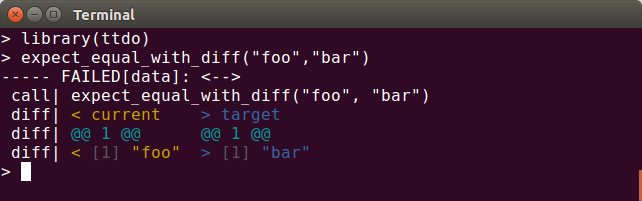
A maintenance release of our (still small) ttdo package just arrived on CRAN. As introduced last fall, the ttdo package extends the most excellent (and very minimal / zero depends) unit testing package tinytest by Mark van der Loo with the very clever and well-done diffobj package by Brodie Gaslam to give us test results with visual diffs: ttdo screenshot tinytest has an extension mechanism we use, and as tinytest was just upgraded to version 1.2.0 changing, among other nice extensions, one interface by allowing for a new error class argument, we had to rebuild as well in order to document the new argument. The release was actually prepared three days ago when tinytest itself was updated, but we waited for the binaries at CRAN to be updated and rebuilt to take advantage of the fully automated submission and test process at CRAN. The NEWS entry follow.

Changes in ttdo version 0.0.5 (2020-05-06)
  • Rebuilt under tinytest 1.2.0 to add support for class argument in error-code test predicates

CRANberries provides the usual summary of changes to the previous version. Please use the GitHub repo and its issues for any questions. If you like this or other open-source work I do, you can now sponsor me at GitHub. For the first year, GitHub will match your contributions.

This post by Dirk Eddelbuettel originated on his Thinking inside the box blog. Please report excessive re-aggregation in third-party for-profit settings.

8 May 2020

Dirk Eddelbuettel: Rcpp Virtual Talk on June 5

We had to cancel R/Finance 2020 due to what is happening all around us. But I plan to present the one-hour workshop I often give in the tutorial session preceding the first day but this time online! To keep it simple, we will stick with the same day, and possibly the same time: Friday morning at 8:00am! So that makes Friday, June 5, at 08:00h Central time. This YouTube! link should then provide the stream, I reckon there may also be a recording afterwards. The talk / demo / presentation will be about an hour long, and material should be similar to the previous ones (of the same length) still available at the talks page (which also has longer talks all the way to the two-day workshops). If you like this or other open-source work I do, you can now sponsor me at GitHub. For the first year, GitHub will match your contributions.

This post by Dirk Eddelbuettel originated on his Thinking inside the box blog. Please report excessive re-aggregation in third-party for-profit settings.

3 May 2020

Dirk Eddelbuettel: #0: Introducing T^4: Tips, Tricks, Tools, and Toys

For way too long now something I had meant to start was a little series about tips, tricks, tools, and toys. I had mentioned the idea a few times to a friend or two, and generally received a thumbs up or a go for it . But it takes a little to get over the humb and get going. And it turns out that last week s r^4 talk on upgrading to R 4.0.0 hit some latent demand as we are now at 1400 views on YouTube. Wowser. So hence without further ado, let s kick off T^4. Similar in spirit to R^4, but broader in scope and going beyond R. The opening slides explaining what we plan to do are here, and the video link follows below:

With some luck we should have the first actual talk next week. See you then! If you like this or other open-source work I do, you can now sponsor me at GitHub. For the first year, GitHub will match your contributions.

This post by Dirk Eddelbuettel originated on his Thinking inside the box blog. Please report excessive re-aggregation in third-party for-profit settings.

28 April 2020

Dirk Eddelbuettel: RcppArmadillo 0.9.870.2.0

armadillo image Armadillo is a powerful and expressive C++ template library for linear algebra aiming towards a good balance between speed and ease of use with a syntax deliberately close to a Matlab. RcppArmadillo integrates this library with the R environment and language and is widely used by (currently) 705 other packages on CRAN. A new upstream release 9.870.2 of Armadillo was released a few days ago. We had tested two release candidates, and this caught one bug. The release was held up at CRAN for a few days as one package had an overly sensitive test depending on random input data; eventually we all convinced ourselves that there was no (Rcpp)Armadillo issue here. So morale: friends don t let friends have tests depend on random behavior. Changes in the new release are noted below.

Changes in RcppArmadillo version 0.9.870.2.0 (2020-04-24)
  • Upgraded to Armadillo release 9.870.2 (Roasted Mocha Retox)
    • faster handling of matrix multiplication expressions by diagvec() and diagmat()
    • added trimatu_ind() and trimatl_ind()
    • more consistent detection of sparse vector expressions

Courtesy of CRANberries, there is a diffstat report relative to previous release. More detailed information is on the RcppArmadillo page. Questions, comments etc should go to the rcpp-devel mailing list off the R-Forge page. If you like this or other open-source work I do, you can now sponsor me at GitHub. For the first year, GitHub will match your contributions.

This post by Dirk Eddelbuettel originated on his Thinking inside the box blog. Please report excessive re-aggregation in third-party for-profit settings.

27 April 2020

Dirk Eddelbuettel: #26: Upgrading to R 4.0.0

Welcome to the 26th post in the rationally regularized R revelations series, or R4 for short. R 4.0.0 was released two days ago, and a casual glance at some social media conversations appears to suggest quite some confusion, almost certainly some misunderstandings, and possibly also a fair amount of fear, uncertainty, and doubt about the process. So I thought I could show how I upgrade my own main workstation, live and in colour without a safety net. (Almost: I did upgrade my laptop yesterday which went swimmingly, if more slowly.) So here is a fresh video about upgrading to R 4.0.0, with some support slides as usual:

The slides used in the video are at this link. A few quick follow-ups to the live nature of this. The pbdZMQ package did in fact install smoothly once the (Ubuntu) -dev packages for Zero MQ were (re-)installed; then IRkernel also followed. BioConductor completed once I realized that GOSemSim needed the annotation package GO.db to be updated, that allowed MNF to install. So the only bug, really, was the circular depdency between pkgload and testthat. Overall, not bad at all for a quick afternoon session! And as mentioned, if you are interested and have questions concerning use of R on a .deb based system like Debain or Ubuntu (or Mint or ), the r-sig-debian list is a very good and friendly place to ask them. If you like this or other open-source work I do, you can now sponsor me at GitHub. For the first year, GitHub will match your contributions.

This post by Dirk Eddelbuettel originated on his Thinking inside the box blog. Please report excessive re-aggregation in third-party for-profit settings.

19 April 2020

Dirk Eddelbuettel: prrd 0.0.3: More improvements

Back in early 2018, the prrd package was introduced as release 0.0.1, uploaded to CRAN, and updated once as release 0.0.2. I have used it extensively for every CRAN release of Rcpp, RcppArmadillo, RcppEigen, BH, and possibly others. The idea of prrd is simple, and described in some more detail on its webpage and its GitHub repo. Reverse dependency checks are an important part of package development and is easily done in a (serial) loop. But these checks are also generally embarassingly parallel as there is no or little interdependency between them (besides maybe shared build depedencies). See the following (dated) screenshot (running six parallel workers, arranged in split byobu session). Since the two early releases, I made a few changes to e.g. the analysis of package checks and their summaries (but never pushed these) as well as a few usability enhancements. This release regroups these. The release is summarised in the NEWS entry:

Changes in prrd version 0.0.3 (2020-04-19)
  • Extended functionality summarise() with optional use of package foghorn (Dirk)
  • New scripts enqueueDepends, dequeueDepends and summmariseJobs (Dirk)
  • Added tweaks and enhancements throughout (Dirk)
  • The default queue location can now be set via options (Dirk)
  • Meta-data on package, version and date is now stored, and shown on dequeue startup (Dirk)
  • The README.md was clarified and improved (Dirk, Avraham Adler in #8, Robert Nuske in #10)

CRANberries provides the usual summary of changes to the previous version. See the aforementioned webpage and its repo for details. For more questions or comments use the issue tracker off the GitHub repo. If you like this or other open-source work I do, you can now sponsor me at GitHub. For the first year, GitHub will match your contributions.

This post by Dirk Eddelbuettel originated on his Thinking inside the box blog. Please report excessive re-aggregation in third-party for-profit settings.

14 April 2020

Dirk Eddelbuettel: RcppArmadillo 0.9.860.2.0

armadillo image Armadillo is a powerful and expressive C++ template library for linear algebra aiming towards a good balance between speed and ease of use with a syntax deliberately close to a Matlab. RcppArmadillo integrates this library with the R environment and language and is widely used by (currently) 706 other packages on CRAN. A new upstream release 9.860.2 of Armadillo was just released. The theme of convergence continues; the previous release increased the minor from 800 to 850, now we are at 860. We first wrapped this up as version 0.9.859.1.0, but it turned out to have been held back by a buglet between R 4.0.0 and Rcpp which the recent patch release fixed (along with other woes on old R or non-CRAN-alike macOS). It then turns out that the new (upstream) version 9.860.1 had a minor bug which I missed as I reverse-depends checked the prior version. Doh. My thanks, as always, to CRAN for spotting this. The fix was added upstream and we have 9.860.2 as RcppArmadillo 0.9.860.2.0. Changes in the new release are noted below.

Changes in RcppArmadillo version 0.9.860.2.0 (2020-04-13)
  • Upgraded to Armadillo release 9.860.2 (Roasted Mocha Fix)
    • Added powmat()
    • Faster access to columns in sparse submatrix views
    • Faster handling of relational expressions by accu()
    • Faster handling of sympd matrices by expmat(), logmat(), sqrtmat()
    • Workaround for save/load issues with HDF5 v1.12
  • Vignettes are now pre-made and include (#285)
  • Two test files are now skipped on 32-bit Windows

Courtesy of CRANberries, there is a diffstat report relative to previous release. More detailed information is on the RcppArmadillo page. Questions, comments etc should go to the rcpp-devel mailing list off the R-Forge page. If you like this or other open-source work I do, you can now sponsor me at GitHub. For the first year, GitHub will match your contributions.

This post by Dirk Eddelbuettel originated on his Thinking inside the box blog. Please report excessive re-aggregation in third-party for-profit settings.

Dirk Eddelbuettel: gettz 0.0.4

A minor routine update 0.0.4 of gettz arrived on CRAN overnight. gettz provides a possible fallback in situations where Sys.timezone() fails to determine the system timezone. That happened when e.g. the file /etc/localtime somehow is not a link into the corresponding file with zoneinfo data in, say, /usr/share/zoneinfo. Since the package was written (in the fall of 2016), R added a similar extended heuristic approach itself. This release adds registration of the compiled routine via R_registerRoutines() and R_useDynamicSymbols(), adds .registration=TRUE to useDynLib() in NAMESPACE, and uses an unquoted symbol in .Call(). Two new badges were added to the README.md as well. And as in the previous release in 2016: No new code, or new features. Courtesy of CRANberries, there is a comparison to the previous release. More information is on the gettz page. For questions or comments use the issue tracker off the GitHub repo. If you like this or other open-source work I do, you can now sponsor me at GitHub. For the first year, GitHub will match your contributions.

This post by Dirk Eddelbuettel originated on his Thinking inside the box blog. Please report excessive re-aggregation in third-party for-profit settings.

12 April 2020

Dirk Eddelbuettel: #25: Test, test, test, those R 4.0.0 binaries with Ubuntu 20.04 and Rocker

Welcome to the 25nd post in the randomly recurring R recitations series, or R4 for short. Just yesterday, we posted a short post along with a video and supporting slides. It covered how to test the soon-to-be-released R 4.0.0 on a custom Ubuntu 18.04 Rocker container. A container for Ubuntu 20.04, which is itself in final beta stages, was being built while the video was made. As it is available now, we created a quick follow-up video showing the use under Ubuntu 20.04:

The updated supporting slides from the video are still at this link. What we showed in both videos does of course also work directly on Ubuntu (or Debian, using those source repos) installations; the commands shown in the Rocker use case generally apply equally to a normal installation. If you like this or other open-source work I do, you can now sponsor me at GitHub. For the first year, GitHub will match your contributions.

This post by Dirk Eddelbuettel originated on his Thinking inside the box blog. Please report excessive re-aggregation in third-party for-profit settings.

Dirk Eddelbuettel: #24: Test, test, test, those R 4.0.0 binaries with Ubuntu and Rocker

Welcome to the 24nd post in the relentlessly regular R ravings series, or R4 for short. R 4.0.0 will be released in less than two weeks, and testing is very important. I had uploaded two alpha release builds (at the end of March and a good week ago) as well as a first beta release yesterday, all to the Debian experimental distribution (as you can see here) tracking the release schedule set by Peter Dalgaard. Because R 4.0.0 will require reinstallation of all packages, it makes some sense to use a spare machine. Or a Docker container. So to support that latter mode, I have now complemented the binaries created from the r-base source package with all base and recommended packages, providing a starting point for actually running simple tests. Which is what we do in the video, using again the R on Ubuntu (18.04) Rocker container:

Slides from the video are at this link. This container based on 18.04 is described here on the Docker Hub; a new 20.04 container with the pre-release of the next Ubuntu LTS should be there shortly once it leaves the build queue. What we showed does of course also work on direct Ubuntu (or Debian, using those source repos) installations; the commands shown in the Rocker use case generally apply equally to a normal installation. If you like this or other open-source work I do, you can now sponsor me at GitHub. For the first year, GitHub will match your contributions.

This post by Dirk Eddelbuettel originated on his Thinking inside the box blog. Please report excessive re-aggregation in third-party for-profit settings.

10 April 2020

Dirk Eddelbuettel: Rcpp 1.0.4.6: Bug fix interim version

rcpp logo Rcpp 1.0.4 was released on March 17, following the usual sequence of fairly involved reverse-depends check along with a call for community testing issued weeks before the release. In that email I specifically pleaded with folks to pretty-please test non-standard setups:
It would be particularly beneficial if those with unsual build dependencies tested it as we would increase overall coverage beyond what I get from testing against 1800+ CRAN packages. BioConductor would also be welcome.
Alas, you can t always get what you want. Shortly after the release we were made aware that the two (large) pull request at the book ends of the 1.0.3 to 1.0.4 release period created trouble. Of these two, the earliest PR in the 1.0.4 release upset older-than-CRAN-tested installation, i.e. R 3.3.0 or before. (Why you d want to run R 3.3.* when R 3.6.3 is current is something I will never understand, but so be it.) This got addressed in two new PRs. And the matching last PR had a bit of sloppyness leaving just about everyone alone, but not all those macbook-wearing data scientists when using newer macOS SDKs not used by CRAN. In other words, unsual setups. But boy, do those folks have an ability to complain. Again, two quick PRs later that was addressed. Along came a minor PR with two more Rcpp::Shield<> uses (as life is too short to manually count PROTECT and UNPROTECT). And then a real issue between R 4.0.0 and Rcpp first noticed with RcppParallel builds on Windows but then also affecting RcppArmadillo. Another quickly issued fix. So by now the count is up to six, and we arrived at Rcpp 1.0.4.6. Which is now on CRAN, after having sat there for nearly a full week, and of course with no reason given. Because the powers that be move in mysterious ways. And don t answer to earthlings like us. As may transpire here, I am little tired from all this. I think we can do better, and I think we damn well should, or I may as well throw in the towel and just release to the drat repo where each of the six interim versions was available for all to take as soon as it materialized. Anyway, here is the state of things. Rcpp has become the most popular way of enhancing R with C or C++ code. As of today, 1897 packages on CRAN depend on Rcpp for making analytical code go faster and further, along with 191 in BioConductor. And per the (partial) logs of CRAN downloads, we are running steasy at one millions downloads per month. The changes for this interim version are summarized below.

Changes in Rcpp patch release version 1.0.4.6 (2020-04-02)
  • Changes in Rcpp API:
    • The exception handler code in #1043 was updated to ensure proper include behavior (Kevin in #1047 fixing #1046).
    • A missing Rcpp_list6 definition was added to support R 3.3.* builds (Davis Vaughan in #1049 fixing #1048).
    • Missing Rcpp_list 2,3,4,5 definition were added to the Rcpp namespace (Dirk in #1054 fixing #1053).
    • A further updated corrected the header include and provided a missing else branch (Mattias Ellert in #1055).
    • Two more assignments are protect with Rcpp::Shield (Dirk in #1059)
  • Changes in Rcpp Attributes:
    • Empty strings are not passed to R CMD SHLIB which was seen with R 4.0.0 on Windows (Kevin in #1062 fixing #1061).
  • Changes in Rcpp Deployment:
    • Travis CI unit tests now run a matrix over the versions of R also tested at CRAN (rel/dev/oldrel/oldoldrel), and coverage runs in parallel for a net speed-up (Dirk in #1056 and #1057).

Thanks to CRANberries, you can also look at a diff to the previous release. Questions, comments etc should go to the rcpp-devel mailing list off the R-Forge page. Bugs reports are welcome at the GitHub issue tracker as well (where one can also search among open or closed issues); questions are also welcome under rcpp tag at StackOverflow which also allows searching among the (currently) 2356 previous questions. If you like this or other open-source work I do, you can now sponsor me at GitHub. For the first year, GitHub will match your contributions.

This post by Dirk Eddelbuettel originated on his Thinking inside the box blog. Please report excessive re-aggregation in third-party for-profit settings.

3 April 2020

Dirk Eddelbuettel: RcppSimdJson 0.0.4: Even Faster Upstream!

A new (upstream) simdjson release was announced by Daniel Lemire earlier this week, and my Twitter mentions have been running red-hot ever since as he was kind enough to tag me. Do look at that blog post, there is some impressive work in there. We wrapped up the (still very simple) rcppsimdjson around it last night and shipped it this morning. RcppSimdJson wraps the fantastic and genuinely impressive simdjson library by Daniel Lemire. Via some very clever algorithmic engineering to obtain largely branch-free code, coupled with modern C++ and newer compiler instructions, it results in parsing gigabytes of JSON parsed per second which is quite mindboggling. For illustration, I highly recommend the video of the recent talk by Daniel Lemire at QCon (which was also voted best talk). The best-case performance is faster than CPU speed as use of parallel SIMD instructions and careful branch avoidance can lead to less than one cpu cycle use per byte parsed. This release brings upstream 0.3 (and 0.3.1) plus a minor tweak (also shipped back upstream). Our full NEWS entry follows.

Changes in version 0.0.4 (2020-04-03)
  • Upgraded to new upstream releases 0.3 and 0.3.1 (Dirk in #9 closing #8)
  • Updated example validateJSON to API changes.

But because Daniel is such a fantastic upstream developer to collaborate with, he even filed a full feature-request maybe you can consider upgrading as issue #8 at our repo containing the fully detailed list of changes. As it is so impressive I will simple quote the upper half of just the major changes:

Highlights
  • Multi-Document Parsing: Read a bundle of JSON documents (ndjson) 2-4x faster than doing it individually. API docs / Design Details
  • Simplified API: The API has been completely revamped for ease of use, including a new JSON navigation API and fluent support for error code and exception styles of error handling with a single API. Docs
  • Exact Float Parsing: Now simdjson parses floats flawlessly without any performance loss (https://github.com/simdjson/simdjson/pull/558). Blog Post
  • Even Faster: The fastest parser got faster! With a shiny new UTF-8 validator and meticulously refactored SIMD core, simdjson 0.3 is 15% faster than before, running at 2.5 GB/s (where 0.2 ran at 2.2 GB/s).

For questions, suggestions, or issues please use the issue tracker at the GitHub repo. Courtesy of CRANberries, there is also a diffstat report for this release. If you like this or other open-source work I do, you can now sponsor me at GitHub. For the first year, GitHub will match your contributions.

This post by Dirk Eddelbuettel originated on his Thinking inside the box blog. Please report excessive re-aggregation in third-party for-profit settings.

2 April 2020

Dirk Eddelbuettel: RQuantLib 0.4.12: Small QuantLib 1.18 update

A new release 0.4.12 of RQuantLib arrived on CRAN today, and was uploaded to Debian as well. QuantLib is a very comprehensice free/open-source library for quantitative finance; RQuantLib connects it to the R environment and language. This version does relatively little. When QuantLib 1.18 came out, I immediately did my usual bit of packaging it for Debian as well creating binaries via my Ubuntu PPA so that I could test the package against it. And a few call from RQuantLib are now hitting interface functions marked as deprecated leading to compiler nags. So I fixed that in PR #146. And today CRAN sent me email to please fix in the released version so I rolled this up as 0.4.12. Not other changes.

Changes in RQuantLib version 0.4.12 (2020-04-01)
  • Changes in RQuantLib code:
    • Calls deprecated-in-QuantLib 1.18 were updated (Dirk in #146).

Courtesy of CRANberries, there is also a diffstat report for the this release. As always, more detailed information is on the RQuantLib page. Questions, comments etc should go to the new rquantlib-devel mailing list. Issue tickets can be filed at the GitHub repo. If you like this or other open-source work I do, you can now sponsor me at GitHub. For the first year, GitHub will match your contributions.

This post by Dirk Eddelbuettel originated on his Thinking inside the box blog. Please report excessive re-aggregation in third-party for-profit settings.

28 March 2020

Dirk Eddelbuettel: RProtoBuf 0.4.17: Robustified

A new release 0.4.17 of RProtoBuf is now on CRAN. RProtoBuf provides R with bindings for the Google Protocol Buffers ( ProtoBuf ) data encoding and serialization library used and released by Google, and deployed very widely in numerous projects as a language and operating-system agnostic protocol. This release contains small polishes related to the release 0.4.16 which added JSON support for messages, and switched to ByteSizeLong. This release now makes sure JSON functionality is only tested where available (on version 3 of the Protocol Buffers library), and that ByteSizeLong is only called where available (version 3.6.0 or later). Of course, older versions build as before and remain fully supported.

Changes in RProtoBuf version 0.4.17 (2020-03-xx)
  • Condition use of ByteSizeLong() on building with ProtoBuf 3.6.0 or later (Dirk in #71 fixing #70).
  • The JSON unit tests are skipped if ProtoBuf 2.* is used (Dirk, also #71).
  • The configure script now extracts the version from the DESCRIPTION file ( (Dirk, also #71).

CRANberries provides the usual diff to the previous release. The RProtoBuf page has copies of the (older) package vignette, the quick overview vignette, and the pre-print of our JSS paper. Questions, comments etc should go to the GitHub issue tracker off the GitHub repo. If you like this or other open-source work I do, you can now sponsor me at GitHub. For the first year, GitHub will match your contributions.

This post by Dirk Eddelbuettel originated on his Thinking inside the box blog. Please report excessive re-aggregation in third-party for-profit settings.

24 March 2020

Dirk Eddelbuettel: New package RcppDate 0.0.1 now on CRAN!

A new small package with a new C++ header library is now on CRAN. It brings the date library by Howard Hinnant to R. This library has been in pretty wide-spread use for a while now, and adds to C++11/C++14/C++17 what will be (with minor modifications) the date library in C++20. I had been aware of it for a while, but not needed thanks to CCTZ library out of Google and our RcppCCTZ package. And like CCTZ, it builds upon std::chron adding a whole lot of functionality and useability enhancement. But a some upcoming (and quite exciting!) changes in nanotime required it, I had a reason to set about packaging it as RcppDate. And after a few days of gestation and review it is now available via CRAN. Two simple example files are included and can be accessed by Rcpp::sourceCpp(). Some brief excerpts follow. The first example shows three date constructors. Note how the month (and the leading digits) are literals. No quotes for strings anywhere. And no format (just like our anytime package for R).
  constexpr auto x1 = 2015_y/March/22;
  constexpr auto x2 = March/22/2015;
  constexpr auto x3 = 22_d/March/2015;
Note that these are constexpr that resolve at compile-time, and that the resulting year_month_day type is inferred via auto. A second example constructs the last day of the months similarly:
  constexpr auto x1 = 2015_y/February/last;
  constexpr auto x2 = February/last/2015;
  constexpr auto x3 = last/February/2015;
For more, see the copious date.h documentation. The (very bland first) NEWS entry (from a since-added NEWS file) for the initial upload follows.

Changes in version 0.0.1 (2020-01-17)
  • Initial CRAN upload of first version

If you like this or other open-source work I do, you can now sponsor me at GitHub. For the first year, GitHub will match your contributions.

This post by Dirk Eddelbuettel originated on his Thinking inside the box blog. Please report excessive re-aggregation in third-party for-profit settings.

19 March 2020

Dirk Eddelbuettel: RProtoBuf 0.4.16: Now with JSON

A new release 0.4.16 of RProtoBuf is now on CRAN. RProtoBuf provides R with bindings for the Google Protocol Buffers ( ProtoBuf ) data encoding and serialization library used and released by Google, and deployed very widely in numerous projects as a language and operating-system agnostic protocol. This release contains a PR contributed by Siddhartha Bagaria which adds JSON support for messages, which had been an open wishlist item. I also appeased a clang deprecation warning that had come up on one of the CRAN test machines.

Changes in RProtoBuf version 0.4.16 (2020-03-19)
  • Added support for parsing and printing JSON (Siddhartha Bagaria in #68 closing wishlist #61).
  • Switched ByteSize() to ByteSizeLong() to appease clang (Dirk).

CRANberries provides the usual diff to the previous release. The RProtoBuf page has copies of the (older) package vignette, the quick overview vignette, and the pre-print of our JSS paper. Questions, comments etc should go to the GitHub issue tracker off the GitHub repo. If you like this or other open-source work I do, you can now sponsor me at GitHub. For the first year, GitHub will match your contributions.

This post by Dirk Eddelbuettel originated on his Thinking inside the box blog. Please report excessive re-aggregation in third-party for-profit settings.

18 March 2020

Dirk Eddelbuettel: RcppCCTZ 0.2.7

A new release 0.2.7 of RcppCCTZ is now at CRAN. RcppCCTZ uses Rcpp to bring CCTZ to R. CCTZ is a C++ library for translating between absolute and civil times using the rules of a time zone. In fact, it is two libraries. One for dealing with civil time: human-readable dates and times, and one for converting between between absolute and civil times via time zones. And while CCTZ is made by Google(rs), it is not an official Google product. The RcppCCTZ page has a few usage examples and details. This package was the first CRAN package to use CCTZ; by now at least three others do using copies in their packages which remains less than ideal. This version adds internal extensions, contributed by Leonardo, which support upcoming changes to the nanotime package we are working on.

Changes in version 0.2.7 (2020-03-18)
  • Added functions _RcppCCTZ_convertToCivilSecond that converts a time point to the number of seconds since epoch, and _RcppCCTZ_convertToTimePoint that converts a number of seconds since epoch into a time point; these functions are only callable from C level (Leonardo in #34 and #35).
  • Added function _RcppCCTZ_getOffset that returns the offset at a speficied time-point for a specified timezone; this function is only callable from C level (Leonardo in #32).

We also have a diff to the previous version thanks to CRANberries. More details are at the RcppCCTZ page; code, issue tickets etc at the GitHub repository. If you like this or other open-source work I do, you can now sponsor me at GitHub. For the first year, GitHub will match your contributions.

This post by Dirk Eddelbuettel originated on his Thinking inside the box blog. Please report excessive re-aggregation in third-party for-profit settings.

Next.

Previous.