I have received two MIPS Creator CI20 boards, thanks to Imagination Technologies. It s a small MIPS32 development board:
As you can see it comes in a nice packaging with a world-compatible power adapter. It uses a Ingenic JZ4780 SoC with a dual core MIPS32 CPU running at 1.2GHz with a PowerVR SGX540 GPU. The board is fitted with 1GB of RAM, 8GB of NOR flash, HDMI output, USB 2.0 ports, Ethernet + Wi-Fi + BlueTooth, SD card slot, IR receiver, expansion headers and more. The schematics are available. The Linux kernel and the U-Boot bootloader sources are also available.
Powering this board with a USB keyboard, a USB mouse and a HDMI display, it boots off the internal flash on a Debian Wheezy up to the XFCE environment. Besides the kernel, the Wi-Fi + Bluetooth firmware, and very few configuration changes, it runs a vanilla Debian. Unfortunately I haven t found time to play more with it yet, but it looks already quite promising.
The board has not been formally announced yet, so I do not know when it will become available, nor the price, but if you are interested I ll bring it to DebConf14. Don t hesitate to ask me if you want to look at it or play with it.
We ve been busy setting up a Virtual Machine (VM) image to be used by participants of a MOOC that s opening in early september on Relational Databases at Telecom SudParis.
We ve chosen to use Vagrant and VirtualBox which are used to build, distribute and run the box, providing scriptability (reproducibility) and making it portable on most operating systems.
The VM itself contains a Debian (jessie) minimal system which runs (in the background) PostgreSQL, Apache + mod_php, phpPgAdmin, and a few applications of our own to play with example databases already populated in PostgreSQL.
As the MOOC s language will be french, we expect the box to be used mostly on machines with azerty keyboards. This and other context elements led us to add some customizations (locale, APT mirror) in provisioning scripts run during the box creation.
At the moment, we generate 2 variants of the box, one for 32 bits kernel (i686) and one for 64 bits kernel (amd64) which (once compressed) represent betw. 300 and 350 Mb.
The resulting boxes are uploaded to a self-hosting site, and distributed through vagrantcloud. Once the VM are created in VirtualBox, the typical VMDK drives file is around 1.3Gb.
We use our own Debian base boxes containing a minimal Debian jessie/testing, instead of relying on someone else s, and recreate them using (the development branch version of) bootsrap-vz. This ensure we can put more trust in the content as it s a native Debian package installation without MITM intervention.
The VM are meant to be run headless for the moment, keeping their size to the minimum, even though we also provide a script to install and configure a desktop environment based on XFCE4.
The applications are either used through vagrant ssh, for instance for SQL command-line in psql, or in the Web browser, for our own Web based SQL exerciser, or phpPgAdmin (see a demo screencast (in french, w/ english subtitles)), which can then be used even off-line by the participants, which also means this requires no servers availability for our IT staff.
The MOOC includes a section on PHP + SQL programming, whose exercises can be performed using a shared sub-folder of /vagrant/ which allows editing on the host with the favourite native editor/IDE, while running PHP inside the VM s Apache + mod_php.
The sources of our environment are available as free software, if you re interested to replicate a similar environment for another project.
As we re still polishing the environment before the MOOC opening (on september 10th), I m not mentioning the box URLs but they shouldn t be too hard to find if you re investigating (refering to the fusionforge project s web site).
We don t know yet how suitable this environment will be for learning SQL and database design and programming, and if Vagrant will bring more difficulties than benefits. Still we hope that the participants will find this practical, allowing them to work on the lab / exercises whenever and wherever they chose, removing the pain of installing and configuring a RDBMS on their machines, or the need to be connected to a cloud or to our overloaded servers. Of course, one limitation will be the requirements on the host machines, that will need to be reasonably modern, in order to run a virtualized Linux system. Another is access to high bandwidth for downloading the boxes, but this is kind of a requirement already for downloading/watching the videos of the MOOC classes
Big thanks go to our intern St phane Germain, who joined us this summer to work on this virtualized environment.
Debian LTS - impressions and thoughts from my first month involvement
About LTS - we want feedback and more companies supporting it financially
Squeeze LTS, and even more Debian LTS, is a pretty young project, started in May 2014, so it's still a bit unclear where exactly we'll be going One purpose of this post is to spread some information about the initiative and invite you to tell us what you think about it or what your needs are.
LTS stands for "Long Term Support" and the goal of the project is to extend the security support for Squeeze (aka the current oldstable distribution) by two years. If it weren't for Squeeze LTS, the security support for it would have been stopped in May 2014 (=one year after the release of the current stable distribution), which for many is a too short timespan after it's release in February 2011. It's an experiment, we hope that there will be a similar Wheezy LTS initiative in future, but the future is unwritten and things will change based on our experiences and your needs.
If you have feedback on the direction LTS should take (or anything else LTS related), please comment on the lts mailing list. For immediate feedback there is also the #debian-lts IRC channel.
Another quite pragmatic way to express your needs is to read more about how to financially contribute to LTS and then doing exactly that - and unsurprisingly we are prioritizing the updates based on the needs expressed from our paying customers.
My LTS work in July 2014
So, "somehow" I started working for money on Debian LTS in July, which means there were 10h I got paid, and probably another 10h where I did LTS related work unpaid. I used those to release four updates for squeeze-lts (linux-2.6, file, munin and reportbug) fixing 22 CVEs in total.
The unpaid work was mostly spent on unsuccessfully working on security updates and on adding support for LTS to the security team tracker, which I improved but couldn't fully address and which I haven't properly shared / committed yet... but at least I have a local instance of the tracker now, which - for LTS - is more useful than the .debian.org one. Hopefully during DebConf14 we'll manage to fix the tracker for good.
Without success I've looked at libtasn1-3 (where the first fixes applied easily but then the code had changed too much from what was in squeeze compared to the available patches that I gave up) and libxstream-java (which is at version 1.3, while patches exist for upstream branches 1.4 and 2.x, but those need newer java to build and maybe if I'll spend two more hours I'll can get it build and then I'll have to find a useful test case, which looked quite difficult on a brief look.. so maybe I give up on libxstream-java too.... OTOH, if you use it and can do some testing, please do tell me.
Working on all these updates turned out to be more team work than expected and a lot of work involving code (which I did expect), and often code which I'd normally not look at... similarily with tools: one has to deal with tools one doesnt like, eg I had to install cdbs... And as I usually like challenges, this has actually been a lot of fun! Though it's also pretty cool to use common best practices, easy and understandable workflows. I love README.Source (or better yet, when it's not needed). And while git is of course really really great, it's still very desirable if your package builds twice (=many times) in a row, without resetting it via git.
Some more observations
The first 16 updates (until July 19th) didn't have a DLA ID, until I suggested to introduce them and insisted until we agreed. So now we agreed to put the DLA ID in the subject of the announcement mails and there is also some tool support for generating the templates/mails, but enforcing proper subjects is not done, as silent bounces are useless (and non silent ones can be abused too easily). I'm not really happy about this, but who is happy with the way email works today? And I agree, it's not the end of the world if an LTS announcement is done without a proper ID, but it looks unprofessional and could be avoided, but we have more important work to do. But one day we should automate this better.
Another detail I'm not entirely happy is the policy/current decision that "almost everything is fine to upload if deemed sensible by the uploader" (which is everyone in the Debian upload keyring(s)). In discussions before actually having the archive some people suggested the desire to upload new upstream versions too (eg newer kernels, iceweasel or other software to keep running a squeeze desktop in the modern world were discussed). I sincerely hope for most intrusive new upstream versions squeeze-(sloppy-)backports is used instead, and squeeze-lts rather not. Luckily so far all uploads were (IMHO) sensible and so, right now, I will just say that I hope it will stay this way. And it's true, one also has to install these upgrades in the first place. But people do that blindly all the time...
So by design/desire currently there is no gatekeeping mechanism whatsover (no NEW, no proposed updates), except that only some selected "few" can upload. What is uploaded (and signed correctly), gets pushed to archive, buildds and the mirrors, and hopefully maybe someone will send an announcement. So far this has worked remarkedly well - and it's also the way the Debian Security team works, as I'm told. Looking at this from a process quality / automatisation perspective, all this manual and errorprone labour seems very strange to me.
And then there is another thing: as already mentioned, the people working paid hours for this, are prioritizing their work based on customer requests. So we did two updates (python-scipy and file), which are not fixed in wheezy yet. I think this is unfortunate and while I could probably prepare the wheezy DSA for file, I don't really want to join the Security Team... or maybe I want/should join the Security Team and be a seldomly active member (eg fixing file in wheezy now....)
A note related to this: out of those 37 uploads done until today, 16 were done by those two people being paid, while the other 21 uploads were done by 10 volunteers (or at least not paid by Debian LTS). It will be interesting to see how this statistics evolves over time.
Last, but not least, there is also this can of worms (aka: the discussion) about paying people to work on Debian... I do agree it's work we didnt find volunteers for and I also see how the (financial side of the) setup is done outside of Debian (and well too, btw!), but... then we also use Debian ressources like buildds, the archive itself and official mailing lists. Also I'm currently biased in this discussion, as I directly (and happily) profit from it. I'm mentioning this here, because I believe it's important we discuss this and come to both good and practical conclusions. FWIW, we have also discussed this on the list, feel free to search the archives for it.
To bring this post to an end: for those attending DebConf14 (directly or thanks to some ninjas), there will be an event about LTS in Portland, though I'm not sure yet what I will have to talk about what hasn't been already covered here But this probably means that will be a good opportunity for you to do lots of talking instead! I'm curious what you will have to say!
Thanks for reading this far. I think I can promise that my next LTS report will be shorter
Today I did something interesting with the Debian packaging for
propellor, which seems like it could
be a useful technique for other Debian packages as well.
Propellor is configured by a directory, which is maintained as a local git
repository. In propellor's case, it's ~/.propellor/. This contains a lot
of haskell files, in fact the entire source code of propellor! That's
really unusual, but I think this can be generalized to any package whose
configuration is maintained in its own git repository on the user's
system. For now on, I'll refer to this as the config repo.
The config repo is set up the first time a user runs
propellor. But, until now, I didn't provide an easy way to update
the config repo when the propellor package was updated. Nothing would
break, but the old version would be used until the user updated it
themselves somehow (probably by pulling from a git repository over the
network, bypassing apt's signature validation).
So, what I wanted was a way to update the config repo, merging in any
changes from the new version of the Debian package, while preserving the
user's local modifications. Ideally, the user could just run git merge
upstream/master, where the upstream repo was included in the
Debian package.
But, that can't work! The Debian package can't reasonably include the
full git repository of propellor with all its history. So, any git repository
included in the Debian binary package would need to be a synthetic one, that
only contains probably one commit that is not connected to anything else. Which
means that if the config repo was cloned from that repo in version 1.0, then
when version 1.1 came around, git would see no common parent when merging 1.1
into the config repo, and the merge would fail horribly.
To solve this, let's assume that the config repo's master branch has
a parent commit that can be identified, somehow, as coming from a past
version of the Debian package. It doesn't matter which version, although
the last one merged with will be best. (The easy way to do this is to set
refs/heads/upstream/master to point to it when creating the config repo.)
Once we have that parent commit, we have three things:
The current content of the config repo.
The content from some old version of the Debian package.
The new content of the Debian package.
Now git can be used to merge #3 onto #2, with -Xtheirs, so the result
is a git commit with parents of #3 and #2, and content of #3. (This can be
done using a temporary clone of the config repo to avoid touching its contents.)
Such a git commit can be merged into the config repo, without any conflicts
other than those the user might have caused with their own edits.
So, propellor will tell the user when updates are available, and they can
simply run git merge upstream/master to get them. The resulting history
looks like this:
* Merge remote-tracking branch 'upstream/master'
 \
  * merging upstream version
   \
    * upstream version
*   user change
 /
* upstream version
So, generalizing this, if a package has a lot of config files, and
creates a git repository containing them when the user uses it
(or automatically when it's installed), this method can be used to provide
an easily mergable branch that tracks the files as distributed with the package.
It would perhaps not be hard to get from here to a full git-backed version of
ucf. Note that the Debian binary package doesn't have to ship a git
repisitory, it can just as easily ship the current version of the config files
somewhere in /usr, and check them into a new empty repository as part of the
generation of the upstream/master branch.
A little more than 2 years ago, the
Ceilometer project was launched inside
the OpenStack ecosystem. Its main objective was to measure OpenStack cloud
platforms in order to provide data and mechanisms for functionalities such
as billing, alarming or capacity planning.
In this article, I would like to relate what I've been doing with other
Ceilometer developers in the last 5 months. I've lowered my involvement in
Ceilometer itself directly to concentrate on solving one of its biggest
issue at the source, and I think it's largely time to take a break and talk
about it.
Ceilometer early design
For the last years, Ceilometer didn't change in its core architecture.
Without diving too much in all its parts, one of the early design decision
was to build the metering around a data structure we called samples. A
sample is generated each time Ceilometer measures something. It is composed
of a few fields, such as the the resource id that is metered, the user and
project id owning that resources, the meter name, the measured value, a
timestamp and a few free-form metadata. Each time Ceilometer measures
something, one of its components (an agent, a pollster ) constructs and
emits a sample headed for the storage component that we call the
collector.
This collector is responsible for storing the samples into a database. The
Ceilometer collector uses a pluggable storage system, meaning that you can
pick any database system you prefer. Our original implementation has been
based on MongoDB from the beginning, but we then added a SQL driver, and
people contributed things such as HBase or DB2 support.
The REST API exposed by Ceilometer allows to execute various reading
requests on this data store. It can returns you the list of resources that
have been measured for a particular project, or compute some statistics on
metrics. Allowing such a large panel of possibilities and having such a
flexible data structure allows to do a lot of different things with
Ceilometer, as you can almost query the data in any mean you want.
The scalability issue
We soon started to encounter scalability issues in many of the read requests
made via the REST API. A lot of the requests requires the data storage to do
full scans of all the stored samples. Indeed, the fact that the API allows
you to filter on any fields and also on the free-form metadata (meaning non
indexed key/values tuples) has a terrible cost in terms of performance (as
pointed before, the metadata are attached to each sample generated by
Ceilometer and is stored as is). That basically means that the sample data
structure is stored in most drivers in just one table or collection, in
order to be able to scan them at once, and there's no good "perfect"
sharding solution, making data storage scalability painful.
It turns out that the Ceilometer REST API is unable to handle most of the
requests in a timely manner as most operations are O(n) where n is the
number of samples recorded (see
big O notation if you're
unfamiliar with it). That number of samples can grow very rapidly in an
environment of thousands of metered nodes and with a data retention of
several weeks. There is a few optimizations to make things smoother in
general cases fortunately, but as soon as you run specific queries, the API
gets barely usable.
During this last year, as the Ceilometer PTL, I discovered these issues
first hand since a lot of people were feeding me back with this kind of
testimony. We engaged several blueprints to improve the situation, but it
was soon clear to me that this was not going to be enough anyway.
Thinking outside the box
Unfortunately, the PTL job doesn't leave him enough time to work on the
actual code nor to play with anything new. I was coping with most of the
project bureaucracy and I wasn't able to work on any good solution to tackle
the issue at its root. Still, I had a few ideas that I wanted to try and as
soon as I stepped down from the PTL role, I stopped working on Ceilometer
itself to try something new and to think a bit outside the box.
When one takes a look at what have been brought recently in Ceilometer, they
can see the idea that Ceilometer actually needs to handle 2 types of data:
events and metrics.
Events are data generated when something happens: an instance start, a
volume is attached, or an HTTP request is sent to an REST API server. These
are events that Ceilometer needs to collect and store. Most OpenStack
components are able to send such events using the notification system built
into oslo.messaging.
Metrics is what Ceilometer needs to store but that is not necessarily tied
to an event. Think about an instance CPU usage, a router network bandwidth
usage, the number of images that Glance is storing for you, etc These are
not events, since nothing is happening. These are facts, states we need to
meter.
Computing statistics for billing or capacity planning requires both of these
data sources, but they should be distinct. Based on that assumption, and the
fact that Ceilometer was getting support for storing events, I started to
focus on getting the metric part right.
I had been a system administrator for a decade before jumping into OpenStack
development, so I know a thing or two on how monitoring is done in this
area, and what kind of technology operators rely on. I also know that
there's still no silver bullet this made it a good challenge.
The first thing that came to my mind was to use some kind of time-series
database, and export its access via a REST API as we do in all OpenStack
services. This should cover the metric storage pretty well.
Cooking Gnocchi
A cloud of gnocchis!
At the end of April 2014, this led met to start a new project code-named
Gnocchi. For the record, the name was picked after confusing so many times
the OpenStack Marconi project, reading OpenStack Macaroni instead. At least
one OpenStack project should have a "pasta" name, right?
The point of having a new project and not send patches on Ceilometer, was
that first I had no clue if it was going to make something that would be any
better, and second, being able to iterate more rapidly without being
strongly coupled with the release process.
The first prototype started around the following idea: what you want is to
meter things. That means storing a list of tuples of (timestamp, value) for
it. I've named these things "entities", as no assumption are made on what
they are. An entity can represent the temperature in a room or the CPU usage
of an instance. The service shouldn't care and should be agnostic in this
regard.
One feature that we discussed for several OpenStack summits in the
Ceilometer sessions, was the idea of doing aggregation. Meaning, aggregating
samples over a period of time to only store a smaller amount of them. These
are things that time-series format such as the
RRDtool have been doing for a long time on
the fly, and I decided it was a good trail to follow.
I assumed that this was going to be a requirement when storing metrics into
Gnocchi. The user would need to provide what kind of archiving it would
need: 1 second precision over a day, 1 hour precision over a year, or even
both.
The first driver written to achieve that and store those metrics inside
Gnocchi was based on whisper. Whisper
is the file format used to store metrics for the
Graphite project. For the actual storage,
the driver uses Swift, which has the advantages to be part of OpenStack and
scalable.
Storing metrics for each entities in a different whisper file and putting
them in Swift turned out to have a fantastic algorithm complexity: it was
O(1). Indeed, the complexity needed to store and retrieve metrics doesn't
depends on the number of metrics you have nor on the number of things you
are metering. Which is already a huge win compared to the current Ceilometer
collector design.
However, it turned out that whisper has a few limitations that I was
unable to circumvent in any manner. I needed to patch it to remove a lot of
its assumption about manipulating file, or that everything is relative to
now (time.time()). I've started to hack on that in my own fork, but then
everything broke. The whisper project code base is, well, not the state of
the art, and have 0 unit test. I was starring at a huge effort to transform
whisper into the time-series format I wanted, without being sure I wasn't
going to break everything (remember, no test coverage).
I decided to take a break and look into alternatives, and stumbled upon
Pandas, a data manipulation and statistics
library for Python. Turns out that Pandas support time-series natively, and
that it could do a lot of the smart computation needed in Gnocchi. I built a
new file format leveraging Pandas for computing the time-series and named it
carbonara (a wink to both the
Carbon project and pasta, how
clever!). The code is quite small (a third of whisper's, 200 SLOC vs 600
SLOC), does not have many of the whisper limitations and it has test
coverage. These Carbonara files are then, in the same fashion, stored into
Swift containers.
Anyway, Gnocchi storage driver system is designed in the same spirit that
the rest of OpenStack and Ceilometer storage driver system. It's a plug-in
system with an API, so anyone can write their own driver. Eoghan Glynn has
already started to write a InfluxDB driver, working
closely with the upstream developer of that database. Dina Belova started to
write an OpenTSDB driver. This helps to make sure
the API is designed directly in the right way.
Handling resources
Measuring individual entities is great and needed, but you also need to link
them with resources. When measuring the temperature and the number of a
people in a room, it is useful to link these 2 separate entities to a
resource, in that case the room, and give a name to these relations, so one
is able to identify what attribute of the resource is actually measured. It
is also important to provide the possibility to store attributes on these
resources, such as their owners, the time they started and ended their
existence, etc.
Relationship of entities and resources
Once this list of resource is collected, the next step is to list and filter
them, based on any criteria. One might want to retrieve the list of
resources created last week or the list of instances hosted on a particular
node right now.
Resources also need to be specialized. Some resources have attributes that
must be stored in order for filtering to be useful. Think about an instance
name or a router network.
All of these requirements led to to the design of what's called the
indexer. The indexer is responsible for indexing entities, resources, and
link them together. The initial implementation is based on
SQLAlchemy and should be pretty efficient. It's
easy enough to index the most requested attributes (columns), and they are
also correctly typed.
We plan to establish a model for all known OpenStack resources (instances,
volumes, networks, ) to store and index them into the Gnocchi indexer in
order to request them in an efficient way from one place. The generic
resource class can be used to handle generic resources that are not tied to
OpenStack. It'd be up to the users to store extra attributes.
Dropping the free form metadata we used to have in Ceilometer makes sure
that querying the indexer is going to be efficient and scalable.
The indexer classes and their relations
REST API
All of this is exported via a REST API that was partially designed and
documented in the
Gnocchi specification in the Ceilometer repository;
though the spec is not up-to-date yet. We plan to auto-generate the
documentation from the code as we are currently doing in Ceilometer.
The REST API is pretty easy to use, and you can use it to manipulate
entities and resources, and request the information back.
Macroscopic view of the Gnocchi architecture
Roadmap & Ceilometer integration
All of this plan has been exposed and discussed with the Ceilometer team
during the last
OpenStack summit in Atlanta
in May 2014, for the Juno release. I led a session about this entire
concept, and convinced the team that using Gnocchi for our metric storage
would be a good approach to solve the Ceilometer collector scalability
issue.
It was decided to conduct this project experiment in parallel of the current
Ceilometer collector for the time being, and see where that would lead the
project to.
Early benchmarks
Some engineers from Mirantis did a few benchmarks around Ceilometer and also
against an early version of Gnocchi, and Dina Belova presented them to us
during the mid-cycle sprint we organized in Paris in early July.
The following graph sums up pretty well the current Ceilometer performance
issue. The more you feed it with metrics, the more slow it becomes.
For Gnocchi, while the numbers themselves are not fantastic, what is
interesting is that all the graphs below show that the performances are
stable without correlation with the number of resources, entities or
measures. This proves that, indeed, most of the code is built around a
complexity of O(1), and not O(n) anymore.
Next steps
Cl ment drawing the logo
While the Juno cycle is being wrapped-up for most projects, including
Ceilometer, Gnocchi development is still ongoing. Fortunately, the composite
architecture of Ceilometer allows a lot of its features to be replaced by
some other code dynamically. That, for example, enables Gnocchi to provides
a Ceilometer dispatcher plugin for its collector, without having to ship the
actual code in Ceilometer itself. That should help the development of
Gnocchi to not be slowed down by the release process for now.
The Ceilometer team aims to provide Gnocchi as a sort of technology preview
with the Juno release, allowing it to be deployed along and plugged with
Ceilometer. We'll discuss how to integrate it in the project in a more
permanent and strong manner probably during the
OpenStack Summit for Kilo
that will take place next November in Paris.
Update 2014-08-20: apcid needs tweaking. See update section below.
Somehow both my regular work laptop and home entertainment computers (both running Debian Jessie) were switched to systemd without me noticing. Judging from by dpkg.log it may have happened quite a while ago. I'm pretty sure that's a compliment to the backwards compatibility efforts made by the systemd developers and a criticism of me (I should be paying closer attention to what's happening on my own machines!).
In any event, I've started trying to pay more attention now - particularly learning how to take advantage of this new software. I'll try to keep this blog updated as I learn. For now, I have made a few changes and discoveries.
First - I have a convenient bash wrapper I use that both starts my OpenVPN client to a samba server and then mounts the drive. I only connect when I need to and rarely do I properly disconnect (the OpenVPN connection does not start automatically). So, I've written the script to carefully check if my openvpn connection is present and either restart or start depending on the results.
I had something like this:
if ps -eFH   egrep [o]penvpn; then
  sudo /etc/init.d/openvpn restart
else
  sudo /etc/init.d/openvpn start
fi
One of the advertised advantages of systemd is the ability to more accurately detect if a service is running. So, first I changed this to:
if systemctl -q is-active openvpn.service; then
  sudo systemctl restart openvpn.service
else
  sudo systemctl start openvpn.service
fi
However, after reviewing the man page I realized I can shorten if further to simply:
sudo systemctl restart openvpn.service
According to the man page, restart means:
Restart one or more units specified on the command line. If the units are not
running yet, they will be started.
After discovering this meaning for "restart" in systemd, I tested and realized that "restart" works the same way for openvpn using the old sysv style init system. Oh well. At least there's a man page and a stronger guarantee that it will work with all services, not just the ones that happen to respect that convention in their init.d scripts.
The next step was to disable openvpn on start up. I confess, I never bothered to really learn update-rc.d. Everytime I read the manpage I ended up throwing up my hands and renaming symlinks by hand. In the case of openvpn I had previously edited /etc/default/openvpn to indicate that "none" of the virtual private networks should be started.
Now, I've returned that file to the default configuration and instead I ran:
systemctl disable openvpn.service
UPDATES
2014-08-20: I've recently noticed strange behavior when I wake my laptop. Seems to sometimes go right back to sleep. After doing some digging I traced the problem to some customizations I have made to my laptop's acpid behavior combined with systemd taking over some apci events.
Up to now, I have created my own /etc/acpi files so I have full control over the acpi events. In particular, I don't want my laptop to suspend when I close the lid. I only want it to suspend when I press the suspend key. And, when it does suspend, I want it to run my own personal suspend script so I can do things like lock the screen and restart tint2.
I've found that systemd launches it's own acpi event monitoring that ignores my /etc/acpid rules (the systemd "unit" that monitors events is called acpid.socket which exists in addition to acpid.service). The systemd reaction to events is controlled by the systemd-logind.service which has a configuration file: /etc/systemd/logind.conf. By default, systemd-logind.service will put my laptop to sleep when the lid is closed and when the suspend button is pushed. systemd seems to get the signal first, putting the laptop to sleep. After I wake it up, acpid gets the signal - so it goes right back to sleep.
Reading man logind.conf helps. I was able to restore my desired behavior by adding these lines to /etc/systemd/logind.conf:
Yet another update from my internship at Mozilla, as part of the OPW.
An online triage workshop
One of the most interesting thing I've done during the last weeks has been to held an online
Bug Triage Workshop on the #testday channel at irc.mozilla.org.
That was a first time for me: I had been a moderator for a series of training sessions on IRC
organized by Debian Women, but never a "speaker".
The experience turned out to be a good one: creating the material for the workshop had me basically summarize (not too much, I'm way too verbose!)
all what I've learned in this past months about triaging in Mozilla, and speaking of it on IRC was a sort of challenge to my usual shyness.
And I was so very lucky that a participant was able to reproduce the bug I picked as example, thus confirming it! How cool is that? ;)
The workshop was about the very basics of triaging for Firefox, and we mostly focused on a simplified lifecycle of bugs, a guided tour of bugzilla (including the quicksearch and the advanced one, the list view, the individual bug view) and an explanation of the workflow of the triager.
I still have my notes, and I plan to upload them to the wiki, sooner or later.
I'm pretty satisfied of the outcome: the only regret is that the promoting wasn't enough, so we have few participants.
Will try to promote it better next time! :)
about:crashes
Another thing that had me quite busy in the last weeks was to learn more about crashes and stability in general.
If you are unfortunate enough to experience a crash with Firefox, you're probably familiar with the Mozilla Crash Reporter dialog box
asking you to submit the crash report.
But how does it works?
From the client-side, Mozilla uses Breakpad as set of libraries for crash reporting. The Mozilla specific implementation adds to that a crash-reporting UI, a server to collect and process crash reported data (and particularly to convert raw dumps into readable stack traces) and a web interface, Socorro to view and parse crash reports.
Curious about your crashes? The about:crashes page will show you a list of the submitted and unsubmitted crash reports.
(And by the way, try to type about:about in the location bar, to find all the super-secret about pages!)
For the submitted ones clicking on the CrashID will take you to the crash report on crash-stats, the website where the reports are stored and analyzed.
The individual crash report page on crash-stats is awesome: it shows you the reported bug numbers if any bug summaries match the crash signature, as well as many other information. If crash-stats does not show a bug number, you really should file one!
The CrashKill team works on these reports tracking the general stability of the various channels, triaging the top crashes, ensuring that the crash bugs have enough information and are reproducible and actionable by the devs.
The crash-stats site is a mine of information: take a look at the Top Crashes for Firefox 34.0a1.
If you click on a individual crash, you will see lots of details about it: just on the first tab ("Signature Summary") you can find a breakdown of the crashes by OS, by graphic vendors or chips or even by uptime range.
A very useful one is the number of crashes per install, so that you know how widespread is the crashing for that particular signature.
You can also check the comments the users have submitted with the crash report, on the "Comments" tab.
One and Done tasks review
Last week I helped the awesome group of One and Done developers, doing some reviewing of the tasks pages.
One and Done is a brilliant idea to help people contribute to the QA Mozilla teams.
It's a website proposing the user a series of tasks of different difficulty and on different topics to contribute to Mozilla. Each task is self-contained and can last few minutes or be a bit more challenging.
The team has worked hard on developing it and they have definitely done an awesome job! :)
I'm not a coding person, so I just know that they're using Django for it, but if you are interested in all the dirty details take a look at the project repository.
My job has been only to check all the existent tasks and verify that the description and instruction are correct, that the task is properly tagged and so on.
My impression is that this an awesome tool, well written and well thought with a lot of potential for helping people in their first steps into Mozilla. Something that other projects should definitely imitate (cough Debian cough).
What's next?
Next week I'll be back on working on bugs. I kind of love bugs, I have to admit it.
And not squashing them: not being a coder make me less of a violent person toward digital insects.
Herding them is enough for me. I'm feeling extremely non-violent toward bugs.
I'll try to help Liz with the Test Plan for Firefox 34, on the triaging/verifying bugs part.
I'll also try to triage/reproduce some accessibility bugs (thanks Mario for the suggestion!).
Hi Everybody,
So I already explained that we decided to go in a new direction and patch ucf to allow automatic configuration file merging with any custom command. Today I wanted to explain how to use ucf s new three-way-merge-command functionality in
conjunction with Elektra in order to ultilize Elektra s powerful tools in order to allow automatic three-way merges of your package s configuration during upgrades in a way that is more reliable than a diff3 merge. This guide assumes that you are fimilar with ucf already and are just trying to impliment the --three-way-merge-command option using Elektra.
The addition of the --three-way-merge-command option was a part of my Google Summer of Code Project. This option takes the form:
--three-way-merge-command command [New File] [Destination]
Where command is the command you would like to use for the merge. New File and Destination are the same as always.
We added a new script to Elektra called elektra-merge for use with this new option in ucf. This script acts as a liaison between ucf and Elektra, allowing a regular ucf command to run a kdb merge even though ucf commands only pass New File and Destination whereas kdb merge requires ourpath, theirpath, basepath, and resultpath. Since ucf already performs a three-way merge, it keeps track of all the necessary files to do so, even though it only takes in New File and Destination.
In order to use elektra-merge, the current configuration file must be mounted to KDB to serve as ours in the merge. The script automatically mounts theirs, base, and result using the kdb remount command in order to use the same backend as ours (since all versions of the same file should use the same backend anyway) and this way users don t need to worry about specifying the backend for each version of the file. Then the script attempts a merge on the newly mounted KeySets. Once this is finished, either on success or not, the script finishes by unmouting all but our copy of the file to cleanup KDB. Then, if the merge was successful ucf will replace ours with the result providing the package with an automatically merged configuration which will also be updated in KDB itself.
Additionally, we added two other scripts, elektra-mount and elektra-umount which act as simple wrappers for kdb mount and kdb umount. That work identically but are more script friendly
The full command to use elektra-merge to perform a three-way merge on a file managed by ucf is:
ucf --three-way --threeway-merge-command elektra-merge [New File] [Destination]
Thats it! As described above, elektra-merge is smart enough to run the whole merge off of the information from that command and utilizes the new kdb remount command to do so.
Integrating elektra-merge into a package that already uses ucf is very easy! In postinst you should have a line similar to:
ucf [New File] [Destination]
or perhaps:
ucf --three-way [New File] [Destination]
All you must do is in postinst, when run with the configure option you must mount the config file to Elektra:
kdb elektra-mount [New File] [Mounting Destination] [Backend]
Next, you must update the line containing ucf with the options --three-way and --threeway-merge-command like so:
ucf --three-way --threeway-merge-command elektra-merge [New File] [Destination]
Then, in your postrm script, during a purge, you must umount the config file before deleting it:
kdb lektra-umount [Name]
That s it! With those small changes you can use Elektra to perform automatic three-way merges on any files that your package uses ucf to handle!
I just wanted to show a quick example, below is a diff representing the changes we made to the samba-common package in order to allow automatic configuration merging for smb.conf using Elektra. We chose this package because it already
uses ucf to handle smb.conf but it frequently requires users to manually merge changes across versions. Here is the patch showing what we changed:
diff samba_orig/samba-3.6.6/debian/samba-common.postinst samba/samba-3.6.6/debian/samba-common.postinst

92c92,93

< ucf --three-way --debconf-ok "$NEWFILE" "$CONFIG"

---

> kdb elektra-mount "$CONFIG" system/samba/smb ini

> ucf --three-way --threeway-merge-command elektra-merge --debconf-ok "$NEWFILE" "$CONFIG"

Only in samba/samba-3.6.6/debian/: samba-common.postinst~

diff samba_orig/samba-3.6.6/debian/samba-common.postrm samba/samba-3.6.6/debian/samba-common.postrm

4a5

> kdb elektra-umount system/samba/smb
As you can see, all we had to do was add the line to mount smb.conf during install, update the ucf command to include the new --threeway-merge-command option, and unmount system/samba/smb during a purge. It really is that easy!
Sincerely,
Ian S. Donnelly
With the release of the latestrtc.debian.org portal update, there are numerous improvements but there are still some known problems too.
The good news is that if you have a web browser, you can probably make successful WebRTC calls from one developer to another without any need to install or configure anything else.
The bad news is that not every permutation of browser and client will work. Here I list some of the limitations so people won't waste time on them.
The SIP proxy supports any SIP client
Just about any SIP client can connect to the proxy server and register. This does not mean that every client will be able to call each other. Generally speaking, modern WebRTC clients will be able to call each other. Standalone softphones or deskphones will call each other. Calling from a normal softphone or deskphone to a WebRTC browser, or vice-versa, will not work though.
Some softphones, like Jitsi, have implemented most of the protocols to communicate with WebRTC but they are yet to put the finishing touches on it.
Chat should just work for any combination of clients
The new WebRTC frontend supports SIP chat messaging.
There is no presence or buddy list support yet.
You can even use a tool like sipsak to accept or send SIP chats from a script.
Chat works for any client new or old. Although a WebRTC user can't call a softphone user, for example, they can send chats to each other.
WebRTC support in Iceweasel 24 on wheezy systems is very limited
On a wheezy system, the most recent Iceweasel update is version 24.7.
This version supports most of WebRTC but does not support TURN relay servers to help you out of a NAT network.
If you call between two wheezy machines on the same NAT network it will work. If the call has to traverse a NAT boundary it will not work.
Wheezy users need to either download a newer Firefox version or use Chromium.
JsSIP doesn't handle ICE elegantly
Internet Connectivity Establishment (ICE, RFC 5245) is meant to prevent calls from being answered with missing audio or video streams.
ICE is a mandatory part of WebRTC.
When correctly implemented, the JavaScript application will exchange ICE candidates and run the connectivity checks before alerting anybody that a call is ringing. If the checks fail (for example, with Iceweasel 24 and NAT), the caller should be told the call can't be made and the callee shouldn't be disturbed at all.
JsSIP is not operating in this manner though. It alerts the callee before telling the browser to start the connectivity checks. Then it even waits for the callee to answer. Only then does it tell the browser to start checking connectivity. This is not a fault with the ICE standard or the browser, it is an implementation problem.
Therefore, until this is fully fixed, people may still see some calls that appear to answer but don't have any media stream. After this is fixed, such calls really will be a thing of the past.
Debian RTC testing is more than just a pipe dream
Although these glitches are not ideal for end users, there is a clear roadmap to resolve them.
There are also a growing collection of workarounds to minimize the inconvenience. For example, JSCommunicator has a hack to detect when somebody is using Iceweasel 24 and just refuse to make the call. See the option require_relay_candidate in the config.js settings file. This also ensures that it will refuse to make a call if the TURN server is offline. Better to give the user a clear error than a call without any audio or video stream.
require_relay_candidate is enabled on freephonebox.net because it makes life easier for end users. It is not enabled on rtc.debian.org because some DDs may be willing to tolerate this issue when testing on a local LAN.
To find out more about practical integration of WebRTC into free software solutions, consider coming to my talk at xTupleCon in October.
There hasn t been a progress-report on DEP-11 for some time, but that doesn t mean there was no work going on on it.
DEP-11 is Debian s implementation of AppStream, as well as an effort to enhance the metadata available about software in Debian. While initially, AppStream was only about applications, DEP-11 was designed with a larger scope, to collect data about libraries, binaries and things like Python modules. Now, since AppStream 0.6, DEP-11 and AppStream have essentially the same scope, with the difference of DEP-11 metadata being described in YAML, while official AppStream data is XML. That was due to a request by our ftpmasters team, which doesn t like XML (which is also not used anywhere in Debian, as opposed to YAML). But this doesn t mean that people will have to deal with the YAML file format: The libappstream library will just take DEP-11 data as another data source for it s Xapian database, allowing anything using libappstream to access that data just like the XML stuff. Richards libappstream-glib will also receive support for the DEP-11 format soon, filling it s in-memory data cache and enabling the use of GNOME-Software on Debian.
So, what has been done so far? The past months, my Google Summer of Code student. Abhishek Bhattacharjee, was working hard to integrate DEP-11 support into dak, the Debian Archive Kit, which maintains the whole Debian archive. The result will be an additional metadata table in our internal Postgres database, storing detailed information about the software available in a Debian package, as well as Components-<arch>.yml.gz files in the Debian repositories. Dak will also produce an application icon-cache and a screenshots repository. During the time of the SoC, Abhishek focused mainly on the applications part of things, and less on the other components (like extracting data about Python modules or libraries) these things can easily be implemented later.
The remaining steps will be to polish the code and make it merge-ready for Debian s dak (as soon as it has received enough testing, we will likely give it a try on the Tanglu Debian derivative). Following that, Apt will be extended to fetch the DEP-11 data on-demand on systems where it is useful (which is currently mostly desktop-systems) if you want to save a little bit of space, you will be able to disable downloading this extra metadata in Apt. From there, libappstream will take the data for it s Xapian db. This will lead to the removal of the much-hated (from ftpmasters and maintainers side) app-install-data package, which has not been updated for two years and only contains a small fraction of the metadata provided by DEP-11.
What Debian will ultimately gain from this effort is support for software-centers like GNOME-Software, and improved support for tools like Apper and Muon in displaying applications. Long-term, with more metadata being available, It would be cool to add support for it to specialized package managers , like Python s pip, npm or gem, to make them fetch information about available distribution software and install that instead of their own copies from 3rd-party repositories, if possible. This should ultimatively lead to less code duplication on distributions and will likely result in fewer security issues, since the officially maintained and integrated distribution packages can easily be used, if possible. This is no attempt to make tools like pip obsolete, but an attempt to have the different tools installing software on your machine communicate better, instead of creating parallel worlds in terms of software management. Another nice sideeffect of more metadata will be options to search for tools handling mimetypes in the software repos (in case you can t open a file), smart software centers installing missing firmware, and automatic suggestions for developers which software they need to install in order to build a specific software package. Also, the data allows us to match software across distributions, for that, I will have some news soon (not sure how soon though, as I am currently in thesis-writing-mode, and therefore have not that much spare time). Since the goal is to have these features available on all distributions supporting AppStream, it will take longer to realize but we are on a good way.
So, if you want some more information about my student s awesome work, you can read his blogpost about it. He will also be at Debconf 14 (Portland). (I can t make it this time, but I surely won t miss the next Debconf)
Sadly, I only see a very small chance to have the basic DEP-11 stuff land in-time for Jessie (lots of review work needs to be done, and some more code needs to be written), but we will definitively have it in Jessie+1.
A small example on how this data will look like can be found here a larger, actual file is available here. Any questions and feedback are highly appreciated.
Last time I changed my desktop computer I bought a CPU from the Intel Haswell family, the one available on the market at that time. I carefully selected the CPU to make sure it supports as many instructions extensions as possible in this family (Intel likes segmentation, even high-end CPUs like the Core i7-4770k do not support all possible instructions). I ended-up choosing the Core i7-4771 as it supports the Transactional Synchronization Extensions (Intel TSX) instructions, which provide transactional memory support. Support for it has been recently added in the GNU libc, and has been activated in Debian. By choosing this CPU, I wanted to be sure that I can debug this support in case of bug report, like for example in bug#751147.
Recently somecomputingwebsites started to mention that the TSX instructions have bugs on Xeon E3 v3 family (and likely on Core i7-4771 as they share the same silicon and stepping), quoting this Intel document. Indeed one can read on page 49:
HSW136. Software Using Intel TSX May Result in Unpredictable System Behavior
Problem: Under a complex set of internal timing conditions and system events, software using the Intel TSX (Transactional Synchronization Extensions) instructions may result in unpredictable system behavior.
Implication: This erratum may result in unpredictable system behavior.
Workaround: It is possible for the BIOS to contain a workaround for this erratum.
And later on page 51:
Due to Erratum HSw136, TSX instructions are disabled and are only supported for software development. See your Intel representative for details.
The same websites tell that Intel is going to disable the TSX instructions via a microcode update. I hope it won t be the case and that they are going to be able to find a microcode fix. Otherwise it would mean I will have to upgrade my desktop computer earlier than expected. It s a bit expensive to upgrade it every year and that s a the reason why I skipped the Ivy Bridge generation which didn t bring a lot from the instructions point of view. Alternatively I can also skip microcode and BIOS updates, in the hope I won t need another fix from them at some point.
This is a random post inspired by recent purchases. Some things we buy are practical, others are a little arbitrary.
I tend to avoid buying things for the sake of it, and have explicitly started decluttering our house over the past few years. That said sometimes things just seem sufficiently "cool" that they get bought without too much thought.
This entry is about two things.
A couple of years ago my bathroom was ripped apart and refitted. Gone was the old and nasty room, and in its place was a glorious space. There was only one downside to the new bathroom - you turn on the light and the fan comes on too.
When your wife works funny shifts at the hospital you can find that the (quiet) fan sounds very loud in the middle of the night and wakes you up..
So I figured we could buy a couple of LED lights and scatter them around the place - when it is dark the movement sensors turn on the lights.
These things are amazing. We have one sat on a shelf, one velcroed to the bottom of the sink, and one on the floor, just hidden underneath the toilet.
Due to the shiny-white walls of the room they're all you need in the dark.
By contrast my second purchase was a mistake - The Logitech Harmony 650 Universal Remote Control should be great. It clearly has the features I want - Able to power:
Our TV.
Our Sky-box.
OUr DVD player.
The problem is solely due to the horrific software. You program the device via an application/website which works only under Windows.
I had to resort to installing Windows in a virtual machine to make it run:
# Get the Bus/ID for the USB device
bus=$(lsusb  grep -i Harmony   awk ' print $2 '   tr -d 0)
id=$(lsusb  grep -i Harmony   awk ' print $4 '   tr -d 0:)
# pass to kvm
kvm -localtime ..  -usb -device usb-host,hostbus=$bus,hostaddr=$id ..
That allows the device to be passed through to windows, though you'll later have to jump onto the Qemu console to re-add the device as the software disconnects and reconnects it at random times, and the bus changes. Sigh.
I guess I can pretend it works, and has cut down on the number of remotes sat on our table, but .. The overwhelmingly negative setup and configuration process has really soured me on it.
There is a linux application which will take a configuration file and squirt it onto the device, when attached via a USB cable. This software, which I found during research prior to buying it, is useful but not as much as I'd expected. Why? Well the software lets you upload the config file, but to get a config file you must fully complete the setup on Windows. It is impossible to configure/use this device solely using GNU/Linux.
(Apparently there is MacOS software too, I don't use macs. *shrugs*)
In conclusion - Motion-activated LED lights, more useful than expected, but Harmony causes Discord.
This is the last week of Google Summer of Code 2014 - all good things must come to an end. To wrap things up, I ve merged all my work on JSCommunicator into a new version with all the added features. You can now demo the new and improved (or at least so I hope) JSCommunicator on rtc.debian.org!
JSCommunicator 2.0 has an assortment of new add-ons, the most important new features are the Instant Messaging component and the internationalization support.
The UI has been reorganized but we are currently not using a skin for color scheme - will be posting about that in a bit. The idea is to have a more neutral look that can be easily customized and integrated with other web apps.
A chat session is automatically opened when you begin a call with someone - unless you already started a chat session with said someone. Sound alerts for new incoming messages are optional in the config file, visual alerts occur when an inactive chat tab receives a new message. Future work includes multiple user chat sessions and adapting the layout to a large amount of chat tabs. Currently it only handles 6. (Should I allow more? Who chats with more than 6 people at once? 14 year old me would, but now I just can t handle that. Anyway, I welcome advice on how to go about this. Should we do infinite tabs or if not, what s the cut-off?)
About internationalization, I m uber proud to say we currently run in 6 languages! The 6 are English (default), Spanish, French, Portuguese, Hebrew and German. But one thing I must mention is that since I added new stuff to JSCommunicator, some of the new stuff doesn t have a translation. I took care of the Portuguese translation and Yehuda Korotkin quickly turned in the Hebrew translation, but we are still missing an update for Spanish, French and German. If you can contribute, please do. There are about 10 new labels to translate, you can fix the issue here. Or if you re short on time, shoot me an email with the translation for what s on the right side of the = :
welcome = Welcome,
call = Call
chat = Chat
enter_contact = Enter contact
type_to_chat = type to chat
start_chat = start chat
me = me
logout = Logout
no_contact = Please enter a contact.
remember_me = Remember me
I ll merge it myself but I ll be sure to add you to the authors list.
One of the issues that comes up from time to time in many organizations and projects (both community and commercial ventures) is the question of how to manage bug reports, feature requests and support requests.
There are a number of open source solutions and proprietary solutions too. I've never seen a proprietary solution that offers any significant benefit over the free and open solutions, so this blog only looks at those that are free and open.
Support request or bug?
One common point of contention is the distinction between support requests and bugs. Users do not always know the difference.
Some systems, like the Github issue tracker, gather all the requests together in a single list. Calling them "Issues" invites people to submit just about anything, such as "I forgot my password".
At the other extreme, some organisations are so keen to keep support requests away from their developers that they operate two systems and a designated support team copies genuine bugs from the customer-facing trouble-ticket/CRM system to the bug tracker. This reduces the amount of spam that hits the development team but there is overhead in running multiple systems and having staff doing cut and paste.
Will people use it?
Another common problem is that a full bug report template is overkill for some issues. If a user is asking for help with some trivial task and if the tool asks them to answer twenty questions about their system, application version, submit log files and other requirements then they won't use it at all and may just revert to sending emails or making phone calls.
Ideally, it should be possible to demand such details only when necessary. For example, if a support engineer routes a request to a queue for developers, then the system may guide the support engineer to make sure the ticket includes attributes that a ticket in the developers' queue should have.
Beyond Perl
Some of the most well known systems in this space are Bugzilla, Request Tracker and OTRS. All of these solutions are developed in Perl.
These days, Python, JavaScript/Node.JS and Java have taken more market share and Perl is chosen less frequently for new projects. Perl skills are declining and younger developers have usually encountered Python as their main scripting language at university.
My personal perspective is that this hinders the ability of Perl projects to attract new blood or leverage the benefits of new Python modules that don't exist in Perl at all.
Bugzilla has fallen out of the Debian and Ubuntu distributions after squeeze due to its complexity. In contrast, Fedora carries the Bugzilla packages and also uses it as their main bug tracker.
Evaluation
I recently started having a look at the range of options in the Wikipedia list of bug tracking systems.
Some of the trends that appear:
Many appear to be bug tracking systems rather than issue tracking / general-purpose support systems. How well do they accept non-development issues and keep them from spamming the developers while still providing a useful features for the subset of users who are doing development?
A number of them try to bundle other technologies, like wiki or FAQ systems: but how well do they work with existing wikis? This trend towards monolithic products is slightly dangerous. In my own view, a wiki embedded in some other product may not be as well supported as one of the leading purpose-built wikis.
Some of them also appear to offer various levels of project management. For development tasks, it is just about essential for dependencies and a roadmap to be tightly integrated with the bug/feature tracker but does it make the system more cumbersome for people dealing with support requests? Many support requests, like "I've lost my password", don't really have any relationship with project management or a project roadmap.
Not all appear to handle incoming requests by email. Bug tracking systems can be purely web/form-based, but email is useful for helpdesk systems.
Questions
This leaves me with some of the following questions:
Which of these systems can be used as a general purpose help-desk / CRM / trouble-ticket system while also being a full bug and project management tool for developers?
For those systems that don't work well for both use cases, which combinations of trouble-ticket system + bug manager are most effective, preferably with some automated integration?
Which are more extendable with modern programming practices, such as Python scripting and using Git?
Which are more future proof, with choice of database backend, easy upgrades, packages in official distributions like Debian, Ubuntu and Fedora, scalability, IPv6 support?
Which of them are suitable for the public internet and which are only considered suitable for private access?
Hi Everybody,
A few days ago I posted an entry on this blog called dpkg Woes where I explained that due to a lack of response, we were abandoning our plan to patch dpkg for my Google Summer of Code project, and I explained that we had a new solution. Well today I would like to tell you about that solution. Instead of patching dpkg, which would take a long time and seemed like it would never make it upstream, we have added some new features to ucf which will allow my Google Summer of Code project to be realized.
If you don t know, ucf, which stands for Update Configuration File, is a popular Debian package whose goal is to preserve user changes to config files. It is meant to act as an alternative to considering a configuration file a conffile on systems that use dpkg. Instead, package maintainers can use ucf to handle these files in a conffile-like way. Where conffiles must work on all systems, because they are shipped with the package, configuration files that use ucf can be handled by maintainer scripts and can vary between systems. ucf exists as a script that allows conffile-like handling of non-conffile configuration files and allows much more flexibility than dpkg s conffile system. In fact, ucf even includes an option to perform a three-way merge on files it manages, it currently only uses diff3 for the task though.
As you can see, ucf has a goal that while different than ours, seems naturally compatible to our goal of automatic conffile merging. Obviously, since ucf is a different tool than dpkg we had to re-think how we were going to integrate with ucf. Luckily, integration with ucf proved to be much more simple than integration with dpkg. All we had to do to integrate with ucf was to add a generic hook to attempt a three way merge using any tool created for the task such as Elektra and kdb merge. Felix submitted a pull request with the exact code almost a week ago and we have talked with Manoj Srivastava, the developer for ucf, and he seemed to really like the idea. The only changes we made are to add an option for a three-way merge command, and if one is present, the merge is attempted using the specified command. It s all pretty simple really.
Since we decided to include a generic hook for a three-way merge command instead of an Elektra-specific one (which would be less open and would create a dependency on Elektra), we also had to add functionality to Elektra to work with this hook. We ended up writing a new script, called elektra-merge which is now included in our repository. All this script does is act as a liaison between the ucf --three-way-merge-command option and Elektra itself. The script automatically mounts the correct files for theirs and base and dest using the new remount command.
Since the only parameters that are passed to the ucf merge command are the paths of ours, theirs, base and result, we were missing vital information on how to mount these files. Our solution was to create the remount command which mirrors the backend configuration of an existing mountpoint to create a new mountpoint using a new file. So if ours is mounted to system/ours using ini, kdb remount /etc/theirs system/theirs system/ours will mount /etc/theirs to system/theirs using the same backend as ours. Since theirs, base, and result should all have the same backend as ours, we can use remount to mount these files even if all we know is their paths.
Now, package maintainers can edit their scripts to utilize this new feature. If they want, package maintainers can specify a command to use to merge files using ucf during package upgrades. I will soon be posting a tutorial about how to integrate this feature into a package and how to use Elektra in your scripts in order to allow for automatic three-way merges during package upgrade. I will post a link to the tutorial here once it is published.
Sincerely,
Ian S. Donnelly
In October this year I'll be visiting the US and Canada for some conferences and a wedding. The first event will be xTupleCon 2014 in Norfolk, Virginia. xTuple make the popular open source accounting and CRM suite PostBooks. The event kicks off with a keynote from Apple co-founder Steve Wozniak on the evening of October 14. On October 16 I'll be making a presentation about how JSCommunicator makes it easy to add click-to-call real-time communications (RTC) to any other web-based product without requiring any browser plugins or third party softphones.
Juliana Louback has been busy extending JSCommunicator as part of her Google Summer of Code project. When finished, we hope to quickly roll out the latest version of JSCommunicator to other sites including rtc.debian.org, the WebRTC portal for the Debian Developer community. Juliana has also started working on wrapping JSCommunicator into a module for the new xTuple / PostBooks web-based CRM. Versatility is one of the main goals of the JSCommunicator project and it will be exciting to demonstrate this in action at xTupleCon.
xTupleCon discounts for developers
xTuple has advised that they will offer a discount to other open source developers and contributers who wish to attend any part of their event. For details, please contact xTuple directly through this form. Please note it is getting close to their deadline for registration and discounted hotel bookings.
Potential WebRTC / JavaScript meet-up in Norfolk area
For those who don't or can't attend xTupleCon there has been some informal discussion about a small WebRTC-hacking event at some time on 15 or 16 October. Please email me privately if you may be interested.
Hi everybody,
Today I wanted to go over what I think is a very useful command in the kdb tool, kdb import. As you know, the kdb tool allows users to interact with the Elektra Key Database (KDB) via the command line. Today I would like to explain the import function of kdb.
The command to use kdb import is:
kdb import [options] destination [format]
In this command, destination is where the imported Keys should be stored below. For instance, kdb import system/imported would store all the keys below system/imported. This command takes Keys from stdin to store them into KDB. Typically, this command is used with a pipe to read in the Keys from a file.
The format argument you see above can be a very powerful option to use with kdb import. The format argument allows a user to specify which plug-in is used to import the Keys into the Key Database. The user can specify any storage plug-in to serve as the format for the Keys to be imported. For instance, if a user wanted to import a /etc/hosts file into KDB without mounting it, they could use the command cat /etc/hosts kdb import system/hosts hosts. This command would essentially copy the current hosts file into KDB, like mounting it. Unlike mounting it, changes to the Keys would not be reflected in the hosts file and vise versa.
If no format is specified, the format dump will be used instead. The dump format is the standard way of expressing Keys and all their relevant information. This format is intended to be used only within Elektra. The dump format is a good means of backing up Keys from the Key Database for use with Elektra later such as reimporting them later. As of this writing, dump is the only way to fully preserve all parts of the KeySet.
It is very important to note that the dump does not rename keys by design. If a user exports a KeySet using dump using a command such as kdb export system/backup > backup.ecf, they can only import that keyset back into system/backup using a command like cat backup.ecf kdb import system/backup.
The kdb import command only takes one special option:
-s --strategy
which is used to specify a strategy to use if Keys already exist in the specified destination.
The current list of strategies are:
preserve any keys already in the destination will not be overwritten

overwrite any keys already in the destination will be overwritten if a new key has the same name

cut all keys already in the destination will be removed, then new keys will be imported
If no strategy is specified, the command defaults to the preserve strategy as to not be destructive to any previous keys.
An example of using the kdb import is as follows:
cat backup.ecf kdb import system/restore
This command would import all keys stored in the file backup.ecf into the Key Database under system/restore.
In this example, backup.ecf was exported from the KeySet using the dump format by using the command:
kdb export system/backup > backup.ecf
backup.ecf contains all the information about the keys below system/backup:
$cat backup.ecf

kdbOpen 1

ksNew 3

keyNew 19 0

system/backup/key1

keyMeta 7 1

binary

keyEnd

keyNew 19 0

system/backup/key2

keyMeta 7 1

binary

keyEnd

keyNew 19 0

system/backup/key3

keyMeta 7 1

binary

keyEnd

ksEnd
Before the import command, system/backup does not exists and no keys are contained there.
After the import command, running the command kdb ls system/backup prints:
system/backup/key1

system/backup/key2

system/backup/key3
As you can see, the kdb import command is a very useful tool included as part of Elektra. I also wrote a tutorial on the kdb export command. Please go read that as well because those two commands go hand in hand and allow some very powerful usage of Elektra.
Sincerely,
Ian S. Donnelly
Hi everybody,
I recently posted a tutorial on the kdb import command. Well I also wanted to go over it s sibling function, kdb export. These two commands work very similarly, but there are some differences.
First of all, the command to use kdb export is:
kdb export [options] source [format]
In this command, source is the root key of which Keys should be exported. For instance, kdb export system/export would export all the keys below system/export. Additionally, this command exports keys under the system/elektra directory by default. It does this so that information about the keys stored under this directory will be included if the Keys are later imported into an Elektra Key Database. This command export Keys to stdout to store them into the Elektra Key Database. Typically, the export command is used with redirection to write the Keys to a file.
As we discussed already, the format argument can be a very powerful option to use with kdb export. Just like with kdb import the format argument allows a user to specify which plug-in is used to export the Keys from the Key Database. The user can specify any storage plug-in to serve as the format for the exported Keys. For instance, if a user mounted their hosts file to system/hosts using kdb mount /etc/hosts system/hosts hosts they would be able to export these Keys using the hosts format by using the command kdb export system/hosts hosts > hosts.ecf. This command would essentially create a backup of their current /etc/hosts file in a valid format for /etc/hosts.
If no format is specified, the format dump will be used instead. The dump format is the standard way of expressing Keys and all their relevant information. This format is intended to be used only within Elektra. The dump format is a good means of backing up Keys from the Key Database for use with Elektra later such as reimporting them later. As of this writing, dump is the only way to fully preserve all parts of the KeySet.
The kdb export command takes one special option, but it s different than the one for kdb import, that option is:
-E --without-elektra which omits the system/elektra directory of keys
An example of using the kdb export is as follows:
kdb export system/backup > backup.ecf
This command would export all keys stored under system/backup, along with relevant Keys in system/elektra, into a file called backup.ecf.
As you can see, the kdb export command is a very useful tool just like it s sibling, kdb import. If you haven t yet, please go read the tutorial I wrote for kdb import because these two commands are best used together and can enable some really great features of Elektra.
Sincerely,
Ian S. Donnelly
PrefaceDuring Google Summer of Code 2014, I got to work on the Debian WebRTC portal under the mentorship of Daniel Pocock. Now I had every intention of meticulously documenting my progress at each step of development in this blog, but I was a bit late in getting the blog up and running. I ll now be publishing a series of posts to recap all I ve done during GSoC. Better late than never.
Intro
JSCommunicator is a SIP communication tool developed in HTML and JavaScript. The code was designed to make integrating JSCommunicator with a website or web app as simple as possible. It s quite easy, really. However, I do think a more detailed explanation on how to set things up and a guide to the JSCommunicator architecture could be of use, particularly for those wanting to modify the code in any way.
Setup
To begin, please fork the JSCommunicator repo.
If you are new to git, feel free to follow the steps in section Setup and Clone in this post.
If you read the README file (which you always should), you ll see that JSCommunicator needs a SIP proxy that supports SIP over Websockets transport. Some options are:
I didn t find a tutorial for Kamailio setup, I did find one for repro setup. And bonus, here you have a great tutorial on how to setup and configure your SIP proxy AND your TURN server.
In your project s root directory, you ll see a file named config-sample.js. Make a copy of that file named config.js. The config-sample.js file has comments that are very instructive. In sum, the only thing you have to modify is the turn_servers property and the websocket property. In my case, debrtc.org was the domain registered for testing my project, so my config file has:
turn_servers:[server:"turn:debrtc.org"],
Note that unlike the sample, I didn t set a username and password so SIP credentials will be used.
Now fill in the websocket property here we use sip5060.net.
I m pretty sure you can set the connection_recovery properties to whatever you like. Everything else is optional. If you set the user property, specifically display_name and uri, that will be used to fill in the Login form and takes preference over any Remember me data. If you also set sip_auth_password, JSCommunicator will automatically log in.
All the other properties are for other optional functionalities and are well explained.
You ll need some third-party javascript that is not included in the JSCommunicator git repo. Namely jQuery version 1.4 or higher and ArbiterJS version 1.0. Download jQuery here and ArbiterJS here and place the .js files in your project s root directory. Do make sure that you are including the correct filename in your html file. For example, in phone-dev.shtml, a file named jquery.js is included. The file you downloaded will likely have version numbers in it s file name. So rename the downloaded file or change the content of src in your includes. This is uber trivial, but I ve made the mistake several times.
You ll also need JsSIP.js which can be downloaded here. Same naming care must be taken as is the case for jQuery and ArbiterJS. The recently added Instant Messaging component and some of the new features need jQuery-UI - so far version 1.11.* is known to work. From the downloaded .zip all you need is the jquery-ui-...js file and the jquery-ui-...css file, also to be placed in the project s root directory. If you ll be using the internationalization support you ll also need jquery.i18n.properties.js.
To try out JSCommunicator, deploy the website locally by copying your project directory to the apache document root directory (provided you are using apache, which is a good idea.). You ll likely have to restart your server before this works. Now the demo .shtml pages only have a header with all the necessary includes, then a Server Side Include for the body of the page, with all the JSCommunicator html. The html content is in the file jscommunicator.inc. You can enable SSI on apache, OR you can simply copy and paste the content of jscommunicator.inc into phone-dev.shmtl. Start up apache, open a browser and navigate to localhost/jscommunicator/phone-dev.shmtl and you should see:
Actually, pending updates to JSCommunicator, you should see a brand new UI! But all the core stuff will be the same.
Architecture
Disclaimer: I m explaining my view of the JSCommunicator architecture, which currently may not be 100% correct. But so far it s been enough for me to make my modifications and additions to the code, so it could be of use. One I get a JSCommunicator Founding Father s stamp of approval, I ll be sure to confirm the accuracy.
Now to explain how the JSCommunicator code interacts, the use of each code item is described, ignoring all the html and css which will vary according to how you choose to use JSCommunicator. I m also not going to explain jQuery which is a dependency but not specific to WebRTC. The core JSCommunicator code is the following:
config.js
jssip-helper.js
parseuri.js
webrtc-check.js
JSCommUI.js
JSCommManager.js
make-release
init.js
Arbiter.js
JsSIP.js
Each of these files will be presented in what I hope is an intuitive order.
config.js - As expected, this file contains your custom configuration specifications, i.e. the servers being used to direct traffic, authentication credentials, and a series of properties to enable/disable optional functionalities in JSCommunicator.
The next three files could be considered utils :
jssip-helper.js - This will load the data from config.js necessary to run JSCommunicator, such as configurations relating to servers, websockets, connection specifications (timeout, recovery intervals), and user credentials. Properties for optional features are ignored of course.
parseuri.js - Contains a function to segregate data from a URI.
webrtc-check.js - Verifies if browser is WebRTC compatible by checking if it s possible to enable camera and microphone access.
These two are where the magic happens:
JSCommUI.js - Responsible for the UI component, controling what becomes visible to the user, audio effects, client-side error handling, and gathering the data that will be fed to JSCommManager.js.
JSCommManager.js - Initializes the SIP User Agent to manage the session including (but not limited to) beginning/terminating the session, sending/receiving SIP messages and calls, and signaling the state of the session and other important notifications such as incoming calls, messages received, etc.
Now for some extras:
make-release - Combines the main .js files into one big file. Gets jssip-helper.js, parseuri.js, webrtc-check.js, JSCommUI.js and JSCommManager.js and spits out a new file JSComm.js with all that content. Now you understand why phone-dev.shtml included each of the 5 files mentioned above whereas phone.shmtl includes only JSComm.js which didn t exist until you ran make-release. That confused me a bit.
init.js - On page load, calls JSCommManager.js init function, which eventually calls JSCommUI.js init function. In other words, starts up the JSCommunicator app. I guess it s only used to show how to start up the app. This could be done directly on the page you re embedding JSCommunicator from. So maybe not entirely needed.
Third party code:
Arbiter.js - Javascript implmentation of the publish/subscribe patten, written by Matt Kruse. In JSCommunicator it s used in JSCommManager.js to publish signals to describe direct the app s behavior. For example, JSCommManager will publish a message indicating that the user received a call from a certain URI. In event-demo.js we subscribe to this kind of message and when said message is received, an action can be performed such as adding to the app s call history. Very cool.
JsSIP.js - Implements the SIP WebSocket transport in Javascript. This ensures the transportantion of data is done in adherence to the WebSocket protocol. In JSCommManager.js we initialize a SIP User Agent based in the implementation in JsSIP.js. The User Agent will translate all of the JSCommunicator actions into SIP WebSocket format. For example, when sending an IM, the JSCommunicator app will collect the essential data such as say the origin URI, destination URI and an IM message, while the User Agent is in charge of formating the data so that it can be transported in a SIP message unit. A SIP message contains a lot more information than just the sender, receiver and message. Of course, a lot of the info in a SIP message is irrelevant to the user and in JSCommUI.js we filter through all that data and only display what the user needs to see.
Here s a diagram of sorts to help you visualize how the code interacts:
In sum, 1 - JSCommUI.js handles what is displayed in the UI and feeds data to JSCommManager.js; 2 - JSCommManager.js actually does stuff, feeding data to be displayed to JSCommUI.js; 3 - JSCommManager.js calls functions from the three utils , parseuri.js, webrtc-check.js and jssip-helpher.js which organizes the data from config.js; 4 - JSCommManager.js initializes a SIP User Agent based on the implementation in Arbiter.js.
When making any changes to JSCommunicator, you will likely only be working with JSCommUI.js and JSCommManager.js.
PrefaceDuring Google Summer of Code 2014, I got to work on the Debian WebRTC portal under the mentorship of Daniel Pocock. Now I had every intention of meticulously documenting my progress at each step of development in this blog, but I was a bit late in getting the blog up and running. I ll now be publishing a series of posts to recap all I ve done during GSoC. Better late than never.
Intro
JSCommunicator is a SIP communication tool developed in HTML and JavaScript. The code was designed to make integrating JSCommunicator with a website or web app as simple as possible. It s quite easy, really. However, I do think a more detailed explanation on how to set things up and a guide to the JSCommunicator architecture could be of use, particularly for those wanting to modify the code in any way.
Setup
To begin, please fork the JSCommunicator repo.
If you are new to git, feel free to follow the steps in section Setup and Clone in this post.
If you read the README file (which you always should), you ll see that JSCommunicator needs a SIP proxy that supports SIP over Websockets transport. Some options are:
I didn t find a tutorial for Kamailio setup, I did find one for repro setup. And bonus, here you have a great tutorial on how to setup and configure your SIP proxy AND your TURN server.
In your project s root directory, you ll see a file named config-sample.js. Make a copy of that file named config.js. The config-sample.js file has comments that are very instructive. In sum, the only thing you have to modify is the turn_servers property and the websocket property. In my case, debrtc.org was the domain registered for testing my project, so my config file has:
turn_servers:[server:"turn:debrtc.org"],
Note that unlike the sample, I didn t set a username and password so SIP credentials will be used.
Now fill in the websocket property here we use sip5060.net.
I m pretty sure you can set the connection_recovery properties to whatever you like. Everything else is optional. If you set the user property, specifically display_name and uri, that will be used to fill in the Login form and takes preference over any Remember me data. If you also set sip_auth_password, JSCommunicator will automatically log in.
All the other properties are for other optional functionalities and are well explained.
You ll need some third-party javascript that is not included in the JSCommunicator git repo. Namely jQuery version 1.4 or higher and ArbiterJS version 1.0. Download jQuery here and ArbiterJS here and place the .js files in your project s root directory. Do make sure that you are including the correct filename in your html file. For example, in phone-dev.shtml, a file named jquery.js is included. The file you downloaded will likely have version numbers in it s file name. So rename the downloaded file or change the content of src in your includes. This is uber trivial, but I ve made the mistake several times.
You ll also need JsSIP.js which can be downloaded here. Same naming care must be taken as is the case for jQuery and ArbiterJS. The recently added Instant Messaging component and some of the new features need jQuery-UI - so far version 1.11.* is known to work. From the downloaded .zip all you need is the jquery-ui-...js file and the jquery-ui-...css file, also to be placed in the project s root directory. If you ll be using the internationalization support you ll also need jquery.i18n.properties.js.
To try out JSCommunicator, deploy the website locally by copying your project directory to the apache document root directory (provided you are using apache, which is a good idea.). You ll likely have to restart your server before this works. Now the demo .shtml pages only have a header with all the necessary includes, then a Server Side Include for the body of the page, with all the JSCommunicator html. The html content is in the file jscommunicator.inc. You can enable SSI on apache, OR you can simply copy and paste the content of jscommunicator.inc into phone-dev.shmtl. Start up apache, open a browser and navigate to localhost/jscommunicator/phone-dev.shmtl and you should see:
Actually, pending updates to JSCommunicator, you should see a brand new UI! But all the core stuff will be the same.
Architecture
Disclaimer: I m explaining my view of the JSCommunicator architecture, which currently may not be 100% correct. But so far it s been enough for me to make my modifications and additions to the code, so it could be of use. One I get a JSCommunicator Founding Father s stamp of approval, I ll be sure to confirm the accuracy.
Now to explain how the JSCommunicator code interacts, the use of each code item is described, ignoring all the html and css which will vary according to how you choose to use JSCommunicator. I m also not going to explain jQuery which is a dependency but not specific to WebRTC. The core JSCommunicator code is the following:
config.js
jssip-helper.js
parseuri.js
webrtc-check.js
JSCommUI.js
JSCommManager.js
make-release
init.js
Arbiter.js
JsSIP.js
Each of these files will be presented in what I hope is an intuitive order.
config.js - As expected, this file contains your custom configuration specifications, i.e. the servers being used to direct traffic, authentication credentials, and a series of properties to enable/disable optional functionalities in JSCommunicator.
The next three files could be considered utils :
jssip-helper.js - This will load the data from config.js necessary to run JSCommunicator, such as configurations relating to servers, websockets, connection specifications (timeout, recovery intervals), and user credentials. Properties for optional features are ignored of course.
parseuri.js - Contains a function to segregate data from a URI.
webrtc-check.js - Verifies if browser is WebRTC compatible by checking if it s possible to enable camera and microphone access.
These two are where the magic happens:
JSCommUI.js - Responsible for the UI component, controling what becomes visible to the user, audio effects, client-side error handling, and gathering the data that will be fed to JSCommManager.js.
JSCommManager.js - Initializes the SIP User Agent to manage the session including (but not limited to) beginning/terminating the session, sending/receiving SIP messages and calls, and signaling the state of the session and other important notifications such as incoming calls, messages received, etc.
Now for some extras:
make-release - Combines the main .js files into one big file. Gets jssip-helper.js, parseuri.js, webrtc-check.js, JSCommUI.js and JSCommManager.js and spits out a new file JSComm.js with all that content. Now you understand why phone-dev.shtml included each of the 5 files mentioned above whereas phone.shmtl includes only JSComm.js which didn t exist until you ran make-release. That confused me a bit.
init.js - On page load, calls JSCommManager.js init function, which eventually calls JSCommUI.js init function. In other words, starts up the JSCommunicator app. I guess it s only used to show how to start up the app. This could be done directly on the page you re embedding JSCommunicator from. So maybe not entirely needed.
Third party code:
Arbiter.js - Javascript implmentation of the publish/subscribe patten, written by Matt Kruse. In JSCommunicator it s used in JSCommManager.js to publish signals to describe direct the app s behavior. For example, JSCommManager will publish a message indicating that the user received a call from a certain URI. In event-demo.js we subscribe to this kind of message and when said message is received, an action can be performed such as adding to the app s call history. Very cool.
JsSIP.js - Implements the SIP WebSocket transport in Javascript. This ensures the transportantion of data is done in adherence to the WebSocket protocol. In JSCommManager.js we initialize a SIP User Agent based in the implementation in JsSIP.js. The User Agent will translate all of the JSCommunicator actions into SIP WebSocket format. For example, when sending an IM, the JSCommunicator app will collect the essential data such as say the origin URI, destination URI and an IM message, while the User Agent is in charge of formating the data so that it can be transported in a SIP message unit. A SIP message contains a lot more information than just the sender, receiver and message. Of course, a lot of the info in a SIP message is irrelevant to the user and in JSCommUI.js we filter through all that data and only display what the user needs to see.
Here s a diagram of sorts to help you visualize how the code interacts:
In sum, 1 - JSCommUI.js handles what is displayed in the UI and feeds data to JSCommManager.js; 2 - JSCommManager.js actually does stuff, feeding data to be displayed to JSCommUI.js; 3 - JSCommManager.js calls functions from the three utils , parseuri.js, webrtc-check.js and jssip-helpher.js which organizes the data from config.js; 4 - JSCommManager.js initializes a SIP User Agent based on the implementation in Arbiter.js.
When making any changes to JSCommunicator, you will likely only be working with JSCommUI.js and JSCommManager.js.
 I have received two MIPS Creator CI20 boards, thanks to Imagination Technologies. It s a small MIPS32 development board:
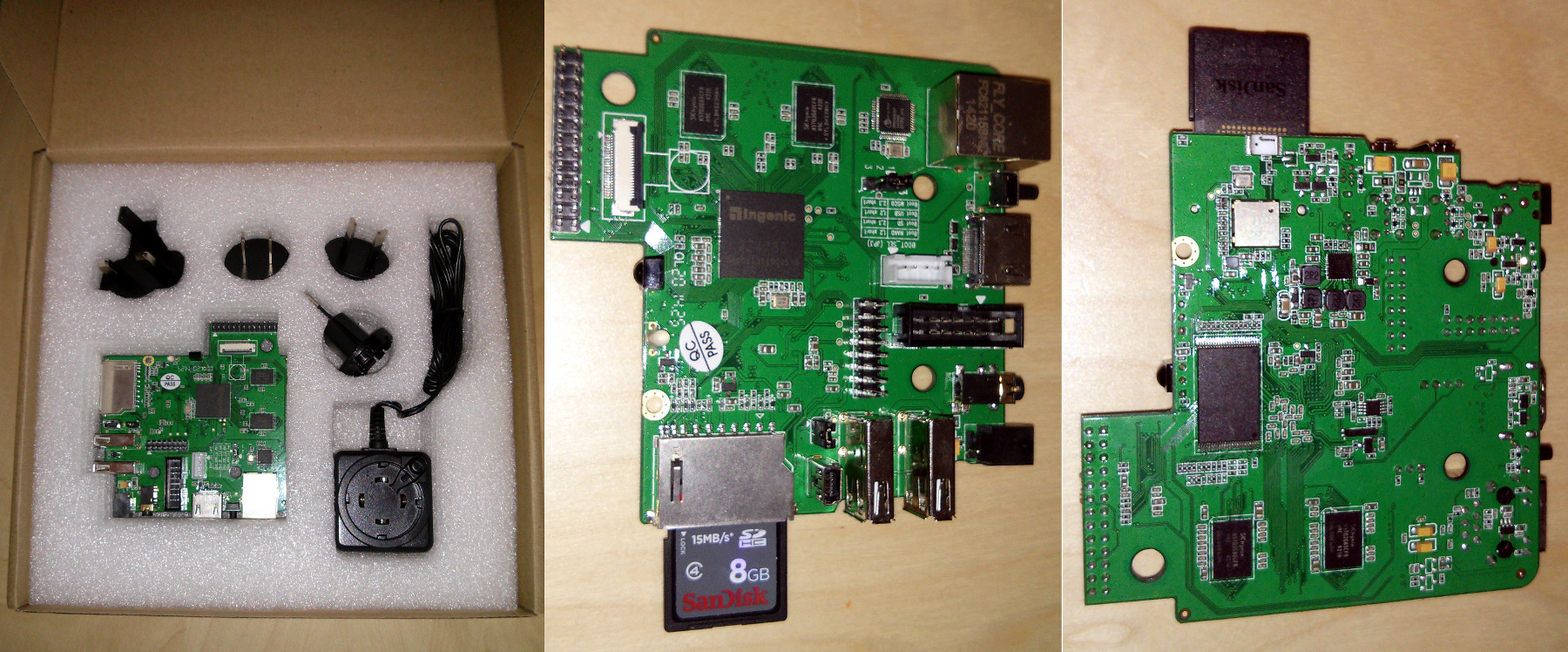 As you can see it comes in a nice packaging with a world-compatible power adapter. It uses a Ingenic JZ4780 SoC with a dual core MIPS32 CPU running at 1.2GHz with a PowerVR SGX540 GPU. The board is fitted with 1GB of RAM, 8GB of NOR flash, HDMI output, USB 2.0 ports, Ethernet + Wi-Fi + BlueTooth, SD card slot, IR receiver, expansion headers and more. The schematics are available. The Linux kernel and the U-Boot bootloader sources are also available.
Powering this board with a USB keyboard, a USB mouse and a HDMI display, it boots off the internal flash on a Debian Wheezy up to the XFCE environment. Besides the kernel, the Wi-Fi + Bluetooth firmware, and very few configuration changes, it runs a vanilla Debian. Unfortunately I haven t found time to play more with it yet, but it looks already quite promising.
The board has not been formally announced yet, so I do not know when it will become available, nor the price, but if you are interested I ll bring it to DebConf14. Don t hesitate to ask me if you want to look at it or play with it.
 We ve been busy setting up a Virtual Machine (VM) image to be used by participants of a
 Big thanks go to our intern St phane Germain, who joined us this summer to work on this virtualized environment.
 Debian LTS - impressions and thoughts from my first month involvement
About LTS - we want feedback and more companies supporting it financially
Squeeze LTS, and even more
 One purpose of this post is to spread some information about the initiative and invite you to tell us what you think about it or what your needs are.
LTS stands for "Long Term Support" and the goal of the project is to extend the security support for Squeeze (aka the current oldstable distribution) by two years. If it weren't for Squeeze LTS, the security support for it would have been stopped in May 2014 (=one year after the release of the current stable distribution), which for many is a too short timespan after it's release in February 2011. It's an experiment, we hope that there will be a similar Wheezy LTS initiative in future, but the future is unwritten and things will change based on our experiences and your needs.
If you have feedback on the direction LTS should take (or anything else LTS related), please comment on the
 And then there is another thing: as already mentioned, the people working paid hours for this, are prioritizing their work based on customer requests. So we did two updates (python-scipy and file), which are not fixed in wheezy yet. I think this is unfortunate and while I could probably prepare the wheezy DSA for file, I don't really want to join the Security Team... or maybe I want/should join the Security Team and be a seldomly active member (eg fixing file in wheezy now....)
A note related to this: out of those 37 uploads done until today, 16 were done by those

 Today I did something interesting with the Debian packaging for
 A little more than 2 years ago, the

 A cloud of gnocchis!
 Relationship of entities and resources
 The indexer classes and their relations
 Macroscopic view of the Gnocchi architecture


 This is a random post inspired by recent purchases. Some things we buy are practical, others are a little arbitrary.
I tend to avoid buying things for the sake of it, and have explicitly started decluttering our house over the past few years. That said sometimes things just seem sufficiently "cool" that they get bought without too much thought.
This entry is about two things.
A couple of years ago
 Some systems, like the Github issue tracker, gather all the requests together in a single list. Calling them "Issues" invites people to submit just about anything, such as "I forgot my password".
At the other extreme, some organisations are so keen to keep support requests away from their developers that they operate two systems and a designated support team copies genuine bugs from the customer-facing trouble-ticket/CRM system to the bug tracker. This reduces the amount of spam that hits the development team but there is overhead in running multiple systems and having staff doing cut and paste.
Will people use it?
Another common problem is that a full bug report template is overkill for some issues. If a user is asking for help with some trivial task and if the tool asks them to answer twenty questions about their system, application version, submit log files and other requirements then they won't use it at all and may just revert to sending emails or making phone calls.
Ideally, it should be possible to demand such details only when necessary. For example, if a support engineer routes a request to a queue for developers, then the system may guide the support engineer to make sure the ticket includes attributes that a ticket in the developers' queue should have.
Beyond Perl
Some of the most well known systems in this space are


 Actually, pending updates to JSCommunicator, you should see a brand new UI! But all the core stuff will be the same.
Architecture
Disclaimer: I m explaining my view of the JSCommunicator architecture, which currently may not be 100% correct. But so far it s been enough for me to make my modifications and additions to the code, so it could be of use. One I get a JSCommunicator Founding Father s stamp of approval, I ll be sure to confirm the accuracy.
Now to explain how the JSCommunicator code interacts, the use of each code item is described, ignoring all the html and css which will vary according to how you choose to use JSCommunicator. I m also not going to explain jQuery which is a dependency but not specific to WebRTC. The core JSCommunicator code is the following:
 In sum, 1 - JSCommUI.js handles what is displayed in the UI and feeds data to JSCommManager.js; 2 - JSCommManager.js actually does stuff, feeding data to be displayed to JSCommUI.js; 3 - JSCommManager.js calls functions from the three utils , parseuri.js, webrtc-check.js and jssip-helpher.js which organizes the data from config.js; 4 - JSCommManager.js initializes a SIP User Agent based on the implementation in Arbiter.js.
When making any changes to JSCommunicator, you will likely only be working with JSCommUI.js and JSCommManager.js.
