Search Results: "sto"

19 September 2013

Luca Falavigna: So long, and thanks for all the packages!

I ve been running several Deb-o-Matic instances on several servers since ages. This service, meant to provide a way to automate the build of Debian source packages, has been the starting point for a lot of Italian developers to start packaging, and eventually become Debian or Ubuntu developers. I can t exactly tell how many packages Deb-o-Matic servers have built so far, but it has been the primary build and test environment for at least three Debian Developers since four years. This service was hosted for free since the beginning, but the good things always come to an end. My provider decided they cannot keep our servers running (its core business is totally unrelated to hosting servers), and asked me to shut them down. I started with the two kfreebsd-* machines, and soon I will shut down i386 and amd64 as well. When all services will be down, I ll take care of removing the debian.net domains I created for them. Deb-o-Matic development won t stop, but developers who used Deb-o-Matic daily will have to find a different solution to build and test their packages.

18 September 2013

Craig Small: Goodbye mygbiz

Google seems to try to invent new and interesting ways for spammers to spam me (and many others). I ve still not worked out a good way to block fake googlegroups which follow this method:
  1. Make new fake gmail login
  2. Make new fake google group
  3. Add lots of people s email addresses to the group
  4. Send lots of junk to these people
  5. Repeat when it gets closed down
I m not sure why groups aren t opt-in. A rather simple and standard way to stop this exact problem. Anyhow, the next new spammer enablement that the nice folks at Google have come up with is the mygbiz.com domain. These are temporary email addresses you can use when setting up Google apps. The only thing I have ever seen from them is spam. So I thought I d try to report some to Google. After looping around several help screens that were, despite their name, very unhelpful, I ve come to the conclusion that Google isn t too serious about fixing this problem. If you have postfix, the solution is very simple:
  1. vi /etc/postfix/access_sender
  2. Add a line like mygbiz.com REJECT
  3. postmap /etc/postfix/access_sender
  4. postfix reload
I find the results to this method far superior to trying to get Google interested in being responsible for a domain they run. If you want to use google apps then spend the $50 and get a domain. Alternatively don t use something that spammers abuse. Does it work? You bet it does!
Sep 18 23:26:38 elmo postfix/smtpd[19013]: NOQUEUE: reject: RCPT from mail-ye0-f208.google.com[209.85.213.208]: 554 5.7.1 <grace@sheiladolan.mygbiz.com>: Sender address rejected: Do not send from mygbiz.com domains; from=<grace@sheiladolan.mygbiz.com> to=<ME@MYDOMAIN> proto=ESMTP helo=<mail-ye0-f208.google.com>

Francois Marier: Presenting from a separate user account

While I suspect that professional speakers have separate presentation laptops that they use only to give talks, I don't do this often enough to justify the hassle and cost of a separate machine. However, I do use a separate user account to present from. It allows me to focus on my presentation and not stress out about running into configuration problems or exposing private information. But mostly, I think it's about removing anything that could be distracting for the audience. The great thing of having a separate user for this is that you can do whatever you want in your normal account and still know that the other account is ready to go and configured for presenting on a big screen.

Basics The user account I use when giving talks is called presenter and it has the same password as my main user account, just to keep things simple. However, it doesn't need to belong to any of the UNIX groups that my main user account belongs to. In terms of configuration, it looks like this:
  • power management and screen saver are turned off
  • all sound effects are turned off
  • window manager set to the default one (as opposed to a weird tiling one)
  • desktop notifications are turned off
Of course, this user account only has the software I need while presenting. You won't find an instant messaging, IRC or Twitter client running on there. The desktop only has the icons I need for the presentation: slides and backup videos (in case the network is down and/or prevents me from doing a live demo).

Web browsers While I usually have my presentations in PDF format (for maximum compatibility, you never know when you'll have to borrow someone else's laptop), I use web browsers (different ones to show that my demos work with all of them) all the time for demos. Each browser:
  • clears everything (cookies, history, cache, etc.) at the end of the session
  • has the site I want to demo as the homepage
  • only contains add-ons or extensions I need for the demos
  • has the minimal number of toolbars and doesn't have any bookmarks
  • has search suggestions turned off
  • never asks to remember passwords

Terminal and editors Some of my demos may feature coding demos and running scripts, which is why I have my terminal and editor set to:
  • a large font size
  • a color scheme with lots of contrast
It's all about making sure that the audience can see everything and follow along easily. Also, if you have the sl package installed system-wide, you'll probably want to put the following in your ~/.bashrc:
alias sl="ls"
alias LS="ls"

Rehearsal It's very important to rehearse the whole presentation using this account to make sure that you have everything you need and that you are comfortable with the configuration (for example, the large font size). If you have access to a projector or a digital TV, try connecting your laptop to it. This will ensure that you know how to change the resolution of the external monitor and to turn mirroring ON and OFF ahead of time (especially important if you never use the default window manager or desktop environment). I keep a shortcut to the display settings in the sidebar.

Localization Another thing I like to do is to set my operating system and browser locales to the one where I am giving a talk, assuming that it is a western language I can understand to some extent. It probably doesn't make a big difference, but I think it's a nice touch and a few people have commented on this in the past. My theory is that it might be less distracting to the audience if they are shown the browser UI and menus they see every day. I'd love to have other people's thoughts on this point though. Also, pay attention to the timezone since it could be another source of distraction as audience members try to guess what timezone your computer is set to.

Anything else? If you also use a separate account for your presentations, I'd be curious to know whether there are other things you've customised. If there's anything I missed, please leave a comment!

17 September 2013

Stefano Zacchiroli: sources.debian.net - advanced search and other news

all your ctag (and checksum) are belong to us A few months after the initial announcement, here are some news about the sources.d.n service. I've been late in blogging this, but most of it has been implemented by myself and Matthieu Caneill during DebConf13, which has been a great DebConf, totally exceeding my expectations (and they were already fairly high!). First, you might have noticed some user-visible changes: On the other hand, under the hood: As you usual, your bug reports (and patches!) are more than welcome, just check BUGS before reporting to avoid duplicates.
That's all!

Craig Small: jqGrid in TurboGears2 Admin Screens

I wanted to use the jqGrid for my admin pages as I liked that look and it matches some of the other screens outside the admin controller. The admin controller, or rather the CrudRestController out of tgext.crud, has a way of exporting results in json format. So surely its a matter of changing the TableBase to use jqGrid in the admin controller and we re done? Well, no. First you need to adjust the jsonReader options so that it lines up to the field names that the controller sends and this was one of the first (or last snags). The json output looks like:
 
  "value_list":  
    "total": 20,
    "items_per_page": 7,
    "page": 1,
    "entries": [(lots of entries)...]
   
 
Now this is a little odd because of the top-level dictionary that is being used here. Most of the examples have everything that is inside the value_list being returned. In fact adjusting the controller to return only those items in the value_list values works. To look inside this structure we need to adjust the jsonReader options. jqGrid documentation uses the format toptier>subtier for the XML reader so that was the intial attempt. It was also an intial fail, it doesn t work and you get your very familiar empty grid. The trick is close to this format, but slightly different for json. You change the options to toptier.subtier . In other words change the greater than symbol to a full stop for json access. The jqGridWidget now has the following options (amongst others):
options =  
  'datatype': 'json',
  'jsonReader':  
    'repeatitems': False,
    'root': 'value_list.entries',
    'total': 'value_list.total',
    'page': 'value_list.page',
   
 
There might be a way of saying all entries sit under value_list inside jqGrid, but I couldn t find it. Those options given above do give a working jqGrid on the admin screens.

Tanguy Ortolo: Google, your IPv6-related email restrictions suck

After years of waiting, Google has finally enabled IPv6 for their email service Gmail. And a few weeks ago, they updated their policy, adding one specific rule: reject email from IP addresses with no reverse name:
% nc -Cv gmail-smtp-in.l.google.com. smtp
Connection to gmail-smtp-in.l.google.com. 25 port [tcp/smtp] succeeded!
220 mx.google.com ESMTP bz2si13656083wjc.108 - gsmtp
HELO boo.example.com
250 mx.google.com at your service
MAIL FROM: <me@example.com>
250 2.1.0 OK bz2si13656083wjc.108 - gsmtp
RCPT TO: <you@gmail.com>
250 2.1.5 OK bz2si13656083wjc.108 - gsmtp
DATA
354  Go ahead bz2si13656083wjc.108 - gsmtp
Subject: Test
From: Me <me@example.com>
To: You <you@gmail.com>
Test.
.
550-5.7.1 [2001:db8:8e3f:43c7::12      16] Our system has detected that this
550-5.7.1 message does not meet IPv6 sending guidelines regarding PTR records
550-5.7.1 and authentication. Please review
550-5.7.1 https://support.google.com/mail/?p=ipv6_authentication_error for more
550 5.7.1 information. bz2si13656083wjc.108 - gsmtp
That sucks By the way, I would love to have a perfect Internet access provider, but that does not exist where I live, and I do not think it exists at all anywhere. Google, instead of complaining about lame access providers, you are welcome to offer me a fibre service with decent upload rate, static IPv4, static IPv6 /64, customizable reverse DNS for IPv4 and IPv6, and full respect of the network neutrality. Until then, I am doing the best I can with the least bad provider available. Workaround As I said, their is an easy workaround. Google does not accept my mail on IPv6? Fine, I will keep using IPv4. Only for Google of course, no need to punish the whole Internet for Google's damn restrictions. With Postfix, you can do that this way (thanks to Christian Skala for his blog post about this problem). In /etc/postfix/master.fr, enable an IPv4-only SMTP client service:
smtp4     unix  -       -       -       -       -       smtp -o inet_protocols=ipv4
Then, in /etc/postfix/main.cf, define a transport map if you do not already use one:
transport_maps = hash:/etc/postfix/transport
Create that transport map /etc/postfix/transport or complete it:
gmail.com smtp4:
Finally, hash that transport map and have Postfix reload its configuration:
# postmap /etc/postfix/transport
# service postfix reload

Vincent Sanders: Ever tried. Ever failed. No matter. Try Again. Fail again. Fail better.


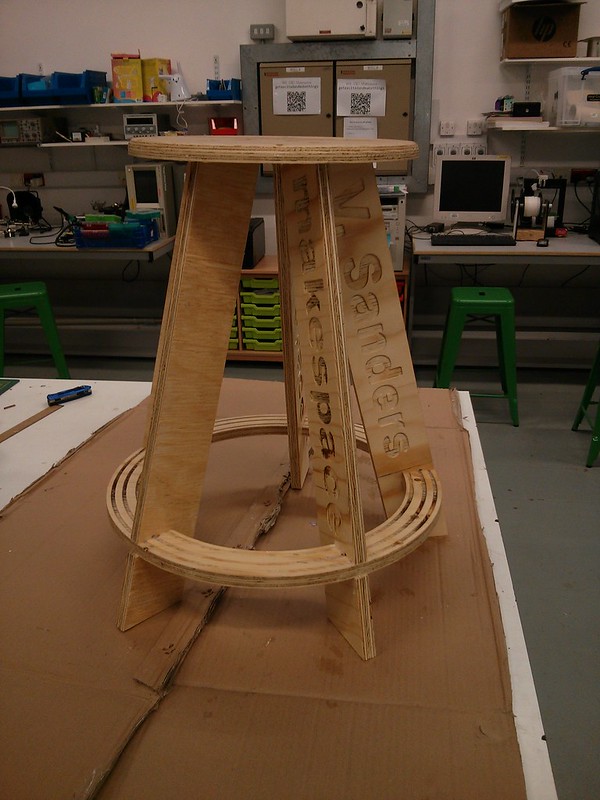
I seem to be adhering to Beckett's approach recently but for some reason, after my previous stool attempts, despite having a functioning design I felt I had to do just one more iteration.

Five legged stoolGoing back to a previous concept of having five legs instead of three while this did not improve the rotational problems with the 12mm thick material, it did make the design more stable overall and less prone to tipping.

The five legged solution realised in 18mm plywood resulted in my final design for this concept. As my friend Stephen demonstrates the design is pretty solid even for those of us with a more ample frame. There are now a couple of them in use at the space alongside the three legged earlier versions.

I was finally satisfied with the result and thought I was done with furniture making for a while. My adorable wife then came up with a challenge, she wanted a practical foldable chair her requirements were:
A frame folding chair, image from wikimedia
Things for individual humans to sit on raised off the floor, or chairs as we call them, have been around for a long time. My previous research for the stool indicated that chairs have a long history with examples still surviving from the ancient egyptians. From this I assumed there would be nothing novel in this project and to quote the song it's all been done before
Foldingchairs
Given this perspective my research started with an image search for "folding chair". The results immediately showed there were two common shapes. Either the chair base was formed with a pair of linked X shapes with the seat across the top, or an A frame style where the seat is across the centre.

My initial thoughts were to replicate the IKEA style A frame design until I noticed that some designs were made from a single sheet of timber with a small number of profile cuts. I searched for pre-existing design files but found none, perhaps I had found something novel to do after all.

A frame chair  1 - Front  2 - Rear  3- seat
Some quick measurements of chairs in shops (and more weird looks, mainly from my family) suggested 900mm is generally the highest a chair ought to stand. I selected a popliteal height of 420mm as a general use compromise which is a bit less than the 430mm of most mass produced chairs. I also decided there should be a front to rear drop across the seat which ought to improve comfort a little.

Material selection was based upon what I had to hand which consisted of a couple of sheets of structural plywood (1220x606x18mm temperate softwood - probably spruce although not specified) which had not become stools yet. Allowing for edge wastage and tool width this gave me a working area from a sheet of 1196x582mm.

I sketched the side view of the chair numbering the three parts. I decided part 1 would be 1000mm total height with top and bottom cross braces 80mm high, assuming the 900mm tall target, the A frame apex would be at 820mm height.

If we assert that the apex is immediately below the top cross brace on part 1 this gives 920mm at which point we have two sides of a right angled triangle (820 and 920) from which we can calculate the top angle is 26 . This also means part 2 will be 840mm long with the same 820 height this gives an angle of 10 .

I did the maths for the seat triangle using the 36 angle and 420mm popliteal height. Having experienced how flexible 18mm plywood was in the face dimension I decided to make the frame sides 50mm wide leaving, after 6mm tool path widths, enough space for a 358mm wide seat .

Once the dimensions were decided the design went pretty quickly producing something that looked similar to the designs I had seen earlier.

CNC routers can go wrong, spot the fail
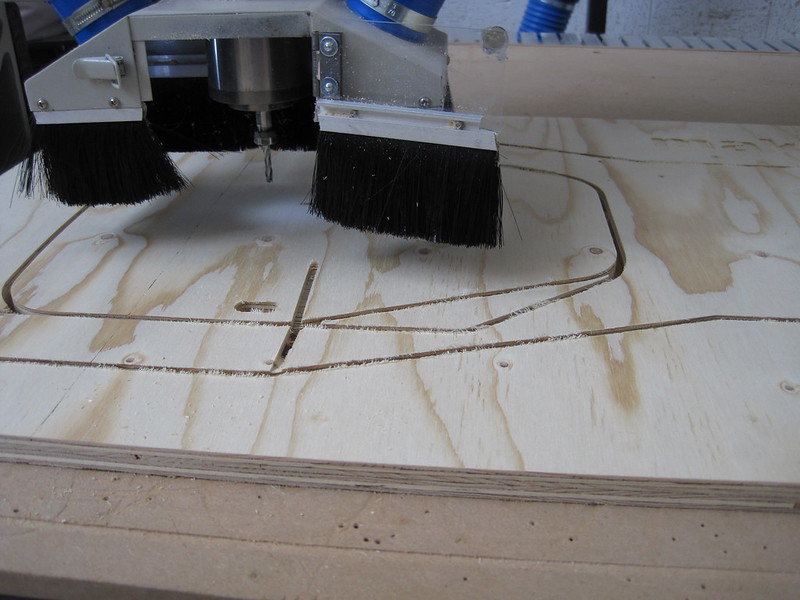
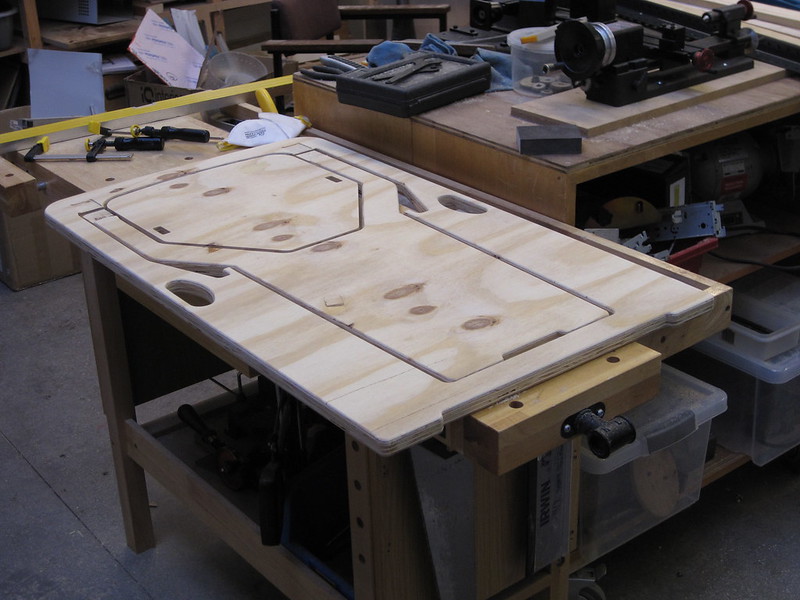
Generating toolpaths for this design proved challenging with the CAM software we had available, mainly because arranging multiple "inner" and "outer" cuts along the same path and having the tabs line up was obviously not an anticipated feature.

Things had been going far too well for me and during the routing operation our machine decided to follow an uncommanded toolpath excursion mid job (it cut a dirty great hole through the middle of my workpiece where I did not want it) ruining the sheet of material.

Fortunately, once factory reset and reconfigured, the machine ran the job correctly the second time although we still do not know why it went wrong. The parts were cut free of their tabs and hinges fitted.

The resulting design worked with a couple of problems:
Folding chair in 24mm plywood with edges rounded off
So time for a second iteration, this time I selected a thicker plywood to reduce the bend under large loads (OK already, I mean me). After shopping around for several days I discovered that unlike 12mm and 18mm thick plywood 24mm thick is much harder to find at a sensible price especially if you want it cut into 1220x606 sheets from the full 1220x2440.

I eventually physically went to Ridgeons and looked at what they actually had in the warehouse and got a price on a sheet of brazilian elliotis pine structural plywood for 43.96 which they cut for me while I waited. Being physically present also gave me the opportunity to pick a "less bad" sheet from the stack much to the annoyance of the Ridgeons employee for not just taking the top one.

This time I reduced the apex height by 30mm, the length of part 1 by 80mm. I also reduced the frame width by 10mm relying on the increased thickness of the plywood to maintain the strength. In area terms it is actually an increase in material (50mm*17.7mm = 885 against 40mm*22.80 = 912). I also included rebates for the top hinges within the design allowing them to be mounted flush within the sheet width.

The new design was cut (without incident this time) and the edges rounded off. I also added some simple catches to keep the seat and back inline while being transported.

While this version worked I had made a couple of mistakes again. The first was simply a radius versus diameter error on the handles which meant too much material was removed from a high stress area causing increased bending.

Third version of folding chair ready for finishing
The second error was a stupid mistake that where I had worked the latch holes in the seat to the wrong side of my measure line meaning the apex angle was 35.5 not the expected 33.6 which meant the backrest felt "too far forward"

The third version rectified those two errors and improved the seat front curve a little to further reduce the unneeded material in the back rest.

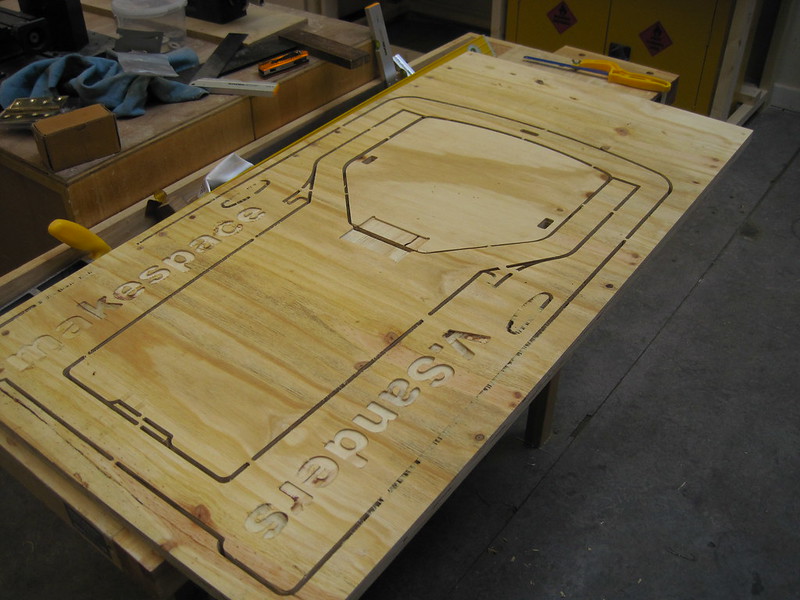
The fabrication of this design was double sided allowing for the seat hinge to be fully rebated and become flush and also adding some text similar to the stools.

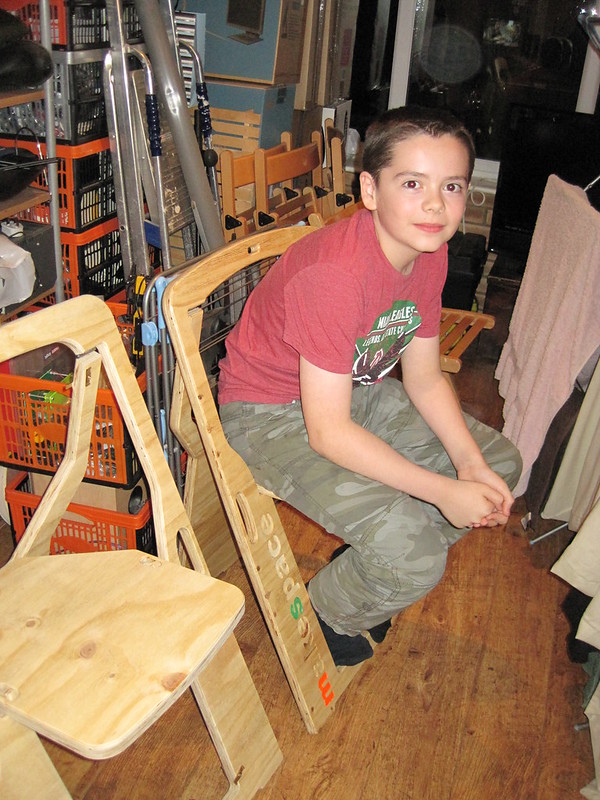
Alex sat on version 3 folding chair
This version still suffers from a backrest that is a bit too far forward and my sons complain it makes them sit up too straight. The problem is that the angle of the front face (23.6 ) means that to move the rest back 20mm means the piece needs to extend another 50mm beyond the frame apex which would probably make the chair feel tall again.

I guess this is a compromise that would take another iteration or two to solve, alas my wife has declared a moratorium on more chairs unless I find somewhere to put the failed prototypes other than her conservatory.

One other addition would be a better form of catch for transport. The ones in version 2 work but are ugly, magnets inset into the frame have been suggested but not actually implemented yet.

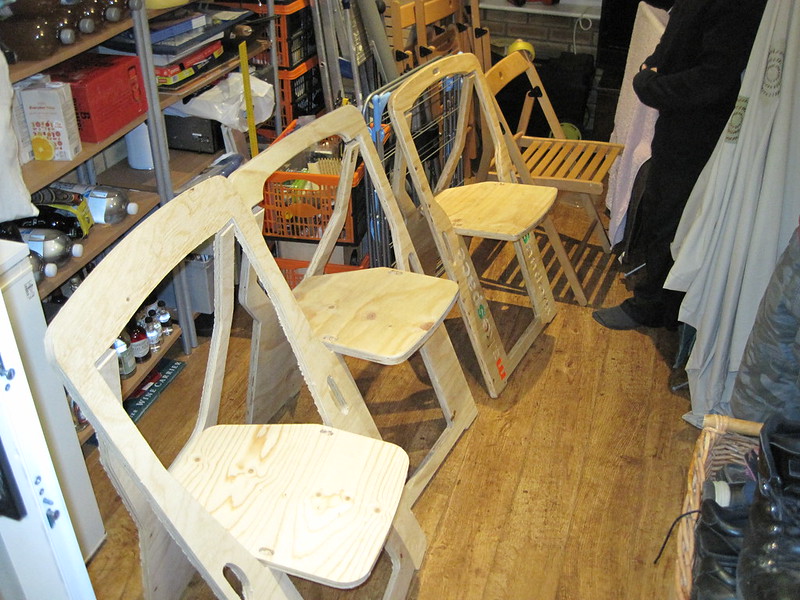
Folding chairs versions 1 to 3 and TERJE for comparison
In conclusion I think I succeeded with the original brief and am pretty pleased with the result. A neatly folding chair that can be stacked simply by having a pile of them and are easy to move and setup.

The price per chair is a little higher than I would like at 22 ( 11 for timber, 5 for hinges and screws , 5 for varnish and 1 for tool wear) plus about 2 hours labour (two sided routing plus roundover takes ages)

As previously the design files are available on github and there are plenty more images in the flikr set.

Cyril Brulebois: Fixing bugs

It s a somewhat strange feeling to spend time fixing things that broke instead of implementing new things, but it s not like I m a creative guy anyway For those last two points, the long term plan is: Hopefully getting this done this week (famous last words, eh?).

16 September 2013

Gunnar Wolf: My favorite (or rather, one among my favorite) non-original work Leo Masliah #encirc13

It seems I'm catching up with the pace of this course I'm following and that is compelling me to go back to posting on my blog, Arte y cultura en circulaci n: crear y compartir en tiempos digitales . This week's lesson is (again, in Spanish) Las fronteras del remix (the boundaries of remixes). An interesting text, open to everybody (regardless of whether you are signed up for the course or, I hope, whether time has passed since the course took place). And this week's homework is to find "our favorite" non-original work (I picked one among my favorite works And, yes, this is partly because I am part of the "club" of deniers of true originality: We cannot create anything without being part of a surrounding culture, without a common heritage and language with which we speak to our audience) and to find something about it, anything considered important or significative as to its antecedents. What do I like about this work, what grabs my attention. Do I consider it to be a true new creative work? Why? I am taking as an example Leo Masliah, an Uruguayan writer and musician (writer and interpreter). I have followed and enjoyed Masliah's work since 1996, and although by far I'm most familiar with his musical works, I have two books (a novel and a series of short stories). Among his facets, I most enjoy the acid, nihilistic/dadaistic streaks. I chose three of his songs to talk about I am linking to anonline resource where possible, but uploading the three songs to this blog to make his work better known, so that people understand what I talk about, and with my best intentions. Of course, if there is any request to remove the material, I will do it right away. I hope this can be seen as fair/academic use, although this blog is somewhat widely read.
La recuperaci n del unicornio
This song was in the first Masliah cassette I came across, Although musically it is an original work, the lyrics are a clear, almost line-by-line reply to the ever-repeated Unicornio song, by Silvio Rodr guez. This song (which I'm sure that every Spanish speaker reading this lines knows, like it or not It defines for me a good deal of Rodr guez hyper-sweetness and clicheness) has been analyzed over and over looking for a meaning. Silvio recorded this song in 1981, and by 1987 Masliah published this answer, mocking each of the lines.
So, this song can be seen as an original creation, as it contains no literal copy neither of the music nor of the lyrics of the original, but it cannot be understood without being familiar with Silvio's lost unicornio. It would just be an almost-dadaistic rant. But every person that has tasted Silvio Rodr guez cloying song will surely laugh with this one.
No necesitamos otro h roe Balderrama
I find this to be a very unique piece. It bonds together Argentinian folklore and USA pop.
Masliah sings the famous Argentinian song Zamba de Balderrama, (Castilla / Leguizam n), a song lamenting that the very popular bar and artist stage Balderrama, in Salta (North-Western corner of Argentina), seemed to be on the brink of closing. Of course, when Mart n, Constanza, Regina and me went to Balderrama in July 2010, the danger of closing this place had long been averted. And basically every Argentinian knows this song by heart.
The interesting part is that Masliah sings this song (as he presents it as the closing piece for one of his concerts) being short on time, and decides to present two acts together: Zamba de Balderrama and We don't need another hero, by Tina Turner, from the Mad Max soundtrack. So, of course, even if it's obvious that Masliah had to stretch bits to make them fit together, he achieved a very funny, interesting and unique blend of two completely unrelated works. He derives from one as well as from the other, but creates something unique and new.
Donna Lee
I was thinking what to write for this assignment , and had already chosen the two other songs. Yesterday, we were visiting our friends Octavio and Claudia, in Guanajuato, and I heard for the first time the original(?) version of Donna Lee, by Miles Davis (although often credited to Charlie Parker). That led me to remember Masliah's interpretation, in his Cl sicos album. This album is basically made up with similar excercises: Taking an instrumental piece, with Masliah singing over it. Some of the lyrics follow the story (i.e. the children stories), others just talk nonsense to illustrate a point (i.e. "La voz del medio", "the middle voice") follows the non-protagonist score trying not to grab much attention to the lyrics but to highlight the often ignored melody)... Donna Lee is just a fun excercise on following the melody asking what was in the head of the author that led him to invent such a strange, hard music.
Masliah is a great music performer, although often it seems he tries to hide it (i.e. by abusing the dissonances, ex-profeso singing off-key, etc), and a very funny and crazy author. Most of his works have a deep satirical tone, and it's common to find either simple winks or complete "borrowings" in a clear remix fashion, but nobody will doubt on the originality of his works.
AttachmentSize
07-Donna Lee.MP31.79 MB
16 No necesitamos otro h roe - Balderrama.mp33.49 MB
Leo Masl ah-La Recuperaci n Del Unicornio.mp31.87 MB

Debian Med

DebConf 13 report (by Andreas Tille) General impression unofficial  Scenic Hacklab I'm beginning my DebConf report in an unofficial "Scenic Hacklab" right at the edge of the lake in Yverdon. This is the right place to memorise the last days. When I started from this place cycling to Le Camp 12 days ago I was full of great expectations and what should I say - the reality has even beaten these. Once it comes about comparing DebConfs even if it is an unfair comparison due all the differences my secret long term favourite was Helsinki very closely followed by Argentina and also very closely followed by all the other great DebConfs I joined (and I joined all in Europe). Would Le Camp be able to beat it? The short answer is: Yes, it is now my favourite DebConf while I think I do not suffer from the last-Debconf-was-the-best-DebConf-syndrome (and I realised there are others thinking the same). As you might probably know I'm a bit addicted to swimming. While Helsinki had admittedly the better conditions I was at least able to fix the distance issue using my bicycle. (Hey, those Le Camp photographers did a great job in hiding the fact that you can not actually touch the lake right from the meadow of Le Camp.) Being able to have my bicycle at DebConf scored some extra points. However, the really great view of the lake, the inspiring "Scenic Hacklab" which was my favourite place has bumped DebConf13 at first place in my personal ranking. So it comes quite natural to say: "Kudos to the great organisation team!" They did a Swiss-like precise work and perfectly succeeded in hiding any problems (I assume there were some as always) from the attendees so everything went smooth, nice and shiny for the attendees. The local team was even precise in setting up great weather conditions for DebConf. sunrise over  the lake While saying thanks to the local team I would like to also explicitly thank Luca Capello who has quite some share that this DebConf was possible at all (while I have to decrease my DebConf score one point because he was not really there - Luca to bad that you were not able to come full time!) Also thanks to Gunnar and Gannef who helped remotely (another score down because I were missing them this year as well). Even if it was my favourite DebConf I was not able to work down my todo list fully (which was not only uploading one package per day which I at least statistically fullfilled). But that's probably a general feature of todo lists anyway. One item was definitely done: Doing my daily swimming BoF. I actually was able to do the other parts of the triathlon which was skipped by Christian and have done in summary about 150km cycling with 3500m elevation and estimated 7-8km swimming (0m elevation ;-)). Considering the great view at sunrise over the lake I was not hating my "Senile bed escape" disease too much (I was every day waking up at sunset) - it was simply a great experience. I will never forget seeing water drips glimmering like gold inside the morning sun while seeing the Alps panorama in the distant. I hope I was able to help all interested swimmers with the DebConf Beach Map which was just a by-product of my activities in DebCamp. Speaking about OSM: I was astonished that the area was way less covered than I expected. Thanks to several DebConf attendees the situation became better and the map does not only show random trees in the wild but also the tracks leading to these. (Remark: It was no DebConf attendee who is responsible for plastering the map with single trees.) While I had my mapping focus basically close to the edge of the lake I was also able to even map my very own street. :-) I clearly remember one specific mapping tour when I was invited by the DPL: He convinced me to join him on a bicycle tour and since I was afraid to get fired I joined him instead to keep on hacking. Also Sorina was brave enough to join us on the tour and she did quite well. (Sorina, do you remember the agreement about your work on the installer? ;-)) Lucas described the tour as: going uphill on only asphalted roads. Sorina and me were witnessing the mighty DPL powers when we left the wood around Le Camp to reach the described road: The asphalt was just put onto the road - no doubt that it was done on the immediate demand of mighty DPL. :-) DebCamp time was flying like nose dive and a lot of known (and unknown) faces arrived at Le Camp. What I really liked a lot this year was that several really young children has pulled down the average age of DebConf attendees. I clearly remember all the discussion one year ago what to do about children. As always the issue was solved in a typical Debian way: Just do it and bring your children - they had obviously a great time as well. I think the youngest child was 2 months and the oldest "child" above 20. ;-) Actually Baptiste Perrier did great in making the C&W party a success and had obviously a nice time. (I wished my son would have been able to come as well but he needs to write his bachelor s thesis in physics. :-() It was nice to see the kids using all playing facilities and communicating with geeks. Also I would like to point out that even the very young attendees had their share at the success of DebConf: Just think of the three "bell ringing assistants" who helped me ringing the bells for lunch and dinner. I've got this cool job from Didier in the beginning of DebCamp. I must say having some real bells ringing is by far nicer than just the "lunch / dinner starts in 10 minutes" from IRC bot. The only thing I did not understand was that people did not considered ringing the bells at 8:00 for breakfast as a good idea. Regarding the food in general I would also like to send kudos to the kitchen: It was tasty, freshly prepared, regional food with a good change rate. I really liked this. Extra points for having the chance to sit outside when eating. Talks But lets have a look into the conference programme. I'd really recommend watching the videos of the talks Bits from the DPL (video) and Debian Cosmology (video). I considered both talks as entertaining and interesting. I also really hope that the effort Enrico Zini started in Debian Contributors (video) will be successful. I had some talks and BoFs myself starting with Why running a Blend (video) and I admit that (as usual) the number of attendees was quite low even if I think there is some proof (see below) that it is interesting for way more people who should consider working more "blendish" in their team. Do you know how to recruit one developer per year and relax the man power problem in your team? Feel free to watch the video. We have confirmation that ten DDs of our team have considered to join Debian only because Debian Med exists. Admittedly biology and medicine are really leaf topics inside the Debian universe. So if even this topic that has a very tiny share of the Debian users is able to attract this level of attention - how many more people could we win for multimedia, games, GIS and others? So if you feel you are quite overworked with your packaging and you have no time this is most probably wrong. The amount of time is basically a matter of priorities you set for your tasks. Try to put some higher priority onto using the just existing Blends tools I explained in my talk to attract more users and developers to your team and by doing so spread the workload over more people. It works, the prove was given in my main talk. So before you start working on a specific package you should wonder who else could have an even stronger interest to get this work done and provide him with some additional motivation and help to get the common goal done. The interesting thing is that my BoF about How to attract new developers for your team (video) - which was a simple report about some by-product of the Blends work - made it into the main talk room and got way more attention. For me this is the proof that the Blends concept itself is probably badly perceived as something like "a few outsiders are doing damn specific stuff which is not really interesting for anybody else" instead of what is really is: Smoothing the way from specific upstream applications to the end user via Debian. Once you see the video of this BoF you can observe how my friend Asheesh Laroia became more and more excited about the Blends concept and admitted what I said above: We should have more Blends for different fields. Funnily enough Asheesh asked me in his excitement to talk more about Blends. This would have been a really good suggestion ten years ago. At DebConf 3 in Oslo I had my very first talk about Blends (at this time under the name "Debian Internal Projects"). I continuously kept on talking about this (MiniDebConf Peking 2005, DebConf 5, Helsinki (video), DebConf 7, Edinburgh (video), DebConf 8, Mar del Plata (video), DebConf 9, C ceres (video), MiniDebConf Berlin 2010 (video in German), MiniDebConf Paris 2010 (not video recorded), DebConf 11, Banja Luka (video) ... and these are only (Mini)DebConfs my talks page is full of this topic) and every new year I try different ways to communicate the idea to my fellow Debianistas. I'm wondering how I could invent a title + abstract avoiding the term Blends, put "Git", "release" and "systemd versus upstart" in and being able to inform about Blends reasonably by not becoming to off topic with the abstract. I also registered the Debian Science round table. I admit we were lacking some input from remote via IRC which used to be quite helpful in the past. The attendees agreed upon the handling of citations in debian/upstream files which was invented by Debian Med team to create even stronger bounds to our upstream developers by giving their work extra reward and providing users with even better documentation (see my summary in Wiki). As usual I suggested to create some Debian Science offsprings like "Debian Astronomy", "Debian Electronics", "Debian Mathematics", "Debian Physics" etc. who could perfectly leave the Debian Science umbrella to get a more fine grained structure and a more focused team to enhance the contact to our users. Unfortunately there is nobody who volunteers to take over the lead for such Blends. I have given a short summary about this BoF on the Debian Science mailing list. In the Debian Med meeting I have given some status report. No other long term team members were attending DebConf and so I gave some kind of introduction for newcomers and interested people. I touched also the DebiChem topic which maintains some packages that are used by biologists frequently and so we have a good connection to this team. Finally I had registered three BoFs in Blends I'm actually not (or not yet) active part of. My motivation was to turn the ideas I have explained in my main talk into specific application inside these teams and helping them to implement the Blends framework. In the first BoF about Debian GIS I have shown the usual team metrics graphs to demonstrate, that the one packaging team Pkg-OSM is in danger to become MIA. There are only three persons doing actual uploads. Two of them were at DebConf but did not joined the BoF because they do not consider their contribution to Pkg-OSM as a major part of their general Debian work. I will contact the main contributor David Paleino about his opinion to move the packages step by step into maintenance of Debian GIS packaging team to try to overcome the split of two teams that are sharing a good amount of interest. At least if I might become an Uploader for one of the packages currently maintained by Pkg-OSM I will move this to pkg-grass-devel (which is the name of the packaging team of Debian GIS for historical reasons). The attendees of the BoF have considered this plan as sensible. Moreover I talked about my experiences with OSGeo Live - an Ubuntu derivative that tries to provide a full tool chain to work on GIS and OSM problems ... basically the same goal as Debian GIS has just provided by the OSGeo project. I'm lurking on OSGeo mailing list when I asked explicitly I've got the answer that they are working together with Debian GIS and are using common repository (which is IMHO the optimal way of cooperation). However, it seems that several protagonists of OSGeo Live are underestimating the resources provided by Debian. For instance there was a question about Java packaging issues but people were not aware about the existence of the debian-java mailing list. I was able to give an example how the Debian Med team managed to strengthen its ties to BioLinux that is also an Ubuntu derivative for biologists. At our first Debian Med sprint in 2011 we invited developers from BioLinux and reached a state where they are using the very same VCS on Alioth where we are maintaining our packages. At DebConf I was able to upload two packages where BioLinux developers did certain changes for enhancing the user experience. My "work" was just bumping the version number in changelog and so we did profit from the work of the BioLinux developers as well as they are profiting from our work. I plan to dive a bit more into Debian GIS and try to strengthen the connection to OSGeo Live a bit. The next BoF was the Debian Multimedia meeting. It was nice that the current leader of Ubuntu Studio Kaj Ailomaa joined the meeting. When I was explaining my ideas about cooperation with derivatives I repeated my detailed explanation about the relation with BioLinux. It seems every topic you could cover inside Debian has its related derivative. So to me it seems to be quite natural to work together with the developers of the derivative to join forces. I actually consider a Blend a derivative done the right way = inside Debian. The final work for the derivers that might be left for them is doing some shiny customising of backgrounds or something like this - but all the hard work could and should be done in common with the relevant Debian team. My dream is to raise such relevant teams inside Debian ... the Blends. Finally the last BoF of this series was the Debian Games meeting. As always I presented the team metrics graphs and the Debian Games team members who attended the BoF were quite interested. So it seems to be some unknown fact that team metrics are done for several teams in side Debian and so I repeat the link to it for those who are not yet aware of it. As a result of the BoF Debian Games team members agreed to put some more effort into maintaining their Blends tasks. Moreover Miriam Ruiz wants to put some effort into reviving Debian Jr. Regarding Debian Jr. there was an interesting talk about DouDouLinux - in case you might want to watch the video I'd recommend skipping the first 30min and rather watch the nice live demo. There was also an ad hoc BoF about Debian Jr scheduled to bring together all people interested into this cute project and Per Anderson volunteered to take over the lead. I have given a summary about this specific BoF at the Debian Jr list. For some other talks that I'd regard as remarkable for some reasons: I'd regard the talk "Debian-LAN" by Andreas Mundt as some hidden pearl because it did not got a lot of attention but after having seen the video I was quite impressed - specifically because it is also relevant for the Blends topic. Memories I also liked "Paths into Debian" by Moray Allan (and I was only able to enjoy the latter talks thanks to the great work of the video team!) because it also scratched the same topic I was concerned about in my mentoring talk. Related to this was in my opinion also "Women in Debian 2013" were we tried to find out reasons for the lack of woman compared to other projects and how to overcome this issue. Geert hovering  over the grass Besides the talks I will probably never forget two specific moments that make DebConf so special. One of these moments is recorded on an image that clearly needs no words - just see Geert hovering over the grass. Another strong moment in my personal record was in the DebConf Newbies BoF "First time at DebConf" that unfortunately was not recorded but at least for this statement it would have been very great if we would have some reference better than personal memory. Aarsh Shah a GSoC student from India suddenly raised up and said: "Four months ago I was not even aware that Free Software exists. Now I'm here with so many people who are totally equal. If I will tell my mother at home that I was standing in the same queue where the Debian Project Leader was queuing up for food she will never believe me." He was totally excited about things we are regarding as normal. IMHO we should memorise moments like this that might be part of the key to success in cultures, where Debian is widely unknown and very rarely in use. Amongst these not scheduled great moments the scheduled day trip was also a great thing. I had a really hard time to decide what tour I might join but ended up in the "long distance walking (or should I say running) group". Inspired by the "running Bubulle" who was flashing between the walking groups we went uphill with 5.4km/h which was a nice exercise. Our destination the large cliff was an exciting landscape and I guess we all enjoyed the dinner organised by the "Trout cabal". ;-) say goodby to  friends So I had a hard time to leave Le Camp and tried hard to make sure my memories will remain as long as possible. Keeping some signs attached to my bicycle, conserving the "Scenic Hacklab" sign for my private "scenic hacklab @ home" was one part. I also have cut some branches of the Buxus sempervirens in Le Camp and have put them in my garden at home (where I create some hedgerow from places where I spent some great time). These will probably build a great part of the hedgerow ... Thanks for reading this longish report. Looking forward to see you all in Germany 2015 (or earlier) Andreas. Scenic Hacklab  @ home

15 September 2013

Ben Hutchings: The terrible state of EFI variable storage

EFI includes support for storing persistent 'variables': it implements a key-value store where keys are (UUID, string) and values are arbitrary blobs. (There are also some flags that restrict when the variables can be accessed.) The physical storage medium is normally flash. The Linux efivars module provides access to variable storage, both through a specific interface in sysfs and through the somewhat abstracted pstore interface. An EFI implementation reads the boot order and (if applicable) Secure Boot configuration from specific EFI variables. An operating system can add arbitrary variables, using its own UUID(s). On Linux, the efibootmgr utility is used to read and write the boot order and the pstore interface is used within the kernel to dump kernel log messages or other information when particular events occur. Since efivars is needed to set the boot order on EFI systems, it's a critical part of installation. But it wasn't being loaded on Debian systems until efibootmgr was run. This doesn't work so well when using a rescue system, as the installation kernel and installed kernel may be different (Debian bug 703363). In future (Debian package version 3.2.41-1) this will be loaded automatically on EFI systems. But now comes a new problem: bugs in the implementation of variable storage can prevent a system from booting, and even worse, they may prevent manual recovery without special equipment (the system is 'bricked'). Matthew Garrett recently talked about this and mentioned that some Samsung laptops are bricked if the variable storage becomes more than 50% full. efivars now has some extra checks to avoid triggering this (both in mainline and in stable branches). This isn't the end of the story, unfortunately. Remember that nothing can be overwritten in flash without erasing a relatively large block, and that writes may fail after a few thousand erase cycles (number depending on the type of flash used). Therefore, deleting a variable usually does not free storage immediately, and overwriting a variable usually reduces the amount of free storage. In the case of the Samsung laptops, unused storage is apparently reclaimed at the next reboot. However, while testing the backported efivars changes I found that my EFI-booting system (Asus P8Z68-V LX motherboard) does not reclaim unused storage until it's very nearly full. Since the firmware itself increments a counter variable on every boot, using 36 more bytes of storage, I was able to observe the available space dropping to under 100 bytes, and then after another boot jumping to about 42K (out of 64K). This means that well over 50% of storage was unused, yet efivars would refuse to write any variables because the firmware didn't reclaim it. This would prevent (re)installation of Linux, as the boot configuration could not be written. On the assumption that both behaviours are common, I've settled on a compromise that I hope minimises overall risk: But it's essential that we find a way to identify and work safely with both behaviours. Not only do I want to eliminate the possibility of bricking or installaton failure, but I want to make EFI-backed pstore safe to enable. Crash logs are often hard to obtain and pstore can help to solve that problem. Updated 2013-09-15: The free space check has been revised (in Linux 3.2.48, 3.5.7.17, 3.8.13.5, 3.9.7 and 3.10) based on advice from Samsung. The kernel leaves at least 5K (rather than 50%) of the EFI variable store free. If it is about to breach this limit, it attempts to write a dummy variable that is larger than the free space, which will either fail or trigger garbage collection. The normal variable can then be written if garbage collection freed up enough space. This check can be disabled using the kernel parameter efi_no_storage_paranoia, but there should be no need to do so.

Dirk Eddelbuettel: RProtoBuf 0.3.1

Two months to the day after the previous 0.3.0 release of RProtoBuf, we are happy to announce a maintenance release 0.3.1 which has now arrived on CRAN. RProtoBuf provides GNU R bindings for the Google Protobuf data encoding library used and released by Google. Once again, Murray lead this release and added a number improvements. The NEWS file entry follows:
Changes in RProtoBuf version 0.3.1 (2013-09-13)
  • Added support for setting and getting 64-bit integer types as character strings of decimal integers to work around R's lack of native 64-bit integer types.
  • Added better error handling, documentation, and tests to the extensions support (getExtension and setExtension).
  • Add support to P for returning extension descriptors.
  • Improved error messages to include field names when invalid fields are specified to protocol buffer messages with new, update, etc.
  • Improved configure to detect and pass -std=c++0x if it is available to enable long long 64-bit integer support in Rcpp.
  • Improved configure in the case when pkg-config is not available or does not know about the google protocol buffer includes.
  • Replaced newly deprecated Rcpp macros with a simplified macro functionality to avoid warnings on the latest development version of Rcpp.
CRANberries also provides a diff to the previous release 0.3.0. More information is at the RProtoBuf page which has a draft package vignette, a 'quick' overview vignette and a unit test summary vignette. Questions, comments etc should go to the rprotobuf mailing list off the RProtoBuf page at R-Forge.

Christoph Berg: Jessie, the HP 6715b, and Wifi

If you are upgrading your HP/Compaq 6715b to Debian Jessie, and suddenly Wifi stops working because the PCI device is gone, install the "rfkill" package:

# lspci   tail -2
02:04.1 FireWire (IEEE 1394): Ricoh Co Ltd R5C832 IEEE 1394 Controller (rev 02)
10:00.0 Ethernet controller: Broadcom Corporation NetLink BCM5787M Gigabit Ethernet PCI Express (rev 02)
# rfkill list 1
1: hp-wifi: Wireless LAN
    Soft blocked: yes
    Hard blocked: no
# rfkill unblock wifi
# rfkill list 1
1: hp-wifi: Wireless LAN
    Soft blocked: no
    Hard blocked: no
# lspci   tail -2
10:00.0 Ethernet controller: Broadcom Corporation NetLink BCM5787M Gigabit Ethernet PCI Express (rev 02)
30:00.0 Network controller: Broadcom Corporation BCM4311 802.11a/b/g (rev 02)
Reports on the internet say that the same could be done by going into the BIOS and selecting "Reset to default" - this makes the Wifi LED active until about udev is started on the next boot. To be done: figure out how to automate this.

14 September 2013

Steve Kemp: CIDR-matching, in node.js

I recently mentioned that there wasn't any built-in node.js functionality to perform IP matching against CIDR ranges. This surprised me, given that lots of other functionality is available by default. As a learning experience I've hacked a simple cidr-matching module, and published it as an NPM module. I've written a few other javascript "libraries", but this is the first time I've published a module. Happy times. The NPM documentation was pretty easy to follow: Now I can take a rest, and stop talking about blog-spam.

13 September 2013

Daniel Pocock: Calendar and Contact data with free software in the Smartphone era

Since the rise of smartphones, first Blackberry, then iPhone and now Android, the world at large has had a convenient option to fall back on for management of contact and calendar data. The data itself seems somewhat trivial: many of us software developers have worked with a plethora of obscenely more obscure schemas. It is unlikely that most people would ever have to perform an operation on their address book that requires a statistical toolkit like the R project or any of the other advanced tools we now have for data processing. In terms of data, addresses and phone numbers can appear quite boring. So why hasn't the free software community mastered it and cloud providers are currently running rampant hoovering up the data of billions of users? Ruling out LDAP One problem that people have faced is the existence of different standards. LDAP has quite a high profile and appears to be supported by default in many desktop applications. For this reason, it tends to grab people's attention but after a close look, many people find it is not the right solution. LDAP tends to work well for organisations where the data is centrally managed and in situations where fine-grained access control is not required. LDAP servers often need a capable UNIX administer to manage effectively. To top it off, LDAP itself does not provide an effective solution for two-way synchronization of data with remote and mobile users. The emergence of SyncML, CalDAV, GroupDAV and CardDAV Addressing this final problem (two-way mobile/portable device sync) has brought on the development of further standards. Initially, SyncML (now known as Open Mobile Alliance Data Synchronization and Device Management) grabbed significant attention, partly because it had been included in some of the first generation of smartphones from once-prominent vendors like Nokia. Open source server solutions for SyncML did not gain traction though. The most prominent is Funambol, however, it is not packaged in any major Linux distribution and it requires some basic Java knowledge to maintain it effectively. Like LDAP it appears to be most comfortable in enterprise use cases and doesn't appeal to the people who run a private mail and web server. SyncML has further suffered with the lack of support in more recent generations of smartphones. WebDAV was formalised in 1999 and there are now various derivative standards such as CalDAV and CardDAV which use WebDAV as a foundation. However, standards didn't arrive at this place directly: CalDAV only appeared as RFC 4791 in 2007 and CardDAV as RFC 6352 in 2011. In the meantime, some vendors experiemented with an alternative called GroupDAV. GroupDAV is largely obsolete now and GroupDAV v2 is a subset of CalDAV and CardDAV. Finally gaining traction The good news is, CardDAV and CalDAV are gaining traction, in no small part due to support from Apple and the highly proprietary iPhone. Some free software enthusiasts may find that surprising. It appears to be a strategic move from Apple, using open standards to compete with the dominance of Microsoft Exchange in large corporate networks. Both protocols are supported natively in iPhones and Mac OS X. More exciting, Apple releases their Contacts Server and Calendar Server as open source software, making it easier to look under the hood and observe any deviations from the standards. Apple's adoption of CardDAV and CalDAV has been accompanied by a similar effort in free software, however, support is more patchy. The Mozilla Lightning calendar plug-in for Thunderbird (known as the iceowl-extension plugin for icedove on Debian) has supported CalDAV for some time. In contrast, Thunderbird's address book lacks native support for CardDAV and has other limitations (discussed in detail below). Limited CardDAV support in Thunderbird can be achieved using the third-party SOGo Connector, which is not just for ScalableOGo server. The Evolution PIM appears to support both CardDAV and CalDAV relatively smoothly and appears to be more functional and easier to get started with. Free software servers are also emerging. DAViCal, despite the name, supports both CardDAV and CalDAV. It is a good solution for people who have an existing mail server and don't want to transition to an all-in-one groupware suite. Packages available in Debian make it easy to deploy and get started. It is a PHP solution, using a PostgreSQL database underneath. For people who do want a groupware suite, CardDAV and CalDAV are supported in products like ScalableOGo and Zimbra. For people who don't want a server at all and just want to sync between a desktop and a mobile device, there are options like Calypso. Mobile support: the missing link A number of people have blogged about using the Android apps CardDAV-Sync and CalDAV-Sync to complete the picture. I've tested these myself and verified that they work. However, there is one vital thing missing: the source code. Nobody knows what is inside these apps except the developer. That makes it impossible for other developers to troubleshoot them and improve them and it also makes it impossible to be certain that they do not leak information. An alternative is the aCal app for Android. Despite the name, aCal can synchronize the address book as well as the calendar. However, in my tests against DAViCal, I found that the addressbook can only be synced once and that on subsequent syncs, it fails to discover any new server-side contacts. aCal source code is available on gitorious.
aCal appears to be a compelling solution for Android users, hopefully the contact sync will be fixed soon. It only syncs once after installation and then fails to detect any new contacts. Thunderbird's limitations It has already been mentioned that the Thunderbird address book can be synchronized to a CardDAV server by adding the SOGo Connector plugin. However, this is not a perfect solution. The plugin itself is fine: the SOGo web site describes the connector (as opposed to the SOGo Integrator plugin) as a portable solution: in other words, it is vendor neutral, compatible with any standards-compliant server. The first limitation is that it is necessary to duplicate the setup process for both the calendar sync and the address book sync. This is just a question of convenience.
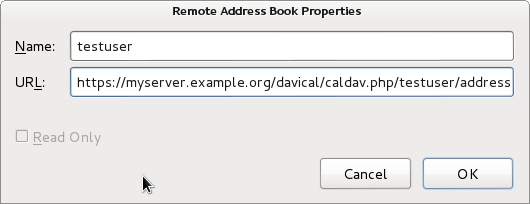
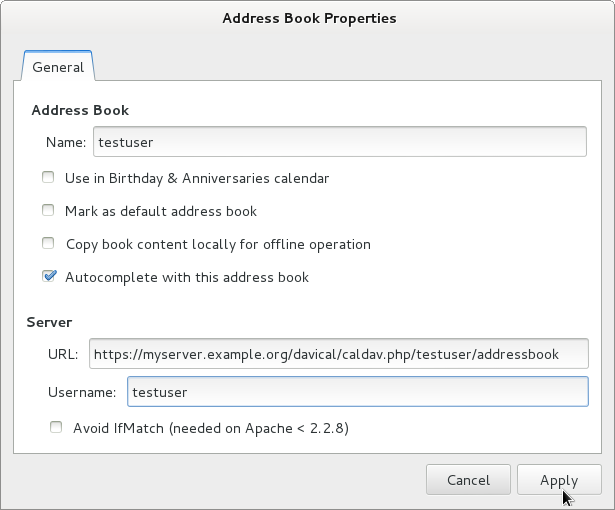
The SOGo Connector plugin configuration window is very trivial. I recommend using read-only mode to avoid the problems with multiple email addresses or telephone numbers. More serious limitations exist in the address book itself: if the CardDAV server has more than 2 email addresses, they will not appear in the Thunderbird address book. Changing an email address on the client side will result in loss of those additional email addresses on the server-side. The Mozilla team initially committed to rewrite the address book from the ground up but it is not clear whether that work is still in progress. DAViCal confusion I had been using DAViCal for quite some time as a CalDAV server before I recently decided to try and use it for CardDAV as well. As a calendar server, it had been working fine. I have a small number of users with some private calendars and also some shared calendars. When I installed the SOGo Connector plugin and went to setup the client-side configuration, it asked me for the server URL. Having used CalDAV already, I simply tried copying the existing CalDAV URL, which is of the form https://myserver.example.org/davical/caldav.php/daniel/home The URL was accepted and I could create address book entries on the client side. No errors appeared. I then tried setting up the same URL as an address book in Evolution. This time, I found I was able to create contacts and sync them to the server and access them from another copy of Evolution. It appeared DAViCal was working fine and I felt that Thunderbird or the SOGo Connector was somehow broken, because the Evolution clients were syncing but Thunderbird was not. The lack of any errors from the Thunderbird GUI further undermined my confidence in the SOGo Connector. Nonetheless, I decided to dig a little deeper, looking through the DAViCal source code. This brought me to the realisation that each URL could be flagged as either a calendar resource or an address book resource. This had not been obvious to me before. Evolution had effectively been storing the contact entries into a calendar URL and DAViCal had been happily accepting them. SOGo Connector, querying the URL, appears to have received both calendar and contact records from DAViCal and given up.
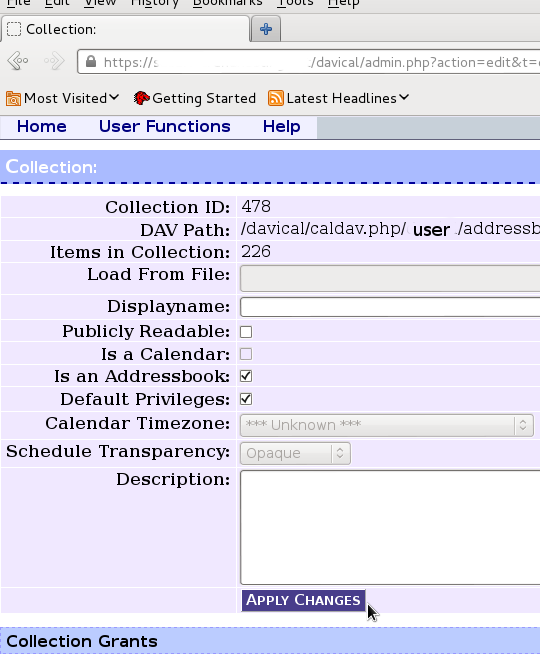
Here is where I configured the extra resource for an address book store under my user account in DAViCal In the DAViCal web management console, I created an extra resource for my user ID and set the appropriate checkbox to mark the resource as an address book. Then I put this resource URL into all the clients and found that they were all able to sync with each other. DAViCal's maintainer has explained that this is a limitation in the CardDAV/CalDAV protocols: technically, it is valid for the client to store the wrong type of objects in each URL. Clients need to be more resilient when they stumble across objects they don't expect in a particular resource. Conclusion A complete free software based contact-management solution can be easily deployed using any of the servers mentioned above, particularly if Evolution is the preferred client software. Using Thunderbird as a client, it can also work, but attention is needed to avoid data loss on sync. Thunderbird could also be used in a read-only mode to access address books maintained with Evolution. Mobile support is still patchy on Android. The closed source solution (CardDAV-Sync and CalDAV-Sync) appears to work and a promising open source close, aCal, appears to be "nearly there". Some people would obviously prefer to use a standalone contact/calendar server, while others may prefer an all-in-one groupware suite. Both approaches appear to be feasible, but the standalone contact/calendar server appears to offer a more compelling way to start quickly and have minimal administrative overhead, particularly due to the fact that DAViCal is available in a supported package.
This is the contact server configuration window in Evolution. It offers slightly more options than SOGo Connector in Thunderbird and appears to be a more finished solution overall.

MJ Ray: Upgrading to Debian 7 wheezy

So I have upgraded my main workstation at last, but there are a few things I wanted to figure out. Some of these I found an answer to, but others I haven t and some answers open more questions: Where did debian-menu.menu go and why doesn t lxlauncher have the Debian menu by default anyway? Answer: It seems this is a combination of debian bug 333848 and bug 722563 which I reported yesterday in that lxlauncher doesn t use the debian menus. Workaround for now: install menu-xdg and hack the lxlauncher menu file. Why don t my xterm shells load .profile any more? Did I bodge that before without making a note? How do I stop kernel or initrd or whatever it is configuring the network with the dhcp settings at boot time instead of the better wicd ones that are available once the system is up? Continuing with networking, how did network-manager (which doesn t cope with my network configuration) get installed again? Answer: debian bug 645656 explains that debian is simply following a silly decision taken upstream and refers to attempts to make network-manager optional as the Crusade . Workaround: remove gnome and install its dependencies like gnome-core directly instead. Drawback: any new dependencies of gnome will have to be installed manually. Why is the audio capture volume at 10% by default and what s the best way to change that? I suspect this might be 682731 but that bug is untouched in over a year. I m tempted to remove pulseaudio, but gnome-core Depends pulseaudio so this is yet more hardware-breaking caused by gnome dependency changes and the only way out of this one would be to remove gnome-core and install its dependencies. Or maybe I should just give up and finally remove gnome because its packages have jumped the shark. I installed gnome to make the system easier to use and it s broken it in at least two ways now. One question that makes me hesitate is: why is gdm3 faster to start than lightdm?

12 September 2013

Russ Allbery: AFS::PAG 1.00

One of the very long-standing problems with AFS is that it doesn't have a stable library interface or API. The situation with shared libraries is even worse. Despite that, there is a native XS AFS Perl module that tries to provide a native Perl interface to the various AFS libraries, despite all of their quirks. We've used that off and on for various things over the years. Unfortunately, the historic AFS code used an LWP (lightweight threading) implementation that relied on hairy C internals, and when Perl switched over to being threaded with POSIX pthreads by default, the loadable module started having trouble. Various people managed to keep it limping along through Debian's squeeze release, but as of wheezy it just no longer worked; the thread mismatches and the mismatches between the various AFS libraries were too severe. There's work in progress to fix this by building yet another profile of the AFS libraries, with all their warts, but in the meantime we needed access to the AFS PAG functions for various backend scripts. Everything else the Perl module did could be replaced by running the regular commands and parsing their output, but setpag has to be called in the process that should be affected to work safely. Hence this module. AFS::PAG provides a native Perl interface to the API exposed by libkafs and libkopenafs for PAG manipulation: hasafs, haspag, setpag, and unlog. (Eventually it might provide access to pioctl, but I haven't done that work yet.) It supports any platform that has a libkafs or libkopenafs, or Linux without either (by implementing the pioctl interface itself). You can get the latest version from the AFS::PAG distribution page.

Gunnar Wolf: What is to be an author? How much code does grant you authorship? #encirc13

I signed up to take part of an online, massive course Arte y cultura en circulaci n: crear y compartir en tiempos digitales (The circulation of arts and culture: Creating and sharing in digital times). As the activities of us the attendees are to be published by each on their personal blog/space, I will be publishing them here. I hope they are interesting to some of my other regular readers. I am late in joining, and I should already be posting the second activity. Anyway, this text goes towards the first week's lesson: Qu es un autor: la (de)construcci n hist rica del concepto de autor a (What is an author? Historic (de)construction of the concept of authorship). Our homework is to find an example of a current discussion where the notion of authorship is discussed, and share it this way. And I'm somewhat in a hurry right now, so this will be hasty. But I didn't want to delay my (late) submission anymore! In the Debian Ruby mailing list, Hleb Valoshka asks basically how deep should copyright recognition be. Because, yes, while copyright attribution is simple (simpler, at least) in literary / artistic works, computer programs (and even more those developed following the Free Software distributed fashion) are harder to properly attribute. Is a two-line patch to a tens-of-thousands-of-lines project enough to warrant mention in the copyright file? Most of us would agree it is not. Few would contend this were the amount of changes to make up, say, even 1% of that scale of project. In the coding projects where I am the main author (which, yes, are usually very small I cannot recognize myself as a good programmer, and the size of my successful works proves me), I try to take care to mention explicitly each of the contributors, even if their contribution is quite small. But were I to lead a larger development work, with enough following to generate on the order of one submitted patch a day, would it make sense for me to follow up with such detail the authorship information? And as a minor side note: How much does the law require me? A very small patch can fix important functionality issues (think security or performance). If somebody sends a very small patch fixing an intellectually hard to grasp problem... I am sure it should be properly acknowledged! Anyway, I have to flee now. I am just dropping some ideas on the table. Of course, if anybody is willing to discuss them further, I'm interested in any debate that springs off it! (Meanwhile... I expect to spam you with this topic a couple of times. But it should not bug you much, as it's one of my usual blog topics!)

Steve Kemp: The blogspam code is live.

Living dangerously I switched DNS to point to the new codebase on my lunch hour. I found some problems immediately; but nothing terribly severe. Certainly nothing that didn't wait until I'd finished work to attend to. I've spent an hour or so documenting the new API this evening, and now I'm just going to keep an eye on things over the next few days. The code is faster, definitely. The load is significantly lower than it would have been under the old codebase - although it isn't a fair comparison: The old XML-RPC API is still present, but now it just proxies to the JSON-version, which is a cute hack. How long it stays alive is an open question, but at least a year I guess. God knows what my wordpress developer details are. I suspect its not worth my updating the wordpress plugin, since nobody ever seemed to love it. These days the consumers of the API seem to be, in rough order of popularity: There are few toy-users, like my own blog, and a few other similar small blogs. All told since lunchtime I've had hits from 189 distinct sources, the majority of which don't identify themselves. (Tempted to not process their requests in the future, but I don't think I can make such a change now without pissing off the world. Oops.) PS. Those ~200 users? rejected 12,000 spam comments since this afternoon. That's cool, huh?

11 September 2013

Brett Parker: Moving, Changing Jobs and the Bank Holiday Weekend...

So, in the last couple of weeks I've (mostly) moved out of Brighton, got a new job, and generally the world has gone crazy. The bank holiday weekend was spent at Debian UK BBQ, and was fantastic fun, including the reading corner on Sunday where we played through various arcs of To Be or Not To Be (small spoiler: PIRATES!). Since then I've been mostly back and forth from Brighton moving stuff, buying a car, and starting a new job... As mentioned in my new employers blog there was a small stumbling block with my new work laptop that stopped me from getting a sensible operating system on it from the get-go, but it's now running a shiny Debian Wheezy install and alllllllllll is well with the world... well, mostly. I have just removed gnome-keyring because I hate that I can't see a way of relocking it, or infact relocking any of the individual keys that it had. So, back to ssh-agent I went, and the world is good again. But that means that I haven't got a gpg agent running at the moment, though, unless I'm missing something, I can't see a way of forcing gpg-agent to forget a passphrase either (ARGH, why on earth wouldn't you have an option for that?!).

Next.

Previous.