Search Results: "nate"

12 January 2008

Aigars Mahinovs: Having a (pyro)blast with your new Ice Block

Here is something I wrote some while ago, hope this will be useful for some World of Warcraft p(l)ayers. Has no other relation to Linux or Debian, except it works on it flawlessly. Also note that 2.3.2 patch went live last week. It is not a secret anymore that mages of all talent specs will be getting a present when patch 2.3.2 hits the live realms - the Ice Block will be available from any friendly mage trainer for a nominal fee. Currently this spell requires a whopping 21 point investment into the Frost talent tree. With patch 2.3.2 Ice Block will become trainable to all mages, Ice Barrier will take it’s place in the talent tree and a new awesome talent - Icy Veins will take the place of the Ice Barrier, so that even frost mages have a new toy to gain in this 2.3.2 mage winterly fiesta. While there is a significant proportion of mages that are frost for PVP or grinding survival purposes, a large proportion of mage population have never used Ice Block or haven’t used it for a while. For that reason, the rest of this article (after the break) will explore all the great uses of Ice Block, that all of you can look forward when patch 2.3.2 hits the live realms (or sooner, if this article convinces you to re-spec frost :)). So, what does the Ice Block do? When you cast the Ice Block, it purges you from all debuffs and releases you from all snares, you get frozen solid into a large block of ice (same look as hunter’s ice trap) and for 10 seconds you are immune to all damage, but unable to do anything - no moving, casting anything, no bandages, nothing. Getting rid of: Ice Block is a buff, so you can get out of the Ice Block by right-clicking it off at any time. Another way for keyboard-addicted mages is to press Ice Block keybinding button again (after the global cooldown is done). Enemy shamans can purge it off you and priests can mass dispel your Ice Block in PVP. Cooldown: the Ice Block is on 5 minute cooldown, which can be ended early using the Cold Snap talent from the mage frost tree. To prevent mages casting two ice blocks back to back by using the Cold Snap, Blizzard added the Hypothermia debuff (in 2.1) that prevents you from casting the Ice Block 30 seconds after the last cast. The main use of Ice Block is to survive pulling aggro in groups. While we all know that “good mages don’t draw aggro”, experienced players can easily show situations when drawing aggro is not mages fault and surviving that can be the difference between a wipe and a win. When Ice Block is used, your threat is NOT reduced, so you need to stay inside the Ice Block at least until you are under 130% of the tanks threat. After you Ice Block, the mob will run to the next person on the threat list. If your tank is dead, Ice Block will send the mob to another DPS or healer giving you a couple seconds to nuke it when it will be running back to you again. I have seen a few bosses loose their last 2-3% of health running between mages with Ice Block and hunters with Feign Death after a unfortunate death of the main tank. Ice Block is a great way to get rid of almost all debuffs that exist in the game: warlock DoTs, stuns, snares, polymorph, mind control … Even boss debuffs go away in a snap - Garrote from Moroes, Demonic Chains from Illhoof and many more deadly debuffs are no threat to a mage with an Ice Block ready. Ice Block can be used as an alternative to Slow Fall if you’re out of Light Feathers. Just do not cast it too high in the air - if the 10 seconds tick by and you haven’t hit the land yet .. you could as well kiss 10% of your durability goodbye. When solo grinding there is noone to draw aggro from you, so the mobs will continue to beat on your personal icy sculpture, however during that time your Water Elemental or other battle pets could be dishing some damage, your cooldowns will tick down and also you will also regenerate some mana inside the Ice Block. The Ice Block could thus make the difference between your death and Frost Nova+Blink+Blizzard and their death. Have you had some fun experience with Ice Block? Leave a comment so that others could repeat it too!

David Welton: Why "dying" is an inappropriate term for programming languages

If you follow online discussions of programming languages, you'll occasionally see articles about language X "dying". It is, however, a bad metaphor, because the "life cycle" of a programming language is different from single biological units, of which you can definitely say at some point "He's not pining ... this is an ex-parrot!". Once a programming language is widely deployed, it simply won't up and disappear from one day to the next. Too many people and companies depend on it, and replacing it is difficult enough, that the "switching costs" will keep it in place for many years. The obvious example is Cobol. This effect works in favor of languages that are not "the new thing", and means they will probably not truly cease to be used for many, many years. On the other hand, it's also pretty easy to tell which way the wind is blowing and get an idea of what's hot and what's not. Java got hyped a lot in the past, now it's Ruby. Scala is beginning to get hyped some, so is Erlang. Careful observers can spot the rise of languages as they hit the early stages of the technology adoption lifecycle. By paying attention to what's going on in the wider world, it's also possible to see when languages are used less and less for new projects, and solely kept on for the legacy systems. I think this is what most people mean by "dying", but of course it creates confusion, because it's clear that the language is still utilized. In some cases, I think it may be possible that a language continues to be more widely adopted, yet still seems to lag behind, simply because other languages are being adopted at a significantly higher rate. So what it's really about is two factors: how widely deployed is the language in any given moment, and, perhaps more importantly, the rate of adoption - is it accelerating or slowing down? Are more people jumping on the bandwagon, or is the language being used less by innovators, early adopters, and new projects? You need both those coordinates to understand where a language is at - it may be huge but declining, small but on its way up, or a niche language that never achieved widespread usage that isn't catching on any more. The last one is the one you'd probably want to be wary of. The first two will probably be ok as long as you understand what you're getting, and the type of user or organization you are matches where the language is at in its lifecycle. I think that perhaps those interested in discussing these things seriously ought to find some good terms to use. "Forth's rate of adoption is declining" doesn't sound as exciting as "Java is dying!" though. "Fortran's diffusion is decelerating" doesn't have much of a ring to it. Any other ideas?

11 January 2008

Felipe Augusto van de Wiel: 11 Jan 2008

Bits from the Debian i18n meeting (Extremadura 2007)
From December 12th to December 15th, Junta de Extremadura hosted another one of the Debian Meetings; five i18n guys shared ideas, food, buses and fun with the Debian KDE maintainers. We would like to thank Extremadura for hosting us during the Hispalinux Meeting 2007, the event was held at Universad de Derecho (Law University) in Caceres, Spain.

These are the minutes, results and notes from our work, it is a brief description but hopefully complete of what we have done and what is still missing/pending.

Thanks to Cesar (cek) we had the chance to work on churro (i18n.debian.net) locally; the server is still running a 2.4 kernel because of some "tick" problems with 2.6 series, the last one tried was 2.6.21 and we should try newer ones, in order to support upgrades and not get stuck with 2.4, we hope Cesar will find time to test new Debian kernels.

First, let me introduce everybody to the services, robots and resources being hosted by i18n.d.n:

  • MoinMoin wiki for local and simple reference documentation, it contains all the links to the below resources. (http://i18n.debian.net/wiki/)
  • Pootle experimental server
  • dl10n scripts, aka dl10n robots (codename Lion), these scripts are responsible for the status of pseudo URLs used by some translation teams, by the Project Smith and by the NMU Priority List for i18n NMU Campaign
  • Synchronization of the i18n material used by the Debian website to generate translation statistics about PO and PO-debconf
  • Generation of Compendium PO files per-language
  • Different types of statistics
  • Other non user-visible services like a full source mirror for stable, testing, unstable and experimental, used by the scripts and robots.
  • DDTP, Debian Descriptions Translation Project
  • DDTSS, The Debian Distributed Translation Server Satellite, a web front-end for DDTP, now integrated to DDTP to use the Database back-end instead of the e-mail interface.


And, at some point, we found important to state clear the acronyms and names used in related DDTP projects/tools:
  • DDTS, Debian Description Translation Server, this is the main "back-end" used in DDTP, it tends to be the interface between translator tools (present and future ones) and the database;
  • ddt.cgi is a CGI interface that is able to provide info for specific packages or translations, including diffs, related packages and active/inactive descriptions.
  • DDTC which is the old (and still functional) command line client for DDTP.


We took the chance to organize a few things on churro, old accounts were cleaned out and removed, we moved from /org to /srv and got more GBs of space to the "playground". Old files were also removed and some are schedule to deletion on early 2008. With the reallocation of /org we also find some more space to /home and /var, we reorganize some of the links on the web space (specially to remove services from people's accounts), and we changed the mirror script to also synchronize the Packages and Contents files.

Grisu and Martijn worked mainly on DDTP and DDTSS integration. DDTSS now provides statistics for stable, testing and unstable, we are also working with Debian Med to provide support and infrastructure to a specific audience, like packages related to Medicine. The conversion to talk directly with DDTP/DDTS database also provided:

  • Fetching new translations is almost instantaneous and marks translation as requested (avoiding duplicated works via the e-mail interface).
  • After sufficient reviews occurred, the upload is instant
  • Committed DDTS / DDTSS / DDTP website generation into SVN
    • Added READMEs for the above directories


DDTSS now announces the user using authentication because of its integration with the Database backend used by DDTP. Quick trivia: DDTP is now a compound of 25 languages occupying 18 GBytes.

A few days before the meeting we had the offer to use "AUTOBYHAND" to upload a package with the Translation-* files. The package is now called 'ddtp-translations' and we worked during the meeting to create scripts to build the package and to test it on the archive side. This approach allow Debian i18n Team to upload new translations and remove old ones (or inactive ones) without bother FTP Master Team. Special thanks to Anthony Town, he has been working with us to prove tips, fixes and info on how to produce the package and the scripts. The code is available in the debian-l10n SVN under pkg-ddtp-translations:
http://svn.debian.org/viewsvn/debian-l10n/pkg-ddtp-translations

In our case, "BYHAND" processing consists of a simple tarball of the main,contrib,non-free /i18n/Translation-*, we decide to work on a set of scripts to make it easier to create new packages (ddtp-translations) in a consistent way and keeping debian/changelog up-to-date. We also made some suggestions to the script what will run on the archive side to check the tarball structure, base on the examples of debian-maintainers and debtags (tags-override).

One of our initial targets for the meeting with regards to Pootle and Debian was to try big PO files per language, fortunately, Nicolas and Friedel were able to increase Pootle performance enough to get a few languages from DDTP loaded in Pootle. Using the upstream Pootle-diet branch, which uses a database back-end for the generation of statistics, the time to browse the DDTP POs of a language (~20.000 files) went down to a dozen of seconds.

Speaking about Pootle, Friedel gave us a good picture of what is coming next in terms of Pootle's development. There are improvements planned in the areas of permissions and rights delegation, as well as file management (for projects and templates). Improved management of terminology projects is also planned.

Improvements in the QA capabilities of the translate toolkit and Pootle are planned to help with the "false positives" of the pofilter checks. Better reuse of existing translations will become possible by using better translation memory techniques. There is also work planned on formats and converters involving, for example, XLIFF, TMX, TRADOS and WordFast.

Another pending task for quite a while was the CVS migration to SVN, it is now done, with a new layout. Commits to the CVS were disabled and every single script or resource depending on CVS should be changed to use SVN. For now, we are publishing (via HTTP) the status files generated by the pseudo-urls robots until we can fix the scripts to re-enable the commit of the files. You can find them here: http://i18n.debian.net/debian-l10n/status/

We are pretty happy with the changes and results of the work during those days, but we still have some items pending on our TODO list:

  • More advertisement and usage information about PO Compendiums
    There are two use cases are identified:
    • Filling new PO files.
    • QA work to find inconsistent translations.
    Maybe Eddy would love to do that? :-)
  • Extend the duration of the statistics history. (Nekral)
  • Debian packages of the services running on churro
    • DDTP (Grisu)
    • DDTSS (Martijn)
    • dl10n (Nekral)
  • DDTP: add some scripts to handle packages with version in the description (e.g. kernel and kernel modules) (Martijn)
  • DDTP: Standard generation of the translation tarballs (faw)
  • DDTP: document the bracketed stats on the main page (faw)
  • DDTC: should be updated to match the current features. Documentation to ease integration with procmail. (Nekral - low priority)
  • Implement mail service for translation teams with their own robots (e.g. Dutch) (faw)
  • Collect data from http://www.debian.org/devel/website/stats/ (Nekral)
  • http://www.debian.org/intl/l10n/po/,
    http://www.debian.org/intl/l10n/po-debconf/
    are built based on the churro material. It would make more sense to build these statistics on churro (Nekral)
    • We could "fork" the page and add some fancy new features on these pages (Nekral)
    • Add information from the coordination page to indicate that a translation is ongoing. (Nekral)
  • Pootle: missing review indication. Hard with PO back-end. (Friedel)


There are a couple more reports to be sent but they are more focused on i18n specific questions, tools and plans for 2008. So, probably those will be sent only to debian-i18n mail list. If you are interested, please, stay tuned. :-)
Posted on d-d-a: http://lists.debian.org/debian-devel-announce/2008/01/msg00002.html
And a big thanks to Nicolas François (aka nekral), he helped me a lot making notes, preparing the text and reviewing it; and was patient enough to wait for the report while I was solving some personal problems.

10 January 2008

Christine Spang: MIT Athena: Not Dead Yet

(Disclaimer: I work for MIT Information Services & Technology blah blah blah I am a student blah blah these are only my words and do not represent the opinion(s) of my employer.) Way back in the day in 1983, MIT started something it called Project Athena, which had the goal of investigating how computers could be used to enhance education at MIT. This project became the origin of such pieces of software as the X Window System and Kerberos, as well as a campus-wide network of workstations all running similar software. In 1991, Project Athena ended, but the Athena system continued on, taken over by MIT Information Systems. It’s 2008, and Athena still exists at MIT—walk into a computing cluster, and chances are all the machines will be running Athena software. (Unless that particular cluster has been taken over be Athena’s evil sibling, often referenced as “WinAthena”, which often seems to be maintained by no one, and whose existence is sometimes denied by those who maintain and support Real Athena. Not many machines have suffered this agonizing fate, luckily.) Unfortunately, as the years have progressed recently, fewer and fewer resources have been put into the development of Athena. In many ways it is no longer on the cutting edge of things as it has been in the past, though it is certainly still useful. Some students these days, however, even think of Athena as only “their MIT email” or maybe use it occasionally to print something in a cluster on the way to class. I’ve seen people grow frustrated and storm out of a cluster due to things like instructions for using a flash drive that involve more steps than just plugging it in. While on the one hand it’s easy to laugh at people for a lack of patience or being open to a computing system that is not either Windows or Mac and perhaps a bit more complicated on the surface, on the other hand, some of these things really should just work by now, and on other UNIX-based systems they do—but Athena has lagged behind. When you log into an Athena workstation for the first time, you are confronted with what looks like this: Clean MIT Athena login That’s GNOME 2.8, and it looks kind of like the GNOME 2.8 default but uglier. When you look under the hood, there are pieces of the system that obviously originated in a time where nothing better existed and so something new had to be created—the “xlogin” login system doesn’t support PAM, and the login path involves a hairy maze of scripts that perform various tasks. Under the hood, the base OS is currently RHEL 4 or Solaris 10. I still can’t remember what the right options are to feed RPM whenever I need some information that I think I should be able to get from it. These things were once necessary but today just look crufty. Some people have tossed around the idea that everyone has a laptop these days and thus clusters are uselessly expensive, but it’s been met with a lot of resistance. I’m all for progress, but I use clusters all the time! They’re one thing that makes it an easy choice for me to have a really portable laptop, because when I really need computing power or screen space on campus away from my room, there is always a cluster nearby. They’re also nice isolated places that can be associated with “work mode”, which is good for productivity. Beyond all this, Athena provides a common platform that all technical classes can depend on, from providing standard and specialized academic software to standing as a baseline of “make sure your code works on this before handing it in because that is how it will be graded”. At any rate, things are finally happening on this front. Athena can’t stay RHEL 4 forever—while AFS allows non-system software to be easily updated for all machines without requiring any OS release, hardware moves on and compatibility is lost, and the rest of the world is coming up with new awesome things that Athena machines are missing out on. A student group that I am vaguely involved with, SIPB, took the early initiative with this and created DebAthena, which takes stock Debian and Ubuntu and allows it to closely resemble an Athena environment. We even run a campus Linux dialup using the packages. (I won’t claim to have done much work on DebAthena myself because, well, I didn’t.) Amazingly, the Athena release team has decided to work with the SIPB on the next release of Athena. So, what I really just wasted over 600 words prepping for is to say that Athena 10 will be based on Ubuntu. This is only relatively new news, but I am lame about finishing blog posts. There are a variety of reasons why Ubuntu was chosen over Debian. Some of them are lame and some of them are not. Even so, I am excited about this prospect—and it should be possible to peripherally support Debian in such a way that was not possible with Athena 9.4. I really like Athena. Even coming to MIT with a background in Linux there has been a steep learning curve, though, and I think that things could be better. Lots of people here have their first encounter with a ‘nix system in the form of Athena, and we should strive to make that experience as good as possible. I’m kind of skeptical on the expected release date of this upcoming summer, but as long as it happens soon it will be a big step forward. In some ways it’s kind of sad that I’m excited about a big part of a research institution catching up with others—but inertia is a strong force, and dealing with thousands of workstations is no trivial task. I kind of long for the exciting days of creating new big pieces of free software like X. I bet I imagine those days as being better than they actually were.

9 January 2008

Eddy Petrișor: Updates: NSLU2, Andrew S. Tanenbaum in .ro

Last weekend was as hectic as my life has been lately: I have been trying to restore sanity into my NSLU2, I went to a lecture from Andrew S. Tanenbaum and I made a 2.5 hours drive to my parents in about 4 hours because of the fog.

First, my slug:
Since the USB NIC works on my laptop, I suspect a hardware problem with the slug. Bummer!

Dear no-so-lazyweb, is there a way to install Debian on an ASUS WL-500G Premium router without loosing wireless ability? Or, is there a way to make use of my USB NIC with the ASUS router?


Second, Andrew S. Tanenbaum visited Romania and lectured Friday at the University Politehnica Bucharest.

He presented Minix3's architecture and the advantages it has over monolithic OSes. I attended the lecture (although I am not a student anymore) and found it quite nice and well prepared, but I had the feeling that sometimes he was trying to avoid or to bash topics that were not putting Minix into a good light or challenged its title of being the first open[0] OS based on a micro-kernel architecture[1]. In spite of that, I found him to be a really good speaker and I liked the overall presentation, although, I also expected some on the spot demos or at least some recordings.

The things that I remember:
I also got a Minix live CD (which is more like the Gentoo Linux install CD - just console in the live system) and made an installation of Minix in a qemu machine[2]. Unfortunately, I don't think I'll have the time to dwell into the source.

I was thinking, would it worth the effort to try to make a GNU/Hurd/Minix system (i.e. replace Mach with Minix's micro-kernel)? BTW, is Debian GNU/Hurd now based on L4 or does it still uses Mach?


Note: Some of my work colleagues suggested that the presentation was the same as one he made at linux.conf.au last year, but I can't confirm/infirm that since I didn't saw the recording.


I won't write about the "fog drive", but I'll just say it wasn't pleasant at all, and I felt I was in driving in The Twilight Zone for the whole Friday evening.


[0] he gave credit to QNX
[1] For instance, I tried to ask him twice if he felt that GNU Hurd was violating the micro-kernel paradigm or if he can compare it to Minix' architecture. I had the impression that both times he avoided to answer and started the usual Hurd bashing, "they have been developing it for 20+ years, but got nothing working", meanwhile "Minix is here". After the lecture/presentation somebody told me that AST shortly said that they "were similar, but different". I didn't catch that line.
[2] thanks to qemu-launcher it is trivial to create and manage multiple qemu virtual machines

6 January 2008

Martin F. Krafft: New blog software and Ikiwiki templates

Every time I read a blog post about a blog having moved or a redesign , I swear to myself, again and again, that I would never do alike. And yet, having just finished the migration of all my posts from PyBloxsom to Ikiwiki, I feel uneasy and may have overlooked an issue or two. Thus, I am asking my readers this way to report any problems to me. But there s more to this post. I switched to using Ikiwiki because I ve had major problems in the past, drawing the lines between blog posts, wiki notes, and pages to be published on a home page. In fact, for the past years, I never had a home page and instead published information intended for posterity on my blog. Ikiwiki is mainly a wiki compiler, but it can be used to generate blog feeds as well, so it is, for me, the ideal tool to fuse the three into one. The result, http://madduck.net, is still far from done and looks quite awful. The blog works (as far as I can tell), but I ran out of time for the rest. Specifically, I need to work on the layout and design. The Gopher-like, plain Ikiwiki style is usable, but I find it too cluttered and unappealing. Unfortunately, Ikiwiki does not (yet) make it easy to amend the underlying templates in a consistent way, nor does it allow the use of different templates for different parts of the site. It is to specify a different template to be used on a page-by-page basis, but such a template cannot reuse an existing template, making it quite hard to achieve a consistent look across sites incorporating different components, such as blog, home page, and wiki. I postulate that the Template Toolkit would solve a number of problems because of the wrapper directive, which makes template reuse quite trivial. Please refer to my wishlist request for more information. Another problem I encounter on Ikiwiki sites is with tags. Tags are mainly specific to the object to which they re stuck. However, I often use them the other way around, too: as concepts. And sometimes I d like to see all pages related to a given concept ( tagged with a given tag ). The only way to do this with Ikiwiki is to instantiate a page for each tag and slap a map on it. This is quite tedious and I d really love to see Ikiwiki do so by default for all tags. Fortunately, Ikiwiki is well maintained and growing, so my hopes are up. If it weren t written in Perl, I d have already taken a stab at it, but as it stands, I ll have to wait for someone else to do it, or for a rainy weekend when I am not afraid to get my hands dirty.

Christoph Berg: mutt-patched

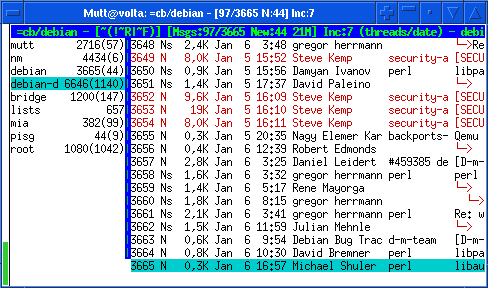
There have been several long-term wishlist bugs on Mutt to include the (in?)famous "sidebar" patch. It adds a panel on the left side of the screen to list mailboxes with message counts. We do ship several patches with Debian's Mutt package that are not considered for inclusion by the upstream authors, but this one is different. It touches the core of the UI renderer and adds extensive counting of messages. There's been quite a hype about the patch, it was even included in the (now discontinued [1]) mutt-ng fork. Unfortunately, the patch was technically questionable, it was written for the Mutt tarballs and didn't easily apply to CVS, and most versions floating around contained lots of cruft like backup files and temporary editor files. Furthermore, it is far from bug-free and even segfaults occasionally. Some months ago we decided we would build a second binary package to put the patch in so we don't destabilize the standard package. Thanks Dann Frazier, we got a clean patch, Adeodato had the right idea on how to build two binaries from the same, differently-patched source (make install would run havoc, the trick was to build the patched version before the regular one), and I resolved some more involved conflicts with the maildir-mtime patch. So, finally, there it is: mutt-patched. Disclaimer: As said, there are bugs. YMMV. On related news, there's now also a -dbg package now for the victims of the IMAP and header cache segfaults that we still see sometimes. Update: The sidebar patch was not the reason for the creation of mutt-ng, but many mutt-ng users were using it because of this patch. Update 2008-01-08: [1] mutt-ng used to be a Mutt fork. It is now maintained as a patch collection for Mutt.

Brice Goglin: Debian X.org notes - One year of X.org BTS maintenance

One year ago, I started triaging the X.org BTS (by replying to #163057 iirc). I closed almost 1600 bugs since then, bringing the remaining ones to about 900 today. I am kind of proud of Ender's graph (when the URL works...). Even if the actual BTS triaging is done now, I still try to take care of X.org bugs. And it's not that easy unfortunately... Almost 650 new bugs were opened this year against X.org packages. 250 of them are already fixed, more than one hundred have been forwarded upstream. It doesn't mean that 300 bugs still apply to our packaging. Most of our X packages are simple (apart from the xserver-xorg postinst mess that David is cleaning). But, there are lots of problems that we have no clue about, or that miss some info because people can't upgrade to unstable, ... I am sometimes tired of getting so many bugs without being able to do much about them. Maybe because upstream doesn't care enough about some problems (lots of drivers are unmaintained and get broken more and more when new features are added for a couple more important drivers). So, I sometimes tend to concentrate my work on what I like and trust. Some people noticed that xserver-xorg-video-ati get very often updated these days (6 uploads in the last 20 days). Of course, the reason is that I own a r300 board :) But also because its upstream devs are very good, it's very nice and easy to work with them. Of course, we have a lot of work and few people to do it. That's kind of sad since playing with X is very interesting. Most users are very happy when discovering things like RandR 1.2 or Compiz. Getting a chance to test them early and understand their internals is very cool. But, as said in some other posts, hacking on X.org doesn't seem to look fun. If you're interested anyway, taking care of the bugs is a very easy way to learn a lot. I had no clue about X one year ago and I learned a lot by taking care of the BTS. I would be glad to get some help now :)
(Permanent link) 

4 January 2008

Andrew Pollock: [life] Post-op, Day 1

I just called the ICU for an update before I head in for the day. She's apparently doing well, and can probably transfer out of the ICU later today, although apparently beds are tight in the ward. Update 1 I've managed to find somewhere with EVDO access, so I can update this in between ICU visits. She's looking really good this morning. She asked for some 7up, because her throat's really dry and sore from being intubated. She had something to eat at 6am. She hasn't had much sleep though, because the ICU has been too busy. She's getting turned every two hours, which isn't terribly enjoyable, but her pain is manageable. She's such a trooper. Update 2 Sarah's continuing to do well. The nurse sat her up on the side of her bed for lunch, and had half a roast beef sandwich and some fruit. Her throat's still pretty sore, and she's really preferring the liquids. Apparently her blood sugar is a bit high (something that can happen post-operatively) so they gave her some insulin before lunch. Getting her back down again looked a bit painful, as did shuffling her up the bed. Apparently there's a bed with her name on it in the intermediate ICU, so as soon as the doctor's order comes through to move her, she'll be moved. They'll also take out the central line and one of the peripheral lines at that time. Update 3 Last update today. Sarah was moved out of the ICU and into intermediate intensive care (where she'll remain until she's discharged) at 2:25pm. She got a private room again, which is very fortunate. It's nice and quiet, so she should get a good night's sleep. I can stay the night as well. One of the doctors from the team looking after her came by at about 5:50pm. She said the chest drain can come out in the next day or two. They took another x-ray this afternoon to check on some pleural effusion that they were worried about. When we asked the doctor about it this evening, she described it more as trapped air than trapped fluid, and that it should work itself out in the next few days. The x-ray showed that it was "stable", in that it hadn't really changed from the x-ray in the morning. They'll take another x-ray tomorrow morning to see how it's going. Other than that, she's continuing to do really well. The pain seems manageable. She got up into a chair for dinner (with help). They didn't give her any more insulin beforehand, so I presume her blood sugar is settling down again.

3 January 2008

Steve Kemp: Its a lot like life

Assume for a moment that you have 148 hosts logging, via syslog-ng, to a central host. That host is recording all log entries into an MySQL database. Assume that each of these machines is producing a total of 4698816 lines per day. (Crazy random numbers pulled from thin air; globviously). Now the question: How do you process, read, or pay attention to those logs? Here is what we've done so far:
syslog-ng
All the syslog-ng client machines are logging to a central machine, which inserts the records into a database. This database may be queried using the php-syslog-ng script. Unfortunately this search is relatively slow, and also the user-interface is appallingly bad. Allowing only searches, not a view of most recent logs, auto-refreshing via AJAX etc.
rss feeds
To remedy the slowness, and poor usability of the PHP front-end to the database I wrote a quick hack which produces RSS feeds via queries, against that same database, accessed via URIs such as:
  • http://example.com/feeds/DriveReady
  • http://example.com/feeds/host/host1
The first query returns and RSS feed of log entries containing the given term. The second shows all recent entries from the machine host1. That works nicely for a fixed set of patterns, but the problem with this approach, and that of php-syslog-ng in general, is that it will only show you things that you look for - it won't volunteer trends, patterns, or news.
The fundamental problem is a lack of notion in either system of "recent messages worth reading" (on a global or per-machine basis). To put that into perspective given a logfile from one host containing, say, 3740 lines there are only approximately 814 unique lines if you ignore the date + timestamp. Reducing logentries by that amount (78% decrease) is a significant saving, but even so you wouldn't want to read 22% of our original 4698816 lines of logs as that is still over a million log-entries. I guess we could trim the results down further via a pipe through logcheck or similar, but I can't help thinking that still isn't going to give us enough interesting things to view. To reiterate I would like to see: To that end I've been working on something, but I'm not too sure yet if it will go anywhere... In brief you take the logfiles and tokenize, then you record the token frequencies as groups within a given host's prior records. Unique pairings == logs you want to see. (i.e. token frequency analysis on things like "<auth.info> yuling.example.com sshd[28427]: Did not receive identification string from 1.3.3.4" What do other people do? There must be a huge market for this? Even amongst people who don't have more than 20 machines!

Ond&#345;ej &#268;ert&iacute;k: SymPy/sympycore (pure Python) up to 5x faster than Maxima (future of Sage.calculus?)

According to this test, sympycore is from 2.5x to 5x faster than Maxima. This is an absolutely fantastic result and also a perfect certificate for Python in scientific computing. Considering that we compare pure Python to LISP.

Ok, this made us excited, so we dugg deeper and ran more benchmarks. But first, let me say a few general remarks. I want a fast CAS (Computer Algebra System) in Python. General CAS, that people use, that is useful, that is easily extensible (!), that is not missing anything, that is comparable to Mathematica and Maple -- and most importantly -- I want it now and I don't care about 30 years horizons (I won't be able to do any serious programming in 30 years anyway). All right. How to do that? Well, many people tried... And failed. The only opensource CAS system, that has any chance of becoming the opensource CAS, in my own opinion, is Sage. You can read more about my impressions form Sage here. I am actually only interested in mathematical physics, so basically Sage.calculus. Currently Sage uses Maxima, because Maxima is old, proven, working system and it's reasonably fast and quite reliable, but written in LISP. Some people like LISP. I don't and I find it extremely difficult to extend Maxima. Also even though Maxima is in LISP, it uses it's own language for interacting with the user (well, that's not the way). I like python, so I want to use Python. Sage has written Python wrappers to Maxima, so Sage can do almost everything that Maxima can, plus many other things. Now. But the Sage.calculus has issues.

First, I don't know how to extend the wrappers with some new things, see my post in the sage-devel for details, it's almost 2 months old with no reaction, which shows that it's a difficult issue (or nonsense:)).

And second, it's slow. For some examples that Sage users have found out, even SymPy, as it is now, is 7x faster than Sage and sympycore 23x faster and with the recent speed improvements 40x faster than Sage.

So let's improve Sage.calculus. How? Well, no one knows for sure, but
I believe in my original idea of pure Python CAS (SymPy), possibly with some parts rewritten in C. Fortunately, quite a lot of us believe that this is the way.

What is this sympycore thing? In sympy, we wanted to have something now, instead of tomorrow, so we were adding a lot of features, not looking too much on speed. But then Pearu Peterson came and said, guys, we need speed too. So he rewrote the core (resulting in 10x to 100x speedup) and we moved to the new core. But first, the speed isn't sufficient, and second it destabilized SymPy a lot (there are still some problems with caching and assumptions half a year later). So with the next package of speed improvements, we decided to either port them to the current sympy, or wait until the new core stabilizes enough. So the new new core is called sympycore now, currently it only has the very basic arithmetics (and derivatives and simple integrals), but it's very fast. It's mainly done by Pearu. But for example the latest speed improvement using sexpressions was invented by Fredrik Johansson, another SymPy developer and the author of mpmath.

OK, let's go back to the benchmarks. First thing we realized is that Pearu was using CLISP 2.41 (2006-10-13) and compiled Maxima by hand in the above timings, but when I tried Maxima in Debian (which is compiled with GNU Common Lisp (GCL) GCL 2.6.8), I got different results, Maxima did beat sympycore.

SymPyCore:

In [5]: %time e=((x+y+z)**100).expand()
CPU times: user 0.57 s, sys: 0.00 s, total: 0.57 s
Wall time: 0.57

In [6]: %time e=((x+y+z)**20 * (y+x)**19).expand()
CPU times: user 0.25 s, sys: 0.00 s, total: 0.25 s
Wall time: 0.25

Maxima:

(%i7) t0:elapsed_real_time ()$ expand ((x+y+z)^100)$ elapsed_real_time ()-t0;
(%o9) 0.41
(%i16) t0:elapsed_real_time ()$ expand ((x + y+z)^20*(x+z)^19)$ elapsed_real_time ()-t0;
(%o18) 0.080000000000005


So when expanding, Maxima is comparable to sympycore (0.41 vs 0.57), but for general arithmetics, Maxima is 3.5x faster. We also compared GiNaC (resp. swiginac):

>>> %time e=((x+y+z)**20 * (y+x)**19).expand()
CPU times: user 0.03 s, sys: 0.00 s, total: 0.03 s
Wall time: 0.03


Then we compared just the (x+y+z)**200:

sympycore:
>>> %time e=((x+y+z)**200).expand()
CPU times: user 1.80 s, sys: 0.06 s, total: 1.86 s
Wall time: 1.92
swiginac:
>>> %time e=((x+y+z)**200).expand()
CPU times: user 0.52 s, sys: 0.02 s, total: 0.53 s
maxima:
(%i41) t0:elapsed_real_time ()$ expand ((x + y+z)^200)$ elapsed_real_time ()-t0;
(%o43) 2.220000000000027


Where GiNaC still wins, but sympycore beats Maxima, but the timings really depend on the algorithm used, sympycore uses Millers algorithm which is the most efficient.

So then we tried a fair comparison: compare expanding x * y where x and y are expanded powers (to make more terms):

sympycore:
>>> from sympy import *
>>> x,y,z=map(Symbol,'xyz')
>>> xx=((x+y+z)**20).expand()
>>> yy=((x+y+z)**21).expand()
>>> %time e=(xx*yy).expand()
CPU times: user 2.21 s, sys: 0.10 s, total: 2.32 s
Wall time: 2.31
swiginac:
>>> xx=((x+y+z)**20).expand()
>>> yy=((x+y+z)**21).expand()
>>> %time e=(xx*yy).expand()
CPU times: user 0.30 s, sys: 0.00 s, total: 0.30 s
Wall time: 0.30
maxima:
(%i44) xx:expand((x+y+z)^20)$
(%i45) yy:expand((x+y+z)^21)$
(%i46) t0:elapsed_real_time ()$ expand (xx*yy)$ elapsed_real_time ()-t0;
(%o48) 0.57999999999993

So, sympycore is 7x slower than swiginac and 3x slower than maxima. We are still using pure Python, so that's very promising.

When using sexpr functions directly then 3*(a*x+..) is 4-5x faster than Maxima in Debian/Ubuntu. So, the headline of this post is justified. :)

Conclusion

Let's build the car. Sage has the most features and it is the most complete car. It has issues, some wheels need to be improved (Sage.calculus). Let's change them then. Maybe SymPy could be the new wheel, maybe not, we'll see. SymPy is quite a reasonable car for calculus (it has plotting, it has exports to latex, nice, simple but powerfull command line with ipython and all those bells and whistles and it can also be used as a regular python library). But it also has issues, one wheel should be improved. That's the sympycore project.

All those smaller and smaller wheels show, that this is indeed the way to go, but very important thing is to put them back in the car. I.e. sympycore back to sympy and sympy back to Sage and integrate them well. While also leaving them as separate modules, so that users, that only need one particular wheel, can use them.

1 January 2008

Russell Coker: Low Power - They Just Don t get it

For a while I’ve been reading the Lenovo blog Inside The Box [1], even though I plan to keep my current laptop for a while [2] (and therefore not buy another Thinkpad for a few years) I am interested in the technology for it’s own sake and read the blog. A recent post concerns a new desktop machine billed as “our greenest desktop ever” [3]. The post has some interesting information on recycling plastic etc, and the fact that the machine in question is physically small (a volume of 4.5L and no PCI expansion slots) means that less petro-chemicals are used in manufacture (and some of the resins used are recycled). However the electricity use is 47W when idle!!! On my documents blog I have a post about the power use of computers I own(ed) [4] which includes my current Thinkpad (idles at 23W) and an IBM P3 desktop system which idles at 38W. Both machines in question were manufactured before Lenovo bought Thinkpad and IBM’s desktop PC business (so they technically aren’t Lenovo machines) and they weren’t manufactured with recycled resins. But the claim that the new machine is the greenest ever is at best misguided and could be regarded as deceptive. I think that the machine is quite decent, but it’s obvious that they can do a lot better. There’s no reason that a low-power desktop machine (which uses some laptop technology) should take more than twice the power of what was a high-end laptop a few years ago. Also comparing power use with P3 machines (which are still quite useful now, my IBM P3 desktop runs 24*7 as a server) is quite relevant - and we should keep in mind that before the Pentium was released no system which an individual could afford had anything other than a simple heat-sink to cool it’s CPU. This is largely a failing of Intel and AMD to make power efficient CPUs and chipsets. It’s also unfortunate that asymmetric multi-processing has not been implemented in recent times. A system with a 64bit CPU core of P3 performance as well as some Opteron class cores that could be suspended independently would be very good for power use with correct OS support. For example when reading documents and email my system will spend most of it’s time idling (apart from when I use Firefox which is a CPU hog) and the CPU use will be minimal for scrolling - a P3 performing core would be more than adequate for that task (which comprises a significant portion of my computer use). Then when I launch a CPU intensive task (composing a blog post in Wordpress or compiling) the more powerful CPU cores could start. It would be good if Intel would release a Pentium-M CPU (32bit) with the latest technology (smaller tracks on the silicon means less power use as well as higher clock speeds). A Pentium-M running at 2GHz produced with the latest Intel fabrication technology would probably use significantly less power than the 1.7GHz Pentium-M that is in my Thinkpad. Put that in a desktop machine and you would have all the compute power you need for most tasks other than playing games and running vista and you could get an idle power less than 23W. The new Lenovo machine in question does sound like a nice machine, I wouldn’t mind having one for testing and running demos. But the claims made about it seem poorly justified if you know the history.

31 December 2007

Mark Brown: Security here we come

The IMAP client provided with the version of Symbian on my phone has an interesting way of verifying certificates used for encrypting IMAP connections. As one would expect the client verifies the signatures on the certificate offered by the IMAP server and will prompt the user if it sees signatures that it can’t trace back to an authority it trusts. Unfortunately it is not possible to tell the device to remember the decision which means that when the device prompts it will prompt every time it connects to the server in question. The result of this is user irritation and a reduction in security since there is much less chance that a changed server certificate will be noticed. You would expect that there would be a lot of users encountering this given that so many sites don’t use a signed certificate but it turns out that this is not the case. Someone must have realised how many systems would be affected and so a solution was provided - if the server is using an unsigned certificate then the phone will accept it without warning the user at all. Only servers with signatures from an unknown trust source like a private certificate authority will cause the user to be prompted to verify the server certificate. This avoids both user irritation and any chance that the user will actually verify the fingerprint of the server they are connecting to, exposing users to spoofing and redirection based attacks. Clearly someone hasn’t thought through what they’re doing here - it all rather defeats the point of signing in the first place. On the bright side, this is the first Symbian phone I have seen where the native IMAP client encrypted connections at all so having this problem is progress.

Matthew Palmer: Cowboys

I am very saddened by the state of the IT industry. It seems like nearly everyone who works in or around IT is, to put it bluntly, a cowboy. There appears to be very little desire for actually helping people; instead all I see is a very large number of people circling around looking for the next person they can make a quick buck off. In short, most of the IT industry is composed of people who are little better than shysters and conmen. As a case in point, I recently had contact with someone who is trying to get an online store running. They've been trying, unsuccessfully so far, for several months. They've been screwed over by basically every IT-related person they've had contact with so far. Now, after all of their suffering, they've finally gotten in contact with me. Most of their money is gone, and they're deeply behind schedule. So I'm left trying to pull a miracle job in little time and with little money. Yes, I could shoo them away, because they're asking for more than they can afford, but there's a little spark of helpfulness left in me, and I'll try to get them going as best they can with what they've got. If they'd found someone competent right at the beginning, they'd have been fine. They started with sufficient cash and time to produce a good end result. But chancing upon someone decent doesn't have good odds in IT; it's a bit like winning the lottery. This story isn't unique in my personal experience, by any stretch. There seems to be a near-endless procession of non-technical people who come out of their encounters with the IT industry battered and bruised, whether it be on the web, in their business infrastructure, or their personal computing needs. While it's easy to blame the customer for not managing themselves and their computing properly, I don't think it's fair to lay the blame on them -- to me, that's like blaming the patient for dying on the operating table, when the responsibility must lie, prima facie, with the surgeon. It's the surgeon, after all, who is the (presumably) trained and experienced professional in the relationship, and it is his responsibility, primarily, to ensure that everything goes smoothly[1]. Depressingly, I don't see much of a way around this problem. The few IT people who did care could try and group together, build some sort of a rating or "membership implies quality" system, educate the consumer, and try and drive the cowboys out, but guilds and trade associations are frowned upon these days, smacking (as they do) of restraint of trade and collusion. Government regulation never seems to produce anywhere near the desired result, while hoping that the consumer will either rise up and demand quality, or will gain sufficient knowledge to be able to pick a cowboy is a complete non-starter, for the same reason as teaching everyone basic surgical techniques isn't going to improve the quality of hospitals.
There's an ad that used to be on Australian TV for a certain bank, where a guy is at a party and he's asked by another of the partygoers what he does for a living. As he replies, "I work in banking", the entire party goes silent and stares at him in horror. It's only when he says, "It's OK, I'm with $BANK_BEING_ADVERTISED" that everyone looks happy again and continues on with their party. Although I've never had that particular experience, I'm almost getting to the point where I'm not happy telling people what I do for a living. This is because in any non-trivial collection of people, there's almost certainly going to be at least one person who has had such a poor experience with the IT industry that they're either going to take it out on me, ask me interminable questions about computers, or will just hate me on principle. It's unfortunate that brothels don't have pianos any more; if I were to say "I play piano in a whorehouse" I'm pretty sure the response would be "lawyer or sysadmin?". As Edsger Dijkstra said back in 2001, "The average customer of the computing industry has been served so poorly that he expects his system to crash all the time, and we witness a massive worldwide distribution of bug-ridden software for which we should be deeply ashamed." Are you?
1. That isn't to say that the patient (or client) has no responsibility in ensuring a positive outcome -- if you go bungee jumping the day after open heart surgery, or never send your web developer any content, you're very unlikely to have a positive outcome. However, it seems to me as though the only customer consultation done by most IT "professionals" on taking on a project is a Homeresque "I only have two questions. 'How much?' and 'give it to me'".

30 December 2007

Steve Kemp: I just don't understand

Whilst I'm very pleased with my new segmented network setup, and the new machine, I'm extremely annoyed that I cannot get a couple of (graphical) Xen guest desktop guests up and running. The initial idea was that I would setup a 64-bit installation of Etch and then communicate with it via VNC - xen-tools will do the necessary magic if you create your guest with "--role=gdm". Unfortunately it doesn't work. When vncserver attempts to start upon an AMD64 host it dies with a segfault - meaning that I cannot create a scratch desktop environment to play with. All of this works perfectly with a 32-bit guest, and that actually is pretty neat. It lets me create a fully virtualised, restorable, environment for working with flash/java/etc. The bug was filed over three years ago as #276948, but there doesn't appear to be a solution. Also, only on the amd64 guest, I'm seeing errors when I try to start X which mention things like "no such file or directory /dev/tty0". I've no idea whats going on there - though it could be a vt (virtual terminal) thing?. The upshot of all this is that I currenly have fewer guests than I was expecting:
skx@gold:~/blog/data$ xm list
Name                                      ID Mem(MiB) VCPUs State   Time(s)
Domain-0                                   0     3114     2 r-----   1180.6
cfmaster.services.xen                      1      256     1 -b----      1.0
etch32.desktop.xen                         2      256     1 -b----      1.4
etch32.security-build.xen                  3      128     1 -b----      1.4
etch64.security-build.xen                  4      128     1 -b----      1.4
sarge32.security-build.xen                 5      128     1 -b----      1.0

Paul van Tilburg: XO Play Night

Christian, Bram and Sjoerd playing with XOs Yesterday after dinner we spontaneously ended up having a XO play night. I liked the interface and the things it could do, the complete difference with a normal notebook, the creeping into a child’s mind a bit. It was funny to notice that being older and experienced, things that probably are intuitive to children, are not/no longer intuitive to me anymore. This fact alone shows how “being used to” and experience are a large part of things one consider intuitive. I notice this also when people are trying to use GNOME when they are used to Windows: they find this difficult, but of course most of them are already “hard wired” to Windows. The reverse holds for me: due to not using Windows often at all, I keep losing the aptitude for it and it seems to be a hard system to use from my perspective. Fortunately for us all, “getting used to” is the specialty of the brain.

Clint Adams: And like a heroin-addled bat, he was gone

I spent two hours answering the phone, ribbing the clients affectionately before sending their calls off to different areas in the firm. It was like I couldn't get enough. I had to stop when Carol came back to her desk and demanded to know what the hell I was doing. I rejected the first fourteen answers that came to mind, and instead gave her a shrug, a wink, and a fingersnap. Then like a Carmelob, I scuttled away and strolled back across town to my office. My dyspeptic boss tapped his foot in a hostile manner. He demanded to know where I had been. I rejected the first three answers that came to mind, and simply responded that I had been answering phones. Also I quit. It seemed the thing to do. Explaining to my colleagues that I had just freed up a bit of time, I returned to Carol's office, where I found her rocking back and forth in the corner. I turned off her light. It seemed the thing to do.

29 December 2007

David Nusinow: Processing

I've been taking a little bit of time away from Debian and X to see what sort of fun stuff is out there that I've been putting off learning. Aside from finding what looks to be a good fitness training plan for the next year (and hopefully beyond), I've been looking at different programming languages. One that I found most recently is Processing.

This program is absurd amounts of fun to play with. I've long been interested in how to do display complicated data sets visually, and processing is really built to allow you to do that relatively easily. More and more often in my work lately I've been generating fairly large data sets, and I'm not really satisfied with the standard graphs that come with a spreadsheet. They work for basic data, but they completely fall down when you need something bigger. You can either add more graphs or just have a large table, both of which are suboptimal. Processing is centered around the concept of sketches, quickly where you quickly type some java code in to the IDE, hit the play button, and have it run. The API is very simple and should be intuitive to anyone who's done any coding before. This lets you play around with how to visualize your data at very low cost.

The software is GPL'ed, and while it relies on java, this shouldn't really be a problem in the near future. Unfortunately, java is java, and to be honest I'd rather be writing something like python or ruby. Options for those seem to be forthcoming (nodebox is apparently being ported to linux and scribble is out there in some form now) but processing has an impressive and easy setup as it is. I'll definitely be picking up one of the new books when it's available.

28 December 2007

Adam Rosi-Kessel: MBTA On Time

After my many philippics against the MBTA, I should give the T credit for being nearly 100% on time this week (at least within five to ten minutes of target), so much so that I am often sprinting to catch the train because I had gotten used to it being late. That the trains are only half-full due to people’s vacations must be related. So maybe the long-term solution is to alienate enough riders that they leave the system? Technorati Tags: ,

Russell Coker: Twilight of the Books?

I’ve just read an interesting article in the New Yorker titled “Twilight of the Books” [1]. It started with some depressing statistics about literacy. One comment that I couldn’t figure out concerned “the panic that takes hold of humanists when the decline of reading is discussed“. The decline in literacy concerns me because I want to live in a society where everyone can contribute as equals and where all voters have the possibility of becoming well informed about the issues that affect their vote. If literacy declines far enough then fascism seems to be the inevitable result. I’m not sure whether that makes me a humanist according to the author. Below in the second part of this post (not included in the feed) I include my dictionary definition of the word, #4 is the definition most commonly used today (which is a reasonable match for my beliefs). There is some interesting information regarding basic research on the mental abilities of literate and illiterate people which suggests that people who an read are better at handling abstract concepts and hypothetical situations. The article notes that spending time on the net increases academic scores for children. It also makes the interesting claim that visiting pr0n sites increases grades, I find that difficult to believe. I wonder whether there is a difference between readers and writers in this regard. Does the typical serious net user who averages writing more than 3650 messages a year for fun (in addition to whatever email may need to be written for work) plus some blog posts and writing other web pages have different mental abilities to someone who just reads what others write? Does blogging (and other writing on your choice of topic) change your brain? What about programmers, does spending 8 hours a day writing formal rules for hypothetical mathematical situations (which is essentially what programming is about) change your brain? Are programmers going to have greater abilities for managing abstract concepts and hypothetical situations than people who have not had such experience? NB It will be difficult to determine this as people who have such skills will find programming easier and more fun so therefore a career in programming computers is self-selecting for people with such abilities. Another interesting fact is the results of research into the comprehension of a PowerPoint presentation. People who read it without an audio-visual accompanying it learned more and rated it as more interesting. Based on this my plan is that in future when attending conferences I will try and read papers which are presented BEFORE attending the lectures. Unfortunately most conferences which have papers presented seem based on the idea that you give a lecture about a topic as a teaser for your paper and assume that the audience knows nothing about it (conferences which don’t have papers outnumber the ones that do). Most Linux conferences seem based on the idea that almost no-one reads papers at all, they attend lectures and visit web sites and IRC channels afterwards. NB this comment is based on talking to people who attend conferences and my observations on attending conferences - it is not a criticism of any conferences merely an observation on cultural attitudes. Based on this information it seems reasonable to provide copies of lecture notes to the audience before the lecture. For example for a typical talk that I give to a LUG I could blog the lecture notes before the meeting and email the LUG mailing-list with the URL, people who really want to learn would hear me talk AFTER reading the notes and hopefully get the best of both forms of learning. I had been considering producing some YouTube [2] videos with instructions on how to use SE Linux. But it seems that might not be such a good idea (at least not a good enough idea to justify the amount of effort I would have to spend). The author seems to misunderstand YouTube, it is NOT about making the Internet resemble TV (where millions of mindless drones watch content created for the lowest common denominator in the audience). The AtGoogleTalks on YouTube [3] and www.ted.com are examples of high-quality free content (comparable to the best TV documentaries - the type of content which is cited as increasing the academic results of children) and the culture of creation and discussion must be a good thing. Most TV is bad because it’s one-way communication and the quality of the content is low. YouTube videos are widely discussed in email, blogs, and other written forums. The creation of the best (and often most viewed) videos would surely involve some writing. I wonder whether the benefits attributed to reading can be obtained without reading fiction. The nature of work is changing to require an increasing amount of reading and writing. The most menial work requires reading instruction manuals. Most of the best paid jobs involve a lot of reading and writing. If reading fiction isn’t required then it seems that there is little risk in the immediate future. (more…)

Next.

Previous.