Search Results: "mak"

19 March 2014

Wouter Verhelst: Spelling should not be hard

I know, I know, I should resist saying this. But every time I see it, I wonder why it happens, and I should just get this off my chest. The difference between "its" and "it's" is something that many people, even native english speakers, seem to miss. Yet, it's so extremely simple that I, a non-native english speaker, have been baffled about that common mistake for as long as I can remember. The apostrophe (') in any sentence usually means that something at the location of that apostrophe is gone out to lunch. In this particular case, it means that the " " and the "i" in the phrase "it is" were hungry. So rather than "it is", we contract that to "it's", and allow the space and the i to enjoy their meal while the apostrophe keeps their seats warm. Practically, what that means is that every time you want to write "it's", you should consider whether you can replace it with "it is" without making the sentence sound like junk. If you can't, you probably meant to write "its" rather than "it's". For instance, consider the following sentence: "It's not possible to repair this car within the budget that its owner wants to pay" It's perfectly possible to say "it is not possible" here, so we need to have the apostrophe keep a seat warm for the space and the i. It makes no sense to say "it is owner", unless you're trying to speak a much deformed form of english, so that makes it a possessive pronoun (similar to "hers", "his", "theirs", etc) and you shouldn't use an apostrophe. Speaking of food, it's time for lunch now.

Russ Allbery: WebAuth 4.6.0

I was going to put out some of these changes in a 4.5.6 release late last year, but that didn't happen, and then more things kept coming up. So this release is rather large. The major new feature is a new WebAuthCookiePath directive for mod_webauth, which allows path-scoped WebAuth cookies so that different portions of a site can maintain separate authentication credentials. There are various caveats, and support will get better later, but it's a beginning. There are two bug fixes from Benjamin Coddington: WebAuthOptional should now work with Apache 2.4, and internal notes management in the module is now done better, which should prevent some cases where the user was redirected to WebLogin twice. Eventually, the things WebAuth uses notes for should become request context data, but that's for a later change. There are multiple changes to keyring handling to let mod_webauth and mod_webkdc work properly with the ITK Apache MPM, which allows each virtual host to run as a different user. Previously, all virtual hosts shared one in-memory keyring, which meant leaking authentication keys between virtual hosts. Now, each virtual host gets its own, lazily loaded from the keyring on disk when it's first needed. This allows ITK users to configure separate keyrings for each virtual host. To make this easier, keyring files are now locked for write, and writing a keyring preserves the ownership and permissions if possible. WebLogin now supports a new remctl-based password change protocol, which I developed for Stanford to work around some problems with the kpasswd when password change takes too long. All the tools for this will eventually be available outside of Stanford when I have a chance to polish them up and release them. There are a few other, more minor bug fixes. mod_webauth and WebLogin are now more aggressive about telling web browsers to really not cache pages. WebLogin also now uses the authenticated identity returned by the WebKDC for multifactor, since it may have canonicalized the user's identity. The correct template variable is now set when the user doesn't enter a code on the WebLogin multifactor page. Better error messages are returned for invalid principals and unknown realms. The workaround for invalid XML returned by the WebKDC should now actually work. And WebLogin logs a more detailed error message on password change failures. You can get the latest release from the official WebAuth distribution site or from my WebAuth distribution pages.

Andrew Pollock: [life] Day 50, Kindergarten, appointments central, cleaning, meetings and meltdowns

Today was a very busy day for me. First up, I had my chiropractic adjustment. Then I had my half-yearly dental checkup. Then I got stuck into cleaning the house. Fortunately I'd done a bit the afternoon before, otherwise I'd never have gotten it done before my massage. I'm starting to seriously consider getting a cleaner. I can make much better use of the limited time I get than cleaning the house. Zoe's Kindergarten has a Parent Advisory Group or something like that, which meets monthly. I wasn't able to attend the first one, but the second one was today, about an hour before pickup, so I grabbed a quick lunch after my massage and biked over to Kindergarten early. The meeting wasn't particularly interesting. The majority of it revolved around fund raising. At pickup time, Zoe was fast asleep again, and had another massive meltdown when I woke her up. It took forever to get her out. She wanted to give Megan a hug, but Megan had long gone. Then, rather fortuitously, Megan's Dad texted me to tell me they were in the playground on the neighbouring school grounds, so I managed to use that as an incentive to get Zoe moving. I didn't know until today, but at the foothill of the neighbouring primary school, there's some play equipment. A few of the Kindergarten kids seem to have a play over there after Kindergarten. Megan and Zoe played there for a bit before it was time to go. Once we got home, we unpacked and then walked down to the Hawthorne Garage to get some vegetables, and then, after buying some milk from the corner store and another grumpy meltdown, I figured a quiet afternoon was in order, so Zoe watched a DVD for a bit while I prepared dinner. I'd bumped into the mother of Zoe's friends Eva and Layla from her old day care while I was at the dentist in the morning, and arranged for her to drop by to pick up a copy of the photos I'd taken at their 4th birthday party. I'd hoped that she'd bring the girls with her, and had told Zoe they'd be dropping by, but unfortunately she came on the way to picking them up from day care, so Zoe was a bit disappointed. We did arrange to have them over for dinner next Friday, so I'm sure that will be very exciting. After that, we had dinner, and a fairly uneventful bedtime. It's hot again, so I hope that doesn't mess with her sleep.

18 March 2014

Enrico Zini: on-responsibilities

On responsibilities I feel like in my Debian projects I have two roles: the person with the responsibility of making the project happen, and the person who does the work to make it happen. As the person responsible for the project, I need to keep track of vision, goals, milestones, status. To make announcements, find contributors, motivate them, deal with users and bug reports, maintain documentation, digest feedback. As the person who does the work to make it happen, I need quiet time, I need to study technology, design code, write unit tests, merge patches, code, code, code, ask around about deployment information, more code. I have a hard time doing both things at the same time: the first engages my social skills and extroversion, requires low-latency interaction, and acting when outside things happen. The second engages my technical skills and introversion, requires quiet uninterrupted periods of flow, and acting when inspiration strikes. I never managed to make good use of "gift bugs" or "minions": I often found the phrase "it's easier for me to do than to explain it" sadly relevant. Now I understand that it's not because of the objective difficulty of explaining or doing things, nor about the value of doing or of involving people. It's about switching from one kind of workflow to another. If I rephrase that as "it's easier for me to stay in flux and fix it, than to switch my entire attitude to ask for help". Of course this does not scale: we've all been saying it since I can remember. Looking at the situation from the point of view of those two roles, however, I now wonder if those two roles shouldn't really require two people. In other worlds they are: the project managers, taking responsibility for making the project happen, and the software designers, artists, and all other kind of artisans doing the work to make it happen. Of course I don't want the kind of project manager that shifts responsibilities to artisans, does nothing and takes the credit for the project: not in paid work, not in Debian. Project management is something else. I would be interested instead in having the kind of project manager that takes responsibility for the project, checks how the artisans are doing and communicates what is happening to the rest of the world, deals with the community, motivates more people to help, test, try, use, give feedback on things as they happen. A project manager / community manager. So that while I'm flux there is someone who tags bugs as "gift", mentors people to find code and documentation, and remembers to write an announcement if I implemented three cool things in a row and I'm already busy working on the fourth. So that I don't write cool ideas in my todo list where nobody can read them, but I can share them to a mailing list where someone picks up a relevant one and finds someone to make it happen while I'm busy refactoring old code that only I can understand. So that if I say "sorry, paid work calls, I won't be able to work on this project for a month", I'll be able to completely forget about that project for a whole month, without leaving the community out there to die. That's an interesting job for non-uploading DDs: please take over my projects. Let's share a vision, and team up to make it happen. Give me the freedom of being the craftsman I enjoy being, and take away from me those responsibilities that I've never asked for. The worst project managers are those that never asked to be one, but were promoted to it. Let's not repeat that mistake in Debian. A good part of the credits for this post go to Francesca Ciceri, for the discussions we had on our way back from MiniDebConf Barcelona 2014. P.S. I'm seeing how a non-uploading DD could be in the Maintainer field for one or more packages, with uploading DDs being, well, uploaders. Food for thought.

Vincent Bernat: EDNS client subnet support for BIND

To provide geolocation-aware answers with BIND, a common solution is to use a patch adding GeoIP support. A client can be directed to the closest (and hopefully fastest) web server:
view "FRANCE"  
     match-clients   geoip_cityDB_country_FR;  ;
     zone "example.com" in  
         type master;
         file "france.example.com.dns";
      ;
 ;
view "GERMANY"  
     match-clients   geoip_cityDB_country_DE;  ;
     zone "example.com" in  
         type master;
         file "germany.example.com.dns";
      ;
 ;
/* [...] */
view "DEFAULT"  
    zone "example.com" in  
        type master;
        file "example.com.dns";
     ;
 ;
However, an end user does not usually talk directly to authoritative servers. They proxy the query to a third-party recursor server which will query the authoritative server on their behalf. The recursor also caches the answer to be able to serve it directly to other clients. On most cases, we can still rely on the recursor GeoIP location to forward the client to the closest web server because it is located in the client s ISP network, as shown on the following schema: Query for www.example.com through an ISP recursor
  1. Juan is located in China and wants to know the IP address of www.example.com. She queries her ISP resolver.
  2. The resolver asks the authoritative server for the answer.
  3. Because the IP address of the resolver is located in China, the authoritative server decides to answer with the IP address of the web server located in Japan which is the closest one.
  4. Juan can now enjoy short round-trips with the web server.
However, this is not the case when using a public recursor as provided by Google or OpenDNS. In this case, the IP address of the end client and the source IP address of the recursor may not share the same locality. For example, in the following schema, the authoritative server now thinks it is in relation with an European customer and answers with the IP address of the web server located in Europe: Query for www.example.com through an open recursor Moreover, caching makes the problem worse. To solve this problem, a new EDNS extension to expose the client subnet has been proposed. When using this extension, the recursor will provide the client subnet to the authoritative server for it to build an optimized reply. The subnet is vague enough to respect client s privacy but precise enough to be able to locate it. A patched version of dig allows one to make queries with this new extension:
$ geoiplookup 138.231.136.0
GeoIP Country Edition: FR, France
$ ./bin/dig/dig @dns-02.dailymotion.com www.dailymotion.com \
>     +client=138.231.136.0/24
; <<>> DiG 9.8.1-P1-geoip-1.3 <<>> @dns-02.dailymotion.com www.dailymotion.com +client=138.231.136.0/24
; (1 server found)
;; global options: +cmd
;; Got answer:
;; ->>HEADER<<- opcode: QUERY, status: NOERROR, id: 23312
;; flags: qr aa rd; QUERY: 1, ANSWER: 2, AUTHORITY: 0, ADDITIONAL: 1
;; WARNING: recursion requested but not available
;; OPT PSEUDOSECTION:
; EDNS: version: 0, flags:; udp: 4096
; CLIENT-SUBNET: 138.231.136.0/24/24
;; QUESTION SECTION:
;www.dailymotion.com.           IN      A
;; ANSWER SECTION:
www.dailymotion.com.    600     IN      A       195.8.215.136
www.dailymotion.com.    600     IN      A       195.8.215.137
;; Query time: 20 msec
;; SERVER: 188.65.127.2#53(188.65.127.2)
;; WHEN: Sun Oct 20 15:44:47 2013
;; MSG SIZE  rcvd: 91
$ geoiplookup 195.8.215.136
GeoIP Country Edition: FR, France
In the above example, a client located in France gets a reply with two IP addresses located in France. If we now are an US client, we will get IP addresses located in the US:
$ geoiplookup 170.149.100.0
GeoIP Country Edition: US, United States
$ ./bin/dig/dig @dns-02.dailymotion.com www.dailymotion.com \
>     +client=170.149.100.0/24
; <<>> DiG 9.8.1-P1-geoip-1.3 <<>> @dns-02.dailymotion.com www.dailymotion.com +client=170.149.100.0/24
; (1 server found)
;; global options: +cmd
;; Got answer:
;; ->>HEADER<<- opcode: QUERY, status: NOERROR, id: 23187
;; flags: qr aa rd; QUERY: 1, ANSWER: 2, AUTHORITY: 0, ADDITIONAL: 1
;; WARNING: recursion requested but not available
;; OPT PSEUDOSECTION:
; EDNS: version: 0, flags:; udp: 4096
; CLIENT-SUBNET: 170.149.100.0/24/24
;; QUESTION SECTION:
;www.dailymotion.com.           IN      A
;; ANSWER SECTION:
www.dailymotion.com.    600     IN      A       188.65.120.135
www.dailymotion.com.    600     IN      A       188.65.120.136
;; Query time: 18 msec
;; SERVER: 188.65.127.2#53(188.65.127.2)
;; WHEN: Sun Oct 20 15:47:22 2013
;; MSG SIZE  rcvd: 91
$ geoiplookup 188.65.120.135
GeoIP Country Edition: US, United States
The recursor is expected to cache the two different answers and only serve them if the client matches the appropriate subnet (the one confirmed in the answer from the authoritative server). With this new extension, the authoritative server knows that Juan is located in China and answers with the appropriate IP address: Query for www.example.com through an open recursor with client subnet Not many authoritative servers support this extension (PowerDNS and gdnsd, as far as I know). At Dailymotion, we have built a patch for BIND. It only works when BIND is configured as an authoritative server and it doesn t expose no configuration knobs. Feel free to use it (at your own risk). Once installed, you need to register yourself to OpenDNS and to Google to receive queries with the extension enabled.

Andrew Pollock: [life] Day 49, Kindergarten, general exhaustion, a new car radio and a body corporate AGM

I was pretty exhausted after yesterday's sustained activities. By the time I'd blogged, done some photo management, gone to yoga class, made dinner and called my girlfriend, it was late, and I'd gotten to that tired point where I couldn't be bothered getting off the couch, so I ended up having a self-inflicted late night. This morning I tried to go for a run, but I died at the 2km mark, half way up Hawthorne Road, so I walked for the remainder of my 5km circuit. I'm going to say it was a combination of tiredness, insufficient hydration, the heat, and my head space. I got home from my "run", and had a shower and cleaned up the kitchen a bit and decided I'd rather get out of the house than work on my taxes, so I headed over to Moorooka to talk to the folks at Northfield about a new car radio. I've been wanting to get a better radio for the car for a while. The factory one has no line in, so I can't play anything off my phone through the car speakers. I've been wanting one that can do Bluetooth and play USB media. That way I can stick all of Zoe's CDs onto a USB stick and give her (and me) more variety than the current 3 track CD from dentist that she's favouring, and with Bluetooth I can listen to Pandora without needing a cable. I got to Northfield, and was pleased that they could do something within the budget I was looking at, and bought the DEH-X6650BT, which they were able to install for me on the spot. They said it'd take an hour and half, so I went for a walk down the road to Moorooka's main street to kill some time. I ended up having lunch at a little Ethiopian cafe where I swear the lady didn't understand English. Moorooka's quite nice and ethnic. After lunch I walked back, with the intention of reading the manual while I waited, and was pleasantly surprised to find they'd already finished the installation. When the guy was walking me through how to use it, I was really pleasantly surprised to discover that it also included Bluetooth hands free for my phone, with a little microphone glued to the top of my windscreen. That really made my day. I don't have to faff around with my little Bluetooth earpiece in the car any more. Then I discovered it had built-in Pandora support. So I'm really happy with this purchase, and really glad I didn't have to make a second trip to get it installed. I scouted around for a small USB thumb drive on the way home, and copied all Zoe's music off my laptop when I got home. By this stage, it was too late to bike to Kindergarten, and I wasn't really feeling like it anyway, because it was too hot, and I wanted to show Zoe the new radio anyway. It was a good call, because Zoe was fast asleep, and didn't take very kindly to being woken up. It took about 20 minutes to get her calm enough to get her back to the car. We got home, and we chilled out on the couch and watched a bunch of Youtube videos on the TV from when she was in the US, and then I showed her some Winter Olympics figure skating and speed skating, and then she watched a bit of DVD while I cleaned up the living room. Sarah picked up Zoe, and then I hosted our Body Corporate's annual general meeting.

17 March 2014

Daniel Pocock: Hangouts Outage? Try WebRTC and JitMeet

With Hangouts being offline right now, it might be a good opportunity to catch up on some of the exciting, free and open alternatives:

Mario Lang: grub-efi-amd64 on a MacBook Air

When I installed Debian on my MacBookAir4,1 in 2012, there was no way to do it without manual intervention yet. I followed a tutorial on how to boot GRUB from the EFI Boot option in the MacBook EFI Menu. I did not want to fiddle with rEFIt, and I didn't want to boot GRUB by default. When I want to boot Linux, I press the Option key during power up and select EFI Boot from the Apple boot menu. Unfortunately, I neglected to collect notes about how I did it manually. However, Linux 3.2 is getting a bit old, so I finally wanted to replace my manual boot configuration with something handled by the package system. In case you don't have /boot/efi in /etc/fstab yet, you need to mount /dev/sda1 on /boot/efi for the following to work. The documentation I found on the net suggested to just reinstall grub-efi-amd64 and everything should work. That is not quite true. When I do
# apt-get install --reinstall grub-efi-amd64
Nothing changes in /boot/efi. I sort of expected that /boot/efi/EFI/debian would be created, and the EFI image should be placed in there. However, that did not happen. Why is that? It turns out that when I installed grub-efi-amd64 manually in 2012, I created /boot/efi/EFI/boot/bootx64.efi which is the EFI fallback location, and apparently exactly what I want on this MacBook which does not support multiple boot options. Matthew Garrett posted an interesting article called Booting with EFI which sheds light on this issue, go and read it. Looking at /var/lib/dpkg/info/grub-efi-amd64.postinst revealed that /boot/efi/EFI/debian needs to be created manually first. If this directory does not exist, grub-efi-amd64 basically does nothing on reinstall. Running grub-install will actually create a new EFI image. However, it is being created in the wrong place for this machine.
# grub-install --target=x86_64-efi
does the trick. Now /boot/efi/EFI/debian/grubx64.efi gets created. However, since I don't want to make GRUB the default, there is yet another manual step to do:
# cp /boot/efi/EFI/debian/grubx64.efi /boot/efi/EFI/boot/bootx64.efi
Now I can select EFI Boot after pressing the Option key during startup. GRUB is loaded and Linux 3.13 gets booted. Strike! Looking more closely reveals that there is actually a way to tell grub-install that it should install to the fallback location directly. The --removable option does that. For the faint of heart, what does grub-install actually do on an EFI system? It does not directly write to the disk, therefore it does not need a device specified. It looks for files in /boot/efi and assumes the EFI partition is mounted there. So for my use case, the correct way to upgrade to a current GRUB EFI image should have been:
# grub-install --removable --target=x86_64-efi
Meanwhile I've been made aware of Bug#708430. I guess it would be nice to have an option in /etc/default/grub which would indicate that installation to the fallback location is desired. While this is a rather ugly hack to work around a stupid limitation, it is still what I'd like on this MacBook. At least since I don't have a triplle boot situation. Fallback location works fine with just two OSes coexisting.

Andrew Pollock: [life] Day 48, Pupil free day, shoes, shoes and more shoes, ice skating, cut-throat shaving

Zoe's Kindergarten had a Pupil Free Day today. I think there's only that impacts the days Zoe attends Kindergarten for the whole year. I'd wanted to make the most of the fact that her friend Mackensie wasn't in Kindergarten on a Monday either, and have a play date with her at Southbank, but her little sister was having sleep issues, and her mother wanted her to nap at home today, so we had to scratch those plans. Given the forecast maximum temperature was going to be over 30 C today, I thought ice skating would be a great way to escape the heat, but the rink didn't have their open session until 1pm, so we had to do something in the morning to kill time. I decided we should go shoe shopping. Before we went to Westfield Carindale, we went to Officeworks to print out some more photos. Zoe really enjoys helping me with the self-serve printing kiosk, and is happy amusing herself at the kid's colouring table otherwise. I wanted some unusual size prints, so it involved one of the staff doing some additional faffing around with Photoshop for me. I'm rather amazed they'll spend the staff time doing that, when I only spend a couple of dollars on prints. After that, we headed out to Carindale. Zoe's in that limbo between size 3 and 4 at the moment. I bought her some new size 4 Autumn/Winter clothes the other weekend, and after that, went through her wardrobe and did a big cull of all her size 2 stuff and any size 3 stuff that didn't fit terribly well. That just left shoes and jumpers to sort out, so we concentrated on them today. First things first, we grabbed some morning tea at Muffin Break. They did a nice babyccino in a little china espresso cup, so Zoe enjoyed that, and we split a muffin between us. Zoe took a fancy to some ballerina pumps she saw at Cotton On Kids. We bought a few pairs of socks and a pair of size 10 pumps, and she wanted to wear them from that point on, so we wore them to the shoe shop. Almost as soon as we walked out of the store, she ran into heel problems on one foot, so after a few rounds of taking a couple of steps and needing to refit the heel of one shoe, I convinced her to go barefoot the remainder of the way. At Shoes and Sox she got properly measured for some light up closed-toe shoes. Zoe absolutely loved them, and wanted to wear them from that point on. Next we went to Target, and got a couple of jumpers. The kid's entertainment area was both a blessing and a curse. It was great for keeping her occupied when I needed to dash off and get some socks for myself for ice skating, but it was a negotiation challenge to get her away from it when it was time to leave. Toy Story 3 conveniently finished at just the right time. We dropped into Pumpkin Patch to get some boots. Despicable Me was playing there. Zoe is absolutely hooked on it at the moment. I managed to prime her to leave at the end of a scene though. She did score a couple of stickers while we were sitting there chilling out watching the movie though, so that was nice. I love Pumpkin Patch, but my God, it is expensive. I could have dropped $50 on a dress I really liked there, but I managed to resist. We decided to go back to Cotton On Kids to exchange the ballerina pumps. They didn't have any more of the style she'd chosen in her size, so we switched from gold glittery ones to red ones, which she wore out of the store. Cotton On Kids was also showing Despicable Me, so Zoe was very pleased. Shoes are horrendously expensive in Australia. The Sketchers and the boots set me back $60 each. The pumps were a bit more reasonably priced. I think they were about $20. I hope her feet don't grow too fast. After that shopping extravaganza it was lunchtime, and we split a spinach pide and had a quick fool around in the outdoor kid's play area and by then it was already after 1pm, so it was time to head to the ice skating rink. We got to the rink by about 1:45pm, and I changed Zoe into something a bit warmer. She was so excited, because we've talked about going ice skating on and off for a while, but it's just not something we've gotten around to doing yet, because neither of the two rinks are particularly convenient to home, and they have slightly odd hours. The rink had these slightly shorter than waist-height penguins that you could rent for little kids, so I rented one of them and Zoe pushed it around the rink, and got progressively better on her skates as time passed. We could also turn the penguin around and she could stand on the "feet" and I could push the penguin around by its head, which was fun for her, because we could get more speed up. By the end of the session, she was confident enough to have a few stints without the penguin, and stayed up pretty well. She was pretty buzzed afterwards. Going during the week was great, because there were maybe 20 people on the ice, tops, so it was nice and quiet. Zoe wasn't much of a hazard to anyone. She loved watching a couple of guys speed skate, and a lady do some figure skating. I'd booked myself a cut-throat razor shave at The Emporium Barber as a bit of a splurge, for 4:30pm, so we headed over there next. We got there a bit early, so I had a coffee, and Zoe had a juice while we waited. Then we discovered this dance apparel place a couple of doors down, that also had lots of fairy dresses and dress up dresses and whatnot. I asked on the off chance if they had ballet shoes, and of course they did, so we grabbed a pair of them while we were there, which was most serendipitous. Zoe has a trial dance class on Friday. She wants to do ballet or something of that ilk as her activity next term. Zoe was really good while I had my shave, and kept herself amused with my phone, and then we headed home, where Sarah was waiting to pick up Zoe. So it was really a rather non-stop, but nicely paced day. I'm looking forward to capping it off with a yoga class.

16 March 2014

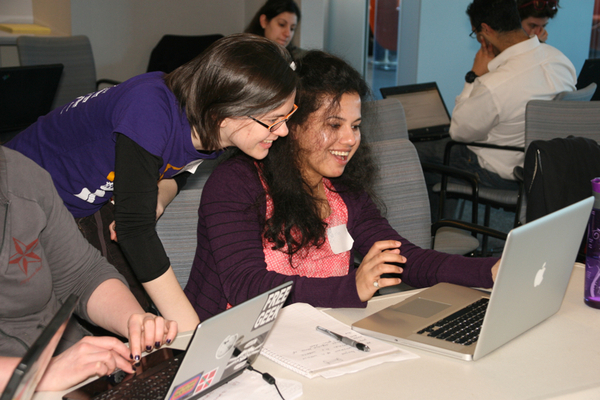
Benjamin Mako Hill: Community Data Science Workshops in Seattle

Photo from the Boston Python Workshop   a similar workshop run in Boston that has inspired and provided a template for the CDSW.

Photo from the Boston Python Workshop a similar workshop run in Boston that has inspired and provided a template for the CDSW.

On three Saturdays in April and May, I will be helping run three day-long project-based workshops at the University of Washington in Seattle. The workshops are for anyone interested in learning how to use programming and data science tools to ask and answer questions about online communities like Wikipedia, Twitter, free and open source software, and civic media. The workshops are for people with no previous programming experience and the goal is to bring together researchers as well as participants and leaders in online communities. The workshops will all be free of charge and open to the public given availability of space. Our goal is that, after the three workshops, participants will be able to use data to produce numbers, hypothesis tests, tables, and graphical visualizations to answer questions like: If you are interested in participating, fill out our registration form here. The deadline to register is Wednesday March 26th. We will let participants know if we have room for them by Saturday March 29th. Space is limited and will depend on how many mentors we can recruit for the sessions. If you already have experience with Python, please consider helping out at the sessions as a mentor. Being a mentor will involve working with participants and talking them through the challenges they encounter in programming. No special preparation is required. If you re interested, send me an email.

Gunnar Wolf: Trying to get Blender to run in the CuBox-i (armhf): Help debugging Python!

As I posted some weeks ago, I have been playing with my CuBox-i4Pro, a gorgeous little ARM machine by SolidRun, built around an iMX6 system-on-a-chip. My first stabs at using it resulted in my previous post on how to get a base, almost-clean Debian distribution to run (Almost? Yes, the kernel requires some patches not yet accepted upstream, so I'm still running with a patched 3.0.35-8 kernel). After writing this step by step instructions, I followed them and built images ready to dd to a SD card and start running (available at my people.debian.org space. Now, what to do with this little machine? My version is by no means a limited box: 4 ARM cores, 2GB RAM make a quite decent box. In my case, this little machine will most likely be a home storage server with little innovation. However, the little guy is a power server, at only 3W consumption. I wanted to test its capabilities to do some number crunching and aid some of my friends The obvious candidate is building a Blender render farm. Right, the machines might be quite underpowered, but they are cheap (and look gorgeous!), so at least it's worth playing a bit! Just as a data point, running on an old hard disk (and not on my very slow SD card), the little machine was able to compile the Blender sources into a Debian package in 89m13.537s, that is, 5353 seconds. According to the Debian build logs (yes, for a different version, I tried with the version in Wheezy and in a clean Wheezy system), the time it took to build on some other architectures' build daemons was 1886s on i386, 1098s on PowerPC, 2003s on AMD64, 11513s on MIPS and 27721 on ARMHF. That means, my little machine is quite slower than desktop systems, but not unbearably so. But sadly, I have hit a wall, and have been unable to do any further progress. Blender segfaults at startup under the Debian armhf architecture. I have submitted bug report #739194 about this, but have got no replies to it yet. I did get the great help from my friends in the OFTC #debian-arm channel, but they could only help up to a given point. It seems the problem lies in the Python interpreter in armhf, not in Blender itself... But I cannot get much further either. I'm sending this as a blog post to try to get more eyeballs on my problem How selfish, right? :-) So, slightly going over the bug report, blender just dies at startup:
  1. $ blender -b -noaudio
  2. Segmentation fault
After being told that strace is of little help when debugging this kind of issues, I went via gdb. A full backtrace pointed to what feels like the right error point:
  1. (gdb) bt full
  2. #0 0x2acd8cce in PyErr_SetObject ()
  3. from /usr/lib/arm-linux-gnueabihf/libpython3.3m.so.1.0
  4. No symbol table info available.
  5. #1 0x2acd8c9a in PyErr_Format ()
  6. from /usr/lib/arm-linux-gnueabihf/libpython3.3m.so.1.0
  7. No symbol table info available.
  8. #2 0x2ac8262c in PyType_Ready ()
  9. from /usr/lib/arm-linux-gnueabihf/libpython3.3m.so.1.0
  10. No symbol table info available.
  11. #3 0x2ac55052 in _PyExc_Init ()
  12. from /usr/lib/arm-linux-gnueabihf/libpython3.3m.so.1.0
  13. No symbol table info available.
  14. #4 0x2ace95e2 in _Py_InitializeEx_Private ()
  15. from /usr/lib/arm-linux-gnueabihf/libpython3.3m.so.1.0
  16. No symbol table info available.
  17. #5 0x00697898 in BPY_python_start (argc=3, argv=0x7efff8d4)
  18. at /build/blender-dPxPUD/blender-2.69/source/blender/python/intern/bpy_interface.c:274
  19. py_tstate = 0x0
  20. py_path_bundle = 0x0
  21. program_path_wchar = L"/usr/bin/blender", '\000' <repeats 1007 times>
  22. #6 0x0044a1ca in WM_init (C=C@entry=0x1d83220, argc=argc@entry=3,
  23. argv=argv@entry=0x7efff8d4)
  24. at /build/blender-dPxPUD/blender-2.69/source/blender/windowmanager/intern/wm_init_exit.c:176
  25. No locals.
  26. #7 0x0042e4de in main (argc=3, argv=0x7efff8d4)
  27. at /build/blender-dPxPUD/blender-2.69/source/creator/creator.c:1597
  28. C = 0x1d83220
  29. syshandle = 0x1d8a338
  30. ba = 0x1d8a840
  31. (gdb)
I'm not pasting here the full bug history (go to the bug report for the full information!), but it does point me to this being a problem in Python-land: It points to something not found at line 59 of Python/errors.c. And what I understand from that line is that some kind of unknown exception is thrown, and the Python interpreter does not now what to do with it. The check done at line 59 is the if (exception != NULL ** ....:
  1. void
  2. PyErr_SetObject(PyObject *exception, PyObject *value)
  3. PyThreadState *tstate = PyThreadState_GET();
  4. PyObject *exc_value;
  5. PyObject *tb = NULL;
  6. if (exception != NULL &&
  7. !PyExceptionClass_Check(exception))
  8. PyErr_Format(PyExc_SystemError,
  9. "exception %R not a BaseException subclass",
  10. exception);
  11. return;
So... Dear lazyweb: Any pointers on where to go on from here? kthxbye.

15 March 2014

Lars Wirzenius: Obnam 1.7 (backup software)

I have just released version 1.7 of Obnam, my backup program. Version 1.7, released 2014-03-15 WARNING: This release has had fairly large parts of the internals re-written. There shouldn't be any externally visible changes due to that, but there is a chance of bugs. Be careful. Make a copy of your backup repository before upgrading, if you can. Bug fixes: Internal changes:

Bits from Debian: Video streams for the MiniDebConf 2014 Barcelona

This is just a quick note to tell you that the video stream of the Barcelona MiniDebConf will be available at the following URL: http://bcn2014.video.debconf.org/ If you were not able to make it to Barcelona, now you can still follow from home! May you have a productive and joyful MiniDebConf - and thanks for volunteering and talking if you do so! The MiniDebConf is what you make it.

DebConf team: Barcelona MiniDebConf 2014 video streams (Posted by Mart n Ferrari and the DebConf videoteam)

This is just a quick note to tell you that the video stream of the Barcelona MiniDebConf will be available at the following URL: http://bcn2014.video.debconf.org/ If you were not able to make it to Barcelona, now you can still follow from home! May you have a productive and joyful MiniDebConf - and thanks for volunteering and talking if you do so! The MiniDebConf is what you make it.

14 March 2014

Neil Williams: LAVA server on an arndale

(ARMv7 A15 dual core) I ve covered how I set up my home LAVA lab and how I got two iMX.53 boards running, the next step was to sort out the LAVA server. My initial setup relied on using my Thinkpad as the server. This was somewhat convenient as that s how I develop the code, but didn t help me run jobs like health checks because the laptop was usually somewhere other than on the home LAN. There had been a long-standing problem with using LAVA on ARM the uwsgi support didn t compile but the code being used was old. As the same code has been in Debian for a long time, I suspected that this was fixed with a newer version. So as part of migrating LAVA to django1.6, apache2.4, postgres9.3, django-tables2 0.13 and a few other updated dependencies, I have been using the version of uwsgi from Debian unstable for quite a while without problems on x86. A simple tweak to the LAVA setup scripts and a newer version of uwsgi became available and it builds just fine on armhf. (I haven t tried armel because Linaro is ARMv7 or newer and we don t test with ARMv5/ARMv6 boards, so there s no point in trying armel it s not likely to be an issue for this fix though.) (Only the current lava-deployment-tool methods need to actually compile uwsgi directly from upstream without any patches the packaging which will replace l-d-t uses precompiled binaries, just as any admin would expect.) That initial install was on one of the iMX.53 boards, which ran as slowly as anyone who has used an iMX.53 would expect. I haven t run test jobs on that install, it had a hard enough time serving the frontend. Clearly some more cores would be a good step and when an arndale became available for the home lab, the next step was to get a SATA drive onto the arndale, put Debian unstable on that and then deploy LAVA to the arndale using the Debian packages. As a bonus, these packages are built for django1.6 (using an unreleased branch). Sounds simple enough. It works on iMX.53, it should work on an arndale. Well, it does but only after some unexpected faff. arndale, u-boot and SATA I hate u-boot every single time I ever touch it, the little I know about any other u-boot device is completely useless. Uniformity is a good thing infinite permutations are just rope to hang ourselves with cute embedded nonsense hacks and I m bored of that whole scene. So, boot the arndale, interrupt the bootloader to get to the prompt. What s the first thing most people would want? help. Denied this particular u-boot has been compiled without the ability to display any help messages. u-boot has just sunk further into the depths of please can we have something else which is uniform across devices . OK, well maybe I can get by without help. sata init unknown command sata . (Go away, do something else for a bit.) The arndale isn t one of the newest boards in the ARMv7 world, LAVA has been using them for a while, so someone has probably done some work to fix this . nope. There s a workaround a nice detailed guide by Phil Endecott which details that the kernel needs to continue to be loaded from SD and then the SATA can be used for just the rootfs. Mildly annoyed (I was hoping to be able to update the arndale kernel without the hassle of mounting the SD card at all), the rest was straight-forward. Preparing the SATA and installing Debian Due to the complexity of some of the transitions currently ongoing in Debian ahead of the Jessie release freeze, uwsgi is not in Debian testing right now so this install has to be Debian unstable. That s OK, I ve been running Debian unstable on all my machines for several years now usually updating ~5 times a week.

# parted /dev/sda -s unit mb mktable msdos
# parted /dev/sda -s unit mb mkpart primary 1 -- "-0"
# mkfs.ext4 /dev/sda1
# mount /dev/sda1 /mnt/root/
(note the in the mkpart command, that catches me out most times I try this. Without it, the special -0 gets interpreted as an option to parted but parted doesn t then tell you how to fix it, it just complains about an unknown option.) The SD image I am using is a LAVA master image, based on Ubuntu, so it was easy to put debootstrap onto it.

# apt-get install debootstrap
# debootstrap --arch=armhf sid /mnt/root/ http://ftp.uk.debian.org/debian
# chroot /mnt/root/
Inside the chroot, it s Debian as usual:

apt-get update
apt-get install emdebian-archive-keyring
passwd
emdebian-archive-keyring is a package I (ab)use to sign my LAVA packaging as it has the advantage of being in Debian and Ubuntu going back to the time of Lenny, so it is always available from a repository which has already been authenticated to apt and doesn t involve downloading some random key from a website. I use passwd manually because this rootfs won t be using auto-login, it will have regular users. root passwords can be automated, if necessary. Thinking about login, remember to give the rootfs a usable tty. (The LAVA master image has a nasty habit of mangling editors like nano and vi when used over serial, so I m using echo.) For the arndale you need:

# echo T0:23:respawn:/sbin/getty -L ttySAC2 115200 vt102 >> ./etc/inittab
# echo >> ./etc/securetty
# echo ttySAC2 >> ./etc/securetty
Then to make the hostname useful, adapt this to your needs:

echo 127.0.0.1 arndale.codehelp arndale >> ./etc/hosts
Finally, get the network running at boot and add the LAVA repository:

# echo auto lo eth0 > ./etc/network/interfaces.d/arndale
# echo iface lo inet loopback >> ./etc/network/interfaces.d/arndale
# echo iface eth0 inet dhcp >> ./etc/network/interfaces.d/arndale
# echo deb http://people.linaro.org/~neil.williams/lava sid main >> ./etc/apt/sources.list.d/lava.list
# apt-get update
# exit
Once the LAVA packaging is finalised, the packages will be uploaded to a normal Linaro PPA, I ll update the packages to use an official download location and we ll move to using sane version string handling. For now, the packages are still in development. Code for the packaging is in Alioth but there are issues with anonymous access to the pkg-linaro-lava repositories currently, so I ve also pushed to http://github.com/Linaro if you are interested in building the packages yourself. See also my packaging guide which is also linked from the Links page on my own site. With that done, time to reboot, set the SATA drive as the rootfs using the horrid u-boot and install LAVA.

# reboot
> setenv bootargs console=tty0 console=ttySAC2,115200n8 drm_kms_helper.edid_firmware=edid-1920x1080.fw root=/dev/sda1
> boot
login
# apt-get install postgresql
After this operation, 63.0 MB of additional disk space will be used.

# apt-get install lava-server
After this operation, 231 MB of additional disk space will be used.

# a2dissite 000-default
# a2ensite lava-server
# apache2ctl restart
# service lava-server restart
Take note of the IP address of your new ARM LAVA server and sign in with your regular details, e.g. using OpenID before creating a temporary superuser:

# lava-server manage createsuperuser --username default --email=user@example.com
Choose a temporary password, log out, log in as the temporary superuser, promote your regular user to superuser and default owner of unrestricted devices in the django admin interface. Finally, log out and login as regular user to delete the temporary user. (Yes, that probably could do with some improvement remind me later and I ll see if a known user can be promoted from the command line.) See also Senthil s recent post on LAVA unit tests. Getting those to run without so many steps is also on the TODO list. Results
IP Address: 127.0.0.1
Is Master? : True
Uptime: 6:02:23.700000
Architecture: armv7l
Platform: Linux-3.10.1.0-1-linaro-arndale-armv7l-with-debian-jessie-sid
Insignal Arndale evaluation board based on EXYNOS5250
System memory: 1998MiB
Next! I m working on some code upstream to make it easier to add devices from the command line. The aim is that a set of simple commands will set up an initial device, run a job on that device and submit a result bundle to the LAVA server as job #1. This gives some assurance that everything has gone well. Now I can finally add health checks for the iMX.53 boards and start regular tests on those boards. The cubie boards will wait for a later blog post, there are interesting problems with the bootloader and serial connections. That s a whole different rant.

Dirk Eddelbuettel: Rcpp 0.11.1

A new minor release 0.11.1 of Rcpp is now on the CRAN network for GNU R; binaries for Debian have also been uploaded. The release fixes a number of bugs that have come up since the 0.11.0 release in January, but also brings some extensions. See the NEWS file section below for details, or the ChangeLog file in the package and on the Rcpp Changelog page Once again, we tested this release by building against all CRAN packages which depend upon Rcpp. In short, three packages are blacklisted from tests, and three came up with something we noted --- but the remaining 177 packages all build and test cleanly. Detailed results of those tests (and the scripts for it) are on GitHub. There are a number of other fixes, upgrades and other extensions detailed in NEWS file extract below, in the ChangeLog file in the package and on the Rcpp Changelog page.
Changes in Rcpp version 0.11.1 (2014-03-13)
  • Changes in Rcpp API:
    • Preserve backwards compatibility with Rcpp 0.10.* by allowing RObject extraction from vectors (or lists) of Rcpp objects
    • Add missing default constructor to Reference class that was omitted in the header-only rewrite
    • Fixes for NA and NaN handling of the IndexHash class, as well as the vector .sort() method. These fixes ensure that sugar functions depending on IndexHash (i.e. unique(), sort_unique(), match()) will now properly handle NA and NaN values for numeric vectors.
    • DataFrame::nrows now more accurately mimics R's internal behavior (checks the row.names attribute)
    • Numerous changes to permit compilation on the Solaris OS
    • Rcpp vectors gain a subsetting method it is now possible to subset an Rcpp vector using CharacterVectors (subset a by name), LogicalVectors (logical subsetting), and IntegerVectors (0-based index subsetting). Such subsetting will also work with Rcpp sugar expressions, enabling expressions such as x[ x > 0].
    • Comma initialization (e.g. CharacterVector x = "a", "b", "c";, has been disabled, as it causes problems with the behavior of the = operator with Rcpp::Lists. Users who want to re-enable this functionality can use #define RCPP_COMMA_INITIALIZATION, but be aware of the above caveat. The more verbose CharacterVector x = CharacterVector::create("a", "b", "c") is preferred.
  • Changes in Rcpp Attributes
    • Fix issue preventing packages with Rcpp::interfaces attribute from compiling.
    • Fix behavior with attributes parsing of ::create for default arguments, and also allow constructors of a given size (e.g. NumericVector v = NumericVector(10)) gives a default value of numeric(10) at the R level). Also make NAs preserve type when exported to R (e.g. NA_STRING as a default argument maps to NA_character_ at the R level)
  • Changes in Rcpp modules
    • Corrected the un_pointer implementation for object
Thanks to CRANberries, you can also look at a diff to the previous release. As always, even fuller details are on the Rcpp Changelog page and the Rcpp page which also leads to the downloads, the browseable doxygen docs and zip files of doxygen output for the standard formats. A local directory has source and documentation too. Questions, comments etc should go to the rcpp-devel mailing list off the R-Forge page

This post by Dirk Eddelbuettel originated on his Thinking inside the box blog. Please report excessive re-aggregation in third-party for-profit settings.

Petter Reinholdtsen: Freedombox on Dreamplug, Raspberry Pi and virtual x86 machine

The Freedombox project is working on providing the software and hardware for making it easy for non-technical people to host their data and communication at home, and being able to communicate with their friends and family encrypted and away from prying eyes. It has been going on for a while, and is slowly progressing towards a new test release (0.2). And what day could be better than the Pi day to announce that the new version will provide "hard drive" / SD card / USB stick images for Dreamplug, Raspberry Pi and VirtualBox (or any other virtualization system), and can also be installed using a Debian installer preseed file. The Debian based Freedombox is now based on Debian Jessie, where most of the needed packages used are already present. Only one, the freedombox-setup package, is missing. To try to build your own boot image to test the current status, fetch the freedom-maker scripts and build using vmdebootstrap with a user with sudo access to become root:
git clone http://anonscm.debian.org/git/freedombox/freedom-maker.git \
  freedom-maker
sudo apt-get install git vmdebootstrap mercurial python-docutils \
  mktorrent extlinux virtualbox qemu-user-static binfmt-support \
  u-boot-tools
make -C freedom-maker dreamplug-image raspberry-image virtualbox-image
Root access is needed to run debootstrap and mount loopback devices. See the README for more details on the build. If you do not want all three images, trim the make line. But note that thanks to a race condition in vmdebootstrap, the build might fail without the patch to the kpartx call. If you instead want to install using a Debian CD and the preseed method, boot a Debian Wheezy ISO and use this boot argument to load the preseed values:
url=http://www.reinholdtsen.name/freedombox/preseed-jessie.dat
But note that due to a recently introduced bug in apt in Jessie, the installer will currently hang while setting up APT sources. Killing the 'apt-cdrom ident' process when it hang a few times during the installation will get the installation going. This affect all installations in Jessie, and I expect it will be fixed soon. Give it a go and let us know how it goes on the mailing list, and help us get the new release published. :) Please join us on IRC (#freedombox on irc.debian.org) and the mailing list if you want to help make this vision come true.

Andrew Pollock: [life] Day 44, Playgroup, laksa and baking

Zoe had Playgroup this morning. We had a little bit of time to kill between when Sarah dropped her off and it was time to bike over to Playgroup, so we went for a little walk to the post box to mail a letter. It was a beautiful morning, so the walk was nice. We biked over to Playgroup. Today I learned from the mother of the boy who was causing issues last week, that he was extremely allergic to everything. They couldn't use egg cartons for their craft activities, for example, because he was allergic to eggs, and even the empty cartons would cause a problem, apparently. That's quite the allergic sensitivity. I'm glad Zoe outgrew her egg allergy. Zoe wanted to do the craft activity first up, so she made another crown, this time for Mummy. I helped roll scraps of crepe paper into balls, and she very carefully glued them onto the points of the crown. She seems to really enjoy mucking around with Clag glue pots. I'll have to get a bottle for home. It reminds of my early primary school days. After that, we just generally mucked around for the rest of Playgroup. She loved the dress up pink lacy skirt again, and wanted to fool around on stage for a bit. One of my ex-co-workers has an occasional yum cha or laksa lunch with a bunch of his ex-co-workers, and I was invited along to laksa at Super Bowl. I figured that since Zoe loves any opportunity to use her chopsticks, and generally loves a good noodle soup, that this could be something I could bring her along to. So straight after Playgroup, we biked over to the Bulimba ferry terminal, locked up the bike, took the ferry across to Teneriffe and jumped on a City Glider bus to Fortitude Valley. We ended up getting there about 30 minutes earlier than everyone else, so I just ordered Zoe some wonton noodle soup and let her have at it while we waited for everyone else to arrive. We all had a BBQ pork laksa, which I personally found a little bit too spicy for my liking, but it was doable. Lunch went well. Zoe was really well behaved, so I'll definitely bring her along again. The next one is supposed to be yum cha, so I think she'll enjoy the selection. Zoe was looking pretty tired by the end of lunch, and we reversed our way back, and biked home from Bulimba. Once we got home, she practically put herself to bed for a nap. Since she was napping pretty late, I didn't let her nap for too long, and she woke up happy. After her nap, I thought we'd do some baking. I wanted to try and make some oatmeal cookies like our friend Bri used to make, so I found a recipe and adapted it to the Thermomix, and we got stuck into it. The joys of having a small child help is that not always do the ingredients wind up where they're supposed to. We had to mill a cup of raw sugar down to white sugar, and I had the cup's worth of sugar in a bowl and asked Zoe to tip the sugar into the Thermomix bowl. Unfortunately, she didn't line up very well, so some of the sugar made it into the Thermomix, but about as much went all over the Thermomix, the counter, the floor, the Guidecraft kitchen helper, everywhere. I've become quite good at taking these sorts of things in my stride, and didn't bat an eyelid. I was actually more bothered by Zoe asking me if I still loved her. After I reassured her I still loved her, even if she accidentally spilled sugar everywhere, and we cleaned up the sugar together, we continued to the point where I realised the dough was supposed to chill in the fridge for at least an hour. This would have meant the cookies wouldn't be ready to hit the oven until right around when Sarah was due to pick up Zoe, so I figured we'd just leave the dough in the fridge and bake the cookies tomorrow. Zoe watched some TV while I cleaned up the kitchen, and then Sarah arrived to pick her up.

13 March 2014

Mario Lang: Living in RAM

I switched to SSD on my home server a few years ago, at a time when SSH was still new and sort of hyped. However, I immediately knew that this type of technology is for me: it is fast and rather silent. SSD storage has this air of being fragile though. You are supposed to not wear it out too much. It's not like in the good old days where you would write to your hard disk without any extra thought.
tmpfs Before I switched to SSD I was already using tmpfs to store /tmp in RAM, for performance reasons mostly. /etc/default/tmpfs:
RAMTMP=yes
Since RAM is relatively cheap these days I have lots of it in my home server.
/var/cache/apt/archives When I switched to SSD, I extended this concept by mounting /var/cache/apt/archives via tmpfs. This is to save disk I/O for package updates. And for a machine running sid which is more or less regularily updated, this saves quite some useless writes to disk. Roughly 100MB per update.
/tmp/src Nowadays, I have almost all of my source code checkouts and build-trees in /tmp/src. myrepos makes this very easy to handle. Simply clone all repositories you are interested in, and remember their details with mr register. After a reboot, all you need to do is:
$ mkdir /tmp/src
$ cd !$
$ mr up
Your repository locations have (likely) been recorded in ~/.mrconfig. Of course there is the danger of accidentally loosing data due to a power outage. However, I feel this leads to a rather clean workflow. Changes need to be pushed anyway. So since you can not trust your local repository to really persist, you are forced to push your changes regularily, which is a good thing! Besides, I have a UPS at home which gives me roughly one hour of backup power. This was enough to sustain every power outage I have witnessed in the past years. Typically, outages are rather short lived in my area, somewhere between a few seconds and 5 minutes. It is rather rare that electricity goes missing for more than half an hour. The only downside of this approach is that from time to time, you will use more bandwidth by re-cloning repositories after a reboot. But really, who needs reboots on Linux? Last time I had half a year uptime, and only rebooted because I wanted to jump from linux 3.8 to 3.13. This approach only works on long-running machines though. It is probably not very useful for a laptop.

12 March 2014

Matthew Garrett: Dealing with Apple ACPI issues

I wrote about Thunderbolt on Apple hardware a while ago. Since then Andreas Noever has somehow managed to write a working Thunderbolt stack, which awesome! But there was still the problem I mentioned of the device not appearing unless you passed acpi_osi="Darwin" on the kernel command line, and a further problem that if you suspended and then resumed it vanished again.

The ACPI _OSI interface is a mechanism for the firmware to determine the OS that the system is running. It turns out that this works fine for operating systems that export fairly static interfaces (Windows, which adds a new _OSI per release) and poorly for operating systems that don't even guarantee any kind of interface stability in security releases (Linux, which claimed to be "Linux" regardless of version until we turned that off). OS X claims to be Darwin and nothing else. As I mentioned before, claiming to be Darwin in addition to Windows was enough to get the Thunderbolt hardware to stay alive after boot, but it wasn't enough to get it powered up again after suspend.

It turns out that there's two sections of ACPI code where this Mac checks _OSI. The first is something like:

if (_OSI("Darwin")) Store 0x2710 OSYS; else if(_OSI("Windows 2009") Store 0x7D9 OSYS; else

ie, if the OS claims to be Darwin, all other strings are ignored. This is called from \_SB._INI(), which is the first ACPI method the kernel executes. The check for whether to power down the Thunderbolt controller occurs after this and then works correctly.

The second version is less helpful. It's more like:

if (_OSI("Darwin")) Store 0x2710 OSYS; if (_OSI("Windows 2009")) Store 0x7D9 OSYS; if

ie, if the OS claims to be both Darwin and Windows 2009 (which Linux will if you pass acpi_osi="Darwin"), the OSYS variable gets set to the Windows 2009 value. This version gets called during PCI initialisation, and once it's run all the other Thunderbolt ACPI calls stop doing anything and the controller gets powered down after suspend/resume. That can be fixed easily enough by special casing Darwin. If the platform requests Darwin before anything else, we'll just stop claiming to be Windows.

Phew. Working Thunderbolt! (Well, almost - _OSC fails and so we disable PCIe hotplug, but that's easy to work around). But boo, no working battery. Apple do something very strange with their ACPI battery interface. If you're running anything that doesn't claim to be Darwin, Apple expose an ACPI Control Method battery. Control Method interfaces abstract the complexity away into either ACPI bytecode or system management traps - the OS simply calls an ACPI method, magic happens and it gets an answer back. If you claim to be Darwin, Apple remove that interface and instead expose the raw ACPI Smart Battery System interface. This provides an i2c bus over which the OS must then speak the Smart Battery System protocol, allowing it to directly communicate with the battery.

Linux has support for this, but it seems that this wasn't working so well and hadn't been for years. Loading the driver resulted in modprobe hanging until a timeout occurred, and most accesses to the battery would (a) take forever and (b) probably fail. It also had the nasty habit of breaking suspend and resume, which was unfortunate since getting Thunderbolt working over suspend and resume was the whole point of this exercise.

So. I modified the sbs driver to dump every command it sent over the i2c bus and every response it got. Pretty quickly I found that the failing operation was a write - specifically, a write used to select which battery should be connected to the bus. Interestingly, Apple implemented their Control Method interface by just using ACPI bytecode to speak the SBS protocol. Looking at the code in question showed that they never issued any writes, and the battery worked fine anyway. So why were we writing? SBS provides a command to tell you the current state of the battery subsystem, including which battery (out of a maximum of 4) is currently selected. Unsurprisingly, calling this showed that the battery we wanted to talk to was already selected. We then asked the SBS manager to select it anyway, and the manager promptly fell off the bus and stopped talking to us. In keeping with the maxim of "If hardware complains when we do something, and if we don't really need to do that, don't do that", this makes it work.

Working Thunderbolt and working battery. We're even getting close to getting switchable GPU support working reasonably, which is probably just going to involve rewriting the entirety of fbcon or something similarly amusing.

comment count unavailable comments

Next.

Previous.