Daniel Pocock: PostBooks 4.7 packages available, xTupleCon 2014 award

I recently updated the PostBooks packages in Debian and Ubuntu to version 4.7. This is the version that was released in Ubuntu 14.10 (Utopic Unicorn) and is part of the upcoming Debian 8 (jessie) release.
Better prospects for Fedora and RHEL/CentOS/EPEL packages
As well as getting the packages ready, I've been in contact with xTuple helping them generalize their build system to make packaging easier. This has eliminated the need to patch the makefiles during the build. As well as making it easier to support the Debian/Ubuntu packages, this should make it far easier for somebody to create a spec file for RPM packaging too.
Debian wins a prize
While visiting xTupleCon 2014 in Norfolk, I was delighted to receive the Community Member of the Year award which I happily accepted not just for my own efforts but for the Debian Project as a whole.
 Steve Hackbarth, Director of Product Development at xTuple, myself and the impressive Community Member of the Year trophy
This is a great example of the productive relationships that exist between Debian, upstream developers and the wider free software community and it is great to be part of a team that can synthesize the work from so many other developers into ready-to-run solutions on a 100% free software platform.
Receiving this award really made me think about all the effort that has gone into making it possible to
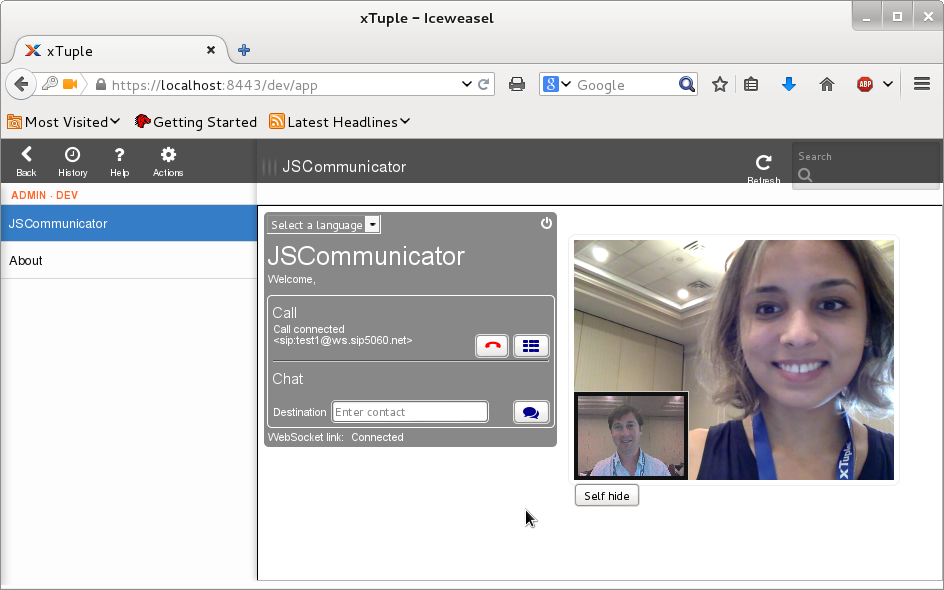 and gives a preview of the wide range of commercial opportunities that WebRTC is creating for software vendors to displace traditional telecommunications providers.
xTupleCon also gave me a great opportunity to see new features (like the xTuple / Drupal web shop integration) and hear about the success of consultants and their clients deploying xTuple/PostBooks in various scenarios. The product is extremely strong in meeting the needs of manufacturing and distribution and has gained a lot of traction in these industries in the US. Many of these features are equally applicable in other markets with a strong manufacturing industry such as Germany or the UK. However, it is also flexible enough to simply disable many of the specialized features and use it as a general purpose accounting solution for consulting and services businesses. This makes it a good option for many IT freelancers and support providers looking for a way to keep their business accounts in a genuinely open source solution with a strong SQL backend and a native Linux desktop interface.
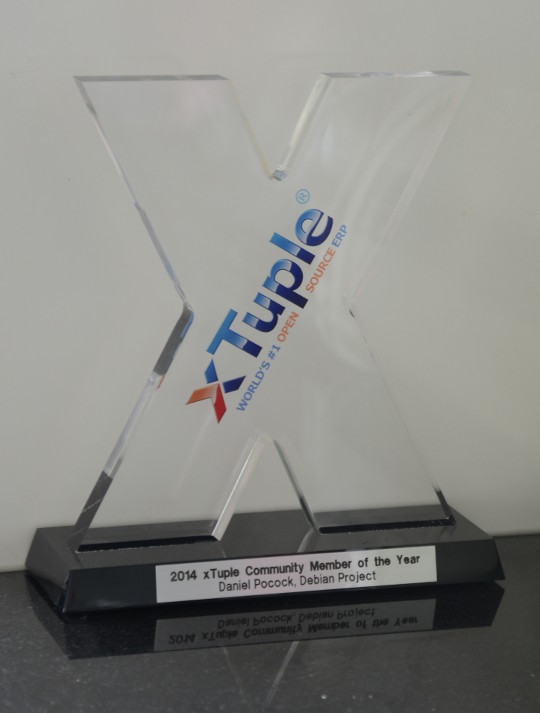
Steve Hackbarth, Director of Product Development at xTuple, myself and the impressive Community Member of the Year trophy
This is a great example of the productive relationships that exist between Debian, upstream developers and the wider free software community and it is great to be part of a team that can synthesize the work from so many other developers into ready-to-run solutions on a 100% free software platform.
Receiving this award really made me think about all the effort that has gone into making it possible to apt-get install postbooks and all the people who have collectively done far more work than myself to make this possible:
- The Debian PostgreSQL packaging team making the PostgreSQL server, client libraries and related packages available to install and upgrade easily on Debian and Ubuntu.
- The Debian Qt/KDE packaging team providing the Qt libraries.
- Andrew Shadura originally started the Postbooks packaging and preparing patches for a clean build on Debian.
- Juliana Louback who created the JSCommunicator / WebRTC extension for xTuple's new web interface while working in Google Summer of Code.
- xTuple themselves, who have an ongoing and enthusiastic commitment to free software and are actively developing their new web platform on Github.
and gives a preview of the wide range of commercial opportunities that WebRTC is creating for software vendors to displace traditional telecommunications providers.
xTupleCon also gave me a great opportunity to see new features (like the xTuple / Drupal web shop integration) and hear about the success of consultants and their clients deploying xTuple/PostBooks in various scenarios. The product is extremely strong in meeting the needs of manufacturing and distribution and has gained a lot of traction in these industries in the US. Many of these features are equally applicable in other markets with a strong manufacturing industry such as Germany or the UK. However, it is also flexible enough to simply disable many of the specialized features and use it as a general purpose accounting solution for consulting and services businesses. This makes it a good option for many IT freelancers and support providers looking for a way to keep their business accounts in a genuinely open source solution with a strong SQL backend and a native Linux desktop interface.
 With
 Tooz provides an API to manage group membership. The basic operations provided
are: the creation of a group, the ability to join it, leave it and list its
members. It's also possible to be notified as soon as a member joins or leaves a
group.
Leader election
 Each group can have a leader elected. Each member can decide if it wants to run
for the election. If the leader disappears, another one is elected from the list
of current candidates. It's possible to be notified of the election result and
to retrieve the leader of a group at any moment.
Distributed locking
 When trying to synchronize several workers in a distributed environment, you may
need a way to lock access to some resources. That's what a distributed lock can
help you with.
Adoption in OpenStack
 So, my work for Wheezy gave us working amd64 UEFI installer
images. Yay! Except: there were a few bugs that remained, and also
places where we could deal better with some of the more crappy UEFI
implementations out there. But, things have improve since then and we
should be better for Jessie in quite a few ways.
First of all, Colin and the other Grub developers have continued
working hard and quite a lot of the old bugs in this area look to be
fixed. I'm hoping we're not going to see so many "UEFI boot gives me a
blank black screen" type of problems now.
For those poor unfortunates with Windows 7 on their machines, using
BIOS boot despite having UEFI support in their hardware, I've fixed a
long-standing bug
(


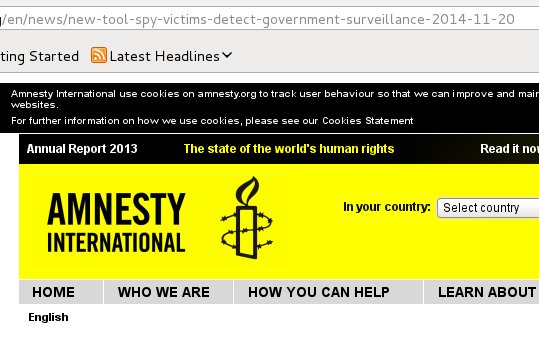 Even before I install the app to find out if the government is monitoring me, Amnesty is keen to monitor my behaviour themselves.
While cookies are used widely, their presence on a site like Amnesty's only further desensitizes Internet users to the downside risks of tracking technologies. By using cookies, Amnesty is effectivley saying a little bit of tracking is justified for the greater good. Doesn't that sound eerily like the justification we often hear from governments too?
Is Amnesty part of the solution or part of the problem?
Amnesty is a well known and widely respected name when human rights are mentioned.
However, their advice that you can install an app onto a Windows computer or iPhone to detect spyware is like telling people that putting a seatbelt on a motorbike will eliminate the risk of death. It would be much more credible for Amnesty to tell people to start by avoiding cloud services altogether, browse the web with
 Write to Amnesty
Amnesty became famous for their letter writing campaigns.
Maybe now is the time for people to write to Amnesty themselves, thank them for their efforts and encourage them to take more comprehensive action.
Feel free to cut and paste some of the following potential ideas
 Unless you ve been living under a firewalled rock, you know that IPv6 is
coming. There s also a good chance that you ve heard that IPv6 doesn t have
NAT. Or, if you pay close attention to the minutiae of IPv6 development,
you ve heard that IPv6 does have NAT, but you don t have to (and
shouldn t) use it.
So let s say we ll skip NAT for IPv6. Fair enough. However, let s say you
have this use case:
 There s many ways to interpret the last GR. The way I see it is how Joey hoped Debian was: the outcome of the poll shows that we don t want to do technical decisions by voting. At the beginning of this GR, I was supportive of it, and though it was a good thing to enforce the rule that we care for non-systemd setups. Though I have slowly changed my mind. I still think it was a good idea to see what the community thought after a so long debate. I now think that this final outcome is awesome and couldn t have been better. Science (and computer science) has never been about voting, otherwise the earth would be flat, without drifting continents.
So my hope is that the Debian project as a whole, will allow itself to do mistakes, iterative trials, errors, and go back on any technical decision if they don t make sense anymore. When being asked something, it s ok to reply: I don t know , and it should be ok for the Debian project to have this alternative as one of the possible answers. I m convince that refusing to take a drastic choice in this point in time was exactly what we needed to do. And my hope is that Joey comes back after he realizes that we ve all understood and embarrassed his position that science cannot be governed by polls.
For Stretch, I m sure there s going to be a lot of new alternatives. Maybe uselessd, eudev and others. Maybe I ll have a bit of time to work on OpenRC Debian integration myself (hum I m dreaming here ). Maybe something else. Let s just wait. We have more than 300 bugs to fix before Jessie can be released. Let s happilly work on that together, and forget about the init systems for a while
P.S: Just to be on the safe side: the rotten tomatoes image was not about criticizing the persons who started the poll, who I respect a lot, especially Ian, who I am convinced is trying to do his best for Debian (hug).

 Earlier today,
 Debian's latest round of angry mailing list threads have been about some
combination of init systems, future direction and project governance.
The details aren't particularly important here, and pretty much everything
worthwhile in favour of or against each position has already been said several
times, but I think this bit is important enough that it bears repeating:
the reason I voted "we didn't need this General Resolution" ahead
of the other options is that I hope we can continue to use our normal
technical and decision-making processes to make Debian 8 the best possible
OS distribution for everyone. That includes people who like systemd,
people who dislike systemd, people who don't care either way and just
want the OS to work, and everyone in between those extremes.
I think that works best when we do things, and least well when a lot
of time and energy get diverted into talking about doing things.
I've been trying to do my small part of the former by


 Martin Pitt reported Debian
 Disclaimer: I m not used to writing personal stuff on Debian channels. However, there is nothing new here for those who know me from other public channels.
