Search Results: "ean"

3 October 2011

Tanguy Ortolo: Viewers should stay in foreground

Traditionally, when you start a program to view a document, for instance xpdf resume.pdf, it stays in foreground, and only returns when it finishes, when you are done with the document. Of course you can still run it in background if you want. Nowadays, several programs behave in a different way, for instance Evince. When you first start it, it stays in foreground as usual. However, if you launch it a second time while the first instance it still running, it will reuse this existing instance, asking it to open your document in a new window, and immediately return. Other examples are Firefox and LibreOffice.This behaviour is certainly more efficient in terms of memory usage and speed, but it is non-standard and causes subtle problems. When you open the attachment of an email message, or when you open a document from the Web without saving it permanently, the mailer or the browser saves the document to a temporary file, and then run a viewer with that file. As this is a temporary file, so they cannot leave it forever in /tmp; in fact they should delete it when you are done viewing it. I think the usual way to implement that is to delete it when the viewer returns: with a program that returns immediately, this means deleting it even before it has had a chance to load it. So, if you can no longer directly open a PDF attachment from Mutt, or if you are unable to view the compressed documentation of the LaTeX class Beamer with texdoc (which uncompresses it to a temporary file and calls a PDF viewer on it), you can blame your modern PDF viewer that returns before you are finished and start hacking your mailcap file. And if you are the author of such a program, please consider implementing a way to keep a lightweight process that does not return before the main process has closed the document or to disable process reuse.

Timo Jyrinki: From MeeGo to Tizen, Debian, ...?

The MeeGo community is frustrated with the news of the MeeGo brand being abandoned. Some are understandably angry or otherwise not happy about how Linux Foundation, Intel handled the Tizen announcement and community in general - or more like how they didn't handle it at all.Last week Openmind 2011 happened to be arranged in Tampere on the very same day as Tizen announcement came alive. It was good in the way that it lead to the fact that Nomovok's CEO Pasi Nieminen was able to initiate the "Reigniting MeeGo" session not just by talking vague things about future, but actually about the process which led to Tizen and the unfortunately brief initial PR about it. Pasi is intense on emphasizing the quality and role of Qt in Tizen as well, even though officially Tizen is all about HTML5 and apparently from Samsung's part at least EFL is provided as a native toolkit. However, the promise of Tizen compared to MeeGo is reportedly that the toolkit is not specified in compliancy documents, so HTML5 with WAC is the main/only "3rd party apps" layer whereas others can be offered case-by-case. This means that unlike before, the underlying system can be built on top of practically any distribution (theoretically) and using whatever toolkits and other techniques wanted. Obviously the "Nordic System Integrators" are probably all very keen of using Qt to produce more of Nokia N9 quality user experiences in various products.

Taking the corporate hat off, I as a community member am also puzzled. The only reason I was not completely blown by the news was that I didn't yet manage to get involved in MeeGo community on a daily basis, since I'm involved with a dozen communities already. Instead I've been more like scratching the surface with MeeGo Network Finland meetings, IRC activity, OBS usage for building a few apps for MeeGo Harmattan and MeeGo proper etc. But I can somewhat understand how people like Jarkko Moilanen from meego-fi feel. They have given a _lot_ to the MeeGo community and brand, all taken away without hearing or pre-notice.

So where to now for MeeGo community? Tizen is one obvious choice. However, for all the talks that even I started this post with, Tizen is still vaporware today, and the dislike of how community is being treated might make it easy to consider other options. Also, if Tizen's reference implementation has lesser meaning, it might also mean less to actually be "in" the Tizen community than in MeeGo. I met Jos Poortvliet at Openmind, and he invited people to openSUSE. There is a lot of common ground with MeeGo and openSUSE - strong OBS usage, RPM packaging, community side focused on KDE and therefore Qt.

I would like to now point similarly to Debian! If one is tired about corporate interests and not listening to community, there is no match for Debian's 15+ years history, purely volunteer based, trust based organization, and first of all scope. While openSUSE has traditionally focused on desktop (even though like Jos pointed out they are open to all new contributions and projects), Debian has always had the "universal" scope, ie. no boundaries besides producing free software operating system for various purposes. There are over 10 architectures maintained at the moment, including the ARM (different ports for ARMv4 and hard-float ARMv7) and x86 from MeeGo world. There are even alternative kernels to Linux, mainly the GNU/kFreeBSD port. There are multiple relevant plans and projects like the Smartphones wiki area, most noticeably Debian on Neo FreeRunner. I have run Debian on my primary mobile phone for over 2.5 years, although now in the recent months I've had dual-SIM in my Nokia N950 as well (Debian not yet running on Nokia N950 or Nokia N9 - but it can and will be done!).

What Debian may lack in both good and bad is corporate funding, if you don't count the still quite respectful contributions from Ubuntu to Debian (it's in Ubuntu's interests to contribute as much possible back to Debian, so that the delta remains small). For each and every aspect, it needs a volunteer - there are a thousand volunteer Debian Developers, and at least a double of that of people without the official DD status but who still maintain a package or two among the 25000+ packages in Debian. That means also that one my find it more lucrative to join a project that has paid people to do some of the "boring parts", more of fancy web tools, including for bug handling and build systems like the OBS (which I do love by the way). On the other hand, there is no other project in my opinion where what you do really matters as much.

To find out more about Debian from MeeGo perspective, please see the recent mailing list post Mobile UXes - From the DebConf11 BoF to the stars where I wrote most of the MeeGo (CE) part when I was asked to and known of my MeeGo involvement.

Last but not certainly least, there is the Mer project - originally "maemo reconstructed", ie. making Nokia's "not really distro" into a real distro by filling in the void places. Now it's obviously MeeGo reconstructed, and they aim to be the MeeGo they always wanted MeeGo to be! Read the post for details from Carsten Munk and other key Mer people. They share the love for Qt, and want the core to be as lean as possible. They also aim to incorporate the most community like aspect from MeeGo - MeeGo CE - as the reference vendor in Mer. They also aim to be Tizen compliant - and when Tizen comes alive, I wouldn't see why the Tizen reference implementation couldn't be used for saving resources. Maybe Nomovok and/or others could offer the Qt maintaining part.

So, it might be that Tizen itself is enough for most people's needs. The key point however in this post is not to fall in agony if one corporate based project takes big turns - it has happened before, it will happen in the future. There are always enough political and business reasons from some points of view to do Big Changes. But the wider community is out there, always, and it's bigger than you think. You should consider where you want to contribute by asking yourself why you are/were part of for example the MeeGo community. Aaron Seigo from KDE asked us all this question in the Openmind MeeGo Reignited session, and I think it's good to repeat.

Amaya Rodrigo: Moving Tips 101

Note to self: Next time you move houses across the country, do remember to pack a small "survival" backpack with clean clothes and other basics *before* everything is packed up.

2 October 2011

Neil Williams: Uses of Emdebian - special purpose computers

A continuation of my intermittent series on Emdebian and prompted by a query from Paul Wise, I thought I'd cover some of the uses to which a device running Emdebian can be put. It is a bit long this one...

So, yes, there are general purpose computers which could run Emdebian but there are common features amongst general purpose computers:
  1. Lots of different tasks must be supported - lots of different packages installed, each user could quite easily use a distinct set of packages from another user.

  2. Multi-user support - even if any one machine is only used by one person, a general purpose computer must have support for adding another user - not just a system user, a real user with a login, shell, possibly bookmarks and browser history etc.

  3. Connectivity - general purpose computers (and that includes mobile phones) must connect to a variety of other computers to be at all useful.

  4. Multi-modal data input - there needs to be support for a mouse and a keyboard or touchscreen and just as likely, software support for accessibility interfaces like an on screen keyboard and switch inputs.

  5. Storage for user data - the system admin can't know how much data users are going to add and if it is general purpose, it's probably going to support media players, image viewers, even office software. The data files managed and written by such software tend to be large and tend to accumulate into large collections. This means that a general purpose machine cannot anticipate the full storage requirements, so has to allow plenty of room for user data storage. If there's so much storage space available, why use an OS which is primarily designed to take up less space? Just use the full version, Debian.


Now compare with the common features of special purpose or single-purpose computers:
  1. Single task only - a splash screen (without support for removal) covers all the boot information, the single task starts as a daemon and if the user quits the task, the task initiates a shutdown, not quit. Every effort is made to prevent the task from exposing the underlying OS, including auto-restarts if it does crash.

  2. Single-user support - indeed, user is not the typical user. user in this case is a non-login user without a shell, created by the postinst of the task package purely to support running the task without root privileges (because if the task doesn't need privileges, it shouldn't retain privileges).

  3. Single mode input - don't expect these machines to support 105 key keyboards. You'll be lucky to have 5 keys which are really just buttons. The button won't just enter 'J' into the machine, it will fire off a command to charge your bank or start a drill or shutdown a malfunctioning service. (Each button will often be multi-functional as well, depending on context). Some devices will replace the mouse with a touchscreen but many are fitted in places where touchscreens simply won't survive, where keys have to be able to withstand being submerged in water (or oil) for hours. Many machines simply won't have mouse support at all. Many will not have any typical external connectors. Indeed, units which go into dirty or wet environments certainly won't have standard external connectors of any kind. Think boats and factories. Internal battery packs with custom hot-fit replacements, buttons encased in 4mm of clear plastic, screens viewable only through protective mesh / filters.

  4. Restricted connectivity - if the task doesn't need networking, no networking hardware is fitted. If the task doesn't need USB, no USB hardware is fitted. If the task doesn't need serial connections, there will probably be an internal serial connector but also a Warranty void if removed sticker. Don't expect an RS232 inside the case either, this will be a flat cable connector which you'll need to attach to a breakout board which correctly connects the cable wires to the RS232 port pins. That mapping is not standardised (why would it? only service engineers are approved to use it.)

  5. Constrained user data - the task is in complete control and determines what the user can view, store and access. Storage can be expensive and a power drain, so if the task doesn't need Gb of storage, don't fit the machine with Gb of storage. Profit.


So what are these mysterious single-use computers running Emdebian? It's hard to tell because the task has no particular reason to tell the user anything about the OS. Perhaps a different way to phrase the same question would be: Why use a general purpose OS for a special purpose computer?.


This is why Emdebian Grip is popular for these machines - because Emdebian Grip is binary compatible with the equivalent Debian suite and when a bug appears in the high level user interface, it is much easier to debug that on the desktop than on device. Debian stable is a fantastic OS for commercial development - the stability of the OS makes detection of interface bugs much easier. It is rare that developers have to investigate whether bugs in their UI come down to a bug in the underlying OS. That saves time.

The machines themselves? I'm sure others can come up with other examples but these are some which come to my mind (no particular order):


Anywhere where the device simply needs to DoTheRightThing in a variety of unpredictable circumstances, you're going to need a general purpose OS to gather the data and produce the right result. Anywhere where the device has only a single task, you're going to want to not provide access to the rest of the system. There's no point providing "general purpose access" when the device doesn't have "general purpose hardware". There's no point fitting general purpose hardware if the device does not use it. That is a waste of money, a waste of resources and causes unnecessary delays if one component or other becomes unobtainable or changes behaviour. Limit your exposure to hardware bugs and get the product out to the user more quickly and more reliably, everyone is happy. Fit non-standard hardware and you can fit custom hardware which better matches the profile of the device usage - why use standard speakers capable of CD quality across a vast frequency range when the device only makes very very loud alert noises which can be done at lower sample rates and with narrow range, high amplitude, speakers.

There are all sorts of estimates for the number of computers now in the average Western home. It's worth noting that the vast majority of those computers are not PCs or laptops or even game consoles and routers - all instances of general purpose machines with general purpose access / connectivity. A lot of the computers in your home are embedded in machines like white goods, media controllers (set top boxes and the like). Some of these will still use low level firmware written entirely in assembly or COBOL. More complex ones already have a general purpose OS inside yet constrain that OS with a simple, user-friendly interface which is tailored to the hardware actually fitted. It might be cool to connect to your set top box over Bluetooth but really, is that actually going to sell more units? Only if there are other high-end services written for the device which the average customer won't want to see pushing up the price of the base unit. Some machines (particularly in automotive uses) will need to be using Real Time operating systems and Safety Critical operating systems but even some of those are based on general purpose systems - just old versions which have been thoroughly tested.

Finally, consider that for a lot of these devices, the customer is not you. The customer is another business who then put the device into something else which is installed into a factory production line which produces something which goes into creating a consumer product you find in Tesco or on Amazon or bundled in with another service like your TV/broadband contract. There is absolutely no reason for these devices to provide general purpose computing to you, even if the device itself is part of something else which can provide such services.

Theppitak Karoonboonyanan: Myanmar Visit

Quite a belated English blog (after the Thai version), due to busy personal life lately. I had visited Yangon during 4-11 Sep. to give some talks and tutorials on Debian packaging and mirroring. And I've shared some information with community. The visit was initiated by Ngwe Tun and the Myanmar L10N team. I found later that a Facebook event had been created for this. Localization The first day was a comparison between Myanmar and Thai supports in GNU/Linux, in which I briefed the status on Thai side, and Thura Hlaing on Myanmar side. It was nice that we had the Myanmar Computer Federation (MCF) director presiding the meeting til the end. That means GNU/Linux support has been awared at executive level. According to Thura, Burmese has gained support in GNU/Linux quite well. On the rendering side, all the reordering for the logical order is normally done with pure GSUB in the fonts, without special processing on the rendering engine. This is suboptimal in principle, but it's the most effective way, as Windows redering engine itself does not yet support Myanmar, either. For input method, Myanmar XKB map has been available in xkb-data for a long time, but to serve users' familarity with visual order typing, some reordering input methods have been developed, based on keymagic and ibus. But all are not context-sensitive like what's done for Thai in other frameworks. Fortunately, with the surrounding text API recently added to ibus, this has become possible. One unusual requirement for Myanmar script editing is the caret movements. It needs to move syllable-wise, not character-wise nor cluster-wise. So, I suggested them to have a look on UAX #29 to see how it should be amended. Myanmar locales are already done, both for GNU C library and CLDR. And even a GNOME applet for Myanmar lunar calendar is also available. This latter thing is what Thai can learn from. Burmese word segmentation is not supported in general. But R&D works have been done for this in its NLP lab. A serious issue left to solve is the existing abuses of Unicode. In Myanmar, there exist at least 14 variations of font hacks, abusing some free slots in Unicode charts as pre-composed clusters for information interchange (not for font internals), making plain text interchange impossible without the proper font for rendering. For program translation, the new Myanmar L10N team is trying to request for a mass submission to the current GNOME team. And for Debian, Thura Hlaing and Ngwe Tun has already started the translation process with Christian's help. Along my stay, I could see the team actively discussing on the IT glossary, trying to settle down the translated terms. This looked very fun. Debian Then, the next three days were a workshop on Debian packaging, where I have presented the basics of Debian package building, uploading, quality-controlling, modifying, creating and delivering. This aimed toward the development of a local distribution based on Debian. Each day in the afternoon was the time for setting up a Debian mirror, not only for convenient local distro developement, but also for general users. This is important because internet penetration is still low in Myanmar. The main media for software distribution is CD/DVD, which means only stable version of Debian can be spread, which is not good for desktop users. Having a mirror should improve the situation somehow. It should make dist-upgrading to testing/unstable easier. And it should make CD snapshotting using local distributions easier, too. For this, I also presented another quick slide on Debian mirroring & caching. In the last day, I was introduced to the staffs of Myanmar NLP Lab and their projects, which include Myanmar OCR (based on tesseract), information retrieval, machine translation, and other lingustic resources like dictionary, lexicon and text corpus. Furthermore, I was also offerred technical helps on developing a Lao/Esaan Tham font for a Lao and North Eastern Thailand variation of Tham script, which is Mon-based and is closely related to Myanmar script. (See some sample transliterations if you are curious how it looks like. It was part of my hacking during DebConf11 travelling.) Currently, its OpenType support is quite sufficient, but it still renders poorly on Mac OSX. To cope with this, I was given a Mac Mini as a present from Myanmar for its development, as well as some explanations on AAT features from a Myanmar font developer. And I am very grateful for that.

1 October 2011

Sergio Talens-Oliag: Static website generators

The last month I was supposed to work on a OpenStack related project, but for administrative reasons it has been delayed and I've tried to do small tasks to be able to finish them quickly and start the work on the main project when the issues get solved. As the delay has been longer than expected last Wednesday I've realized than on the last weeks I did a lot of small system administration tasks: With all the changes I did I noticed that I had to do something with our Intranet server; it is just a reverse proxy for a lot of different web services and its main page was one static HTML page with links to them, nothing else. In the long term maybe we will replace it with something based on Drupal or Lifeay, but for now I just wanted something to be able to organize the links and provide some information about the services for the new users without having to write HTML (I really like Agile Documentation Tools that let me focus on the content and forget about the markup), and started to look at some of them. My first idea was to use ikiwiki, as it has all the features I was looking for: I can use Markdown or reStructuredText to write the contents, the source pages are easily handled on a Version Control System, it supports the use of templates for the HTML, etc., but it seemed to me that using ikiwiki was like killing flies with a cannon (that's a Spanish say, I guess it's easy to understand it in English, no?) and I decided to review other tools to build static web sites. To make a long story short, I selected some tools that met my requirements and looked nice on their demo sites; after my first review I thought that Hyde was going to be my bet, as it uses technologies I'm already familiar with, but after trying it I saw that I was going to have a problem with documentation (the current Hyde version lacks it) and it was going to be more complicated that using ikiwiki. Before giving up I decided to review simpler tools, just in case, and after looking some of them I ended up using poole, a simple python script (the source is just one file and it only requires python-markdown to work). Before moving to the content I tried to adapt a couple of free themes to be used by the tool, but I didn't liked the result, so I went back to the plain style provided by the tool and added a logo and a background. With that simple look and feel I started to work with the content, splitting it into eight markdown files and a python macro to include a file that has all the links used on the site. While trying to make the main page look good I noticed how little I know about CSS, but using search engines I was able to build a two column block into the main page and publish the contents and with the help of some CSS enabled co-workers I changed the look and feel of the site in about 30 minutes. In summary, if you want a really simple website, you know a little bit of python and don't want to spend much time learning how to use a website generator then Poole is a good option. If you want something more complex I still think that ikiwiki is a good option, but YMMV.

30 September 2011

Craig Small: ncurses library split

The new ncurses library that is currently sitting in the NEW queue will have a significant change that, if we ve done it right, should be an invisible change. If we ve got it wrong, then the BTS (and us) may be a little busy. What has happened is that the low-level terminfo library has been split out from the general ncurses library making a new package called libtinfo5. This also means that there only needs to be one libtinfo5 package because at this low level it doesn t care about wide characters, so there is no libtinfo5w (and that gets important later). libncurses is linked to libtinfo so from the point of view of using libncurses there should be no major change in how things are done. So, why bother? The way ncurses was built before causes a nice long conga line of trouble . There really are (was) two main ncurses library packages, libncurses5 and libncursesw5. The w meant it was for wide characters. So anything that uses ncurses needs to decide which one to link to or perhaps both. A problem came up with the readline library that needs to link to ncurses because programs that link to IT (such as python) want a wide library but other programs do not. One solution is to have two readline libraries, but then any other library would need to be compiled and built twice as well and so on and so on. readline didn t really want the full ncurses library, it only wants the terminfo part but there was (until now) no way of picking up that bit only. Once this new version of ncurses gets released then readline can link to libterminfo which is agnostic to wide and non-wide characters which means it is as well which them means everything else should, in theory work. If you are using ncurses for some low-level terminfo work only, you may want to have a look to see if you can link to libtinfo5 only which will mean depending on libtinfo5 and not libncurses5 or libncursesw5. I m just writing this up mainly and uploading the packages, the bulk of the work was done by Sven and Matthias as well as some help from our ever-helpful upstream Thomas.

29 September 2011

Wouter Verhelst: Youtube music

There's loads of music on YouTube. However, when I want to listen to music, I'm not necessarily interested in slideshows. And yes, that's a euphemism. Luckily, extracting the video and audio from a youtube clip isn't very hard. The critical bit is the '-vn' part, which tells ffmpeg not to encode the video to the output file. The 'mplayer' step isn't strictly required; but since youtube only uses lossy audio codecs, re-encoding the audio to a different codec will cost you audio quality. You may not want to do that; hence the mplayer step (to figure out which codec the source file is using), and the '-acodec copy' argument to ffmpeg's command line (which tells ffmpeg to not re-encode the audio, but just store the unmodified original audio stream in a different container file). Tadaa, music without video.

Roland Mas: Non-FusionForge, September 2011

Besides FusionForge stuff, I also kept busy with other things.

27 September 2011

Christian Perrier: Stop making sense...

Hope a few of my readers got it from the title of this blog post. And maybe many others didn't. So let's talk about "Stop Making Sense". You're warned: nothing to do with free software...or running, this time. This is all about music. Music from the 80's. "Stop Making Sense" is indeed, in my opinion, one of the best achieved musical movie. It is simple: it features a gig by the Talking Heads, back in 1983, when this band was among the most innovative ones that ever appeared in the late 70's. And I finally managed to take time to actually buy the DVD and see it again as I didn't see it since 1985. For many people, Talking Heads is the incredible person that's David Byrne. That's certainly true for some parts (and this is what lead to their split in 1991), but the movie really gives credit to all members of the band, either the "regular" ones (Tina Weymouth, Chris Frantz, Jerry Harrison) or the tour musicians (Bernie Worrell, Alex Weir, Steven Scales, Lynn Mabry, Edna Holt). The construction of the movie is simple: it just starts with Byrne bringing a music box on an empty stage, with his acoustic guitar and playing an incredible tense "Psycho Killer" (there are so many different version of that mythical piece but this one is among the best). Then Tina joins for a not-so-often played "Heaven" and brings her so inimitable bass line (I count Tina among my very favourite bass player, immediately after Tony Levin). At the end of the piece, the crew quietly brings a full drum set, then Chris Frantz joins, smiling as ever, and the rhythm increases with "Thank you for sending me an angel". Then Jerry Harrison joins, to make the original Heads line-up for a really funky "Found a Job", where Jerry shows that he was THE Heads lead guitar (and Tina is still keeping the foundations so strong). Continuing the increasing tension, the rest of the musicians join for Slippery People, then Burning Down the House ("Who's got a match?"). All this culmminates in a crazy joggin on stage during "Life During Wartime" and Byrne performing incredible and stellar movements on stage. THis one surely makes the band entirely exhausted. How can they survive this? The few next songs are a little bit less stunning (oh, well, "Making Flippy Floppy" still features a dream bass line)...until a really special "Once in a Lifetime" that...has just to be seen (SAME AS IT EVER WAS), then a break where....the Tom Tom Club (namely Chris, Tina and the rest of the band) perform a giant "Genius of Love", so funky. All this is indeed meant for Byrne to prepare for his top appearance, in "Girlfriend is Better", in a giant suit, that makes his head over his long neck yet more...strange. This leads to a crazy "Take me to the River" which has always been the top of the Heads shows during the 80's and a tireless encore on "Crosseyed and Painless". The movie ends up and you nearly never had a breath. So, yes, if you think you enjoy the Heads music and have never seen that movie, just try doing it once. That's how music was in the 80's..and, doh, these folks were so good! By the way, all parts of the movie can be seen on YouTube in case you just want to see what *I* enjoy. Ah, and yes I share the love of the Heads with Danese "we never meet often enough" Cooper, by the way. We once made a promise ourselves to sing Psycho Killer in karaoke if we're happy (and drunk) enough to meet again before we're too old for this..:-).

Michal Čihař: GePeS continued

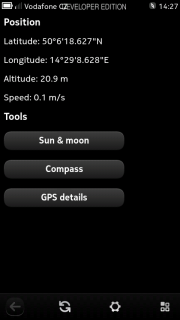
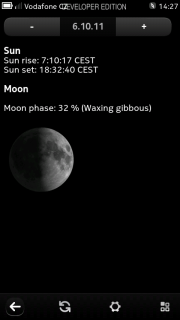
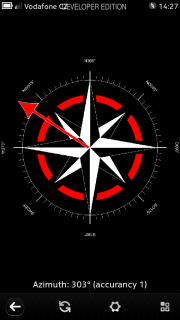
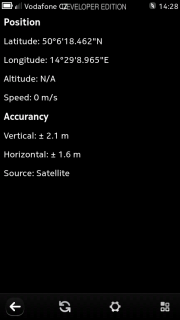
Continuing on my Hackweek project, I've polished GePeS a bit today. I started with better display of GPS coordinates and added some more GPS details to separate page. Adding images for moon phase was also part of the plan, though it force me to learn how to switch application to black theme, which looks much better with moon image. Rest of time was spent on cleaning up the code and adding preferences (for now only refresh rate). Updated screenshots: Main screen Sun and moon screen Compass screen GPS details screen PS: Some numbers look weird (altitude and speed), though I'm pretty sure this is what phone reports me.

Filed under: English Meego Suse 4 comments Flattr this!

26 September 2011

Gunnar Wolf: e-voting: Something is brewing in Jalisco...

There's something brewing, moving in Jalisco (a state in Mexico's West, where our second largest city, Guadalajara, is located). And it seems we have an opportunity to participate, hopefully to be taken into account for the future. Ten days ago, I was contacted by phone by the staff of UDG Noticias, for an interview on the Universidad de Guadalajara radio station. The topic? Electronic voting. If you are interested in what I said there, you can get the interview from my webpage. I held some e-mail contact with the interviewer, and during the past few days, he sent me some links to notes in the La Jornada de Jalisco newspaper, and asked for my opinion on them: On September 23, a fellow UNAM researcher, C sar Astudillo, claims the experience in three municipalities in Jalisco prove that e-voting is viable in the state, and today (September 26), third generation of an electronic booth is appearingly invulnerable. Of course, I don't agree with the arguments presented (and I'll reproduce the mails I sent to UDG Noticias about it before my second interview just below They are in Spanish, though). However, what I liked here is that it does feel like a dialogue. Their successive texts seem to answer to my questioning. So, even though I cannot yet claim this is a real dialogue (it would be much better to be able to sit down face to face and have a fluid conversation), it feels very nice to actually be listened to from the other side! My answer to the first note:
El tema de las urnas electr nicas sigue dando de qu hablar por ac en Jalisco... nosotros en Medios UDG hemos presentado distintas voces como la del Dr. Gabriel Corona Armenta, que est a favor del voto electr nico, del Dr. Luis Antonio Sobrado, magistrado presidente del tribunal supremo de elecciones de Costa Rica, quien nos habl sobre los 20 MDD que les cuesta implementar el sistema por lo que no lo han logrado hasta el momento, pudimos hablar hasta argentina con Federico Heinz y su rotunda oposici n al voto electr nico y por supuesto la entrevista que le realizamos a usted. Sin embargo este d a La Jornada Jalisco publica la siguiente nota http://www.lajornadajalisco.com.mx/2011/09/23/index.php?section=politica... nos gustar a saber cu l es su punto de vista al respecto, quedo a la espera de su respuesta
Hola, Pues... Bueno, s que el IFE hizo un desarrollo muy interesante y bien hecho hace un par de a os, dise ando desde cero las urnas que propon an emplear, pero no se instrumentaron fuera de pilotos (por cuesti n de costos, hasta donde entiendo). Se me hace triste y peligroso que el IEPC de Jalisco est proponiendo, teniendo ese antecedente, la compra de tecnolog a prefabricada, y confiando en lo que les ofrece un proveedor. Se me hace bastante iluso, directamente, lo que propone el t tulo: comicios en tres municipios prueban la viabilidad del voto electr nico en todo el estado . Pong moslo en estos t rminos: El que no se caiga una choza de l mina con estructura de madera demuestra que podemos construir rascacielos de l mina con estructura de madera? Ahora, un par de p rrafos que me llaman la atenci n de lo que publica esta nota de La Jornada:
la propuesta de realizar la elecci n en todo el estado con urnas electr nicas que desea llevar a cabo el Instituto Electoral y de Participaci n Ciudadana (IEPC) es viable, pues los comicios realizados en tres municipios son pruebas suficientes para demostrar que la urna es fiable
y algunos p rrafos m s adelante,
Cu ntas experiencias m s se necesitan para saber si es confiable, 20, 30, no lo s (...) Pero cuando se tiene un diagn stico real, efectivo y serio de cu ndo t cnicamente procede, se puede tomar la decisi n
Como lo menciono en mi art culo... No podemos confundir a la ausencia de evidencia con la evidencia de ausencia. Esto es, que en un despliegue menor no haya habido irregulares no significa que no pueda haberlas. Que haya pa ses que operan 100% con urnas electr nicas no significa que sea el camino a seguir. Hay algunas -y no pocas- experiencias de fallas en diversos sentidos de urnas electr nicas, y eso demuestra que no puede haber confianza en las implementaciones. Aunque el equipo nos saliera gratis (que no es el caso), hay que invertir recursos en su resguardo y mantenimiento. Aunque se generara un rastro impreso verificado por el votante (que s lo ha sido el caso en una peque a fracci n de las estacione de votaci n), nada asegura que los resultados reportados por el equipo sean siempre consistentes con la realidad. El potencial para mal uso que ofrecen es demasiado. Saludos,
And to September 26th:
Disculpe que lo molestemos otra vez, pero este d a fue publicada otra nota m s sobre el tema de las Urnas electr nicas en Jalisco donde se asegura que la urna es invulnerable. http://www.lajornadajalisco.com.mx/2011/09/26/index.php?section=politica... nos podr a conceder unos minutos para hablar con usted, como la vez pasada, v a telef nica sobre el caso espec fico de Jalisco, en referencia a estas notas publicadas recientemente? si es posible podr a llamarle este d a a las 2 pm? Quedo a la espera de su respuesta agradeci ndole su ayuda, apreciamos mucho esta colaboraci n que est haciendo con nosotros
Hola, ( ) Respecto a esta nota: Nuevamente, ausencia de evidencia no es evidencia de ausencia. Se le permite a un peque o segmento de personas jugar con una m quina. Significa eso que fue una prueba completa, exhaustiva? No, s lo que ante un jugueteo casual no pudieron encontrar fallos obvios y graves. Un verdadero proceso que brindara confianza consistir a en (como lo hicieron en Brasil - Y resultaron vulnerables) convocar a la comunidad de expertos en seguridad en c mputo a hacer las pruebas que juzguen necesarias teniendo un nivel razonable de acceso al equipo. Adem s, la seguridad va m s all de modificar los resultados guardados. Un par de ejemplos que se me ocurren sin darle muchas vueltas:
  • Qu pasa si meto un chicle a la ranura lectora de tarjeta magn tica?
  • Qu pasa si golpeo alguna de las teclas lo suficiente para hacerla un poquito menos sensible sin destruirla por completo? (o, ya entrados en gastos, si la destruyo)
La negaci n de servicio es otro tipo de ataque con el cual tenemos que estar familiarizados. No s lo es posible modificar el sentido de la votaci n, sino que es muy f cil impedir que la poblaci n ejerza su derecho. Qu har an en este caso? Bueno, podr an caer de vuelta a votaci n sobre papel - Sobre hojas de un block, probablemente firmadas por cada uno de los funcionarios, por ejemplo. Pero si un atacante bloque la lectura de la tarjeta magn tica, que es necesaria para que el presidente de casilla la marque como cerrada, despoj de su voto a los usuarios. S , se tienen los votos impresos (que, francamente, me da mucho gusto ver que esta urna los maneja de esta manera). El conteo es posible, aunque un poco m s inc modo que en una votaci n tradicional (porque hay que revisar cu les son los que est n marcados como invalidados - no me queda muy claro c mo es el escenario del elector que vot por una opci n, se imprimi otra, y el resultado fue corregido y marcado como tal)... Pero es posible. Sin embargo, y para cerrar con esta respuesta: Si hacemos una corrida de prueba, en circunstancias controladas, obviamente no se notar n los much simos fallos que una urna electr nica puede introducir cuando los "chicos malos" son sus programadores. Podemos estar seguro que este marcador Atlas-Chivas-Cruz Azul tenga el mismo ndice de fiabilidad como una elecci n de candidatos reales, uno de los cuales puede haberle pagado a la empresa desarrolladora para manipular la elecci n? Y a n si el proceso fuera perfecto, indican aqu que est n _intentando_ licitar estas urnas (y nuevamente, si lo que menciona esta nota es cierto, son de las mejores urnas disponibles, y han atendido a muchos de los se alamientos - Qu bueno!)... Para qu ? Qu nos van a dar estas urnas, qu va a ganar la sociedad? Mayor rapidez? Despreciable - Media hora de ganancia. A cambio de cu nto dinero? Mayor confiabilidad? Me queda claro que no, siendo que no s lo somos cuatro trasnochados los que ponemos su sistema en duda, sino que sus mismos proponentes apuntan a la duda generalizada. La frase con la que cierra la nota se me hace digna para colgar un ep logo: "en ese futuro quiz no tan distante la corrupci n tambi n ocurre y sta se debe siempre al factor humano". Y el factor humano sigue ah . Las urnas electr nicas son programadas por personas, por personas falibles. Sin importar del lado que est n, recordar n la pol mica cuando se hizo p blico que la agregaci n de votos en el 2006 fue supervisada por la empresa Hildebrando, propiedad del cu ado del entonces candidato a la presidencia Felipe Calder n. Qu evita que caigamos en un escenario similar, pero ampliamente distribu do? Y aqu hay que referirnos a la sentencia de la Suprema Corte de Alemania: En dicho pa s, las votaciones electr nicas fueron declaradas anticonstitucionales porque s lo un grupo de especialistas podr an auditarlas. Una caja llena de papeles con la evidencia clara del sentido del voto de cada participante puede ser comprendida por cualquier ciudadano. El c digo que controla a las urnas electr nicas, s lo por un peque o porcentaje de la poblaci n.

John Goerzen: Five

Dad, will you and mom stay up all night decorating the house for me?
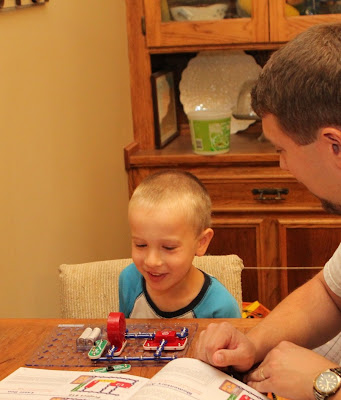
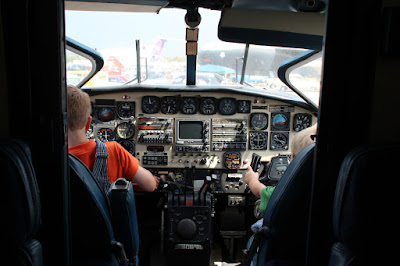
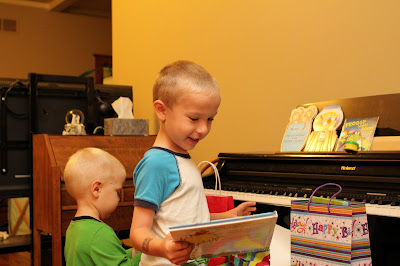
That was Jacob s question to me at bedtime the evening before his fifth birthday. Jacob had already had his birthday party a few weeks ago. When scheduling means that parties happen that far away from the boys real birthdays, they get a smaller celebration with just Terah and me where we open their presents from us. A low-key thing, so we weren t planning to decorate the house. I said, Well, I don t think we ll be doing all that since you already had your birthday party. And the look of eager anticipation on his face turned to a very sad and disappointed look, and made me feel really bad. Uhoh. So while Jacob was sleeping, I mentioned it to Terah. We decided we should improvise something simple, so she found some old streamers and we taped them up, running them through several rooms in the house and across his door. It took a few minutes using supplies we already had, but the joy the next morning was priceless. Oh dad, you said you wouldn t stay up all night, BUT YOU DID! Oh I am SO HAPPY! YAY YAY YAY! And he ran through the house to discover what else was set up. Then he ran to find Oliver and gave him a tour of everything. Then we sat down to open his presents. Here he is, holding a present from Terah and me: That s a copy of The Lorax. My friend Jonathan had brought a copy along during our road trip in Mexico, and Jacob was really excited about it. And didn t really want to give it up, because You can only get The Lorax in Mexico. He (and Oliver) really enjoyed all his presents he also got a train book from us (which he said, Oh, yay, it s the book they have at preschool! ), and a game and some other presents from the distant relatives. But the highlight was something of an impulse buy. I was at the RadioShack in Derby a place I ve written about before, It is what a RadioShack should (and used to) be. It has a large amateur radio section, sells all sorts of coax by the foot, and provides astonishingly good post-sale service. Well, I was there with a radio question, and Mark (the owner) who is an excellent salesman in a positive way pointed me to a display of snap kits. I noticed their Electronics 101 Snap-Kit (a rebranded Snap Circuits Jr. SC-100). A ham in Pennsylvania had suggested them to me once, and as Jacob s birthday was coming up, I gave it some thought. The kit said ages 8 and up. I asked Mark what he thought about a boy just turning 5. He said, Well, probably not normally. But knowing you, if you re there to work on them with him, I think he d enjoy it. But I wouldn t have him work on it by himself. I agreed and we bought it. I pondered how to explain the concept of this thing to Jacob. Eventually I decided I would call it a toy-building kit. He understood that. Jacob and I spent hours together working with it. He would flip through the book, either picking circuits that looked interesting or telling me what kind of circuit he wanted to build. Then I would tell him what to put where, and he d snap them together and play with them. He only played with each finished product a few minutes before he was ready to try another. Once I got him very excited with my offer to show him how to hook up two switches in parallel for the fan he built (and later introduced the parallel vs. series concept by hooking them up in series instead.) Here we are working on it together. Jacob repeatedly called Terah over to look at the things he built. He was very excited that he assembled it himself. Eventually, Oliver (age 2) came over wanting to help. So he sat on my lap, and handed parts to Jacob, then Jacob put them on the grid. Oliver really enjoyed being involved in this way, even though I had to keep him from doing things like ripping the capacitor off its mount. We tend to be modest in terms of the number of things we give the boys and their cost, reasoning that we, like many, already have too many toys in our house, and that greater cost doesn t necessarily equate with a better experience for the boys. I particularly look for things with lasting value and unique experiences for them, and I think we succeeded this year. But I realized quickly that the greatest value of this kit wasn t electronics. It was having a great way for me to spend a lot of time doing things with the boys which all of us enjoyed. Those hours building things together were as much a present for me as for Jacob, I m quite sure. Jacob s real party was a few weeks ago at the Great Plains Transportation Museum in Wichita. They let people rent a historic caboose to use for a birthday party for children. So we did that for Jacob this year. That was a huge hit for the boys. Jacob got to help his grandpa make some pie (instead of cake) for the party. He enjoyed eating it, of course. He enjoyed opening his presents high up on the observation chair in the caboose. And the boys got to play on all the other equipment in the museum. Jacob enjoyed playing tour guide for family since most of them hadn t been there. He also enjoyed watching freight trains pass on the other side of the fence from the museum preferably while sitting in one of the museum s engines. Oliver certainly didn t get left out. Train-watching is serious business, after all. Jacob has long talked about going to the train museum and the airplane museum (Kansas Aviation Museum) on the same day, so one of his birthday surprises was that we went to the airplane museum after his party. His favorite item there is a retired FedEx 727. Here he is walking down the rear of the plane. And, of course, they played captain and co-pilot in several different planes.

25 September 2011

Joachim Breitner: Yesod packaged for Debian

As Clint writes on his blog, we have now Yesod, a Haskell web framework, packaged in Debian. Despite his humble choice of words, it was mostly his work, and it is quite some work, given that Yesod has a huge number of dependencies that were not yet packaged. So if you want to use Yesod on Debian, and prefer pre-built libraries without dependency problems and clean installation/deinstallation with dpkg over having always latest and greatest, this should provide you with a solid base.

Flattr this post

Christian Perrier: [life] [running] Berlin marathon: I ran in the world record race...

...but I didn't break it myself. Still, Patrick Makau broke today Haile Gebresselassie's world record by 21 seconds, lowering it down to 2h03'38". This is an impressive performance, considering the quite "high" temporature today in Berlain (about 23 C). My own race was quite good, though not perfect. My goal was targeting 3h36', to break my own record (3h40'24"). However, my preparation was complicated by an hurted ankle in early August, then a very shaky September month at work with a lot of stress and work days up to 12 hours. Not the best way to prepare a marathon. Last two weeks were fairly good wrt running, with an half-marathon run in 1h43' two weeks ago. Still, we complicated this by speding a few days to do sightseeing in Berlin (you can't really be in such a nice city and not try to see it!). So, that means a lot of walking here or there, with museum visits and quite long days. Again, not the best way to prepare a marathon..:-) Still, my watch was set on a 5'07"/km pace. My goal was starting like this, work to avoid going faster over the first 20K ad see what happens. At the beginning, it worked fairly well. Contrary to Paris marathon, Berlin's start in Strasse des 17. Juni is very cool for the first 3 kilometers with an incredibly wide avenue, whilst Paris marathon shrinks in Rue de Rivoli after km 1.5, making it fairly complicated to pass. Also, runners in Germany are much more respectful of running principles and very few register for starting blocks that are nont their real performance (like registering for 3h30 while your best time if 4h). So less passing and a much more costant pace. Up to km15 in Kreuzbeg, everything went well, though the heat was growing, which already made me suspect that I would not make it (0-5K in 25'31", 5-10K in 25'54", 10-15K in 25'55") . From this point, I had to "fight" a bit more to keep the pace...and a few streets without shade had their effect. Moreover, I already had to refill my belt bottle after drinking 0,8l for the first 17KM. The pace thus went down to about 5'10-5'15" and I reached half-marathon in 1h50'28", already not really on time for less than 3h40). 15-20K in 26'41", including a bottle refill. Then 20-25 in 25'44", so small drop after all. However, the wall hit me on km28. For the first time in my marathon life, I think I considered abandoning because I was feeling without any energy and still 1/3 of a marathon to run. Well, that was only the 30K wall which they apparently moved 2K earlier..:-) After calming myself down, I decided to do what has to be done in such case: refill with energy. So long for the gels I had and particularly the hyper-glucidic "Coup de Fouet". Finally, around KM30, I found more motivation to complete the race. Anyway, we were then very very far away, at the end of Hohenzollendamm, so the only option was to come back anyway! Despite all this, I kept a very decent pace, after all: 26'45" for 25-30K. Each kilometer, my watch was beeping to remind me that I was not crawling on the street but more keeping about 5'20". Still, the last kilometers on these giants avenues (oh, endless Leipziger Strasse after Postdamer Platz!) needed a lot of motivation to be completed. It's indeed only at Gendarmenmarkt that I finally could be reliefed and know that I would not only finish, but also do it in a very decent time. 30-35K in 27'43", 35-40K in 27'38". Then we turned in Unter den Linden and, even better, at KM41, my beloved Elizabeth was there yelling. This, plus Brandenburder Tor not so far away....I could then "sprint" at 5'08" for the last kilometer. Finally, this marathon (my 6th official) was completed in 3h44'50", which is my second best. I'm really happy with this result, finally. OK, I didn't break my record as I was intending to (I think I can go down to 3h35 with a normal preparation and good conditions), but the way I managed the difficulty was finally good. So, now, let's prepare the next goal, a 67km night race in November, the longest distance I have ever run. Yet another different thing to prepare. And what about Berlin in all this? Well, in short, that city is *great*. What could I tell more?

Tanguy Ortolo: Increase your productivity with two spaces

Shell prompts are often designed to provide a reminder of useful context information such user name, host and current directory:
PS1="\u@\h:\w\$"
tanguy@muscat:~/public_html$
Such a prompt is sufficient to serve its original purpose, but it can be enhances in at least one useful way. Sometimes you have to copy the path of the current directory: with this prompt, it means selecting it by precisely dragging the mouse over it. Well, by adding spaces around the current directory you can become able to select it with a simple double click:
PS1="\u@\h: \w \$"
tanguy@muscat: ~/public_html $
Indeed, with such a prompt, you can now roughly point to the path, double click, and let your terminal emulator's word detection feature select the whole path for you. This simple modification may save you several tenths of seconds!

23 September 2011

Matthew Garrett: UEFI secure booting (part 2)

Microsoft have responded to suggestions that Windows 8 may make it difficult to boot alternative operating systems. What's interesting is that at no point do they contradict anything I've said. As things stand, Windows 8 certified systems will make it either more difficult or impossible to install alternative operating systems. But let's have some more background.

We became aware of this issue in early August. Since then, we at Red Hat have been discussing the problem with other Linux vendors, hardware vendors and BIOS vendors. We've been making sure that we understood the ramifications of the policy in order to avoid saying anything that wasn't backed up by facts. These are the facts:
Microsoft have a dominant position in the desktop operating system market. Despite Apple's huge comeback over the past decade, their worldwide share of the desktop market is below 5%. Linux is far below that. Microsoft own well over 90% of the market. Competition in that market is tough, and vendors will take every break they can get. That includes the Windows logo program, in which Microsoft give incentives to vendors to sell hardware that meets their certification requirements. Vendors who choose not to follow the certification requirements will be at a disadvantage in the marketplace. So while it's up to vendors to choose whether or not to follow the certification requirements, Microsoft's dominant position means that they'd be losing sales by doing so.

Why is this a problem? Because there's no central certification authority for UEFI signing keys. Microsoft can require that hardware vendors include their keys. Their competition can't. A system that ships with Microsoft's signing keys and no others will be unable to perform secure boot of any operating system other than Microsoft's. No other vendor has the same position of power over the hardware vendors. Red Hat is unable to ensure that every OEM carries their signing key. Nor is Canonical. Nor is Nvidia, or AMD or any other PC component manufacturer. Microsoft's influence here is greater than even Intel's.

What does this mean for the end user? Microsoft claim that the customer is in control of their PC. That's true, if by "customer" they mean "hardware manufacturer". The end user is not guaranteed the ability to install extra signing keys in order to securely boot the operating system of their choice. The end user is not guaranteed the ability to disable this functionality. The end user is not guaranteed that their system will include the signing keys that would be required for them to swap their graphics card for one from another vendor, or replace their network card and still be able to netboot, or install a newer SATA controller and have it recognise their hard drive in the firmware. The end user is no longer in control of their PC.

If Microsoft were serious about giving the end user control, they'd be mandating that systems ship without any keys installed. The user would then have the ability to make an informed and conscious decision to limit the flexibility of their system and install the keys. The user would be told what they'd be gaining and what they'd be giving up.

The final irony? If the user has no control over the installed keys, the user has no way to indicate that they don't trust Microsoft products. They can prevent their system booting malware. They can prevent their system booting Red Hat, Ubuntu, FreeBSD, OS X or any other operating system. But they can't prevent their system from running Windows 8.

Microsoft's rebuttal is entirely factually accurate. But it's also misleading. The truth is that Microsoft's move removes control from the end user and places it in the hands of Microsoft and the hardware vendors. The truth is that it makes it more difficult to run anything other than Windows. The truth is that UEFI secure boot is a valuable and worthwhile feature that Microsoft are misusing to gain tighter control over the market. And the truth is that Microsoft haven't even attempted to argue otherwise.

comment count unavailable comments

21 September 2011

Ian Wienand: Exploring $ORIGIN

Anyone who works with building something with a few libraries will quickly become familiar with rpath's; that is the ability to store a path inside a binary for finding dependencies at runtime. Slightly less well known is that the dynamic linker provides some options for this path specification; one in particular is a path with the special variable $ORIGIN. ld.so man page has the following to say about the an $ORIGIN appearing in the rpath:
  ld.so understands the string $ORIGIN (or equivalently $ ORIGIN )
  in  an  rpath specification to mean the directory containing the
  application  executable.  Thus,  an   application   located   in
  somedir/app   could   be  compiled  with  gcc  -Wl,-rpath,'$ORI 
  GIN/../lib' so that it finds an  associated  shared  library  in
  somedir/lib  no matter where somedir is located in the directory
  hierarchy.
  
As a way of a small example, consider the following:
$ cat Makefile
main: main.c lib/libfoo.so
	gcc -g -Wall -o main -Wl,-rpath='$$ORIGIN/lib' -L ./lib -lfoo main.c
lib/libfoo.so: lib/foo.c
	gcc -g -Wall -fPIC -shared -o lib/libfoo.so lib/foo.c
$ cat main.c
void function(void);
int main(void)
 
   function();
   return 0;
 
$ cat lib/foo.c
#include <stdio.h>
void function(void)
 
   printf("called!\n");
 
$ make
gcc -g -Wall -fPIC -shared -o lib/libfoo.so lib/foo.c
gcc -g -Wall -o main -Wl,-rpath='$ORIGIN/lib' -L ./lib -lfoo main.c
$ ./main
called!
Now, wherever you should choose to locate main, as long as the library is in the right relative location it will be found correctly. If you are wondering how this works, examining the back-trace from the linker function that expands it is helpful:
$ gdb ./main
(gdb) break _dl_get_origin
Function "_dl_get_origin" not defined.
Make breakpoint pending on future shared library load? (y or [n]) y
Breakpoint 1 (_dl_get_origin) pending.
(gdb) r
Starting program: /tmp/test-origin/main 
Breakpoint 1, _dl_get_origin () at ../sysdeps/unix/sysv/linux/dl-origin.c:37
37	../sysdeps/unix/sysv/linux/dl-origin.c: No such file or directory.
	in ../sysdeps/unix/sysv/linux/dl-origin.c
(gdb) bt
#0  _dl_get_origin () at ../sysdeps/unix/sysv/linux/dl-origin.c:37
#1  0x00007ffff7de61f4 in expand_dynamic_string_token (l=0x7ffff7ffe128, 
    s=<value optimized out>) at dl-load.c:331
#2  0x00007ffff7de62ea in decompose_rpath (sps=0x7ffff7ffe440, 
    rpath=0xffffffc0 <Address 0xffffffc0 out of bounds>, l=0x0, 
    what=0x7ffff7df780a "RPATH") at dl-load.c:554
#3  0x00007ffff7de7051 in _dl_init_paths (llp=0x0) at dl-load.c:722
#4  0x00007ffff7de2124 in dl_main (phdr=0x7ffff7ffe6b8, 
    phnum=<value optimized out>, user_entry=0x7ffff7ffeb28) at rtld.c:1391
#5  0x00007ffff7df3647 in _dl_sysdep_start (
    start_argptr=<value optimized out>, dl_main=0x7ffff7de14e0 <dl_main>)
    at ../elf/dl-sysdep.c:243
#6  0x00007ffff7de0423 in _dl_start_final (arg=0x7fffffffe7c0) at rtld.c:338
#7  _dl_start (arg=0x7fffffffe7c0) at rtld.c:564
#8  0x00007ffff7ddfaf8 in _start () from /lib64/ld-linux-x86-64.so.2
Just from a first look we can divine that this has found the RPATH header in the dynamic section and has decided to expand the string $ORIGIN.
$ readelf --dynamic ./main
Dynamic section at offset 0x7d8 contains 23 entries:
  Tag        Type                         Name/Value
 0x0000000000000001 (NEEDED)             Shared library: [libfoo.so]
 0x0000000000000001 (NEEDED)             Shared library: [libc.so.6]
 0x000000000000000f (RPATH)              Library rpath: [$ORIGIN/lib]
 0x000000000000000c (INIT)               0x4004d8
 0x000000000000000d (FINI)               0x4006f8
At this point it proceeds to do a readlink on /proc/self/exe to get the path to the currently running binary, effectively does a basename on it and replaces the value of $ORIGIN. Interestingly, if this should fail, it will fall back on the environment variable LD_ORIGIN_PATH for unknown reasons. This might be useful if you were in a bad situation where /proc was not mounted and you still had to run your binary, although you could probably achieve the same thing via the use of LD_LIBRARY_PATH just as well. This feature should be used with some caution to avoid turning your application in a mess that can't be packaged in any standard manner. One common example of use is probably your java virtual machine to find its implementation libraries.
$ readelf --dynamic /usr/lib/jvm/java-6-sun/bin/java
Dynamic section at offset 0x9a28 contains 25 entries:
  Tag        Type                         Name/Value
 0x0000000000000001 (NEEDED)             Shared library: [libpthread.so.0]
 0x0000000000000001 (NEEDED)             Shared library: [libjli.so]
 0x0000000000000001 (NEEDED)             Shared library: [libdl.so.2]
 0x0000000000000001 (NEEDED)             Shared library: [libc.so.6]
 0x000000000000000e (SONAME)             Library soname: [lib.so]
 0x000000000000000f (RPATH)              Library rpath: [$ORIGIN/../lib/amd64/jli:$ORIGIN/../jre/lib/amd64/jli]
 ...
There is a small but interesting security issue. If an attacker can hardlink to your binary that is using $ORIGIN then any path expansion is now relative to the attackers directory. Hence it is possible to make the linker read in arbitrary libraries and hence run arbitrary code. Clearly if your program is running setuid as someone else, such as root, you've just given up the keys to the house! Luckily, the dynamic linker will not let you shoot yourself in the foot like this, and prevents expansion of the $ORIGIN field if the program is running setuid.
$ sudo chown root ./main
$ sudo chmod +s ./main
$ ./main
./main: error while loading shared libraries: libfoo.so: cannot open shared object file: No such file or directory
However, this is a good example of why you might want to keep users home and temp directories on separate file systems away from where binaries live. There is also a similar variable $PLATFORM, which describes the current running system. This is gained via the auxiliary vector, which I have written about here and here. Setting LD_SHOW_AUXV=1 will allow you to examine this value.
$ LD_SHOW_AUXV=1 ls
...
AT_PLATFORM:     x86_64
...

20 September 2011

Matthew Garrett: UEFI secure booting

Since there are probably going to be some questions about this in the near future:

The UEFI secure boot protocol is part of recent UEFI specification releases. It permits one or more signing keys to be installed into a system firmware. Once enabled, secure boot prevents executables or drivers from being loaded unless they're signed by one of these keys. Another set of keys (Pkek) permits communication between an OS and the firmware. An OS with a Pkek matching that installed in the firmware may add additional keys to the whitelist. Alternatively, it may add keys to a blacklist. Binaries signed with a blacklisted key will not load.

There is no centralised signing authority for these UEFI keys. If a vendor key is installed on a machine, the only way to get code signed with that key is to get the vendor to perform the signing. A machine may have several keys installed, but if you are unable to get any of them to sign your binary then it won't be installable.

This impacts both software and hardware vendors. An OS vendor cannot boot their software on a system unless it's signed with a key that's included in the system firmware. A hardware vendor cannot run their hardware inside the EFI environment unless their drivers are signed with a key that's included in the system firmware. If you install a new graphics card that either has unsigned drivers, or drivers that are signed with a key that's not in your system firmware, you'll get no graphics support in the firmware.

Microsoft requires that machines conforming to the Windows 8 logo program and running a client version of Windows 8 ship with secure boot enabled. The two alternatives here are for Windows to be signed with a Microsoft key and for the public part of that key to be included with all systems, or alternatively for each OEM to include their own key and sign the pre-installed versions of Windows. The second approach would make it impossible to run boxed copies of Windows on Windows logo hardware, and also impossible to install new versions of Windows unless your OEM provided a new signed copy. The former seems more likely.

A system that ships with only OEM and Microsoft keys will not boot a generic copy of Linux.

Now, obviously, we could provide signed versions of Linux. This poses several problems. Firstly, we'd need a non-GPL bootloader. Grub 2 is released under the GPLv3, which explicitly requires that we provide the signing keys. Grub is under GPLv2 which lacks the explicit requirement for keys, but it could be argued that the requirement for the scripts used to control compilation includes that. It's a grey area, and exploiting it would be a pretty good show of bad faith. Secondly, in the near future the design of the kernel will mean that the kernel itself is part of the bootloader. This means that kernels will also have to be signed. Making it impossible for users or developers to build their own kernels is not practical. Finally, if we self-sign, it's still necessary to get our keys included by ever OEM.

There's no indication that Microsoft will prevent vendors from providing firmware support for disabling this feature and running unsigned code. However, experience indicates that many firmware vendors and OEMs are interested in providing only the minimum of firmware functionality required for their market. It's almost certainly the case that some systems will ship with the option of disabling this. Equally, it's almost certainly the case that some systems won't.

It's probably not worth panicking yet. But it is worth being concerned.

comment count unavailable comments

Kai Wasserb ch: TNEF or how to lock-up your e-mails

As the administrator for several MTAs I've received my fair share of support requests for "unreadable" e-mails. They generally have an attachment called winmail.dat. This is what all (for exceptions see the rest of this blog post) non-Outlook MUAs can display, when they receive an e-mail with the application/ms-tnef (or application/vnd.ms-tnef) MIME type. TNEF is a propietary format cooked up in Redmond. When chosen, the e-mail in question isn't sent as text/plain or at least text/html, but the entire e-mail is put into an TNEF-encoded attachment, most often called winmail.dat, in which you (most commonly) find the content of the e-mail in RTF, possible attachments are also put into the winmail.dat. The easieast solution for all involved parties is to convince the sender, that her Outlook and/or Exchange setup needs fixing (disabling TNEF in Outlook and Exchange 2003). Sadly this won't work all the time. The other solutions are to either filter the e-mails on your e-mail server and run them through something like ytnef_smtpd.py (please note, that this might be legally problematic for you as a service provider, opening an e-mail, even automatically, is a violation of communication privacy rights in many jurisdictions). Or, if the legal problem is too big or can't be solved through an local server installation (e.g. because there is no server running 24/7), you're left with either using Outlook (probably what Microsoft intended) or you can use a plug-in/add-on for your client. I've tested the LookOut add-on for icedove and it seems to work well. There are of course plug-ins for many other clients, but I can't honestly tell whether they work or not. [UPDATE 2011-09-20]: Fellow Debian Developer Josselin Mouette wrote me, that Evolution is capable of reading TNEF-encoded e-mails out of the box, but he also said that [TNEF e-mails should] be banned by all means.[/UPDATE 2011-09-20] Now, before I close, please always try to convince the sender/postmaster to fix their setup. It has only advantages: text/plain e-mails are smaller, they're less likely to contain malicious code (i.e. no parts hidden away from the virus scanner on the mail server (amavis can read TNEF e-mails, if libconvert-tnef-perl is installed)) and all recipients can open the e-mails with the client of their choice.

Next.

Previous.