Search Results: "reg"

10 July 2010

John Goerzen: Radios

Those of you that follow me on twitter or identi.ca know that I ve been working on my amateur radio license. This started a few weeks ago when Jacob got excited about radios, and must have infected me too. I ve been studying and learning a bit. I had called a local ham (amateur radio operator) I know from church. He gave me one of his apparently newer radios, a 1981 2m Icom IC-22U 10W unit. That was great and got me all the more interested. Then last Friday, a couple of local hams came over to check out that radio and see what repeaters I could hit with it. They discovered a handheld 5W unit could hit at least one local repeater, and this 10W unit could too. One of them also had an HF rig in his pickup, and it was fun to stand out in the driveway and listen to conversations in Michigan and Utah. That evening erased any doubt in my mind about whether or not I would become a ham and it s a bit hard to believe it was only a week ago. I had been studying for the Technician-class amateur radio license, the lowest of three levels of licensing. One of the guys that came over Friday gave me a book to study for the General license, the intermediate level. It warned me to allow a month to prepare, and here I was planning to take the exams Tuesday. I picked it up Sunday, so really got 2 days of studying in. Tuesday I drove to Independence, KS, about 2.5 hours away for the exams. I went so far primarily because the Wichita exams weren t going to be offered until mid-August and I didn t want to wait that long. I found a fun group of people in Independence. I hadn t expected to have fun taking exams, but really, I did. We visited before the exams, and they wanted to know where I was from, of course. When it was time to take the exams, I guess I sort of surprised them by already having my FRN (FCC registration number) and photo copies of my IDs with me. One of them said, You re going to have no trouble with this, are you? I took the Technician exam, checked my work carefully, and turned it in to be graded. They checked it twice and had two people looking over it before they announced I passed with all 35 questions correct. I should note at this point that I was the only person taking the exams that night. Anyhow, on to the General exam. Same drill. It was harder, of course, and I turned it in to be graded. One of them looked at the test, looked at me, put on a grave face and said, Uh oh, not one right. I knew he was joking and they announced I passed THAT one with 100% correct as well. I hadn t expected that, and neither had they. That was what I planned to do, but they said that nobody had ever walked in, taken two tests, and had a score like that and pretty much insisted I try taking the Amateur Extra exam as well. I said I haven t studied for it at all and really doubt I could pass, but eventually went ahead and took that one too. I didn t pass, but I don t think they d have wanted to let me leave without trying. After the paperwork was done, they invited me to hang around and chat with their group that was meeting next door for a bit. I did, and drove home. Then was the frustrating part of the week: waiting for my license. I can t transmit until the FCC issues my license, even though I had passed the exam. My handheld radio arrived later in the week, and of course I still couldn t do much with it. Finally the FCC posted my license late yesterday so I was able to talk to people. It s been fun and I look forward to doing more. I was able to talk to people 55 miles away while driving, and with suitable equipment at home should be able to do much more than that. Several of the people I talked to were offering me tips. I ve never seen a group of people so eager to help out someone new. It s an amazing community and I think Jacob and Oliver will enjoy it one day too.

8 July 2010

Phil Hands: Debian Tartan: Batch 2 ready for cutting

The cloth is woven, so the tailors are busy collecting measurements. If you've ordered a kilt or whatever, and have not yet sent in your dimensions & money you need to do that within about 24 hours if you're hoping to get something in time for DebConf.We seem to have got about 20 yards more than we ordered (weaving's more of an art than a science) so if you've only just realised that you want a kilt, skirt, whatever, in glorious Debian Tartan, I suggest you get in touch promptly, as even if you don't want it in time for DebConf, I imagine the rest will get snapped up as soon as people see what they've been missing in New York.I'm getting some Ties made -- they'll cost about 25.00 GBP each. If you fancy one, tell me, and add yourself to this table on the wiki. There's more background on that page.

Michael Banck: 8 Jul 2010

Bug-Squashing-Party in Munich We are organizing another BSP in Munich on the weekend of 17th/18th July. Like the last BSP, it will take place in the LiMux office in the city center. See the coordination page for further information and directions and in order to sign up for it. Food and drinks for the event are partly sponsored by the City of Munich and this amount (100 ) has been again matched by credativ GmbH. Contributions by non-DDs are welcome as always; the BSP will be attended by several Debian Developers who will be able to upload fixes. Attending BSPs is a great way to get involved in the Debian community! We cannot guarantee crash space to people from outside Munich at this point, so if you want to attend please contact the Munich list (area-muc@teams.debian.net) beforehand or arrange your own accomodation. We probably start the BSP at some point after 6PM on Friday evening already, but the main action will be on Saturday and Sunday. As usual, people should bring their notebooks and possibly an ethernet cable. Wireless will be present as well, but a certain bandwidth cannot be guaranteed. Bug-Squashing Introduction I also plan to give an introduction to bug-squashing at this month's Garching Debian Stammtisch, which will take place next Wednesday, July 14th in the campus-cneipe (or its beergarden) as usual (the monthly Stammtisch is always on the second Wednesday of the month). If you study/work in Garching and would like to attend the BSP, come to the Stammtisch for a tutorial (and beer)! Debian Packaging Tutorial Some time ago, I gave a tutorial on Debian packaging in the TechTalk series of the Open-Source- School. The audience seemed to be pleased with the talk, and as more people requested to attend than there were seats in the room, we decided to reprise the event on September 7th. Attendence is free, but you have to register (see the event page). There are still some places left at this point.

Aigars Mahinovs: Phoning it in

Currently I own and use an iPhone 3G. I bought it almost two years ago, when the local phone provider LMT started offering the iPhone legally. I had a pretty good experience with it most of the time, but now it is showing its age: I will try to send my iPhone in for repair hoping to extend its usefulness, but frankly it looks that I might have to get a new phone at or before Debconf. So I am considering my options for a new phone and so far I have 3 main options each with some sub-options. The main options are: iPhone 4, MeeGo and Android. Each choice has its benefits and drawbacks and each also has several sub-options related either to specific phone models or to purchase methods. What I need is a phone with: calling function, contact information synchronised to Google, support for Google Mail/Contacts/Calendar simultaneously with one Exchange account also providing mail/contacts/calendars, music, audiobooks saving my place in the audio book and in the list of books, fully featured Twitter client with Twitpic and location support, encrypted password storage application (preferably open source), GPS with maps, ability to download maps for offline use, Geocaching support with offline cache info and logging, Skype client, ability to write in Latvian, English and Russian in all applications, reliable backup and restore of phones data including settings and data of installed apps. Optional features: last.fm streaming and reporting support, ebook applications with purchasable ebooks, high quality video and photo recording (for a phone), ability for me to write applications on the phone, ssh client, wireless data upload to the phone, ability to change the phones battery without loosing data in the phone (on the go), compass, physical keyboard, confidence in getting software upgrades and developer interest for the next 2 years. I ll try to describe all of the options here to organise my thoughts and maybe also help someone else make the choice. Option 1: iPhone 4 To get the iPhone 4 I have two options: LMT and unlocked. The official arrival of iPhone 4 to Latvia is expected in September and it will likely be sold by LMT for the same prices as iPhone 3GS is now. If I choose this scenario, I will need to survive with my semi-broken iPhone for 2-3 more months. Total price over 2 years (LVL): 131 (purchase price) + 24 * 8 (surcharge) = 323 LVL. Note: the surcharge is the extra cost of the iPhone call plan compared to a comparable regular plan (Vien dais 7 + Internets telefon 5). If I go and purchase an unlocked iPhone 4 in a country where such units are sold (UK is the most easily accessible choice, because a few of my workmates travel weekly to and from UK) then the total price over 2 years would be the purchase price: 499 GBP + 65 GBP (2 year warranty extension) = 505 LVL Now lets go over the general benefits and downsides of the iPhone 4, first the positives: Drawbacks: Option 2: Maemo/MeeGo Some of my colleagues at work (in the Riga office of Accenture) have N900 phones and I have been exposed to people with raw enthusiasm towards the Maemo platform ever since the Debconf in Helsinki, where we saw the first N700 devices in the hands of some lucky Debian/Nokia people using it as an Internet tablet. N900 has been a strong leap forward for the platform, before its head was teleported sideways by the whole MeeGo merger/debackle. Again I have two options here: Get a N900 either here in Latvia for 325 LVL (that would be the total cost over 2 years) or get it from USA during Debconf for 399 USD (+129 USD for 2 year warranty) = 317 LVL. And additional option would be to wait until October/November and then buy the new Nokia MeeGo device, rumoured to be N9-00 and likely to be around the same price as N900 was when it was introduced (around 500 LVL). Benefits: Drawbacks: Option 3 Android After looking trough the options for Android phones, I ve narrowed the selection to the ones that are either available from local carriers or can be easily gotten unlocked also the phones need to have announced plans to have at least Android 2.2 version. Currently the choice is limited to HTC Desire (from carrier or unlocked) and Samsung Galaxy S (unlocked). The prices over 2 years break down as follows: HTC Desire (locked to LMT): 69 + 9*24 = 285 LVL
HTC Desire (locked to Bite): 199 + 2*24 = 247 LVL (Note: only 500Mb of data per month available)
HTC Desire (locked to Tele2): 179 + 6*24 = 323 LVL
Note: all the above options would also require me to pay a 45 LVL early termination fee on my current iPhone contract if I choose to do this before September.
HTC Desire (unlocked): 311 LVL
Samsung Galaxy S (unlocked): 350 LVL (import from Germany) Benefits: Drawbacks: Please correct me if I am wrong with something!!! And also it would be cool if you expressed your own opinions in the comments. Currently I am very undecided about what I am going to do, but after completing this entry I am leaning towards an unlocked HTC Desire. Update:
Olivier Cr te shares a N900 vs. Nexus One experience Edit 01-07-2010: Handed my iPhone in for a warranty repair, got a dumbphone Nokia as a loaner during repairs. Very surprised about how long a battery can last on a low powered and cheap phone. In the mean time from all the comments here and elsewhere I am starting to see that I am too annoyed with the iPhone platform (mostly iTunes) to stay there and that I am also not convinced in the direction MeeGo is going (a lot of community developers are annoyed and are jumping ship), so N900 is also out. I will need to see 2-3 MeeGo smartphones and also see how Nokia will treat their smartphone users and developers on this platform, in the long term, before I ll be ready to trust them with my money. Therefore, my choice is becoming pretty clear look for the best Android phone (after my iPhone dies). We have this thing at Accenture, where we can get company phones at a discount and HTC Desire is on that list. If I can get that, it would slash 100 LVL (almost a third of the price!) off it, but to get there I either need to get a promotion (rather rare after just one year with the company) or prove the necessity of the phone for the needs of my project (kinda hard currently). Well, the situation will be a bit clearer next week when I get my iPhone back. (Apparently the Latvia s largest holiday Midsummer Festivities or J i/L go with tons of traditional outdoor activities, caused a lot of phones to become broken and there is a backlog of warranty service :) ) So at this point my plan is: get my iPhone repaired and get a promotion or a project where I can justify a company-paid HTC Desire and then hope that Nokia/Intel really get their stuff together and make MeeGo a great smartphone platform over the next year or two. Update: Got my iPhone 3G back from the warranty . It is in quotes because they just gave me a new iPhone 3G. The battery lasts for 3 days of minimal use and it has not crashed yet. The recovery process was a pain again caused by iTunes: iTunes refused to restore my backup onto the new phone, because my backup was made on a iOS 4.0, while the new phone I got from the warranty has 3.1.3 on it. So I had to set this phone as a new phone, initialise it, make a backup, upgrade to 4.0, restore from the (empty) backup, then reset the phone to factory settings again and only then I could start restoring data from my original (pre-warranty) backup and start copying my data on to the device. All in all it took nearly 3 hours if iTunes doing something and almost a dozen reboots of the phone. Almost half of that time was spent doing completely unnecessary steps to work around the fact that iTunes is braindead. I ll continue using my iPhone for now, keeping my eyes on the newest Android phones and also waiting for the long-promised first MeeGo phone from Nokia.

Adrian von Bidder: What's the Purpose Here?

Hello,
Just to let you know that we sent to you some possible interesting informations, but it seems it has been discarded in undesired mails.
Regards. That was the full content of an email I got today, with my email address in both To: and From: headers. It's certainly undesired email, but I just can't see why somebody would send it out. Verifying an address list to see how many bounces? Just being silly?

Michael Prokop: Report from FAI developer workshop 07/2010

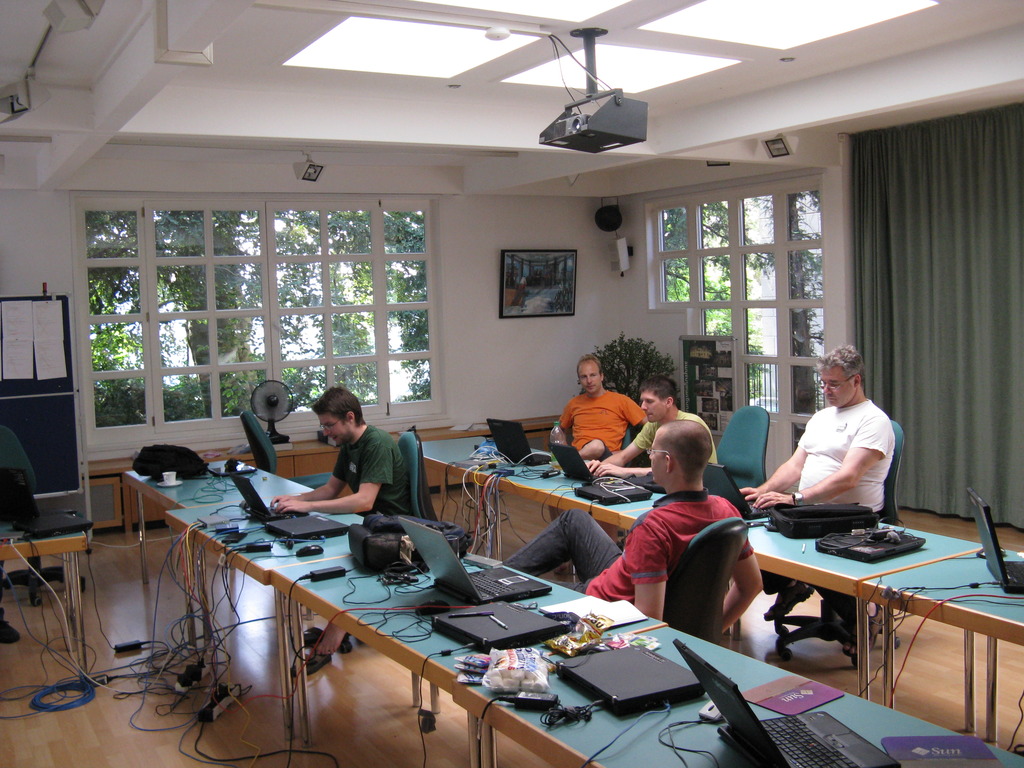
Last weekend (2010-07-02 2010-07-04) nine people met at the FAI developer workshop at Linuxhotel in Essen/Germany. If you can t remember: FAI is a non-interactive system to install, customize and manage Linux systems and software configurations on computers as well as virtual machines and chroot environments, from small networks to large-scale infrastructures and clusters. The participants of the FAI meeting: picture of participants of the FAI developer workshop 2010 second row from left to right: Michael Goetze, Michael Prokop, Andreas Schuldei
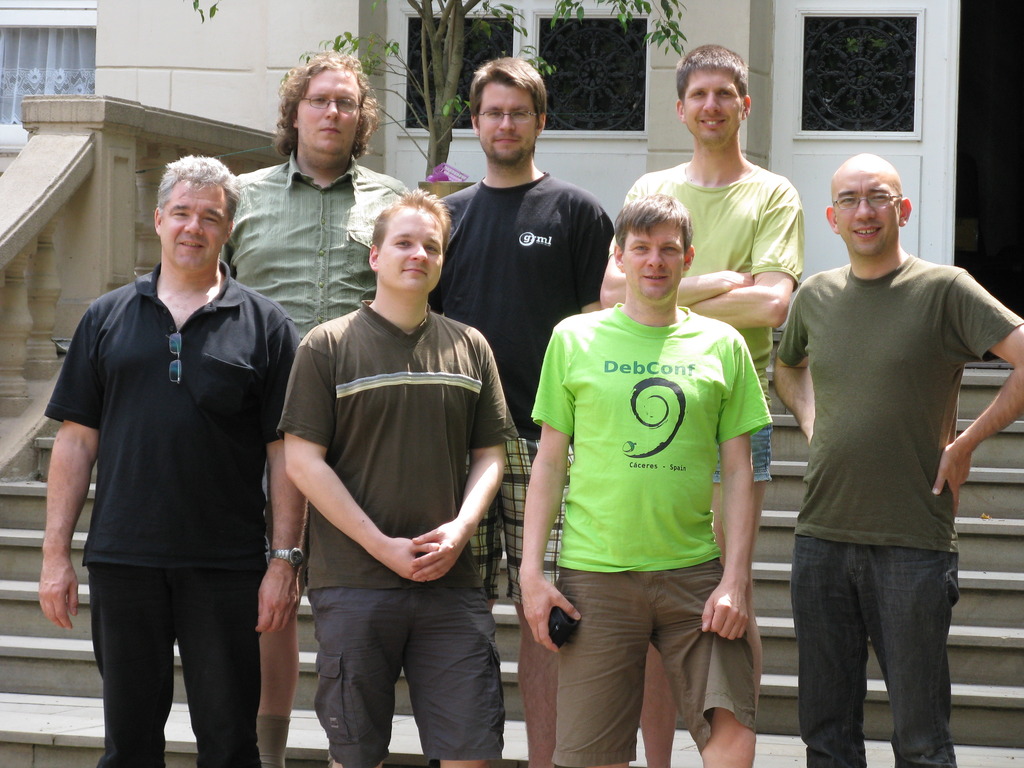
first row from left to right: Sebastian Hetze, Manuel Hachtkemper, Thomas Lange, Mattias Jansson
missing on the picture: Thomas Neumann (left on sunday midday) and Stephan Hermann (only part-time) Friday afternoon started with getting to know each other, continuing with discussions all around FAI. On saturday we started to hack on FAI. * Between the hack sessions and discussions the attending people presented their FAI usage and approaches. Some notes from the presentations:
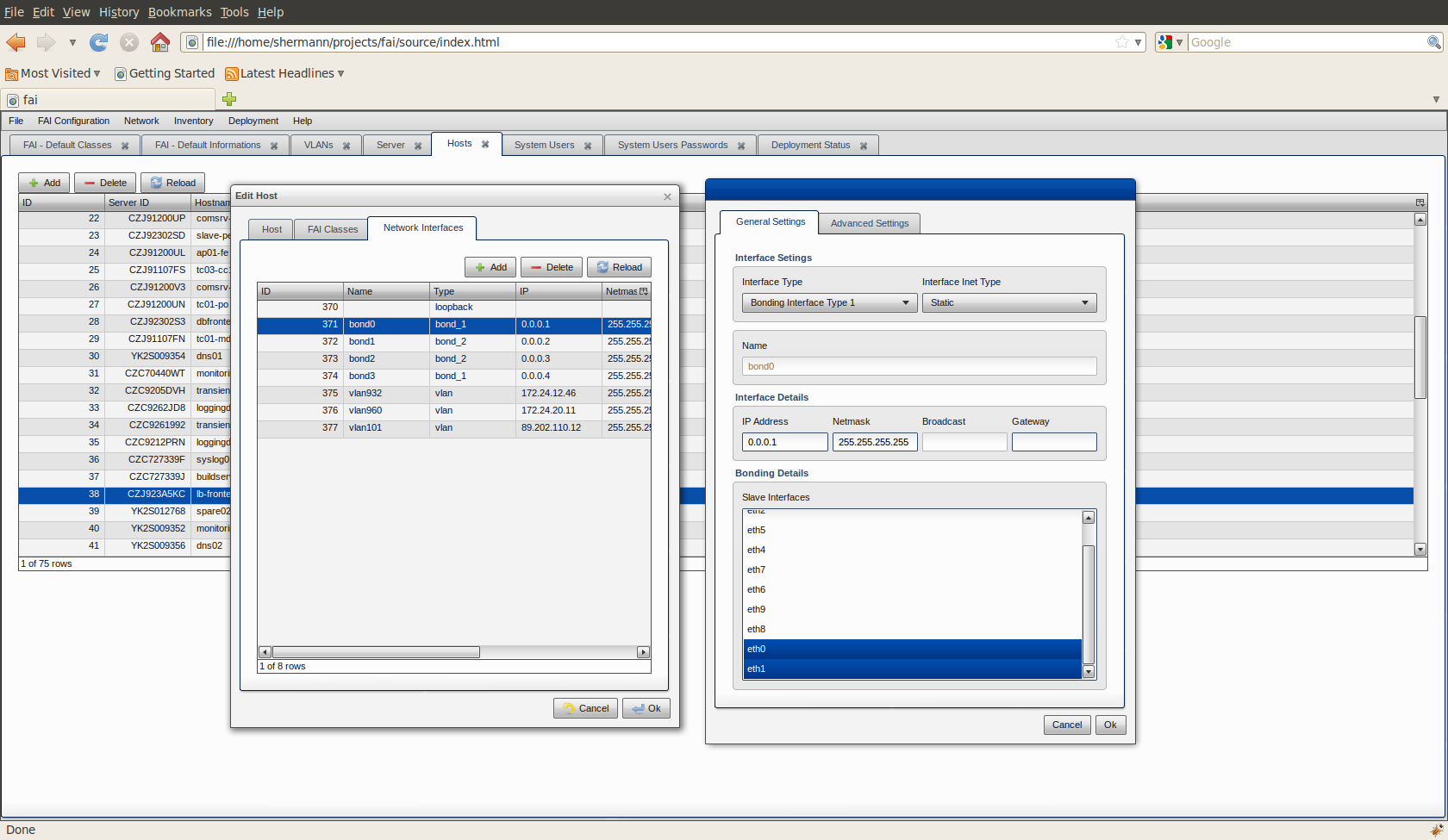
FAI Manager webfrontend / Stephan Hermann Stephan \sh Hermann presented his FAI web frontend which should be released under the GPL license in those days. The frontend uses qooxdoo whereas the backend is based on django, rpc4django and python-tftpy. Screenshot of FAI manager webfrontend A demo video is available at blip.tv. Currently Stephan is searching for a nice name for his FAI management tool please send suggestions either to him or to the linux-fai-devel mailinglist. Grml / Michael Prokop Grml is a Debian based Linux live system specially made for system administrators. Grml uses grml-live for building the ISOs, whereas grml-live itself uses FAI s dirinstall feature to build the live system. This provides the Grml team with a nice way to autobuild 18 ISOs per day, known as daily.grml.org. Mika also presented Grml s netscript bootoption and the ethdevice bootoption of live-initramfs which is useful for booting Grml/FAI via PXE. Host Europe / Michael Goetze Host Europe uses FAI for installing Debian and Ubuntu (32+64 bit) in the support center. They have ~20 FAI classes and use a Debian lenny NFSROOT as base for all deployed systems. Their main problems with FAI aren t related to FAI itself, but instead e.g. broadcom NICs with lack of support for it in Lenny s kernel. They are not using softupdate (yet) and currently use Kickstart for deploying CentOS but are working on deploying CentOS with FAI as well. LIS AG / Sebastian Hetze Linux Information Systems AG (LIS AG) are using FAI 3.2.17 and provide a luma and PyQt based GUI to their customers. They use DHCP, LDAP and DDNS for inventory, configuration and deployment. Mathematical Institute of the University of Bonn / Manuel Hachtkemper The Mathematical Institute of the University of Bonn uses FAI 3.1.8 and 3.3.5 for managing ~150 systems. They are automatically running softupdates every day, reporting how many hosts actually did run the softupdate and how many didn t run. The involved failogwatch tool supports two regex files, one for excluding specific hosts and the other one for grepping for known problems in the logs. Spotify / Andreas Schuldei + Mattias Jansson Spotify is a peer-to-peer music streaming service and the operating people at Spotify use FAI for deploying the systems. Currently they are using FAI 3.3.3 to deploy ~400 bare metal machines and ~150 virtualised machines. They have their class names in DNS using the txt/Text record entry. They are using a self written prepend_class script to manage dependencies between classes. University K ln / Thomas Lange Thomas uses FAI s trunk version (of course :) ), managing ~25 machines with less than 20 FAI classes. He s not using softupdates as Lenny s aptitude ignores the hold status of packages (this bug should be fixed for Squeeze). $COMPANY One of the big telecommunication providers in Germany uses FAI 3.3.3 for installing their bare-metal and virtual servers, providing Debian, Ubuntu and SLES. They are using Debian NFSROOT as a base for all systems as well and their main problems with FAI wasn t FAI itself but how to manage installation of virtual machines.
On Saturday evening we had a nice barbecue which included beer and K lsch *d&r*. ;) On Sunday we continued with discussions and development. Our work-log of the weekend: Important decisions made: We noticed that many FAI users implement their own way how to handle dependency management between classes, we will re-consider how we could provide such a mechanism through FAI s core. We also noted that it s important that any self-written scripts used within FAI are fully idempotent and users should be aware of this. Last but not least many thanks to the sponsors of the FAI developer workshop 07/2010! The workshop wouldn t have been possible without our generous sponsors, namely being:

7 July 2010

Marco Túlio Gontijo e Silva: Immix on GHC Summer of Code weekly report #9

My project. This post assumes that the reader has read my last post. I m posting this weekly report earlier this week because there are too many things to tell already. I ve found the reason behind the segfault I m looking for so much time. The last problem, which is the only I know exactly when was fixed, because the programs started working, was related to allocating two times in the same region of memory. This happened because in each major GC the list of free line groups is generated again, but my old code was still allocating in the same line group of the last generation. So the last part of the line group, which was not yet used, would be a part of a line group in generated in the new collection, and it will be used for allocation two times: one in the allocation of the current line group, and another when this new line group starts being allocated. The implementation of the allocation of memory in lines is not very complicated, but it has some details that should be paid attention, and that were the cause of most trouble last weeks, and still need improvement. Initially I was allocating one object per line, just to see if it would work. As it didn t, I kept on improving the approach until I could find the problem. The next attempt was by setting ws->todo_free and ws->todo_lim in alloc_for_copy() in rts/sm/Evac.c. I think this is not ideal, because I didn t want the code to become too inconsistent with the way memory was allocated using these pointers before my changes. So I created new variables, line_free and line_lim, at first in the gen_workspace ws, the same place that todo_free and todo_lim are, but because of the last problem I described in the previous paragraph I changed it to generation. I m still not sure about where to place these pointers, this is something that can be improved. Another problem that I took a long time to understand is that the object need to be scavenged after being allocated. When it was allocated in todo_free, it was being scavenged by scavenge_block() in rts/sm/Scav.c, because the block in which it s in, todo_bd, is scavenged by this function. As I didn t wanted to the whole block where the free line group is to get scavenged again, I didn t want to send it to this function. So I thought about creating a way to scavenge only part of a block, that is, the space in the free line group that was allocated. This is still a valid idea, but I noticed that it was easier to use the mark stack. So I mark the object that is allocated in the line and push it in the mark stack. The main problem with this approach it s only possible to allocate in lines during major GCs, since only in this kind of GCs the mark stack is active. This is certainly the place where I can make more improvement. The patch of these changes and another one for the sanity checking explained in the last post. I m now benchmarking these changes with nofib, to see how much it affects the performance.

Raphaël Hertzog: Joining Ubuntu as a Debian developer

I m a Debian developer since 1998 and have been fostering cooperation between Debian and Ubuntu since its inception with various levels of success. I recently decided to go one step further and join Ubuntu as an official member. I wanted to be able to vote and to promote best cooperation practices from the Ubuntu side as well (and not only in Debian). Joining as a Debian developer should be relatively easy, it is well known in the Debian community that Mark Shuttleworth once said:
Every Debian developer is also an Ubuntu developer, because one way to contribute to Ubuntu is to contribute to Debian.
So I sought to verify that too! Here s the result. I prepared my application page collecting 2 testimonials from Lucas Nussbaum and Colin Watson, I registered for the next EMEA membership meeting (which happened yesterday, irc logs here), and I attended. (I just followed the instructions on the wiki) During the meeting, when it was my turn, I pasted my short introduction and got immediately +1 votes from several board members, they didn t even want to hear from me, they were already convinced. :-) I still responded to a few questions and elaborated on my goals and was promptly accepted even if I made it clear that my technical contributions will continue to be done within Debian. A few minutes later I was added to the ubuntumembers launchpad group and this morning I followed the instructions to add my feed to Planet Ubuntu and here I am The whole process has been very smooth and the meeting shows a very welcoming attitude. Even someone who was denied the Ubuntu member status was cheered for his work and encouraged to try again when he can present some testimonials from other members. Hello Planet Ubuntu! Flattr this Share/Bookmark 11 comments Support my work

6 July 2010

Gregor Herrmann: I'm going to DebConf10

Im going to DebConf10

finally I bought my airplane tickets. at cheaptickets.com & for the first time in my life in USD :)


Leave Sunday, July 25, 2010

British Airways 951 Economy Airbus Industrie A320 (320) 2hr 5min 575 miles
Depart: 12:55pm Munich, Germany Munich Franz Josef Strauss (MUC)
Arrive: 2:00pm London, United Kingdom London Heathrow (LHR)

British Airways 189 Economy Boeing 777 (777) 7hr 45min 3458 miles
Depart: 3:35pm London, United Kingdom London Heathrow (LHR)
Arrive: 6:20pm Newark, NJ Newark Liberty Int'l (EWR)


Return Saturday, August 14, 2010

British Airways 186 Economy Boeing 767 Passenger (767) 7hr 15min 3458 miles
Depart: 10:55pm Newark, NJ Newark Liberty Int'l (EWR)
Arrive: 11:10am London, United Kingdom London Heathrow (LHR)

British Airways 952 Economy Airbus Industrie A319 (319) 1hr 55min 575 miles
Depart: 12:45pm London, United Kingdom London Heathrow (LHR)
Arrive: 3:40pm Munich, Germany Munich Franz Josef Strauss (MUC)

5 July 2010

Julian Andres Klode: Review: Lenovo ThinkPad Edge 15

Wednesday, after some weeks with a flickering screen (or more precisely, something is causing GTK+ to redraw and the kernel to print ^@ in the terminal when you touch the screen, see http://jak-linux.org/tmp/20100628_002.mp4) in my 3 years old HP Compaq 6720s (which seems to be a software-hardware combination problem, at least it works in Ubuntu); I decided to buy a new laptop. It took me a few minutes to find the Lenovo ThinkPad Edge 15 NVL7VGE; which I ordered at notebooksbilliger.de at around 14:30 CEST using Express. On Thursday morning at 6:40 CEST, the device arrived. The laptop features an Intel Core i5 430 M processor with integrated graphics, 4 GiB of RAM, 320 GB hard disk storage, matte screen, and of course a TrackPoint. The machine comes pre-installed with Windows 7 Professional which is not very nice (and Lenovo does not take Windows licenses back). I booted Ubuntu 10.04 from an USB disk which worked a few times, but not always, so I upgraded the BIOS to make USB booting reliable (as Lenovo published multiple BIOS updates already, one fixing this USB booting issue). The first step was booting Ubuntu 10.04 from an USB hard disk to check the Linux support. Using Ubuntu, everything worked out of the box, including stuff like HDMI audio support or output switching. An exception may be the DVD drive, which only works if you set the SATA mode to compatibility. Non-DVD media also works in AHCI mode, but only if you start with a disc inserted in the drive. Playing DVDs requires setting a region code using setregion(8) [otherwise they do not work at all] and SATA compatibility mode [otherwise they only work partially]. Another issue is the HDMI output, as the TV is not correctly detected and some parts at the top and the bottom of the image are missing (that is, the GNOME panels) (but that happens with different screens and ATI cards as well). Oh, and closing the lid with a screen attached and the internal screen disabled works only as long as you do not open it again, because that causes the GPU to stop. On the input side, we have one keyboard, one TrackPoint, and a touch pad. All of them work out of the box, but they have a few problems on the hardware side: The cursor keys on the keyboard are incredibly small and the touchpad is very large. The keyboard is different from the one in the HP Compaq: First of all, there is space between the keys (like Apple keyboards); and secondly, you need to apply more pressure in order to use the keys. The device feels more solid than the HP Compaq 6720s, especially touching the screen does not change the colors on the screen. I don t know how long the keyboard will last, but I hope that I will still have symbols on them in 5 months (which was not the case for the HP Compaq 6720s keyboard). Power consumption is another interesting point. When the device is idle and the screen is disabled, the device seems to consume about 10W. With screen enabled, consumption varies between 13W (idle) 35W (building source code); if the values received via ACPI are correct. The device ships with a 48 Wh battery which after some time was displayed as 53 Wh in gnome-power-statistics (only the when loaded state, capacity is displayed as 47.5Wh). According to Lenovo, the laptop lasts 4.5 hours on battery, meaning consumption of 47.5 Wh / 4.5 h = 10.5 Wh which is a bit overly optimistic if you want to work on the device. After checking everything, I took over my Debian sid installation from my old laptop (which I installed in 2008). It runs happely now, although I still need to get accustomed to the new keyboard and the large touch pad. All in all, the price of 765 I paid for the device seems to be OK. Now I only need to remove the Windows 7 sticker and hope that the device lasts long enough until I want to buy a new one (probably 2013, if the aliens don t invade us 2012).
Filed under: General

4 July 2010

Bernd Zeimetz: gimp-plugin-registry 3.5-1

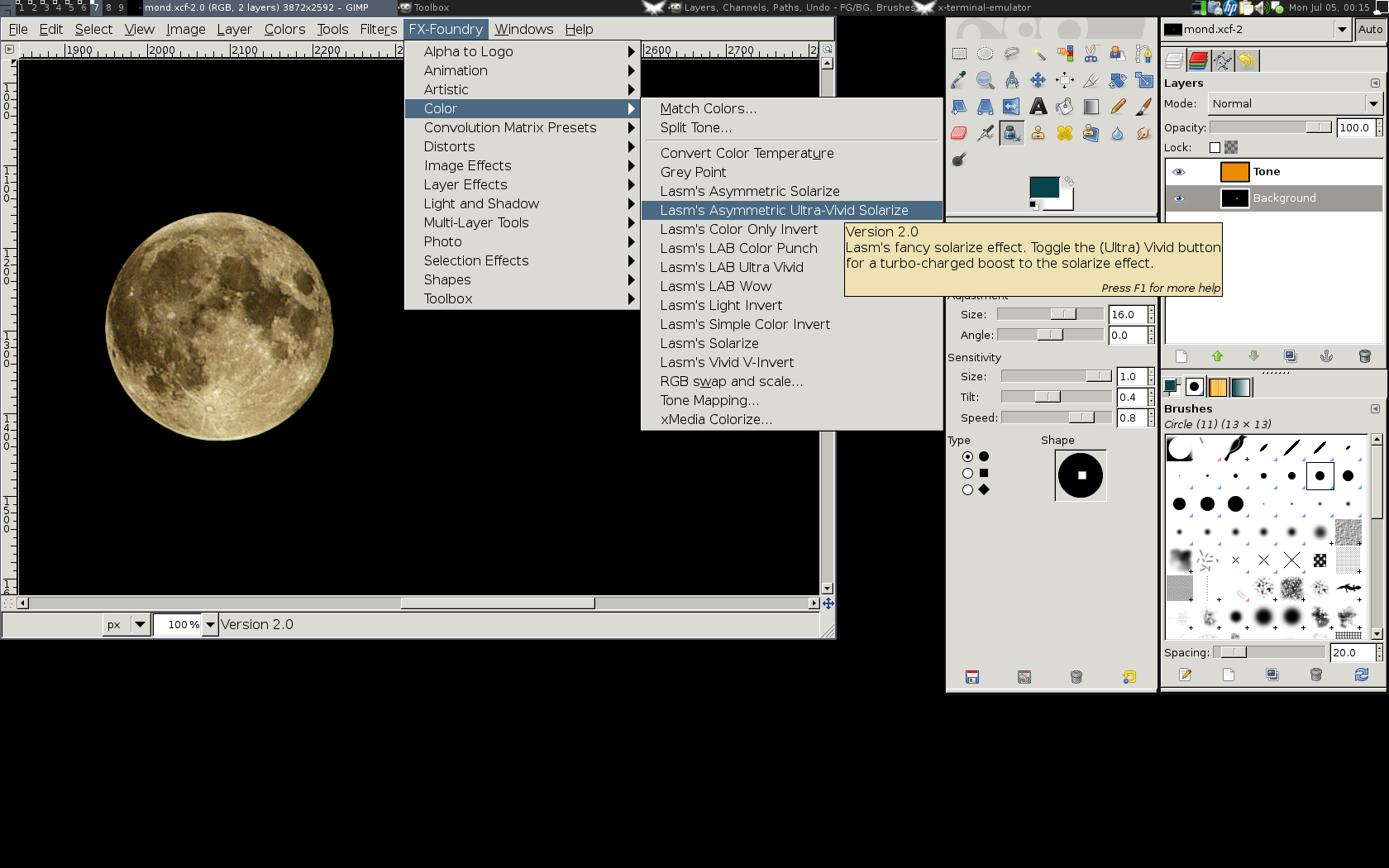
During the last three months and since my last blog-post about gimp-plugin-registry a lot happened: Mainly a large number of new plugins was added, but also various enhancements and bugfixes went into the package, together with updates for various already included plugins. The GIMP screenshot with open FX-Foundry menu For those who don't know gimp-plugin-registry yet, it is a collection of scripts and plugins for The GIMP. The name is based on the webpage GIMP Plugin Registry, where most (new) plugins and scripts are listed. So far the package ships with 170 scripts/plugins. Most of the scripts are written in TinyScheme, but there are also several plugins in C or Python. Probably most noticeable is the inclusion of the GIMP FX Foundry, which is an awesome collection of 124 scripts. Below follows a list of all scripts and plugins as shown in the long description of the Debian package. New plugins are marked with a bold fontface. If there is any interest from other distributions to include the package, I'd be happy to help out to make an integration as easy as possible. The few interesting parts could be ripped out of debian/rules and shipped as a normal Makefile, so they could be used easily. More complicated is the generation of the package description and copyright information, but I guess instead of writing debian/coyright and debian/control, it should be possible to integrate the information into a rpm spec file template or similar files. So in case you're interested to port the package to Fedora, OpenSuSE or some other distribution, don't hesitate to contact me! The sources are available via git, see git.recluse.de for details. For wishes, suggestions and bug reports either use the Debian BTS or Launchpad. While I prefer bugs via the BTS, it might be easier for non-Debian users to file bugs in the Ubuntu Launchpad.
Gregor Herrmann: RC bugs 2010/25, 2010/26

to start with the good news: christine has joined the RCBW initiative yeah! let's see who joins next ...

as usual, a short overview about my own attempts in the RC bugs department:

Cyril Brulebois: We need *you*! (redux)

We need you! (redux) The X Strike Force needs you! (redux) This time, the focus is on the xserver-xorg-video-intel driver. KMS and UMS are going to be used heavily below, one may want to check the mode-setting wikipedia article and the modesetting page on X.org. Intel follows a 3-month cycle for its video driver releases. Some comments on the last ones: It d be nice to have users install 2.12 from experimental and see how it goes from here. If regressions are found, we should be able to try hard(er) to get them fixed, so that we can move 2.12 to unstable and release with it. If there are too many of them, and if they re not going to be fixed on time, we might stick with 2.9. Pulling the driver from experimental should be quite easy: libdrm* packages are going to be upgraded, but that s mostly it (meaning the server itself will stay the same, and rolling back should be as easy as downgrading the driver and the libdrm* packages). A note on KMS and UMS: a benefit of sticking with 2.9 was being able to switch back to UMS in case KMS wasn t usable for some cards. Unfortunately, popular/well-spread cards like i8xx aren t well supported yet, that s why Chris Wilson (upstream) is considering introducing UMS support again for that kind of blacklisted cards. This way, it should be possible to move to 2.12 (including Chris work) without leaving some users behind. Feedback appreciated as follows: Thanks already!

Torsten Werner: Monday, 19th July: Debian bug squashing party in Berlin

A bug squashing party with take place on monday, 19th july, in the rooms of B ro 2.0 in Berlin Neuk lln. Please check the Wiki page for more information and please register yourself there if you plan to attend. Please don't forget that you have to organize your accomodation by yourself if you do not live in Berlin.

1 July 2010

Thibaut Girka: Fourth GSoC report

This week's report is unfortunately even lesser interesting than the previous week, but it doesn't mean nothing has been done. The main work of this week have been to fix an outstanding bug with the glamo-mci driver. What I'll do next week will depend on the acceptance of my last patches in the OpenMoko kernel tree, but I'll probably submit the glamo drivers upstream. Other than that, I plan to work on flash-installer and uboot-envtools-udeb/uboot-installer, which has already been worked on by Per Andersson, to provide automatic u-boot configuration at the end of the installation process, in a way similar to what is done for GRUB on a regular PC.

David Welton: On the block: squeezedbooks.com

In keeping with the idea that I want to focus on things where I sell something directly to people, rather than just advertising, I am putting http://www.squeezedbooks.com up for auction on flippa.com. The auction is here: http://flippa.com/auctions/99073/Business-Book-Summary-Site
Here's what I wrote about it:

I like to read business books, but many of them contain a nugget of valuable information, and lots of fluff, because you can't sell a 10 page book. Some of them are pure fluff! Occasionally, one of them has profound implications.

I created this site several years ago in order to have a place to summarize a series of books I'd read, with the aim of creating a community interested in summarizing and, most of all, discussing business books. To be honest, that community hasn't really materialized, although there are a number of registered users (585 at last count). Most other business book summary sites are for-pay - you pay $X dollars a month and receive Y summaries. I wanted to create an open site, in order to foster discussion and communication between people reading summaries.

In any case, one baby later and in a different country, my heart isn't really in it any more, so I've decided to put the site up for sale. I still think the idea is a good one, and that in the right hands, the site could take off.
It was a fun site to work on, and really do think that in the right hands, it, or something derived from it, could be successful. I could conceivably hang on to it and keep trying different things with it, but I've decided I really need to impose this limitation of "make something to sell directly" on myself in order to avoid wandering off into "cool, but no idea how to make money" projects. Edit:
One thing that I'd like to state explicitly and publicly is that I'm not giving up on open source, just that I think I need to draw a really clear line between "I hope to make some money with this" and "this is a cool project I want to share with the world". In other words, I think I'd rather avoid the middle ground where stuff is sort of openish, and go either for projects that pay directly, or stuff that's pure open source under an Apache or BSD license. Hopefully, if I ever hit on a project that takes off, I'll be able to dedicate some time/resources to open sourcing some of the infrastructure, as I think that's currently one of the better models for producing open source software.

30 June 2010

Joey Hess: Osmos

I love this game. Love that it's so abstract and beautiful and meditative. Love how it plays with fractal scale. Am I a planet or a unicelled organism? Love that this basic game idea could have been written at any point since Spacewar (1961), and could be said to be recycling ideas from everything from that to Pac Man ... but instead seems entirely new, pure, and fresh. Love that I can be playing it and it makes me think about things right out of a Greg Egan novel. Like about how it's most efficient for conciousness to be slow and not care about the passage of time. So you don't have to waste much mass on delta-v. Until carnivorous life enters the picture. Then you have to be bold, and fast. Love that it has a linux port. Love that it's hard. A screenshot can't do it justice -- the video on its site gives a better idea.

28 June 2010

Russell Coker: Can you run SE Linux on a Xen Guest?

I was asked Can you run SELinux on a XEN guest without any problem? . In a generic sense the answer is of course YES, Xen allows you to run Linux kernels with all the usual range of features and SE Linux isn t a particularly difficult feature to enable. I do most of my SE Linux development and testing on virtual machines and until recently I didn t have any hardware suitable for running KVM, so in the last few years I ve done more SE Linux testing on Xen than on non-virtual machines. My SE Linux Play Machine [1] (which will be online again tomorrow) is one SE Linux system running under Xen. But the question was asked in the context of my blog post comparing the prices of virtual hosting providers [2], which changes things. Both Linode and Slicehost (the two virtual hosting providers that my clients use) provide kernels without SE Linux support, the command grep selinux /proc/filesystems (which is the easiest way to test for SE Linux support) gives no output. I am not aware of any other virtual hosting company that provides SE Linux support. If anyone knows of a virtual hosting company that runs Xen or KVM virtual machines with SE Linux support then please let me know, I ll write a blog post comparing such companies if there are some. For the people who work at ISPs: If your company supports SE Linux virtual machines then I would be happy to review your service, just give me a free DomU for a couple of weeks so I can test it out. If your company is considering offering such virtual machines then I would be happy to have a confidential discussion about the issues that you will face, while I am available for paid consulting work in this area I am more than happy to spend an hour or two helping a company that s going to help support my favorite free software project without expecting to be paid. But I have to note that if a dozen hosting companies happen to want advice I won t be able to provide two hours of free advice to each of them. I think that there is an unsatisfied market demand for SE Linux virtual machines. I don t expect all virtual hosting companies to support it in the near future, but this will make it more profitable for those that do. If for the sake of discussion we assume that 5% of sysadmins who are making purchasing decisions regarding virtual servers really want to have SE Linux support and if 5% of virtual hosting companies were to offer such support, then those hosting companies would almost double their market share as a result of supporting SE Linux. It s the usual economic factors relating to small companies that profit from providing good support for the needs of a minority of customers.

26 June 2010

Stefano Zacchiroli: Welcome, DebConf newbies!

and the newbies are ... A long time ago, in a couple of blog posts far far away, we have introduced the DebConf Newbies initiative. I'm hereby happy to announce the actual DebConf newbies and I'm looking forward to meet them at the forthcoming DebConf10 in New York City: Now, folks, please be kind with them, they (still) don't know how crazy we can be(come) during DebConf. Above all: do not harm them (too much) at Mao. In exchange, they have already promised that they will fix all RC bugs that will still be open at the beginning of DebConf10 (or maybe I've just read that in their minds, I don't quite remember ...). Does that mean that DebConf10 travel sponsoring is completely OK as of now? No, not really. This initiative was specifically targeting DebConf newbies, but several DebConf "regulars" are planning to attend too. For some of them the amazing DebConf sponsoring team has already found enough resources to secure their travel sponsorship, for quite some others it is not the case yet. This is a pity, because we know from the past that having more Debian folks at DebConf means more hacking, a better distribution, and a better community, ultimately it means a better Debian. Some of the readers of this blog post will be in the condition to improve the situation: it is as simple as donating to Debian or, better, becoming a DebConf10 sponsor by simply mailing the sponsoring team.

Anand Kumria: Get Low

A story about getting people together to tell them a story of regret involving the main character, which we see at the start. The story itself isn't very dramatic. Which is why there isn't a film about that. Instead we have the story about getting people to tell the story. This is a great example of a movie with a mind-boggingly amazing cast (Bill Murray, Robert Duvell, Sissy Spacek, Lucas Black) having a script that is crap. Having the director present, to discuss the film, after the screening lifted this from a 1 to 2. Hearing Aaron talk about the different styles of Duvell, Murray and how the editing process was actually done (Final Cut Pro) was very entertaining. The story drifts, the soundtrack doesn't annoy and the filmography is alright. Oh, the period setting is done very well. Not much else to recommend it though. Get Low refers to burying in the film. Something I think that should have happened to this film.

Next.

Previous.