Search Results: "ema"

15 April 2010

Joachim Breitner: A mathematician s status symbol

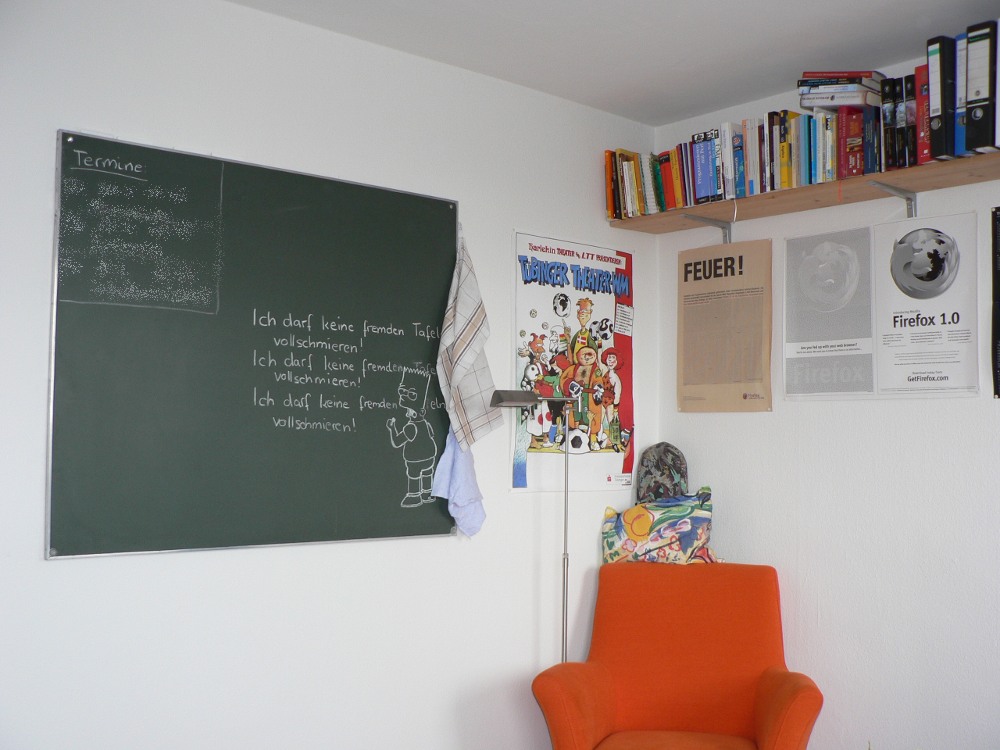
While writing my diploma thesis, I often wished I had a blackboard in my room: A place to quickly scribble some ideas on, somewhere where I can easily erease and replace stuff. Also, somewhere where you can literally (and not just figuratively) step back from and look at from the distance. For my 25th birthday, my parents organized a discharged part of a blackboard from my old scool, and yesterday, we installed it in my room in Karlsruhe:
A blackboard in my room
Although my diploma thesis is finished, I m sure it will be a nice and useful piece of furniture, and if only to draw funny things on (as my girlfriend did on this picture).

MJ Ray: Debian Project Leader Election Campaign Round-up

I ve been AWOL for most of the debian project leader election campaigns this year, but I still want to vote, so I ve been dredging the emails on the last day. Maybe someone still has to vote and reads this, or maybe it ll help someone to interpret the result. What I ve done this year is to make a quick tally of platform points and campaign answers that I liked and disliked for each candidate, then total them up to get an order. If anyone gets a negative (more dislikes than likes), then I ll rank them below NOTA. Platforms: Margarita Manterola, Stefano Zacchiroli, Wouter Verhelst, Charles Plessy. Some of the questions: Make of that what you will. It surprised me which way the scores came out, but there was one answer with such a massive problem (in my opinion) that I ranked its giver equal with the next candidate down anyway. If you re a debian developer (DD), have you voted yet?

14 April 2010

Adrian von Bidder: Harold and Maude. And some others.

The friend who lent me his Kottan ermittelt DVDs gave me the 1981 movie (cinema, not TV) Den T chtigen geh rt die Welt. I guess a warning is in order: if you liked the TV series, it's possible that you'll share my disappointment with this film. There are reports of a new movie to be made this year, and I also haven't seen the first 9 episodes of the TV series yet, so I'll probably report on Kottan again some time in the future. I was surprised but liked the film: There's a coherent plot and even a happy end. And it's till a film by David Lynch: Wild at Heart. Also by Lynch: the very early Eraserhead. Now this is Lynch (at least for me, since I started with Lost Highway and Mulholland Drive ), and I really like the hairstyle of Henry Spencer. Something completely different: Harold and Maude, or what happens when a bored high society youth falls in love with an 80 years old eccentric who shares his hobby of going to funerals of some random people.

Matt Zimmerman: Pop visualization

It s no surprise that information visualization and related fields have been active research topics in the past decade. The widespread availability of large, valuable data sets has created a need for improved tools and techniques for making sense of it. This is highly technical work, requiring expertise in design, mathematics, software and other fields, and there is a vibrant community of professionals and amateurs who experiment and critique the latest methods. In the geeky blogs that I follow, I see more and more amateur interest in visualization. Visualization is starting to take on political significance as well, as evidenced by the appointment of information design pioneer Edward Tufte to a US government advisory panel to help explain economic policy to the American public. A technology is confirmed to be truly and vitally relevant, though, when it enters the mainstream consciousness in the form of humor. In the case of visualization, geeks have been trading funny charts and graphs for many years, but this phenomenon seems to have finally crossed the chasm into popular Internet culture with the advent of the Venn diagram meme. Now, anyone with an elementary education and a drawing program can create their own chuckle-inducing infographics and enjoy their 15 minutes of Twitter fame. Likewise for the X as seen by Y two-dimensional grids, revealing how various (stereotyped) groups perceive each other. This is the future, becoming more evenly distributed by the minute.

13 April 2010

Gunnar Wolf: Regarding the fatal cycling accident in Ciudad Universitaria

My blog is written in English, even though I sometimes post content relevant locally. Anyway, I want this to be as widely known as possible. We are about to launch a website/community for my University's cyclists, BiciUNAMonos. Please note the site I'm linking is still very preliminary in several ways. But that's the least relevant for now. I am translating here a message written by fellow cyclist (and researcher in the Institute of Astronomy of my University) Sergio Mendoza.
Regarding the fatal cycling accident in Ciudad Universitaria Yesterday night I got home, and was quite surprised to open my mailbox and find a considerable amount of messages under the subject Urgent: Fallen cyclist! I immediately noticed something was very wrong, and was surprised they were contacting me. When I decided to read the first such message, I realized what happened: Dr. Jorge Villanueva was run over by the Puma [internal University service] bus number 14, route 2, which was being driven over the speed limit. This happened last Sunday, April 11. On Sundays, all of Ciudad Universitaria becomes a cycling and running circuit. I was immediately brought back to the moment that, when I was leaving my office in the Astronomy Institute and heading towards Cerro del Agua avenue, a lady driving over the speed limit on the circuit that comes from Metro Universidad threw her car at me. I saw her at a few centimeters distance from her windshield... To the day I don't know how I pulled my bike away, as I was going to hit the windshield with my shoulder. Everything happened in slow motion, I just heard several cars honking at this imprudent lady. I didn't have a scratch, but got excessively close to getting a strong hit, and with the adrenaline raging I gave a kind caress with my closed fist to her brand new car. I had to free my adrenaline somehow... My legs were trembling when I tried to pedal. I told her, lady, I am excessively visible in my bike, why did you do this? , she didn't answer, she just looked despectively at me. This kind of accidents happen every day in the University and its main entries. Precisely today, a University professor threw his car at me entering the University via Cerro del Agua. When I reached him and confronted him, he told me completely sure of his words that I was invading the lane with my bike, and that it was my fault. Anybody would have thought a car-driving university professor is capable of reading the Metropolitant Transit Regulations that clearly states on its 1st article: The priority for using the public space, for the different transport modes will be according to the following priorization: I. Pedestrians; II. Cyclists; III. Users and providers of massive, collective or individual public transport service; IV. users of particular automotor transport; and V. users and providers of freight transport. We are now organizing to put up the first ghost bike in Ciudad Universitaria. This happens few days before the formal inauguration of BiciUNAMonos, the universitary association of urban cyclists; we will do this remembering our university mate. I see every day more people in the University hitting their bike pedals to get to their faculties, centers and research institutes, but what is striking is the lack of University infrastructure. The few cycleways we have are built to use a bycicle system that is open only until 16:00. It is good, but it is in no way useful for those of us who use the bike every day and at every hour, no matter the weather. The main problem lies at the communication points, when cyclists arrive from outside Ciudad Universitaria and have to take the regular circuits to reach the cycleways. The Transit Regulation, in the 1st article I quoted above, defines in an excellent way the priorities that must exist to allow human movility. In this regard we have to mention that:
  1. The pedestrians must be enormously protected with walkways and semaphores to allow them to safely walk. In Ciudad Unviersitaria there are many places that don't even have a walkway or semaphores, and drivers do not respect the pedestrian's preference. Also, now in the central area of Ciudad Universitaria we have the Pumabus system on a confined lane, providing an excellent service to the pedestrians to move within the campus.
  2. The cyclist comes next in this priorization, but there is nothing obvious for him. There are a couple of cyclist ways, usually invaded by pedestrians, and explicitly made to use the Bicipuma system. Cyclists need their own lane for circulation in the Universitary circuit; pedestrians have walkways, Pumab s has its confined lanes, but the cyclists still lack it. The third lane that remains is precisely for the IV and V entries in the Metropolitan Transport Regulations. They can perfectly share the remaining lane in the campus.
The last thing I wanted was to formally announce BiciUNAMonos reminding a fallen cyclist and dedicating a ghost bycicle to his memory in Ciudad Universtiaria, but we don't have a choice. We have to make it very clear to the University community that the bicycle is the best transport system, and that the drivers' imprudence inside Ciudad Universitaria must be strongly punished. Sergio Mendoza
President
http://www.biciunamonos.org
Coincidentally, today I also had a freightening experience. Taking one of my usual routes to work, going up from the sporting area in the Western half of the campus (just before where the map lists the highest point in my ride), just by Investigaciones Biom dicas, I heard a car hitting the breaks behind me and passing me (on my right side) quite narrowly. I was, as always, driving towards the center of the lane, to be able to respond to unforseen events (as this one, precisely). The Universitary authorities had the great(?) idea of placing round, small bumps before the Pumabus stations to avoid drivers parking in front of them. I have seen a strong accident caused by them, and was close to suffering one myself some months ago. I know that just after Biom dicas there are some such bumps, so I never ride too much to the right I don't know what was on this driver's head. Ciudad Universitaria has a 40 Km/h speed limit. Yes, it might seem too low - Circuits are wide and well planned. But there is a lot of cyclist and pedestrian transit, at all times, and I must recognize such a limit is well in place. I often take a longer route to my Institute, bordering the University along Av. Delf n Madrigal. People tell me I'm crazy, as this is an avenue that's often taken at high speed - Usually, cars pass me by between 60 and 80 Km/h. However, I even feel safer going that way than going inside the University. Contrary to the popular belief, Universitary people do not have better driving habits than the bulk of the population. And it's often much easier to drive along a way where the traffic even if it goes at three times my speed runs only in one direction, unlike the swarming of people going in every possible direction inside the main campus. Anyway, last Sunday we lost a University professor, we lost a cyclist. Some people lost a friend, a family member. We have to make this case well known, we have to speak with the authorities so they see the Bicipuma system is good, but not enough. Cycling is the only way to go for a city as complex as ours. A much needed first step is to allow proper vial connections linking the University and the many avenues that surround it. Another one is to make a campaign so the cyclists are not seen as Sergio regards as intruders in the streets The street belongs to us all. Cyclists should never drive on walkways or among pedestrians. Drivers need to learn to share the streets with us.

12 April 2010

Andrew Pollock: [tech] Using capabilities from Python

I've become passingly interested in Linux's capabilities functionality, as a way of reducing full-blown UID 0 requirements. Unrelated to this, one of my few gripes about Python, coming from Perl, was the inability to do anything like Perl's $0 to alter the appearance of the running program. I used to use this functionality in Perl a lot to provide cheap insight into what a long running Perl script was up to. Well the other day, I was rather excited to learn that Dennis Kaarsemaker has written a Python interface to capabilities, which also implements a set_proctitle() function. The python-prctl module isn't currently available in Debian, but as Dennis has all of the packaging in the Git repository, I've offered to sponsor it for him if he wishes.

11 April 2010

Christian Perrier: [life] Paris marathon 2010~bubulle-1 ACCEPTED

Upload accepted by organisers. Upload time has been 3h49'29" (my watch says 27", eh!). That was a good one, really (actually, I can compare to only 3 as it was my fourth marathon after Paris and Cologne 2009, plus the unofficial Rambouillet Forest marathon I ran alone 6 weeks after Paris 2009). For marathoners around, here are the chronometric data. Please note that GPS watches tend to overestimate the distance, mostly because of the jerky way one runs in mass events, as well as geometric considerations related to the imprecision of GPS (imprecision may be lateral and thus the line recorded by the watch is often less straight than the real one). For instance, according to my watch, Paris marathon was 42.63km long, so an overestimate by nearly 500meters. As a consequence, the recorded speed of 5'23"/km should be corrected to 5'25". So, times below should be increased by 2 seconds. As a conclusion, even though I can improve the pace and avoid going too fast in the first 25km, I'm very happy as I avoided nearly collapsing as I did last year (with sometimes over 7'00/km and a few walks). Going back home was OK and I had no cramps and I still haven't any. This is also what one gets when preparing well. My only regret is that I didn't run over 30km since, indeed, Cologne Marathon! That made the difference in the last 12 kilometers, obviously. Having spent the winter on many half-marathons (either alone, or a few officials) clearly improved my "performance" up to 25km. For the next marathon (a marathoner always thinks about the next one), I need to have 1 or 2 long trainings a few weeks before. Now, I have to find out which one will be the next one... and I wish good luck to my friend No l K the, who is preparing the Mainz marathon for May 9th as well as Dirk who's certainly preparing another one. Guys, rendez-vous is of course for Debconf10 in NYC. We won't run a marathon for sur, but how about an half one? :-)

10 April 2010

Russell Coker: Web Server Performance

We Have to Make Our Servers Faster Google have just announced that they have made site speed part of their ranking criteria for search results [1]. This means that we now need to put a lot of effort into making our servers run faster. I ve just been using the Page Speed Firefox Plugin [2] (which incidentally requires the Firebug Firefox Plugin [3]) to test my blog. Image Size One thing that Page Speed recommends is to specify the width and height of images in the img tag so the browser doesn t have to change the layout of the window every time it loads a picture. The following script generates the HTML that I m now using for my blog posts. I run BASE=http://www.coker.com.au/blogpics/2010 jpeg.sh foo.jpg bar.jpg and it generates HTML code that merely needs the data for the alt tag to be added. Note that this script relies on a scheme where there are files like foo-big.jpg that have maximum resolution and foo.jpg which has the small version. Anyone with some shell coding skills can change this of course, but I expect that some people will change the naming scheme that they use for new pictures. #!/bin/bash
set -e
while [ "$1" != "" ]; do
RES=$(identify $1 cut -f3 -d\ )
WIDTH=$(echo $RES cut -f1 -dx)px
HEIGHT=$(echo $RES cut -f2 -dx)px
BIG=$(echo $1 sed -e s/.jpg/-big.jpg/)
echo "<a href=\"$BASE/$BIG\"><img src=\"$BASE/$1\" width=\"$WIDTH\" height=\"$HEIGHT\" alt=\"\" /></a>"
shift
done Thanks to Brett Pemberton for the tip about using identify from imagemagick to discover the resolution. Apache and Cache Expiry Page Speed complained that my static URLs didn t specify a cache expiry time, this didn t affect things for my own system as my Squid server forcibly caches some things without being told to but would be a problem for some others. I first ran the command a2enmod expires ; a2enmod headers to configure my web server to use the expires and headers Apache modules. Then I created a file named /etc/apache2/conf.d/expires with the following contents: ExpiresActive On
ExpiresDefault "access plus 1 day"
ExpiresByType image/gif "access plus 1 month"
ExpiresByType image/jpeg "access plus 1 month"
ExpiresByType text/css "access plus 1 day"
# Set up caching on media files for 1 year (forever?)
<FilesMatch "\.(flv ico pdf avi mov ppt doc mp3 wmv wav)$">
ExpiresDefault "access plus 1 year"
Header append Cache-Control "public"
</FilesMatch>

# Set up caching on media files for 1 month
<FilesMatch "\.(gif jpg jpeg png swf)$">
ExpiresDefault "access plus 1 month"
Header append Cache-Control "public"
</FilesMatch> DNS Lookups Page Speed complains about DNS names that are used for only one URL. One example of this was the Octofinder service [4], it s a service to find blogs based on tags, but I don t seem to get any traffic from it so I just turned it off. In this case it was the only sensible thing to do to have a single URL from their web site, but I had been considering removing the Octofinder link for a while anyway. As an aside I will be interested to see if there are comments from anyone who has found Octofinder to be useful. I ve also disabled the widget that used to display my score from Technorati.com, it wasn t doing what it used to do, the facility of allowing someone to list my blog as a favorite didn t seem to provide any benefit, and it was taking extra DNS lookups and data transfers. I might put something from Technorati on my blog again in future as they used to be useful. Cookies If you have static content (such as images) on a server that uses cookies then the cookie data is sent with every request. This requires transferring more data and breaks caching. So I modified the style-sheet for my theme to reference icons on a different web server, this will supposedly save about 4K of data transfer for a page load while also giving better caching. The down-side of this is that I have my static content on a different virtual server so now updating my Wordpress theme will require updating two servers, this isn t a problem for the theme (which doesn t get updated often) but will be a problem if I do it with plugins. Conclusion The end result is that my blog now gets a rating of 95% for Page Speed when previously it got a rating of 82%. Now most of the top references that are flagged by Page Speed come from Google, although there is still work for me to do. Also it seems that Australia is now generally unsuitable for hosting web sites for viewing in other countries. I will advise all my clients who do International business to consider hosting in the US or the EU.

Andrew Pollock: [tech/security] How not to do it

From http://www.symantec.com/connect/articles/active-directory-and-linux...
An alternative to allowing anonymous searches on your Active Directory is to allow the nss_ldap routines to bind as an administrator DN to your directory and perform searches in privileged mode. To do this, insert the following lines in your /etc/ldap.conf file: binddn cn=Administrator,cn=Users, bindpw You should be used to the "" thing by now. WARNING: The above example shows that the administrator user name and password have been coded in clear text in the /etc/ldap.conf file! Unfortunately, this file must always remain world-readable, because otherwise users logged on to the system will not be able to read data from the directory. You should not do this on a system where any user has shell access to your system, or can in any other way read this file.
If you've put the Administrator password in a world-readable file, you've already lost.

9 April 2010

Phil Hands: Debian Tartan, in time for DebConf10

It looks like we have just enough interest for a second run of Debian Tartan. If we get it ordered in the next couple of weeks there will be time for kilts to be made in time be worn at DebConf10.The only issue at present is that it would be rather cheaper if more people were involved. For short runs the cloth costs 26.00 GBP per yard, and one also needs to find 400.00 GBP for the loom setup. Once you get to an order of 80 yards, the weavers will swallow the setup cost, and only charge 24.00 GBP per yard.In other words, if we're making only 46 yards (which seems like the current level) it's going to cost 10 GBP extra per yard, which is frustrating, as that then means that buying the remaining 36 yards to make it up to 80 yards will only cost another 365.00 GBP or a tenner a yard.If I wanted to make a profit out of this, I suppose I could speculate on the spare cloth, and then knock it out for 150% profit, but I have no desire to make money from my fellow developers, so while I'm chivying, and talking to the weavers, I'm not going to be underwriting the order like I did last time.So if you're even slightly tempted to join this cheerful clan then mail me now! Every extra kilt, skirt, tie, or other item ordered not only results in you owning a beautifully crafted item, but it also does your fellows good by making their orders cheaper too.At an order of 60 yards, the prices cross over, at which point there is no point in not making the full 80 yards, which can then be sold to late-comers to recoup costs for the early-birds.Go on -- you know you want one.Update: not sure what happened to the spam unfriendly mail link - use this: phil at hands dot com

Bastian Venthur: Debbugs RW-SOAP API Project in GSoC 2010

Google Summer of Code 2010 This year again, I m proposing a project for this year s Summer of Code. Very much like my last year s proposal, it is about adding submit- and manipulation capabilities to debbugs SOAP interface. The idea for this project is to add another way to communicate with our bug tracking system than email. Since we already have a read-only SOAP interface, it seems natural to add write-capabilities. Libraries like python-debianbts would adopt those features and end user applications like reportbug or reportbug-ng could use it to enhance usability. One student has already applied. Others are also very welcome but be quick, the deadline for student applications is April 9th at 19:00 UTC.

David Welton: US Exports: "The Cloud"?

An Economist special report in last week's print edition talks about how the US will need focus more on savings and exports:

A special report on America's economy: Time to rebalance I've been thinking about that for a while too, especially after the dollar's recent weakness, although it has been strengthening some, lately, apparently due to the state of Greece's finances... I think that the computing industry is, in general, well poised to take advantage of that. For instance, what could be easier to export than computing power or "Software as a Service"? All it takes is a few minutes for someone in Europe to sign up to a US-based service with a credit card. For instance, compare Linode's prices and good service with most of their European competitors (gandi.net for instance, who are good people, and you have to love that they put "no bullshit" right on their front page). Not that they don't have good service in Europe, but it's very difficult to compete on price with the dollar being significantly cheaper. With the dollar where it is right now, gandi is almost, but not quite, competitive with Linode. If you don't include taxes. If the dollar weakens again, though, things could easily tilt far in Linode's favor. Besides a weak dollar, I think it will be important for companies in a position to do so in the US to focus on "the rest of the world". The US is a big, populous country where it's very easy to forget about far-off lands. Compare my home town of Eugene, Oregon to where I live in Padova. Google Maps says that it takes 7+ hours to drive to Vancouver, Canada (which, to tell the truth, isn't all that foreign in that they speak English with an accent much closer to mine than say, Alabama or Maine). Going south, Google says it's 15+ hours just to San Diego, although I think that's optimistic myself, given traffic in California. From Padova, I can be in France in 5 hours, according to Google, 3 hours to Switzerland, 4 to Innsbruck, in Austria, less than 3 hours to the capital of Slovenia, Ljubljana, and around 3 hours to Croatia, too. And if you wanted to throw in another country, the Republic of San Marino is also less than 3 hours away, according to Google's driving time estimates. You could probably live your entire life in a place like Eugene and never really deal much with foreigners, whereas here, nearby borders are both a historic and an ever-present fact. The outcome of this is that, to some degree, people in the US have traditionally focused their businesses "inwards" until they got to a certain size. Which is, of course, a natural thing to do when you have such a big, homogenous market to deal with before you even start thinking about foreign languages, different laws, exchange rates and all the hassle those things entail. However, if exchange rates hold steady or favor the US further, and internal spending remains weaker, it appears as if it may be sensible for companies to invest some time and energy to attract clients in "the rest of the world". "Cloud" (anyone got a better term? this one's awfully vague, but I want to encompass both "computing power" like Linode or Amazon's EC2, as well as "software as a service") companies likely will have a much easier time of things: for many services, it's easy to just keep running things in the US for a while, and worry about having physical or legal infrastructure abroad later. Your service might not be quite as snappy as it may be with a local server, but it'll do, if it performs a useful function. Compare that with a more traditional business where you might have to do something like open a factory abroad, or at the very least figure out the details of how to ship physical products abroad and sell them, and do so in a way that you're somewhat insured against the large array of things that could go wrong between sending your products on their merry way, and someone buying them in Oslo, Lisbon or Prague. Since this barrier to entry is lower, it makes more sense to climb over it earlier on. As an example, Linode recently did a deal to provide VPS services from a London data center, to make their service more attractive to European customers. However, they still don't appear have marketing materials translated into various languages, and presumably they don't have support staff capable of speaking languages like Chinese, German or Russian either (well, at least not in an official capacity). This isn't to pick on them; they may have considered those things and found them too much of an expense/distraction/hassle for the time being - they certainly know their business better than I do - and that they simply are content to make do with English. Other businesses, however, may decide that a local touch is important to attracting clients. What do you need to look at to make your service more attractive to people in other countries? In no particular order:

There's certainly no lack of work there, but on the other hand, it's possible to do almost all of it from wherever you happen to be located, rather than spending lots of money and time flying around to remote corners of the globe, as is still common practice in many industries.

8 April 2010

Stefano Zacchiroli: campaigning woes

lots of votes! In principle, I just meant to blog saying that I've really enjoyed campaigning this year: thanks to the other candidates and to all the people who asked questions. (... and kudos to a couple of who-know-who-you-are-persons which have managed to ask very inflammable questions with a lot of tact) But given that a blog post that way would have been too empty for my standards, here are a couple of extra random remarks:
  1. I believe that the campaigning summary on my DPL 2010 page is now complete
  2. One week into the voting period, we seem to have quite more votes than last year: we've just passed the 200 ballot thresholds, whereas last year the very same threshold got passed only after the second call for votes (which corresponds to steep increases in most Debian votes). Considering that the number of potential voters is lower this year (i.e. a bit more than 1'000 vs a bit less than 900), this might well be the first year after a while, in which the percentage of voters increases (which I consider to be a good indicator of interest, no matter what).

John Goerzen: Face to Face With Destruction

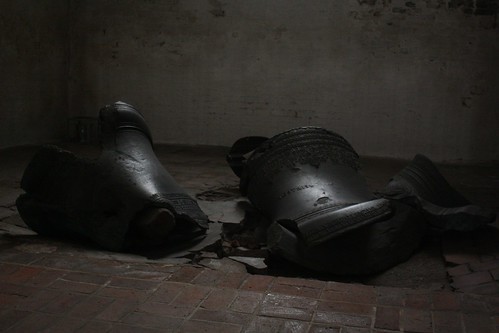
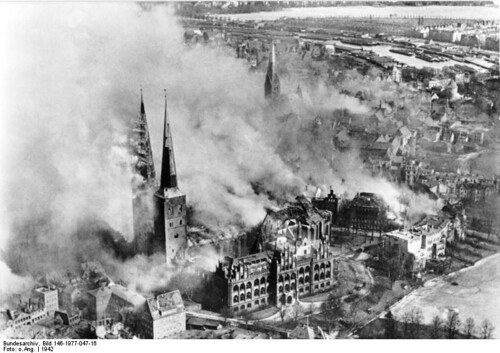
IMG_2641 Seeing these church bells in L beck wasn t easy for me. They melted and fell to the ground after an air raid in 1942, and have been left exactly as they fell. I wasn t alive in 1942, and even my parents hadn t yet been born. My grandfather was relocated by the American government because he refused to fight in the military for religious reasons. And yet, I still felt a sense of embarrassment, being an American standing there in Germany next to those bells. My country* did things like this. Why? Even if there s a war on, and whatever the other side may be doing, do we really have to bomb all their churches? Then, we went to the Dom (cathedral). It has a small gallery of photos of the destruction in 1942, and how it took 40 years to restore (though some original works are simply irreplaceable.) Burning L beck Cathedral after an air raid in 1942 I had just been walking through the beautiful Dom, and then saw pictures like that. It was very sad. I imagined the people in 1942, seeing the smoking remains of so many buildings that had been important to the town for centuries. Places where, no doubt, some of them worshiped, and their parents and grandparents had too. I imagined my sadness if a country bombed one of the churches that my ancestors helped start or build. I felt ashamed of what the democracy in which I live (and its allies) did to the Dom, to Marienkirche, and to the other churches and civilians there. Then, a few days ago, Wikileaks posted a video from an American helicopter in which our soldiers begged Come on, let us shoot! at people, most or all of which were completely unarmed. They killed a bunch of people. Then a van came to try to get the wounded to the hospital. Then the soldiers in helicopter killed those people, and wounded some children. Even if they thought their lives were in danger, I d expect to hear some quiet sadness at what they thought was a regrettable need to use force. Instead, you d hear them cheering whenever they killed someone, as if they had just won a round on some video game. They killed civilians, and considered it a fun experience and a mission accomplished. There was no sadness for knocking a man to the ground, leaving him writhing. Just jokes. There was no more care for human life here than there was 60 years ago. It saddens me that every year we celebrate our military on independence day celebrating its ability to kill, not its ability to feed. I wish that we could rather celebrate the times Americans have saved lives, whether in Berlin or in Port-au-Prince, or helped to topple dictatorships. Military power shouldn t be our first choice so often. L beck wasn t attacked for any strategic purpose; the British did it to destroy the morale of the enemy civil population , as the Americans did in Dresden or the Germans in London. In other words, those bells fell to the ground for no reason other than that they were German. People lost their lives for the same reason in Germany and in London. The British had no reason to believe that those civilians meant them any harm, that they were anything but caught between two strong powers. And the same held true in Iraq. When we went to Berlin, we walked through the replica of Checkpoint Charlie, with the big sign announcing that you are leaving the American sector. There is little positive to be said about the Cold War, but there is something the British and American military did of which I am not the least ashamed: the Berlin Airlift. Although I didn t see it, I feel a sense of the USA having been a force for good when I read about the Berlin Airlift Monument at Tempelhof, which has the names of the 70 British and American men that lost their lives in the airlift (due to accidents), above the inscription They gave their lives for the freedom of Berlin. That s the spirit I wish we d see more often in the world today: people giving their lives not just for their own security, but for strangers in need on a different continent. We Americans have been, compared to many countries in Europe, relatively sheltered from the ravages of war in our own midst. I wish that more of us would have the opportunity to gaze at fallen church bells, to wonder through a magnificent old church and then to see photos of it on fire, or to see a monument to our soldiers in a far away land. Perhaps then we could better learn from history, and see firsthand that some of our most positive contributions to the world have come in the form of coal and candy bars instead of incendiary devices. A small post script Many historic buildings or locations we saw in Germany had plaques on their exterior with a brief history, often in German and in English. I was interested to note that some (though not all) of these plaques had language such as destroyed by fire in 1942 , with no mention that the cause of the fire was a bombing. I was even more interested to note that same sort of description at several sites in Prague Castle, mentioning that the original building was lost in the fire of 1142. It was only on the third or fourth building in the Castle that we learned that the fire of 1142 was caused by a military siege of Prague Castle. * I know it was the British at L beck, but the Americans did similar things elsewhere. I also acknowledge that, at a macro level at least, the Berlin Airlift wasn t purely an altruistic act, as there were geopolitical factors in play. But I am speaking of the actions of the airmen here, who took on considerable risk to help others.

7 April 2010

Jon Dowland: tesco

Tesco Car Insurance (and most likely their other financial products) operate a commercial email system which is populated by anyone who submits their address to them as part of searching for a car insurance quote. That's not particularly unusual. Each mail that Tesco sends includes unsubscribe instructions - standard industry practise. However Tesco's instructions do not work. I have followed them at least three times since January this year to no avail. Despite this I have continued to receive unsolicitied commercial email (spam) from Tesco. Tesco do not answer mail to their postmaster or abuse addresses, and do not accept mail for those local parts at many of their domains (they use more than one domain for their business: tescofinance.com, tesco.com, tescocompare.com, contact.tescocompare.com, tescoinsurance.com). I would advise that nobody ever submit their details to a Tesco-affiliated company for these reasons. I have given up and blacklisted them on the mail servers which I control. Based on the unrelated experiences of a friend of mine, I would have strong reservations regarding the quality of the services they offer, too - in particular their home insurance products.

Biella Coleman: Nameless, Freak, Phreak

So I tend to focus on the cultural present but during grad school it was hammered into my brain that to understand the contemporary moment, history matters, a lot.. The problem with hacking and related activities is that the history is a bit sparse and fragmented. Recently I have been working on a piece that examines some of the aesthetics similarities between phrakers, underground hackers, and trollers and it sort of hit me that I had no idea when the term phreak or freak came into being. So I dropped a note to Phil Lapsely who is writing (finally) a proper history of phreaking and he was thoughtful enough to pen down a genealogy of the term.

6 April 2010

David Welton: Upcoming Conferences: "Better Software" and "Whymca"

One of the things I missed when we lived in Innsbruck was interacting with other "computer people". Back here in Italy, I have more friends and connections, and of course speak the language fluently. I sent in a few proposals for talks at several conferences this year, and they were both accepted. I'll be speaking at the Better Software conference in Florence in early May, about the economics of software and open source businesses. Later on in May, I'll be at Whymca, a conference dedicated to mobile development, to give a presentation about Hecl. That one's in Milan, which isn't as nice as Florence, but it should be a very interesting conference! I'm looking forward to both of them a lot, as there are a series of interesting talks that I'm looking forward to seeing, and a number of sharp programmers who I haven't seen in a while who I am looking forward to catching up with. I think I have some discount codes or something along those lines to hand out, for Better Software, so if you're interested, write me an email.

Ingo Juergensmann: New UPS battery miracles

Well, in the last weeks my UPS battery died somewhat. At least the UPS wanted it to be exchanged against a new one. So I ordered a replacement unit and got the battery replaced. The funny thing is now: apcupsd recognize it as fully loaded, but with no remaining Run Time:


As you can see, it's somewhat strange. During loading the battery, apcupsd showed remaining run times of <2 mins, usually <1 min, sometimes 1.2 min or such. But after a reload of the browser, it was quite often <1 min again. Apcaccess is reporting this (excerpt):

CODE:
DATE : Tue Apr 06 07:21:36 CEST 2010
HOSTNAME : hahn
RELEASE : 3.14.4
VERSION : 3.14.4 (18 May 2008) debian
UPSNAME : BR800I
CABLE : USB Cable
MODEL : Back-UPS BR 800
UPSMODE : Stand Alone
STARTTIME: Mon Apr 05 22:53:00 CEST 2010
STATUS : ONLINE LOWBATT
LINEV : 232.0 Volts
LOADPCT : 41.0 Percent Load Capacity
BCHARGE : 100.0 Percent
TIMELEFT : 0.0 Minutes
MBATTCHG : 20 Percent
MINTIMEL : 5 Minutes
MAXTIME : 0 Seconds
OUTPUTV : 230.0 Volts
LASTXFER : Automatic or explicit self test
SELFTEST : NO
STATFLAG : 0x07000048 Status Flag
BATTDATE : 2001-09-25
FIRMWARE : 9.o4 .I USB FW:o4
APCMODEL : Back-UPS BR 800


Running a selftest with apctest shows no problem, apparently:

CODE:
Clearing previous self test result...CLEARED
Initiating self test...INITIATED
Waiting for test to complete...COMPLETED
Result of last self test: PASSED


I wonder now how to proceed? Send the battery back? Try a newer version of apcupsd? Contact APC about the issue? Hmmm...

UPDATE:
After connecting the UPS to a laptop with Windows und PowerChute software, apcupsd reports >20 mins remaining time as well. Thanks for all hints & tips!

Daniel Burrows: aptitude-related projects for Summer of Code 2010

I wasn't planning to be a mentor this year, but it looks like I might have enough time to do a decent job at mentoring after all. So here are a few ideas I have kicking around that would probably be suitable for an SoC coder. I have lots more ideas, but these are the first ones that came to mind. These ideas are deliberately broad: as a student, you are responsible for collaborating with me to figure out the details of your project and put together a workable implementation plan. At the same time, this list is not all-encompassing; feel free to come up with your own idea and explain why I should act as a mentor for it.
  1. Improve the GTK+ interface. The GTK+ interface is only partly complete and I'd like it to be completely complete. A few open ends of interest are noted at aptitude-gtk-status-a-visual-tour, or you can just run the program yourself and see what's missing or ugly.
  2. Work on per-package Wiki pages (the idea is sketched out in my email on the subject). Most likely this can use the existing wiki.debian.org infrastructure.
  3. Create a service for tracking user reviews of Debian packages and implement support in one or more apt clients.
Note that the last two aren't aptitude-specific; they basically amount to working out a spec for clients to access the data in question, and then implementing the spec in one or more clients (possibly including aptitude, apt, synaptic, packages.debian.org, etc).

Next.

Previous.