Search Results: "sto"

12 October 2013

Thomas Goirand: Jenkins remote build trigger (eg: from git push) tokens

After upgrading my Sid virtual machine hosting my Jenkins, build after git push stopped working. This is because version 1.503 and above require an auth token for triggering the build. Since it took me some time to search the web, I ve decided to blog about it to save time to other Jenkins users. Under each project configuration screen, in the Build Triggers section, tick the Trigger builds remotely (e.g., from scripts) option. Then enter a random token (I used a password generator for it). Then in your post-receive hook, use what s below:
wget -q --no-check-certificate https://<jenkins-url>/job/heat/build?token=<your-token> -O -

Lars Wirzenius: Moving repositories to git.liw.fi

I'm moving all my git repositories from Gitorious and git.gitano.org.uk to my new Gitano instance at git.liw.fi. Gitano is a git server written by Daniel Silverstone, and it's wonderful. I will be converting my non-git repositories to git, on git.liw.fi, later on.

11 October 2013

Russ Allbery: kadmin-remctl 3.5

No, I still haven't written the generic Perl bindings for Kerberos that I really want to write (although I have made a bit more forward progress in writing the beginnings of some of the add-ons to Config::AutoConf that I would need in order to do so). This is just another bug-fix release for our remctl backend for doing kadmin actions. Most of the fixes this time are around password changes. kadmin-remctl does password changes by running kpasswd under Expect, but its timeouts weren't long enough for our production environment under some conditions (particularly when propagating passwords into Active Directory). This release both fixes that and clears up some Perl warnings if we still hit timeouts. It also recognizes the new form of Heimdal kpasswd prompts in the upcoming 1.6 release and stops mapping password quality errors to more generic error messages. (I'm fixing that problem in krb5-strength instead.) Also in this release, the Heimdal backend has been improved to use get rather than list to check whether a principal exists (not sure why it was ever using list), and to check the existence of a principal before enabling or disabling so that it can produce better error messages. You can get the latest release from the kadmin-remctl distribution page.

10 October 2013

Russ Allbery: Review: 2312

Review: 2312, by Kim Stanley Robinson
Publisher: Orbit
Copyright: 2012
ISBN: 0-316-19280-5
Format: Kindle
Pages: 563
Swan Er Hong is a native of Mercury, granddaughter of one of the most influential women in the solar system. Alex, known as the Lion of Mercury, has just died as the story opens, and Swan is mourning. But she's also discovering that something else has been going on, something that Alex had not confided in her. Something that involves an inspector from the asteroids, a scientist from Titan, and a message Alex left in the event of her death, asking Swan to convey something personally to another scientist on Io. And then Mercury is attacked and the situation becomes much more complicated. 2312 is, like most Robinson novels, built on top of monumental world-building. The date is given away by the title; the setting is a solar system full of terraforming, habitats, and explosive human colonization. There are human settlements on every world that could possibly sustain them, including a terraformed Mars and a vast in-progress terraforming project on Venus. Mercury, Song's home, supports the city known as Terminator, a shielded habitat that travels around the planet on rails, pushed forward by the thermal expansion of metal at sunrise. Humans have scattered across the solar system and changed everything they've touched, even the asteroids. Many of those have been repurposed as long-haul shuttles: self-contained habitats on carefully-designed routes on which people live for months or years until they get to their destinations. Parts of this book are gorgeous. One of Robinson's strengths is creating images of the vastness of space, science, and human endeavor that feel plausible and inspiring at the same time. The setting of 2312 frees him to go wild with mega construction projects, and he takes full advantage. Parts of the book inspire the same sense of awe as the Hoover Dam or the Great Wall of China, transplanted into space and backed with neat scientific ideas to ponder. (Even if the more skeptical will note certain human habitation hazards, such as prolonged weightlessness and radiation, are mostly hand-waved away.) Unusually for a Robinson novel, 2312 also features an interesting and vibrant protagonist. Usually I can barely remember Robinson's protagonists five minutes after I finish the book, but Swan is so impulsive, erratic, and emotionally intense that I doubt I'll forget her. Her past is stuffed with outrageous risks and intense creativity: having songbird neurons transplanted into her brain, ingesting extraterrestrial bacteria, designing habitats in the asteroid belt, and creating art on the plains of Mercury. As the story gets underway, she meets the oversized and mellow Wahram; at first, she finds him boring, but then they're thrown together by one of the best set pieces of the book, and both they and the reader discover they work well together. Wahram serves as a straight man and as a stand-in for the reader's opinion, showing Swan all the more clearly in contrast. All this sounds quite promising. Unfortunately, what makes 2312 an ambitious failure rather than an excellent story is the story part. Robinson has built an amazing world, but he doesn't seem to know what to do with it. His economy, at least outside of Earth (and more on that in a moment), is essentially post-scarcity. Few of the characters we meet seem to have any concept of fiscal or practical limitation. They head across the solar system on a moment's notice, take vacations in habitats, or head to favorite spots for the view. It felt like Robinson was trying to write a Culture story. Unlike Banks, however, he struggles with generating a plot. 2312 is, in structure, a murder mystery. The characters witness a crime, survive it, and then intend to investigate it, and the crime appears to grow and link to fault lines in their society. This could have worked, but it has two problems: their society is only barely coherent enough for the reader to perceive the potential fault lines, and Robinson seems to have no idea how to construct a mystery plot. There is no sense of coherence to Swan and Wahram's approach, no sense of a gathering of clues, and very little sense of drama. All of the plot revelations are either dropped in Swan's lap by another character at a convenient moment or generated by Swan refusing to take the plot of the book seriously. The characters do essentially no meaningful investigation on-camera and show almost no investment in the outcome of the plot. When the climax comes, it's all weirdly forgettable. There are also large sections of the book that appear to have nothing to do with the rest of the plot, and that's where the unfortunate interval on Earth comes in. Robinson takes advantage of the scenes on Earth to do a bit of alienation and shows how foreign and strange and stifling Earth feels to someone who grew up outside of its atmosphere. Parts of this work, but he puts the plot on hold to do it. And parts of it do not work at all. The most glaring example is Swan and Wahram's bizarre bit of attempted charity in Africa, which comes across as stunningly high-handed and arrogant. This could be in character, particularly for Swan (who is not long on empathy), but, if so, the book doesn't signal to the reader that it should be read that way. Instead, there are some side (or snide) comments that seem to indicate Robinson knows nothing about the economic arc of Africa from the past twenty years. And when their absurd, botched, condescending charity plan fails for all the obvious reasons, the characters, and apparently the novel, throw up their hands and write Earth off as a stagnant lost cause that can't accept the imposition of a good idea and go back to the plot, never apparently caring about Earth again. Almost as frustrating is the way that these interludes are tied back into the story, which is usually through Swan getting ridiculously lucky on her random encounter rolls. It felt like whenever Robinson needed to make progress in the plot, Swan would just accidentally run into exactly the right person or situation to bring up the next plot point or to have some investigation make sense. (Not that Swan usually figured this out. Normally, the inspector explains it to her.) The author's finger was planted so firmly on the scales that it destroyed my suspension of disbelief and made a mockery of the idea that the characters were actually investigating anything. 2312 is built around a skeleton of a plot, but the lack of engagement with it, the lack of tension and emotion, the way the next developments are generally narrated to the protagonists and the reader, and the repeated use of random encounters to steer it left me without much reason to care. Robinson tries a few twists, but since the story never felt committed to its plot anyway, those twists feel less like planned complications and more like another random veer in the road. It didn't help that the final outcome was more prosaic and forgettable than the book had been implying it would be. There is a lot to like here. I'm very pleased to see Robinson finally write a memorable protagonist, and he's very good at both world-building and set pieces. But it needed a plot, and it needed a more coherent and complete cultural backdrop for its characters. Without both, it fell back into the typical Robinson trap: gorgeous moments separated by a whole lot of boring, and an overall impression of a construction tour rather than a story. There are bits of it I loved and still remember, particularly Song and Wahram in the tunnels of Mercury (which is possibly the best extended characterization Robinson has ever written). But the book as a whole is a mess, and I can't recommend wading through it for the good parts. Rating: 5 out of 10

Matthew Palmer: How *not* to respond to interview feedback

Seen at $DAYJOB, from a candidate we rejected due to a pretty poor showing in a phone interview:
May I suggest that your company puts in place a more effective way of interviewing potential candidates. Please pass this to comment to your senior management so they may look at improving this process.
I m not sure I ve ever seen such a clear confirmation that our interviewing process is working as intended. While we hire for smart people who don t meekly accept the status quo, we d prefer it if our staff don t mouth off when things don t go their way. Customers tend to frown on such outbursts.

9 October 2013

John Goerzen: Two Kittens

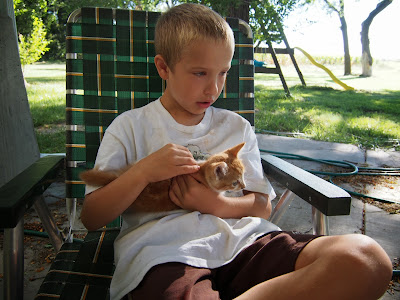
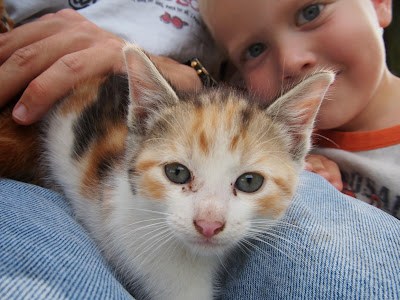
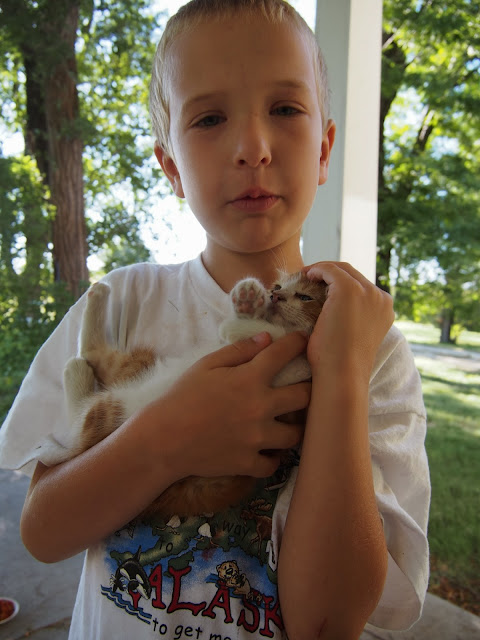
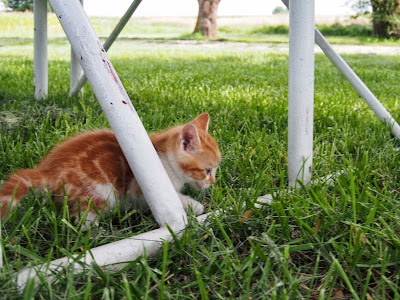
Almost every time he got off the bus for the past month and a half, Jacob started his afternoon in the same way. Before toys, before his trains and his toy bus, before anything indoors, he went for our cats. Here he is, cradling his favorite, Tigger: Laura and I both grew up around cats. We had been talking about kittens, and shortly after we got engaged, one of my relatives offered us some free kittens. We went to his place one evening and selected two of them one calico and one tiger-colored. Since what is now my place will soon be our place, they came to live with me. Our cats were one of the first things we did to prepare for our lives together. Oliver wanted to name them some rather impractical sentence-long names ( The Cat Who Always Likes To Run ), so Laura and I suggested some names from one of their favorite books: Tigger and Roo. They both liked the names, but Oliver thought they should be called Tigger the Digger and Roo the Runner . Never mind that they were just 6 weeks old at the time, and not really old enough to either dig or run. Here s Oliver with Roo, the day after the kittens arrived here. I have always had outside cats, both because I m allergic to cats so I need them to be outside, and because they sometimes literally quiver with joy of being outdoors. Tigger and Roo often chased insects, wrestled with each other, ran up (and slowly came back down) trees, and just loved the outside. Sometimes, I have taken my laptop and wireless headset and work from the back porch. The kittens climb up my jeans, inspect the laptop, and once Roo even fell asleep on my lap at one of those times. Jacob has been particularly attached to Tigger, calling him my very best friend. When Jacob picks him up after school, Tigger often purrs while cradled in Jacob s arms, and Jacob comments that Tigger loves me. Oh dad, he knows I am his friend! The kittens have been growing, and becoming more and more comfortable with their home in the country. Whenever I go outside, it isn t long before there are two energetic kittens near my feet, running back and forth, sometimes being very difficult to avoid stepping on. I call and I see little heads looking at me, from up in a tree, or peeking out from the grain elevator door, or from under the grill. They stare for just a second, and then start running, sometimes comically crashing into something in their haste. Yesterday when I went to give them food, I called and no cats came. I was concerned, and walked around the yard, but at some point either they come or they don t. Yesterday afternoon, just after the bus dropped off Jacob, I discovered Tigger on the ground, motionless. Once Jacob was in the house, I went to investigate, and found Tigger was dead. As I was moving his body, I saw Roo was dead, too. Both apparently from some sort of sudden physical injury a bit mysterious, because neither of them were at a place where they had ever gone before. While all this was happening, I had to also think about how I was going to tell the boys about this. I tried to minimize what he could see, Jacob had caught an unavoidable glimpse of Tigger as we were walking back from the bus, but didn t know exactly what had happened. He waited in the house, and when I came back, asked me if Tigger was dead. I said he was. Jacob started crying, saying, Oh Dad, I am so sad , and reached up for a hug. I picked him up and held him, then sat down on the couch and let him curl up on my lap. I could quite honestly let him know he wasn t alone, telling him I am sad, too. Oliver arrived not long after, and he too was sad, though not as much as Jacob. Both boys pretty soon wanted to see them. I decided this was important for them for closure, and to understand, so while they waited in the house, I went back out to arrange the kittens to hide their faces, the part that looks most unnatural after they die. The boys and I walked out to where I put them, then I carried both of them the last few feet. We stood a little ways back close enough to see who was there, far enough to not get too much detail and they were both sniffling. I tried to put voice to the occasion, saying, Goodbye, Tigger and Roo. We love you. Oliver asked if they could hear us. I said No, but I told them what I felt like anyway. Jacob, through tears, said, Dad, maybe they are in heaven now. We went back inside. Jacob said, Oh dad, I am so sad. This is the saddest day of my life. My heart is breaking. Hearing a 7-year-old say that isn t exactly easy for a dad. Pretty soon he was thinking of sort of comfort activities to do, saying I think I would feel better if we did So they decided to watch a favorite TV program. Jacob asked if Laura knew yet, and when I said no, he got his take-charge voice and said, Dad, you will start the TV show for us. While we are watching, you will send Laura an email to tell her about Tigger and Roo. OK? What could I say, it wasn t a bad idea. Pretty soon both boys were talking and laughing. It was Big Truck Night last night, at a town about half an hour away. It s an annual event we were already planning to attend, where all sorts of Big Trucks firetrucks, school bus, combine, bucket truck, cement truck, etc show up and are open for kids to climb in and explore. It s always a highlight for them. They played and sang happily as we drove, excitedly opened and closed the big door on the school bus and yelled All Aboard! from the top of the combine. We ate dinner, and drove back home. When we got home, Jacob mentioned the cats again, in a sort of matter-of-fact way, and also wanted to make sure he knew Laura had got the message. A person never wakes up expecting to have to dump a bowl of un-eaten cat food, or to give an impromptu cat funeral for little boys. As it was happening, I wished they hadn t been around right then. But in retrospect, I am glad they were. They had been part of life for those kittens, and it is only right that they could be included in being part of death. They got visual closure this way, and will never wonder if the cats are coming back someday. They had a chance to say goodbye. Here is how I remember the kittens.

8 October 2013

Daniel Kahn Gillmor: Unaccountable surveillance is wrong

As I mentioned earlier, the information in the documents released by Edward Snowden show a clear pattern of corporate and government abuse of the information networks that are now deeply intertwined with the lives of many people all over the world. Surveillance is a power dynamic where the party doing the spying has power over the party being surveilled. The surveillance state that results when one party has "Global Cryptologic Dominance" is a seriously bad outcome. The old saw goes "power corrupts, and absolute power corrupts absolutely". In this case, the stated goal of my government appears to be absolute power in this domain, with no constraint on the inevitable corruption. If you are a supporter of any sort of a just social contract (e.g. International Principles on the Application of Human Rights to Communications Surveillance), the situation should be deeply disturbing. One of the major sub-threads in this discussion is how the NSA and their allies have actively tampered with and weakened the cryptographic infrastructure that everyone relies on for authenticated and confidential communications on the 'net. This kind of malicious work puts everyone's communication at risk, not only those people who the NSA counts among their "targets" (and the NSA's "target" selection methods are themselves fraught with serious problems). The US government is supposed to take pride in the checks and balances that keep absolute power out of any one particular branch. One of the latest attempts to simulate "checks and balances" was the President's creation of a "Review Group" to oversee the current malefactors. The review group then asked for public comment. A group of technologists (including myself) submitted a comment demanding that the review group provide concrete technical details to independent technologists. Without knowing the specifics of how the various surveillance mechanisms operate, the public in general can't make informed assessments about what they should consider to be personally safe. And lack of detailed technical knowledge also makes it much harder to mount an effective political or legal opposition to the global surveillance state (e.g. consider the terrible Clapper v. Amnesty International decision, where plaintiffs were denied standing to sue the Director of National Intelligence because they could not demonstrate that they were being surveilled). It's also worth noting that the advocates for global surveillance do not themselves want to be surveilled, and that (for example) the NSA has tried to obscure as much of their operations as possible, by over-classifying documents, and making spurious claims of "national security". This is where the surveillance power dynamic is most baldly in play, and many parts of the US government intelligence and military apparatus has a long history of acting in bad faith to obscure its activities. The people who have been operating these surveillance systems should be ashamed of their work, and those who have been overseeing the operation of these systems should be ashamed of themselves. We need to better understand the scope of the damage done to our global infrastructure so we can repair it if we have any hope of avoiding a complete surveillance state in the future. Getting the technical details of these compromises in the hands of the public is one step on the path toward a healthier society. PostscriptLest I be accused of optimism, let me make clear that fixing the technical harms is necessary, but not sufficient; even if our technical infrastructure had not been deliberately damaged, or if we manage to repair it and stop people from damaging it again, far too many people still regularly accept ubiquitous private (corporate) surveillance. Private surveillance organizations (like Facebook and Google) are too often in a position where their business interests are at odds with their users' interests, and powerful adversaries can use a surveillance organization as a lever against weaker parties. But helping people to improve their own data sovereignty and to avoid subjecting their friends and allies to private surveillance is a discussion for a separate post, i think.Tags: cryptography, nsa

Gergely Nagy: Onto the margin of a summer of code

Just as last year, BalaBit applied to become a mentoring organisation for this year's Google Summer of Code, but like the year before, were not accepted. Instead, the openSUSE project was kind enough to give us two slots of their own, similarly to the year before - we are very thankful for this, and this year, both of the projects we took were closed successfully! So much so, that one of them was already merged into syslog-ng 3.5.0beta2, and the other one is being prepared for getting merged into the Incubator. I also helped out a little with Clojure & Leiningen packaging, although my contributions there were minimal at best.On the whole, I really liked this year's programme, our students accomplished a lot, and the whole summer was a great experience in itself, I learned a lot about mentoring, and about working with other people, people who are very new to the codebase they're working on. I would like to summarise what I learned and observed this year, in the hopes that others may find them useful too.This year, we set fairly ambitious goals for our students: they had to write a Redis and a MySQL destination, both of which presented interesting challenges to the students. None of them had prior experience with the syslog-ng source code, and their programming knowledge was mostly in C#, not plain old C which syslog-ng is written in. They also had to dabble a bit in the bowels of our overly complex configure.ac and a few Makefiles. Wasn't an easy task.In the beginning, we tasked the students to write proof of concept code, to get familiar with the libraries they will need to use - no syslog-ng involved at this point. This sounded like a good idea on paper, but without clear goals and milestones, a lot of time was spent on this task, and the students ran into a few dead-ends which could have been avoided, if we, the mentors, were more careful. This resulted in a reasonably poor first term, frustration and caused many a sleepless nights. We had to change our approach if we wanted to see the projects succeed.So we sat down with the students, and took one big leap: in person, we explained some of the internals of syslog-ng, did code reviews with them, and so on. But the best thing we did was what my colleague (and the main mentor), Viktor Tusa, came up with: we wrote a test script, that started syslog-ng, configured it, and ran tests against it. Students had to make their code pass the test by the next in-person meeting. This helped tremendously, and increased the speed they worked at by an order of magnitude at least. We kept developing the test script further, and so did the projects improve.ConclusionsThere are a couple of conclusions I arrived at as the programme concluded, things we (or other mentors, as I plan to participate as a student next year) will need to improve upon in the coming years.

Raphael Geissert: Faster, more stable and new opportunities

A new version of the code behind http.debian.net was deployed a few days ago. It has proved to be far more stable, faster, and scalable compared to the previous mod_perl-based deployment.

There were a couple of glitches during the earlier roll-out for IPv6 users, fixed thanks to the reports by Cyril Brulebois, Michael Stapelberg and Robert Drake.

What's behind?
The redirector is now a plack application (with no middlewere) running under the Starman server with an apache fronted. Requests are processed faster than before and there mod_perl-induced system overload is finally gone.

The redirector is now easier to test and develop. Deploying the live instance is not yet fully streamlined, but it has seen a lot of improvement. Some important changes to the way the redirector works are already on their way to see the light and I am going to be announcing them when they do. Fork the repository and hack a few changes, contributions are welcome :)

It's probably time to move it under debian.org, and finish making it the default everywhere. It's even made its way into the installation manual.

Russ Allbery: Review: Grimspace

Review: Grimspace, by Ann Aguirre
Series: Sirantha Jax #1
Publisher: Ace
Copyright: March 2008
ISBN: 0-441-01599-9
Format: Mass market
Pages: 312
Sirantha Jax is a jumper: a person with the rare genetic ability to jump spaceships through the shortcut dimension of grimspace. It's a science fiction idea with a long pedigree. It creates a separate in-group for the characters to belong to, a society with its own rules, and sets up tension with the rest of the institutions of the world. In Aguirre's version, jumpers can provide the transition but direction in grimspace has to be done by a pilot, and the jumper and the pilot develop a deep psychic bond. Jax had been jumping with her husband piloting, but on their last trip their ship crashed, killing everyone on board except her. As Grimspace opens, Jax is in a treatment facility that's much more like a prison. In theory, they're trying to figure out whether she's still able to (and safe to allow to) jump. In practice, something quite a bit more sinister is going on, a fact that the reader senses early but only learns more about after Jax is helped to escape. Scarred, deeply depressed, and nearly suicidal, she's pulled into the subversive plans of a small ship of renegades who are trying to break open the Corp monopoly on grimspace travel and their tight hold over every jumper. But she's not sure whether she trusts them, or whether she cares enough about their crusade to truly join in. Grimspace follows well-trod SF paths of special cadres of pilots and navigators, lawless corners of space with local warlords, and rebellion against smothering centralization, but its first-person protagonist and point of view have more in common with urban fantasy. It's written in first-person and, at times, nearly stream of consciousness from Jax's perspective, and Jax displays plenty of profanity, acidic commentary, and emotional angst. If her special ability were shapeshifting or magic instead of jumping spaceships, one could easily see her as the typical burned-out urban fantasy detective. I liked that. It's a fun point of view when it's written well, and it felt fresh when applied to a science fiction background instead of the more typical fantasy. That said, Grimspace has a rather rough start. Jax isn't sure what's going on at first and also isn't sure she cares, and I thought that carried over to the reader's experience. The first section of the book is rough and jagged, with staccato bursts of character introduction, world-building that doesn't quite cohere, and an extended stop on a very odd outback planet that felt to me like a repurposed stage from a western. Part of the early problem is that Jax and the reader are being intentionally kept in the dark about the real goal of this group, but part of the problem is also that none of the characters start off as very likable. That includes Jax, who is a complete mess and who is both scared and despairing to the point of being almost nihilistic. The world-building unfortunately does not carry the reader through that part of the story, and at about eighty pages in I wasn't sure I was going to like this book. It does, however, get much better. For one, Jax calms down and starts making emotional connections with the rest of the crew, and that lets her demonstrate skills as a fearless problem solver. For another, while the goal of the group of people she's fallen in with isn't exactly deep, it does make sense and it does slowly become a cause the reader (and Jax) can believe in. The frenetic pace of introduction and discovery also slows down, the cast stabilizes, and the surroundings get a bit less weird (and a bit more conventional for a science fiction novel). I didn't care for the alien baby subplot I rarely do but the rest of the story slowly pulled me in. One thing Aguirre did extremely well was surprise me. There are several points later in the book where Jax gets put in a fairly typical high-stress position and does something very atypical in reaction to it, twisting the story into a shape quite a bit unlike what I had been expecting. That made Jax feel like a true free agent, establishing her independence and her desire to control her own life, and that appealed to me. Aguirre also palms one card exceptionally well, setting up an ending that I thought was the best set of scenes in the whole book, and that had me thoroughly engrossed. One can see the bones of the urban fantasy heroine inside Jax's character, but they're fresh and interesting in an SF world, and they work better than I would have expected. There is a romance, in fitting with the urban fantasy inspiration, and it didn't quite work for me, but Aguirre also builds in a reason why it might not make sense and makes it spiky and fragile without being too cliched. By the end of the book, I was, if not entirely persuaded, at least willing to go along for the ride. And that's the best summary of Grimspace, I think. Parts of it don't make a great deal of sense, and parts of it are quite choppy. But I liked Jax once she starts getting a handle on her trauma, the other characters grew on me, and the plot surprised me in some interesting ways. It's not the smoothest or most polished SF novel I've read, but it has a lot of energy and an unusual genre mix. I think I'll stick along for the ride. Followed by Wanderlust. Rating: 7 out of 10

7 October 2013

Michal &#268;iha&#345;: Weblate 1.7

Weblate 1.7 has been released today. It comes with lot of improvements, especially in translation speed and many new features. Full list of changes for 1.7: You can find more information about Weblate on it's website, the code is hosted on Github. If you are curious how it looks, you can try it out on demo server. You can login there with demo account using demo password or register your own user. Ready to run appliances will be soon available in SUSE Studio Gallery. Weblate is also being used https://l10n.cihar.com/ as official translating service for phpMyAdmin, Gammu, Weblate itself and others. If you are free software project which would like to use Weblate, I'm happy to help you with set up or even host Weblate for you. Further development of Weblate would not be possible without people providing donations, thanks to everybody who have helped so far!

Filed under: English SUSE Weblate 1 comments Flattr this!

6 October 2013

Craig Small: Changed Twitter Handle

For my birthday I thought I d fix my twitter handle. The old one was a bit fiddly and hard to remember. So the new one is @smallsees Pretty easy to remember; my surname and my ircname. Sorted, done. Now all I need to do is stop these birthday things.

Gregor Herrmann: RC bugs 2013/37-40

not much activity around RC bugs on my side in the last weeks; & the ones I worked on were all in the Debian Perl Group: on an unrelated note: following the discussion on debian-project, I finally revoked my old opengpg key 0x00F3CFE4 which served me well from 1998 until 2009. since then, I've only been using 0x8649AA06 anyway ...

Russ Allbery: Review: Captain Vorpatril's Alliance

Review: Captain Vorpatril's Alliance, by Lois McMaster Bujold
Series: Vorkosigan #14
Publisher: Baen
Copyright: November 2012
ISBN: 1-4516-3845-0
Format: Kindle
Pages: 432
This is the fourteenth book in the long-running Vorkosigan series (not counting a few side works). It shifts viewpoint characters, following Ivan Vorpatril instead of either Miles or Cordelia, and could be read on its own since the necessary background is at least briefly explained. But it's probably best read in its proper context in the larger series, since otherwise many of the prior events mentioned here won't have much resonance. Ivan Vorpatril, Miles's cousin, has appeared in multiple previous books along with the rest of Miles's extended family, but he's stayed out of the center of the plot. And he clearly likes it that way. Ivan is not at all ambitious, tries to avoid politics, and just wants to live a quiet life (insofar as that's possible in the Barrayan military), sleep with a few women, and stay out of trouble. But given his relations and his job as aide-de-camp to an admiral this doesn't always work. In this book, the not working comes in the form of Byerly, ImpSec (Imperial Security, the Barrayan equivalent of the CIA), and a request to find out more about a woman who seems to be the target of a bounty. Fairly quickly, Ivan finds himself hopelessly entangled in both politics and in someone else's complex life, and is not entirely sure what to do about either. It's been months since I read this book and I'm only now writing a review, in part because I find it hard to know what to say about it. While Ivan doesn't have Miles's manic energy, the tone of this book is very similar to the rest of the Vorkosigan series, as is the plot and most of the characters. Ivan tries a more laid-back approach and doesn't actively seek danger the way that Miles does, but his persistent efforts to do the right thing in the face of unexpected events lead mostly to the same places. There's a bit of humor, a bit of danger, some galactic politics, some scheming, and a slow process of understanding other people better in short, Captain Vorpatril's Alliance is very similar to the thirteen books that proceeded it. This is obviously not a bad thing. If you've read this far in the series, more of the same is probably just fine. I enjoyed the book. Bujold is great at telling stories, the plot mostly moved right along, and I quite liked the two women Ivan meets over the course of the story. But there wasn't much about the story that grabbed me or, I suspect, that I will find particularly memorable. One reason for my somewhat "meh" reaction is that the core of this story is a romance, and while much of that romance is well-done, there is a large segment in the middle of the book where the suspense of the plot derives mostly from one of the two characters refusing to confide in the other. This is Bujold, so this isn't as much of a train wreck as it might be in the hands of another author, and it is for valid plot reasons. But even with those justifications, I never like that plot element. There were about a hundred pages where I wanted to grab Tej and shake some sense into her, which doesn't endear a character to me. And the leads in a romance, at least this sort of romance, should be endearing. I think one reason why Bujold went for that approach to building tension is that there weren't a lot of options available. The basic outlines of what's going to happen are obvious from early in the book and essentially forced by the structure of the series. We know from past books that Ivan is both trustworthy and related to a staggering variety of powerful people, almost all of whom are highly competent and honorable. It's fairly obvious that, as soon as the necessary people trust Ivan and let him and his family solve their problems, all the problems will be solved. It's also fairly obvious how the romances will play out, and that all the new characters will end up a little in awe of how competent and trustworthy all the Barrayans are (a few misdirections aside). Therefore, much of the book, for a long-time reader of the series, involves waiting until those things happen, and meanwhile getting increasingly annoyed at characters who refuse to trust obviously trustworthy people. All that said, I still quite liked the beginning of the book, because Tej and Rish are a wonderful pair and have a great interpersonal dynamic, and the very end of the book once everyone gets past the communication problems and the plot can deliver on its promises. Both together make up for some noticeable sagging in the middle section of the book. Captain Vorpatril's Alliance is not up to the standards of the most memorable books of the series, but it's a solid dose of "more of the same" and provides its money's worth of entertainment. I'm still hoping for more Ekaterin and more fireworks in the next book, though. Rating: 7 out of 10

5 October 2013

Joachim Breitner: Why PVP is better than no PVP

This is a reply to Roman Cheplyaka s post Why PVP doesn't work , where he argues that Haskell packages should not per default put upper bounds on their build dependencies (as mandated by the Package Versioning Policy), at least not without good reason. I disagree, and I d like to explain why. I assume that you are packaging your libraries and programs not only for your fellow developers, but also for users. Hackage has turned not only into a hub for developers sharing their libraries, but also for users to conveniently download stuff from. And when I say users, I include xmonad users (although they write a bit of Haskell for their configuration) and beginners (who we certainly don t expect to understand and make sense of error messages that occur if some obscure crypto-related dependency of their favourite web framework fails to build). And for their benefit we should try hard to make sure cabal install either succeeds (great) or fails early with an error message that the user can understand as I could not find a package configuration of which the maintainers believe with good confidence that it works. Please talk to them. I speak with some experience, because as a maintainer of the >666 Haskell packages in Debian, I am, in a sense, a very heavy user. In the years after the PVP got commonly accepted, we could noticeably reduce the number of build failures that we encounter on our machines and the Debian build farms, simply because the meta data (which we transfer to the Debian package level) prevented such builds from being attempted. We now even have a build compatibility prediction system: We maintain a text file with all Haskell packages in Debian, together with a directory of patches (where we sometimes indeed override the packages Cabal file), and a script that runs cabal-install s dependency checker against this day. This way, when I want to upgrade a package, I can simply change the version in the file and know what packages will be broken. So I change their version until I either find a fixed-point (and only then actually upload packages to the user) or find a problem, which I then report to the maintainers or start cooking up my own patches. This works really well, but it only does because most maintainers are following the PVP. That s why I argue: Please continue to do so. (What we would probably need instead of less using the PVP is more tools in helping us with it. I could imagine a build bot that finds packages on Hackage with an upper bound on a package where a newer version exists, fetches those and automatically tries to build against the new version, and if it succeeds, sends a message to the maintainer: Your dependency on bar in foo also builds against version 0.42 of bar; please check for incompatibilities that are not expressed in the type system and upload a new version of foo allowing bar-0.42. Isn t that something the Stackage infrastructure can be used for?) (What we could probably use as well (and is probably a stepping stone towards what I just said) is a way to tell cabal-install to ignore a certain build dependency version bound. This way we still prevent normal users from trying a dependency version that the maintainer did not test, but nevertheless make it as easy as possible for the advanced user to try nevertheless, and then hopefully report about it to the maintainer. Of course, other had that idea before, someone just has to make it happen.)

Vincent Sanders: If I have a style, I am not aware of it.

I wish I had known about that quote from Michael Graves before now. I would have perhaps had an answer to some recent visitors to makespace.

There are regular scheduled visits to makespace where people can come and view our facilities, and perhaps start the process of becoming a member if they decide they like what they see.

Varnishing a folding chair using a stool as a stand
However, we sometimes get people who just turn up at the door. If a member feels charitable they may choose to give a short tour rather than just turn the person away. I happened to be in one Friday afternoon recently varnishing a folding chair when two such people rang the doorbell. There were few other members about and because watching varnish dry was dull I decided to be helpful and do a quick tour.

I explained that they really ought to return for a scheduled event for a proper tour, gave the obligatory minimal safety briefing, and showed them the workshops and tools. During the tour it was mentioned they were attending a certain local higher education establishment and were interested in makespace as an inexpensive studio.

Before they left I was asked what I was working on. I explained that I had been creating stools and chairs from plywood. At this point the conversation took a somewhat surreal turn, one of them asked, well more demanded, who my principle influence had been in designing with plywood.

When I said that I had mainly worked from a couple of Google image searches they were aghast and became quite belligerent. They both insisted I must have done proper research and my work was obviously influenced by Charles and Ray Eames and Arne Jacobsen and surely I intended to cite my influences in my design documents.

My admission that I had never even heard the names before and had no design documents seemed to lead to a distinctly condescending tone as they explained that all modern plywood design stemmed from a small number of early 20th century designers and any competent designers research would have revealed that.

At this point in proceedings I was becoming a bit put out that my good deed of showing off the workshop had not gone unpunished. I politely explained that I designed simply by generating a requirement in my head, maybe an internet search to see what others had done, measuring real things to get dimensions and then a great deal of trial and error.

I was then abruptly informed that my "design process was completely invalid and there were well established ways to design furniture correctly and therefore my entire design was invalid" and that I was wasting time and material. I thanked them for their opinion and showed them out, safe and well before anyone gets any ideas.

I put the whole incident out of my mind until I finished writing up the final folding chair post the other day. It struck me that perhaps I had been unknowingly influenced by these designers. It was certainly true I had generated ideas from the hundreds of images my searches had revealed.

I did some research and it turns out that from the 1930s to the 1950s there were a string of designers using plywood in novel ways from the butterfly stool by Sori Yanagi through formed curvy chairs by Alvar Aalto and eero saarinen.

While these designers produced some wonderfully iconic and contemporary furniture I think that after reviewing my initial notes that two more modern designers Christian Desile and Leo Salom probably influenced me more directly. Though I did not reference their designs beyond seeing the images along with hundreds of others, certainly nothing was directly copied.

And there in lies an often repeated observation: no one creates anything without being influenced by their environment. The entire creative process of several billion ape descendants (or Golgafrincham telephone sanitisers if you prefer) is based on the simple process of copying, combining and transforming what is around us.

Isaac Newton by Sir Godfrey Kneller [Public domain], via Wikimedia Commons
I must accept that certain individuals at points in history have introduced radical improvements in their field, people like Socrates Galileo Leonardo Newton Einstein. However, even these outstanding examples were enlightened enough to acknowledge those that came before. Newtons quotation "If I have seen further it is by standing on the shoulders of giants" pretty much sums it up.

In my case I am privileged enough to live in a time where my environment has grown to the size of the world thanks to the internet. My influences, and therefore what I create, is that much richer but at the same time it means that my influence on others is similarly diminished.

I have joined the maker community because I want to create. The act of creation teaches me new skills in a physical, practical way and additionally I get to exercise my mind using new techniques or sometimes things I had forgotten I already knew. I view this as an extension of my previous Open Source software work, adding a physical component to a previously purely mental pursuit.

But importantly I like that my creations might provide inspiration for someone else. To improve those chances in the wider world I force myself to follow a few basic rules:
Release
Possibly one of the hardest things for any project. I carefully avoided the word finish here because my experience leads me to the conclusion that I always want to improve my designs.

But it is important to get to a point in a project where you can say "that is good enough to share", this is more common in software but it really applies to any project.

Share
If your aim here is to improve your society with your contribution sharing your designs and information is important. I think there is nothing better than someone else taking one of your designs and using it and perhaps improving on it, remember that is what you probably did in one way or another better to make it less hard for that to happen.

Ensure your design files are appropriately licensed and they are readily accessible. I personally lean towards the more generally accessible open source licences like MIT but the decision is ultimately yours.

Licencing is important, especially in the current copyright happy society. I know it sounds dull and no one takes that seriously, right? Sorry, but yes they do and it is better for you to be clear from the start, especially if there is a software component to your project. Oh one personal plea, use an existing well known licence, the world simply does not need another one!

Write about it
The blog posts about the things I have made sometimes take almost as much time as the creation. The clear recording on my thoughts in written and photographic form often gives me more inspiration for improvements or other projects.

If someone else gets pleasure from the telling then that can only be good. If you do not do this then your voice cannot be heard and you wasted an opportunity to motivate others.

Feedback
If you do manage to get feedback on your creation, read it. You may disagree or not be interested for the current project but the feedback process is important. In software this often manifests as bug reports, in more physical projects this often becomes forum or blog comments.

Just remember that you need a thick skin for this, the most vocal members of any society are the minority with inflammatory opinion, the silent majority are by definition absent but there is still useful feedback out there.

Create again
By this I simply mean that once you are satisfied yourself on a project move on to the next. This may sound a little obvious but once you have some creative momentum it is much easier to keep going project to project than in you leave time between.

Also do not have too many projects ongoing, by all means have a couple so you do not get stuck waiting for materials or workshop time but more than three and four and you will never be able to release any of them.
Those students were perhaps somewhat misguided in how they stated their opinions, but they are correct that in the world in which we find ourselves we are all influenced. Though contrary to received wisdom those influences are more likely to be from the internet and our peers in the global maker society than historical artists.

Steve Kemp: I understand volunterering is hard

The tail end of this week was mostly spoiled by the discovery that libbeanstalkclient-ruby was not included in Wheezy. Apparently it was removed because the maintainer had no time, and there were no reverse dependencies - #650308. Debian maintainers really need to appreciate that no official dependencies doesn't mean a package is unused. Last year I needed to redesign our companies monitoring software, because we ran out of options that scaled well. I came up with the (obvious) solution: I chose beanstalkd for my central queue precisely because it was packaged for Debian, had a client library I could use, and seemed to be a good fit. It was a good fit, a year on and we're still running around 5000 tests every minute with 10 workers. The monitoring tool is called Custodian Custodian, and I think I've mentioned it before here and on the company blog. It looks like we'll need to re-package the Ruby beanstalk client, and distribute it alongside our project now. That's not ideal, but also not a huge amount of work. In summary? Debian you're awesome. But libraries shouldn't be removed unless it can't be helped, because you have more users than you know.

R&#233;mi Vanicat: Key-transition

A recent discussion on debian-project remind me I have to do this:
-----BEGIN PGP SIGNED MESSAGE-----
Hash: SHA1,SHA256
Hello,
I am transitioning GPG keys from an old 1024-bit DSA key to a new
4096-bit RSA key.  The old key will continue to be valid for some
time, but I prefer all new correspondance to be encrypted in the new
key, and will be making all signatures going forward with the new key.
This transition document is signed with both keys to validate the
transition.
If you have signed my old key, I would appreciate signatures on my new
key as well, provided that your signing policy permits that without
reauthenticating me.
The old key, which I am transitional away from, is:
   pub   1024D/9057B5D3 2002-02-07
         Key fingerprint = 7AA1 9755 336C 6D0B 8757  E393 B0E1 98D7 9057 B5D3
The new key, to which I am transitioning, is:
   pub   4096R/31ED8AEF 2009-05-08
         Key fingerprint = DE8F 92CD 16FA 1E5B A16E  E95E D265 C085 31ED 8AEF
To fetch the full new key from a public key server using GnuPG, run:
  gpg --keyserver keys.gnupg.net --recv-key D265C08531ED8AEF
If you have already validated my old key, you can then validate that
the new key is signed by my old key:
  gpg --check-sigs D265C08531ED8AEF
If you then want to sign my new key, a simple and safe way to do that
is by using caff (shipped in Debian as part of the "signing-party"
package) as follows:
  caff D265C08531ED8AEF
Please contact me via e-mail at <vanicat@debian.org> if you have any
questions about this document or this transition.
  Remi vanicat
  vanicat@debian.org
  remi.vanicat@gmail.com
  remi.vanicat@ens-lyon.org
-----BEGIN PGP SIGNATURE-----
Version: GnuPG v1.4.14 (GNU/Linux)
iD8DBQFST8iPsOGY15BXtdMRAggfAJ4z5wEpUy8Bcicv9KTGOjsUAZF2xACfYKv9
GWXh8iT1N2Qqjhwtpvx9B3aJAhUDBQFST8iP0mXAhTHtiu8BCPldEADYM9e/22yu
En8lcZ5UUI/eQ5jFgZaxTZ90ShS0vPD/Mgn6xyKoeigA0Bk4ltTjDXA7vEWXLjOK
gbGv3SvffPJIsR1WJmhYtVyNquJXXjyElEBsbxvCJ/awYdU9BFXPqtLlLVCObvSc
bE9xlJhoLdk3bDqSSTO3nqoDa0qgPnJvwKNYIMBrNavGyIW3QT0BRUCKyBssqh+u
P4x8VhpHiR2Ee4LHfRVeJk+5ncvSXYluAohOXka5AnV2GgFQoVYfFqxn2Gh3BMWC
sqf/NUPnFOCSRw++oNP3mBv3jn/jZuo8BcVOECKL+/dO6/3otgO6a/5tUspfnAJA
m/UxBdc2vs7LkZ0wUipIHg10x4154f+hZfx4WuCJ05X0dqcKeh4eJ0zFBvxMyh+A
o2TfifT9WJlyb+Hah/w1MFAXI8cAj5RvwdVgTzcodXpggtpBpdLDvv3G1KYFm/TG
Zev480N6bGrBb3JKgUtAMuTls8+FngYtYg9YKBiajEDM3MVC+H4MiOzVNKV++y/n
YW3z59Oc04ZMi9hV+uR3kwq8D7aUJmc0QFeOGmq7W9LOjvVO+lTf87l3jh2ahxx/
FgiinSZr1YzE+9OtNj8CTsmAmApIxsTJUCR6h554z+lyrTwc0pdeUwzSWqV84k7G
V6HBmTiw9IGs22+W15pRzq/mCVYdrYT7zQ==
=c5fJ
-----END PGP SIGNATURE-----
Here is the link to the .txt version for easier checking of signature.

Russ Allbery: Miscellaneous haul

Despite the fact that I've had very little time to either read or write reviews, I haven't stopped buying a few books here and there. And, of course, Powell's Indiespensable keeps coming. Matt Bell In the House Upon the Dirt Between the Lake and the Woods (mainstream)
Steven Brust Orca (sff)
Steven Brust Dragon (sff)
John W. Campbell Collected Editorials from Analog (non-fiction)
Jane Fletcher The Walls of Westernfort (sff)
Mira Grant How Green This Land, How Blu This Sea (sff)
Tate Hallaway Tall, Dark, & Dead (sff)
Diana Wynne Jones Howl's Moving Castle (sff)
Rebecca Lee Bobcat and Other Stories (mainstream)
Victor Lombardi Why We Fail (non-fiction)
George R.R. Martin & Gardner Dozois (ed.) Songs of Love and Death (sff anthology)
Seanan McGuire In Sea-Salt Tears (sff)
Seanan McGuire Late Eclipses (sff)
Justina Robson Selling Out (sff)
John Scalzi Muse of Fire (sff)
Mark Slouka Brewster (mainstream)
Tor.com (ed.) The Stories (sff anthology)
Carrie Vaughn Kitty and the Midnight Hour (sff) This is a wide variety of random stuff, including some stuff that was free (the Tor.com anthology, which is every piece of short fiction they've published and is about 4000 pages, the Campbell editorials from the Internet Archive) and a lot of stuff that was on sale. As well as another two shipments of Indiespensible. The Brust books I've already read and are already in the family, but I hooked a friend of mine on the Vlad Taltos series, and those were the only two that I both didn't have and that weren't available on Kindle. So I picked them up while he was visiting so that he could read the whole series.

4 October 2013

Paul Sarbinowski: Debian android app is published

Now that GSOC is over and DebianDroid is in a more functional state i ve decided to finally publish the app to the Google Play Store and to F-Droid. That way I can get way more feedback about it plus it might already be useful for some people.
You can find a features and todo list in the readme in my github repo or alioth mirror. Special thanks to Hans-Christoph Steiner (my gsoc mentor) and to Paul Tagliamonte for their help and feedback along the way. If you want to help send me your feedback about the app via mail to onexemailx@gmail.com or via github or play store. I m looking for bugs, new feature ideas, suggestions for rest/soap/any other apis I can use to implement features in the todo list and also possibly for other icon or design ideas. That s all for now. :) Edit: I did a last minute rename of the app package to net.debian.debiandroid (since debian.com doesn t exist) and it was a bit more complicated that I expected so I had to republish the app in the play store. Just uninstall the old one and install it again from the link above. I changed the description of the old app as well so it should be clear which is which. Sorry for the inconvenience. The good thing is that I fixed some bugs/crashes as well.

Next.

Previous.