Search Results: "nic"

26 April 2012

Sylvain Le Gall: On the importance of memory buffer...

I have been working since a long time on trying to solve random crashes on the OCaml Forge. I have first suspected failing hardware to be the cause of it, but found no evidence about that. In despair of a solution, I have installed cacti to investigate the issue. The good news is that it has allowed me to catch a pretty nice graph of a crash. Load average - Crash Just before the crash the average load was 200... My conclusion was that too many processes were running at the same time. So I start to hunt processes that load the server for nothing. One of them was darcsweb. This process doesn't really create a load, but it calls darcs for various operations and most of them are quite expensive. The most expensive one is darcs diff. I first turn on the caching of darcsweb, which already reduce the number of invocation of darcs. But it doesn't make a real difference (except that the website was faster to load). I continued to investigate. In order to reduce globally the load of the server, I installed various robots.txt to prevent crawler to call diff for all VCS on the forge. Crawler traffic is 10 times the normal traffic and indexing diff in Google is not very interesting. It doesn't make a real difference. Load average - Peaks I installed a script to analyze all the peak load above 2. The peaks happen every hour and are more or less important (from 4 to 10). I discovered that this peak were related to the hourly cronjob of FusionForge that fixed repository permissions. I was pretty surprise because updating permissions should no generate this load. This morning, I had a simple idea. There are a lot of process on the server and one of them (the bzr daemon, loggerhead) eats a big chunk of memory (at least never frees it). I just had a quick at the "buffers" memory... Only 4MB ! I just restarted loggerhead. The improvement made on robots.txt makes it a lot more stable with regard to memory consumption, since we don't run bzr diff anymore. The "buffers" memory is now at 100MB and guess what ! No more peaks... Here is the result: Load average - Restart Conclusion: sometimes the cause of a high load lies in a single number...

Soeren Sonnenburg: GSoC2012 Accepted Students

Shogun has received an outstanding 9 slots in this years google summer of code. Thanks to google and the hard work of our mentors ranking and discussing with the applicants - we were able to accept 8 talented students (We had to return one slot back to the pool due to not having enough mentors for all tasks. We indicated that octave gets the slot so lets hope they got it and will spend it well :). Each of the students will work on rather challenging machine learning topics. The accepted topics and the students attacking them with the help of there mentors are We are excited to have them all in the team! Happy hacking!

Olly Betts: Xapian GSoC 2012 Projects

At the end of the previous episode, you may remember our gallant heroes had a pile of 30 proposals to review. We soon spotted one more to mark as invalid (just a paste with our ideas list plus a some biographical details), and another got withdrawn by the student without explanation (but was low quality anyway), so that left us with 28. We had six volunteers for mentoring, and in the initial allocation we received five student slots from Google, but we asked nicely if we could have an extra one, and were lucky enough to get it. Last year we had four students, so that's a 50% increase. Here's those 28, broken down by the project idea:
  • 8 - Weighting Schemes
  • 6 - Learning to Rank
  • 3 - Dynamic Snippets
  • 2 - Lucene Backend
  • 2 - QueryParser improvements
  • 1 - Erlang Bindings
  • 1 - Improve C# and Java bindings
  • 1 - Improve PHP Bindings
  • 1 - Improve Python Bindings
  • 1 - Improving Japanese Support
  • 1 - Node.js Bindings
  • 1 - Postlist encodings
I find it interesting that the most popular three ideas have closer connections to Information Retrieval theory than most - probably these appeal to students who have taken IR courses and already have an interest and some knowledge of the project area. I think we should aim to get more ideas like these on the list in future years. It's worth noting that in several cases students had taken an idea in sufficiently different directions that there wasn't much overlap, so we didn't just pick the best proposal for each project idea to narrow things down. Also, the proposal isn't the only factor - we like to see applicants work on patch, and to interact with us on IRC and/or email. But in the end it happens we ended up with proposals which were all from different ideas - here are those we selected:
My congratulations to the lucky six, and my commiserations to those we weren't able to select. It wasn't an easy selection to make, and we truly appreciate the time you spent writing your proposal, working on patches, and on the rest of the application process. We'd encourage you to remain involved with Xapian, and to apply to us again next year if you're still eligible for GSoC.

25 April 2012

Alessandro Ghedini: Rakudo Perl 6 2012.01 uploaded to unstable

I ve uploaded yesterday the rakudo package version 0.1~2012.01-1 to unstable. It ships the Rakudo upstream release from January, running on top of the Parrot stable release 4.0.0 (which was uploaded earlier). Rakudo is a compiler that implements the Perl 6 specification and runs on top of the Parrot virtual machine (if you are interested on Perl 6 you may have a look at some nice articles, and at the talk of Damian Conway, about Perl 6). This is the first upload since a few months, and the first release being uploaded to Debian based on the nom (New Object Model) development branch of Rakudo, which opened the door for substantial performance improvements. This release brings other nice things too, such as the support for meta-programming, better package and exception handling and more. The latest upstream release 2012.04 (which brings, among other things, improvements in startup times thanks to bounded serialization) has been released a few days ago and uses the new Parrot stable release 4.3.0 (which has been released about a week ago), so we hope to test and upload both in time for the Wheezy freeze (and hopefully we ll be a bit more timely for future updates too).

24 April 2012

M nica Ram rez Arceda: Debian talk at Institut usias March

Last Friday (2012-04-20) I gave a talk about Debian at Institut usias March. This talk was inside Jornades t cniques d'FP 2012, a conference organized by different schools around Catalonia. I tried to explain to about 60 students the essence of Debian Project I hope they enjoyed the talk! To prepare the slides, I played a little bit with impress.js. I don't think I'm a great artist but I enjoyed using this nice tool. Here you have the slides I used for the talk: Talk: Debian. El sistema operatiu lliure creat per la comunitat. They are in Catalan but, although you don't understand this language, I encourage you to go until the last slide stars always have something to tell you ;)

Jonathan McDowell: The future is here again

Back in 2004 when Simon and I went full time with Black Cat one of the first things I did was sort out an ADSL offering, including native IPv6. We were one of the first UK ISPs to offer this (possibly the first; I know A&A had been doing tunneled IPv6 for a lot longer, but I'm not sure exactly when they enabled IPv6 on the PPP session. Also Bogons were fairly quick to enable it as well). By the middle of 2004 I was fully IPv6 enabled; my colo box had a native connection, my entire home network (a /64 for the wired, a /64 for the wireless) was configured, BCN had multiple native IPv6 connections to other ISPs (such as peering over LoNAP). By and large it just worked; I remember at one point looking at a traffic graph link from someone in Australia and them indicating surprise that I'd come in over v6. I hadn't noticed anything different than normal, which is exactly how it should be. When we sold BCN in 2007 unfortunately one of the casualties was the v6 support. The ISP that took over the ADSL wasn't setup to be able to continue the v6 support, nor were RapidSwitch, who took over most of the hosting (I note with sadness that RapidSwitch still don't seem to be offering v6, though they keep saying it's a work in progress). So I stopped having any v6 for some time, refusing to slum it with a tunnel. This changed at the start of last year, when I sought out new hosting for the. I ended up selecting Bytemark, partly because I knew of their commitment to v6. I'd chosen Sonic as my US access ISP, again partly because they offered an IPv6 tunnel service (while not as nice as native v6 over the DSL I felt that a tunnel provided by the DSL ISP was acceptable for access). However a combination of not having a machine that was always on at home, and a dynamic IP on my connection, meant that I never got round to configuring anything permanent up. Recently I got around to buying a little low powered box to be always-on and this week I finally looked at configuring it up as the tunnel endpoint, planning to do some sort of screen scraping of the web interface to automatically update the tunnel broker information for the rare occurrences when my IP changes. The first nice surprise was that Sonic are now doing static IPs for free (previously you could only have a block of 8 for $20/month extra). That makes things a lot easier. So tonight I configured up the little server as the tunnel endpoint, installing radvd and some basic v6 firewalling. As expected my laptop sees the RAs, automatically configures everything up and my ssh sessions start to go over IPv6 instead. Looks like my phone also does the same. I'm not entirely sure what the NAT on the ADSL router is doing and if inbound connections will fail if there's nothing outbound holding the translation entry active, but I'm sure I can work around that if it turns out to be a problem. I care more about access than hosting anything on the end of my DSL anyway. This means I'm finally almost back to where I was nearly 8 years ago, just in time for World IPv6 Launch day.

23 April 2012

Christian Perrier: Boston marathon 2012

I just read reports about Boston marathon 2012. Incredibly though race this year as the heat raised up to 32-35 C (around 90 F?) for the last runners and 26 C at 10:00 at marathon start. The outcome is indeed impressive: the 2012 winner won with a "not so good" time of 2h12 while last year saw an unofficial world best time of 2h03'02" (there can't be any world record in Boston because of the race being one-way, thus prone to too favourable wind, plus a negative slope between start and finish). Even though this year is less likely to see great records (because this is an olympic year and the best runners won't run another marathon before the Olympics), we still had times around 2h05 in Paris, Rotterdam....and this year's best time in London with 2h04'44" (Dubai time is 2h04'23" but I do not count this one as a mass marathon). So, 2h12 in Boston just says how hard this race was. But, still, that's my dream marathon, even more than NYC marathon. And I'll do it, I promise....though I now have to run below 3h30 to qualify....unless I'm still running marathons when I reach 55, where the qualificaiton mark will be only 3h40 (which is exactly my PB as of now). Will I still be able to run in 3h40 in 4 years? Or will I succeed in running in less than 3h30 in the meantime? We'll see..:-) Until then....my first marathon for this year will be on June 9th, in Caen, as planned. Target: less than 3h40, despite the quite hard profile (and possible windy conditions as the first half of the race is along the famous Normandy beaches code named Sword, Gold and Juno, between Courseulles sur Mer and Ouistreham). So, until then, I'll forget about my nice races in forests and plains, and concentrate on interval trainings, boring sequences of 400m or 1000m runs, etc, etc. That will be the first time I'm doing this but everybody keeps telling me I need to do that if I want to lower my PB (and every marathoner wants to!).

Clint Adams: Work in advertising!

The marketing industry divides itself up into a number of businesses. Some are boutique agencies, but most are owned by one of the world's four major holding companies. These conglomerates pursue an aggressive M&A strategy, snapping up smaller companies all the time. There are other sets of services, as well as variations on the above, particularly in terms of targeting certain age groups or ethnic groups, but also particular industries or sectors (movies, politics). There is direct marketing (spamming) through all the imaginable media. There is also paying people to blog about certain things without disclosing their sponsorship.

Russell Coker: Links April 2012

Karen Tse gave an interesting TED talk about how to stop police torture as an investigative tool [1]. Mostly it s about training and empowering public defenders. Phil Plait gave an interesting TED talk about how to defend the Earth from asteroids [2]. Julian Baggini wrote an interesting article for the Financial Times about the persecution of Atheists in the US [3]. Charlie Todd of Improv Everywhere gave an amusing TED talk about Improv events that he has run [4]. He is most famous for organising people to wear blue shirts and khaki pants in Best Buy, but he s done lots of other funny things. Paul Zak gave an interesting TED talk about trust, morality, and oxytocin [5]. One of the many interesting fact that he shared is that oxytocin levels can significantly increase when using social networking sites. So people who use Facebook etc are likely to be more trustworthy as well as more trusting. The Occupy the Judge Rotenberg Center movement aims to stop the torture of Autistic children in the US [6], Anonymous is involved in that too. Paul Lewis gave an insightful TED talk about the use of crowdsourced data in news reporting [7]. A lot of the analysis of citizen journalism is based on comparing bloggers with full-time paid journalists, but Paul describes how professional full-time journalistic work can be greatly assisted by random people filming and photographing things that seem noteworthy. Make sure your next phone has the best possible camera phone cameras will never be great but the quality of the camera you have with you is what matters. Sam Harris published an interesting interview with Tim Prowse who is a Baptist minister who faked belief for two years after becoming an atheist [8A]. He also references The Clergy Project a support group for atheists who are current or former members of the clergy [8B]. Cracked has an insightful article about 6 things that rich people need to stop saying [9]. How do the 1% not understand these things? Barack Obama and Nichelle Nichols (who played Lt Uhura in the original Star Treck) give the Vulcan Salute in the White-House [10]. Gabriel Arana wrote an insightful article about his experiences with the ex-gay movement [11]. The therapist who hurt him so much is still doing the same to other victims. S#!T Ignorant People Say To Autistics is an interesting youtube video about ignorant and annoying people [12]. Strangely I ve received little of that myself, I wonder whether women on the Autism Spectrum get a lot more of that than men. At GManCaseFile an ex-FBI agent has written an informative post about how the TSA is failing [13]. The Nieder Family has an interesting article about how patents are being used to prevent the creation of assisted communication (AAC) devices for children [14]. Apparently the company that has the patents wants all AAC devices to be really expensive and profitable for them. This is yet another example of patents doing harm not good. Renew Economy has an informative article by Giles Parkinson about the affect that solar power generation will have on power prices [15]. In short as solar systems produce power when it s most needed (during the day and at the hottest time of the day for warm climates) it will dramatically reduce the auction price for wholesale power. That will hurt the business of the power companies and also allow lower prices on the retail market. Related posts:
  1. Links March 2012 Washington s Blog has an informative summary of recent articles about...
  2. Links February 2012 Sociological Images has an interesting article about the attempts to...
  3. Links April 2010 Sam Harris gave an interesting TED talk about whether there...

Julien Danjou: OpenStack Swift eventual consistency analysis & bottlenecks

Swift is the software behind the OpenStack Object Storage service. This service provides a simple storage service for applications using RESTful interfaces, providing maximum data availability and storage capacity. I explain here how some parts of the storage and replication in Swift works, and show some of its current limitations. If you don't know Swift and want to read a more "shallow" overview first, you can read John Dickinson's Swift Tech Overview. How Swift storage works If we refer to the CAP theorem, Swift chose availability and partition tolerance and dropped consistency. That means that you'll always get your data, they will be dispersed on many places, but you could get an old version of them (or no data at all) in some odd cases (like some server overload or failure). This compromise is made to allow maximum availability and scalability of the storage platform. But there are mechanisms built into Swift to minimize the potential data inconsistency window: they are responsible for data replication and consistency. The official Swift documentation explains the internal storage in a certain way, but I'm going to write my own explanation here about this. Consistent hashing Swift uses the principle of consistent hashing. It builds what it calls a ring. A ring represents the space of all possible computed hash values divided in equivalent parts. Each part of this space is called a partition. The following schema (stolen from the Riak project) shows the principle nicely: Consistent hashing ring In a simple world, if you wanted to store some objects and distribute them on 4 nodes, you would split your hash space in 4. You would have 4 partitions, and computing hash(object) modulo 4 would tell you where to store your object: on node 0, 1, 2 or 3. But since you want to be able to extend your storage cluster to more nodes without breaking the whole hash mapping and moving everything around, you need to build a lot more partitions. Let's say we're going to build 210 partitions. Since we have 4 nodes, each node will have 210 4 = 256 partitions. If we ever want to add a 5th node, it's easy: we just have to re-balance the partitions and move 1 4 of the partitions from each node to this 5th node. That means all our nodes will end up with 210 5 204 partitions. We can also define a weight for each node, in order for some nodes to get more partitions than others. With 210 partitions, we can have up to 210 nodes in our cluster. Yeepee. For reference, Gregory Holt, one of the Swift authors, also wrote an explanation post about the ring. Concretely, when building one Swift ring, you'll have to say how much partitions you want, and this is what this value is really about. Data duplication Now, to assure availability and partitioning (as seen in the CAP theorem) we also want to store replicas of our objects. By default, Swift stores 3 copies of every objects, but that's configurable. In that case, we need to store each partition defined above not only on 1 node, but on 2 others. So Swift adds another concept: zones. A zone is an isolated space that does not depends on other zone, so in case of an outage on a zone, the other zones are still available. Concretely, a zone is likely to be a disk, a server, or a whole cabinet, depending on the size of your cluster. It's up to you to chose anyway. Consequently, each partitions has not to be mapped to 1 host only anymore, but to N hosts. Each node will therefore store this number of partitions:
number of partition stored on one node = number of replicas   total number of partitions   number of node
Examples:
We split the ring in 210 = 1024 partitions. We have 3 nodes. We want 3 replicas of data.
Each node will store a copy of the full partition space: 3 210 3 = 210 = 1024 partitions.
We split the ring in 211 = 2048 partitions. We have 5 nodes. We want 3 replicas of data.
Each node will store 211 3 5 1129 partitions.
We split the ring in 211 = 2048 partitions. We have 6 nodes. We want 3 replicas of data.
Each node will store 211 3 6 = 1024 partitions.
Three rings to rule them all In Swift, there is 3 categories of thing to store: account, container and objects. An account is what you'd expect it to be, a user account. An account contains containers (the equivalent of Amazon S3's buckets). Each container can contains user-defined key and values (just like a hash table or a dictionary): values are what Swift call objects. Swift wants you to build 3 different and independent rings to store its 3 kind of things (accounts, containers and objects). Internally, the two first categories are stored as SQLite databases, whereas the last one is stored using regular files. Note that this 3 rings can be stored and managed on 3 completely different set of servers. Swift storage schema Data replication Now that we have our storage theory in place (accounts, containers and objects distributed into partitions, themselves stored into multiple zones), let's go the replication practice. When you put something in one of the 3 rings (being an account, a container or an object) it is uploaded into all the zones responsible for the ring partition the object belongs to. This upload into the different zones is the responsibility of the swift-proxy daemon. Swift proxy schema But if one of the zone is failing, you can't upload all your copies in all zones at the upload time. So you need a mechanism to be sure the failing zone will catch up to a correct state at some point. That's the role of the swift- container,account,object -replicator processes. This processes are running on each node part of a zone and replicates their contents to nodes of the other zones. When they run, they walk through all the contents from all the partitions on the whole file system and for each partition, issue a special REPLICATE HTTP request to all the other zones responsible for that same partition. The other zone responds with information about the local state of the partition. That allows the replicator process to decide if the remote zone has an up-to-date version of the partition. In case of account and containers, it doesn't check at the partition level, but check each account/container contained inside each partition. If something is not up-to-date, it will be pushed using rsync by the replicator process. This is why you'll read that the replication updates are "push based" in Swift documentation.
# Pseudo code describing replication process for accounts
# The principle is exactly the same for containers
for account in accounts:
    # Determine the partition used to store this account
    partition = hash(account) % number_of_partitions
    # The number of zone is the number of replicas configured
    for zone in partition.get_zones_storing_this_partition():
        # Send a HTTP REPLICATE command to the remote swift-account-server process
        version_of_account = zone.send_HTTP_REPLICATE_for(account):
        if version_of_account < account.version()
            account.sync_to(zone)
This replication process is O(number of account number of replicas). The more your number of account will increase and the more you will want replicas for your data, the more the replication time for your accounts will grow. The same rule applies for containers.
# Pseudo code describing replication process for objects
for partition in partitions_storing_objects:
    # The number of zone is the number of replicas configured
    for zone in partition.get_zones_storing_this_partition():
        # Send a HTTP REPLICATE command to the remote swift-object-server process
        verion_of_partition = zone.send_HTTP_REPLICATE_for(partition):
        if version_of_partition < partition.version()
            # Use rsync to synchronize the whole partition
            # and all its objects
            partition.rsync_to(zone)
This replication process is O(number of objects partitions number of replicas). The more your number of objects partitions will increase, and the more you will want replicas for your data, the more the replication time for your objects will grow. I think this is something important to know when deciding how to build your Swift architecture. Choose the right number the number of replicas, partitions and nodes. Replication process bottlenecks Copycat File accesses The problem, as you might have guessed, is that to replicate, it walks through every damn things, things being accounts, containers, or object's partition hash files. This means it need to open and read (part of) a every file your node stores to check that data need or not to be replicated! For accounts & containers replication, this is done every 30 seconds by default, but it will likely take more than 30 seconds as soon as you hit around 12 000 containers on a node (see measurements below). Therefore you'll end up checking consistency of accounts & containers on each all node all the time, using obviously a lot of CPU time. For reference, Alex Yang also did an analysis of that same problem. TCP connections Worst, the HTTP connections used to send the REPLICATE commands are not pooled: a new TCP connection is established each time something has to be checked against the same thing stored on a remote zone. This is why you'll see in the Swift's Deployment Guide this lines listed under "general system tuning":
# disable TIME_WAIT.. wait..
net.ipv4.tcp_tw_recycle=1
net.ipv4.tcp_tw_reuse=1
# double amount of allowed conntrack
net.ipv4.netfilter.ip_conntrack_max = 262144
In my humble opinion, this is more an ugly hack than a tuning. If you don't activate this and if you have a lot of containers on your node, you'll end up soon with thousands of connections in TIME_WAIT state, and you indeed risk to overload the IP conntrack module. Container deletion We also should talk about container deletion. When a user deletes a container from its account, the container is marked as deleted. And that's it. It's not deleted. Therefore the SQLite database file representing the container will continue to be checked for synchronization, over and over. The only way to have a container permanently deleted is to mark an account as deleted. This way the swift-account-reaper will delete all its containers and, finally, the account. Measurement On a pretty big server, I measured the replications to be done at a speed of around 350 account,container,object-partitions /second, which can be a real problem if you chose to build a lots of partition and you have a low number_of_node number_of_replicas ratio. For example, the default parameters runs the container replication every 30 seconds. To check replication status of 12 000 containers stored on one node at the speed of 350 containers/seconds, you'll need around 34 seconds to do so. In the end, you'll never stop checking replication of your containers, and the more you'll have containers, the more your inconsistency window will increase. Conclusion Until some of the code is fixed (the HTTP connection pooling probably being the "easiest" one), I warmly recommend to chose correctly the different Swift parameters for your setup. The replication process optimization consists in having the minimum amount of partitions per node, which can be done by: For very large setups, some code to speed up accounts and containers synchronization, and remove deleted containers will be required, but this does not exist yet, as far as I know.

22 April 2012

Russell Coker: Autism as an Excuse

A Polish geek going by the handle of mmemuar has recently written a blog post claiming that people use Autism as an excuse for bad behavior [1]. He gets enough things wrong in one short post to make it worth debunking it. It seems that Google s translation of Polish isn t as good as some other languages, but unless Google mistranslated about a dozen sections such that they had the exact opposite meaning then mmemuar s post has a lot of wrong ideas. Does Anyone use Autism as an Excuse? I ve read a lot of blog posts written by people on the Autism Spectrum, read many forum discussions, and talked to more than a few people in person. So far I haven t yet encountered any evidence of people using an Autism Spectrum Disorder (ASD) diagnosis as an excuse. There are probably about 70,000,000 people who meet the diagnostic criteria (most of whom have not been diagnosed due to not having access to anyone who is qualified to do an assessment). The number of people who have been diagnosed is large enough that I couldn t claim that none of them have ever used it as an excuse. The number of self-diagnosed people is also large enough that there has to be some people who wouldn t get diagnosed if professionally assessed. But I don t see any evidence that using an ASD as an excuse is at all common. I imagine that some people would take someone merely mentioning the fact that they have an ASD diagnosis in a public place (EG a mailing list or a blog post) as some sort of an excuse. One problem with such an interpretation is that for every way in which people on the Autism Spectrum annoy other people it s the ones who aren t diagnosed (or who reject a diagnosis) that will do it the most. Being diagnosed with an ASD is correlated with annoying other people less. Another problem is that keeping quiet about such things when they get raised for discussion so often takes a psychological toll. When someone is diagnosed as an adult a fairly common reaction is to study Psychology and Sociology (usually through web sites such as Sociological Images which I highly recommend [2]) and try to get a better understanding of other people. Any time you assume that everyone else thinks like you then you will get things wrong, when someone gets an ASD diagnosis they will probably take more care to avoid making such mistakes. Is Autism Obvious? Mmemuar says if you were full of autistic, which is very easy to overheat the brain from excess signals at the input, it would be very obvious to all . There are some people who are utterly incapable of acting like an NT. But the majority of people on the Autism Spectrum have some ability to pass as NT, it just takes a lot of effort. So if someone is spending all their effort to walk, talk, and make eye contact in a way that most people expect then they will have little spare effort for other things. This can result in them having little patience for other people. The solution to this is to not require people to look average. Even apart from Autism there are people who fidget, don t make eye contact in the way you expect, and do other things a little differently. Being tolerant of such things won t hurt you and will generally make things easier for everyone. TheAnMish gave a good Youtube presentation about the way that she has to act normal [3]. Note that while her video represents her own personal experiences (which differ slightly from those of other Aspies particularly male Aspies) they are regarded as representative enough for her video to be shown by Tony Attwood (a world renowned expert on Asperger Syndrome) at a conference about women on the Autism Spectrum. As an aside I disagree with her use of the word normal without scare-quotes. Learning about Psychology through Sci-Fi In the end of the blog post and in some of the comments there is discussion about learning to understand people through reading sci-fi books. The first problem with this is that fiction books generally have a range of characters that is determined by the author s understanding of people, if you read multiple books by an author then you will usually notice the same character types. The second problem is that characters in fiction books are simplified to fit into a reasonable sized book, in real life people have lots of really boring reasons for doing what they do, in fiction only stuff that is interesting ends up in print. But the biggest problem is that fiction books just aren t a good way of learning about people. Whatever lessons might be in a fiction book will probably be missed by a reader who is concentrating on the plot. You can learn things about people by reading an analysis of literature by a Psychologist or a Sociologist, but apart from that you probably won t be able to learn things if you don t already know them. As an aside, my experience of reading sci-fi books suggests that some of the popular sci-fi authors have such a poor understanding of people that it impairs their ability to write believable fiction about human characters. If I was going to try and learn about people by reading fiction I d choose something that s been popular for a long time. If a book has been popular for more than 100 years and sold well in different times, cultures, and languages then it probably has something to say about the human condition. Catching up on Youth Mmemuar says absolutely nothing prevents you to the age of twenty he began to catch up on some of youth . Actually one significant thing is that the human brain develops in particular stages, the older you get the more difficult it becomes to learn things. So even if it was just a matter of learning things someone who was behind at age 20 would have some significant difficulty in catching up. But some things just can t be learned, for example someone who has extreme discomfort in making eye contact can t just learn to be happy with it. Also there are some things which people would have learned if it was possible. For example people who have Prosopagnosia (an inability to recognise faces) suffer extreme bullying in school, if they could just learn to recognise people then they surely would do so, so if they complete school without learning then it s probably going to be impossible for them. Prosopagnosia is one of many conditions which can contribute to social difficulties and therefore contribute to an ASD diagnosis. Can Aspies get Married? Some people think that people on the Autism Spectrum can t get married. In fact this belief is so widely held that some people who seem very obviously Autistic are convinced that they are NT simply because they are married! The fact that there are more than few books offering advice to people who have married someone who is on the Autism Spectrum is clear proof that such claims are bogus. The Relevance to Geek Communities People who meet the diagnostic criteria for Asperger Syndrome will almost certainly be Geeks due to the Restricted, repetitive patterns of behavior, interests, or activities section of the diagnostic criteria (the proposed revision for the DSM-V is the best reference I know for this [4]) as the modern use of the term Geek applies to anyone who has an extreme interest in something. The more Geeky a community is the greater the incidence of people who could be diagnosed with an ASD. Spreading ideas such as those of mmemuar will lead to people not being assessed for an ASD. I would have been assessed earlier if it wasn t for hearing an influential member of the Linux community say some things which were similar in concept (although not as deliberate). Having people not be assessed is bad for the individuals in question and bad for the community. Related posts:
  1. Autism Awareness and the Free Software Community It s Autism Awareness Month April is Autism Awareness month, there...
  2. Autism vs Asperger Syndrome Diagnostic Changes for Autism Spectrum Disorders Currently Asperger Syndrome (AS)...
  3. Communication Shutdown and Autism The AEIOU Foundation The AEIOU Foundation [1] is a support...

Steve Kemp: Work on my bathroom continues

Work on my bathroom continues. I had expected it to be complete on Friday but it lookse like the new completion date will be Tuesday or Wednesday. It will be very nice to have a working shower, and a toilet I don't need to "flush" with a bucket. The only interesting thing I've been doing is planning on a kernel to support long-term for some poor unfortunate souls who cannot use Debian-based kernels. I know building, supporting, and maintaining a kernel will be a pain. But at the moment it looks like a valid thing to be suggesting. Otherwise life goes on. I've been hit by the DIY bug, largely as the result of seeing all the bathroom work going on, and figuring I was going to live with dust/mess anyway - so I've erected some more book-shelves, and ordered a pair of ceiling fans. The only other thing to report is that I've started deleting emails. (shock!) I look after a few machines for myself, friends and so on. Each one will send me automated emails at times. I've got them going back years - but no longer:
#
#  Prune old mailboxes.
#
for maildir in .Automated.backups .machines.spotlight .machines.skx; do
   nrecent --keep=150 $HOME/Maildir/$ maildir /cur
done
Another new use for my nrecent tool. (Note: Only delete files from ./cur, to avoid deleting messages I've not read. Maildir is your friend!) ObQuote: "I'm sorry I'm sweating on you... " - Knocked Up.

Iustin Pop: Running: Z rich city run rain, rain, rain

This year was the 10th anniversary of the Z rich marathon, so they had a new category: 10km city run (at least, I think it was a new category). So I went along, thinking 10k would be a nice Sunday run. But oh, even the famed Swiss organisational skills fail some time. And when they fail, they fail hard. First, if you have 3 events all going on at the same time (marathon, team run, city run), please, please mark the road appropriately. The finish line was marked only marathon and team run, so I didn't even knew when I finished, I only realised well, that must have been it when I reached the place where I gave back the transponder chip. This marking issue was on-going for the last ~500-600 metres, as I thought I was lost when running along a road marked (again) only with marathon and team run and almost exited the road to look for my actual trail. Of course, if I had remembered that the finish is common to all three categories, all would have been good, but don't ask me to remember such stuff at the end of a race. Second, clothes storage. They had clothes storage organised nicely, in railroad freight cars, 500 people per car. This went well, except that they underestimated the number of people registering, so the last car had well over 700 bags, which created a huge bottleneck for this single car, which of course was where I also had the clothes (as I registered late). So I run for ~1 hour and then spend 30 minutes getting my clothes back. This wouldn't have been an issue, if the weather would have been fine. But it started raining seriously 500 meters into the race, and by the time I finished I was already fully drenched, just in a t-shirt (thanks fully with long pants) and waiting in the rain for 30 minutes was painful. I think also unhealthy, due to the abrupt switch from running to just standing in the rain. I haven't been so cold in a long while. By the time I got home my hands were shaking so hard I couldn't unzip my jacket (and I couldn't stop shaking, which is not a good sign). So yeah, I learned a few things. Try not to use the clothes storage if you can (it was the first time I used it), especially if you can pick up the stuff they give you a day early (and I could have gone to the race directly dressed) and I hope the organisers learned to provide better conditions just in case it rains. Which in Z rich happens, well, quite often. People were joking in the line: "1 hour running, 1 hour picking the clothes, 1 week sick". I hope I won't get sick (a hot tea after a hot bath can do wonders), but still, at least my voice will sound like after whole-night partying. OK, rant over. What about the race? It's nice (except the very dark overcast & rain, as said), through the centre of the city; as a friend says: Running on Bahnhofstrasse is cool . Otherwise, 10k seem to go quite quick nowadays . Having ~1,600 people all in red t-shirts was funny, especially if you're trying to look for friends. It was a very diverse crowd, you could see more varied people than in the other races (where more running-focused people seem to come); here there were all kind of people, children, teenagers, adults and so on, no per-category start or such. As to myself, I still am bothered by some small injuries, so I can't enjoy the nice result I got: 47m26.4s, for a 4m.44s/km! Yay! Of course, the reason I run so fast was because I was cold and needed to run to heat up. Also, again a flat race. I should start getting friends with hills. And due to the fact that it was a more diverse crowd, for the first time I didn't class (in my age category) around the ~66% down the list, but around ~44% only (~13 minutes slower than the winner). Yay!

Stefano Zacchiroli: deferred bits from the DPL for March 2012

Posted a week ago, already deferred back then, this report is even more deferred now! But as there are people interest in knowing what the "DPL job" is about even among non debian-devel-announce subscribers, here is a blog-conveyed reproduction, for the records.
Dear project members,
here is my monthly DPL activity report, this time for last March. It is delayed by a couple of weeks because, myself being both incumbent and candidate DPL, I preferred not to use d-d-a during the voting period unless really needed. Apologies for the delay (or the unneeded paranoia, you name it). As a side effect of the delay, the results of the DPL election are now known. I'd like to thank all the people who took part in the elections: voters, people who asked questions on -vote, the secretary, and obviously Gergely and Wouter, without whom the campaign wouldn't have allowed to discuss relevant aspects of Debian "politics". Thanks for your trust. I'll do my best to match your expectations. ... and just to remind you what you've just asked for, here goes the BigMonthlyBlurb! Highlight: long-term hardware replacement planning The highlight for this month is long term planning of hardware replacement. It's something I've been discussing with DSA for quite a while and on which DSA has worked hard during the recent sprint. As a result, we now have a quite ambitious 5-year hardware replacement plan that will guarantee that all machines in production are under warranty at any given time (with the nice side effect of generally better performances, as they go hand in hand with newer hardware). The current estimated cost per year is 29'000 USD. That does not yet include buildds and porter-boxes, so it is expected to increase a bit to cover all our hardware needs. But we expect it not increase too much, as we tend to get explicit hardware donations to cover arch-specific needs. Given the current state of Debian finances and donation trends, the plan looks sustainable for at least 2-3 years. But this assessment still needs to be refined as soon as, together with the auditors, we'll manage to obtain the history of past Debian transactions, in particular from SPI. We've been waiting for this for about 5 months now, but I'm positive it could become a reality in the next weeks. In the meantime, it is surely safe to start with the plan for the next 1-1.5 years, so I'll give green light to DSA for the first acquisitions as soon as they're ready for it. When implemented, this plan will increase our ability to rely on hardware. But it also means we will need to become a bit more organized about fund-raising. The discussion started with the sprint report has some insights about how to do that. As part of this, we'll also need to share resources (e.g. contact databases, people, etc.) among the yearly DebConf fund-raising initiatives and the initiatives mentioned in the aforementioned discussion. Ongoing discussions Summer of Code Debian has been accepted as an organization for the Google Summer of Code. At the time these bits go out, the student application deadline has also elapsed. In March I've contributed a few project ideas and chased potential mentors for them, when I thought the project could be important for Debian and the prospective student. I'm happy that one (a dak building block needed for the implementation of PPAs and more) has found both mentors and students. We'll see if any of the corresponding student proposal is retained and how it goes. Communication I've given an interview, about Debian and Free Software in general, to La Repubblica, one of the major newspapers in Italy. The interview is available online, but only in Italian. If some kind (and Italian-speaking) soul would like to translate it into English, I'll be happy to publish the translation as well. (update 22/04/2012: Matteo Cortese has contributed an English translation of the interview, which I'll make available shortly) Legal stuff In order to transfer ownership of the Debian trademark in Japan to SPI, I've contacted the current owners (all Japanese Debian Developers or contributors) to do the needed paperwork. I've been blessed by the help of Kenshi Muto that has taken the matter in his hands. He is now navigating through Japanese trademark procedures, a subject neither myself nor SPI lawyers were familiar with. Thanks also to Jonathan McDowell who has done the needed paperwork, SPI-side. Sprints Plenty of sprints and sprint reports in March!: Debian Med, DSA, DAM/FrontDesk. Everything should also be available from the wiki sprint page where you can find info to organize your team sprint. Assets miscellanea Cheers.
PS the boring day-to-day activity log for March is available at master:/srv/leader/news/bits-from-the-DPL.txt.201203

20 April 2012

Keith Packard: fireworks

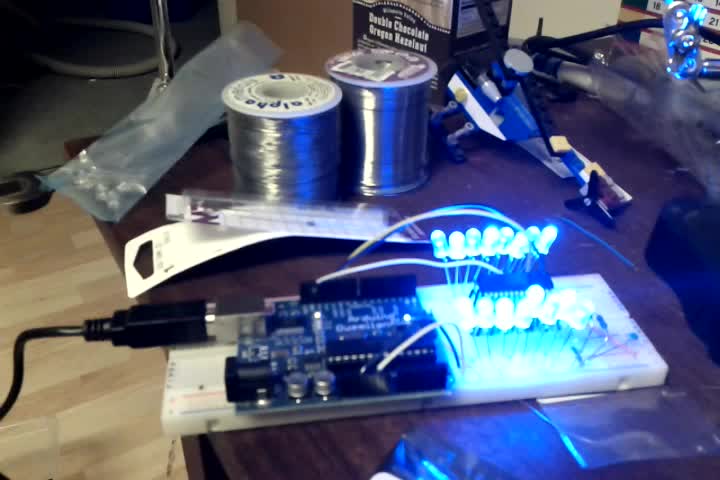
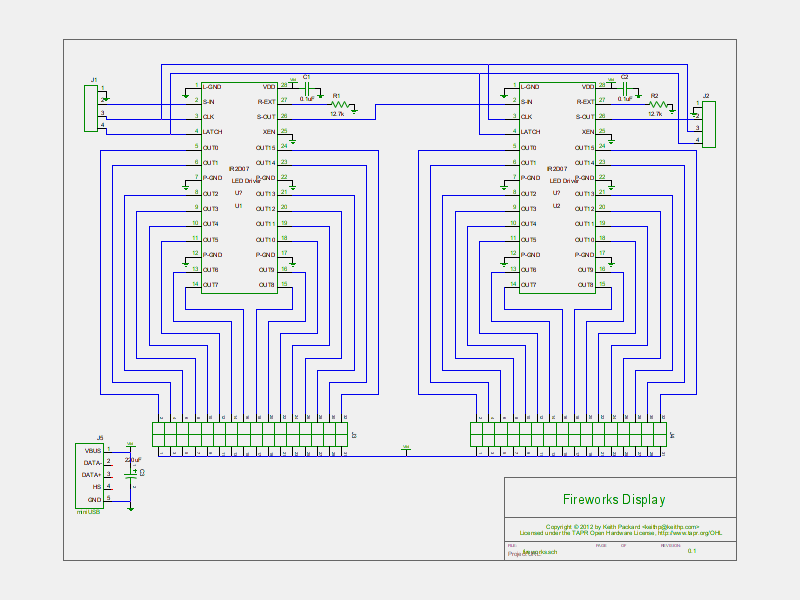
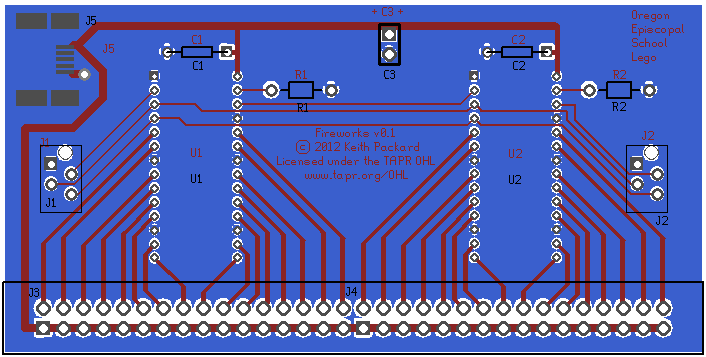
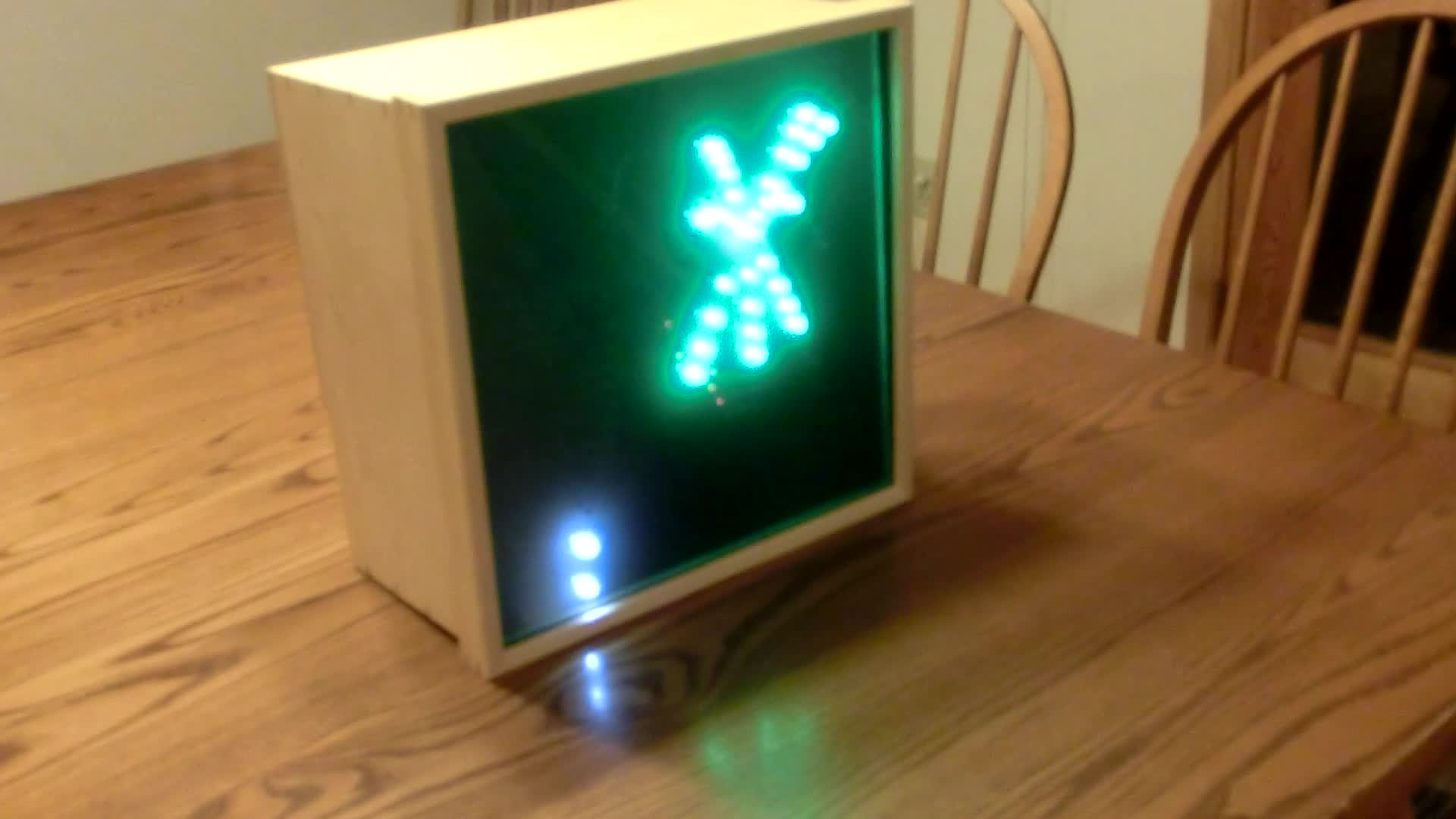
LED Fireworks. Or, parent helpers go overboard My friend, Mike Ward, and I help out at our kids school by teaching 5th and 6th graders programming in conjunction with a Lego class. For several years, I was teaching Logo on ancient Apple II machines. The teacher had a great curriculum and the kids learned a lot, but this year we decided to switch things around and try them out on Arduinos. This spring, the kids are building a Lego display centered around a birthday party theme for the star elephant at the Oregon Zoo (Packy), who turned 50 last weekend. In a moment of fun, I suggested that perhaps we should have some fireworks, along with the presents and birthday cake. How hard could it be to wire up a couple of LEDs to an Arduino to make something that looked like fireworks? Selecting parts. Mike and I sat down to order some parts from Digikey. We found these nice, cheap, LED drivers from Sharp. Then we found a selection of LEDs from Cree along with current-programming resistors (12.7k ) to drive the LEDs at 20mA, and some bypass caps (0.1 F) to keep the parts happy. The LED drivers are simple shift registers, with separate clock and data. They have both input and output pins, so you can daisy chain them and drive as many as you like from a single pair of CPU pins. We figured 160 LEDs would be plenty, so we ordered 10 chips. The LED drivers came in a through-hole, DIP package; it seemed like we d be able to just stuff them into a breadboard and quickly wire things up. Prototyping the design The LED driver chips turn out to use a much finer pitch package than the usual 0.1 spacing. There s no way we could stuff them into a breadboard and quickly wire things up. Obviously, a bit more care while ordering would have uncovered this, but my experience with through-hole parts is limited to parts from the mid 1970s I soldered extension wires onto one chip to test the circuit, and managed to get one chip talking to an Arduino. Here s a short movie of that in action: You can see the LED driver chip sitting on a set of extension leads plugged into the breadboard. It s hooked to the SPI port on the Arduino board, with the clock set as fast as it will go. If you watch the video, you can see that the LEDs actually vary in brightness. They re actually being pulse-width modulated. Clocked at 2MHz, there s enough bandwidth in the SPI bus to drive 160 LEDs with 127 discrete pulse widths at nearly 100Hz (100 * 127 * 160 = 2032000). Is bread boarding practical? With the chip propped up on its extension wires, and the LEDs plugged in, the whole setup was not surprisingly fragile. Getting five of these chips wired up and running for the length of the Lego show (one day at school and two days at the zoo) seemed unlikely. So, we decided to build some custom circuit boards. Using the GEDA tools to make circuit boards My business partner, Bdale Garbee, and I build rocketry electronics through Altus Metrum. He s the hardware guy and I spend my weekends writing firmware for various micro-controllers. Of course, I use free software tools for the firmware, and Bdale uses the free gEDA tools for the hardware. I ve gotten vaguely familiar with those by helping Bdale review circuit diagrams and PC board layout over the years. So I figured I d be able to learn a bit more about them and come up with some designs. I decided to stick two LED drivers on each board. As the chips can drive each LED with up to 50mA of current, each board could potentially consume 1.6A at 5V. Sticking a linear regulator on each board capable of supplying that much current would have required a hefty heat sink. Instead, I decided to stick a mini USB connector on the board and use some cheap USB power supplies. Of course, there wasn t a pre-packaged schematic symbol or footprint for the LED driver, so I first had to construct those. But, with symbols for all of the parts I used available, I drew this circuit: Wiring up 32 LEDs It s really easy to draw wires showing 32 LEDs hooked up to each board. Actually selecting connectors that can be easily hooked up took a bit more time. The idea of crimping individual two-pin connectors for 160 LEDs didn t seem like fun, plus individual connectors were going to cost a small fortune (the best option I found would have cost about $0.40 per LED). Bdale suggested using ribbon cable with a crimp-on connector crimp a connector across the whole cable and then split out two-wire sets for each LED. I d still have to individually solder each LED to the wire, but on the board end, all I d have to do is crimp the connector on to the cable. Designing the circuit boards The gEDA tools separate schematic design and PCB layout into two separate tools; the schematic program, gschem, exports a netlist and set of components which the schematic program, PCB, can import. This sounded a bit clunky to me, as you have to re-export and re-import the schematic data into the PCB each time you make changes, but it seems to work reasonably well in practice. The first time the schematic data is imported to the PCB tool, all of the component footprints are simply stacked on top of one another. With those moved to sensible locations, the tool will show rats for each netlist. Having drawn the schematic with symbols that strongly resembled the actual components, it was pretty easy to work through the rats one at a time by painting copper on the board. I d noticed that all of the signals could easily be routed on one side of the board, so I flooded the back side with a ground plane to keep things quiet. The final circuit board design looks like this: Circuit boards. All Altus Metrum products are manufactured by Advanced Circuits, and we ve been quite happy with them. They offer a cheap and fast prototyping service through their barebonespcb.com site. These boards are two layers with no silk screen or solder mask. I uploaded my design and in a couple of days I got back some shiny circuit boards: The footprint I designed for the LED drivers turned out to have a very small gap between the pads for each pin and the ground plane. This lead to a couple of shorted pins in the five boards, which were pretty easy to diagnose as the LED driven by that pin would be stuck on. Here s another picture with the ribbon cable connected and an LED lit up: Mounting the LEDs I started by writing a small nickle program to simulate the trajectory of a ballistic fireworks shell followed by an explosion at apogee and subsequent ballistic tracks for the resulting pieces. I made the initial conditions of the launch somewhat random, and Mike and I sat and watched that draw things until we saw a couple that looked good . The output from that was a series of X/Y locations spaced uniformly in time. Mike used those to drill holes in a piece of acrylic from TAP plastics. He glued the LEDs into that with some white glue (so that we have a chance of getting them back out): A custom maple box? I spent last weekend visiting my father for his birthday. Meanwhile, Mike was busy back home building a case for the project. I got home and found that he had fabricated a solid maple case. It s beautiful, and holds all of the LEDs, boards, wires and a couple of 4-outlet USB power supplies. Here s a picture of the joint he made in the box corners: The finished product Here s the inside of the box: And here s a movie of the whole thing in action. It s missing 8 white LEDs; I hadn t ordered enough from Digikey. Downloading schematics and PCB artwork The hardware design is licensed under the TAPR Open Hardware License. It s all stored in git (of course):
git://keithp.com/git/hw/fireworks
All of the symbols I created are also available through git:
git://keithp.com/git/hw/keithp
Things I d do differently One of the frustrating things about moving atoms around instead of just bits is that once you ve got a physical artifact, it s really expensive to change it. There are a couple of minor things I would change if I were going to build more of these: Things that worked well There were a couple of things that went better than I had expected:

19 April 2012

Rapha&#235;l Hertzog: People behind Debian: Samuel Thibault, working on accessibility and the Hurd

Samuel Thibault is a French guy like me, but it took years until we met. He tends to keep a low profile, even though he s doing lots of good work that deserves to be mentioned. He focuses on improving Debian s accessibility and contributes to the Hurd. Who said he s a dreamer? :-) Checkout his interview to have some news of Wheezy s status on those topics. Raphael: Who are you? Samuel: I am 30 years old, and live in Bordeaux, France. During the workday, I teach Computer Science (Architecture, Networking, Operating Systems, and Parallel Programming, roughly) at the University of Bordeaux, and conduct researches in heterogeneous parallel computing. During the evening, I play the drums and the trombone in various orchestra (harmonic/symphonic/banda/brass). During the night, I hack on whatever fun things I can find, mainly accessibility and the Hurd at the moment, but also miscellaneous bits such as the Linux console support. I am also involved in the development of Aquilenet, an associative ISP around Bordeaux, and getting involved in the development of the network infrastructure in Bordeaux. I am not practicing Judo any more, but I roller-skate to work, and I like hiking in the mountains. I also read quite a few mangas. Saturday mornings do not exist in my schedule (Sunday mornings do, it s Brass Band rehearsal :) ). Raphael: How did you start contributing to Debian? Samuel: Bit by bit. I have been hacking around GNU/Linux since around 1998. I installed my first Debian system around 2000, as a replacement for my old Mandrake installation (which after all my tinkering was actually no longer looking like a Mandrake system any more!). That was Potato at the time, which somebody offered me through a set of CDs (downloading packages over the Internet was unthinkable at the time with the old modems). I have been happily reading and hacking around documentation, source code, etc. provided on them. Contribution things really started to take off when I went to the ENS Lyon high school in 2001: broadband Internet access in one s own student room! Since sending a mail was then really free, I started submitting bugs against various packages I was using. Right after that I started submitting patches along them, and then patches to other bugs. I did that for a long time actually. I had very little knowledge of all packaging details at the time, I was just a happy hacker submitting reports and patches against the upstream source code. At ENS Lyon, I met a blind colleague with very similar hacking tastes (of course we got friends) and he proposed me, for our student project, to work on a brlnet project (now called brlapi), a client/server protocol that lets applications render text on braille devices themselves. Along the way, I got to learn in details how a blind person can use a Unix system and the principles that should be followed when developing Accessibility. That is how I got involved in it. We presented our project at JDLL, and the Hurd booth happened to be next to our table, so I discussed with the Hurd people there about how the Hurd console could be used through braille. That is how I got into the Hurd too. From then on, I progressively contributed more and more to the upstream parts of both accessibility software and the Hurd. And then to the packaging part of them. Through patches in bug reports first, as usual, as well as through discussions on the mailing lists. But quickly enough people gave me commit access so I could just throw the code in. I was also given control over the Hurd buildds to keep them running. It was all good at that stage: I could contribute in all the parts I was caring about. People however started telling me that I should just apply for being a Debian Developer; both from accessibility and Hurd sides. I had also seen a bunch of my friends going through the process. I was however a bit scared (or probably it was just an excuse) by having to manage a gpg key, it seemed like a quite dangerous tool to me (even if I already had commit access to glibc at the time anyway ). I eventually applied for DM in 2008 so as to at least be able to upload some packages to help the little manpower of the Accessibility and Hurd teams. Henceforth I had already a gpg key, thus no excuse any more. And having it in the DM keyring was not enough for e.g. signing the hurd-i386 buildd packages. So I ended up going through NM in 2009, which went very fast, since I had already been contributing to Debian and learning all the needed stuff for almost 10 years! I now have around 50 packages in my QA page, and being a DD is actually useful for my work, to easily push our software to the masses :) So to sum it up, the Debian project is very easy to contribute to and open to new people. It was used during discussions at the GNU Hackers Meeting 2011 as an example of a very open community with public mailing lists and discussions. The mere fact that anybody can take the initiative of manipulating the BTS (if not scared by the commands) without having to ask anybody is an excellent thing to welcome contributions; it is notable tha the GNU project migrated to the Debbugs BTS. More generally, I don t really see the DD status as a must, especially now that we have the DM status (which is still a very good way to drag people into becoming DDs). For instance, I gave a talk at FOSDEM 2008 about the state of accessibility in Debian. People did not care whom I was, they cared that there was important stuff going on and somebody talking about it. More generally, decisions that are made through a vote are actually very rare. Most of the time, things just happen on the mailing lists or IRC channels where anybody can join the discussion. So I would recommend beginners to first use the software, then start reporting bugs, then start digging in the software to try fix the bugs by oneself, eventually propose patches, get them reviewed. At some point the submitted patches will be correct already most of the time. That s when the maintainers will start getting bored of just applying the patches, and simply provide with commit access, and voil , one has become a main contributor. Raphael: You re one of the main contributors to the Debian GNU/Hurd port. What motivates you in this project? Samuel: As I mentioned above, I first got real contact with the Hurd from the accessibility point of view. That initially brought me into the Hurd console, which uses a flexible design and nice interfaces to interact with it. The Hurd driver for console accessibility is actually very straightforward, way simpler than the Windows or Linux drivers. That is what caught me initially. I have continued working on it for several reasons. First, the design is really interesting for users. There are many things that are natural in the Hurd while Linux is still struggling to achieve them, such as UID isolation, recently mentioned in LWN. What I really like in the Hurd is that it excels at providing users with the same features as the administrator s. For instance, I find it annoying that I still can not mount an ISO image that I build on e.g. ries.debian.org. Linux now has FUSE which is supposed to permit that, but I have never seen it enabled on an ssh-accessible machine, only on desktop machines, and usually just because the administrator happens to be the user of the machine (who could as well just have used sudo ) For me, it is actually Freedom #0 of Free Software: let the user run programs for any purpose, that is, combining things together all the possible ways, and not being prevented from doing some things just because the design does not permit to achieve them securely. I had the chance to give a Hurd talk to explain that at GHM 2011, whose main topic was extensibility , I called it GNU/Hurd AKA Extensibility from the Ground, because the design of the Hurd is basically meant for extensibility, and does not care whether it is done by root or a mere user. All the tools that root uses to build a GNU/Hurd system can be used by the user to build its own GNU/Hurd environment. That is guaranteed by the design itself: the libc asks for things not to the kernel, but to servers (called translators), which can be provided by root, or by the user. It is interesting to see that it is actually also tried with varying success in GNU/Linux, through gvfs or Plash. An example of things I love being able to do is: $ zgrep foo ~/ftp://cdn.debian.net/debian/dists/sid/main/Contents-*.gz On my Hurd box, the ~/ftp: directory is indeed actually served by an ftpfs translator, run under my user uid, which is thus completely harmless to the system. Secondly and not the least, the Hurd provides me with interesting yet not too hard challenges. LWN confirmed several times that the Linux kernel has become very difficult to significantly contribute to, so it is no real hacking fun any more. I have notably implemented TLS support in the Hurd and the Xen and 64bit support in the GNU Mach kernel used by the Hurd. All three were very interesting to do, but were already done for Linux (at least for all the architectures which I actually know a bit and own). It happens that both TLS and Xen hacking experience became actually useful later on: I implemented TLS in the threading library of our research team, and the Xen port was a quite interesting line on my CV for getting a postdoc position at XenSource :) Lastly, I would say that I am used to lost causes :) My work on accessibility is sometimes a real struggle, so the Hurd is almost a kind of relief. It is famous for his vapourware reputation anyway, and so it is fun to just try to contribute to it nevertheless. An interesting thing is that the opinion of people on the Hurd is often quite extreme, and only rarely neutral. Some will say it is pure vapourware, while others will say that it is the hope of humanity (yes we do see those coming to #hurd, and they are not always just trolls!). When I published a 0.401 version on 2011 April 1st, the comments of people were very diverse, and some even went as far as saying that it was horrible of us to make a joke about the promised software :) Raphael: The FTPmasters want to demote the Hurd port to the debian-ports.org archive if it doesn t manage a stable release with wheezy. We re now at 2 months of the freeze. How far are you from being releasable ? Samuel: Of course, I can not speak for the Debian Release team. The current progress is however encouraging. During Debconf11, Michael Banck and I discussed with a few Debian Release team members about the kind of goals that should be achieved, and we are near completion of that part. The Debian GNU/Hurd port can almost completely be installed from the official mirrors, using the standard Debian Installer. Some patches need some polishing, but others are just waiting for being uploaded Debian GNU/Hurd can start a graphical desktop and run office tools such as gnumeric, as well as the iceweasel graphical web browser, KDE applications thanks to Pino Toscano s care, and GNOME application thanks to Emilio Pozuelo Monfort s care. Of course, general textmode hacking with gcc/make/gdb/etc. just works smoothly. Thanks to recent work on ghc and ada by Svante Signell, the archive coverage has passed 76%. There was a concern about network board driver support: until recently, the GNU Mach kernel was indeed still using a glue layer to embed the Linux 2.2 or even 2.0 drivers (!). Finding a network board supported by such drivers had of course become a real challenge. Thanks to the GSoC work of Zheng Da, the DDE layer can now be used to embed Linux 2.6.32 drivers in userland translators, which was recently ACCEPTed into the archive, and thus brings way larger support for network boards. It also pushes yet more toward the Hurd design: network drivers as userland process rather than kernel modules. That said, the freeze itself is not the final deadline. Actually, freeze periods are rests for porters, because maintainers stop bringing newer upstream versions which of course break on peculiar architectures. That will probably be helpful to continue improving the archive coverage. Raphael: The kfreebsd port brought into light all the packages which were not portable between different kernels. Did that help the Hurd port or are the problems too different to expect any mutual benefit? Samuel: The two ports have clearly helped each other in many aspects. The hurd-i386 port is the only non-Linux one that has been kept working (at least basically) for the past decade. That helped to make sure that all tools (dpkg, apt, toolchain, etc.) were able to cope with non-Linux ports, and keep that odd-but-why-not goal around, and evidently-enough achievable. In return, the kFreeBSD port managed to show that it was actually releasable, at least as a technological preview, thus making an example. In the daily work, we have sometimes worked hand in hand. The recent porting efforts of the Debian Installer happened roughly at the same time. When fixing some piece of code for one, the switch-case would be left for the other. When some code could be reused by the other, a mail would be sent to advise doing so, etc. In the packaging effort, it also made a lot of difference that a non-Linux port is exposed as released architecture: people attempted by themselves to fix code that is Linuxish for no real reason. The presence of the kFreeBSD is however also sometimes a difficulty for the Hurd: in the discussions, it sometimes tends to become a target to be reached, even if the systems are not really comparable. I do not need to detail the long history of the FreeBSD kernel and the amount of people hacking on it, some of them full-time, while the Hurd has only a small handful of free-time hackers. The FreeBSD kernel stability has already seen long-term polishing, and a fair amount of the Debian software was actually already ported to the FreeBSD kernel, thanks to the big existing pure-FreeBSD hackerbase. These do not hold for the GNU/Hurd port, so the expectations should go along. Raphael: You re also very much involved in the Debian Accessibility team. What are the responsibilities of this team and what are you doing there? Samuel: As you would expect it, the Debian Accessibility team works on packaging accessibility-related packages, and helping users with them; I thus do both. But the goal is way beyond just that. Actual accessibility requires integration. Ideally enough, a blind user should be able to just come to a Debian desktop system, plug his braille device, or press a shortcut to enable speech synthesis, and just use the damn computer, without having to ask the administrator to install some oddly-named package and whatnot. Just like any sighted user would do. He should be able to diagnose why his system does not boot, and at worse be able to reinstall his computer all by himself (typically at 2am ). And that is hard to achieve, because it means discussing about integration by default of accessibility features. For instance, the Debian CD images now beep during at the boot menu. That is a precious feature that has been discussed between debian-boot and debian-accessibility for a few weeks before agreeing on how to do it without too much disturbance. Similarly, my proposition of installing the desktop accessibility engines has been discussed for some time before being commited. What was however surprisingly great is that when somebody brought the topic back for discussion, non-debian-accessibility people answered themselves. This is reassuring, because it means things can be done durably in Debian. On the installation side, our current status is that the stable Debian installer has a high contrast color theme, and several years ago, I have pushed toward making standard CD images automatically detect braille devices, which permits standalone installation. I have added to the Wheezy installer some software speech synthesis (which again brought discussion about size increase vs versatility etc.) for blind people who do not have a braille device. I find it interesting to work on such topic in Debian rather than another distribution, because Debian is an upstream for a lot of distributions. Hopefully they just inherit our accessibility work. It at least worked for the text installer of Ubuntu. Of course, the Accessibility team is looking for help, to maintain our current packages, but also introduce new packages from the TODO list or create some backports. One does not need to be an expert in accessibility: tools can usually be tested, at least basically, by anybody, without particular hardware (I do not own any, I contributed virtual ones to qemu). For new developments and ideas, it is strongly recommended to come and discuss on debian-accessibility, because it is easy to get on a wrong track that does not bring actual accessibility. We still have several goals to achieve: the closest one is to just fix the transition to gnome3, which has been quite bad for accessibility so far :/ On the longer run, we should ideally reach the scenario I have detailed above: desktop accessibility available and ready to be enabled easily by default. Raphael: What s the biggest problem of Debian? Samuel: Debian is famous for its heated debian-devel discussions. And some people eventually say this no fun any more . That is exemplified in a less extreme way in the debian-boot/accessibility discussions that I have mentioned above. Sometimes, one needs to have a real stubborn thick head to continue the discussion until finding a compromise that will be accepted for commit. That is a problem because people do not necessarily have so much patience, and will thus prefer to contribute to a project with easier acceptance. But it is also a quality: as I explained above, once it is there, it is apparently for good. The Ubuntu support of accessibility in its installer has been very diverse, in part due to quite changing codebase. The Debian Installer codebase is more in a convergence process. Its base will have almost not changed between squeeze and wheezy. That allowed the Debian Accessibility team to continue improving its accessibility support, and not have to re-do it. A wiki page explains how to test its accessibility features, and some non-debian-accessibility people do go through it. A problem I am much more frightened by is the manpower in some core teams. The Debian Installer, grub, glibc, Xorg, gcc, mozilla derivatives, When reading the changelogs of these, we essentially keep seeing the same very few names over and over. And when one core developer leaves, it is very often still the same names which appear again to do the work. It is hard to believe that there are a thousand DDs working on Debian. I fear that Debian does not manage to get people to work on core things. I often hear people saying that they do not even dare thinking about putting their hands inside Xorg, for instance. Xorg is complex, but it seems to me that it tends to be overrated, and a lot of people could actually help there, as well as all the teams mentioned above. And if nobody does it, who will? Raphael: Do you have wishes for Debian Wheezy? Samuel: That is an easy one :) Of course I wish that we manage to release the hurd-i386 port. I also wish that accessibility of gnome3 gets fixed enough to become usable again. The current state is worrying: so much has changed that the transition will be difficult for users already, the current bugs will clearly not help. I also hope to find the time to fix the qt-at-spi bridge, which should (at last!) bring complete KDE accessibility. Raphael: Is there someone in Debian that you admire for their contributions? Samuel: Given the concerns I expressed above, I admire all the people who do spend time on core packages, even when that is really not fun everyday. Just to alphabetically name a few people I have seen so often here and there in the areas I have touched in the last few years: Aur lien Jarno, Bastian Blank, Christian Perrier, Colin Watson, Cyril Brulebois, Frans Pop, J rg Jaspert, Joey Hess, Josselin Mouette, Julien Cristau, Matthias Klose, Mike Hommey, Otavio Salvador, Petr Salinger, Robert Millan, Steve Langasek. Man, so many things that each of them works on! Of course this list is biased towards the parts that I touched, but people working in others core areas also deserve the same admiration.
Thank you to Samuel for the time spent answering my questions. I hope you enjoyed reading his answers as I did. Note that older interviews are indexed on wiki.debian.org/PeopleBehindDebian.

Subscribe to my newsletter to get my monthly summary of the Debian/Ubuntu news and to not miss further interviews. You can also follow along on Identi.ca, Google+, Twitter and Facebook.

3 comments Liked this article? Click here. My blog is Flattr-enabled.

18 April 2012

Richard Hartmann: Woegle is me

Google seems to become more and more annoying. Package download http://dl.google.com/linux/chrome/deb/ is slow. Not just slow, but slow. Any random apt-get update will take ages; just sitting there waiting for Google's servers to send any data. Downloading actual packages is slow, as well. Ironically, Google's PageRank will punish sites for loading slowly; it's a pity they don't use their considerable server & bandwidth capacities to fix slowness they are causing, themselves. Chrome Copy and paste is a central part of what I use a mouse for. X has had two copy buffers for as long as I can remember, one for mouse selection, pasting with middle mouse button and one for CTRL-c/CTRL-v. Chrome merges the two. That's bad enough in and as of itself, but every time Chrome gets focus, it will clobber anything you may have in your copy buffers at that time with anything that's selected. No matter if you selected it via mouse, via keyboard, a context switch autoselected something. Selection goes into buffer. Every time. Every. Single. Time. To add insult to injury, this is dependent on which tab is active. And if you happen to search on the site (CTRL-f), it will always use what's in the search bar to clobber buffers, no matter if anything on the actual website has been selected. I can't find the bug report about this at the moment, but Google's stance is that this is a feature and introducing an option for traditional copy & paste handling is not desirable. Google+ I get that they feel a need to combat Facebook, but still, pushing Google+ on you is just annoying. At least the Android application has had a permission change on ICS so it can not auto-update. It's the little things ;) WWW Unified branding, the need to support touch-based devices in their UI, etc. Still, GMail's new interface sucks and the old one will be going away for good. And while making some UI elements larger or displaying them unconditionally makes sense for hand-held portrait displays, this is highly annoying on wide-screen landscape displays. 1366x768 may have overtaken 1024x768, but 768 is a constant here and still not a lot. As an aside, hopefully the Apple Effect and the iPad 3 will break the age-long stalemate with regards to screen resolution. More is better, here. Android Bloatware Using stock Android means you won't get Facebook and other useless apps pre-installed. Yet, uninstalling stock applications, like Google+, is impossible. Rights management It's nice that I get to see what kind of access an application would like to have. It's not nice that I can not choose what access I am willing to grant any given application. I can make a binary decision, install or not install, but I can't refuse random access rights to applications. There are custom versions of Android out there which allow you to do this and many applications seem to cope with being unable to do some things. This should be a standard feature. Access management The concept of "access to USB storage" meaning "whatver your SD card or, in the Galaxy Nexus' case, just a specific directory" is also broken. There is a middle ground between "this application needs access to a large chunk of storage" and "this application needs complete access to said large chunk". Just assign the application a specific directory to write into and read from and done's done. Multi-user I can not hand anyone my phone to play a game or surf the Internet without giving them the ability to look through all my email, contacts, calendar, you name it. While I only give my phone to people I trust completely, this still sucks. How hard can it be to create a minimal guest mode which allows people to access a few pre-selected applications with a custom setting of if they are allowed to use cellular data and/or WiFi? Data access Authorized Access Ah, the big one.... Keep in mind that I am using Google's latest and greatest, the Samsung Galaxy Nexus GSM. It's as cutting-edge as you can get. Yes, having one continuous storage device is nice. But MTP support on Linux is abysmal and you are forced to access your data by means of MTP or PTP. gphoto2, gwenview, and gthumb are all unable to import any photos via PTP; no program I tried can transfer anything via MTP. gphoto2 will transfer the background images which APOD (highly recommended, by the way; there's also a donation application for this) stores on my phone. That's it. So, unless I send email to myself, use WiFi-based hacks, or root my phone, I can not access my data. On the strongest mobile platform in the world. Using the most powerful and versatile OS with up-to-date packages. In 2012. Yay. Unauthorized Access Not being able to access my data is a Bad Thing. Even worse is when others can access my data. Contrary to older Android versions, someone decided that it would be a good idea to allow MTP or PTP, only. As in "you can not disable MTP and PTP. One of them has the be activated." This is awesome when you want to charge your phone at an airport or at an acquaintance's possibly malware-ridden Windows machine. Everyone and their bot-herder can potentially access my data while I can not. Usability And while MTP/PTP is an either/or decision, they are using check-boxes, not radio buttons. There's a decade or more of UI experience about check-box versus radio button, so why not use it? I know of at least one owner of a Galaxy Nexus who was not even aware that he couldn't turn off MTP (the default) as the UI pretends otherwise. Opaqueness And good luck trying to contact anybody about this. Having filed a few bugs against Google stuff in the past, I simply gave up on it. Back when Gmail's mailing list filtering and labelling system was somewhat broken, I spent months hunting down people who knew people who knew someone who was able to actually do something about it.

17 April 2012

Debian Med: New Debian Med metapackages uploaded (Posted by Andreas Tille)

I just uploaded new metapackages featuring dependencies of several new packages prepared thanks to the great work of the Debian Med team. Here are the newcomers (and packages we lost):

med-bio:
+ ballview
+ bowtie2
+ cd-hit
+ clustalo
+ ffindex
+ gassst
+ grinder
+ hhsuite
+ profphd-utils
+ proftmb
+ profphd
+ profphd-utils
+ pynast
+ qiime
+ r-bioc-cummerbund
+ reprof
- seq-gen (turned out to be non-free)

med-bio-dev:
+ libchado-perl
+ libffindex0-dev
+ libtfbs-perl
+ libpal-java
+ librg-reprof-bundle-perl
+ librostlab-blast0-dev
+ librostlab-blast-doc
+ librostlab3-dev
+ librostlab-doc
+ libzerg0-dev
+ libzerg-perl

med-data:
- freediams (restructuring upstream, will be back with next release hopefully)

med-imaging:
+ imagevis3d
+ itksnap
+ odin
+ volview

med-imaging-dev:
+ python-pyxnat

med-practice:
+ clinica
- freediams (restructuring upstream, will be back with next release hopefully)

Seems the regular sprints of the Debian Med team have enhanced the team (regarding the number of people and the effectivity of the cooperation). Thanks to all people who joined our effort to make Debian the best free operating system for medical care and biological research.

Russell Coker: ZFS vs BTRFS on Cheap Dell Servers

I previously wrote about my first experiences with BTRFS [1]. Since then I ve been using BTRFS on more systems and have had good results. The main problem I want to address is with the reliability of RAID [2]. Requirements for a File Server Now one of my clients has a need for a new fileserver. They need to reliably store terabytes of data (currently 6TB and growing) which is mostly comprised of data files in the 10MB 15MB size range. The data files will almost never be re-written and I anticiapte that the main bottleneck will be the latency of NFS and other network file sharing protocols. I would hope that saturating a GigE network when sending 10MB data files from SATA disks via NFS, AFS, or SMB wouldn t be a technical challenge. It seems that BTRFS is the way of the future. But it s still rather new and the lack of RAID-5 and RAID-6 is a serious issue when you need to store 10TB with today s technology (that would be 8*3TB disks for RAID-10 vs 5*3TB disks for RAID-5). Also the case of two disks entirely failing in a short period of time requires RAID-6 (or RAID-Z2 as the ZFS variant of RAID-6 is known). With BTRFS at it s current stage of development it seems that to recover from two disks failing you need to have BTRFS on another RAID-6 (maybe Linux software RAID-6). But for filesystems based on concepts similar to ZFS and BTRFS you want to have the filesystem run the RAID so that if a block has a filesystem hash mismatch then the correct copy can be reconstructed from parity. ZFS seems to be a lot more complex than BTRFS. While having more features is a good thing (BTRFS seems to be missing some sysadmin friendly features at this stage) complexity means that I need to learn more and test more before going live. But it seems that the built in RAID-5 and RAID-6 is the killer issue. Servers start becoming a lot more expensive if you want more than 8 disks and even going past 6 disks is a significant price point. As 3TB disks are available an 8 disk RAID-6 gives something like 18TB usable space vs 12TB on a RAID-10 and a 6 disk RAID-6 gives about 12TB vs 9TB on a RAID-10. With RAID-10 (IE BTRFS) my client couldn t use a 6 disk server such as the Dell PowerEdge T410 for $1500 as 9TB of usable storage isn t adequate and the Dell PowerEdge T610 which can support 8 disks and costs $2100 would be barely adequate for the near future with only 12TB of usable storage. Dell does sell significantly larger servers such that any of my clients needs could be covered by RAID-10, but in addition to costing more there are issues of power use and noise. When comparing a T610 and a T410 with a full set of disks the price difference is $1000 (assuming $200 per disk) which is probably worth paying to delay any future need for upgrades. Buying Disks The problem with the PowerEdge T610 server is that it uses hot-swap disks and the biggest disks available are 2TB for $586.30! 2TB*8 in RAID-6 gives 12TB of usable space for $4690.40! This compares poorly to the PowerEdge T410 which supports non-hot-swap disks so I can buy 6*3TB disks for something less than $200 each and get 12TB of usable space for $1200. If I could get hot-swap trays for Dell disks at a reasonable price then the T610 would be worth considering. But as 12TB of storage should do for at least the next 18 months it seems that the T410 is clearly the better option. Does anyone know how to get cheap disk trays for Dell servers? Implementation In mailing list discussions some people suggest using Solaris or FreeBSD for a ZFS server. ZFS was designed for and implemented on Solaris, and FreeBSD was the first port. However Solaris and FreeBSD aren t commonly used systems so it s harder to find skilled people to work with them and there is less of a guarantee that the desired software will work. Among other things it s really convenient to be able to run software for embedded Linux i386 systems on the server. The first port of ZFS to Linux was based on FUSE [3]. This allows a clean separation of ZFS code from the Linux kernel code to avoid license issues but does have some performance problems. I don t think that I will have any performance issues on this server as the data files are reasonably large, are received via an ADSL link, and which require quite a bit of CPU time to process them when they are accessed. But ZFS-FUSE doesn t seem to be particularly popular. The ZFS On Linux project provides source for a ZFS kernel module which you can compile and load [4]. As the module isn t distributed with or statically linked to the kernel the license conflict of the CDDL ZFS code and the GPL Linux kernel code is apparently solved. I ve read some positive reports from people who use this so it will be my preferred option. Related posts:
  1. ECC RAM in a Cheap Machine In a comment on my previous post about ECC RAM...
  2. Starting with BTRFS Based on my investigation of RAID reliability [1] I have...
  3. Dell PowerEdge T105 Today I received a Dell PowerEDGE T105 for use by...

15 April 2012

Iustin Pop: Running: GP der Stadt D bendorf 2012 and some stats

Another weekend, another running opportunity! This was a nice, simple, fast race. The announcer was claiming (if I understood correctly) it is the fastest race around Z rich: completely flat, on an airfield (which unfortunately meant all paved road). The weather was perfect (for running), a bit cold but no problems with overheating. So I managed my fastest time ever: according to the my Garmin (which for the first time recorded a slightly longer distance than the official one), I managed to run 10.18km in 50:39, which makes it 4:58/km! For the first time, below the 5:00 mark, yay! I'll ignore the official marking which claimed 10km in 50:57, since that ruins my nice result, hah! Back to earth however let's see some stats about this race. Just to put it in context: My current running speed is lower than the winner in the 70+ age category by a significant amount. Based on the graph shape, I would probably win at the 85+ category . Or to put it in a slightly different context, a cultural one. Back in my home country (Romania), a 70-year old person (especially male!) that is still able to move around well and to manage by himself is (most of the time) an exception. Of course there are many old men who are doing well, but in general old people are (usually) considered deprecated by this age. In comparison, in Switzerland, they are still active and are doing sport. And some of them, as you can see, doing it quite well. The difference between these two cultures in this regard (sport) is huge. Doing sports (except playing football) is considered something unusual, and in my home town there's a somewhat linear relation between people's age and their weight (both are monotonically increasing). When I first came to Switzerland, I was shocked to see so many people over 50 that are fit and active. Now, every time I go back to Romania, I'm shocked to see people so many people overweight and looking more than their actual age. I can't help but wonder what is the cause of this disregard for health or aversion to sports. Just the fact that "it's expected" for older people to be unhealthy? Is it somehow related to the difference in income/standard of life (I can't see a trivial connection)? Is it to lack of education about how to live a healthy life? Or maybe it's not a country difference, but rather the fact that I grew up in a quite small town; people in Bucharest are indeed looking more after their health than in my home town, and are therefore fitter. Who knows Anyway, rant over, and I'm still happy that I managed to beat my own record, thanks to a flat race and favourable weather!

Next.

Previous.