Search Results: "ed"

8 May 2020

Dirk Eddelbuettel: Rcpp Virtual Talk on June 5

We had to cancel R/Finance 2020 due to what is happening all around us. But I plan to present the one-hour workshop I often give in the tutorial session preceding the first day but this time online! To keep it simple, we will stick with the same day, and possibly the same time: Friday morning at 8:00am! So that makes Friday, June 5, at 08:00h Central time. This YouTube! link should then provide the stream, I reckon there may also be a recording afterwards. The talk / demo / presentation will be about an hour long, and material should be similar to the previous ones (of the same length) still available at the talks page (which also has longer talks all the way to the two-day workshops). If you like this or other open-source work I do, you can now sponsor me at GitHub. For the first year, GitHub will match your contributions.

This post by Dirk Eddelbuettel originated on his Thinking inside the box blog. Please report excessive re-aggregation in third-party for-profit settings.

7 May 2020

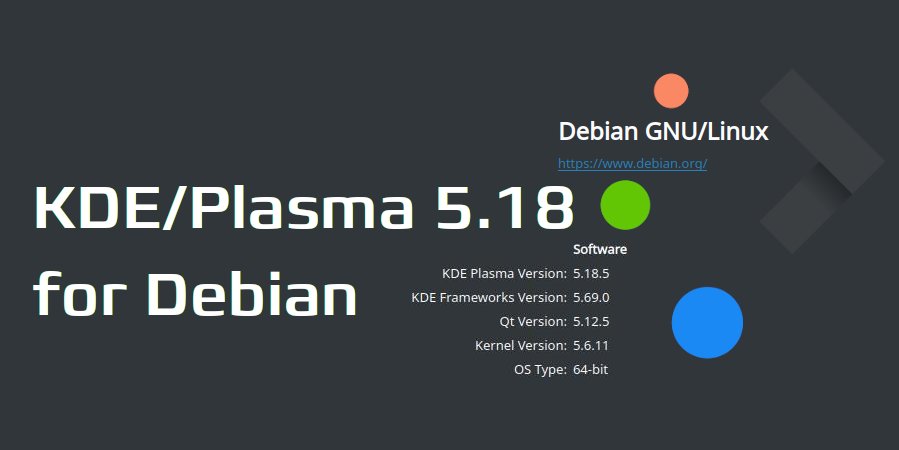
Norbert Preining: KDE/Plasma 5.18.5 for Debian

After the KDE Apps update 20.04, now the recently released Plasma 5.18.5 is ready for Debian.
Furthermore, since the most recent version of the KDE frameworks have been uploaded to Debian/experimental, I have adapted the packages to make upgrades to the versions in experimental and hopefully soon in unstable smooth. I am also working with the Debian KDE Qt Team to update KDE Apps and Plasma in Debian proper. Stay tuned. For now, here is what you need: Use the following APT sources in /etc/apt/sources.list.d/obs-npreining-kde.list: For Unstable:
deb https://download.opensuse.org/repositories/home:/npreining:/debian-kde:/other-deps/Debian_Unstable/ ./
deb https://download.opensuse.org/repositories/home:/npreining:/debian-kde:/frameworks/Debian_Unstable/ ./
deb https://download.opensuse.org/repositories/home:/npreining:/debian-kde:/plasma/Debian_Unstable/ ./
deb https://download.opensuse.org/repositories/home:/npreining:/debian-kde:/apps/Debian_Unstable/ ./
deb https://download.opensuse.org/repositories/home:/npreining:/debian-kde:/other/Debian_Unstable/ ./
For Testing:
deb https://download.opensuse.org/repositories/home:/npreining:/debian-kde:/other-deps/Debian_Testing/ ./
deb https://download.opensuse.org/repositories/home:/npreining:/debian-kde:/frameworks/Debian_Testing/ ./
deb https://download.opensuse.org/repositories/home:/npreining:/debian-kde:/plasma/Debian_Testing/ ./
deb https://download.opensuse.org/repositories/home:/npreining:/debian-kde:/apps/Debian_Testing/ ./
deb https://download.opensuse.org/repositories/home:/npreining:/debian-kde:/other/Debian_Testing/ ./
And don t forget that you need to import my OBS gpg key: obs-npreining.asc, best to download it and put the file into /etc/apt/trusted.gpg.d/obs-npreining.asc. Enjoy.

6 May 2020

Reproducible Builds: Reproducible Builds in April 2020

Welcome to the April 2020 report from the Reproducible Builds project. In our regular reports we outline the most important things that we and the rest of the community have been up to over the past month. What are reproducible builds? One of the original promises of open source software is that distributed peer review and transparency of process results in enhanced end-user security. But whilst anyone may inspect the source code of free and open source software for malicious flaws, almost all software today is distributed as pre-compiled binaries. This allows nefarious third-parties to compromise systems by injecting malicious code into seemingly secure software during the various compilation and distribution processes.

News It was discovered that more than 725 malicious packages were downloaded thousands of times from RubyGems, the official channel for distributing code for the Ruby programming language. Attackers used a variation of typosquatting and replaced hyphens and underscores (for example, uploading a malevolent atlas-client in place of atlas_client) that executed a script that intercepted Bitcoin payments. (Ars Technica report) Bernhard M. Wiedemann launched ismypackagereproducibleyet.org, a service that takes a package name as input and displays whether the package is reproducible in a number of distributions. For example, it can quickly show the status of Perl as being reproducible on openSUSE but not in Debian. Bernhard also improved the documentation of his unreproducible package to add some example patches for hash issues. [ ]. There was a post on Chaos Computer Club s website listing Ten requirements for the evaluation of Contact Tracing apps in relation to the SARS-CoV-2 epidemic. In particular:
4. Transparency and verifiability: The complete source code for the app and infrastructure must be freely available without access restrictions to allow audits by all interested parties. Reproducible build techniques must be used to ensure that users can verify that the app they download has been built from the audited source code.
Elsewhere, Nicolas Boulenguez wrote a patch for the Ada programming language component of the GCC compiler to skip -f.*-prefix-map options when writing Ada Library Information files. Amongst other properties, these .ali files embed the compiler flags used at the time of the build which results in the absolute build path being recorded via -ffile-prefix-map, -fdebug-prefix-map, etc. In the Arch Linux project, kpcyrd reported that they held their first rebuilder workshop . The session was held on IRC and participants were provided a document with instructions on how to install and use Arch s repro tool. The meeting resulted in multiple people with no prior experience of Reproducible Builds validate their first package. Later in the month he also announced that it was now possible to run independent rebuilders under Arch in a hands-off, everything just works solution to distributed package verification. Mathias Lang submitted a pull request against dmd, the canonical compiler for the D programming languageto add support for our SOURCE_DATE_EPOCH environment variable as well the other C preprocessor tokens such __DATE__, __TIME__ and __TIMESTAMP__ which was subsequently merged. SOURCE_DATE_EPOCH defines a distribution-agnostic standard for build toolchains to consume and emit timestamps in situations where they are deemed to be necessary. [ ] The Telegram instant-messaging platform announced that they had updated to version 5.1.1 continuing their claim that they are reproducible according to their full instructions and therefore verifying that its original source code is exactly the same code that is used to build the versions available on the Apple App Store and Google Play distribution platforms respectfully. Lastly, Herv Boutemy reported that 97% of the current development versions of various Maven packages appear to have a reproducible build. [ ]

Distribution work In Debian this month, 89 reviews of Debian packages were added, 21 were updated and 33 were removed this month adding to our knowledge about identified issues. Many issue types were noticed, categorised and updated by Chris Lamb, including: In addition, Holger Levsen filed a feature request against debrebuild, a tool for rebuilding a Debian package given a .buildinfo file, proposing to add --standalone or --one-shot-mode functionality.
In openSUSE, Bernhard M. Wiedemann made the following changes: In Arch Linux, a rebuilder instance has been setup at reproducible.archlinux.org that is rebuilding Arch s [core] repository directly. The first rebuild has led to approximately 90% packages reproducible contrasting with 94% on the Reproducible Build s project own ArchLinux status page on tests.reproducible-builds.org that continiously builds packages and does not verify Arch Linux packages. More information may be found on the corresponding wiki page and the underlying decisions were explained on our mailing list.

Software development

diffoscope Chris Lamb made the following changes to diffoscope, the Reproducible Builds project s in-depth and content-aware diff utility that can locate and diagnose reproducibility issues (including preparing and uploading versions 139, 140, 141, 142 and 143 to Debian which were subsequently uploaded to the backports repository):
  • Comparison improvements:
    • Dalvik .dex files can also serve as APK containers so restrict the narrower identification of .dex files to files ending with this extension and widen the identification of APK files to when file(1) discovers a Dalvik file. (#28)
    • Add support for Hierarchical Data Format (HD5) files. (#95)
    • Add support for .p7c and .p7b certificates. (#94)
    • Strip paths from the output of zipinfo(1) warnings. (#97)
    • Don t uselessly include the JSON similarity percentage if it is 0.0% . [ ]
    • Render multi-line difference comments in a way to show indentation. (#101)
  • Testsuite improvements:
    • Add pdftotext as a requirement to run the PDF test_metadata text. (#99)
    • apktool 2.5.0 changed the handling of output of XML schemas so update and restrict the corresponding test to match. (#96)
    • Explicitly list python3-h5py in debian/tests/control.in to ensure that we have this module installed during a test run to generate the fixtures in these tests. [ ]
    • Correct parsing of ./setup.py test --pytest-args arguments. [ ]
  • Misc:
    • Capitalise Ordering differences only in text comparison comments. [ ]
    • Improve documentation of FILE_TYPE_HEADER_PREFIX and FALLBACK_FILE_TYPE_HEADER_PREFIX to highlight that only the first 16 bytes are used. [ ]
Michael Osipov created a well-researched merge request to return diffoscope to using zipinfo directly instead of piping input via /dev/stdin in order to ensure portability to the BSD operating system [ ]. In addition, Ben Hutchings documented how --exclude arguments are matched against filenames [ ] and Jelle van der Waa updated the LLVM test fixture difference for LLVM version 10 [ ] as well as adding a reference to the name of the h5dump tool in Arch Linux [ ]. Lastly, Mattia Rizzolo also fixed in incorrect build dependency [ ] and Vagrant Cascadian enabled diffoscope to locate the openssl and h5dump packages on GNU Guix [ ][ ], and updated diffoscope in GNU Guix to version 141 [ ] and 143 [ ].

strip-nondeterminism strip-nondeterminism is our tool to remove specific non-deterministic results from a completed build. In April, Chris Lamb made the following changes:
  • Add deprecation plans to all handlers documenting how or if they could be disabled and eventually removed, etc. (#3)
  • Normalise *.sym files as Java archives. (#15)
  • Add support for custom .zip filename filtering and exclude two patterns of files generated by Maven projects in fork mode. (#13)

disorderfs disorderfs is our FUSE-based filesystem that deliberately introduces non-determinism into directory system calls in order to flush out reproducibility issues. This month, Chris Lamb fixed a long-standing issue by not drop UNIX groups in FUSE multi-user mode when we are not root (#1) and uploaded version 0.5.9-1 to Debian unstable. Vagrant Cascadian subsequently refreshed disorderfs in GNU Guix to version 0.5.9 [ ].

Upstream patches The Reproducible Builds project detects, dissects and attempts to fix as many currently-unreproducible packages as possible. We endeavour to send all of our patches upstream where appropriate. This month, we wrote a large number of such patches, including: In addition, Bernhard informed the following projects that their packages are not reproducible:
  • acoular (report unknown non-determinism)
  • cri-o (report a date issue)
  • gnutls (report certtool being unable to extend certificates beyond 2049)
  • gnutls (report copyright year variation)
  • libxslt (report a bug about non-deterministic output from data corruption)
  • python-astropy (report a future build failure in 2021)

Project documentation This month, Chris Lamb made a large number of changes to our website and documentation in the following categories:
  • Community engagement improvements:
    • Update instructions to register for Salsa on our Contribute page now that the signup process has been overhauled. [ ]
    • Make it clearer that joining the rb-general mailing list is probably a first step for contributors to take. [ ]
    • Make our full contact information easier to find in the footer (#19) and improve text layout using bullets to separate sections [ ].
  • Accessibility:
    • To improve accessibility, make all links underlined. (#12)
    • Use an enhanced foreground/background contrast ratio of 7.04:1. (#11)
  • General improvements:
  • Internals:
    • Move to using jekyll-redirect-from over manual redirect pages [ ][ ] and add a redirect from /docs/buildinfo/ to /docs/recording/. (#23)
    • Limit the website self-check to not scan generated files [ ] and remove the old layout checker now that I have migrated all them [ ].
    • Move the news archive under the /news/ namespace [ ] and improve formatting of archived news links [ ].
    • Various improvements to the draft template generation. [ ][ ][ ][ ]
In addition, Holger Levsen clarified exactly which month we ceased to do weekly reports [ ] and Mattia Rizzolo adjusted the title style of an event page [ ]. Marcus Hoffman also started a discussion on our website s issue tracker asking for clarification on embedded signatures and Chris Lamb subsequently replied and asked Marcus to go ahead and propose a concrete change.

Testing framework We operate a large and many-featured Jenkins-based testing framework that powers tests.reproducible-builds.org that, amongst many other tasks, tracks the status of our reproducibility efforts as well as identifies any regressions that have been introduced.
  • Chris Lamb:
    • Print the build environment prior to executing a build. [ ]
    • Drop a misleading disorderfs-debug prefix in log output when we change non-disorderfs things in the file and, as it happens, do not run disorderfs at all. [ ]
    • The CSS for the package report pages added a margin to all <a> HTML elements under <li> ones, which was causing a comma/bullet spacing issue. [ ]
    • Tidy the copy in the project links sidebar. [ ]
  • Holger Levsen:
    • General:
    • Debian:
      • Reduce scheduling frequency of the buster distribution on the arm64 architecture, etc.. [ ][ ]
      • Show builds per day on a per-architecture basis for the last year on the Debian dashboard. [ ]
      • Drop the Subgraph OS package set as development halted in 2017 or 2018. [ ]
      • Update debrebuild to version from the latest version of devscripts. [ ][ ]
      • Add or improve various parts of the documentation. [ ][ ][ ]
    • Work on a Debian rebuilder:
      • Integrate sbuild. [ ][ ][ ][ ][ ]
      • Select a random .buildinfo file and attempt to build and compare the result. [ ][ ][ ][ ]
      • Improve output and related output formatting. [ ][ ][ ][ ][ ]
      • Outline next steps for the development of the tool. [ ][ ][ ]
      • Various refactoring and code improvements. [ ][ ][ ]
Lastly, Mattia Rizzolo fixed some log parsing code regarding potentially-harmless warnings from package installation [ ][ ] and the usual build node maintenance was performed by Holger Levsen [ ][ ][ ] and Mattia Rizzolo [ ][ ][ ].

Misc news On our mailing list this month, Santiago Torres asked whether we were still publishing releases of our tools to our website and Chris Lamb replied that this was not the case and fixed the issue. Later in the month Santiago also reported that the signature for the disorderfs package did not pass its GPG verification which was also fixed by Chris Lamb. Hans-Christoph Steiner of the Guardian Project asked whether there would be interest in making our website translatable which resulted in a WIP merge request being filed against the website and a discussion on how to track translation updates.
If you are interested in contributing to the Reproducible Builds project, please visit our Contribute page on our website. However, you can get in touch with us via:

This month s report was written by Bernhard M. Wiedemann, Chris Lamb, Daniel Shahaf, Holger Levsen, Jelle van der Waa, kpcyrd, Mattia Rizzolo and Vagrant Cascadian. It was subsequently reviewed by a bunch of Reproducible Builds folks on IRC and the mailing list.

Russell Coker: About Reopening Businesses

Currently there is political debate about when businesses should be reopened after the Covid19 quarantine. Small Businesses One argument for reopening things is for the benefit of small businesses. The first thing to note is that the protests in the US say I need a haircut not I need to cut people s hair . Small businesses won t benefit from reopening sooner. For every business there is a certain minimum number of customers needed to be profitable. There are many comments from small business owners that want it to remain shutdown. When the government has declared a shutdown and paused rent payments and provided social security to employees who aren t working the small business can avoid bankruptcy. If they suddenly have to pay salaries or make redundancy payouts and have to pay rent while they can t make a profit due to customers staying home they will go bankrupt. Many restaurants and cafes make little or no profit at most times of the week (I used to be 1/3 owner of an Internet cafe and know this well). For such a company to be viable you have to be open most of the time so customers can expect you to be open. Generally you don t keep a cafe open at 3PM to make money at 3PM, you keep it open so people can rely on there being a cafe open there, someone who buys a can of soda at 3PM one day might come back for lunch at 1:30PM the next day because they know you are open. A large portion of the opening hours of a most retail companies can be considered as either advertising for trade at the profitable hours or as loss making times that you can t close because you can t send an employee home for an hour. If you have seating for 28 people (as my cafe did) then for about half the opening hours you will probably have 2 or fewer customers in there at any time, for about a quarter the opening hours you probably won t cover the salary of the one person on duty. The weekend is when you make the real money, especially Friday and Saturday nights when you sometimes get all the seats full and people coming in for takeaway coffee and snacks. On Friday and Saturday nights the 60 seat restaurant next door to my cafe used to tell customers that my cafe made better coffee. It wasn t economical for them to have a table full for an hour while they sell a few cups of coffee, they wanted customers to leave after dessert and free the table for someone who wants a meal with wine (alcohol is the real profit for many restaurants). The plans of reopening with social distancing means that a 28 seat cafe can only have 14 chairs or less (some plans have 25% capacity which would mean 7 people maximum). That means decreasing the revenue of the most profitable times by 50% to 75% while also not decreasing the operating costs much. A small cafe has 2-3 staff when it s crowded so there s no possibility of reducing staff by 75% when reducing the revenue by 75%. My Internet cafe would have closed immediately if forced to operate in the proposed social distancing model. It would have been 1/4 of the trade and about 1/8 of the profit at the most profitable times, even if enough customers are prepared to visit and social distancing would kill the atmosphere. Most small businesses are barely profitable anyway, most small businesses don t last 4 years in normal economic circumstances. This reopen movement is about cutting unemployment benefits not about helping small business owners. Destroying small businesses is also good for big corporations, kill the small cafes and restaurants and McDonald s and Starbucks will win. I think this is part of the motivation behind the astroturf campaign for reopening businesses. Forbes has an article about this [1]. Psychological Issues Some people claim that we should reopen businesses to help people who have psychological problems from isolation, to help victims of domestic violence who are trapped at home, to stop older people being unemployed for the rest of their lives, etc. Here is one article with advice for policy makers from domestic violence experts [2]. One thing it mentions is that the primary US federal government program to deal with family violence had a budget of $130M in 2013. The main thing that should be done about family violence is to make it a priority at all times (not just when it can be a reason for avoiding other issues) and allocate some serious budget to it. An agency that deals with problems that affect families and only has a budget of $1 per family per year isn t going to be able to do much. There are ongoing issues of people stuck at home for various reasons. We could work on better public transport to help people who can t drive. We could work on better healthcare to help some of the people who can t leave home due to health problems. We could have more budget for carers to help people who can t leave home without assistance. Wanting to reopen restaurants because some people feel isolated is ignoring the fact that social isolation is a long term ongoing issue for many people, and that many of the people who are affected can t even afford to eat at a restaurant! Employment discrimination against people in the 50+ age range is an ongoing thing, many people in that age range know that if they lose their job and can t immediately find another they will be unemployed for the rest of their lives. Reopening small businesses won t help that, businesses running at low capacity will have to lay people off and it will probably be the older people. Also the unemployment system doesn t deal well with part time work. The Australian system (which I think is similar to most systems in this regard) reduces the unemployment benefits by $0.50 for every dollar that is earned in part time work, that effectively puts people who are doing part time work because they can t get a full-time job in the highest tax bracket! If someone is going to pay for transport to get to work, work a few hours, then get half the money they earned deducted from unemployment benefits it hardly makes it worthwhile to work. While the exact health impacts of Covid19 aren t well known at this stage it seems very clear that older people are disproportionately affected, so forcing older people to go back to work before there is a vaccine isn t going to help them. When it comes to these discussions I think we should be very suspicious of people who raise issues they haven t previously shown interest in. If the discussion of reopening businesses seems to be someone s first interest in the issues of mental health, social security, etc then they probably aren t that concerned about such issues. I believe that we should have a Universal Basic Income [3]. I believe that we need to provide better mental health care and challenge the gender ideas that hurt men and cause men to hurt women [4]. I believe that we have significant ongoing problems with inequality not small short term issues [5]. I don t think that any of these issues require specific changes to our approach to preventing the transmission of disease. I also think that we can address multiple issues at the same time, so it is possible for the government to devote more resources to addressing unemployment, family violence, etc while also dealing with a pandemic.

5 May 2020

Jonathan Dowland: Introducing Red Hat UBI OpenJDK runtime images

At Red Hat we've just shipped Universal Base Image (UBI) build images for OpenJDK. Download them with your favourite container manager, e.g.:
podman pull registry.access.redhat.com/ubi8/openjdk-8
podman pull registry.access.redhat.com/ubi8/openjdk-11
UBI, announced a year ago, is an initiative where you can obtain, share and build upon official Red Hat container images without needing a Red Hat subscription. Unlike something like CentOS, they aren't modified in any way (e.g. to remove branding), they're exactly the same base images that Red Hat products are built upon, composed entirely of Open Source software. Your precise rights are covered in the EULA. I work on the Red Hat OpenJDK container images, which are designed primarily for use with OpenShift. We've been based upon the RHEL base images since inception. Although our containers are open source (of course), we haven't been able to distribute the binary images more widely than to Red Hat customers, until now. These are based upon the "minimal" flavour base image and add an OpenJDK runtime and development packages (either JDK8 or JDK11, as per the image name) as well as Maven and OpenShift integration scripts that allow the image to be used with Source To Image. If you give these a try, please let us know what you think! Comment here, on twitter, or file Issues or Pull Requests in the GitHub project.

4 May 2020

Jonathan Dowland: Amiga floppy recovery project: what next?

This is the ninth part in a series of blog posts. The previous post was Amiga floppy recovery project scope. The whole series is available here: Amiga.
It's been a while since I've reported on my Amiga floppy recovery project. With my bulky Philips CRT attached I slowly ground through the process of importing all my floppy disks, which is now done. The majority of disks were imported without errors. Commercial disks were the most likely to fail to import. Possibly I'd have more success with them if I used a different copying technique than X-COPY's default, but my focus was not on the commercial disks. I have not yet restored the use of my LCD TV with the Amiga. I was waiting to hear back from Amiga Kit about an agreed return, but despite their web store claiming they're still open for business, I haven't been able to get any response to my emails to them since mid-February. I've given up, written off that order and bought an RGB/SCART adaptor elsewhere instead. Meanwhile my bulky CRT has returned to the loft. The next step is pretty boring: time to check over my spreadsheet of disks, the imported copies of them, make sure everything is accounted for and decide whether to make further attempts for any that failed or write them off. For commercial disks it's almost certainly less effort to track down someone else's rip than to try mine again. After that I can return to moving the Gotek floppy adaptor inside the Amiga case, as described in the last entry, and start playing.

Dima Kogan: Redirection and /dev/stderr

I just hit some unexpected unix-ism (or maybe Linux-ism?) that I'd like to mention here. I found a workaround, but if anybody knows what's actually happening and can enlighten me, please send me an email, and I'll update the post. OK, so I have a program that does stuff, and outputs its progress to stderr. And I'm invoking this from a shell script that also outputs stuff to stderr. A minimized sample:
echo "Outer print 1111" > /dev/stderr
perl -E 'say STDERR ("1111 1111 1111 1111 1111 1111 1111 1111\n")'
echo "Outer print 2222" > /dev/stderr
perl -E 'say STDERR ("2222 2222 2222 2222 2222 2222 2222 2222\n")'
Let's call this dothing.sh. This works just fine. Now let's say I want to log the output to a file. Naturally I do this:
./dothing.sh 2> /tmp/log
Surprisingly, this does not work:
$ bash dothing.sh 2> /tmp/log && cat /tmp/log
Outer print 2222
2222 2222 2222 2222 2222 2222 2222 2222
$ bash dothing.sh 2> /tmp/log && xxd /tmp/log
0000000: 4f75 7465 7220 7072 696e 7420 3232 3232  Outer print 2222
0000010: 0a00 0000 0000 0000 0000 0000 0000 0000  ................
0000020: 0000 0000 0000 0000 0032 3232 3220 3232  .........2222 22
0000030: 3232 2032 3232 3220 3232 3232 2032 3232  22 2222 2222 222
0000040: 3220 3232 3232 2032 3232 3220 3232 3232  2 2222 2222 2222
0000050: 0a0a                                     ..
The 1111 prints are gone, and we now have a block of binary 0 bytes in there for some reason. I had been assuming that writes to stderr block until they're finished. So I can, without thinking about it, mix writing to fd 2 and opening, and then writing to /dev/stderr. Apparently the right way to do this is to write to fd 2 in the script directly, instead of opening /dev/stderr:
echo "Outer print 1111" >&2
perl -E 'say STDERR ("1111 1111 1111 1111 1111 1111 1111 1111\n")'
echo "Outer print 2222" >&2
perl -E 'say STDERR ("2222 2222 2222 2222 2222 2222 2222 2222\n")'
Why?

Update So I poked at it for a bit more, and it turns out that the obvious scapegoat (buffering) is actually not the issue. The problem is this:

$ ls -l /dev/stderr(:A)
-rw-r--r-- 1 dima dima 36 May  4 17:02 /tmp/log
:A is the zsh syntax for recursive link-following. /dev/stderr is thus ultimately a link to /tmp/log. So the file on disk /tmp/log is being opened for writing and written-to twice at the same time
  • once in the outer 2>/tmp/log redirection
  • again in the inner >/dev/stderr redirection
Now we know. Thanks to Larry Doolittle for pointers.

Christoph Berg: arm64 on apt.postgresql.org

The apt.postgresql.org repository has been extended to cover the arm64 architecture. We had occasionally received user request to add "arm" in the past, but it was never really clear which kind of "arm" made sense to target for PostgreSQL. In terms of Debian architectures, there's (at least) armel, armhf, and arm64. Furthermore, Raspberry Pis are very popular (and indeed what most users seemed to were asking about), but the raspbian "armhf" port is incompatible with the Debian "armhf" port. Now that most hardware has moved to 64-bit, it was becoming clear that "arm64" was the way to go. Amit Khandekar made it happen that HUAWEI Cloud Services donated a arm64 build host with enough resources to build the arm64 packages at the same speed as the existing amd64, i386, and ppc64el architectures. A few days later, all the build jobs were done, including passing all test-suites. Very few arm-specific issues were encountered which makes me confident that arm64 is a solid architecture to run PostgreSQL on. We are targeting Debian buster (stable), bullseye (testing), and sid (unstable), and Ubuntu bionic (18.04) and focal (20.04). To use the arm64 archive, just add the normal sources.list entry:
deb https://apt.postgresql.org/pub/repos/apt buster-pgdg main
Ubuntu focal At the same time, I've added the next Ubuntu LTS release to apt.postgresql.org: focal (20.04). It ships amd64, arm64, and ppc64el binaries.
deb https://apt.postgresql.org/pub/repos/apt focal-pgdg main
Old PostgreSQL versions Many PostgreSQL extensions are still supporting older server versions that are EOL. For testing these extension, server packages need to be available. I've built packages for PostgreSQL 9.2+ on all Debian distributions, and all Ubuntu LTS distributions. 9.1 will follow shortly. This means people can move to newer base distributions in their .travis.yml, .gitlab-ci.yml, and other CI files.

Russ Allbery: Review: Seraphina

Review: Seraphina, by Rachel Hartman
Series: Seraphina #1
Publisher: Ember
Copyright: 2012
ISBN: 0-375-89658-9
Format: Kindle
Pages: 360
Forty years ago, dragons and humans negotiated a fragile truce. The fighting stopped, the dragon-killing knights were outlawed, and dragons were allowed to visit the city in peace, albeit under stringent restrictions. Some on both sides were never happy with that truce and now, as the anniversary approaches, Prince Rufus has been murdered while hunting. His head was never found, and not a few members of the court are certain that it was eaten. Sixteen-year-old Seraphina had no intention of being part of that debate. She's desperately trying to keep a low profile as the assistant court music director and music tutor to a princess. Her father is furious that she's at court at all, since that they are hiding a family secret that cannot get out. But Seraphina has a bad habit of being competent in ways that are hard to ignore: improving the princess's willingness to learn music beyond all expectations, performing memorably at Prince Rufus's funeral, and then helping, with her dragon tutor, a newskin dragon (one new to shapeshifting) who was attacked by a mob. This brings her to the attention of Prince Lucian Kiggs: royal bastard, fiance of the princess, head of the royal guard, and observant investigator. For Seraphina and her secrets, that's a threat, but she has made more friends at court than she realizes. I probably should spoil Seraphina's secret, since it's hard to talk about this book without it and Hartman reveals it relatively early, but I try to avoid spoilers. I'll instead say that Seraphina is in danger from both the court and the dragons if her secret is uncovered, but she has an ability that will prove more useful than she ever expected in helping the kingdom avoid war. That ability is not something flashy; it lies in listening, understanding, and forming connections. As you have probably guessed from the age of the protagonist, this is a young adult fantasy. It has that YA shape; Seraphina is uncertain but brave, gets into trouble by being unable to keep her mouth shut or stand by when she can prevent bad things from happening, and is caught by surprise when others find those characteristics likable. The cast is small despite an epic fantasy setup, and the degree to which Seraphina ends up at the heart of the kingdom's affairs is perhaps a touch unrealistic. Like a lot of YA, Seraphina is very centered on its main character. Your enjoyment of this book will likely hinge on how much you like her mix of uncertainty, determination, and ethics. I liked her. I also appreciated the way that Hartman had her stumble into the plot through a series of accidents and entanglements with her past and her secret, despite her own best intentions. Seraphina is trying to avoid attention, not get into the middle of a novel, but she's naturally the sort of person who rushes towards danger to help others whenever events happen too fast for her to think. She has also attracted the attention (and unexpected friendship) of critical members of the royal family who like to meddle, which is bad for her attempts to hide. This could have felt artificial and too coincidental, but it didn't. The one thing that did bother me about this book, though, was the nature of dragons, although it's possible that I'm being unfair. Dragons in Hartman's world can shapeshift into human form, but they don't understand (and deeply distrust) human emotions, finding them overwhelming and impure. This bit of world-building is not original to this book, and perhaps I should attribute it to the ubiquitous influence of Spock and Vulcans. But I kept stumbling over the feeling like dragons were based partly on stereotypes of the autism spectrum, which hurt my ability to engross myself in the story. It would not surprise me if I had this all wrong, Hartman didn't intend anything of the sort, and no one else will read it that way. But it still seemed worth mentioning. Seraphina's dynamic with Kiggs becomes the core of the story, but it's slow and stumbling and occasionally frustrating when Seraphina is more cautious than the reader thinks she needs to be. The payoff is mostly worth the frustration, though. I wish Seraphina had been a bit more curious about her abilities, a bit more willing to notice the obvious (the bit with the dancers drug on far too long), and a bit more trusting of people who deserve her trust, and I wish Hartman had taken a different approach with the dragon attitude towards emotions. But this was fun. Recommended if you want a good-hearted story where doing the right thing is rewarded and people in positions of power notice when someone is a good person. Followed by Shadow Scale. Rating: 7 out of 10

3 May 2020

Enrico Zini: Tech links

The way developers somehow think DevOps is (or should be) an abbreviation of "Developers doing/replacing Operations" is terrifying to me.I'm also in the same boat as the author, in that I recommend and target Debian Stable + Backports (and some vendor/community repos when required).
However hard you work on documentation, it won't work for your software - unless you do it the right way.
I'm going to preach the wonders of Python dataclasses, but for reasons of interested to those who have already gone down the delightful rabbit-hole of typed Python. So let me start with a quick plug for mypy if you haven't heard about it.
Subscribe in a reader Subscribe by Email
Database of 15500 abandonware games free. One of the most complete video games museum. Take a trip down Memory Lane now! Warning: whole weekends can be lost.

Dirk Eddelbuettel: #0: Introducing T^4: Tips, Tricks, Tools, and Toys

For way too long now something I had meant to start was a little series about tips, tricks, tools, and toys. I had mentioned the idea a few times to a friend or two, and generally received a thumbs up or a go for it . But it takes a little to get over the humb and get going. And it turns out that last week s r^4 talk on upgrading to R 4.0.0 hit some latent demand as we are now at 1400 views on YouTube. Wowser. So hence without further ado, let s kick off T^4. Similar in spirit to R^4, but broader in scope and going beyond R. The opening slides explaining what we plan to do are here, and the video link follows below:

With some luck we should have the first actual talk next week. See you then! If you like this or other open-source work I do, you can now sponsor me at GitHub. For the first year, GitHub will match your contributions.

This post by Dirk Eddelbuettel originated on his Thinking inside the box blog. Please report excessive re-aggregation in third-party for-profit settings.

Sean Whitton: Processing mail from discussion lists differently

I realised this week that for some years I have been applying Inbox Zero indiscriminately to all e-mail that I receive, but this does not make sense, and has some downsides. My version of Inbox Zero works very well when applied to mail addressed directly to me, and for mail to certain mailing lists, where each post to the list might as well be addressed directly to me, in addition to the list. However, I also receive by e-mail the following things to which I now believe Inbox Zero should not be applied: I believe that applying Inbox Zero to these sorts of things is not only incorrect but is actually harming my engagement with these mediums. Let us distinguish
  1. processing e-mail this means applying the Inbox Zero decision procedure to incoming messages, at set times during the day (I do it once, around 4pm)
  2. browsing and sometimes catching up RSS articles and list mail looking through unread items, replying if I think I have something useful to say, leaving things for later, and occasionally marking all as read if I ve not had time for that group of lists lately.
These should be kept apart. The easy case to see is why you shouldn t apply the browsing/catching up approach to e-mail which should rather be processed that s just the original wisdom of Inbox Zero. And clearly you don t want ever to have to resort to just marking all mail addressed directly to you as read. What goes wrong, then, if you misapply the processing mentality to e-mail which should, rather, be browsed/caught up? Well, the core of Inbox Zero is deciding whether to read and reply to something right now, add it to your todo list to handle later, or decide the mail cannot be dealt with quickly but is not important enough to go on that todo list. If you apply this to RSS articles and discussion list mail, then the third option is basically ruled out, because almost nothing on mailing lists or on blogs that I follow is important enough to go on my list of Real Tasks. But then you re faced with either reading the article/post right now, or discarding it. There is no option to leave the item marked as unread and then maybe come back to it, or postpone discarding it until you ve decided to catch up the group. Applying Inbox Zero to discussion lists and RSS feeds creates a false sense of urgency. I ve realised that my implicit response to this has been reluctance to subscribe to new mailing lists and feeds, because I don t have things set up to allow me to read them in a leisurely way. But then I m missing out on discussions and writing that might be relevant and beneficial to me if I could only approach them when I m in a frame of mind other than time to get my inbox down to zero . This also means that subscribing to new mailing lists just in order to post something has an unreasonably high cost: introducing all mail on those lists into my Inbox Zero processing window. So, what s needed is to make the virtual folder views which I use to read new mail correspond cleanly to the distinction between mail to be processed and mail to be browsed. I.e. for each virtual folder it should be clear whether mail there is to be processed or to be browsed. Then I can continue to use my processing views once per day, and access the browsing views at leisure. (Indeed, I ve created a keybinding to cycle through the new browsing views, and another to catch them up.) As I mentioned, some list mail ought to be processed. For example, I want to process rather than browse the debian-policy mailing list, as one of the Policy Editors. With notmuch, it s easy to include this mail in the relevant processing views (I ve long had one processing view for weekdays and another for weekends). Additionally, I ve used a bit of Emacs Lisp to create a dynamic uncategorised unread view which catches mail to be browsed which (i) doesn t show up in one of the other virtual folders for mail to be browsed, and (ii) doesn t show up in one of the processing views. So now subscribing to a mailing list is cheap: mail will end up in the uncategorised view, and I can decide whether to leave it there for a low traffic list; create a new virtual folder for the list (trivial as it s all just more Emacs Lisp, no actual moving of files required); or unsubscribe. I ve been experiencing nostalgia for my time in secondary school when my friends and I had all sorts of interesting stuff flowing into our mailstores, from RSS feeds to each other s blogs where we d post both our own content and links elsewhere, RSS feeds to stranger s blogs, and e-mails sent to each other with links. We didn t have to worry about processing anything back then, as our e-mail accounts were used for intellectual enrichment but not the completion of tasks. I think I can recapture something of that with my new virtual folders for browsing.

Iain R. Learmonth: Hetzner Dedicated Server Reverse DNS + Ansible

Continuing on the path towards all my stuff being managed by Ansible, I ve figured out a method of managing the reverse DNS entries for subnets on the Hetzner Dedicated Server. There s a bunch of Ansible modules for handling Hetzner Cloud, but these servers are managed in Robot which the Cloud API doesn t cover. Instead, you need to use the Robot Webservice. Ansible does have a module for doing pretty arbitrary things with web APIs though, so using that I ve got the following playbook figured out to keep the reverse DNS entries in sync:
---
- hosts:
  - vmhost_vm1
  gather_facts: False
  tasks:
  - name: import hetzner webservice credentials
    include_vars:
      file: "hetzner_ws.yml"
  - name: set rdns for hetzner hosts
    block:
    - name: get current rdns entry
      uri:
        user: "  hetzner_ws_user  "
        password: "  hetzner_ws_password  "
        url: "https://robot-ws.your-server.de/rdns/  vmip4  "
        status_code: [200, 404]
      register: rdns_result
    - name: update incorrect rdns entry
      uri:
        user: "  hetzner_ws_user  "
        password: "  hetzner_ws_password  "
        url: "https://robot-ws.your-server.de/rdns/  vmip4  "
        method: "POST"
        body_format: form-urlencoded
        body:
          ptr: "  inventory_hostname  "
        status_code: [200, 201]
      when: '"rdns" not in rdns_result.json or inventory_hostname != rdns_result.json.rdns.ptr'
      changed_when: True
    delegate_to: localhost
The host groups this runs on are currently hardcoded as the VMs that live in the Hetzner Dedicated Server. A future iteration of this might use some inventory plugin to look up the subnets that are managed on Hetzner and create a group for all of those. Right now it won t be setting the reverse DNS for the router interface on that subnet, and won t automatically include new server s subnets. Gathering facts is disabled because all of these run locally. There is at least one VM running on this server that I can t log in to because I host it for someone else, so running locally is a necessity. The webservice credentials are stored in an Ansible Vault encrypted YAML file and loaded explicitly. An important note: the webservice username and password is not the same as your regular Robot username and password. You need to create a webservice user in Robot under Settings; Webservice and app settings . If you attempt to authenticate with an incorrect username and password 3 times in a row, your IP address will be blocked for 10 minutes. There are 6 hosts in this group, so I did this a few times before I realised there was a different user account I needed to create. I d suggest limiting to a single host while you re testing to get the authentication figured out. The actual calls to the webservice take place in a block just to avoid having to specify the delegate_to: localhost twice. The first step looks up the current PTR record, and accepts success if it gives either a 200 or 404 status code (it will be 404 if there is no existing pointer record). The result of this is used to conditionally create/update the PTR record in the next task. If nothing needs to be done, nothing will be changed and the second task will be skipped. If a change is needed, the second step is successful if either the PTR record is updated (status 200) or created (status 201). This was actually a lot easier than I thought it would be, and the uri module looks to be really flexible, so I bet there are other things that I could easily integrate into my Ansible playbooks.

Evgeni Golov: Remote management for OpenWRT devices without opening inbound connections

Everyone is working from home these days and needs a decent Internet connection. That's especially true if you need to do video calls and the room you want to do them has the worst WiFi coverage of the whole flat. Well, that's exactly what happened to my parents in law. When they moved in, we knew that at some point we'll have to fix the WiFi - the ISP provided DSL/router/WiFi combo would not cut it, especially not with the shape of the flat and the elevator shaft in the middle of it: the flat is essentially a big C around said shaft. But it was good enough for email, so we postponed that. Until now. The flat has wired Ethernet, but the users MacBook Air does not. That would have been too easy, right? So let's add another access point and hope the situation improves. Luckily I still had a TP-Link Archer C7 AC1750 in a drawer, which I could quickly flash with a fresh OpenWRT release, disable DHCPd and configure the same SSID and keys as the main/old WiFi. But I didn't know which channels would be best in the destination environment. Under normal circumstances, I'd just take the AP, drive to my parents in law and finish the configuration there. Nope, not gonna happen these days. So my plan was to finish configuration here, put the AP in a box and on the porch where someone can pick it up. But this would leave me without a way to further configure the device once it has been deployed - I was not particularly interested in trying to get port forwarding configured via phone and I was pretty sure UPnP was disabled in the ISP router. Installing a Tor hidden service for SSH was one possibility, setting up a VPN and making the AP a client another. Well, or just creating a reverse tunnel with SSH! sshtunnel Creating a tunnel with OpenSSH is easy: ssh -R127.0.0.1:2222:127.0.0.1:22 server.example.com will forward localhost:2222 on server.example.com to port 22 of the machine the SSH connection originated from. But what happens if the connection dies? Adding a while true; do ; done around it might help, but I would really like not to reinvent the wheel here! Thankfully, somebody already invented that particular wheel and OpenWRT comes with a sshtunnel package that takes care of setting up and keeping up such tunnels and documentation how to do so. Just install the sshtunnel package, edit /etc/config/sshtunnel to contain a server stanza with hostname, port and username and a tunnelR stanza referring said server plus the local and remote sides of the tunnel and you're good to go.
config server home
  option user     user
  option hostname server.example.com
  option port     22
config tunnelR local_ssh
  option server         home
  option remoteaddress  127.0.0.1
  option remoteport     2222
  option localaddress   127.0.0.1
  option localport      22
The only caveat is that sshtunnel needs the OpenSSH client binary (and the package correctly depends on it) and OpenWRT does not ship the ssh-keygen tool from OpenSSH but only the equivalent for Dropbear. As OpenSSH can't read Dropbear keys (and vice versa) you'll have to generate the key somewhere else and deploy it to the OpenWRT box and the target system. Oh, and OpenWRT defaults to enabling password login via SSH, so please disable that if you expose the box to the Internet in any way! Using the tunnel After configuring and starting the service, you'll see the OpenWRT system logging in to the configured remote and opening the tunnel. For some reason that connection would not show up in the output of w -- probably because there was no shell started or something, but logs show it clearly. Now it's just a matter of connecting to the newly open port and you're in. As the port is bound to 127.0.0.1, the connection is only possible from server.example.com or using it as a jump host via OpenSSH's ProxyJump option: ssh -J server.example.com -p 2222 root@localhost. Additionally, you can forward a local port over the tunneled connection to create a tunnel for the OpenWRT webinterface: ssh -J server.example.com -p 2222 -L8080:localhost:80 root@localhost. Yes, that's a tunnel inside a tunnel, and all the network engineers will go brrr, but it works and you can access LuCi on http://localhost:8080 just fine. If you don't want to type that every time, create an entry in your .ssh/config:
Host openwrt
  ProxyJump server.example.com
  HostName localhost
  Port 2222
  User root
  LocalForward 8080 localhost:80
And we're done. Enjoy easy access to the newly deployed box and carry on.

Fran ois Marier: Backing up to a GnuBee PC 2

After installing Debian buster on my GnuBee, I set it up for receiving backups from my other computers.

Software setup I started by configuring it like a typical server but without a few packages that either take a lot of memory or CPU: I changed the default hostname:
  • /etc/hostname: foobar
  • /etc/mailname: foobar.example.com
  • /etc/hosts: 127.0.0.1 foobar.example.com vogar localhost
and then installed the avahi-daemon package to be able to reach this box using foobar.local. I noticed the presence of a world-writable directory and so I tightened the security of some of the default mount points by putting the following in /etc/rc.local:
mount -o remount,nodev,nosuid /etc/network
mount -o remount,nodev,nosuid /lib/modules
chmod 755 /etc/network
exit 0

Hardware setup My OS drive (/dev/sda) is a small SSD so that the GnuBee can run silently when the spinning disks aren't needed. To hold the backup data on the other hand, I got three 4-TB drives drives which I setup in a RAID-5 array. If the data were valuable, I'd use RAID-6 instead since it can survive two drives failing at the same time, but in this case since it's only holding backups, I'd have to lose the original machine at the same time as two of the 3 drives, a very unlikely scenario. I created new gpt partition tables on /dev/sdb, /dev/sdbc, /dev/sdd and used fdisk to create a single partition of type 29 (Linux RAID) on each of them. Then I created the RAID array:
mdadm /dev/md127 --create -n 3 --level=raid5 -a /dev/sdb1 /dev/sdc1 /dev/sdd1
and waited more than 24 hours for that operation to finish. Next, I formatted the array:
mkfs.ext4 -m 0 /dev/md127
and added the following to /etc/fstab:
/dev/md127 /mnt/data/ ext4 noatime,nodiratime 0 2
To reduce unnecessary noise and reduce power consumption, I also installed hdparm:
apt install hdparm
and configured all spinning drives to spin down after being idle for 10 minutes by putting the following in /etc/hdparm.conf:
/dev/sdb  
       spindown_time = 120
 
/dev/sdc  
       spindown_time = 120
 
/dev/sdd  
       spindown_time = 120
 
and then reloaded the configuration:
 /usr/lib/pm-utils/power.d/95hdparm-apm resume
Finally I setup smartmontools by putting the following in /etc/smartd.conf:
/dev/sda -a -o on -S on -s (S/../.././02 L/../../6/03)
/dev/sdb -a -o on -S on -s (S/../.././02 L/../../6/03)
/dev/sdc -a -o on -S on -s (S/../.././02 L/../../6/03)
/dev/sdd -a -o on -S on -s (S/../.././02 L/../../6/03)
and restarting the daemon:
systemctl restart smartd.service

Backup setup I started by using duplicity since I have been using that tool for many years, but a 190GB backup took around 15 hours on the GnuBee with gigabit ethernet. After a friend suggested it, I took a look at restic and I have to say that I am impressed. The same backup finished in about half the time.

User and ssh setup After hardening the ssh setup as I usually do, I created a user account for each machine needing to backup onto the GnuBee:
adduser machine1
adduser machine1 sshuser
adduser machine1 sftponly
chsh machine1 -s /bin/false
and then matching directories under /mnt/data/home/:
mkdir /mnt/data/home/machine1
chown machine1:machine1 /mnt/data/home/machine1
chmod 700 /mnt/data/home/machine1
Then I created a custom ssh key for each machine:
ssh-keygen -f /root/.ssh/foobar_backups -t ed25519
and placed it in /home/machine1/.ssh/authorized_keys on the GnuBee. On each machine, I added the following to /root/.ssh/config:
Host foobar.local
    User machine1
    Compression no
    Ciphers aes128-ctr
    IdentityFile /root/backup/foobar_backups
    IdentitiesOnly yes
    ServerAliveInterval 60
    ServerAliveCountMax 240
The reason for setting the ssh cipher and disabling compression is to speed up the ssh connection as much as possible given that the GnuBee has avery small RAM bandwidth. Another performance-related change I made on the GnuBee was switching to the internal sftp server by putting the following in /etc/ssh/sshd_config:
Subsystem      sftp    internal-sftp

Restic script After reading through the excellent restic documentation, I wrote the following backup script, based on my old duplicity script, to reuse on all of my computers:
# Configure for each host
PASSWORD="XXXX"  # use  pwgen -s 64  to generate a good random password
BACKUP_HOME="/root/backup"
REMOTE_URL="sftp:foobar.local:"
RETENTION_POLICY="--keep-daily 7 --keep-weekly 4 --keep-monthly 12 --keep-yearly 2"
# Internal variables
SSH_IDENTITY="IdentityFile=$BACKUP_HOME/foobar_backups"
EXCLUDE_FILE="$BACKUP_HOME/exclude"
PKG_FILE="$BACKUP_HOME/dpkg-selections"
PARTITION_FILE="$BACKUP_HOME/partitions"
# If the list of files has been requested, only do that
if [ "$1" = "--list-current-files" ]; then
    RESTIC_PASSWORD=$PASSWORD restic --quiet -r $REMOTE_URL ls latest
    exit 0
# Show list of available snapshots
elif [ "$1" = "--list-snapshots" ]; then
    RESTIC_PASSWORD=$GPG_PASSWORD restic --quiet -r $REMOTE_URL snapshots
    exit 0
# Restore the given file
elif [ "$1" = "--file-to-restore" ]; then
    if [ "$2" = "" ]; then
        echo "You must specify a file to restore"
        exit 2
    fi
    RESTORE_DIR="$(mktemp -d ./restored_XXXXXXXX)"
    RESTIC_PASSWORD=$PASSWORD restic --quiet -r $REMOTE_URL restore latest --target "$RESTORE_DIR" --include "$2"   exit 1
    echo "$2 was restored to $RESTORE_DIR"
    exit 0
# Delete old backups
elif [ "$1" = "--prune" ]; then
    # Expire old backups
    RESTIC_PASSWORD=$PASSWORD restic --quiet -r $REMOTE_URL forget $RETENTION_POLICY
    # Delete files which are no longer necessary (slow)
    RESTIC_PASSWORD=$PASSWORD restic --quiet -r $REMOTE_URL prune
    exit 0
# Catch invalid arguments
elif [ "$1" != "" ]; then
    echo "Invalid argument: $1"
    exit 1
fi
# Check the integrity of existing backups
RESTIC_PASSWORD=$PASSWORD restic --quiet -r $REMOTE_URL check   exit 1
# Dump list of Debian packages
dpkg --get-selections > $PKG_FILE
# Dump partition tables from harddrives
/sbin/fdisk -l /dev/sda > $PARTITION_FILE
/sbin/fdisk -l /dev/sdb > $PARTITION_FILE
# Do the actual backup
RESTIC_PASSWORD=$PASSWORD restic --quiet --cleanup-cache -r $REMOTE_URL backup / --exclude-file $EXCLUDE_FILE
I run it with the following cronjob in /etc/cron.d/backups:
30 8 * * *    root  ionice nice nocache /root/backup/backup-machine1-to-foobar
30 2 * * Sun  root  ionice nice nocache /root/backup/backup-machine1-to-foobar --prune
in a way that doesn't impact the rest of the system too much. Finally, I printed a copy of each of my backup script, using enscript, to stash in a safe place:
enscript --highlight=bash --style=emacs --output=- backup-machine1-to-foobar   ps2pdf - > foobar.pdf
This is actually a pretty important step since without the password, you won't be able to decrypt and restore what's on the GnuBee.

2 May 2020

Jonathan Carter: Free Software Activities for 2020-04

Debian project leader This month contained the first week and a half or so of my term as Debian Project Leader. So far my focus has been getting up to speed and keeping the gears turning with day to day DPL tasks. The updates listed here will also be available on the DPL blog, where I aim to make more frequent updates. During May, Debian Brazil will host Debian talks throughout the month which they will stream to their YouTube channel. You can find the schedule in this git repository, most of the talks will be in Portuguese, but on the 4th of May at 21:00 UTC, I ll be covering some Debian project topics for an hour or so and take some questions if there s time left. 2020-04-19: Handover session with Sam, our outgoing DPL. We covered a lot of questions I had and main areas that the DPL works in. Thanks to Sam for having taken the time to do this. 2020-04-21: First day of term! Thank you to everybody who showed support and have offered to help! 2020-04-21: Request feedback from the trademark team on an ongoing trademark dispute. 2020-04-21: Join the GNOME Advisory Board as a representative from Debian. 2020-04-21: Reply on an ongoing community conflict issue. 2020-04-21: Update Debian project summary for SPI annual report. 2020-04-21: Received a great e-mail introduction from Debian France and followed up on that. 2020-04-21: Posted Bits from the new DPL to debian-devel-announce. 2020-04-22: Became Debian s OSI Affilliate representative. 2020-04-22: Reply to a bunch of media inquiries for interviews, will do them later when initial priorities are on track. 2020-04-23: Resign as Debian FTP team trainee and mailing list moderator. In both these areas there are enough people taking care of it and I intend to maximise available time for DPL and technical areas in the project. 2020-04-25: Review outgoing mail for trademark team. 2020-04-25: Answer some questions in preparation for DAM/Front Desk delegation updates. 2020-04-26: Initiated wiki documentation for delegation updates process. 2020-04-27: Update delegation for the Debian Front Desk team. 2020-04-29: Schedule video call with Debian treasurer team. 2020-04-29: OSI affiliate call. Learned about some Open Source projects including OpenDev, OpenSourceMatters, FOSS Responders and Democracy Labs.

Debian Social Work on the Debian Social project is progressing, we plan to start a separate blog syndicated to Planet Debian that contains progress and status updates. I ve been terrible at tracking the work we ve been doing on this, so for now, here are some micro updates:

MiniDebConf Online In the DebConf video team, we ve been wondering whether we have all the tools required to successfully host a DebConf (or even a mini DebConf) entirely online. There s really just one way to know for sure, so we re going to host MiniDebConf Online from 28 May to 31 May. The first two days will be an online MiniDebCamp, where we can try to hold online spints, meetings and general chit-chat. The last two days will be for talks and lightnight talks, with BoFs likely to take place throughout the 4 days (this will probably be decided once we have a content team). Announcements should go out within the next week, in the meantime, save the dates.

Debian package uploads 2020-04-07: Upload package flask-autoindex (0.6.6-1) to Debian unstable. 2020-04-07: Upload package gamemode (1.5.1-1) to Debian unstable. 2020-04-08: Accept MR#2 for live-tasks (add usbutils to live-task-standard). 2020-04-08: Upload package live-tasks (11.0.2) to Debian unstable (Closes: #955526, #944578, #942837, #942834). 2020-04-08: Close live-config bug #655198 (Only affects squeeze which is no longer supported). 2020-04-08: Upload package live-config (11.0.1) to Debian unstable. 2020-04-08: Upload package calamares (3.2.22-1) to Debian unstable. 2020-04-15: Upload package xabacus (8.2.6-1) to Debian unstable. 2020-04-16: Merge MR#1 for gnome-shell-extension-dashtodock (new upstream release). 2020-04-16: Upload package gnome-shell-extension-dashtodock (67+git20200225-1) to Debian unstable. 2020-04-16: Merge MR#1 for gnome-shell-extension-hard-disk-led (fix some lintian issues). 2020-04-16: Merge MR#1 for gnome-shell-extension-system-monitor (fix some lintian issues). 2020-04-17: Upload package calamares (3.2.23-1) to Debian unstable. 2020-04-17: Upload package catimg (2.6.0-1) to Debian unstable (Closes: #956150). 2020-04-17: Upload package fabulous (0.3.0+dfsg1-7) to Debian unstable (Closes: #952242). 2020-04-17: Upload package gnome-shell-extension-system-monitor (38+git20200414-32cc79e-1) to Debian unstable (Closes: #956656, #956171). 2020-04-17: Upload package gnome-shell-extension-arc-menu (45-1) to Debian unstable (Closes: #956168). 2020-04-18: Upload package toot (0.26.0-1) to Debian unstable. 2020-04-23: Update packaging for gnome-shell-extension-tilix-shortcut, upstream section needs some additional work before release is possible. 2020-04-23: Upload package xabacus (8.2.7-1) to Debian unstable. 2020-04-27: Upload package gnome-shell-extension-dash-to-panel (37-1) to Debian unstable (Closes: #956162, #954978). 2020-04-27: Upload package gnome-shell-extension-dash-to-panel (37-2) to Debian unstable. 2020-04-27: Upload package gnome-shell-extension-dashtodock (68-1) to Debian unstable. 2020-04-30: Merge MR#8 for gamemode (add symbol files) (Closes: #952425). 2020-04-30: Merge MR#9 for gamemode (reduce number of -dev packages generated). 2020-04-30: Merge MR#10 for gamemode (deal better with upgrades on a buggy version). 2020-04-30: Manually merge changes from MR#11 for gamemode (packaging fixes). 2020-04-30: Upload package gamemode (1.5.1-2) to Debian unstable.

Sylvain Beucler: Debian LTS and ELTS - April 2020

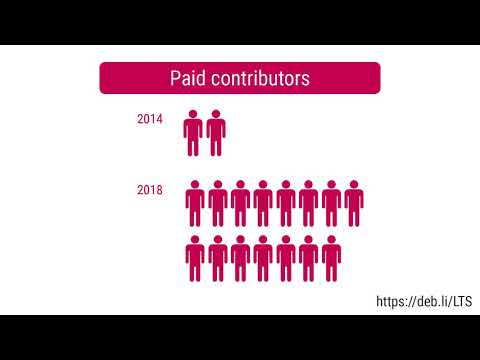
Debian LTS Logo Here is my transparent report for my work on the Debian Long Term Support (LTS) and Debian Extended Long Term Support (ELTS), which extend the security support for past Debian releases, as a paid contributor. In April, the monthly sponsored hours were split evenly among contributors depending on their max availability - I was assigned 28.75h for LTS (out of 30 max; all done) and 7.75h for ELTS (out of 20 max; I did 2.75). Escalation procedures were (internally) documented with a focus on discussing issues with team coordinator(s) first. Debian LTS had its first team meeting through IRC and lots of workflow question were discussed. This should help discuss questions that are a bit hard to bring up, and ensure everybody participates. There were lots of topics and it was a bit rushed, but this is something we want to repeat monthly now, possibly with audio/video in a couple months. Remarks from last month's report were discussed, strengthening the Front-Desk role. 10% of the global funding is now reserved for infrastructure work. What kind of work, and who (LTS or external) will do the work, will be discussed further. A fellow DD suggested (in a private conversation) that LTS may be taking time from the Debian Security team, due to additional commits to review. Conversely, this is another opportunity to mention all the global, non-LTS-specific work that LTS provides, which I usually highlight in my reports, and maybe I should be even more ;) ELTS - Wheezy LTS - Jessie Documentation/Scripts

1 May 2020

Paul Wise: FLOSS Activities April 2020

Changes

Issues

Review

Administration
  • myrepos: fix the forum
  • Debian: restart non-responsive tor daemon, restart processes due to OOM, apply debian.net changes for DD with expired key
  • Debian wiki: approve accounts
  • Debian QA services: deploy changes, auto-disable oldoldstable pockets

Communication

Sponsors The purple-discord work was sponsored by my employer. All other work was done on a volunteer basis.

Utkarsh Gupta: FOSS Activites in April 2020

Here s my (seventh) monthly update about the activities I ve done in the F/L/OSS world.

Debian
It s been 14 months since I ve started contributing to Debian. And 4 months since I ve been a Debian Developer. And in this beautiful time, I had this opprotunity to do and learn lots of new and interesting things. And most importantly, meet and interact with lots of lovely people!
Debian is $home.

Uploads:

Other $things:
  • Attended Ruby team meeting. Logs here.
  • Attended Perl team LHF. Report here.
  • Sponsored a lot of uploads for William Desportes and Adam Cecile.
  • Mentoring for newcomers.
  • FTP Trainee reviewing.
  • Moderation of -project mailing list.
  • Applied for DUCI project for Google Summer of Code 2020.

Ruby2.7 Migration:
Ruby2.7 was recently released on 25th December, 2019. Santa s gift. Believe it or not. We, the Debian Ruby team, have been trying hard to make it migrate to testing. And it finally happened. The default version in testing is ruby2.7. Here s the news! \o/
Here s what I worked on this month for this transition.

Upstream: Opened several issues and proposed patches (in the form of PRs):
  • Issue #35 against encryptor for Ruby2.7 test failures.
  • Issue #28 against image_science for removing relative paths.
  • Issue #106 against ffi-yajl for Ruby2.7 test failures.
  • PR #5 against aggregate for simply using require.
  • PR #6 against aggregate for modernizing CI and adding Ruby 2.5 and 2.7 support.
  • Issue #13 against espeak-ruby for Ruby2.7 test failures.
  • Issue #4 against tty-which for test failures in general.
  • Issue #11 against packable for Ruby2.7 test failures. PR #12 has been proposed.
  • Issue #10 against growl for test failures and proposed an initial patch.

Downstream: I fixed and uploaded the following packages in Debian:

Debian LTS
Debian Long Term Support (LTS) is a project to extend the lifetime of all Debian stable releases to (at least) 5 years. Debian LTS is not handled by the Debian security team, but by a separate group of volunteers and companies interested in making it a success.
This was my seventh month as a Debian LTS paid contributor. I was assigned 24.00 hours and worked on the following things:

CVE Fixes and Announcements:

Other LTS Work:

Other(s)
Sometimes it gets hard to categorize work/things into a particular category.
That s why I am writing all of those things inside this category.
This includes two sub-categories and they are as follows.

Personal: This month I could get the following things done:
  • Most importantly, I finally migrated to a new website. Huge UI imporvement! \o/
    From Jekyll to Hugo, it was not easy. But it was worth it! Many thanks to Luiz for writing hugo-coder, Clement, and Samyak!
    If you find any flaws, issues and pull requests are welcomed at utkarsh2102/utkarsh2102.com
  • Wrote battery-alert, a mini-project of my own to show battery alerts at <10% and >90%.
    Written in shell, it brings me all the satisfaction as it has saved my life on many occasions.
    And guess what? It has more users than just myself!
    Reviews and patches are welcomed \o/
  • Mentored in HackOn Hackathon. Thanks to Manvi for reaching out!
    It was fun to see people developing some really nice projects.
  • Thanks to Ray and John, I became a GitLab Hero!
    (I am yet to figure out my role and responibility though)
  • Atteneded Intro Sec Con and had the most fun!
    Heard Ian s keynote and attended other talks and learned how to use WireShark!

Open Source: Again, this contains all the things that I couldn t categorize earlier.
Opened several issues and pull requests:
  • Issue #297 against hugo-coder, asking to enable RSS feed for blogs.
  • PR #316 for hugo-coder for fixing the above issue myself.
  • Issue #173 against arbre for requesting a release.
  • Issue #104 against combustion, asking to relax dependency on rubocop. Fixed in this commit.
  • Issue #16 against ffi-compiler for requesting to fix homepage and license.
  • Issue #57 against gographviz for requesting a release.
  • Issue #14 against crb-blast, suggesting compatability with bio 2.0.x.
  • Issue #58 against uniform_notifier for asking to drop the use of ruby-growl.
  • PR #2072 for polybar, adding installation instructions on Debian systems.

Until next time.
:wq for today.

30 April 2020

Chris Lamb: Free software activities in April 2020

Here is my monthly update covering what I have been doing in the free software world during April 2020 (previous month's report). Looking it over prior to publishing, I am surprised how much I got done this month I felt that I was not only failing to do all the extra things I had planned, but I was doing far less than normal. But let us go easy on ourselves; nobody is nailing this. In addition, I did more hacking on the Lintian static analysis tool for Debian packages:
Reproducible builds One of the original promises of open source software is that distributed peer review and transparency of process results in enhanced end-user security. However, whilst anyone may inspect the source code of free and open source software for malicious flaws, almost all software today is distributed as pre-compiled binaries. This allows nefarious third-parties to compromise systems by injecting malicious code into ostensibly secure software during the various compilation and distribution processes. The motivation behind the Reproducible Builds effort is to ensure no flaws have been introduced during this compilation process by promising identical results are always generated from a given source, thus allowing multiple third-parties to come to a consensus on whether a build was compromised. The initiative is proud to be a member project of the Software Freedom Conservancy, a not-for-profit 501(c)(3) charity focused on ethical technology and user freedom. Conservancy acts as a corporate umbrella allowing projects to operate as non-profit initiatives without managing their own corporate structure. If you like the work of the Conservancy or the Reproducible Builds project, please consider becoming an official supporter. Elsewhere in our tooling, I made the following changes to diffoscope, our in-depth and content-aware diff utility that can locate and diagnose reproducibility issues, including preparing and uploading versions 139, 140, 141 and 142 to Debian: Lastly, I made a large number of changes to our website and documentation in the following categories:
Debian LTS This month I have contributed 18 hours to Debian Long Term Support (LTS) and 7 hours on its sister Extended LTS project. You can find out more about the project via the following video:
Debian I only filed three bugs in April, including one against snapshot.debian.org to report that a Content-Type HTTP header is missing when downloading .deb files (#956471) and to report build failures in the macs & ruby-enumerable-statistics packages:

Next.

Previous.