Search Results: "don"

10 April 2014

Joey Hess: Kite: a server's tale

My server, Kite, is finishing its 20th year online. It started as kite.resnet.cornell.edu, a 486 under the desk in my dorm room. Early on, it bounced around the DNS -- kite.ithaca.ny.us, kite.ml.org, kite.preferred.com -- before landing on kite.kitenet.net. The hardware has changed too, from a succession of desktop machines, it eventually turned into a 2u rack-mount server in the CCCP co-op. And then it went virtual, and international, spending a brief time in Amsterdam, before relocating to England and the kvm-hosting co-op. Through all this change, and no few reinstalls from scratch, it's had a single distinct personality. This is a multi-user unix system, of the old school, carefully (and not-so-carefully) configured and administered to perform a grab-bag of functions. Whatever the users need. I read the olduse.net hacknews newsgroup, and I see, in their descriptions of their server in 1984, the prototype of Kite and all its ilk. It's consistently had a small group of users, a small subset of my family and friends. Not quite big enough to really turn into a community, and we wall and talk less than we once did.
Exhibit: Kite as it appeared in the 90's [Intentionally partially broken, being able to read the cgi source code is half the fun.] Kite was an early server on the WWW, and garnered mention in books and print articles. Not because it did anything important, but because there were few enough interesting web sites that it slightly stood out.
Many times over these 20 years I've wondered what will be the end of Kite's story. It seemed like I would either keep running it indefinitely, or perhaps lose interest. (Or funding -- it's eaten a lot of cash over the years, especially before the current days of $5/month VPS hosting.) But I failed to anticipate what seems to really be happening to it. Just as I didn't fathom, when kite was perched under my desk, that it would one day be some virtual abstract machine in a unknown computer in anther country. Now it seems that what will happen to Kite is that most of the important parts of it will split off into a constellation of specialized servers. The website, including the user sites, has mostly moved to branchable.com. The DNS server, git server and other crucial stuff is moving to various VPS instances and containers. (The exhibit above is just one more automatically deployed, soulless container..) A large part of Kite has always been about me playing with bleeding-edge stuff and installing random new toys; that has moved to a throwaway personal server at cloudatcost.com which might be gone tomorrow (or might keep running for free for years). What it seems will be left is a shell box, with IMAP access to a mail server, and a web server for legacy /~user/ sites, and a few tools that my users need (including that pine program some of them are still stuck on.) Will it be worth calling that Kite?
[ Kite users: This transition needs to be done by December when the current host is scheduled to be retired. ]

Christine Spang: a tuturial about search

Today I gave a tutorial at PyCon 2014 entitled Search 101: An Introduction to Information Retrieval. It was an experiment of sorts: the first workshop I've run primarily by myself, my first tutorial at PyCon, my first paid teaching gig. It was an opportunity to take some of the lessons I learned from teaching the Boston Python Workshop and apply them to a new situation. The material itself is a distillation of many hours of frustration with the documentation for various open source search engine libraries, frustration that they didn't tell me where to start or about the big picture, they just jumped straight into the details. Here's what worked: Here's what caused problems: Intermediate students are a different crowd than beginners. There was less of an air of discovery in the room, though I organized the class around open-ended tasks. Since the material allowed for folks to take it in the direction of their interest, I found it a bit difficult to gauge whether people were following or not. Overall though, everyone was attentive and studious. I had fun. Ruben and Stuart, the PyCon tutorial organizers, had logistics running super smoothly, AV, lunch, everything. Thanks for that you guys, you rock. :) And thanks as well to my helpers: Leo, the tutorial host, Eben, my TA, and Roberto, on AV. It's impossible to pay adequate attention to 20+ people as a single person, couldn't have done a decent job without y'all. ;)

9 April 2014

Thorsten Glaser: Heartbleed vs. Startcom / StartSSL

First of all, good news, MirBSD is not vulnerable to The Heartbleed Bug due to my deliberate choice to stick to an older OpenSSL version. My inquiry (in various places) as to what precisely could leak when a vulnerable client connected to a n n-vulnerable server has yet to be answered, though we can assume private key material is safe. Now the bad news: while the CA I use and a CA I don t use offer free rekeying (in general), a CA I also use occasionally refuses to do that. The ugly: they will not even revoke the certificates, so any attacker who gained your key, for example when you have been using a certificate of theirs on a Debian system, will be able to use it (e.g. to MITM your visitors traffic) unless you shell over lots of unreasonable money per certificate. (Someone wrote they got the fee waived, but others don t, nor do I. (There s also a great Twitter discussion-thingy about this involving Zugschlus, but I won t link Twitter because they are not accessible to Lynx users like me and other Planet Debian authors.)
I ve been using GoDaddy privately for a while, paid for a wildcard certificate for *.mirbsd.org, and later also at work. I ve stopped using it privately due to current lack of money. Occasionally, for n n-wildcard gratis SSL certificates for HTTP servers. Startcom s StartSSL certificates are unusable for real SSL as used in SMTP STARTTLS anyway, so usage isn t much.
Now I ve got a dilemma here. I ve created a CA myself, to use with MirBSD infrastructure and things like that X.509 certificates for my hosts (especially so I can use them for SMTP) and possibly personal friends (whose PGP key I ve signed with maximum trust after the usual verification) but am using a StartSSL certificate for www.mirbsd.org as my GoDaddy wildcard certificate expires in a week or so (due to the aforementioned monetary issues), and I d rather not pay for a limited certificate only supporting a single vhost. There is absolutely no issue with that certificate and key (only ever generated and used on MirBSD, only using it in Apache mod_ssl). Then, there s this soon-to-be tax-exempt non-profit society of public utility I m working with, whose server runs Debian, and which is affected, but has been using a StartSSL certificate for a while. Neither the society nor I can afford to pay for revocation, and we do not see any possible justification for this especially in the face of CVE-2014-0160. I expect a rekey keeping the current validity end date, and would accept a revocation even if I were unable to get a new certificate, since even were we to get a certificate for the society s domain from someplace else, an attacker could still MITM us with the previous one from Startcom. The problem here is: I d really love to see (all of!) Startcom dropped from the global list of trustworthy CAs, but then I d not know from where to get a cert for MirBSD; Globalsign is not an option because I will not limit SSL compatibility to a level needed to pass their quality test possibly GoDaddy, ISTR they offer a free year to Open Source projects no idea about one for the society but it would solve the problem of not getting the certificates revoked. For everyone. I am giving Startcom time until Friday after $dayjob (for me); after that, I ll be kicking them off MirBSD s CA bundle and will be lobbying for Debian and Mozilla to do the same. Any other ideas of how to deal with that? I d probably pay 5 for a usable certificate accepted by people (including old systems, such as MSIE 5.0 on Win2k and the likes) without questioning most of the time, I only serve public content anyway and just use SSL to make the NSA s job more difficult (and even when not I m not dealing with any payment information, just the occasional login protected area). By the way, is there any way to access the information that is behind a current-day link to groups.google.com with Lynx or Pine? I can t help but praise GMane for their NNTP interface. ObFunfact: just when I was finished writing this wlog entry, I got a new eMail Special offer just for you. from GoDaddy. Sadly, no offer for a 5 SSL certificate, just the usual 20-35% off coupon code.

Petter Reinholdtsen: S3QL, a locally mounted cloud file system - nice free software

For a while now, I have been looking for a sensible offsite backup solution for use at home. My requirements are simple, it must be cheap and locally encrypted (in other words, I keep the encryption keys, the storage provider do not have access to my private files). One idea me and my friends had many years ago, before the cloud storage providers showed up, was to use Google mail as storage, writing a Linux block device storing blocks as emails in the mail service provided by Google, and thus get heaps of free space. On top of this one can add encryption, RAID and volume management to have lots of (fairly slow, I admit that) cheap and encrypted storage. But I never found time to implement such system. But the last few weeks I have looked at a system called S3QL, a locally mounted network backed file system with the features I need. S3QL is a fuse file system with a local cache and cloud storage, handling several different storage providers, any with Amazon S3, Google Drive or OpenStack API. There are heaps of such storage providers. S3QL can also use a local directory as storage, which combined with sshfs allow for file storage on any ssh server. S3QL include support for encryption, compression, de-duplication, snapshots and immutable file systems, allowing me to mount the remote storage as a local mount point, look at and use the files as if they were local, while the content is stored in the cloud as well. This allow me to have a backup that should survive fire. The file system can not be shared between several machines at the same time, as only one can mount it at the time, but any machine with the encryption key and access to the storage service can mount it if it is unmounted. It is simple to use. I'm using it on Debian Wheezy, where the package is included already. So to get started, run apt-get install s3ql. Next, pick a storage provider. I ended up picking Greenqloud, after reading their nice recipe on how to use S3QL with their Amazon S3 service, because I trust the laws in Iceland more than those in USA when it come to keeping my personal data safe and private, and thus would rather spend money on a company in Iceland. Another nice recipe is available from the article S3QL Filesystem for HPC Storage by Jeff Layton in the HPC section of Admin magazine. When the provider is picked, figure out how to get the API key needed to connect to the storage API. With Greencloud, the key did not show up until I had added payment details to my account. Armed with the API access details, it is time to create the file system. First, create a new bucket in the cloud. This bucket is the file system storage area. I picked a bucket name reflecting the machine that was going to store data there, but any name will do. I'll refer to it as bucket-name below. In addition, one need the API login and password, and a locally created password. Store it all in ~root/.s3ql/authinfo2 like this:
[s3c]
storage-url: s3c://s.greenqloud.com:443/bucket-name
backend-login: API-login
backend-password: API-password
fs-passphrase: local-password
I create my local passphrase using pwget 50 or similar, but any sensible way to create a fairly random password should do it. Armed with these details, it is now time to run mkfs, entering the API details and password to create it:
# mkdir -m 700 /var/lib/s3ql-cache
# mkfs.s3ql --cachedir /var/lib/s3ql-cache --authfile /root/.s3ql/authinfo2 \
  --ssl s3c://s.greenqloud.com:443/bucket-name
Enter backend login: 
Enter backend password: 
Before using S3QL, make sure to read the user's guide, especially
the 'Important Rules to Avoid Loosing Data' section.
Enter encryption password: 
Confirm encryption password: 
Generating random encryption key...
Creating metadata tables...
Dumping metadata...
..objects..
..blocks..
..inodes..
..inode_blocks..
..symlink_targets..
..names..
..contents..
..ext_attributes..
Compressing and uploading metadata...
Wrote 0.00 MB of compressed metadata.
# 
The next step is mounting the file system to make the storage available.
# mount.s3ql --cachedir /var/lib/s3ql-cache --authfile /root/.s3ql/authinfo2 \
  --ssl --allow-root s3c://s.greenqloud.com:443/bucket-name /s3ql
Using 4 upload threads.
Downloading and decompressing metadata...
Reading metadata...
..objects..
..blocks..
..inodes..
..inode_blocks..
..symlink_targets..
..names..
..contents..
..ext_attributes..
Mounting filesystem...
# df -h /s3ql
Filesystem                              Size  Used Avail Use% Mounted on
s3c://s.greenqloud.com:443/bucket-name  1.0T     0  1.0T   0% /s3ql
#
The file system is now ready for use. I use rsync to store my backups in it, and as the metadata used by rsync is downloaded at mount time, no network traffic (and storage cost) is triggered by running rsync. To unmount, one should not use the normal umount command, as this will not flush the cache to the cloud storage, but instead running the umount.s3ql command like this:
# umount.s3ql /s3ql
# 
There is a fsck command available to check the file system and correct any problems detected. This can be used if the local server crashes while the file system is mounted, to reset the "already mounted" flag. This is what it look like when processing a working file system:
# fsck.s3ql --force --ssl s3c://s.greenqloud.com:443/bucket-name
Using cached metadata.
File system seems clean, checking anyway.
Checking DB integrity...
Creating temporary extra indices...
Checking lost+found...
Checking cached objects...
Checking names (refcounts)...
Checking contents (names)...
Checking contents (inodes)...
Checking contents (parent inodes)...
Checking objects (reference counts)...
Checking objects (backend)...
..processed 5000 objects so far..
..processed 10000 objects so far..
..processed 15000 objects so far..
Checking objects (sizes)...
Checking blocks (referenced objects)...
Checking blocks (refcounts)...
Checking inode-block mapping (blocks)...
Checking inode-block mapping (inodes)...
Checking inodes (refcounts)...
Checking inodes (sizes)...
Checking extended attributes (names)...
Checking extended attributes (inodes)...
Checking symlinks (inodes)...
Checking directory reachability...
Checking unix conventions...
Checking referential integrity...
Dropping temporary indices...
Backing up old metadata...
Dumping metadata...
..objects..
..blocks..
..inodes..
..inode_blocks..
..symlink_targets..
..names..
..contents..
..ext_attributes..
Compressing and uploading metadata...
Wrote 0.89 MB of compressed metadata.
# 
Thanks to the cache, working on files that fit in the cache is very quick, about the same speed as local file access. Uploading large amount of data is to me limited by the bandwidth out of and into my house. Uploading 685 MiB with a 100 MiB cache gave me 305 kiB/s, which is very close to my upload speed, and downloading the same Debian installation ISO gave me 610 kiB/s, close to my download speed. Both were measured using dd. So for me, the bottleneck is my network, not the file system code. I do not know what a good cache size would be, but suspect that the cache should e larger than your working set. I mentioned that only one machine can mount the file system at the time. If another machine try, it is told that the file system is busy:
# mount.s3ql --cachedir /var/lib/s3ql-cache --authfile /root/.s3ql/authinfo2 \
  --ssl --allow-root s3c://s.greenqloud.com:443/bucket-name /s3ql
Using 8 upload threads.
Backend reports that fs is still mounted elsewhere, aborting.
#
The file content is uploaded when the cache is full, while the metadata is uploaded once every 24 hour by default. To ensure the file system content is flushed to the cloud, one can either umount the file system, or ask S3QL to flush the cache and metadata using s3qlctrl:
# s3qlctrl upload-meta /s3ql
# s3qlctrl flushcache /s3ql
# 
If you are curious about how much space your data uses in the cloud, and how much compression and deduplication cut down on the storage usage, you can use s3qlstat on the mounted file system to get a report:
# s3qlstat /s3ql
Directory entries:    9141
Inodes:               9143
Data blocks:          8851
Total data size:      22049.38 MB
After de-duplication: 21955.46 MB (99.57% of total)
After compression:    21877.28 MB (99.22% of total, 99.64% of de-duplicated)
Database size:        2.39 MB (uncompressed)
(some values do not take into account not-yet-uploaded dirty blocks in cache)
#
I mentioned earlier that there are several possible suppliers of storage. I did not try to locate them all, but am aware of at least Greenqloud, Google Drive, Amazon S3 web serivces, Rackspace and Crowncloud. The latter even accept payment in Bitcoin. Pick one that suit your need. Some of them provide several GiB of free storage, but the prize models are quite different and you will have to figure out what suits you best. While researching this blog post, I had a look at research papers and posters discussing the S3QL file system. There are several, which told me that the file system is getting a critical check by the science community and increased my confidence in using it. One nice poster is titled "An Innovative Parallel Cloud Storage System using OpenStack s SwiftObject Store and Transformative Parallel I/O Approach" by Hsing-Bung Chen, Benjamin McClelland, David Sherrill, Alfred Torrez, Parks Fields and Pamela Smith. Please have a look. Given my problems with different file systems earlier, I decided to check out the mounted S3QL file system to see if it would be usable as a home directory (in other word, that it provided POSIX semantics when it come to locking and umask handling etc). Running my test code to check file system semantics, I was happy to discover that no error was found. So the file system can be used for home directories, if one chooses to do so. If you do not want a locally file system, and want something that work without the Linux fuse file system, I would like to mention the Tarsnap service, which also provide locally encrypted backup using a command line client. It have a nicer access control system, where one can split out read and write access, allowing some systems to write to the backup and others to only read from it. As usual, if you use Bitcoin and want to show your support of my activities, please send Bitcoin donations to my address 15oWEoG9dUPovwmUL9KWAnYRtNJEkP1u1b.

8 April 2014

Tanguy Ortolo: Disable your spammed addresses with Postfix

Using address extension Postfix (and many other mail servers) offers one nice address extension feature: addresses like <user+whaterver@> are implicit aliases to <user@>. This allows users to implement a simple measure to fight spam:

  1. when SomeCompany or whatever asks for your email address, give them <user+somecompany@>;
  2. if you start receiving spam at that address, you know who sold or was stolen your address;
  3. finally, you will be able to disable that address so messages are simply refused with a permanent error code.
Road sign  you shall not pass  with Gandalf
Disabling an extended address So, here is how to implement that last step with Postfix, when you detect that your extended address <user+evilcorp@> is being spammed. In /etc/postfix/main.cf:
smtpd_recipient_restrictions =
    check_recipient_access hash:/etc/postfix/recipients,
    [ ]
Then, create /etc/postfix/recipients containing the addresses to disable:
user+evilcorp@example.com   553 5.7.1 I did not subscribe to receive spam, go away
Of course, the error codes and message can be freely configured, just make sure you are using a permanent error code so senders do not retry. Hash that table, reload Postfix and it is done:
# postmap /etc/postfix/recipients
# service postfix reload
After that, your mail server will reject messages sent to these addresses. And it will do so at the RCPT TO step, saving your bandwidth for more useful things.

Andrew Pollock: [life] Day 70: Visiting relatives and home visiting doctors

Zoe did indeed sleep in this morning, by a whole 30 minutes. It was nice. She seemed no worse for wear for her lip injury, and it was looking better this morning. Wow, "bimonthly" is ambiguous. I had my "every two month" in person co-parenting sync up lunch with Sarah today. Phew, that was a mouthful. Anyway, I had that today, and normally that would fall on a Kindergarten day, but it's school holidays. So we paid grandma and grandpa a visit, and they looked after Zoe for me so I could make the meeting. Mum and Dad have been away on a driving holiday, so Zoe hasn't seen them for a while, and it's been even longer since we've been to their house. She really loves going to their house because it's big, with a big back yard with a swing set. There's all sorts of exciting things like grandpa's worm farm, a sand pit, a china tea set, a piano, a tricycle and remote controlled cars. Zoe basically just works her way around the house entertaining herself. It's great. I usually get to put my feet up and read the newspaper. After I got back from my lunch meeting, we headed over to Greenslopes Private Hospital to visit my cousin, who's just had major surgery. On the way, Zoe napped in the car. I made a brief side trip to clear my post office box along the way. Amusingly, Zoe wakes up from short naps in the car way better than at Kindergarten. I don't know if it has anything to do with the quality of sleep she's getting or what it is, but I easily woke her up and extracted her from the car when we arrived at the hospital. No meltdowns. And that's pretty typical of car naps. I've had a discomfort in my right ear for the last couple of days, and it grew into increasing pain throughout the day today. It got to the point where, while I was driving home, that I deciding to get it looked at by a doctor, ASAP. One of my favourite things about being back in Australia is the availability of home visiting doctors. It was actually faster and cheaper for me to get a home doctor out to look at me tonight than it was to get an appointment with my regular doctor. I wouldn't have gotten an appointment until some time tomorrow at the earliest (assuming he had appointments available), because I made the decision to see a doctor after 5pm, when they'd closed. Instead, I had a doctor at my door in a little more than 2 hours of making the request. It also worked out cheaper, because the home doctor bulk bills Medicare, whereas my regular doctor does not. Add in the massive convenience of not having to lug a small child anywhere while I get seen by a doctor, and it's a major convenience. I love socialised healthcare. It turned out I have an outer ear infection. So all we had to do after the doctor came was find a pharmacy that was still open after 7pm to get my ear drop prescription filled. All of that mucking around meant that Zoe got to bed a little later than usual. It's another cool night tonight, so I'm hoping she'll sleep well and have another sleep in.

Russ Allbery: Review: With Charity for All

Review: With Charity for All, by Ken Stern
Publisher: Anchor
Copyright: November 2013
ISBN: 0-307-74381-0
Format: Trade paperback
Pages: 244
I've been reading a lot lately about how to measure charitable organizations and where best to give your money, which has already prompted a rethinking of which organizations I want to support. Most of that has been shorter, on-line blog posts, but I've been wanting a deeper analysis. This is the first of a couple of books I've found on the topic. (The second, an analysis of microfinance, is waiting for me to have more time to read.) For this kind of book, the background of the author matters a lot. Stern was the former CEO of National Public Radio for eight and a half years, so he has practical experience in the business side of non-profits. He's credited with improving NPR's financial position and management and oversaw an era of rapid growth. In With Charity for All, he speaks frankly about his own personal experiences as well as his research. My impression is that he's typical of competent business managers of non-profits: not particularly radical, focused mostly on business issues, and the sort of person that a non-profit needs to turn a mission or cause into a sustainable organization. It's worth noting in advance that With Charity for All is specifically about the United States charitable sector and US laws and approaches. Some of this may generalize to other countries, but non-profit and charity law is very different between different countries, and the US attitude towards government, non-profits, and the appropriate division of responsibilities between them often doesn't match the prevailing view elsewhere. This book may well be interesting to people outside the US, but only if they're curious about the US charitable sector. The short summary of the message of this book is that we're not getting our money's worth out of charity, either as donors or as taxpayers who are indirectly subsidizing these organizations. This is not (usually) due to any outright fraud, although there certainly is some of that due to the almost total lack of oversight of charitable organizations. Rather, it's the result of a complex combination of history and institutional momentum, focus on the aspects of a charity that play well to potential donors, a concerted effort at feel-good marketing, well-intentioned but misguided donor dictates, adoption of approaches and business practices from the for-profit sector, and, above everything else, the almost complete absence of evidence-based evaluation of charities. Evidence-based evaluation is currently a hot trend among charities. I heard about this book via one of the organizations that is focusing on this (GiveWell). This is not what sites like Charity Navigator do, and indeed Stern talks at some length about the serious limitations of the Charity Navigator approach. All that sites of that type can do is look at spending breakdowns. Stern makes a strong argument that a focus on reducing overhead, as measured by those financial forms, is misguided and leads to very ineffective and unorganized charities. Worse, all Charity Navigator can tell you is if the charity is spending money on something they declare to be in line with their goal, not whether that money did any good whatsoever. The short and depressing news is that most of that money does little or no good, and worse, that most charities have no systematic way of measuring whether it does any good. I'm particularly interested in how to ground charities in more concrete evidence, and Stern's discussion does not disappoint. But one of the things I liked about the book is that he doesn't stop there. Other topics include the dizzying variety of charities and the resulting confusion and dispersion of resources, the non-profits that are practically indistinguishable from for-profit companies except that they get huge tax breaks (sports organizations, as you might expect, are probably the worst offenders, but Stern has harsh commentary on the US hospital system), the mess of compensation in the non-profit sector, and the serious problems created by major donors who want to get directly involved and oversee how their money is spent. All of these topics are fascinating, if a bit depressing in the aggregate. As is typical for a book of this sort, it's a lot easier to see the problems than to describe the solutions. Stern does try to offer his own prescriptions, most of which are variations on more oversight: more regulation, more effort put into measuring results, more concrete standards for success or failure, and a stronger culture of treating tax-exempt status as a privilege, not a right, that has to be defended by showing clear social benefit. I'm convinced those steps would be helpful, although less convinced that we're able to get there from here. One of his ideas I am already using on a small scale: pooling charitable donations with professional evaluators who can take the time to look deeper than financial breakdowns and do some independent measurement of results, or at least survey relevant studies done by others and possibly demand more be done. This model of a mutual fund for charitable giving has some promise, I think (more than a managed mutual fund, in fact), and is very similar to what GiveWell is doing. This is an advocacy book, and one that's primarily focused on concrete, measurable deliverables and on the finances. There are a few places where I have reason to be dubious of the black-and-white conclusions Stern draws. For example, he makes much of the bill collecting practices of charitable hospitals, which I agree is a travesty, but doesn't mention that non-profit hospitals produce better health outcomes. I'm also not sure his analysis is as directly applicable to advocacy organizations, where measuring success is a much more challenging proposition. I think the Southern Poverty Law Center is one of the best charities in the United States (admittedly based largely on gut feeling and presentation), but the nature of their work is not amenable to the style of analysis that Stern is doing here. It's therefore worth taking this book with a grain of salt. But, that said, Stern's conclusions are in line with things I've read elsewhere. I think he's pointing in the right direction, and I would recommend this book to anyone who gives regularly to charity. Hopefully it won't just cause you to stop. There are charities out there that are trying hard to measure their results and ensure they deliver social value for the money that we give them. Our system just doesn't support them very well, yet. Rating: 8 out of 10

7 April 2014

Yves-Alexis Perez: CVE-2014-0160 / heartbleed

Short version: DSA should be in your INBOX in a few moments, and the updates on the mirror a moment later. [UPDATE Tue, 08 Apr 2014 01:06:42 +0200] After the upgrade, you really need to restart all TLS application using libssl1.0.0 to get the fix. Usual suspects are webservers, mailservers etc. Don't forget to restart clients too. Easiest way is to completely reboot the sever, but in case that's not a solution, you can check the process still using the old library with the following snippet:

grep -l 'libssl.*deleted' /proc/*/maps tr -cd 0-9\\n xargs -r ps u Some people seem to indicate that the 64kB leak can enable an attacker to get pretty much anything from the process memory space, including the certificate private key. While we weren't able to confirm that yet, that's not really impossible, so you might also want to regenerate those private keys, although that's not something you should do in a rush either.

Vasudev Kamath: Loading Python modules/plug-ins at runtime

Some times it is desired to load arbitrary python files or pre- installed python modules during application run time.I had encountered 2 such usecases, one is in SILPA application and other is dictionary-bot which I was refactoring recently.

Case 1: Loading installed python module In case of SILPA I need to load pre-installed modules and here is the old code , that is a bit hacky code I copied from Active State Python recipies. I found a bit better way to do it using importlib module as shown below.
from __future__ import print_function
import sys
import importlib
def load_module(modulename):
    mod = None
    try:
        mod = importlib.import_module(modulename)
    except ImportError:
        print("Failed to load  module ".format(module=modulename),
                     file=sys.stderr)
    return mod
Here importlib itself takes care of checking if modulename is already loaded by checking sys.modules[modulename], if loaded it returns that value, otherwise it loads the module and sets it to sys.modules[modulename] before returning module itself.
Case 2: Loading python files from arbitrary location In case of dictionary bot my requirement was bit different, I had some python files lying around in a directory, which I wanted to plug into the bot during run time and use them depending on some conditions. So basic structure which I was looking was as follows.
      pluginloader.py
      plugins
       
       __ aplugin.py
       
       __ bplugin.py
pluginloader.py is the file which needs to load python files under plugins directory. This was again done using importlib module as shown below.
import os
import sys
import re
import importlib
def load_plugins():
    pysearchre = re.compile('.py$', re.IGNORECASE)
    pluginfiles = filter(pysearchre.search,
                           os.listdir(os.path.join(os.path.dirname(__file__),
                                                 'plugins')))
    form_module = lambda fp: '.' + os.path.splitext(fp)[0]
    plugins = map(form_module, pluginfiles)
    # import parent module / namespace
    importlib.import_module('plugins')
    modules = []
    for plugin in plugins:
             if not plugin.startswith('__'):
                 modules.append(importlib.import_module(plugin, package="plugins"))
    return modules
Above code first searches for all python file under specified directory and creates a relative module name from it. For eg. file aplugin.py will become .aplugin. Before loading modules itself we will load the parent module in our case plugins, this is because relative imports in python expects parent module to be already loaded. Finally for relative imports to work with importlib.import_module we need to specify parent module name in package argument. Note that we ignore files begining with __, or specifically we don't want to import __init__.py, this will be done when we import parent module. The above code was inspired from a answer on StackOverflow, which uses imp module, I avoided imp because its been deprecated from Python 3.4 in favor of importlib module.

Russ Allbery: Review: Fantasy & Science Fiction, September/October 2011

Review: Fantasy & Science Fiction, September/October 2011
Editor: Gordon van Gelder
Issue: Volume 121, No. 3 & 4
ISSN: 1095-8258
Pages: 258
Another review of a magazine that I finished quite some time ago. Apologies for any inaccuracies or lack of depth in the reviews. There wasn't much in Charles de Lint's reviews in this issue that interested me, but Michelle West covers a great selection of books. Two of them (The Wise Man's Fear and The Quantum Thief) are already on my to-read list; the third, The Postmortal, sounded interesting and would go on my list to purchase if I didn't already have so many good books I've not read. Otherwise, this issue is short on non-fiction. The only other essay entry is a film review from Kathi Maio, which is the typical whining about all things film that F&SF publishes. "Rutger and Baby Do Jotenheim" by Esther M. Friesner: Baby is a former pole dancer with a toy poodle named Mister Snickers, which warns you right away that this story is going to involve a few over-the-top caricatures and more use of the word "piddle" than one might ideally want. Rutger is a mythology professor who tolerates her for the standard reasons in this sort of pairing. They're travelling across country to Baby's sister's wedding when their car breaks down in Minnesota, prompting an encounter with frost giants. As you might expect, this is a sort of fractured fairy tale, except based on Norse mythology instead of the more typical Grimm fare. The fun is in watching these two apparent incompetents (but with enough knowledge of mythology to clue in the reader) reproduce the confrontation between Thor and Utgard-Loki. The fight with old age is particularly entertaining. If you've read any of Friesner's other stories, you know what to expect: not much in the way of deeper meaning, but lots of fun playing with stereotypes and an optimistic, funny outcome. Good stuff. (7) "The Man Inside Black Betty" by Sarah Langan: This story comes with a mouthful of a subtitle: "Is Nicholas Wellington the World's Best Hope?" It's also a story that purports to be written by a fictional character, in this case one Saurub Ramesh (with Langan credited as having done "research"). It's told in the style of first-person journalism, relating the thoughts and impressions of Ramesh as he interviews Nicholas Wellington. The topic is Black Betty: a black hole above Long Island Sound. Wellington is a scientific genius and iconoclast with radical theories of black holes that contradict how the government has been attempting to deal with Black Betty, unsuccessfully. The structure here was well-handled, reminding me a lot of a Michael Lewis article during the financial collapse. Langan has a good feel for how journalism of this type mixes personalities, politics, and facts. But it's all setup and no story. We get some world building, and then it's over, with no resolution except pessimism. Meh. (4) "A Borrowed Heart" by Deborah J. Ross: Ross starts with the trappings of urban fantasy transplanted into a Victorian world: supernatural creatures about, a protagonist who is a high-class prostitute, and sex and a sucubus by the second page. It evolves from there into a family drama and an investigation, always giving the reader the impression that a vampire will jump out at any moment. But the ending caught me entirely by surprise and was far more effective due to its departure from the expected path. Well done. (7) "Bright Moment" by Daniel Marcus: The conflict between terraforming and appreciation for the universe as we find it is an old story pattern in science fiction, and Marcus doesn't add much here. I think the story would have been stronger if he'd found a way to write the same plot with a pure appeal to environmental beauty without the typical stakes-raising. But he does sprinkle the story with a few interesting bits, including a pod marriage and a futuristic version of extreme sports as a way of communing with nature. (6) "The Corpse Painter's Masterpiece" by M. Rickert: This is typical of my reaction to a Rickert story: shading a bit too much towards horror for me, a bit too cryptic, well-written but not really my thing. It's about a corpse painter who does the work of an informal mortician, improving the appearance of bodies for their funerals, and the sheriff who brings him all the dead bodies. It takes an odd macabre twist, and I have no idea what to make of the ending. (4) "Aisle 1047" by Jon Armstrong: Armstrong is best known for a couple of novels, Grey and Yarn, which entangle their stories in the future of marketing and commerce. One may be unsurprised, then, that this short story is on similar themes, with the intensity turned up to the parody point. Tiffan3 is a department-store saleswoman, spouting corporate slogans and advertising copy while trying to push customers towards particular products. The story follows the escalation into an all-out brand war, fought with the bubbly short-cut propaganda of a thirty-second commercial. For me, it fell awkwardly between two stools: it's a little too over-the-top and in love with its own bizarre alternate world to be effective satire, but the world is more depressing than funny and the advertising copy is grating. More of a curiosity than a successful story, I think. (5) "Anise" by Chris DeVito: Stories that undermine body integrity and focus on the fascinated horror of violation of physical boundaries aren't generally my thing, so take that into account in this review. Anise's husband died, but that's not as much of a problem as it used to be. Medical science can resurrect people via a sort of permanent, full-body life support system, making them more cyborg than human. "Anise" is about the social consequences of this technology in a world where a growing number of people have a much different relationship with their body than the typical living person today. It's a disturbing story that is deeply concerned with the physical: sex, blood, physical intimacy in various different forms, and a twisted type of psychological abuse. I think fans of horror will like this more than I did, although it's not precisely horror. It looks at the way one's perception of self and others can change by passing through a profound physical transformation. (5) "Spider Hill" by Donald Mead: I liked this story a lot better. It's about witchcraft and farm magic, about family secrets, and a sort of coming-of-age story (for a girl rather than a boy, for once). The main character is resourceful, determined, but also empathetic and aware of the impact of her actions, which made her more fun to read about. I doubt I'll remember this for too long, but when skimming through it again for a review, I had fond memories of it. (6) "Where Have All the Young Men Gone?" by Albert E. Cowdrey: Cowdrey in his paranormal investigation mode, which I like better than his horror mode. For once, the protagonist isn't even a lower-class or backwoods character. Instead, he's a military historian travelling in Austria who runs across a local ghost story. This is a fairly straightforward ghost investigation that follows a familiar path (albeit to an unusual final destination), but Cowdrey is a good story-teller and I liked the protagonist. (7) "Overtaken" by Karl Bunker: This is the sort of story that delivers its moral with the force of a hammer. It's not subtle. But if you're in the right mood for that, it's one of the better stories of its type. It's about a long-journey starship, crew in hibernation, that's overtaken by a far newer and faster mechanized ship from Earth that's attempting to re-establish contact with the old ships. The story is a conversation between the ship AIs. Save this one until you're in the mood for an old-fashioned defense of humanity. (8) "Time and Tide" by Alan Peter Ryan: Another pseudo-horror story, although I think it's better classified as a haunting. A wardrobe recalls a traumatic drowning in the childhood of the protagonist. As these things tend to do in stories like this, reality and memory start blurring and the wardrobe takes on a malevolent role. Not my sort of thing. (3) "What We Found" by Geoff Ryman: Any new Geoff Ryman story is something to celebrate. This is a haunting story on the boundaries between the scientific method and tribal superstition, deeply entangled with the question of how one recovers from national and familial trauma. How can we avoid passing the evils and madness of one generation down to the next? Much of the story is about family trauma, told with Ryman's exceptional grasp of character, but the science is entangled in an ingenious way that I won't spoil. As with Air, this is in no way science fiction. The science here would have fascinating and rather scary implications for our world, but clearly is not how science actually works. But as an insight into politics, and into healing, I found it a startlingly effective metaphor. I loved every bit of this. By far the best story of the issue. (9) Rating: 7 out of 10

6 April 2014

Steve Kemp: So that distribution I'm not-building?

The other week I was toying with using GNU stow to build an NFS-share, which would allow remote machines to boot from it. It worked. It worked well. (Standard stuff, PXE booting with an NFS-root.) Then I started wondering about distributions, since in one sense what I'd built was a minimal distribution. On that basis yesterday I started hacking something more minimal: Unfortunately here is where I ran out of patience. Using tcc and the static C library I can compile code. But I can't link it.
$ cat > t.c <>EOF
int main ( int argc, char *argv[] )
 
        printf("OK\n" );
        return 1;
 
EOF
$ /opt/tcc/bin/tcc t.c
tcc: error: file 'crt1.o' not found
tcc: error: file 'crti.o' not found
..
Attempting to fix this up resulted in nothing much better:
$ /opt/tcc/bin/tcc t.c -I/opt/musl/include -L/opt/musl/lib/
And because I don't have a full system I cannot compile t.c to t.o and use ld to link (because I have no ld.) I had a brief flirt with the portable c-compiler, pcc, but didn't get any further with that. I suspect the real solution here is to install gcc onto my host system, with something like --prefix=/opt/gcc, and then rsync that into my (suddenly huge) intramfs image. Then I have all the toys.

Russell Coker: Finding Corrupt Files that cause a Kernel Error

There is a BTRFS bug in kernel 3.13 which is triggered by Kmail and causes Kmail index files to become seriously corrupt. Another bug in BTRFS causes a kernel GPF when an application tries to read such a file, that results in a SEGV being sent to the application. After that the kernel ceases to operate correctly for any files on that filesystem and no command other than reboot -nf (hard reset without flushing write-back caches) can be relied on to work correctly. The second bug should be fixed in Linux 3.14, I m not sure about the first one. In the mean time I have several systems running Kmail on BTRFS which have this problem. (strace tar cf . cat > /dev/null) 2>&1 tail To discover which file is corrupt I run the above command after a reboot. Below is a sample of the typical output of that command which shows that the file named .trash.index is corrupt. After discovering the file name I run reboot -nf and then delete the file (the file can be deleted on a clean system but not after a kernel GPF). Of recent times I ve been doing this about once every 5 days, so on average each Kmail/BTRFS system has been getting disk corruption every two weeks. Fortunately every time the corruption has been on an index file so I don t need to restore from backups. newfstatat(4, ".trash.index", st_mode=S_IFREG 0600, st_size=33, , AT_SYMLINK_NOFOLLOW) = 0
openat(4, ".trash.index", O_RDONLY O_NOCTTY O_NONBLOCK O_NOFOLLOW O_CLOEXEC) = 5
fstat(5, st_mode=S_IFREG 0600, st_size=33, ) = 0
read(5, <unfinished >
+++ killed by SIGSEGV +++

4 April 2014

Daniel Pocock: Best real-time communication (RTC / VoIP) softphone on the Linux desktop?

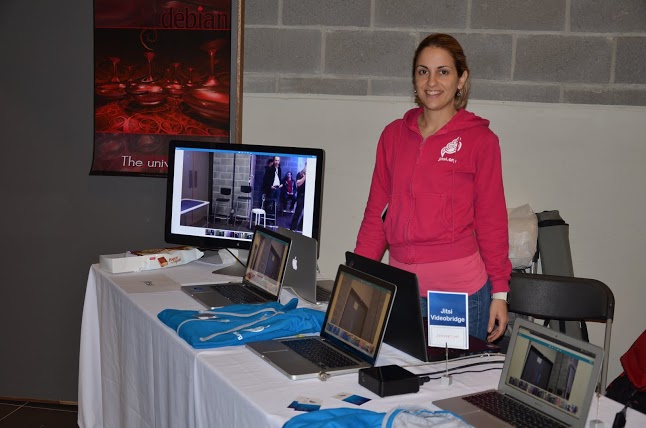
The Debian community has recently started discussing the way to choose the real-time communications (RTC/VoIP) desktop client for Debian 8 (jessie) users. Debian 7 (wheezy), like Fedora, ships GNOME as the default desktop and the GNOME Empathy client is installed by default with it. Simon McVittie, Empathy package maintainer has provided a comprehensive response to the main discussion points indicating that the Empathy project comes from an Instant Messaging (IM) background (it is extremely easy to setup and use for XMPP chat) but is not a strong candidate for voice and video. Just how to choose an RTC/VoIP client then? One question that is not answered definitively is just who should choose the default RTC client. Some people have strongly argued that the maintainers of individual desktop meta-packages should choose as they see fit. Personally, I don't agree with this viewpoint and it is easy to explain why. Just imagine the maintainers of GNOME choose one RTC application and the maintainers of XFCE choose an alternative and these two RTC applications don't talk to each other. If a GNOME user wants to call an XFCE user, do they have to go to extra effort to get an extra package installed? Do they even have to change their desktop? For power users these questions seem trivial but for many of our friends and family who we would like to contact with free software, it is not amusing. When the goal of the user is to communicate freely and if they are to remain free to choose any of the desktops then a higher-level choice of RTC client (or at least a set of protocols that all default clients must support) becomes essential. Snail mail to the rescue? There are several friends and family I want to be able to call with free software. The only way I could make it accessible to them was to burn self-booting Debian Live desktop DVDs with an RTC client pre-configured. Once again, as a power-user maybe I have the capability to do this - but is this an efficient way to overcome those nasty proprietary RTC clients, burning one DVD at a time and waiting for it to be delivered by snail mail? A billion browsers can't be wrong WebRTC has been in the most recent stable releases of Firefox/Iceweasel and Chrome/Chromium for over a year now. Many users already have these browsers thanks to automatic updates. It is even working well on the mobile versions of these browsers. In principle, WebRTC relies on existing technologies such as the use of RTP as a transport for media streams. For reasons of security and call quality, the WebRTC standard mandates the use of several more recent standards and existing RTC clients simply do not interoperate with WebRTC browsers. It really is time for proponents of free software to decide if they want to sink or swim in this world of changing communications technology. Browsers will not dumb-down to support VoIP softphones that were never really finished in the first place. Comparing Empathy and Jitsi There are several compelling RTC clients to choose from and several of them are now being compared on the Debian wiki. Only Jitsi stands out offering the features needed for a world with a billion WebRTC browser users.
Feature Empathy WebRTC requirement? Comments
Internet Connectivity Establishment (ICE) and TURN (relay) Only for gmail XMPP accounts, and maybe not for much longer For all XMPP users with any standards-based TURN server, soon for SIP too Mandatory Enables effective discovery of NAT/firewall issues and refusal to place a call when there is a risk of one-way-audio. Some legacy softphones support STUN, which is only a subset of ICE/TURN.
AVPF X Mandatory Enables more rapid feedback about degrading network conditions, packet loss, etc to help variable bit rate codecs adapt and maximise call quality. Most legacy VoIP softphones support AVP rather than AVPF.
DTLS-SRTP X Mandatory for Firefox, soon for Chrome too DTLS-based peer-to-peer encryption of the media streams. Most legacy softphones support no encryption at all, some support the original SRTP mechanism based on SDES keys exchanged in the signalling path.
Opus audio codec X Strongly recommended. G.711 can also be used but does not perform well on low bandwidth/unreliable connections Opus is a variable bit rate codec the supercedes codecs like Speex, SILK, iLBC, GSM and CELT. It is the only advanced codec browsers are expected or likely to implement. Most of the legacy softphones support the earlier codec versions (such as GSM) and some are coded in such a way that they can't support any variable bit-rate codec at all.
Retrofitting legacy softphones with all of these features is no walk in the park. Some of them may be able to achieve compliance more easily by simply throwing away their existing media code and rebuilding on top of the WebRTC media stack used by the browsers However, the Jitsi community have already proven that their code can handle all of these requirements by using their media processing libraries to power their JitMeet WebRTC video conferencing server Dreams are great, results are better Several people have spoken out to say they want an RTC client that has good desktop integration (just like Empathy) but I'm yet to see any of them contribute any code to such an effort. Is this type of desktop integration the ultimate priority and stubbornly non-negotiable though? Is it more an example of zealous idealism that may snuff out hope of bringing the optimum communications tools into the hands of users? As for solving all the other problems facing free communications software, the Jitsi community have been at it for more than 10 years. Just have a look at their scorecard on Github to see what I mean. Jitsi lead developer Emil Ivov has a PhD in multimedia and is a regular participant in the IETF, taking on some of the toughest questions, like how to make a world with two protocols (SIP and XMPP) friendly for real users. A serious issue for all Linux distributions Communications technology is one of the most pervasive applications and also one of the least forgiving. Users have limited patience with phones that don't work, as the Australian Russell Crowe demonstrated in his infamous phone-throwing incident. Maximizing the number of possible users is the key factor that makes networks fail or succeed. It is a knife that cuts both ways: as the free software community struggles with this issue, it undermines our credibility on other issues and makes it harder to bring free desktops to our friends, families and workplaces. Do we really want to see the rest of our work in these areas undermined, especially when there is at least one extremely viable option knocking at the door?

Luciano Bello: Private folder in Dropbox

I wanted to have a directory in my Dropbox where every file placed get some sort of encryption. They might be personal pictures (if you know what I mean), finance notes, patent ideas, or the like. I create those files constantly, often with my phone. While I would like to back them up on the cloud, I don t need to access them regularly. The problem is that I don t want my phone to storage them (at least not plain) for obvious reasons. And, on top of this, Android s Dropbox app does not allow to disable synchronization by folder. So, here is the scheme I came up with. Maybe it is also useful for you or you get some idea how to improve it. You will need an always-on-line computer with Dropbox client (for Dropbox synchronization), GnuPG (for cipher the files), and a really nice tool called incron (which monitors a directory and trigger actions). The instructions: That s all, each time you put something in your private folder, incron will cipher it and leave it there.

Mario Lang: Accessible voting graphs

It is that time of the year again, Debian is electing the Project Leader for 2014/15. Whenever a Debian vote is in progress, I find myself rather happy to rediscover that Debian is providing text mode voting graphs. These are quite accessible to me as a braille user. It is rather unusual for me as a blind person to be able to access any graphs on the internet at all. All this has been made possible by gnuplots ability to generate text plots, and Manoj's willingness to implement it during his term as project secretary. Thanks to Gnuplot and Manoj, and thanks to the current secretary for keeping this feature, it is (at least to me) a very nice to have, and actually makes Debian rather unique. I personally don't know of any other major projects which provide text graphs. We are indeed setting a very good example here. It would be nice if other projects would adopt this as well. This is bridging the digital divide for me. For completeness sake I should probably mention that text graphs are not an universal solution for blind users. Those of us who do not use braille will probably have a very hard time extracting any meaningful information from this ASCII character salad. But to a braille user used to reading two dimensional information from the screen, it does actually work rather well. Some solutions from the 90s, when people didn't have graphical terminals readily available everywhere, are still very good accessibility workarounds. I am going to post another article about how I play chess on a computer, with newsgroup-style chessboard diagrams. Now that I think of it, these two topics are very related. There are some rather nifty solutions floating around from the good old text mode days which we need to revive before they finally get forgotten on the internet.

Gunnar Wolf: Mozilla: So our communitary echobox *does* resound with social issues

I woke up to the news that, after a very short tenure, Brendan Eich steps down as the Mozilla CEO. Why? Because of the community outcry. Because some years ago, Eich pubilcly supported (and donated funds) the ban of any kind of marriages in California that were not between a man and a woman. The world has advanced enormously in this regard in the last years/decades, and so many individuals and organizations opposed and announced they would boycott Mozilla that either him or Mozilla could not stand the pressure anymore. So, of course, it's sad the person had to resign. Many people talked about freedom of speech, freedom of harbouring his own personal opinion But when it comes to the rights of minorities, particularly of minorities that have suffered such hard prejudice and abuse as the gay, lesbian and all the other non-orthodox sexual- and gender- orientations, righting a wrong is much more important than preserving an individual's freedom of opinion. Besides, it's not just thinking or talking about something The concrete proposition Eich supported (and eventually made him resign) is about bringing the life of thousands of people to a hellish state of uncertainty, and going back to not having a way for the society to legally recognize their way of being, their love, their lifes. But anyway What prompts me into writing this is that, once again, the Free Software (and related denominations) community has shown that a set of core values, seemingly shared by a very large amount of our own people with no coordination or correlation with what conforms us as a community (and thus, being emergent traits), are strong enough to create a critical mass, to achieve cohesion. And that ours is not just a technical community of people writing software at all layers of the stack, but first and foremost is a group of social activists, committed to making the world better. I will quote from Matthew Garrett's post on this topic, clearly more contundent and thorough that what I'm trying to come up with:

The Mozilla Manifesto discusses individual liberty in the context of use of the internet, not in a wider social context. Brendan's appointment was very much in line with the explicit aims of both the Foundation and the Corporation - whatever his views on marriage equality, nobody has seriously argued about his commitment to improving internet freedom. So, from that perspective, he should have been a fine choice. But that ignores the effect on the wider community. People don't attach themselves to communities merely because of explicitly stated goals - they do so because they feel that the community is aligned with their overall aims. The Mozilla community is one of the most diverse in free software, at least in part because Mozilla's stated goals and behaviour are fairly inspirational. People who identify themselves with other movements backing individual liberties are likely to identify with Mozilla. So, unsurprisingly, there's a large number of socially progressive individuals (LGBT or otherwise) in the Mozilla community, both inside and outside the Corporation. A CEO who's donated money to strip rights from a set of humans will not be trusted by many who believe that all humans should have those rights. It's not just limited to individuals directly affected by his actions - if someone's shown that they're willing to strip rights from another minority for political or religious reasons, what's to stop them attempting to do the same to you? Even if you personally feel safe, do you trust someone who's willing to do that to your friends? In a community that's made up of many who are either LGBT or identify themselves as allies, that loss of trust is inevitably going to cause community discomfort.

3 April 2014

Matthew Garrett: Mozilla and leadership

A post I wrote back in 2012 got linked from a couple of the discussions relating to Brendan Eich being appointed Mozilla CEO. The tldr version is "If members of your community doesn't trust their leader socially, the leader's technical competence is irrelevant". That seems to have played out here.

In terms of background[1]: in 2008, Brendan donated money to the campaign for Proposition 8, a Californian constitutional amendment that expressly defined marriage as being between one man and one woman[2]. Both before and after that he had donated money to a variety of politicians who shared many political positions, including the definition of marriage as being between one man and one woman[3].

Mozilla is an interesting organisation. It consists of the for-profit Mozilla Corporation, which is wholly owned by the non-profit Mozilla Foundation. The Corporation's bylaws require it to work to further the Foundation's goals, and any profit is reinvested in Mozilla. Mozilla developers are employed by the Corporation rather than the Foundation, and as such the CEO is responsible for ensuring that those developers are able to achieve those goals.

The Mozilla Manifesto discusses individual liberty in the context of use of the internet, not in a wider social context. Brendan's appointment was very much in line with the explicit aims of both the Foundation and the Corporation - whatever his views on marriage equality, nobody has seriously argued about his commitment to improving internet freedom. So, from that perspective, he should have been a fine choice.

But that ignores the effect on the wider community. People don't attach themselves to communities merely because of explicitly stated goals - they do so because they feel that the community is aligned with their overall aims. The Mozilla community is one of the most diverse in free software, at least in part because Mozilla's stated goals and behaviour are fairly inspirational. People who identify themselves with other movements backing individual liberties are likely to identify with Mozilla. So, unsurprisingly, there's a large number of socially progressive individuals (LGBT or otherwise) in the Mozilla community, both inside and outside the Corporation.

A CEO who's donated money to strip rights[4] from a set of humans will not be trusted by many who believe that all humans should have those rights. It's not just limited to individuals directly affected by his actions - if someone's shown that they're willing to strip rights from another minority for political or religious reasons, what's to stop them attempting to do the same to you? Even if you personally feel safe, do you trust someone who's willing to do that to your friends? In a community that's made up of many who are either LGBT or identify themselves as allies, that loss of trust is inevitably going to cause community discomfort.

The first role of a leader should be to manage that. Instead, in the first few days of Brendan's leadership, we heard nothing of substance - at best, an apology for pain being caused rather than an apology for the act that caused the pain. And then there was an interview which demonstrated remarkable tone deafness. He made no attempt to alleviate the concerns of the community. There were repeated non-sequiturs about Indonesia. It sounded like he had no idea at all why the community that he was now leading was unhappy.

And, today, he resigned. It's easy to get into hypotheticals - could he have compromised his principles for the sake of Mozilla? Would an initial discussion of the distinction between the goals of members of the Mozilla community and the goals of Mozilla itself have made this more palatable? If the board had known this would happen, would they have made the same choice - and if they didn't know, why not?

But that's not the real point. The point is that the community didn't trust Brendan, and Brendan chose to leave rather than do further harm to the community. Trustworthy leadership is important. Communities should reflect on whether their leadership reflects not only their beliefs, but the beliefs of those that they would like to join the community. Fail to do so and you'll drive them away instead.

[1] For people who've been living under a rock
[2] Proposition 8 itself was a response to an ongoing court case that, at the point of Proposition 8 being proposed, appeared likely to support the overturning of Proposition 22, an earlier Californian ballot measure that legally (rather than constitutionally) defined marriage as being between one man and one woman. Proposition 22 was overturned, and for a few months before Proposition 8 passed, gay marriage was legal in California.
[3] http://www.theguardian.com/technology/2014/apr/02/controversial-mozilla-ceo-made-donations-right-wing-candidates-brendan-eich
[4] Brendan made a donation on October 25th, 2008. This postdates the overturning of Proposition 22, and as such gay marriage was legal in California at the time of this donation. Donating to Proposition 8 at that point was not about supporting the status quo, it was about changing the constitution to forbid something that courts had found was protected by the state constitution.

comment count unavailable comments

Johannes Schauer: mapbender - maps for long-distance travels

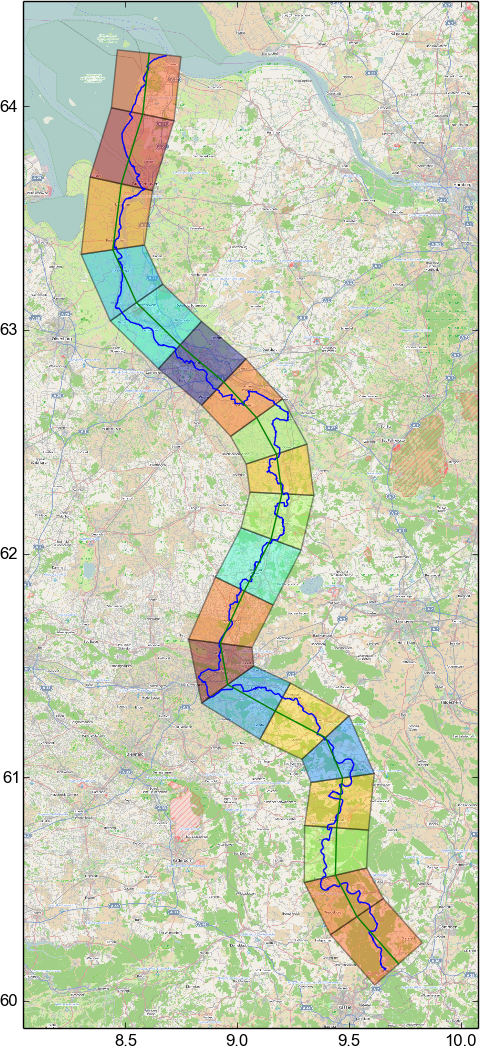
Back in 2007 I stumbled over the "Plus Fours Routefinder", an invention of the 1920's. It's worn on the wrist and allows the user to scroll through a map of the route they planned to take, rolled up on little wooden rollers. At that point I thought: that's awesome for long trips where you either dont want to take electronics with you or where you are without any electricity for a long time. And creating such rollable custom maps of your route automatically using openstreetmap data should be a breeze! Nevertheless it seems nobody picked up the idea. Years passed and in a few weeks I'll go on a biking trip along the Weser, a river in nothern Germany. For my last multi-day trip (which was through the Odenwald, an area in southern Germany) I printed a big map from openstreetmap data which contained the whole route. Openstreetmap data is fantastic for this because in contrast to commercial maps it doesnt only allow you to just print the area you need but also allows you to highlight your planned route and objects you would probably not find in most commercial maps like for example supermarkets to stock up on supplies or bicycle repair shops. Unfortunately such big maps have the disadvantage that to show everything in the amount of detail that you want along your route, they have to be pretty huge and thus easily become an inconvenience because the local plotter can't handle paper as large as DIN A0 or because it's a pain to repeatedly fold and unfold the whole thing every time you want to look at it. Strong winds are also no fun with a huge sheet of paper in your hands. One solution would be to print DIN A4 sized map regions in the desired scale. But that has the disadvantage that either you find yourself going back and forth between subsequent pages because you happen to be right at the border between two pages or you have to print sufficiently large overlaps, resulting in many duplicate map pieces and more pages of paper than you would like to carry with you. It was then that I remembered the "Plus Fours Routefinder" concept. Given a predefined route it only shows what's important to you: all things close to the route you plan to travel along. Since it's a long continuous roll of paper there is no problem with folding because as you travel along the route you unroll one end and roll up the other. And because it's a long continuous map there is also no need for flipping pages or large overlap regions. There is not even the problem of not finding a big enough sheet of paper because multiple DIN A4 sheets can easily be glued together at their ends to form a long roll. On the left you see the route we want to take: the bicycle route along the Weser river. If I wanted to print that map on a scale that allows me to see objects in sufficient detail along our route, then I would also see objects in Hamburg (upper right corner) in the same amount of detail. Clearly a waste of ink and paper as the route is never even close to Hamburg.

As the first step, a smooth approximation of the route has to be found. It seems that the best way to do that is to calculate a B-Spline curve approximating the input data with a given smoothness. On the right you can see the approximated curve with a smoothing value of 6. The curve is sampled into 20 linear segments. I calculated the B-Spline using the FITPACK library to which scipy offers a Python binding.
The next step is to expand each of the line segments into quadrilaterals. The distance between the vertices of the quadrilaterals and the ends of the line segment they belong to is the same along the whole path and obviously has to be big enough such that every point along the route falls into one quadrilateral. In this example, I draw only 20 quadrilaterals for visual clarity. In practice one wants many more for a smoother approximation.
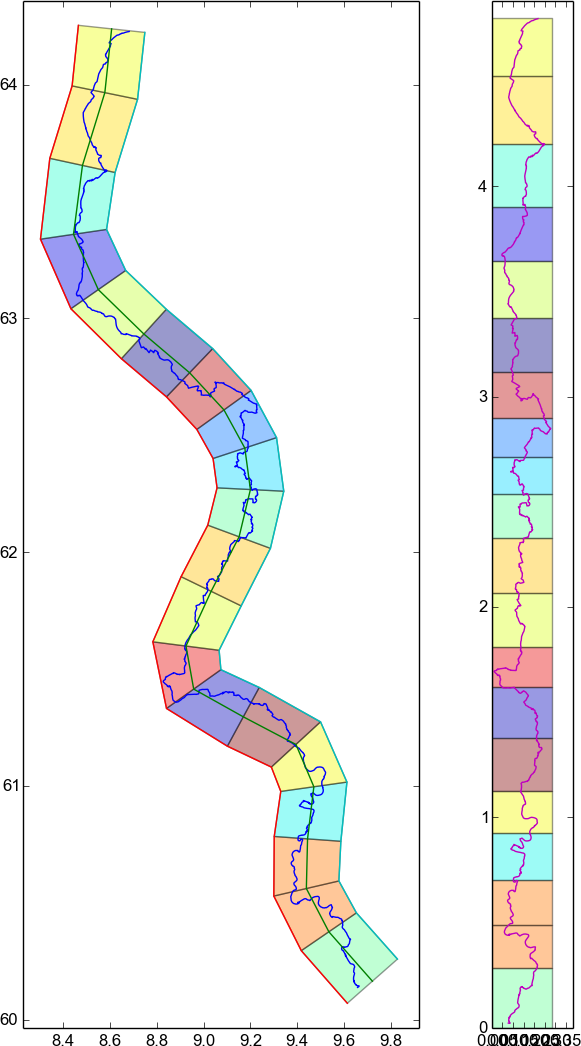
Using a simple transform, each point of the original map and the original path in each quadrilateral is then mapped to a point inside the corresponding "straight" rectangle. Each target rectangle has the height of the line segment it corresponds to. It can be seen that while the large scale curvature of the path is lost in the result, fine details remain perfectly visible. The assumption here is, that while travelling a path several hundred kilometers long, it does not matter that large scale curvature that one is not able to perceive anyways is not preserved. The transformation is done on a Mercator projection of the map itself as well as the data of the path. Therefore, this method probably doesnt work if you plan to travel to one of the poles. Currently I transform openstreetmap bitmap data. This is not quite optimal as it leads to text on the map being distorted. It would be just as easy to apply the necessary transformations to raw openstreetmap XML data but unfortunately I didnt find a way to render the resulting transformed map data as a raster image without setting up a database. I would've thought that it would be possible to have a standalone program reading openstreetmap XML and dumping out raster or svg images without a round trip through a database. Furthermore, tilemill, one of the programs that seem to be one of the least hasslesome to set up and produce raster images is stuck in an ITP and the existing packaging attempt fails to produce a non-empty binary package. Since I have no clue about nodejs packaging, I wrote about this to the pkg-javascript-devel list. Maybe I can find a kind soul to help me with it.
Here a side by side overview that doesnt include the underlying map data but only the path. It shows how small details are preserved in the transformation. The code that produced the images in this post is very crude, unoptimized and kinda messy. If you dont care, then it can be accessed here

Steve Kemp: Tagging images, and maintaining collections?

I'm an amateur photographer, although these days I tend to drop the amateur prefix, given that I shoot people for cash at least once a month. (It isn't my main job, and I'd never actually want it to be, because I'm certain I'd become unhappy hustling for jobs and doing the promotion thing.) Anyway over the years I've built up a large library of images, mostly organized in a hierarchy of directories beneath ~/Images. Unlike most photographers I don't use aperture, lighttable, or any similar library management. I shoot my images in RAW, convert to JPG via rawtherapee, and keep both versions of the images. In short I don't want to mix the "library management" functions with the "RAW conversion" because I do regard them as two separate steps. That said I'm reaching a point where I do want to start tagging images, and finding them more quickly. In the past I wrote a couple of simple tools to inject tags into the EXIF data of images, and then indexed them. But that didn't work so well in practise. I'm starting to think instead I should index images into sqlite: The downside is that this breaks utterly as soon as you move images around on-disk. Which is something my previous exif-manipulation was designed to avoid. Anyway I'm thinking at the moment, but I know that the existing tools such as F-Spot, shotwell, DigiKam, and similar aren't suitable. So I either need to go standalone and use EXIF tags, accepting the fact that the tags I enter won't be visible to other tools, or I cope with the file-rename issues by attempting to update an existing sqlite database via hash/size/etc.

Aigars Mahinovs: Wireless photo workflow

For a while now I've been looking for ways to improve my photo workflow - to simplify and speed up the process. Now I've gotten a new toy to help that along - a Panasonic FlashAir SD card with WiFi connectivity. I was pretty sure that build-in workflows of some more automated solutions would not be a perfect fit for me, so I got this card which has a more manual workflow and a reasonable API, so I could write my own. Now I am trying to work out my requirements, the user stories if you will. I see two distinct workflows: live event and travel pictures. In both cases I want the images to retain the file names, Exif information and timing of the original photos and also have embedded GPS information from the phone synced to the time the photo was taken. And if I take a burst of very similar photos, I want the uploading process to only select and upload the "best" one (trivial heiristic being the file size) with an ability for me to later choose another one to replace it. There would need to be some way of syncing phone and camera time, especially considering that phones usually switch to local time zone when traveling and cameras do not, maybe the original time the photo was taken would need to be changed to local time zone, so that there are no photos that are taken during the day, but have a timestamp of 23:45 GMT. When I am in Live Event mode I would like the photos that I take to immediately start uploading to an event album that I create (or choose) at the start of the shoot with a preset privacy mode. This assumes that either I am willing to upload via 3G of my phone or that I have access to a stable WiFi network on-site. It might be good if I could upload a scaled down version of the pictures during the event and then later replace the image files with full-size images when the even is over and I am at home in my high-speed network. I probably don't need the full size files on my phone. When I am in Travel mode, I want to delay photo uploading until I am back at the hotel with its high speed Wifi, but also have an option to share some snapshots immediately over 3G or random cafe Wifi. I am likely to take more photos that there is memory in my phone, so I would like to clear original files from the phone while keeping them in the SD card and in the cloud, but still keeping enough metadata to allow re-uploading an image or choosing another image in a burst. Now I need to flesh out the technical requirements from the above and write an Android app to implement that. Or maybe start by writing this in Python as a cross-platform command-line/desktop app and only later porting it to Android when all the rought parts are ironed out. This will have an extra benefit of people being able to run the same workflow on a laptop instead of a phone or tablet. Let's assume that this is written in a pretty flexible way, allowing to plug in backends for different WiFi SD cards, cloud services, plug-in points for things like instant display of the latest photo on the laptop screen in full-screen mode and other custom actions, what else would people love to see in something like this? What other workflow am I completely overlooking?

Next.

Previous.