Search Results: "sto"

25 October 2013

David Welton: MicroConf Europe

I don't envy conference organizers these days - most of what's being said can be read the next day, for free, on line, at your own pace, from the comfort of your own home, and without spending a bundle of time and money to sleep in a far away hotel. Competing with that is not easy, but the guys at MicroConf managed to. I would sum up the weekend by saying that it was a "very high bandwidth experience". Every day, from breakfast until I turned in, I was chatting with people or listening to speakers during the conference itself. That's aproximately 16 hours of being "on", and by the time I got home to Padova, I was exhausted! But at the end of the day, I felt like it was worth it being there in person, because of all the interaction with other people. The speakers' talks all ended up on line, more or less, but all the chatting and discussion and getting to know everyone is the human element that is tough to replicate on line, and one of the most important reasons to attend a conference in person. Prague is also a beautiful city - I wish I had had more time there to check it out. Here are some highlights and notes, in no particular order: However, since it was a business conference, I also have to put on my cold, hard accountant hat. Will the conference pay for itself? Only time will tell. I learned a variety of interesting and useful things, many of which I think I can put into practice. The problem is finding the time between consulting work and family, but that was a bottleneck before, too - I had, and have, more things to do than time. Also, to be very direct about it, how much of what I learned could not have been learned by carefully reading accounts of the conference, slides, and other material published on the internet? A lot of it. I'm not sure I would have paid attention to all of it though, so the conference was definitely nice in that it exposed me to some talks and ideas that otherwise I might have brushed off before giving them a chance. In terms of dollars and cents, I won't be able to say for a while whether it was a sensible investment or not. Would I go again? I'd like to - it was a lot of fun and the people were great. Like I said, it's tough doing conferences because your competition is the internet!

Enrico Zini: A vision wanted

A vision wanted Today Richard Stallman mailed all Italian LUGs asking that tomorrow's LinuxDay be called "GNU/Linux Day" instead. I wonder how that is ever going to help a community so balkanised, that the only way Italian LUGs manage to do something together, is to say "let's not care what we all do, let's just do it on the same day and call it a national event". Of course a few LUGs still make a point of not doing anything on that day, because you know, Judean People's Front. Cawk. Today a friend asked me if I could help her support people in installing Citrix Whatsit to set up a video conference to network meetings that will take place in a month in different cities. Those meetings are something I look forwad to. It wasn't much of a problem to say "no, I can't do that"; it was a problem to be unable to come up with some viable, Free alternatives. I sometimes have to use Skype to talk with friends who also are Debian Developers, because I still haven't managed to make VoIP work unless I go through a commercial proxy. There was the happy news that our regional administration is switching from MS Word to OpenOffice. It soon became a flamewar, because some people loudly complained that they should have used LibreOffice instead. At DebConf, after spending an hour getting frustrated with the default formatting of bullet points in WhateverOffice Impress, I did my Debian Contributors talk using a text file in vim. And it was a success! Thanks Francois Marier for maintaining cowsay. I can't sync contact lists and appointments between my N900, which runs a Debian derivative, and my laptop, because I don't want to have a Google account, and nothing else would work out of the box. I don't even know how to keep a shared calendar with other DDs, without using a 3rd party cloud service that I don't want to trust with my life's personal schedule. I need to do a code review of every vim plugin I need to use, because you can only get them by cloning GitHub repositories over plain http, and they don't even provide signed tags. That code is run with my own privileges every time I start a text editor, which is, like, all the time. I'm frightened at the idea of how many people blissfully don't think about what that means. Vim users. Programmers. Cool chaps. Yet the most important thing in Debian today seems to be yet another crusade between upstart and systemd. But we haven't had a lengthy discussion on why, although the excellent OpenStreetMap exists and many of us contribute to it, it seems to still be more immediate to hit Google Maps to get a route computed. How can we change that? We haven't had a lengthy discussion on what can we offer to allow anyone to set up some social platform that won't get swamped with spam the first day and cracked open the second; that would allow people to share some photos with their friends only, and some with the rest of the world; that won't required a full-time paid person to maintain. That won't be obsolete and require a migration to a new platform in a year. That isn't Facebook or Google Plus. I stopped taking photos because it's too much work to show them to people. Other people use Instagram. Whatever the hipster trend is for photo sharing today, October 25, 2013, I'm pretty sure it's not a Free platform. But we can do something. We technology leaders. We are those who drive technological change! For example, today I invested two hours of hard effort trying to figure out why libbuffy's test suite fails on kfreebsd. All while wondering why I was doing that, since I know all buffy's users personally, and none of them uses kfreebsd. And I will take a day off work to study the library symbols file specification, so that next time I'll know right away if the new version of a C++ compiler decides that a template-generated symbol isn't worth adding to a library anymore. What is this effort really about? It sometimes feel like micromanaging to me. It's good to have excellent quality standards. But not without a vision. Not until "reliable network printing with all PDF viewers and print servers we ship" is among our release goals. Not until we commit to making sure that "sharing files between Debian users" will work out of the box, without the need of going through a 3rd party website, or email. I'm not interested in spending energy discussing init systems. I'm interested in spending energy sharing stories of what cool stuff we can do in Debian today, out of the box. And what cool stuff we'll be able to do tomorrow. Let's spend time on IRC, on mailing lists, and at the next Debian events, talking about why we are really into this. Talking about a vision! Note: Please don't spend time telling me how to fix the problems I mentioned above. I'm not interested in help fixing some problems for me today. I'm interested in asking help fixing problems for everybody, right in the next stable release. Remember, remember, the 5th of November, 2014.

Jorge Salamero Sanz: Zentyal is hiring (C/C++ developers for Samba4/OpenChange)

Zentyal is seeking to hire a results driven and autonomous software C/C++ developers, motivated to work in a start-up environment and to become part of an open source company. You will be actively involved into Zentyal products -OpenChange and Samba projects-, digging into the internals, answering escalated customers requests and participating in pushing the full solution to enterprise level. Also, you will take part in discussions and proof of concept developments related to scalability, high availability and best efficiency scenarios. Check Zentyal careers website for more information, or ping us in IRC!

Jan Wagner: PHP.net infected with Malware and Linux Malware Detect

As some of you might have noticed, the Site PHP.net was infected yesterday with Malware.
If you are running a shared hosting environment, you are also be faced with similar Malware problems. Beside XSS attacks and compromised server systems on OS-level, very widely used attack szenarios are stolen user credentials. A usefull mitigation strategy might be a web application firewall (WAF) like ModSecurity. Another way might be the Malware scanner Linux Malware Detect. The project describes itself:
**Description**
Linux Malware Detect (LMD) is a malware scanner for Linux released under the
GNU GPLv2 license, that is designed around the threats faced in shared hosted
environments. It uses threat data from network edge intrusion detection systems
to extract malware that is actively being used in attacks and generates
signatures for detection. In addition, threat data is also derived from user
submissions with the LMD checkout feature and from malware community resources.
The signatures that LMD uses are MD5 file hashes and HEX pattern matches, they
are also easily exported to any number of detection tools such as ClamAV.
**Features**
- MD5 file hash detection for quick threat identification
- HEX based pattern matching for identifying threat variants
- statistical analysis component for detection of obfuscated threats (e.g: base64)
- integrated detection of ClamAV to use as scanner engine for improved performance
- integrated signature update feature with -u update
- integrated version update feature with -d update-ver
- scan-recent option to scan only files that have been added/changed in X days
- scan-all option for full path based scanning
- checkout option to upload suspected malware to rfxn.com for review / hashing
- full reporting system to view current and previous scan results
- quarantine queue that stores threats in a safe fashion with no permissions
- quarantine batching option to quarantine the results of a current or past scans
- quarantine restore option to restore files to original path, owner and perms
- quarantine suspend account option to Cpanel suspend or shell revoke users
- cleaner rules to attempt removal of malware injected strings
- cleaner batching option to attempt cleaning of previous scan reports
- cleaner rules to remove base64 and gzinflate(base64 injected malware
- daily cron based scanning of all changes in last 24h in user homedirs
- daily cron script compatible with stock RH style systems, Cpanel & Ensim
- kernel based inotify real time file scanning of created/modified/moved files
- kernel inotify monitor that can take path data from STDIN or FILE
- kernel inotify monitor convenience feature to monitor system users
- kernel inotify monitor can be restricted to a configurable user html root
- kernel inotify monitor with dynamic sysctl limits for optimal performance
- kernel inotify alerting through daily and/or optional weekly reports
- e-mail alert reporting after every scan execution (manual & daily)
- path, extension and signature based ignore options
- background scanner option for unattended scan operations
- verbose logging & output of all actions
The recent development can be found at Github and in the last days I worked on packaging this into a Debian package 'maldetect'. If you want to give it a try on Debian, you could install the packages from our restricted repository:
    # wget "http://ftp.cyconet.org/debian/sources.list.d/restricted-cyconet.list" \
        -O /etc/apt/sources.list.d/restricted-cyconet.list
    # aptitude update
    # aptitude -t restricted install maldetect
For adding our archive key, you can just install the package "debian-cyconet-archive-keyring"

24 October 2013

Russ Allbery: Review: Applied Cryptography

Review: Applied Cryptography, by Bruce Schneier
Publisher: John Wiley & Sons
Copyright: 1996
ISBN: 0-471-11709-9
Format: Trade paperback
Pages: 621
This is the next entry in the series of Russ reading books that he bought years ago and never got around to reading. Thankfully, this time, the book has aged somewhat better. This review is for the second edition of Applied Cryptography, published in 1996. Given how important computer security has become, and how central cryptography is to computer security, one might think that the passage of 17 years would make a book effectively obsolete. This turns out not to be the case. Yes, Rijndael (the current AES standard and the most widely-used block cipher), Camellia (the up-and-comer in the block cipher world), and the SHA-2 hash postdate this book and aren't discussed. Yes, there have been some further developments in elliptic-curve public-key cryptography. And yes, much of the political information in this book, as well as the patent situation for public-key cryptosystems, is now mostly of historical interest. But a surprising amount of this book still applies directly. Partly that's because much of Applied Cryptography is focused on general principles, classes of algorithms, and cryptographic protocols, and those do not change quickly. A rather amazing number of techniques and protocols still in widespread use today originated in the 1970s. Block ciphers, stream ciphers, cipher modes, public-key systems, signature systems, hash functions, key exchange, secret splitting, key management, and other, similar topics have not changed substantially. And even in the area of specific algorithms, DES is still in use (unfortunately) and its analysis is valuable for understanding any block cipher. RC4, Triple DES, CAST, RSA, MD4, MD5, and SHA-1 are still part of the cryptography landscape, and Schneier was already warning against using MD5 in 1996. The source code included in this book has, thankfully, been made obsolete by widely-available, high-quality free implementations of all common ciphers, available for any modern operating system. But the math, the explanations, and much of the cryptanalysis is still quite relevant. While it contains a comprehensive introduction to cryptographic concepts, Applied Cryptography is structured more like a reference manual than a tutorial. The first two chapters provide some foundations. Then, a wide variety of protocols, from the common to the completely esoteric, are discussed across the subsequent four chapters. There are four chapters on the basics of ciphers, another chapter on the mathematics, and then the longest part of the book: twelve chapters that provide a tour of all major and several interesting minor protocols that existed in 1996. These are organized into block ciphers, stream ciphers (and pseudo-random number generators), hash functions, and public-key systems. An entire chapter is devoted to the history and analysis of DES, and I think that was my favorite chapter of the book. Not only is it worth understanding how DES works, but it also provides a comprehensive introduction to the complexities of block cipher design, the politics of interactions with the NSA, and a fascinating history of early computer cryptosystems. Finally, Applied Cryptography closes with chapters on real-world systems and on politics. The politics section is mostly a historical curiosity, as is much of the chapter on real-world systems. Schneier discusses some of the PKCS and X.509 protocols here but doesn't use SSL as one of his examples despite its specification predating this book (perhaps the most glaring omission of the book). But he does discuss Kerberos (which is of personal interest to me), and it was useful to see it analyzed in the broader context of this sort of book. Those who read Schneier's blog regularly, or who have read any of his other books, will know that he's concise, incisive, and very readable, even with difficult material. I think he does err on the side of compactness this is not a book that handholds the reader or explains something more than once but there's a lot of ground to cover, so I can't really blame him. Expect to have to read the more difficult parts several times, and (at least on a first read) expect to just skip past some of the most complex sections as probably not worth the effort. But I think Schneier does a great job structuring the book so that one comes away with a high-level impression and overview sufficient to make informed guesses about capabilities and relative difficulty even if one doesn't have the patience to work through the details. I suspect most readers will want to skim at least part of this book. Unless you're willing to do a lot of background reading to understand the math, or a lot of careful study to follow the detailed descriptions and flaws in often-obscure algorithms, the algorithm discussions start to blend together. I found myself skipping a lot of the math and focusing on the basic descriptions and the cryptanalysis, particularly for the obscure ciphers. Many of the algorithms are also highly opaque and of obscure benefit; I doubt I will ever care about blind signatures or oblivious transfer, and I struggled to wrap my mind around the details of bit commitment (although it's apparently important in zero knowledge proofs, which in turn are relevant to authentication). But this is not the sort of book where you have to read every word. It's very well-structured, provides clear resynchronization points for readers who have had enough of a particular topic, and marks the topics that are more obscure or of dubious general usefulness. The most useful parts of this book, in my opinion, are the basic conceptual introductions to each class of cryptographic algorithm or protocol, and those chapters are excellent. I've been working in applied computer security, at the application and deployment level, for years, and this is the first time that I've felt like I really understood the difference between a block cipher and a stream cipher, or the implications of block cipher mode selection. Applied Cryptography is also a fascinating exercise in adjusting one's intuition for where the complexity lies. It's a memorable experience to move from the chapters on block ciphers, full of S-boxes and complex mixing and magic numbers, into the far more straightforward mathematical analysis of stream ciphers. Or the mathematical simplicity of RSA (although quite a bit of complexity is lurking on the cryptanalysis side, much of which is only touched on here). Of more historical interest, but still quite impressive, is that Applied Cryptography doubles as a comprehensive literature review. Not only does it cover nearly every algorithm in use at the time, it discusses the cryptography literature on nearly every topic with brief summaries of results and lines of investigation. The references section is a stunning 66 pages of small print featuring 1,653 references, and those are mentioned and put in context throughout the book. I'm not personally interested in chasing those lines of research further, and of course 17 years means there are many new papers that are as important to read today, but it's obvious that this book would have been an amazing and invaluable map to the research territory when it was first published. There are now newer books on this topic that you should consider if you're purchasing a book today. Cryptography Engineering in particular is in my to-read pile, and I'm interested to see how much of this book it could replace, although I believe it's lighter on the mathematical analysis and details. But I think Applied Cryptography still has a place on the bookshelf of any computer security professional. Schneier is succinct, detailed, straightforward, and comprehensive, at least for 1996, and I know I'll be reaching for this book the next time I forget the details of CFB mode and then get hopelessly confused by the Wikipedia article on the topic. Rating: 8 out of 10

23 October 2013

Russell Coker: Thinkpad T420

I ve owned a Thinkpad T61 since February 2010 [1]. In most ways it s a great system and it still does most things that I require, even though it inspired my post about how modern laptops suck [2]. Problems with my T61 The biggest ongoing problem with my T61 was the heat production, I m not sure how much of it was due to the CPU producing heat and how much was due to the cooling system not removing it fast enough. But any serious computation for even a relatively small amount of time caused it to get close to thermal shutdown. But as I mostly use my laptop for reading email, a SSH client, and coding (for which the big compiles are done on servers) that didn t force me to replace it. The next problem was the battery life, it s expected that laptop batteries degrade over time so it wasn t a surprise that after 3 years my T61 battery only lasted for about 15 minutes. A final problem is the screen which didn t seem to be as bright as it used to be, it s annoying but doesn t compel me to buy a replacement. T61 Failure But in July my T61 stopped working, it appeared to be either the power supply or something internal related to power, it had been running but was suddenly powered down after being left alone so for some reason power wasn t getting from the wall to the laptop. I initially thought that it was the power supply at fault and investigated the price of a new PSU and a new battery as well. The Lenovo online store [3] charges $71.90 for a new PSU and $113 for a regular capacity battery or $156 for an extended capacity battery (50% more power). So based on the assumption that the PSU was faulty that meant a cost of $185 or $228 (maybe more if postage is included) to get the old Thinkpad going again. I could probably get the parts cheaper from somewhere else, but I m hesitant to buy batteries from sources that aren t reliable in case I get one that s been used. Buying at Auction I ended up buying a refurbished Thinkpad T420 (product ID 4236-J73) from Grays Online [4]. It was refurbished and cost me $306.35 including delivery. $306.35 for a new laptop including PSU was a much better deal than buying a new PSU and battery for $185 or more. It turned out that the PSU wasn t broken (a different PSU also didn t work with it) but then my Thinkpad T61 just started working again, presumably it has some intermittent fault related to power and needed to be replaced anyway (I use my laptop for work and can t have it fail randomly). One significant problem when buying a Thinkpad is that the model numbers aren t specific to the hardware specs. According to ThinkWiki the T420 model ranges from a 2.1GHz i3 to a 2.8GHz I7 CPU, from 160G to 500G hard drive, and has either a 1366*768 or a 1600*900 display [5]. Auction sites almost always specify the size of a hard drive and usually the exact CPU speed doesn t matter much for an auction purchase (2.1GHz is fast enough for most things). But the display resolution is a big deal, in this case Grays had multiple Thinkpads on offer with the same description and the same price so bidding on one with high resolution was quite important. Lenovo has a web site for discovering Thinkpad specs, this is the current link for it (it changes periodically) [6]. At that page you can specify the TYPE AKA PRODUCT ID that is printed on the back of a Thinkpad (and usually included in an auction listing) in the search field that s currently described as QUICK PATH and get all the specifications. Lenovo really do a great job of providing all the details for their products (including ones that were obsolete years ago). But it s unfortunate that their web site sucks, there should be a single URL for such things that s easy to find and they shouldn t use cookies to track which model you are looking at because it makes it really difficult to research two different models. Comparing T61 and T420 I upgraded my new Thinkpad to 8G of RAM because RAM is really cheap. I bought it with 4G of RAM which didn t seem to be quite enough as the hard drive is slow for paging (my desktop with 3G of RAM and a SSD performed well for similar tasks). Now it s running really well, my new Thinkpad is a lot cooler than the old one (not being broken is a good thing). My T420 has a screen resolution of 1600*900 which was a little disappointing initially when going from 1680*1050 (18% fewer pixels and 2% fewer than the T41p I used previously). But having a smaller screen means that the Thinkpad is a lot smaller and lighter. My T61 didn t fit in most backpacks and laptop bags and was unreasonably heavy, it s the type of laptop that looks good on a spec sheet but doesn t seem so good when you carry it around for a few hours. Not only is the T420 a lot smaller and lighter than the T61 but the power supply that shipped with it is a lot smaller and lighter too. I might have spent $72 a few years ago to buy a lighter PSU if I knew that was an option. Cost of Ownership Thinkpads are getting so cheap at auction that I m tempted to buy myself an X series as well. When a $300 item can last several years (my T41p was from some time before 2006, my T61 was from 2010, and my latest is from 2013) that brings the cost of ownership down to something like $0.25 per day. If I bought myself a Thinkpad X series (ultra light) as well at auction then I would be looking at maybe $0.50 per day for my laptop use which would give me the option of taking a light laptop to a conference and a bigger laptop for spending a day at a client site.

22 October 2013

Wouter Verhelst: bind module for puppet

Yesterday, I released a module to manage bind zones using puppet on the puppet forge. It uses a custom type to manage DNS RRs (using dig and nsupdate), and there's also a class for ensuring that a zone is installed, both on masters and on slaves, in a manner that you only need to list the zones, with their master and slave name servers, in a hiera data file. The main reason why I did it this way is because all the other modules that I looked at would either expect you to write zone files (and then just copy them over), or generate the zone files and use "rndc reload" or similar. I don't like that way of doing things. BIND does support dynamic updates of zone entries, and it's perfectly possible to query a name server to verify whether a given record actually exists. Additionally, this gave me a good excuse to learn how to write a custom type for puppet. Today, I was astonished to learn that my module has already had six downloads. In 20 hours, that's fairly impressive, in my opinion.

21 October 2013

Petter Reinholdtsen: A Raspberry Pi based batman-adv Mesh network node

The last few days I have been experimenting with the batman-adv mesh technology. I want to gain some experience to see if it will fit the Freedombox project, and together with my neighbors try to build a mesh network around the park where I live. Batman-adv is a layer 2 mesh system ("ethernet" in other words), where the mesh network appear as if all the mesh clients are connected to the same switch. My hardware of choice was the Linksys WRT54GL routers I had lying around, but I've been unable to get them working with batman-adv. So instead, I started playing with a Raspberry Pi, and tried to get it working as a mesh node. My idea is to use it to create a mesh node which function as a switch port, where everything connected to the Raspberry Pi ethernet plug is connected (bridged) to the mesh network. This allow me to hook a wifi base station like the Linksys WRT54GL to the mesh by plugging it into a Raspberry Pi, and allow non-mesh clients to hook up to the mesh. This in turn is useful for Android phones using the Serval Project voip client, allowing every one around the playground to phone and message each other for free. The reason is that Android phones do not see ad-hoc wifi networks (they are filtered away from the GUI view), and can not join the mesh without being rooted. But if they are connected using a normal wifi base station, they can talk to every client on the local network. To get this working, I've created a debian package meshfx-node and a script build-rpi-mesh-node to create the Raspberry Pi boot image. I'm using Debian Jessie (and not Raspbian), to get more control over the packages available. Unfortunately a huge binary blob need to be inserted into the boot image to get it booting, but I'll ignore that for now. Also, as Debian lack support for the CPU features available in the Raspberry Pi, the system do not use the hardware floating point unit. I hope the routing performance isn't affected by the lack of hardware FPU support. To create an image, run the following with a sudo enabled user after inserting the target SD card into the build machine:
% wget -O build-rpi-mesh-node \
    https://raw.github.com/petterreinholdtsen/meshfx-node/master/build-rpi-mesh-node
% sudo bash -x ./build-rpi-mesh-node > build.log 2>&1
% dd if=/root/rpi/rpi_basic_jessie_$(date +%Y%m%d).img of=/dev/mmcblk0 bs=1M
%
Booting with the resulting SD card on a Raspberry PI with a USB wifi card inserted should give you a mesh node. At least it does for me with a the wifi card I am using. The default mesh settings are the ones used by the Oslo mesh project at Hackeriet, as I mentioned in an earlier blog post about this mesh testing. The mesh node was not horribly expensive either. I bought everything over the counter in shops nearby. If I had ordered online from the lowest bidder, the price should be significantly lower:
SupplierModelNOK
TeknikkmagasinetRaspberry Pi model B349.90
TeknikkmagasinetRaspberry Pi type B case99.90
LefdalJensen Air:Link 25150295.-
Clas OhlsonKingston 16 GB SD card199.-
Total cost943.80
Now my mesh network at home consist of one laptop in the basement connected to my production network, one Raspberry Pi node on the 1th floor that can be seen by my neighbor across the park, and one play-node I use to develop the image building script. And some times I hook up my work horse laptop to the mesh to test it. I look forward to figuring out what kind of latency the batman-adv setup will give, and how much packet loss we will experience around the park. :)

Aigars Mahinovs: Moved to Mezzanine

After my server that has hosted my blog for some years had given out its last breath (second motherboard failure), I decited it was time for a change. And not just server change, but also change in the blog engine itself. As I now focus on Python and Django almost exclusively at work, it felt logical to use some kind of Django-based blog or CMS. I tried django-cms and mezzanine and ... Mezzanine is so fast and simple, that I simply stopped looking. After simply following the tutorial and creating a skeleton project, I had a ready-to go site with all the CMS features, incuding a blog. I just had to change a few settings to have the blog module be the home page of the site, change site settings for the title and Google Analytics settings and such and tweak the theme a bit to my liking. This was my first real exposure to a Bootstrap design. I must say - it is very simple to understand and modify if your needs fit within its limits. For example, I wanted to remove the left sidebar and expand the main content block to fill that. All I had to do was to remove the div element with class "left-sidebar span-2" and change the class of the main content part from "span-7" to "span-9". To do that I simply copied the templates/base.html file from mezzanine default templates and modified it. The information from django-debug-toolbar showed me what files were used in rendering the page. But the feature that really got me hooked was the Wordpress import. Using a simple management command I was able to feed into Mezzanine instance the XML export file from Wordpress. It created blog posts, categories, comments, static pages and even redirects from Wordpress permalinks to Mezzanine permalinks. It was not flawless - there were a few issues: After that was done it was a relatively straightforward process of picking up the code and data and deploying it to a Django-friendly hosting service. There is a plenty of good competition out there, most now offer a simple one-click Django installation, so I just created a simple Django skeleton via their web interface and then replace what they generated with my app while keeping their settings as local_settings.py . I should probably write a bit more details about the process. After I create a custom fabric file for this. It is quite a strange feeling to have a Mezzanine blog that responds faster from a shared server half a continent away, compared to a Wordpress on dedicated server in the same room There are a few features that I am still missing - most notably draft post autosave. That has bitten me hard while writing this post :P Also a Twitter digest post feature. But on the bright side - that is a great motivation to write such features, preferably in a portable way that other people can use too :)

17 October 2013

Thomas Goirand: OpenStack Havana 2013.2 Debian packages available

OpenStack upstream was released today. Thanks to the release team and a big up to TTX for his work. By the time you read this, probably all of my uploads have reached your local Debian mirror. Please try Havana using either Sid from any Debian mirror, or using the Wheezy backports available here: deb http://havana.pkgs.enovance.com/debian havana main
deb http://archive.gplhost.com/debian havana-backports main Yes, you will need *both* repositories. This is unofficial, though these are the exact same packages as in Sid, just rebuilt for Wheezy. On the package side, here s what is new: - All packages who needs it can now be configured through debconf for the RabbitMQ settings. This is on top of what was already available for Grizzly, which is automated configuration for: keystone auth token, the database, the API endpoints and much more. (remember: this is fully optional, you can always use the non-interactive mode ) - All Quantum pluggin packages have been removed, and now everything is self-contained in the neutron-common package. The selection of which plugin to use is done directly using the core_plugin= directive in /etc/neutron/neutron.conf. This will also control the init.d script of neutron-server, so that it loads the corresponding ini file in /etc/neutron/plugins. The plugin selection is done through Debconf, so that users don t have to write the full path of the plugin class, which is (for most) very cryptic (am I the only one who thinks that writing neutron.plugins.openvswitch.ovs_neutron_plugin.OVSNeutronPluginV2 in a configuration file is user friendly?). - All of the package descriptions and Debconf templates have been reviewed by the Debian internationalization team, and most strings are translated in Czech, Danish, French, Italian, Japanese and Russian (sometimes even more) for almost all packages (thanks everyone!). I d like to publicly thanks eNovance for sponsoring my packaging work, and Mehdi Abaakouk for his work on our CI with the tempest tests. Happy Havana release testing,
Please report bugs through the Debian BTS.

15 October 2013

Francois Marier: The Perils of RAID and Full Disk Encryption on Ubuntu 12.04

I've been using disk encryption (via LUKS and cryptsetup) on Debian and Ubuntu for quite some time and it has worked well for me. However, while setting up full disk encryption for a new computer on a RAID1 partition, I discovered that there are a few major problems with RAID on Ubuntu.

My Setup: RAID and LUKS Since I was setting up a new machine on Ubuntu 12.04 LTS (Precise Pangolin), I used the alternate CD (I burned ubuntu-12.04.3-alternate-amd64+mac.iso to a blank DVD) to get access to the full disk encryption options. First, I created a RAID1 array to mirror the data on the two hard disks. Then, I used the partition manager built into the installer to setup an unencrypted boot partition (/dev/md0 mounted as /boot) and an encrypted root partition (/dev/md1 mounted as /) on the RAID1 array. While I had done full disk encryption and mirrored drives before, I had never done them at the same time on Ubuntu or Debian.

The problem: cannot boot an encrypted degraded RAID After setting up the RAID, I decided to test it by booting from each drive with the other one unplugged. The first step was to ensure that the system is configured (via dpkg-reconfigure mdadm) to boot in "degraded mode". When I rebooted with a single disk though, I received a evms_activate is not available error message instead of the usual cryptsetup password prompt. The exact problem I ran into is best described in this comment (see this bug for context). It turns out that booting degraded RAID arrays has been plagued with several problems.

My solution: an extra initramfs boot script to start the RAID array The underlying problem is that the RAID1 array is not started automatically when it's missing a disk and so cryptsetup cannot find the UUID of the drive to decrypt (as configured in /etc/crypttab). My fix, based on a script I was lucky enough to stumble on, lives in /etc/initramfs-tools/scripts/local-top/cryptraid:
#!/bin/sh
PREREQ="mdadm"
prereqs()
 
     echo "$PREREQ"
 
case $1 in
prereqs)
     prereqs
     exit 0
     ;;
esac
cat /proc/mdstat
mdadm --run /dev/md1
cat /proc/mdstat
After creating that file, remember to:
  1. make the script executable (using chmod a+x) and
  2. regenerate the initramfs (using dpkg-reconfigure linux-image-KERNELVERSION).
To make sure that the script is doing the right thing:
  1. press "Shift" while booting to bring up the Grub menu
  2. then press "e" to edit the default boot line
  3. remove the "quiet" and "splash" options from the kernel arguments
  4. press F10 to boot with maximum console output
You should see the RAID array stopped (look for the output of the first cat /proc/mdstat call) and then you should see output from a running degraded RAID array.

Backing up the old initramfs If you want to be extra safe while testing this new initramfs, make sure you only reconfigure one kernel at a time (no update-initramfs -u -k all) and make a copy of the initramfs before you reconfigure the kernel:
cp /boot/initrd.img-KERNELVERSION-generic /boot/initrd.img-KERNELVERSION-generic.original
Then if you run into problems, you can go into the Grub menu, edit the default boot option and make it load the .original initramfs.

Matthew Garrett: Hacker News is a social echo chamber

Hacker News is a fairly influential link aggregation site, with stories submitted and voted on by users. As explained in the FAQ, the ranking of stories is roughly determined by the number of votes divided by a function of the time since submission. It's not a huge traffic driver (my personal experience of stories on the front page is on the order of 30,000 hits), but it's notable because the demographic tends to include a more technically literate and influential set of readers than most other sites. The discussion that ensues from technical posts often includes meaningful feedback from domain experts. Stories that appear there are likely to be noted by technology workers, especially in the Silicon Valley startup field[1].
That rather specific demographic appears to correlate with other traits. There's a rather more techno-libertarian bias on Hacker News than on most general discussion forums, which is consistent with the startup-oriented culture that it springs from - the desire to provide disruptive solutions to real world problems tends to collide with existing regulatory frameworks, so it's unsurprising that a belief in individual rights and small government would overlap with US startup culture. There's a leaning towards the use of web technologies rather than traditional client applications, which matches what people are doing in the rest of the world. And there's more enthusiasm for liberal open-source licenses over Copyleft licenses, which makes sense in a web-focused environment (as I wrote about here).

Now, personally I'm a big-government, client-app, Copyleft kind of person, but for the most part I don't think the above is actively dangerous. It's inevitable that political views will vary, we'll probably continue to cycle between thick and thin clients for generations and nobody's ever going to demonstrably prove that one licensing model deserves to win over another. But what is important is that the ongoing debates between these opinions be driven by facts, and that it remain obvious that these disagreements exist. As far as technical (and even political) discussion goes, Hacker News doesn't seem to
have a problem with that. Disagreeing with the orthodoxy is tolerated.


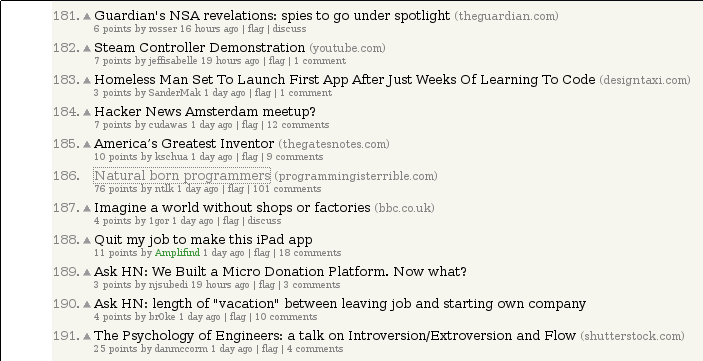
This seems less true when it comes to social issues. When a posting discussing the myth of the natural born programmer[2] hit the front page, the top rated comment is Paul Graham[3] off-handedly discounting the conclusions drawn. The original story linked to a review of peer-reviewed scientific research. Graham simply discounts it on the basis of his preconceptions. Shortly afterwards, the story plummeted off the front page, now surrounded by stories posted around the same time but with much lower scores.

How does this happen? There's two publicised methods which can result in stories dropping down the order. Users with high karma scores (either via submitting popular stories or writing popular comments) are able to flag submissions, and if enough do so then a negative weighting is applied to the story. There's also a flamewar detector, a heuristic that attempts to detect contentious subjects and pushes them off the front page.

The effect of both is to enforce the status quo of social beliefs. Stories that appear to challenge the narrative that good programmers are just naturally talented tend to vanish. Stories that discuss the difficulties faced by minorities in our field are summarily disappeared. There are no social problems in the technology industry. We have always been at war with Eastasia.

This isn't healthy. We don't improve the state of the software industry by hiding stories that expose conflicts. Flamewars don't solve problems, but without them we'd be entirely unaware of how much of a victim blaming mentality exists amongst our peers. It's true that conflict may reinforce preconceptions, causing people to dig in as they defend their beliefs. However, the absence of conflict does nothing to counteract that. If you're never exposed to opinions you disagree with, you'll never question your existing beliefs.

Hacker News is a privately run site and nobody's under any obligation to change how they choose to run it. But the focus on avoiding conflict to such an extent that controversial stories receive less exposure than ones that fit people's existing beliefs doesn't enhance our community. If we want to be able to use technology as an instrument of beneficial change to society as a whole, we benefit from building a diverse and welcoming community and questioning our preconceptions. Building a social echo chamber risks marginalising us from the rest of society, gradually becoming ignored and irrelevant as our self-reinforcing opinions drift ever further away from the mainstream. It doesn't help anybody.

[1] During the batch of interviews I did last year, two separate interviewers both mentioned a story they'd read on Hacker News that turned out to have been written by me. I'm not saying that that's what determined a hire/don't hire decision, but it seems likely that it helped.
[2] The article in question discusses the pervasive idea that some people are inherently good programmers. It turns out that perpetuating the idea that some people are just born good at a particular skill actually discourages others from even trying to learn it, even those who are just as capable.
[3] One of the co-founders of Y-Combinator and creator of Hacker News.

(Edited to fix a footnote reference)

comment count unavailable comments

14 October 2013

Bits from Debian: Ada Lovelace Day: meet some of the "women behind Debian"!

Today is Ada Lovelace Day:
"Ada Lovelace Day is about sharing stories of women - whether engineers, scientist, technologists or mathematicians - who have inspired you to become who you are today. The aim is to create new role models for girls and women in these male-dominated fields by raising the profile of other women in STEM". source
To celebrate, we asked to some of the "women behind Debian" to share their stories with us. Enjoy! Alt Ada Lovelace portrait Ana Guerrero Lopez (ana) Who are you? I'm a 30-something years old geek. I'm from Andalusia, Spain but live in France. What do you do in Debian? I work mostly on my packages, in sponsoring new people's packages and in this very blog you're reading now. I also maintain an unofficial Google+ page about Debian. At $PAID job, I work in an internal Debian distribution so from time to time, I get the opportunity to contribute back some of the stuff we do there. How and why did you start contributing to Debian? I started using Debian around 2003 switching from Mandrake. I was a happy Debian user when the Debian Women project started in the summer 2004. When I saw the project announced, I asked myself why I wasn't contributing to Debian and the rest is history... in a couple of weeks it'll be my 7 years DD-versary! If for some reason you want a longer reply to this question, read here. Beatrice Who are you? I am a PhD student with a degree in Biology. I am a computer fan since my first C64 and I am a self-taught computer geek wanna-be. And I am a bug fan - not software bugs, real bugs :) What do you do in Debian? I work on translations - doing the translation work itself, but also reviewing other translators' work and helping in coordinating the translation effort. How and why did you start contributing to Debian? I started using Linux because I liked the idea of an open source operative system based on collaboration and I began reviewing open source software translations. Since my first Linux system was Debian Potato and I sticked to Debian ever since, it only seemed natural to focus my translation work on Debian. Christine Caulfield Who are you? My name is Christine Caulfield. My day job is principal software engineer at Red Hat working on the cluster infrastructure components corosync & pacemaker. Outside computing I'm a musician and sound engineer. I play violin with lots of technology attached, and love avant garde music. What do you do in Debian? I'm not that active on Debian any more due to pressure of time, and maturity of the packages I work on. I currently maintain the, little-used, DECnet userspace packages and the, even less used I suspect, mopd bootloader. I used to maintain lvm2 for a while but dropped that a few years ago. How and why did you start contributing to Debian? My initial reasons for joining Debian were slightly selfish, to find a home for the DECnet project that I was heavily involved in at the time. I was a keep Debian user and people wanted a distribution where the software was easy to set up. DECnet is quite complicated for users to configure, being a totally independant networking stack to IP and so OS support is needed. Debian seemed like the logical place to make this happen. As mentioned above I got quite involved for a time and maintained other packages too. I picked up lvm2 because I was on the lvm2 dev team at work in Red Hat and as it was a new package at that time I seemed a logical choice. Elena Grandi (valhalla) Who are you? I'm a 30-something years old geek and Free Software enthusiast from Italy. What do you do in Debian? I'm currently maintaining a few packages (2 python modules and a python program) as a sponsored uploader; I'm also slowly looking around for other things to do (by preference technical, but not limited to packaging), with the aim to spend more time contributing to Debian. How and why did you start contributing to Debian? For a while I had being distro-hopping between "fun" distributions (the ones that break now and then) on the desktop while using Debian stable on the home server and in chroots. I was already doing marginal contributions to those distributions, where finding stuff that was missing was easy, but my perception as a stable user was that Debian was already working fine and probably didn't really need any help. Then I started to socialize on IRC with some DDs and DMs, and realized that my perception was superficial and that in reality there were dark holes in the depths of the archive where Evil festered and prospered and... ok, sorry, I got carried away :) Anyway, since I was actually using Debian more and more I decided to start contributing: I read documentation, I attended the useful IRC sessions on #debian-women and decided that it was probably best not to add new stuff, but look for things that I used and that needed help. Then nothing happened for a while, because finding stuff that doesn't work is hard (at least on my mostly textual systems). Then one day I was trying to write a python script that needed to verify gpg signed messages; it had to run on my Debian server, so I was trying to use python-pyme and its documentation was painful to use, while I remembered an earlier attempt using python-gnupg that was much more pythonic, but not available in Debian. In a fit of anger I decided to forgo all of my good intentions and actually add a new package: I checked the sources for problems, packaged, sent it to mentors@d-o, got reviews, fixed problems, resent and finally got sponsored and well, everything started. Francesca Ciceri (madamezou) Who are you? I'm Francesca, a 30-something Italian graduated in Social Sciences. What do you do in Debian? I'm a (non uploading) Debian Developer since 2011 and have been DPN editor, press officer, webmaster for www.debian.org and translator for the Italian l10n team. Recently, due to time constraints, I had to reduce my involvement and now only work on two things: writing/editing articles for bits.debian.org together with Ana Guerrero, and creating subtitles for the DebConf talks, in the DebConf Subs team. How and why did you start contributing to Debian? Basically thanks to the sudden abundance of free time - due to an health problem - and the desire to give something back to this wonderful operating system. After that, I found out that Debian is not only a great OS but also a very special community. Today, some of my dearest friends are people I met through Debian. :) Laura Arjona Who are you? I live in Madrid (Spain), and work as IT Assistant in the Technical University of Madrid (UPM). I'm married and I have a 4-years-old son. What do you do in Debian? In 2012 I started to clean spam and to translate Debian web pages into Spanish. I also follow the work of the web and publicity team, I hope I'll get more involved there too. And of course, I'm in Debian Women :) How and why did you start contributing to Debian? I'm using Debian at work since 2007 (servers), and in my desktops since 2010. I like very much that it is a community distro and I wanted to participate. I was already doing translations in other (small) free software projects, so I began here too. The Debian-Women list, the planet, and people in identi.ca helped me to learn a lot and feel part of the community even when I was not contributing yet. M nica Ram rez Arceda (monica) Who are you? My name is M nica Ram rez Arceda and I am an enthusiast of free software and sharing knowledge cultures: for me it's a kind of philosophy of life. I studied Maths a long time ago but ended up working as a developer for some years. Now I'm working as an IT teacher. What do you do in Debian? Debian is a huge project, so you can help in various scopes. Mainly, I work on packaging, fixing wnpp bug inconsistencies in BTS and helping in spam cleaning of the mailing lists. But I also enjoy doing some non-technical work from time to time: the project I am just now involved is organizing, with the rest of Debian Catalan community, a local team to propose Barcelona as the venue for a minidebconf where all the speakers will be women. How and why did you start contributing to Debian? In 2000 I discovered Free Software world and I fell deeply in love with its philosophy. Since then, I've been trying to do my best in different activities, like spreading the word, giving free courses, helping collectives and friends in technical stuff (from installing Debian to developing some helping apps for them)... but two years ago I was looking forward to join a free software project and I decided to try Debian, since it has been my first and only distro in my day-to-day life for about ten years. So, I wanted to give back Debian all what it had offered to me, but.... I thought I couldn't (hey, Debian is for real hackers, not for you little ant!), but I started to adopt some orphaned packages, do some QA uploads, fix some RC bugs, talk with some Debian Developers that helped me and encouraged me more than I expected, I traveled to my first Debconf... And one thing takes you to the other, and on March 2012 I became a DD. Now, I'm glad to see that everything that frightened me is not so scary :-)

Brett Parker: Just in case you missed it...

So, I've changed jobs, I now work for the incredibly awesome Mythic Beasts, So far it's been great, we've hit a few problems, we've made sane plans, and we're moving forwards and making things easier to manage long term. I've mostly been involved with debugging mac-mini boot problems, and getting them working with (as far as possible) stock kernels, rather than our previous set of custom compiled kernels, so that it's easier to upgrade later, and so that we're not having to maintain a whole set of patches that we shouldn't need to! We're also starting to package our own software that we use internally so that actually deploying new servers is becoming a lot easier, and configuration of our previous packages is now (mostly) handled by debconf, meaning that actually setting up backups is becoming much easier. We've also changed out main backup strategy from using a (slightly flaky) openvpn connection with loopback mounted ext3 filesystems to using rsync with the --fake-super option - the only thing that we've found slightly wrong with this so far is that --fake-super can't reconcile symlinks (it uses user level xattr to store the origional permissions, and with symlinks this doesn't work, because, apparently, symlinks should store user xattr attrbutes!). We also offer ipv6 for all our dedicated and vps customers, as per the mythic blog - and our 2 authoritative name servers are both v6 enabled. We're working towards making all of our core services available over both ipv4 and ipv6, and we should be there soon. It's fantastic to work for a company that has the technical knowledge and no-shit stance that Mythic Beasts has, we will hold our hands up if we do something wrong, and we'll tell you exactly what happened, why, and what we're doing to stop it from happening again. So, 1 month in, and I'm absolutely loving working for them, and I've been a customer of theirs since black cat networks sold their domain name side to them, and shortly afterwards bluelinux sold their virtual servers service to them. Our new VDS lite service is reasonably priced, and well spec'd. I thoroughly recommend our services, and obviously, we actually use our own vds service to provide some of our services - so it's as important to us that it keeps working as it is for our customers. Wow, so that was a very salesy post. Erm, next time, back to whinging about authors not having written the books I'm waiting for yet! :)

Charles Plessy: Update of EMBOSS explorer in Wheezy.

EMBOSS explorer was broken in Debian 7 (Wheezy) because of an incompatibly with EMBOSS 6.4. The package was repaired with the second update (7.2). The development and maintenance of EMBOSS explorer have stopped for many years. If a new serious bug surfaces, we may need to remove the package rather than repair it. In consequence, do not hesitate to suggest us an alternative, or if you are developer and need EMBOSS explorer, to see how you can reinvigorate this project (currently on SourceForge).

Gunnar Wolf: C sar Y ez (@caesarcomptus) in the classroom: Process scheduling

I try to have some guests every now and then to my Operating Systems class. The class is not as practical/interactive as I'd like, and having some people show the students how the subjects I teach are reflected in the real world is, I feel, very useful for them to understand the topics' importance. The past semester (the first one for me) I had three guests: Chema Serralde, talking about process scheduling and in particular on the importance of real time, from his perspective as a musician, Rolando Cedillo, talking about the early stages of the boot process, and C sar Y ez, giving a review of file systems. This semester, there have been two guests so far: Felipe Esquivel, who spoke about parallelism, and used renders with Blender to illustrate the speed gains and limitations (i.e. Amdahl's law), and this last Thursday, I invited again C sar Y ez. C sar spoke about process scheduling, first giving a quite thorough review of what had taken me at least three sessions to go through, and second, giving some in-depth review based on his experience with Haiku OS. What else was different this time? I told our coordinator in the faculty, and she invited the other teachers of the subject (and attended herself). So, instead of the usual ~25 students, we have ~40 people in the classroom. And one of them, Adolfo, recorded most of C sar's explanation. Yay! Of course, I asked Adolfo for a copy of his recording, and recoded it in a format more suitable for Web viewing. Here it is (almost 300MB, Ogg Video, ~95 minutes). I still have the original video file given to me, in an Apple-generated badly-compressed .mov, but at over 1.5GB, it's too much for a Web download. I will try to record future sessions, as they will surely be useful!

13 October 2013

Dirk Eddelbuettel: Chicago Marathon 2013

A gorgeous day in Chicago for the 37th annual Chicago Marathon. Today was the seventh time I ran this race. I had sat out last fall, and ran a smaller local race (well enough for a BQ). But the last time I ran Chicago I mused that maybe next time I'd train more. I tried, but it didn't quite work with a minor injury dragging on a little. Just like in 2010. And so it continues: it is my home course, and the course I have run the most and know the best. Yet it is the one where I have the greatest difficulty coming in with a time that is good enough for Boston. I knew that today wasn't going to be that day, so I aimed lower to just run even splits (ie running about equal halfs). But even that failed: After 1:44 for the first half I lost a good ten minutes to finish at 3:40:42. Oh well. There is always next year... But it was a simply sunningly fabulous day, and the race was once again very, very well put together. We were worried about extra security: not a real issue. The streets were lined with people and even Lisa and Julia managed to cheer me on at mile 13 (still smiles), mile 19 (grimacing, about to fall apart) and 25 (hanging in). And Anna was working the mile 18 water stop. The worst where miles 20 to 22 when I walked a fair bit. The race results have details; maybe I'll update the chart I made in prior years. One minor FAIL was a wait at the end for gear check. That was pathetic. I guess the folks manning the stand didn't keep bags sorted well enough so lines were long, and slow. Oh well -- the rest was fine, and it remains one of the nicest marathon races. Oh, and the other FAIL was that my Nexus 4 phone couldn't hold a charge til I was done. What's up with that? The running tracker traced me til around mile 20, and then the phone shut down for lack of juice. Disappointing too. But hey, it spares you, dear reader, the look of some bad post-race selfies...

Francesca Ciceri: MissRepresentation: discussing gender stereotypes in Moldova

Recently, I've been attending a training course in Moldova about the representation of gender in the media and the influence on society of gender stereotypes.
The course was organized by Inesa Lupu, of Invento and financed by the UE as part of the Youth in Action program. It was the first time, for me, in this kind of international project and it was, in a word, fantastic.
Among the participants, there were people from Azerbaijan, Georgia, Italy, Latvia, Moldova and Slovenia.
That meant a great mix of cultures, languages and experiences.
And that was the key, in my opinion, of the success: coming from different countries and different social and cultural contexts meant that we were able to have a very broad and diverse point of view on the problem of gender stereotypes. So, here's some highlights on what we discussed. The media representation of gender (aka: gender issues are not only women issues) Tough Guise by Jackson Katz is a interesting documentary about the way the modern society - particularly in the US - defines masculinity as intrinsically tied to violence, aggressivity and "toughness" and on the consequences of this on the society as a whole. The author's theory is "that male violence, misogyny, and homophobia are inextricably linked to how we define manhood as a culture. The film gives special attention to how American media have glamorized increasingly regressive and violence masculine ideals in the face of mounting social and economic threats to traditional white male heterosexual authority". It then results clear that we cannot avoid to think about gender issues as women and men issues, because after all is the cultural definition of both femininity and masculinity that heavily influences the behaviour of men and women and their interaction.
In particular, I liked Katz's analysis of media's use of victim blaming speech while reporting of violences against women which tend to shift the focus from the violence perpetrated by men as part of definition of masculinity. Another documentary we watched, more focused on women representation, is MissRepresentation by Jennifer Siebel Newsom.
The film analyses the under representation of women in position of power, and the issue of women and leadership, especially in politics, in the US. Nothing too new, if you are interested in gender issues, as it is a widely discussed and studied topic, but still worth watching. After watching them, we formed little groups of three-four persons from different countries to discuss them, and it was even more interesting to listen the opinion of the guys (we had four male participants). The guys talking about Tough Guise Photography and Phototherapy As a workshop on media representation of gender, photography and advertisement were two of the main argument we spoke about. We focused on it for two days: our trainer, Lietta Granato - photographer and phototherapist - first gave us a lesson on photography, making us experimenting a bit with exposure times and diaphragm's aperture. a lesson on photography Then she presented the evolution in the last 50 year or so, of the depiction of women in the ads.
And that, to be honest, was a bit upsetting.
I've already had seen one of the most important and widely known films on this theme, the Killing Us Softly series by Jean Kilbourne, but some of the ads Lietta showed to us were really really horrible. Actually, most of them were horrible. Commenting and deconstructing these ads would take a separate blogpost, probably, and there are many people more competent than me on the topic, so I've decided to simply share some of the worst ads in a collage, without much commenting. These are vintage, from the fifties to the seventies. a collage of vintage sexist ads Do you think we got better? Pff. a collage of recent sexist ads They go from promoting violence and rape to heavily objectifying women. Special mention for the Compaq ad: as a geek woman I feel particularly insulted by the idea that I'm supposed to use a "pocket pc" as "pocket mirror". Because I wouldn't be able, obviously, to use it as a computer. Lietta also introduced us to photographic therapy and particularly the work of Jo Spence and Rosy Martin. If you browse Jo Spence's site, please be aware that there is a series of pics documenting all the stages of her illness (she died of breast cancer) and they are pretty intense. "In 1984, alongside Rosy Martin, Spence developed Photo-Therapy , adopting techniques from co-counselling. The considerable achievement of Photo-Therapy was to invert the traditional relationship between the photographer and the subject. If historically the subject had little control over their own representation, Photo-Therapy shifts this dynamic. The subject was able to act out personal narratives and claim agency for their own biography." (source: http://www.jospence.org/biography.html)
I love this concept and I really really love Spence's photos. To close on a happier note, I really suggest you to allocate 20 minutes of your time to watch this great talk by Nigerian novelist Chimamanda Ngozi Adichie, about the role of "single story" in shaping stereotypes and misunderstandings.

John Goerzen: Why are we still backing up to hardlink farms?

A person can find all sorts of implementations of backups using hardlink trees to save space for incrementals. Some of them are fairly rudimentary, using rsync --link-dest. Others, like BackupPC, are more sophisticated, doing file-level dedup to a storage pool indexed by a hash. While these are fairly space-efficient, they are really inefficient in other ways, because they create tons of directory entries. It would not be surprising to find millions of directory entries consumed very quickly. And while any given backup set can be deleted without impact on the others, the act of doing so can be very time-intensive, since often a full directory tree is populated with every day s backup. Much better is possible on modern filesystems. ZFS has been around for quite awhile now, and is stable on Solaris, FreeBSD and derivatives, and Linux. btrfs is also being used for real workloads and is considered stable on Linux. Both have cheap copy-on-write snapshot operations that would work well with a simple rsync --inplace to achieve the same effect ad hardlink farms, but without all the performance penalties. When creating and destroying snapshots is a virtually instantaneous operation, and the snapshots work at a file block level instead of an entire file level, and preserve changing permissions and such as well (which rsync --link-dest can have issues with), why are we not using it more? BackupPC has a very nice scheduler, a helpful web interface, and a backend that doesn t have a mode to take advantage of these more modern filesystems. The only tool I see like this is dirvish, which someone made patches for btrfs snapshots three years ago that never, as far as I can tell, got integrated. A lot of folks are rolling a homegrown solution involving rsync and snapshots. Some are using zfs send / btrfs send, but those mechanisms require the same kind of FS on the machine being backed up as on the destination, and do not permit excluding files from the backup set. Is this an area that needs work, or am I overlooking something? Incidentally, hats off to liw s obnam. It doesn t exactly do this, but sort of implements its own filesystem with CoW semantics.

Next.

Previous.
