Norbert Preining: Cinnamon 4.6 for Debian
 After a few rounds of testing in experimental, I have uploaded Cinnamon 4.6 packages to Debian/unstable. Nothing spectacular new besides the usual stream of fixes. Enjoy the new Cinnamon!
 developer-reference challenge: get the bug count down to 0
As of now, the BTS counts 52 bugs for src:developers-reference and I'd like to get this down to zero, because src:developers-reference is just documenting best practices and this should be easy and done well.
So, I've been trying to keep the habit of fixing at least one bug per month and I also try to do one upload per month. And I very much welcome your patches, commits, MRs and bug reports, because else it will take more than 5 years. Though I'm hopeful, src:developers-reference is maintained by the debian group on salsa, which is like a thousand people.
Please help and join the fun and responsibility. Even if only once every three months (or less)
 And thank you, it's awesome to be in this together.
--allow-weak-digest-algos to GnuPG so it can use old keys
and verify signatures from old keys, such as those created with PGP
2.6.2.

 The twelveth release of littler as a CRAN package is now available, following in the fourteen-ish year history as a package started by Jeff in 2006, and joined by me a few weeks later.
littler is the first command-line interface for R as it predates
Rscript. It allows for piping as well for shebang scripting via #!, uses command-line arguments more consistently and still starts faster. It also always loaded the methods package which Rscript only started to do in recent years.
littler lives on Linux and Unix, has its difficulties on macOS due to yet-another-braindeadedness there (who ever thought case-insensitive filesystems as a default where a good idea?) and simply does not exist on Windows (yet the build system could be extended see RInside for an existence proof, and volunteers are welcome!). See the FAQ vignette on how to add it to your PATH.
A few examples are highlighted at the Github repo, as well as in the examples vignette.
This release mostly responds to the recent docopt release 0.7.0 which brought a breaking change for quoted arguments. In short, it is for the better because an option --as-cran is now available parsed as opt$as_cran which is easier than the earlier form where we needed to back-tick protect as-cran containing an underscore. We also added a new portmanteau-ish option to roxy.r.
The NEWS file entry is below.
CRANberries provides a comparison to the previous release. Full details for the littler release are provided as usual at the ChangeLog page. The code is available via the GitHub repo, from tarballs and now of course also from its CRAN page and viaChanges in littler version 0.3.11 (2020-06-26)
- Changes in examples
- Scripts
check.randrcc.rupdated to reflect updated docopt 0.7.0 behaviour of quoted arguments- The
roxy.rscript has a new ease-of-use option-f --fullregrouping two other options.
install.packages("littler"). Binary packages are available directly in Debian as well as soon via Ubuntu binaries at CRAN thanks to the tireless Michael Rutter.
Comments and suggestions are welcome at the GitHub repo.
If you like this or other open-source work I do, you can now sponsor me at GitHub. For the first year, GitHub will match your contributions.
This post by Dirk Eddelbuettel originated on his Thinking inside the box blog. Please report excessive re-aggregation in third-party for-profit settings.
 People love to tell you that they "don't watch sports" but the story of Lance Armstrong provides a fascinating lens through which to observe our culture at large.
For example, even granting all that he did and all the context in which he did it, why do sports cheats act like a lightning rod for such an instinctive hatred? After all, the sheer level of distaste directed at people such as Lance eludes countless other criminals in our society, many of whom have taken a lot more with far fewer scruples. The question is not one of logic or rationality, but of proportionality.
In some ways it should be unsurprising. In all areas of life, we instinctively prefer binary judgements to moral ambiguities and the sports cheat is a clich of moral bankruptcy cheating at something so seemingly trivial as a sport actually makes it more, not less, offensive to us. But we then find ourselves strangely enthralled by them, drawn together in admiration of their outlaw-like tenacity, placing them strangely close to criminal folk heroes. Clearly, sport is not as unimportant as we like to claim it is. In Lance's case in particular though, there is undeniably a Shakespearean quality to the story and we are forced to let go of our strict ideas of right and wrong and appreciate all the nuance.
Spaniards tend to be modest, very humble. Very unpretentious. And the Italians are loud, vain and outrageous showmen.Former directeur sportif Johan Bruyneel then asserts that "Belgians are hard workers... they are ambitious to a certain point, but not overly ambitious", and cyclist J rg Jaksche concludes with:
The Germans are very organised and very structured. And then the French, now I have to be very careful because I am German, but the French are slightly superior.This kind of lazy caricature is nothing new, especially for those brought up on a solid diet of Tintin and Asterix, but although all these examples are seemingly harmless, why does the underlying idea of ascribing moral, social or political significance to genetic lineage remain so durable in today's age of anti-racism? To be sure, culture is not quite the same thing as race, but being judged by the character of one's ancestors rather than the actions of an individual is, at its core, one of the many conflations at the heart of racism. There is certainly a large amount of cognitive dissonance at work, especially when Friebe elaborates:
East German athletes were like incredible robotic figures, fallen off a production line somewhere behind the Iron Curtain...... but then bermensch Jan Ullrich is immediately described as "emotional" and "struggled to live the life of a professional cyclist 365 days a year". We see the habit to stereotype is so ingrained that even in the face of this obvious contradiction, Friebe unironically excuses Ullrich's failure to live up his German roots due to him actually being "Mediterranean".
It's quite a complicated collective imposture, people pretending to be British and people pretending to be French, and then they get really angry with each other over what they're pretending to be.The really remarkable thing about this tendency is that even if we consciously notice it there is no seemingly no escape even I could not smirk when I considered that a brash Texan winning the Tour de France actually combines two of America's cherished obsessions: winning... and annoying the French.
After the long wait (or should I say The Long Dark) finally Qt 5.14 has arrived in Debian/unstable, and thus the doors for KDE/Plasma 5.19 are finally open.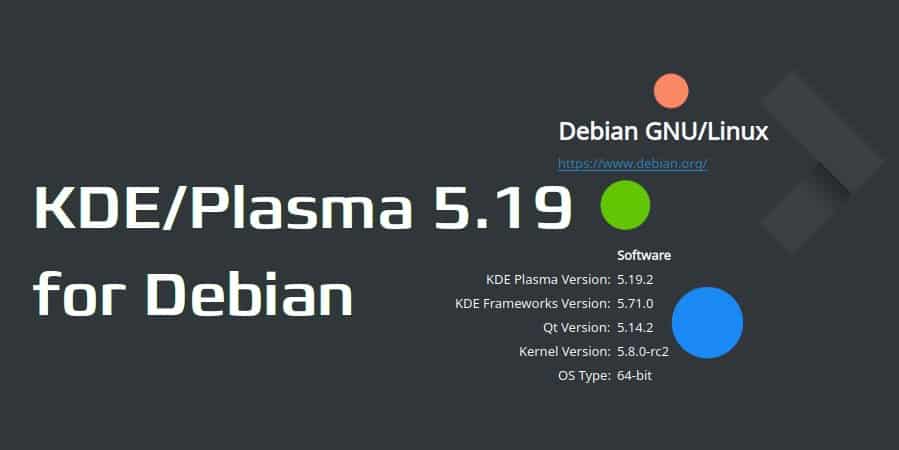 I have been preparing this release for quite some time, but due to Qt 5.12 I could only test it in a virtual machine using Debian/experimental. But now, finally, a full upgrade to Plasma 5.19(.2) has arrived.
Unfortunately, it turned out that the OBS build servers are either overloaded, incapable, or broken, but they do not properly build the necessary packages. Thus, I make the Plasma 5.19.2 (and framework) packages available via my server, for amd64. Please use the following apt line:
deb https://www.preining.info/debian/ unstable kde
/etc/apt/trusted.gpg.d/preining-norbert.asc.
For KDE Applications please still use
deb https://download.opensuse.org/repositories/home:/npreining:/debian-kde:/apps/Debian_Unstable/ ./
 This is a fairly self-indulgent post, sorry!
Encouraged by Evgeni,
Michael and
others, given I'm spending a lot more time at my desk in my home office, here's
a picture of it:
 Fisheye shot of my home office
 I released version 2.3 of ledger2beancount,
a ledger to beancount converter.
There are three notable changes with this release:
importmkdocs149. This version includes the following changes:
[ Chris Lamb ]
* Update tests for file 5.39. (Closes: reproducible-builds/diffoscope#179)
* Downgrade the tlsh warning message to an "info" level warning.
  (Closes: #888237, reproducible-builds/diffoscope#29)
* Use the CSS "word-break" property over manually adding U+200B zero-width
  spaces that make copy-pasting cumbersome.
  (Closes: reproducible-builds/diffoscope!53)
* Codebase improvements:
  - Drop some unused imports from the previous commit.
  - Prevent an unnecessary .format() when rendering difference comments.
  - Use a semantic "AbstractMissingType" type instead of remembering to check
    for both "missing" files and missing containers.
[ Jean-Romain Garnier ]
* Allow user to mask/filter reader output via --diff-mask=REGEX.
  (MR: reproducible-builds/diffoscope!51)
* Make --html-dir child pages open in new window to accommodate new web
  browser content security policies.
* Fix the --new-file option when comparing directories by merging
  DirectoryContainer.compare and Container.compare.
  (Closes: reproducible-builds/diffoscope#180)
* Fix zsh completion for --max-page-diff-block-lines.
[ Mattia Rizzolo ]
* Do not warn about missing tlsh during tests.
Courtesy of CRANberries, there is also a diffstat report for this release. For questions, suggestions, or issues please use the issue tracker at the GitHub repo. If you like this or other open-source work I do, you can now sponsor me at GitHub. For the first year, GitHub will match your contributions.Changes in version 0.0.6 (2020-06-25)
- Created C++ integer-handling utilities for safe downcasting and integer return (Brendan in #16 closing #13).
- New JSON functions
.deserialize_jsonand.load_json(Brendan in #16, #17, #20, #21).- Upgrade Travis CI to 'bionic', extract package and version from
DESCRIPTION(Dirk in #23).- Upgraded to simdjson 0.4.0 (Dirk in #25 closing #24).
This post by Dirk Eddelbuettel originated on his Thinking inside the box blog. Please report excessive re-aggregation in third-party for-profit settings.
master for the default git branch. Regardless of the etymology (which is unclear), some people say they have negative associations for this word, Changing this upstream in git is complicated on a technical level and, sadly, contested.
But git is flexible enough that I can make this change in my own repositories. Doing so is not even so difficult.
So:
Announcement
I intend to rename master to trunk in all repositories owned by my personal hat. To avoid making things very complicated for myself I will just delete refs/heads/master when I make this change. So there may be a little disruption to downstreams.
I intend make this change everywhere eventually. But rather than front-loading the effort, I'm going to do this to repositories as I come across them anyway. That will allow me to update all the docs references, any automation, etc., at a point when I have those things in mind anyway. Also, doing it this way will allow me to focus my effort on the most active projects, and avoids me committing to a sudden large pile of fiddly clerical work. But: if you have an interest in any repository in particular that you want updated, please let me know so I can prioritise it.
Bikeshed
Why "trunk"? "Main" has been suggested elswewhere, and it is often a good replacement for "master" (for example, we can talk very sensibly about a disk's Main Boot Record, MBR). But "main" isn't quite right for the VCS case; for example a "main" branch ought to have better quality than is typical for the primary development branch.
Conversely, there is much precedent for "trunk". "Trunk" was used to refer to this concept by at least SVN, CVS, RCS and CSSC (and therefore probably SCCS) - at least in the documentation, although in some of these cases the command line API didn't have a name for it.
So "trunk" it is.
Aside: two other words - passlist, blocklist
People are (finally!) starting to replace "blacklist" and "whitelist". Seriously, why has it taken everyone this long?
I have been using "blocklist" and "passlist" for these concepts for some time. They are drop-in replacements. I have also heard "allowlist" and "denylist" suggested, but they are cumbersome and cacophonous.
Also "allow" and "deny" seem to more strongly imply an access control function than merely "pass" and "block", and the usefulness of passlists and blocklists extends well beyond access control: protocol compatibility and ABI filtering are a couple of other use cases.5 1 * * * mythtv /usr/share/mythtv/mythconverg_backup.pl
/home/mythtv/.mythtv/backuprc:
DBBackupDirectory=/var/backups/mythtv
mkdir /var/backups/mythtv
chown mythtv:mythtv /var/backups/mythtv
/etc/cron.d/mythtv-maintenance runs a contrib script to optimize the database
tables:
10 1 * * * mythtv /usr/bin/chronic /usr/share/doc/mythtv-backend/contrib/maintenance/optimize_mythdb.pl
libmythtv-perl and libxml-simple-perl packages
to be installed on Debian-based systems.
It is quickly followed by a check of the recordings and automatic repair of
the seektable (when possible):
20 1 * * * mythtv /usr/bin/chronic /usr/bin/mythutil --checkrecordings --fixseektable
30 1 * * *  mythtv  /usr/bin/mythutil --quiet --scanvideos
31 1 * * *  mythtv  /usr/bin/mythutil --quiet --scanmusic
45 1 * * 1-4,6-7 root /usr/sbin/xfs_fsr
15 3 * * 2  root  /usr/local/sbin/raid_parity_check md0
15 3 * * 4  root  /usr/local/sbin/raid_parity_check md2
/etc/smartd.conf:
/dev/sda -a -d ata -o on -S on -s (S/../.././04 L/../../6/05)
/dev/sdb -a -d ata -o on -S on -s (S/../.././04 L/../../6/05)

 Like each month, here comes a report about the work of paid contributors to Debian LTS.
Individual reports
In May, 198 work hours have been dispatched among 14 paid contributors. Their reports are available:
No comment Liked this article? Click here. My blog is Flattr-enabled.
 I recently moved house, and the new building has a Doorbird to act as a doorbell and open the entrance gate for people. There's a documented local control API (no cloud dependency!) and a Home Assistant integration, so this seemed pretty straightforward.
#!/usr/bin/perl
print "First Name,Last Name,Display Name,E-mail Address\n";
while(<STDIN>)

  chomp;
  my @fields = split(/\ /, $_);
  printf("%s,%s,%s %s,%s\n", $fields[1], $fields[2], $fields[0], $fields[4], $fields[3]);
Welcome to the 27th post in the rationally regularized R revelations series, or R4 for short. This is a edited / updated version of yesterday s T^4 post #7 as it really fits the R4 series as well as it fits the T4 series.
A new video in both our T^4 series of video lightning talks with tips, tricks, tools, and toys is also a video in the R^4 series as it revisits a topic previously covered in the latter: how to (more easily) get (binary) packages onto your Ubuntu system. In fact, we show it in three different ways.
The slides are here. This repo at GitHub support the series: use it to open issues for comments, criticism, suggestions, or feedback. Thanks to I aki Ucar who followed up on twitter with a Fedora version. We exchanged some more message, and concluded that complete comparison (from an empty Ubuntu or Fedora container) to a full system takes about the same time on either system. If you like this or other open-source work I do, you can now sponsor me at GitHub. For the first year, GitHub will match your contributions.
This post by Dirk Eddelbuettel originated on his Thinking inside the box blog. Please report excessive re-aggregation in third-party for-profit settings.

library (and later module_utils and doc_fragment_plugins) in ansible.cfg and effectively inject our modules, their helpers and documentation fragments into the main Ansible namespace. Not the cleanest solution, but it worked quiet well for us.
When Ansible started introducing Collections, we quickly joined, as the idea of namespaced, easily distributable and usable content units was great and exactly matched what we had in mind.
However, collections are only usable in Ansible 2.8, or actually 2.9 as 2.8 can consume them, but tooling around building and installing them is lacking. Because of that we've been keeping our modules usable outside of a collection.
Until recently, when we decided it's time to move on, drop that compatibility (which costed a few headaches over the time) and release a shiny 1.0.0.
One of the changes we wanted for 1.0.0 is renaming a few modules. Historically we had the module names prefixed with foreman_ and katello_, depending whether they were designed to work with Foreman (and plugins) or Katello (which is technically a Foreman plugin, but has a way more complicated deployment and currently can't be easily added to an existing Foreman setup). This made sense as long as we were injecting into the main Ansible namespace, but with collections the names be became theforemam.foreman.foreman_ <something> and while we all love Foreman, that was a bit too much. So we wanted to drop that prefix. And while at it, also change some other names (like ptable, which became partition_table) to be more readable.
But how? There is no tooling that would rename all files accordingly, adjust examples and tests. Well, bash to the rescue! I'm usually not a big fan of bash scripts, but renaming files, searching and replacing strings? That perfectly fits!
First of all we need a way map the old name to the new name. In most cases it's just "drop the prefix", for the others you can have some if/elif/fi:
prefixless_name=$(echo $ old_name   sed -E 's/^(foreman katello)_//')
if [[ $ old_name  == 'foreman_environment' ]]; then
  new_name='puppet_environment'
elif [[ $ old_name  == 'katello_sync' ]]; then
  new_name='repository_sync'
elif [[ $ old_name  == 'katello_upload' ]]; then
  new_name='content_upload'
elif [[ $ old_name  == 'foreman_ptable' ]]; then
  new_name='partition_table'
elif [[ $ old_name  == 'foreman_search_facts' ]]; then
  new_name='resource_info'
elif [[ $ old_name  == 'katello_manifest' ]]; then
  new_name='subscription_manifest'
elif [[ $ old_name  == 'foreman_model' ]]; then
  new_name='hardware_model'
else
  new_name=$ prefixless_name
fi
That defined, we need to actually have a
$ old_name . Well, that's a for loop over the modules, right?
for module in $ BASE /foreman_*py $ BASE /katello_*py; do
  old_name=$(basename $ module  .py)

done
While we're looping over files, let's rename them and all the files that are associated with the module:
# rename the module
git mv $ BASE /$ old_name .py $ BASE /$ new_name .py
# rename the tests and test fixtures
git mv $ TESTS /$ old_name .yml $ TESTS /$ new_name .yml
git mv tests/fixtures/apidoc/$ old_name .json tests/fixtures/apidoc/$ new_name .json
for testfile in $ TESTS /fixtures/$ old_name -*.yml; do
  git mv $ testfile  $(echo $ testfile   sed "s/$ old_name /$ new_name /")
done
Now comes the really tricky part: search and replace. Let's see where we need to replace first:
module key of the DOCUMENTATION stanza (e.g. module: foreman_example)foreman_example: )foreman_example: )conftest.py and other files related to test executionsed -E -i "/^(\s+$ old_name module):/ s/$ old_name /$ new_name /g" $ BASE /*.py sed -E -i "/^(\s+$ old_name module):/ s/$ old_name /$ new_name /g" tests/test_playbooks/tasks/*.yml tests/test_playbooks/*.yml sed -E -i "/'$ old_name '/ s/$ old_name /$ new_name /" tests/conftest.py tests/test_crud.py sed -E -i "/ $ old_name / s/$ old_name /$ new_name /g' README.md docs/*.mdYou've probably noticed I used
$ BASE and $ TESTS and never defined them Lazy me.
But here is the full script, defining the variables and looping over all the modules.
#!/bin/bash
BASE=plugins/modules
TESTS=tests/test_playbooks
RUNTIME=meta/runtime.yml
echo "plugin_routing:" > $ RUNTIME
echo "  modules:" >> $ RUNTIME
for module in $ BASE /foreman_*py $ BASE /katello_*py; do
  old_name=$(basename $ module  .py)
  prefixless_name=$(echo $ old_name   sed -E 's/^(foreman katello)_//')
  if [[ $ old_name  == 'foreman_environment' ]]; then
    new_name='puppet_environment'
  elif [[ $ old_name  == 'katello_sync' ]]; then
    new_name='repository_sync'
  elif [[ $ old_name  == 'katello_upload' ]]; then
    new_name='content_upload'
  elif [[ $ old_name  == 'foreman_ptable' ]]; then
    new_name='partition_table'
  elif [[ $ old_name  == 'foreman_search_facts' ]]; then
    new_name='resource_info'
  elif [[ $ old_name  == 'katello_manifest' ]]; then
    new_name='subscription_manifest'
  elif [[ $ old_name  == 'foreman_model' ]]; then
    new_name='hardware_model'
  else
    new_name=$ prefixless_name
  fi
  echo "renaming $ old_name  to $ new_name "
  git mv $ BASE /$ old_name .py $ BASE /$ new_name .py
  git mv $ TESTS /$ old_name .yml $ TESTS /$ new_name .yml
  git mv tests/fixtures/apidoc/$ old_name .json tests/fixtures/apidoc/$ new_name .json
  for testfile in $ TESTS /fixtures/$ old_name -*.yml; do
    git mv $ testfile  $(echo $ testfile   sed "s/$ old_name /$ new_name /")
  done
  sed -E -i "/^(\s+$ old_name  module):/ s/$ old_name /$ new_name /g" $ BASE /*.py
  sed -E -i "/^(\s+$ old_name  module):/ s/$ old_name /$ new_name /g" tests/test_playbooks/tasks/*.yml tests/test_playbooks/*.yml
  sed -E -i "/'$ old_name '/ s/$ old_name /$ new_name /" tests/conftest.py tests/test_crud.py
  sed -E -i "/ $ old_name  / s/$ old_name /$ new_name /g' README.md docs/*.md
  echo "    $ old_name :" >> $ RUNTIME
  echo "      redirect: $ new_name " >> $ RUNTIME
  git commit -m "rename $ old_name  to $ new_name " $ BASE  tests/ README.md docs/ $ RUNTIME
done
As a bonus, the script will also generate a
meta/runtime.yml which can be used by Ansible 2.10+ to automatically use the new module names if the playbook contains the old ones.
Oh, and yes, this is probably not the nicest script you'll read this year. Maybe not even today. But it got the job nicely done and I don't intend to need it again anyways.Next.