Lintian is static analysis tool for Debian packages, reporting on various errors, omissions and quality-assurance issues to the maintainer.
I seem to have found myself hacking on it a bit more recently (see my previous installment). In particular, here's the code of mine which made for a total of 20 bugs closed that made it into the recent 2.5.52 release:
I normally don t play survival games or walking simulators, but The Long Dark by Hinterland Games, which I purchased back then when it was still in early access on Steam, took me into new realms. You are tossed out into the Canadian wilderness with hardly anything, and your only aim is to survive, find shelter, food, craft tools, hunt for food, explore. And while everything by now is Sandbox mode, on August 1st the first episode of Story mode is released. Best time to get the game!

You will be greeted with some icy nights, but also with great vistas, relaxed evenings at a fire place, you will try to survive on moldy food and rotten energy bars, but also feast on the fireside while reading a good book. A real treat this game!
Sandbox mode features five different areas to explore. Each one is large enough to spend weeks (in game time) wandering around. The easiest area to start with is Mystery Lake, with plenty of shelter (several huts) and abundance of resources. And just in case you are getting bored, all the areas are connected via tunnels or caves and one can wander of into the neighboring places. My home in Mystery Lake was always the Camp Office, the usual suspect. Nice views, fishing huts nearby to get fresh fish, lots of space.
After managing to get from your starting place (which is arbitrary as far as I see) to one of the shelters, one starts collecting food, wood, savaging every accessible place for tools, weapons, burning material. And soon the backpack becomes to heavy, and one needs to store stuff and decide what to take.
This is a very well done part of the game. The backpack is not limited by number of items, but you are limited in weight you can carry. That includes clothes (which can get quite heavy) and all the items in your backpack. In addition, the longer the day and the more tired you become, the less weight you can carry. And if the backpack starts getting too heavy you crawl to a very slow movement.
There are many influences of the outside world on the player s condition: temperature, the wetness of your clothes, hunger, thirst, exhaustion, but also infections and bruises, all need to be taken care of, otherwise the end is coming faster than one wishes for.
I have only two things to complain: First, if one walks outside, or runs outside, the own body temperature does not rise. This is unrealistically and should have been taken into account. The other thing is the difficulty: I have played weeks in game time in the easiest level, without any problem. But the moment I switched to the second level of difficulty (of 5!), I not even manage it for 2(!) days. Wolves, starvation, thirst, any of those kills me within an instant. I don t want to know how the hardest level feels, but it has a certain steep step here.
The game takes a very realistic view onto the weather: Every day is different, sunny, foggy, blizzard, windy, often changing very quickly. It is wise to plan one s activities according to the weather, as it is very unforgiving.
With beautifully crafted landscapes, loads of areas to explore, your own pride to survive for at least a few weeks, and lots of tools to find and craft and try out, this games, even while it is still in Sandbox mode, is a real feat. My absolute favorite since I have finished the Talos Principle and Portal series, absolutely recommendable!
In the past there used to be a puppet-labs project called puppet-dashboard, which would let you see the state of your managed-nodes. Having even a very basic and simple "report user-interface" is pretty neat when you're pushing out a change, and you want to see it be applied across your fleet of hosts.
There are some other neat features, such as allowing you to identify failures easily, and see nodes that haven't reported-in recently.
This was spun out into a community-supported project which is largely stale:
Having a dashboard is nice, but the current state of the software is less good. It turns out that the implementation is pretty simple though:
root@master /var/lib/puppet/reports # ls tail -n4
smaug.dh.bytemark.co.uk
ssh.steve.org.uk
www.dns-api.com
www.steve.org.uk
Inside each directory is a bunch of YAML files which describe the state of the host, and the recipes that were applied. Parsing those is pretty simple, the hardest part would be making a useful/attractive GUI. But happily we have the existing one to "inspire" us.
I think I just need to write down a list of assumptions and see if they make sense. After all the existing installation(s) won't break, it's just a matter of deciding whether it is useful/worthwhile way to spend some time.
wheezy.4.84.2-2+deb8u4. root@master ~# dump-run www.steve.org.uk
www.steve.org.uk
Puppet Version: 4.8.2
/var/lib/puppet/reports/www.steve.org.uk/201707291813.yaml
Runtime: 2.16
Status:changed
Time:2017-07-29 18:13:04 +0000
Resources
total -> 176
skipped -> 2
failed -> 0
changed -> 3
out_of_sync -> 3
scheduled -> 0
corrective_change -> 3
Changed Resources
Ssh_authorized_key[skx@shelob-s-fi] /etc/puppet/code/environments/production/modules/ssh_keys/manifests/init.pp:17
Ssh_authorized_key[skx@deagol-s-fi] /etc/puppet/code/environments/production/modules/ssh_keys/manifests/init.pp:22
Ssh_authorized_key[steve@ssh.steve.org.uk-s-fi] /etc/puppet/code/environments/production/modules/ssh_keys/manifests/init.pp:27
Skipped Resources
Exec[clone sysadmin utils]
Exec[update sysadmin utils]
Earlier today, I demonstrated how to work with coinduction in the theorem provers Isabelle, Coq and Agda, with a very simple example. This reminded me of a discussion I had in Karlsruhe with my then colleague Denis Lohner: If coinduction is the dual of induction, why do the induction principles look so different? I like what we observed there, so I d like to share this.

The following is mostly based on my naive understanding of coinduction based on what I observe in the implementation in Isabelle. I am sure that a different, more categorial presentation of datatypes (as initial resp. terminal objects in some category of algebras) makes the duality more obvious, but that does not necessarily help the working Isabelle user who wants to make sense of coninduction.
datatype 'a list = nil cons (hd : 'a) (tl : "'a list")
with the well-known induction principle that many of my readers know by heart (syntax slightly un-isabellized):
P nil ( x xs. P xs P (cons x xs)) xs. P xs
codatatype 'a llist = lnil lcons (hd : 'a) (tl : "'a llist")
we get the following coinduction principle:
( xs ys.
R xs ys' (xs = lnil) = (ys = lnil)
(xs lnil ys' lnil
hd xs = hd ys R (tl xs) (tl ys)))
( xs ys. R xs ys xs = ys)
This is less scary that it looks at first. It tell you if you give me a relation R between lists which implies that either both lists are empty or both lists are nonempty, and furthermore if both are non-empty, that they have the same head and tails related by R, then any two lists related by R are actually equal.
If you think of the infinte list as a series of states of a computer program, then this is nothing else than a bisimulation.
So we have two proof principles, both of which make intuitive sense. But how are they related? They look very different! In one, we have a predicate P, in the other a relation R, to point out just one difference.
datatype declaration automatically creates a relator:
rel_list :: ('a 'b bool) 'a list 'b list bool
The definition of rel_list R xs ys is that xs and ys have the same shape (i.e. length), and that the corresponding elements are pairwise related by R. You might have defined this relation yourself at some time, and if so, you probably introduced it as an inductive predicate. So it is not surprising that the following induction principle characterizes this relation:
Q nil nil
( x xs y ys. R x y Q xs ys Q (cons x xs) (cons y ys))
( xs ys rel_list R xs ys Q xs ys)
Note how how similar this lemma is in shape to the normal induction for lists above! And indeed, if we choose Q xs ys (P xs xs = ys) and R x y (x = y), then we obtain exactly that. In that sense, the relation induction is a generalization of the normal induction.
codatatype declaration introduces a function
rel_llist :: ('a 'b bool) 'a llist 'b llist bool
which relates lists of the same shape with related elements only that this one also relates infinite lists, and therefore is a coinductive relation. The corresponding rule for proof by coinduction is not surprising and should remind you of bisimulation, too:
( xs ys.
R xs ys (xs = lnil) = (ys = lnil)
(xs lnil ys lnil
Q (hd xs) (hd ys) R (tl xs) (tl ys)))
( xs ys R xs ys rel_llist Q xs ys)
It is even more obvious that this is a generalization of the standard coinduction principle shown above: Just instantiate Q with equality, which turns rel_llist Q into equality on the lists, and you have the theorem above.
( xs ys.
R xs ys (xs = lnil) = (ys = lnil)
(xs lnil ys lnil
Q (hd xs) (hd ys) R (tl xs) (tl ys)))
= case analysis (the other two cases are vacuously true)
( xs ys.
xs = lnil ys = lnil
R xs ys (xs = lnil) = (ys = lnil)
(xs lnil ys lnil
Q (hd xs) (hd ys) R (tl xs) (tl ys)))
( xs ys.
xs lnil ys lnil
R xs ys (xs = lnil) = (ys = lnil)
(xs lnil ys lnil
Q (hd xs) (hd ys) R (tl xs) (tl ys)))
= simplification
( xs ys. xs = lnil ys = lnil R xs ys
( x xs y ys. R (cons x xs) (cons y ys) (Q x y R xs ys))
= more rewriting
R nil nil
( x xs y ys. Q x y R xs ys R (cons x xs) (cons y ys))
The DeepSpec Summer School is almost over, and I have had a few good discussions. One revolved around coinduction: What is it, how does it differ from induction, and how do you actually prove something. In the course of the discussion, I came up with a very simple coinductive exercise, and solved it both in Coq and Isabelle
CoInductive ENat :=
N : ENat
S : ENat -> ENat.
CoFixpoint min (n : ENat) (m : ENat)
:=match n, m with S n', S m' => S (min n' m')
_, _ => N end.
CoInductive le : ENat -> ENat -> Prop :=
leN : forall m, le N m
leS : forall n m, le n m -> le (S n) (S m).
The lemma is specified as
Lemma min_le: forall n m, le (min n m) n.
and the proof method of choice to show that some coinductive relation holds, is cofix. One would wish that the following proof would work:
Lemma min_le: forall n m, le (min n m) n.
Proof.
cofix.
destruct n, m.
* apply leN.
* apply leN.
* apply leN.
* apply leS.
apply min_le.
Qed.
but we get the error message
Error:
In environment
min_le : forall n m : ENat, le (min n m) n
Unable to unify "le N ?M170" with "le (min N N) N
Effectively, as Coq is trying to figure out whether our proof is correct, i.e. type-checks, it stumbled on the equation min N N = N, and like a kid scared of coinduction, it did not dare to run the min function. The reason it does not just run a CoFixpoint is that doing so too daringly might simply not terminate. So, as Adam explains in a chapter of his book, Coq reduces a cofixpoint only when it is the scrutinee of a match statement.
So we need to get a match statement in place. We can do so with a helper function:
Definition evalN (n : ENat) :=
match n with N => N
S n => S n end.
Lemma evalN_eq : forall n, evalN n = n.
Proof. intros. destruct n; reflexivity. Qed.
This function does not really do anything besides nudging Coq to actually evaluate its argument to a constructor (N or S _). We can use it in the proof to guide Coq, and the following goes through:
Lemma min_le: forall n m, le (min n m) n.
Proof.
cofix.
destruct n, m; rewrite <- evalN_eq with (n := min _ _).
* apply leN.
* apply leN.
* apply leN.
* apply leS.
apply min_le.
Qed.
ENat and le:
theory ENat imports Main begin
codatatype ENat = N S ENat
primcorec min where
"min n m = (case n of
N N
S n' (case m of
N N
S m' S (min n' m')))"
coinductive le where
leN: "le N m"
leS: "le n m le (S n) (S m)"
There are actually many ways of defining min; I chose the one most similar to the one above. For more details, see the corec tutorial.
Now to the proof:
lemma min_le: "le (min n m) n"
proof (coinduction arbitrary: n m)
case le
show ?case
proof(cases n)
case N then show ?thesis by simp
next
case (S n') then show ?thesis
proof(cases m)
case N then show ?thesis by simp
next
case (S m') with n = _ show ?thesis
unfolding min.code[where n = n and m = m]
by auto
qed
qed
qed
The coinduction proof methods produces this goal:
proof (state)
goal (1 subgoal):
1. n m. ( m'. min n m = N n = m')
( n' m'.
min n m = S n'
n = S m'
(( n m. n' = min n m m' = n) le n' m'))
I chose to spell the proof out in the Isar proof language, where the outermost proof structure is done relatively explicity, and I proceed by case analysis mimiking the min function definition.
In the cases where one argument of min is N, Isabelle s simplifier (a term rewriting tactic, so to say), can solve the goal automatically. This is because the primcorec command produces a bunch of lemmas, one of which states n = N m = N min n m = N.
In the other case, we need to help Isabelle a bit to reduce the call to min (S n) (S m) using the unfolding methods, where min.code contains exactly the equation that we used to specify min. Using just unfolding min.code would send this method into a loop, so we restrict it to the concrete arguments n and m. Then auto can solve the remaining goal (despite all the existential quantifiers).
min.code into the simpset, so working with objects that do not evaluate easily or completely is less strange.
module ENat where
open import Coinduction
data ENat : Set where
N : ENat
S : ENat ENat
min : ENat ENat ENat
min (S n') (S m') = S ( (min ( n') ( m')))
min _ _ = N
data le : ENat ENat Set where
leN : m le N m
leS : n m (le ( n) ( m)) le (S n) (S m)
min_le : n m le (min n m) n
min_le S n' S m' = leS ( min_le)
min_le N S m' = leN
min_le S n' N = leN
min_le N N = leN
I will refrain from commenting it, because I do not really know what I have been doing here, but it typechecks, and refer you to the official documentation on coinduction in Agda. But let me note that I wrote this using plain inductive types and recursion, and added , and until it worked.
Is it possible to do software development, mathematical or not, as mathematician in academics? This is a question I was asking myself recently a lot, seeing my own development from logician at a state university getting rid of foreigners to software developer. And then, a friend pointed me to this very depressing document: The origins of SageMath by William Stein, the main developer of SageMath. And I realized that it seems to be a global phenomenon that mathematicians who are interested in software development have to leave academics. What a sad affair.
SageMath has a clear mission:
Creating a viable free open source alternative to Magma, Maple, Mathematica and Matlab.All the Ma -software packages are commercial, and expensive. On the other hand they often have very good algorithms implemented. The Sage developers invested lots of time, energy, and brain power to develop excellent algorithm in an open source project for the mathematical researcher, but this investment wasn t honored in academic life. To quote from the presentation:
Issues with software dev in academiaI can fully agree to this. Both from my own experience as well as from those around me. The presentation slides are full of other examples, from the developers of NumPy, Jupyter, as well as statements by Stephen Wolfram from Mathematica about this issue. A textbook how to not setup academia. My assumption was that this hits only on non-tenured staff, the academic precariat. It is shocking to see that even William Stein with a tenure position is leaving academics. It seems the times are not readyThe origins of SageMath, p.31
- Hard money for software development is virtually nonexistent: I can t think of anyone I know who got tenured based on his or her software.
- Researchers on soft money are systematically discriminated against in favor of tenure-track and tenured faculty.
- Researchers are increasingly evaluated solely on bibliometric counts rather than an informed assessment of their overall portfolio of papers, code, software, industry engagement, or student supervision.
Every great open source math library is built on the ashes of someone s academic career.
The origins of SageMath, p.32
In this
wiki entry, I describe how to extend a FAI nfsroot, so it can be used
as a file system for a diskless client or a Live CD. A host can mount it
via NFS when booting via PXE. You can create a Live CD easily by using
the command fai-cd.
This works also nicely with a Xfce desktop, and I've prepared a
ISO image for easy testing.
You can log in as user demo, and the password is fai.
The next thing is to check, if we can use FAI's dirinstall or install method
for creating the same environment, so it will be easy to create
customized Live images.
FAI
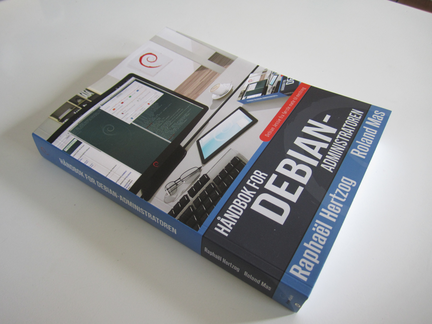
I finally received a copy of the Norwegian Bokm l edition of
"The Debian Administrator's
Handbook". This test copy arrived in the mail a few days ago, and
I am very happy to hold the result in my hand. We spent around one and a half year translating it. This paperbook edition
is available
from lulu.com. If you buy it quickly, you save 25% on the list
price. The book is also available for download in electronic form as
PDF, EPUB and Mobipocket, as can be
read online
as a web page.
This is the second book I publish (the first was the book
"Free Culture" by Lawrence Lessig
in
English,
French
and
Norwegian
Bokm l), and I am very excited to finally wrap up this
project. I hope
"H ndbok
for Debian-administratoren" will be well received.
SOURCE_DATE_EPOCH support:
test_device on FreeBSDMETA-INF/container.xml file.Sqlite3Database.RE_FILE_TYPEorchprovider contains packages of different orchestrators such as kubernetes and nomad.types provides all the generic types related to orchestrator.pkg contains packages like nethelper, util etc.volumes contain packages related to volume provisioner and profiles.
buildscripts
docker
command
docs
example
scripts
config
templates
buildscripts
docker
cmd
docs
lib
api
v1
artifacts
docker
docker-compose
k8s
config
flaghelper
loghelper
mockit
etcmayaserver
nethelper
orchprovider
k8s
nomad
profile
orchprovider
volumeprovisioner
server
util
volumeprovisioner
jiva
proposals
buildscripts
docker
command
docs
example
orchprovider
k8s
v1
nomad
v1
pkg
nethelper
util
scripts
config
templates
types
v1
profile
orchestrator
volumes
profile
volumeprovisioner
provisioner
jiva
buildscripts
docker
cmd
docs
lib
artifacts
docker
docker-compose
k8s
config
flaghelper
loghelper
server
proposals

Some month ago I upgrade my (European) fenix3 to a (Japanese) fenix 5x, looking forward to the built-in maps as well as support for Japanese. I was about to write a great review, how content I have been with the fenix 3 and how much better the 5x is. Well, until I realized that Garmin s engineers seem to be brain-damaged and shipping broken by design devices: Just one word: Set an alarm on the watch, and wonder
.. because you will never wake up the next day, since the alarm was deleted due to an unattended (so-called) sync operation. Happened to me, several times, worst was when I was with clients working as guide.
So the problem is well known, see this link and this link and this link, and it is not restricted to the fenix. The origin of the problem is that Garmin is incapable of implementing a synchronization protocol. They have three sources of data: The Connect website, the Connect application on the smartphone, and the watch itself. And interestingly they only do pushes from Web to application to device, overwriting settings on the lower end. Which means, any alarm that I create on the watch will be overwritten, ie deleted, on every sync sorry, not sync, on every forced push from the mobile.

It is a bit depressing, but I think the urgent solution is to exempt alarms from the synchronization completely, and remove them from both the connect web page and the application, until a better, a real, synchronization is implemented.
I found a work-around in one of the threads on the Garmin forum, that is: create an alarm on the web or application, better alarms for each of the times you might need it. These will be synced to the device, and can be activated/deactivated on the device without problems. But to be honest this is not a solution I can really trust in when I need to get up in the morning.
Besides this issue, which is unfortunately rather severe a restriction for me as mountaineer and mountain guide, I really love the watch and will write a more detailed review soon.
This post attempts to chart my journey towards getting usefully started with Ansible to manage my system configurations. It s a high level discussion of how I went about doing so and what I got out of it, rather than including any actual config snippets - there are plenty of great resources out there that handle the actual practicalities of getting started much better than I could.
I ve been convinced about the merits of configuration management for machines for a while now; I remember conversations about producing an appropriate set of recipes to reproduce our haphazard development environment reliably over 4 years ago. That never really got dealt with before I left, and as managing systems hasn t been part of my day job since then I never got around to doing more than working my way through the Puppet Learning VM. I do, however, continue to run a number of different Linux machines - a few VMs, a hosted dedicated server and a few physical machines at home and my parents . In particular I have a VM which handles my parents email, and I thought that was a good candidate for trying to properly manage. It s backed up, but it would be nice to be able to redeploy that setup easily if I wanted to move provider, or do hosting for other domains in their own VMs.

I picked Ansible, largely because I wanted something lightweight and the agentless design appealed to me. All I really need to do is ensure Python is on the host I want to manage and everything else I can bootstrap using Ansible itself. Plus it meant I could use the version from Debian testing on my laptop and not require backports on the stable machines I wanted to manage.
My first attempt was to write a single Ansible YAML file which did all the appropriate things for the email VM; installed Exim/Apache/Roundcube, created users, made sure the appropriate SSH keys were in place, installed configuration files, etc, etc. This did the job, but I found myself thinking it was no better than writing a shell script to do the same things.
Things got a lot better when instead of concentrating on a single host I looked at what commonality was shared between hosts. I started with simple things; Debian is my default distro so I created an Ansible role debian-system which configured up APT and ensured package updates were installed. Then I added a task to setup my own account and install my SSH keys. I was then able to deploy those 2 basic steps across a dozen different machine instances. At one point I got an ARM64 VM from Scaleway to play with, and it was great to be able to just add it to my Ansible hosts file and run the playbook against it to get my basic system setup.
Adding email configuration got trickier. In addition to my parents email VM I have my own email hosted elsewhere (along with a whole bunch of other users) and the needs of both systems are different. Sitting down and trying to manage both configurations sensibly forced me to do some rationalisation of the systems, pulling out the commonality and then templating the differences. Additionally I ended up using the lineinfile module to edit the Debian supplied configurations, rather than rolling out my own config files. This helped ensure more common components between systems. There were also a bunch of differences that had grown out of the fact each system was maintained by hand - I had about 4 copies of each Let s Encrypt certificate rather than just putting one copy in /etc/ssl and pointing everything at that. They weren t even in the same places on different systems. I unified these sorts of things as I came across them.
Throughout the process of this rationalisation I was able to easily test using containers. I wrote an Ansible role to create systemd-nspawn based containers, doing all of the LVM + debootstrap work required to produce a system which could then be managed by Ansible. I then pointed the same configuration as I was using for the email VM at this container, and could verify at each step along the way that the results were what I expected. It was still a little nerve-racking when I switched over the live email config to be managed by Ansible, but it went without a hitch as hoped.
I still have a lot more configuration to switch to being managed by Ansible, especially on the machines which handle a greater number of services, but it s already proved extremely useful. To prepare for a jessie to stretch upgrade I fired up a stretch container and pointed the Ansible config at it. Most things just worked and the minor issues I was able to fix up in that instance leaving me confident that the live system could be upgraded smoothly. Or when I want to roll out a new SSH key I can just add it to the Ansible setup, and then kick off an update. No need to worry about whether I ve updated it everywhere, or correctly removed the old one.
So I m a convert; things were a bit more difficult by starting with existing machines that I didn t want too much disruption on, but going forward I ll be using Ansible to roll out any new machines or services I need, and expect that I ll find that new deployment to be much easier now I have a firm grasp on the tools available.
In a few days, I ll be attending DebCamp17 in Montr al, Canada. Here are a few things I plan to pay attention to:
long time no blog post. & the stretch release
happened without many RC bug fixes from me; in practice, the
auto-removals are faster & more convenient.
what I nevertheless did in the last months was to fix RC bugs in
pkg-perl packages (it still surprises me how fast rotting &
constantly moving code is); prepare RC bug fixes for jessie (also for
pkg-perl packages); & in the last weeks provide patches
& carry out NMUs for perl packages as part of the ongoing perl
5.26 transition.
Here s what I m planning to work on please get in touch if you want
to get involved with any of these items. In rough order of
priority/likelihood of completion:
Next.