Search Results: "tar"

21 November 2014

Julien Danjou: Distributed group management and locking in Python with tooz

With OpenStack embracing the Tooz library more and more over the past year, I think it's a good start to write a bit about it. A bit of history A little more than year ago, with my colleague Yassine Lamgarchal and others at eNovance, we investigated on how to solve a problem often encountered inside OpenStack: synchronization of multiple distributed workers. And while many people in our ecosystem continue to drive development by adding new bells and whistles, we made a point of solving new problems with a generic solution able to address the technical debt at the same time. Yassine wrote the first ideas of what should be the group membership service that was needed for OpenStack, identifying several projects that could make use of this. I've presented this concept during the OpenStack Summit in Hong-Kong during an Oslo session. It turned out that the idea was well-received, and the week following the summit we started the tooz project on StackForge. Goals Tooz is a Python library that provides a coordination API. Its primary goal is to handle groups and membership of these groups in distributed systems. Tooz also provides another useful feature which is distributed locking. This allows distributed nodes to acquire and release locks in order to synchronize themselves (for example to access a shared resource). The architecture If you are familiar with distributed systems, you might be thinking that there are a lot of solutions already available to solve these issues: ZooKeeper, the Raft consensus algorithm or even Redis for example. You'll be thrilled to learn that Tooz is not the result of the NIH syndrome, but is an abstraction layer on top of all these solutions. It uses drivers to provide the real functionalities behind, and does not try to do anything fancy. All the drivers do not have the same amount of functionality of robustness, but depending on your environment, any available driver might be suffice. Like most of OpenStack, we let the deployers/operators/developers chose whichever backend they want to use, informing them of the potential trade-offs they will make. So far, Tooz provides drivers based on: All drivers are distributed across processes. Some can be distributed across the network (ZooKeeper, memcached, redis ) and some are only available on the same host (IPC). Also note that the Tooz API is completely asynchronous, allowing it to be more efficient, and potentially included in an event loop. Features Group membership Tooz provides an API to manage group membership. The basic operations provided are: the creation of a group, the ability to join it, leave it and list its members. It's also possible to be notified as soon as a member joins or leaves a group. Leader election Each group can have a leader elected. Each member can decide if it wants to run for the election. If the leader disappears, another one is elected from the list of current candidates. It's possible to be notified of the election result and to retrieve the leader of a group at any moment. Distributed locking When trying to synchronize several workers in a distributed environment, you may need a way to lock access to some resources. That's what a distributed lock can help you with. Adoption in OpenStack Ceilometer is the first project in OpenStack to use Tooz. It has replaced part of the old alarm distribution system, where RPC was used to detect active alarm evaluator workers. The group membership feature of Tooz was leveraged by Ceilometer to coordinate between alarm evaluator workers. Another new feature part of the Juno release of Ceilometer is the distribution of polling tasks of the central agent among multiple workers. There's again a group membership issue to know which nodes are online and available to receive polling tasks, so Tooz is also being used here. The Oslo team has accepted the adoption of Tooz during this release cycle. That means that it will be maintained by more developers, and will be part of the OpenStack release process. This opens the door to push Tooz further in OpenStack. Our next candidate would be write a service group driver for Nova. The complete documentation for Tooz is available online and has examples for the various features described here, go read it if you're curious and adventurous!

20 November 2014

Steve McIntyre: UEFI Debian CDs for Jessie...

So, my work for Wheezy gave us working amd64 UEFI installer images. Yay! Except: there were a few bugs that remained, and also places where we could deal better with some of the more crappy UEFI implementations out there. But, things have improve since then and we should be better for Jessie in quite a few ways. First of all, Colin and the other Grub developers have continued working hard and quite a lot of the old bugs in this area look to be fixed. I'm hoping we're not going to see so many "UEFI boot gives me a blank black screen" type of problems now. For those poor unfortunates with Windows 7 on their machines, using BIOS boot despite having UEFI support in their hardware, I've fixed a long-standing bug (#763127) that could leave people with broken systems, unable to dual boot. We've fixed a silly potential permissions bug in how the EFI System Partition is mounted: (#770033). Next up, I'm hoping to add a workaround for some of the broken UEFI implementations, by adding support in our Grub packages (and in d-i) for forcing the installation of a copy of grub-efi in the removable media path. See #746662 for more of the details. It's horrid to be doing this, but it's just about the best thing we can do to support people with broken firmware. Finally, I've been getting lots of requests for adding i386 (32-bit x86) UEFI support in our official images. Back in the Wheezy development cycle, I had test images that worked on i386, but decided not to push that support into the release. There were worries about potentially critical bugs that could be tickled on some hardware, plus there were only very few known i386 UEFI platforms at the time; the risk of damage outweighed the small proportion of users, IMHO. However, I'm now revisiting that decision. The potentially broken machines are now 2 years older, and so less likely to be in use. Also, Intel have released some horrid platform concoction around the Bay Trail CPU: a 64-bit CPU (that really wants a 64-bit kernel), but running a 32-bit UEFI firmware with no BIOS Compatibility Mode. Recent kernels are able to cope with this mess, but at the moment there is no sensible way to install Debian on such a machine. I'm hoping to fix that next (#768461). It's going to be awkward again, needing changes in several places too. You can help! Same as 2 years ago, I'll need help testing some of these images. Particularly for the 32-bit UEFI support, I currently have no relevant hardware myself. That's not going to make it easy... :-/ I'll start pushing unofficial Jessie EFI test images shortly.

Gunnar Wolf: UNAM. Viva M xico, viva en paz.

UNAM. Viva M xico, viva en paz.
We have had terrible months in Mexico; I don't know how much has appeared about our country in the international media. The last incidents started on the last days of September, when 43 students at a school for rural teachers were forcefully disappeared (in our Latin American countries, this means they were taken by force and no authority can yet prove whether they are alive or dead; forceful disappearance is one of the saddest and most recognized traits of the brutal military dictatorships South America had in the 1970s) in the Iguala region (Guerrero state, South of the country) and three were killed on site. An Army regiment was stationed few blocks from there and refused to help. And yes, we live in a country where (incredibly) this news by themselves would not seem so unheard of... But in this case, there is ample evidence they were taken by the local police forces, not by a gang of (assumed) wrongdoers. And they were handed over to a very violent gang afterwards. Several weeks later, with far from a thorough investigation, we were told they were killed, burnt and thrown to a river. The Iguala city major ran away, and was later captured, but it's not clear why he was captured at two different places. The Guerrero state governor resigned and a new governor was appointed. But this was not the result of a single person behaving far from what their voters would expect It's a symptom of a broken society where policemen will kill when so ordered, where military personnel will look away when pointed out to the obvious, where the drug dealers have captured vast regions of the country where are stronger than the formal powers. And then, instead of dealing with the issue personally as everybody would expect, the president goes on a commercial mission to China. Oh, to fix some issues with a building company. That coincidentally or not was selling a super-luxury house to his wife. A house that she, several days later, decided to sell because it was tarnishing her family's honor and image. And while the president is in China, the person who dealt with the social pressure and told us about the probable (but not proven!) horrible crime where the "bad guys" for some strange and yet unknown reason (even with tens of them captured already) decided to kill and burn and dissolve and disappear 43 future rural teachers presents his version, and finishes his speech saying that "I'm already tired of this topic". Of course, our University is known for its solidarity with social causes; students in our different schools are the first activists in many protests, and we have had a very tense time as the protests are at home here at the university. This last weekend, supposed policemen entered our main campus with a stupid, unbelievable argument (they were looking for a phone reported as stolen three days earlier), get into an argument with some students, and end up firing shots at the students; one of them was wounded in the leg. And the university is now almost under siege: There are policemen surrounding us. We are working as usual, and will most likely finish the semester with normality, but the intimidation (in a country where seeing a policeman is practically never a good sign) is strong. And... Oh, I could go on a lot. Things feel really desperate and out of place. Today I will join probably tens or hundreds of thousands of Mexicans sick of this simulation, sick of this violence, in a demonstration downtown. What will this achieve? Very little, if anything at all. But we cannot just sit here watching how things go from bad to worse. I do not accept to live in a state of exception. So, this picture is just right: A bit over a month ago, two dear friends from Guadalajara city came, and we had a nice walk in the University. Our national university is not only huge, it's also beautiful and loaded with sights. And being so close to home, it's our favorite place to go with friends to show around. This is a fragment of the beautiful mural in the Central Library. And, yes, the University stands for "Viva M xico". And the university stands for "Peace". And we need it all. Desperately.

Steve Kemp: An experiment in (re)building Debian

I've rebuilt many Debian packages over the years, largely to fix bugs which affected me, or to add features which didn't make the cut in various releases. For example I made a package of fabric available for Wheezy, since it wasn't in the release. (Happily in that case a wheezy-backport became available. Similar cases involved repackaging gtk-gnutella when the protocol changed and the official package in the lenny release no longer worked.) I generally release a lot of my own software as Debian packages, although I'll admit I've started switching to publishing Perl-based projects on CPAN instead - from which they can be debianized via dh-make-perl. One thing I've not done for many years is a mass-rebuild of Debian packages. I did that once upon a time when I was trying to push for the stack-smashing-protection inclusion all the way back in 2006. Having had a few interesting emails this past week I decided to do the job for real. I picked a random server of mine, rsync.io, which stores backups, and decided to rebuild it using "my own" packages. The host has about 300 packages installed upon it:
root@rsync ~ # dpkg --list   grep ^ii   wc -l
294
I got the source to every package, patched the changelog to bump the version, and rebuild every package from source. That took about three hours. Every package has a "skx1" suffix now, and all the build-dependencies were also determined by magic and rebuilt:
root@rsync ~ # dpkg --list   grep ^ii   awk '  print $2 " " $3 '  head -n 4
acpi 1.6-1skx1
acpi-support-base 0.140-5+deb7u3skx1
acpid 1:2.0.16-1+deb7u1skx1
adduser 3.113+nmu3skx1
The process was pretty quick once I started getting more and more of the packages built. The only shortcut was not explicitly updating the dependencies to rely upon my updages. For example bash has a Debian control file that contains:
Depends: base-files (>= 2.1.12), debianutils (>= 2.15)
That should have been updated to say:
Depends: base-files (>= 2.1.12skx1), debianutils (>= 2.15skx1)
However I didn't do that, because I suspect if I did want to do this decently, and I wanted to share the source-trees, and the generated packages, the way to go would not be messing about with Debian versions instead I'd create a new Debian release "alpha-apple", "beta-bananna", "crunchy-carrot", "dying-dragonfruit", "easy-elderberry", or similar. In conclusion: Importing Debian packages into git, much like Ubuntu did with bzr, is a fun project, and it doesn't take much to mass-rebuild if you're not making huge changes. Whether it is worth doing is an entirely different question of course.

Daniel Pocock: Is Amnesty giving spy victims a false sense of security?

Amnesty International is getting a lot of attention with the launch of a new tool to detect government and corporate spying on your computer. I thought I would try it myself. I went to a computer running Microsoft Windows, an operating system that does not publish its source code for public scrutiny. I used the Chrome browser, users often express concern about Chrome sending data back to the vendor about the web sites the users look for. Without even installing the app, I would expect the Amnesty web site to recognise that I was accessing the site from a combination of proprietary software. Instead, I found a different type of warning. Beware of Amnesty? Instead, the only warning I received was from Amnesty's own cookies: Even before I install the app to find out if the government is monitoring me, Amnesty is keen to monitor my behaviour themselves. While cookies are used widely, their presence on a site like Amnesty's only further desensitizes Internet users to the downside risks of tracking technologies. By using cookies, Amnesty is effectivley saying a little bit of tracking is justified for the greater good. Doesn't that sound eerily like the justification we often hear from governments too? Is Amnesty part of the solution or part of the problem? Amnesty is a well known and widely respected name when human rights are mentioned. However, their advice that you can install an app onto a Windows computer or iPhone to detect spyware is like telling people that putting a seatbelt on a motorbike will eliminate the risk of death. It would be much more credible for Amnesty to tell people to start by avoiding cloud services altogether, browse the web with Tor and only use operating systems and software that come with fully published source code under a free license. Only when 100% of the software on your device is genuinely free and open source can independent experts exercise the freedom to study the code and detect and remove backdoors, spyware and security bugs. It reminds me of the advice Kim Kardashian gave after the Fappening, telling people they can continue trusting companies like Facebook and Apple with their private data just as long as they check the privacy settings (reality check: privacy settings in cloud services are about as effective as a band-aid on a broken leg). Write to Amnesty Amnesty became famous for their letter writing campaigns. Maybe now is the time for people to write to Amnesty themselves, thank them for their efforts and encourage them to take more comprehensive action. Feel free to cut and paste some of the following potential ideas into an email to Amnesty:
I understand you may not be able to respond to every email personally but I would like to ask you to make a statement about these matters on your public web site or blog. I understand it is Amnesty's core objective to end grave abuses of human rights. Electronic surveillence, due to its scale and pervasiveness, has become a grave abuse in itself and in a disturbing number of jurisdictions it is an enabler for other types of grave violations of human rights. I'm concerned that your new app Detekt gives people a false sense of security and that your campaign needs to be more comprehensive to truly help people and humanity in the long term. If Amnesty is serious about solving the problems of electronic surveillance by government, corporations and other bad actors, please consider some of the following:
  • Instead of displaying a cookie warning on Amnesty.org, display a warning to users who access the site from a computer running closed-source software and give them a link to download a free and open source web browser like Firefox.
  • Redirect all visitors to your web site to use the HTTPS encrypted version of the site.
  • Using free software such as the GNU/Linux operating system (using one of the Debian, Fedora or Ubuntu systems is one of the more common ways to achieve this) and LibreOffice for all Amnesty's own operations, making a public statement about your use of free software and mentioning this in the closing paragraph of all press releases relating to surveillance topics.
  • Encouraging Amnesty donors, members and supporters to choose similar software especially when engaging in any political activities.
  • Make a public statement that Amnesty will not use cloud services such as SalesForce or Facebook to store, manage or interact with data relating to members, donors or other supporters.
  • Encouraging the public to move away from centralized cloud services such as those provided by their smartphone or social networks and use de-centralized or federated services such as XMPP chat.
Given the immense threat posed by electronic surveillance, I'd also like to call on Amnesty to allocate at least 10% of annual revenue towards software projects releasing free and open source software that offers the public an alternative to the centralized cloud.

While publicity for electronic privacy is great, I hope Amnesty can go a step further and help people use trustworthy software from the ground up.

Stefano Zacchiroli: Thoughts on the Init System Coupling GR

on perceived hysteria and silent sanity As you probably already know by now, the results of the Debian init system coupling general resolution (GR) look like this:
Init system coupling GR: results (arrow from A to B means that voters preferred A to B by that margin)
results of the init system coupling GR
Some random thoughts about them: My take home message is that we are experiencing a huge gap between the public perception of the state of Debian (both from within and from without the project) and the actual beliefs of the silent majority of people that make Debian with their work, day after day. In part this is old news. The most "senior" members of the project will remember that the topic of "vocal minorities vs silent majority" was a recurrent one in Debian 10+ years ago, when flames were periodically ravaging the project. Since then Debian has grown a lot though, and we are now part of a much larger and varied ecosystem. We are now at a scale at which there are plenty of FOSS "mass-media" covering daily what happens in Debian, inducing feedback loops with our own perception of ourselves which we do not fully grok yet. This is a new factor in the perception gap. This situation is not intrinsically bad, nor there is blame to assign here: after all influential bloggers, news sites, etc., just do their job. And their attention also testifies of the huge interest that there is around Debian and our choices. But we still need to adapt and learn to take perceived hysteria with a pinch (or two) of salt. It might just be time for our decennial check-up. Time to remind ourselves that our ways of doing things might in fact still be much more sane than sometimes we tend to believe. We went on 10+ years ago, after monumental flames. It looks like we are now ready to move on again, putting The Era of the Great systemd Histeria behind us.

19 November 2014

Thomas Goirand: Rotten tomatoes

There s many ways to interpret the last GR. The way I see it is how Joey hoped Debian was: the outcome of the poll shows that we don t want to do technical decisions by voting. At the beginning of this GR, I was supportive of it, and though it was a good thing to enforce the rule that we care for non-systemd setups. Though I have slowly changed my mind. I still think it was a good idea to see what the community thought after a so long debate. I now think that this final outcome is awesome and couldn t have been better. Science (and computer science) has never been about voting, otherwise the earth would be flat, without drifting continents. So my hope is that the Debian project as a whole, will allow itself to do mistakes, iterative trials, errors, and go back on any technical decision if they don t make sense anymore. When being asked something, it s ok to reply: I don t know , and it should be ok for the Debian project to have this alternative as one of the possible answers. I m convince that refusing to take a drastic choice in this point in time was exactly what we needed to do. And my hope is that Joey comes back after he realizes that we ve all understood and embarrassed his position that science cannot be governed by polls. For Stretch, I m sure there s going to be a lot of new alternatives. Maybe uselessd, eudev and others. Maybe I ll have a bit of time to work on OpenRC Debian integration myself (hum I m dreaming here ). Maybe something else. Let s just wait. We have more than 300 bugs to fix before Jessie can be released. Let s happilly work on that together, and forget about the init systems for a while P.S: Just to be on the safe side: the rotten tomatoes image was not about criticizing the persons who started the poll, who I respect a lot, especially Ian, who I am convinced is trying to do his best for Debian (hug).

EvolvisForge blog: Valid UTF-8 but invalid XML

Another PSA: something surprising about XML. As you might all know, XML must be valid UTF-8 (or UTF-16 (or another encoding supported by the parser, but one which yields valid Unicode codepoints when read and converted)). Some characters, such as the ampersand & , must be escaped ( &#38; or &#x26; , although &amp; may also work, depending on the domain) or put into a CDATA section ( <![CDATA[&]]> ). A bit surprisingly, a literal backspace character (ASCII 08h, Unicode U+0008) is not allowed in the text. I filed a bugreport against libxml2, asking it to please encode these characters. A bit more research followed. Surprisingly, there are characters that are not valid in XML documents in any way, not even as entities or in CDATA sections. (xmlstarlet, by the way, errors out somewhat nicely for an unescaped literal or entity-escaped backspace, but behaves absolutely hilarious for a literal backspace in a CDATA section.) Basically, XML contains a whitelist for the following Unicode codepoints: Additionally, a certain number of codepoints is discouraged: U+007F U+0084 (IMHO wise), U+0086 U+009F (also wise, but why allow U+0085?), U+FDD0 U+FDEF (a bit surprisingly, but consistent with disallowing the backspace character), and the last two codepoints of every plane (U+FFFE and U+FFFF were already disallowed, but U-0001FFFE, U-0001FFFF, , U-0010FFFF weren t; this is extremely wise). The suggestion seems to be to just strip these characters silently from the XML document . I m a bit miffed about this, as I don t even use XML directly (I m extending a PHP webapplication that is a SOAP client and talks to a Java SOAP-WS) and would expect this to preserve my strings, but, oh my. I ve forwarded the suggestion to just strip them silently to the libxml2 maintainers in the aforementioned bug report, for now, and may even hack that myself (on customer-paid time). More robust than hacking the PHP thingy to strip them first, anyway I ve got no control over the XML after all. Sharing this so that more people know that not all UTF-8 is valid in XML. Maybe it saves someone else some time. (Now wondering whether to address this in my xhtml_escape shell function. Probably should. Meh.)

Thorsten Glaser: Debian init system freedom of choice GR worst possible outcome

Apparently (the actual results have not yet been published by the Secretary), the GR is over, and the worst possible option has won. This is an absolutely ambiguous result, while at the same time sending a clear signal that Debian is not to be trusted wrt. investing anything into it, right now. Why is this? Simply: GR not required means that whatever people do is probably right . Besides this, we have one statement from the CTTE ( systemd is default init system for jessie. Period. ) and nothing else. This means that runit, or upstart, or file-rc, or uselessd, can be the default init system for zurg^H^H^H^Hstretch, or even the only one. It also means that the vast majority of Debian Developers are sheeple, neither clearly voting to preserve freedom of choice between init systems for its users, nor clearly voting to unambiguously support systemd and progress over compatibility and choice, nor clearly stating that systemd is important but supporting other init systems is still recommended. (I ll not go into detail on how the proposer of the apparently winning choice recommends others to ignore ftpmaster constraints and licences, and even suggests to run a GR to soften up the DFSG interpretation.) I d have voted this as no, absolutely not if it was possible to do so more strongly. Judging from the statistics, the only thing I voted above NOTA/FD is the one least accepted by DDs, although the only other proposal I considered is the first-rated of them: support for other init systems is recommended but not required. What made me vote it below NOTA/FD was: The Debian Project makes no statement at this time on sysvinit support beyond the jessie release. This sentence made even this proposal unbearable, unacceptable, for people wanting to invest (time, money, etc.) into Debian. Update: Formal result announced. So 358 out of 483 voting DDs decided to be sheeple (if I understand the eMail correctly). We had 1006 DDs with voting rights, which is a bit ashaming as well. That s 48.01% only. I wonder what s worse. This opens up a very hard problem: I m absolutely stunned by this and wondering what to do now. While there is no real alternative to Debian at $dayjob I can always create customised packages in my own APT repository, and while it was great when those were eventually (3.1.17-1) accepted into Debian, even replacing the previous packages completely it is simpler and quicker to not do so. While $dayjob benefits from having packages I work on inside Debian itself, even though I cannot always test all scenarios Debian users would need, some work reduction due to reactions already led to Debian losing out on Mediawiki for jessie and some additional suffering. With my own package repository, I can modulo installing/debootstrap serve my needs for $dayjob much quicker, easily, etc. and only miss out on absolutely delightful user feedback. But then, others could always package software I m upstream of for Debian. Or, if I do not leave the project, continue doing so via QA uploads. I m also disappointed because I have invested quite some effort into trying to make Debian better (my idea to join as DD was if I ve got to use it, it better be damn good! ), into packaging software and convincing people at work that developing software as Debian packages instead of (or not) thinking of packaging later was good. I ve converted our versions of FusionForge and d-push to Debian packages, and it works pretty damn well. Sometimes it needs backports of my own, but that s the corportate world, and no problem to an experienced DD. (I just feel bad we ($orkplace) lost some people, an FTP master along them, before this really gained traction.) I d convert to OpenBSD because, despite MirBSD s history with them, they re the only technically sound alternative, but apparently tedu (whom I respect technically, and who used to offer good advice to even me when asked, and who I think wouldn t choose systemd himself) still (allying with the systemd side (I m not against people being able to choose systemd, for the record, I just don t want to be forced into it myself!)) has some sort of grudge against me. Plus, it d be hard to get customers to follow. So, no alternative right now. But I m used to managing my own forks of software; I m doomed to basically hack and fix anything I use (I recently got someone who owns a licence to an old-enough Visual Studio version to transfer that to me, so I can hack on the Windows Mobile 6 version of Cachebox, to fix bugs in one of the geocaching applications I use. Now I just need to learn C# and the .NET Compact Framework. So I m also used to some amount of pain.) I m still unresolved wrt. the attitude I should show the Debian project now. I had decided to just continue to live on, and work on the things I need done, but that was before this GR non-result. I absolutely cannot recommend anyone to invest into Debian (without sounding hypocriet), but I cannot recommend anything else either. I cannot justify leaving but don t know if I want to stay. I think I should sleep over it. One thing I promised, and thus will do, is to organise a meeting of the Debian/m68k people soonish. But then, major and important and powerful forces inside Debian still insist that Debian-Ports are not part of it [Update: yes, DSA is moving it closer, thanks for that by the way, but that doesn t mean anything to certain maintainers or the Release Team, although, the latter is actually understandable and probably sensible.] yet, all forks of Debian now suffer from the systemd adoption in it instead of having a freedom-of-choice upstream. I ve said, and I still feel that systemd adoption should have done in a Debian downstream / (pure?) blend, and maybe (parts of) GNOME removed from Debian itself for it. (Adding cgroups support to the m68k kernel to support systemd was done. I adviced against it, on the grounds of memory and code size. But no downstream can remove it now.)

Rhonda D'Vine: The Pogues

Actually I was working already on a different music blog entry, but I want to get this one out. I was invited to join the Organic Dancefloor last thursday. And it was a really great experience. A lot of nice people enjoying a dance evening of sort of improvisational traditional folk dancing with influences from different parts of europe. Three bands playing throughout the evening. I definitely plan to go there again. :) Which brings me to the band I want to present you now. They also play sort-of traditional songs, or at least with traditional instruments, and are also quite danceable to. This is about The Pogues. And these are the songs that I do enjoy listening to every now and then: Like always, enjoy!

/music permanent link Comments: 2 Flattr this

Simon McVittie: still aiming to be the universal operating system

Debian's latest round of angry mailing list threads have been about some combination of init systems, future direction and project governance. The details aren't particularly important here, and pretty much everything worthwhile in favour of or against each position has already been said several times, but I think this bit is important enough that it bears repeating: the reason I voted "we didn't need this General Resolution" ahead of the other options is that I hope we can continue to use our normal technical and decision-making processes to make Debian 8 the best possible OS distribution for everyone. That includes people who like systemd, people who dislike systemd, people who don't care either way and just want the OS to work, and everyone in between those extremes. I think that works best when we do things, and least well when a lot of time and energy get diverted into talking about doing things. I've been trying to do my small part of the former by fixing some release-critical bugs so we can release Debian 8. Please join in, and remember to write good unblock requests so our hard-working release team can get through them in a finite time. I realise not everyone will agree with my idea of which bugs, which features and which combinations of packages are highest-priority; that's fine, there are plenty of bugs to go round! Regarding init systems specifically, Debian 'jessie' currently works with at least systemd-sysv or sysvinit-core as pid 1 (probably also Upstart, but I haven't tried that) and I'm confident that Debian developers won't let either of those regress before it's released as Debian 8. I expect the freeze for Debian 'stretch' (presumably Debian 9) to be a couple of years away, so it seems premature to say anything about what will or won't be supported there; that depends on what upstream developers do, and what Debian developers do, between now and then. What I can predict is that the components that get useful bug reports, active maintenance, thorough testing, careful review, and similar help from contributors will work better than the things that don't; so if you like a component and want it to be supported in Debian, you can help by, well, supporting it.
PS. If you want the Debian 8 installer to leave you running sysvinit as pid 1 after the first reboot, here's a suitable incantation to add to the kernel command-line in the installer's bootloader. This one certainly worked when KiBi asked for testing a few days ago:
preseed/late_command="in-target apt-get install -y sysvinit-core"
I think that corresponds to this line in a preseeding file, if you use those:
d-i preseed/late_command string in-target apt-get install -y sysvinit-core
A similar apt-get command, without the in-target prefix, should work on an installed system that already has systemd-sysv. Depending on other installed software, you might need to add systemd-shim to the command line too, but when I tried it, apt-get was able to work that out for itself. If you use aptitude instead of apt-get, double-check what it will do before saying "yes" to this particular switchover: its heuristic for resolving conflicts seems to be rather more trigger-happy about removing packages than the one in apt-get.

18 November 2014

Laura Arjona: Translating (reviewing) Debian package descriptions

Some days I feel super lazy but I still would like to go on contributing translations to Debian.
Then, I leave the web translations a bit, and change to translate or review Debian package descriptions. It s something that anybody can do without any knowledge of translation tools, since it is a very simple web interface, as you will see. First you need to create a login account, then, login into the system. And then, go to the page of your mother language (in my case, Spanish, es ). You will see some introductory text, and the list of pending translations:
ddtss_es1
At the end of the page, there is the list of translations pending to review:
ddtss_es2 We should begin with this, so the work that other people already made arrives quickly its destination. And it s the easiest part, as you will see. Let s pick one of them (libvformat1-dev): review1
You see the short description in the original English, and the current translation (if there were changes from a former version, they are coloured too). I didn t know what the package libvformat1-dev does, but here s a nice opportunity to learn aobut it a bit :) The short description looks ok for me. Let s go on to the long description: review2 It also looks correct for me. So I leave the text box as is, and go on until the bottom of the page:
review3
and click Accept as is . That s all!! The system brings you back to the page with pending translations and reviews. Let s pick another one: totem
review4
I found a typo and corrected some other words, so I updated the text in the translation box, left a message to the other translators in the comment box, and clicked Accept with changes . And iterate. When 3 translators agree in a translation, it becomes official, and its propagated to apt-cache, aptitude, synaptic, etc., and the website (packages.debian.org). This is the most difficult part (to get 3 reviews for each package description): many language teams are small, and their workforce is spread in many fronts: translations for the website, news and announcements, debconf templates (the messages that are shown to the user when a package is installed), the Debian installer, the documentation, the package descriptions So your help (even when you only review some translations from time to time) will be appreciated, for sure.
Filed under: Tools Tagged: Contributing to libre software, Debian, English, translations

Michal &#268;iha&#345;: Mercurial support in Weblate

Weblate has started as a translation system tightly bound to Git version control system. This was in no means design decision, but rather it was the version control I've used. But this has shown not to be sufficient and other systems were requested as well. And Mercurial is first of them to be supported. Weblate 2.0 already had separated VCS layer and adding another system to that is quite easy if you know the VCS you're adding. Unfortunately this wasn't the case for me with Mercurial as I've never used it for anything more serious than cloning a repository, committing fixes and pushing it back. Weblate needs a bit more than that, especially in regard to remote branches. But nevertheless I've figured out all operations and the implementation is ready in our Git. In case somebody is interested in adding support for another version control, patches are always welcome!

Filed under: English phpMyAdmin SUSE Weblate 0 comments Flattr this!

Josselin Mouette: Introspection (not the GObject one)

Disclaimer: I m not used to writing personal stuff on Debian channels. However, there is nothing new here for those who know me from other public channels.

Yesterday, I received the weirdest email from well-known troll MikeeUSA. He thought I shared his views of a horrible world full of bloodthirsty feminists using systemd in their quest for domination over poor white male heterosexuals. The most nauseating paragraph was probably the one where he showed signs of the mentality of a pedocriminal.

At first, I shrugged it off and sent him an email explaining I didn t want anything with his stinky white male supremacist theories, assorted with a bit of taunting. But after discovering all that stuff was actually sent to public mailing lists, I took the time for a second look and started a bit of introspection.

MikeeUSA thought I was a white male supremacist because of the so-called SmellyWerewolf incident, 6 years ago.
Oh boy, people change in six years. Upon re-reading that, I had trouble admitting I was the one to write it. Memory is selective, and with time, you tend not to remember some gruesome details, especially the ones that conflict most with your moral values.

I can assure every reader that the only people I intended to mock then were those who mistook Debian mailing lists for advertising channels; but I understand now that my message must have caused pain to a lot more people than that. So, it may come late, but let me take this opportunity to offer my sincerest apologies to anyone I may have hurt at that time.


It may seem strange for someone with deeply-rooted values of equality to have written that. To have considered that it was okay to stereotype people. And I think I found this okay because to me, those people were given equal rights, and were therefore equal. But the fight for equality is not over when everyone is given the same rights. Not until they are given the same opportunities to exert those rights. Which does not happen when they live in a society that likes to fit them in little archetypal peg holes, never giving you the chance to question where those stereotypes come from.

For me, that chance came from an unusual direction: the fight against prostitution. This goes way back for me. Since when I was a teenager, I have always been ticked off at the idea of nonconsensual sex that somehow evades criminal responsibility because of money compensation. I never understood why it wasn t considered as rape. Yet it sounded weird that a male heterosexual would hold such opinions; after all, male heterosexuals should go to prostitutes as a kind of social ritual, right?

It was only three years ago that an organization of men against prostitution was founded in France. Not only did I find out that I was not alone with my progressive ideas, I was given the opportunity to exchange with many men and women who had studied prostitution: its effects on victims, its relationship to rape culture and more generally to the place men and women hold in society. Because eventually, it all boils down to little peg holes in which we expect people to fit: the virile man or the faggot, the whore or the mother. For me, it was liberating. I could finally get rid of the discomfort of being a white male heterosexual that didn t enter the little peg holes that were made for me.

And now, after Sweden 15 years ago, a new group of countries are finally adopting laws to criminalize the act of paying for sex. Including France. That s too bad for MikeeUSA, but this country is no longer the eldorado for white male supremacists. And I m proud that our lobbying made a contribution, however small, to that change.

Antoine Beaupr : bup vs attic silly benchmark

after see attic introduced in a discussion about bup, i figured out i could give it a try. it was answering two of my biggest concerns with bup: and seemed to magically out of nowhere and basically do everything i need, with an inline manual on top of it.

disclaimer Note: this is not a real benchmark! i would probably need to port bup and attic to liw's seivot software to report on this properly (and that would amazing and really interesting, but it's late now). even worse, this was done on a production server with other stuff going on so take results with a grain of salt.

procedure and results Here's what I did. I setup backups of my ridiculously huge ~/src directory on the external hard drive where I usually make my backups. I ran a clean backup with attic, than redid it, then I ran a similar backup with bup, then redid it. Here are the results:
anarcat@marcos:~$ sudo apt-get install attic # this installed 0.13 on debian jessie amd64
[...]
anarcat@marcos:~$ attic init /mnt/attic-test:
Initializing repository at "/media/anarcat/calyx/attic-test"
Encryption NOT enabled.
Use the "--encryption=passphrase keyfile" to enable encryption.
anarcat@marcos:~$ time attic create --stats /mnt/attic-test::src ~/src/
Initializing cache...
------------------------------------------------------------------------------
Archive name: src
Archive fingerprint: 7bdcea8a101dc233d7c122e3f69e67e5b03dbb62596d0b70f5b0759d446d9ed0
Start time: Tue Nov 18 00:42:52 2014
End time: Tue Nov 18 00:54:00 2014
Duration: 11 minutes 8.26 seconds
Number of files: 283910
                       Original size      Compressed size    Deduplicated size
This archive:                6.74 GB              4.27 GB              2.99 GB
All archives:                6.74 GB              4.27 GB              2.99 GB
------------------------------------------------------------------------------
311.60user 68.28system 11:08.49elapsed 56%CPU (0avgtext+0avgdata 122824maxresident)k
15279400inputs+6788816outputs (0major+3258848minor)pagefaults 0swaps
anarcat@marcos:~$ time attic create --stats /mnt/attic-test::src-2014-11-18 ~/src/
------------------------------------------------------------------------------
Archive name: src-2014-11-18
Archive fingerprint: be840f1a49b1deb76aea1cb667d812511943cfb7fee67f0dddc57368bd61c4bf
Start time: Tue Nov 18 00:05:57 2014
End time: Tue Nov 18 00:06:35 2014
Duration: 38.15 seconds
Number of files: 283910
                       Original size      Compressed size    Deduplicated size
This archive:                6.74 GB              4.27 GB            116.63 kB
All archives:               13.47 GB              8.54 GB              3.00 GB
------------------------------------------------------------------------------
30.60user 4.66system 0:38.38elapsed 91%CPU (0avgtext+0avgdata 104688maxresident)k
18264inputs+258696outputs (0major+36892minor)pagefaults 0swaps
anarcat@marcos:~$ sudo apt-get install bup # this installed bup 0.25
anarcat@marcos:~$ free && sync && echo 3   sudo tee /proc/sys/vm/drop_caches && free # flush caches
anarcat@marcos:~$ export BUP_DIR=/mnt/bup-test
anarcat@marcos:~$ bup init
D p t Git vide initialis  dans /mnt/bup-test/
anarcat@marcos:~$ time bup index ~/src
Indexing: 345249, done.
56.57user 14.37system 1:45.29elapsed 67%CPU (0avgtext+0avgdata 85236maxresident)k
699920inputs+104624outputs (4major+25970minor)pagefaults 0swaps
anarcat@marcos:~$ time bup save -n src ~/src
Reading index: 345249, done.
bloom: creating from 1 file (200000 objects).
bloom: adding 1 file (200000 objects).
bloom: creating from 3 files (600000 objects).
Saving: 100.00% (6749592/6749592k, 345249/345249 files), done.
bloom: adding 1 file (126005 objects).
383.08user 61.37system 10:52.68elapsed 68%CPU (0avgtext+0avgdata 194256maxresident)k
14638104inputs+5944384outputs (50major+299868minor)pagefaults 0swaps
anarcat@marcos:attic$ time bup index ~/src
Indexing: 345249, done.
56.13user 13.08system 1:38.65elapsed 70%CPU (0avgtext+0avgdata 133848maxresident)k
806144inputs+104824outputs (137major+38463minor)pagefaults 0swaps
anarcat@marcos:attic$ time bup save -n src2 ~/src
Reading index: 1, done.
Saving: 100.00% (0/0k, 1/1 files), done.
bloom: adding 1 file (1 object).
0.22user 0.05system 0:00.66elapsed 42%CPU (0avgtext+0avgdata 17088maxresident)k
10088inputs+88outputs (39major+15194minor)pagefaults 0swaps
Disk usage is comparable:
anarcat@marcos:attic$ du -sc /mnt/*attic*
2943532K        /mnt/attic-test
2969544K        /mnt/bup-test
People are encouraged to try and reproduce those results, which should be fairly trivial.

Observations Here are interesting things I noted while working with both tools:
  • attic is Python3: i could compile it, with dependencies, by doing apt-get build-dep attic and running setup.py - i could also install it with pip if i needed to (but i didn't)
  • bup is Python 2, and has a scary makefile
  • both have an init command that basically does almost nothing and takes little enough time that i'm ignoring it in the benchmarks
  • attic backups are a single command, bup requires me to know that i first want to index and then save, which is a little confusing
  • bup has nice progress information, especially during save (because when it loaded the index, it knew how much was remaining) - just because of that, bup "feels" faster
  • bup, however, lets me know about its deep internals (like now i know it uses a bloom filter) which is probably barely understandable by most people
  • on the contrary, attic gives me useful information about the size of my backups, including the size of the current increment
  • it is not possible to get that information from bup, even after the fact - you need to du before and after the backup
  • attic modifies the files access times when backing up, while bup is more careful (there's a pull request to fix this in attic, which is how i found out about this)
  • both backup systems seem to produce roughly the same data size from the same input

Summary attic and bup are about equally fast. bup took 30 seconds less than attic to save the files, but that's not counting the 1m45s it took indexing them, so on the total run time, bup was actually slower. attic is also (almost) two times faster on the second run as well. but this could be within the margin of error of this very quick experiment, so my provisional verdict for now would be that they are about as fast. bup may be more robust (for example it doesn't modify the atimes), but this has not been extensively tested and is more based with my familiarity with the "conservatism" of the bup team rather than actual tests. considering all the features promised by attic, it makes for a really serious contender to the already amazing bup.

Next steps The properly do this, we would need to:
  • include other software (thinking of Zbackup, Burp, ddar, obnam, rdiff-backup and duplicity)
  • bench attic with the noatime patch
  • bench dev attic vs dev bup
  • bench data removal
  • bench encryption
  • test data recovery
  • run multiple backup runs, on different datasets, on a cleaner environment
  • ideally, extend seivot to do all of that
Note that the Burp author already did an impressive comparative benchmark of a bunch of those tools for the burp2 design paper, but it unfortunately doesn't include attic or clear ways to reproduce the results.

17 November 2014

Vincent Sanders: NetSurf Developer workshop IV

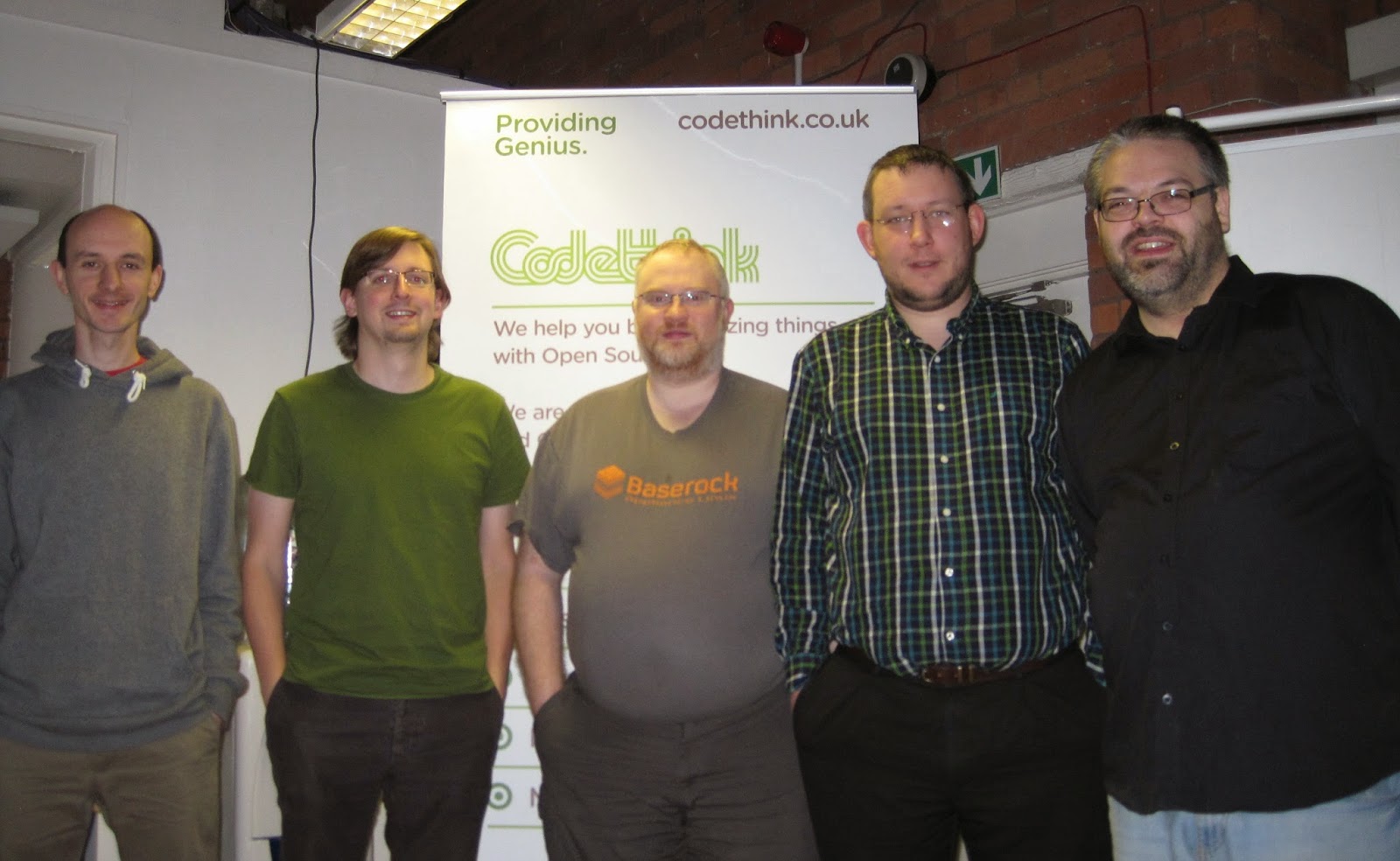
Michael Drake, John-Mark Bell, Daniel Silverstone, Rob Kendrick and Vincent Sanders at the Codethink manchester office
Over the weekend the NetSurf developers met to make a concentrated effort on improving the browser. This time we were kindly hosted by Codethink in their Manchester office in a pleasant environment with plenty of refreshments.

Five developers managed to attend in person from around the UK: Michael Drake, John-Mark Bell, Daniel Silverstone, Rob Kendrick and Vincent Sanders. We also had Chris Young providing some bug fixes remotely.

We started the weekend by discussing all the thorny core issues that had been put on the agenda and ensuring the outcomes were properly noted. We also held the society AGM which was minuted by Daniel.

The emphasis of this weekend was very much on planning and doing the disruptive changes we had been putting off until we were all together.

John-Mark and myself managed to change the core build system as used by all the libraries to using standard triplets to identify systems and use the gnu autoconf style of naming for parameters (i.e. HOST, BUILD and CC being used correctly).

This was accompanied by improvements and configuration changes to the CI system to accommodate the new usage.

Several issues from the bug tracker were addressed and we put ourselves in a stronger position to address numerous other usability problems in the future.

We managed to pack a great deal into the 20 hours of work on Saturday and Sunday although because we were concentrating much more on planning and infrastructure rather than a release the metrics of commits and files changed were lower than at previous events.

Niels Thykier: The first 12 days and 408 unblock requests into the Jessie freeze

The release team receives an extreme amount of unblock requests right now. For the past 22 days[1], we have been receiving no less than 408 unblock/ageing requests. That is an average of ~18.5/day. In the same period, the release team have closed 350 unblocks requests, averaging 15.9/day. This number does not account for number of unblocks, we add without a request, when we happen to spot when we look at the list of RC bugs[2]. Nor does it account for unblock requests currently tagged moreinfo , of which there are currently 25. All in all, it has been 3 intensive weeks for the release team. I am truly proud of my fellow team members for keeping up with this for so long! Also a thanks to the non-RT members, who help us by triaging and reviewing the unblock requests! It is much appreciated. :) Random bonus info: [1] We started receiving some in the 10 days before the freeze as people realised that their uploads would need an unblock to make it into Jessie. [2] Related topics: what is adsb? (the answer being: Our top hinter for Wheezy)

Daniel Leidert: Rsync files between two machines over SSH and limit read access

From time to time I need to get contents from a remote machine to my local workstation. The data sometimes is big and I don't want to start all over again if something fails. Further the transmission should be secure and the connection should be limited to syncing only this path and its sub-directories. So I've setup a way to do this using rsync and ssh and I'm going to describe this setup. Consider you have already created a SSH key, say ~/.ssh/key_rsa together with ~/.ssh/key_rsa.pub, and on the remote machine there is an SSH server running allowing to login by a public key and rsync is available. Lets further assume the following:
  • the remote machine is rsync.domain.tld
  • the path on the remote machine that holds the data is /path/mydata
  • the user on the remote machine being able to read /path/mydata and to login via SSH is remote_user
  • the path on the local machine to put the data is /path/mydest
  • the user on the local machine being able to write /path/mydest is local_user
  • the user on the local machine has the private key ~local_user/.ssh/key_rsa and the public key ~local_user/.ssh/key_rsa.pub
Now the public key ~local_user/.ssh/key_rsa.pub is added to the remote users ~remote_user/.ssh/authorized_keys file. The file will then probably look like this (there is just one very long line with the key, here cut out by [..]):
ssh-rsa [..]= user@domain.tld
Now I would like to limit the abilities for a user logging in with this key to only rsync the special directory /path/mydata. I therefor preceed the key with a command prefix, which is explained in the manual page sshd(8). The file then looks like this:
command="/usr/bin/rsync --server --sender -vlogDtprze . /path/mydata",no-port-forwarding,no-X11-forwarding,no-agent-forwarding,no-pty ssh-rsa [..]= user@domain.tld
I then can rsync the remote directory to a local location over SSH by running:
rsync -avz -P --delete -e 'ssh remote_user@rsync.domain.tld' rsync.domain.tld:/path/mydata/ /path/mydest
That's it.

Daniel Leidert: Removal of debian.wgdd.de and cvs,svn,vcs .wgdd.de

If you've recently tried to browse to or apt-get from either cvs.wgdd.de, svn.wgdd.de, vcs.wgdd.de, debian.wgdd.de or ubuntu.wgdd.deyou've probably seen (and still are) an error (410, Gone) coming up and I'd like to give a short explanation why. cvs,svn,vcs .wgdd.deI've left my server provider and shut down the above services and only keep a small amount of services running. The domains cvs,svn,vcs .wgdd.de were used to provide (a) a subversion (SVN) server (via HTTPS and dav_svn) for some public and private work and (b) a CVS web-client to some old project works in CVS.Among the latter was e.g. old code to generate manual pages for the proprietary fglrx graphics driver, stuff that laid there untouched for many years. So I guess, it was about time to finally remove it :)The subversion web-client gave public access to some packaging work I do for the Debian GNU/Linux distribution, e.g. for the cvsweb, gtypist packages and some non-official packaging work. For the official packages I plan to move the files into the collab-maint web space and adjust the packages control files accordingly. Everything else will be hosted non-publicly in the future. I still intend to move stuff, that turns out to be useful for more people, to public places like github and Co. Update 17.11.2014: cvsweb, gurlchecker and gtypist have been moved to collab-maint. debian.wgdd.deI used this site to describe my usage of Debian GNU/Linux on the hardware I own ... laptop, servers etc. I wrote a few HOWTOs and provided a link collection with useful links. You can still find all of this using the archive.org service. I also had a repository up and working, especially to provide bluefish packages for users of Debian stable and Ubuntu. Half a year ago I dropped the Ubuntu build environments and packages and moved the Debian stable backports to official places. This effectively emptied the repository and left only the wgdd-archive-keyring package in place. So, there is no real need for a public repository anymore and the linklist probably got outdated too. All in all, I decided to stop this service (maybe I'll forward the site to here later :)).If you see an error regarding the debian.wgdd.de URL running apt-get or aptitude, then there is a reference to this site in /etc/apt/sources.list or /etc/apt/sources.list.d/*, which can be safely removed. Further you should get rid of the wgdd-archive-keyring package:
apt-get autoremove --purge wgdd-archive-keyring
... or the repository key:
apt-key del E394D996
What elseIn case you need any content from the mentioned services, just let me know.

Paul Tagliamonte: BOS -> DC

Hello, World Been a while since my last blog post - things have been a bit hectic lately, and I ve not really had the time. Now that things have settled down a bit I m in DC! I ve moved down south to join the rest of my colleagues at Sunlight to head up our State & Local team. Leaving behind the brilliant Free Software community in Boston won t be easy, but I m hoping to find a similar community here in DC.

Next.

Previous.