Search Results: "mak"

12 April 2014

Russ Allbery: Accumulated haul

Wow, it's been a while since I've done this. In part because I've not had much time for reading books (which doesn't prevent me from buying them). Jared Bernstein & Dean Baker Getting Back to Full Employment (non-fiction)
James Coughtrey Six Seconds of Moonlight (sff)
Philip J. Davis & Reuben Hersh The Mathematical Experience (non-fiction)
Debra Dunbar A Demon Bound (sff)
Andy Duncan & Ellen Klages Wakulla Springs (sff)
Dave Eggers & Jordan Bass The Best of McSweeny's (mainstream)
Siri Hustvedt The Blazing World (mainstream)
Jacqueline Koyanagi Ascension (sff)
Ann Leckie Ancillary Justice (sff)
Adam Lee Dark Heart (sff)
Seanan McGuire One Salt Sea (sff)
Seanan McGuire Ashes of Honor (sff)
Seanan McGuire Chimes at Midnight (sff)
Seanan McGuire Midnight Blue-Light Special (sff)
Seanan McGuire Indexing (sff)
Naomi Mitchinson Travel Light (sff)
Helaine Olen Pound Foolish (non-fiction)
Richard Powers Orfeo (mainstream)
Veronica Schanoes Burning Girls (sff)
Karl Schroeder Lockstep (sff)
Charles Stross The Bloodline Feud (sff)
Charles Stross The Traders' War (sff)
Charles Stross The Revolution Trade (sff)
Matthew Thomas We Are Not Ourselves (mainstream)
Kevin Underhill The Emergency Sasquatch Ordinance (non-fiction)
Jo Walton What Makes This Book So Great? (non-fiction) So, yeah. A lot of stuff. I went ahead and bought nearly all of the novels Seanan McGuire had out that I'd not read yet after realizing that I'm going to eventually read all of them and there's no reason not to just own them. I also bought all of the Stross reissues of the Merchant Princes series, even though I had some of the books individually, since I think it will make it more likely I'll read the whole series this way. I have so much stuff that I want to read, but I've not really been in the mood for fiction. I'm trying to destress enough to get back in the mood, but in the meantime have mostly been reading non-fiction or really light fluff (as you'll see from my upcoming reviews). Of that long list, Ancillary Justice is getting a lot of press and looks interesting, and Lockstep is a new Schroeder novel. 'Nuff said. Kevin Underhill is the author of Lowering the Bar, which you should read if you haven't since it's hilarious. I'm obviously looking forward to that. The relatively obscure mainstream novels here are more Powell's Indiespensible books. I will probably cancel that subscription soon, at least for a while, since I'm just building up a backlog, but that's part of my general effort to read more mainstream fiction. (I was a bit disappointed since there were several months with only one book, but the current month finally came with two books again.) Now I just need to buckle down and read. And play video games. And do other things that are fun rather than spending all my time trying to destress from work and zoning in front of the TV.

Russ Allbery: Review: Cryptography Engineering

Review: Cryptography Engineering, by Niels Ferguson, et al.
Publisher: Wiley
Copyright: 2010
ISBN: 0-470-47424-6
Format: Kindle
Pages: 384
Subtitled Design Principles and Practical Applications, Cryptography Engineering is intended as an overview and introduction to cryptography for the non-expert. It doesn't dive deeply into the math, although there is still a fairly thorough mathematical introduction to public-key cryptography. Instead, it focuses on the principles, tools, and algorithms that are the most concretely useful to a practitioner who is trying to design secure systems rather than doing theoretical cryptography. The "et al." in the author summary hides Bruce Schneier and Tadayoshi Kohno, and this book is officially the second edition of Practical Cryptography by Ferguson and Schneier. Schneier's name will be familiar from, among other things, Applied Cryptography, and I'll have more to say later about which of the two books one should read (and the merits of reading both). But one of the immediately-apparent advantages of Cryptography Engineering is that it's recent. Its 2010 publication date means that it recommends AES as a block cipher, discusses MD5 weaknesses, and can discuss and recommend SHA-2. For the reader whose concern with cryptography is primarily "what should I use now for new work," this has huge benefit. "What should I use for new work" is the primary focus of this book. There is some survey of the field, but that survey is very limited compared to Applied Cryptography and is tightly focused on the algorithms and approaches that one might reasonably propose today. Cryptography Engineering also attempts to provide general principles and simplifying assumptions to steer readers away from trouble. One example, and the guiding principle for much of the book, is that any new system needs at least a 128-bit security level, meaning that any attack will require 2128 steps. This requirement may be overkill in some edge cases, as the authors point out, but when one is not a cryptography expert, accepting lower security by arguments that sound plausible but may not be sound is very risky. Cryptography Engineering starts with an overview of cryptography, the basic tools of cryptographic analysis, and the issues around designing secure systems and protocols. I like that the authors not only make it clear that security programming is hard but provide a wealth of practical examples of different attack methods and failure modes, a theme they continue throughout the book. From there, the book moves into a general discussion of major cryptographic areas: encryption, authentication, public-key cryptography, digital signatures, PKI, and issues of performance and complexity. Part two starts the in-depth discussion with chapters on block ciphers, block cipher modes, hash functions, and MACs, which together form part two (message security). The block cipher mode discussion is particularly good and includes algorithms newer than those in Applied Cryptography. This part closes with a walkthrough of constructing a secure channel, in pseudocode, and a chapter on implementation issues. The implementation chapters throughout the book are necessarily more general, but for me they were one of the most useful parts of the book, since they take a step back from the algorithms and look at the perils and pitfalls of using them to do real work. The third part of the book is on key negotiation and encompasses random numbers, prime numbers, Diffie-Hellman, RSA, a high-level look at cryptographic protocols, and a detailed look at key negotiation. This will probably be the hardest part of the book for a lot of readers, since the introduction to public-key is very heavy on math. The authors feel that's unavoidable to gain any understanding of the security risks and attack methods against public-key. I'm not quite convinced. But it's useful information, if heavy going that requires some devoted attention. I want to particularly call out the chapter on random numbers, though. This is an often-overlooked area in cryptography, particularly in introductions for the non-expert, and this is the best discussion of pseudo-random number generators I've ever seen. The authors walk through the design of Fortuna as an illustration of the issues and how they can be avoided. I came away with a far better understanding of practical PRNG design than I've ever had (and more sympathy for the annoying OpenSSL ~/.rnd file). The last substantial part of the book is on key management, starting with a discussion of time and its importance in cryptographic protocols. From there, there's a discussion of central trusted key servers and then a much more comprehensive discussion of PKI, including the problems with revocation, key lifetime, key formats, and keeping keys secure. The concluding chapter of this part is a very useful discussion of key storage, which is broad enough to encompass passwords, biometrics, and secure tokens. This is followed by a short part discussing standards, patents, and experts. A comparison between this book and Applied Cryptography reveals less attention to the details of cryptographic algorithms (apart from random number generators, where Cryptography Engineering provides considerably more useful information), wide-ranging surveys of algorithms, and underlying mathematics. Cryptography Engineering also makes several interesting narrowing choices, such as skipping stream ciphers almost entirely. Less surprisingly, this book covers only a tiny handful of cryptographic protocols; there's nothing here about zero-knowledge proofs, blind signatures, bit commitment, or even secret sharing, except a few passing mentions. That's realistic: those protocols are often extremely difficult to understand, and the typical security system doesn't use them. Replacing those topics is considerably more discussion of implementation techniques and pitfalls, including more assistance from the authors on how to choose good cryptographic building blocks and how to combine them into useful systems. This is a difficult topic, as they frequently acknowledge, and a lot of the advice is necessarily fuzzy, but they at least provide an orientation. To get much out of Applied Cryptography, you needed a basic understanding of what cryptography can do and how you want to use it. Cryptography Engineering tries to fill in that gap to the point where any experienced programmer should be able to see what problems cryptography can solve (and which it can't). That brings me back to the question of which book you should read, and a clear answer: start here, with Cryptography Engineering. It's more recent, which means that the algorithms it discusses are more directly applicable to day-to-day work. The block cipher mode and random number generator chapters are particularly useful, even if, for the latter, one will probably use a standard library. And it takes more firm stands, rather than just surveying. This comes with the risk of general principles that aren't correct in specific situations, but I think for most readers the additional guidance is vital. That said, I'm still glad I read Applied Cryptography, and I think I would still recommend reading it after this book. The detailed analysis of DES in Applied Cryptography is worth the book by itself, and more generally the survey of algorithms is useful in showing the range of approaches that can be used. And the survey of cryptographic protocols, if very difficult reading, provides tools for implementing (or at least understanding) some of the fancier and more cutting-edge things that one can do with cryptography. But this is the place to start, and I wholeheartedly recommend Cryptography Engineering to anyone working in computer security. Whether you're writing code, designing systems, or even evaluating products, this is a very useful book to read. It's a comprehensive introduction if you don't know anything about the field, but deep enough that I still got quite a bit of new information from it despite having written security software for years and having already read Applied Cryptography. Highly recommended. I will probably read it from cover to cover a second time when I have some free moments. Rating: 9 out of 10

Russell Coker: Replacement Credit Cards and Bank Failings

I just read an interesting article by Brian Krebs about the difficulty in replacing credit cards [1]. The main reason that credit cards need to be replaced is that they have a single set of numbers that is used for all transactions. If credit cards were designed properly for modern use (IE since 2000 or so) they would act as a smart-card as the recommended way of payment in store. Currently I have a Mastercard and an Amex card, the Mastercard (issued about a year ago) has no smart-card feature and as Amex is rejected by most stores I ve never had a chance to use the smart-card part of a credit card. If all American credit cards had a smart card feature which was recommended by store staff then the problems that Brian documents would never have happened, the attacks on Target and other companies would have got very few card numbers and the companies that make cards wouldn t have a backlog of orders. If a bank was to buy USB smart-card readers for all their customers then they would be very cheap (the hardware is simple and therefore the unit price would be low if purchasing a few million). As banks are greedy they could make customers pay for the readers and even make a profit on them. Then for online banking at home the user could use a code that s generated for the transaction in question and thus avoid most forms of online banking fraud the only possible form of fraud would be to make a $10 payment to a legitimate company become a $1000 payment to a fraudster but that s a lot more work and a lot less money than other forms of credit card fraud. A significant portion of all credit card transactions performed over the phone are made from the customer s home. Of the ones that aren t made from home a significant portion would be done from a hotel, office, or other place where a smart-card reader might be conveniently used to generate a one-time code for the transaction. The main remaining problem seems to be the use of raised numbers. Many years ago it used to be common for credit card purchases to involve using some form of carbon paper and the raised numbers made an impression on the credit card transfer form. I don t recall ever using a credit card in that way, I ve only had credit cards for about 18 years and my memories of the raised numbers on credit cards being used to make an impression on paper only involve watching my parents pay when I was young. It seems likely that someone who likes paying by credit card and does so at small companies might have some recent experience of carbon paper payment, but anyone who prefers EFTPOS and cash probably wouldn t. If the credit card number (used for phone and Internet transactions in situations where a smart card reader isn t available) wasn t raised then it could be changed by posting a sticker with a new number that the customer could apply to their card. The customer wouldn t even need to wait for the post before their card could be used again as the smart card part would never be invalid. The magnetic stripe on the card could be changed at any bank and there s no reason why an ATM couldn t identify a card by it s smart-card and then write a new magnetic stripe automatically. These problems aren t difficult to solve. The amounts of effort and money involved in solving them are tiny compared to the costs of cleaning up the mess from a major breach such as the recent Target one, the main thing that needs to be done to implement my ideas is widespread support of smart-card readers and that seems to have been done already. It seems to me that the main problem is the incompetence of financial institutions. I think the fact that there s no serious competitor to Paypal is one of the many obvious proofs of the incompetence of financial companies. The effective operation of banks is essential to the economy and the savings of individuals are guaranteed by the government (so when a bank fails a lot of tax money will be used). It seems to me that we need to have national banks run by governments with the aim of financial security. Even if banks were good at their business (and they obviously aren t) I don t think that they can be trusted with it, an organisation that s too big to fail is too big to lack accountability to the citizens.

11 April 2014

Lars Wirzenius: Applying the Doctorow method to coding

When you have a big goal, do at least a little of it every day. Cory Doctorow writes books and stuff, and writes for at least twenty minutes every day. I write computer software, primarily Obnam, my backup program, and recently wrote the first rough draft of a manual for it, by writing at least a little every day. In about two months I got from nothng to something that is already useful to people. I am now applying this to coding as well. Software development is famously an occupation that happens mostly in one's brain and where being in hack mode is crucial. Getting into hack mode takes time and a suitable, distraction-free environment. I have found, however, that there are a lot of small, quick tasks that do not require a lot of concentration. Fixing wordings of error messages, making small, mechanical refactorings, confirming bugs by reproducing them and writing test cases to reproduce them, etc. I have foubd that if I've prepared for and planned such tasks properly, in the GTD planning phase, I can do such tasks even on trains and traun stations. This is important. I commute to work and if I can spend the time I wait for a train, or on the train, productively, I can significant, real progress. But to achieve this I really do have to do the preparation beforehand. Th 9:46 train to work is much too noisy to do any real thinking in.

Hideki Yamane: given enough eyeballs, but...

"given enough eyeballs, all bugs are shallow"
Oh, right?

And we easily make mistakes because we're human, you know.

Andrew Pollock: [life] Day 73: A fourth-generation friendship

Oh man, am I exhausted. I've known my friend Kim for longer than we remembered. Until Zoe was born, I thought the connection was purely that our grandmothers knew each other. After Zoe was born, and we gave her my birth mother's name as her middle name, Kim's mother sent me a message indicating that she knew my mother. More on that in a moment. Kim and I must have interacted when we were small, because it predates my memory of her. My earliest memories are of being a pen pal with her when she lived in Kingaroy. She had a stint in South Carolina, and then in my late high school years, she moved relatively close to me, at Albany Creek, and we got to have a small amount of actual physical contact. Then I moved to Canberra, and she moved to Melbourne, and it was only due to the wonders of Facebook that we reconnected while I was in the US. Fast forward many years, and we're finally all back in Brisbane again. Kim is married and has a daughter named Sarah who is a couple of years older than Zoe, and could actually pass of as her older sister. She also has as a younger son. Since we've been back in Brisbane, we've had many a play date at each other's homes, and the girls get along famously, to the point where Sarah was talking about her "best friend Zoe" at show and tell at school. The other thing I learned since reconnecting with Kim in the past year, is that Kim's aunt and my mother were in the same grade at school. Kim actually arranged for me to have a coffee with her aunt when she was visiting from Canberra, and she told me a bunch of stuff about my Mum that I didn't know, so that was really nice. Kim works from home part time, and I offered to look after Sarah for a day in the school holidays as an alternative to her having to go to PCYC holiday care. Today was that day. I picked up Zoe from Sarah this morning, as it was roughly in the same direction as Kim's place, and made more sense, and we headed over to Kim's place to pick up Sarah. We arrived only a couple of minutes later than the preferred pick up time, so I was pretty happy with how that worked out. The plan was to bring Sarah back to our place, and then head over to New Farm Park on the CityCat and have a picnic lunch and a play in the rather fantastic playground in the park over there. I hadn't made Zoe's lunch prior to leaving the house, so after we got back home again, I let the girls have a play while I made Zoe's lunch. After some play with Marble Run, the girls started doing some craft activity all on their own on the balcony. It was cute watching them try to copy what each other were making. One of them tried gluing two paper cups together by the narrow end. It didn't work terribly well because there wasn't a lot of surface to come into contact with each other. I helped the girls with their craft activity briefly, and then we left on foot to walk to the CityCat terminal. Along the way, I picked up some lunch for myself at the Hawthorne Garage and added it to the small Esky I was carrying with Zoe's lunchbox in it. It was a beautiful day for a picnic. It was warm and clear. I think Sarah found the walk a bit long, but we made it to the ferry terminal relatively incident free. We got lucky, and a ferry was just arriving, and as it happened, they had to change boats, as they do from time to time at Hawthorne, so we would have had plenty of time regardless, as everyone had to get off one boat and onto a new one. We had a late morning tea at the New Farm Park ferry terminal after we got off, and then headed over to the playground. I claimed a shady spot with our picnic blanket and the girls did their thing. I alternated between closely shadowing them around the playground and letting them run off on their own. Fortunately they stuck together, so that made keeping track of them slightly easier. For whatever reason, Zoe was in a bit of a grumpier mood than normal today, and wasn't taking too kindly to the amount of turn taking that was necessary to have a smoothly oiled operation. Sarah (justifiably) got a bit whiny when she didn't get an equitable amount of time getting the call the shots on what the they did, but aside from that they got along fine. There was another great climbing tree, which had kids hanging off it all over the place. Both girls wanted to climb it, but needed a little bit of help getting started. Sarah lost her nerve before Zoe did, but even Zoe was a surprisingly trepidatious about it, and after shimmying a short distance along a good (but high) branch, wanted to get down. The other popular activity was a particularly large rope "spider web" climbing frame, which Sarah was very adept at scaling. It was a tad too big for Zoe to manage though, and she couldn't keep up, which frustrated her quite a bit. I was particularly proud of how many times she returned to it to try again, though. We had our lunch, a little more play time, and the obligatory ice cream. I'd contemplated catching the CityCat further up-river to Sydney Street to then catching the free CityHopper ferry, but the thought of then trying to get two very tired girls to walk from the Hawthorne ferry terminal back home didn't really appeal to me all that much, so I decided to just head back home. That ended up being a pretty good call, because as it was, trying to get the two of them back home was like herding cats. Sarah was fine, but Zoe was really dragging the chain and getting particularly grumpy. I had to deploy every positive parenting trick that I currently have in my book to keep Zoe moving, but we got there eventually. Fortunately we didn't have any particularly deadline. The girls did some more playing at home while I collapsed on the couch for a bit, and then wanted to do some more craft. We made a couple of crowns and hot-glued lots of bling onto them. We drove back to Kim's place after that, and the girls played some more there. Sarah nearly nodded off on the way home. Zoe was surprisingly chipper. The dynamic changed completely once we were back at Sarah's house. Zoe seemed fine to take Sarah's direction on everything, so I wonder how much of things in the morning were territorial, and Sarah wasn't used to Zoe calling the shots when she was at Zoe's place. Kim invited us to stay for dinner. I wasn't really feeling like cooking, and the girls were having a good time, so I decided to stay for dinner, and after they had a bath together we headed home. Zoe stayed awake all the way home, and went to bed without any fuss. It's pretty hot tonight, and I'm trialling Zoe sleeping without white noise, so we'll see how tonight pans out.

Dirk Eddelbuettel: RcppCNPy 0.2.3

R 3.1.0 came out today. Among the (impressive and long as usual) list of changes is the added ability to specify CXX_STD = CXX11 in order to get C++11 (or the best available subset on older compilers). This brings a number of changes and opportunities which are frankly too numerous to be discussed in this short post. But it also permits us, at long last, to use long long integer types. For RcppCNPy, this means that we can finally cover NumPy integer data (along with the double precision we had from the start) on all platforms. Python encodes these as an int64, and that type was unavailable (at least in 32-bit OSs) until we got long long made available to us by R. So today I made the change to depend on R 3.1.0, and select C++11 which allowed us to free the code from a number if #ifdef tests. This all worked out swimmingly and the new package has already been rebuilt for Windows. I also updated the vignette, and refreshed its look and feel. Full changes are listed below.
Changes in version 0.2.3 (2014-04-10)
  • src/Makevars now sets CXX_STD = CXX11 which also provides the long long type on all platforms, so integer file support is no longer conditional.
  • Consequently, code conditional on RCPP_HAS_LONG_LONG_TYPES has been simplified and is no longer conditional.
  • The package now depends on R 3.1.0 or later to allow this.
  • The vignette has been updated and refreshed to reflect this.
CRANberries also provides a diffstat report for the latest release. As always, feedback is welcome and the rcpp-devel mailing list off the R-Forge page for Rcpp is the best place to start a discussion.

This post by Dirk Eddelbuettel originated on his Thinking inside the box blog. Please report excessive re-aggregation in third-party for-profit settings.

10 April 2014

Andrew Pollock: [life] Day 72: The Workshops, and zip lining into a pool

Today was jam packed, from the time Zoe got dropped off to the time she was picked up again. I woke up early to go to my yoga class. It had moved from 6:15am to 6:00am, but was closer to home. I woke up a bunch of times overnight because I wanted to make sure I got up a little bit earlier (even though I had an alarm set) so I was a bit tired. Sarah dropped Zoe off, and we quickly inspected our plaster fish from yesterday. Because the plaster had gotten fairly thick, it didn't end up filling the molds completely, so the fish weren't smooth. Zoe was thrilled with them nonetheless, and wanted to draw all over them. After that, we jumped in the car to head out to The Workshops Rail Museum. We were meeting Megan there. We arrived slightly after opening time. I bought an annual membership last time we were there, and I'm glad we did. The place is pretty good. It's all indoors, and it's only lightly patronised, even for school holidays, so it was nice and quiet. Megan and her Dad and sister arrived about an hour later, which was good, because it gave Zoe and I a bit of time to ourselves. We had plenty of time on the diesel engine simulator without anyone else breathing down our neck wanting a turn. The girls all had a good time. We lost Megan and Zoe for a little bit when they decided to take off and look at some trains on their own. Jason and I were frantically searching the place before I found them. There was a puppet show at 11am, and the room it was in was packed, so we plonked all three kids down on the floor near the stage, and waited outside. That was really nice, because the kids were all totally engrossed, and didn't miss us at all. After lunch and a miniature train ride we headed home. Surprisingly, Zoe didn't nap on the way home. Jason was house sitting for some of his neighbours down the street, and he'd invited us to come over and use their pool, so we went around there once we got back home. The house was great. They also had a couple of chickens. The pool was really well set up. It had a zip line that ran the length of the pool. Zoe was keen to give it a try, and she did really well, hanging on all the way. They also had a little plastic fort with a slippery slide that could be placed at the end of the pool, and the girls had a great time sliding into the pool that way. We got back home from all of that fun and games about 15 minutes before Sarah arrived to pick Zoe up, so it was really non-stop day.

9 April 2014

Thorsten Glaser: Heartbleed vs. Startcom / StartSSL

First of all, good news, MirBSD is not vulnerable to The Heartbleed Bug due to my deliberate choice to stick to an older OpenSSL version. My inquiry (in various places) as to what precisely could leak when a vulnerable client connected to a n n-vulnerable server has yet to be answered, though we can assume private key material is safe. Now the bad news: while the CA I use and a CA I don t use offer free rekeying (in general), a CA I also use occasionally refuses to do that. The ugly: they will not even revoke the certificates, so any attacker who gained your key, for example when you have been using a certificate of theirs on a Debian system, will be able to use it (e.g. to MITM your visitors traffic) unless you shell over lots of unreasonable money per certificate. (Someone wrote they got the fee waived, but others don t, nor do I. (There s also a great Twitter discussion-thingy about this involving Zugschlus, but I won t link Twitter because they are not accessible to Lynx users like me and other Planet Debian authors.)
I ve been using GoDaddy privately for a while, paid for a wildcard certificate for *.mirbsd.org, and later also at work. I ve stopped using it privately due to current lack of money. Occasionally, for n n-wildcard gratis SSL certificates for HTTP servers. Startcom s StartSSL certificates are unusable for real SSL as used in SMTP STARTTLS anyway, so usage isn t much.
Now I ve got a dilemma here. I ve created a CA myself, to use with MirBSD infrastructure and things like that X.509 certificates for my hosts (especially so I can use them for SMTP) and possibly personal friends (whose PGP key I ve signed with maximum trust after the usual verification) but am using a StartSSL certificate for www.mirbsd.org as my GoDaddy wildcard certificate expires in a week or so (due to the aforementioned monetary issues), and I d rather not pay for a limited certificate only supporting a single vhost. There is absolutely no issue with that certificate and key (only ever generated and used on MirBSD, only using it in Apache mod_ssl). Then, there s this soon-to-be tax-exempt non-profit society of public utility I m working with, whose server runs Debian, and which is affected, but has been using a StartSSL certificate for a while. Neither the society nor I can afford to pay for revocation, and we do not see any possible justification for this especially in the face of CVE-2014-0160. I expect a rekey keeping the current validity end date, and would accept a revocation even if I were unable to get a new certificate, since even were we to get a certificate for the society s domain from someplace else, an attacker could still MITM us with the previous one from Startcom. The problem here is: I d really love to see (all of!) Startcom dropped from the global list of trustworthy CAs, but then I d not know from where to get a cert for MirBSD; Globalsign is not an option because I will not limit SSL compatibility to a level needed to pass their quality test possibly GoDaddy, ISTR they offer a free year to Open Source projects no idea about one for the society but it would solve the problem of not getting the certificates revoked. For everyone. I am giving Startcom time until Friday after $dayjob (for me); after that, I ll be kicking them off MirBSD s CA bundle and will be lobbying for Debian and Mozilla to do the same. Any other ideas of how to deal with that? I d probably pay 5 for a usable certificate accepted by people (including old systems, such as MSIE 5.0 on Win2k and the likes) without questioning most of the time, I only serve public content anyway and just use SSL to make the NSA s job more difficult (and even when not I m not dealing with any payment information, just the occasional login protected area). By the way, is there any way to access the information that is behind a current-day link to groups.google.com with Lynx or Pine? I can t help but praise GMane for their NNTP interface. ObFunfact: just when I was finished writing this wlog entry, I got a new eMail Special offer just for you. from GoDaddy. Sadly, no offer for a 5 SSL certificate, just the usual 20-35% off coupon code.

Petter Reinholdtsen: S3QL, a locally mounted cloud file system - nice free software

For a while now, I have been looking for a sensible offsite backup solution for use at home. My requirements are simple, it must be cheap and locally encrypted (in other words, I keep the encryption keys, the storage provider do not have access to my private files). One idea me and my friends had many years ago, before the cloud storage providers showed up, was to use Google mail as storage, writing a Linux block device storing blocks as emails in the mail service provided by Google, and thus get heaps of free space. On top of this one can add encryption, RAID and volume management to have lots of (fairly slow, I admit that) cheap and encrypted storage. But I never found time to implement such system. But the last few weeks I have looked at a system called S3QL, a locally mounted network backed file system with the features I need. S3QL is a fuse file system with a local cache and cloud storage, handling several different storage providers, any with Amazon S3, Google Drive or OpenStack API. There are heaps of such storage providers. S3QL can also use a local directory as storage, which combined with sshfs allow for file storage on any ssh server. S3QL include support for encryption, compression, de-duplication, snapshots and immutable file systems, allowing me to mount the remote storage as a local mount point, look at and use the files as if they were local, while the content is stored in the cloud as well. This allow me to have a backup that should survive fire. The file system can not be shared between several machines at the same time, as only one can mount it at the time, but any machine with the encryption key and access to the storage service can mount it if it is unmounted. It is simple to use. I'm using it on Debian Wheezy, where the package is included already. So to get started, run apt-get install s3ql. Next, pick a storage provider. I ended up picking Greenqloud, after reading their nice recipe on how to use S3QL with their Amazon S3 service, because I trust the laws in Iceland more than those in USA when it come to keeping my personal data safe and private, and thus would rather spend money on a company in Iceland. Another nice recipe is available from the article S3QL Filesystem for HPC Storage by Jeff Layton in the HPC section of Admin magazine. When the provider is picked, figure out how to get the API key needed to connect to the storage API. With Greencloud, the key did not show up until I had added payment details to my account. Armed with the API access details, it is time to create the file system. First, create a new bucket in the cloud. This bucket is the file system storage area. I picked a bucket name reflecting the machine that was going to store data there, but any name will do. I'll refer to it as bucket-name below. In addition, one need the API login and password, and a locally created password. Store it all in ~root/.s3ql/authinfo2 like this:
[s3c]
storage-url: s3c://s.greenqloud.com:443/bucket-name
backend-login: API-login
backend-password: API-password
fs-passphrase: local-password
I create my local passphrase using pwget 50 or similar, but any sensible way to create a fairly random password should do it. Armed with these details, it is now time to run mkfs, entering the API details and password to create it:
# mkdir -m 700 /var/lib/s3ql-cache
# mkfs.s3ql --cachedir /var/lib/s3ql-cache --authfile /root/.s3ql/authinfo2 \
  --ssl s3c://s.greenqloud.com:443/bucket-name
Enter backend login: 
Enter backend password: 
Before using S3QL, make sure to read the user's guide, especially
the 'Important Rules to Avoid Loosing Data' section.
Enter encryption password: 
Confirm encryption password: 
Generating random encryption key...
Creating metadata tables...
Dumping metadata...
..objects..
..blocks..
..inodes..
..inode_blocks..
..symlink_targets..
..names..
..contents..
..ext_attributes..
Compressing and uploading metadata...
Wrote 0.00 MB of compressed metadata.
# 
The next step is mounting the file system to make the storage available.
# mount.s3ql --cachedir /var/lib/s3ql-cache --authfile /root/.s3ql/authinfo2 \
  --ssl --allow-root s3c://s.greenqloud.com:443/bucket-name /s3ql
Using 4 upload threads.
Downloading and decompressing metadata...
Reading metadata...
..objects..
..blocks..
..inodes..
..inode_blocks..
..symlink_targets..
..names..
..contents..
..ext_attributes..
Mounting filesystem...
# df -h /s3ql
Filesystem                              Size  Used Avail Use% Mounted on
s3c://s.greenqloud.com:443/bucket-name  1.0T     0  1.0T   0% /s3ql
#
The file system is now ready for use. I use rsync to store my backups in it, and as the metadata used by rsync is downloaded at mount time, no network traffic (and storage cost) is triggered by running rsync. To unmount, one should not use the normal umount command, as this will not flush the cache to the cloud storage, but instead running the umount.s3ql command like this:
# umount.s3ql /s3ql
# 
There is a fsck command available to check the file system and correct any problems detected. This can be used if the local server crashes while the file system is mounted, to reset the "already mounted" flag. This is what it look like when processing a working file system:
# fsck.s3ql --force --ssl s3c://s.greenqloud.com:443/bucket-name
Using cached metadata.
File system seems clean, checking anyway.
Checking DB integrity...
Creating temporary extra indices...
Checking lost+found...
Checking cached objects...
Checking names (refcounts)...
Checking contents (names)...
Checking contents (inodes)...
Checking contents (parent inodes)...
Checking objects (reference counts)...
Checking objects (backend)...
..processed 5000 objects so far..
..processed 10000 objects so far..
..processed 15000 objects so far..
Checking objects (sizes)...
Checking blocks (referenced objects)...
Checking blocks (refcounts)...
Checking inode-block mapping (blocks)...
Checking inode-block mapping (inodes)...
Checking inodes (refcounts)...
Checking inodes (sizes)...
Checking extended attributes (names)...
Checking extended attributes (inodes)...
Checking symlinks (inodes)...
Checking directory reachability...
Checking unix conventions...
Checking referential integrity...
Dropping temporary indices...
Backing up old metadata...
Dumping metadata...
..objects..
..blocks..
..inodes..
..inode_blocks..
..symlink_targets..
..names..
..contents..
..ext_attributes..
Compressing and uploading metadata...
Wrote 0.89 MB of compressed metadata.
# 
Thanks to the cache, working on files that fit in the cache is very quick, about the same speed as local file access. Uploading large amount of data is to me limited by the bandwidth out of and into my house. Uploading 685 MiB with a 100 MiB cache gave me 305 kiB/s, which is very close to my upload speed, and downloading the same Debian installation ISO gave me 610 kiB/s, close to my download speed. Both were measured using dd. So for me, the bottleneck is my network, not the file system code. I do not know what a good cache size would be, but suspect that the cache should e larger than your working set. I mentioned that only one machine can mount the file system at the time. If another machine try, it is told that the file system is busy:
# mount.s3ql --cachedir /var/lib/s3ql-cache --authfile /root/.s3ql/authinfo2 \
  --ssl --allow-root s3c://s.greenqloud.com:443/bucket-name /s3ql
Using 8 upload threads.
Backend reports that fs is still mounted elsewhere, aborting.
#
The file content is uploaded when the cache is full, while the metadata is uploaded once every 24 hour by default. To ensure the file system content is flushed to the cloud, one can either umount the file system, or ask S3QL to flush the cache and metadata using s3qlctrl:
# s3qlctrl upload-meta /s3ql
# s3qlctrl flushcache /s3ql
# 
If you are curious about how much space your data uses in the cloud, and how much compression and deduplication cut down on the storage usage, you can use s3qlstat on the mounted file system to get a report:
# s3qlstat /s3ql
Directory entries:    9141
Inodes:               9143
Data blocks:          8851
Total data size:      22049.38 MB
After de-duplication: 21955.46 MB (99.57% of total)
After compression:    21877.28 MB (99.22% of total, 99.64% of de-duplicated)
Database size:        2.39 MB (uncompressed)
(some values do not take into account not-yet-uploaded dirty blocks in cache)
#
I mentioned earlier that there are several possible suppliers of storage. I did not try to locate them all, but am aware of at least Greenqloud, Google Drive, Amazon S3 web serivces, Rackspace and Crowncloud. The latter even accept payment in Bitcoin. Pick one that suit your need. Some of them provide several GiB of free storage, but the prize models are quite different and you will have to figure out what suits you best. While researching this blog post, I had a look at research papers and posters discussing the S3QL file system. There are several, which told me that the file system is getting a critical check by the science community and increased my confidence in using it. One nice poster is titled "An Innovative Parallel Cloud Storage System using OpenStack s SwiftObject Store and Transformative Parallel I/O Approach" by Hsing-Bung Chen, Benjamin McClelland, David Sherrill, Alfred Torrez, Parks Fields and Pamela Smith. Please have a look. Given my problems with different file systems earlier, I decided to check out the mounted S3QL file system to see if it would be usable as a home directory (in other word, that it provided POSIX semantics when it come to locking and umask handling etc). Running my test code to check file system semantics, I was happy to discover that no error was found. So the file system can be used for home directories, if one chooses to do so. If you do not want a locally file system, and want something that work without the Linux fuse file system, I would like to mention the Tarsnap service, which also provide locally encrypted backup using a command line client. It have a nicer access control system, where one can split out read and write access, allowing some systems to write to the backup and others to only read from it. As usual, if you use Bitcoin and want to show your support of my activities, please send Bitcoin donations to my address 15oWEoG9dUPovwmUL9KWAnYRtNJEkP1u1b.

Andrew Pollock: [life] Day 71: Tumble Tastics trial, painting and plaster fun

Zoe slept in even later this morning. I'm liking this colder weather. We had nothing particular happening first thing today, so we just snuggled in bed for a bit before we got started. Tumble Tastics were offering free trial classes this week, so I signed Zoe up for one today. She really enjoyed going to Gold Star Gymnastics in the US, and has asked me about finding a gym class over here every now and then. Tumble Tastics is a much smaller affair than Gold Star, but at 300 metres from home on foot, it's awesomely convenient. Zoe scootered there this morning. It seems to be physically part of what I'm guessing used to be the Church of Christ's church hall, so it's not big at all, but the room that Zoe had her class in still had plenty of equipment in it. There were 8 kids in her class, all about her size. I peeked around the door and watched. Most of the class was instructor led and mainly mat work, but then part way through, the parents were invited in, and the teacher walked us all through a course around the room, using the various equipment, and the parents had to spot for their kids. The one thing that cracked me up was when the kids were supposed to be tucking into a ball and rocking on their backs. Zoe instead did a Brazilian Jiu-Jitsu break-fall and fell backwards slapping the mat instead. It was good to see that some of what she learned in those classes has kicked in reflexively. She really enjoyed the rope swing and hanging upside down on the uneven bars. The class ran for 50 minutes (I was only expecting it to last 30 minutes) and Zoe did really well straight off. I think we'll make this her 4th term extra-curricular activity. We scootered home the longer way, because we were in no particular hurry. Zoe did some painting when we got home, and then we had lunch. After lunch we goofed off for a little bit, and then we did quiet time. Zoe napped for about two and a half hours, and then we did some plaster play. I'd picked up a fish ice cube tray from IKEA on the weekend for 99 cents (queue Thrift Shop), and I bought a bag of plaster of Paris a while back, but haven't had a chance to do anything with it yet. I bribed Zoe into doing quiet time by telling her we'd do something new with the ice cube tray I'd bought. We mixed up a few paper cups with plaster of Paris in them and then I squirted some paint in. I'm not sure if the paint caused a reaction, or the plaster was already starting to set by the time the paint got mixed in, but it became quite viscous as soon as the paint was mixed in. We did three different colours and used tongue depressers to jam it into the tray. Zoe seemed to twig that it was the same stuff as the impressions of her baby feet, which I thought was a pretty clever connection to make. After that, there was barely enough time to watch a tiny bit of TV before Sarah arrived to pick Zoe up. I told her that her plaster would be set by the time she got dropped off in the morning. I procrastinated past the point of no return and didn't go for a run. Instead I decided to go out to Officeworks and print out some photos to stick in the photo frame I bought from IKEA on the weekend.

8 April 2014

Tanguy Ortolo: Disable your spammed addresses with Postfix

Using address extension Postfix (and many other mail servers) offers one nice address extension feature: addresses like <user+whaterver@> are implicit aliases to <user@>. This allows users to implement a simple measure to fight spam:

  1. when SomeCompany or whatever asks for your email address, give them <user+somecompany@>;
  2. if you start receiving spam at that address, you know who sold or was stolen your address;
  3. finally, you will be able to disable that address so messages are simply refused with a permanent error code.
Road sign  you shall not pass  with Gandalf
Disabling an extended address So, here is how to implement that last step with Postfix, when you detect that your extended address <user+evilcorp@> is being spammed. In /etc/postfix/main.cf:
smtpd_recipient_restrictions =
    check_recipient_access hash:/etc/postfix/recipients,
    [ ]
Then, create /etc/postfix/recipients containing the addresses to disable:
user+evilcorp@example.com   553 5.7.1 I did not subscribe to receive spam, go away
Of course, the error codes and message can be freely configured, just make sure you are using a permanent error code so senders do not retry. Hash that table, reload Postfix and it is done:
# postmap /etc/postfix/recipients
# service postfix reload
After that, your mail server will reject messages sent to these addresses. And it will do so at the RCPT TO step, saving your bandwidth for more useful things.

Daniel Pocock: reConServer for easy SIP conferencing

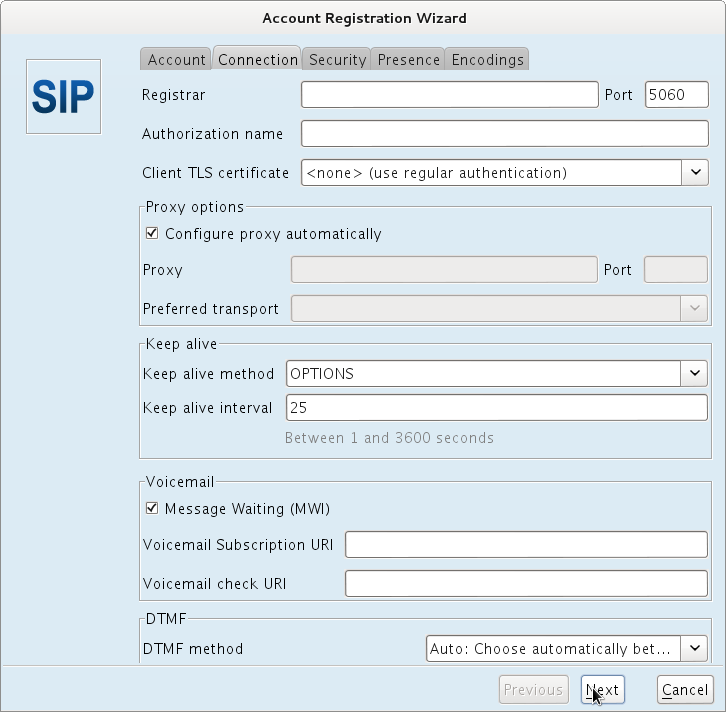
In the lead up to the release of Debian wheezy, there was quite some debate about the Mumble conferencing software which uses the deprecated and unsupported CELT codec. Although Mumble has very recently added Opus support, it is still limited by the fact that it is a standalone solution without any support for distributed protocols like SIP or XMPP. Making SIP conferencing easy Of course, people could always set up SIP conferences by installing Asterisk but for many use cases that may be overkill and may simply introduce alternative security and administration overheads. Enter reConServer The popular reSIProcate SIP stack includes a high-level programming API, the Conversation Manager, dubbed librecon. It was developed and contributed to the open source project by Scott Godin of SIP Spectrum. In very simple terms, a Conversation object with two Participants is a phone call. A Conversation object with more than two Participants is a conference. The original librecon includes a fully functional demo app, testUA that allows you to control conferences from the command line. As part of Google Summer of Code 2013, Catalin Constantin Usurelu took the testUA.cxx code and converted it into a proper daemon process. It is now available as a ready-to-run SIP conferencing server package in Debian and Ubuntu. The quick and easy way to try it Normally, a SIP conferencing server will be linked to a SIP proxy and other infrastructure. For trying it out quickly, however, no SIP proxy is necessary. Simply install the package with the default settings and then configure a client to talk to the reConServer directly by dialing the IP address of the server. For example, set the following options in /etc/reConServer/reConServer.config:
UDPPort = 5062
EnableAutoAnswer = true
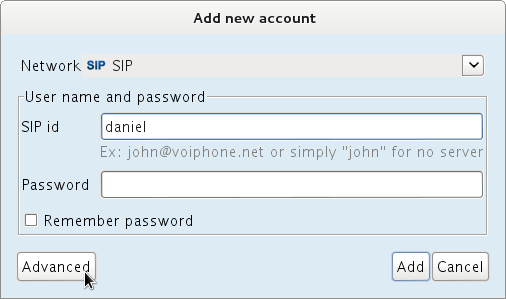
and it will happily accept all SIP calls sent to the IP address where it is running. Now configure Jitsi to talk to it directly in serverless SIP configuration: Notice here that we simply put a username without any domain part, this tells Jitsi to create an account that can operate without a SIP proxy or registration server: Calling in to the conference Notice in the screenshot below we simply dial the IP address and port number of the reConServer process, sip:192.168.1.100:5062. When the first call comes in, reConServer will answer and place the caller on hold. When the next caller arrives, the hold should automatically finish and audio will be heard. Next steps To make it run as part of a proper SIP deployment, set the necessary configuration options (username, password, proxy) to make reConServer register to the SIP proxy. Users can then call the conference through the proxy. To discuss any problems or questions, please come and join the recon-users mailing list or the Jitsi users list Consider using Wireshark to observe the SIP packets and learn more about the protocol.


Andrew Pollock: [life] Day 70: Visiting relatives and home visiting doctors

Zoe did indeed sleep in this morning, by a whole 30 minutes. It was nice. She seemed no worse for wear for her lip injury, and it was looking better this morning. Wow, "bimonthly" is ambiguous. I had my "every two month" in person co-parenting sync up lunch with Sarah today. Phew, that was a mouthful. Anyway, I had that today, and normally that would fall on a Kindergarten day, but it's school holidays. So we paid grandma and grandpa a visit, and they looked after Zoe for me so I could make the meeting. Mum and Dad have been away on a driving holiday, so Zoe hasn't seen them for a while, and it's been even longer since we've been to their house. She really loves going to their house because it's big, with a big back yard with a swing set. There's all sorts of exciting things like grandpa's worm farm, a sand pit, a china tea set, a piano, a tricycle and remote controlled cars. Zoe basically just works her way around the house entertaining herself. It's great. I usually get to put my feet up and read the newspaper. After I got back from my lunch meeting, we headed over to Greenslopes Private Hospital to visit my cousin, who's just had major surgery. On the way, Zoe napped in the car. I made a brief side trip to clear my post office box along the way. Amusingly, Zoe wakes up from short naps in the car way better than at Kindergarten. I don't know if it has anything to do with the quality of sleep she's getting or what it is, but I easily woke her up and extracted her from the car when we arrived at the hospital. No meltdowns. And that's pretty typical of car naps. I've had a discomfort in my right ear for the last couple of days, and it grew into increasing pain throughout the day today. It got to the point where, while I was driving home, that I deciding to get it looked at by a doctor, ASAP. One of my favourite things about being back in Australia is the availability of home visiting doctors. It was actually faster and cheaper for me to get a home doctor out to look at me tonight than it was to get an appointment with my regular doctor. I wouldn't have gotten an appointment until some time tomorrow at the earliest (assuming he had appointments available), because I made the decision to see a doctor after 5pm, when they'd closed. Instead, I had a doctor at my door in a little more than 2 hours of making the request. It also worked out cheaper, because the home doctor bulk bills Medicare, whereas my regular doctor does not. Add in the massive convenience of not having to lug a small child anywhere while I get seen by a doctor, and it's a major convenience. I love socialised healthcare. It turned out I have an outer ear infection. So all we had to do after the doctor came was find a pharmacy that was still open after 7pm to get my ear drop prescription filled. All of that mucking around meant that Zoe got to bed a little later than usual. It's another cool night tonight, so I'm hoping she'll sleep well and have another sleep in.

Russ Allbery: Review: With Charity for All

Review: With Charity for All, by Ken Stern
Publisher: Anchor
Copyright: November 2013
ISBN: 0-307-74381-0
Format: Trade paperback
Pages: 244
I've been reading a lot lately about how to measure charitable organizations and where best to give your money, which has already prompted a rethinking of which organizations I want to support. Most of that has been shorter, on-line blog posts, but I've been wanting a deeper analysis. This is the first of a couple of books I've found on the topic. (The second, an analysis of microfinance, is waiting for me to have more time to read.) For this kind of book, the background of the author matters a lot. Stern was the former CEO of National Public Radio for eight and a half years, so he has practical experience in the business side of non-profits. He's credited with improving NPR's financial position and management and oversaw an era of rapid growth. In With Charity for All, he speaks frankly about his own personal experiences as well as his research. My impression is that he's typical of competent business managers of non-profits: not particularly radical, focused mostly on business issues, and the sort of person that a non-profit needs to turn a mission or cause into a sustainable organization. It's worth noting in advance that With Charity for All is specifically about the United States charitable sector and US laws and approaches. Some of this may generalize to other countries, but non-profit and charity law is very different between different countries, and the US attitude towards government, non-profits, and the appropriate division of responsibilities between them often doesn't match the prevailing view elsewhere. This book may well be interesting to people outside the US, but only if they're curious about the US charitable sector. The short summary of the message of this book is that we're not getting our money's worth out of charity, either as donors or as taxpayers who are indirectly subsidizing these organizations. This is not (usually) due to any outright fraud, although there certainly is some of that due to the almost total lack of oversight of charitable organizations. Rather, it's the result of a complex combination of history and institutional momentum, focus on the aspects of a charity that play well to potential donors, a concerted effort at feel-good marketing, well-intentioned but misguided donor dictates, adoption of approaches and business practices from the for-profit sector, and, above everything else, the almost complete absence of evidence-based evaluation of charities. Evidence-based evaluation is currently a hot trend among charities. I heard about this book via one of the organizations that is focusing on this (GiveWell). This is not what sites like Charity Navigator do, and indeed Stern talks at some length about the serious limitations of the Charity Navigator approach. All that sites of that type can do is look at spending breakdowns. Stern makes a strong argument that a focus on reducing overhead, as measured by those financial forms, is misguided and leads to very ineffective and unorganized charities. Worse, all Charity Navigator can tell you is if the charity is spending money on something they declare to be in line with their goal, not whether that money did any good whatsoever. The short and depressing news is that most of that money does little or no good, and worse, that most charities have no systematic way of measuring whether it does any good. I'm particularly interested in how to ground charities in more concrete evidence, and Stern's discussion does not disappoint. But one of the things I liked about the book is that he doesn't stop there. Other topics include the dizzying variety of charities and the resulting confusion and dispersion of resources, the non-profits that are practically indistinguishable from for-profit companies except that they get huge tax breaks (sports organizations, as you might expect, are probably the worst offenders, but Stern has harsh commentary on the US hospital system), the mess of compensation in the non-profit sector, and the serious problems created by major donors who want to get directly involved and oversee how their money is spent. All of these topics are fascinating, if a bit depressing in the aggregate. As is typical for a book of this sort, it's a lot easier to see the problems than to describe the solutions. Stern does try to offer his own prescriptions, most of which are variations on more oversight: more regulation, more effort put into measuring results, more concrete standards for success or failure, and a stronger culture of treating tax-exempt status as a privilege, not a right, that has to be defended by showing clear social benefit. I'm convinced those steps would be helpful, although less convinced that we're able to get there from here. One of his ideas I am already using on a small scale: pooling charitable donations with professional evaluators who can take the time to look deeper than financial breakdowns and do some independent measurement of results, or at least survey relevant studies done by others and possibly demand more be done. This model of a mutual fund for charitable giving has some promise, I think (more than a managed mutual fund, in fact), and is very similar to what GiveWell is doing. This is an advocacy book, and one that's primarily focused on concrete, measurable deliverables and on the finances. There are a few places where I have reason to be dubious of the black-and-white conclusions Stern draws. For example, he makes much of the bill collecting practices of charitable hospitals, which I agree is a travesty, but doesn't mention that non-profit hospitals produce better health outcomes. I'm also not sure his analysis is as directly applicable to advocacy organizations, where measuring success is a much more challenging proposition. I think the Southern Poverty Law Center is one of the best charities in the United States (admittedly based largely on gut feeling and presentation), but the nature of their work is not amenable to the style of analysis that Stern is doing here. It's therefore worth taking this book with a grain of salt. But, that said, Stern's conclusions are in line with things I've read elsewhere. I think he's pointing in the right direction, and I would recommend this book to anyone who gives regularly to charity. Hopefully it won't just cause you to stop. There are charities out there that are trying hard to measure their results and ensure they deliver social value for the money that we give them. Our system just doesn't support them very well, yet. Rating: 8 out of 10

7 April 2014

Holger Levsen: 20140407-some-jenkins-activities

Some jenkins.debian.net activities Yesterday and today I've spent some time time on jenkins.debian.net, so that it's finally only available via https, or so I thought. I quickly learned that it's better still serving via http, but only when queried from localhost :) Second, I've moved the git repo to QA group namespace on alioth and set up IRC notifications using the wonderful KGB client. There is no mailinglist which receives commit diffs yet, but thats also because it's mostly still me working on this. Though since yesterday there are now seven committers in the git history, which is two more than before: Niels Thykier submitted job configuratios for running the lintian testsuite on stable, testing and sid on every commit to the lintian git repo. The test suite passes nicely on testing and unstable but fails for stable as it needs backports and we need to make the job to install those. Gabriele Giacone submitted several patches so that soon hurd wgnu/hurd can be tested too. Currently this fails for two reasons, both of which are very temporarily: the hurd .iso image which was here this morning is gone now, and secondly I haven't installed (the locally build packages for) qemu and qemu-kvm packages with the fixes for #742386 as that .iso ain't there so this is pointless atm ;-) But I'm very happy to have a hopefully soon working job which will regularily test installation of Debian hurd and I do hope that some Debian kfreebsd enthusiasts will pick up and fix the existing jobs for kfreebsd tests. (Hint hint hint! I'm also totally happy to help with that!) This reminds me to mention one last bit: Thanks to Paul Wise, jenkins.d.n bugs are now tracked in the BTS among other Debian QA group bugs!

Olivier Berger: Tagged a first version of the TWiki to FusionForge s MediaWiki converter

As announced previously, I ve been hacking on a migration tool allowing to import into the MediaWiki of a FusionForge project, a conversion of the contents of a TWiki wiki. I ve succesfully imported a first project (from PicoForge to FusionForge) using the tool, so I ve decided to tag a first release and make the Git repo accessible. More details at : https://fusionforge.int-evry.fr/projects/pytwiki2mediawi/ Feel free to ask here in the comments or by email, in case of need. And, yes, my Python is most likely awful, but at least, this works, and much more featureful than existing tools I could test.

Andrew Pollock: [life] Day 69: Walk to King Island, a picnic at Wellington Point, the long slow acquisition of some linseed and a split lip

Today was a really good day, right up until the end, when it wasn't so good, but could have been a whole lot worse, so I'm grateful for that. I've been wanting to walk out to King Island at low tide with Zoe for a while, but it's taken about a month to get the right combination of availability, weather and low tide timing to make it possible. Today, there was a low tide at about 10:27am, which I thought would work out pretty well. I wasn't sure if the tide needed to be dead low to get to King Island, so I thought we could get there a bit early and possibly follow the tide out. I invited Megan and Jason to join us for the day and make a picnic of it. It turned out that we didn't need a really low tide, the sand bar connecting King Island to Wellington Point was well and truly accessible well before low tide was reached, so we headed out as soon as we arrived. I'd brought Zoe's water shoes, but from looking at it, thought it would be walkable in bare feet. We got about 10 metres out on the sand and Zoe started freaking out about crabs. I think that incident with the mud crab on Coochiemudlo Island has left her slightly phobic of crabs. So I went back to Jason's car and got her water shoes. I tried to allay her fears a bit by sticking my finger in some of the small holes in the sand, and even got her to do it too. I'm actually glad that I did get her water shoes, because the shell grit got a bit sharp and spiky towards King Island, so I probably would have needed to carry her more than I did otherwise. Along the way to the island we spotted a tiny baby mud crab, and Zoe was brave enough to hold it briefly, so that was good. We walked all the way out and partially around the island and then across it before heading back. The walk back was much slower because where was a massive headwind. Zoe ran out of steam about half way back. She didn't like the sand getting whipped up and stinging her legs, and the wind was forcing the brim of her hat down, so I gave her a ride on my shoulders for the rest of the way back. We had some lunch after we got back to Wellington Point, and Zoe found her second wind chasing seagulls around the picnic area. After an ice cream, we went over to the playground and the girls had a great time playing. It was a pretty good park. There was this huge tree with a really big, thick, horizontal branch only about a metre or two off the ground. All the kids were climbing on it and then shimmying along the branch to the trunk. Zoe's had a few climbs in trees and seems not afraid of it, so she got up and had a go. She did really well and did a combination of scooting along, straddling the branch and doing a Brazilian Jiu-Jitsu-style "bear crawl" along the branch. It was funny seeing different kids' limits. Zoe was totally unfazed by climbing the tree. Megan was totally freaking out. But when it came to walking in bare feet in an inch of sea water, Zoe wanted to climb up my leg like a rat up a rope, in case there were crabs. Each to their own. Zoe wanted to have a swim in the ocean, so I put her into her swimsuit, but had left the water shoes back in the car. Once again, she freaked out about crabs as soon as we got ankle deep in the water, and was freaking out Megan as well, so the girls elected to go back to playing in the park. After a good play in the park, we headed back home. We'd carpooled in Jason's truck, with both girls in the back. I'd half expected Zoe to fall asleep on the way back, but the girls were very hyped up and had a great time playing games and generally being silly in the back. When we got back to our place, Jason was in need of a coffee, so we walked to the Hawthorne Garage and had coffee and babyccinos, before Megan and Jason went home. It was about 3:30pm at this point, and I wanted to make a start on dinner. I was making a wholemeal pumpkin quiche, which I've made a few times before, and I discovered we were low on linseed. I thought I'd push things and see if Zoe was up for a scooter ride to the health food shop to get some more and kill some time. She was up for it, but ran out of steam part way across Hawthorne Park. Fortunately she was okay with walking and didn't want me to carry her and the scooter. It took us about an hour to get to the health food shop. Zoe immediately remembered the place from the previous week where we'd had to stop for a post-meltdown pit stop and declared she needed to go to the toilet again. We finally made it out of the shop. I wasn't looking forward to the long walk back home, but there were a few people waiting for a bus at the bus stop near the health food shop, and on checking the timetable, the bus was due in a couple of minutes, so we just waited for the bus. That drastically shortened the trip back. Zoe managed to drop the container of linseed on the way home from the bus stop, but miraculously the way it landed didn't result in the loss of too much of the contents, it just split the container. So I carefully carried the container home the rest of the way. By this stage it was quite a bit later than I had really wanted to be starting dinner, but we got it made, and Zoe really liked the pumpkin quiche, and ate a pretty good dinner. It was after dinner when things took a turn for the worse. Zoe was eating an ice block for dessert, and for whatever reason, she'd decided to sit in the corner of the kitchen next to the dishwasher, while I was loading it. I was carrying over one of the plates, and the knife managed to fall off the plate, bounce off the open dishwasher door and hit her in the mouth, splitting her lip. Zoe was understandably upset, and I was appalled that the whole thing had happened. She never sits on the kitchen floor, let alone in the corner where the dishwasher is. And this knife came so close to her eye. Fortunately the lip didn't look too bad. It stopped bleeding quickly, and we kept some ice on it and the swelling went down. I hate it when accidents happen on my watch. I feel like I'm fighting the stigma of the incompetent single Dad, or the abusive single Dad, so when Zoe sustains an injury to the face like a fat lip, which could be misinterpreted, I, well, really hate it. This was such a freak accident, and it could have gone so much worse. I'm just so glad she's okay. Zoe recovered pretty well from it, and I was able to brush her teeth without aggravating her lip. She went to bed well, and I suspect she's going to sleep really well. It's a bit cooler tonight, so I'm half-expecting a sleep in in the morning with any luck.

Russ Allbery: Review: Fantasy & Science Fiction, September/October 2011

Review: Fantasy & Science Fiction, September/October 2011
Editor: Gordon van Gelder
Issue: Volume 121, No. 3 & 4
ISSN: 1095-8258
Pages: 258
Another review of a magazine that I finished quite some time ago. Apologies for any inaccuracies or lack of depth in the reviews. There wasn't much in Charles de Lint's reviews in this issue that interested me, but Michelle West covers a great selection of books. Two of them (The Wise Man's Fear and The Quantum Thief) are already on my to-read list; the third, The Postmortal, sounded interesting and would go on my list to purchase if I didn't already have so many good books I've not read. Otherwise, this issue is short on non-fiction. The only other essay entry is a film review from Kathi Maio, which is the typical whining about all things film that F&SF publishes. "Rutger and Baby Do Jotenheim" by Esther M. Friesner: Baby is a former pole dancer with a toy poodle named Mister Snickers, which warns you right away that this story is going to involve a few over-the-top caricatures and more use of the word "piddle" than one might ideally want. Rutger is a mythology professor who tolerates her for the standard reasons in this sort of pairing. They're travelling across country to Baby's sister's wedding when their car breaks down in Minnesota, prompting an encounter with frost giants. As you might expect, this is a sort of fractured fairy tale, except based on Norse mythology instead of the more typical Grimm fare. The fun is in watching these two apparent incompetents (but with enough knowledge of mythology to clue in the reader) reproduce the confrontation between Thor and Utgard-Loki. The fight with old age is particularly entertaining. If you've read any of Friesner's other stories, you know what to expect: not much in the way of deeper meaning, but lots of fun playing with stereotypes and an optimistic, funny outcome. Good stuff. (7) "The Man Inside Black Betty" by Sarah Langan: This story comes with a mouthful of a subtitle: "Is Nicholas Wellington the World's Best Hope?" It's also a story that purports to be written by a fictional character, in this case one Saurub Ramesh (with Langan credited as having done "research"). It's told in the style of first-person journalism, relating the thoughts and impressions of Ramesh as he interviews Nicholas Wellington. The topic is Black Betty: a black hole above Long Island Sound. Wellington is a scientific genius and iconoclast with radical theories of black holes that contradict how the government has been attempting to deal with Black Betty, unsuccessfully. The structure here was well-handled, reminding me a lot of a Michael Lewis article during the financial collapse. Langan has a good feel for how journalism of this type mixes personalities, politics, and facts. But it's all setup and no story. We get some world building, and then it's over, with no resolution except pessimism. Meh. (4) "A Borrowed Heart" by Deborah J. Ross: Ross starts with the trappings of urban fantasy transplanted into a Victorian world: supernatural creatures about, a protagonist who is a high-class prostitute, and sex and a sucubus by the second page. It evolves from there into a family drama and an investigation, always giving the reader the impression that a vampire will jump out at any moment. But the ending caught me entirely by surprise and was far more effective due to its departure from the expected path. Well done. (7) "Bright Moment" by Daniel Marcus: The conflict between terraforming and appreciation for the universe as we find it is an old story pattern in science fiction, and Marcus doesn't add much here. I think the story would have been stronger if he'd found a way to write the same plot with a pure appeal to environmental beauty without the typical stakes-raising. But he does sprinkle the story with a few interesting bits, including a pod marriage and a futuristic version of extreme sports as a way of communing with nature. (6) "The Corpse Painter's Masterpiece" by M. Rickert: This is typical of my reaction to a Rickert story: shading a bit too much towards horror for me, a bit too cryptic, well-written but not really my thing. It's about a corpse painter who does the work of an informal mortician, improving the appearance of bodies for their funerals, and the sheriff who brings him all the dead bodies. It takes an odd macabre twist, and I have no idea what to make of the ending. (4) "Aisle 1047" by Jon Armstrong: Armstrong is best known for a couple of novels, Grey and Yarn, which entangle their stories in the future of marketing and commerce. One may be unsurprised, then, that this short story is on similar themes, with the intensity turned up to the parody point. Tiffan3 is a department-store saleswoman, spouting corporate slogans and advertising copy while trying to push customers towards particular products. The story follows the escalation into an all-out brand war, fought with the bubbly short-cut propaganda of a thirty-second commercial. For me, it fell awkwardly between two stools: it's a little too over-the-top and in love with its own bizarre alternate world to be effective satire, but the world is more depressing than funny and the advertising copy is grating. More of a curiosity than a successful story, I think. (5) "Anise" by Chris DeVito: Stories that undermine body integrity and focus on the fascinated horror of violation of physical boundaries aren't generally my thing, so take that into account in this review. Anise's husband died, but that's not as much of a problem as it used to be. Medical science can resurrect people via a sort of permanent, full-body life support system, making them more cyborg than human. "Anise" is about the social consequences of this technology in a world where a growing number of people have a much different relationship with their body than the typical living person today. It's a disturbing story that is deeply concerned with the physical: sex, blood, physical intimacy in various different forms, and a twisted type of psychological abuse. I think fans of horror will like this more than I did, although it's not precisely horror. It looks at the way one's perception of self and others can change by passing through a profound physical transformation. (5) "Spider Hill" by Donald Mead: I liked this story a lot better. It's about witchcraft and farm magic, about family secrets, and a sort of coming-of-age story (for a girl rather than a boy, for once). The main character is resourceful, determined, but also empathetic and aware of the impact of her actions, which made her more fun to read about. I doubt I'll remember this for too long, but when skimming through it again for a review, I had fond memories of it. (6) "Where Have All the Young Men Gone?" by Albert E. Cowdrey: Cowdrey in his paranormal investigation mode, which I like better than his horror mode. For once, the protagonist isn't even a lower-class or backwoods character. Instead, he's a military historian travelling in Austria who runs across a local ghost story. This is a fairly straightforward ghost investigation that follows a familiar path (albeit to an unusual final destination), but Cowdrey is a good story-teller and I liked the protagonist. (7) "Overtaken" by Karl Bunker: This is the sort of story that delivers its moral with the force of a hammer. It's not subtle. But if you're in the right mood for that, it's one of the better stories of its type. It's about a long-journey starship, crew in hibernation, that's overtaken by a far newer and faster mechanized ship from Earth that's attempting to re-establish contact with the old ships. The story is a conversation between the ship AIs. Save this one until you're in the mood for an old-fashioned defense of humanity. (8) "Time and Tide" by Alan Peter Ryan: Another pseudo-horror story, although I think it's better classified as a haunting. A wardrobe recalls a traumatic drowning in the childhood of the protagonist. As these things tend to do in stories like this, reality and memory start blurring and the wardrobe takes on a malevolent role. Not my sort of thing. (3) "What We Found" by Geoff Ryman: Any new Geoff Ryman story is something to celebrate. This is a haunting story on the boundaries between the scientific method and tribal superstition, deeply entangled with the question of how one recovers from national and familial trauma. How can we avoid passing the evils and madness of one generation down to the next? Much of the story is about family trauma, told with Ryman's exceptional grasp of character, but the science is entangled in an ingenious way that I won't spoil. As with Air, this is in no way science fiction. The science here would have fascinating and rather scary implications for our world, but clearly is not how science actually works. But as an insight into politics, and into healing, I found it a startlingly effective metaphor. I loved every bit of this. By far the best story of the issue. (9) Rating: 7 out of 10

6 April 2014

Julien Danjou: Doing A/B testing with Apache httpd

When I started to write the landing page for The Hacker's Guide to Python, I wanted to try new things at the same time. I read about A/B testing a while ago, and I figured it was a good opportunity to test it out. A/B testing If you do not know what A/B testing is about, take a quick look at the Wikipedia page on that subject. Long story short, the idea is to serve two different version of a page to your visitors and check which one is getting the most success. When you found which version is better, you can definitely switch to it. In the case of my book, I used that technique on the pre-launch page where people were able to subscribe to the newsletter. I didn't have a lot of things I wanted to test out on that page, so I just used that approach on the subtitle, being either "Learn everything you need to build a successful Python project" or "It's time you make the most out of Python". Statistically, each version would be served half of the time, so both would get the same number of view. I then would build statistics about which page was attracting the most subscribers. With the results I would be able to switch definitively to that version of the landing page. Technical design My Web site, this Web site, is entirely static and served by Apache httpd. I didn't want to use any dynamic page, language or whatever. Mainly because I didn't want to have something else to install and maintain just for that on my server. It turns out that Apache httpd is powerful enough to implement such a feature. There are different ways to build it, and I'm going to describe my choices here. The first thing to pick is a way to balance the display of the page. You need to find a way so that if you get 100 visitors, around 50 will see the version A of your page, and around 50 will see the version B of the page. You could use a random number generator, pick a random number for each visitor, and decides which page he's going to see. But it turns out that I didn't find a way to do that with Apache httpd at first sight. My second thought was to pick the client IP address. But it's not such a good idea, because if you got visitors from, for example, people behind a company firewall, they are all going to be served the same page, so that kind of kills the statistics. Finally, I picked time based balancing: if you visit the page on a second that is even, you get version A of the page, and if you visit the page on a second that is odd, you get version B. Simple, and so far nothing proves there are more visitors on even than odd seconds, or vice-versa. The next thing is to always serve the same page to a returning visitor. I mean that if the visitor comes back later and get a different version, that's cheating. I decided the system should always serve the same page once a visitor "picked" a version. To do that, it's simple enough, you just have to use cookies to store the page the visitor has been attributed, and then use that cookie if he comes back. Implementation To do that in Apache httpd, I used the powerful mod_rewrite that is shipped with it. I put 2 files in the books directory, named either "the-hacker-guide-to-python-a.html" and "the-hacker-guide-to-python-b.html" that got served when you requested "/books/the-hacker-guide-to-python".
RewriteEngine On
RewriteBase /books

# If there's a cookie called thgtp-pre-version set,
# use its value and serve the page
RewriteCond % HTTP_COOKIE thgtp-pre-version=([^;])
RewriteRule ^the-hacker-guide-to-python$ % REQUEST_FILENAME -%1.html [L]

# No cookie yet and
RewriteCond % HTTP_COOKIE !thgtp-pre-version=([^;]+)
# the number of seconds of the time right now is even
RewriteCond % TIME_SEC [02468]$
# Then serve the page A and store "a" in a cookie
RewriteRule ^the-hacker-guide-to-python$ % REQUEST_FILENAME -a.html [cookie=thgtp-pre-version:a:julien.danjou.info,L]

# No cookie yet and
RewriteCond % HTTP_COOKIE !thgtp-pre-version=([^;]+)
# the number of seconds of the time right now is odd
RewriteCond % TIME_SEC [13579]$
# Then serve the page B and store "b" in a cookie
RewriteRule ^the-hacker-guide-to-python$ % REQUEST_FILENAME -b.html [cookie=thgtp-pre-version:b:julien.danjou.info,L]

With that few lines, it worked flawlessly. Results The results were very good, as it worked perfectly. Combined with Google Analytics, I was able to follow the score of each page. It turns out that testing this particular little piece of content of the page was, as expected, really useless. The final score didn't allow to pick any winner. Which also kind of proves that the system worked perfectly.
But it still was an interesting challenge!

Next.

Previous.