I want to blog frequently but usually don't seem to find the time for
it. I'm not above tying myself to the mast if it means blogging
more.
Iron Blogger is a blogging and drinking club based on this
premise. The rules are pretty simple:
This is interesting. It's obviously lacking in details yet, but it does highlight one weakness of secure boot. The security for secure boot is all rooted in the firmware - there's no external measurement to validate that everything functioned as expected. That means that if you can cause any trusted component to execute arbitrary code then you've won. So, what reads arbitrary user data? The most obvious components are any driver that binds to user-controlled hardware, any filesystem driver that reads user-provided filesystems and any signed bootloader that reads user-configured data. A USB drive could potentially trigger a bug in the USB stack and run arbitrary code. A malformed FAT filesystem could potentially trigger a bug in the FAT driver and run arbitrary code. A malformed bootloader configuration file or kernel could potentially trigger a bug in the bootloader and run arbitrary code. It may even be possible to find bugs in the PE-COFF binary loader. And once you have the ability to run arbitrary code, you can replace all the EFI entry points and convince the OS that everything is fine anyway.
I probably don t have to present Mark Shuttleworth he was already a Debian developer when he became millionaire after having sold Thawte to Verisign in 1999. Then in 2002 he became the first African (and first Debian developer) in space. 2 years later, he found another grandiose project to pursue: bring the Microsoft monopoly to an end with a new alternative operating system named Ubuntu (see bug #1).
I have met Mark during Debconf 6 in Oaxtepec (Mexico), we were both trying to find ways to enhance the collaboration between Debian and Ubuntu. The least I can say is that Mark is opinionated but any leader usually is, and in particular the self-appointed ones! Debian would always be the most rigorous of the community distributions.Debian on its own, as an institution, could not be a partner for industry or enterprise. The bits are brilliant, but the design of an institution for independence implies making it difficult to be decisive counterparty, or contractual provider. It would be essentially impossible to achieve the goals of pre-installation, certification and support for third-party hardware and software inside an institution that is designed for neutrality, impartiality and independence. However, two complementary institutions could cover both sides of this coin. So Ubuntu is the second half of a complete Debian-Ubuntu ecosystem. Debian s strengths complement Ubuntu s, Ubuntu can achieve things that Debian cannot (not because its members are not capable, but because the institution has chosen other priorities) and conversely, Debian delivers things which Ubuntu cannot, not because its members are not capable, but because it chooses other priorities as an institution. Many people are starting to understand this: Ubuntu is Debian s arrow, Debian is Ubuntu s bow. Neither instrument is particularly useful on its own, except in a museum of anthropology
Ubuntu is Debian s arrow, Debian is Ubuntu s bow.So the worst and most frustrating attitude comes from those who think Debian and Ubuntu compete. If you care about Debian, and want it to compete on every level with Ubuntu, you are going to be rather miserable; you will want Debian to lose some of its best qualities and change some of its most important practices. However, if you see the Ubuntu-Debian ecosystem as a coherent whole, you will celebrate the strengths and accomplishments of both, and more importantly, work to make Debian a better Debian and Ubuntu a better Ubuntu, as opposed to wishing Ubuntu was more like Debian and vice versa. Raphael: The Ubuntu-Debian relationship was rather hectic at the start, it took several years to mature . If you had to start over, would you do some things differently? Mark: Yes, there are lessons learned, but none of them are fundamental. Some of the tension was based on human factors that cannot really be altered: some of the harshest DD critics of Canonical and Ubuntu are folk who applied for but were not selected for positions at Canonical. I can t change that, and wouldn t change that, and would understand the consequences are, emotionally, what they are. Nevertheless, it would have been good to be wiser about the way people would react to some approaches. We famously went to DebConf 5 in Porto Allegre and hacked in a room at the conference. It had an open door, and many people popped a head in, but I think the not-a-cabal collection of people in there was intimidating and the story became one of exclusion. If we d wanted to be exclusive, we would have gone somewhere else! So I would have worked harder to make that clear at the time if I d known how many times that story would be used to paint Canonical in a bad light. As for engagement with Debian, I think the situation is one of highs and lows. As a high, it is generally possible to collaborate with any given maintainer in Debian on a problem in which there is mutual interest. There are exceptions, but those exceptions are as problematic within Debian as between Debian and outsiders. As a low, it is impossible to collaborate with Debian as an institution, because of the design of the institution.
It is generally possible to collaborate with any given maintainer [ ] [but] it is impossible to collaborate with Debian as an institution.In order to collaborate, two parties must make and keep commitments. So while one Debian developer and one Ubuntu developer can make personal commitments to each other, Debian cannot make commitments to Ubuntu, because there is no person or body that can make such commitments on behalf of the institution, on any sort of agile basis. A GR is not agile
Subscribe to my newsletter to get my monthly summary of the Debian/Ubuntu news and to not miss further interviews. You can also follow along on Identi.ca, Google+, Twitter and Facebook .
32 comments Liked this article? Click here. My blog is Flattr-enabled.
We just released a sample chapter of the Debian Administrator s Handbook. It covers the APT family of tools: apt-get, aptitude, synaptic, update-manager, etc.

Click here to get your free sample chapter
I m sure you will enjoy it. There are many interesting things to learn:
If you liked this chapter, click here to contribute a few euros towards the liberation of the whole book. That way you ll get a copy of the ebook as soon as it s available. Thank you! I also invite you to share this sample chapter as widely as possible. We re only at 40% of the liberation fund and there s less than 2 weeks left. I hope this book extract will convince enough people that the book is going to be great, and that it really deserves to be liberated and bundled with Debian!
8 comments Liked this article? Click here. My blog is Flattr-enabled.
After recently reading a number of SSL/TLS-related articles, I decided to experiment and look for the ideal OpenSSL configuration for Apache (using mod_ssl since I haven't tried mod_gnutls yet) and nginx.and for nginx:SSLProtocol TLSv1
SSLHonorCipherOrder On
SSLCipherSuite RC4-SHA:HIGH:!kEDH
ssl_protocols TLSv1;
ssl_ciphers RC4-SHA:HIGH:!kEDH;
ssl_prefer_server_ciphers on;
We've had sporadic Altus Metrum customer reports
about RF susceptibility issues with their
TeleMetrum installations. In almost
every case, these problems have been completely resolved by either making
sure the system battery has sufficient charge before launch, or through the
application of standard engineering techniques such as twisting wire pairs
to reduce differential coupling. However, even when every technique we could
think of had been applied, once in a while someone still had issues.
Around the time of LDRS this year, the incidence of such reports seemed to
increase. One customer, in particular, had an installation in which he
virtually always saw continuous resets of the board once his 54mm airframe
was put on a launch rail, and several customers reported seeing board resets
during ejection charge firing. Keith and I saw a board
reset during main charge firing happen in person at
NCR's Oktoberfest, and with a couple days available
to work together after that launch, we decided it was time to figure out
what was really going on.
Here's what we've learned.
In bench testing, it quickly became clear that the problem was the 3.3
volt power supply rail getting pulled down far enough to reset the CPU.
This most frequently happened during ejection
charge firing, when the input of the LDO regulator is pulled down by the
near-short presented by the e-match when a pyro FET is turned on. To keep
the 3.3 volt rail voltage up during firing, we include a 100uF bulk capacitor
on the regulator's output. In all of our prior bench testing, we never saw
the 3.3 volt rail droop significantly. Clearly something had changed... or
maybe several things had changed?
The first thing I wondered about was whether the new Kalman filtering code,
which requires more compute cycles from the processor, might be consuming
enough more power to pull the rail down faster during charge firing. After
poking around at it, though, we have no data to suggest the new code makes a
measurable difference in power consumption.
The next thing we pondered was that at least some of the e-matches we and
others are using in the hobby now come from the fireworks industry, where it
is apparently considered a feature for the match to retain continuity after
firing. This means the input of the LDO gets held down for longer than with
the e-matches we used to use and Quest Q2G2 igniters that open when fired.
But that still didn't make sense as the root cause, as we chose the FET
firing time such that even with a dead short across the igniter terminals,
the 3.3 volt rail wouldn't be pulled down far enough to cause trouble during
firing.
One of the big changes between v1.0 and v1.1 on TeleMetrum was that the newer
boards incorporate a better reset circuit. This helps ensure the GPS chip
always comes up running at power on, which was a problem at temperature
extremes with older boards. However, a side-effect of this change is that
a v1.1 board will reset any time the 3.3 volt rail drops below 3.15 volts,
whereas older boards didn't trip until a much lower voltage. So the recent
increase in reports might just be related to more v1.1 boards being placed
in service?
While experimenting on the bench, we observed that injecting RF energy into
the input of the LDO regulator had the effect of pulling down the output
voltage, presumably because the internal reference source accumulates charge
and is fooled into thinking the output is too high. Since our designs all
have the power switch contacts ahead of the LDO, the wires going out to the
switch and back are effectively an antenna... as are, to a lesser extent,
the wires going to the e-matches. There is some variability from part to
part in just how badly the LDO reacts. But by attaching a tuned length of
wire as an antenna to the LDO input and playing around, we were finally able
to reproduce the problem reliably on a test board at my bench!
On further analysis, we realized that the output of the USB battery charger
chip and the input of the LDO both expect a 1uF bypass cap to ground. At
some point, those looked redundant and we eliminated one of the
two. Unfortunately, we weren't internalizing the fact that the switch leads
were between the two caps, and the one we left was on the output of the charger
and not at the input of the LDO. Placing a suitable bypass cap right at the
input of the LDO turns out to have a truly dramatic effect on RF immunity!
Once we realized that RF getting into the LDO input was the problem, Keith
pointed out that we used to see "noise" in the accelerometer data on earlier
boards that was caused by the 3.3 volt rail moving slightly during radio
transmit, which we fixed with a hardware change on v1.1. We are now
convinced that this was at least partly related to RF coupling to the LDO
input, not just the change in power consumption on the LDO output. We
didn't realize what was going on in earlier testing because we often didn't
have ematches wired up, so RF coupling was minimal. But going back to
flights logged with v1.0 boards that included deployment, and studying the
magnitude of the "steps" in acceleration data observed when the transmitter
was on, Keith was able to compute the amount the 3.3 volt rail must have
sagged if the real acceleration wasn't changing... which in some cases was
as much as 180mV! We think this proves that RFI could cause the LDO to
drop its output voltage below the reset controller set point on v1.1 boards.
Based on these observations, I'm making two hardware changes for the next
version of TeleMetrum (version 1.2), and Keith is also making a software
change. We have tested all of these changes on real boards both on the
bench and in test flights, and the net effect is a major improvement in
the RF immunity of TeleMetrum.
The first hardware change is moving to a slightly lower trip voltage on the
reset controller. Instead of 3.15, the new part trips at 3.00 volts nominal.
This gives us more "headroom" to tolerate 3.3 volt rail droop during charge
firing, and will allow the board to operate longer on a given battery
charge. This change is not relevant for v1.0 and prior.
The second hardware change is adding an appropriate bypass capacitor right
at the LDO input. This requires a PCB update, but it's possible for me to
update existing production boards by adding an 0402 cap right across the
appropriate pins on the regulator chip.
The software change prevents our altimeters from turning on the radio
transmitter while an ejection charge is firing. Since the RF transmitter
draws substantial additional power, this should help keep the 3.3 volt rail
from drooping. This may not really matter, but it feels like the right
thing to do. This change will be part of our next stable firmware release.
We think most TeleMetrum customers need not worry about these updates. But
if you have seen odd resets on the rail or during ejection charge firing in
flight with a TeleMetrum v1.1, feel free to contact me about updating
your existing board to include these improvements.
Back in the dark ages of the web, before the introduction of CSS 3,
browsers could only display fonts available on the client
system. Thanks to the introduction of @font-face and its now
widespread support, this is over. Now, Web designers have access to a
large selection of fonts and most users will be able to appreciate them.
Typekit provides a subscription-based library of hosted,
high-quality fonts to use on websites. I expose here my own, mostly
uneducated1 on the typographic side, look on this service.
@font-face
A first possibility is to host fonts yourself and provide a CSS file
with the appropriate @font-face declarations. There are five
important things to know:
Access-Control-Allow-Origin header when serving fonts.font-weight: bold and add local names:
@font-face font-family: 'Crimson'; src: url('Crimson-Bold-webfont.eot'); src: local('Crimson Bold'), local('Crimson Text Bold'), url('Crimson-Bold-webfont.eot?#iefix') format('embedded-opentype'), url('Crimson-Bold-webfont.woff') format('woff'), url('Crimson-Bold-webfont.ttf') format('truetype'), url('Crimson-Bold-webfont.svg#CrimsonBold') format('svg'); font-weight: bold; font-style: normal;
<head> element of your page. For example,
for Crimson:
<link href='http://fonts.googleapis.com/css?family=Crimson+Text:400,700,400italic' rel='stylesheet' type='text/css'>
<script type="text/javascript" src="//use.typekit.com/tyt0atd.js"></script> <script type="text/javascript"> try Typekit.load(); catch(e) </script>
I have also added a third line where the ligature is built from o
and e and the following style is applied to e :
.lf-ligature margin-left: -0.172em; zoom: 1; /* Here to trigger hasLayout on IE7 */
use.typekit.com. The first one is a script that will act as a
loader. Based on the characteristics of your browser, it will choose
how to download the requested fonts for best rendering. The second
file is generally a big CSS file containing the fonts.
Here are the headers returned for the first file:
HTTP/1.1 200 OK Accept-Ranges: bytes Cache-Control: max-age=300 Content-Encoding: gzip Content-Type: text/javascript Date: Tue, 08 Nov 2011 18:34:16 GMT ETag: "388467610+gzip" Expires: Tue, 08 Nov 2011 18:39:16 GMT Last-Modified: Sat, 05 Nov 2011 09:31:57 GMT Server: ECS (cdg/D624) Vary: Accept-Encoding X-Cache: HIT Content-Length: 7440
Cache-Control, Date, ETag and
Expires: the server requests the content to be cached for 5
minutes. When the browser notices that its copy is out-of-date, it
will issue a new request including a If-None-Match: 388467610+gzip
header. Unless the kit has been modified, the server will answer
with 304 Not Modified and no content. The copy of the browser
will be valid for another 5 minutes. This means that after 5 minutes,
at least 3 round-trips are needed to check if our fonts are up-to-date.
Worse, sometimes, Typekit servers may be just slow. They can wait
one second before answering, just to send a 304. Since the first file
is a script embedded in <head>, the whole page is blocked until you
get the answer. Here is an illustrative example with Chromium 14 where
a page using Typekit is loaded while all static assets are in the
navigator cache and things have gone wrong (which is pretty rare):
Since fonts are needed, the rendering has been paused for 3.5 seconds
until Typekit was fully loaded. If we look more closely, we may also
notice we got a status 200 from the server instead of 304. Here is
an excerpt of the browser request:
GET /tyt0atd.js HTTP/1.1 Host: use.typekit.com Connection: keep-alive Accept-Encoding: gzip,deflate,sdch If-None-Match: "2200251225+gzip" If-Modified-Since: Thu, 10 Nov 2011 11:38:11 GMT
HTTP/1.1 200 OK Accept-Ranges: bytes Cache-Control: max-age=300 Content-Type: text/javascript Date: Fri, 11 Nov 2011 17:10:03 GMT ETag: "2200251225" Expires: Fri, 11 Nov 2011 17:15:03 GMT Last-Modified: Thu, 10 Nov 2011 11:38:11 GMT Server: EOS (lax001/54E5) Content-Length: 25755
Content-Encoding: gzip while the browser did send
Accept-Encoding: gzip. The tag provided by the browser
(2200251225+gzip) came obviously from the compressed resource and
therefore does not match. RFC 2616 requests
If-Modified-Since header to be ignored if the tag does not
match. Consequently, the server answers with 200 OK and resend the
whole file. The same problem happened with the CSS file. Let me stress
again how important the problem is: we had to download again the two
files but we also downloaded the non-compressed version.
Now, let s suppose that we did not run into this problem and the
server answered with 304 Not Modified. The result is still not
satisfactory: we would have waited 1.3 seconds to get both answers
from the server. Keep in mind that most of the time, Typekit is
pretty fast.
Here is how I think this should have been done: each time you modify
your font kit, you get a new URL to use (containing the version of
the font kit for example). This resource and the associated fonts
(whose URL is also versioned) are requested to be cached for several
days. As a sidenote, this also enables to modify a kit for your
development environment without modifying the kit for your
production site.
I suspect that Typekit did not go this way to track kit usage more
accurately and enforce the appropriate pricing. Having multiple
versions of the same kit would also allow us to use more fonts that we
are paying for.
UPDATED: Typekit support knows the problem and is working on it:
You ve identified a small bug in our CDN provider that we re working with them to fix. Hopefully I can give an explanation of what s happening. The CDN edge servers have a cache of recently served kits on them. Any request that is served from that cache will be correctly Gzipped and handle ETags. Unfortunately, if the content isn t already in cache and needs to be fetched from the master origin server then the request won t be gzipped correctly which has the side effect of breaking ETags. [ ] We are working to on getting this bug fixed, but any change to a globally distributed CDN will take some time. We re also working on having our content cached longer than 5 minutes whilst still allowing people to quickly update their site.
& another mix of various RC bug fixes: applying patches from others,
fixing stuff myself, closing obsolete bugs:

Debian's libvirt in unstable finally passes the Technology Compatibility
Kit (libvirt-tck) for qemu:///system:
Files=59, Tests=1579, 315 wallclock secs ( 0.77 usr 1.02 sys + 31.40 cusr 10.14 csys = 43.33 CPU)
Result: PASS
We're running libvirt's internal test suite since 0.9.0 but this doesn't launch
any real virtual machines to check things like suspend, resume, snapshotting,
migration and it doesn't create storage pools and volumes or networks. This
means a lot of testing was done manually with each release.
libvirt-tck provides a framework to perform these kinds of integration testing
between libvirt and it's drivers, comes with hundreds of testcases already and
it's easy to set up since it's available in experimental:
apt-get install -t experimental libvirt-tck
Edit /etc/libvirt-tck/default.cfg if you don't want to use the default
connection URI. Then just run libvirt-tck:
libvirt-tck
Since this is supposed to stress libvirtd and the hypervisor and since it
creates and deletes storage pools, networks and virtual machines it's
recommended to run this on a dedicated system to make sure the tests don't blow
away any precious config.
If a test fails one can debug that single test using:
LIBVIRT_TCK_CONFIG=/etc/libvirt-tck/default.cfg prove --verbose /usr/share/libvirt-tck/tests/hooks/051-daemon-hook.t
This already revealed errors in our package like a missing parted build
dependency breaking the creation of disk based storage pools, bugs in
libvirt, crashes in QEMU and minor errors in the test suite itself.
We're currently cheating a bit since the tests for hooks and nwfilter are
currently disabled due to license problems with the used Perl modules.
libvirt-tck can easily be integrated into Jenkins since it can now
use libtap-formatter-junit-perl to generate JUnit XML. To do so simply
configure a free-style software project to execute these commands:
rm -f libvirt-tck.xml
sudo libvirt-tck --timer --format junit --force > libvirt-tck.xml
allow Jenkins to run libvirt-tck as root
jenkins ALL=(ALL) NOPASSWD: /usr/bin/libvirt-tck --timer --format junit --force
and configure it to publish a JUnit test result report.
Currently I'm only running the tests for qemu:///system so any help running
and debugging this for LXC, VirtualBox or XEN is very welcome.
Many thanks go to Salvatore Bonaccorso for packaging the missing Perl modules
needed by libvirt-tck.
If you ever get an error message from the blktrace tool that looks like
this:
BLKTRACESETUP(2) /dev/dm-0 failed: 2/No such file or directory
Thread 3 failed open /sys/kernel/debug/block/(null)/trace3: 2/No such file or directory
Thread 2 failed open /sys/kernel/debug/block/(null)/trace2: 2/No such file or directory
Thread 0 failed open /sys/kernel/debug/block/(null)/trace0: 2/No such file or directory
Thread 1 failed open /sys/kernel/debug/block/(null)/trace1: 2/No such file or directory
FAILED to start thread on CPU 0: 1/Operation not permitted
FAILED to start thread on CPU 1: 1/Operation not permitted
FAILED to start thread on CPU 2: 1/Operation not permitted
FAILED to start thread on CPU 3: 1/Operation not permitted
Don t be alarmed your disk hasn t suddenly disappeared out from
underneath you. In fact, it means quite the opposite of what No such file
or directory might imply. In fact, it means that there is already a
blktrace of that particular block device in progress, and you ll need to
kill that one off before you can start another one.
Thank $DEITY for the kernel source code it was the only hope I had of
diagnosing this particular nit before I went completely bananas and smashed
my keyboard into small pieces.
aptitude search '?for x:
?x:installed
?x:automatic
?x:provides(?virtual ?reverse-depends(?installed))
?not(?x:reverse-depends(?installed(?depends(?=x))))'
This is mostly for my own reference, but since it might be useful to others:<xml version="1.0" encoding="UTF-8"?>
<plist version="1.0">
<dict>
<key>ProductBuildVersion</key>
<string></string>
<key>ProductName</key>
<string>Linux</string>
<key>ProductVersion</key>
<string>Fedora 16</string>
</dict>
</plist>
I recently started getting mails from no-reply@joindiaspora.com. Usually, a mail from no-reply@whatever is enough to make me believe that the admins of said whatever are clueless regarding what e-mail means and how should it work. And in this case, it really amazes me If I get an invite to Diaspora*, right, I should not pester a hypothetical sysadmin@joindiaspora.com to get me off his list, but I should be able to reply to the person mailing me Maybe requesting extra details on what he is inviting me to, or allowing me to tell him why I'm not interested. But yes, Diaspora* has fallen to the ease of requiring me to join their network to be able to communicate back with the "friend" who invited me.
Some of the (three?) readers of this site might not be familiar with the Diaspora* project. It is a free reimplementation (as far as I know) of something similar to Facebook Free not only in the sense that it runs free software, but also because it is federated Your data will not belong to a specific company (that is, you are not the value object they sell and make money with), but you can choose and switch (or become) the provider for your information. A very interesting proposal, socially and technically.
I find that a gross violation of netiquette. I should be able to reply to the mail - Even if in this case it were to (and sorry As you are spreading my name/mail, you will excuse me if I spread your name ;-) ) fernando.estrada.invite1501335@joindiaspora.com. Such an (fictional FWIW) address would allow for mail to reach back the submitter by the same medium it was sent, without allowing open spamming into the network.
Now, what prompted me to write this mail (just before adding no-reply@joindiaspora.com to my blacklist) is the message I got (in an ugly HTML-only mail which erroneously promised to be text/plain, sigh...) is that Fernando sent me as the inviting message, So, at least are you going to give Diaspora a chance?
The answer is: No..
But not because of being a fundamentalist. Right, I am among what many people qualify as Free Software zealots, but many of my choices (as this one is) is in no way related to the software's freeness. I use non-free Web services, as much as many of you do. Yes, I tend to use them less, rather than more (as the tendency goes).
But the main reason I don't use Twitter is the same reason I don't use Identi.ca, its free counterpart And the reason I'm not interested in Facebook is the same reason I will not join Diaspora* Because I lack time for yet another stream of activity, of information, of things to do and think about.
Yes, even if I care about you and I want to follow what's going on in your life: The best way to do it is to sit over a cup of coffee, or have some dinner, or to meet once a year in the most amazing conference ever. Or we can be part of distributed projects together, and we will really interact lots. Or you can write a blog! I do follow the blogs of many of my friends (plus several planets), even if they have fallen out of fashion A blog post pulls me to read it as it is a unit of information, not too much depending on context (a problem when I read somebody's Twitter/Identica lines: You have to hunt a lot of conversations to understand what's going on), gives a true dump of (at least one aspect of) your state of (mind life work), and is a referenceable unit I can forward to other people, or quote if needed.
So, yes, I might look old-fashioned, clinging to the tools of the last-decade for my Social Web presence. I will never be a Social Media Expert. I accept it But please, don't think it is a Stallmanesque posture from me. It is just that of a person who can lose too much time, and needs to get some work done in the meantime.
(oh, of course: Blog posts also don't have to make much sense or be logically complete. But at least they allow me to post a full argument!)
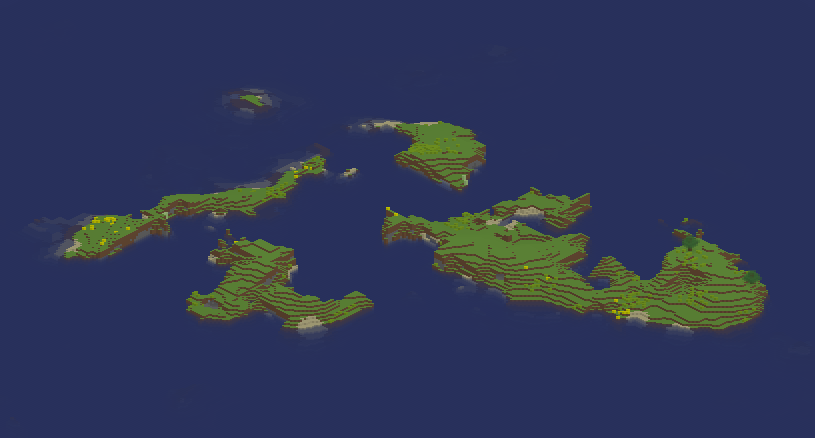
You're on a small island in the middle of a vast ocean. There's nothing but
dirt, stone and grass on the your island, which is part of a tiny archipelago.
One of the nearby islands features a dark cave, with what looks like a coal
seam near the entrance. You can glimps two small trees on another island
nearby.
All around your little clutch of islands is what appears to be vast, unending
ocean in all directions.
It's midday and you need to make yourself safe for the night. You can use the
wood from the trees to craft a pickaxe. With this, you can fetch some coal
from the seam. With the coal, you can create some torches, to see in the dark.
You might have enough wood left over to make a door, if you're lucky. Or
perhaps you should save it to craft a boat, or a sword. Groans from something
unknown emanate worryingly closely from the darkness of the cave.
You're lucky: one of your two trees has dropped a sapling. You eagerly plant
it. In a few days time, you might be able to harvest some more wood. You've
been granted a temporary reprieve, but the law of diminishing returns means at
some point, and soon, you'll run out of wood.
Swimming is time-consuming. By the time you have assembled a meagre supply of
wood and coal, it's almost sunset. You nervously dig a burrow in the mud of
your original island, light it with a torch and block the entrance back up.
Night passes slowly as you listen to things crawling around in the darkness
outside.
I first learned about Minecraft from this blog post
by Mike Watson last year. Mike did a great
job of demonstrating the narrative power of the game and his post left a
lasting impression on me.
Every now and then I dip in to Minecraft to see what's new since the last time
I played it. In the last few months version 1.8 was released and so I started a
new map to check it out. I ended up with a corker of a randomly-generated map.
Inspired by Mike's post, I thought I'd write a bit about it. In a follow-up
post I will provide the map itself.
Since there have been a few blog posts about GNOME 3 already, I m sure you don t mind me adding one. I m one of those who don t do any work, just lurk around and wait for stuff to be fixed or working in the first place. I also don t like compiling GNOME myself. I barely touched the already packaged stuff in the repository of our Debian GNOME packaging team. But I run unstable plus stuff from experimental. I ll thus have a bit of a different experience with GNOME 3 than current testing users who at least in parts don t seem to like what they re getting.
That being said I love it.
No, I don t mind running network manager on my systems, I even have it on my netbook (Atom processor). I used wicd for a long time because network manager really got nothing done back in the days (half a year ago or what :)). Nowadays, since version 0.9, it works fine for me. No fiddling around with config files, perfect integration in the desktop, and LAN and WLAN Just Work [tm].
No, I don t like if some weird dependencies dictate what tools to use. I usually used pidgin for messaging, for instance. Now I m using empathy, simply because it s best integrated in GNOME. And no, I won t switch from mutt to evolution. :-P
And there are more such cases. Also, these weird accessibility tools that are stuck in the gnome-shell top panel , I don t need them. Still there. (There s an extension to remove it, by the way.) Also, I must say, GNOME 3.2 is a lot better than 3.0 already. And I think 3.4 might do the final trick for me.
Fact is, with GNOME 3 I have a much cleaner desktop, there is more room for windows (which is nice on a netbook display), there are web apps which I already use a lot, and it has a professional, not too playful look (i.e. a few effects, clear and consistent theming, no bubbling windows). And the new notification stuff is just awesome, especially with the empathy integration.
Oh, and too many mouse click to access an application? 1) Put your most used apps in the favorites bar (or whatever it is called); it s just one click then. 2) Press your meta-key (that way our name for the windows key, or was that the ESC key? Whatever, press your windows key), type in the first two or three letters of your application, and hit enter; you don t need a mouse at all.
There. It had to be said. :)

It's about time that Rapha l is interviewed in the "People behind
Debian" series he initiated on his
blog.
Indeed, when he interviews people, Rapha l asks about other people
they could suggest for next interviews. So, during mine, I suggested
him to be a next "victim". As he couldn't interview himself, I
volunteered for this.
As you'll see below, Rapha l (who's a friend of mine as I'm a friend
of his) likes to speak and that shows in the length of his answers
:-) but you always know more about Debian when reading his blog posts,
books, mails, etc. I personnally think that he is among the best
promoters of the project for years and it was a pleasure for me to
conduct this interview.
My questions are in bold, the rest is by Rapha l.
Who are you?
Hi, Rapha l Hertzog, I'm a 32 years old French Debian developer who is
married and who has a 2-year old son. I'm running my own company (Freexian) since 2005, I started
it 3 years after the end of my computer science studies. I'm also a very
proud author of the Cahier de
l'Admin Debian, a French book about Debian.
You often wrote about your attempts to make your living partly, if
not completely, out of your Debian work. Can you describe the way
you're trying to do this?
My first try has been with Freexian. I always advertised this company
as being specialized in Debian GNU/Linux. While Freexian is successful
enough to provide me a decent income, I'm not really satisfied with the
result because very few of my contracts are about improving Debian. I
use Debian daily for the benefit of my customers, writing new customer
specific (embedded) software, deploying a service on Debian servers, etc.
But except for the occasional bugfix, all this work does not improve
Debian (the only exception has been the dpkg multiarch implementation
work sponsored by Linaro).
The positive side is that I don't need to fill my entire schedule to earn
enough money to live. So I'm regularly taking some days off work to be
able to contribute to Debian. This is a freedom that I enjoy...
My French book has also been a bestseller and depending on the years
the royalties represented between 1 and 2 months of supplementary time
that I can spend on Debian (that is between 2000 and 4000 EUR of income).
Now since last year, I decided to actively work towards my goal of making
a living out of my Debian work. I want to build on what has been most
successful for me up to now, that is my book. My strategy has been to
build an audience around my blog: with a direct contact with my readers I
have the opportunity to sell e-books, and without any intermediary taking
the biggest part of the price, I don't need a very large audience to be
successful.
I have also been experiencing micro-donations with Flattr, people who are
enjoying my articles on my blog can use it to give a few cents for each
article they find useful. With a large enough userbase, this could fund
free documentation and would avoid the need for commercial e-books but
we're not there currently and I don't know if it will ever reach the
critical mass.
Last but not least, I'm soliciting donations for my Debian work on the
sidebar of my blog, and I have the chance to a have a few (regular) donators.
You're a proud father since last year. How do you manage your
commitment to the project with your family life?
There are few things that I put above Debian in my life, but my family
certainly is. I try to handle most of my Debian duties during work
hours so that I can spend time with my family on evenings and during
week-ends but in truth I never really disconnect from Debian. It happens
quite often that I say to my wife I'll come in a few minutes, let me
finish this and then I end up responding to a Debian mail, or an IRC
query and take 30 minutes instead of the 5 expected ones. I try hard to
avoid this but it's difficult. Luckily for me, my wife is very supportive
of my Debian involvement and knows me well...
By the way my wife is using Debian on her computer, and my son has already played
with DoudouLinux (a Debian derivative!).
Have you already been accused of self-promotion in your writings? If
that would ever happen, what would you answer to that?
Yes, more than once. I am proud of what I do for Debian, I enjoy sharing
the result of my work. Because of this, some people believe that I'm
selfish and egocentric. And this has somewhat increased since I have been
soliciting donations: for me it's important to be transparent towards
donators so that they see what I really do for Debian. But some people
have the feeling that I'm getting undeserved attention and that I bring
everything towards my own person. On the other side, as an author, I'm a
public figure who is definitely seeking some attention...
I don't have any miraculous answer, we are a large and diverse community,
it's next to impossible to please everybody. I listen to all the concerns
that people bring forward, I take them into account as much as possible,
in particular when I believe they are reasonable/well justified, or when
they come from people that I highly respect. But sometimes I have to plainly
ignore them too... in particular when they are trying to impose their
own political view on a topic that's not directly related to the only
value that we all share: the social contract.
Contributing to Debian is a challenge, we all have to make efforts to
put aside our differences and to concentrate on the work that brings
us closer to the best free software operating system ever built.
You recently launched a campaign to free out the soon-to-be-published
"Debian Administrator Handbook", an English version of your
well-known book about Debian in French. Can you tell us more about
this project?
My French book has been very successful at helping people to get started
with Debian, and like I already explained, it was also effective to fund a
part of my Debian work. So I wanted to make it available world-wide by
publishing an English translation of it. I tried to find an
English-speaking editor willing to take on the challenge but I found none
interested.
Not put off by a setback, Roland (my co-author) and I decided to negotiate
with our French editor Eyrolles to recuperate the necessary rights to
translate the book into English. Handling everything ourselves represents
a lot of work, but it also means that we have the freedom required to decide
of the license of the resulting book. We would love to see it under
a license compatible with the Debian Free Software Guidelines.
But at the same time we firmly believe that we deserve a reasonable
monetary compensation for the work on the book, so we conditioned its
liberation to a predefined amount of money (25 K ) in what we call the
"liberation fund". And since we wanted to be sure that we would have the
required means to complete the translation, we used a crowfunding platform
to seek support of people interested by the book. With such a platform
you're only debited if the minimal requested amount is reached. Anyone
can participate, pre-order the book and/or put some money in the
liberation fund.
As of today, we already reached the minimal funding goal (15 K ) so the
book translation will happen. But the liberation target has not yet been
reached so we don't know yet if the book will be free from the start...
you can follow the progress right on the fundraising page or
on the website dedicated to the
book.
PS: If you want to contribute to this project and also make a donation
to Debian at the same time, you should check out this page.
You're one of the main developers of dpkg, a critical tool for
Debian systems. Can you tell us more about the current development
challenges it is facing? What will be the new dpkg features for
wheezy?
The current challenges are not really technical. dpkg is a relatively
mature piece of software and it will continue to work for the foreseeable
future without needing much maintenance work.
The real challenge is trying to setup a healthy developement community
around it so that we can keep tackling new interesting problems (there are
many listed in the roadmap and in
the 225 wishlist bugs).
There is a real problem of leadership and communication in the current
team. We used to be three, and we're only two nowadays. Guillem is the
legitimate leader since he's involved in dpkg's developement since early
2006 while I joined only in late 2007. But in the last 4 years, we did not manage to recruit anyone
else on the team. Some persons tried to contribute significant new
features (like Sean Finney with a rework of the way we handle
configuration files) but they gave up frustrated after a while because we
did not manage to review their work (and discuss the design) in any
reasonable timeframe. Another famous case is Ian Jackson with his trigger
work. His work got merged, but so late that in the mean time he blew up
while trying to hijack
the maintenance of dpkg.
For a long time I was concentrating my work on the Perl part of dpkg (aka
dpkg-dev mainly), so I did not feel qualified to review and merge work
related to the C part and I was just a worried observator of this
situation. I tried to improve it by setting up some basic
review
infrastructure, it should have brought some lisibility to the status
of each change left to be reviewed... but it has not been used
and it changed nothing.
Over the years, I became much more interested in the C part. My first big
contribution in C has been the rewrite of update-alternatives (from Perl
to C). I made other small changes in between, but at the start of this
year I had this great opportunity to work on the multiarch implementation
(FYI, multiarch is the
possibility to mix packages from several architectures on a single
system). This really forced me to jump into the C codebase and learn a lot about
how dpkg is implemented. Thanks to this I have been able to tackle other
small projects (like the improved triggers).
This would be all great if my multiarch work was already merged, but
it's not. It's a large work, I do not mind waiting a bit in particular
since Guillem is a highly skilled C programmer. His sharp analysis of new
designs are invaluable, when he reviews code he always finds something to
improve. I learnt a lot just by reviewing the code he wrote over the
years.
That said I have been waiting since April without almost no updates from
him. With the release team asking us
to hurry up, the situation is getting somewhat strained as I really
want to see multiarch in Wheezy and I do not really want to short-circuit
Guillem.
Hum, I may have drifted a bit from your original question... what great
new features can people expect? Well multiarch is supposed to be the big
new feature, apart from that there aren't many things that matter to the
end users. But there are already quite a few changes
that are of interest to package maintainers (like hardened build
flags, source package improvements, improved triggers, ).
What's the biggest problem of Debian?
Manicheism and a tendency to quickly polarize the discussions. In reality,
there are very few situations where everything is all good or all bad.
Ever since I have read The 7
Habits of Highly Effective People I try hard to put into practice the
habits of interdependence . Instead of having only my point of view in
mind, I try to understand the motivations from the other party ( Seek
First to Understand, Then to be Understood ) in order to be able to put
forward solutions acceptable to both parties ( Think Win-Win ).
I highly recommend this book to anyone. And I invite everybody to
at least try to follow those simple advices.
Is there someone in Debian you admire for their contributions?
There are many and I can't give an exhaustive list... here are some
that I would like to highlight (in no particular order):
Next.