Search Results: "ana"

14 July 2011

Asheesh Laroia: Open Source Bridge 2011: they love me (and gave me a scarf)!

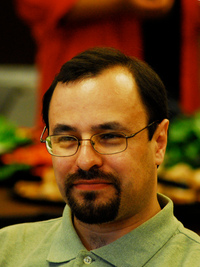
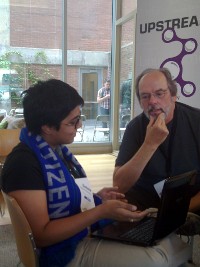
On Friday, June 24, the last day of Open Source Bridge, I won a scarf! It says, "Open Source Citizen." I wasn't the only one. The attendees nominated people who "made an extra effort to help others and share their knowledge," and the conference committee chose the three people they felt exemplified this. The winners were Sumana Harihareswara, Igal Koshevoy, and me. In case you don't know Sumana, she's the new Wikimedia Volunteer Development Coordinator, a friend, and a commenter here at Asheeshworld. In the photo of her and her new scarf, you can also see Ward Cunningham. I suggest reading her wrap-up about the conference, and checking out the notes from her talk. I haven't met Igal, but I've learned he's a fixture of the Portland tech scene. He's user number one on opensourcebridge.org and one of the original contributors to calagator, the most important event calendar in the Portland tech world. That's just a brief summary; follow him on Twitter to keep in touch. I started the conference a little shy, not wanting to introduce myself to people, so I hung out with Sumana. She talked to everyone she could find, and there I was standing next to her. On the first day, it was only because of Sumana's outgoingness that people knew who I was. On the second and third days, I was involved in two sessions: a panel on open source communities and a talk about the OpenHatch training missions. I was extremely honored to be chosen. There were so many other spectacular people I met for the first time, like Valerie Aurora, Jacinta Richardson, Brian Aker, and Alex Linsker. These are all people with three crucial traits: they're extremely knowledgeable, friendly, and opinionated. I'm glad I had a chance to attend and meet them! Photo credits: Thanks to Noah Swartz for the photo of me. Sumana's photo comes from her post to wikitech-l. Igal's comes from his Open Source Bridge user profile.

13 July 2011

Steve McIntyre: Project Harmony?

So, the "Harmony Project" launched their set of contributor agreements and tools last week. Colour me unimpressed... There's a claim on their website that they are a "community-centered group", but I don't see any list of people and organisations who contributed to this work. That bothers me. Regarding their aim to "assist organisations which use contribution agreements", I don't think that there is anything of value here for the Free Software community at all. Free Software developers don't need contribution agreements, and in my opinion encouraging their use like this is only going to cause further splintering of the community. We've managed for a very long time without them, why start now? As a developer, I personally don't believe in contribution agreements at all. If I contribute code to a project, it will be under the terms of a good Free Software license or not at all. That's all that's needed. There's a fair body of opinion out there on this - see pieces from Bradley Kuhn, Richard Fontana and Dave Neary for more discussion. What do you think?

Clint Adams: Savannah Doldrums

About a month ago, I submitted a project request to Savannah. It made sense at the time to host it there for a variety of reasons, but now I am still waiting for project approval. I am told that the reason my very exciting project is sitting there collecting moss is that there is a lack of reviewers. So if you want to help Savannah out, you should write to savannah-hackers-public@gnu.org.

Jaldhar Vyas: A Dance With Dragons (No Spoilers)

Somehow, even though I'd know about it for the longest time, I had never get around to reading George R.R. Martins A Song of Ice and Fire series until I heard about the Game of Thrones HBO series. Then I thought I had better hurry up and read the books as TV adaptations tend to be inferior. (I must say HBO did a pretty good job though.) I was instantly hooked and finished all four books in a week. Today the long-awaited fifth installment called A Dance with Dragons and I immediately got myself a copy. (Nowadays I mostly do my recreational reading with the Kindle app on my Android smartphone.) As before, I'm spellbound. I'm already about 25% through it and loving it. What I love about Martin is that he really gets how traditional, "pagan", "feudal" societies work. Take religion for instance. A lot of Sci-Fi/Fantasy authors if they deal with the subject at all usually give a cartoon version of polytheism that owes more to Christian canards and Dungeons & Dragons than any existing human religion. But in Westeros, one can be simultaneously devout, amoral, superstitious, and cynical in a way that makes a lot of sense to me as a Hindu. Or class. Being a peasant in Martins' world is horrible. Your life is completely at the mercy of Lords and Ladies and can end in an instant. But the upper class despite its wealth and power is trapped in its own way too. They must constantly protect their status from jealous competitors and a reversal of political or military fortune can destroy an ancient noble family just as suddenly as a bad harvest can destroy a family of farmers. Like the other books in the series, this one has a huge cast of characters whose stories weave in and out with each chapter told mainly from one characters viewpoint. This is a tactic which I for one found helpful to keep my attention from flagging but it means you can't really enjoy it unless you've read the previous volumes in order first. I definitely think it's worth the effort though.

12 July 2011

John Goerzen: First Look at Google Plus

Seems like everybody s writing Google+ reviews these days, but most of the ones I ve found seem to be fluff pieces. I haven t used it long, but have some initial impressions to share. First, an analogy. Facebook reminds me of the sleazy guy selling stuff from his car down the street. They do things like change privacy defaults when they think it s good for Facebook, rather than good for you. Google+ reminds me of an Apple product. It s beautiful, easy to learn, but locks everything down and is lacking some critical features. So here goes with the details. The good I think that this can be best summed up by: it s not Facebook. Facebook has, perhaps, set an incredibly low bar but still, this holds. Facebook is the only website I can ever remember using that changes things so much, so often, and so completely that I keep having this feeling of not knowing how to do things. Try maintaining a Facebook page or two and you ll especially feel my pain then. But even the basics: how many times have I accidentally posted a partial comment because I pressed Enter to start a new paragraph (that has only been the button used for that for, hmm, let s see now, decades), and instead it posted the comment. Principle of least surprise, anyone? Google+ has a simple and, on the surface anyway, intuitive interface. However, it does get muddy; more on that below. I m going to spend a lot more space on the bad below, but don t let that diminish my excitement about having a viable alternative to Facebook. I am keen to get rid of that monster. The Bad I ll start of this section with the fact that Google+ is a tightly-controlled walled garden. There is no way to take a copy of your status updates, comments, etc. and back them up with your own devices. If your Google account goes away, so do all your updates about your kids first words. Facebook does have this feature these days. It has broken half the time, but it exists, works, and I use it. Twitter doesn t have the feature built in, but its API makes it pretty easy; you could easily use my twidge program to do this, for instance. But whatever you put in G+ stays in G+. There is no autoposting it to twitter or Facebook, no backups, nothing. I m disappointed in that, given Google s prior attitude about openness to individual data ownership. (Update 7/12/2011: There is a way to get a backup, which I hadn t noticed; see comments below.) Almost as bad, there s also no way to get data in. So I now have identi.ca, twitter, Facebook, and now also G+ accounts. When I post an item in identi.ca, it autoposts to twitter, and then it autoposts from twitter to Facebook. Handy one place to notify people of my public activities. My uploads to Flickr and blog posts also auto-post to Facebook, so people I m friends with there get a picture of what I m doing outside of Facebook without me manually having to link it in. Not so with G+. There is no way to even add an RSS feed for my blog to auto-post to G+ as there is with Facebook. If you use G+, the only way to get stuff into it is with a keyboard. Poor integration with other Google apps is also an issue. G+ is nowhere near Google s first social app. They also have Blogger, Google Reader, Buzz, Gmail, etc. So here s the rub. These aren t integrated well, and when they have tried to integrate them, they ve done an exceedingly poor job of it. As an example: Buzz is a twitter-like service for posting updates. Very similar to what G+ does, right? Well, the best you can do is link your Buzz account to a separate tab on your profile. You can t even have your Buzz updates flow straight into G+, from what I can see. You have a separate list of followers in Buzz from G+. Reader is even worse; it has a sharing feature, but it s not G+ aware, so it goes to a reader inbox. But what takes the cake is the integration with Gmail Contacts. Sounds easy? Not entirely. When you add someone to G+, apparently it sometimes links the record with their entry in Contacts. And the help gives you the handy warning that when you remove them from G+, you have the option of removing them from Contacts, which could impact what you see on a mobile device. It is unclear what happens when it doesn t link the record, or how it decides which record to link (some people have more than one person in a family sharing phone numbers and email addresses, for instance.) One very nice feature of G+ is you can add email addresses, even if they aren t G+ members. Then when you post updates to the circle you ve added them to, G+ offers to send them an email with an update. Very handy. Except the undocumented part is that if you select Your circles (meaning all your circles), rather than individually ticking the box by each circle, they don t get the email. And they also don t get it if you set it Public. You have to select their specific circle, which is a significant difference from how people with G+ accounts are treated. And that s just an example. There are a ton of things that work one way 95% of the time, but have non-obvious exceptions. Some of these exceptions are documented in the help, and some aren t. I m still confused about the integration with Picasa. G+ help says that you can upload unlimited numbers of photos for free (though they will be downscaled at a certain point). Picasa has definite storage limits. But G+ uploads are showing up in Picasa. Do I really get free storage by uploading to the same place via a different tool? Very odd. And finally, a gripe about web standards. I ve been using Firefox/Iceweasel 3.5, which came out in Debian squeeze and is still supported there. It is also pretty darn new by corporate IT standards. And Google Plus refuses to let me log in with it, saying it s incompatible. Perhaps it can t do some fancy animation, but then again I don t really care. Seems Google has forgotten the old RFC adage: be liberal in what you accept and conservative in what you generate. If you can detect that my browser won t animate something right, then you could give me a stripped-down version of the page rather than an error message.

11 July 2011

Thorsten Glaser: [Update] Big Brother , or: Help wanted arguments against monitoring employees

English version of this posting lese stattdessen die deutsche Version The head system administrator of a henceforth unnamed company I happen to be employed at wants to force us to use the shell s persistent history feature disabled by default in mksh as is sensible, for privacy reasons on all systems, so he can retrace what we do (of course, his wording was more like, so he can reconstruct how I fixed a problem the last time it occurred yeah, sure). Now I ve escalated this to the boss, since this just cannot happen, what ll be next, video monitoring our offices or what and the boss said he sees my concerns and would like a meeting to get an agreement between all parties involved. Most sysadmin coworkers actually don t even think about this, they are sheeple, really; but my project manager (for when I m not a sysadmin but a programmer) and the leaderess of our QA department agree with me, luckily. Now I m in dire need of arguments, especially German-Legalese, to fight this total surveillance of employees, mostly targetted at these who use the command line almost exclusively, which I m a prime example of. Please mail me at my address, which is not junk@mirbsd.org but with tg instead of the waste part here to catch address grabbers (sending mail to that address yields a 24-hour total blacklist of your IPv4 address I ve yet to get enough spam via IPv6 to say filtering it is worth the cost). Thanks in advance!


Update 2011-07-12: We talked, and it was agreed to not force a shell history; instead I will now put problem solutions into smallish scripts and commit them into the sysadmin SCM. It was not solved using legal arguments, as many people commented would have been difficult; instead, they acknowledged that I was concerned with this, and we searched for a different solution to the head sysadmin s original concerns (apparently, to figure out how to fix things without reinventing the fix every time, and to find out what was changed on a server in case it breaks).

Raphaël Hertzog: 7 tips to file useful Debian bug reports and get your problem solved

Filing bug reports is the most common way for users to contribute. Even if it s not too difficult, I ll give you some advice to improve the quality of your reports. After all, when you go out of your way to report a bug, it is in the hope to see it fixed so let s see how we can make this more likely. 1. Try to reproduce the bug If you can t reproduce the bug, it s next to impossible to find the root cause and thus to fix it. In that case, I would suggest you to wait until you experienced the bug multiple times. Maybe you ll be able to find something that triggers it (or that makes it more likely to encounter it). If the application has a debug/verbose mode, it might be a good idea to enable it until you experience the bug a second time. The generated log might be helpful for the developer to understand what happens exactly. So don t file bug reports straight away unless you can reproduce it. The exception to the rule is when the application gives some useful information like a core-dump, a back-trace or an error message. Obviously if the bug happens during an upgrade, it s difficult to reproduce it (unless you have multiple computers) but you should still report it. Be sure to include all the relevant information (versions of packages before and after the upgrade, logs of the upgrade, etc.). 2. Do your best to identify the faulty package When you report a bug to Debian, you must assign it to a package. While there are pseudo-packages useful for problems which are not directly attributable to a real package, in most of the cases you should report a bug against the specific package that seems to be the cause of the problem you encountered. In turn this often requires you to attribute the problem to a file (for example the executable of the application that triggers the bug). Once you have a filename you can use dpkg -S to identify the corresponding package.
$ dpkg -S /usr/bin/hamster-time-tracker
hamster-applet: /usr/bin/hamster-time-tracker
Note that reportbug accepts a filename as parameter and will do the above conversion for you. If you only know the name of the application (but not the filename of the associated executable), you can use dpkg -S with a pattern to let it return all possible matches:
$ dpkg -S hamster
hamster-applet: /usr/share/applications/hamster-applet.desktop
hamster-applet: /usr/share/gnome/help/hamster-applet/es/statistics.page
[ ]
hamster-applet: /usr/bin/hamster-time-tracker
[ ]
Or you can also verify in the list of installed packages:
$ dpkg -l "*hamster*"
Desired=Unknown/Install/Remove/Purge/Hold
  Status=Not/Inst/Conf-files/Unpacked/halF-conf/Half-inst/trig-aWait/Trig-pend
 / Err?=(none)/Reinst-required (Status,Err: uppercase=bad)
 / Name            Version         Description
+++-===============-===============-==============================================
ii  hamster-applet  2.32.1-1        time tracking applet for GNOME
3. Verify that the bug is not already reported and/or fixed If there s a newer version of the software available, it s a good idea to try to reproduce the problem with this version too. Because the developers tend to care only about the latest version, they will want to reproduce it with this version, and they will be annoyed if the problem that you reported is already fixed. That s why bug reports of users of testing/unstable tend to be more useful than bug reports of stable users. In any case, you want to verify that the bug has not yet been reported: filing a duplicate bug is useless and only generates more work for the developers to merge both bugs together. On the opposite, it s highly appreciated to add supplementary information to an existing bug report, even a simple confirmation that the bug still exists on a newer version is useful. Note that reportbug will automatically show you the list of open bugs before allowing you to submit a new one. 4. Use reportbug While the Debian bug tracking system allows anyone to submit a new bug with a simple mail, you should really use a dedicated program like reportbug (or reportbug-ng) because it will automatically include lots of useful information in the generated report (version of dependencies, current architecture, etc.) and will assist you in all the steps. 5. Describe the problem so that the developer can reproduce it Ideally your report should include everything required so that the developer can reproduce the problem on his system. If a given document triggers the bug, attach it. Describe the steps required to reproduce the bug in great details just like you would explain it to your grand-ma. Explain how you expected the program to react and what happened instead. You can learn much more on how to draft a good bug report in this article: How to report bugs effectively. It s a bit long but well worth it if you intend to report bugs and thus interact with developers. 6. Be kind and willing to help When you draft a bug report, keep in mind that you re writing to a volunteer free software developer and not to a customer service. You should be respectful and follow the usual rules of courtesy. Developers attention is scarce and should not be wasted. Be willing to help, if the developer starts investigating your problem, he might need your help to get supplementary information (in particular if he can t reproduce it) and you should be ready to provide it. Thus it s important to keep whatever you need to reproduce the problem. In some cases, the Debian maintainer might be overworked and you can offer your help to forward the bug to the upstream bug tracker, it s always appreciated. If you re reasonably confident that the problem is not Debian-specific, you can do it straight away and set the forwarded field to the URL of the upstream bug report (for example with bts forwarded <bug> <url>). 7. Use the correct severity The Debian bug tracking system lets you set the initial severity of the bug report (in decreasing severity: critical, grave, serious, important, normal, minor, wishlist). Pick the correct severity according to the official definitions but don t misread them. In particular, don t over-inflate the severity: for instance if you lost some data due to a misuse of the software, it s not critical (i.e. rm -rf * doesn t warrant a critical bug against rm). If you use only a tiny part of a software, and that part doesn t work, the package might be unusable for you but it s not unusable for everybody, so it doesn t warrant the grave severity. The important severity is often a good choice in those cases. Do not under-estimate the severity either, if a problem is important enough that it must be fixed before the next stable release (for example a regression compared to the previous release), pick a release-critical severity (i.e. at least serious ). The maintainer and the release manager can always lower the severity if they do not agree with your initial judgment. And now, happy bug-reporting!
Follow me on Identi.ca, Twitter and Facebook. Or subscribe to this blog by RSS or by email.

6 comments Liked this article? Click here. My blog is Flattr-enabled.

Vincent Bernat: Rewriting my .zshrc

Ten years ago, I started to use ZSH, a shell designed for interactive use but which is also powerful for scripting usage. I had a fairly comprehensive .zshrc file splitted in several parts. I have decided to rewrite it for several reasons:
  1. I did not take advantage of several features of ZSH, like some advanced parameter expansion, arrays, arithmetic expressions and other built-in features. There were a lot of head, awk, sed that could be replaced by some ZSH machinery (something easier to read like $ $ (f)~~"$(</etc/hosts)" %%\#* ).
  2. It contained a lot of hacks to make things work on some odd/old setups. I was not really sure that those hacks are useful anymore. It also contained a lot of conditionals where some parts of the code were executed depending on the hostname.
I have discovered oh-my-zsh, a nice project trying to provide a generic and flexible ZSH configuration:
A community-driven framework for managing your zsh configuration. Includes 40+ optional plugins (rails, git, OSX, hub, capistrano, brew, ant, macports, etc), over 80 terminal themes to spice up your morning, and an auto-update tool so that makes it easy to keep up with the latest updates from the community.
The idea of such a project is to fork it and make the changes that you need. I was previously hacking around Phil! s ZSH Prompt for my prompt. oh-my-zsh contains a close theme (jonathan). Neat. However, I decided to write my .zshrc from scratch (but with some snippets stolen from oh-my-zsh). Why? Mostly because I want to precisely configure ZSH. Even with its plugin architecture and its override mechanism, oh-my-zsh provides some features (options, aliases, functions) that I do not want. Of course, thanks to git, you can fork and make any local changes you want but since I would have modified most of the files, it seemed easier to just start from scratch. I have published the result on GitHub. You can use it as is, fork it or (better) steal and adapt some snippets for your own usage. Here is the mandatory screenshot for the prompt (no much space left for the commands): My ZSH prompt Here is a short snippet used to select a sensible EDITOR depending on what is available. It uses anonymous functions (to restrict the scope of local variables), arrays and flags in parameter expansion. For another example, take a look on how I select a valid locale.
()  
    local -a editors
    local editor
    editors=(
        "emacs23 -Q -D -nw" # Fast emacs
        "jove" "mg" "jed"   # Emacs clone
        "vim" "vi"          # vi
        "editor")           # fallback
    for editor in $editors; do
        (( $+commands[$editor[(w)1]] )) &&  
            export EDITOR=$editor
            break
         
    done
 
Enjoy! UPDATED: Anonymous functions were introduced in ZSH 4.3.7. Older versions do not support them. A workaround is to use a classic function instead:
__()  
    local -a editors
    local editor
    ...
  && __

10 July 2011

NeuroDebian: NeuroDebian@HBM2011.ca

NeuroDebian@HBM2011.ca On June 26-30 the annual meeting of the Organization for Human Brain Mapping (HBM2011) took place in Quebec City, Canada. Encouraged by our positive experience at last year s SfN in San Diego and enthusiasm of our scientific adviser, James V. Haxby, we hosted another NeuroDebian booth. The setup was pretty much the same as last year: Some chairs and tables, lots of people, our tri-fold flyers, a Debian mirror and some virtual machine images to show Debian in action. This time we also had an LCD display attracting visitors with the package swarm, some demos, and our recent paper. We had many curious people have their first exposure to Debian, long-time users expressing their gratitude to Debian, and our upstream developers getting together to discuss various topics. Having registered the booth as NeuroDebian , we had the additional pleasure of explaining visitors the concept of a project inside Debian, in contrast to a derived distribution. But that is nothing new really, so let s talk about the differences from last year s booth. First of all, we had more people at the booth. Dominique Belhachemi volunteered to help us out and that was very much appreciated. Although HBM has only about a tenth of the attendees that SfN has, we had significantly more traffic. While last year people were primarily interested in knowing about the project, this time many of them wanted to give it a try immediately. People came with their laptops, got the VM images and started playing with Debian. After a day or so, some came back and asked for recommendations on particular software after having been exposed to the wealth of the Debian archive. What also had increased was the number of developers, or rather research labs developing neuroimaging software that came to the booth to discuss how to get their software into Debian and how to arrange ongoing maintenance of these future Debian packages. As we have our plates already quite full, we have been spending some time on mentoring interested developers to learn the art of Debian packaging and making them familiar with Debian s procedures and standards (e.g. working on #609820 with Yannick Schwartz, upstream, at the booth). ../../_images/BusyBooth216.jpg Two promising new developments need to be mentioned. First, we were approached by companies that develop hardware for brain-imaging and psychophysics research. They were curious to learn about Debian as an integrated platform that offers free software solutions that an increasing amount of their customers demands (e.g. PsychoPy). Apparently, the movement towards open research software has finally made it into the business plans of companies, as they seem to start perceiving compatibility with free software systems as a competitive advantage. We explained how software gets into Debian, and how its release cycle is managed. To foster their motivation we also pointed them to the existing open-source software that is already available or even present in Debian. Let s see whether we see more Debian-certified research products in the future. Lastly, we started talking with folks from the INCF to explore possibilities of collaborating on INCF projects using Debian as the integration and development platform. The INCF is an OECD-funded organization that develops collaborative neuroinformatics infrastructure and promotes the sharing of data and computing resources to the international research community. At least one INCF project is already relying on the efforts of the NeuroDebian project. We are going to continue this discussion during a workshop in September. A report will follow...
../../_images/DDs13.jpg

Debian people at the booth (f.l.t.r): Michael Hanke, Yaroslav Halchenko, Stephan Gerhard, Dominique Belhachemi. Not shown: Swaroop Guntupalli.

Acknowledgments This booth has been made possible by the generous support of Prof. James V. Haxby (Dartmouth College, New Hampshire, USA).

Christian Perrier: Cheese and Wine party for DebConf 11, aka C&W7

Do I need to explain what is the Cheese and Wine (C&W) party? Still, if some of you need more information, please feel free to ask. The C&W7 wiki page now exists on DebConf wiki. Information will come there until the day of the C&W, which is scheduled for Tuesday July 26th, so the day before the planned daytrip, if I'm correct. C&W orga details are currently very vague, but the most important point is: start planning what YOU will be bringing for the event. Remember that the event is only successful when many of us manage to bring good stuff to share (preferrably cheese, wine...or other ethanol-improved beverages). If you think about something *else* than cheese, please feel free to bring it: just try to have it representative of your part of the world...or a part of the world you love. Any further questions can be asked in the debconf-discuss mailing list or in #debconf channel on irc.debian.org

5 July 2011

Rudy Godoy: Compute Clusters Integration for Debian Development and Testing Report 3

Hello this is the third report regarding my project. As usual, quick
summary first. From my last report I have progressed much little than I
would like but, as stated previously also, I m finishing semester
and between exams and projects it takes almost all my time. However, I m
free of academic duties next week and I ll double the speed on the project. What was done so far

- Started working on the modifications to the Eucalyptus code, as
expected.
I ve almost complete the code for the Libvirt s XML Domain
definition. I ve abstracted the wrapper in order to support a broader
number of arches. Previously it was tailored for supporting x86/amd64
based machines. The idea is to have a list of supported arches and
generate the XML file according that. For ARM some parameters and
elements are different than for the others. This would allow for
people to support another architectures, given they are well supported
by KVM-Qemu.
Started working on changes to util/data.c to make sure the correct
parameters are being passed to the XML generator and to libvirt kvm
calls.
- Define and start to setup the testing / demo environment. Basically
involves having one machine to run KVM as hypervisor so the Eucalyptus
handler uses it to run ARM kvm-qemu images.
- Over this weekend I ll be publising the code changes on my
website. Steffen suggested to create some docs regarding the progress
too. I ll do that once I feel I m on track again for my current
pending work, that s coding. What I ll be working over the next two weeks

- My primary goal is to catch up on the work pace and finish the neccesary
code for Eucalyptus to support ARM images. This means to finish
modifications to:
node/handlers_kvm.c handling nc creation. Little changes are need
here from what I ve indentified already.
util/data. c,h handling instance creation. This is the part where
most of the work shall be done. I ve started to work here already.
- Test the code I ve complete already and send the patches to the teams
involved. To date I m still working on a local environment, because no
usable patches have been generated already, just little pieces here
and there.
- Since this is a sort of gluing project, that is code here and there
and make it work together. I m in the process of finding a machine to
be able to test parts of it once they are complete. I m still
contacting people to get such machine, in anycase I gues I can manage
to get one myself. I can t use my current machine since it involves
reinstalling and working at the OS level.
- For the project s demo I ll use both machines, one as the front-end
and the kvm one for NCs (nodes). That s the goal. What is required after that

- I d like to release a package that includes my changes, so it can be
installed either from official packages or my own packages, this
involves:
Updating the packaging bits to the pkg-Eucalyptus repo.
Talking to upstream about it.
- Write the reference Steffen suggested. I believe that I can finish the first part in one week, because of the
work I ve done in the past weeks to understand the Eucalyptus code. I m
also will be talking more to the Eucalyptus team and also to the
maintainers about such changes. I guess that s all for now.

John Goerzen: The Lives of Others

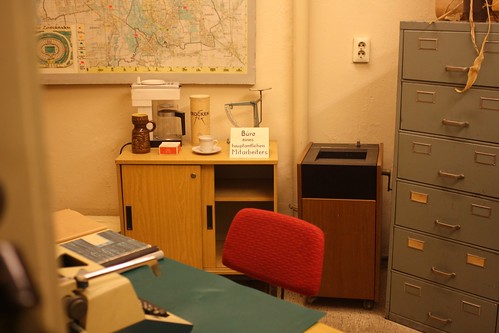
It s not very often that I watch a movie anymore. It s been a few years since I ve actually purchased one (normally I see them from Netflix). But yesterday I saw one that may change that. The Lives of Others is an incredible film set in the former East Germany (GDR/DDR) mostly in 1984. The authenticity of it is incredible and so is the story. It s subtitled, but if you re an American wary of subtitled European films, don t be wary of this one. It is easy to watch and worth every minute. The story revolves around the Stasi, the GDR Ministry for State Security ( secret police ). It is an incredible picture of what living in a police state was like, and how many of the informants were victims of the regime too. My breath caught near the beginning of the film, showing the inside of a Stasi building. A prisoner was being interrogated for helping someone attempt to escape to the west. But the reason my breath caught was this incredible feeling of I was there . Last year, Terah and I were in Leipzig and visited the Stasi museum there, Museum in der Runden Ecke . I always have an incredible sense of history when being in a preserved place, and this building was literally the Stasi headquarters for Leipzig. Much of it was preserved intact, and seeing it in the film brought home even more vividly the terrible things that happened in that building, and others like it, not so very long ago. IMG_2717 We watched the special features on the Blu-Ray disc, and one of them was an interview with director Florian Henckel von Donnersmarck. He described how he spent a lot of time interviewing both victims of the Stasi, as well as ex-Stasi officers. One of the most disturbing things to me was his almost offhand comment that most of the former Stasi officers still had some pride in performing their jobs well. Even now, freed of the state s ideology, they were proud of the work they did which could be put most charitably as ruining people s lives. What leads a person to view life that way? How can we try to make sure it doesn t happen again elsewhere? I am happy to say that most of us have never experienced anything like the Stasi. And yet, small reflections of that mindset can be seen almost everywhere. Societies at wartime or feeling under threat, even Western democracies, can drum up those feelings. In the USA, for instance, the McCarthyism era saw people s careers ruined for alleged anti-state behavior. Contemporary examples include the indefinite detention (I hate that word; shouldn t we say imprisonment ?) of terrorism suspects at Guantanamo Bay, and the terrible treatment of Bradley Manning, who revealed some true but embarrassing things about the US military which really needed to be revealed. Even tobacco farmers and companies are selling a product they know ruins lives, but somehow keep doing it. And there are still members of the public that try to make life difficult for people that don t think like they do. From organizing campaigns of telephone harassment of colleges that don t perform the American national anthem before sporting events, to tossing about the term un-American (a loaded McCarthyist one, which many may not even be aware) at an inflated rate, we are not immune from attempts at forcing conformity or silence in others, and blind loyalty to state. I am never in a particularly celebratory mood on July 4, the biggest day for American boasting, faux patriotism, militarism, and general flag-waving. We do have a lot to be proud of and thankful for, but it seems that we celebrate all the wrong things on July 4, and see it as an occasion to proclaim American exceptionalism rather than as one to see how far we ve come and bolster hope for how far we can, and should, yet go. No, I don t think that the land of the free ought to have operated secret prisons in Europe (nor the Europeans to have been complicit in it), or that the American military was defending our freedom 100% of the time they were deployed, or that it is right for governments to mandate daily recitation of an untrue document (the pledge of allegiance) in schools. And yet, I am mindful that I have a lot to be thankful for stability, lack of much internal violent conflict, etc. And this particular day I am happy that a post like this is not something that gets the attention of some government agency and mostly that I will have a handful of angry emails to delete.

4 July 2011

Joachim Breitner: gtk-vector-screenshot works with epiphany

Martin Borgert uses my gtk-vector-screenshot application to take screenshots of a web page opened in the browser, in his case, epiphany. I find this a very good idea and was surprised to hear that it works flawlessly: The rendered web page not only shows up, it even shows up as vector graphic with fully selectable text. It s also neat that a HTML5 video appears. One feature that is hard to replicate with regular screenshots is taking a shot of a window that is larger than the current screen. This PDF file (of which the image on the left is a thumbnail preview) contains a whole web page that would not fit on my screen. To achieve that you need a window manager that allows resizing windows beyond the size of your screen (e.g. xmonad). Then just keep resizing and moving the window until the scroll bar disappears and take the shot. BTW, gtk-vector-screenshot is available in Debian unstable.
Flattr this post

Rapha&#235;l Hertzog: How to prepare patches for Debian packages

You want to start contributing to Debian and/or Ubuntu, you decided to help a package maintainer and you re now looking for how to change a source package and how to submit your changes. 1. Retrieve the source package and install build-dependencies The first step is to retrieve the latest version of the source package and to install the required build-dependencies. I already covered how to do this with apt-get in the article explaining how to rebuild a source package. If you prefer, you can use dget (from the devscripts package) to directly grab the source package. You can find the URL of the .dsc files in the Package Tracking System for example. Sometimes apt-get will warn you that the source package is maintained in a VCS repository, like this:
$ apt-get source wordpress
[...]
NOTICE: 'wordpress' packaging is maintained in the 'Git' version control system at:
git://git.debian.org/git/collab-maint/wordpress.git
[...]
In that case, you can use debcheckout to retrieve the VCS repository instead (provided that you have the corresponding VCS installed):
$ debcheckout wordpress
declared git repository at git://git.debian.org/git/collab-maint/wordpress.git
git clone git://git.debian.org/git/collab-maint/wordpress.git wordpress ...
Cloning into wordpress...
Note however that some maintainers use their VCS in a way that s not really compatible with the explanations that I will give below. It s also a good idea to install the package packaging-dev . It s a meta-package depending on the most common tools that are used for Debian packaging work. 2. Do the changes Execute dch --nmu to record the fact that you re working on an update prepared by someone who is not the maintainer (NMU means Non Maintainer Upload). This also ensures that if we build the package, we won t overwrite the original source package that we downloaded, thus making it possible to generate a diff between both versions. 2.1. Modify Debian packaging files Now fire your text editor and do the required changes in the debian sub-directory. You will probably run dch -a multiple times to document each subsequent change. 2.2. Modify upstream files If you have to modify upstream files, the proper way to do it depends on the source package format ( 1.0 vs 3.0 (quilt) vs 3.0 (native) , see the debian/source/format file) and on the presence or not of a patch system (the what-patch can help you identify it). In this explanation, I ll assume that the package is using the recommended format: 3.0 (quilt) . (It also works for 1.0 if quilt is used and if you configured ~/.quiltrc as recommended by /usr/share/doc/quilt/README.source). First you should ensure that all patches have been applied with quilt push -a. If there s no patch yet, you want to create the debian/patches directory (with mkdir debian/patches). 2.2.1. Import a patch If the upstream changes are already in a patch file (say /tmp/patch that you downloaded from the upstream VCS repository) you can import that patch like this:
$ quilt import -P fix-foobar.patch /tmp/patch
Importing patch /tmp/patch (stored as fix-foobar.patch)
$ quilt push
Applying patch fix-foobar.patch
[...]
Now at patch fix-foobar.patch
The -P option allows to select the name of the patch file created in debian/patches/. As you see, the new patch file is recorded in debian/patches/series but not applied by default, we re thus doing it with quilt push. 2.2.1. Create a new patch If the upstream changes that you want to make are not in a patch yet, you should tell quilt that you re going to create one:
$ quilt new fix-foobar.patch
Patch fix-foobar.patch is now on top
Then you must record every file that you re going to modify with a quilt add invocation. quilt then makes a backup of those files so that it can generate the patch later on. If you re going to modify the files with your text editor you can just do quilt edit file-to-modify, it s the same than quilt add file-to-modify followed by sensible-editor file-to-modify.
$ quilt edit foobar.c
File foobar.c added to patch fix-foobar.patch
The last step is tell quilt to generate the patch:
$ quilt refresh
Refreshed patch fix-foobar.patch
3. Test your changes You should build your modified package with debuild -us -uc . You can easily install the resulting package with debi . Verify that everything works as expected. If not, continue your modifications until you re satisfied with the result. 4. Generate a patch and mail it If you followed the instructions, you should have two .dsc files in the parent directory, like this:
$ cd ..
$ ls wordpress_*.dsc
../wordpress_3.0.5+dfsg-1.1.dsc
../wordpress_3.0.5+dfsg-1.dsc
Generating the patch to send to the maintainer is then just a matter of running debdiff:
$ debdiff wordpress_3.0.5+dfsg-1.dsc wordpress_3.0.5+dfsg-1.1.dsc >/tmp/wp-debdiff
You can send the /tmp/wp-debdiff file to the wordpress maintainer. Usually you send it via the bugreport that your update is fixing and you add the patch tag to the report. This can be automated with the nmudiff utility. By default it assumes that you re using mutt but it can also directly feed the resulting mail to sendmail. The default text that nmudiff proposes assumes that you re actually performing an NMU and that the result has been uploaded. If that s not the case, you should edit the text and make it clear that you re just sending a patch. If you have been working in a VCS repository, instead of using debdiff you can simply use the diff feature integrated in your VCS (git diff, svn diff, etc.). But note that with a distributed VCS (like git/bzr/mercurial, unlike svn) you should probably have committed all individual changes in separate changesets. And instead of sending a single patch, you re probably going to send a series of patches (though it might be easier to just upload your branch in a public repository and give the corresponding URL to the maintainer).
Found it useful? Be sure to not miss other packaging tips (or lessons), click here to subscribe to my free newsletter and get new articles by email.

No comment Liked this article? Click here. My blog is Flattr-enabled.

3 July 2011

Andrea Veri: Automatic Gmail s Trash & Spam folders cleanup

Since some time I ve been thinking about a possible way to delete my Gmail s Trash & Spam folders content automatically without having to bother doing it manually every single time I wanted to check my mail and clean it up. (I love keeping everything in place and having my Trash&Spam folders empty as they should be makes me pretty happy) A few years ago when Mutt was my main mail client I had the need to filter my mail through IMAP and while googling around for that I found out a great piece of software: imapfilter. Today while analyzing the above quoted issue I suddenly told myself: Hey, but why don t you use your dear and old friend imapfilter to fulfil your needs? After a few minutes I came up with a small lua script that was doing exactly what I wanted: my Trash&Spam folders are no longer crowded and I finally don t have to delete mails twice! But here they come a few details about my script:
options.timeout = 120
options.subscribe = true
account = IMAP  
 server = 'imap.gmail.com',
 username = 'example@gmail.com',
 password = 'password',
 ssl = 'ssl3'
  
trash = account['[Gmail]/Trash']:is_undeleted()
account['[Gmail]/Trash']:delete_messages(trash)
spam = account['[Gmail]/Spam']:is_unanswered()
account['[Gmail]/Spam']:delete_messages(spam)
The script does two things:
  1. It checks whether a mail is not marked as deleted (moving an e-mail into the Trash does not mark it as to be deleted automatically) already and removes it.
  2. It checks whether a mail on the Spam folder has been answered (I never had to answer a single e-mail contained into my Spam folder) and if not removes it.
Using the above script is really easy (you should run imapfilter on interactive mode first to generate Gmail s certificates, do that before having cron to run the script for you or otherwise it ll just hang), just make sure to have imapfilter installed on your system and then run it through cron every half an hour or less depending on your needs:
crontab -e
*/30 * * * * imapfilter -c /home/user/imapfilter.lua >> /home/user/imapfilter.log
Please also remember to setup appropriate permissions on the config file since it contains your Gmail s password and most of all make sure that your Spam folder is visible through IMAP (this option can be found on the label menu available under your Gmail s settings) otherwise imapfilter will just report an error. Enjoy!

Clint Adams: A very little bit about how herb works

This information is pieced together from no fewer than five informants. As such it is likely to contain inaccuracies. Every year, through the conference registration system, a fork of an old version of Pentabarf, attendees declare that they need sponsorship. They state their cost of travel as well as how much of this amount they can afford to pay themselves. In addition, there is a text field in which one is to answer what you do for Debian and why you request sponsorship. Next a committee is assembled. The head of the committee hand-picks its members. In 2011, twenty-four people were asked if they would like to participate, thirteen people were named to the committee, and twelve of those ended up voting. This committee is named herb , after Herbert Powell. The members of herb each individually rate the applicants on two factors: contribution to Debian and amount requested. Each factor is rated on a five-point scale (-2 to +2). Raters may leave, at their option, a comment regarding the applicant. The raters are able to see previous ratings and comments. In the interest of avoiding the appearance of conflict of interest, each rater will refrain voluntarily from self-rating. Individual raters use exercise judgment during this process.
Contribution to Debian is very subjective, and some raters will vote either on total travel cost, requested amount, the ratio of the two, or something else. At a certain point in time, a weighted average of all the ratings is used to order all the applicants into a list. At the top will be the people ranked most highly. The herb team will then conduct an IRC meeting in which ranking may be arbitrarily changed and two thresholds will be established. The result of this process is three lists of people: queue A, for people who should definitely get sponsorship; queue B, for people that might get sponsorship if people from queue A cancel or other circumstances arise; and queue C, which is not really a queue, but a rejection pile. In some cases, the structure of these queues are decided before definite budget numbers are known. Applicants are emailed to let them know which queues they are in, and their rankings within those queues.

Asheesh Laroia: How I feel about Google+ (not thrilled)

Image credit: Lake Shimmer by (nc-sa) cobalt123. The beautiful photo above is what reflections should look like. If you don't like Google's shimmering +1 buttons, try the convenient AdBlock filter Tom Morris wrote. I also block this image.

I have been reading a lot about Google+. I'm sure a lot of people put a lot of hard work into it. Lots of people seem to enjoy using it and appreciate its features. For my part, right now, when I see Google+ mentioned, the smile vanishes from my face. I just have a few thoughts. It's anti-competitive. If you could ask Google, "How much for a shimmering +1 button next to every search result?" you would be laughed out of the room. But they managed to offer themselves that unique marketing opportunity. I know that (1) most regulators who see this anti-competitive behavior won't see it as an anti-trust violation, and (2) the damage is already done, and no retribution in the future can act fast enough to fix the unfair advantage Google gave itself in the Internet-mediated personal communication (and ad sales) markets. The shimmering is distracting, making my online search experience worse. I know that Google is holding nothing back; they are willing to distract me from my intended use of Google in order to branch out their business. (If you haven't seen the shimmering +1 button, it's next to every web search result, and if you mouse over any part of the result, it does a wavy dance.) The most-touted feature is a clone of Diaspora. This by itself is fine; software should help users by having the best features imaginable. But the enthusiasm I've seen within the free software community (like when I read about Google+ on Slashdot and Planet Debian) should at least recognize that Google "circles" are a clone of Diaspora's Aspects. Centralization on the web feels like a personal attack. Corporations on the web are like unstoppable machines rolling us toward a future of corporate eavesdropping, central points of failure, and end-users sold en masse to advertisers. It enables a future of individual "platform owners" who can change the lived experience of untold hundreds of millions with tweaks that benefit their actual customers (the advertisers). There's not much I can do about that. I happen to take this personally: I am part of a small culture of people who run their own mail and web servers and understand the importance of software freedom. This is a part of my identity. I watch as its traces online vanish, replaced by something more efficient and terrifying. It makes me sad. I'm probably going to end up using it despite all these pain points. That's how I know that I am being steamrolled. The reasons I have given above are not reasons to not use Google+. They're just reasons that I'm going to frown all the way to the address bar. In weeks to months to years, the service will grow an enthusiastic userbase. At that point, personally, I'll have to make a choice between connecting with those people on their terms, or not staying in touch with them. Already, professionally, the idea has already come up on #openhatch that Google+ could help us reach people willing to contribute to open source. Are my gripes worth holding OpenHatch back, or worth isolating myself over? Probably not.


Dominique Dumont: Generate a configuration editor from a config template file with Perl: lcdproc example

Hello Creating a configuration model for Config::Model can be a boring task: When a configuration system has a lot of parameters, a lot of details need to be specified to have a complete configuration validation tool. So, all tricks are permitted to make this task more bearable. Let s see how this can be applied to lcdproc. This project requires a configuration file that supports more than 40 drivers. Each driver has it own set of parameters for a total of about 250 parameters. That s a lot to specify.. Fortunately, LCDd.conf template file is written in a way which makes it relatively easy to parse and get all required information to build a model. All drivers are listed in this template file, most parameters have default values and legal values are written in comments in a uniform way. Hence this file (and comments) can be parsed to retrieve information required for the model. This blog will describe how this task can be implemented in Perl using Config::Model modules. The code will be slightly trimmed down to keep this blog (relatively) short. All initialisation code and error checks are removed. You can get the whole script on sourceforge. The main steps are:
  1. prepare a parser for LCDd.conf template
  2. parse LCDd.conf template
  3. prepare a LCDd model skeleton
  4. translate LCDd.conf template information in a format suitable to create a model.
  5. Write the resulting LCDd model
First, here s the necessary incantation to start properly a Perl program:
use strict;
use warnings;
Then load all required libraries. Their use will be described later:
use Config::Model;
use Config::Model::Itself 1.225;
use Config::Model::Backend::IniFile;
use 5.10.0;
use IO::File;
use IO::String;
Perform some initialisation to avoid upsetting the logging system:
use Log::Log4perl qw(:easy);
Log::Log4perl->easy_init($WARN);
Let s also initialize a model object that will be very useful later:
my $model = Config::Model->new();
Now we can really start the fun part. Step 1: Create a parser for LCDd.conf (INI file)
Problem: LCDd.conf comments must also be analysed to get more semantic information. The comments must be retrieved and associated with the INI classes and parameters found in this file. Fortunately, Config::Model::Backend::IniFile is able to associate comments with the relevant parameters. But Config::Model::Backend::IniFile must store its values in a configuration tree. So let s create a model suitable for LCDd.conf template that accepts any INI class and any INI parameter Dummy::Class is used to store any parameter found in an INI class. The accept keyword with .* regular expression means that any INI parameter will be accepted in each INI class.
$model->create_config_class(
  name   => 'Dummy::Class',
  accept => [
    '.*' =>  
       type => 'leaf',
       value_type => 'uniline'
        ,
    ],
);
Now the Dummy model must provide a configuration class to hold all INI classes:
$model->create_config_class(
    name   => 'Dummy',
    accept => [
       '.*' =>  
           type => 'node',
           config_class_name => 'Dummy::Class'
        ,
    ],
);
Note that an INI backend could be specified directly here. But, some useful parameters are commented out in LCD.conf. Some some processing is required to be able to create a model with these commented parameters. See below for this processing. Step 2: Parse LCDd.conf Now the dummy configuration class is created. Let s create a configuration tree from this dummy class to store the data from LCDd.conf
my $dummy = $model->instance(
    instance_name   => 'dummy',
    root_class_name => 'Dummy',
)-> config_root;
Now, read LCDd.conf:
my $lcd_file
  = IO::File->new('examples/lcdproc/LCDd.conf');
my @lines    = $lcd_file->getlines;
And perform the pre-processing on LCDd.conf mentioned above. Just un-commenting commented parameters is required:
foreach (@lines)   s/^#(\w+=)/$1/  
Store the pre-processed LCDd.conf in a IO::Handle usable by INI backend
my $ioh = IO::String->new( join( '', @lines ) );
Create an INI backend to read the data from pre-processed LCDd.conf and store it in the configuration tree:
my $ini_backend = Config::Model::Backend::IniFile
  ->new( node => $dummy );
$ini_backend->read( io_handle => $ioh );
Step 3: Prepare LCDd configuration model Your attention please. You may remember that we invoked instance on object to create the dummy configuration tree to hold LCDd.conf data. The instance method used the Dummy configuration class. Now, we must invoke instance again on object. But this time, instance will use Config::Model::Itself. This model is Config::Model s way of eating its own dog food. The configuration tree created there will be able to hold LCDd model. Hence the root of this special configuration tree will be called meta_root to avoid confusion with the other configuration root defined above (for the Dummy model). Still with me? Good, let s create this meta tree that will contain LCDd model:
my $meta_root = $model->instance(
    root_class_name => 'Itself::Model',
    instance_name   => 'meta_model',
) -> config_root;
Create the main LCDd configuration class and store the first comment from LCDd.conf as class description:
my $first_comment = $dummy->annotation ;
$meta_root
  ->grab("class:LCDd class_description")
  ->store( $first_comment );
Append my own text in this description:
my $extra_description =
    "Model information extracted from template /etc/LCDd.conf"
  . "\n\n=head1 BUGS\n\nThis model does not support to load "
  . "several drivers. Loading several drivers is probably a "
  . "marginal case. Please complain to the author if this "
  . "assumption is false";
$meta_root->load(
     qq!class:LCDd
        class_description.="\n\n$extra_description"!
);
Add legal stuff in the model:
$meta_root->load( qq!
  class:LCDd
    copyright:0="2011, Dominique Dumont"
    copyright:1="1999-2011, William Ferrell and others"
    license="GPL-2"
!
);
Add INI backend so configuration object created from LCDd model will be able to read user s INI files:
$meta_root->load( qq!
  class:LCDd
    read_config:0
      backend=ini_file
      config_dir="/etc"
      file="LCDd.conf"
!
);
Note that all the load calls above could be done as one call. They were split for better clarity. Step 4:Extracting LCDd.conf information Now that all information from LCDd.conf template file is stored in $dummy configuration tree, it s time to use this information to enhance the skeleton of LCDd model created above. Let s first find all the INI classes defined in LCDd.conf:
my @ini_classes = $dummy->get_element_name;
Now before actually mining LCDd.conf information, we must prepare several subs to handle them. This is done using a dispatch table:
my %dispatch;
First create the default entry which will be used for most parameters. This subs is passed: the INI class name, the INI parameter name, the comment attached to the parameter, the INI value, and an optional value type. It will return a string describing a model for simple elements. For instance: class:"LCDd::MD8800" element:Device type=leaf value_type=uniline default="/dev/ttyS1" description="device to use [default: /dev/ttyS1]" Here s the subroutine invoked by default. Let s create a an anonymous subroutine and store it in the dispatch table:
$dispatch _default_  = sub  
    my ( $ini_class, $ini_param, $ini_note,
         $ini_v, $value_type ) = @_;
    $value_type  = 'uniline';
Now, prepare a string that will be used later to create the ini_class model. This string uses Config::Model s serialisation format described in Config::Model::Loader:
    my $load = qq!class:"$ini_class"
                  element:$ini_param type=leaf !;
Get semantic information from LCDd.conf template comments (written between square brackets):
    my $info = $ini_note =~ /\[(.*)\]/ ? $1 : '';
    $info =~ s/\s+//g;
Use this semantic information to better specify the parameter:
    $load .=
        $info =~ /legal:(\d+)-(\d+)/
           ? " value_type=integer min=$1 max=$2"
      : $info =~ /legal:([\w\,]+)/
           ? " value_type=enum choice=$1"
      :    " value_type=$value_type";
    if ( $info =~ /default:(\w+)/ )  
        # specify upstream default value
        # if it was found in the comment
        $load .= qq! upstream_default="$1"!
           if length($1);
     
    else  
        # or use the value found in INI
        # file as default
        $ini_v =~ s/^"//g;
        $ini_v =~ s/"$//g;
        $load .= qq! default="$ini_v"!
           if length($ini_v);
     
The model (in serialised format) is ready, let s return it and exit the subroutine:
    return $load;
 ;
Now let s take care of the special cases. This one deals with Driver parameter found in INI [server] class. This sub will create a string for an enum element. The possible values of the enum are extracted from the comment found in the LCDd.conf file:
$dispatch "LCDd::server" Driver  = sub  
    my ( $class, $elt, $info, $ini_v ) = @_;
    my $load = qq!class:"$class"
                    element:$elt
                      type=leaf
                      value_type=enum
    !;
    my @drivers = split /\W+/, $info;
    while ( @drivers
            and ( shift @drivers ) !~ /supported/ )  
      # nothing, the work is done by shift operator
      # in loop test to skip all words in $info until
      # 'The following drivers are supported:'.
      # ok, that's a hack
     
    $load .= 'choice='
          . join( ',', @drivers ) . ' ';
    return $load;
 ;
This sub invokes the default sub and add a small feature to the model to ensure that DriverPath ends with / . This is ensured by the match="/$" snippet:
$dispatch "LCDd::server" DriverPath  = sub  
    my ( $class, $elt, $info, $ini_v ) = @_;
    return   $dispatch _default_ ->(@_)
           . q! match="/$" !;
 ;
Likewise, this sub invokes the default sub with the optional 4th parameter that forces the value_type of the element. In this case, we enforce an integer element:
 $dispatch "LCDd::server" WaitTime 
 = $dispatch "LCDd::server" ReportLevel 
 = $dispatch "LCDd::server" Port 
 = sub  
    my ( $class, $elt, $info, $ini_v ) = @_;
    return $dispatch _default_ ->( @_, 'integer' );
   ;
This sub returns a string for a list element with default values:
  $dispatch "LCDd::server" GoodBye 
= $dispatch "LCDd::server" Hello 
= sub  
    my ( $class, $elt, $info, $ini_v ) = @_;
    my $ret = qq( class:"$class"
                    element:$elt
                      type=list
                ) ;
    $ret .= 'cargo type=leaf
             value_type=uniline - ' ;
    $ret .= 'default_with_init:0="\" '.$elt.'\"" ' ;
    $ret .= 'default_with_init:1="\" LCDproc!\""';
    return $ret ;
 ;
Now that the dispatch table is ready, let s really mine LCDd.conf information. First handle all INI classes in the foreach loop:
foreach my $ini_class (@ini_classes)  
Let s retrieve parameters for this INI class from the LCDd.conf template:
  my $ini_obj = $dummy->grab($ini_class);
This will be the name of the lcdproc driver configuration class (e.g. LCDd::imonlcd):
  my $config_class   = "LCDd::$ini_class";
The configuration class will also be created in a serialised format. Let s create config class in case there s no parameter in INI file:
  $meta_root->load(qq!class:"LCDd::$ini_class"!);
Now, loop over all INI parameters and create LCDd::$ini_class elements:
  my @all_ini_params = $ini_obj->get_element_name ;
  foreach my $ini_param ( @all_ini_params )  
Retrieve the value provided in template LCDd.conf:
    my $ini_v = $ini_obj->grab_value($ini_param);
Retrieve the comment attached to the value provided in template LCDd.conf:
    my $ini_comment
      = $ini_obj->grab($ini_param)->annotation;
    # escape embedded quotes
    $ini_comment =~ s/"/\\"/g;
Retrieve the correct sub from dispatch table:
    my $sub = $dispatch $config_class $ini_param 
              $dispatch _default_ ;
Run the sub to get the model string:
    my $model_spec
      = $sub->( $config_class, $ini_param,
                   $ini_comment, $ini_v );
Attach the comment from LCDd.conf as class description:
    $model_spec .= qq! description="$ini_comment"!
      if length($ini_comment);
Then, last but not least, load class specification in the model, and end the loop aroung INI parameters:
    $meta_root->load($model_spec);
   
Now create a an $ini_class element in LCDd class (to link LCDd class and LCDd::$ini_class):
  my $driver_class_spec = qq!
    class:LCDd
      element:$ini_class
  ! ;
Since server and menu are not drivers, they have a special treatment:
  if (   $ini_class eq 'server'
      or $ini_class eq 'menu' )  
    $driver_class_spec .= qq!
      type=node
      config_class_name="LCDd::$ini_class"
    ! ;
   
Here s the treatment for LCDd drivers. Setup the model with a warped node so that a driver configuration class is shown only if the driver was selected in the [server] class:
  else  
    $driver_class_spec .= qq!
      type=warped_node
      config_class_name="LCDd::$ini_class"
      level=hidden
      follow:selected="- server Driver"
      rules:"\$selected eq '$ini_class'"
        level=normal
    !;
   
Now we can load the LCDd driver model in meta root:
  $meta_root->load($driver_class_spec);
 
Step 5: save LCDd model Still with me ? Good. Here s the last part, now that the model was created in memory, let s save it in files. Config::Model::Itself constructor returns an object to read or write the data:
my $rw_obj = Config::Model::Itself
     ->new( model_object => $meta_root );
say "Writing all models in file (please wait)";
$rw_obj->write_all(
    model_dir => 'lib/Config/Model/models/'
);
That s it. Once this script is run, the directory lib/Config/Model/models/ contains a bunch of files: You can see the resulting editor in my first blog on lcdproc. Conclusion and future steps (with you?) As mentioned at the end of this blog, the result of this model generation process is far from perfect, because the information retrieved from LCDd.conf template are not complete for this task (which is normal since these comments were targeted for users). Now, I d really like to discuss with project developers to improve configuration template to generate better models. For project owner, such an improvement would give them: Please leave a comment on this blog (or send a message to config-model-users at lists.sourceforge.net) if you are interested in configuration tool generation for a project you contribute to. All the best

Rapha&#235;l Hertzog: My Debian activities in June 2011

This is my monthly summary of my Debian related activities. If you re among the people who made a donation to support my work (195 , thanks everybody!), then you can learn how I spent your money. Otherwise it s just an interesting status update on my various projects. Dropbox for Debian This is not free software but Dropbox is very popular and they did only provide an Ubuntu package that did not work on Debian. So I created an official package. I have been in touch with Dropbox developers and they have been very helpful. They ll shortly release a signature mechanism (with GPG) so that we can further improve the package by verifying the origin of the downloaded binaries. SAT Britney At the start of the month, I continued my work on the britney reimplementation (the software that creates testing out of unstable) but I quickly stalled it because the release managers asked the feedback of Stefano Zacchiroli and Ralf Treinen (who have extensive knowledge on the topic with their research work on Mancoosi) and I did not want to invest further work in case they would identify a major flow the feedback came only very late this month and while it was somewhat negative, I still think it s worth pursuing the effort for a bit longer. Converted ftplib to multiarch While dpkg still doesn t support multiarch (no news from Guillem and no visible sign of progress :-( ), unstable got all the remaining bits allowing us to convert libraries to multiarch (see the announce). As soon as the required libc6 landed in unstable, I looked into converting the only library package that I maintain. I had no major problem but I still identified 2 issues in Lintian (filed as #630164 and quickly fixed by Niels Thykier). build-arch / build-indep support For the 42th time in the last 10 years, the idea of using build-arch/build-indep targets in the rules file has surfaced again. I had already decided some time ago that I would accept a patch implementing a new field Build-Features to enable dpkg-buildpackage to use those targets and this time Bill Allombert completed such a patch so I merged it. The technical committee also decided that it would take a final decision on this topic (see #629385). Roger Leigh provided useful input by doing an archive-wide rebuild with the various solutions suggested. Given that the majority would like to make the target mandatory at some point in the future, I provided the dpkg patch for my preferred solution. We would use auto-detection as a temporary measure until all packages have been converted to have the targets. The technical committee has not yet taken any decision even though the discussion stalled since the 12th of June. But that s usual with that body. I m sure it will be solved during Debconf. ;-) Misc dpkg work Hamster applet update Hamster-applet is a GNOME application which did not have a 3.0 release, but it had a development release (2.91.x). I checked out whether it was possible to package this version for experimental and have the applet work with the GNOME fallback mode. Apparently not, the code was not yet updated to be compatible with the newer panel. Instead I uploaded the latest stable version (2.32.1) to unstable. It has some nice improvements in the standalone version (and the name of the executable changed). For usage with GNOME 3, I have created a custom shortcut to start it quickly (with gconf-editor set /apps/metacity/global_keybindings/run_command_1 to <Mod4>t and /apps/metacity/keybinding_commands/command_1 to hamster-time-tracker because the GNOME 3 control panel does not seem to work to set custom keybindings currently). Translated my professional website into English While I m grateful for all the people who are supporting my work, I m still far from my goal to have one third of my time funded through donations and sales of products on this blog. So I decided to also bring more visibility to my company and in particular to its Debian-related service offering. It was only available in French up to now so I translated it and expanded it a bit. My support page on this blog now also links to my company s website. If your company needs help to create Debian packages, or needs Debian technical support by email, you just found the right partner. :-) BTW, I have discounted prices for individuals and non-profits who would like to benefit from my help to create Debian packages. The Debian Administrator s Handbook This is the title of the upcoming translation of my book. The project now has a dedicated website: debian-handbook.info. You can subscribe to its RSS feed to keep up with the latest news. The full table of contents is online along with a FAQ. I m actively looking for partners to help me promote the fundraising once it goes live. If you can reach a large set of readers interested by a good Debian book, get in touch with me to join the affiliate program. Thanks See you next month for a new summary of my activities.

No comment Liked this article? Click here. My blog is Flattr-enabled.

Erich Schubert: Google vs. Facebook

Let the games begin. It looks like Google and Facebook are going to fight it out.
Given the spectacular failures of Wave and Buzz, people are of course skeptic about the success of Google Plus. However, I'm rather confident it is going to stay. Here are some things I like about it:
Some people think that Google will not stand a chance against social giant Facebook. But after all, Google has more users - and they have tons of services people like to use. So when Google Maps has Plus integration, will the users use it to chat about where to meet, or will they go the long way and post the map URL on Facebook, without the option of updating it collaboratively?
Googles position is much stronger than many people believe, once you think about integration possibilities. The current Plus is just a fragment, the missing puzzle piece connecting the other apps. But imagine that Google now Plus-connects its various services: YouTube, Maps, Mail, Talk, ... - for them, this is just a matter of some engineering. I guess probably half of these are already in internal testing. And Facebook just can't keep up there. Sure, they do have Facebook Video. But actually, most people prefer YouTube. And while Google can integrate plus all the way there, Facebook cannot. And while Google is the master of search, Facebook is particularly weak there - they can't even properly search their own data. Google however will at some point offer an "find things that interest me" button; Sparks is just the beginning where you have to manually define your interests (which will probably remain an option due to privacy concerns!); it is way too static right now.
So essentially, Google doesn't need to copy Facebook. They just need to do what is obvious on their own products, and Facebook will have a hard time keeping up.
Plus, in my opinion, Google got the timing just right. Users aren't too happy with Facebook these days, there is just no big alternative around anymore; their friends are on Facebook and not on some other social network. Facebook doesn't seem to evolve much anymore. The mail functionality opened more security holes (apparently you can post to a group with a fake user name when you spoof the senders email address) than it contributed to functionality and usefulness. Privacy is still not in line with all countries such as Germany; but Facebook keeps telling those users essentially that they don't care. Spam and fraud still reappears every month following the same pattern again and again (Clickjacking). The search function of Facebook is still usually described as "useless" ... People waste time in games and annoy their friends with random game invitations and posts. Facebook should better make a major move now, too. More than a demo of Skype integration. But whenever Facebook changed, their users complained ...

Of course, Google+ still has a long way to go, too. There are still many things missing here, too. For example groups and events. I figure Google is already testing them in "dogfood", and they'll actually come out within the month. With groups I do not refer to the existing Google product, but to what would be "public circles" that you need to join and that are accessible to all the circle members instead of just the creator. And events are also a key function; probably one of the most used on Facebook. These may require much more careful design to integrate well with Calendar. But given the visual update of Calender these days, this may just be around the corner, too.

Next.

Previous.