Search Results: "sto"

16 November 2013

Russ Allbery: Review: Blue Remembered Earth

Review: Blue Remembered Earth, by Alastair Reynolds
Series: Poseidon's Children #1
Publisher: Ace
Copyright: January 2012
Printing: June 2012
ISBN: 0-441-02071-2
Format: Hardcover
Pages: 505
Geoffrey Akinya is one heir to the vast Akinya business empire, which straddles the solar system and has created vast riches from exploration and mining. He wants nothing to do with it. His passion is elephants: long and methodical study of wild herds in Africa, including a slow and careful investigation into their thought processes. His obnoxious and superior cousins have a passion for business and finance and can have the running of the company for all he cares. But Geoffrey's grandmother Eunice, the family matriarch and driving force behind much of their business expansion, has died. Her ashes are brought back to Africa from the Winter Palace in orbit around the Moon where she lived out her final days and scattered in a family ceremony. And, shortly thereafter, Geoffrey's cousins convince him to investigate a safe-deposit box left on the Moon by Eunice to ensure that it doesn't contain anything damaging to the family. What it contains is the first step in a puzzle. Despite himself, Geoffrey and his sister Sunday an artist and family black sheep who lives in a region of the Moon that is one of the sole holdouts against the ubiquitous monitoring common in the rest of the inhabited solar system are slowly pulled into unraveling that puzzle. This leads them into an uneasy alliance with one of the major political forces in the solar system and some startling revelations about their grandmother's actual plans. Blue Remembered Earth is another entry in the currently-popular sub-genre of solar system SF. Interstellar travel is still a dream, but a combination of improved technology, suspended animation, and heavy use of robots and robotic factories has let humans slowly expand into more of the solar system. On Earth, powers have risen and fallen, and the leap into the solar system coincided with a surging and powerful Africa. Extensive undersea colonization has established a new international consortium of sea-floor countries, and Earth politics have realigned into a diplomatic and business struggle between surface and oceanic nations. Unusually for this sort of fiction, most characters of significance in this story are African. The United States and Europe have quietly disappeared in the way that all non-US countries tend to in most other SF. Reynolds doesn't do very much with this setup (and the characters don't seem distinctly African to me). It's just there as the unremarked normal. I liked that. I kind of wish more of African culture had come through in the story, but there are enough SF novels with an assumed and unremarked white (and usually US) future that an assumed and unremarked black African culture is a nice change of pace. I picked up this book in part because it was described as a better 2312. That's a fairly accurate summary (although only helpful to those who have read Kim Stanley Robinson's novel). The scope and setting are similar, although Reynolds's future cuts back on the scope of off-world human colonization, relies more heavily on robotics, and keeps the power base on Earth. Both books are structured as a mystery, although in Blue Remembered Earth that mystery is deliberately planted for the characters. Reynolds is nowhere near as good at set pieces as Robinson, sadly. There's nothing here at the level of some of the scenes on Mercury in 2312. But he is much better at plotting and characterization, and Blue Remembered Earth tells a coherent story with increasing tension and a satisfying ending. Reynolds here uses an interesting strategy for spinning a mystery out of pieces of knowledge and discovery: set the discovery process prior to the novel, use protagonists who were unaware of it, and turn the details into a mystery that they have to investigate. This is an interesting way to address the problem that most discovery processes are slow and not particularly dramatic. It is artificial Eunice creates the plot for the novel but that worked for me. By the end of the book, I think I understand her reasons for doing so, and both Geoffrey and Sunday have good reasons to not be aware of any of the details before they start following the clues that Eunice leaves behind. The mystery of course sends Geoffrey and Sunday on a bit of a tour of the solar system as well as a tour of the past of their family business and the politics of the present. Here, Reynolds draws on an old SF idea: a conflict between groups that want to mechanize space exploration and groups that want to adapt humans for space. Long-time SF readers will be familiar with this approach, and I don't think Reynolds does anything startlingly new with it, but I thought it was a well-executed side plot. And, for once, an SF author realizes that Earth's oceans are as compelling of a place for that conflict to play out as outer space. There are, of course, significant mysteries to be uncovered, but it takes much of the book before those revelations start (even if one of them is almost spoiled in the dust jacket summary). The story up until that point is driven by character, particularly Geoffrey's stubborn annoyance at the rest of his family and his complete lack of interest in being the protagonist of a novel. I should probably warn here that many of the Amazon reviews disliked this book because of the characters, particularly Geoffrey. Apparently he comes across to some as whiny, resentful, and annoying. I, however, didn't have this reaction at all, possibly in part because I wholeheartedly share his opinion of both big business and his cousins. I thoroughly enjoyed reading an SF novel whose main characters are not driven either typical capitalist motives or a desire for personal exploration, but instead are pulled into the plot through a sense of loyalty and an inability to get out of the way of the problem. I also liked the way Reynolds manages to broaden and deepen the reader's appreciation for the characters as the story unfolds, and even salvages some characters I thought were unsalvageable. The last third of the book features some excellent plot twists and some very nicely-handled revelations. This is apparently the first book of a trilogy, and I had a suspicion at the end of the book that sequels were coming, but I think it stands on its own quite well. Most of the questions raised by the plot are resolved by the end of the book, and those that remain are of a size that other books have left unanswered intentionally. Despite not reaching the same moments of awe-inspiring beauty, and despite more workman-like descriptions, the stronger plot and more interesting characters do make Blue Remembered Earth a better 2312 for me. Given that 2312 won a Nebula, that's saying something (although I don't agree with that award). It's a bit deliberate in its pacing, and the plot built around a constructed puzzle can feel a bit artificial, but I think it's a solid and satisfying near-space SF novel. Followed by On the Steel Breeze. Rating: 7 out of 10

15 November 2013

Jo Shields: The directhex! In an Adventure with MIPS

We ve been trying to build Mono on MIPS in Debian for a long time. Just under a decade, in fact. Mono 0.29.99.20040114-3 was the first attempt, back when the Mono source was 10 meg, not today s ~80. It never worked though. Not once. At the end of 2004, 10 upstream versions later, we gave up, and turned off mipsel as a target architecture in the package. When I became a Debian Developer in 2009, one of the first things I did was try again with Mono on various previously unsupported architectures, by running a build on the Debian porterboxes. Supposedly MIPS support was there, as evidenced by all the MIPS-related files in the source tree. But I d try it, and it d fail, and upstream would say works for me . I repeat the process every major release or so, to see what s changed. The breakthrough Spurred by the removal of two bitrotted architectures (IA64 and SPARC), I decided to try again, this time investigating more deeply into the reason for the failures, with the help of upstream developer Alex R nne Petersen. A couple of hours of IRC-driven gdb and test program disassembly later, a seemingly innocent comment flagged something in my brain: 09-07-2013 15:10:11 < alexrp!~zor@baldr.rfw.name: TIL that mul and mult are not the same thing on mips Why is this notable? Well, MIPS processors lack a whole bunch of instructions which are commonly used in assembler. MUL is one of them it s valid MIPS assembler, which is expanded to MULT/MFLO when compiling. Call it a macro, or a mnemonic, or shorthand the preferred term is pseudoinstructions . So what s the issue? 09-07-2013 15:18:27 > directhex: mono isn't trying to use a mul instruction, right? i mean, that instruction doesn't exist as far as the cpu is concerned, it's a macro the compiler does things with See where this is headed? 09-07-2013 15:23:59 > directhex: mini/mini-mips.c:#define USE_MUL 1 /* use mul instead of mult/mflo for multiply */ Argh. See, the thing about MIPS pseudoinstructions is they may be real instructions on a given CPU implementation. Strictly speaking MUL isn t a standard instruction, but a given CPU might have it anyway, to make multiplication a little faster (by using only one instruction, not two, for multiplication). In this case, the Debian MIPS infrastructure is based around ICT Loongson-2E processors which don t have that extension but the upstream Mono developers were building and testing on an extended CPU, never seeing the issue themselves. Flipping that define to 0 (and amending the instruction length setting in another file) fixed the build. Mono was running on MIPS for me for the first time ever. Digging through the history in git showed just how annoying this implementation quirk was. USE_MUL was added in late 2008 replacing a previously used #if 1 . The mult/mflo version of the code existed in the Mono source since the first time the full MIPS port was committed in 2006, but we never saw it. The breakage So, with that patched to work, I added mipsel to the Experimental build of Mono which still failed. The runtime would build fine, but the class library build would fail at random times, with random meaningless stack traces. Unrepeatable. Some kind of race condition. The build would eventually succeed if I hammered make a few times, but that s no good for the Debian build daemons. Back to square one except I had an epiphany yesterday. I have heard more than once that Loongson processors are missing a few instructions. What if one of those was being hit, intermittently? I started doing a search in places that might need to work around that kind of issue, and found this. A patch to binutils in 2009, replacing one no-op instruction with another, when /usr/bin/as is fed the -mfix-loongson2f-nop flag. Turns out NOP is another pseudoinstruction on MIPS. Well, more of an alias. The opcode 0 000000 is Shift Left Logical with 0 registers and 0 data, which is a no-op. But on all but the latest generation of Loongson-2F chips, that opcode can, under heavy load, fail causing inconsistent state in the CPU registers. The flag to as replaces sll 0,0,0 with or $at,$at,0 , which is also a no-op instruction, but doesn t trigger the failure on Loongson-2F chips (and 2E chips, although that s not stated in the documentation). As long as ALL your programs get fed through as , you don t have a problem, since it uses the replacement opcode but what if you use a JITter to generate your own opcodes? Oh fuck, it couldn t be diff --git a/mono/arch/mips/mips-codegen.h b/mono/arch/mips/mips-codegen.h
index dc4df7d..1dbd1c6 100644
--- a/mono/arch/mips/mips-codegen.h
+++ b/mono/arch/mips/mips-codegen.h
@@ -334,7 +334,7 @@ enum
/* misc and coprocessor ops */
#define mips_move(c,dest,src) mips_addu(c,dest,src,mips_zero)
#define mips_dmove(c,dest,src) mips_daddu(c,dest,src,mips_zero)
-#define mips_nop(c) mips_sll(c,0,0,0)
+#define mips_nop(c) mips_or(c,mips_at,mips_at,0)
#define mips_break(c,code) mips_emit32(c, ((code)<<6) 13)
#define mips_mfhi(c,dest) mips_format_r(c,0,0,0,dest,0,16)
#define mips_mflo(c,dest) mips_format_r(c,0,0,0,dest,0,18)
Oh yes it could! Mono was using sll 0,0,0 (the recommended no-op instruction from the MIPS instruction reference manual), causing failures in my tests, because Debian s build and test infrastructure just happens to use defective silicon. And, again, upstream were unable to reproduce a problem because they use better silicon than we do. So what now? Well, last night I uploaded mono_3.2.3+dfsg-3, which includes the above patch to force the replacement no-op instruction. It test built fine on the porterbox, and it should (when the damn experimental buildd gets around to it), just work. Finally. After just under a decade, Mono packages will be available on MIPS in Debian. And after all this time, all we had to change was 4 lines to work around 7 year old Chinese knock-off processors. The edit So, things are finally built. It turns out that despite everything, the replacement NOP opcode is not enough. If you re-read the post to the binutils list, pay close attention to: In theory this is still not enough to fully eliminate possible hangs, but the possiblity is extremely low now and hard to be hit in real code. It s a filthy lie. It s easy to hit the issue in real code: just do a from-source build of the whole Mono class library. With the replacement instruction it builds .NET 2.0, 3.0, 3.5, 4.0, and most of 4.5, before dying in the same way as before an improvement on failing early in the 2.0 build, but not enough. Thankfully, 2 out of the 5 Debian mipsel build servers are not Loongson 2 they re 11 year old Broadcom SWARM developer boards. Not fast but also not broken. Luck smiled on me, and caused my build to go to one of these Broadcom machines. As a result (experimental_mipsel-dchroot)directhex@eder:~$ mono --version head -1
Mono JIT compiler version 3.2.3 (Debian 3.2.3+dfsg-3)
It s been a long time coming.

Rudy Godoy: New GPG Key 65F80A4D

A bit late but I ve created a new 4096 RSA GPG key. I ve published a transition document as well. I hope I can meet fellow Debian developers soon to get my new key signed. So, if you are in town (Arequipa, Peru) drop me an email!

14 November 2013

Steve Kemp: Meanwhile, behind the facade of this innocent book store

In brief:

Russ Allbery: rra-c-util 4.11

This is my collection of helper libraries and utilities that I use for most of my C-based software (and some Perl bits as well). Most of the changes in this release are improvements to the Autoconf macros, primarily based on feedback from Julien LIE and reconciliation with the macros used in INN. The major backward-incompatible change is that RRA_LIB_KRB5 and friends now define HAVE_KRB5 (to match the name) and set rra_use_KRB5, and similarly RRA_LIB_OPENSSL and friends define HAVE_OPENSSL and set rra_use_OPENSSL. Any packages that use these macros will probably need some updates. There are also a couple other fixes for RRA_LIB_KRB5 and RRA_LIB_KRB5_OPTIONAL: both now work for packages that do not use Automake, and the optional version does not fail if com_err couldn't be found. Similarly, RRA_LIB_OPENSSL_OPTIONAL no longer aborts if libcrypto couldn't be found and both OpenSSL macros probe for libdl first unless --enable-reduced-depends is used. Finally, RRA_LIB_OPENSSL properly restores the default CPPFLAGS, LDFLAGS, and LIBS after the library probes. Also in this release, all uses of asprintf, snprintf, and related functions check the return status, since POSIX allows these functions to fail for reasons other than memory allocation failure. xasprintf and xvasprintf distinguish between memory allocation failure and other failures and report better error messages, and the vasprintf replacement properly preserves errno if snprintf fails. portable/socket.h also defines EAI_ADDRFAMILY, which is obsolete but which some software needs to check, to EAI_FAMILY if it's not defined so that the check can be done unconditionally. You can get the latest version from the rra-c-util distribution page.

Jan Wagner: Upgrade RAM of your QNAP TS-459 Pro+ to 2GB

After running a QNAP TS-459 Pro+ for the last 3 or 4 years at home, my monitoring was alerting me about memory warnings cause I upgraded my SqueezeBox Server to the latest nightly version. So I looked into how to upgrade the shipped Adata SU3S1333B1G9-B.

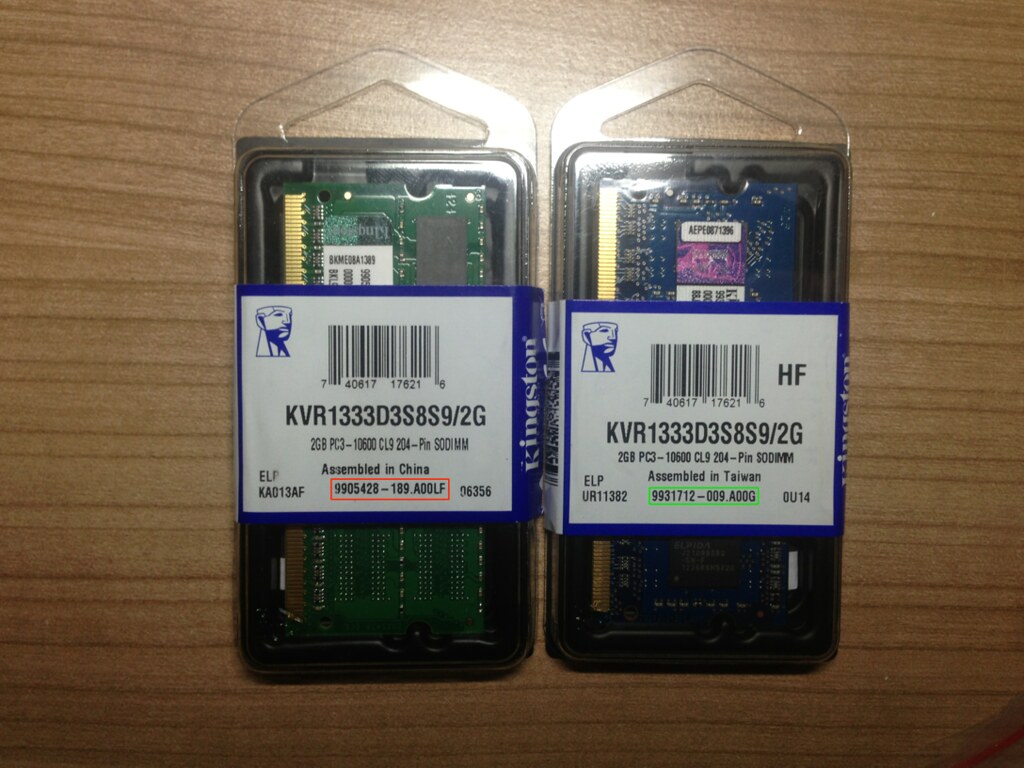
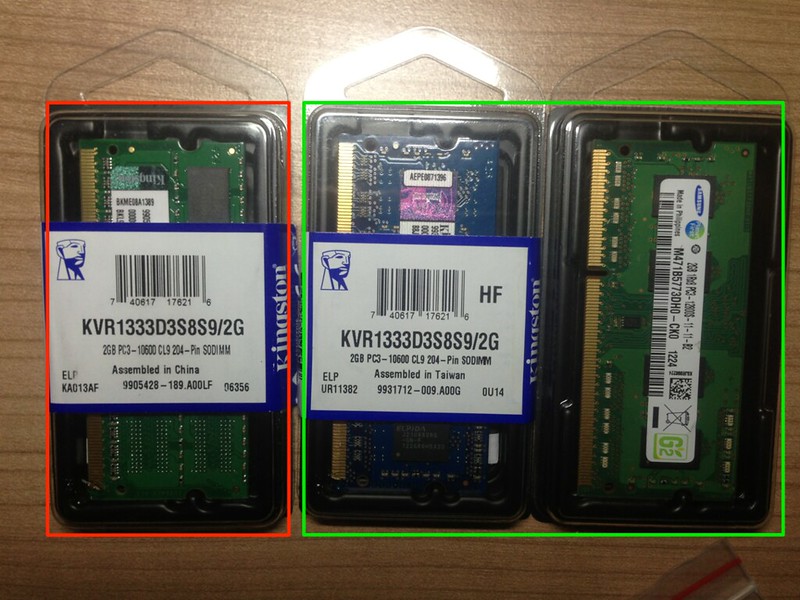
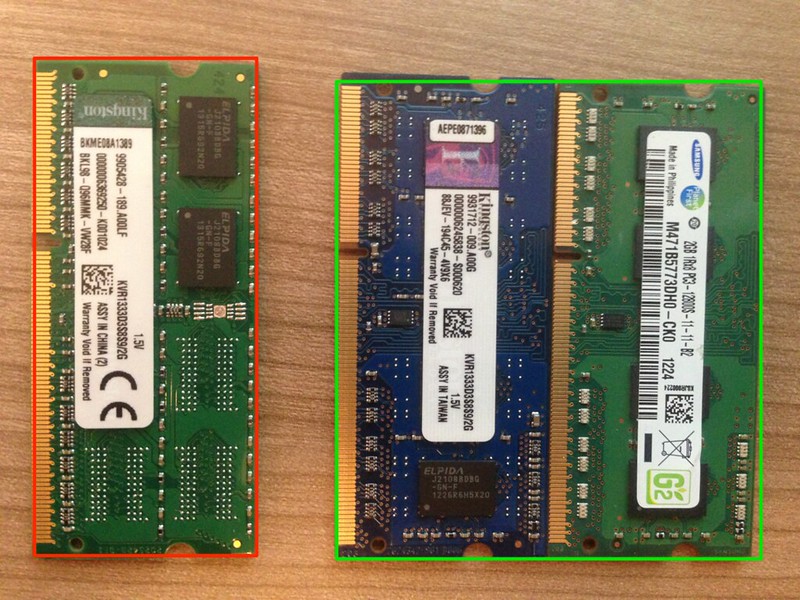
It seems that the KVR1333D3S8S9/2G should work, so I ordered one. After plugin it in, it revealed that the module wasn't working while it worked for others. After digging around, it seems essentially that the modul has a 8-chip design. Indeed, my modul just has only 8 memory chips, but the design is a 16 chip. So I thought it would be a nice try to order the one from amazon that worked for others. And like expected it's not the same module but has the same Kingston Part Number.

As you can see, the 16 chip design module has printed '9905428-189.A00lf' on and the 8 chip design '9931712-009.A00G'. It's something like in the Wireless LAN USB dongle business where they sell totally different hardware with the same Part Number but different Revisions.
I also ordered a Samsung M471B5773DH0-CH9 cause that's also a 8 chip design.

To make it short, both 8 chips design modules worked like a charm, the M471B5773DH0-CH9 and the KVR1333D3S8S9/2G (9931712-009.A00G). - Please avoid the Adolf one from Kingston! ;)

Russ Allbery: Review: Water Logic

Review: Water Logic, by Laurie J. Marks
Series: Elemental Logic #3
Publisher: Small Beer Press
Copyright: 2007
ISBN: 1-931520-23-2
Format: Trade paperback
Pages: 332
Water Logic is the third book in the Elemental Logic series, starting with Fire Logic. As with Earth Logic, it's best to read all three books in close temporal proximity, since Water Logic offers little recap of what happened in the previous books and relies on a large cast of characters who are not reintroduced. It's also hard to review without spoilers for the previous books. Earth Logic ended with a monumental shift in Shaftal politics, and half of Water Logic is deeply concerned with the implications of that shift and where Shaftal should go from here. Karis and Zanja are, of course, deeply involved, but much of the political story is told from the perspective of the character introduced in Earth Logic, and from the perspective of another earth blood, Meriseth. Water bloods haven't been seen much so far in the series. Water magic is about repeated patterns and the malleability of time, and the plot of Water Logic eventually entangles Zanja in events far in the past of Shaftal. This proceeds in parallel with more of Marks's excellent analysis of the meaning of war and peace, diplomacy, cooperation, multiculturalism, adaptation, and empathy. The two sides of the book do to some extent reinforce each other, but the connections are tricky and less obvious. Parts of this book are excellent. Wars are complicated and powerful, and don't end easily. The mutual incomprehension and mutual (if intermittant) struggle for understanding between the natives of Shaftal and the Sainnites is beautifully presented. I particularly loved Mariseth's approach throughout the book. Earth bloods are perhaps Marks's best invention, and seeing another (besides Karis) at work, with the same stubborn patience but with different tactics and different levels of power, was a delight. I feel like reading, and thinking about, Seth's decisions makes me a better person. As with the previous books, though, parts of Water Logic are a bit boring, or at least don't seem to coherently move in a conclusive direction. Zanja has long journeys across the landscape as well as several adventures after she's grabbed by water logic that seem only distantly connected to the rest of the story. Marks does pull this mostly together in the end, and I could detect other thematic linkages while mulling the book over after finishing it, but the book feels a bit disjointed while reading it. And there are some elements, such as the cowdogs, that are neat bits of world-building but that seem tossed in just because they're neat and don't feel strongly connected to the plot. The other complaint I have, which would probably have been lessened by reading the books closer together, is that the cast is a bit too large. All of Karis's extended family are, of course, still around, which I found more confusing than helpful. Named and important characters keep popping in and then disappearing, with no introduction and no help for the reader who doesn't remember the exact details of their roles from previous books. It's a bit frustrating, and it makes the book feel a bit cluttered, although it does a great job of showing the dynamics of a large and comfortable family. (Marks shows the dynamics of family webs with multiple adults better than any other fantasy author I know.) Karis is a bit more sidelined in this book, casting her in the role of force of nature, and I think that works well. It took me a bit to warm to Zanja again, but by the end of the book I was greatly enjoying her sections. But the star, for me, is Seth. Even though some of her segments should have been the boring parts of the book, since they were mostly concerned with quitodian issues, they were the parts I wanted to read about. I was very touched by the ending, even if I think a bit too much authorial hand-waving was required. There is material left for a sequel at the end of Water Logic, including a villain who has yet to fully appear, but it's currently not clear whether Air Logic will ever materialize. But, as with Earth Logic, Water Logic provides a satisfying ending and leaves the world in a stable enough place that I didn't feel cheated out of the end of the story. I think Fire Logic remains the strongest book of this series, but Water Logic is very much worth reading if you've read the previous books. Unfortunately, the books apparently didn't sell well, so this book is from a small press instead of Tor. You may have to order it on-line instead of finding it a local bookstore. But the whole series is very much worth reading. It's a refreshingly original take on fantasy and is much more thoughtful about human relationships and politics than most fantasy works. Rating: 7 out of 10

13 November 2013

Julien Danjou: OpenStack Design Summit Icehouse, from a Ceilometer point of view

Last week was the OpenStack Design Summit Icehouse in Hong-Kong where we, OpenStack developers, discussed and designed the new OpenStack release (Icehouse) that is coming up. The week has been wonderful. It was my second OpenStack design summit, and I loved it. Bumping into various people I've never met so far and worked with online was a real pleasure. As it was to meet again with fellow OpenStack developers! The event organisation was great, as were the parties. :-) On the last day, I had the chance to present a talk with Eoghan Glynn and Nick Barcet how we built the auto-scaling feature in Heat, implementing the "alarming" feature needed in Ceilometer.
The slides and video of the talk is online on my talks page. Design sessions This time, Ceilometer design sessions were spread on 3 days. Everything we talked about has its Etherpad instance. The discussions were interesting, and the amount of feedback gathered is big and is going to be very useful. There's a lot of people and companies using Ceilometer now, and the project is getting more and more traction in general. There's a lot of different way to use it and to bend it to one's needs. Considering the amount of features and options that is provided, building functionality with a genericized approach it making Ceilometer useful for a lot of different and interesting use-cases. Icehouse roadmap The list of blueprints targeting Icehouse is available, but not yet complete. I expect people to start filling this list in the next days.If you want to propose blueprints, you're free to do so and inform us about it so we can validate it. The same applies if you wish to implement one of them! Thereafter, I try to guess what the roadmap will look like in the upcoming weeks for Ceilometer based on the discussion we had last week during the summit. Events management A lot of work is going to be put into event management. Ceilometer plans to store notifications sent using oslo.messaging by OpenStack projects. Some work already got merge for Havana, but the API part and future improvements and ideas will continue to flow into the Icehouse release. Agents and group management A lot has been discussed around the polling agents and around the alarm evaluator agent. The current state of the ceilometer-central-agent disallows any kind of high-availability and load-balancing, as the polling task are kept and scheduled on only one node. The high-availability part is already covered by a custom mechanism built into ceilometer-alarm-evaluator, but it came clear to us that a more generic approach is needed. A lot of other projects needs this kind of functionality, and a pattern have been pointed out. A blueprint about group membership has been discussed in an Oslo session, and will end into a new Python library written to solve this in Ceilometer and in other projects. TaskFlow will also probably be leveraged to solve the task distribution issue. Documentation Since a few weeks, Ceilometer auto-generates its API reference documentation using sphinxcontrib-docbookrestapi that parses our API code that uses WSME. We also want to start writing a user guide, and we'll do that inside our own repository. That way, I hope that we will be the first project in OpenStack to require documentation to be incorporated into every patch that's being sent to Ceilometer. This is the best way to assure that nothing can be changed nor added without being accompanied with a documentation update. Tempest testing Testing of Ceilometer already has been a subject during the previous design summit about testing. We already put a large effort on Tempest testing in this last cycle, but we encountered a lot of small issues that we had to tackle to achieve something. Some Ceilometer basic tests are already on their way into Tempest, so this is something that is going to be achieved very soon. Ultimately, I would also want Ceilometer moving towards providing its own set of Tempest tests as part of the code base. That way, it'd be as easy for core reviewers to refuse a patch if it doesn't provide functional tests as it is to refuse it if it doesn't provide unit tests. As we'll do for the documentation. API improvements Once again, a few API improvements will probably be implemented, like aggregation or the ability to specify multiple queries with OR and AND operators. Roll-up, archiving of data There seems to be interest in archiving and rolling-up the data stored by Ceilometer, so work in this area is to be expected. Supporting multiple data storage driver in parallel seems to be something that needs to be done for this and other aspects of Ceilometer feature set. Alarming The alarming feature set is already big, and the work that has been accomplished pretty amazing. A few improvements will be made, as retrieving better metrics and building better statistics (exclusion of low quality data points).

Joachim Breitner: Constructing a list in a Monad

In Haskell, lists are ubiquitous. In real-world Haskell, monads are ubiquitous. So it should be an easy task to fill a list with values obtained in a monad, i.e. a list of n random numbers (in the Rand monad), or getting some input from the user, and storing it in a list, until the user chooses to finish the input. The task For now, assume a function getInput :: IO Int; we want to run it 10000 and then have the list of the values returned. Sounds simple and straight forward, but it is actually really hard to get the run-time behaviour that we naively and optimistically expect. The expectation In an imperative setting, we would have a simple counting loop. In the loop, we run getInput, allocate a new cell for the linked list, and append it to the list. Clearly, this Can we achieve that with Haskell? Let s look at a few alternatives (complete code available)
Attempt 1: The accumulator I ll start with the probably worst attempt. Unfortunately, from what I have seen from correcting Haskell exams, this is what beginners would write, especially if they have the above imperative algorithm in mind, and know about the convert loops to recursion with accumulators approach to solving Haskell problems:
accumAppend :: Int -> IO [Int]
accumAppend n = go n []
  where
    go 0 l = return l
    go n l = do  x <- getInput; go (n-1) (l++[x]) 
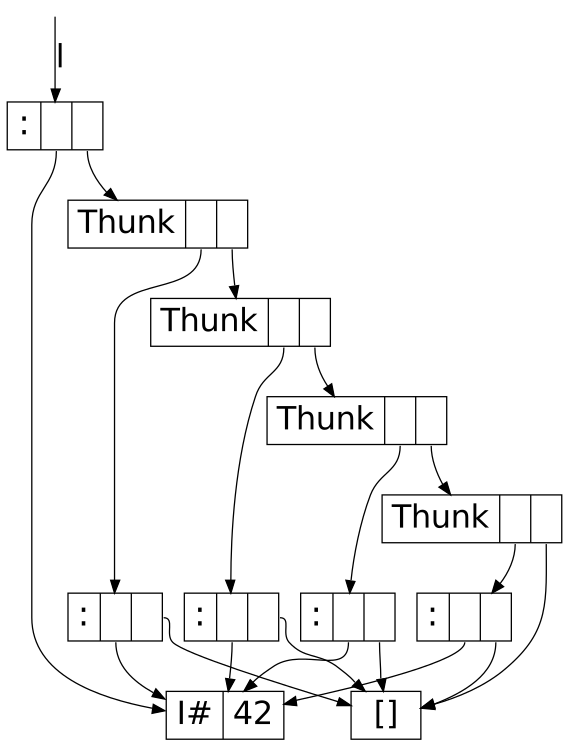
To check the space usage of this, I pass -Kn to the GHC runtime and see what limit is just enough to let this program calculate accumAppend 10000 and fully evaluate the resulting list. It turns out that we need 328336 bytes of stack space. So what about the second requirement; that the list is fully evaluated? Experienced Haskellers see it immediatelly: The accumulator is not used in the loop, so each iteration adds a thunk around the previous value, that would add the next entry to the end. Only when the list is actually used, these are run, each traversing the whole list, causing quadratic cost. We can verify this using ghc-vis:
Clearly (and not surprisingly) this is not the best solution. Attempt 2: The accumulator (forced) Lets try to fix the second issue, by making sure that the list is always fully evaluated. We import Control.DeepSeq and write
accumAppendSeq :: Int -> IO [Int]
accumAppendSeq n = go n []
  where
    go 0 l = return l
    go n l = do  x <- getInput ; go (n-1) $!! (l++[x]) 
As the accumulator gets fully evaluated before being passed to the next invocation of go, the result will not contain thunks. But note that this has also fixed the stack consumption: The code now runs the smallest setting for -K, 8 bytes. This works as both go and deepseq are tail-recursive. But this is still not the solution we are looking for, as the quadradic cost caused by using ++ is still there. Attempt 3: The accumulator (reversed) Since we know that l++[x] is expensive, but x:l is cheap, we can simply use this to update the accumulator. This has the slightly annoying consequence that the entries of the list are in the reverse order, but we can fix that in the base case:
accumReverse :: Int -> IO [Int]
accumReverse n = go n []
  where
    go 0 l = return (reverse l)
    go n l = do  x <- getInput ; go (n-1) (x:l) 
And indeed, we get noticably faster code that still runs in 8 bytes of stack. Unfortunately, we still don t construct the final list directly. Attempt 4: Naive recursion Maybe we can do without an accumulator. The most naive such code would be
listRecurse :: Int -> IO [Int]
listRecurse n = go n
  where
    go 0 = return []
    go n = do  x <- getInput; r <- go (n-1); return (x:r) 
and I d expect that most experienced Haskellers would write that code (if they are asked not to use a library function). And indeed, this code does create the final list directly. But it requires a large stack or 164616 bytes. The reason is that this is no longer tail recursive: After calling go again we need to take the result and prepend x Attempt 5: library functions Maybe we should simply not worry about the implementation, and use library functions? Clearly, the authors of such libraries have found the best solution. So how does
listReplicateM :: Int -> IO [Int]
listReplicateM n = Control.Monad.replicateM n getInput
fare? Unfortunately, not better than the naive recursion. In fact, the stack space requirement is the same 164616 bytes. The same holds when using special libraries for generating and consuming list, e.g. the Streams module from the vector package:
listStreams :: Int -> IO [Int]
listStreams n = MStream.toList $ MStream.replicateM n getInput
Attempt 6: Difference lists It is time to dig deeper into our box of tricks. What if we have lists with constant time Snoc (a.k.a. appending a new element)? Then Attempt 3 would not require reversing the list. Such lists are provided by difference lists; there are libraries for that, but we can simply implement them using lambdas:
accumDList :: Int -> IO [Int]
accumDList n = go n id
  where
    go 0 l = return (l [])
    go n l = do  x <- getInput; go (n-1) (l . (x:)) 
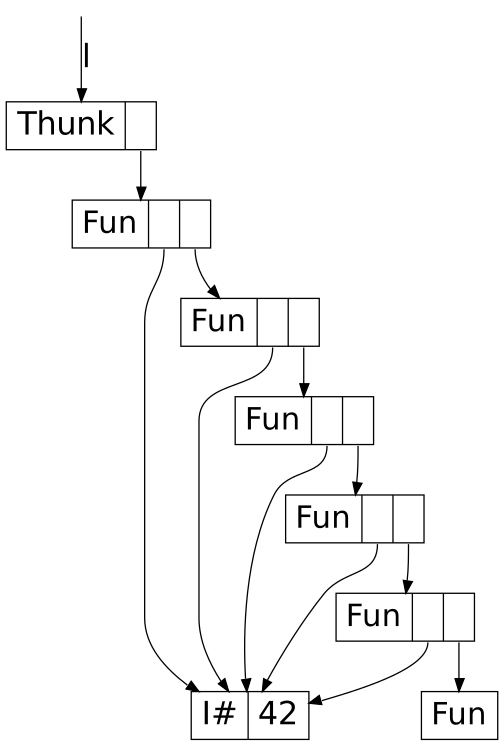
Indeed, no stack is required (8 bytes are enough). But we are cheating here: We are still not constructing the final list, but rather we combine functions that append elements to lists. So when accumDList returns, what we have in memory, is a thunk and sequence of partial function applications in the wrong order, and evaluating the thunk does basically the same thing as reverse in Attempt 3. It might be a bit faster, is still not satisfying enough:
Attempt 7: Unsafe functions Even deepter in the box of tricks, somewhere in the grit and dust where one usually should not reach, there is a function that can help us out here: unsafeInterleaveIO. This allow us to modify the naive recursion in a way that first creates the Cons-cell, and then continues the loop:
listUnsafeInterleave :: Int -> IO [Int]
listUnsafeInterleave n = do  l <- go n; return $!! l 
  where
    go 0 = return []
    go n = do x <- getInput
              r <- unsafeInterleaveIO (go (n-1))
              return (x:r)
The stack consumption is 8 bytes. It is worth noting that the all to deepseq (in $!!) will actually drive the evaluation of go. Also, it guarantees that the unsafe effects of unsafeInterleaveIO are confined to the execution of listUnsafeInterleave, i.e. are actually safe. Run time statistics I ran criterion over the functions (generating lists of length 1000), and found these results: Conclusion There are many ways to write a list-constructing list in Haskell, none are perfect they either fill the heap, or do not construct the list directly (usually requiring a second pass through it), or rely on IO-specific unsafe functions. The naive recursion performs the best, but may cause a stack overflow (note, though that from GHC 7.8, the stack will be unlimited). The next best option seems to be the difference lists
I m still wondering: What would be required from Haskell, GHC or the monads in question to have a fully satisfactory solution here, i.e. one that is as fast as the naive recursion, as stack efficient as the difference list solution, and allocates no thunks, only list cells?

11 November 2013

Simon Josefsson: Using Replicant on Samsung Galaxy S III

For the last half-year I have used CyanogenMod on an Nexus 4 as my main phone. Recently the touch functionality stopped working on parts of the display, and the glass on the back has started to crack. It seems modern phones are not built to last. For comparison, before the N4 I used a Nokia N900 for around 3 years without any hardware damages (in my drawer now, still working). A few weeks ago I started looking for a replacement. My experience with CyanogenMod had been good, but the number of proprietary blobs on the N4 concerned me. Finding something better wasn t easy though, so I m documenting my experience here. My requirements were, briefly, that I wanted a phone that I could buy locally that had a free software community around it that produced a stable environment. I have modest requirements for things I wouldn t give up on: telephony, data connection (3G), email (IMAP+SMTP), chat (XMPP), and a web browser. I like the philosophy and openness around the Firefox OS but the more I have read about it, it seems unlikely that it would deliver what I need today. In particular none of the devices capable of running Firefox OS appealed to me, and the state of email reading seemed unclear. I m sure I ll revisit Firefox OS as an alternative for me in the future.

As I had been happy with CyanogenMod, but concerned about its freeness, it felt natural to move on and test the more free software friendly project Replicant. Replicant only supports a small number of devices. After talking with people in the #replicant IRC channel, it seemed the Samsung S3 would be a decent choice for me. The Samsung S2 would have worked as well, but it cost almost as much as the S3 where I looked. Despite the large number of Samsung S3 devices out there, it seems the prices even for used devices are high (around 2500 SEK in Sweden, ~380 USD). I ended up buying a brand new one for 3200 SEK (~500 USD) which felt expensive, especially after recalling the recent $199 sale for Nexus 4. Noticing that brand new Nexus 4 devices are still over 3000 SEK in Sweden comforted me a bit. I would have preferred a more robust phone, like the CAT B15, but the state of free software OSes on them seem unclear and I wanted something stable. So, enough about the background, let s get started. Building and installing Replicant on the device was straight forward. I followed the Replicant Samsung S3 Build instructions to build my own images. The only issue I had was that I had not set JAVA_HOME and the defaults were bad; make sure to set JAVA_HOME before building. I built everything on my Lenovo X201 running Debian Wheezy, with OpenJDK 6 as the Java implementation. Installing the newly built firmware was easy, I just followed the installation process documentation. I made sure to take a clockworkmod backup to an external SD card before wiping the old system. To get a really clean new device, I also re-formated /sdcard inside clockworkmod; I noticed there were some traces left of the old system there. I spent about one week testing various configurations before settling on something I could use daily. A fair amount of time was spent looking into backup and restore options for Android devices. My idea was that I would take a backup of the apps I ran on the N4 and transfer them to the S3. The Android Debug Bridge (adb) has a backup/restore command, however it (intentionally) ignores apps marked as allowBackup=false which a number of apps has. It doesn t seem possible to override that settings so much for the freedom to backup your own device. I then discovered oandbackup. It can backup your entire system, saving each app (together with associated data) into a separate directory, for simple review and inspection before restore. You can do batch backups and batch restore. I couldn t get it to automatically restore things, though, which would be neat for really automated re-installations (there is an open issue about this feature). After noticing that some apps did not like being moved from the N4 (running Android 4.2) to the S3 (running 4.0), I ended up installing most apps from scratch on a freshly installed Replicant. I use oandbackup to the external SD card so that I can quickly restore my phone. For backup/restore of SMS/MMS and Call Log, I use SMS Backup+ against my own IMAP server. Camera pictures are synced manually using adb when I am connected to my laptop. There is a number of apps that deserve to be mentioned because they are what I use on a daily basis. All of them come via the free software market F-Droid. For email (IMAP/SMTP), I use K-9 Mail which is feature rich but still easy to use. For chat, I use Xabber. I use NewsBlur s free software app to read RSS flows. For two-factor authentication, I use Google Authenticator. I haven t evaluated different PDF viewers, but the first one I tried (APV PDF Viewer) has worked fine so far. Handling a a synchronized address book and calendar deserve its own blog post because it is a challenging topic, but briefly, I m currently using a combination of aCal and DAVdroid. Finally, since Replicant is still work in progress, some words about stability and notes on what doesn t work. This is probably the most interesting part if you are considering running Replicant on an S3 yourself. Overall system stability is flawless, I hadn t had any crash or problem with the fundamental functionality (telephony, 3G, Camera). People have said graphics feels a bit laggy, but I cannot compare with the stock ROM and it doesn t get in the way of daily use. First some notes about non-free aspects: Some other observations: I am quite happy with the setup so far, and I will continue to use it as my primary phone. flattr this!

Vincent Bernat: Snimpy: SNMP & Python

While quite old fashioned, SNMP is still an ubiquitous protocol supported by most network equipments. It comes handy to expose various metrics, like network interface counters, to be gathered for the purpose of monitoring. It can also be used to retrieve and modify equipments configuration. Variables exposed by SNMP agents (servers) are organized inside a Management Information Base (MIB) which is a hierarchical database1. Each entry is identified by an OID. Querying a specific OID allows a manager (client) to get the value of an associated variable. For example, one common MIB-module is IF-MIB defined in RFC 2863. It contains objects used to manage network interfaces. One of them is ifTable whose rows are representing agent s logical network interfaces. Each row will expose the interface name, characteristics and various associated counters.
ifIndex ifDescr ifPhysAddress ifOperStatus ifOutOctets
1 lo up 545721741
2 eth0 0:18:f3:3:4e:4 up 78875421
3 eth1 0:18:f3:3:4e:5 down 0
ifTable is indexed by its first column ifIndex. If you want to get the operational status of the second interface, you need to query IF-MIB::ifOperStatus.2 which is translated to OID .1.3.6.1.2.1.2.2.1.8.2 using information provided by the MIB definition.

Scripting SNMP An SNMP agent can deliver a lot of interesting information: You can gather those information manually with tools like snmpget and snmpwalk:
$ snmpwalk -v 2c -c public localhost IF-MIB::ifDescr      
IF-MIB::ifDescr.1 = STRING: lo
IF-MIB::ifDescr.2 = STRING: eth0
IF-MIB::ifDescr.3 = STRING: eth1
However, building robust scripts with them is quite challenging. For example, if you wanted to get the descriptions of all active interfaces as well as the total number of octets transmitted, you could do something like that:
#!/bin/sh
set -e
host="$ 1:-localhost "
community="$ 2:-public "
args="-v2c -c $community $host"
for idx in $(snmpwalk -Ov -OQ $args IF-MIB::ifIndex); do
    descr=$(snmpget -Ov -OQ $args IF-MIB::ifDescr.$idx)
    oper=$(snmpget -Ov -OQ $args IF-MIB::ifOperStatus.$idx)
    in=$(snmpget -Ov -OQ $args IF-MIB::ifInOctets.$idx)
    out=$(snmpget -Ov -OQ $args IF-MIB::ifOutOctets.$idx)
    [ x"$descr" != x"lo" ]   continue
    [ x"$oper" = x"up" ]   continue
    echo $descr $in $out
done
Hopefully, SNMP bindings in various languages are pretty common. For example, Net-SNMP ships with a Python binding:
import argparse
import netsnmp
parser = argparse.ArgumentParser()
parser.add_argument("host", default="localhost", nargs="?",
                    help="Agent to retrieve variables from")
parser.add_argument("community", default="public", nargs="?",
                    help="Community to query the agent")
options = parser.parse_args()
args =  
    "Version": 2,
    "DestHost": options.host,
    "Community": options.community
 
for idx in netsnmp.snmpwalk(netsnmp.Varbind("IF-MIB::ifIndex"),
                            **args):
    descr, oper, cin, cout = netsnmp.snmpget(
        netsnmp.Varbind("IF-MIB::ifDescr", idx),
        netsnmp.Varbind("IF-MIB::ifOperStatus", idx),
        netsnmp.Varbind("IF-MIB::ifInOctets", idx),
        netsnmp.Varbind("IF-MIB::ifOutOctets", idx),
        **args)
    assert(descr is not None and
           cin is not None and
           cout is not None) #  
    if descr == "lo":
        continue
    if oper != "1": #  
        continue
    print("     ".format(descr, cin, cout))
This binding is quite primitive and has several drawbacks:
  1. It exports everything as strings. See .
  2. Error handling is just deficient. If you mispell something, like a variable name, you ll get snmp_build: unknown failure on the standard error. No exception. If a variable does not exist, you ll get None instead. See .
This inability to sanely handle failures makes this binding quite dangerous to use in scripts. Imagine making important modifications on the basis of the returned values. If you forget to check against None, your script may cause havoc!

Snimpy Because I didn t find any reliable Python binding for SNMP, I decided to write Snimpy with two goals in mind:
  1. Leverage information contained in MIBs to provide a pythonic interface.
  2. Any error condition should raise an exception.
Here is how the previous script could be written:
#!/usr/bin/env snimpy
import argparse
parser = argparse.ArgumentParser()
parser.add_argument("host", default="localhost", nargs="?",
                    help="Agent to retrieve variables from")
parser.add_argument("community", default="public", nargs="?",
                    help="Community to query the agent")
options = parser.parse_args()
m = M(options.host, options.community, 2)
load("IF-MIB")
for idx in m.ifDescr:
    if m.ifDescr[idx] == "lo":
        continue
    if m.ifOperStatus[idx] != "up":
        continue
    print("     ".format(m.ifDescr[idx],
                            m.ifInOctets[idx],
                            m.ifOutOctets[idx]))
You can also use a list comprehension:
load("IF-MIB")
print("\n".join([ "     ".format(m.ifDescr[idx],
                                    m.ifInOctets[idx],
                                    m.ifOutOctets[idx])
                  for idx in m.ifDescr
                  if m.ifDescr[idx] != "lo"
                  and m.ifOperStatus[idx] == "up" ]))
Here is another simple example to get the routing database from the agent:
load("IP-FORWARD-MIB")
m=M("localhost", "public", 2)
routes = m.ipCidrRouteNextHop
for x in routes:
    net, netmask, tos, src = x
    print(" :>15s / :<15s  via  :<15s  src  :<15s ".format(
        net, netmask, routes[x], src))
IP-FORWARD-MIB::ipCidrRouteNextHop is a more complex table with a compound index. Despite this, querying the table still seems natural. Have a look at Snimpy s documentation for more information. Behind the hood, SNMP requests are handled by PySNMP and MIB parsing is done with libsmi2. Snimpy supports both Python 2, Python 3 and Pypy.

  1. A MIB is defined using a subset of ASN.1 called SMI. However, it is not uncommon to refer to the definition as a MIB too.
  2. Unfortunately, there is currently no robust SMI parser written in pure Python. For example, PySNMP relies on smidump which comes with libsmi. Snimpy uses a custom CFFI wrapper around libsmi.

Matthew Palmer: Timezones are not optional information

In high school, I had a science teacher who would mark your answers wrong if you forgot to include units. What does that mean? , he would write, 17.2 elephants? The point he was trying to get across was that a bare number, without the relevant units, wasn t precise enough to be useful. Also, carrying the units with you helped to cross-check your work if you got a numeric answer, but the units were garbage (seconds per kilogram, for instance, when you were trying to find an acceleration), then you could be pretty sure you d made a mistake somewhere. Fast forward to today, and I m currently working with a database containing a pile of timestamps. Without timezones. Where the timestamps being inserted are in local time. Thankfully, so far, this particular system has always been run in one timezone, so I ve only got one timezone to deal with, but the potential ramifications of systems with different timezones inserting data into this database terrify me. The naive answer is to just store everything in UTC and be done with it. I m not particularly averse to that solution, as long as it s very clear to everyone what s going on. The correct answer, though, I think, is to always keep timezone information with your timestamps otherwise, you ll never know whether it s 0830 in elephants

10 November 2013

Steve Kemp: So I have a new project

Recently I decided to set myself a big photography challenge. The three options which I discussed with a couple of people were: Ultimately I decided pubs would be most fun. Not least because you could do it every year or two, to see what changes occurred. To make it more useful I decided to not only take the pictures, but to collect, and share, the meta-data too: Today I spent an hour walking up Easter road, and down Leith Walk. I shot the outside of about 20 pubs, and then fiddled with the layout and organization of the images. I'm reasonably happy with the result, but it remains obvious that I'm not a designer. The data-set use to generate the site - which is perhaps the most interesting/useful part of the whole exercise to other people - is available online too: All the data, even the images, is stored on github for collaboration purposes. I'm not sure if folk will join in, but I can probably manage a few of the major thoroughfares every weekend indefinitely it will only take a couple of days to get "city-wide coverage", then the rest is gravy.

Sylvain Le Gall: opam2debian, a tool to create Debian binary package out of OPAM

One week ago, a thread in opam-devel mailing list started about the possibility to create binary snapshot to distribute OPAM packages. Distributing binary packages with everything already compiled is pretty useful when you want to make sure that everyone has the same version of packages installed and you don't want to spend time configuring all the computer of your colleague. As a matter of fact I was also interested to see that happening. I have several computers where I want to install a set of packages and I want to snapshot OPAM archives when I am ready for an upgrade. I have tested for a long time another source distribution: GODI. I even wrote a puppet module to drive it. This was a fun experience, but as with any source only distribution, there are some drawbacks. Especially even if it is fully automated, you get a lot of errors and timeout when trying to build automatically from source. This is how opam2debian has started. I wanted a replacement for puppet-godi that takes advantage of OPAM and the possibility to distribute my set of packages everywhere quickly. The goals of this project are:
  1. generate a Debian binary package with all the dependencies set on external packages (like libpcre)
  2. use OPAM to build everything
  3. use standard Debian process to build package
  4. create snapshot of OPAM repository that allow to rebuild exactly the same thing on different arches
The real challenge behind opam2debian was to be able to use standard Debian process to create package to get all the power of dependencies computation provided by the Debian maintainer scripts. My great achievement on this topic was to find a tool called proot that allows you to bind mount a directory as a user. This is an achievement because it allows to create a package using a directory where you are not allowed to write (i.e. /opt/opam2debian directory which is owned by root). This is a way to do it on any Jenkins builder without root access and a standard way for Debian to build packages. Usage example I need to compile a set of package to install on all my Jenkins builder. Here is the list of packages I need and I also want to use the latest OCaml version. I want to build a Debian package for Debian Wheezy which has only OCaml 3.12.1. Building the package:
$ opam2debian create --build --name opam2debian-test2 --compiler 4.01.0 \
 ocamlfind fileutils ocaml-data-notation ocaml-expect ounit \
 ocamlmod ocamlify oasis yojson sexplib extlib pcre-ocaml \
 calendar ocaml-inifiles ocamlnet ocurl gettext inotify ocaml-sqlexpr \
 ocamlrss ocaml-xdg-basedir
Getting the package list right can be tricky because the process will stop at the first error -- and if it is because the last package fails to build it can be long. I have implemented a --keep-build-dir in case you want to tune the package list live. The program will build everything and it can takes quite a while. At the end you get a file opam2debian-test2_20131105_amd64.deb which has a reasonable size of 232MB. That is big, but it looks like the biggest directory is $OPAMROOT/4.01.0/build, I am not sure if I can remove it but we may save some space here (the build directory represents 50% of the package size). Then you can just do a standard Debian installation:
$ sudo dpkg -i opam2debian-test2_20131105_amd64.deb
And you can use it:
$ eval $(opam config env --root /opt/opam2debian/opam2debian-test2/)
$ which ocamlfind
 /opt/opam2debian/opam2debian-test2/4.01.0/bin/ocamlfind
$ ocamlfind list
 [...]
 stdlib              (version: [distributed with Ocaml])
 str                 (version: [distributed with Ocaml])
 threads             (version: [distributed with Ocaml])
 threads.posix       (version: [internal])
 threads.vm          (version: [internal])
 type_conv           (version: 109.41.00)
 unidiff             (version: 0.0.2)
 unix                (version: [distributed with Ocaml])
 userconf            (version: 0.3.1)
 xdg-basedir         (version: 0.0.3)
 xmlm                (version: 1.1.1)
 yojson              (version: 1.1.5)
A nice thing to note, is that it is a standard OPAM install. You can install, update and upgrade OPAM from there, as root. However, I would recommend not to do it, and just rebuild a newer Debian package to upgrade. Install You will need the opam and proot Debian package available in Debian jessie and sid. You will also need various OCaml libraries (cmdliner, calendar, fileutils and jingoo). Download the opam2debian tarball on the forge, build and install it. The project is hosted on github. Open issues On the initial list of goals of the project. Not everything is completed. I have still several open issues. In particular 4. (create snapshot of OPAM repository) was blocked by a bug in opam-mk-repo, that prevents snapshots (see my pull-request to solve it). Another issues is about licenses of the included files. I should list them all and I need to figure out a way to extract every licences. Submit bugs directly to github.

Jelmer Vernooij: The state of distributed bug trackers

A whopping 5 years ago, LWN ran a story about distributed bug trackers. This was during the early waves of distributed version control adoption, and so everybody was looking for other things that could benefit from decentralization. TL;DR: Not much has changed since. The potential benefits of a distributed bug tracker are similar to those of a distributed version control system: ability to fork any arbitrary project, easier collaboration between related projects and offline access to full project data. The article discussed a number of systems, including Bugs Everywhere, ScmBug, DisTract, DITrack, ticgit and ditz. The conclusion of our favorite grumpy editor at the time was that all of the available distributed bug trackers were still in their infancy. All of these piggyback on a version control system somehow - either by reusing the VCS database, by storing their data along with the source code in the tree, or by adding custom hooks that communicate with a central server. Only ScmBug had been somewhat widely deployed at the time, but its homepage gives me a blank page now. Of the trackers reviewed by LWN, Bugs Everywhere is the only one that is still around and somewhat active today. In the years since the article, a handful of new trackers have come along. Two new version control systems - Veracity and Fossil - come with the kitchen sink included and so feature a built-in bug tracker and wiki. There is an extension for Mercurial called Artemis that stores issues in an .issues directory that is colocated with the Mercurial repository. The other new tracker that I could find (though it has also not changed since 2009) is SD. It uses its own distributed database technology for storing bug data - called Prophet, and doesn't rely on a VCS. One of the nice features is that it supports importing bugs from foreign trackers. Some of these provide the benefits you would expect of a distributed bug tracker. Unfortunately, all those I've looked at fail to even provide the basic functionality I would want in a bug tracker. Moreso than with a version control system, regular users interact with a bug tracker. They report bugs, provide comments and feedback on fixes. All of the systems I tried make these actions a lot harder than with your average bugzilla or mantis instance - they provide a limited web UI or no web interface at all. Update: LWN later also publishe articles on on SD and on Fossil. Other interesting links are Eric Sink's article on distributed bug tracking (Erik works at Sourcegear who develop Veracity) and the dist-bugs mailing list.

Russell Coker: Aldi Changes, Cheap Telcos, and Estimating Costs

I ve been using Aldi as my mobile phone provider for two months now since Kogan was shut down [1]. Now Aldi have cut the transfer quota on their Unlimited plan from 5G per month to 2.5G per month. The most charitable interpretation of this would be that Aldi got a lot of former Kogan customers who needed the 6G per month that Kogan offered and that forced them to make changes to remain profitable. But the most likely possibility is that with less competition Aldi can just offer less for the same price. This isn t a huge problem for me, in two months on Aldi my biggest month involved almost exactly 2.5G of data transfer. But it s annoying to lose something and it s enough to make me consider other options. Also some of my relatives are looking for new plans so now is a good time to research the options. Other Pre-paid Options Lebara offers Unlimited plans that start at $30 per month and offer 1.5G of data [2], this compares well to the Unlimited plan of $35 per month from Aldi which has 2.5G of data (depending on whether 1.5G is enough). Amaysim has an Unlimited plan that includes 4G of data for $40 per month [3]. If you make lots of phone calls and transfer more than 2.5G of data per month then that would be a really good deal. Lebara uses the Vodafone network and Amaysim uses Optus. Neither of them compare to the Telstra 3G network if you want access outside major urban areas. I had Virgin (Optus network) work well for me for years and Three (their own network now part of Vodafone) work well for many years before that. But data transfer is becoming more important to me and the Telstra network is a major feature of Aldi. Lebara has one of the wost web sites I ve ever seen and Amaysim isn t much better. Aldi is great, they just provide all the key data in one page. Aldi and Amaysim have Android apps that can be used for recharging and viewing the balance, Aldi s app works well but I haven t been able to test the Amaysim app. Lebara doesn t even have an app. Generally Lebara doesn t seem to have anything going for it unless you want to make lots of calls to other Lebara customers, you want to make calls to certain other countries where Lebara has very low international rates, or unless you need a plan with unlimited calls but don t need more than 1.5G of data. The following table summarises the costs of the three pre-paid telcos.
Telco Flagfall Cost/min (Australia calls) SMS Data Cost/Meg Data Increment Credit Expiry and Minimum 30day Data Packs
Aldi 0 $0.12 $0.12 $0.05 1M 1 year $15 2G=$15
Lebara $0.29 $0.15 $0.15 $0.05 1K 90 days $10
Amaysim 0 $0.12 $0.12 $0.05 1M 90 days $5 1G=$10 2G=$20 4G=$30
Post-paid Options Virgin s cheapest offer is $20 per month for $200 of calls (at $0.98/min + $0.40 flagfall) and 200M of data [4], they currently have a special offer of an extra 1G if you sign up before the 18th of November. Virgin have a long history of periodically offering special deals so if you want to sign up with them some time in the next few months it s best to poll their web site and wait for a deal. The TeleChoice Global Liberty plan is a slightly better deal of $20 per month for $500 of calls (at $0.97/min + $0.40 flagfall) and 1G of data which also has free SMS [5]. TeleChoice Global Rebel Texter is a plan for $15 per month that includes $200 of calls and 200M of data and free SMS [6]. They also have a $10 per month plan which charges $0.22 per SMS, which would be bad value for anyone who sends 1 SMS per day. At Aldi rates if you spend $15 per month on 2G of data and $5 on calls then you will get 41 * one minute calls as opposed to $200/($0.98+$0.40)==145 * one minute calls with the cheapest Virgin plan. It seems to me that there is little possibility for those two $20 post-paid plans (which seem to be two of the best value plans currently available) to compete well with the pre-paid options from Aldi and Lebara. Even if you have the same usage pattern every month there are only particular patterns which make the Virgin or TeleChoice deals most appealing options, for example if you need to make more than 40 minutes of calls but less than 145 minutes of calls then Virgin will look good. TeleChoice Global Liberty looks good if you make between 40 and $500/($0.97+$0.40)==365 * one minute calls. If you only need a small amount of data transfer (less than 200M billed in 10K increments) then the TeleChoice Rebel Texter plan would look good as the Aldi 1M increments matter for small amounts of data transfer. But I don t think that many people are in that situation, even my mother in law can t easily stick within 200M of data transfer. Measuring Phone Use The first program I used for measuring phone calls is the Call & SMS Stats app from the Android Market [7]. I wouldn t recommend this to technical users as it demands a lot of access to the phone (including reading SMS, accessing the phone storage, and sending data to the Internet), but it s good for less technical users. For my use I prefer Call Meter 3G from the F-Droid repository [8]. I trust the Call Meter 3G program more because it s source is available under the GPL and it also has the convenient feature of adding up the costs of the calls, SMS, and data used. According to Call Meter 3G I m using less than $20 of calls and SMS per month, so if I continue my current use with a 2G data pack every month from Aldi instead of buying a $35 Unlimited pack and don t use more than 2G of data then I ll save at least a few dollars every month. My wife makes fewer calls so I ve already moved her phone away from the Unlimited plan and I ll move my phone later if it looks like it will save money she will now use my phone for making calls when we are together so the Unlimited plan may become good value when we share it. The Case for Aldi Aldi offers competitive options for phones for most levels of usage. While there are some post-paid plans which are better in some areas such as the ones from TeleChoice Aldi has the benefit of flexibility. A phone with Aldi can have it s plan scaled up or down easily with no penalty fees. For a phone to be usable for an entire year the cheapest option at the moment is Aldi which has a $15 recharge that lasts for a year. The next best option seems to be Amaysim with a $5 recharge that lasts for 90 days. Saving Money In the past I ve been used to SMS being significantly cheaper than phone calls. When I was on Virgin and calls just over $1 per minute ($0.98 per minute plus the flag-fall) and SMS were $0.28 which made a simple question and answer cheaper by SMS than calling. But with Aldi charging the same for a 1 minute call and sending an SMS a simple question and answer will cost half as much if it s done with a call so SMS isn t a good deal. Also I ve started using Google Hangouts to communicate with my wife instead of SMS as extra use of Hangouts is essentially free (we both have it running all the time for Ingress related communication anyway). The financial incentive now is to use Google Hangouts to replace some calls. One down-side to saving money in such ways is that it restricts usage of the phone. While moving from SMS to Google Hangouts (or any other instant-messaging system) isn t any great cost having to reduce the number of calls does. The ability to talk for as long as you want without bothering about cost is something that s worth paying for. I Hate Telcos For most things that I spend money on I wouldn t invest much effort to try and save $10 or $15 per month. Even when doing research that will help my friends and relatives and random people on the Internet I probably wouldn t take so much time for a small saving. But the Telcos seems to avoid competing as much as possible which is obvious from the way that they increase prices and decrease services at the same time. Also most Telcos seem to have a business model that is based around exploiting customers, they have confusing terms in the contracts that make it very likely for customers to go over the included usage and hit penalty rates and charge unreasonable prices for the phones that are bundled with a telephony contract. I want to reduce the amount of money I pay to Telcos as a matter of principle. Aldi is better than most Telcos, they have clear terms that are explained on a single web page [9], and they have an Android app to show the remaining credit that can reduce the risk of excessive fees if a 2G data block is used. Aldi sells phones in their stores at low prices, the phones that they sell aren t the highest quality but the customer gets what they pay for and the warranty return policy is good. But we still need to find the best options so that market forces will encourage Telcos to make more reasonable offers.

Luke Faraone: Why I use my bank's mobile site on my desktop

(or, cutting out bloat by using a platform where bloat won't fly)

Let me start off by saying I'm generally a huge fan of my bank, USAA. Their offerings are free of hidden fees, their phone support excellent, and the perks they provide are competitive. They don't have the best savings interest rates, but you can always find a better deal online to park money not actively in your checking account.

However, USAA's website is a behemoth. My account page took about 8 seconds to fully load, downloading 1.4MiB of content.

The "My Accounts" page you're redirected to after logging in.
It is frequently buggy; whenever I log in via Google Chrome on Ubuntu 12.04 I land on a page with a URL beginning with "https://www.usaa.com/inet/gas_bank/AccountBannerAjax" and a bunch of GET parameters like "currentaccountkey" and "accnumber" with values like "encrypted12a1f4dd1[ ]". The server returns a 200 OK, promises a Content-Length of 20, but then actually returns zero bytes. After navigating to the homepage and clicking a button, I end up getting logged in, but I wonder what percentage of their userbase are experiencing this problem?

For some strange reason, I get a lot of checks. It appears that nobody else informed the banking system that it's 2013, and the easiest mechanism for people to send money without paying fees is still on paper. To its credit, USAA made remote deposit of checks available to all customers in 2006, when it was mostly an offering limited to businesses. However, it seems like they haven't updated their web workflow since then.


Using it on the web still requires using a signed Java applet (itself discouraged by CMU's CERT) that does the incredibly complex task of letting you select a file from your computer and upload it to their servers. At least, that's what I think it does, because any time I chose "Run", my browser complained a few minutes later that the tab had stopped responding. Regardless of functionality, you can accomplish almost anything their site could currently be doing with HTML5 and a third party service if they want to crop images locally.

Spinning after logging
in on Android
USAA's mobile app for Android has another host of problems; I haven't been able to log into it for 2 weeks, and when I chatted with someone today I was told they were "doing some maintenance this weekend", so I should try again in a few hours once that's finished.

I googled around a bit for some way to perhaps make the applet work in Ubuntu (which admittedly is not a supported platform), and came upon a Facebook thread where a rep suggested using the mobile web site.

A breath of fresh air
I loaded it in my browser, and was amazed at how well it functioned. Obviously designed for higher-end devices (It didn't even load in one WAP emulator I tried), the mobile web interface was a refreshing breath of fresh air. It scaled well to a full-screen device (see below), loaded quickly, and gave me all the information I would have wanted out of the normal web interface.

Most notably: remember the whole "upload a check" workflow that required a buggy Java applet on the main website? We get bog-standard HTML form fields, no additional magic. There goes any theories about the Java client doing some magic validation or prep of the image; here, all they're getting is the images and my session cookie.


I'm still shocked at whoever thought a My Yahoo!-style homepage was the best layout for a bank, but props to the web developers who managed to make a mobile interface that was both pretty and allowed me to work around broken functionality in their implementations on every other platform I had access to.

But why was the mobile web interface the least bloated? Easy. On the desktop, you generally have a nice pipe, or if not, the user knows it and won't be too upset if your site is just as slow as other sites similarly situated. On mobile, the user downloaded all the code already, so the only latency should be the API requests against the server, right?

On the mobile web users have come to expect relatively speedy mobile-optimised sites and there's less screen real estate to do fancy things that get in the way of content. For many sites, that's a huge improvement. Of course, it would be really nice if more banks supported open protocols for interactions (USAA has a read-only, limited-duration OFX feed), but I would settle for a better web interface.

So tl;dr: USAA, please make www.usaa.com redirect to m.usaa.com, kthxbai.

9 November 2013

Russ Allbery: Review: Fantasy & Science Fiction, July/August 2011

Review: Fantasy & Science Fiction, July/August 2011
Editor: Gordon van Gelder
Issue: Volume 121, No. 1 & 2
ISSN: 1095-8258
Pages: 258
Nothing of particular interest in the book reviews in this issue, although I was entertained to see Charles de Lint review a collection of the Prince Valiant strip. I have memories of that strip being one of the most boring works of art created by mankind. De Lint, of course, quite likes it. Our tastes seem to be very disjoint, although I have to admit that I've not read it collected and it may be more coherent and more interesting in that format. The science column in this issue, by Paul Doherty and Pat Murphy, deserves special mention. It's on roshambo (rock-paper-scissors), human difficulties with randomness, and strategy in roshambo competitions. It's also the first essay I've read that clearly explains how there can be strategy to roshambo, and why that strategy is worth studying. Even though the primary topic of the column is randomness, it's worth reading from the perspective of strategy in competitive human vs. human games. "Bronsky's Dates with Death" by Peter David: Anyone familiar with PAD's body of work will immediately expect a humorous story with some deeper thoughtful bits, and that's exactly what this is. Bronsky, the title character, is a man almost incapable of saying exactly what's on his mind, and what's on his mind is his eventual death. Not that it bothers him that much; he's just thinking a lot about it. But his incessant discussion of it certainly bothers the people around him. This leads to a few entertaining exchanges with his family, and then to more entertaining exchanges with Death. Or Deaths, as there appear to be several different kinds. I found the exact metaphysics a bit confused, but the ending was still touching and a bit funny. (7) "The Way It Works Out and All" by Peter S. Beagle: This is a reprint of a special fund-raising story about Avram Davidson, so a lot of it was lost on me given that I know almost nothing about Davidson and have yet to get to any of his novels I own. But even without that background, it's a diverting story of hidden and parallel worlds and unexpected explorations. There isn't all that much in the way of a plot, but it's a nice bit of characterization set against a fun SF twist. (6) "Less Stately Mansions" by Rob Chilson: This is a story about conservatism in life, about a farmer staying on his farm and resisting change, and about nostalgia, but I liked it much better than I normally like stories with those themes. It's set against a future world in which climate change is making life increasingly untenable. Humans are migrating into space colonies of various types, but Jacob refuses. This frustrates some parts of the family who want a piece of the substantial cash-out he's being offered for his farm, which of course makes Jacob even more stubborn. It's more of an elegy than a story, but I think it captures a particular stubborn mood, and a conscious decision to go with what one knows even if it doesn't have a long future, quite well. (7) "The Ants of Flanders" by Robert Reed: This is the novella of the issue, and, as you might expect from the author, it's thoughtful, meaty, and satisfying. At the start of the book, the planet is visited by an extraterrestrial ship (or ships it's not entirely clear at first). One of the people near one landing is Bloch, a huge teenager who has an odd lack of natural fear. He stays near the center of the story as Reed slowly develops a cosmology and a galactic political background that makes it clear humans may be incidental to everything that's happening. I liked this. It's a touch depressing in spots, and Bloch is a strange protagonist, but the cosmology is not the normal SF background and sparks some thoughts about how a status quo would be maintained by powers that don't care much about individual lives. The interlude with the leopard is nicely done, even if its significance is inobvious at first. (7) "Hair" by Joan Aiken: This is one of those weird Gothic horror stories about creepy families and half-explained supernatural events that some people love and that do nothing for me. (3) "The Witch of Corinth" by Steven Saylor: This is straight historical fantasy, featuring a Roman and his Greek tutor (heroes, apparently, of a series of historical mysteries) visiting the ruins of Corinth and encountering some bloody and dangerous local conflicts. It's slow and atmospheric, carried along by good characterization and description of ruins. It's not that much of a mystery the characters don't figure things out as much as stick around until the answer becomes obvious but it kept me entertained throughout a sizable story. Numerous elements of the story appear to be fantasy and then get other explanations, but there is a fantasy twist to the ending. (6) "Sir Morgravain Speaks of Night Dragons and Other Things" by Richard Bowes: This odd story is set among the knights of King Arthur on Avalon, where they sleep (mostly), awaiting their call to aid Britain again. Most of the story is told as one-sided dialogue from Morgravain, interspersed with some italic narration. Again, not much of a plot; the story, as such, is figuring out what Morgravain is doing and the point of his interactions with the other knights. I thought it was slight and oddly pointless, but I may have just missed the point. (4) "Someone Like You" by Michael Alexander: A time travel story, but one that's less about time travel per se than about examining and speculating about the alternate paths childhood could take and whether those changes produce different people. It takes some time to figure out what's going on, during which Alexander fills in the protagonist's past and the murder mystery that drives the tale. The time travel mechanism is blatantly hand-waved, making this more of a fantasy than an SF story, which matches the emphasis on emotion and psychology. It's not a bad story, and I think I see where the author was going with the slowly-constructed central conflict, but I still found it hard to take the conflict that seriously. One of the problems with time travel is that undermining of causality also undermines finality of decisions and consequences in ways that can rob stories of their punch. (6) "The Ramshead Algorithm" by KJ Kabza: The first-person protagonist is a well-respected and experienced fixer in a world of chaos and dimensional connection, a world with physics and inhabitants very much unlike ours. But the story doesn't spend much time there; his connection to his home earth is threatened, and he returns to try to stabilize it, which leads to the reader discovering that his family considers him a worthless appendage on a wealthy business family whose sole purpose in life is to stay out of their way. And his portal is rooted in a hedge maze that his father intends to demolish. This is one of those stories that gets more interestingly complex the deeper one gets into it. Ramshead's family is badly screwed up along multiple axes, but not without some hope of redemption. He's desperate and ineffective in his home universe, but more confident and capable when it comes to dealing with dimensional portal problems (although he still seems very young and relies on tools given to him by others). And there's always more going on than it first appears, and not as few obvious villains as it first appears. Good stuff, although I would have liked to understand more about Ramshead's world. (7) Rating: 7 out of 10

7 November 2013

Matt Zimmerman: Management: a rant

You keep using that word. I do not think it means what you think it means. -Inigo Montoya
Having worked in full-time management positions for some years now, I am increasingly convinced that management is widely misunderstood as a role, as a discipline and as a field, and that this makes a lot of lives more difficult and stressful than necessary. It is the subject of much speculation and misbelief, and I ve chosen a few of my favorite examples to deconstruct here. Misbelief #1: management is what managers do I ve noticed a trend among a certain class of companies, whose employees will tell anyone who will listen that there is no management in their organization, they never plan to have any, and neither should you. I think these statements are respectively a lie, a na ve belief, and a piece of bad advice. Usually, these companies are just a few years old and relatively small, most of the people in the company have been there for less than a year, and the speaker is trying to persuade us what a unique and innovative company they work for because nobody there is a manager . They invariably have not read The Tyranny of Structurelessness. Management is the practice of enabling people to effectively cooperate. A manager is someone whose job is to do that. It s that simple. It usually involves tasks such as sharing information, agreeing on a course of action, dividing up work, and figuring out what to do when there s a problem. They re things that every team needs to do, whether anyone is designated a manager or not. Teams can function without managers, but they can t function properly without management. Someone (or everyone) has to do the work to make cooperation possible. Modern management is a specialized discipline, which draws on a broad range of skills in communication, psychology, empathy, problem-solving, leadership, and more. These skills aren t unique to managers, but it often makes sense to designate certain people to do more of the management work, on behalf of the team. By devoting more of their time and attention to it, they free other members of the team to focus on other tasks. They can act as a coordinator to help the team stay in sync, and by focusing on this job, they may be able to do a better job of it, and acquire a higher level of skill through practice and study. But it remains an inherently collaborative practice. Misbelief #2: management is about telling people what to do There are many different varieties of management, each of which is oriented toward a particular type of team or organization. Factories are managed differently from design studios, large companies are managed differently from small companies, and every team has its own distinct management style which arises from the unique group of people involved. Some managers are specialists in a particular type of management, while others are more generalists. The telling people what to do style of management is called command and control . It s characterized by authority, hierarchy, and strict adherence to protocol. It s widely employed by military organizations, and by the managers we see in television and film. It has some advantages and disadvantages, which I won t discuss here. My point is that it is just one example, but this example is used to represent the general concept of management. Self-organization, where no one in particular is responsible for group decisions, is another, quite different, style of management. Small, self-organizing teams are capable of amazing feats of productivity. They re less difficult to manage because they re comparatively simple, and so simple tools and techniques work well. Everyone can be fully aware of what everyone else is doing, and new information propagates quickly throughout the team. But as the team or organization grows, it will often outgrow this way of working, and needs to adapt. There is no single management approach which works universally well. Misbelief #3: management is a promotion You know the story. When an employee is successful within their area of expertise, someone will eventually offer them a management role as a reward for their good work. This is utter nonsense. Management is not a promotion: it s a career change. It means starting over as a beginner in a new discipline and learning from the ground up. Domain expertise is important, as a manager needs to understand the work of the other people on their team, but it is no longer paramount. The team, the human system, becomes their focus. When organizations fail to provide career advancement within a discipline, people may turn to management as the only way to get promoted , only to discover that they are completely unprepared for this new field, and often their new job when they realize what they ve gotten into. If someone were promoted from a position as a financial analyst to a new job as a biochemist with no training or expertise, we would probably find this bizarre. But this is analogous to what happens to new managers all the time, and has become almost standard practice in many organizations and industries. So what? Management is misunderstood. So are science, engineering, and many other fields. What does it matter?
People leave managers not companies in the end, turnover is mostly a manager issue, - Marcus Buckingham & Curt Coffman, First, Break All the Rules
This mythology leads to massive organizational dysfunction, making it harder for everyone to do their jobs. It virtually guarantees incompetent management, which is a scourge on anyone who is exposed to it. It ruins days, weeks, jobs and careers. It leads talented people to leave companies, and it drives them out of their chosen professions. I recommend that we stop denigrating and ignoring management, and start doing a better job of it.

Russ Allbery: Review: Muse of Fire

Review: Muse of Fire, by John Scalzi
Publisher: Subterranean
Copyright: 2012
Printing: 2013
ISBN: 1-59606-639-3
Format: Kindle
Pages: 28
This is another separately-published short work by Scalzi probably a novelette, although I didn't do a word count. Since it's separately published and has its own ISBN, it gets its own separate review page. At present, it's $1 on the Kindle (and probably elsewhere). I've read a variety of these now, and while the quality of Scalzi's short works varies (as with everyone), I've generally enjoyed them. This is the first one I've read that I really didn't like. The premise is promising enough. Ben Patton is a scientist or engineer of some sort (I don't recall if the story is specific) working on plasma physics for a corporation. He has a nervous tic involving playing with a lighter and an obsession with fire, which his co-workers tolerate (and his boss does not tolerate). The reason for that tic is something he keeps secret: he sees a beautiful woman named Hestia in any flames that he's looking at. For him, she's his muse, and his untouchable obsession. He's mangled one hand trying to touch her. But she appears in fire because she's trapped in hell. There are all sorts of great places Scalzi could have gone with this. Musae and inspiration by themselves are fodder for many stories. The woman's name is Hestia, which is immediately recognizable as the Greek goddess of the hearth and who is extremely important to Greek religious life (although she's definitely not a muse, but I'd even let that pass). That raises more story possibilities around the transition of religion and the effect on worshiped gods, including the way Christian missionaries called "pagan" gods and goddesses devils and indeed did claim they were from hell. There are interesting science and magic crossover possibilities between plasma physics and a muse of fire. And there is, of course, the whole rescue from hell angle, which has generated many a story going back to ancient Greek drama. As you might have guessed from this catalog and my disappointment, Scalzi didn't go any of those directions. He provides some good characterization of the passions and discomfort of Ben's life, shows us the practicalities of his relationship with Hestia, and sets up dramatic tension, all well and good. And then takes the most obvious, least interesting, and least satisfying twist possible. I was getting nervous as I got closer and closer to the end of the story and Scalzi had yet to develop any of the interesting possible directions, but even then I didn't expect the train wreck ending. Even a simplistic "happily ever after" ending would have been preferable. He did catch me by surprise, but only because I wouldn't have expected any author to take that easy of a way out of the story. I can't build up a proper rant while avoiding spoilers, but I will say that Scalzi even manages to walk straight into a rather nasty stereotype in the process. I'm not sure what happened here, but it didn't work, and it's far below the normal standards of Scalzi's work. Such a shame, too, since the setting had so much potential. Avoid. Rating: 4 out of 10

Next.

Previous.