Search Results: "nic"

30 May 2012

Paul Tagliamonte: My first foray into non-compliant Debian packages

I ve decided to start putting together packages to rebuild the bare bones install I use for most of my systems, since rebuilding everything by hand is starting to get annoying. I call it hairy candy. Because my setup relies on some chem interesting chem hacks, none of this is fit in any way for the archive. If the vim team was to catch wind of what I was doing, they d be none too happy :) While these packages work great for me, I can t stress enough how badly they can break something. Using Zack s guide, I was able to get an archive up and running, no problem. Taking his advice, I even got signing working. Simple. mini-dinstall rocks a nice alternative to a PPA, for sure. At least, for one arch :) Now, the one spin I took on Zack s work was to add a landing page a listing of what s in the archive. I did this using a bit of Python & Jinja2. The script follows.
#!/usr/bin/env python
# Copyright (c) Paul Tagliamonte, under the terms of the Expat license.
from jinja2 import Template
import sys
def parse_packages(fd):
    ret = []
    cur =  
    key = None
    for line in fd.readlines():
    if line.strip() == "":
        ret.append(cur)
        cur =  
        continue
    if line[0] == " ":
        cur[key] += "\n" + line.strip()
    else:
        key, val = line.split(":", 1)
        cur[key] = val.strip()
    return ret
pkgs = parse_packages(open(sys.argv[1], 'r'))
context =  
    "pkgs": pkgs
 
t = Template(open(sys.argv[2], 'r').read())
print t.render(**context)
Invocation looks something like:
render.py $ARCHIVE/debian/wicked/Packages $DATA/index.html
I kick this script off in the singing script, since mini-dinstall doesn t have a exit hook. Works great, thanks everyone!

29 May 2012

Daniel Kahn Gillmor: KVM, Windows XP, and Stop Error Code 0x0000007B

i dislike having to run Windows as much as the next free software developer, but like many sysadmins, i am occasionally asked to maintain some legacy systems. A nice way to keep these systems available (while not having to physically maintain them) is to put them in a virtual sandbox using a tool like kvm. While kvm makes it relatively straightforward to install WinXP from a CD (as long as you have the proper licensing key), it is more challenging to transition a pre-existing hardware windows XP installation into a virtual instance, due to Windows only wanting to boot to ide chipsets that it remembers being installed to. In particular, booting a disk image pulled from a soon-to-be-discarded physical disk can produce a Blue Screen of Death (BSOD) with the message:
Stop error code 0x0000007B
or
(INACCESSABLE_BOOT_DEVICE)
This seems like it's roughly the equivalent (in a standard debian GNU/Linux environment) of specifying MODULES=dep in /etc/initramfs-tools/initramfs.conf, and then trying to swap out all the hardware. At first blush, Microsoft's knowledge base suggests doing an in-place upgrade or full repartition and reinstall, which are both fairly drastic measures -- you might as well just start from scratch, which is exactly what you don't want to have to do for a nursed-along legacy system which no one who originally set it up is even with the organization any more. Fortunately, a bit more digging in the Knowledge Base turned up an unsupported set of steps that appears to be the equivalent of setting MODULES=most (at least for the IDE chipsets). Running this on the old hardware before imaging the disk worked for me, though i did need to re-validate Windows XP after the reboot by typing in the long magic code again. i guess they're keying it to the hardware, which clearly changed in this instance. Such silliness to spend time working around, really, when i'd rather be spending my time working on free software. :/

Michal Čihař: Android support in Gammu

Android support in Gammu is one of frequently requested features. I don't have neither time to motivation to do that, so unless somebody else will step up, it won't be done. Recently, I got offer from MyPhoneExplorer author to share it's applet for communicating with Android phones. It basically provides protocol similar to Sony-Ericsson phones Gammu already supports, just over TCP/IP. So all what would have to be done is glue layer for using TCP/IP and possibly some minor adjustments to Sony-Ericsson code. Both of these should be quite easy tasks and I'm willing to guide you through this process. In case anybody would be interested in this challenge, just let me know :-).

Filed under: English Gammu 1 comments Flattr this!

28 May 2012

Vincent Bernat: Integration of NetSNMP into an event loop

NetSNMP comes with its own event loop based on the select() system call. While you can build your program around it, you may prefer to use an existing event loop, either a custom one or something like libevent, libev or Twisted.

Own custom event loop Let s start with the easiest case: you have written your own event loop. This means you make a call to select(), poll(), epoll(), kqueue() or something similar. All those functions take a set of file descriptors and wait for any of them to become available in a specified time frame. Here is a typical use of select() (adapted from Quagga)
readfd = m->readfd;
writefd = m->writefd;
exceptfd = m->exceptfd;
timer_wait = thread_timer_wait (&m->timer);
num = select (FD_SETSIZE,
              &readfd, &writefd, &exceptfd,
              timer_wait);
if (num < 0)
   
    if (errno == EINTR)
      continue; /* signal received - process it */
    zlog_warn ("select() error: %s",
               safe_strerror (errno));
    return NULL;
   
if (num == 0)
   
    /* Timeout handling */
    thread_timer_process (&m->timer);
   
if (num > 0)
   
    thread_process_fd (&readfd);
    thread_process_fd (&writefd);
   
thread_process_fd (fds) function iterates on each file descriptor fd and executes the appropriate action if FD_ISSET (fds, fd) is true. Integrating NetSNMP into such an event loop is easy: NetSNMP provides the snmp_select_info() function which alters a set of file descriptors to insert its own. Here is the new code:
#if defined HAVE_SNMP
struct timeval snmp_timer_wait;
int snmpblock = 0;
int fdsetsize;
#endif
/* ... */
#if defined HAVE_SNMP
fdsetsize = FD_SETSIZE;
snmpblock = 1;
if (timer_wait)
   
    snmpblock = 0;
    memcpy(&snmp_timer_wait, timer_wait,
           sizeof(struct timeval));
   
snmp_select_info(&fdsetsize, &readfd,
                 &snmp_timer_wait, &snmpblock);
if (snmpblock == 0)
  timer_wait = &snmp_timer_wait;
#endif
num = select (FD_SETSIZE,
              &readfd, &writefd, &exceptfd,
              timer_wait);
if (num < 0)   /* ... */  
#if defined HAVE_SNMP
if (num > 0)
  snmp_read(&readfd);
else if (num == 0)
   
    snmp_timeout();
    run_alarms();
   
netsnmp_check_outstanding_agent_requests();
#endif
/* ... */
snmp_select_info() may modify the provided set of file descriptors (and therefore, its size). It may also modify the provided timer in case it needs to schedule an action before the original timeout. snmpblock is a tricky variable. While select() can be called with a timeout set to NULL, this is not the case of snmp_select_info(): you have to pass a valid pointer. snmpblock is set to 0 if the provided timeout must be considered or to 1 otherwise. snmp_select_info() will set snmpblock to 0 if and only if it alters the timeout. Here are a two examples of integration. Both are for a subagent but the code for a manager is the same:

Third-party event loop With a third party event loop, you don t have access to the select() system call anymore. Therefore, you cannot alter it with snmp_select_info(). Instead, at each iteration of the loop, a list of SNMP related file descriptors is kept up-to-date with the help of snmp_select_info(): new ones are added and old ones are removed.

libevent Let s assume that snmp_fds is the list of current SNMP related events1. A function levent_snmp_update() calls snmp_select_info() to update this list. Here is a partial implementation (error handling removed and some declarations omitted, look at the complete version from lldpd):
static void
levent_snmp_update()
 
    int maxfd = 0;
    int block = 1;
    FD_ZERO(&fdset);
    snmp_select_info(&maxfd, &fdset, &timeout, &block);
    /* We need to untrack any event whose FD is not in  fdset 
       anymore */
    for (snmpfd = TAILQ_FIRST(snmp_fds);
         snmpfd;
         snmpfd = snmpfd_next)  
        snmpfd_next = TAILQ_NEXT(snmpfd, next);
        if (event_get_fd(snmpfd->ev) >= maxfd  
            (!FD_ISSET(event_get_fd(snmpfd->ev), &fdset)))  
            event_free(snmpfd->ev);
            TAILQ_REMOVE(snmp_fds, snmpfd, next);
            free(snmpfd);
          else
            FD_CLR(event_get_fd(snmpfd->ev), &fdset);
     
    /* Invariant: FD in  fdset  are not in list of FD */
    for (int fd = 0; fd < maxfd; fd++)
        if (FD_ISSET(fd, &fdset))  
            snmpfd->ev = event_new(base, fd,
                EV_READ   EV_PERSIST,
                levent_snmp_read,
                NULL);
            event_add(snmpfd->ev, NULL);
            TAILQ_INSERT_TAIL(snmp_fds, snmpfd, next);
         
    /* If needed, handle timeout */
    evtimer_add(snmp_timeout, block?NULL:&timeout);
 
Then, replace the main loop (usually, a call to event_base_dispatch()) with this:
do  
    if (event_base_got_break(base)  
        event_base_got_exit(base))
        break;
    netsnmp_check_outstanding_agent_requests();
    levent_snmp_update();
  while (event_base_loop(base, EVLOOP_ONCE) == 0);
Here is how are defined the two callbacks:
static void
levent_snmp_read(evutil_socket_t fd, short what, void *arg)
 
    FD_ZERO(&fdset);
    FD_SET(fd, &fdset);
    snmp_read(&fdset);
    levent_snmp_update();
 
static void
levent_snmp_timeout(evutil_socket_t fd, short what, void *arg)
 
    snmp_timeout();
    run_alarms();
    levent_snmp_update();
 

Twisted reactor As a second example, here is how to integrate NetSNMP into Twisted reactor. Twisted is an event-driven network programming framework written in Python. It does not come with support for SNMP2. Because of the language mismatch, the integration of NetSNMP in Twisted needs to be done using a C extension or the ctypes module. Twisted event loop is called a reactor. Like for libevent, events need to be registered. It is possible to register file descriptor-like objects using a class implementing a handful of methods. Here is the implementation of such a class (adapted from PyNetSNMP, a subproject of Zenoss using the ctypes module):
class SnmpReader:
    "Respond to input events"
    implements(IReadDescriptor)
    def __init__(self, fd):
        self.fd = fd
    def doRead(self):
        netsnmp.snmp_read(self.fd)
    def fileno(self):
        return self.fd
Like for libevent, we have a function to update the list of SNMP related events (stored as a mapping between file descriptors and SnmpReader instances):
class Timer(object):
    callLater = None
timer = Timer()
fdMap =  
def updateReactor():
    "Add/remove event handlers for SNMP file descriptors and timers"
    fds, t = netsnmp.snmp_select_info()
    for fd in fds:
        if fd not in fdMap:
            reader = SnmpReader(fd)
            fdMap[fd] = reader
            reactor.addReader(reader)
    current = Set(fdMap.keys())
    need = Set(fds)
    doomed = current - need
    for d in doomed:
        reactor.removeReader(fdMap[d])
        del fdMap[d]
    if timer.callLater:
        timer.callLater.cancel()
        timer.callLater = None
    if t is not None:
        timer.callLater = reactor.callLater(t, checkTimeouts)
Contrary to libevent, we cannot alter the main loop to call updateReactor() at each iteration. Therefore, it must be called after each SNMP related function. For another example, have a look at my equivalent implementation as a C extension.

Miscellaneous

Lack of asynchronicity Integrating NetSNMP into an event-based program is not risk-free. I have written a fairly comprehensive article on the lack of asynchronicity in NetSNMP AgentX protocol implementation. I urge you to read it if you want to integrate a SNMP subagent into an existing program. On the manager side, you will get similar drawbacks when using SNMPv3. To retrieve or manipulate management information using SNMPv3, it is necessary to know the identifier of the remote SNMP protocol engine. This identifier can be configured directly on each manager but it is usually discovered by querying SNMP-FRAMEWORK-MIB:: snmpEngineID, as described in RFC 5343. Unfortunately, this discovery is done synchronously by NetSNMP. There is a bug report for this issue but it seems difficult to fix. I have not been able to come up with a proper patch but I have described a workaround around snmp_sess_async_send(). There is no such problem with SNMPv2.

Limitation of file descriptor sets snmp_select_info() and snmp_read() uses the fd_set type to handle a set of file descriptors. This type should be manipulated with FD_CLR(), FD_ISSET(), FD_SET() and FD_ZERO(). Those may be defined as functions but they usually are macros. Moreover, no file descriptor greater than FD_SETSIZE (which is usually set to 1024) can be handled with the fd_set type. This means that if you have a file descriptor greater than 1024, you won t be able to use snmp_select_info() with it. Starting from NetSNMP 5.5, you can use snmp_select_info2() and snmp_read2() instead of snmp_select_info() and snmp_read(). They use the netsnmp_large_fd_set. If you want to keep compatibility with NetSNMP 5.4, here is another twist. The fd_set type is usually a fixed-size array of long integers. FD_CLR(), FD_ISSET() and FD_SET() are size-independant. The size only matters for FD_ZERO() which is not used by either snmp_select_info() or snmp_read(). You can therefore allocate a larger fd_set. A common way is to compile your program with -D__FD_SETSIZE=4096. You can still use FD_ZERO() yourself. However, this is not portable (GNU C Library only). Another way is to allocate your own array of long integers and cast it to fd_set. You ll have to redefine FD_ZERO():
typedef struct  
   long int fds_bits[4096/sizeof(long int)];
  my_fdset;
#undef FD_ZERO
#define FD_ZERO(fdset) memset((fdset), 0, sizeof(my_fdset))
 
   /* ... */
   my_fdset fdset;
   FD_ZERO(&fdset);
   /* ... */
   rc = snmp_select_info(&n, (fd_set *)&fdset, &timeout, &block);
   /* ... */
 

Threads NetSNMP provides two API:
  • the traditional session API which is not thread-safe and
  • the single session API.
In the above examples, I have used the traditional session API. If you are using threads, you need to ensure that all SNMP operations are done in a single thread. Otherwise, you need to adapt the examples to use the single session API. snmp_select_info() is part of the traditional session API. You should replace it with snmp_sess_select_info() and keep a list of SNMP sessions. This API is not available for the agent side of NetSNMP.

  1. The event list is global but some code could be added to bind a different list for each base in case you use different bases. This is not needed in the case of lldpd which uses only one event base.
  2. TwistedSNMP is an SNMP protocol implementation for Twisted based on PySNMP but is not maintained anymore. PySNMP comes with examples on how to integrate with Twisted.

27 May 2012

Petter Reinholdtsen: Debian Edu interview: Ralf Gesellensetter

In 2003, a German teacher showed up on the Debian Edu and Skolelinux mailing list with interesting problems and reports proving he setting up Linux for a (for us at the time) lot of pupils. His name was Ralf Gesellensetter, and he has been an important tester and contributor since then, helping to make sure the Debian Edu Squeeze release became as good as it is.. Who are you, and how do you spend your days? I am a teacher from Germany, and my subjects are Geography, Mathematics, and Computer Science ("Informatik"). During the past 12 years (since 2000), I have been working for a comprehensive (and soon, also inclusive) school leading to all kind of general levels, such as O- or A-level ("Abitur"). For quite as long, I've been taking care of our computer network. Now, in my early 40s, I enjoy the privilege of spending a lot of my spare time together with my wife, our son (3 years) and our daughter (4 months). How did you get in contact with the Skolelinux/Debian Edu project? We had tried different Linux based school servers, when members of my local Linux User Group (LUG OWL) detected Skolelinux. I remember very well, being part of a party celebrating the Linux New Media Award ("Best Newcomer Distribution", also nominated: Ubuntu) that was given to Skolelinux at Linux World Exposition in Frankfurt, 2005 (IIRC). Few months later, I had the chance to join a developer meeting in Ulsrud (Oslo) and to hand out the award to Knut Yrvin and others. For more than 7 years, Skolelinux is part of our schools infrastructure, namely our main server (tjener), one LTSP (today without thin clients), and approximately 50 work stations. Most of these have the option to boot a locally installed Skolelinux image. As a consequence, I joined quite a few events dealing with free software or Linux, and met many Debian (Edu) developers. All of them seemed quite nice and competent to me, one more reason to stick to Skolelinux. What do you see as the advantages of Skolelinux/Debian Edu? Debian driven, you are given all the advantages of a community project including well maintained updates. Once, you are familiar with the network layout, you can easily roll out an entire educational computer infrastructure, from just one installation media. As only free software (FOSS) is used, that supports even elderly hardware, up-sizing your IT equipment is only limited by space (i.e. available labs). Especially if you run a LTSP thin client server, your administration costs tend towards zero. What do you see as the disadvantages of Skolelinux/Debian Edu? While Debian's stability has loads of advantages for servers, this might be different in some cases for clients: Schools with unlimited budget might buy new hardware with components that are not yet supported by Debian stable, or wish to use more recent versions of office packages or desktop environments. These schools have the option to run Debian testing or other distributions - if they have the capacity to do so. Another issue is that Debian release cycles include a wide range of changes; therefor a high percentage of human power seems to be absorbed by just keeping the features of Skolelinux within the new setting of the version to come. During this process, the cogs of Debian Edu are getting more and more professional, i.e. harder to understand for novices. Which free software do you use daily? LibreOffice, Wikipedia, Openstreetmap, Iceweasel (Mozilla Firefox), KMail, Gimp, Inkscape - and of course the Linux Kernel (not only on PC, Laptop, Mobile, but also our SAT receiver) Which strategy do you believe is the right one to use to get schools to use free software?
  1. Support computer science as regular subject in schools to make people really "own" their hardware, to make them understand the difference between proprietary software products, and free software developing.
  2. Make budget baskets corresponding: In Germany's public schools there are more or less fixed budgets for IT equipment (including licenses), so schools won't benefit from any savings here. This privilege is left to private schools which have consequently a large share among German Skolelinux schools.
  3. Get free software in the seminars where would-be teachers are trained. In many cases, teachers' software customs are respected by decision makers rather than the expertise of any IT experts.
  4. Don't limit ourself to free software run natively. Everybody uses free software or free licenses (for instance Wikipedia), and this general concept should get expanded to free educational content to be shared world wide (school books e.g.).
  5. Make clear where ever you can that the market share of free (libre) office suites is much above 20 p.c. today, and that you pupils don't need to know the "ribbon menu" in order to get employed.
  6. Talk about the difference between freeware and free software.
  7. Spread free software, or even collections of portable free apps for USB pen drives. Endorse students to get a legal copy of Libreoffice rather than accepting them to use illegal serials. And keep sending documents in ODF formats.

Ingo Juergensmann: DaviCal and Addressbook Sync

After exchanging my rusted Nokia N97 against an iPhone I was in need to setup calendar and addressbook syncing again. Addressbook syncing wasn't possible with N97 anyways, or I haven't found out how to do it. Previously I synced my N97 by using iSync, but iSync doesn't sync anymore with iPhone, although iPhone now syncs with iTunes. Weird? Yes. But that's how it works. The iPhone syncs now via WLAN instead of Bluetooth, which is an improvement, but I don't really want to fire up iTunes everytime I want to sync my calendar or addressbook. And using iCloud is really not an option as well, because of privacy concerns. I'm a big fan of selfhosting and already have a running DaviCal instance running on my server. DaviCal is a great piece of software from Debian maintainer Andrew McMillan, who is doing a survey on Davical, so there's, of course, a Debian package for it. Anyway, one problem with OSX and addressbook sync via carddav is that it is not working out of the box with Addressbook.app on OSX, although the documentation in the DaviCal wiki is quite useful. When you try to enter a new account in Addressbook.app the sync will not work. The solution can be found on the private blog of Harald Nikolisin, which is in German. He writes (German, English translation follows)
Mac OS X Adressbuch anschliessen
Oh ja wenn man mittels SSL drauzugreift, dann gibts Probleme.
Im der Applikation Adressbuch kann man zwar ein CardDAV Account anlegen bei dem man die Authorisierungsdaten und den kompletten Serverpfad (s.o.) eingeben kann, man l uft aber immer auf eine Fehlermeldung hinaus.
Die L sung ist, zweimal Create anzuklicken um den fehlerhaften Account anzulegen. Dann editiert man manuell folgende Datei: ~/Library/Application Support/AddressBook/Sources/UNIQUE-ID/Configuration.plist
Dort tr gt man unter Server String die komplette URL ein.
https://SERVERNAME/davical/caldav.php/USERNAME/contacts
Am besten modifiziert man noch das Feld HaveWriteAccess auf den Wert auf 1
English translation: 
Connecting Mac OS X addressbook
Oh, yes - there are problems when accessing via SSL.
In Addressbook.app you can add a CardDAV account where you can define authentication and 
server path, but you'll always get an error message.
The solution is to click twice on "Create" in order to create the faulty entry.
Then you can edit the following file:
~/Library/Application Support/AddressBook/Sources/UNIQUE-ID/Configuration.plist
There you enter your complete URL under Server String.
https://SERVERNAME/davical/caldav.php/USERNAME/contacts 
It's best to modify the field HaveWriteAccess to the value "1"
After following this advice my Addressbook.app did successfully stored the contacts into DaviCals CardDAV from where I can sync with my iPhone. Maybe Andrew want to include this to the DaviCal wiki, maybe I'll do this myself by registering in the Wiki for that purpose... Oh, and I forgot: Using the Roundcube plugin from graviox is working nice as well with DaviCals CardDAV!
Kategorie:

26 May 2012

Craig Small: JFFNMS 0.9.3

jffnms version 0.9.3 has been released today. This is a vast improvement over the 0.9.x releases and anyone using that train is strongly recommended to upgrade.So what changed? What didn t change! A nice summary would be fixing a lot of things that were broken or needed some tweaking. A really, really big thanks to Marek for all the testing and bug reports and also patient just run this and tell me what it says tests he did too. If something wasn t right before and works now, it is quite likely it is working because Marek told me how it broke. A brief overview of what has changed: You can download the file off sourceforge at https://sourceforge.net/projects/jffnms/files/JFFNMS%20Releases/

25 May 2012

Matthew Garrett: Fedora 17 and Mac support

Fedora 17 will be shipping next week. It's got a bunch of new features, none of which I contributed to in the slightest. What I did work on was improving our support for installation on x86 Apple hardware. There's still a few shortcomings in this so it's not an announced or supported feature, but it's sufficient progress that it's worth writing about.

There's a few ways that Apple platforms differs from normal PC hardware. The first is that Apples are very much intended to be EFI first and BIOS second, while that's still not really true for commodity PC hardware. Apple launched Boot Camp shortly after they started shipping x86 Macs (and shortly after I'd got Ubuntu running on one for the first time[1]) but the focus of Boot Camp has always been to be good enough to boot Windows and not much else[2]. The other is the integration with the boot environment. You can boot Linux easily enough by setting the standard EFI boot variables, but if you ever boot back into OS X it's easy to trigger deletion of those. There's then no straightforward way of resetting them, and you're left having to recover your installation.

The other difficult bit has been actually starting the installer at all. If you're happy to use BIOS emulation than this can be done without too much misery, but you're then left with dealing with Apple's custom synchronised GPT/MBR. More modern Macs will boot via the standard EFI mechanisms, but there's a range of problems that can be caused that way. Fedora 17 is the first Linux distribution to ship install media that will EFI boot a Mac when either written to optical media or a USB stick[3]. Put the install media in your system and then either select it in the OS X Startup Disk preferences menu and reboot, or reboot and hold down the alt key. In the latter case there'll be a nice Fedora logo. Click on it and it'll boot.

The biggest difference between Apple hardware and anyone else is that we'd normally put the bootloader in a FAT partition that's shared with any other installed operating systems. That does actually work on Apples, but then you run into the earlier point I mentioned. The Apple startup picker that you get by holding down the alt key doesn't pay any attention to the standard EFI boot variables, so it won't show a FAT partition merely because it's got an EFI bootloader on it. The same is true of the OS X Startup Disk preferences. The best way to get a drive to appear in the menu is to make it look like an OS X drive.

This was problematic in a few ways, due to the requirement for an OS X drive to be HFS+. The first was that we didn't have any support for that in our installer, so work had to be done there. The second was that the state of HFS+ was woefully poor in Linux[4]. Linux will refuse to write to an HFS+ filesystem if it hasn't been cleanly unmounted or fscked, and since we can't rely on everyone always shutting their machine down cleanly that means a working fsck.hfsplus. In theory we were shipping one of those. In practice, it reliably segfaulted on 64-bit systems[5]. So I had to package the latest version of Apple's code, and doing that involved dealing with the fact that Apple now use blocks almost as much as Grub 2 uses nested functions, and that meant using Clang and that meant dealing with a bug where Clang segfaulted if it had been built with gcc 4.7[6], but finally once all of those yaks had been shaven we could trust our filesystem.

Of course, more problems existed. You can't just drop a bootloader onto an HFS+ partition and expect it to work. You need to write its inode value into the superblock. Trivial, except that if you do this from userspace then the kernel kindly overwrites your update when you unmount the disk and it updates the superblock. That required a mechanism for updating that data via the kernel, which meant adding an ioctl. This would have been fine, except the OS X Startup Disk preference looks for a bootloader in a location other than where Fedora installs it. Changing our bootloader install path wasn't a great option, so the easiest thing to do was just to link them together. Except HFS+ doesn't really support hardlinks. When you hardlink something the original file gets moved into a magic directory in the filesystem root and the links are special files that refer to it. And it turns out that it's not actually the inode that the firmware wants when finding the bootloader, it's the catalogue ID, and these aren't the same when hardlinks are involved. So, another kernel patch.

All that was left for the boot partition then was adding an icon and a drive label. We already had code for generating the icon, and the drive label wasn't that difficult. Hurrah!

Ok, so we can construct a filesystem that (a) appears in the bootpicker, and (b) appears in the OS X Startup Disk preferences. We can even put a bootloader on it. This led to the next problem. The bootloader started without any trouble. But the bootloader couldn't read any files off the boot partition, including its configuration. This should have been obvious with hindsight - the problem was simply that grub legacy[7] doesn't support HFS+. Writing an HFS+ driver seemed like an excessive amount of work, especially since the firmware already supported reading HFS+, so instead I wrote a simple grub filesystem driver that uses the UEFI interfaces to read files.

A working bootloader! One more problem there. grub looks in its startup directory to find its configuration file. We have two "copies" of grub hardlinked to each other, each looking in a different directory for configuration. Hardlinking the config files together worked fine, except that most tools that update config files have this irritating habit of writing to a temporary file and moving that over the original, thus breaking the hardlink. Easily solved by using a symlink instead, except that the UEFI filesystem semantics don't really support symlinks because UEFI only really envisaged using FAT. If you use Apple's UEFI HFS+ driver to open a symlink, you get a short file containing the target path of the symlink. Rather less than ideal, and a rather gross hack to cope with it.

All set now, other than a bug in some older Mac firmware where read would return BUFFER_TOO_SMALL without returning the real buffersize and the odd way that Apple treat CDs. Oh, and a bug in Apple's Broadcom wifi driver that could overwrite the kernel, and case-sensitivity, something that obviously isn't something you often hit on UEFI when all you usually see is FAT.

Kernel-side, we had a couple of things. Obviously there the bugs I'd mentioned in the past, but those had already been dealt with. New issues included the fact that we were frequently picking the wrong framebuffer address, especially on machines with multiple GPUs. Fixed now, along with another issue where we'd sometimes get confused by models with different GPU configurations. And at that point, most of the implementation work was done.

Of course, there was also the work of integrating this into the tools that we use to generate our install media, and I'd like to thank Will Woods, Brian Lane and Dennis Gilmore for the work they put into that, along with anyone I've forgotten. Tom Calloway handled getting the device label graphics generated right before deadline. A cast of thousands helped with testing.

So why did I mention shortcomings? First, this only works on machines with 64-bit firmware. Early 64-bit Apples still had 32-bit firmware. In theory we can support that case - in practice it's a moderate amount of writing, including some mildly awkward kernel code. But anything later than mid-2007 should have 64-bit firmware, so it's not a massive concern. Second, we seem to have fairly significant trouble with Radeon hardware on a lot of Macs. We fixed one bug there, but something's still going wrong in setup and you'll frequently end up with a black screen. And thirdly, I'm sure there's some other machines that still don't work for (as yet) undetermined reasons.

With luck we'll get these things dealt with by Fedora 18. But even with these flaws, Fedora 17 will work fine on a lot of Apple hardware, and testing it is as simple as downloading and booting a live image. Bugs go in the usual place.

[1] Note my charming belief that the Ubuntu installer would fully support this hardware via EFI in the near future. 6 years ago. It still doesn't.
[2] This can be fairly easily seen from little things like the name "Windows" being hardcoded into every UI that sees a Boot Camp drive.
[3] I cover this in more depth here
[4] To be fair, it mostly still is - there's plenty of work to be done there.
[5] Approximately nobody had noticed this, which is all kinds of unreassuring.
[6] Thanks to Kalev Lember for dealing with that
[7] Still the EFI bootloader in Fedora 17. We've already swapped Fedora 18 over to grub 2.

comment count unavailable comments

24 May 2012

Vincent Sanders: Interrupt Service Routines

Something a little low level for this post. I have been asked recently how to "test" for the maximum duration of an Interrupt Service Routine (ISR) in Linux

To do this I probably ought to explain what the heck an ISR is!

A CPU executes one instruction after another and runs your programs. However early in the history of the electronic computer it soon became apparent that sometimes there were events happening, generally caused by a hardware peripheral, that required some other code to be executed without having to wait for the running program to check for the event.

This could have been solved by having a second processor to look after those exceptional events but that would have been expensive, difficult to synchronize and the designers took the view that there was a perfectly good processor already sat there just running some users program. This Interruption in the code flow became known as, well, an Interrupt (and the other approach as polling).

The hardware for supporting interrupts started out very simply, the processor would complete execution of the current instruction and when the Program Counter (PC) was about to be incremented if an Interrupt ReQest (IRQ) was pending the PC would be stored somewhere (often a "special" IRQ stack or register) and then execution started at some fixed address.

The interrupting event would be dealt with by some code and execution returned to the original program without it ever knowing the CPU just wandered off to do something else. The code that deals with the interrupt is known as the Interrupt Service Routine (ISR).

Now I have glossed over a lot of issues here (sufficient to say there are a huge number of details in which to hide the devil) but the model is good enough for my purpose. A modern CPU has a extraordinarily complex system of IRQ controllers to deal with numerous peripherals requesting the CPU stop what its doing and look after something else.

This system of controllers will ultimately cause program execution to be delivered to an ISR for that device. If we were living in the old single thread of execution world we could measure how long execution remains within an ISR, perhaps by using a physical I/O line as a semaphore and an external oscilloscope to monitor the line.

You may well ask "Why measure this?" well historically while the ISR was running nothing else could interrupt it executing which meant even if there was an event that was more important it would not get the CPU until the first ISR was complete. This was known as IRQ latency which was undesirable if you were doing something that required an IRQ to be serviced in a timely manner (like playing audio)

This is no longer how things are done while the top half runs with IRQ disabled many are threaded interrupt handlers and are preemptable (I.e. can be interrupted themselves) which leads to the first issue with measuring ISR time in that the ISR may be executed in multiple chunks if something more important interrupts. Indeed it may appear an ISR has taken many times longer one time than another because the CPU has been off servicing multiple other IRQ.

Then we have the issue that Linux kernel drivers often do as little as possible within their ISR, often only as much as is required to clear the physical interrupt line. Processing is then continued in a "bottom half" handler this leads to ISR which take practically no time to execute but processing is still being caused elsewhere in the system.

The next issue is the world is not uniprocessor any more, how many processors does a machine have these days? even a small ARM SoC can often have two or even four cores. This makes our timing harder because it is now possible to be servicing multiple interrupts from a single peripheral on separate cores at the same time!

In summary measuring ISR execution time is not terribly enlightening and almost certainly not what you are interested in. The actual question is much more likely that you really want to be examining something that the ISR time was an historical proxy for like IRQ latency or system overheads in locking.

Junichi Uekawa: A few weeks ago, my sony VAIO type P that I have been using for the past 2 years have died.

A few weeks ago, my sony VAIO type P that I have been using for the past 2 years have died. I've now got my MacBook Air and back to being productive again. One thing is that I probably lost your mail since I recovered from my home directory backup from 5 May. Not that I read mail all that often, but your mail will certainly be lost if you've sent me a mail in the meanwhile.

23 May 2012

Joey Hess: kickstarter for git-annex assistant

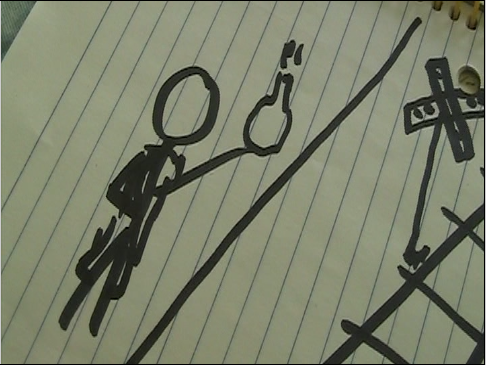
I'm doing a Kickstarter! The plan is to take git-annex and use it as the foundation to build a DropBox-like application, that can be used without any knowledge of git. The other part of the plan is for me to get through the summer with my finances intact. :) kickstarter My Kickstarter page explains in more detail, but the basic idea is to make git-annex watch a directory, with inotify, and automatically add and sync files placed there. Then build a local web app to control and configure it. I have a working prototype of the inotify part already; getting the distributed syncronisation to work well will be a major challenge; and overall it's going to be a challanging but I think very achievable project. One thing I'm really excited about is the potential of Kickstarter to connect me with a diverse group of potential users, who are interested enough in a distributed and autonomous equivilant to DropBox to fund my project. Because, with luck, their involvement won't stop at giving some money, but will extend to actually using what I'm developing, and giving me feedback on it. I hope this will widen the sphere of git-annex users, beyond the current very technically inclined crowd. It's awesome to have users doing things like taking git-annex on the transiberian railroad to help manage all their photos, and others using it to store scientific data ... but getting more regular folks using git, even if they don't know about it, is something I'm very interested in. xkcd-esque drawing BTW, I was surprised how much I got into doing the video for the Kickstarter. Using xkcd-style drawings used to explain technical concepts is a medium I enjoy working in. My own git-annex is stuffed with 17 gigabytes of video clips -- 99 separate takes! -- that boiled down to a 2 minute video. Anyway, please consider backing me if you can, and more importantly, do anything you can to help spread the word. Thanks!

Anand Kumria: Lifelong learning

Below are four of my (150!) browser tabs opened, that I oddly had in sequence. Various tabs open to online learning websites. There has been much made of the pheonmen of lifelong learning and although I thought I had finished my exams when I finished University, I'm still doing them. From left to right:
Duolingo, where I am learning Spanish.
Quite a reasonable site, currently invite-only. My worry is my pronounciation will be crap though. I do wish that it did not have to use Flash to accomplish things though.
Udacity, where I am doing CS212 - Design of Computer Programs
Nice interface, annoying that it uses YouTube to host videos as that meant I had to whitelist YouTube in Flashblock.I picked this course as one of the other ones I wanted to do had already closed. I suspect I'll eventually do each of the courses they have on offer. One nice thing is that courses run every 8 weeks or so.
Codeacademy, I am currently doing their Codeyear course.
Well presented, but I find that their Javascript interface is extremely slow to startup. It consistently lags behind my typing speed by about 3 seconds.I'm using Firefox beta, so I'm always running something fairly fast and modern too.I'm primarily doing this course to see how/what they are trying to teach non-programmers. My feedback is that it is not geared towards someone with no programming knowledge. The initial 10 weeks of Javascript presentation proceeded at a very fast pace. If I weren't a programmer already, I'd have stuggled to keep up.
Coursera, here I am doing the Machine Learning class.
I'm not a fan of this interface at all, which is why I find it hard to come back to the site each week. I'm not sure exactly why though, since it uses WebM and no Flash. Hurray!!Either way, I'm doing the Machine Learning class. I tried this last time it was offered and got to week 5 same week I'm on now and then I got suddenly busy IRL, so was not able to complete the course.Unlike Udacity, courses run at set times and you have to do the work on the required dates in order to get the statement of attainment, which can be hard when you are juggling multiple things
Keep in mind, these are just the extra things I have decided to learn. I'm also learning more about Django, Puppet and Python in my work everyday. Plus I'm actually doing a Spanish course in real life too. Oh, and I have a job and I go out. I'm generally actually pushed for time. Which probably explains why I have not been keeping up with the blog. It isn't because I hate you, although it might be too ;-) , I'm just busy.

22 May 2012

Mark Brown: ASoC updates in 3.4

Linux version 3.4 has been released. This was a very active release for ASoC in framework terms, in addition to the usual bug fixes and so on there were a large number of framework enhancements though most are fairly small or are laying the groundwork for more user visible features like dynamic PCM.

Gunnar Wolf: e-voting: Bad when it's near, worse when it's far.

Note: All of the information linked to from this post is in Spanish and related to Mexico Part of it will be translatable via automated means, some will not. Sorry, that's what I have, and it's too much text to invest the effort to hand-translate
I have been following the development of the different e-vote modalities in Mexico for several years already, although I have only managed to do so methodically in the last half year or so. If you are interested in my line of reasoning as to why I completely oppose e-voting, you can look at the short article I published in 2010 or the slightly longer and more updated version published in our book in 2011. Currently, in Mexico there are two different venues of e-vote that are being pushed: Bad and worse. The bad one will be carried out for about 10% of the population of the state of Jalisco and somewhat less for the state of Coahuila (Distrito Federal was also to be in this list, but the contract was cancelled due to the provider company delivering booths with too many problems and unable to deliver in the due time). The worse one is, fortunately, likely to have the least impact. Why? Because it regards votes cast by Distrito Federal residents (the capital entity, where part of Mexico City is located) living abroad. And it will have less impact because of the amount of the population registered for it: We are about 9 million residents in DF, and in the last election (first time IIRC there was the right to vote from abroad) there were only about 10,000 people registered for casting a (enveloped and sent by post) vote. Even if this year we the campaign for this was better (and I'm not yet sure about it), the number of voters will not be enough to make a dent on the results. I'm not going into details as to why it is bad in this post I requested information from the DF Electoral Institute (IEDF) with academic interest, to try to find more information about it, and I want to share my results with you and, of course, to request for your input on how to continue with this. On May 3rd, I sent the following request (this I am translating to English :) You can look at the receipt for the request for the original redaction) to the official contact address, oficinadeinformacionpublica@iedf.org.mx: Of course, I wasn't very optimistic when receiving this information. Still, I have to share my results: My information request was largely denied:
( )
III. The divulgation of this information harms the interest it protects
Given that, were it to be divulged it would affect the informatic security of the refered system. Anyway, we have to point out that said systems have enough measures and security provisions, so that the citizen can emit his vote in a universal, free, secret and direct way.
IV. The damage that can be produced by making this information public is larger than the public interest to know it
This is so because making this information public puts at risk the correct development of the Internet-based voting, because were the technical, purpose-specific information be made public, it could be misused to carry out informatic attacks.
It is also important to mention that a confidentiality agreement was signed with the company that developed said systems.
( )
VI. The time for the information to be reserved
It will be seven years starting at the present resolution, this information will be made public when the reserve period is over or when the target is reached, except for the confidemtial information that it could contain. ( )
In case some other person is interested in following this information, the other two points were answered, and I'll try to get some relevant information from it: So, I don't have any real conclusions yet. I'm just reporting how work is unfolding. Tomorrow evening (Wednesday May 23) I'll give a talk on the "e-voting in Mexico 2012" subject in Congreso Internacional de Software Libre in Zacatecas, Mexico. I'll talk on the situation on this and the other topics I have been able to work on.
AttachmentSize
Receipt of my information request11.64 KB
Transparency Committee resolution354.66 KB
Information request answered by UTCSTyPDP (IEDF)85.75 KB

Pietro Abate: bootstrap puppet with ganeti

Third post about ganeti. Ganet-debootstrap-instance contains a nice set of scripts to create a debian (or derivatives) image using debootstrap. Images can be configured and customized by writing simple hooks script to modify various aspects of the default installation. However writing these script is not really fun and pushing it too far can lead to long messy scripts, loosing the overall benefit of automatic configuration. Puppet is my configuration management tool of choice, but installing puppet on a new machine requires few magic incantations that the user should perform manually, or in a semi automatic mode (autosign=true) to make it work. My goal is to install puppet automatically on the newly created instance so it will run and configure the new instance at the first boot. From that moment on I'll forget about ganeti and configure all remaining services of my new VM using puppet. In order to do so, we need to install puppet (and apt-get update/upgrade...), create the ssl certificates for the client and enabling the puppet daemon on the client. We add another hook in /etc/ganeti/instance-debootstrap/hooks/ :
if [ -z "$TARGET" -o ! -d "$TARGET" ]; then
echo "Missing target directory"
exit 1
fi

LANG=C
chroot "$TARGET" apt-get -y --force-yes update
chroot "$TARGET" apt-get -y --force-yes upgrade

# install puppet on the client
chroot "$TARGET" apt-get -y --force-yes install puppet

DOMAIN=localnet.org
instance=$INSTANCE_NAME.$DOMAIN

echo "Installing puppet certificates for $instance"
puppetca clean $instance
puppetca -g $instance

mkdir -p $TARGET/etc/puppet
mkdir -p $TARGET/var/lib/puppet/ssl/private_keys/
mkdir -p $TARGET/var/lib/puppet/ssl/certs/

cp /var/lib/puppet/ssl/private_keys/$instance.pem $TARGET/var/lib/puppet/ssl/private_keys/
rm -f $TARGET/var/lib/puppet/ssl/public_keys/$instance.pem

cp /var/lib/puppet/ssl/certs/$instance.pem $TARGET/var/lib/puppet/ssl/certs/
cp /var/lib/puppet/ssl/certs/ca.pem $TARGET/var/lib/puppet/ssl/certs/

chown root. $TARGET/var/lib/puppet/ssl/private_keys/$instance.pem
chmod 0400 $TARGET/var/lib/puppet/ssl/private_keys/$instance.pem

chown root. $TARGET/var/lib/puppet/ssl/certs/$instance.pem
chmod 0640 $TARGET/var/lib/puppet/ssl/certs/$instance.pem

chown root. $TARGET/var/lib/puppet/ssl/certs/ca.pem
chmod 0641 $TARGET/var/lib/puppet/ssl/certs/ca.pem

#echo "server=puppet" >> /etc/puppet/puppet.conf

echo "START=yes" > $TARGET/etc/default/puppet
echo "DAEMON_OPTS=\"\"" >> $TARGET/etc/default/puppet
This script uses puppetca to create on the puppet (and ganeti) server the client key, sign it, and then copy it to the target machine. Notice that we create the certificate for a fqnd name $INSTANCE_NAME.$DOMAIN or otherwise puppet will complain loudly. This is not strictly needed, but if you want to do otherwise, you'll need to fiddle with the puppet configuration a bit more. The procedure to create a puppet certificate server-side is well documented on the puppet website, so if you are curious about the details duck-duck-it .

Matthew Garrett: I've been a terrible person (and so have most of you)

John Scalzi recently wrote a piece on straight white male privilege. If you haven't read it already, go and do so. No rush. I'll wait.

So. Some facts:

(If you disagree with any of these then that's absolutely your right. You're wrong, but that's ok. But please do me a favour and stop reading here. Otherwise you'll just get angry and then you'll write something ill-tempered and still wrong in the comments and then I'll have to delete it and why not just save everybody the time and effort and go and eat ice cream or something instead)

I know I've said this before, but inappropriate and marginalising behaviour is rife in our community, and at all levels of our community. There's the time an open source evangelist just flat out told a woman that her experiences didn't match his so she must be an outlier. There's the time a leading kernel developer said that most rape statistics were basically made up. There's the time that I said the most useful thing Debian could do with its money would be to buy prostitutes for its developers, simultaneously sexualising the discussion, implying that Debian developers were all straight men and casting sex workers as property. These aren't the exceptions. It's endemic. Almost all of us have been part of the problem, and in doing so we've contributed to an environment that has at best driven away capable contributors. You probably don't want to know what it's done at worst.

But what people have done in the past isn't important. What's important is how we behave in the future. If you're not angry about social injustice like this then you're doing it wrong. If you're reading this then there's a pretty high probability that you're a white male. So, it's great that you're angry. You should be! As a straight white male born into a fairly well-off family, a native English speaker in an English speaking country, I have plenty of time to be angry before going back to my nice apartment and living my almost entirely discrimination-free life. So if it makes me angry, I have absolutely no way of comprehending how angry it must make the people who actually have to live with this shit on a daily basis.


(Were tampon mouse able to form and express coherent thoughts, tampon mouse would not put up with this shit)

The point isn't to be smugly self aware of our own shortcomings and the shortcomings of others. The point is to actually do something about it. If you're not already devoting some amount of your resources to improving fairness in the world, then why not? It doesn't have to be about women in technology - if you're already donating to charity or helping out at schools or engaging in local politics or any of the countless other ways an individual can help make the world a better place, large or small, then keep on doing that. But do consider that many of us have done things in the past that contributed to the alienation of an astounding number of potential community members, and if you can then please do do something to make up for it. It might be donating to groups like The Ada Initiative. It might be mentoring students for projects like the GNOME Outreach Program for Women, or working to create similar programs. Even just making our communities less toxic by pointing out unacceptable behaviour when you see it makes a huge difference.

But most importantly, be aware that it was people like me who were responsible for this problem in the first place and people like me who need to take responsibility for solving it. We can't demand the victims do that for us.

comment count unavailable comments

21 May 2012

Thomas Goirand: Unit tests for PHP: PHPUnit

PHPUnit, according to its PTS, has been in Debian since 2009. But it was orphaned, and nobody took care of it for a while. That is until few weeks ago, Luis Uribe started to work on it. Since he isn t a DD, and that I take care of, I believe, about half of the all the PHP PEAR packages in Debian, I started working with him on re-doing the work of packaging PHPUnit for Debian. Previously, the old version was quite wrong, with missing dependencies, and not really working, what a shame PHPUnit 3.6 has been in Debian SID for 3 days now. And it s working well. I m now adding runs of unit testings from upstream packages at build time (of course, only if DEB_BUILD_OPTIONS doesn t contains nocheck , as per the policy). All together, it s been quite some fun to hack this, and I m quite happy of the results, even though there s still a lot of work remaining. PHP itself is running unit tests at build time. And not just a few: more than 11000 of them. The only small issue, is that they are totally outdated. Over the time, the vardump() function has evolved, and doesn t print things the same way. One may say that it prints things in a nicer way, but as a result, many of the tests that were suppose to work, actually fails because of these differences in vardump() over time. So I started working on fixing some of the tests. It s most of the time very easy to fix, but it takes a long time to fix all these small unit tests. So far, I ve been able to fix most of what s in the tests/, Zend/tests (more than 161 tests fixed), and the beginning of ext/*/tests: for the moment: bcmath, bz2, calendar, curl, date, dba, dom, ereg, and a part of exif, which for the moment represent 214 fixed tests, and I ll try to do more fixes when I have time. I hope to send the patches upstream soon. The final goal is of course to have the build of PHP to fail if unit tests are failing as well. For the moment, unit tests do run at build time, but the build don t care of the results, which I think is stupid (it s wasting CPU cycles for no reasons, IMO). If you maintain some PEAR packages, I would welcome you to first join the PKG-PEAR team on Alioth, and team maintain your packages, switch over to pkg-php-tools and dh 8 auto-sequencer, and to follow the PKG-PHP-PEAR packaging guide lines so that we have consistency in the archive. And of course, run unit testings, by doing a build-depends on phpunit (>= 3.6). Note that unit testings in PEAR packages are tracked on the Debian wiki. This post is also a call for help, because I feel quite alone doing this work of packaging PEAR packages, which many PHP applications depend on (think about roundcube, horde, extplorer, and many more). Other teams are doing very well, like the Perl team, and there s no reason why Debian wouldn t maintain PHP libraries as well as the ones for Perl.

Johannes Schauer: sisyphus wins ICRA 2012 VMAC

Sisyphus is a piece of software that I wrote as a member of a team from Jacobs University led by Prof. Dr. Andreas N chter. It managed to place our team first in this year's IEEE ICRA 2012 Virtual Manufacturing Automation Competition in all three rounds. The goal was, to stack a given set of boxes of different length, height and width on a pallet in a way that achieved optimal volume utilization, center of mass and interlock of the boxes. Besides the cartesian placement of a box on the pallet, the only other degree of freedom was a 90 rotation of the box around a vertical axis. Since the arrangement of boxes into a three dimensional container is NP hard (three dimensional orthogonal knapsack), I decided for a heuristic for an approximate solution. The premise is, that there are many boxes of equal height which was the case in the test cases that were available from the 2011 VMAC. Given this premise, my heuristic was, to arrange the boxes into layers of equal height and then stack these layers on top of each other. A set of boxes that would be left over or too little from the start to form its own full layer, would then be stacked on the top of the completed layers. There is a video of how this looked like. My code is now online on github and it even documented for everybody who is not me (or a potential future me of course). This blog post is about the "interesting" parts of sisyphus. You can read about the overall workings of it in the project's README. Python dict to XML and XML to Python dict The evaluation program for the challenge is reading XML files and the pallet size and the list of articles with their sizes are also given in XML format. So I had to have a way to easily read article information from XML and to easily dump my data into XML format. Luckily, all the XML involved was not making use of XML attributes at all, so the only children a node had, where other nodes. Thus, the whole XML file could be represented as an XML dictionary with keys being tagnames and the values being other dictionaries or lists or strings or integers. The code doing that uses xml.etree.ElementTree and turns out to be very simple:
from xml.etree import ElementTree

def xmltodict(element):
def xmltodict_handler(parent_element):
result = dict()
for element in parent_element:
if len(element):
obj = xmltodict_handler(element)
else:
obj = element.text
if result.get(element.tag):
if hasattr(result[element.tag], "append"):
result[element.tag].append(obj)
else:
result[element.tag] = [result[element.tag], obj]
else:
result[element.tag] = obj
return result
return element.tag: xmltodict_handler(element)

def dicttoxml(element):
def dicttoxml_handler(result, key, value):
if isinstance(value, list):
for e in value:
dicttoxml_handler(result, key, e)
elif isinstance(value, basestring):
elem = ElementTree.Element(key)
elem.text = value
result.append(elem)
elif isinstance(value, int) or isinstance(value, float):
elem = ElementTree.Element(key)
elem.text = str(value)
result.append(elem)
elif value is None:
result.append(ElementTree.Element(key))
else:
res = ElementTree.Element(key)
for k, v in value.items():
dicttoxml_handler(res, k, v)
result.append(res)
result = ElementTree.Element(element.keys()[0])
for key, value in element[element.keys()[0]].items():
dicttoxml_handler(result, key, value)
return result

def xmlfiletodict(filename):
return xmltodict(ElementTree.parse(filename).getroot())

def dicttoxmlfile(element, filename):
ElementTree.ElementTree(dicttoxml(element)).write(filename)

def xmlstringtodict(xmlstring):
return xmltodict(ElementTree.fromstring(xmlstring))

def dicttoxmlstring(element):
return ElementTree.tostring(dicttoxml(element))
Lets try this out:
>>> from util import xmlstringtodict, dicttoxmlstring
>>> xmlstring = "<foo><bar>foobar</bar><baz><a>1</a><a>2</a></baz></foo>"
>>> xmldict = xmlstringtodict(xmlstring)
>>> print xmldict
 'foo':  'baz':  'a': ['1', '2'] , 'bar': 'foobar' 
>>> dicttoxmlstring(xmldict)
'<foo><baz><a>1</a><a>2</a></baz><bar>foobar</bar></foo>'
The dict container doesnt preserve order, but as XML doesnt require that, this is also not an issue. Arranging items in layers When it was decided, that I wanted to take the layered approach, it boiled down the 3D knapsack problem to a 2D knapsack problem. The problem statement now was: how to best fit small rectangles into a big rectangle? I decided for a simple and fast approach as it is explained in Jake Gordon's blog article. There is a demo of his code and should the site vanish from the net, the code is on github. This solution seemed to generate results that were "good enough" while simple to implement and fast to execute. If you look very hard, you can still see some design similarities between my arrange_spread.py and his packer.js code. Jake Gordon got his idea from Jim Scott who wrote an article of arranging randomly sized lightmaps into a bigger texture. There is also an ActiveState Code recipe from 2005 which looks very similar to the code by Jake Gordon. The posts of Jake Gordon and Jim Scott explain the solution well, so that I dont have to repeat it. Should the above resources go offline, I made backups of them here and here. There is also a backup of the ActiveState piece here. Spreading items out The algorithm above would cram all rectangles into a top-left position. As a result, there would mostly be space at the bottom and left edge of the available pallet surface. This is bad for two reasons:
  1. the mass is distributed unequally
  2. articles on the layer above at the bottom or left edge, are prone to overhang too much so that they tumble down
Instead all articles should be spread over the available pallet area, creating small gaps between them instead big spaces at the pallet borders. Since articles were of different size, it was not clear to me from the start what "equal distribution" would even mean because it was obvious that it was not as simple as making the space between all rectangles equal. The spacing had to be different between them to accommodate for differently sized boxes. The solution I came up with, made use of the tree structure, that was built by the algorithm that arranged the rectangles in the first place. The idea is, to spread articles vertically first, recursively starting with the deepest nodes and spreading them out in their parent rectangle. And then spreading them horizontally, spreading the upper nodes first, recursively resizing and spreading child nodes. The whole recursion idea created problems of its own. One of the nicest recursive beauty is the following function:
def get_max_horiz_nodes(node):
if node is None or not node['article']:
return [], []
elif node['down'] and node['down']['article']:
rightbranch, sr = get_max_horiz_nodes(node['right'])
rightbranch = [node] + rightbranch
downbranch, sd = get_max_horiz_nodes(node['down'])
ar = rightbranch[len(rightbranch)-1]['article']
ad = downbranch[len(downbranch)-1]['article']
if ar['x']+ar['width'] > ad['x']+ad['width']:
return rightbranch, sr+[downbranch[0]]
else:
return downbranch, sd+[rightbranch[0]]
else:
rightbranch, short = get_max_horiz_nodes(node['right'])
return [node] + rightbranch, short
get_max_horiz_nodes() traverses all branches of the tree that node has below itself and returns a tuple containing the list of nodes that form the branch that stretches out widest plus the list of nodes that are in the other branches (which are shorter than the widest). Another interesting problem was, how to decide on the gap between articles. This was interesting because the number resulting of the subtraction of the available length (or width) and the sum of the articles lengths (or widths), was mostly not divisible by the amount of gaps without leaving a rest. So there had to be an algorithm that gives me a list of integers, neither of them differing by more than one to any other, that when summed up, would give me the total amount of empty space. Or in other words: how to divide a number m into n integer pieces such that each of those integers doesnt differ more than 1 from any other. Surprisingly, generating this list doesnt contain any complex loop constructs:
>>> m = 108 # total amount
>>> n = 7 # number of pieces
>>> d,e = divmod(m, n)
>>> pieces = (e)*[(d+1)]+(n-e)*[d]
>>> print pieces
[16, 16, 16, 15, 15, 15, 15]
>>> sum(pieces) == m
True
>>> len(pieces) == n
True
You can test out the algorithms that arrange rectangles and spread them out by cloning the git and then running:
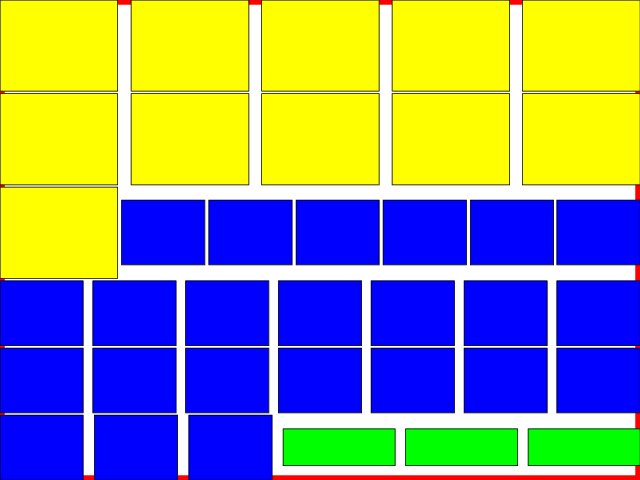
PYTHONPATH=. python legacy/arrange_spread.py
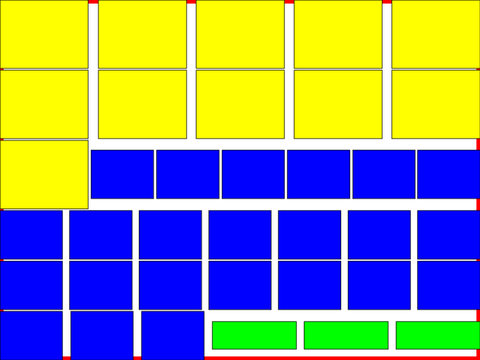
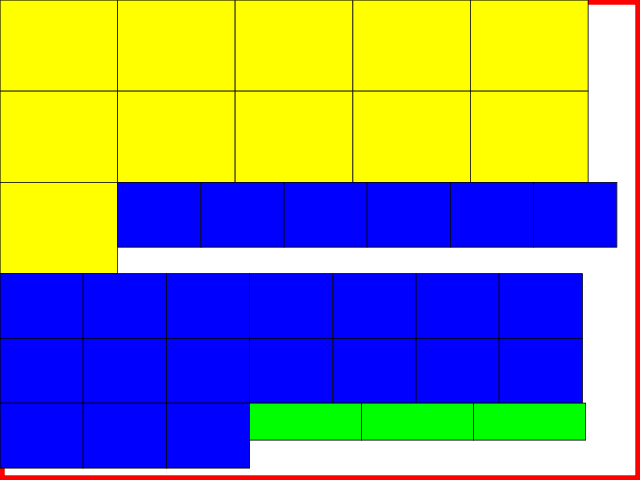
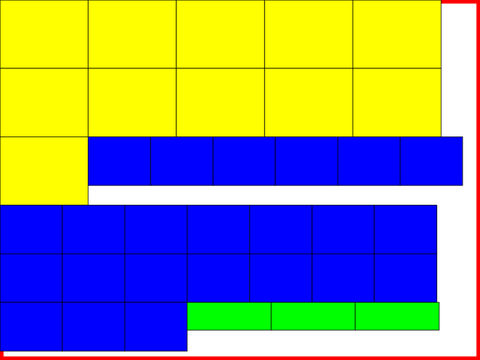
The results will be svg files test1.svg and test2.svg, the latter showing the spread-out result. Here is an example how the output looks like (without the red border which is drawn to mark the pallet border): arrange_spread2.py contains an adaption of arrange_spread.py for the actual problem. Permutations without known length When creating a layer out of articles of same height, then there are four strategies that I can choose from. It is four because there are two methods that I can either use or not. I can rotate the article by 90 per default or not and I can rotate the pallet or not. So every time that I build a new layer, there are those four options. Depending on which strategy I choose, there is a different amount of possible leftover articles that did not fit into any layer. The amount is different because each strategy is more or less efficient. To try out all combinations of possible layer arrangements, I have to walk through a tree where at each node I branch four times for each individual strategy. Individual neighboring nodes might be the same but this outcome is unlikely due to the path leading to those neighboring nodes being different. To simplify, lets name the four possible strategies for each layers 0, 1, 2 and 3. I now want an algorithm that enumerates through all possible permutations of those four numbers for "some" length. This is similar to counting. And the itertools module comes with the product() method that nearly does what I want. For example, should I know that my tree does not become deeper than 8 (read: no more than eight layers will be built), then I can just run:
>>> for i in itertools.product([0,1,2,3], repeat=8):
...     print i
...
(0,0,0,0,0,0,0,0)
(0,0,0,0,0,0,0,1)
(0,0,0,0,0,0,0,2)
(0,0,0,0,0,0,0,3)
(0,0,0,0,0,0,1,0)
(0,0,0,0,0,0,1,1)
(0,0,0,0,0,0,1,2)
(0,0,0,0,0,0,1,3)
This would work if the number of layers created with each strategy was the same. But as each strategy behaves differently depending on the input, it cannot be known before actually trying out a sequence of strategies, how many layers it will yield. The strategy (0,0,0,0,0,0,0,0) might create 7 layers, resulting in (0,0,0,0,0,0,0,1), (0,0,0,0,0,0,0,2) and (0,0,0,0,0,0,0,3) yielding the same output as only the first 7 strategies count. This would create duplicates which I should not waste cpu cycles on later. It might also be that (0,0,0,0,0,0,1,0) turns out to be a combination of strategies that creates more than 8 layers in which case the whole thing fails. So what I need is a generator, that gives me a new strategy depending on how often it is asked for one. It should dynamically extend the tree of possible permutations to accommodate for any size. Since the tree will become humongous (4^11 = 4194304), already traversed nodes should automatically be cleaned so that only the nodes that make the current list of strategies stays in memory at any point in time. This sounded all complicated which made me even more surprised by how simple the solution was in the end. Here a version of the algorithm that could easily be ported to C:
class Tree:
def __init__(self, branch_factor):
self.branch_factor = branch_factor
self.root = "value": None, "parent": None, "children": []
self.current = self.root

def next(self):
if not self.current["children"]:
self.current["children"] = [ "value":val, "parent":self.current, "children":[] for val in range(self.branch_factor)]
self.current = self.current["children"][0]
return self.current["value"]

def reset(self):
if self.current["parent"]:
self.current["parent"]["children"].pop(0)
else:
return False
if self.current["parent"]["children"]:
self.current = self.root
return True
else:
self.current = self.current["parent"]
return self.reset()

def __str__(self):
return str(self.root)
It would be used like this:
>>> tree = Tree(4)
>>> print tree.next(), tree.next(), tree.next()
>>> while tree.reset():
...     print tree.next(), tree.next(), tree.next()
Which would be equivalent to calling itertools.product([1,2,3,4], 3). The special part is, that in each iteration of the loop I can call tree.next() an arbitrary amount of times, just how much it is needed. Whenever I cannot generate an additional layer anymore, I can call tree.reset() to start a new permutation. For my code I used a python specific version which is a generator:
def product_varlength(branch_factor):
root = "value": None, "parent": None, "children": []
current = root
while True:
if not current["children"]:
current["children"] = [ "value":val, "parent":current, "children":[] for val in range(branch_factor)]
current = current["children"][0]
if (yield current["value"]):
while True:
if current["parent"]:
current["parent"]["children"].pop(0)
else:
return
if current["parent"]["children"]:
current = root
break
else:
current = current["parent"]
It is used like this:
it = product_varlength(4)
print it.next(), it.send(False), it.send(False)
while True:
    print it.send(True), it.send(False), it.send(False)
Again, the expression in the loop can have any number of it.send(False). The first it.send(True) tells the generator to do a reset.

Cyril Brulebois: Fun with ints, longs, and pointers!

While investigating the case of some packages responsible for uninstallability on the s390x architecture, I stumbled upon one FTBFS on a single architecture, reported as #673590 (<insert some nice words about software shipping with a decent testsuite>). Given the int versus size_t question was asked, I grabbed this old (it s UNIX!) reference: 64-bit and Data Size Neutrality. Among other things, it describes the everything is 32-bit to 64-bit is becoming the new standard slow conversion process, where keeping compatibility with existing applications was a high priority. It has a nice description of so-called C data models, making it possible to refer to them quickly: LP32 and ILP32 in the 32-bit world; ILP64, LLP64, and LP64 in the 64-bit world. I won t go into detail here, this page has a nice table and lots of explanations about pros and cons for those. (On a personal note, I discovered those on xorg-devel@ when I saw patches floating around, which were about optimizing data sizes for this or that data model, by picking the right types.) While standards may be boring, this page makes it really easy to understand which data types to use, to ensure the best 32/64-bit compatibility possible. It s even full of dos and don ts. See the second half (Porting Issues) for details.

19 May 2012

Richard Hartmann: Mongolia

I will start linking to places we stayed at etc, from now on. On the one hand, we already left those places so my paranoid self can rest assured that no one will come hunt us down, on the other hand, I decided to only to name and link to those places which really deserve a mention. If they are linked here, I can whole-heartedly recommend them. Mongolia After leaving through the Russian border fortifications, Mongolia was an instant and welcome change. Trees growing right next to the tracks, branches forming a bit of a natural tunnel; the trains passing by keeping branches at bay, but the trees free to grow wherever else they pleased. A few hundred meters later below a rocky ledge, a cow had apparently fallen down and died. Partially decomposed flesh still clinging halfway to its rib-cage, it proved to be a sign of the (mostly) more laid-back attitude Mongolians tend to take. After finally getting our passports back and being allowed to leave the train, we first headed to the station to get some money. At ~1800:1, the exchange rate for Tugruk against Euro speaks volumes about inflation; imagine my surprise that the MNT 20,000 note is the largest one. It's also the one and only amount any and all ATMs will default to. We were quite surprised by how cheap everything was, even in the one single store within the station directly behind the border. In Russia, travellers expect to pay hefty markups when shopkeepers know they can charge them, not so in Mongolia. The woman in the trash Upon returning from the station, our waggon was just merrily being driving away on its own by a lone engine, something we had not anticipated or appreciated a whole lot. A woman (we hadn't noticed her before) who was busy scavenging a trash container for food for herself and her scrawny-looking son happily stopped what she was doing and, with a big smile, moved her hands around and smacked them back together, signalling us that our waggon would be attached to a different train for the subsequent journey. To put it mildly, I was stunned; we had met people eating from the trash in Russia as well (yes, I always make a point of giving them enough for a few decent meals; anyone eating out of the trash actually needs and definitely deserves something good happening to them), but they were glum and disheartened. Here, there was someone who not only had to look out for herself, but for a three or four year old boy as well, and still was just so... positive... I don't know if I would have it in me to act the same way... As an aside, even though we were just a few kilometers across the border from Russia, she did not actually take the money from me, she cupped her hands to receive it by having me place it into her hands; this is a very Asian thing in my experience and something we would see both in Mongolia and China consistently. Later, when we were back in our waggon, she passed by and happened to see the Spot Messgenger 2 dangling in front of our window, its lights blinking every five seconds. For a solid twenty minutes, until the train started moving again, she squatted down with her son, oggling the Spot. I have no idea what she was thinking it was and I had no chance to explain it to her, but she was really fascinated and just kept staring and staring. When we finally left the station, we waved to and smiled at each other, she ran after us, and then she was gone. All in all, this was one the more memorable things which happened to us. Mongolian Infrastructure When I say that Mongolians as a whole tend to be a lot more laid back than Russians, this extends to infrastructure as well, but not in the good way. Ulan Bator Little Dhingis Khan We arrived in Ulan Bator at six in the morning and started haggling with taxi drivers. Our hostel had (stale, it turned out) information about acceptable fare from station to their place on their website, 5,000 MNT was supposedly OK. Our driver tried to get 20,000, then 15,000, then 12,000, then 10,000, went down to 7,000 and finally settled for 5,000, all this interspersed with frequent "no" by us and walking away. Once on the road, he wanted to convince me that we had agreed upon 5,000 per person, something that did not quite work out for him. When we arrived, he started to tell me that he was good friends with the hostel manager and that said manager would surely want us to pay more; again, that did not work too well. He made the mistake of getting our luggage out of his trunk immediately (we always kept all our stuff in the passenger area afterwards...) before I paid and even though I only had a 10,000 or 20,000 note, I insisted on correct change. The same old dance began anew, with him edging closer to the correct change in steps of 1,000 MNT. He tried to get away several times, but I stood in his door and held it open; if he had just driven off, I couldn't have stopped him, but that thankfully didn't occur to him. After he shoved all small change (MNT is bill only, no coins) he had with him at me and wanted to make off yet again, I was close to throwing all the small crap at him, but after he, a man of maybe 1.65 meter and sitting down, tried to signal his willingness for a fist fight and me, a man of 1.94 meter and standing started laughing, he gave me 2,000 more and drove off cursing. In case you forgot, at that exchange rate, we argued about two to three Euro, but as he tried to cheat, it became a matter of principle. The Hostel, part one All parking lots and other property in Ulan Bator have a small watchtower with private 24/7 guards; said guard ambled down, let us in and woke the poor woman who was forced to let us check in. As she was Mongolian as well, we were a bit surprised when she switched from broken English to perfect German, but the owners of the OASIS are a German-Austrian couple so I guess that makes sense. Fighting through the war Traffic in Ulan Bator is war. Lonely Planet talks about the city being too newly motorized and that it did not have to develop a culture of driving, yet. This is a euphemism for "no one has any qualms maiming or killing you". Everyone is driving like mad, nudging and racing their way in front of each other. If a driver has an oppurtunity to get ahead by a few centimeters with his small car, thereby blocking the way for several buses, making a whole parking lot grind to a halt and thereby deadlocking themselves, they will take said opportunity, and gladly. Red lights are gentle suggestions, there to be mainly ignored; police will not drive over red lights, but they will not stop anybody else from doing so, either. A hearse will have a dozen or more cars following it, all driving in a tight pack, aggressively attacking anyone who dares to wedge in between them and expecting all other traffic to make way even if they are driving over a red light. Crossing a main street in Ulan Bator as a pedestrian is hell. There are a few traffic lights and they help to some extent, but you still need to be extremely careful when crossing a street. Thailand, India, Russia, China, no matter where it's supposedly hard to cross a street by foot, I never had any issues weaseling through. In UB, it takes planning, determination, and a lot of attention, especially as there are stretches where there's not a traffic light in sight. While maintaining eye contact with a driver usually ensures that they will try not to hit you, this does not work in the least in UB. In the evening, I took to shining a high-powered flashlight at the ground to the oncoming traffic's side to mark ourselves and decrease the likelihood of being hit. This worked well in combination with sprinting through gaps in the traffic, except for one guy who actively aimed for us and did not slow down. He even changed lanes, just to keep us in front of his car... Shining the flashlight directly at him in highest mode made him break quite violently though; a good thing, as he may have hit us had he not slowed down. UB itself Ulan Bator is weird. It has clear signs of westernization, but it's still very much an old city. There is one large store which would fit into any random shopping center in Germany (which are tiny when compared to most other countries) and which carries most goods, if with a limited selection. Its supermarket is extremely well stocked with food and drink from all other the world and laughably cheap (for us) prices. While its infrastructure is definitely crumbling, the city is clean, especially when compared to Russia. Two girls from Stuttgart who we met during our Trans-Siberian travels commented on how clean Russian cities were when compared to home, but that may be more of a statement about Stuttgart than about Russia... Anyway, in Mongolia in general and in UB in particular, there's a concise effort to make what they have look nice and clean. There is no trash in the streets, loose gravel and earth is removed from the curb by dedicated workers, all areas of packed earth are sieved and all large stones removed. All in all, it's a lot cleaner (if more dusty and sandy) than Russian cities if somewhat older and more shabby-looking. That being said, Mongolia's countryside is littered There were several street stalls consisting of nothing more than a cardboard box on a stool selling single chewing gums and cigarettes from the original packaging; it's normal for people to buy one cigarette or one piece of chewing gum and walk on. The sights of UB were nice, but nothing too special. Outlook In the next part, I'll cover "The Hostel, part disaster" and generally talk more about excrement than I thought one could write before moving on to China (were I am located at the time of this writing).

Next.

Previous.