Search Results: "don"

2 May 2014

C.J. Adams-Collier: Bringing the VMs back online

okay. New hypervisor hardware. Switching from xen to KVM. I took a snapshot of the xen partitions and moved them to a holding location during migration. I am now imaging these partitions to the LVM block devices:
calcifer:/home/cjac# for guest in  ls /usr/src/moonunit-guests/   grep -v -e etc   awk -F- ' print $1 '  ; do lvcreate /dev/vg00 -n $ guest  -L 4200M -C y ; done
  Logical volume "edge" created
  Logical volume "ns0" created
  Logical volume "sh1" created
  Logical volume "sip0" created
  Logical volume "smtp" created
  Logical volume "vpn1" created
  Logical volume "wsg" created
calcifer:/home/cjac# partprobe /dev/vg00/edge
calcifer:/home/cjac# fdisk -l /dev/vg00/edge
GNU Fdisk 1.2.4
Copyright (C) 1998 - 2006 Free Software Foundation, Inc.
This program is free software, covered by the GNU General Public License.
This program is distributed in the hope that it will be useful,
but WITHOUT ANY WARRANTY; without even the implied warranty of
MERCHANTABILITY or FITNESS FOR A PARTICULAR PURPOSE.  See the
GNU General Public License for more details.
Disk /dev/dm-21: 4 GB, 4400524800 bytes
255 heads, 63 sectors/track, 535 cylinders
Units = cylinders of 16065 * 512 = 8225280 bytes
     Device Boot      Start         End      Blocks   Id  System 
/dev/dm-21p1               1         535     4297356   83  Linux
calcifer:/home/cjac# kpartx -l /dev/vg00/edge
vg00-edge1 : 0 8594712 /dev/vg00/edge 63
calcifer:/home/cjac# kpartx -a /dev/vg00/edge
calcifer:/home/cjac# dd if=/usr/src/moonunit-guests/edge-disk-20140420T070034.xz   xz -d   dd of=/dev/mapper/vg00-edge1 
503474+1 records in
503474+1 records out
257778704 bytes (258 MB) copied, 311.538 s, 827 kB/s
8388608+0 records in
8388608+0 records out
4294967296 bytes (4.3 GB) copied, 925.612 s, 4.6 MB/s
calcifer:/home/cjac# mount /dev/mapper/vg00-edge1 /mnt/tmp
calcifer:/home/cjac# cp -r /lib/modules/ uname -r  /mnt/tmp/lib/modules/
calcifer:/home/cjac# emacs /mnt/tmp/etc/inittab
calcifer:/home/cjac# emacs /mnt/tmp/etc/fstab
calcifer:/home/cjac# umount /mnt/tmp
calcifer:/home/cjac# kpartx -d /dev/vg00/edge
calcifer:/home/cjac# virsh start edge && virsh console edge
Somebody needs faster drives. Wow was that ever slow.

Vasudev Kamath: Note to Self: How to use url_for in Flask application

url_for is normally used to avoid hard coding of URL in Flask based webapps. I've been using it in SILPA port written using Flask by. But this was written long back and written as POC to show for Santhosh author of SILPA app which even managed to go into production :-). Recently I started organizing the code and started using flask.Blueprint which was previously written using flask.views.MethodView class and here I started facing problem with old templates. I'm just gonna explain what is the difference when using url_for with MethodView and Blueprint. Lets have some sample code for MethodView first, this code is from Flask documentation.
from flask.views import MethodView
class UserAPI(MethodView):
       def get(self):
           users = User.query.all()
           ...
       def post(self):
           user = User.from_form_data(request.form)
           ...
app.add_url_rule('/users/', view_func=UserAPI.as_view('users'))
Here we have a view which is derived from MethodView which has logic on how to handle the requests. We use add_url_rule to register rule to handle /users/ url end point and we pass the class as view function which is done by as_view class method and we can refer this method in our Jinja2 templates using name users. So a statement like
url_for('users')
in our templates will be converted to /users/ URL when page is rendered to client by Flask. Now when I replaced the MethodView in favor of Blueprint I started getting up werkzeug.routing.BuildError thrown on my face and I had no clue why!. Yeah I know I'm bad at reading documentation but even after reading documentation I was still thinking that
url_for('/')
should return me a proper URL and I was wondering why its failing. Finally after re-reading documentation for url_for it was becoming clear to me, url_for definition looks like below
flask.url_for(endpoint, **values)
Here endpoint is actually a function which is supposed to be serving the URL and **values is the arguments for this function. The URL in question should be defined in python code using decorator. In my case following is the new function serving the web pages for SILPA.
bp = Blueprint('frontend', __name__)
@bp.route(_BASE_URL, defaults= 'page': 'index.html' )
@bp.route(_BASE_URL + '<page>')
def serve_pages(page):
       if page == "index.html":
          return render_template('index.html', title='SILPA',
                               main_page=_BASE_URL,
                               modules=_modulename_to_display)
       elif page == "License":
          return render_template('license.html', title='SILPA License',
                                main_page=_BASE_URL,
                                modules=_modulename_to_display)
       elif page == "Credits":
           return render_template('credits.html', title='Credits',
                                main_page=_BASE_URL,
                                modules=_modulename_to_display)
       elif page == "Contact":
           return render_template('contact.html', title='Contact SILPA Team',
                                main_page=_BASE_URL,
                                modules=_modulename_to_display)
       else:
           # modules requested!.
           if page in _display_module_map:
               return render_template(_display_module_map[page] + '.html',
                                    title=page, main_page=_BASE_URL,
                                    modules=_modulename_to_display)
           else:
               # Did we encounter something which is not registered by us?
               return abort(404)
You can ignore function code but just note the decorators, here I'm registering the function serve_pages with page as argument for URL patterns / and /<page>, _BASE_URL here is mount point of application it can be just / or /mountpoint depending on that URL registered changes. Now I need to modify code for all url_for in my template to look like below
url_for('.serve_pages', page='/License') # for /License
url_for('.serve_pages') # which will turn in to /index.html
The . in front of function is for referring current Blueprint, in my case the Flask will consider it as frontend.serve_pages as function name and generates appropriate URL at run time. So my fault was misunderstanding endpoint argument as URL endpoint but where as its actually function name supposed to serve the page. But when using MethodViews I can simply convert class to a function with my preferred name just like UserAPI.as_view('/') so url_for('/') just works.

1 May 2014

Siri Reiter: Last minute proposal

I've been asked to make another design proposal for the Minidebconf. People have been brainstorming. I could have asked them to do that months ago. I didn't, because I was working with my own ideas. We need to know who and what we are aiming at with the graphic communication, as well as with the conference. Who is the design for? What should they do? Why? Who is the conference for? Who should be interested? Is the design for people in Barcelona only? Is it for women only? Is it for current developers? Or is it for local politicians? Male or female? Students? - only? Does the communication have other goals than getting people at the venue? Should the design reflect the organizers - or rather not? Does the geography have to play a role in the visual imagery? These are questions that should always be asked. I made the mistake to answer a lot of the questions myself, based on my second hand knowledge and guesses. A common mistake, I've made before and will probably make again. I'm used to working on my own, that's my poor excuse. To my mind, the gathering, the meeting in the flesh and the communication and sharing of knowledge, is far more important than local landmarks. I don't feel that strongly for a location oriented identity design. La Sagrada Familia doesn't have anything to do with a gathering for free software development, does it. How? Oh, that was the minidebconf in Barcelona
Oh, that was the minidebconf arranged by Debian Women
Oh, that was the minidebconf that made a point out of being inclusive
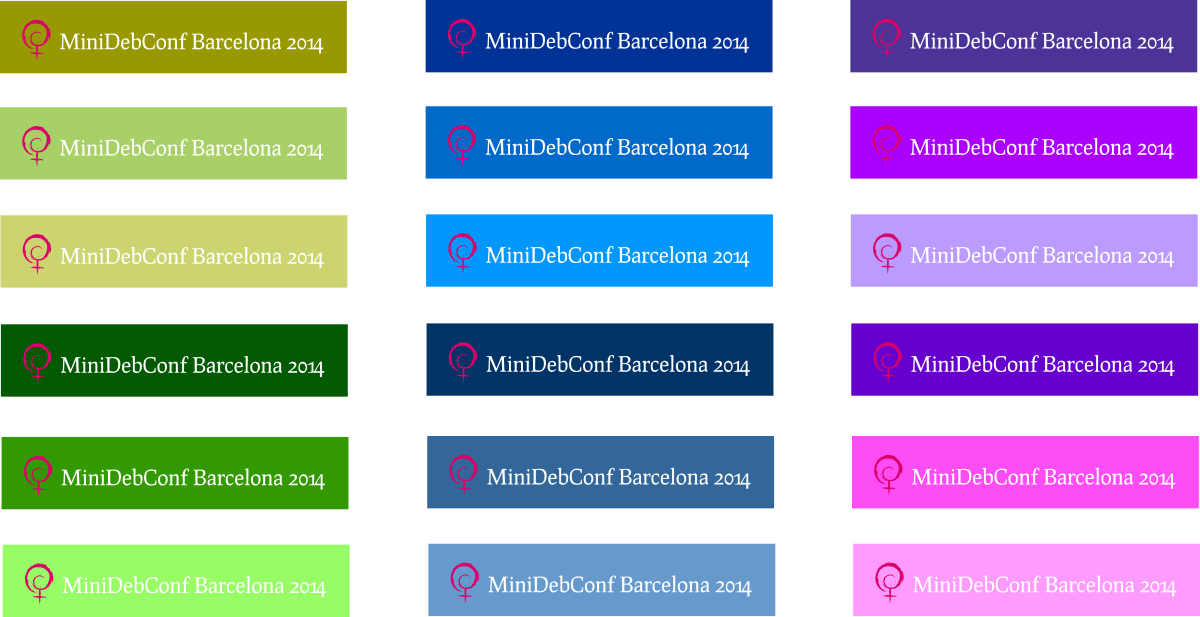
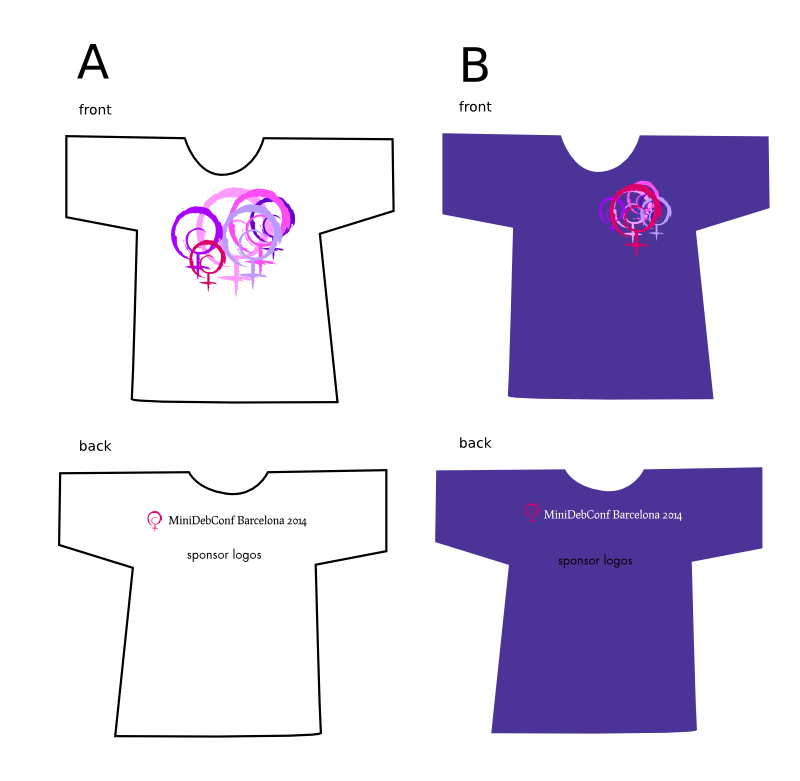
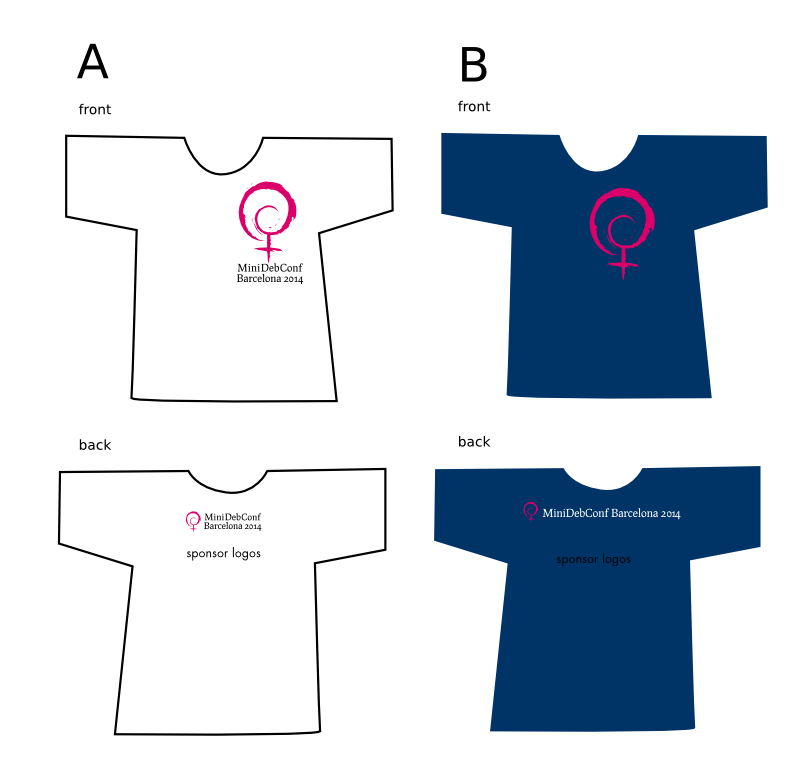
Oh, that was the minidebconf that The identity design might have more to do with support to the local group than with any of the other aspects of the conference. Interesting. This table of colors shows different ways a blue and a purple could go. I put the green colors there to have more options covered for the discussion today. You can see how the different hues interacts with the red of the logo. The colors can be referred to like this: B3, C6, A4 etc. Click on the image for full size version. Here is an idea based on all the purple colors. Fun, uplifting, feels like many voices. Too many colors for T-shirt print, maybe: Here is some ideas of how to implement a minimalistic solution that I recommend for minidebconfs: My suggestion is that the banner (and everything else displaying the event) has the logo of the organizers placed on it. The font used for headlines etc is semantically of another nature than the logo, though it could be the same. I prefer neutral fonts, that can be reused by the next minidebconf, and I suggest a sans serif font. A condensed font makes huge display easier to fit. Don't be confused by displayfonts, I aim to show you that type alone speaks loudly, and if this typography should be recycled, we should not choose one of them, but go with the "neutral" sans serif. I need suggestions of free and good sans serif fonts.

Siri Reiter: That goddamned perfection again

Since the MiniDebConf Jonas and I have been travelling in Spain, France and finally staying in Belgium for a week, getting some work done. It's been harder than imagined to work during travel. I haven't exercised either, and regained at least three of four kilos I spent much time and effort getting rid in the year preceding. I thrive in my home and find it hard to keep my own time and focus when I am deprived of my own space. It was challenging to give a talk, "Why aren't more designers using Debian or working for Debian", my first public talk. I've been working to recapture my points in writing, to make a stronger statement, but I seem to blur my own views with conflicting ones, and I'm loosing momentum every day. One of my reasons for speaking up was to do it even though I'm not at trained speaker and have "nothing" to contribute but my opinions from the angle of a user that happens to be a designer. Not claiming to be a superior designer, but one that would like to contribute if it was easier to figure out how. And since the community wants to encourage designers to contribute to the Debian project, I figured it to be a good idea to talk about how this has been challenging to me as a dedicated user and completely out of the question for any other designer I know - or knew before the minidebconf. No reseach, no scientific proofs, just my wiew from my "dumb user" and designer's perspective. I saw one single attendant rolling his eyes during my talk. I didn't care at that time, but I've given that look more consideration than the people approaching me after the talk, saying thank you for voicing their opinions and thoughts. I think that's absolutely astonishing and at the same time it's just typically me. It makes me angry, first with myself for not speaking to this man's perception of things, then with myself for not just letting go of that image. I'm really glad that so many seemed to listen with curiosity and interest. What if one more - or half of the auditorium - had rolled their eyes? I don't like to feel that vulnerable. The truth is, though, that I'm really not. I gave the talk against my fear of failure and public humiliation and I'm convinced that my thoughts and actions matter, just as anybody's does, if we dare to say what's on our minds and to take action. I believe it's in anybody's power to "make a difference" and even "change the world" - at least in a small way. I guess that's one of the underlying reasons to be a designer in the first place. That is quite a strong position to take. I've created the wikipage http://wiki.debian.org/Design - well knowing that design is a word with many meanings. Everything is design. Since the talk I've been in doubt about that page. About the project, my aim with it, what to do about it, how to move on with just a tiny babystep, and I realise that I'm simply afraid to be disturbing someone's peace, making people angry or roll their eyes at my fumbling attempts to figure out in public what can be done to make a thriving community of designers collaborating with coders to make better, more usable and attractive software in the free, wide world. I'm starting a design process, not presenting a perfect, finished solution. Now, having put these thoughts into words, perhaps, my mind will be somewhat appeaced and let me move on with my intended tasks of cultivating that acclaimed space in the Debian information jungle into a friendly and welcoming place with info that makes it easier to be a contributing designer in Debian.

Daniel Pocock: reSIProcate v1.9 WebRTC available for Fedora 20 testing

Today I just released reSIProcate v1.9 packages into the Fedora 20 testing updates repository. This means Fedora 20 users can now try WebRTC more easily. The same version is already available in Debian wheezy-backports and Ubuntu trusty. Get started today Install the resiprocate-repro proxy server package using yum. Set up a DNS entry, here is what we will use in the example:
Domain sip-ws1.example.org
WebSocket URL
Use this in JSCommunicator or JsSIP
ws://sip-ws1.example.org
IP address of server 198.51.100.50
so the DNS entry will be
sip-ws1.example.org.     IN    A    198.51.100.50
Notice that in the ws:// URL, we do not specify a port. This means port 80 is used by default. You can also use a non-standard port if you prefer or if you dont' have root permissions. Now edit the file /etc/repro/repro.config, adding a transport definition for WebSockets (WS) and change a few other parameters from their defaults:
# Bind to 198.51.100.50 on port 80
Transport1Interface = 198.51.100.50:80
# Use WS (can also use WSS for TLS, see repro.config for full details)
Transport1Type = WS
# if using WSS, must also change the transport param here
Transport1RecordRouteUri = sip:sip-ws1.example.org;transport=WS
EnableFlowTokens = true
DisableOutbound = false
# Disable all authentication - just for testing
DisableAuth = false
# allow http admin access on all interfaces,
# default is 127.0.0.1
# HttpBindAddress = 0.0.0.0
Now set up a password for the web admin tool using htdigest:
# htdigest /etc/repro/users.txt repro admin
After all that, restart the repro process
# service repro restart
Go to the web interface on port 5080 (only listening on localhost by default), go to the "ADD DOMAIN" page and add sip-ws1.example.org Now restart repro again so it recognises the new domain.
# service repro restart
Finally, you can test it using JSCommunicator or tryit.jssip.net Next steps
  • Set up a TURN server for NAT traversal
  • Use WebSockets over TLS (WSS) instead of regular WS mode
  • Set up authentication (see the various options, including client certificate support, in repro.confg)
  • Connect to regular SIP infrastructure such as Asterisk
Questions? Please come and ask on the repro-users mailing list

Lisandro Dami&aacute;n Nicanor P&eacute;rez Meyer: Call for help from Debian's KDE Team

Hi all!


For quite a while now the KDE team has been severely understaffed. We maintain a lot of packages, with many different kinds of bugs, but we don't have enough people to do all the work that needs to be done. We have tools that help us automate the update to new upstream releases, but that's just the tip of the iceberg of our work and so we are writing to invite more people to get involved in the team and help us get KDE software in Debian into better shape.


Some of the tasks that we need help with are:
  • Bug triaging: there are many many bugs in the BTS. We need people that go through them, understand the problem and how to reproduce it, confirm that they are still present in the latest versions. In particular, there are bugs affecting the version in wheezy, and we need people to go through those as well.
  • Bug forwarding: we are so understaffed that we have been asking users to forward the bugs upstream themselves. Some users do this, but some don't. It would help us a lot to have people in the team in charge of this.
  • Patch forwarding: we have quite a bunch of patches applied in the Debian packages that should be applied upstream. Some need to be generalized instead of being Debian-specific. This work would save us time in the future, so it's very important to get it done.
  • Upgrade-testing: in the past, the upgrade from one Debian stable to the other has been quite traumatic for KDE software users. We need people to try upgrading from wheezy to jessie and report any bugs that they might encounter so that we can fix them ahead of the release.
  • Creating patches: many of the bugs that we have require writing patches, some are easy and some are harder, but any help here would be really appreciated.
  • Packaging other KDE apps: we have packages for the core components of KDE software, but there are many other useful components that still need to get packaged.
  • Updating our welcoming wiki page [1], adding these tasks and any future tasks, and unifying the todo lists [2].
If you are interested in helping with any of these, please join our irc channel #debian-qt-kde in irc.oftc.net, or our mailing list [3]. We are happy to help you get started.


[1]: https://wiki.debian.org/PkgKde
[2]: https://wiki.debian.org/KDETodo
https://wiki.debian.org/KdeDebTasks
http://pkg-kde.alioth.debian.org/todo.html
gobby://gobby.debian.org/Teams/KDE/TODO

[3]: https://lists.debian.org/debian-qt-kde/


--
Regards,
Maximiliano Curia
On behalf of the KDE team

Andrew Pollock: [life] Day 93: A whole lot of running around

This morning Zoe woke up again at around 4am and ended up in bed with me. I don't even remember why she woke up, and neither does she, but she's assuring me it won't happen tomorrow morning. We'll see. As a result of the disturbed night's sleep, we had a bit of a slow start to the day. Zoe was happy to go off and watch some TV after she woke up for the day, and that let me have a bit more of a doze before I got up, which made things vaguely better for me. ABC 4 Kids has been showing a lot of ads for Ha Ha Hairies, which airs at 10:20am, lately, and it's one of the shows that isn't available on iView. Zoe had been lamenting that she never got to see it, and asking me if she could. Today the schedule was fairly open, so I made sure we were home at 10:20am. That involved a quick dash out to Woolies first to get a few bits and pieces for Zoe's birthday party. While Zoe watched the Ha Ha Hairies, I did some bulk egg hard boiling in the oven. After the Ha Ha Hairies and a little bit of general mucking around, we drove out to Spotlight to pick up the helium tank I'd rented. Zoe nearly fell asleep on the way out there. We picked up the helium tank and headed back home. That errand alone probably took a bit over an hour all up. We got back home and had lunch, but by the time all of that was out of the way, Zoe seemed to have missed the window for her nap. She did have a bit of a rest in bed, flipping through her library books, and I got to read some of my book as well, so that was nice. During that time, I got the call from Bunkers saying they were about half an hour out with the delivery of Zoe's bunk bed (my birthday present for her). That worked out well, as it was towards the start of the two hour window they'd advised me of. The bunk bed was delivered and then we popped out to Overflow to see if they had any food covers for the party food (they did) so we picked up a few of them. Today I learned that "As Seen On TV" is trademarked, and so "Similar To As Seen On TV" is the trademark dodging thing to put on cheap knock-offs. As Overflow is two doors down from Petbarn, we stopped in there as well and grabbed some more kitty litter. One does not just pop into Petbarn with Zoe, so we spent some time there looking at the fish and assorting aquarium paraphernalia. They also had some hermit crabs now too. On the way back home, we stopped in at (a different) Woolies to pick up the half slab of chocolate mudcake that I'd ordered for Zoe's birthday cake. I'd decided that the upright Minion cake I'd initially wanted to do was just way too adventurous for my abilities and not a good use of my time (and the quotes I'd sought for outsourcing it had come in at over $300). I scaled things back to just a flat slab Minion, which may still exceed my cake decorating abilities, but we'll find out tomorrow. There'd been a miscommunication at Woolworths, and my half slab hadn't been boxed up and wasn't ready for my collection. All the bakery staff had already gone home, and I didn't really want to come back tomorrow, because I had this crazy idea of possibly starting on the cake tonight (not going to happen), so a couple of non-bakery staff had to find the cake and figure out how to extract a full slab from the baking tray and cut it in half and box it up. It provided some entertainment for Zoe and I. We finally got home, and I rehashed some frozen leftovers for dinner. I decided to try something different for the bath time and bed time routine to see if it'd reduce procrastination. I got Zoe to pick out the three books she wanted to read at bed time before we got to story time, so we'd have something concrete to negotiate with. I also threw in the possibility of a "bonus story" if she didn't muck around. It seemed to work, and we had a fairly streamlined bath time. There's no doubt she was pretty tired today, and she went to bed without any fuss, so I'm hopeful that we'll have a good night tonight.

C.J. Adams-Collier: I think perhaps they mean could join x86 in the server room

As much as I love PowerPC, and as great as it is that they re doing this OpenPower thing, I don t think that the first step should be to eliminate the competition. Perhaps they should put some effort in to taking back a large part of the market. Didn t these guys read The Art of War?
The OpenPower Foundation, and how IBM and friends could oust x86 from the server room
I d certainly take a look at a server if they sent me one; it looks like Debian still supports powerpc arch on wheezy. ;-)

30 April 2014

Chris Lamb: Marlon Brando in the Lake District

Alan How:
There's an Italian restaurant somewhere in the Lake District in the north of England. And if you can imagine, there are hills, lots of rain, lakes, and so on and so forth. And inside this Italian restaurant is a huge picture a wall-sized mural of Marlon Brando. Now, I asked my students once: Why Marlon Brando? Well he's The Godfather! I don't think he was a Godfather, you know... But he was in that film, wasn't he? It was called The Godfather. Ah, that film from 40 years ago, virtually.. 1970-something? Yes, yes, but he was The Godfather then, wasn't he? You mean if was a mafiosi? He was a leading figure in gangsterland in New York? Well, yes, he was The Godfather, they keep saying, ... and he was Italian. Well, no, actually he was American... So you get this regular kind of placing and misplacing of the real, ie. a very large American actor who played in a film called The Godfather about American gangsters, or Italian-American gangsters, nothing to do with godfathers in Christianity, in the north of England, stuck on a huge wall in a restaurant. All of which tells us that it's an Italian restaurant. And we don't demure, we don't say "no, that's all untrue", we just take it for granted: "Yeah, that's what it means - it's an Italian restaurant". And it's that kind of slippage between the real and the imagined or the true and the fictional which Baudrillard thinks is becoming inceasingly characteristic of how our society goes on.

Russell Coker: Links April 2014

Yves Rossy is the Jetman, he flys with a wing and four jet engines strapped to his body, he gave an interesting TED talk about flying along with some exciting videos [1]. Larry Brilliant gave an informative and inspiring TED talk about stopping pandemics [2]. I thought that Smallpox was the last disease to be eradicated but I was wrong. Michael Shermer gave an interesting TED talk about pattern recognition and self deception [3]. It s a pity that the kissing prank shown at the end only pranked women, they should be less sexist and prank men too. Raffaello D Andrea gave an interesting TED presentation about Athletic quadcopters [4]. It s very impressive and has the potential for several new human/machine sports. Lisa D wrote an insightful article about Prejudice Spillover discussing the way that people who aren t in minority groups only seem to care about injustice when a member of the majority is targetted by mistake [5]. Ron Garret wrote an insightful post about the Divine Right of Billionaires which debunks some stupid arguments by a billionaire [6]. Ron says that it s often instructive to examine incorrect arguments, especially when those arguments are advanced by smart people and demonstrates it in this post. Lisa D wrote an interesting post about her problems with financial aid bureaucracy [7]. She intended the post to be a personal one about her situation, but I think it illustrates problems with the various aid programs. If aid was available to her with less bureaucracy then she would be doing paid work, completing her studies, and heading towards post-graduate studies. Mark Shuttleworth wrote an insightful article about ACPI, security, and device tree [8]. It s the first time I ve seen a good argument for device tree. TED presented an interesting video-conference interview with Edward Snowden [9]. It s unusually long by TED standards but definitely worth watching. Tom Meagher (who s wife was raped and murdered two years ago) wrote an insightful article about rape culture [10]. Key Lay (the Victorian Chief Commissioner of Police) wrote a good article encouraging men to act to stop violence against women [11]. It s particularly noteworthy when a senior police officer speaks out about this given the difficulties women have had in reporting such crimes to police. Emily Baker wrote an insightful article about the lack of support for soldiers who survive war [12]. A lot of attention and money is spent remembering the soldiers who died in the field but little on those who live suffer afterwards, more soldiers die from suicide than enemy fire. Daniel Pocock wrote an informative article about the failings of SMS authentication for online banking [13]. While he has good points I think he s a little extreme. Stopping the least competent attackers is still a significant benefit as most potential attackers aren t that competent. Jess Zimmerman wrote an interesting article for Time about the Not All Men argument that is a current trend in derailing discussions about the treatment of women [14]. The Belle Jar has an insightful article Why Won t You Educate Me About Feminism about some ways that men pretend to care about the treatment of women [15]. Jon Evans wrote an article for Tech Crunch about the Honywell Bubble Count measure of diversity in people you follow on social media [16]. Currently on Twitter I follow 57 accounts of which 15 are companies and organisations, so I follow 42 people. I follow 13 women 31%, for a visible minority group other than my own it s 2/42 or 5%, for people who live in other countries I think it s 8/42 (although it s difficult to determine where some people live) which is 19%. So my Honywell number is 55. The Top Stocks forum has an interesting post by a Coal Seam Gas (CSG) worker [17]. It seems that CSG is even worse than I thought. Ashe Dryden wrote an informative post for Model View Culture about the backlash that members of minority groups (primarily women) receive when they speak out [18].

Andrew Pollock: [life] Day 92: Kindergarten, cleaning and more birthday party preparation

I'm mostly back into my normal routine now. Next week should be spot on. Today, after my chiropractic adjustment and another walk to the post office to collect another package, I got stuck into cleaning the house. I got that mostly done before my massage, and knocked out the rest of it before I picked up Zoe from Kindergarten. Zoe seems to have successfully dropped her day time nap at Kindergarten now, which certainly makes a huge difference to getting out of the place on time. I'd underestimated the number of kids coming to Zoe's birthday party, so I needed to get some extra goody bags made up, so we headed directly out to Westfield Carindale to raid the The Reject Shop for some more bits and pieces. After we got home from that, Zoe watched a bit of TV and helped me assemble the extra bags, and then we had dinner. After some epic procrastination (on Zoe's behalf) I managed to get her to bed approximately on time. I really need to try some different approaches to getting through the bath time routine, because it's just taking too long. I gave myself a couple of time outs because I could see the situation deteriorating if I didn't. It's unhelpful that my blog seems to be the third hit in Google at the moment for "positive parent procrastination". I don't have the answers.

29 April 2014

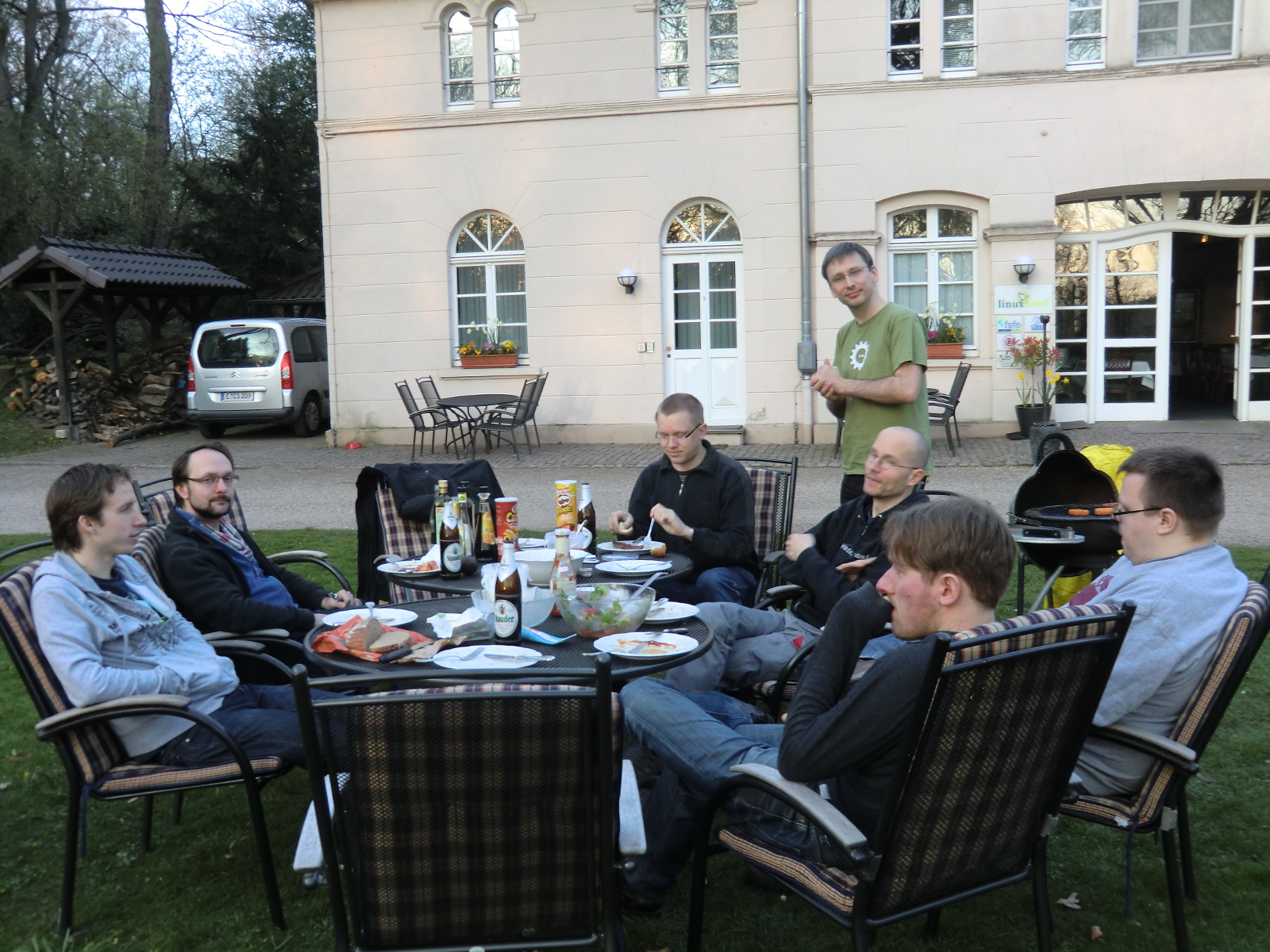
Guido G nther: Bits from the 7th Debian groupware meeting

The seventh Debian Groupware Meeting was held in the LinuxHotel, Essen, Germany. We had one remote hacker from NYC which brings the number of attendants up to 9. This is a short summary of what happened during the weekend: Since we had a nice mix of first time Debian contributors, Debian Maintainers and Debian Developers we had lots of room for discussion and co-working which made this an exciting weekend. Groupphoto by Carsten Sch nert

Gunnar Wolf: Split regarding Docker

I have heard many good things about Docker, and decided to give it a spin on my systems. I think application-level virtualization has a lot to offer to my workflow... But the process to understand and later adopt it has left me somewhat heart-torn. Docker is clearly great technology, but its documentation is... Condescending and completely out of line with what I have grown used to in my years using Linux. First, there is so much simplistic self-praise sprinkled throughout it. There is almost no page I landed on that does not mention how user-friendly and user-centric Docker's commandline arguments are They let you talk in almost plain1 English. What they don't mention is that... Well, that's the way of basically every command-line tool. Of course, as soon as you start specifying details to it, the plain-Englishness starts dilluting into a more realistic English-inspiredness... Then... Things that go against our historical culture. It is often said that Windows documentation tends to be repetitive because users don't have the patience to read a full document. And our man pages are succint and to the point, because in our culture it is expected that users know how to search for the bit of information they are after. But reading documentation that's so excited with itself and praises again and again the same values and virtues, but never gets to the point I am interested in getting at (be it deployment, interoperation, description of the in-disk images+overlays layout, or anything moderately technical) never gets there... makes me quite unhappy. Last (for now)... Such a continuous sales pitch, an insistence on the good virtues, makes me wary of something they might be hiding. Anyway, at least for now, I just wanted to play a bit with it; I will wait at least until there is a backport to the stable Debian version before I consider moving my LXC VMs setup over to Docker (and a backport does not seem trivial to achieve, as Docker has several updated low-level dependencies we are unlikely to see in Wheezy). But I had to vent this. OK, now go back to your regular work ;-)

Petter Reinholdtsen: Half the Coverity issues in Gnash fixed in the next release

I've been following the Gnash project for quite a while now. It is a free software implementation of Adobe Flash, both a standalone player and a browser plugin. Gnash implement support for the AVM1 format (and not the newer AVM2 format - see Lightspark for that one), allowing several flash based sites to work. Thanks to the friendly developers at Youtube, it also work with Youtube videos, because the Javascript code at Youtube detect Gnash and serve a AVM1 player to those users. :) Would be great if someone found time to implement AVM2 support, but it has not happened yet. If you install both Lightspark and Gnash, Lightspark will invoke Gnash if it find a AVM1 flash file, so you can get both handled as free software. Unfortunately, Lightspark so far only implement a small subset of AVM2, and many sites do not work yet. A few months ago, I started looking at Coverity, the static source checker used to find heaps and heaps of bugs in free software (thanks to the donation of a scanning service to free software projects by the company developing this non-free code checker), and Gnash was one of the projects I decided to check out. Coverity is able to find lock errors, memory errors, dead code and more. A few days ago they even extended it to also be able to find the heartbleed bug in OpenSSL. There are heaps of checks being done on the instrumented code, and the amount of bogus warnings is quite low compared to the other static code checkers I have tested over the years. Since a few weeks ago, I've been working with the other Gnash developers squashing bugs discovered by Coverity. I was quite happy today when I checked the current status and saw that of the 777 issues detected so far, 374 are marked as fixed. This make me confident that the next Gnash release will be more stable and more dependable than the previous one. Most of the reported issues were and are in the test suite, but it also found a few in the rest of the code. If you want to help out, you find us on the gnash-dev mailing list and on the #gnash channel on irc.freenode.net IRC server.

Russell Coker: Autism and the Treatment of Women Again

Background I ve previously written about the claim that people use Autism as an excuse for bad behavior [1]. In summary it doesn t and such claims instead lead to people not being assessed for Autism. I ve also previously written about empathy and Autism in the context of discussions about conference sexual harassment [2]. The main point is that anyone who s going to blame empathy disorders for the widespread mistreatment of women in society and divert the subject from the actions of average men to men in minority groups isn t demonstrating empathy. Discussions of the actions of average men are so often derailed to cover Autism that the Geek Feminism Wiki has a page about the issue of blaming Autism [3]. The Latest Issue Last year Shanley Kane wrote an informative article for Medium titled What Can Men Do about the treatment of women in the IT industry [4]. It s a good article, I recommend reading it. As an aside @shanley s twitter feed is worth reading [5]. In response to Shanley s article Jeff Atwood wrote an article of the same title this year which covered lots of other things [6]. He writes about Autism but doesn t seem to realise that officially Asperger Syndrome is now Autism according to DSM-V (they decided that separate diagnosis of Autism, Asperger Syndrome, and PDD-NOS were too difficult and merged them). Asperger Syndrome is now a term that refers to historic issues (IE research that was published before DSM-V) and slang use. Gender and the Autism Spectrum Jeff claims that autism skews heavily towards males at a 4:1 ratio and cites the Epidemiology of Autism Wikipedia page as a reference. Firstly that page isn t a great reference, I fixed one major error (which was obviously wrong to anyone who knows anything about Autism and also contradicted the cited reference) in the first section while writing this post. The Wikipedia page cites a PDF about the Epidemiology of Autism that claims the 4.3:1 ratio of boys to girls [7]. However that PDF is a summary of other articles and the one which originated the 4.3:1 claim is behind a paywall. One thing that is worth noting in the PDF is that the section containing the 4.3:1 claim also references claims about correlations between race and Autism and studies contradicting such claims it notes the possibility of ascertainment bias . I think that anyone who reads that section should immediately consider the possibility of ascertainment bias in regard to the gender ratio. Most people who are diagnosed with Autism are diagnosed as children. An Autism diagnosis of a child is quite subjective, an important part is an IQ test (where the psychologist interprets the intent of the child in the many cases where answers aren t clear) to compare social skills with IQ. So whether a child is diagnosed is determined by the psychologist s impression of the child s IQ vs the impression of their social skills. Whether a child is even taken for assessment depends on whether they act in a way that s considered to be obviously different. Any child who is suspected of being on the Autism Spectrum will be compared other children who have been diagnosed (IE mostly boys) and this will probably increase the probability that a boy will be assessed. So an Aspie girl might not be assessed because she acts like other Aspie girls not like the Aspie boys her parents and teachers have seen. The way kids act is not solely determined by neuro-type. Our society expects and encourages boys to be louder than girls and take longer and more frequent turns to speak, this is so widespread that I don t think it s possible for parents to avoid it if their kids are exposed to the outside world. Because of this boys who would be diagnosed with Asperger Syndrome by DSM-IV tend to act in ways that are obviously different from other kids. While the combination of Autism and the the social expectations on girls tends to result in girls who are quiet, shy, and apologetic. The fact that girls are less obviously different and that their differences cause fewer difficulties for parents and teachers makes them less likely to be assessed. Note that the differences in behavior of boys and girls who have been diagnosed is noted by the professionals (and was discussed at a conference on AsperGirls that my wife attended) while the idea that this affects assessment rates is my theory. Jeff also cites the book The Essential Difference: Male And Female Brains And The Truth About Autism by Professor Simon Baron-Cohen (who s (in)famous for his Extreme Male Brain theory). The first thing to note about the Extreme Male Brain theory are that it depends almost entirely on the 4.3:1 ratio of males to females on the Autism Spectrum (which is dubious as I noted above). The only other evidence in support of it is subjective studies of children which suffer from the same cultural issues this is why double blind tests should be used whenever possible. The book Delusions of Gender by Cordelia Fine [8] debunks Simon Baron-Cohen s work among other things. The look inside feature of the Amazon page for Delusions of Gender allows you to read about Simon Baron-Cohen s work [9]. Now even if the Extreme Male Brain theory had any merit it would be a really bad idea to cite it (or a book based on it) if you want to make things better for women in the IT industry. Cordelia s book debunks the science and also shows how such claims about supposed essential difference are taken as exclusionary. The Problem with Jeff Atwood Jeff suggests in his post that men should listen to women. Then he and his followers have a huge flame-war with many women over twitter during which which he tweeted Trying to diversify my follows by following any female voices that engaged me in a civil, constructive way recently . If you only listen to women who agree with you then that doesn t really count as listening to women. When you have a stated policy of only listening to women who agree then it seems to be more about limiting what women may feel free to say around you. The Geek Feminism wiki page about the Tone Argument [10] says the following: One way in which the tone argument frequently manifests itself is as a call for civility. A way to gauge whether a request for civility is sincere or not is to ask whether the person asking for civility has more power along whatever axes are contextually relevant (see Intersectionality) than the person being called incivil , less power, or equal power. Often, people who have the privilege of being listened to and taken seriously level accusations of incivility as a silencing tactic, and label as incivil any speech or behavior that questions their privilege. For example, some men label any feminist thought or speech as hostile or impolite; there is no way for anybody to question male power or privilege without being called rude or aggressive. Likewise, some white people label any critical discussion of race, particularly when initiated by people of color, as incivil. Writing about one topic is also a really good idea. A blog post titled What Can Men Do should be about things that men can do. Not about Autism, speculation about supposed inherent differences between men and women which are based on bad research, gender diversity in various occupations, etc. Following up a post on What Can Men Do with discussion (in blog comments and twitter) about what women should do before they are allowed to join the conversation is ridiculous. Jeff s blog post says that men should listen to women, excluding women based on the tone argument is gross hypocrisy. Swearing Jeff makes a big deal of the fact that Shanley uses some profane language in her tweets. This combines a couple of different ways of silencing women. It s quite common for women to be held to a high standard of ladylike behavior, while men get a free pass on doing the same thing. One example of this is the Geek Feminism article about the results of Sarah Sharp s request for civility in the Linux kernel community [11]. That s not an isolated incident, to the best of my recollection in 20+ years my local Linux Users Group has had only one debate about profanity on mailing lists in that case a woman (who is no longer active in the group) was criticised for using lesser profanity than men used both before and after with no comment (as an experiment I used some gratuitous profanity a couple of weeks later and no-one commented). There is also a common difference in interpretation of expressions of emotion, when a woman seems angry then she invariably has men tell her to change her approach (even when there are obvious reasons for her anger) while when a man is angry the possibility that other people shouldn t make him angry will usually be considered. The issues related to the treatment of women have had a large affect on Shanley s life and her friend s lives. It s quite understandable that she is angry about this. Her use of profanity in tweets seems appropriate to the situation. Other Links Newsweek s Gentlemen in Technology article has a section about Jeff [12], it s interesting to note his history of deleting tweets and editing his post. I presume he will change his post in response to mine and not make any note of the differences. Jacob Kaplan-Moss wrote a good rebuttal to Jeff s post [13]. It s a good article and has some other relevant links that are worth reading.

Andrew Pollock: [life] Day 91: Kindergarten, a successful assault on my to do list, haircuts and venus fly traps

I hate the days when I wake up at odd hours for no good reason. This morning I woke up at 4:30am briefly, with no idea why. It makes me wonder if there was some sort of external noise, and that's what woke Zoe up yesterday morning. I got myself going at a reasonable hour this morning, and decided to walk to the Bulimba post office to collect a package that was waiting for me. It was a nice enough morning for a walk, and I'm glad I decided to do it. Along the way, I observed multiple grandmothers walking their grandchildren to school. I've been thinking a lot about next year lately. I feel very strongly about Zoe not having to go into after school care. It seems that one of the new societal norms is the grandparents have to step in with the school transportation and after school care. That's not going to be particularly practical in our situation though, so I'm currently leaning towards seeking some sort of flexible employment next year that will allow me to be able to be available after Zoe finishes school. I was fairly motivated to get stuck into my to do list after my walk. A long standing item was to cancel one of my remaining US credit cards, and the time difference worked out well to do that, so I finally took care of that. I then realised it was a good time for the US East Coast, so I did a Hangout with one of my best friends in New York. It was great to have a catch up. After that, I finished off my US tax return, and also sorted out some other stuff that needed finishing off. I had to go to the Valley to find a FedEx location, so I drove over there, and on the way back stopped off in Bulimba to get some Mother's Day cards. By that stage it was about time to pick up Zoe from Kindergarten, so I quickly grabbed some lunch and then drove over to pick her up. She didn't nap again today, so that made our departure from Kindergarten nice and easy. I'd booked both of us in for haircuts at 3pm, so we got home with enough time for Zoe to ride her scooter to the hairdresser. We had our haircuts and Zoe had a bit of a play in the play corner, and we headed back home. I'd bought a venus fly trap from Bunnings last week while we were picking up other bits and pieces. I wanted to show Zoe how they worked, so we watched a few YouTube videos. This one was particularly good. After that, we went down to the rubbish skip with our fly trap to see if we could catch any flies in it, but Zoe quickly lost interest. So we headed back upstairs, and triggered one with a toothpick. I probably could have done this on a Friday and called it a Science Friday activity with a botany bent. After that, we just watched some TV together on the couch until Sarah arrived to pick her up.

28 April 2014

Daniel Pocock: SMS logins: an illusion of security

The IT security world is still reeling from the impact of the OpenSSL Heartbleed bug. Thanks to the bug, many experts have been reviewing other technologies to try and find similar risks. While Heartbleed was hidden away in the depths of the OpenSSL code base, another major security risk has been hiding in plain sight: SMS authentication for web site logins. Remarkably, a number of firms have started giving customers the ability to receive single-use passwords over SMS for logging into their secure web sites. Some have even insisted that customers can no longer log in without it, denying customers the right to make an important choice about their own security preferences. Unfortunately, SMS is no substitute to the one-time-passwords generated using proper authentication tokens or the use of other strong authentication schemes such as cryptographic smart cards. Even telephone companies themselves advise that SMS should not be used to secure financial transactions. Ocean's 11 in real life: exploiting the weakest link in the chain To deliver single-use SMS passwords, the SMS must travel through various networks from the firm's headquarters, to a wholesale SMS gateway, international SMS network and finally down the line of the local phone company. In comparison, properly certified token devices generate a code inside the device in the palm of your hand. The code only travels from the screen to your eyes. In a litany of frauds coming in all shapes and sizes, telephone networks have been exploited over and over again because they are almost always the weakest link in the chain. Using the mobile SMS network for authentication is not building on solid ground - some experts even feel it is downright stupidity. One of the most serious examples was the theft of $150,000,000 from a pension fund deposited with JP Morgan: it was described as a real-life case of Ocean's 11. The authentication was meant to be a phone call rather than an SMS: a phone company employee who was in on the scam duly ensured the call never reached the correct place. The insecurity of traditional telephone networks has been on display for all the world to see in the ongoing trial of News Corporation executives for phone hacking. If journalists from a tabloid newspaper can allegedly hack a dozen phones before their first cigarette of the day, is it really wise to use an insecure technology like SMS as the cornerstone of a security system for authorizing transactions? A fraud recently played out on many credit card holders in the UK exploited a low-tech feature of the phone system to trick people to believe they were safe by "calling back" to their bank. A plethora of new attack vectors The staggering reality of the situation is that attackers don't even have to directly hack their victim's phones to access SMS messages. As the Android API documentation demonstrates, SMS reception is notified to all apps in real-time. Apps can process the messages even when the phone is sleeping and the message is not read by the user. Just consider all the apps on a phone that have requested permission to read incoming messages. There was an uproar recently when a new version of the Facebook app started demanding permissions to read incoming SMS. The app can't be installed if the user doesn't agree to these new permissions. WhatsApp, another popular app that has SMS access rights, was recently exposed in a major security scandal which revealed they use a phone's IMEI number as the password. When people install an app like Tinder (which does not yet request SMS access) is the security of their bank account likely to be at the front of their mind? Even if Facebook intends no harm, they have opened the floodgates by further de-sensitizing users to the risks of giving apps un-necessary access to their data. These companies are looking for every piece of data that could give them an edge in their customer profiling and marketing programs. Having real-time access to your SMS is a powerful way for them to understand your activities and feelings at every moment in the day. To facilitate these data analysis techniques, replicating and archiving your messages into their cloud databases (whether you can see them there or not) is par for the course. The cloud, of course, has become a virtual smorgasboard for cyber-criminals, including both hackers and occasionally insiders wanting to peek at private data or harvest it en-masse. Social networking and communication sites are built on a philosophy of sharing data to create interaction and excitement. Unfortunately, this is orthogonal to the needs of security. In this context, the telephone network itself may no longer be the weakest link in the chain. The diligent attacker only needs to look for the cloud operator with an unplugged security hole and use their system as a stepping stone to read any SMS they want, when they want. Would you notice a stray SMS? Maybe you feel that you would notice a stray SMS carrying a login code for your bank account. Would you always be able to react faster than the criminal however? Thanks to social networks, or location data inadvertently leaked by other apps the attacker can easily work out whether you are on holiday, at the gym, at a party or sleeping or in some other situation where you are not likely to check messages immediately. If you receive a flood of SMS spam messages (deliberately sent by an attacker) in the middle of the night and you put your phone into silent mode and ignore it, you may well miss one message that was a login to your bank account. SMS technology was never designed for secure activities. The inconvenience of SMS While security is a headline issue these days, it is also worth reflecting on the inconvenience of SMS in some situations. Travel is at the top of the list: SMS doesn't work universally when abroad. These are usually the times when the only way to access the bank is through the web site. After dealing with the irritations of the hotel or airport wifi registration, do you really need more stress from your bank's systems too? For some networks, SMS can be delayed by hours or days, sometimes never arriving at all. Many people swap their SIM cards when travelling to avoid the excessive roaming charges and there is extra inconvenience in swapping SIM cards back again just to log in to a bank account. Worst of all, if you are tethering with a SIM card from the country you are visiting, then it is impossible for you to receive the SMS message from the bank on your regular SIM card while simultaneously maintaining the SSL connection to their web site over your new SIM card. Other problems like a flat battery, water damage or PIN permanently blocked by children playing with the phone can also leave you without access to your bank account for varying lengths of time. Is there any up-side to SMS authentication? The only potential benefit to SMS authentication is that it weeds out some of the most amateur attempts to compromise your bank account, but this is a false sense of security and it opens up new attack vectors through the cloud as we have just demonstrated. For all other purposes, it smells like a new form of security theater. A more likely reason why it has become popular amongst some firms is that many lenders want to ensure they have mobile phone numbers to contact customers when loan or credit card payments are missed. Making the mobile phone number mandatory for login ensures they almost always have the correct phone number for almost 100% of customers. It is not clear that this benefit justifies the failure to provide proper security and the inconvenience when travelling though. Opting out Next time you log in to a web site, if the firm does try to enrol you in an SMS authentication scheme, it may be a good idea to click the "No thanks" option. If you have already been registered into an SMS authentication scheme, fill out the online complaint form and inform the firm that you will only accept a proper authentication token or cryptographic smart card. These solutions are tried and tested and they are the correct tool for the job.


Martin Pitt: Booting Ubuntu with systemd: Now in Utopic

Hot on the heels of my previous annoucement of my systemd PPA for trusty, I m now happy to announce that the latest systemd 204-10ubuntu1 just landed in Utopic, after sorting out enough of the current uninstallability in -proposed. The other fixes (bluez, resolvconf, lightdm, etc.) already landed a few days ago. Compared to the PPA these have a lot of other fixes and cleanups, due to the excellent hackfest that we held last weekend. So, upgrade today and let us know about problems in bugs tagged systemd-boot . I think systemd in current utopic works well enough to not break a developer s day to day workflow, so we can now start parallelizing the work of identifying packages which only have upstart jobs and provide corresponding systemd units (or SysV script). Also, this hasn t yet been tested on the phone at all, I m sure that it ll require quite some work (e. g. lxc-android-config has a lot of upstart jobs). To clarify, there is nofixed date/plan/deadline when this will be done, in particular it might well last more than one release cycle. So we ll release (i. e. switch to it as a default) when it s ready :-)

Evgeni Golov: Debian Bug Squashing Party Salzburg 2014

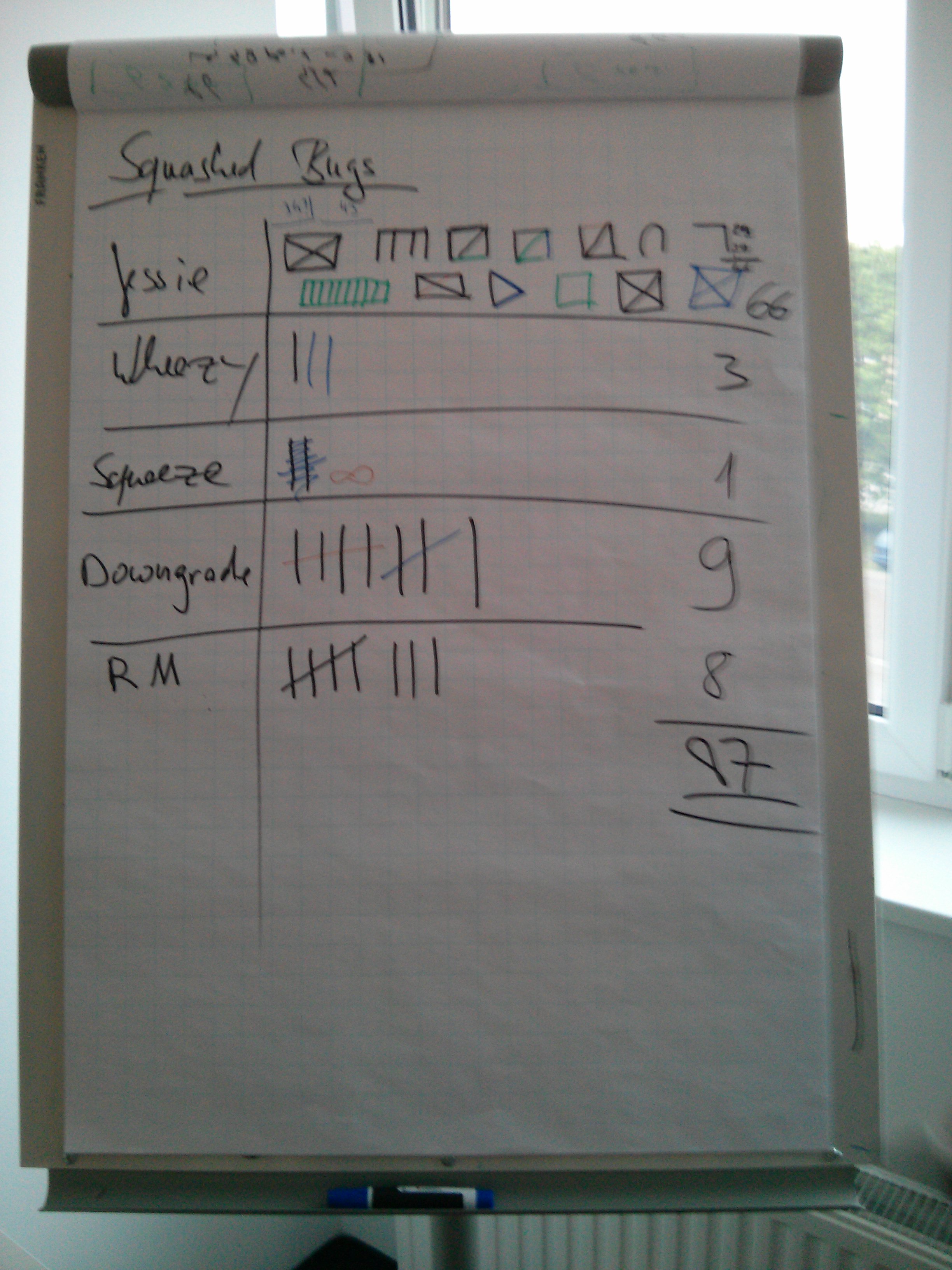
bsp2014_small This weekend, Bernd Zeimetz organized a BSP at the offices of conova in Salzburg, Austria. Three days of discussions, bugfixes, sparc removals and a lot of fun and laughter. We squashed a total of 87 bugs: 66 bugs affecting Jessie/Sid were closed, 9 downgraded and 8 closed via removals. As people tend to care about (old)stable, 3 bugs were fixed in Wheezy and one in Squeeze. These numbers might be not totaly correct, as were kinda creative at counting Marga promised a talk about an introduction to properly counting bugs using the Haus vom Nikolaus algorithm to the base of 7 . IMG_20140427_182902 Speaking of numbers, I touched the following bugs (not all RC): A couple of (non-free) pictures are available at Uwe s salzburg-cityguide.at. Thanks again to Bernd for organizing and conova and credativ for sponsoring!

Andrew Pollock: [life] Day 90: Kindergarten, and a motivational slump

My alternative option to quitting my day job so I could spend more time with Zoe was to take three months leave without pay. That wasn't really a great option, because it would mean that Zoe would only get one term of Kindergarten, and then I'd be back at work. Well today is the day that I'd go back to work if I took 3 months leave without pay. So far, I have zero regrets from doing the stay year-long at home Dad thing. At the end of the first week, I was absolutely exhausted, and a little worried that I'd bitten off more than I could chew, but since that point, I've found my stride and now I'm mostly just worried about what I'm going to do with myself next year. I'm really happy with the range of activities that I've been able to do with Zoe in the past 90 days. For this term, I'm going to do a combination of repeating some of the things we've done previously (Zoe's already asking to go ice skating again), and introduce her to a few new things that we didn't get a chance to do last term. As it starts to cool down a little bit more, we'll be looking around for more indoor activities to do, as well. Today though, I had a bit of a motivational slump. Zoe woke up, briefly, at 4:30am. I can't even remmeber why. I was smack bang in the middle of some serious REM sleep, so I found getting up to attend to her particularly jarring. I was a bit sluggish this morning as a result, and Zoe was also doing some spectacular procrastination. That coupled with rain meant we were a bit late getting to Kindergarten. The drop off itself went pretty well, and I drove home and had a late shower. There was a myriad of things I could have been doing, but I mostly just made a bunch of phone calls to organise things, did some more planning for Zoe's birthday party this Saturday, and waited for pick up time to roll around. I'll need to do a better job of being self-disciplined tomorrow. Kindergarten pick up was fine. I've been encouraging Zoe to reconsider napping at rest time, and the last two times I've picked her up, she hasn't napped, which has made for a much easier departure, and she hasn't been noticeably worse for wear for it. We went to take a look at the park we're having her birthday party in on Saturday, just to get a lie of the land in terms of tables and BBQs, and then we went to the Valley to clear my PO box. After that we went to the dance store in the Valley to get a leotard, socks and stockings for her ballet class. By the time we got home from all of that, there was only about an hour before Sarah was due to pick Zoe up, so she watched a bit of TV, and then we played hide and seek for a bit, and watered the seeds we've planted. I skipped yoga tonight because I'm still on lifting restrictions, and decided to skip Meatless Monday as well and hang out with my friend Michael and eat all the ribs I could handle. Boy was that an eating binge.

Next.

Previous.