Daniel Pocock: Real-time streaming market data with free software

Here is an overview of the real-time market data architecture based on OpenMAMA:
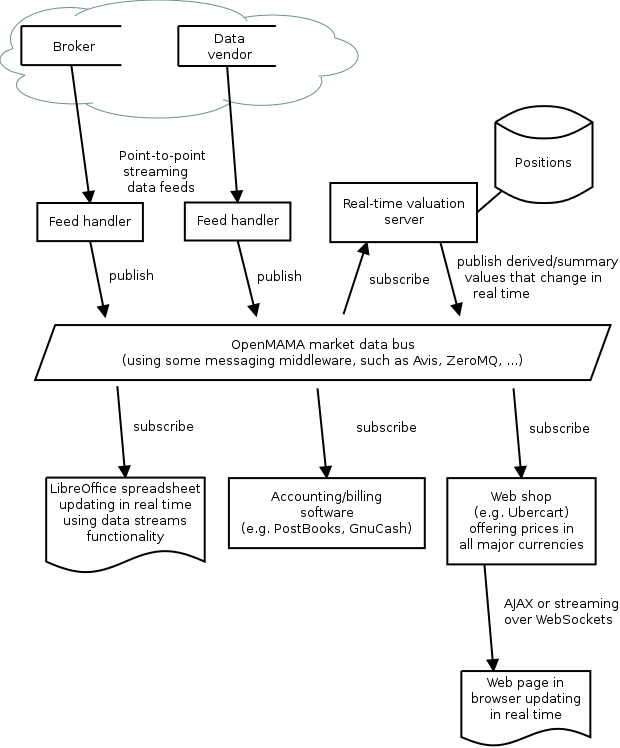 All these components may be running on a single host or they may be distributed across different servers and workstations in a LAN. The OpenMAMA market data bus ties them together.
External data sources
These are external sources of data. These could be currency trading firms, stock brokers, bullion dealers or even Bitcoin exchanges. Some exchanges don't provide data services directly to the general public and they distribute their price data through third-party data vendors such as Reuters and Bloomberg.
Feed handlers
The feed handlers manage the connections to external data sources. These are typically daemon processes that implement the wire protocols used by the external vendors for transmitting data over the public internet or a leased line. They typically use a point-to-point topology such as TCP connections.
The feed handlers publish the data into the market data bus.
In practice, the feed handler may be a proprietary application provided by the data vendor or it may simply be a Python script that fetches exchange rates from a URL every five minutes.
OpenMAMA
The market data bus is a distributed framework that is accessible to all of the local servers and workstations in the LAN.
At the lowest level a messaging middleware solution is used to transport the data. The Avis Event Router is a free middleware. There is upcoming support for Apache QPID as well. Some commcercial middleware is supported too - here is the full list
OpenMAMA does not provide a daemon or server process of its own. It is a set of libraries that operate on top of the middleware transport.
In very general terms, the OpenMAMA libraries let applications publish messages (such as price ticks) or subscribe to receive the messages published by other applications.
Spreadsheet application (for example, LibreOffice)
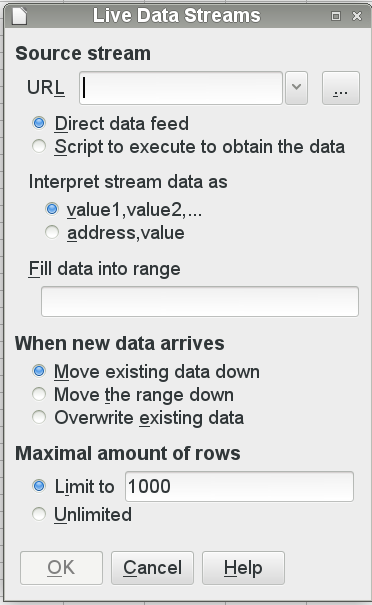
LibreOffice is introducing a new data import feature for streaming time series data. This appears to provide a useful integration point for OpenMAMA and discussion is taking place in the development community.
The spreadsheet can operate in various ways. A simple application may simply poll the currency prices when the spreadsheet is opened or refreshed. A more demanding application may see the spreadsheet come alive, recalculating all cells on every tick from the data vendor (several times per second). This latter scenario is more common in dealing rooms and hedge funds.
 Accounting/billing software
There are many free accounting applications today, including PostBooks and GnuCash and some more heavyweight solutions like Adempiere and OpenERP. In a world where credit cards and the world wide web have made international trade an everyday activity, many people are using this software to track expenses and accounts in more than one currency. For example, a British business may be paying some suppliers in Euros and a Canadian may be charging some customers in US dollars. A Swiss person may be keeping some of their savings in gold bullion in the vault of one of their world reknowned Swiss banks.
A common requirement for all of these users is the balance sheet. Using real-time market data sources, the balance sheet can be refreshed at any time from the live market prices. A home user may just find it convenient that they can open the balance sheet and always see their net worth immediately without having to manually cut and paste the currency prices from a web page. A business user operating in a competitive industry with low margins may be checking the balance sheet several times per day to ensure they remain solvent and profitable.
Web shops
Many web shops now offer the customers the convenience of viewing prices in their own currency. It is important to make sure these prices are accurate, especially when dealing with volatile currencies or when the products have a low profit margin.
The web application server can receive the market data price ticks just like any other application in the network. Using this data, it can insert live prices into the pages as they are generated. If the currencies are particularly volatile, the web application could stream the prices to the browser using WebSockets and a JavaScript client embedded in the page would update the price field in real time.
In fact, this web-based streaming price update mechanism is exactly how many online financial trading services offer live market prices to their customers.
Real-time valuation server
In a large organisation there may be many users looking at the same values. For example, in a trading desk, many users may need to see the desk's overall position in each market. In a busy web shop, many concurrent users may need to see the prices of common products.
Rather than recalculating these values for each user in parallel, a common solution involves setting up a server to receive raw values (such as currency prices) from the data feed, calculate values needed by local users and then broadcast those values over the market data bus.
How applications can integrate with real-time market data
Here are some steps for getting started:
All these components may be running on a single host or they may be distributed across different servers and workstations in a LAN. The OpenMAMA market data bus ties them together.
External data sources
These are external sources of data. These could be currency trading firms, stock brokers, bullion dealers or even Bitcoin exchanges. Some exchanges don't provide data services directly to the general public and they distribute their price data through third-party data vendors such as Reuters and Bloomberg.
Feed handlers
The feed handlers manage the connections to external data sources. These are typically daemon processes that implement the wire protocols used by the external vendors for transmitting data over the public internet or a leased line. They typically use a point-to-point topology such as TCP connections.
The feed handlers publish the data into the market data bus.
In practice, the feed handler may be a proprietary application provided by the data vendor or it may simply be a Python script that fetches exchange rates from a URL every five minutes.
OpenMAMA
The market data bus is a distributed framework that is accessible to all of the local servers and workstations in the LAN.
At the lowest level a messaging middleware solution is used to transport the data. The Avis Event Router is a free middleware. There is upcoming support for Apache QPID as well. Some commcercial middleware is supported too - here is the full list
OpenMAMA does not provide a daemon or server process of its own. It is a set of libraries that operate on top of the middleware transport.
In very general terms, the OpenMAMA libraries let applications publish messages (such as price ticks) or subscribe to receive the messages published by other applications.
Spreadsheet application (for example, LibreOffice)
LibreOffice is introducing a new data import feature for streaming time series data. This appears to provide a useful integration point for OpenMAMA and discussion is taking place in the development community.
The spreadsheet can operate in various ways. A simple application may simply poll the currency prices when the spreadsheet is opened or refreshed. A more demanding application may see the spreadsheet come alive, recalculating all cells on every tick from the data vendor (several times per second). This latter scenario is more common in dealing rooms and hedge funds.
Accounting/billing software
There are many free accounting applications today, including PostBooks and GnuCash and some more heavyweight solutions like Adempiere and OpenERP. In a world where credit cards and the world wide web have made international trade an everyday activity, many people are using this software to track expenses and accounts in more than one currency. For example, a British business may be paying some suppliers in Euros and a Canadian may be charging some customers in US dollars. A Swiss person may be keeping some of their savings in gold bullion in the vault of one of their world reknowned Swiss banks.
A common requirement for all of these users is the balance sheet. Using real-time market data sources, the balance sheet can be refreshed at any time from the live market prices. A home user may just find it convenient that they can open the balance sheet and always see their net worth immediately without having to manually cut and paste the currency prices from a web page. A business user operating in a competitive industry with low margins may be checking the balance sheet several times per day to ensure they remain solvent and profitable.
Web shops
Many web shops now offer the customers the convenience of viewing prices in their own currency. It is important to make sure these prices are accurate, especially when dealing with volatile currencies or when the products have a low profit margin.
The web application server can receive the market data price ticks just like any other application in the network. Using this data, it can insert live prices into the pages as they are generated. If the currencies are particularly volatile, the web application could stream the prices to the browser using WebSockets and a JavaScript client embedded in the page would update the price field in real time.
In fact, this web-based streaming price update mechanism is exactly how many online financial trading services offer live market prices to their customers.
Real-time valuation server
In a large organisation there may be many users looking at the same values. For example, in a trading desk, many users may need to see the desk's overall position in each market. In a busy web shop, many concurrent users may need to see the prices of common products.
Rather than recalculating these values for each user in parallel, a common solution involves setting up a server to receive raw values (such as currency prices) from the data feed, calculate values needed by local users and then broadcast those values over the market data bus.
How applications can integrate with real-time market data
Here are some steps for getting started:
- The OpenMAMA developers guide
- Sample code in the repository (for both C/C++ samples and Java samples)
- Build and install it from sources
- Use the packages on Debian or Ubuntu - RPM packages will hopefully be developed in the near future, most likely after the OpenMAMA build system update is complete.

 I suppose nobody at Microsoft remembers what it was like when everyone was
taking potshots at them, so they ve decided it s fair game to


 no exciting achievements but I still try to keep an eye on RC bugs:
 Over last months, I notice I'm not that active on IRC. Still, my
always connected IRSSI client was constantly connected to 12+ channels.
I just decided to reduce this to channels where I'm still (loosely)
active and maybe less likely to miss highlights (or answer then 3 days
later).
So, I'll stick to the following:


 This year, I had slowly taken again running. It's an activity I enjoy, even though I'm far from the condition I had when I did it every day My maximum was running about 8Km four days a week (ocassionally up to 15Km, say, on weekends)... But I slowly drifted out of it over the last three years. Yes, I have taken it up now and then, but dropped out again after a few weeks.
Well, this year it felt I was getting back in the routine. Not without some gaps, but I had ran most weeks since July at least once, but usually two times. I started slowly, doing about 3Km close to home, but didn't take much to go back to my usual routes inside UNAM, doing a modest average of 4.5-5Km per run, and averaging somewhat over 8Km/h (6.5 min/Km).
But... Well, I cannot relate precisely what happened on this Exactly a month ago, after a very average run (even a short one, 3.6Km), I had a lower back ache. Didn't pay too much attention to it, but it was strange since the first day, as I often have upper back aches Never lower.
The pain came and went slowly several times. I kept cycling to work, although not every day. On October 27th, I even took the time to do the Ciclot n, a nice 38Km (including the ~5Km distance from home) around central Mexico City. I enjoyed the ride, even though every stop and re-start of the bike was a bit painful what hurts is to get off and on the bike: The posture change. But the pain has been almost constantly there. When I stand up, or when I sit down, it's about five minutes until the body gets used to the new position and stops hurting.
Another strange data point: This last weekend (together with a national holiday) we went to a small conference in Guadalajara, and then to visit our friends in Guanajuato. So, we spent 12 hours on the bus there (12 Yes, there was an accident on the road, and we could not pass... So many hours were wasted there, and going back to a junction to take an alternative, longer road), then one night in a hotel bed, and two nights in our friends' guest mattresses which are not precisely luxury-grade. And Sunday night... I had no pain at all!
Came back home, and after only one night back in our bed... I just could not move. I had the strongest pain so far. Could not even walk without some help. We went to the orthopedist a friend recommended, and I was seriously bending my posture: While that part of my posture is usually stable, my right hip was about 2cm higher than the left one, and my shoulders were almost 7cm displaced from my hips!
So... Well, I'm having a cocktail of painkillers and antiinflamatories. The doctor says next week he wants me to have a tomography taken to better understand the causes for this.
And, of course, tomorrow I'm leaving for
 This is part 6 in


 I wanted to create a

 This is an essay form of a talk I have given today at the Cambridge
Mini-debconf. The talk was videoed, so will presumably show up in the
Debconf video archive eventually.
Abstract
Debian has a long and illustrious history. However, some of the things
we do perhaps no longer make as much sense as they used to do. It's a
new millennium, and we might find better ways of doing things. Things
that used to be difficult might now be easy, if we dare look at things
from a fresh perspective. I have been doing that at work, for the
Baserock project, and this talk is a compilation of observations based
on what I've learnt, concentrating on things that affect the
development workflow of package maintainers.
Introduction and background
I have been a Debian developer since August, 1996 (modulo a couple of
retirements), and have used it a little bit longer. I have done a
variety of things for Debian, from maintaining PGP 2 packages to
writing