Search Results: "nic"

9 June 2012

Stefano Zacchiroli: bits from the DPL for May 2012

Just posted to d-d-a, here are the monthly DPL bits.
Dear project members,
here's the periodic report of what has happened in DPL land, this time during May 2012. It's briefer than usual, as this year I've enjoyed the lovely French habit of frequent holidays during the month of May. Highlight First highlight for this month is an invitation to us all. We're now in June and the Wheezy freeze is literally a few days away. The RC bugs count is moving in the right direction, but it's still stellar if we want to ensure a short freeze. And a short freeze is of paramount importance: it'll reduce the time during which we can't implement great plans for the future, increase the "freshness" of software we'll ship with Wheezy, and reduce the inconveniences for those who run the testing suite due to its nice "rolling" feature. So please set out some regular time to do RC bug squashing, by providing patches and doing NMUs. Releasing Wheezy is not something that could be outsourced to the Release Team, it's a collective responsibility that kicks in as soon as our own packages are RC bug free (which they already are, right? :-)) The second highlight is more on the internal structure camp. As mentioned last month, I've discussed with the tech-ctte insisting a bit to set up periodic IRC meetings, to ensure outstanding issues get periodically reviewed. At the end of May the first IRC meeting has happened, and has been very productive. See the minutes. Another one has been scheduled, trying to setup a monthly cadence, for the end of June. Many thanks to all tech-ctte members who have took part in and helped with the meeting organization. Communication I've given an interview to iTWire, answering a number of questions about several past and future Debian challenges. Discussions The ongoing discussion to harmonize packaging of multimedia software between the official Debian archive and the unofficial debian-multimedia.org archive (dmo) has progressed. I've tried to help the two groups reaching an agreement on which packages belong where, so that both duplicate packaging efforts and user inconveniences are minimized. That seems not to have worked and dmo maintainers have simply announced that they will move away from the current domain name to a new one that does not include "debian" in its name. Sprints There will be a Debian Science sprint in June, co-located with the broader Debian Science event organized by European Synchrotron Radiation Facility (ESRF) in Grenoble. I've confirmed my attendance for the opening talk of the conference day. ESRF organizers have kindly sponsored travel for all Debian attendees, many thanks to them! Another sprint will happen next week-end in Paris, this time by the i18n/l10n team. I've approved the corresponding tentative budget for travel sponrship for ~2'000 EUR. Other expenses Hardware replacement plans go on. We've ordered SSDs (for ~3'000 CAD) for recently bought machines meant to replace bugs-mirror, bugs-master, and udd. On the "small emergencies" front, we also had to replace failing disks on wagner (1/2 of alioth), for as little as 100 GBP. Miscellanea Happy Wheezy freeze,
and RC bugs squashing!
PS the boring day-to-day activity log for May is available at master:/srv/leader/news/bits-from-the-DPL.txt.201205

8 June 2012

Joey Hess: going to DebConf 12

going to Debconf button Nicaragua here I come! I plan to be at DebCamp for a few days too, taking advantage of some time on internet-better-than-dialup to work on fixing the tasks on the CDs. Also will be available for one-on-one sessions on debhelper, debconf, debian-installer development, pristine-tar, or git-annex. Give me a yell if you'd like to spend some time learning about any of these. Also, my git-annex Kickstarter ends in 3 days. It has reached heights that will fund me, at a modest rate, for a full year of development! (I'm also about to start renting my house for the first time. Whee!)

Lars Wirzenius: Obnam 1.0 (backup software); a story in many words

tl;dr: Version 1.0 of Obnam, my snapshotting, de-duplicating, encrypting backup program is released. See the end of this announcement for the details. Where we see the hero in his formative years; parental influence From the very beginning, my computing life has involved backups. In 1984, when I was 14, my father was an independent telecommunications consultant, which meant he needed a personal computer for writing reports. He bought a Luxor ABC-802, a Swedish computer with a Z80 microprocessor and two floppy drives. My father also taught me how to use it. When I needed to save files, he gave me not one, but two floppies, and explained that I should store my files one one, and then copy them to the other one every now and then. Later on, over the years, I've made backups from a hard disk (30 megabytes!) to a stack of floppies, to a tape drive installed into a floppy interface (400 megabytes!), to a DAT drive, and various other media. It was always a bit tedious. The start of the quest; lengthy justification for NIH In 2004, I decided to do a full backup, by burning a copy of all my files onto CD-R disks. It took me most of the day. Afterwards, I sat admiring the large stack of disks, and realized that I would not ever do that again. I'm too lazy for that. That I had done it once was an aberration in the space-time continuum. Switching to DVD-Rs instead CD-Rs would reduce to the number of disks to burn, but not enough: it would still take a stack of them. I needed something much better. I had a little experience with tape drives, and that was enough to convince me that I didn't want them. Tape drives are expensive hardware, and the tapes also cost money. If the drive goes bad, you have to get a compatible one, or all your backups are toast. The price per gigabyte was coming down fast for hard drives, and it was clear that they were about to be very competitive with tapes for price. I looked for backup programs that I could use for disk based backups. rsync, of course, was the obvious choice, but there were others. I ended up doing what many geeks do: I wrote my own wrapper around rsync. There's hundred, possibly thousands, of such wrappers around the Internet. I also got the idea that doing a startup to provide online backup space would be a really cool thing. However, I didn't really do anything about that until 2007. More on that later. The rsync wrapper script I wrote used hardlinked directory trees to provide a backup history, though not in the smart way that backuppc does it. The hardlinks were wonderful, because they were cheap, and provided de-duplication. They were also quite cumbersome, when I needed to move my backups to a new disk the first time. It turned out that a lot of tools deal very badly with directory trees with large numbers of hardlinks. I also decided I wanted encrypted backups. This led me to find duplicity, which is a nice program that does encrypted backups, but I had issues with some of its limitations. To fix those limitations, I would have had to re-design and possibly re-implement the entire program. The biggest limitation was that it treated backups as full backup, plus a sequence of incremental backups, which were deltas against the previous backup. Delta based incrementals make sense for tape drives. You run a full backup once, then incremental deltas for every day. When enough time has passed since the full backup, you do a new full backup, and then future incrementals are based on that. Repeat forever. I decided that this makes no sense for disk based backups. If I already have backed up a file, there's no point in making me backup it again, since it's already there on the same hard disk. It makes even less sense for online backups, since doing a new full backup would require me to transmit all the data all over again, even though it's already on the server. The first battle I could not find a program that did what I wanted to do, and like every good NIHolic, I started writing my own. After various aborted attempts, I started for real in 2006. Here is the first commit message:
revno: 1
committer: Lars Wirzenius <liw@iki.fi>
branch nick: wibbr
timestamp: Wed 2006-09-06 18:35:52 +0300
message:
  Initial commit.
wibbr was the placeholder name for Obnam until we came up with something better. We was myself and Richard Braakman, who was going to be doing the backup startup with me. We eventually founded the company near the end of 2006, and started doing business in 2007. However, we did not do very much business, and ran out of money in September 2007. We ended the backup startup experiment. That's when I took a job with Canonical, and Obnam became a hobby project of mine: I still wanted a good backup tool. In September 2007, Obnam was working, but it was not very good. For example, it was quite slow and wasteful of backup space. That version of Obnam used deltas, based on the rsync algorithm, to backup only changes. It did not require the user to do full and incremental backups manually, but essentially created an endless sequence of incrementals. It was possible to remove any generation, and Obnam would manage the deltas as necessary, keeping the ones needed for the remaining generations, and removing the rest. Obnam made it look as if each generation was independent of each other. The wasteful part was the way in which metadata about files was stored: each generation stored the full list of filenames and their permissions and other inode fields. This turned out to be bigger than my daily delta. The lost years; getting lost in the forest For the next two years, I did a little work on Obnam, but I did not make progress very fast. I changed the way metadata was stored, for example, but I picked another bad way of doing it: the new way was essentially building a tree of directory and file nodes, and any unchanged subtrees were shared between generations. This reduced the space overhead per generation, but made it quite slow to look up the metadata for any one file. The final battle; finding cows in the forest In 2009 I decided to leave Canonical and after that, my Obnam hobby picked up in speed again. Below is a table of the number of commits per year, from the very first commit (bzr log -n0 awk '/timestamp:/ print $3 ' sed 's/-.*//' uniq -c awk ' print $2, $1 ' tac):
2006 466
2007 353
2008 402
2009 467
2010 616
2011 790
2012 282
During most of 2010 and 2011 I was unemployed, and happily hacking Obnam, while moving to another country twice. I don't recommend that as a way to hack on hobby projects, but it worked for me. After Canonical, I decided to tackle the way Obnam stores data from a new angle. Richard told me about the copy-on-write (or COW) B-trees that btrfs uses, originally designed by Ohad Rodeh (see his paper for details), and I started reading about that. It turned out that they're pretty ideal for backups: each B-tree stores data about one generation. To start a new generation, you clone the previous generation's B-tree, and make any modifications you need. I implemented the B-tree library myself, in Python. I wanted something that was flexible about how and where I stored data, which the btrfs implementation did not seem to give me. (Also, I worship at the altar of NIH.) With the B-trees, doing file deltas from the previous generation no longer made any sense. I realized that it was, in any case, a better idea to store file data in chunks, and re-use chunks in different generations as needed. This makes it much easier to manage changes to files: with deltas, you need to keep a long chain of deltas and apply many deltas to reconstruct a particular version. With lists of chunks, you just get the chunks you need. The spin-off franchise; lost in a maze of dependencies, all alike In the process of developing Obnam, I have split off a number of helper programs and libraries: I have found it convenient to keep these split off, since I've been able to use them in other projects as well. However, it turns out that those installing Obnam don't like this: it would probably make sense to have a fat release with Obnam and all dependencies, but I haven't bothered to do that yet. The blurb; readers advised about blatant marketing The strong points of Obnam are, I think: Backups may be stored on local hard disks (e.g., USB drives), any locally mounted network file shares (NFS, SMB, almost anything with remotely Posix-like semantics), or on any SFTP server you have access to. What's not so strong is backing up online over SFTP, particularly with long round trip times to the server, or many small files to back up. That performance is Obnam's weakest part. I hope to fix that in the future, but I don't want to delay 1.0 for it. The big news; readers sighing in relief I am now ready to release version 1.0 of Obnam. Finally. It's been a long project, much longer than I expected, and much longer than was really sensible. However, it's ready now. It's not bug free, and it's not as fast as I would like, but it's time to declare it ready for general use. If nothing else, this will get more people to use it, and they'll find the remaining problems faster than I can do on my own. I have packaged Obnam for Debian, and it is in unstable, and will hopefully get into wheezy before the Debian freeze. I provide packages built for squeeze on my own repository, see the download page. The changes in the 1.0 release compared to the previous one: The future; not including winning lottery numbers I expect to get a flurry of bug reports in the near future as new people try Obnam. It will take a bit of effort dealing with that. Help is, of course, welcome! After that, I expect to be mainly working on Obnam performance for the foreseeable future. There may also be a FUSE filesystem interface for restoring from backups, and a continous backup version of Obnam. Plus other features, too. I make no promises about how fast new features and optimizations will happen: Obnam is a hobby project for me, and I work on it only in my free time. Also, I have a bunch of things that are on hold until I get Obnam into shape, and I may decide to do one of those things before the next big Obnam push. Where; the trail of an errant hacker I've developed Obnam in a number of physical locations, and I thought it might be interesting to list them: Espoo, Helsinki, Vantaa, Kotka, Raahe, Oulu, Tampere, Cambridge, Boston, Plymouth, London, Los Angeles, Auckland, Wellington, Christchurch, Portland, New York, Edinburgh, Manchester, San Giorgio di Piano. I've also hacked on Obnam in trains, on planes, and once on a ship, but only for a few minutes on the ship before I got seasick. Thank you; sincerely SEE ALSO

7 June 2012

Riku Voipio: Adventures in perlsembly

Some Debian packages are missing important optimizations. This one was noticed when comparing openssl benchmarks by monkeyiq to the results got on a pandaboard (OMAP 4430). Being a Cortex-A9, it should have clearly been same or faster than the N9 in the benchmark (OMAP 3630). And it was, except for AES benchmarks. Since AES is quite important, that seemed a bit odd. Turns out, that Debian/Ubuntu package had some hand-crafted arm assembler optimizations missing. Enable them, and the results with openssl speed command benchmark were quite nice:

The 'numbers' are in 1000s of bytes per second processed.

benchmark debian with patch +%
sha1 55836.67k -> 73599.08k +31.811%
aes-128 cbc 18451.11k -> 36305.34k +96.765%
aes-256 cbc 13552.30k -> 27108.31k +100.027%
sha256 20092.25k -> 43469.45k +116.349%
sha512 8052.74k -> 37194.28k +361.884 %
rsa 1024 1904.2v/S -> 3650.5v/s +91.708 %
Curiously, the assembler code is actually in perl files that output assembler code. This kind of code is affectionately called "perlsembly". A bug with patch has been filed, hopefully applied at the soonest.

Rog rio Brito: I am not going to DebConf 12

Due to some real life impediments (including a beautiful one with just over 2 months of life called Daniel), I will not be able to go to this year's DebConf, even though it seems that this DebConf will exceed many expectations with the support that the governement of Nicaragua just offered. Things that I would like to have worked on Unfortunately, this means that I will not be working with some fellows that may be there, like people from the pkg-multimedia team. In particular, as I am working on some packages that are not that well suited to distributions (especially regarding HandBrake), it would be highly productive to have a hacking session or two with other people interested in having this popular and easy-to-use video ripper/transcoder on Debian. I would also like to be able to talk in person with other people (including Joey Hess) about controversial packaging of some programs, like GNU Parallel, which I maintain in Debian. There are many things else that I would love to work on, besides helping a bit with some of the still pending transitions of the the Debian Fonts Task Force umbrella, meeting friends and other social stuff. Oh, well. I guess that working at home will be the solution for some time.

6 June 2012

Christian Perrier: Developers per country (June 2012)

This is time again for my annual report about the number of developers per country. This is now the fourth edition of this report, after the 2011, 2010 and 2009 editions. So, here we are with the June 2012 version, sorted by the ratio of *active* developers per million population for each country.
Act: number of active developers
Dev: total number of developers
A/M: number of active devels per million pop.
D/M: number of devels per million pop.
2009: rank in 2009
2010: rank in 2010
2011: rank in 2011 (June)
2012: rank now
Code Name Population Act Dev Dev Act/Million Dev/Million 2009 2010 June 2011 June 2012
fi Finland 5259250 21 33 3,99 6,27 1 1 1 1
ie Ireland 4670976 12 15 2,57 3,21 13 9 6 2 *
ch Switzerland 7870134 20 26 2,54 3,3 2 2 2 3
mq Martinique 396404 1 1 2,52 2,52

3 4
se Sweden 9088728 22 37 2,42 4,07 3 6 7 5 *
no Norway 4973029 12 15 2,41 3,02 5 4 4 6
nz New Zealand 4331600 10 15 2,31 3,46 4 3 5 7
lu Luxemburg 503302 1 1 1,99 1,99 8 5 8 8
de Germany 81471834 155 223 1,9 2,74 7 7 9 9
at Austria 8217280 14 24 1,7 2,92 6 8 10 10
fr France 65350000 94 124 1,44 1,9 12 12 11 11
au Australia 22607571 29 57 1,28 2,52 9 10 12 12
be Belgium 11071483 13 16 1,17 1,45 10 11 13 13
uk United-Kingdom 62698362 71 111 1,13 1,77 14 14 14 14
nl Netherlands 16728091 18 38 1,08 2,27 11 13 15 15
ca Canada 33476688 31 60 0,93 1,79 15 15 17 16 *
dk Denmark 5529888 5 10 0,9 1,81 17 17 16 17
es Spain 46754784 32 53 0,68 1,13 16 16 19 18 *
it Italy 59464644 37 52 0,62 0,87 23 22 22 19 *
hu Hungary 10076062 6 11 0,6 1,09 18 25 26 20 *
cz Czech Rep 10190213 6 6 0,59 0,59 21 20 21 21
lt Lithuania 3535547 2 2 0,57 0,57 28 19 20 22
bg Bulgaria 7364570 4 4 0,54 0,54 25 23 23 23
us USA 313232044 165 368 0,53 1,17 19 21 25 24 *
il Israel 7740900 4 6 0,52 0,78 24 24 24 25
hr Croatia 4290612 2 2 0,47 0,47 20 18 18 26 *
lv Latvia 2204708 1 1 0,45 0,45 26 26 27 27
uy Uruguay 3477778 1 2 0,29 0,58 22 27 28 28
jp Japan 127078679 35 50 0,28 0,39 30 28 29 29
pl Poland 38441588 9 13 0,23 0,34 29 29 30 30
cr Costa Rica 4301712 1 1 0,23 0,23 31 30 31 31
ar Argentina 40677348 8 10 0,2 0,25 34 33 35 32 *
sg Singapore 5183700 1 1 0,19 0,19


33 *
pt Portugal 10561614 2 4 0,19 0,38 27 32 32 34
gr Greece 10787690 2 3 0,19 0,28 33 38 34 35
sk Slovakia 5477038 1 1 0,18 0,18 32 31 33 36
tw Taiwan 23040040 3 3 0,13 0,13 37 34 37 37
br Brazil 192376496 21 22 0,11 0,11 36 35 38 38
by Belarus 9577552 1 1 0,1 0,1 35 36 39 39
mg Madagascar 21281844 2 2 0,09 0,09 44 37 40 40
cu Cuba 11241161 1 1 0,09 0,09
38 41 41
kr South Korea 48754657 4 6 0,08 0,12 39 39 42 42
ec Ecuador 15007343 1 1 0,07 0,07
40 43 43
cl Chile 16746491 1 2 0,06 0,12 42 41 44 44
ru Russia 143030106 7 8 0,05 0,06 43 42 47 45 *
ro Romania 21904551 1 2 0,05 0,09 45 43 45 46
co Colombia 45566856 2 3 0,04 0,07 41 44 46 47
za South Africa 50590000 2 9 0,04 0,18 38 48 48 48
ve Venezuela 28047938 1 1 0,04 0,04 40 45 50 49
my Malaysia 28250000 1 1 0,04 0,04

49 50
pe Peru 29907003 1 1 0,03 0,03 46 46 51 51
tr Turkey 74724269 2 2 0,03 0,03 47 47 52 52
mx Mexico 112336538 2 2 0,02 0,02 49 49 53 53
th Thailand 66720153 1 2 0,01 0,03 50 50 54 54
eg Egypt 80081093 1 3 0,01 0,04 51 51 55 55
cn China 1344413526 9 13 0,01 0,01 53 53 57 56
in India 1210193422 8 8 0,01 0,01 52 52 56 57
sv El Salvador 7066403 0 1 0 0,14

36 58 *
ua Ukraine 45134707 0 0 0 0 48 53 58 59


920 1490 61,74%


A few interesting facts: PS: no, comments are still impossible on this blog. Yes, I know: not good. But I really don't want to have the hassle of dealing with spam and I'm old school. So, comments should be sent by mail to bubulle@d.o.

5 June 2012

Anand Kumria: Internet-o! Or why the Internode Business SLA is not worth a damn.

Last week (28th May), I had five Internet services across two countries. This week, I have seven (7), with two new ones in Australia. It all begin, when Internode decided that in their own best interest to migrate me from my existing DSLAM to one of their own infrastructure. They had sent an email indicating when it was likely to occur. And they were sending invoices to the same address. Naturally, they would send the date of the migration to the same address they had used for the past 9 months to communicate to me with, right? Wrong. Internode still do not understand why they never sent the notification email, as it turns out. Compare the response time, update times, and restore times they specify to what actually occurred.
2012-05-28 12:05 BST
I'm informed of an outage. In the past, the problem has been at my end, so I run through the standard diagnostic procedure. Everything seems to be normal, so I call Internode. Sure enough, our service dropped off the Internet. According to Timothy, that happened at 11:15 AEST because of a migration to their own DSLAM. After some diagnosis from Internode, they realise that whilst the migration has successfully disconnected the service, they have not reconnected anything. There is no sync. Ticket #454448 raised - which is when I'm informed that I'm on the business SLA. I've asked for updated to both an Australian and UK mobile. "Not a problem". Estimated time of resolution: 48 hours. Yes, 48 hours. There goes the first SLA milestone.
2012-05-30 07:28 BST
I ring and speak with Carl. He indicates that as best he knows, the service is to be 7pm. for those keeping score, no updates have occurred during this time. To either number. I query him about the SLA period. He says the response time is 2hrs and restore time is 10hrs. He also indicates that this can all be checked online and that we can apply for a refund.
2012-05-30 10:27 BST
I ring, again, and this time speak with Justin. I ask why I've not have an updated, since 7pm AEST has well and truly gone. He authenticates me and places me on hold to investigate. Advises that the issue is fixed, says he sees sync on the line. I indicate that I do not. He asks me to turn off the ADSL modem, we do, and he still sees sync. on the line. Believes there is another problem at the exchange, another issue raised with wholesaler. No ticket number issues to me. ETA to fix 7pm 2nd June. Note:This was a 1 hour International call
2012-06-01 04:00 BST
I happened to check, and notice I have connectivity to the external interfaces (and thus, obviously, line sync.) again. No notification though.
2012-06-01 14:31 BST
Amidst all this, I also have to to source two external connections - Telstra & Optus, get them setup, reconfigure routing, email delivery and other network services so that the businesses which are relying on the Internet, still work. Not fun. Especially when I have no access to the routers. I had to get multiple people on site.
2012-06-04 11:XX CEST
I'm told that the second site has gone done. Inexplicably. After some round-trip and diagnosis, we determine that the routing change has occurred. However it has been done incorrectly. And, of course, no notice / or update occurred either. Multiple tickets are raised by multiple people, amongst them: #4562559 from my mobile phone whilst I am in Zurich.
2012-06-04 16:56 CEST
I am informed, and it is confirmed, that the attempted routing change has been reverted and we are back to how things were on 2012-06-01.
2012-06-05 05:44 CEST
I wake up, and find out that of at least three hours ago, they appear to have called (finally!) and actually fixed the routing to both sites. That is a week of down time, multiple people (4 people) around in various countries around the World and hundreds of dollars in calls between us all to get things working. Now, to look into compensation.
2012-06-05 09:43 CEST
I receive a missed call, which I later learn is Internode actually calling me (for once!). At that moment, I'm actually giving a lightening talk on Django-PaaS
And that, dear reader, is why Internode Business SLA is a waste of money. The services were broken by a change of no net benefit to me, was over a week ago. Also, during this process. My UK home Internet went down. My UK Three post-paid service "ran out of money" and Vodafone has a service outage for half a day. A perfect storm of Internet dis-connectivity. So, if you have been wondering, that is why I've been offline for various parts of the last week.

Ond&#345;ej &#268;ert&iacute;k: How to convert scanned images to pdf

From time to time I need to convert scanned documents to a pdf format.


Usage scenario 1: I scan part of a book (i.e. some article) on a school's scanner that sends me 10 big separate color pdf files (one pdf per page). I want to get one nice, small (black and white) pdf file with all the pages.


Usage scenario 2: I download a web form, print it, fill it in, sign it, scan it on my own scanner using Gimp and now I want to convert the image into a nice pdf file (either color or black & white) to send back over email.

Solution: I save the original files (be it pdf or png) into a folder and use git to track it. Then create a simple reduce script to convert it to the final format (view it as a pipeline). Often I need to tweak one or two parameters in the pipeline.

Here is a script for scenario 1:
<script src="https://gist.github.com/2871625.js?file=reduce2.sh"></script>
And here for scenario 2:
<script src="https://gist.github.com/2871625.js?file=reduce1.sh"></script>
There can be several unexpected surprises along the way. From my experience:

In general, I am happy with my solution. So far I was always able to get what I needed using this "pipeline" method.

4 June 2012

Steve McIntyre: Wandering around Hong Kong

Jo and I flew in to HK a few days early for the Linaro conference, so we got some time to ourselves for doing touristy stuff. That was a good plan - we got to see quite a lot of Kowloon for a couple of days, then we wandered over to Hong Kong island itself for a day. Jo also had more time during the week while I was in the sessions at the conference. Hong Kong is a busy place, very densely packed at all times of day and night that we could see. The first impression we got on the taxi from the airport on day one was that it was a city full of tower blocks - huge numbers of apartments stacked very closely together for living space. That makes sense, I guess, with the large population in such a small space. There are houses around with more space for people to live, but they are understandably very expensive. Later on in Kowloon, we got to meet lots of the local street vendors, mostly offering us "Copy Rolex", "Fake handbag" and the like. Even "Sharp trousers" at one point. We decided not to try them out... :-) We saw lots and lots of very expensive shops downtown, crammed into huge shopping centres in the tourist area. As an antidote for all of that, we headed up to the "Golden Computer Arcade" to go browsing around the vast array of tiny technology stalls and shops there. Picked up some nice cheap laptop memory and some SD cards there. Yay! Across on Hong Kong island itself on Sunday, we found my grandfather's grave then rode around on the trams for a while to get a good view of the city, including a democracy protest that happened to be on that day! We had a quick look around Tin Hau Temple, where we found a very specific set of rules for visitors:
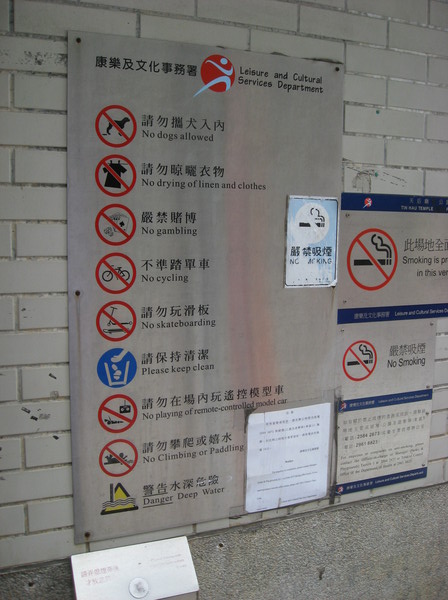
temple rules I can only guess that they must have been terrified by gangs of kids racing their RC cars at one point! We finished the day by heading up to Victoria Peak for the sunset view and some dinner, then back to the hotel. Killing time in a shopping centre waiting for the bus to turn up, we found a truly astonishing little item on sale, a Solar Queen!

solar queen Apparently this gift has a solar panel on the handbag to provide power to a little motor in the Queen's hand to make her wave to her subjects. We decided that we'd somehow have to live without such a delight in our lives... :-) HK was a cool place to visit. It still feels very British in some ways, as you'd expect from an ex-colony (power sockets are still the same as ours, driving on the left, everybody spoke English, etc.) but utterly alien in others (the climate, working public transport *grin*). I look forwards to heading out there again!

3 June 2012

Junichi Uekawa: Hello June.

Hello June.

2 June 2012

Petter Reinholdtsen: Debian Edu interview: Mike Gabriel

Back in 2010, Mike Gabriel showed up on the Debian Edu and Skolelinux mailing list. He quickly proved to be a valuable developer, and thanks to his tireless effort we now have Kerberos integrated into the Debian Edu Squeeze version. Who are you, and how do you spend your days? My name is Mike Gabriel, I am 38 years old and live near Kiel, Schleswig-Holstein, Germany. I live together with a wonderful partner (Angela Fu ) and two own children and two bonus children (contributed by Angela). During the day I am part-time employed as a system administrator and part-time working as an IT consultant. The consultancy work touches free software topics wherever and whenever possible. During the nights I am a free software developer. In the gaps I also train in becoming an osteopath. Starting in 2010 we (Andreas Buchholz, Angela Fu , Mike Gabriel) have set up a free software project in the area of Kiel that aims at introducing free software into schools. The project's name is "IT-Zukunft Schule" (IT future for schools). The project links IT skills with communication skills. How did you get in contact with the Skolelinux/Debian Edu project? While preparing our own customised Linux distribution for "IT-Zukunft Schule" we were repeatedly asked if we really wanted to reinvent the wheel. What schools really need is already available, people said. From this impulse we started evaluating other Linux distributions that target being used for school networks. At the end we short-listed two approaches and compared them: a commercial Linux distribution developed by a company in Bremen, Germany, and Skolelinux / Debian Edu. Between 12/2010 and 03/2011 we went to several events and met people being responsible for marketing and development of either of the distributions. Skolelinux / Debian Edu was by far much more convincing compared to the other product that got short-listed beforehand--across the full spectrum. What was most attractive for me personally: the perspective of collaboration within the developmental branch of the Debian Edu project itself. In parallel with this, we talked to many local and not-so-local people. People teaching at schools, headmasters, politicians, data protection experts, other IT professionals. We came to two conclusions: First, a technical conclusion: What schools need is available in bits and pieces here and there, and none of the solutions really fit by 100%. Any school we have seen has a very individual IT setup whereas most of each school's requirements could mapped by a standard IT solution. The requirement to this IT solution is flexibility and customisability, so that individual adaptations here and there are possible. In terms of re-distributing and rolling out such a standardised IT system for schools (a system that is still to some degree customisable) there is still a lot of work to do here locally. Debian Edu / Skolelinux has been our choice as the starting point. Second, a holistic conclusion: What schools need does not exist at all (or we missed it so far). There are several technical solutions for handling IT at schools that tend to make a good impression. What has been missing completely here in Germany, though, is the enrolment of people into using IT and teaching with IT. "IT-Zukunft Schule" tries to provide an approach for this. Only some schools have some sort of a media concept which explains, defines and gives guidance on how to use IT in class. Most schools in Northern Germany do not have an IT service provider, the school's IT equipment is managed by one or (if the school is lucky) two (admin) teachers, most of the workload these admin teachers get done in there spare time. We were surprised that only a very few admin teachers were networked with colleagues from other schools. Basically, every school here around has its individual approach of providing IT equipment to teachers and students and the exchange of ideas has been quasi non-existent until 2010/2011. Quite some (non-admin) teachers try to avoid using IT technology in class as a learning medium completely. Several reasons for this avoidance do exist. We discovered that no-one has ever taken a closer look at this social part of IT management in schools, so far. On our quest journey for a technical IT solution for schools, we discussed this issue with several teachers, headmasters, politicians, other IT professionals and they all confirmed: a holistic approach of considering IT management at schools, an approach that includes the people in place, will be new and probably a gain for all. What do you see as the advantages of Skolelinux/Debian Edu? There is a list of advantages: international context, openness to any kind of contributions, do-ocracy policy, the closeness to Debian, the different installation scenarios possible (from stand-alone workstation to complex multi-server sites), the transparency within project communication, honest communication within the group of developers, etc. What do you see as the disadvantages of Skolelinux/Debian Edu? Every coin has two sides: Technically: BTS issue #311188, tricky upgradability of a Debian Edu main server, network client installations on top of a plain vanilla Debian installation should become possible sometime in the near future, one could think about splitting the very complex package debian-edu-config into several portions (to make it easier for new developers to contribute). Another issue I see is that we (as Debian Edu developers) should find out more about the network of people who do the marketing for Debian Edu / Skolelinux. There is a very active group in Germany promoting Skolelinux on the bigger Linux Days within Germany. Are there other groups like that in other countries? How can we bring these marketing people together (marketing group A with group B and all of them with the group of Debian Edu developers)? During the last meeting of the German Skolelinux group, I got the impression of people there being rather disconnected from the development department of Debian Edu / Skolelinux. Which free software do you use daily? For my daily business, I do not use commercial software at all. For normal stuff I use Iceweasel/Firefox, Libreoffice.org. For serious text writing I prefer LaTeX. I use gimp, inkscape, scribus for more artistic tasks. I run virtual machines in KVM and Virtualbox. I am one of the upstream developers of X2Go. In 2010 I started the development of a Python based X2Go Client, called PyHoca-GUI. PyHoca-GUI has brought forth a Python X2Go Client API that currently is being integrated in Ubuntu's software center. For communications I have my own Kolab server running using Horde as web-based groupware client. For IRC I love to use irssi, for Jabber I have several clients that I use, mostly pidgin, though. I am also the Debian maintainer of Coccinella, a Jabber-based interactive whiteboard. My favourite terminal emulator is KDE's Yakuake. Which strategy do you believe is the right one to use to get schools to use free software? Communicate, communicate, communicate. Enrol people, enrol people, enrol people.

1 June 2012

C.J. Adams-Collier: Vacation Tasks

So, I m taking vacation this week and next. Here s a (partial) list of tasks that are left to do: That s probably enough, if not too much. Here s some of the bits I ve done this week: And probably some other stuff ;-)

Pietro Abate: apt-get with external solvers : call for testers

Last year we invited David to work with us for a few days to add a generic interface to apt to call external solvers. After a few iterations, this patch finally landed in master and recently (about 3 months ago), in debian unstable.
  [ David Kalnischkies ]
  * [ABI-Break] Implement EDSP in libapt-pkg so that all front-ends which
    use the internal resolver can now be used also with external
    ones as the usage is hidden in between the old API
  * provide two edsp solvers in apt-utils:
    - 'dump' to quickly output a complete scenario and
    - 'apt' to use the internal as an external resolver
Today the new version of apt-cudf was upload in unstable and with it the latest bug fixes that makes it ready for daily use. I've used it quite a lot myself to upgrade my machine and it seems working pretty well so far... The most important difference with the old version is the support for multi-arch enabled machines. This marks an important milestone in our efforts to integrate external solvers, built using different technologies, directly into apt. From a user prospective, this means that (s)he will have the possibility to check if there exists a better (best ?) solution to an installation problem then what proposed by the internal apt solver. Moreover, even if apt-get gives very satisfactory answers, there are occasions where it fails miserably, leaving the user wondering how to unravel the complex web of dependencies to accomplish his task. Available cudf solvers in debian are at the moment : aspcud, mccs and packup. From an architectural point of view this is accomplished by abstracting the installation problem via a simple textual protocol (EDSP) and using an external tool to do the heavy duty translation. Since all solvers now available in debian are not meant to be debian-specific, using them involve a two step translation. The EDSP protocol specification is for the moment "hidden" in the apt documentation. I hope to find a better place for it soon : it would be cool if other package managers as smart or cupt could add an implementation on EDSP in their code so to automatically benefit of this technology. To make it happen, Apt first creates an EDSP file that is then handled to apt-cudf that takes care of the translation to cudf and back into EDSP that is then read back by apt. Apt-cudf is the bridge between edsp and the external solvers and takes care of doing the book keeping and to select the right optimization criteria. Roberto recently wrote a very nice article explaining how to use apt-get with an external solver. In a nutshell, if you want to try this out you just need to install apt-cudf, one external solver like aspcud from the university of Pasdam and then call apt-get using the --solver option (that is not yet documented #67442 ). For example :
apt-get install -s gnome --solver aspcud
This will install gnome while using the a optimization criteria that tries to minimizing the changes on the system. Various other optimization criteria for all apt-get default actions can be specified in the apt-cudf configuration file /etc/apt-cudf.conf I hope the new release of apt-cudf make it into testing before the freeze. Time to test !!!

Rapha&#235;l Hertzog: My Debian Activities in May 2012

This is my monthly summary of my Debian related activities. If you re among the people who made a donation to support my work (338.26 , thanks everybody!), then you can learn how I spent your money. Otherwise it s just an interesting status update on my various projects. Dpkg Like last month, I did almost nothing concerning dpkg. This will probably change in June now that the book is out The only thing worth noting is that I have helped Carey Underwood who was trying to diagnose why btrfs was performing so badly when unpacking Debian packages (compared to ext4). Apparently this already resulted in some btrfs improvements. But not as much as what could be hoped. The sync_file_range() calls that dpkg are doing only force the writeback of the underlying data and not of the meta-data. So the numerous fsync() that follow still create many journal transactions that would be better handled as one big transaction. As a proof of this, replacing the fsync() with a sync() brings the performance on par with ext4. (Beware this is my own recollection of the discussion, while it should be close to the truth, it s probably not 100% accurate when speaking of the brtfs behaviour) Packaging I uploaded new versions of smarty-gettext and smarty-validate because they were uninstallable after the removal of smarty. The whole history of smarty in Debian/Ubuntu has been a big FAIL since the start. Once upon a time, there was a smarty package and some plugins. Everything was great except that the files were installed in a way that differs from the upstream recommendations. So Ubuntu changed the path in their version of the package and did not check whether it broke anything else (and it did break all the plugins). Despite the brokenness of the plugins, this divergence survived for years. So several packages that were using Smarty were modified to use dpkg-vendor to use the correct path depending on whether it was built on Debian or Ubuntu. In 2010, Smarty 3.0 has been released and instead of upgrading the smarty package to this version, one of the smarty co-maintainers introduced a smarty3 package that used yet another path (despite the fact that smarty 3 had a mode to be compatible with smarty 2).


At some point, I informed him that he had to handle the migration of users of smarty to smarty3 he acknowledged and then lost interest in smarty ( I m no longer using it ) and did nothing. After some more bitrot, smarty has been forcefully orphaned in August 2011 by a member of the security team. And in March this year, it has been removed from unstable despite the fact that it still had reverse dependencies (usually removals only happen when they impact no other packages, I don t know why this wasn t the case here). At least the brokenness attracted some attention to the situation and Mike Gabriel contacted me about it. I offered him to take over the various packages since they all needed a real maintainer and he accepted. I sponsored his uploads of all smarty related packages (bringing in the latest upstream versions at the same time). In the end, the situation is looking better now, except that there s no migration path from users who rely on smarty in Squeeze. They will discover that they need smarty3 in Wheezy and that the various paths have to be adjusted. It s probably acceptable since the new upstream versions are no longer backwards compatible with smarty 2 The Debian Administrator s Handbook At the start of the month, I was busy preparing the release of the book. I introduced the publican-debian package to unstable, it s a Publican brand (aka a set of CSS and XSL stylesheets to tailor the output of Publican) using the Debian colors and using the Debian logo. This brand is used by the book. I also created the debian-handbook package and setup the public Git repository on alioth.debian.org. I was ready or so I thought. A few hours after the announce, the website became unusable because the numerous visitors were exhausting the maximum number of client connections. And I could not increase the limit due to Apache s memory usage (with PHP and WordPress). We quickly off-loaded most of the static files traffic to another machine and we setup bittorrent. The problem was solved for the short term. Thousands of persons downloaded the ebook and to this date, 135 copies of the paperback have been sold. Then I took a one-week vacation. Even though I had no Internet at the place I was, I wandered in the street to find a Freewifi wifi network (customers of the Free ISP can use those freely) to stay on top of incoming email. We quickly received some bug reports and I dealt with the easy ones (typos and the like) on the fly. When I came back at home, I manually placed 54 lulu orders for the people who opted for the paperback as reward during the fundraising campaign. A bit tedious but it had to be done (if only Lulu supported a way to batch many orders at once ). I also wanted a long term solution to avoid the use of an external host to serve static files (should a new traffic spike arrive ). So I installed nginx as a front-end. It serves static files directly, as well as WordPress pages which have been cached by wp-super-cache. Apache is still here listening on a local port and responding to the remaining queries forwarded by nginx. Once I ll migrate to wheezy, I might completely ditch apache in favor of php5-fpm to handle the PHP pages. Last but not least, I wanted to bootstrap the various translations that people offered to contribute. I wrote some documentation for interested translators and blogged about it. It s shaping up nicely check it out if you re interested to help! Thanks See you next month for a new summary of my activities.

No comment Liked this article? Click here. My blog is Flattr-enabled.

31 May 2012

Maximilian Attems: New klibc release 2.0

The new klibc features prominently the merged stdio branch (causing the version bump). The buffered I/0 allows a faster fstype and thus faster boot. Plus klibc gained the support of several stream I/O functions, for details see the longer story on: klibc 2.0 release announcement or klibc git repository. The dhcp cmd ipconfig can now generate enough info for a proper lease file too and got fixed concerning the min length of it's replies. Google sponsored the /etc/fstab or cmdline boot mounting in kinit. 2.0 is shipping several arch fixes including i386 signal fixes, m68 support, s390x, sh4 compile fixes. There is still portability work todo: #439181 ia64 shared lib buggy (longdated unresolved ia64 mystery), #634890 amrhf all binaries segfault (maybe signal related), status on parisc is unknown, avr32 patch is untested (might as well just merge) and sh4 SIGILL. We got nice arch testcoverage thanks to mksh testsuite and working mksh klibc support. We are confident of this release on all this archs: alpha, armel, m68k, mips, ppc, ppc64, sparc, s390, s390x and x86. (:

Russell Coker: Links May 2012

Vijay Kumar gave an interesting TED talk about autonomous UAVs [1]. His research is based on helicopters with 4 sets of blades and his group has developed software to allow them to develop maps, fly in formation, and more. Hadiyah wrote an interesting post about networking at TED 2012 [2]. It seems that giving every delegate the opportunity to have their bio posted is a good conference feature that others could copy. Bruce Schneier wrote a good summary of the harm that post-911 airport security has caused [3]. Chris Neugebauer wrote an insightful post about the drinking culture in conferences, how it excludes people and distracts everyone from the educational purpose of the conference [4]. Matthew Wright wrote an informative article for Beyond Zero Emissions comparing current options for renewable power with the unproven plans for new nuclear and fossil fuel power plants [5]. The Free Universal Construction Kit is a set of design files to allow 3D printing of connectors between different types of construction kits (Lego, Fischer Technic, etc) [6]. Jay Bradner gave an interesting TED talk about the use of Open Source principles in cancer research [7]. He described his research into drugs which block cancer by converting certain types of cancer cell into normal cells and how he shared that research to allow the drugs to be developed for clinical use as fast as possible. Christopher Priest wrote an epic blog post roasting everyone currently associated with the Arthur C. Clarke awards, he took particular care to flame Charles Stross who celebrated The Prestige of such a great flaming by releasing a t-shirt [8]. For a while I ve been hoping that an author like Charles Stross would manage to make more money from t-shirt sales than from book sales, Charles is already publishing some of his work for free on the Internet and it would be good if he could publish it all for free. Erich Schubert wrote an interesting post about the utility and evolution of Favebook likes [9]. Richard Hartmann wrote an interesting summary of the problems with Google products that annoy him the most [10]. Sam Varghese wrote an insightful article about the political situation in China [11]. The part about the downside of allowing poorly educated people to vote seems to apply to the US as well. Sociological Images has an article about the increased rate of Autism diagnosis as social contagion [12]. People who get their children diagnosed encourage others with similar children to do the same. Vivek wrote a great little post about setting up WPA on Debian [13]. It was much easier than expected once I followed that post. Of course I probably could have read the documentation for ifupdown, but who reads docs when Google is available? Related posts:
  1. Links March 2012 Washington s Blog has an informative summary of recent articles about...
  2. Links April 2012 Karen Tse gave an interesting TED talk about how to...
  3. Links February 2012 Sociological Images has an interesting article about the attempts to...

Richard Hartmann: Potpourri II

Traffic jams suck; but they do give you a chance to think and blog. Truckers hams are telling me that four trucks are totalled and need to be removed by the THW. As the trucker next to me just broke out his gas grill and several people are joining him in a spontaneous BBQ, I don't expect to be moving any time soon. Kicking things along This is coming along nicely RAID 4 Unless you are forced to support legacy systems or playing RAIDemon and gotta try them all, there is no valid use case for RAID 4. So doing so is a patently bad idea. RAID 5 is always the better option as you are not relying on a single disk which contains the checksums, but use striping to distribute them. RAID 4 has a chance of 1/n that a failed disk will force all remaining disks to read all respective sectors and then the controller/CPU to XOR everything. There is a reason why RAID 3 was replaced with RAID 4; just as there's a reason why RAID 4 was replaced by RAID 5. Don't use RAID 4. Seriously. Tom Tom vs OSM In case you have been following the news in the GPS circles, you will have noticed that TomTom pretty gave up on innovating and resigned themselves to dying a slow death. Well that and to start a nice amount of FUD. While they have been rebuked pretty thoroughly already, I wanted to add my own POV. There is a kernel of truth in what TomTom said inasmuch they state that pedestrian paths are better than car paths. Of course, while they got the relative quality right, they are wrong about the absolute quality of the data. They claim pedestrian is OK and motorized is bad. In my experience, maps for motorized traffic are good while pedestrian tracks are mind-boggingly great. These days, most people (and probably all who read this) will be at least somewhat familiar with the quality of OSM in the random cities they visit over the year. The common verdict is usually "very nice". But that's not where OSM shines. It's in the lesser-known places where you don't expect too many tech-minded people to come along where it starts to really impress me. While I found a few stubs on a dead-end street in Akureyri which were not mapped, every foot trail I ever walked along in Iceland has been mapped. ski-doo tracks on Svalbard? Check. Backyard in Novosibirsk? Check, as well. And we are talking "packed earth track in between garages opening up into a 'playground' where a man and a pregnant women are passing a bottle back and forth while smoking and watching over their two kids who play next to a middle-aged man who is lying on the ground wasted, using a rock as a pillow all the while an extremely blingy Mercedes with two muscle-packed thugs is cruising by, all in the time it took us to walk through". Mapped. Horse tracks and hiking trails in Mongolia? Yep. Hutongs in Beijing including alleys so narrow you have to walk single file? Of course. Richard Fairhurst is right that the plural of anecdote is not data, but OSM is good. TomTom is afraid for a reason. As an aside, I find the picture used in TomTom's newsletter extremely funny; I am sure they didn't intend this, but hey. Windows 100-300 MiB for any random driver installation package is par for the course. Be it GFX, audio, or network card. If you plug in a different USB mouse, Windows 7 will take several seconds while "setting up" a standard USB HID device. And hitting ctrl-alt-del in the login screen or while logged in does not give you a quick way to shut down or reboot the machine. As I am breaking out the Windows installation every month to install updates and every six months to actually use this does not affect me a lot. Still, it's amazing that so many people are putting up with this. UEFI It's nice to see that Matthew Garrett is still going strong. I am not sure if this is the best way, but it seems to be a workable solution while in between a rock and a hard place. Not sure about the requirements of GPLv3 with regards to the keys Fedora will use to sign GRUB 2 with. From what I remember without rereading the license, as long as Fedora is not selling a system on which you can not disable secure boot they should be in the clear. IANAL, IIRC, etc. Wrapping up And I have not moved a single meter, other than making way to a police motorbike, in over an hour. Pity I don't have anything to BBQ with me; smells delicious over there.

30 May 2012

Sorina Sandu: Initial commit

Hello!

I'm Sorina and this summer I will be working on Debian Installer network setup during Google Summer of Code. I am a second year bachelor's student at Politehnica University of Bucharest, I am studying Computer Science. I very much enjoy what I am doing even if sometimes I feel that the amount of stuff I want/have to learn/do/work on is infinite and I don't really know where to start.

I am at the beginning of the project, I believe now I am accustomed to the way things work and I am waiting forward to finishing the exam period so that I could really start working.

The hardest part for me in what I've done so far is testing what I am doing. It took me a while to figure out at least a part of how the installer functions and to solve the problems that occurred while building. Luckily, there is documentation and internet and even more important, I had help and support from my mentors.

So far I have only written two patches for netcfg, for bugs #610752 and #636211. For the first one I had a version for a while now, but I was unable to test it (unfortunately, it's likely that you will hear this a lot in the future). The idea was to make the link detection timeout preseedable and for this I have added two new templates, asking the user to provide a value for that matter.

The second one involved a missing "Go Back" button. This seemed to be the result of not letting debconf know that the program is capable of handling the user pressing a back button. That could be solved using deb_capb.

As I said before, testing was my main problem. Eventually, I built the image, wrote it to an USB and rebooted my laptop. This served its purpose, since I had access to anything I needed such as the wireless interface and physical access to the network cable. Running it through a virtual machine did not help much in this case, because I was unable to provide those.

Another thing I considered to be hard was blog posting, but now that I have just finished my first post it seems that I overreacted.

That's all for now, have a nice day!

Michal &#268;iha&#345;: Four counferences in Prague this October

I'm participating on organizing this year's openSUSE conference and as we've finally finalized place and time and CFP is open, it's time to share some information. This will be special - there is not a single conference, but four of them are sharing same space and the motto - Bootstrapping awesome!!!. The 4th openSUSE conference will be held together with LinuxDays, Czech conference following tradition of canceled LinuxExpo, what should be the biggest free software event in Czech republic. In addition there will be also 12th SUSE Labs conference (so you can meet quite a lot of kernel hackers and other strange guys) and first Gentoo mini summit (the website is empty so far). All that will happen on weekend from 20th October to 21st October, the SUSE conferences will then continue for 22nd and 23rd October. I believe it will be great mixture of conferences and I hope to meet lot of people there.

Filed under: English Gentoo Suse 0 comments Flattr this!

Lucas Nussbaum: Debian archive rebuilds on Amazon Web Services

I like to think that archive rebuilds play an important role in Debian Quality Assurance and Release Management efforts. By trying to rebuild every Debian package from source, one can identify packages that do not build anymore due to changes in other packages (compilers, interpreters, libraries, ). It is also a good way to stress-test all packages that are involved in building other packages. Since 2007, I had been running Debian archive rebuilds on the Grid 5000 testbed, a research infrastructure for performing experiments on distributed systems HPC/Grid/Cloud/P2P. I filed more than 6000 release-critical bugs in the process. Late last year, Amazon kindly offered us a grant to allow us to run such QA tests on Amazon Web Services. With S bastien Badia, we ported the rebuild infrastructure to AWS (scripts), and several rebuilds have already been carried out on AWS. On the technical level, 50 to 100 EC2 spot instances are started, and then controlled from a master instance using SSH. On build instances, a classic sbuild setup is used. Logs are retrieved to the master node after rebuilds, and build instances are simply shut down when there are no more tasks to process. Several tasks are processed simultaneously on each instance, and when they fail, they are retried again with no other concurrent build on the same instance, to eliminate random failures caused by load or timing issues. All the scripts are designed to support other kind of QA tests, not just rebuilds. Moving to Amazon Web Services will facilitate sharing the human workload of doing those tests. It is now possible for developers interested in custom tests to do them themselves (hint hint).

Next.

Previous.