Search Results: "ms"

16 September 2015

Ben Hutchings: Debian LTS work, August 2015

This was my ninth month working on Debian LTS. I was assigned 15 hours of work by Freexian's Debian LTS initiative. Front desk I spent another week in the 'front desk' role, largely overlapping with DebConf. I investigated which new CVEs affected LTS-supported packages in squeeze, recorded this in the secure-testing repository, and mailed the package maintainers to give them a chance to handle the updates. I found that one claimed security flaw in glusterfs was actually harmless for all supported Debian releases. conntrack conntrack had one new issue (CVE-2015-6496, possible remote DoS if certain kernel modules aren't loaded). I didn't find a way to reproduce it, but it still seemed to be applicable to squeeze (but for fewer protocols). I was able to backport the upstream fix without difficulty, after which I uploaded and issued DLA-295-1. DebConf I attended the LTS BoF at DebConf 15 to discuss the plans for wheezy LTS. Raphael just posted a summary of these discussions. linux-2.6 I spent some time on kernel security fixes, but haven't uploaded an update yet. That will probably come in September.

Russ Allbery: Review: The Goblin Emperor

Review: The Goblin Emperor, by Katherine Addison
Publisher: Tor
Copyright: April 2014
ISBN: 1-4299-4640-7
Format: Kindle
Pages: 446
Maia is the child of the current emperor of the Elflands, but not a favored one. He's the half-goblin son of a political marriage to a goblin princess, quickly orphaned away from the capital and kept in seclusion well out of the way of his father and court politics. And in the care of his cousin Setheris: cruel and abusive companionship. Then the airship Wisdom of Choharo crashes with no survivors, killing everyone in the line of succession. Except Maia. Maia is in no way prepared to be emperor, but the rules of succession are clear: he is now emperor. We all know from medieval history, both real and fantastic, that clear rules rarely got in the way of aggressive political maneuvering, but Maia's short-term survival is helped considerably by complex factions at play at court (of which he is almost wholly ignorant), and a certain lack of bloodthirstiness in elven politics. Rather than disposing of the unexpected heir, people instead start maneuvering to manipulate and control him. The current Lord Chancellor is the first, beginning his play in the message sent informing Maia of his father's death, and his cousin isn't far behind, but they're only the first two. Meanwhile, Maia, who had never been trained for any sort of court life, has to learn nearly everything about his new life: how to interact with servants, the rituals of court, his new duties, and all of the factions in play. One might expect that Maia would quickly be reduced to a pawn of one faction or another, but he has two secret weapons. One is that he is a legitimately nice person with a strongly developed sense of empathy. Early on, he lucks into some opportunities to show this and wins some popularity and some allies of his own, particularly among those people not used to being treated with respect. And two, he's had enough of his cousin controlling and abusing him. He's determined to make his own decisions and not take orders from someone else, and now has enough nominal power to possibly pull this off. The Goblin Emperor is a fantasy of political agency, and a story about political maneuvering, tricky decisions, navigating alliances, and learning politics. There isn't a lot of action here: most of the plot happens in conversation. The tension is high Maia's situation is precarious but it mostly involves second-guessing his decisions and actions, and hoping that his weaknesses and ignorance don't get him into too much trouble. That is an extremely tricky book to write. Addison had to walk a tightrope between letting Maia's new responsibilities come unrealistically easily, making him seem like a Chosen One with special plot powers, and having readers get too frustrated with realistically bad decisions and lose their desire to read about him. Addison walks that tightrope magnificently. I liked Maia throughout this book, and that's the strength of it. He never felt like the typical fantasy coming of age hero who is magically protected by the plot. He's just a genuine, honest person, reacting to his own past as best he can, making the best decisions he knows how to make. He makes mistakes, but Addison wisely avoids making those mistakes cringe-worthy or too obvious. Instead, they're like bad moves in a chess match: they create problems but also some opportunities, and they're realistically recoverable. And it's a delight to see Maia bring empathy and a disinterested outside perspective to the hothouse mess of court politics and come up with some very creative solutions. Obviously, the situation that allows Maia to succeed is artificial. This is a fantasy: Maia happens to be just the right person the empire needs, and that's clearly an authorial construction. It may be impossible to write a political story about a well-meaning, naive outsider that isn't a tragedy without a bit of cheating. But Addison hides the cheating well. Maia may be very lucky in the empire he inherits, but it feels coherent and believable. By the end of the book, Maia has dealt with everything from international diplomacy to the incredibly complex negotiations around further heirs to the empire. And (realistically) he doesn't stay lucky throughout the book: eventually, no matter how careful he tries to be, he angers some powerful people. I enjoyed every step along the way, and would have happily read more about Maia. In my personal ranking, this was second only to Ancillary Sword in the nominees for the 2015 Hugo, and I wouldn't disagree too strongly with someone who argued it was better. It's not a typical sort of fantasy, but it's one I enjoyed very much. Recommended. One warning: consider going to the back of the book and reading the glossary at the start. There may be some mild spoilers in there, but it also explains the title conventions in the empire, and some of those titles look very much like proper names. If, like me, you don't read this until the end of the book, you may find yourself horribly confused by several apparently similarly-named characters. Rating: 8 out of 10

15 September 2015

Russ Allbery: Review: Let's Pretend This Never Happened

Review: Let's Pretend This Never Happened, by Jenny Lawson
Publisher: Berkley
Copyright: 2012, 2013
Printing: March 2013
ISBN: 0-425-26101-8
Format: Trade paperback
Pages: 366
Let's Pretend This Never Happened, subtitled (A Mostly True Memoir), is the closest that I've ever found to the book form of a stand-up comedy routine. Lawson grew up in rural Texas with a taxidermist father, frequent contact with animals in various forms of distress, an undiagnosed anxiety disorder, and a talent for creatively freaking out about things that never occur to anyone else. But, more importantly, she has a talent for putting down on paper the random thoughts that go through her head so the rest of us can read them. Not to mention excellent comic timing and absolute mastery of the strangely relevant digression. It's always tricky to review comedy. I think tastes differ more wildly in this genre than any other. Things some people find hilarious others will find offensive or just boring. That may be particularly true of Lawson, who, similar to some of the best stand-up comics, specializes in taking off filters and saying all sorts of offensive things that people might think but not say. This kind of comedy is a knife's edge, since it can easily turn into punching down. Lawson avoids this (rather well, in my opinion) by making herself the punch line of most of the jokes. A pretty typical paragraph of the book, so that you know the sort of thing that you're in for:
The following is a series of actual events pulled form my journal that led me to believe that our home was possessed by demons and/or built over an Indian burial ground. (Also, please note that the first part of this chapter actually happens just before the previous chapter, and the last part of it happens just after it. This could be viewed as "clunky and awkward," but I prefer to think of it as "intellectually challenging and chronologically surreal. Like if Memento was a book. About dead dogs and vaginas and puppets made out of squirrel corpses." You can feel free to use that quote if you're reviewing this chapter, or if you're a student and your teacher asks you, "What was the author trying to say here?" That was it. That's what I was trying to say. That and "Use condoms if you're going to have sex, for God's sake. There are a lot of skanks out there." That's not really covered in this book, but it's still good advice.)
That has a little bit of everything this book had for me: Lawson's somewhat surreal worries, the extended digression, a rhythm that's quite compelling once you start reading it, random uncomfortable topics, and the occasional miss that I don't find funny (the last few sentences). It's all mixed together in a slightly breathless rush of narrative momentum. For more samples, Lawson's writing started as a blog and she's still actively blogging, so you can get a good advance sample by reading some of The Bloggess. Her tone there matches the book closely. What makes this book more than only comedy is that Lawson is very open about her struggles with mental illness (anxiety and depression). A lot of the humor comes from "this is the ridiculous nonsense that my brain throws out on a regular basis" and inviting you to laugh along with her, but the undertone is use of humor as a coping mechanism to deal with anxiety spirals. And alongside that coping mechanism is an open-hearted message of "you are not the only person to have completely irrational reactions to the world please laugh along with mine and feel better about yours." Due to that, the best comparison I can make to another book I've read is to Allie Brosh's Hyperbole and a Half. Brosh is more serious in places, more analytical, and a bit better at generalizing to experiences the reader can identify with. (And, of course, more graphical.) Lawson is more madcap, a bit more manic, and focused on absurd situations that don't normally happen to people. I loved this book from beginning to end, and it had me laughing out-loud in multiple places. Despite being a collection of disconnected stories, it has a rhythm and flow that kept me reading. Some books of this kind are best read in small segments with a break between, but I devoured Let's Pretend This Never Happened in large chunks (and had to be careful about reading it in public and laughing too loudly). Check first whether the sense of humor works for you, but if it does, highly recommended. Rating: 9 out of 10

Clint Adams: It's just like that thing

Hi, Craige.

14 September 2015

Lunar: Reproducible builds: week 20 in Stretch cycle

What happened in the reproducible builds effort this week: Media coverage Motherboard published an article on the project inspired by the talk at the Chaos Communication 15. Journalists sadly rarely pick their headlines. The sensationalist How Debian Is Trying to Shut Down the CIA got started a few rants here and there. One from OpenBSD developper Ted Unangst lead to a good email contact and some thorough comments. Toolchain fixes The modified version of gettext has been removed from the experimental toolchain. Fixing individual package seems a better approach for now. Chris Lamb sent two patches for abi-compliance-checker: one to drop the timestamp from generated HTML reports and another to make umask and timestamps deterministic in the abi tarball. Bugs submitted by Dhole lead to a discussion on the best way to adapt pod2man now that we have SOURCE_DATE_EPOCH specified. There is really a whole class of issues that are currently undiscovered waiting for tests running on a different date. This is likely to should happen soon. Chris Lamb uploaded a new version of debhelper in the reproducible repository, cherry-picking a fix for interactions between ddebs and udebs. Packages fixed The following packages became reproducible due to changes in their build dependencies: aspic, django-guardian, erlang-sqlite3, etcd, libnative-platform-java, mingw-ocaml, nose2, oar, obexftp, py3cairo, python-dugong, python-secretstorage, python-setuptools, qct, qdox, recutils, s3ql, wine. The following packages became reproducible after getting fixed: Some uploads fixed some reproducibility issues but not all of them: Patches submitted which have not made their way to the archive yet: reproducible.debian.net The configuration of all remote armhf and amd64 nodes in now finished. The remaining reproducibility tests running on the Jenkins host has been removed. armhf results and graphs are now visible in dashboard. We can now test the whole archive in 2-3 weeks using the current 12 amd64 jobs and 3 months using the current 6 armhf builders. We will be looking at improving the armhf sitation, maybe using more native systems or via arm64. (h01ger) The Jenkins UI is now more responsive since all jobs building packages have been moved to remote hosts. (h01ger) A new job has been added to collect information about build nodes to be included in the variation table. (h01ger) The currently scheduled page has been split for amd64 and armhf. They now give an overview (refreshed every minute, thanks to Chris Lamb) of the packages currently being tested. (h01ger) Several cleanup and bugfixes have been made, especially in the remote building and maintenance scripts. They should now be more robust against network problems. The automatic scheduler is now also run closer to when schroots and pbuilders are updated. (h01ger, mapreri) Package reviews 16 reviews have been removed, 54 added and 55 updated this week. Santiago Vila renamed lc_messages_randomness with the more descriptive different_pot_creation_date_in_gettext_mo_files. New issues added this week: timestamps_in_reports_generated_by_abi_compliance_checker, umask_and_timestamp_variation_in_tgz_generated_by_abi_compliance_checker, and timestamps_added_by_blast2. 23 new FTBFS bugs have been filled by Chris Lamb, and Niko Tyni. Misc. Red Hat developper Mike McLean had a talk at Flock 2015 about reproducible builds in Koji. Slides and video recording are available. Koji is the build infrastructure used by Fedora, Red Hat and other distributions. It already keeps track of the environment used for a given build, so the required changes for handling the environment are smaller than the ones in Debian. Fedora is still missing a team effort to fix non-determinism in the package builds, but it is great to see Fedora moving forward.

13 September 2015

Norbert Preining: Gaming: The Talos Principle

Over the last weekends I finally managed to finish The Talos Principle, all of its endings. Compared to the actual play time I needed for Portal 2, namely about 12 hours, The Talos Principle challenged me much longer, about 36 hours. An enjoyable ride through many different and stunningly created worlds filled with many many puzzles that need to be solved.
Combined with three different endings the games offers great fun for those who love riddle games. Comparing it to my favorite riddle game (series), Myst, the graphics have of course developed and provide stunning views. I haven t played games in a landscape since the Myst series (Portal is indoors), so I was taken by surprise about all the details and love that has been put into the graphics. Maybe its only me because it was the first game of this quality I have played. And above all, I could actually play it on my normal Intel GPU laptop (but surprisingly only on Linux, the Windows version refused to play on my under-powered laptop).
There are only two slightly negative points I have to mention: Due to the nature of very restricted tool set, the riddles feel a bit repetitive. Some of them stand out, but after having played through the A and B worlds, you feel like you have seen that before when entering a new riddle. Still challenging, and that is what I was looking for, but a bit more variation would be nice. Here is a riddle that stood out due to its funny nature.
The game also has a long list of Easter Eggs, some of which I could find, some of which I surely missed. Most funny of those I found was the Developer World where funny characters lounge. Another I found was this money throwing guy called Fork Parker, who happens to be the financial officer of the developers team. Did they really make sooo much money from the game?
Something a bit uncommon or new to me was the fact that there are three (3!) endings, depending on what you choose to do. The first and easiest one is the ending of the good student you collect enough sigils, and follow Elohims words and ascent to eternity rather boring. Reminds me of an old Viennese song how boring it is to be an angel in heaven.
Bit more challenging is the bad student ending: You ignore Elohim s warnings and ascent the tower, solve several more riddles, and via a few more twists manage to escape to the real world. Nice graphics, great ending.
The most challenging ending is the enlighted student ending. To manage to reach this ending, one needs to collect each and everything that is to be found in the game, including all hidden stars and grey sigils. Here I have to mention the second slightly negative point: Finding the stars is rather luck then problem solving ability. Often one needs to guess a location of a reflector, or stumble over a hidden staircase, or press some arbitrary buttons. For my feeling the riddles for the stars were to arbitrary. So I managed to collect several of the stars by myself, but for many I needed hints on how to solve the riddles. Anyway, in case you managed to listen to all recordings, collect all texts, get all stars and collect all sigils from the extra worlds, you might ascend to the last floor of the tower and become a messenger yourself. Not sure if I want to become a messenger there, though.
Just in time with me finishing the game, the developers shipped out an extension called Road to Gehenna . Stunning graphics, even better, waiting ahead now I only need the time!
All in all a great piece of game, lovingly crafted graphics, interesting game play, lots of small levels, which helps people like me who cannot play for hours overnight, but need to do riddles one by one in short gaming sessions. So if you are in for riddle games, watch out for the next offer on Steam. Enjoy.

Russ Allbery: Review: My Real Children

Review: My Real Children, by Jo Walton
Publisher: Tor
Copyright: May 2014
ISBN: 0-7653-3265-5
Format: Hardcover
Pages: 317
Patricia, the one form of her name that she's never used, is what the staff in the nursing home call her. "VC" is the frequent annotation on her daily chart: very confused. She's old, and forgetful, and trying very hard not to be her mother, and she remembers two lives. Not only remembers but lives: the nursing home isn't the same from day to day. They keep misplacing the lift, and the staff keep changing. But the memories are the strongest. She has two lives, two sets of children, all of whom she recognizes. When someone from one life visits, the other feels like a dream, but both of them persist. Two lives that divided at the most significant decision of her life. My Real Children is one of those books that fits in the broader speculative fiction genre as alternate history, but also has many of the virtues of mimetic fiction. It's the story of one woman's life, told, except for the opening frame, chronologically from start to finish. At the start, it's simple biography, telling Patty's story from childhood, through World War II, until the moment of her fateful decision in 1949. From there the narrative splits, and she lives two lives. And the world splits as well: in one, Kennedy was assassinated by a bomb; in another, the Cuban Missile Crisis escalated into something much worse. Much is still unchanged, including the general lives of people Patty knew well in one life and not in another, but the worlds keep diverging from each other and from ours. The exact nature of the divergence is not, however, a significant part of the book. This is not the type of alternate history that is obsessed with the point of change, or even the implications for the world. Rather, this novel is about one woman, one decision, and two very different paths through life. Different friends, different challenges, different careers... different hopes and dreams, and different children. But always the same person, the same sense of practicality, the same ethics. It's beautifully told, striking just the right balance of showing important moments in detail and passing quickly, but smoothly, over some years. And, as with Among Others, Walton strikes the perfect emotional balance, leaving some reactions understated, letting the reader bring their own reactions to the book, and filling it with small bits of telling, factual detail rather than internal monologues. This is also one of the most heart-wrenching books I've ever read. My Real Children is a whole life, and not an easy one, complete with the heartaches and betrayals, the good and bad decisions, care for elderly relatives, dementia, tragedy, and even abuse. And moments of shining joy or profound satisfaction, but made all the more poignant because they're fleeting. The reader knows, in a sense, how the story ends, which casts a shadow over the rest of the book. But, even without that shadow, life can be hard, or cruel, alongside the wonder and joy. And it ends, and the ending is not neat and clean and uplifting, although one can choose how one meets it. This is the story of a life, all of it, and how choices can divide that life, and how they can cast a long shadow over how one later defines oneself. This book hurts. A lot. Enough that I want to warn you in advance I was in tears through the last third of the book. But it hurts because it's so very real and deep, not via a blow-by-blow description of daily actions, but by striding unafraid into the deep complications of choice and consequence. It's also a profoundly feminist book, in a quiet and descriptive way. It shared the Tiptree award for 2015 and fully deserved it. Both of the protagonist's lives are struggles against expectations, around gender, sexuality, and the role of women in society. Those struggles take very different forms, but they share some deep similarities. Walton shows the impact from the bottom up: the effects on specific lives, specific people, specific situations. It's brilliantly done. One can't help but think of The Female Man given the telling of parallel lives, but this is a case study, whereas Russ's novel was a battle cry. It gets under your skin instead of in your face. (Use of subtlety on this topic is easier now, forty years of occasional progress past when Russ wrote her classic.) This is a much harder book to read than Among Others. It's less forgiving, less reassuring, less willing to provide a happy ending. Lives rarely have clean, happy endings; one has to construct them, by choosing the material to build the ending on. But it's a brilliant, profound book, in that way that stories about people in all their complexity can be. Be cautious about your mood when you read this, particularly if you've had the experience of caring for a dying relative, but it's a book I will remember for a very long time. Rating: 9 out of 10

Steve Kemp: All about sharing files easily

Although I've been writing a bit recently about file-storage, this post is about something much more simple: Just making a random file or two available on an ad-hoc basis. In the past I used to have my email and website(s) hosted on the same machine, and that machine was well connected. Making a file visible just involved running ~/bin/publish, which used scp to write a file beneath an apache document-root. These days I use "my computer", "my work computer", and "my work laptop", amongst other hosts. The SSH-keys required to access my personal boxes are not necessarily available on all of these hosts. Add in firewall constraints and suddenly there isn't an obvious way for me to say "Publish this file online, and show me the root". I asked on twitter but nothing useful jumped out. So I ended up writing a simple server, via sinatra which would allow: This worked, and was even secure-enough, given that I run SSL if you import my CA file. But using basic auth felt like cheating, and I've been learning more Go recently, and I figured I should start taking it more seriously, so I created a small repository of learning-programs. The learning programs started out simply, but I did wire up a simple TOTP authenticator. Having TOTP available made me rethink things - suddenly even if you're not using SSL having an eavesdropper doesn't compromise future uploads. I'd also spent a few hours working out how to make extensible commands in go, the kind of thing that lets you run:

cmd sub-command1 arg1 arg2
cmd sub-command2 arg1 .. argN
The solution I came up with wasn't perfect, but did work, and allow the seperation of different sub-command logic. So suddenly I have the ability to run "subcommands", and the ability to authenticate against a time-based secret. What is next? Well the hard part with golang is that there are so many things to choose from - I went with gorilla/mux as my HTTP-router, then I spend several hours filling in the blanks. The upshot is now that I have a TOTP-protected file upload site:
publishr init    - Generates the secret
publishr secret  - Shows you the secret for import to your authenticator
publishr serve   - Starts the HTTP daemon
Other than a lack of comments, and test-cases, it is complete. And stand-alone. Uploads get dropped into ./public, and short-links are generated for free. If you want to take a peak the code is here: The only annoyance is the handling of dependencies - which need to be "go got ..". I guess I need to look at godep or similar, for my next learning project. I guess there's a minor gain in making this service available via golang. I've gained protection against replay attacks, assuming non-SSL environment, and I've simplified deployment. The downside is I can no longer login over the web, and I must use curl, or similar, to upload. Acceptible tradeoff.

12 September 2015

Ritesh Raj Sarraf: Google Take Action - Encryption

So I got an email yesterday from Google's Jess Hemerly, talking about how they care about encryption To quote a small snippet of the email:
We use locks to keep our homes and our possessions safe offline. But how can we protect our digital things, like photos on a smartphone or email traveling across the web? The answer is encryption.
To change, it has to start from home. That means, add encryption support to Gmail. Add encryption to Google Photos. To every service you provide. So that, if tomorrow, your service is compromised, you don't public our data. What all the service providers need to realize, is that it is not the tool that needs encryption, but the data. You could claim that newer Androids are safer because encryption is enabled by default. But the data that you are backing up on your cloud, is not encrypted. It only makes sense to have an end-to-end encryption, or rather, encryption at source. Had you just stacked the interface to have write() transparently call encrypt() for any and all data, there'd be no worry about privacy. But wait, then how'd you munch.

Categories:

Keywords:

Like:

Lars Wirzenius: Obnam 1.17 released (backup software)

I have just released version 1.17 of Obnam, my backup program. See the website at http://obnam.org for details on what the program does. The new version is available from git (see http://git.liw.fi) and as Debian packages from http://code.liw.fi/debian, and uploaded to Debian, and soon in unstable. The NEWS file extract below gives the highlights of what's new in this version. It includes highlights for 1.15 and 1.16 as well, as I didn't announce those in this blog. Version 1.17, released 2015-09-12

  • Luk Pol ek added the --fsck-skip-checksums setting to greatly speed up obnam fsck.
  • Lars Wirzenius fixed a bug that caused Obnam to sometimes back up the parent of the backup live data root. In other words, if running obnam backup $HOME/important, then Obnam might backup the whole of the home directory, instead of just the important subdirectory.
Version 1.16, released 2015-09-06
  • Fixed another typo in a variable name ("netloc"), found by Benedikt Neuffer.
  • Fixed a lot of missing module imports, unnecessary module imports, and other minor bugs and style issues found by pylint. Pylint now gets run automatically by the test suite. This includes a fix in exclude_pathnames_plugin.py to add a missing import and fix variable namaes, by Diane Trout. A similar fix was also contributed by Mesar Hameed.
  • Luk Pol ek fixed an unlocking problem when GnuPG fails during an Obnam run. The lock should now be removed rather than left behind.
Version 1.15, released 2015-08-19
  • Fixed a typo in a variable name ("netloc"), found by Dirk.

11 September 2015

Matthias Klumpp: Deploying Limba packages: Ideas & current status

LimbaHubThe Limba project does not only have the goal to allow developers to deploy their applications directly on multiple Linux distributions while reducing duplication of shared resources, it should also make it easy for developers to build software for Limba. Limba is worth nothing without good tooling to make it fun to use. That s why I am working on that too, and I want to share some ideas of how things could work in future and which services I would like to have running. I will also show what is working today already (and that s quite something!). This time I look at things from a developer s perspective (since the last posts on Limba were more end-user centric). If you read on, you will also find a nice video of the developer workflow  1. Creating metadata and building the software To make building Limba packages as simple as possible, Limba reuses already existing metadata, like AppStream metadata to find information about the software you want to create your package for. To ensure upstreams can build their software in a clean environment, Limba makes using one as simple as possible: The limba-build CLI tool creates a clean chroot environment quickly by using an environment created by debootstrap (or a comparable tool suitable for the Linux distribution), and then using OverlayFS to have all changes to the environment done during the build process land in a separate directory. To define build instructions, limba-build uses the same YAML format TravisCI uses as well for continuous integration. So there is a chance this data is already present as well (if not, it s trivial to write). In case upstream projects don t want to use these tools, e.g. because they have well-working CI already, then all commands needed to build a Limba package can be called individually as well (ideally, building a Limba package is just one call to lipkgen). I am currently planning DeveloperIPK packages containing resources needed to develop against another Limba package. With that in place and integrated with the automatic build-environment creation, upstream developers can be sure the application they just built is built against the right libraries as present in the package they depend on. The build tool could even fetch the build-dependencies automatically from a central repository. 2. Uploading the software to a repository While everyone can set up their own Limba repository, and the limba-build repo command will help with that, there are lots of benefits in having a central place where upstream developers can upload their software to. I am currently developing a service like that, called LimbaHub . LimbaHub will contain different repositories distributors can make available to their users by default, e.g. there will be one with only free software, and one for proprietary software. It will also later allow upstreams to create private repositories, e.g. for beta-releases. 3. Security in LimbaHub Every Limba package is signed with they key of its creator anyway, so in order to get a package into LimbaHub, one needs to get their OpenPGP key accepted by the service first. Additionally, the Hub service works with a per-package permission system. This means I can e.g. allow the Mozilla release team members to upload a package with the component-ID org.mozilla.firefox.desktop or even allow those user(s) to own the whole org.mozilla.* namespace. This should prevent people hijacking other people s uploads accidentally or on purpose. 4. QA with LimbaHub LimbaHub should also act as guardian over ABI stability and general quality of the software. We could for example warn upstreams that they broke ABI without declaring that in the package information, or even reject the package then. We could validate .desktop files and AppStream metadata, or even check if a package was built using hardening flags. This should help both developers to improve their software as well as users who benefit from that effort. In case something really bad gets submitted to LimbaHub, we always have the ability to remove the package from the repositories as a last resort (which might trigger Limba to issue a warning for the user that he won t receive updates anymore). What works Limba, LimbaHub and the tools around it are developing nicely, so far no big issues have been encountered yet. That s why I made a video showing how Limba and LimbaHub work together at time: Still, there is a lot of room for improvement Limba has not yet received enough testing, and LimbaHub is merely a proof-of-concept at time. Also, lots of high-priority features are not yet implemented. LimbaHub and Limba need help! At time I am developing LimbaHub and Limba alone with only occasional contributions from others (which are amazing and highly welcomed!). So, if you like Python and Flask, and want to help developing LimbaHub, please contact me the LimbaHub software could benefit from a more experienced Python web developer than I am  (and maybe having a designer look over the frontend later makes sense as well). If you are not afraid of C and GLib, and like to chase bugs or play with building Limba packages, consider helping Limba development :-)

Russell Coker: Running a Shell in a Daemon Domain

allow unconfined_t logrotate_t:process transition;
allow logrotate_t shell_exec_t bin_t :file entrypoint;
allow logrotate_t unconfined_t:fd use;
allow logrotate_t unconfined_t:process sigchld; I recently had a problem with SE Linux policy related to logrotate. To test it out I decided to run a shell in the domain logrotate_t to interactively perform some of the operations that logrotate performs when run from cron. I used the above policy to allow unconfined_t (the default domain for a sysadmin shell) to enter the daemon domain. Then I used the command runcon -r system_r -t logrotate_t bash to run a shell in the domain logrotate_t. The utility runcon will attempt to run a program in any SE Linux context you specify, but to succeed the system has to be in permissive mode or you need policy to permit it. I could have written policy to allow the logrotate_t domain to be in the role unconfined_r but it was easier to just use runcon to change roles. Then I had a shell in the logrotate_t command to test out the post-rotate scripts. It turned out that I didn t really need to do this (I had misread the output of an earlier sesearch command). But this technique can be used for debugging other SE Linux related problems so it seemed worth blogging about.

Daniel Pocock: Payment for shadow work

A significant court ruling yesterday means that companies in the EU have to pay employees for time spent traveling to and from work. If something seems too good to be true, it usually is. Once you get past the headline, you find that it only applies to workers who are going to appointments outside their workplace. Some companies have been careless about scheduling such appointments, sometimes leaving an employee more than 2 hours from his home at the end of the day and this new ruling may just force them to either try a little harder to schedule appointments with consideration for the employee or pay for the extra time if excessive travel sometimes occurs. The ruling may be good news for IT workers, road congestion and the environment. With companies now becoming more efficient in managing travel time, they may well need to improve the software they use for scheduling the employee's time. With certain types of employee potentially having a shorter journey after the last appointment, this means less road congestion and less pollution. Professionals who have to fly may also be taking note: if you work in Paris but have to fly to London one day for meetings, then your working time starts when you leave your home at 05:30 and finishes at 22:00 when you get home. Shadow work comes in many forms It is good to see society taking note of the hidden cost of shadow work. What about all those other nasty and inefficient practices that take time but you don't get paid for them? Have you ever wondered why some companies send bills and statements to you by email or post, but others expect you to waste 5 minutes of your time logging in to their web site to download the bill or statement? Should people be paid for this time too and would that force these companies to stop being so lazy? Some companies have been trying to avoid doing the right thing by arguing that email is not secure, but this just doesn't add up: the original PGP MIME specs for email encryption were published through the IETF process in 1996. Barclaycard recently began offering to send credit card statements using encrypted PDF, proving that many of the excuses given by other companies are just that: excuses. For developers For people who are interested in improving the way their organization sends communications to customers, a popular choice is the Apache Camel integration framework. I've deployed Camel for customer trade notification and other purposes at several large and well known firms in financial services. It has a rich set of features for transforming messages, including a PGP data format for encryption and it is able to send messages out using a vast number of connectivity options, including many of the basic ones like SMTP, SMPP (for SMS), XMPP/Jabber and message queues.

10 September 2015

Gunnar Wolf: So you want to get our book?

OK, I already bragged that our book on Operating Systems is finally printed and has, thus, been formally published. What I had not yet mentioned is how we planned its physical distribution. Yes, it is available for sale at some UNAM libraries... But coming to UNAM is sadly an option only for people who are in Mexico City. I have been quite busy, and was unable to come up with anything earlier, but I have finally finished setting up a decent although minimal web page for the book. In it, I mention the possible ways you can get your own printed copy of Fundamentos de sistemas operativos:
  • If you are in Mexico, the advised way is to call or mail the library at Instituto de Investigaciones Econ micas (+52-55)5623-0080 or ventiiec@unam.mx.
    They will ship the book (they would ship it overseas, but it'd be too expensive!) and are able to process electronic payment opetions.
    The book printed at UNAM has substantive part of its pages printed in color, and let me tell you... It's worth it.
  • If you are not in Mexico or you prefer not to deal with a human, you can buy the book from the on-demand printing service lulu.com.
    For cost reasons, it is printed in black and white, but it is the same content (minus two typos ;-) ). Lulu.com is an international company, so they will get it shipped to you cheaper and faster And I have requested the book to be made available to libraries such as Amazon and Barnes and Noble (and was told it should take a couple of weeks to have it ready there).
Of course, the book is and will always be free for downloading, and its sources are online so you can easily derive from it as well. Enjoy! (and please report me any bugs you see!)

Chris Lamb: Joining strings in POSIX shell

A common programming task is to glue (or "join") items together to create a single string. For example:

>>> ', '.join(['foo', 'bar', 'baz'])
"foo, bar, baz"
Notice that we have three items but only two commas this can be important if the tool we passing doesn't support trailing delimiters or we simply want the result to be human-readable. Unfortunately, this can be inconvenient in POSIX shell where we construct strings via explicit concatenation. A na ve solution of:
RESULT=""
for X in foo bar baz
do
    RESULT="$ RESULT , $ X "
done
... incorrectly returns ", foo, bar, baz". We can solve this with a (cumbersome) counter or flag to only attach the delimiter when we need it:
COUNT=0
RESULT=""
for X in foo bar baz
do
    if [ "$ COUNT " = 0 ]
    then
        RESULT="$ X "
    else
        RESULT="$ RESULT , $ X "
    fi
    COUNT=$((COUNT + 1))
done

One alternative is to use the little-known ":+" expansion modifier. Many people are familiar with ":-" for returning default values:
$ echo $ VAR:-fallback 
By contrast, the ":+" modifier inverts this logic, returning the fallback if the specified variable is actually set. This results in the elegant:
RESULT=""
for X in foo bar baz
do
    RESULT="$ RESULT:+$ RESULT ,  $ X "
done

Antoine Beaupr : Switched to bootstrap theme

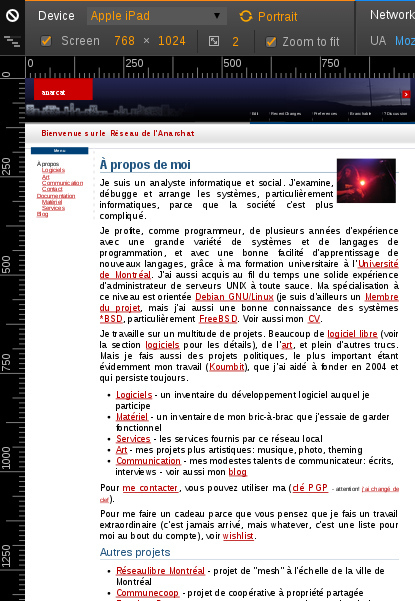
I finally gave up and drank the cool-aid of the Bootstrap theme. The main reason was that I noticed the site was basically unusable on any mobile device, including tablet computers like the iPad, which are unfortunately very, very common. Phones wouldn't render the site in a legible way either, unfortunately. The change is rather drastic, so I figured it was important to mention it here. I am not so satisfied pretty exctied with the result: the theme is very basic, if not absent. I actually like that purified form now, and it works across devices now much better. But I do feel I just made my blog look like everyone else that uses Bootstrap. We seem to enter an era where non-graphic designers (like me) are back to building web pages that all look the same, not very different, in a way, from the old days of plain HTML, like the default ikiwiki theme. I did some work to change the look at least minimally, but the top black navbar is really a killer giveaway this is a bootstrap theme. Bootstrap does a lot for the typography, at least when checking the presslabs checklist or the practical typography checklist, but I still had to change the main body width, which helped a lot I think. Anyways, the old Night City theme is still available for download and I could still flip it back on here if I need to.

What changed The new theme keeps the distractions away, but ironically, it's slower than the previous theme even though there are no images and basically no colors at all. On my tests, it now loads in about 3.42 seconds on the "Regular 2G (250Kbps)" simulation of Chromium with 72KB in 12 requests. Whereas my tests with the previous theme were taking 3.25 seconds with 43.5KB in 17 requests. This is due to the Bootstrap CSS, which takes a whopping 19KB itself, but especially because I now load JQuery, which takes a whopping 32.8KB! And that is probably gzip-compressed, as the original is more around 90KB. But at least the thing is readable on phones and tablets now. Compare:

Samsung S3, before Screenshot of a fake rendering on the Samsung Galaxy S3 in night city

Samsung S3, after Screenshot of a fake rendering on the Samsung Galaxy S3 in bootstrap I like this: much simpler, purer version on smaller devices. And we see what counts: the freaking text. Of course, on tablets, it doesn't fare as well: the top menu gets wrapped around...

Apple iPad, before Screenshot of a fake rendering on the iPad in night city

Apple iPad, after Screenshot of a fake rendering on the iPad in bootstrap Apparently, the fix would be for me to "customize the @grid-float-breakpoint variable" in LESS (which I thought was a pager, but seems to be a CSS preprocessor, graaah). Still, I think it's better that way, more readable, and less crufty.

How it was done After doing a thorough evaluation of all the Bootstrap ikiwiki themes I could find (there are more than 4 at least!), I figured I prefered the Jak Linux one. It seemed to be better implemented than the others, cleaner, and I liked the mean black border on top. Black is cool. Oh, and I liked the subtle footer as well. Subtle is cool. Unfortunately, that theme originally required a custom plugin to have a menu on top, which i thought was silly. So I patched it to make it work with the sidebar plugin, which turned out to be trivially simple: just dump the sidebar content, and make the sidebar page have explicit HTML tags in it that match Bootstrap's required classes. I also added the regular action links in the top navbar, but that does overload it quite a bit. I also did some code cleanups and various other small changes, all of which are available in my personnal git repo.

What doesn't work So of course, there are always problems. The first problem is the extra bandwidth usage. Not sure that can be fixed, other than switching to the upcoming Bootstrap 4, which is smaller than Bootstrap 3, bizarrely. The more annoying problems are weird alignment issues. If the screen gets two narrow without kicking some collapse rules in place (the iPad bug above), the navbar rows overflow and look ugly. Even more bizarre, in some cases the right navbar can just completely disappear, in fact, that's the only fix I could find: to assign the hidden-xs and hidden-sm classes to the navbar-right <UL> element. But then it just goes away, which is pretty darn stupid. Still - I assigned the classes to a few actions that seemed low priority, both in the theme and in the sidebar page. Similarly, the search form at the bottom of the page doesn't seem to want to fit in the footer properly. No idea why and I can't bother to figure that one out. I ended up merging this with the backlinks, tags and trails navigation items. Oh, and amazingly enough: comments are simply not rendered at all right now. Oops. I seemed to have picked the single bootstrap Ikiwiki theme that does *not* have comments rendering... Aaaargh. For now I just copy-pasted stuff from the [ramseydsilva][] theme and it looks pretty ugly, but at least it works. I ended up theming comments the same way i did for Night City, which looks pretty good, but is not in sync with the LESS stuff in Bootstrap. I also add to add back trails, backlinks and favicon... looks like the Jak theme wasn't made for a blog after all... but that's now fixed! :) Another improvement would be to change the font from the canonical Helvetica to something prettier, like suggested in Practical Typography, in the font recommendations section, or the presslabs checklist. So far I have settled on Mozilla's Fira font (which means, yes, one set of objects is actually loading from the CDN, sorry). Feedback welcome.

9 September 2015

Carl Chenet: Retweet 0.3: retweet given tweet popularity

Follow me on Identi.ca or Twitter or Diaspora*diaspora-banner Don t know Retweet? My last post about it introduced this small Twitter bot whichs aims to retweet every tweets from a Twitter account to another one. Retweet The new features of this release:
  • retweet a tweet only if it was already retweeted a number of times you can specify
  • define the duration to wait before processing the next tweet to possibly retweet (useful if you want to control the delay between two tweets).
Retweet was created in order to improve the Journal du hacker Twitter account. The Journal du hacker is a Hacker News-like French-speaking website. logo-journal-du-hacker Especially useful to broadcast news through a network of Twitter accounts, Retweet was also improved to improve pep8 compliance and code readability (wip). The project is also well documented and should be quite simple to install, configure and use. Twitter_logo_blue What about you? If you try it, please tell me what you think about it, opening a bug request or ask for new features. Or just write your comment here ;)

8 September 2015

Daniel Silverstone: Orchestration, a cry for help

Over the past few years, a plethora of orchestration frameworks have been exploding onto the scene. Many have been around for quite a while but not all have the same sort of community behind them. For example there's a very interesting option in Joey Hess' Propellor but that is hurt by needing to be able to build Propellor on all the hosts you manage. On the other hand, Ansible is able to operate without installing extra software on your target hosts, but instead it ends up very latency-bound which can cause problems when your managed hosts are "far away". I have considered CFEngine, Chef, Puppet and Salt in addition to the above mentioned options, but none of them feel quite right to me. I am looking for a way to manage a small number of hosts, at least one of which is not always online (my laptop) and all of which are essentially snowflakes whose sparkleybits I want some reasonable control over. I have a few basic requirements which I worry would be hard to meet -- I want to be able to make changes to my hosts by editing a file and committing/pushing it to a git server. I want to be able to manage a host entirely over SSH from one or more systems, ideally without having to install the orchestration software on the target host, but where if the software is present it will get used to accelerate matters. I don't want to have to install Ruby or PHP on any system in order to have orchestration, and some of the systems I wish to manage simply can't compile Haskell stuff sanely. I'm not desperately interested in learning yet more DSLs, but I appreciate that it will be necessary, but I really don't want to have to learn more than one DSL simply to run one frameworks. I don't want to have to learn strange and confusing combinations of file formats. For example, Ansible quite sensibly uses YAML for its structured data except for its host/group lists. It uses Jinja2 for its templating and looping, except for some things which it generates its own looping constructs inside its YAML. I also personally find Ansible's sportsball oriented terminology to be confusing, but that might just be me. So what I'm hoping is that someone will be able to point me at a project which combines all the wonderful features of the above, with a need to learn only one DSL and which doesn't require to be installed on the managed host but which can benefit from being so installed, is driven from git, and won't hurt my already overly burdened brain. Dear Lazyweb, pls. kthxbye.

Dirk Eddelbuettel: It was twenty years ago today...

sgt pepper Hm, wasn't there a catchy tune that started that way? Just kidding. But about twenty years ago today I sent this email about a new Debian package upload -- and that makes it (as best as I can tell) the earliest trace of me doing Debian work. It so happened that I did upload two packages in July of 1995 as well, but it was so early in the project that we did not have a mailing list archive for such things yet (!!). And I have a vague recollection that the two in July were an adoption---whereas the post referenced above announced efax as my first new package added to the distribution. And there were more to come ... Anyway, thanks for all the fish! Twenty years with Debian has been a great, great ride. I learned a lot from a lot of fantastic people, and I hope I helped a few people along the way with a package or two I still maintain. Debian remains a truly fabulous project which I hope will go strongly for another 20 (or even 22).

This post by Dirk Eddelbuettel originated on his Thinking inside the box blog. Please report excessive re-aggregation in third-party for-profit settings.

Russ Allbery: Review: Dark Currents

Review: Dark Currents, by Jacqueline Carey
Series: Agent of Hel #1
Publisher: Roc
Copyright: 2012
Printing: October 2013
ISBN: 0-451-41483-7
Format: Mass market
Pages: 399
This is another much-belated review. Hopefully I can remember the book well enough to do it justice. Daisy Johanssen has normal urban fantasy problems: her father was an incubus who (somewhat unsurprisingly) didn't stick around, she has to keep careful control of her own demonic side, her father occasionally tries to tempt her to invoke demonic power, and it's possible that she could breach the walls protecting the world from demons and bring about Armageddon. The typical sort of thing. Also, there's an unexplained murder in her home town, a mid-western US resort town whose image does not go well with eldritch murders. Daisy's only official role with the town police department is as a part-time file clerk, but this is urban fantasy, so you know the protagonist is going to be hip-deep in some sort of crime investigation. In this case, that's because the Norse goddess Hel (as distinct from the origin of Daisy's father entirely different thing) also lives here, in a manner of speaking, and Daisy is her liaison. In this case, Hel decides she's the one who should dispense justice. Carey previously has primarily been an epic fantasy writer, and this is her first foray into urban fantasy. (Well, arguably Santa Olivia and its sequel count, but those felt closer to superhero fiction to me.) The language and tone of her epic fantasy is far different than the conventions of either urban fantasy or superhero fiction, and I thought Santa Olivia was somewhat awkward in places. (None of the profanity quite worked, for instance.) Dark Currents felt smoother and more comfortable, aided by a charming mid-western feel. A few of Daisy's first-person narrative quirks wore poorly, such as every reference to "the Seven Deadlies," but Carey did a solid job with a typical out-of-her-depth urban fantasy protagonist. I'm pretty tired of the standard mythology of urban fantasy, and that is a bit of a drawback here: vampires and werewolves both feature, and I think I could happily go ten years before reading another story about vampires or hunky werewolves. Carey adds her own take on ghouls, but it's still pretty similar to lots (and lots) of other series. Thankfully, there's a bit of Norse mythology, a bit of fairy, and one extremely memorable lamia (of the serpent-tail-below-the-waist variety, at least some of the time). Lurine, a reclusive, retired starlet, a friend of Daisy's mother, and Daisy's childhood babysitter, is the lamia in question. She absolutely steals the show. The dynamic between her and Daisy is perfect: Carey resists the urge to ruin it with dark hints or falling-outs to increase tension. Instead, she lets it be a bit quirky, a bit complicated, but full of the reliability of a deep friendship. And Lurine is a wonderful character, the kind that only works as a supporting character because she's best seen through other people's eyes. Daisy's mother just makes the dynamic better. The reader can believe she's the sort of person who would have an ill-advised fling with an incubus, but also the sort of person who could raise a daughter like Daisy without many resources other than sheer grit. She never loses her optimistic outlook on the world, but has enough backbone behind it to make Lurine's friendship with her entirely believable. The plot here is nothing particularly special. Daisy unravels various clues, gets deeper into complicated relationships between various factions, occasionally finds herself in serious trouble, and relies on the help of friends and allies. I would have enjoyed the book more with a lot less Cody and more of the less typical mythology. But the relationships between the female characters, and the sheer persistence of mid-western normality and ordinary life challenges in the face of so much supernatural meddling, help this book stand out from the crowd. Dark Currents is different from most of what Carey has written, and you may be a bit disappointed if you were hoping for the epic sweep of the Kushiel series. But I found myself charmed by it, and will be reading the next book of the series. Followed by Autumn Bones. Rating: 7 out of 10

Next.

Previous.