Search Results: "ean"

12 December 2011

Cyril Brulebois: Fixing synaptics on powerpc

(It s a new day, it s a new bug ) A regression appeared in the synaptics input driver, between the 1.4.1 and the 1.5.0 release, as reported in Debian #649002 by many users. Basically, no more touchpad on PowerPC (hi, iBook G4 users!). :-( What follows is how I tracked it down. The upstream bug report is fdo#43728. Anyone could have done so, there s no black magic involved. A little hint maybe: git bisect is really easy on X drivers, since one can build and test without the Debian packaging bits. 1st step: Getting started You need sources and build dependencies, nothing fancy. Since packages might be named a bit differently, there s a reference to the relevant upstream repositories in debian/watch for X packages.
# You need git here:
debcheckout xserver-xorg-input-synaptics synaptics.git
cd synaptics.git
# Let s get the upstream tags and branches:
cat debian/watch
git remote add upstream git://anongit.freedesktop.org/xorg/driver/xf86-input-synaptics
git fetch --all
# Let s install build dependencies:
sudo apt-get build-dep xserver-xorg-input-synaptics
2nd step: Reproducing It was said 1.5.0 was the first known buggy version, so let s make sure:
# Get the appropriate tag:
git checkout xf86-input-synaptics-1.5.0
# Prepare the build system:
autoreconf -vfi
# X finds its modules under /usr, not /usr/local:
./configure --prefix=/usr
# Build and install:
make && sudo make install
Now time to restart the display manager, and confirm that the pointer is not moving bug reproduced. Now let s check the 1.4.1 release isn t affected:
# Clean everything:
git clean -xdf
git checkout xf86-input-synaptics-1.4.1
autoreconf -vfi
./configure --prefix=/usr
make && sudo make install
And after a display manager restart, the pointer is moving again, good! For reference, the log has very different lines about appletouch, so it can be used to programmatically learn about the status (good or bad). 3rd step: Narrowing it down So, we have a known good version and a known bad version. Time for a binary search to find the guilty commit which introduced that regression!
git bisect start
git bisect good xf86-input-synaptics-1.4.1
git bisect bad  xf86-input-synaptics-1.5.0
You don t even need to know that 1.4.x and 1.5.x live in different branches, git figures that out for you:
Bisecting: a merge base must be tested
[de0dfb76444ad4160468d00515876c91a9fa20bf] synaptics 1.4.0
It s just a matter of running autoreconf && ./configure && make && sudo make install && sudo /etc/init.d/xdm restart every step of the way, so it s pretty easy. No wonder, 1.4.0 was working OK, so it can be recorded as such through git bisect good, and the binary search goes between that commit and 1.5.0. After a few iterations of git bisect good and git bisect bad, we get to the commit reported on the upstream bug. As an extra bonus, mentioning the upstream bug number/URL in the Debian bug means it can be marked as forwarded there and we ll receive automatic notifications when its status changes, thanks to bts-link. Now, if you want to provide a patch for this bug, you may want to try and revert this commit. 4th step: Providing a patch Let s go back to the affected release and try to revert the guilty commit:
git checkout xf86-input-synaptics-1.5.0
git revert 13543b156d78bc4d01a19844a5ee8f283269621b
Unfortunately, some later commits modified the affected areas so we re running into conflicts:
error: could not revert 13543b1... eventcomm: replace synaptics-custom TEST_BIT with server's BitIsOn.
hint: after resolving the conflicts, mark the corrected paths
hint: with 'git add <paths>' or 'git rm <paths>'
hint: and commit the result with 'git commit'
Let s try to understand what the offending commit did: it replaced a set of macros with a single one, taken from the server. Both the old TEST_BIT() and the new BitIsOn() take 2 arguments, but the order is reversed. Reverting it should only be a matter of introducing the TEST_BIT() macro again (along with the two other ones it needs), and using it. The problem is replacing all BitIsOn(foo,bar) with TEST_BIT(bar,foo): foo and bar might not be trivial, they could be complex C expressions, and a replacement in your favourite editor might not get all occurrences right. Thankfully, there s a nice tool to handle such things, called coccinelle. I won t go into details, just show how it can help here. Basically you just need to craft a tiny patch, called a semantic patch, which describes what I wrote in the previous paragraph. You only need to declare two expressions, say a and b, and declare that all BitIsOn(a,b) must be replaced with TEST_BIT(b,a). Here s the syntax:
@@
expression a,b;
@@
-BitIsOn(a,b)
+TEST_BIT(b,a)
Save it under testbit.cocci and apply it through spatch (from the coccinelle package), asking it to perform in-place replacement (we re in a git checkout copy, remember):
# Apply:
spatch -sp_file testbit.cocci -in_place .
# Profit:
git diff
Then you can run git commit -s, write a nice commit message, send it upstream, and enjoy the rest of the night. Coming soon to a mirror near you: fixing commit. As mentioned on the upstream bug report, I got the Debian reference wrong in the commit message, I really meant #649002.

11 December 2011

Stefano Zacchiroli: bits from the DPL for November 2011

Mako's IronBlogger is a great idea. I often find myself postponing blog posts for a very long time, simply out of laziness. IronBlogger provides a nice community incentive to counter (my) laziness and blogging more often. As a related challenge, we have to face the fact that different subsets of our communities use different media to stay informed: mailing lists, blog (aggregators), social media, IRC, etc. Disparities in how they stay informed are a pity and can be countered using multiple medias at a time. Although I haven't blogged very often as of lately, I managed to keep the Debian (Developer) community informed of what happens in "DPL land" on a monthly basis, by the means of bits from the DPL mails sent to d-d-a. While the target of bits mails perfectly fits d-d-a, there is no reason to exclude a broader public from them. After all, who knows, maybe we'll find the next DPL victim^W candidate among Planet readers! Bonus point: blogging this also helped me realize that my mails are not as markdown-clean as I thought they were. I still have no IronBlogger squad, though. (And sharing beers with folks in the Boston area is not terribly handy for me ). Anyone interested in setting up a BloggeurDeFer in the Paris area? (SCNR)
Dear Project Members,
another month has passed, it's time to bother you again about what has happened in DPL land in November (this time, with even less delay than the last one, ah!). Call for Help: press/publicity team I'd like to highlight the call for help by the press / publicity teams. They are "hiring" and have sent out a call for new members a couple of weeks ago. The work they do is amazing and is very important for Debian, as important as maintaining packages or fixing RC bugs during a freeze. It is only by letting the world know what Debian is and what we do, that we can keep the Project thriving. And letting the world know is exactly what the publicity and press teams do. If you're into writing, blogging, or simply have a crush for social media, please read the call and "apply"! Interviews November has apparently been the "let's interview the DPL" month. I've spent quite some time giving interviews to interested journalists about various topics. For both my embarrassment and transparency on what I've said on behalf of Debian, here are the relevant links: Assets Legal advice (work in progress) Relationships with others Miscellanea Thanks for reading thus far,
and happy hacking.
PS as usual, the boring day-to-day activity log is available at master:/srv/leader/news/bits-from-the-DPL.*

Christian Perrier: New update about Debian Installer localization

Czech back to 100% in level 1 and 2, thus joining the hall of fame of full completeness. Dutch completes level 2 and also reaches the hall of fame. I take this as a specific wish for Frans Pop memory. Korean and Marathi complete level 1. Full stats are here Status for D-I level 1 (core D-I files): Status for D-I level 2 (packages that have localized material that may appear during default installs, such as iso-codes, tasksel, etc.): Status for D-I level 3 (packages that have localized material that may appear during non-default installs, such as win32-loader) So, full 100% completeness (hall of fame) for: Czech, Dutch, German, Persian, French, Portuguese, Russian, Slovak

9 December 2011

Christian Perrier: 10 years being Debian Developer - part 5: being a newbie DD...and working on l10n

I left you 2.5 months ago with the last question asked by my applicaiton manager, Martin Michlmayr : "Please tell me about about yourself and what you intend to do for Debian". Interesting question to revisit now, indeed. Here is what I answered: About myself first. I'm a 40 year old project manager and system administrator working in French National Aerospace Research Center. My best definition of my skills in computing is "Know more or less about a Lot of Things and be a Specialist of Nothing"...:-). I'm definitely not a programmer, nor a real system administrator, nor a RDBMS administrator, nor a personal workstation designer, though I do all of these daily. I think I'm perfect for finding the good person for having a defined job done. Besides this, I'm a genealogist for several years now. This is what finally decided me to apply for becoming a package maintainer : there are some quite good free genealogy software for Unix, though for various reasons they are not used very widely, even Unix geeks (my main software for genealogy still runs on Another Operatin System and is evertythig but free).I think that I can bring something here to the Free Software World, by helping some of these good programs in getting into the best Linux distribution I know.... For me, this is a mean for giving back to the free software movement what I gives to me since I discovered Linux 6-7 years ago. My very first intention as soon as I get my way into the Debian Developers Heaven is adopting the Geneweb package currently maintained by Brent Flugham. I'm in close contact with the author (who happens to be french, which helps) as well as a daily user of it. The current package which is in the distribution is already my work for a great part. I gave it to Brent, the current maintainer and we both agreed that it would be better for me to apply to becoming anofficial maintainer. I also contributed to the package for lifelines, another genealogy software. The last version of the package is also 80% my work, acknowledged by Javier, the official maintainer. Concerning that package, I do not have "plans" for adopting it (we didn't discussed of this with Javier, and I'm not sure I could bring him that much things). I came to Linux thanks to a great friend of mine, Ren Cougnenc. Ren opened my eyes to the free software world when I still thought that it was only a variant of free beers. I got really involved into Linux when I forced me to remove any other Operating System from my computer at work and tried to do my daily job with Linux. I have now succeeded at ONERA in getting free software to be accepted as a credible alternative for important projects. At this time, especially for server and network-related projects. I absolutely cannot tell why and how I came to be a Debian user. I simply don't remember. But I know why I am still a Debian user : this is a distribution which is controlled by only one organisation--->its users. And I want to be part of it. Finally, I did not mention above the somewhat "political" nature of my personal involvment into free software. Except for the physical appearence, I think I mimic RMS on several points (though he probably speaks better french than I try to speak english....which does not help for expressing complex ideas like the ones above!). As anyone can see, I was already very verbose when writing, sorry for this. Funnily Martin summed this up in one paragraph when he posted his AM report about my application. From what I see, also, my English didn't improve that much since then. It seems this is a desperatecause, I'm afraid. Anyway, all this was apparently OK for Martin and, on July 21st 2001, he wrote and posted his AM report and, on July 30th 2001, I got a mail by James Troup: An account has been created for you on developer-accessible machines with username 'bubulle'. bubulle@debian.org was born. Now I can more easily destro^W contribute to my favourite Linux distro. Indeed, I don't remember that much about the 2001-2003 years. I was probably not that active in Debian. Mostly, I was maintaining geneweb, for which I polished the package to have it reach a quite decent state, with elaborated debconf configuration. Indeed, at that time, I was still also deeply involved in genealogy research and still contributing to several mutual help groups for this. This is about the time where I did setup my web site (including pages to keep the link with our US family, which we visited in 2002). I think that the major turn in my Debian activities happened around september 2002 when Denis Barbier contacted me to add support in geneweb for a new feature he introduced in Debian : po-debconf. At that time, I knew nearly nothing about localization and internationalization. Denis was definitely one of the "leaders" in this effort in Debian. During these years, he did a tremendous job setting up tools and infrastructure to make the translation work easier. One of his achievements was "po-debconf", this set of tools and scripts that allows translation debconf "templates", the questions asked to users when configuring packages. All this lead me to discover an entire new world : the world of translating software. As often when I discover something I like, I jumped into it very deeply. Indeed, in early January 2003, I did my very first contributions to debian-l10n-french and began working on systematic translation of debconf templates. Guess what was the goal : 100%, of course! Have ALL packages that have debconf templates...translated to French. We reached that goal.....on June 2nd 2008 in unstable (indeed "virtually" : all packages were either 100% translated...or had a bug report with a complete translation) and on December 21st 2010 for testing. Squeeze was indeed the first Debian release with full 100% for French. Something to learn with localization work: it's never finished and you have to be patient. So, back in 2003, we were starting this effort. Indeed, debian-l10n-french was, at that time, an incredibly busy list and the translation rate was very high: I still remember spending my summer holidays translating 2-3 packages debconf templates every day for two weeks. Meanwhile, my packaging activities were low: only geneweb and lifelines, that was all. Something suddenly changed this and it has been the other "big turn" in my Debian life. After summer 2003, I suddenly started coming on some strange packages that were needing translation: they were popping up daily in lists with funny names like "languagechooser", "countrychooser", "choose-mirror", etc. I knew nothing about them and started "translating" their strings too, and sending bug reports after a decent review on debian-l10n-french. Then, Denis Barbier mailed me and explained me that these things were belonging to a new shiny project named Debian Installer and meant to replace the good old boot-floppies. Denis explained me that it would maybe be more efficient to work directly in the "D-I" team and "commit" my work instead of sending bug reports. Commit? What's that? You mean this wizard tool that only Real Power Developers use, named "CVS"? But this is an incredibly complicated tool, Denis. Do you really want me, the nerd DD, to play with it? Oh, and in this D-I development, I see people who are close to be semi-gods. Names I read in mailing lists and always impress me with their Knowledge and Cleverness: Martin Michlmayr (my AM, doh), Tollef Fog Heen, Petter Reinholdtsen and so many others and, doh, this impressive person named "Joey Hess" who seems to be so clever and knowledgeable, and able to write things I have no clue about. Joey Hess, really? But this guy has been in Debian forever. Me, really? Work with the Elite of Debian? Doh, doh, doh. Anyway, in about two months time, I switched from the clueless guy status to the status of "the guy who nags people about l10n in D-I", along with another fellow named Denny "seppy" Stampfer". And then we started helping Joey to release well localized D-I alphas and betas at the end of 2003 (the release rate at the time was incredible: Sarge installer beta1 in November 2003, beta2 in January 2004). I really remember spending my 2003 Christmas holidays hunting for....100% completion of languages we were supporting, and helping new translators to work on D-I translation. Yes, 8 years ago, I was already doing all this..:-)...painting the world in red. All this leads up to the year 2004. Certainly the most important year in my Debian life because it has been....the year of my first DebConf. But you'll learn about this....in another post (hopefully not in 2.5 months).

Russell Coker: Some OWS Stuff

There is an interesting interview with Richard Wilkinson on ted.com about the damage to society that is caused by excessive inequality [1]. The conclusion is interesting, it seems that one part of the solution is to send the message that excessive greed is anti-social. The demonstrations against the greedy 1% seem likely to do some good in this regard. He also has a TED talk about this in which he shows that even the rich don t benefit from great inequality [2]. If nothing else the links between great inequality and high rates of mental illness and murder should convince people that they don t want to live in such a society. Buying Cameras Some of the radio news reports have claimed that some of the people in OWS camps in Australia are somehow unworthy because they have smart-phones and digital cameras. They seem to believe that people have to demonstrate great poverty to have standing to complain. The problem here is that owning a mobile phone is essential to getting employment in many industries, so the vast majority of people who are old enough to work but not near retirement age just have to own a mobile phone. Once you have decided to use a phone if you are going to use it a lot (which you probably will if living in a tent in a public place) then being on a contract usually makes economic sense. As the cheapest contracts include a free Android phone that means almost everyone who is old enough to be allowed out alone at night and young enough to be willing to sleep rough for a cause will have such a phone. A related complaint is about people owning good cameras. One reason for this is the fact that the huge number of cameras deters the police from using excessive force that s a good justification for spending money on a good camera. But then a good camera doesn t cost much nowadays, the specs on $100 cameras are quite impressive and a camera that costs $400 new will have features that are useful for professional photographers and cameras are even cheaper on ebay. In Australia social security payments for a single person who is out of work are as much as $486.80 per fortnight [3]. Therefore someone who is living on social security could buy a great camera if they saved up two weeks of social security payments or buy a similar camera on ebay for one week s worth of payments. When at a protest the widespread use of cameras is essential for protection against police brutality. It s worth saving up for a camera. But really they are missing the point, OWS is about representing ~99% of the population. Even people on the average income are suffering because of the greed of the rich. Is Australia such a Great Place? There have been claims that Australia is such a great place that OWS protests are not needed, supposedly we have a very egalitarian society. The ABS data shows that the level of inequality as expressed by numbers isn t that great when restricted to just income if you restrict the analysis to the top 20% [4]. The mean gross household income per week is $340 for the lowest quintile and $2,380 for the highest quintile giving a ratio of 1:7.0. But when you look at total household net worth it s $27,400 vs $1,720,700 a ratio of 1:62.8! The ratio for the richest 1% would surely be a lot greater but a quick search of abs.gov.au didn t turn up any statistics on them. Also Richard Wilkinson s analysis puts Australia quite close to the US. If the people who are in the top 1% earned their money, paid taxes, and didn t pervert the political process then there wouldn t be any OWS protests. The corruption in the political process and rent seeking by corporations isn t as bad here as it is in the US, but it s bad enough that we need some serious changes. Emily Manuel wrote an interesting article for Tiger Beatdown about the need for an Occupy movement in Australia [5]. Her description of the political problems in Australia is quite clear. But I wasn t convinced by her analysis which suggested that Australia is different from the US in any significant way. Really Comparing Income To properly compare income it doesn t make sense to compare a ratio of money earned, or disposable income which is often misleading due to disagreements about what is considered disposable. It s really about which of the things that you want to do can be achieved on your income. One possible way of comparing it is based on Maslow s hierarchy of human needs. The poorest 20% of households in Australia have a gross income of $340 per week. The ABS shows that the average of private rental prices in the 8 capital cities (where most of the population lives) is $218 per week [6]. Obviously the poorest households can t afford an average rent unless you have lots of people packed in one house. No matter how you look at the numbers it s going to be difficult for low income people to pay for rent and food. That puts them on the bottom level of Maslow s higherarchy. It seems to me that the benefits of increased income diminish and it becomes more of a contest to be richer than other people. Owning an old car is a significant benefit over having no car. Owning a new car has some real benefits over an old car. Luxury cars usually have safety features before they are introduced to cheaper cars, but apart from that the benefit of owning a luxury car is small. Owning multiple Rolls-Royces doesn t seem to provide any real benefit, someone who would want to do that would probably be better served by hiring a good psychologist. Update: In a comment Brendan Scott cited The Theory of the Leisure Class by Thorstein Veblen. That s a great point, and I ll have to read that book! I still maintain that owning two Rolls Royces is a symptom of psychological problems, people who can sort out such problems won t feel the need to try and prove that they have more money than others. Charles Stross has an interesting article about wealth disparity etc [7]. Being a sci-fi author he also explores what life might be like after Drexler boxes satisfy most of our current materiel needs. The Age has an informative article by Suzy Freeman-Greene contrasting the OWS protests in Melbourne which were broken up by police to the Catholic anti-abortion protests that have been going on for more than 20 years [8]. It seems that corporations aren t the only large organisations that are pwning democracy!

8 December 2011

Tanguy Ortolo: Return codes

According to Eric S. Raymond, one rule for Unix programming is the Rule of Silence: When a program has nothing surprising to say, it should say nothing. Since return codes are a form of information, I would like to add: when a program has carried out its task with no surprise, it should exit(0).Take xscreensaver-command -lock, for instance. That command is meant to make a running XScreenSaver to lock the screen. I have never seen it fail in doing so, however I sometimes get a non-zero code:
% xscreensaver -lock
xscreensaver-command: could not frobnicate window 4212
zsh: exit 1   xscreensaver-command -lock
Well, xscreensaver-command, I have the deep regret to announce you that despite of your surprising return code, you successfully succeeded to lock my screen. But that return code is wrong and annoying. Wrong, because as a user, I do not care if xscreensaver-command -lock failed to frobnicate some window he would have loved to as long as it does its job and locks my screen. To the user's point of view, locking the screen is binary: either it is done and it is a success or it is not done and that is a failure. And it is annoying, because it makes the return code meaningless and prevents you from using it to do things like:
% # Lock screen and suspend to RAM (only if locking was successful)
% xscreensaver -lock && sudo pm-suspend
With xscreensaver-command sometimes returning a non-zero code with no apparent reason, you end with a locked screen and your computer still running, and have to unlock it and try again. This looks like this meaningless dialogue: So please, when you write a utility, design your return code for the user, not for you. If your utility has done the job, it should exit(0). What happened inside does may interest you as the developer but it does not matter to the user as long as the job is done, so it should not be reported to him, especially not with a misleading failure code.

7 December 2011

Gustavo Noronha Silva: WebKitGTK+ hackfest \o/

It s been a couple days since I returned from this year s WebKitGTK+ hackfest in A Coru a, Spain. The weather was very nice, not too cold and not too rainy, we had great food, great drinks and I got to meet new people, and hang out with old friends, which is always great!
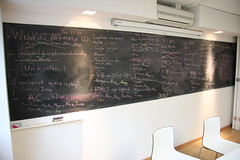
Hackfest black board, photo by Mario

I think this was a very productive hackfest, and as usual a very well organized one! Thanks to the GNOME Foundation for the travel sponsorship, to our friends at Igalia for doing an awesome job at making it happen, and to Collabora for sponsoring it and granting me the time to go there! We got a lot done, and although, as usual, our goals list had many items not crossed, we did cross a few very important ones. I took part in discussions about the new WebKit2 APIs, got to know the new design for GNOME s Web application, which looks great, discussed about Accelerated Compositing along with Joone, Alex, Nayan and Martin Robinson, hacked libsoup a bit to port the multipart/x-mixed-replace patch I wrote to the awesome gio-based infrastructure Dan Winship is building, and some random misc. The biggest chunk of time, though, ended up being devoted to a very uninteresting (to outsiders, at least), but very important task: making it possible to more easily reproduce our test results. TL;DR? We made our bots and development builds use jhbuild to automatically install dependencies; if you re using tarballs, don t worry, your usual autogen/configure/make/make install have not been touched. Now to the more verbose version! The need

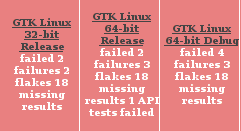
Our three build slaves reporting a few failures

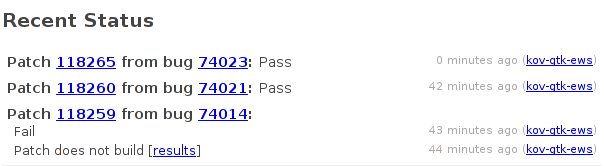
For a couple years now we have supported an increasingly complex and very demanding automated testing infrastructure. We have three buildbot slaves, one provided by Collabora (which I maintain), and two provided by Igalia (maintained by their WebKitGTK+ folks). Those bots build as many check ins as possible with 3 different configurations: 32 bits release, 64 bits release, and 64 bits debug. In addition to those, we have another bot called the EWS, or Early Warning System. There are two of those at this moment: one VM provided by Collabora and my desktop, provided by myself. These bots build every patch uploaded to the bugzilla, and report build failures or passes (you can see the green bubbles). They are very important to our development process because if the patch causes a build failure for our port people can often know that before landing, and try fixes by uploading them to bugzilla instead of doing additional commits. And people are usually very receptive to waiting for EWS output and acting on it, except when they take way too long. You can have an idea of what the life of an EWS bot looks like by looking at the recent status for the WebKitGTK+ bots. Maintaining all of those bots is at times a rather daunting task. The tests require a very specific set of packages, fonts, themes and icons to always report the same size for objects in a render. Upgrades, for instance, had to be synchronized, and usually involve generating new baselines for a large number of tests. You can see in these instructions, for instance, how strict the environment requirements are yes, we need specific versions of fonts, because they often cause layouts to change in size! At one point we had tests fail after a compiler upgrade, which made rounding act a bit different! So stability was a very important aspect of maintaining these bots. All of them have the same version of Debian, and most of the packages are pinned to the same version. On the other hand, and in direct contradition to the stability requirement, we often require bleeding edge versions of some libraries we rely on, such as libsoup. Since we started pushing WebKitGTK+ to be libsoup-only, its own progress has been pretty much driven by WebKitGTK+ s requirements, and Dan Winship has made it possible to make our soup backend much, much simpler and way more featureful. That meant, though, requiring very recent versions of soup. To top it off, for anyone not running Debian testing and tracking the exact same versions of packages as the bots it was virtually impossible to get the tests to pass, which made it very difficult for even ourselves to make sure all patches were still passing before committing something. Wow, what a mess. The explosion^Wsolution So a few weeks back Martin Robinson came up with a proposed solution, which, as he says, is the nuclear bomb solution. We would have a jhbuild environment which would build and install all of the dependencies necessary for reproducing the test expectations the bots have. So over the first three days of the hackfest Martin and myself hacked away in building scripts, buildmaster integration, a jhbuild configuration, a jhbuild modules file, setting up tarballs, and wiring it all in a way that makes it convenient for the contributors to get along with. You ll notice that our buildslaves now have a step just before compiling called updated gtk dependencies (gtk is the name we use for our port in the context of WebKit), which runs jhbuild to install any new dependencies or version bumps we added. You can also see that those instructions I mentioned above became a tad simpler. It took us way more time than we thought for the dust to settle, but it eventually began to. The great thing of doing it during the hackfest was that we could find and fix issues with weird configurations on the spot! Oh, you build with AR_FLAGS=cruT and something doesn t like it? OK, we fix it so that the jhbuild modules are not affected by that variable. Oh, turns out we missed a dependency, no problem, we add it to the modules file or install them on the bots, and then document the dependency. I set up a very clean chroot which we could use for trying out changes so as to not disrupt the tree too much for the other hackfest participants, and I think overall we did good. The aftermath By the time we were done our colleagues who ran other distributions such as Fedora were already being able to get a substantial improvements to the number of tests passing, and so did we! Also, the ability to seamlessly upgrade all the bots with a simple commit made it possible for us to very easily land a change that required a very recent (as in unreleased) version of soup which made our networking backend way simpler. All that red looks great, doesn t it? And we aren t done yet, we ll certainly be making more tweaks to this infrastructure to make it more transparent and more helpful to the users (contributors and other people interested in running the tests). If you ve been hit by the instability we caused, sorry about that, poke mrobinson or myself in the #webkitgtk+ IRC channel on FreeNode, and we ll help you out or fix any issues. If you haven t, we hope you enjoy all the goodness that a reproducible testing suite has to offer! That s it for now, folks, I ll have more to report on follow-up work started at the hackfest soon enough, hopefully =).

Julien Danjou: New job, new blog

It has been a while since I blogged but I've been very busy, with my new job and this new blog! New job! I quitted my job last September, and found another one that I started in October. I'm now the lead developer of eNovance Labs, where I work on the OpenStack project. So far, this allowed me to contribute heavily to the Debian packaging of OpenStack. New blog! In the meantime, I took some time to redesign my personal homepage and this blog, which is now using Hyde, the Python equivalent of Jekyll, which is in Ruby. Since I dislike Ruby (sorry), I preferred to use a Python based generator, and I admit Hyde is really cool. Since I really suck at Web design, this one is obviously based on Twitter's bootstrap

Daniel Stone: why you don't actually want dpi

Inspired by a discussion in #wayland today, here are snippets from three people explaining why X declares its DPI as 96, and why a single 'DPI' sledgehammer isn't actually what basically anyone<super>*</super> wants. Please read them. Thanks. Adam Jackson:
I am clearly going to have to explain this one more time, forever. Let's see if I can't write it authoritatively once and simply answer with a URL from here out.
Matthew Garrett:
But what about the single monitor case? Let's go back to your Vaio. It's got a high DPI screen, so let's adjust to that. Now you're happy. Right up until you plug in an external monitor and now when you run any applications on the external display your fonts are twice the size they should be. WOOHOO GO TEAM of course that won't make us look like amateurs at all. So you need another heuristic to handle that, and of course "heuristic" is an ancient african word meaning "maybe bonghits will make this problem more tractable".
Federico Mena-Quintero:
People who know a bit of typography may know a few factoids:
- Printed books generally use fonts which can be from about 9 to about 12 points in size.
- A point is roughly 1/72 of an inch. For people in civilized countries, this translates to "I have no idea what the fuck a quarter pounder is".
*: Yes, I know you need to have actual point equivalence, and you've had all your displays and printer colour-calibrated for the past ten years too. You're doing all this in the GIMP or some other kind of design tool, so please yell at them to use the display size information that XRandR gives you right now, already, today.

6 December 2011

Kees Cook: EC2 instances in support of a BSP

On Sunday, I brought up EC2 instances to support the combined Debian Bug Squashing Party/Ubuntu Local Jam that took place at PuppetLabs in Portland, OR, USA. The intent was to provide each participant with their own sbuild environment on a 64bit machine, since we were going to be working on Multi-Arch support, and having both 64bit and 32bit chroots would be helpful. The host was an Ubuntu 11.10 (Oneiric) instance so it would be possible to do SRU verifications in the cloud too. I was curious about the juju provisioning system, since it has an interesting plugin system, called charms , that can be used to build out services. I decided to write an sbuild charm, which was pretty straight forward and quite powerful (using this charm it would be possible to trigger the creation of new schroots across all instances at any time, etc). The juju service itself works really well when it works correctly. When something goes wrong, unfortunately, it becomes nearly impossible to debug or fix. Repeatedly while working on charm development, the provisioning system would lose its mind, and I d have to destroy the entire environment and re-bootstrap to get things running again. I had hoped this wouldn t be the case while I was using it during production on Sunday, but the provisioner broke spectacularly on Sunday too. Due to the fragility of the juju agents, it wasn t possible to restart the provisioner it lost its mind, the other agent s couldn t talk to it any more, etc. I would expect the master services on a cloud instance manager to be extremely robust since having it die would mean totally losing control of all your instances. On Sunday morning, I started 8 instances. 6 came up perfectly and were excellent work-horses all day at the BSP. 2 never came up. The EC2 instances started, but the service provisioner never noticed them. Adding new units didn t work (instances would start, but no services would notice them), and when I tried to remove the seemingly broken machines, the instance provisioner completely went crazy and started dumping Python traces into the logs (which seems to be related to this bug, though some kind of race condition seems to have confused it much earlier than this total failure), and that was it. We used the instances we had, and I spent 3 hours trying to fix the provisioner, eventually giving up on it. I was very pleased with EC2 and Ubuntu Server itself on the instances. The schroots worked, sbuild worked (though I identified some additional things that the charm should likely do for setup). I think juju has a lot of potential, but I m surprised at how fragile it is. It didn t help that Amazon had rebooted the entire West Coast the day before and there were dead Ubuntu Archive Mirrors in the DNS rotation. For anyone else wanting to spin up builders in the cloud using juju, I have a run-down of what this looks like from the admin s perspective, and even include a little script to produce little slips of paper to hand out to attendees with an instance s hostname, ssh keys, and builder SSH password. Seemed to work pretty well overall; I just wish I could have spun up a few more. :) So, even with the fighting with juju and a few extra instances that came up and I had to shut down again without actually using them, the total cost to run the instances for the whole BSP was about US$40, and including the charm development time, about US$45. UPDATE: some more details on how to avoid the glitches I hit.

2011, Kees Cook. This work is licensed under a Creative Commons Attribution-ShareAlike 3.0 License.
Creative Commons License

5 December 2011

Philipp Kern: New Debian buildd at Karlsruhe Institute of Technology

It took quite a lot of effort to persuade all decision makers to make this happen, but here it is: A new Debian buildd is being hosted at Karlsruhe Institute of Technology, to support the s390(x) ports. Its name is zemlinsky. So we've got some redundancy now and despite them being some sort of fringe architectures, they're looking pretty good. s390x is currently bootstrapped in the archive and it's progressing pretty quick. This new fast builder is one of the reasons why the slope is so steep.

Pointing people at the Debian Machine Usage Policies (DMUP) is pretty helpful to get a consent, with relation to network usage and acceptable use of the machines themselves. In this case the hardest part was drafting a user agreement that allows other non-university persons to log into the box, which is crucial to have it maintained by the Debian System Administrators.

Thanks to all the people at IPD Reussner, Steinbuch Centre for Computing and BelW who helped me getting this done.

4 December 2011

Joerg Jaspert: BSP Hildesheim

Right, so I am at the BSP in Hildesheim. Arrived somewhere Friday, leave in a few hours, and in the meantime I managed to break all our 3 archives at least once. Yay. But heck, I also managed to get them back to work (with help from the FTPTeam too), so it was a good thing. We are back on one code revision for security, backports and main archive. Security also changed to the newer style of handling the buildd repositories and is now also using daks own method of writing packages files instead of using apt-ftparchive. And while I was at it I also created 3 new sections, got a SHA256SUMS file in addition to the MD5SUMS for the debian-installer images (thanks Joeyh for the quick reaction), enabled DM uploads for backports and implemented various other smaller fixes and cleanups.

Tanguy Ortolo: Concerning the good use of ITP

When someone wants to package a piece of software for Debian, he has to file an Intent to Package, by filing a special bug report against the pseudo-package wnpp (work-needing and prospective packages) with a title of ITP: software name . This way, we can synchronize our efforts, for instance if someone else wants to package the same piece of software. I have seen two recent examples of a misunderstanding of the correct use of such reports, so perhaps this reminder may be of some help for newcomers.While an Request for Package means that its author would like someone to package a piece of software, and ITP means that its author wants to package it himself and to have it integrated to Debian (in fact, an RFP also becomes an ITP when someone is willing to do the work). This means that the owner of an ITP bug is responsible for the corresponding work. Given that the ITP report is meant to inform others, that implies that he should document his progress by appending messages to the bug report. In particular, when something is blocking the work (typically a failure to find a sponsor), that should be indicated in the ITP report so that it does not appear as being abandoned. So, in a nutshell, when you have opened an ITP, do not expect someone to take it, to reply to it or whatever deus ex machina; you are now the owner of that bug, which means you are responsible of making it live and eventually closing it by sending your package to Debian. The progress of a packaging work should be documented, especially if it requires some specific help such as sponsoring, and the ITP report is the best place to do that since this is where interested people will look for status information.

3 December 2011

Steve Kemp: So I removed some more software from my host

Today I was idly performing some maintainence upon one of my hosts, and it crossed my mind to look beneath /etc in there I found:

/etc/python
/etc/python2.4
/etc/python2.5
/etc/python2.6
That made me look more closely at the contents of /etc - the following command output was surprising:
steve@steve:~$ ls /etc   wc -l
187
Is that average? Heavy? Light? I have no idea, but I purged a hell of a lot of software today. Now I have only python v2.6 although for some reason I still have:
python
python-apt
python-apt-common
python-central
python-minimal
python-support
python2.6
python2.6-minimal
I suspect I could drop the pything2.6-minimal package, but for the moment I'm done. I have to make pretty people look exceptional with my magical camera. Anyway as part of this cleanup I ran a quick sanity-check on which processes are running and I think, short of kernel processes, I'm as minimal as I can be. I understand the purpose and reason for every running service:
UID        PID  CMD
root         1  init [2]
pdnsd    14091  /usr/sbin/pdnsd --daemon -p /var/run/pdnsd.pid
root     14199  /usr/sbin/monit -c /etc/monit/monitrc -s /var/lib/monit/monit.state
root     14206  /usr/sbin/syslog-ng -p /var/run/syslog-ng.pid
root     14234  /usr/sbin/cron
102      14595  /usr/sbin/exim4 -bd -q30m
redis    14627  /usr/bin/redis-server /etc/redis/redis.conf
root     14637  /usr/sbin/sshd
These are basic services; I use monit to ensure those essential daemons keep running. The only oddity there is probably the local DNS cache, but it is useful if you run any kind of DNS blacklist-using service, for example.
root     14794  /sbin/getty -L ttyS0 9600 vt100
I need a serial console login for emergencies.
root     14796  runsv node-reverse-proxy
root     14797  /bin/sh ./run
root     14799  /opt/node/bin/node node-reverse-proxy.js --config ./rewrites.js
These three processes combine to run my reverse proxy which routes incoming HTTP requests to a number of local thttpd instances.
qpsmtpd  27309    /usr/bin/perl -Tw /usr/bin/qpsmtpd-prefork --port 25 --user qpsmtpd --pid-file /var/run/qpsmtpd/qpsmtpd.pid --detach
..
The perl SMTP daemon which runs my incoming mail, passing it to exim4 which listens upon 127.0.0.1:2525. You can read about my setup in the out-of-date writeup Chris & I put together.
 /usr/bin/memcached -m 64 -p 11211 -u root -l 127.0.0.1
Memory cache for transient items.
s-blog    thttpd -C /etc/thttpd/sites.enabled/blog.steve.org.uk
1030      thttpd -C /etc/thttpd/sites.enabled/edinburgh-portraits.com
s-hg      thttpd -C /etc/thttpd/sites.enabled/hg.steve.org.uk
s-ipv4    thttpd -C /etc/thttpd/sites.enabled/ipv4.steve.org.uk
s-ipv6    thttpd -C /etc/thttpd/sites.enabled/ipv6.steve.org.uk
s-kvm     thttpd -C /etc/thttpd/sites.enabled/kvm-hosting.org
...
One thttpd instance is launched for each distinct HTTP site my server runs. Each site runs under its own UID, with its own chrooted directory tree. This is important for security. Each local instance listens upon 127.0.0.1 - and the reverse proxy previously mentioned rewrites connections to the appropriate one.
1016     28812     /usr/bin/perl -I./lib/ -I./ /usr/local/bin/blogspam
My anti-spam filter for blog comments.
Here is my christmas challenge. Can you identify each service upon your host? Do you know why you're running what you're running? Me? I had no idea I had a dbus deamon running. Now I've purged it. Ha! ObQuote - "I owe everything to George Bailey. Help him, dear Father." - It's a wonderful life.

Evgeni Golov: git rocks even when it sucks

Today I wanted to clone my dotfiles repository (no, not available online, too much private stuff in there) to a remote machine and noticed that it has grown way too big (20MiB working directory and about 200MiB in .git), so I decided to clean it up. git gc did clean up a couple of megabytes, but .git was still about 190MiB, so I wasn t satisfied. Short thinking revealed the lost megabytes are somewhere in the history when I accidentally added some files and removed them afterwards (iceweasel, icedove, it s you I m blaming ;)). But how the heck do I find and remove them? git filter-branch -f --index-filter 'git rm --cached --ignore-unmatch FILE' -- --all will remove FILE from all commits, says git-filter-branch(1), but how to find those files? They are not in my working directory anymore and I do not want to checkout every revision and look for big files in there. Let s ask git itself :)
for commit in git log --all --pretty=format:%H ; do git ls-tree -r -l $commit; done awk ' print $4 " " $5 ' sort -nu will show all files (actually all versions of all files) ever known to git, with the biggest ones at the end. Just identify the really big (unused) ones and remove them as above, thats what you think, right? Right, but .git won t be any smaller. Huh? Read git-filter-branch(1) again, just create a clone and it will be smaller, so mission accomplished! Now I had just 6MiB to push (compressed). For reference, the old tree would have used something about 150MiB to push.

2 December 2011

Rapha&#235;l Hertzog: My Debian Activities in November 2011

This is my monthly summary of my Debian related activities. If you re among the people who made a donation to support my work (310.73 , thanks everybody!), then you can learn how I spent your money. Otherwise it s just an interesting status update on my various projects. Dpkg: Multi-Arch Saga I know lots of people are waiting the landing of multiarch in Debian unstable, and so am I. Things are progressing, though not as quickly as I hoped. Guillem merged about half of the branch between the 24th October and the 6th of November. After that most of the work happened on his personal repository in his pu/multiarch/master branch. I verify this repository from time to time because Guillem does not inform me when he has made progress. I noticed changes on his repository on the 10th, 19th, 23th, 28th of November and on the 1th of December. He announced a long time ago that he had some interface changes and up to now only wrote about the switch from the command-line option --foreign-architecture (to put in /etc/dpkg/dpkg.cfg) to the explicit command dpkg --add-architecture that only needs to be called once (see mail here). As of today (December 2th), the promised email for the other interface changes is still not here. On November 23th, I reviewed Guillem s work and tried to run the code in his branch. I spent the whole day chasing up regressions and submitted lots of fixes to Guillem. Thanks to the extensive test-suite I wrote when I developed my branch, it has been fairly easy to track them all down. All the issues I reported have been fixed in the latest version of Guillem s branch although the fixes are often slightly different from those that I submitted. Dpkg: Squeeze Backport At the start of the month, I uploaded what I expected to be a fairly uncontroversial backport of dpkg 1.16.1.1. It turns out I was wrong. After some discussion, I think we came to an agreement that it was acceptable to backport dpkg-dev and libdpkg-perl only. My goal was not to bring the latest dpkg to users but to make it easier for package maintainers to backport packages using new features provided by dpkg-dev >= 1.16 (such as hardening build flags, the makefile snippets provided in /usr/share/dpkg/, or the improved dpkg-buildflags interface). Thus I modified the source package uploaded to squeeze-backports to build only dpkg-dev and libdpkg-perl. It has been uploaded on November 23th and it s waiting in the NEW queue for a backports admin to process it. Misc Dpkg Work I merged a patch of Colin Watson to be able to verify build-dependencies for a foreign architecture (taking into account the Multi-Arch status of each package listed). I released dpkg 1.16.1.2 with two minor fixes that were sitting in the sid branch. I wanted to get rid of this so that the path is clear for a 1.16.2 upload with multiarch. The package just migrated to testing so we re fine. I spent another day doing dpkg bug triaging on Launchpad, we re now down to 77 bugs with many of them tagged as incomplete and likely to expire in 2 months. The Debian Administrator s Handbook eBookWe released a sample chapter so that it s easier to have an idea of the quality of the book. The chapter covers the APT tools quite extensively. I bet that even you could learn something about apt-get/aptitude The crowfunding campaign on Ulule ended on November 28th.

With 675 supporters, we raised 24385 EUR. Of those, 14935 EUR have been put in the liberation fund and the rest corresponds to the various pre-orders and rewards offered. This means that the translation will happen (we just started) but that the book is currently not going to be released under a free license. Don t despair As planned, the liberation campaign is carried on until the 25 K target is reached! Instead of being hosted on Ulule, this permanent campaign is on the project website at debian-handbook.info/liberation/. Note that any contribution of 10 EUR or more means that you get a copy of the ebook as soon as it s available (even if the liberation target is not reached). Package Tracking System At the start of the month, I filed two ideas of improvements for the PTS in the bug tracking system: #647258 is about showing outstanding bugs that relate to a release goal and #647901 is about warning maintainers that the package is affected by a current transition. If you re a coder and want to start contributing to Debian and its QA team, those bugs could be interesting targets for a start. :-) In both cases, I have been in contact with members of the release team because those ideas require some structured data from the release team as input. Thanks to Meddi Dohguy and Niels Thykier for their help. Later in the month, the topic of relocating the PTS once again came up. For historical reasons, the PTS was hosted on master.debian.org together with the BTS. Nowadays the BTS has its own host and it made no sense anymore to have the PTS separate from the rest of the QA services hosted on qa.debian.org (currently quantz.debian.org). So together with Martin Zobel Helas we took care to plan the migration and on November 19th we executed the plan. It worked like a charm and almost nobody noticed (only one undocumented dependency was missed, which broke the SOAP interface). Misc Packaging Work WordPress was broken in Ubuntu and it was also not properly synchronized with Debian due to an almost useless change on their side. Thus I requested a sync so that the working version from Debian gets imported in Ubuntu. I sponsored the docbook-xsl 1.76.1 upload that I needed for Publican. Then I updated Publican just to discover that the test-suite triggers a new bug in fop (filed as #649476). I disabled the test-suite temporarily and uploaded Publican 2.8 to unstable. BTW, I also filed 2 upstream bugs with patches for issues I discovered while trying to generate the sample chapter of my book (see here and here). I uploaded a version 0.7.1 of nautilus-dropbox and fixed #648215 at the same time. I made an NMU of bison to fix a long-standing release critical bug that hit me once more during an upgrade (see #645038). I uploaded to experimental a new version of gnome-shell-timer compatible with GNOME 3.2. I took the opportunity to install from experimental the few GNOME 3.2 packages which are not yet in unstable Thanks See you next month for a new summary of my activities.

7 comments Liked this article? Click here. My blog is Flattr-enabled.

1 December 2011

Christian Perrier: Between 60 and 64 languages supported in Debian Installer

(including English!) The string freeze of Debian Installer officially ended at 23:59 yesterday (Sept. 20th). Indeed, this was extended a bit to today, with agreement by Otavio Salvador who I thank for this. That allowed Zak to "save" Tagalog and also the Welsh and Latvian translators to polish their work. We now have to decide about some of these languages: those that failed to meet the release criteria but were formerly activated in D-I. There are four such languages: Amharic, Welsh, Estonian and Northern Sami. Please find below the mail I just sent to debian-i18n and debian-boot. I promised that this discussion would happen in public. It will (but it will be short as we can't delay the release of the installer for ages....and I think that my proposals are reasonable!)
First of all, the numbers as of Sunday Sept. 21st 09:32 UTC (date of
the last commit with an l10n update):
Languages meeting the release criteria: 59
------------------------------------------
Already activated and complete for level 1: 51
 Arabic, Belarusian, Bulgarian, Bosnian, Catalan, Czech, Danish,
 German, Dzongkha, Greek, Esperanto, Spanish, Basque, Finnish, French,
 Galician, Gujarati, Hebrew, Hindi, Croatian, Hungarian, Indonesian,
 Italian, Japanese, Georgian, Khmer, Korean, Lithuanian, Latvian,
 Macedonian, Malayalam, Marathi, Norwegian Bokm l, Nepali, Dutch,
 Norwegian Nynorsk, Punjabi, Polish, Portuguese, Brazilian Portuguese,
 Romanian, Russian, Slovak, Albabian, Swedish, Tamil, Thai, Turkish,
 Vietnamese, Simplified Chinese, Traditional Chinese
Already activated and complete for sublevels 1 and 2: 6
Bengali, Kurdish, Slovenian, Tagalog, Ukrainian, Wolof
Not yet activated languages complete for sublevels 1 and 2: 2
 (the mail in -i18n and -boot says 3 but this is an error by me)
Irish, Serbian
Languages failing to meet the release criteria: 15
--------------------------------------------------
Activated languages: 4
Amharic, Welsh, Estonian, Northern Sami
Not yet activated languages: 11
Afrikaans, Persian, Armenian, Icelandic, Kazakh, Kannada,
Malagasy, Malay, Telugu, Urdu, Xhosa
Discussion
----------
(careful people will notice that I moved Welsh down to "failed to meet
the release criteria" as this is what is technically correct)
Nothing to discuss for the 57 already activated languages that meet
the defined criteria. They'll be kept or first activated in the RC1
release of Debian Installer.
Similarly, nothing to discuss for the 11 languages that were not
activated and haven't made it. They will remain unactivated.
Two languages should be activated as they have met the release
criteria for the first time during the string freeze: Irish and Serbian.
This adds more load (and size changes) to D-I but I really don't see
any reason to not follow our own rules there.
The discussion comes for the 4 languages that fail to meet the release
criteria. Here are my proposals with some rationale:
Amharic: 
  I would really dislike deactivating Amharic because it's highly
  symbolic to have the language of Ethiopia activated. We have so few
  African languages. Also, the translation is nearly complete and the
  translator was well coping with updates until July. The missing
  stuff for Amharic in sublevels 1 and 2 are messages about loading
  drivers or firmware from removable media, the rescue mode stuff for
  the graphical installer and some messages that briefly appear during
  finish-install. A little bit more important is the message warning
  that the boot partition is not ext2 or ext3, added in August by
  tbm. I think this is not enough to drop out one year of efforts for
  the translator
  As a consequence, I propose to KEEP Amharic.
Welsh:
  Only five strings are missing in sublevels 1 and 2 because of the
  small experience of PO files by the person who completed the
  translation during last week. One will make the regular user login
  name screen to be in English and others will make the GRUB password
  screen to be in English as well, that's all.
  Additionnally, we can safely assume that all potential users of
  Welsh have good skills in English...and will therefore very easily
  cope with these screens.
  As a consequence, I propose to KEEP Welsh.
Estonian:
  The translation had NO update since Etch. The last update is dated
  back to Feb. 17th 2007. I haven't got any sign of life from the
  translator and no Estonian users have volunteered to maintain the
  translation.
  Missing strings are in many places, including several screens that
  appear in default installs. Even though one can assume that the
  skills of the average Linux user in Estonia is fairly good, I think
  this is not enough to throw users in a big mix of English and
  Estonian.
  As a consequence, I propose to DROP Estonian.
Northern Sami:
  The translation is very incomplete. With about any other language,
  that would be a reason to drop the translation.
  However, a few reasons make me suggest keeping it:
   - Northern Sami is mostly used in Norway and D-I will fall back
     to Norwegian Bokm l which is understood by all potentials users
     as it is teached in all Norwegian schools. 
   - Users will be warned, *in Sami*, about this situation
   - The choice of Sami will be kept in localechooser even if the
     translations are dropped. This is on request of Debian Edu
     developers to avoid them to develop a special boot floppy
     to offer the choice of Sami (a requirement for Norwegian
     schools). I personnally think this is a reward to Debian Edu and
     its ancestor Skolelinux for their initial involvement in the
     development of D-I
  As a consequence, I propose to KEEP Northern Sami.
I understand that these choices may be debatable and some may sound
slightly subjective. I however think this is the best way to be fair
with translators' efforts without compromising the quality of D-I.
Please note that the final word on this will be by D-I release
managers...but advices are very much welcomed.

Dirk Eddelbuettel: Wicked Webapps with R, err, Wt

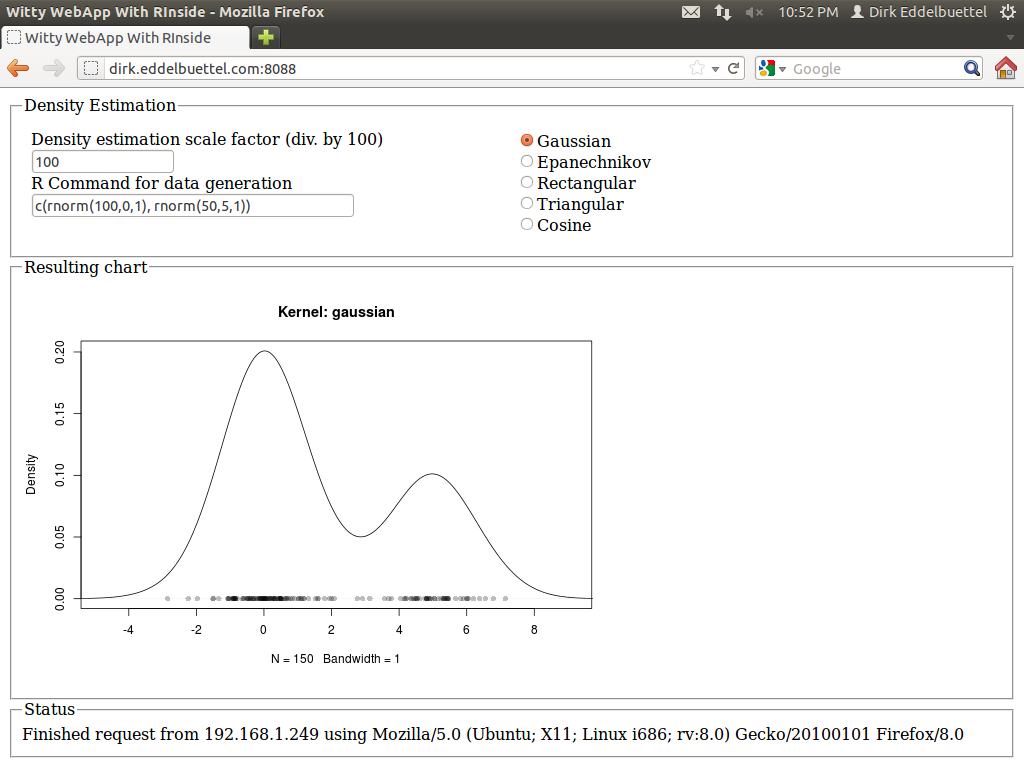
A few months ago, I had blogged about using R inside of Qt. This used our RInside package for embedding the statistical programming environment and language R inside of a C++ application, and further relies on our Rcpp package for R and C++ integration and object mapping. The example was simple yet powerful: a reimplementation of the standard GUI application of a standard density estimate. Here the user can pick a kernel density function from a selection, and also slide a bandwidth parameter. One nice addition was an entry field already populated with a simple expression for a mixture of Normals, allowing for arbitrary random distributions over which to estimate. The example is pretty (thanks to Qt), and was added to RInside with the last CRAN release 0.2.4. The blog post has a nice screenshot. I had long wondered how to do something similar 'on the web'. Web integration and application frameworks are of course a dime a dozen: Just about any language offers this, with more or less ease. But I wanted something simple yet powerful and fast. And I did not like the idea of a multi-tier app, or of a multi-language mix. I remember having seen something about a web-application framework not unlike Qt, and studying the very useful Wikipedia web application framework comparison I re-discovered Wt (pronounced "Witty"). So there it is, using C++ which brings us ample performance, the ability to connect to a number of libraries and applications (which is important in my quantitatively-minded workd) and avoid the whole multi-tier, multi-language combination. The Wt website has a few more good reason why this may be a suitable idea; the toolkit also offers a very decent amount of features and is amply documented with a fair number of examples. And after just a little bit poking around during two weekends, I now have the following webapp committed in the SVN repository of RInside, and it is all implemented in in less than two hundred (generously commented) lines of code. Example of embedding R via RInside into a Wt C++ application: density estimation for a mixture It is currently up and running at the address shown in the screenshot, so give it a go (though I may take it down at another point in time). I quite like it: The application is responsive: changes in the radio buttons (for the density), or the bandwidth, each trigger reestimation of the density, and a new and updated chart is displayed immediately with no noticeable delay---just like the desktop application did. Best of all, the code logic is essentially unchanged from the Qt-based app. Signals and slots related events to actions, the layout is in terms of standard GUI boxen and containers. And best of all, I did not have to write a line of html, javascript, css or ajax: it is all handled by the Wt toolkit. I was able to drive the app from an Android phone, my tablet, various computers around the house, and had a few friends poke a stick at it from afar. There is at one open issue. Wt launches new instances of the application object with each connection, which is a very clean model. That doesn't map perfectly with R (which is single-threaded) and RInside (which runs as a singleton for the same reason). So right now, each action sends its state back to the client. In other words, each clients own its parameters and well as vector of random numbers. Each new action sends these back to the app which passes it to R, launches the re-estimation and gets an updated chart back which is then shown by the the client. That is not perfect, and maybe a forking model as used by Simon's RServe would be better, though it would require a rewrite of RInside. Not sure if we get there anytime soon. And for simple applications not facing legions of concurrent users, the singleton should still work. It's a proof of concept at this point. Feedback welcome, and RInside and Rcpp questions should go to the rcpp-devel list as usual.
30 November 2011

Daniel Stone: some meaningless numbers

My current running Xorg server, built with -O0 -g3 -ggdb, having been through a few suspend cycles, hosting a full GNOME Shell session with several billion tabs in a long-running Chromium instance, a couple of terminals, and a freshly-opened gedit, is currently sitting at 20MB resident memory usage, of which 11MB is shared. The freshly-opened gedit instance has 25MB resident, of which 17MB is shared. Bloat is in the eye of the beholder, I guess.

(Those numbers are RES/SHR respectively in top. Correct me if I'm wrong about what they mean.)

29 November 2011

Gustavo Noronha Silva: Accelerated Compositing in webkit-clutter

For a while now my fellow Collaboran Joone Hur has been working on implementing the Accelerated Compositing infrastructure available in WebKit in webkit-clutter, so that we can use Clutter s powers for compositing separate layers and perform animations. This work is being done by Collabora and is sponsored by BOSCH, whom I d like to thank! What does all this mean, you ask? Let me tell me a bit about it. The way animations usually work in WebKit is by repainting parts of the page every few milliseconds. What that means in technical terms is that an area of the page gets invalidated, and since the whole page is one big image, all of the pieces that are in that part of the page have to be repainted: the background, any divs, images, text that are at that part of the page. What the accelerated compositing code paths allow is the creation of separate pieces to represent some of the layers, allowing the composition to happen on the GPU, removing the need to perform lots of cairo paint operations per second in many cases. So if we have a semi-transparent video moving around the page, we can have that video be a separate texture that is layered on top of the page, made transparent and animated by the GPU. In webkit-clutter s case this is done by having separate actors for each of the layers. I have been looking at this code on and off, and recently joined Joone in the implementation of some of the pieces. The accelerated compositing infrastructure was originally built by Apple and is, for that reason, works in a way that is very similar to Core Animation. The code is still a bit over the place as we work on figuring out how to best translate the concepts into clutter concepts and there are several bugs, but some cool demos are already possible! Bellow you have one of the CSS3 demos that were made by Apple to demo this new functionality running on our MxLauncher test browser. <video controls="controls" src="http://cafe.minaslivre.org/~kov/webkit/ac.webm" width="640"></video> You can also see that the non-Accelerated version is unable to represent the 3D space correctly. Also, can you guess which of the two MxLauncher instances is spending less CPU? ;) In this second video I show the debug borders being painted around the actors that were created to represent layers. <video controls="controls" src="http://cafe.minaslivre.org/~kov/webkit/debug-borders.webm" width="640"></video> The code, should you like to peek or test is available in the ac2 branch of our webkit-clutter repository: http://gitorious.org/webkit-clutter/webkit-clutter/commits/ac2 We still have plenty of work to do, so expect to hear more about it. During our annual hackfest in A Coru a we plan to discuss how this work could be integrated also in the WebKitGTK+ port, perhaps by taking advantage of clutter-gtk, which would benefit both ports, by sharing code and maintenance, and providing this great functionality to Epiphany users. Stay tuned!

Next.

Previous.