Search Results: "dom"

25 April 2006

Wouter Verhelst: Google maps.

Looks like Google Maps finally reached civilization. Or is it the other way around? They still don't have high-resolution photos of my house yet, and you can't search for an address yet either; but at least I can point people that yes, that's where I live. Oh, and TeleAtlas? You guys are dead wrong. The bit of asphalt between the Waterstraat, the Jos Craeybexlaan, Den Geer, the Oostergeest, the Bremboslei, and the middle part of the Bund isn't called 'Bund'. It's part of the parochial domain of the local parish called 'Bunt'. They're spelled differently, owing to a disagreement between the religious and city governments ages ago that you don't want to know about. But in any case, the church isn't on the Bund; the bit of asphalt doesn't have a name, and the official address of the church is "Waterstraat 16". Conveniently, the local area is called 'Bunt', too. Oh well. I'll forgive you for that little mistake—you're not the first to get this wrong, and probably not the last, either.

Zak B. Elep: On Pedagogies

I feel a bit sad. Is FOSS really just going to be an alternative forever? Or can it break out of the trappings of alternatives, and make a world a better place? =) Instead of posting this to BiOS, I felt that it would be better posting it here; feel free to comment, feel free to ignore ;-)
Get a grip on reality. Even windows is an alternative to us FOSS loving peeps. Saying that FOSS is an alternative IMHO is a good marketing/advocacy tactic to get potential new users to get their feet wet on FOSS.
And now you are risking yourself to sounding hostile. At the risk of sounding like a bad guy, I have been shifting in between the planes of Ubuntu and Windows via cold water over the past few weeks; wala lang, I just wanted to be reminded of how it feels to be shackled’, so to speak. But really, I’m doing this because I can, and as a result I’m having a rocking time appreciating the subtleties of both Windows and Ubuntu ;-) So I guess I’m not so far removed from reality as you seem to portray. Now, let me play the simpleton, who’s really an astute participant. If a FOSS desktop, say Ubuntu’s Gnome, is supposed to be as easy as Windows, then why should I bother learning it at all, when I can simply transfer my old Windows skills to Ubuntu without much a problem? Another question: why should I be motivated to switch to FOSS at all? Perhaps you can dismiss this as FUD, but you are none the wiser when your reasons for switching to FOSS is only because that it is an alternative, that it is cheap (hard to get cheaper being free), and that its mandated by the local government. Among other things petty and cruel. Indeed, these are the questions people ask to us FOSS people, even long after the good shows (OSForum, SFD, LinuxWorld, etc.) have their run. As a matter of fact, I keep asking this to myself everyday, for the past 3 years of using GNU/Linux everyday. And every single day ends with an answer: “I use FOSS because it empowers me to surf,chat,email,program with relish.” For many other people, unfortunately, they don’t even get around to use a FOSS system, much more a CLI; thence they just make do with “I use Windows because that’s just what I have.” But I don’t want to force people to switch (or even just use) FOSS because of those reasons. I want them to use FOSS exactly because it empowers them, allowing them to get their jobs done effectively and efficiently. FOSS isn’t out there to deceive, as you so imply, maybe unwittingly. Well, perhaps, sometimes it is, but more often than not, its there so as to convey a deeper truth: that you can do things with it, while at the same time feel empowered, and FREE, with it.
Once they get their feet wet, it would likely be a natural progression for these users to realize the benefits that FOSS can offer (full-fledged, stand-alone and yet cooperative at the same time, approach to solving real problems). The key here is to just even entice the user to try, to take it for a spin, that would be a big step towards FOSS land.
Yes, getting feet wet is a good thing, it has its purpose, namely, for a person to acknowledge that he’s stepping on water, and preparing for a plane shift ;-) But from the point of view of a swimming instructor, getting feet wet is not good enough; it is better to get a person wet his head into the water, because that’s the time you know that he’s ready to learn how to swim, even if he doesn’t feel he’s ready. The same is true for newbies wanting to dive in like in that Linux Crash Course. It is not good enough that a newbie be exposed only to just one interface, just one true way (yeah, that coming from an Emacs guy ;-) I do not want them to slave away moving the mouse to and fro, doing some stuff under a GUI when they can just do the same thing in less time by just a few keystrokes. Perhaps, most wouldn’t be ready to use a CLI immediately to do some hand-hacking, but, like air in the planet, its always there, even when you don’t have an immediate need for it (air, however, is something we always have an immediate need for ;-) And neither do I recommend learning the intricacies of the shell, whether be it Bourne, Korn, or Peanut shell. Indeed, there’s nothing wrong about being at least bilingual; I want my audience to learn just a little bit of everything ;-) I want them to be aware, that there’s more to FOSS than what we’re just showing them. I don’t want them to deny the freedom and potential of looking what’s within a GNU/Linux system, unlike the usual situation of getting a brand-new PC with just Windows in it, with not a clue as to how things work within it. It’s like showing what’s under the hood of a car, but unlike the casual driver who only knows just how to drive it, the FOSS user is much more free to tweak whatever pleases; yeah, the danger of overheating is there, but with care, that could be addressed. In short: I don’t like this kind of false FOSS advocacy, when you’re effectively denying the chance for other people to improve and empower themselves, just so because CLIs seem to be so complicated to be taught in a single day :( No; I don’t think a shell has to be complicated and convoluted and inscrutable, like governments, among other things; rather, they are their own kind of fun, like finding a sleuth solving a case in a whodunit, or winning the World Cup. I’m no longer wanting to be in the business of long, impassioned, flamewars (is this thread one?) so I’m stopping here. Like I said earlier, it’s a speaker’s call to make adjustments on his presentations so that it reaches its target audience effectively and efficiently, just as it is a call for a FOSS user to use a GUI or the CLI to solve a problem. Besides, I have a swimming class to teach tomorrow ;-) Dive in!

23 April 2006

Martin F. Krafft: It's cool in Pyin Oo Lwin

While the heat in Mandalay was stifling, here in Pyin Oo Lwin it's quite bearable, at about 1000 metres elevation. I accepted Adam's offer to accompany him and his friends, and on Friday morning, after I climbed the Mandalay hill and visited some of the caves at its foot, we were off to drive the two hours into the Shan hills. The car ride was exhausting, so when we finally arrived, I blew off my initial plans to go to walk the botanical garden (which Adam calls the most beautiful in the world) and instead stayed in started to read my new book, "From the land of green ghosts" by Pascal Khoo Thwe, a Burmese fugitive's memoirs about his travels from this most remarkable country to Cambridge, where he went to university. We went to eat Chinese that evening and I tried to chat up some locals afterwards, but without much success, so after everything had closed at around 9:30, I headed back to the hotel. The lodge is a beautiful British colonial house with great teak-floor rooms and most helpful staff, set in a very nice setting overlooking the lake up here. At $30 per night, it's actually above my budget, but given that so far I didn't pay anything for transport or food -- Adam and his friends have taken me around -- I am still within the bounds of the expected. And for sure, those $30 are worth it, I slept great, but woke for an hour to witness a giant storm followed by a downpour of really cold rain. Saturday morning, we visited the local market and I made a reservation for my return flight from Yangon to Bangkok on 4 May. Then, following a recommendation by Adam's friend Eddy, I took a motorbike taxi to a nearby Bhuddist cave and some waterfalls. The cave was great and very unlike the ones we had seen in Laos. It extends several hundreds of metres into the mountain with a river running through it, but stairs and planks have been built everywhere, and there was plenty of light from bulbs hanging everywhere to illuminate the Bhudda statues. Actually, being very close to the Shan state, which hosts the only people with a catholic religion, I was able to witness some statues of Jesus, and also some icons of Bhuddist images with clearly Christian tendencies, such as the halo, giving it all a very weird touch, or at least I cannot place it yet. I returned for a longer chat with Adam and then set off to meet James, a former employee of the British government, who runs a computer school and was able to help me out with his satellite dish to at least allow me to send an email to a friend, who will hopefully publish my blog entries for me. Burma is really cut off, many websites are blocked, SSH seems impossible, as does HTTPS, so the sshd I had bound to port 443 is of no use to me. Also, my cellphone has no reception -- only local cellphones that cannot make international calls are allowed -- and telephone calls from the public booths are very unreliable (I tried a couple of times at least to reach my mother to say I am still alive), and a call to Germany comes in at $6 per minute and seldomly work. My time online is short as I don't want to be a burden to James, and I also want some of his time to talk about Linux and computers in Burma in general. I left eight Ubuntu CDs with him and hopefully he can put them to good use. He seemed interested at least. My further itinerary is beginning to solidify: I shall leave for Mandalay on Monday and head to Bagan on Tuesday, by boat, which a friend from college recommended to me when he read about my expedition. From there, I am considering to fly to Inle Lake and then take local transportation down to Yangon, where I want to spend four or five days. That's it for now, thanks for reading along. I will write more about my impressions of Burma when I have more time, at the latest when I get back home.

Zak B. Elep: Aren t I free to blog, or what?

It begins like this:
  1. Charo posts; gets syndicated on Planet Ubuntu-PH
  2. Some bloke notices it, and eventually gets into rant mode talking about freedom of choice’.
  3. Same bloke posts something really stupid:
you’ve completely diverged from the topic. the original question is why this individual is advocating non-free and proprietary toolchain in a group that is supposed to advocate free software. Freedom is subjective and we will not be able to end up this topic when we go to technicalities and social relevance.
Um, I’m having a difficult time parsing this. See below:
I guess what the Geekette should do next time is fix her drupal to categorize her blog and have only those free stuff aggregated to the community site then let her non-free stuff just stay here and its case closed.
Or get a better feed reader that filters out what you want to filter out. Be as persnickety as you can be. Go figure. You’re free to do the above, just as the Geekette is free to blog what she wants to blog, in whatever category she feels like posting in. After all, its her blog, and definitely not yours (or mine either.) Which is why I chose to post this as my post, not as a comment. Feel free to be an ignoramus. Planets, for those of you playing at home, can be thought ouf as just fancy RSS aggregators on the Web, especially for those who don’t have the luxury of a good RSS reader (or those who choose not to read via RSS, like me.) The Ubuntu-PH administrators could in theory impose some Draconian criteria for selecting which blog posts from persons to show, but in practice, they just don’t, probably because they feel that contributors are smart enough to be able to judge for themselves what they want to blog. I can understand this bloke’s pain, since our Planet is, after all, a “window into the world, work and lives of Ubuntu Team Philippines community members.” However it should also be obvious that the world is not so perfect, since even if we do get to use Ubuntu freely, we also get to have the choice to use some shackled software for some end. Freedom may be subjective, but it is definitely also self-referential too; you may have the freedom to not have a particular freedom to do something, and vice versa. A little Matrix philosophy is in order, care of the Oracle: “You’re not here to make a choice, for you have already made the choice. You are here now to understand the choice.” Now, figure me as stupid. I’ll just move along DhIconCacheChanges, help my fellow cadet in the X-SWAT, fix Debian Bug#360950 (despite lacking an amd64; readers, care to donate one? ;-) and continue to give my love for FOSS…

22 April 2006

Joey Hess: ugh, mailman

Just wasted 3 hours fighting with my mailman installation, which had, unnoticed to me, stopped processing any mail two weeks ago. It seemed to be either getting completly stuck on some messages in the outgoing mail queue -- strace and ltrace showed it was in some kind of tight loop processing their contents. So I solved that by removing some 900 of the 1000 queued messages (the ones that were messages about bounces, held messages, and spam), then it processed the rest of the actual important messages quite quickly. I think I've had enough of mailman. The web user interface is great for letting nontechnical users admin their own mailing lists, but every time the package upgrades I seem to have to manually delete cruft out of the queue; the spamassassin integration sucks, it doesn't allow configuring it on a per-list basis; its mail archiving is sucky, especially its attachment handling; it seems to shunt random messages constantly for no apparent reason; mailing list admin is unending drudgery of processing mails that it thinks are spam; this is at least the third time in the past year that it's just died for no apparent reason; and in general it seems the be designed with the idea that there will be a human constantly in the loop babysitting things. Oh and it still defaults to sending stupid monthly password reminders in cleartext. Guess I should try Enemies of Carlotta or something, ezmlm used to work fine w/o handholding back when I used qmail.

Andreas Metzler: snowboard season's balance sheet

www.hoehenmeter.com is interesting. I can check there how often I went snowboarding this winter with my season ticket, how many times I used which lift on a specific day and - as the domainname suggests - meters in altitude per run and day. I was pleasantly surprised that I had managed 25 days although my season was cut short due to scribed (but not completely torn) ligaments in my ankle joint. See below one of my longer days.
29.01.2006 Damüls
timelocationminutesmeters in altitude
09:15Uga Bergfahrt5448m
09:29Hasenbühel6512m
…
15:30Walisgaden3163m
total10247m
Update: More data here.

19 April 2006

Miguel Gea

A pretty option to Thunderbird:
mail.identity.id1.FQDN
It let to set the prefered FQDN in Thunderbird, so the Message-Id is correctly shown in headers instead using the domain in your mail when you use a smtp to relay mails.

18 April 2006

Matt Brown: Desktop with Dual-DVI

I recently aquired a new desktop for work which came with a 17″ Philips LCD screen. Given that I work from home and I already owned a 17″ LCD the scene was set for a nice dual-head setup, or so I thought. Having two LCD monitors side by side, I wanted them both to be running on DVI. This was not to prove an easy task. The first hurdle was finding a video card with Dual-DVI output for a reasonable price. This was made even harder by the fact that I was originally looking for a AGP card to avoid having to upgrade the entire motherboard. Eventually we gave up on this option and I ended up getting an HP dc7600 mini tower with a PCI-e slot to use for my desktop. We also ordered a Power Color card based on the Radeon X1300 chipset to satisfy the Dual-DVI requirement. Unfortunately when the machine arrived (around the end of March) I discovered that the X1300 was not yet supported by the open source X.org drivers and, even worse, there was no support for it in the latest fglrx release from ATI either! This was sloppy checking on my part really. I’ve become so used to hardware “just working” thanks to Ubuntu that I didn’t even consider that the card might not be supported. I filed a support request with ATI asking when support for the X1300 was expected and received the standard “Linux isn’t supported, not aware of any upcoming revisions, we’ll support it when we get around to it” style response. Eventually we found an Radeon X850 based Dual-DVI PCI-e card for around twice the price of the X1300 and ordered that. I limped along with a single screen using the VESA driver until the card arrived. Initial impressions with the X850 card were not promising. Although it is supported by the radeon driver in X.org 7.0 there seems to be a bug that prevents it from working correctly in Dual-head mode. There are numerous tickets in the X.org bugzilla and the problem appears to be solved if you use DVI+VGA, but its still broken for DVI+DVI unfortunately. Next step was to try the fglrx drivers to see if I could get Dual-head working with them. More problems! fglrx doesn’t play nicely with Xen (I run my desktop in a Xen dom0 with other testing domains (for sid, etc) in domU’s). After reverting back to the standard Ubuntu kernel (eg. no Xen) I’ve managed to get a nice Dual-DVI Dual-Head setup working with the X850. However, in the process of installing the fglrx drivers I discovered that there had been a new release made on the 12th of April that among other changes added support for the X1300 chipset!!! Needless to say I’m not particularly impressed with the response from ATI’s helpdesk, given that only one week prior, they had disclaimed any knowledge of when support for the X1300 chipset would be available. As it turns out, its a bit of a non-issue anyway as I couldn’t make the X1300 work properly in a Dual-DVI setup. The secondary screen suffered all sorts of corruption and ghosting that I couldn’t work out how to remove. Running the second screen in VGA mode (via a DVI-VGA adaptor) was fine, but with a drop in quality due to the VGA connection. So after several months of waiting, almost a day of configuration twiddling and the loss of Xen. I finally have a Dual-head, DVI based desktop setup. Its very nice, but the cost is certainly high. I can’t believe that Dual-DVI doesn’t seem to be widely used, am I really that fussy about my monitors? Now that I’ve had to give up Xen, I’m trying to get VMware setup to do the job, but I’m already running in to problems there. VMware refuses to use LVM devices for raw disk access and the LD_PRELOAD solution provided by vmware-bdwrapper is not playing nicely with dapper’s multiarch setup at the moment. Hopefully with another days worth of twiddling I can get it working!

14 April 2006

Amaya Rodrigo: Mallorca

I was invited to give a talk on Debian Women in Mallorca, last weekend, during the Jornades de Programari Lliure hosted by Bulma, the LUG from Mallorca. The island is a beautiful place, sure, over exploited because of tourism, and full of Germans, which is not intrinsically bad in itself, but if you know where to look, there s still virgin beaches with no electricity (power is provided by the sun) or tap water. There is 350 sunny days a year in Mallorca. Amazing. My pics are up at My gallery. My slides are also here. I even run into a mgp bug that I still need to report.

The organizers treated us wonderfully, we were hosted in a luxurious countryside hotel, where I found a cat that was Vi s wild twin, it was semi-feral, but enjoyed having (mooching) breakfast next to us in the sunny patio. Speakers even got a rental car to get around the island, which was greatly appreciated. If you want to meet some of us, download the hello world video . The organizers went out of their way to make us feel comfortable and at home, had video-streaming during the talks, real-time screenshots of the speaker s slides on a website, and every single detail that makes you realize they are one of a kind. I want to thank them for a wonderful weekend, that really recharged my batteries and karma, and also helped me remind the reasons of my involvement in Free Software, (total world domination, and of course, changing this ugly world into a more fair place), and why Free Software is (or should be declared) Heritage of Humanity.

Marcelo Branco attended with his wonderful namorada, Renata, a great girl. You might have met Marcelo in Debconf4 in Porto Alegre. He is in part responsible for Brazil s embracing free software, the point of reference in every party, and now employed by the Spanish Administration to build an international network of Public Administrations throughout the world to make Governments use, defend and embrace Free Software. His talk was one of those critical moments in life after which you find find yourself thinking faster and harder, on why. The figures he gave were hair-raising. Brazil s annual budget to put an end to hunger in the country is roughly half of the money spent on proprietary software licenses. It is a hell of a lot of money, given that only 8% of the population use software at all, and only half of them, that is 4%, is actually paying for a license. We also rode one of those rental cars around Mallorca, spotting the loveliest of places, wanting to retire there, after we change the world.

Ricardo Galli, upstream for Men ame.net, an improved digg in Spanish, also gave a mind blowing talk on ethical responsibility, intellectual property, and introduced me to the whole Zen-talk concept. His slides were awesome, so was his talk, and he was a pleasure to listen to.

Dato also gave a talk, on Debian, very complete, and very to the point. He could not make us play Mao, though, we were too tired at night.

Antonio Larrosa, one of our national glories. He is a KDE developer since KDE was born, and even got to work for Suse until it became Novell. As far as I remember, he was one of my youth idols in the times when Linux was still not ready for the desktop, he was one of the many that changed this. And we made a deal that turns him into one of my all-time heroes. He will write a KDE client for Mao, according to my specs, but I will have to switch to KDE. Therefore, here is my gpg-signed part of the deal:
I hereby declare that I will switch my desktop to KDE if my friend, Antonio
Larrosa, writes a Mao Client for me. This client will be networked, and have a
Chat window. It will follow the Cambridge Standard Five-Card Mao rules.
-----BEGIN PGP SIGNATURE-----
Version: GnuPG v1.4.3 (GNU/Linux)
iD8DBQFEP/FONFDtUT/MKpARAiiaAKCZUGEzGDA1ioCFK60TrS7APp71/ACgsMJh
rENpTKAsUSmPf/YzDkY7wU4=
=OHpi
-----END PGP SIGNATURE-----

13 April 2006

Jose Carlos Garcia Sogo: Google Calendar

One step further in total worl domination, Google has launched Google Calendar. It completely rocks. It has iCal support, sharing calendars, notifications, reminders, and other cool stuff. And you can easily import your calendars, be them in iCal or CSV formats. The only thing I see it lacks is allowing you to publish your calendars out of Google Calendar, so you can use multisync or Evolution to sync the calendar in google with your PDA one. If this cannot be done, this service is not so useful as it is Gmail, which at least has POP3 support (though it still lacks the very interesting IMAP support). Once IMAP support for Gmail and exporting calendars work for Google Calendar, a lot of people will bow at Google's domination. Google Calendar web view

12 April 2006

Joey Hess: a random thought

If you base any opinon about something in Debian on the presence of a cabal, your conclusion will be fundamentally incorrect.

Matt Brown: Loading GPG / SSH Keys from a USB Key, Round 2

Back in January I talked about setting up some scripts to automatically load ssh/gpg keys into the appropriate agents when you plugged in a UBS key. I had quite a number of people ask me for my scripts, but they just weren’t quite ready. I’m still not entirely happy with the solution that I’ve come up with, but I figure its working well enough to get some feedback now. It’s based very heavily on the usb-storage script originally written by Sean Finney, so I think that means I owe him Pizza now. However while its based on the usb-storage script it has changed in a few major ways: The mounting of the partition is the key change and I’m still tossing up whether the way I’m doing it is best or whether I should return to having it handled by the script. The primary reason for changing it was to allow the partition to be mounted in a stable location (as opposed to a random directory under /var/tmp) so that I could symlink from appropriate places in my home directory to the partition on the key. The symlinking is needed to keep GPG happy as the gpg-agent seems to store only the passphrase and requires access to the private key whenever you need to sign/encrypt something. The way ssh-agent works is much nicer in this respect, in that once you’ve loaded a key into the agent it doesn’t need to refer to it on disk again. Currently I’m using autofs to mount the partition as needed and this seems to be working well. It’s probably possible to go back to mounting the partition at a stable location from within the script without too much hassle. You can grab the script from http://www.mattb.net.nz/debian/misc/manage-keys The remaining details for my configuration are below: First, setup udev to rename the key partitions to a static name and then fire the script at the appropriate times
/etc/udev/rules.d/usbkey.rules

ACTION=="add", KERNEL=="sd?2", SYSFS serial ="A0494386139B005B", NAME="%k", SYMLINK="usbkeys", RUN+="/usr/local/bin/manage-keys"
ACTION=="remove", KERNEL=="sd?2", RUN+="/usr/local/bin/manage-keys"
Then setup autofs to mount the partition on demand
/etc/auto.master

/media/usb /etc/auto.usbkey --timeout=10

/etc/auto.usbkey

keys -fstype=ext3,ro,noatime,nosuid,nodev :/dev/usbkeys
I keep only id_dsa and secring.gpg on the key and symlink from the appropriate places in my homedir to /media/usb/keys/

matt@argon:~$ ls -l .ssh/
total 76
-rw------- 1 matt matt 612 2006-04-12 22:45 authorized_keys
-rw-r--r-- 1 matt matt 2694 2006-04-12 22:46 config
lrwxrwxrwx 1 matt matt 22 2006-04-13 01:08 id_dsa -> /media/usb/keys/id_dsa
-rw-r--r-- 1 matt matt 612 2006-04-12 22:46 id_dsa.pub
-rw-r--r-- 1 matt matt 58851 2006-04-12 23:10 known_hosts
matt@argon:~$ ls -l .gnupg/
total 2336
-rw-r--r-- 1 matt matt 126 2006-04-12 22:56 gpg.conf
drwx------ 2 matt matt 4096 2006-04-12 23:07 private-keys-v1.d
-rw------- 1 matt matt 1175737 2006-04-12 23:29 pubring.gpg
-rw------- 1 matt matt 600 2006-04-13 01:51 random_seed
lrwxrwxrwx 1 matt matt 27 2006-04-13 01:08 secring.gpg -> /media/usb/keys/secring.gpg
-rw------- 1 matt matt 10560 2006-04-12 23:27 trustdb.gpg
And that’s basically it. The script takes care of the rest. The main problem I’m having with the script at the moment is that it doesn’t autolock the screen when you remove the key because gnome-screensaver-command is lacking the necessary environment variables to find the DBUS socket it needs to talk to its backend. Need to read up on DBUS/gnome-screensaver and sort out how to fix that tommorrow. Update: Updated example udev config so it doesn’t run a script out of /home

Lars Wirzenius: Random hacks: doc-get

I often want to save interesting web pages on my own disk, so that I have a copy even off-line, or in case the page goes away. Occasionally a bit of a pack-rat I am, yes. Web browsers can do this, but not in a perfect manner. For example, Epiphany does not save all embedded objects (images), so viewing the saved page can result in images being loaded from the net. Another problem is that I'd like to record the URL of the page that was saved, in case I want to go back some day. And finally, I would like to be able to get an entire multi-page document (say, a manual) in one go. The other day I played around with wget options, and came up with this set:
wget -N -nd -k -p -H -P "$dir" "$url"
This seems to work fairly well so far. I've wrapped it in a little shell script I call doc-get. It doesn't do the multi-page document thing yet, but I'll look at that later. More things that doc-get might do, but that I'm probably too lazy to implement in the near future: updating an already saved document; better heuristics for the name of the directory (currently it's date + MD5 of URL); having a central registry of saved documents, so that you can do "doc-get --update-all" and refresh everything; inventing something to make it easy for publishers of free documents (say, much of the Creative Commons stuff) easily downloadable by doc-get, even if their directory structure is complicated.

Jonathan McDowell: Time to read the papers?

How do people find the time to read a daily paper? Kathy and I often end up buying a Sunday paper, and I find it takes me the entire week to read it all. Between the main section, the Review bit, the magazine, the random bits that change weekly and so on, it's quite a considerable amount to read. I know daily papers tend to have less sections, but even when we end up with one of those it takes me a while to get through it all. And it's not like I'm a slow reader. Do other people just have more time than me? Can I have some?

Eric Dorland: The Pain of the GFDL GR and the DPL throws down

(aside: I love acronyms) The GFDL GR is particularly painful for packagers of GNU software like, say, automake. While I voted for it, and I think it was the right thing, it's almost physically painful to have to split my package apart for such ridiculously trivial 3 lines of Front and Back Cover Text:
     Permission is granted to copy, distribute and/or modify this
     document under the terms of the GNU Free Documentation License,
     Version 1.2 or any later version published by the Free Software
     Foundation; with no Invariant Sections, with the Front-Cover texts
     being "A GNU Manual," and with the Back-Cover Texts as in (a)
     below.  A copy of the license is included in the section entitled
     "GNU Free Documentation License."
     (a) The FSF's Back-Cover Text is: "You have freedom to copy and
     modify this GNU Manual, like GNU software.  Copies published by
     the Free Software Foundation raise funds for GNU development."

New DPL Anthony Towns has started his term, guns blazing. I like his idea. Making it easier to contribute to Debian can only really be a net win. The obvious objection is that this will allow untrusted people to upload to Debian. But does the current New Maintainer process really guarantee that an applicant is not malicious? I don't think so. It only weeds out impatient attackers, not determined ones. Now, if we really do believe that it is too dangerous to allow these "Debian Maintainers" direct upload, their uploads could go into their own queue. A queue that would be viewable by any "Debian Developer" to vet the package and approve it. I believe the Fedora Extras project does something similar.

8 April 2006

Wouter Verhelst: Crypto law in Belgium.

I've always thought that I live in a sane country regarding crypto law—or, at least, one not as insane as the US. Apparently I was a bit too optimistic. According to this page, or more specifically, the Belgium-specific bits, you need a special license to be allowed to export cryptography outside of the Benelux. This is in relation to the Wassenaar Arrangement, an international agreement on cryptography laws which allows "public-domain" software, but not necessarily other types of software. If I can assume that the term "public domain" here really refers to software of which the source is freely available, then there is no issue; otherwise, I may be doing something illegal. I guess I'll have to investigate that. Moreover, and this is really a surprise to me, law enforcement officials in Beligum can, after an order of an investigation judge, order me to "make accessible [...] data in the form ordered by the judge", which might involve decryption; or they can also order someone whom they reasonably suspect to have special knowledge of encryption services to give information on "how to get the data at stake in intelligible form"—how to break the algorithm, if that can be done. Failure to comply with this might get me between 6 months and a year of imprisonment and/or a fine between 26 and 20 000 BEF (1EUR = 40.3399 BEF) I had no clue.

Lars Wirzenius: Random thought: Simplicity in web browsers

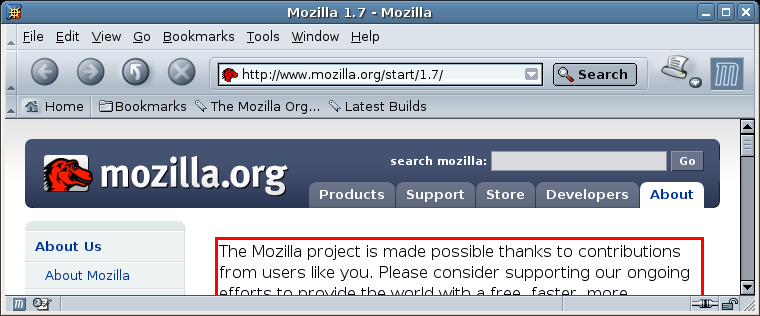
I like simplicity. I want things to be as simple as is sensible, but no more, and because of this, I tend not to particularly like web browsers. Web browsers are extremely complicated beasts, and to a large degree this is for stupid reasons, like having to support any kind of broken markup. I think the world would be better if web browsers would simply not display pages with broken markup. However, web browsers also have other things that irritate me, even if ever so slightly. For example, there's way too many buttons and other elements in their tool bars. Compare the following four screenshots of Mozilla, Firefox, and Epiphany, with their default configurations in Debian, with the version of Epiphany that I have configured myself.
Mozilla screenshot Mozilla: six real buttons, URL box, throbber, four bookmark buttons, plus widgets for rearranging or otherwise manipulating the toolbars themselves.
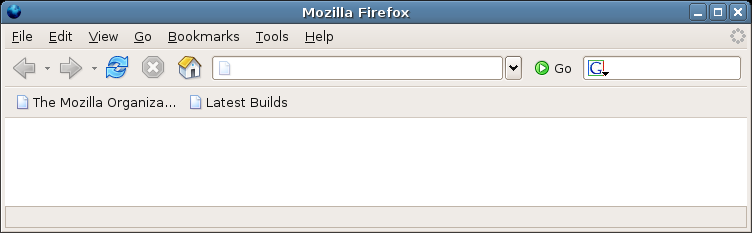
Firefox screenshot Firefox: six real buttons, URL box, Google search box, throbber, two bookmark buttons.
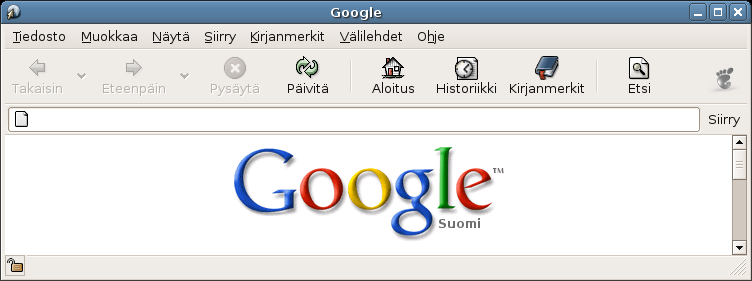
Epiphany screenshot Epiphany: nine buttons, throbber, and URL box on a separate line.
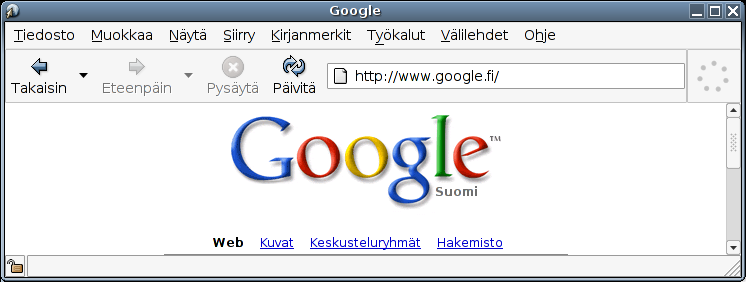
Epihany   la liw screenshot Epiphany la liw: four buttons, URL box, throbber.
Now, I admit that I'm a bit of a power user, and don't need quite as much hand-holding as a novice, but still, does anyone need a bookmarks button in the toolbar? People who make bookmarks often will quickly learn to type control-D, and those who do it only rarely don't need a toolbar button, they're happy enough with a menu entry. And why do Firefox and Mozilla need a button called "Latest Builds"? How is that interesting to anyone except Mozilla developers? Me, I prefer my setup. Four buttons plus the URL box. All buttons are easy to hit with the mouse, no need to hunt and seek the right location. Besides simplicity, my configuration saves on vertical space, which is pretty important for us laptop users.

Erich Schubert: Alexa.com wildy inaccurate

I just checked out alexa.com, and was very surprised to see graphs for my blogs domain. (Note: the other stuff in the same domain has even less visitors; alexa says 75% are on the blog) Alexa graph for blog.drinsama.de Apparently, one day beginning of april, drinsama.de made it into the top 100.000 domains at alexa again (happened in january and february, too). This very likely was my blog posting on running MSIE on Linux (whyever you might want to do that...). But their numbers are just absurdly off. They claim my blog has a reach of 20 Mio users. My ModLogAn, which uses the actual access logs, lists a peak of 358 visitors on April 4 (average is around 300 for March, 220 average in April so far). This doesn't include readers on Planet Debian, which is probably the largest share. At alexa, the domain peaked at .6 million pageviews - ModLogAn says 10k. I have, however, lots of referrals from Digg.com, Reddit.com and del.icio.us this month, since they've picked up my MSIE posting. Maybe this will happen again with the Cross-platform virus posting. I do think it has to do with users using the alexa toolbar and similar things (there is a nice firefox extension for showing Google Pagerank and Alexa traffic rating). My personal homepage, which is totall overrated in Google and has had an average of 1000 unique daily visitors in December and January, never made it that highly into alexa. While having three times as many visitors, alexa thinks it's 3-4 times worse. The difference is probably the power users. My personal page doesn't have "power visitors" like my blog.

Jonathan McDowell: Shaving is dull.

I shaved my sides a week or two ago, returning my face to its normal (well, as normal as it gets) goateed self. However I remember why I stopped shaving for winter now. If you shave, you have to do it every day. Otherwise you just look like someone who can't be bothered shaving, and while that might be because it's true, why not just not bother at all? I'm not really convinced about the wisdom in applying a sharp blade to my face early in the morning either. Oh well. I'm sure I'll get used to it again soon enough.

Erich Schubert: Proof of concept virus for Linux and Windows

Many IT news websites have been reporting that there is a new proof-of-concept "cross-platform" virus for both Windows and Linux. This is largely overrated. There are a couple of reasons why this type of virus poses no threat to Linux users: So overall, this threat is very theoretic. However, the Linux community should consider defense mechanisms for this. Debian can already verify the integrity of most of its files via md5sums, but some tools (e.g. prelink, to improve application start times) will modify the applications and thus the md5sums. A couple of measures we could/should probably do: These measures could make it even less attractive to write attacks against Linux software. I can't assess the potential security issues we might "inherit" from the Windows platform by offering the Mono C# implementation. This basically means that some of the to-come malware for Windows will run on Linux, too. Only if users try to run their Windows shareware, of course. [Update: another win32+linux virus, from 2001. Noone cared, nothing happened.]

Next.

Previous.