Search Results: "nic"

24 June 2012

Russell Coker: Targeted Advertising

Don Marti has written another blog post about targeted advertising [1]. His main point is that when a company uses the most targeted adverts (such as Google advertising) everyone knows that they are paying a small number of cents per click and nothing for the people who don t click. This compares to TV adverts which cost a lot of money and for which most viewers either leave the room or use fast-forward. Therefore using Google adverts doesn t send a signal about the amount of money invested in the products. Don also cited an example of a company sponsoring an OK Go film clip, that was a great idea, it shows that the company can do expensive things which are also a bit creative and fans will thank them (watch all the OK Go videos on Youtube, they are great). The next question is how else companies can advertise? One thing I d really like to see is sponsorship of authors. Pick an author and pay them a salary with paid editorial services for releasing a book a year for free in HTML and ebook formats. Having a fixed salary is a significant benefit when it comes time to apply for a mortgage or plan a holiday and being able to freely distribute books would be a significant benefit for an author who hasn t got a large fan base. In the computer industry it seems that there s a lot of potential for sponsoring people who produce free things. That ranges from free software and designs for free hardware to blog posts and documentation. Five years ago Sun had a blogging contest and my friend Dave Hall won a server that was worth $21K [2]. It would be nice if some other companies started doing similar things and if Sun did a repeat so some other people I like could get some free kit. Related posts:
  1. What is Appropriate Advertising? Colin Charles writes about a woman who is selling advertising...
  2. Advertising Free Software Projects Today I just noticed the following advert on one of...
  3. Friends and Adverts For some time I have been running Google Adsense adverts...

Petter Reinholdtsen: Song book for Computer Scientists

Many years ago, while studying Computer Science at the University of Troms , I started collecting computer related songs for use at parties. The original version was written in LaTeX, but a few years ago I got help from H kon W. Lie, one of the inventors of W3C CSS, to convert it to HTML while keeping the ability to create a nice book in PDF format. I have not had time to maintain the book for a while now, and guess I should put it up on some public version control repository where others can help me extend and update the book. If anyone is volunteering to help me with this, send me an email. Also let me know if there are songs missing in my book. I have not mentioned the book on my blog so far, and it occured to me today that I really should let all my readers share the joys of singing out load about programming, computers and computer networks. Especially now that Debconf 12 is about to start (and I am not going). Want to sing? Check out Petter's Computer Science Songbook.

23 June 2012

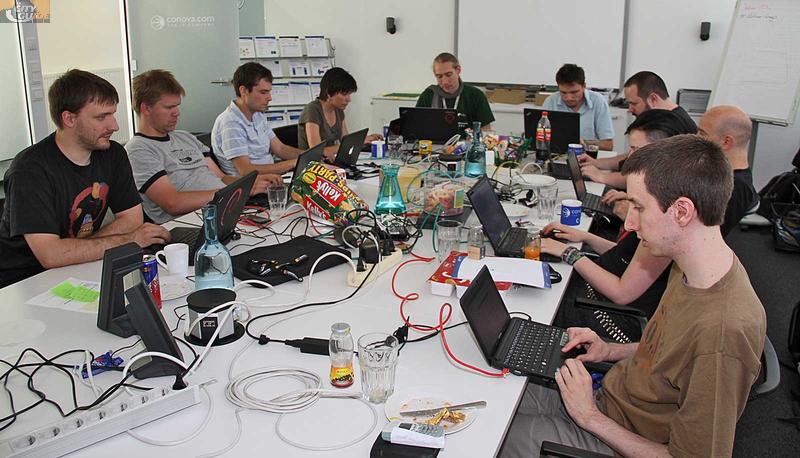
Bernd Zeimetz: Report from the Bug Squashing Party in Salzburg

bsp_2012_salzburg photo from salzburg-cityguide.com, Copyright (C) Uwe Brandl

Participation and Results From June 15-17th we held a Debian BugSquashingParty in Salzburg, hosted and sponsored by conova communications GmbH. It was a fun and busy weekend, with 15-17 people from 5 countries being around, mainly working on RC bugs in Testing/Unstable. Gerfried Fuchs (rhonda) also worked on triaging the impact of RC bugs on the version in Squeeze, while Peter Palfrader (weasel) took care of Tor related things and Debian sysadmin work, including starting on the new bugs and udd hosts. Phillip Hug (hug) worked on the debian.ch infrastructure. Together with Miroslav Such from Red Hat Bernd Zeimetz (bzed) worked on the packaging of the necessary libraries and daemons to add (basic) Spacewalk client support to Debian. As soon as the packages passed NEW and #677871 was applied (thanks to the APT guys for working on that already), managing Debian clients with Spacewalk should work out of the box. Of course we also had a little keysigning party :)

Statistics
  • about 68 bugs in unstable/testing were triaged/patched/fixed or at least pinged
  • 54 bugs were tagged to show if they affect Squeeze, several other bugs were pinged to retrieve necessary information or to trigger an update in the next stable pointrelease.
  • 5 packages were introduced into Debian (still in NEW, though) - the Spacewalk client related packages and libapache2-mod-auth-memcookie.

Accomodation Thanks to Debian funds we were able to provide accomodation for four participants in the JUFA youth hostel in Salzburg. We had paid in advance for eight, but changing to rooms with a higher category for only 4 people would have been equally or more expensive.

Press/Media coverage Additionally to being mentioned in the calendars on ProLinux and similar pages, we had some press coverage by the local newspaper and online magazines:

Fun facts We consumed 2kg of Leberkas, a big plate of "Buchteln mit Vanillesosse", about 16000cm^2 of Pizza, about 80 litres of coke, juice, beer and wine and I guess we drank at least the same amount of water. We had coffee made of 1.5kg coffee beans and managed to empty the (formerly well filled) icemaker in the fridge. Also we had successful training sessions of a standard Debconf game (rules won't be explained here obviously). Maybe we even successfully spread the game to the employees of a commercial linux distribution ;)

22 June 2012

Michael Casadevall: Announcement of Calxeda Highbank Images for Quantal

Hello all,

As many of you are aware, Canonical, in coordination with Calxeda and others have been working to bring Ubuntu to this new class of high-performance cluster yet low power-consumption computers built around ARM processors. Many of you who were in attendance at UDS in Oakland may remember seeing Calxeda's talks and demonstration live, and the exciting news that this represents. The full presentation is available here.

In line of this work, I'm am extremely pleased to announce that the initial images for the Calxeda Highbank platform are now available for download, with installation instructions available here. Please remember that Quantal is still in alpha development, and is not currently recommended for use in a production environment. As development of 12.10 continues, we will continue to refine these images, and our tools to fully embrace MAAS on ARM, and make 12.10 to be our best release yet.


As an additional note, Highbank support for Ubuntu 12.04 LTS will be released as part of the 12.04.1 update in mid-August and will join our support for ArmadaXP from Marvell, which was released as part of 12.04.

---
Michael Casadevall
ARM Server Tech Lead
Professional Engineering and Services, Canonical
michael.casadevall@canonical.com

21 June 2012

Michal Čihař: Slovakia trip

To continue in photography blog posts, let's document part of our last week trip around Slovakia. We've visited many nice places, starting at Mura sk planina, going trhough Slovensk r j and ending in Nizke Tatry. All pictures are taken in Slovensk r j (Slovakian paradise), where I've really enjoyed taking photos of waterfalls and wonderful streams: Such  Biel Sokolia dolina Sokolia dolina Piecky Piecky

Filed under: English Photography Travelling 2 comments Flattr this!

20 June 2012

DebConf team: Call for DebConf14 venues! (Posted by Gunnar Wolf)

2000, Bordeaux, France. 2001, Bordeaux, France. 2002, Ottawa, Canada. 2003, Oslo, Norway. 2004, Porto Alegre, Brazil. 2005, Helsinki, Finland. 2006, Oaxtepec, Mexico. 2007, Edinburgh, United Kingdom. 2008, Mar del Plata, Argentina. 2009, C ceres, Spain. 2010, New York, United States. 2011, Banja Luka, Bosnia and Herzegovina. 2012, Managua, Nicaragua. 2013, Vaumarcus, Switzerland. We have gone to all different latitudes (although not yet longitudes!). We have had very hot and very cold weather. Great cities and small villages have hosted us. What will be the next addition to this great list? As we approach DebConf12 (10 days to DebCamp and counting, yay!), we should keep the future in mind. So, as every year in recent history, we will once again have a DebConf session presenting possible venues for the next year. Organizing DebConf in your city means a lot of hard work. It also means one of the greatest personal experiences you can imagine. And it is a great way to contribute to Debian. The decision process for every DebConf venue starts two years before, with presentations during DebConf(n-2). That means, if you consider presenting a bid for DebConf14, now is the moment to act! Do you have to be present at Managua to propose your bid? No. You can proxy via somebody I d suggest to do it via somebody who knows the location you are suggesting, but basically, choose a friend that you trust that trusts you. Of course, you can participate in the presentation session via IRC. Do you have to be a Debian Developer to propose a bid? No. For DebConf9, none of the C ceres guys was a DD; for DebConf10, some of the people most involved from the local New Yorkers were not DDs. For DC11, none of our hosts in Bosnia are DDs. And for DC12, the dear and overworked Nicaraguan crew is also made from people interested in getting closer to the Debian project, but not DDs. Do you have to decide now? No. This is just a call for a first presentation, but the decision regarding DC14 will be taken probably around March 2013. However, giving a nice presentation at DebConf helps a lot, gives you visibility, and will get the ball rolling. Is there a geographical bias? Slight. So far, and since the second DebConf, we have kept the tradition not to repeat continents on two successive DebConfs. This is not a hard condition, however! While there is some probability that DebConf14 will be somewhere in America (the continent, of course), it depends on the proposals more than on any pseudo-rule. What do you need to start thinking about? Go visit our prospective location checklist. You can also look at what other teams have historically presented. And of course, go to the DebConf14 wiki planning page Register there, even if you are just in the early phases of finding data.

Andrew Pollock: [life] On running, Android apps, personal area networks and fund raising

Sarah and I are running in the 5K Packard Summer Scamper on Saturday. Sarah's been working on her fitness for a few months now, and I belatedly started working on mine about a 6 weeks ago. (Sarah's fund raising, so if you'd like to sponsor her, her page is here) I've been using the Couch to 5K program to get my fitness up, but I haven't managed to stick to it exactly, due to a combination of injury and wet weather. I have still managed to get myself to the point where I can run for 28 minutes solidly, which is close to 5K (I'm doing my last training run tomorrow, so I'll see what the distance comes out to). I've been doing up to three runs a week at lunchtime around the Shoreline Amphitheatre area, using my Galaxy Nexus and some Bluetooth headphones, and I've got a pretty nice little setup. I'm using Pandora for some music to listen to, C25K Pro for the actual running intervals. It has voice prompts that tell me when to run, or to start a walk interval. Finally, I'm using Strava Run for recording the run and getting some additional statistics during the run (kilometre markers, split times and time elapsed). These also come through as voice prompts. I'm not currently wearing a watch, and I want to keep track of the wall time, so I've also found Audio Clock, which verbally announces the time (I've set it to do it every 15 minutes that a Bluetooth headset is connected). What I really like about all of this is that I get spoken voice prompts and information, seamlessly mixed in with the music from Pandora, all while I'm running. I've got my phone strapped to my arm, and I don't have to look at it during the run, and there's no wires. I'm a huge personal metrics junkie, and that was why I previously eschewed running outdoors. I wanted that information on the treadmill display so I could push myself that little bit further. Sure, I'm not getting the constant information as much as if I had a treadmill display in front of me the whole time, but I'll settle for running in the great outdoors and getting some feedback every kilometre (if I get really desperate, Strava will do it every half kilometre). Not to diss optical augmented reality efforts too much, but I'd rather go for a combination of discreet audio announcements through a Bluetooth earpiece, perhaps complemented with something I choose to look at like a Pebble watch, than an in-your-face pair of glasses. My Bluetooth headphones are the around the back of the head variety that aren't going to bounce off during a run. I've really enjoyed doing the runs during the week, and when I was doing the full 3 runs a week of a given week of the Couch to 5K program, I'd really notice a difference by run number 3. I'm currently planning on sticking with doing a 5K run hopefully at least twice a week after this weekend. It's certainly done wonders for my waistline.

19 June 2012

Matthew Garrett: Ubuntu ODM UEFI requirements for secure boot

Updated 22/06/2012: Reference to Canonical's response

A couple of people have asked me about the Ubuntu ODM UEFI requirements, specifically the secure boot section. This is aimed at hardware vendors who explicitly want to support Ubuntu, so it's not necessarily the approach Canonical will be taking for installing Ubuntu on average consumer hardware. But it's still worth looking at.

In a nutshell, the requirements for secure boot are:
It's basically the same set of requirements as Microsoft have, except with an Ubuntu key instead of a Microsoft one.

The significant difference between the Ubuntu approach and the Microsoft approach is that there's no indication that Canonical will be offering any kind of signing service. A system carrying only the Ubuntu signing key will conform to these requirements and may be certified by Canonical, but will not boot any OS other than Ubuntu unless the user disables secure boot or imports their own key database. That is, a certified Ubuntu system may be more locked down than a certified Windows 8 system.

(Practically speaking this probably isn't an issue for desktops, because you'll need to carry the Microsoft key in order to validate drivers on any PCI cards. But laptops are unlikely to run external option ROMs, so mobile hardware would be viable with only the Ubuntu key)

There's two obvious solutions for this:
  1. Canonical could offer a signing service. Expensive and awkward, but obviously achievable. However, this isn't a great solution. The Authenticode format used for secure boot signing only permits a single signature. Anything signed with the Ubuntu key cannot also be signed with any other key. So if, say, Fedora wanted to install on these systems without disabling secure boot first, you'd need to have two sets of install media - one signed with the Ubuntu key for Ubuntu hardware, one signed with the Microsoft key for Windows hardware.
  2. Require that ODMs include the Microsoft key as well as the Ubuntu key. This maintains compatibility with other operating systems.

This kind of problem is why we didn't argue for a Fedora-specific signing key. While it would have avoided a dependence on Microsoft, it would have created an entirely different kind of vendor lock-in.

Update: Canonical have now provided their full plans. They won't be providing a signing service, but will be requiring that all Ubuntu-certified hardware ship with the Microsoft key

comment count unavailable comments

Joey Hess: I work for The Internet now

I have an interesting problem: How do I shoehorn "hired by The Internet for a full year to work on Free Software" into my resume? Yes, the git-annex Kickstarter went well. :) I had asked for enough to get by for three months. Multiple people thought I should instead work on it for a full year and really do the idea justice. Jason Scott was especially enthusiastic about this idea. So I added new goals and eventually it got there. graph: up and to the right, to 800% funded Don Marti thinks the success of my Kickstarter validates crowdfunding for Free Software. Hard to say; this is not the first Free Software to be funded on Kickstarter. Remember Diaspora? Here's what I think worked to make this a success: I've already put two weeks work into developing the git-annex assistant. I'm blogging about my progress every day on its development blog. The first new feature, a git annex watch command that automatically commits changes to git, will be in the next release of git-annex. I can already tell this is going to be a year of hard work, difficult problems, and great results. Thank you for helping make it happen.

Wouter Verhelst: E-voting in Belgium

A post by Gunnar reminded me that I wanted to blog about this: e-voting in Belgium is going to change slightly. Previously, e-voting worked with a computer with a lightpen on which you would enter your vote, a magnetic card that would contain your vote in encoded form, and a magnetic card reader that would count the votes. After more than a decade when I was first eligible to vote back in 1996, it had already been implemented in the city of Antwerp, where my vote would be cast, so I've never voted on paper it had still not been rolled out everywhere, and some of the computers used for the voting were now starting to show their age. A few days ago on the news, they reported that the e-voting system was to change so that rather than magnetic cards, it would use pieces of paper. This way, voters would be able to check that the information on the piece of paper conforms with their vote. Investigating what this means, I found this website by the federal government, where they have some pictures of a test run of the new system which they ran in October last year. Rather than using magnetic cards, the new system uses paper slips with the voted information in two forms: once as a (huge) QR code, and once as a human-readable text. In theory, this is a more transparent system than using a magnetic card, and that's a good thing; additionally, it allows for a traditional recount (by people, not computers) should the need ever arise. However, I do still see some problems: Having said that, I do think the new system is an improvement over the old (in fact, it's exactly the kind of system I had thought about myself earlier when thinking about ways to improve e-voting); and if the two problems are solved in some way (it's not impossible to do that, just requires some clever thinking), I believe it has potential as a way to implement electronic voting in a good way.

18 June 2012

Gunnar Wolf: Turning failure into apparent success, and carrying on: e-voting in Jalisco

I will sound monothematic, but I have been devoting quite a bit of work to this topic lately: Trying to stop the advance of e-voting in Mexico, Latin America and the world. Why trying to stop it? Isn't technology supposed to help us, to get trustable processes? Yes, it's supposed to... but it just cannot achieve it, no matter how hard it is tried I won't get into explanations in this blog post, but there is plenty of information. Feel free to ask me for further details. Anyway Yesterday (Sunday, 2012-06-17) was the fifth simulated voting that will lead to the first wide-scale deployment of electronic voting booths in my country: About 10% of the population of the state of Jalisco (that means, ~500,000 people) will cast their votes on July 1st electronically. This particular case illustrates how simulated votings can be used to forge a lie: Pounce Consulting, the company that won the e-voting project for IEPC (Jalisco's voting authority), delivered their booths over 40 days late, just before the deadline for the project to be canceled. Oh, and by the way, it's the same company that just failed to deliver on time for another planned local authority (10% of the booths in the Federal District, where I live, where fortunately 100% of the votes will be cast on traditional, auditable and cheap paper). After this delay, five voting simulations were programmed, to get the local population acquinted with them. The first ones just failed to get the population's interest and had close to 40% failure rates (mainly regarding transmission). Several other "minor details" were reported, including mechanical details that allowed subsequent voters to see the vote of who had just left. Anyway, making long story short: The fifth and last simulation was held yesterday. Officially, it was finally successful (about time). As these booths include the "facilities" to communicate the results via the cellular network, but the populations where they are to be deployed do not yet have cellular coverage, 10% of the booths will have to be carried back to the Districtal Header (that can be a ~10hr trip) to be counted. Also, in all places, traditional paper stationery and paraphernalia will be printed just in case it is needed (and when will they now? When half of the votes are cast and lost?) Anyway... e-voting is still in its first stage in Mexico. Right now, I'm sure, no attempts to rig the election will be made (centrally). But every effort will be made (as it has been made) to dismiss the obviously big and nontrivial ways it has failed and will fail, and any problems will be labeled as "minor". And probably by 2018 we will be facing many more states (even nationwide) deployments. But propaganda fails to see the obvious: E-voting is more expensive, more complicated, leads to more possible failure states. E-voting should not be deployed in large-scale (i.e. more than a couple of hundred voters) elections. Electronic voting is insecure, violates secrecy, allows for fraud. No matter how many locks are put into it.

17 June 2012

Russell Coker: Debian SE Linux Status June 2012

It s almost the Wheezy freeze time and I ve been working frantically to get things working properly. Policy Status At the moment I m preparing an upload of the policy which will support KDE (and probably most desktop environment) logins and many little fixes related to server operations (particularly MTAs). I would like to get another version done before Wheezy is released, but if Wheezy releases with version 2.20110726-6 of the policy that will be OK. It will work well enough for most things that users will be able to use local changes for the things that don t work. One significant lack with the current policy is that systemd won t work. I ve included most of the policy changes needed, but haven t done any of the testing and tweaking that is necessary to make it work properly. I would like to see policy support for systemd in a Wheezy update if I don t get it done in time for the first release. If I don t get it done in time for the release and if the release team don t accept it for an update then I ll put it in my own repository so anyone who needs it can get it. /run Labelling One significant change for Wheezy is to use a tmpfs mounted on /run instead of /var/run. This means that lots of daemon start scripts create subdirectories of /run at boot time which need to have SE Linux labels applied for correct operation. The way things work is that usually the daemon will write to the directory immediately after the init script has created it, so I can t just have my own script recursively relabel all of /run. Some packages that need to be patched are x11-common #677831, clamav-daemon #677686, sasl2-bin #677685, dkim-filter #677684, and cups #677580. I am sure that there are others. [ -x /sbin/restorecon ] && /sbin/restorecon -R $DIR Generally if you are writing an init script and creating a directory under /run then you need to have some shell code like the above immediately after it s created. Also the same applies for directories under /tmp and any other significant directories that are created at boot time. Upgrading Currently there are some potential problems with the upgrade process, I m working on them at the moment. Ideally an apt-get dist-upgrade would cleanly upgrade everything. But at the moment it seems likely that the upgrade might initially go wrong and then work on the second try. There are some complications such as the selinux-policy-default package owning a config file which is used by mcstransd (which is part of the policycoreutils package), when the config file format changes you get order dependencies for the upgrade. Kernel Support My aim when developing a new SE Linux release for Debian is that the policy should work as much as possible with the user-space from the previous release. So if you upgrade from Squeeze to Wheezy you should be able to start the process by upgrading the SE Linux policy (which drags in the utilities and lots of libraries). This means that if you have a server running you don t have to put it out of action for the entire upgrade, you can get the policy going and then get other things going. I haven t tested this yet but I don t expect any problems (apart from all the dependencies). Also the policy should work with the kernel from the previous release. So if you have a virtual server where it s not convenient to upgrade the kernel then that shouldn t stop you from upgrading the user-space and the SE Linux policy. I ve tested this and found one bug, the sepolgen-ifgen utility that you need to run before audit2allow -R won t work if the kernel is older than the utilities #677730. I don t know if it will be possible to get this fixed. Anyway it s not that important, you can always copy the audit log to another system running the same policy to run audit2allow, it s not convenient but not THAT difficult either. The End Result I think that the result of using SE Linux in Wheezy will be quite good for the people who get the upgrade done and who modify a few init scripts that don t get the necessary changes in time. I anticipate that someone who doesn t know much about SE Linux will be able to get a basic workstation or small server installation done in considerably less than an hour if they read the documentation and someone who knows what they are doing will get it done in a matter of minutes (plus download and install time which can be significant on old hardware). At the moment I m in the process of upgrading all of my systems to Unstable (currently Testing has versions of some SE Linux packages that are too broken). While doing this I will keep discovering bugs and fix as many of them as possible. But it seems that I ve already fixed most things that affect common users. Also BTRFS works well. Not that supporting a new filesystem is a big deal (all that s needed is XATTR support), but having all the nice new features on one system is a good thing. Now I just need to get systemd working. Related posts:
  1. SE Linux Status in Debian 2012-01 Since my last SE Linux in Debian status report [1]...
  2. SE Linux Status in Debian 2012-03 I have just finished updating the user-space SE Linux code...
  3. SE Linux Status in Debian 2011-10 Debian/Unstable Development deb http://www.coker.com.au wheezy selinux The above APT sources.list...

16 June 2012

Brett Parker: Things that piss me off #1

You know what really pisses me off? Idiots in takeaways... More to the point, racist, idiotic, drunken idiots in takeaways - having just been to one of the few places still open at "silly o'clock" i.e. a place that's open after the pub has shut, it's really annoying and disappointing in the human race, to hear someone refer to the staff as a "paki bastard". I'm disgusted with the customer in question. I mean, WTF, how absolutely fucking stupid have you got to be to both be racist and do it loud enough to not only piss off the staff, but piss off any customer that actually just views people as people - we're in this world together ffs, stop being such fucking moronic, racist cunts. It's not difficult. People are people. All of them. The whole world. (apologies for bad language in the post, it's just, well, as the title says, something that really pisses me off).

15 June 2012

Erich Schubert: Dritte Startbahn - 2 gewinnt!

Usually I don't post much about politics. And this even is a highly controversial issue. Please do not feel offended.
This weekend, there is an odd election in Munich. Outside of Munich, nearby the cities of Freising and Erding, there is the Munich airport. The company operating the airport is owned partially by the city of Munich, which gives the city a veto option.
The Munich airport has grown a lot. Everybody who has been flying a bit knows that big airports (such as Heathrow) are oft the worst. If anything goes wrong, you are busted, because it will take them a long time to resume operations. This just happened to me in Munich, where the luggage system was down, and no luggage arrived at the airplanes.
Yet, they want to take the airport further down this road, and make it even bigger: add two satellite terminals, and a third runway. I'm convinved that this will make the airport much worse for anybody around here. The security checkpoints will be even more crowded, the lines for the baggage drop-off too, and you will have to walk much further on the airport.
Up to now, the Munich airport was pretty good compared to others. In particular given that is is one of the largest in Europe! It is because it had been designed from the ground up for this size. Now they plan to screw it up.
But there are other arguments against this, not the egoist view of a traveller. The first is the money issue. The airport is continuously making losses. It's the taxpayer that has to pay for all of this - and the current cost estimation is 1200 million. This is not appropriate, in particular since history shows that you can take this x2 to x10 to get the real number. They should first get the airport into a financial stable condition, then plan on making it even bigger.
Then there are the numbers. Just like with any polticial large-scale project, the numbers are all fake. The current airport was planned to cost 800 million, in the end it was about 8550 million. The politicians happily lie to us. Because they want to push their pet projects. We must no longer accept such projects based on fake numbers and old predictions.
If you are already one of the 10 largest airports in Europe, can you really expect to grow even further?!? There is a natural limit to growth, unless you want to have every single passenger on the world first travel to Munich multiple times, then go to his final destination ...
One thing they seem to have completely neglected is that Berlin is currently getting a brand new airport. And very likely, this is going to divert quite some traffic away from Munich. Just like the Munich airport diverted a lot of traffic away from Frankfurt. To some extend because many people actually want to go to Berlin, not Munich, but they currently have to change planes here or in Frankfurt. So when Berlin finally is operational, this will have an impact on Munich.
And speaking of the Berlin airport, this is a good example to not trust the numbers and our politicians. It is another example of a way-over-budget, way-behind-time project the politicians screwed up badly and where they lied to us. If we should not have trusted them with Berlin, why should we trust them with the Munich addon?
A lot of people whose families have been living there for years will have to be resettled. Whole towns are going to disappear. An airport is huge. Yet, they cannot vote against it, because their small towns do not own shares of the airport. The polticians don't even talk to them, not even to their poltical representatives.
Last but not least, the airport is in a sensitive ecological area. The directly affected area is an European special protection area for wild birds. There are nature preserves nearby, and all this area already suffers badly from airport drainage, pollution and noise. When they built the airport originally, the replacement areas they setup were badly done, and are mostly inhabited by nettles and goldenrod (which is not even native to Europe). See this article in S ddeutsche Zeitung on the impact on nature. You can't replace the loss of the original habitats just by digging some pools and filling them with water ...
If you want more information, go to this page, by Bund Naturschutz.
This is not about progress ("Fortschritt"). That is a killer argument the politicians love, but it doesn't hold. Nobody is trying to shut down the airport. Munich will be better of by keeping the balance having both a reasonably sized airport (and in fact, the airport is already one of the 10 largest in Europe!) and preserving some nature to make it worth living here.
If you are located in Munich, please go vote against the airport extension, and enjoy the DEN-GER soccer game afterwards. Thank you.

Christian Perrier: [Running] Caen "Courants de la Libert " marathon...outcome

I made it..:-) Despite quite horrible weather conditions (heavy rain before the race, strong rain during the first 1/2h, light rain up to half-marathon....and wind during the first 25 kilometers), I managed to break my personal best in a marathon, down to 3h38'45". Not a huge improvement (1'35") but, given that this race is not the easiest ever (the last 17 kilometers are made of ups and downs, for a total 150 meters positive slope and 60 meters height difference between start and finish), a very good result indeed. This has been my first "negative split" marathon, with a second half faster than the first. Also I managed to keep the same speed all along the race, each kilometer being 5'02" and 5'16" except one at 5'23 because of the steepest hill there. Final kilometer in 4'50"! As I was hoping, training gives results... Now, I'm heading to a summer without races, but probably great runs during DebConf in Nicaragua. Next "big" race : Seine-Eure marathon, in Val de Rueil, France, on October 20th. Here, I again expect to break my PB as this is a very flat race (the place where I set my previous PB, indeed)

Cyril Brulebois: Fixed!

A while ago, I used to use the Fixed font, which I very much liked, since it featured a quite decent Unicode coverage, and was available in tiny sizes. Then time passed, I switched systems a few times and it kind of disappeared. Terminus is also nice, but quite bigger (for a given terminal geometry, 60 lines for Terminus, 72 for Fixed). Today, wondering why some fonts I dropped in ~/.fonts weren't picked up by fc-cache -rv ~/.fonts/, I found out a configuration file was preventing fontconfig from considering them: /etc/fonts/conf.d/70-no-bitmaps.conf Kill it with fire, and tada: Fixed is back!

11 June 2012

Brett Parker: Newsflesh Trilogy

So, on Thursday the final part of the Newsflesh trilogy by Mira Grant came out, I'd only been waiting on it for a year. The series is fantastic, and the last book answers the over hanging questions from the second nicely - there's some twists along the way, and it's a Damned Good read. I didn't pick up Blackout (the last book) until Saturday night, as I was re-reading Feed and Deadline first - I'd finished Feed on Wednesday but didn't finish Deadline until Saturday. I picked up Blackout Saturday night at ~ 2200 and didn't go to sleep until ~ 0200 - then, waking up on Sunday, other than doing a few bits of work from 1100 till about 2100 I read the rest of Blackout, it's kinda addictive. It ends a bit abruptly, but well. If you've not read this series - pick up Feed - if you like it, you'll love the series... also, if you don't cry at at least 2 points in Feed, you're obviously a heartless bastard!

10 June 2012

Gregor Herrmann: DebConf12

Yo voy a ir a la DebConf 12

finally I managed to book a flight to MGA. here's my itinerary, in case someone shares a flight:
Munich        Madrid        IB3537   Jul  1   07:30   10:30
Madrid        San Jose      IB6313   Jul  1   12:05   15:05
San Jose      Managua       LR679    Jul  1   18:24   19:24


Managua Panama City CM105 Jul 21 14:49 17:24 Panama City Madrid IB6346 Jul 21 18:55 12:10+1 Madrid Munich IB3564 Jul 22 16:10 18:55

C.J. Adams-Collier: Spinning up a telco with Asterisk

Back in 2010 our family moved to an island in an archipelago in the very top left of the US s continental 48. Before moving, we did some research regarding high speed network access. There are a number of ISPs in the county, and even one headquartered on our particular island. But we found that the location where we were moving was in a location that was only serviced by 1.5Mbit DSL. We had been spoiled in our previous two locations and had seen bittorrent swarms reach over 1 megabyte (8Mbit) per second. Our bill said 12 down and 2 up and I wouldn t be surprised if we achieved that. At any rate, we were disappointed by the speeds available and I wanted to do something to increase the availability of higher speed network access. Some of my friends from the North American Network Operators Group (NANOG) told me that one way to improve the infrastructure would be to get involved with telecommunications provisioning as a Competitive Local Exchange Carrier (CLEC). With the above in mind, I did some research and found that in my state, the authority which certifies and regulates telecommunication companies is the Washington Utilities and Transportation Commission (UTC). I found the application forms on their web site, filled them in, filed the appropriate documents with the appropriate departments and received a certificate in the mail shortly thereafter. We have since filed annual reports as required by regulations. And with the regulatory bits out of the way, we re now left with only the technical details. We have established collocation of some equipment near our state s central telecommunications facility at the Westin Building. Technically speaking, the equipment is not in the Westin, but at a facility connected to the Westin by multiple 10Gbit links. Close enough for me. On this equipment, we re running a Debian Squeeze Xen virtual machine and Digium s Asterisk packages:
cjac@sip0:/etc/asterisk$ grep -B1 -A3 Digium /etc/apt/sources.list
#
#  Digium asterisk packages
#
deb http://packages.asterisk.org/deb squeeze main
deb-src http://packages.asterisk.org/deb squeeze main
cjac@sip0:/etc/asterisk$ dpkg -l   grep digium
ii  asterisk                           1:1.8.11.1-1digium1~squeeze  Open Source Private Branch Exchange (PBX)
ii  asterisk-config                    1:1.8.11.1-1digium1~squeeze  Configuration files for Asterisk
ii  asterisk-core-sounds-en-gsm        1.4.21-1digium1~squeeze      asterisk PBX sound files - English/gsm
ii  asterisk-voicemail                 1:1.8.11.1-1digium1~squeeze  simple voicemail support for the Asterisk PBX
We saved up our nickles and dimes to purchase a 24-port analog telephony adapter (ATA). At the recommendation of one of the denizens of the #asterisk IRC channel on Freenode, we decided on the GrandStream GXW4024. It is pretty simple to configure them to register with the Asterisk server using SIP. The only problem we had was getting the RTP streams, and specifically their dynamically negotiated service ports, to traverse the NATting routers. We currently have no public IPv4 address space at the facility which hosts the ATA and so the rest of the internet sees all traffic originating from this facility as sourced from a single IP address. In order for this to work, the edge NAT/router device (in our case, BIG-IP LTM) needs to map its external L4 ports (TCP and UDP) to the ports of internal hosts so that traffic can flow correctly. This works fine for traffic which originates from internal hosts and is destined to hosts on the outside, but does not work so well when hosts on the outside wish to establish connections to hosts on the inside. Call management sessions established with the SIP protocol fall in the former category, but call media (voice, video, txt) sessions established with the RTP protocol fall into the latter; the host and port used to carry the media data are negotiated during the SIP session and the media socket is established out of band. The problem occurs when the call server (on the outside) attempts to establish an RTP stream with the caller (on the inside). The call server attempts to connect to the caller using the IP address from which it connected. The problem is that this address belongs to the NATting router, not the caller, and the router is not expecting the incoming request. To get around the NAT problem, we temporarily configured an OpenVPN tunnel to extend our L2 network segment. Our long-term solution will be to provision an Asterisk server in the same facility as the ATA and then register with it instead of the server in the exterior facility. Calls will then be switched at the local facility and the upstream link will be established using the IAX2 protocol, which does not suffer from the same NAT problems. All of the above provides us with the ability to make voice calls between the 24 channels of the ATA and any other SIP client which happens to be registered with our call server. This is all well and good, but we want to allow our customers to call the rest of the world. Enter our upstream provider, Threshold Communications, Inc. These folks are experienced and professional and have helped us successfully establish both outbound and inbound calling for very reasonable monthly costs. The call quality is indistinguishable from the lines provisioned by the local bell company, and inter-operates flawlessly with the Asterisk call server stack. Because calls transit our Asterisk server, we can add additional features such voicemail, speech to text, DTMF-driven menus, or call forwarding, for instance. We could even theoretically set up autopatch service using amateur frequencies or launch perl scripts to automate arbitrary fancyness. Our next step is to finish configuration of our 12-channel ZyXEL AAM1212 DSLAM modules so that we can deliver ADSL service over the same copper pairs as we deliver voice.

9 June 2012

Neil Williams: Going to Nicaragua


Not DebCamp this year, but I intend to get to more talks than I did in Bosnia and still get some work done on Emdebian Integration into Debian as well as working on as many RC bugs as I can manage during the week.

Possibly easy targets via UDD

A couple of my usual RC bug filter queries:


wheezy-and-sid, ignoring patch, pending, security, claimed and not in main.
(483 bugs)


wheezy-or-sid, ignoring merged and done
(987 bugs)

Next.

Previous.