Search Results: "agi"

7 June 2007

Joerg Jaspert: Laptop suspend

Dear Lazyweb, some time ago I got a new notebook, a HP nw9440. It’s all nice and great and stuff and does what I want. Except two little things that I couldn’t fix yet, but maybe you have some suggestions? The first is only a little bit annoying. X does not like DPMS after a suspend/resume cycle. Running
xset dpms force off
will turn off the display, but the next acpi event received (according to acpi_listen) turns it on again. Restarting acpid fixes this, until next resume/suspend. For some reason the restart trick only works if done some time after the whole resume finished. Adding it to the scripts so its done automagically doesn’t fix this. The second thing, mostly time consuming, is the fact that this laptop does not like Suspend-to-RAM, so only Suspend-to-Disk working. It happily suspends to ram and goes to sleep and it also gets back on. Just that it doesnt turn the display back on, no matter what I try. I tried all combinations of options for s2ram I could find, nothing. Is there someone out there that has the same laptop and got it to suspend to ram and can tell me what screw he had to jump on? Update: Looks like the first problem is fixed in Xorg upstream.. Just that it didn’t got into etch anymore. Looking at xserver-xorg that probably means updating to sid right now, which I don’t want to do. So well, lets wait until a newer version is in lenny, maybe someone backports Xorg at some point? :)
Adam Rosi-Kessel: Religion, Secularism, and Mystery

To follow up on my early post Christopher Hitchens v. God, Jonah at the Frontal Cortex has some insightful comments on religion and secularism. The money quote:
When people like Dawkins attack wimpy agnostics or moderate believers, they forget that many atheists aren’t uber-rationalists. They carry around tarot cards, not The Selfish Gene.
Jonah also makes a good point that science and religion may not have irreconcilable differences:
It’s important to note that science isn’t necessarily in conflict with our need to believe in some sort of mystery. Modern science, after all, has discovered some of the craziest ideas around, from the principles of quantum physics to the fact that our head holds a trillion cells trafficking in minor jolts of electricity. These ideas are both materialist and mysterious, since they hint at a universe that exceeds the current capacities of our imagination. What Hamlet said to Horatio is still true.
This sort of analysis seems to me far more nuanced and interesting than that advanced by what I’ll call the “vulgar atheists” — Dawkins, Hitchens, Dennett, et al.

6 June 2007

Michael Prokop: Python on the console

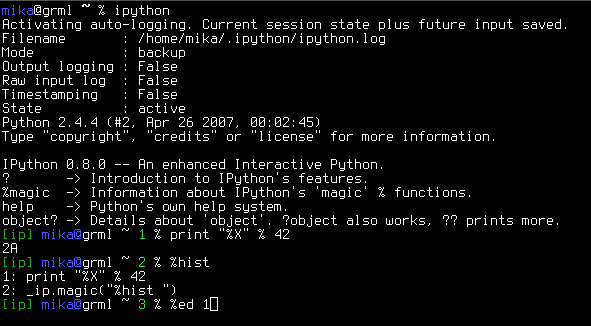
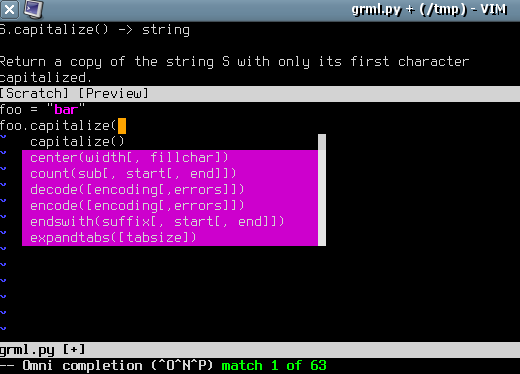
I wrote a small python webpage for the grml-wiki to provide some information regarding Python-development on grml. I just upgraded Vim on my main system to version 7.1 and omnicompletion with vim-python became better once more. So time for a short demo of ctrl-x-o: Python coding in Vim 7.1 - Screenshot I also very much like ‘%ed’ within ipython using the following snippet in my ~/.ipython/ipythonrc:
editor 1
editor /usr/bin/vim.python
Notice: Don’t wonder about the prompt style of the following ipython-screenshot, I customized it a little bit (see python-webpage in the grml-wiki again to get an idea). ipython demo - Screenshot So running the last line containing ‘%ed 1′ will execute /usr/bin/vim.python providing the code from the first command line of ipython and I can use all the magic of Vim for editing the code. When exiting the editor I have the code within ipython. Rocking. :) Oh, don’t forget to check out the Quick tips of ipython when exploring it. Now what’s missing in ipython is the edit-command-line feature of Zsh. That would allow me to edit already typed (but not yet executed) code with an external editor. Anyone out there with an according tip? ;-)

Paul van Tilburg: Master Project Finished

Yesterday, I have completed my master project with a presentation of my work and a defence of my thesis. I got awarded a 9 (out of 10) for my entire project. It is a result that I am very happy with and am very proud of. This result will allow me to get my Master of Science degree with honours on June 19, after the exam committee has checked everything. Note that the diploma will be handed out not on June 19, but on August 28, because I am on my holiday and at Debconf in Edinburgh the next two weeks. Thanks everyone for attending my presentation, joining the “celebration lunch” afterwards, and all the encouraging words and kudos. :-)

Jan Wagner: PHP packages in etch and binary compatibility to 3rd party extensions

Since etch php is compiled with large file support. This breakes binary compatibility to other packages, which are commonly not compiled with LFS and leads into trouble with 3rd party extensions, cause these are precompiled against the ABI of upstream and LFS not turned on. One example is Zend Optimizer. You may say this will only hit closed source applications, but if these are customer requirements, you have to solve the issue in some way.
You can do this by compiling your php and all extension from source without LFS enabled, but here you have to care about bugs, regressions and exploits for your own.
An other solution is to rebuild the packages from etch with LFS disabled. I’ve done this with the source packages of php4 and php5 from etch. Additionaly I did backport php-suhosin from unstable against this php packages for php4 and php5. Packages are available at http://ftp.cyconet.org/debian/archive/special/ or via

deb http://ftp.cyconet.org/debian etch-special-cyconet main non-free contrib If there are any DSA popping up, you can expect updates with a short delay. Please keep in mind, that you cant install php extension directly from etch. You need to rebuild them against php[45]-dev with disabled LFS. Other php packages may apear later. , , , , ,

5 June 2007

Martin-Éric Racine: Good news for those who care about Debian

Via Hector:
Debian, Ubuntu and DCCA joint efforts for improving laptop support and for Linux kernel and X11 packaging on Debian -derivative software distributions.
This kind of group effort is precisely what makes the Free Software development model so great and, as this story demonstrates eloquently, it applies remarkably well to corporate software development, even among vendors that are competing for the same market segment. Awesome, isn't it?

Martin-Éric Racine: Eesti keele spelleri arendus [2]

The publication of an article by Elver, about my packages of ispell-et on Minut.ee (the Estonian Slashdot) produced an interesting thread: ...with myself personally replying to some of the posts in the thread.

Martin-Éric Racine: Eesti keele spelleri arendus

As I mentioned in a previous post, I maintain the Debian and Ubuntu package of ispell-et (Estonian dictionaries for the Aspell, Ispell and MySpell spell checkers - plus an hyphenation pattern for OpenOffice). Packaging this software was a natural choice for someone like me who is learning the language and who needs something to highlight obvious mistakes. This being said, the Estonian wordlists that serve as raw material to generate those dictionaries are in desperate need of Language Love; the vocabulary appears frozen in Soviet time and rather incomplete to begin with: obsolete words nobody can even remember (probably of importance only to linguists or philologists), omission of even the most basic colloquial slangs, complete absence of contemporary technical vocabulary, etc. Therefore, I am hereby inviting all Estonians to contribute to the development of the wordlist. The procedure is fairly simple: install the Estonian dictionary package for your favorite text editor or word processor (on Ubuntu 6.04, simply install language-support-et), load a few documents and report all words that were mistakenly marked as misspelled to Jaak Pruulmann. As an incentive, please note that all improvements will go into the Estonian version of Edubuntu, providing free language learning tools to Estonian children and thus benefiting the entire Estonian community. Tore homma, eks ole? :-)

Martin-Éric Racine: Award to the Debian community of Finland

Open Source 2006 is a one-day seminar that provides Free Software actors of Finland with a forum to present their work and the current trends in Free Software development to a greater audience comprised mainly of decision-makers from the business and governmental sectors. Finnish Open Office localization team This year, a noticeable trend were governmental cases of transition to Open Office and other Free Software solutions on the municipal desktop. Thus, it was only fitting that Finnish localization took greater importance than before and, in concordance, that this year's Linux-tekij award went to the Finnish Open Office localization team. The jury invited 3 people from the localization team to receive the award on their team's behalf: Pastor Koskinen also gave a very stimulating lecture on the collaborative effort behind the localization, mentioning in passing that Czech Pavel Jani k also plays an important role in building the Open Office binaries for a number of Baltic and Scandinavian languages. Debian community of Finland The jury also granted an honorary mention to the Debian community of Finland to acknowledge years of achievements, reaching an important milestone in 2005 when Finland hosted the yearly Debian Conference. Another motivation was a number of nominations for Ubuntu, both as a distribution and for its extremely active local user community. Given how a majority of Ubuntu developers actually are Debian Developers, the jury unanimously decided to honor them collectively from the perspective of Debian and its derivatives. The jury invited 3 people to receive the honorary mention on the community's behalf: Lars gave the audience a very interesting perspective of his long involvement with Debian, while Tapio emphasized particular pride in seeing non-programmers that maintain documentation or localize software be acknowledged. Fabian gave a very emotional speech in which he praised the commendable efforts of dozens of volunteer DebConf5 organizers that discretely handled unpleasant tasks that were nonetheless essential to the success of the event. The Jury Yours truly was invited to join the jury on behalf of Linux Aktivaattori, alongside representatives from the academic, business and Free Software communities. During the prize ceremony, FLUG chairman Arto Ter s and myself took turns at describing the award's selection process and at introducing the winners.

Martin-Éric Racine: Life after Etch

This week, following the announce of the freeze, I upgraded most of my home cluster to Etch. The upgrade went surprisingly smoothly, although I had a bit of a scare when the kernel upgrade pulled in a bunch of dependencies that resulted in the forced removal of all previous kernels. This minor scare asides, kudos to everyone who made this new Debian release possible! My only disappointment about Etch is that we're stuck with Firefox 1.5.0.7 instead of 2.0.1 or Iceweasel. Then again, speaking of Iceweasel: Forget it! Breakages it introduces have been marked as pending or patched for a number of weeks and yet there's still no updated package. At this rate, better wait until Etch r1 or Lenny to introduce it, rather than release Etch with a browser fork that has not undergone several months of thorough testing! This got me thinking about life after Etch, or more specifically, about what I'm gonna do with the packages I maintain. The Dunc Tank debacle and similar other unfortunate events that overtook Debian this year have prompted me to reevaluate my motivation. Another unrelated issue is, I've been working in software development for more than 10 years and my guts are telling me that it's time to move on so, while my computers will still run on Debian or Ubuntu, I don't intend on doing any more development per-se. Thus, I have already taken the initiative of soliciting co-maintainers for most of my packages. The Debian GNOME team agreed to be added for Planner, which is nice given the sheer number of bugs that are regularly found against this package. CUPS-PDF, Gaim-IRChelper and NumlockX haven't seen a meaningful bug in ages and can be rebuilt using bin-NMU magic, so they're pretty much taken care of. This leaves the issue of the Estonian and Russian dictionaries (plus a large patch in my personal repository that would upgrade Aigars' Latvian dictionary to generate the Aspell wordlist from his MySpell wordlist) open. For these, native speakers that develop for Debian or Ubuntu would be welcome to join me. What next? I have a couple of interesting offers, one on the Business side of computer hardware manufacturing in Estonia and another one as the manager of a western company's Latvian office. The tricky part in either case would be the immigration process: despite close to 9 years of living right here in Europe, I am still perceived as foreign labor whose hiring must be thoroughly justified (in the case of Estonia, I even need to request an explicit exemption to the immigration quotas), whereas if I had been granted EC Long-Term Resident status or Finnish citizenship, I could just sign the contract and notify the local authorities of my change of address. Instead, 9 years later, I'm stuck at the passport control queues for non-EU citizens with its disgustingly suspicious border guards. Sigh! Thus, while I indeed have shares in Linutop (yes, we are finally shipping - stay tuned for details) that might eventually turn into gold, I also have close to zero motivation left in my personal life, because lingering European bureaucrazy prevents my talent from reaching its customers - turning all my attempts at having a career into a neverending series of bitter disappointments. Is it any wonder that I'm so adamant about getting out of the Rat Race to return to more gratifying creative activities like composing and photography, then? Post Scriptum Actually, there is a second disappointment about Etch: we are stuck with Evince 0.4.0, at a time where upstream just released 0.7.0 with strong recommendations that everyone upgrade to that. Heck, even Ubuntu has 0.6.0 already. I find the Evince situation way more annoying than the Firefox one, because, from a user's perspective, Evince 0.4.0 fails to display several PDF documents that more recent releases handle just fine.

Martin-Éric Racine: Almost there: granny-friendly PDF writing

One aspect of Ubuntu that I really enjoy is the sheer amount of constructive feedback a maintainer gets about the usability of their packages. In my case, CUPS-PDF [1] [2] has been a landmark example of how beneficial this feedback can be: See, one long-standing goal at Ubuntu has been to include the capability to generate PDF documents "out of the box" and regardless of which Desktop Environment is used. Many people considered that CUPS-PDF would be an excellent tool, but various technical issues prevented this from working in a security-conscious way. Once that issue was taken care of, someone pondered how the PDF queue could be automatically created at installation time? It turns out that we're almost there: with the upload of version 2.4.6 into Debian today (which should propagate into Ubuntu within a few days), only one configuration step remains: the selection of a PPD driver. Everything else is automatically detected and configured by CUPS itself. Kudos to our friendly upstream, Volker, for implementing this driver magic in his back-end code! Enjoy!

4 June 2007

David Welton: Rails Distributions

A random idea: rails distributions that include what "should be included in the core". I'm not the first to think of it (google finds several others), but I have been mulling it over lately, and I think it's a good idea. Nothing too fancy, simply a tarball or gem that includes rails + the stuff that you end up installing every time you set up a real web site with rails. Of course, "what to include" is the big question, so the best thing would be for lots of people to try, and see what sticks. Here's what I always end up installing: Acts as Authenticated Exception Notifier And I recently found another one that seems to be pretty small, and very handy: Condition Builder because I usually always end up having to build up complex queries with dynamic components with any sort of more advanced search, and this makes it much easier, and more fun. However, I'm sure more advanced Rails users can add to that list. The trick is to nail those things that you pretty much always end up installing sooner or later as your project grows in complexity. Perhaps at that point a gem could be created that installs them...

3 June 2007

Matthew Palmer: OfflineIMAP and Deleting Folders

(File this under "Reminders for the future Matt") I use, and highly recommend, OfflineIMAP for the synchronisation of your e-mail between your daily working machine and your IMAP server (if you don't have an IMAP server available for your mail, it's high time you got one). You point it at an IMAP server somewhere far, far away, and a local Maildir, and all of your mail and folders magically get synchronised in both directions. New folder on the server? After the next run, it'll be on your local machine. Even more magical, though, is that any new mail or folders you create on your local machine will be uploaded to the server. Woohoo! Offsite Backups! (Before you GUI mail users say "pfft, my client does that all for me", I'll remind you that I don't need to chew several hundred megs of core to delete my spam) I've got some magical procmail rules (specifically, look for "ARTFUL PROCMAIL") that automatically filter list e-mail into individual folders (with automatic creation of the folder if necessary, of course). This makes mailing lists soooo much easier to handle. Of course, when I unsubscribe from the list a couple of weeks later, that folder is still sitting there, empty and forlorn. I don't mind empty directories, except that they slow down the OfflineIMAP sync run, since it asks "any new mail in here?" for every one of them. I'd just delete them from my local machine periodically, except that OfflineIMAP can't delete folders off the server if you remove them from your local Maildir (and vice versa). Instead, the folder gets re-created on the local machine, which is definitely not the result I'm looking for. I'm pretty sure this is an IMAP limitation, so I'm not criticising John Goerzen for not implementing this particular feature. However, the empty folders bother me a bit, so I decided to do something about it. Namely, I hacked up some little shell one-liners. These one-liners are all dependant on you having the same IMAP server (Courier) and folder name mapping (none) as me, otherwise there's a good chance that your file names won't match the patterns I've used. For reference, My folders on the server are dot-directories under $HOME/Maildir, and my folders all start with INBOX. on the client. Also, both sides use periods to separate folder levels. As an example, e-mail to the debian-devel-announce list gets stored in $HOME/Maildir/.lists.debian-devel-announce on the server, and $HOME/Maildir/INBOX.lists.debian-devel-announce on the client. I've got one big before you start warning: this process involves deleting things. If you're not able to verify that what these snippets are doing is correct for your particular situation, then please do not run them. Also, if running them causes all your e-mail to disappear or your cat to fall pregnant (despite being spayed and/or male), then that isn't my fault. The only warranty I give is that It Works For Me. It May Not Work For You. As a first step, make sure that your local and remote mail stores are in sync -- presumably by running OfflineIMAP. Otherwise, a folder which is empty on one side might not be quite-so-empty on the other side, and that would possibly make for sadness. Stopping e-mail from coming into your mailboxes would be good, too -- I just turned off my MTA for a few minutes, because clogging other people's queues is fun. Doing something smart with procmail would also work. On the OfflineIMAP client machine (laptop, home desktop, whatever), cd into your local mail store, and run this to generate a list of IMAP folders that don't have anything in them:
 for i in INBOX.*; do find $i -type f   grep -q $i   \
 (echo $i   sed 's/^INBOX//'); done >/tmp/empties
The contents of /tmp/empties should look something like:
 .Deleted
 .junk
 .lists.debian-devel-announce
 .lists.something-funny
 .spam
Review the list of folders it produced (just to make sure nothing really unpleasant ended up in the list), and then run:
 for i in $(cat /tmp/empties); do rm -rf INBOX$i; done
to delete all the empty folders. Next, copy the list of folders onto the IMAP server (yes, you need shell access on the server to do all of this; that's why I run a Linode), cd into your Maildir on the server, and run this:
 rm -rf $(cat /tmp/empties)
That removes the folders from the server as well. For some reason, OfflineIMAP doesn't notice that a folder has gone away, and so it doesn't remove the metadata for the deleted folders from it's cache. I'm not sure if that hurts performance or is otherwise injurious to your health. To be ultra-neat, go into $HOME/.offlineimap (or wherever your metadata dir is) on the client machine and run
 for i in $(cat /tmp/empties); do find . -name INBOX$ i ; done  xargs rm -rf
And that makes everything clean and tidy. Now, of course, someone's going to point me to a small script that finds all of your local empty folders and deletes them locally then issues an IMAP "delete folder" command on the server. But I had fun working all this out, so it's not a complete waste.

Bernd Zeimetz: gimp-plugin-registry

gimp-plugin-registry Dear lazyweb, since a few days there s gimp-plugin-registry waiting in unstable. At the moment the package contains several tiny GIMP plugins I like to use and which are not included in the gimp package or in other gimp-* packages. In my opinion a collection like this one was missing in Debian, since there re a lot of very nice plugins/scripts out there, which are too small to package them on their own.
Which plugins would you like to see in the collection? Packaging all plugins from http://registry.gimp.org/ doesn t make sense, so I d like to know which plugins other people are using and put them into the next release of the package. Any feedback is appreciated. P.S.: As I didn t find a real alternative for my needs, I ll stay with Dokuwiki. As far as I remember is a rss feed with proper html on Andi s todo list, and there re more other nice features going to come :-) Although somehow I still would like to rewrite Dokuwiki in python ;-)

Bernd Zeimetz: hi, planet && iso8859-15 to utf8 with netatalk magic

hi, planet && iso8859-15 to utf8 with netatalk magic Hi, Planet!
Welcome to my blog, and thanks to Martin for subscribing me. I m not going to bother you with any details about me, if you have any questions feel free to ask me on freenode or oftc (in case you re wondering: my nick is bzed).


After a longer time of planning we ve upgraded our main file server at work: New machine, new storage (7TB - woohoo!), Etch instead of Sarge and UTF-8 for file names instead of ISO8859-15. Everything not a too complicated thing, except for renaming the about 10,000,000 files from ISO8859-15 to UTF-8 in a proper way.
In theory this is easy, as convmv happily takes care of the problem. But this did not work for us unfortunately, as we re not only providing NFS and Samba services, but also AFP (Apple_Filing_Protocol) via netatalk. Years ago you had to choose ISO8859-15 if you wanted to allow your Apple and Windows users to see the same, non-broken file names - not only because AFP didn t support UTF8 before version 3, which came out with OSX1). Normally you d think that a server would not allow a client to write a file with a file name which includes not supported characters - again, OSX and netatalk go their own way here:
Characters which are not supported by the underlying file system are character(!)-wise encoded using the CAP encoding. So we had to find a way to Luckily netatalk ships the uniconv(1) util2) which is able to take care of this problem. It also updates the CNID3) Database at the same time. There s two things you need to take care of in case you re using the dbd CNID backend: Be careful: uniconv assumes that all colons in a file name are part of a CAP encoded character. That s not a problem as long as you have only Mac and Windows clients accessing your server, as both systems do not allow colons in file names. In our case we found a number of cache files from Nautilus (which is running on our sunray/Solaris web-surf terminals as default browser) with colons in the file name. I hope no user will miss them ;-) Including a final synchronisation of all files to the new storage, about two hours it took uniconv to convert the file names and a aunch break, we were finished after about 14 hours of work. Until now it seems that our users didn t notice the change at all, except for those who realized that they have much more free space now. Looks like a successful weekend so far! :-D 1) and uses a NFD variant of Unicode normalization (UTF-8#Mac_OS_X), but netatalk takes care of this and translates it into the NFC form, which is used on most other platforms 2) it s called netatalk-uniconv in Debian and shipped with netatalk 3) Catalog Node ID, another crust from old Mac OS versions

2 June 2007

Frank Lichtenheld: packages.debian.org status and development

Copy of a mail I sent to debian-www earlier today. I don't think it warrants posting to -devel-announce, but I post it here to make it visible to people not usually following debian-www. Since I seem to sense an increased stream of offers to help out with packages.d.o coming my way (but maybe that is just wishful thinking ;) I wanted to give a short update on the development of the current code and the status of the infrastructure so that nobody can claim he wanted to help but failed due to lack of information.

Alexander Schmehl: Report from the LinuxTag -- Part I (A bit of DebianDay and my talk)

Before I start with my report I need to fulfill my promise for those who stumble here from kushaldas.in: The URL of the web interface for the package description translation framework is for now: ddtp.debian.net (It's easy: Debian Description translation pproject). There might be some changes after DebConf, our annual conference, which will take place this month. So keep an eye on your language's team mailing list. But more about Kushal Das later. The first part of my report will cover a bit of our DebianDay and of course especially my talk ;) More will follow later. Friday was DebianDay and I attended Holger's talk about debian-community. It's a quite interesting project, trying to solve the problem, that there's not much between real DDs and the rest of the world. It's more low level than the Debian maintainers idea floating around for a while: Look around, you'll see much contributors to Debian, who are not maintaining any package. The idea is basically to have kind of bonuses for contributing to Debian, as a more direct way to say Thanks!. Have look at the website, and think how you could help to get things rolling. After his talk it was my turn. I did a Debian package building for beginners talk... Well, actually it's a workshop stripped down by the practical part leaving only the slides of the introduction. But who cares ;) Again I was surprised how many people where interested in that topic. I always thought it's kind of special and not that interesting, but the room was quite stuffed. Some people where even sitting on the floor. I neither counted how many people attended my talk, nor how many seats where available. I guess I had something between 80 and 120? Perhaps Wolfgang Borgert, who moderated DebianDay, can correct me, if I'm wrong. Since I stripped down a workshop to a talk, I needed to take special care about the timing. Well... I didn't work perfectly. I took a bit too long while answering questions, but I think all in all it was quite right. As usual I took gnujump as example; easy package, works without much tweaking of the templates created by dh_make, and if you have some time left at the end, you can show some additional stuff, like splitting of a -data package. After the talk I got some quite interesting questions; the three most interesting ones were the following: So much for now; I'll write some more about the event in general, a goodie from an old friend from Treuchtlingen (rather short; the german entry is longer), and a small talk I had with an other J rg later... I'm kind of tired right now.

1 June 2007

Edd Dumbill: Launching Expectnation

I'm very pleased to announce the launch of Expectnation, a web application for managing conferences. Expectnation logo What does it do? Expectnation is intended to replace the ad-hoc collection of emails, spreadsheets, documents and hacks that hold together the organization of most conferences. The aim is to improve the quality and reliability of communication between the organizers, speakers and attendees. But it doesn't stop there. What I'm really excited about is the chance to enhance the conference experience through the web. Expectnation is capable of managing the complete web site for a conference, which provides many opportunities for bringing the best of the social software world to augment events. Our tagline is "build your conference into a community", which underpins a key aim: to help organizers make events more relevant and useful to attendees, and to live on beyond the event itself. We do this in two ways: saving time, so you can spend it on improving your conference, and providing online tools to support community building.
Right now Expectnation is able to manage the proposal, review, scheduling and publication of presentations, along with the conference web site and smart emailing to speakers, reviewers and chairs. Over the next two months we'll be introducing our registration module, with optional online payments, and working on extending the social software features available for attendees. Take a look  I'm really excited about letting users get started with Expectnation, and seeing the uses it gets put to. We believe Expectnation will be just as handy for organizing events inside an organization as for traditional conferences. So, if you organize, speak at, or attend conferences of any sort, please check out Expectnation and recommend it to a conference organizer near you!Related links

30 May 2007

Russell Coker: Another Heartbeat 2.0 STONITH example configuration

In a Heartbeat cluster installation it may not be possible to have one STONITH device be used to reboot all nodes. To support this it is possible to have multiple STONITH devices configured that will each be used to reboot different nodes in the cluster. In the following code section there is an example of how to configure STONITH for two separate ssh instances. Of course this is not useful apart from as an example of how to configure STONITH. It would be quite easy to change one of those ssh configuration entries to use IPMI or some more effective method of managing machines. My previous post on this topic has an example of a simpler ssh STONITH configuration. It is convenient that the ssh method for rebooting nodes is available both as a shared object (which is used by the following example XML) and as a shell script (type external/ssh). The shell script can be used to give the same functionality as the shared object (with reduced performance) but the benefit is as an example of how to write external plugins. For a client I have just written an IPMI module that works with machines that have two Ethernet ports. When a server has two Ethernet ports you want to send an IPMI reset command to both of them in case the failure which requires a STONITH was triggered by a broken Ethernet cable. Unfortunately I can’t release the IPMI code at this time (more…)

29 May 2007

Sven Mueller: blood donations

Hi. Recently, on planet.debian.org, there were quite a few posts relating to blood donations. I must say that I really only live thanks to people donating blood. As many might know, I had a freaking motorcycle accident about 9 years ago. Well, apart from loosing my right leg in the weeks following the accident (irreparable damages to tissues led to amputation), I also lost a lot of blood after the accident. In the six hours following the accident, I got no less than 65 blood infusions (approximately 24-30 litres or 6-8 US gallons). As you can imagine, this is about 3-4 times as much blood as my body normally carries around. At least I can say that I didn’t receive blood without giving some before, though certainly I wasn’t able to give that much blood (I donated about 10 times, approx. 0.45 litres each time). However, due to the medication I now need, I can’t donate blood anymore. Anyhow, I strongly suggest to anyone who is capable of donating blood to do so. And regarding Thijs comment about the frequency of donation and payment: This is highly depending on the area you live in and the organisation who manages the donations. For example, while I donated blood in Dortmund, Germany, I had two options to donate blood: German Red Cross, who would accept a donation every 6 weeks, with free sandwiches, drinks and chocolate but without payment and the city-owned hospital’s blood bank, which allowed a donation every 3 month, with free drinks and a 50DEM (approx. 25EUR/30USD) payment. This sounds as if the city-owned blood bank could attract homeless and junkies who were in for the money, but from my experience, the blood bank did far stricter pre-donation tests (I can’t tell what they did after donation for either organisation) than the red cross. And knowing how much money can be earned with the blood donated, I certainly think that payment is fair, though not strictly necessary. And the blood bank people did a much better job when applying the needle than the red cross people did, which might be because they were used to taking blood from people with bad veins (mostly patients donating blood for themselves for use in a later, planned surgery). But to be fair: I know from other people who had very good experiences with the red cross staff in this respect. Once again: Please donate blood if you can. If you are uncomfortable with the choice you made on your first donation, check out other options for donations. For example, if you almost collapsed when donating blood, try out the plasma donation if it is offered. They usually take the plasma, but give back an equal volume of a substitution, so your circulation isn’t disturbed as much as by taking approx. 0.5 litres from it within an hour. If you feel that the person who applied the needle did a bad job, ask for someone else next time or try a different organisation altogether. cu,
Sven

Next.

Previous.