Sean Whitton: A standing desk that looks a bit like it's made of LEGO bricks

 Making a big difference to my neck and back pain after just a week!

 Registration now open
DebConf 16 is taking place in Cape Town, South Africa. For more information read the registration opening announcement.
Quick summary
 More sandboxing
When working on untrusted code or data it's impossible to predict what
happens when one does a:
bundle install --path=vendor
npm install
evince Downloads/justdownloaded.pdf
sudo virt-sandbox \
   -m ram:/tmp=10M \
   -m ram:$HOME=10M \
   -m ram:/var/run/screen=1M \
   -m host-bind:/path/to/your/ruby-stuff=/path/to/your/ruby-stuff \
   -c lxc:/// \
   -S $USER \
   -n rubydev-sandbox \
   -N dhcp,source=default \
   /bin/bash
sudo virt-sandbox \
  -m ram:$HOME=10M \
  -m ram:/dev/shm=10M \
  -m host-bind:$HOME/Downloads=$HOME/Downloads \
  -c lxc:/// \
  -S $USER \
  -n evince-sandbox \
  --env="DISPLAY=:0" \
  --env="XAUTHORITY=$XAUTHORITY" \
  /usr/bin/evince Downloads/justdownloaded.pdf
 Debian folks at LibrePlanet
Happy hacking!
 With apologies to those Debian folks who were at LibrePlanet but didn't make it on this picture
 For quite some time I maintain set of scripts to convert some freely available dictionaries to StarDict format. I think it's time to make it easily available to others as well, so it has seen first release on PyPI after the code is almost 10 years old.
The project originally started for English - Czech dictionary, but over the time support for more sources have been introduced and you can generate StarDict dictionaries from many other sources. So we now have German - Czech dictionary as well. There is also support for dicts.info which provides many bilingual dictionaries, unfortunately it's license doesn't allow to distribute them.
Filed under: English StarDict 0 comments
 I'm going to loudly sing John Lennon's "Imagine" until Bug #818652 resolves itself.
 This is a screenshot of the IPMI console, so it's not showing the full information of that kernel oops, but as you can see, there are most likely such parts involved like bridge, netif, xenvif and the physical igb NIC.
Here's another screenshot of a crash from this night:
 Slightly different information, but still somehow network involved as you can see in the first line (net_rx_action).
So the big question is: is this a bug Xen or with my setup? I'm using xl toolstack, the xl.conf is basically the default, I think:
## Global XL config file ##With this the default network scripts of the distribution (i.e. Debian stable) should be used. The network setup consists of two brdiges:
# automatically balloon down dom0 when xen doesn't have enough free
# memory to create a domain
autoballoon=0
# full path of the lockfile used by xl during domain creation
#lockfile="/var/lock/xl"
# default vif script
#vif.default.script="vif-bridge"
auto xenbr0There are some more lines to that config like setting up some iptables rules with up commands and such. But as you can see my eth0 NIC is part of the "main" xen bridge with all the IP addresses that are reachable from the outside. The second bridge is used for internal networking like database connections and such. I would rather like to use a netconsole to capture the full debug output in case of a new crash, but unfortunately this only works until the bridge is brought up and in place:
iface xenbr0 inet static
address 31.172.31.193
netmask 255.255.255.192
gateway 31.172.31.254
bridge_ports eth0
pre-up brctl addbr xenbr0 auto xenbr1
iface xenbr1 inet static
address 192.168.254.254
netmask 255.255.255.0
pre-up brctl addbr xenbr1
[ 0.000000] Command line: placeholder root=UUID=c3....22 ro debug ignore_loglevel loglevel=7 netconsole=port@31.172.31.193/eth0,514@5.45.x.y/e0:ac:f1:4c:y:xSo, the first question is: how to use netconsole with an interface that is used on a bridge? The second question is: is the setup with two bridges with Xen ok? I've been using this setup for years now and it worked fairly well on the Hetzner server as well, although I used there xm toolstack with a mix of bridge and routed setup, because Hetzner didn't like to see the MAC addresses of the other VMs on the switch and shut the port down if that happens.
[ 32.565624] netpoll: netconsole: local port $port
[ 32.565683] netpoll: netconsole: local IPv4 address 31.172.31.193
[ 32.565742] netpoll: netconsole: interface 'eth0'
[ 32.565799] netpoll: netconsole: remote port 514
[ 32.565855] netpoll: netconsole: remote IPv4 address 5.45.x.y
[ 32.565914] netpoll: netconsole: remote ethernet address e0:ac:f1:4c:y:x
[ 32.565982] netpoll: netconsole: device eth0 not up yet, forcing it
[ 36.126294] netconsole: network logging started
[ 49.802600] netconsole: network logging stopped on interface eth0 as it is joining a master device
 Last week was a bit less working for me as I had few days off. The 4.6.0 is about to be released in the time as this blog post will be published, so the focus was obviously on fixing bugs.
Most of annoying issues I've fixed were caused by our SQL Parser which we need to generate some export statements and which didn't properly understand some more complex syntax. Most of the export issues are now fixed, but there are still situations where it doesn't parse the query right, usually this is true for nested SELECT statements or some more complex constructs (CASE). Anyway it's being improved and works better with every release.
Handled issues:
Filed under: English phpMyAdmin 0 comments
 Some of you (
Thankfully, I'm not behaving manically. I have been doing a lot more shopping than usual, but almost the first purchase was a whiteboard to maintain the to-do list that I had been keeping rather unreliably in my head, and mostly I've been buying things off that list - that I've intended to get for months or years. It's just been so long since I could feel generally positive and optimistic about my life - outside of any special event - that I didn't immediately recognise this state of mind as normality.Feeling better mentally than I have in at least 6 months. Unfortunately my head's been buzzing with thoughts that kept me awake all night. Ben Hutchings (@benhutchingsuk) 29 February 2016
It's now been@benhutchingsuk Did I say 6 months? I think it's more like a decade. There's a pretty deep pile of stuff I'm finally dealing with... Ben Hutchings (@benhutchingsuk) 7 March 2016
 What happened in the reproducible
builds effort between March 13th and March 19th 2016:
SOURCE_DATE_EPOCH, set LC_ALL to C, and ensure deterministic build order when running parallel builds.md5sums.dash as system shell..o file.C locale when listing files to be put in README.Patches.UTC is used as the timezone when generating the documentation.C locale in the script for iterating over the files.makecode.pl. Last night I got back from spending around 5 days in the Bay Area for
Spring Break. I stayed in a hostel in downtown SF for three nights
and then I stayed with a friend who is doing a PhD at Stanford. When
initially planning this trip my aim was just to visit somewhere
interesting on the west coast of the continental United States. I
chose the Bay Area because I wanted to get my PGP key signed by some
Debian Developers and that area has a high concentration of DDs, and
because I wanted to see my friend at Stanford. But in the end I liked
San Francisco a lot more than expected to and am very glad that I had an
opportunity to visit.
The first thing that I liked was how easy it seemed to be to find
people interested in the same kind of tech stuff that I am. I spent
my first afternoon in the city exploring the famous Mission district,
and at one point while sitting in the original Philz Coffee I found
that the person sitting next to me was running Debian on her laptop
and blogs about data privacy. We had an discussion about how viable
OpenPGP is as a component of a technically unsophisticated user s
attempts to stay safe online. Later that same day while riding the
subway train, someone next to me fired up Emacs on their laptop. And
over the course of my trip I met five Debian Developers doing all
sorts of different kinds of work both in and outside of Debian, and
some Debian users including one of Stanford s UNIX sysadmins. This is
a far cry from my day-to-day life down in the Sonoran Desert where new
releases of iOS are all anyone seems to be interested in.
Perhaps I should have expected this before my trip, but I think I had
assumed that most of the work being done in San Francisco was writing
web apps, so I was pleased to find people working on the same kind of
things that I am currently putting time into. And in saying the
above, I don t mean to demean the interests of the people around me in
Arizona for a moment (nor those writing web apps; I d like to learn
how to write good ones at some point). I m very grateful to be able
to discuss my philosophical interests with the other graduate
students. It s just that I miss being able to discuss tech stuff. I
guess you can t have everything you want!
One particular encouraging meeting I had was with a Debian Developer
employed by Google and working on Git. While my maths background sets
me up with the right thinking skills to write programs, I don t have
knowledge typically gained from an education in computer science that
enables one to work on the most interesting software. In particular,
low-level programming in C is something that I had thought it wouldn t
be possible for me to get started with. So it was encouraging to meet
the DD working on Git at Google because his situation was similar: his
undergraduate background is in maths and he was able to learn how to
code in C by himself and is now working on a exciting project at a
company that it is hard to get hired by. I don t mean that doing
exactly what he s doing is something that I aiming for, just that it
is very encouraging to know the field is more open to me than I had
thought. I was also reminded of how fortunate I am to have the
Internet to learn from and projects like Debian to get involved with.
Moving on from tech, I enjoyed the streets of San Francisco, and the
Stanford campus. San Francisco is fantastically multicultural though
with clear class and wealth divisions. A very few minutes walk from
the Twitter headquarters with its tech bros , as the maths PhD
students I met at Stanford call them, are legions of the un- and
barely-employed passing their time on the concrete. I enjoyed riding
one of the old cable cars through the aesthetically revealing and
stark combination of a west coast grid system on some very steep
hills. I was fortunate to be able to walk across the Golden Gate
Bridge on a perfectly clear and mist-free day.
Meeting people involved with Debian and meeting my old friend at
Stanford had me reflecting on and questioning my life in the desert
even more than usual. I try to remind myself that there is an end
date in sight and I will regret spending my time here just thinking
about leaving. I sometimes worry that I could easily find myself
moving to the big city London, San Francisco or elsewhere and
letting myself be carried by the imagined self-importance of that,
sidelining and procrastinating things that I should prize more highly.
I should remember that the world of writing software in big cities
isn t going away and my time in the desert is an opportunity to
prepare myself better for that, building my resistance to being swept
away by the tides of fashion.
 About one month has passed and here is the usual updated of TeX Live packages for Debian, this time also with an update to biber to accompany the updated version of biblatex. This will be (probably) the last upload before TeX Live 2015 gets frozen in preparation for 2016. After the freeze there will be some time of piece, and updates will got to experimental with the new binaries.
 From the list of updated and new packages I want to mention that biblatex has been updated together with biber, and most biblatex styles should already by updated to work with the new biblatex, too.
From the new packages one has in particular caught my attention: prooftrees. As I am writing a lot of proofs in my research, I am happy to see new package dealing with this, especially because this package is built on top of the excellent package forest (which in turn uses tikz), allowing for very compact proofs.
Updated packages
aastex, abntex2, academicons, acro, amsmath, animate, archaeologie, asciilist, babel, babel-french, babel-friulan, babel-russian, babel-spanish, beamertheme-metropolis, bibexport, biblatex, biblatex-apa, biblatex-bookinarticle, biblatex-caspervector, biblatex-chem, biblatex-fiwi, biblatex-gost, biblatex-manuscripts-philology, biblatex-nature, biblatex-philosophy, biblatex-phys, biblatex-publist, biblatex-realauthor, biblatex-science, bxjscls, cabin, caption, cbfonts-fd, celtic, chemmacros, computational-complexity, crimson, csplain, datetime2-english, diagbox, disser, droit-fr, dtk, dvips, ejpecp, emisa, factura, fibeamer, fithesis, forest, gost, hobby, hyperxmp, inconsolata, lualatex-math, mandi, mcf2graph, media9, nameauth, ocgx2, parades, pdftex, pkuthss, poetrytex, ptex, reledmac, roundrect, showhyphens, siunitx, spath3, splitindex, suftesi, tcolorbox, tetex, tex4ht, texinfo, texlive-scripts, thuthesis, titlesec, turabian-formatting, unicode-data, uptex, velthuis, venndiagram, xassoccnt, xint, xsavebox.
New packages
beamercolorthemeowl, bibletext, cochineal, formation-latex-ul, gobble, keyvaltable, lroundrect, luatex85, mathpartir, miama, multidef, parades, pgfornament, prooftrees, visualpstricks, visualtikz, xsavebox, ycbook.
Enjoy.
 My online activity, in most if not all of the projects I most care about, has dropped to a lifelong minimum. But that is not necessarily a bad thing Yes, I want to be more involved again in everything. And yes, I am in a permanent crisis of lack of time (and/or sleep).
I didn't even remember to blog about this on time... but never mind...
A little over a year after the single, most important moment I have lived, we are not only enjoying, but deeply understanding the true meaning of life.



 "vh":500.00,
 "vm":0,
 "vl":0,
 "uqr":1,
 "tp":1,
 "nme":"Din Leverand r",
 "cc":"NO",
 "cid":"997912345 MVA",
 "iref":"12300001",
 "idt":"20151022",
 "ddt":"20151105",
 "due":2500.0000,
 "cur":"NOK",
 "pt":"BBAN",
 "acc":"17202612345",
 "bc":"BIENNOK1",
 "adr":"0313 OSLO"
The interpretation of the fields can be found in the format specification (revision 2 from june 2014). The format seem to have most of the information needed to handle accounting and payment of invoices, at least the fields I have needed so far here in Norway. Unfortunately, the site and document do not mention anything about the patent, trademark and copyright status of the format and the specification. Because of this, I asked the people behind it back in November to clarify. Ann-Christine Savlid (ann-christine.savlid (at) visma.com) replied that Visma had not applied for patent or trademark protection for this format, and that there were no copyright based usage limitations for the format. I urged her to make sure this was explicitly written on the web pages and in the specification, but unfortunately this has not happened yet. So I guess if there is submarine patents, hidden trademarks or a will to sue for copyright infringements, those starting to use the UsingQR format might be at risk, but if this happen there is some legal defense in the fact that the people behind the format claimed it was safe to do so. At least with patents, there is always a chance of getting sued... I also asked if they planned to maintain the format in an independent standard organization to give others more confidence that they would participate in the standardization process on equal terms with Visma, but they had no immediate plans for this. Their plan was to work with banks to try to get more users of the format, and evaluate the way forward if the format proved to be popular. I hope they conclude that using an open standard organisation like IETF is the correct place to maintain such specification. Update 2016-03-20: Via Twitter I became aware of some comments about this blog post that had several useful links and references to similar systems. In the Czech republic, the Czech Banking Association standard #26, with short name SPAYD, uses QR codes with payment information. More information is available from the Wikipedia page on Short Payment Descriptor. And in Germany, there is a system named BezahlCode, (specification v1.8 2013-12-05 available as PDF), which uses QR codes with URL-like formatting using "bank:" as the URI schema/protocol to provide the payment information. There is also the ZUGFeRD file format that perhaps could be transfered using QR codes, but I am not sure if it is done already. Last, in Bolivia there are reports that tax information since november 2014 need to be printed in QR format on invoices. I have not been able to track down a specification for this format, because of my limited language skill sets.
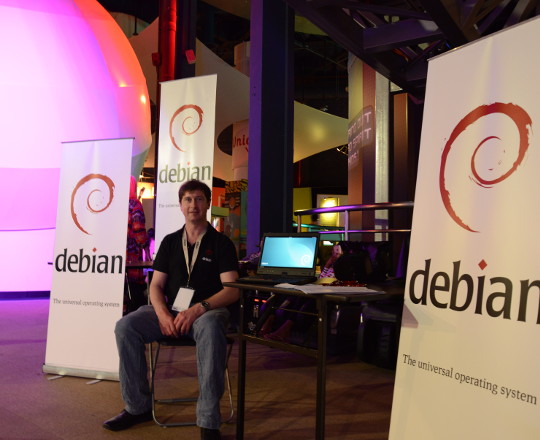 Thanks to Hong Phuc from the FOSSASIA team for helping us produce these new Debian banners
Google Summer of Code 2016
If you are keen to participate in GSoC 2016, please feel free to come and discuss it with me in person or attend any of my sessions at FOSSASIA this weekend. Please also see my blog about getting selected for GSoC, attending a community event like FOSSASIA is a great way to distinguish yourself from the many applications we receive each year. (Debian Outreach / GSoC information).
 Real-time communications, WebRTC and mobile VoIP at FOSSASIA
There are a number of events involving real-time communications technology throughout FOSSASIA 2016, please come and join us at these:
| Event | Time |
|---|---|
| Hands-on workshop with WebRTC and mobile VoIP (1 hr) | Saturday, 14:30 |
| Talk: Free Communications with Free Software (20 min) | Saturday, 17:40 |
| Ring: a decentralized and secure communication platform | Sunday, 13:00 |
 I own a motherboard an Intel 8-Series Lynx Point chipset, with an Intel Haswell CPU supporting VT-d. This allow me to use Linux s VFIO features and assign PCIe devices to a KVM-based virtual machine. High-end network controllers goes even further with the Single Root I/O Virtualization (SR-IOV) capabilities, allowing them to be shared between to multiple virtual machines.
The Lynx Point chipset provides a total of 14 USB ports arranged in 6 USB 3.0 ports and 8 USB 2.0 ports. It would be nice to be able to assign USB ports to virtual machines. QEMU already allows to assign a USB device to a virtual machine, but it works emulating a USB controller, and the traffic goes through userland. In addition it only works for a specific known device, a random device plugged to a given port is not automatically assigned to the guest (though I guess it can be scripted using the libvirt API). The xHCI specification, the one behind USB 3.0, has been designed to also support SR-IOV, to the best of my knowledege none of them actually support it. We ll see that with some hacks it is possible to actually assign a set of USB ports to a virtual machine, with the restrictions that running ports in SuperSpeed mode is allowed only on one side, host or virtual machine.
First let s look at how the USB controllers appears on a Lynx Point chipset using
lscpi:00:14.0 USB controller [0c03]: Intel Corporation 8 Series/C220 Series Chipset Family USB xHCI [8086:8c31] (rev 04)
00:1a.0 USB controller [0c03]: Intel Corporation 8 Series/C220 Series Chipset Family USB EHCI #2 [8086:8c2d] (rev 04)
00:1d.0 USB controller [0c03]: Intel Corporation 8 Series/C220 Series Chipset Family USB EHCI #1 [8086:8c26] (rev 04)
As one can see, three controllers are visible, one xHCI one and two EHCI ones. Let s now look at how the USB ports are arranged using lsusb -t/: Bus 04.Port 1: Dev 1, Class=root_hub, Driver=ehci-pci/3p, 480M
__ Port 1: Dev 2, If 0, Class=Hub, Driver=hub/8p, 480M
/: Bus 03.Port 1: Dev 1, Class=root_hub, Driver=ehci-pci/3p, 480M
__ Port 1: Dev 2, If 0, Class=Hub, Driver=hub/6p, 480M
/: Bus 02.Port 1: Dev 1, Class=root_hub, Driver=xhci_hcd/6p, 5000M
/: Bus 01.Port 1: Dev 1, Class=root_hub, Driver=xhci_hcd/15p, 480M
explain EHCI/OHCI/XHCI
http://www.intel.com/content/www/us/en/chipsets/8-series-chipset-pch-datasheet.html
the kernel in the VM might move back the devices to the xHCI controller. This is always the case for old kernels (like the 3.2 in Debian Wheezy), but for recent kernel it only happens if there is an intel EHCI controller available (either passed through VFIO or emulated by QEMU).
add table
Add warning
 Conrad announced a new Armadillo release 6.600.4 yesterday. This followed some work we had done for thorough pre-release checking with reverse dependencies tests for the over 200 CRAN packages using it and resulted in one more squashed bug. This releasehas been folded into RcppArmadillo 0.6.600.4.0 which arrived on CRAN and Debian earlier today.
Armadillo is a powerful and expressive C++ template library for linear algebra aiming towards a good balance between speed and ease of use with a syntax deliberately close to a Matlab.
Changes in this release are as follows:
Changes in RcppArmadillo version 0.6.600.4.0 (2016-03-15)Courtesy of CRANberries, there is also a diffstat report for this release. As always, more detailed information is on the RcppArmadillo page. Questions, comments etc should go to the rcpp-devel mailing list off the R-Forge page.
- Upgraded to Armadillo 6.600.4 (Catabolic Amalgamator)
- expanded
sum(),mean(),min(),max()to handle cubes- expanded
Cubeclass to handle arbitrarily sized empty cubes (eg. 0x5x2)- added
shift()for circular shifts of elements- added
sqrtmat()for finding the square root of a matrix- fix for
gmm_diagwhen using Mahalanobis distance- The
configurescript now reflects the full LAPACK fallback offered by R 3.3.0 or later (PR #81)
This post by Dirk Eddelbuettel originated on his Thinking inside the box blog. Please report excessive re-aggregation in third-party for-profit settings.
egt annotate command that reads a project file, tweaks it,
and then prints it out; I opened a project file in vim; I typed
:%!egt annotate %:p --stdin and saw that it could be done.
I find the result quite fun: I type 15 March: 18:00-21:00 in a log in egt,
save the file, and it becomes 15 March: 18:00-21:00 3h. I do something in
TaskWarrior, save the file in egt, and the lines that are TaskWarrior tasks
update with the new task states.
Details
Here's a step by step example of how to hook into vim in this way.
First thing, create a filter script that processes text files in some way.
Let's call this /usr/local/bin/pyvimshell:
#!/usr/bin/python3
import sys
import subprocess
for line in sys.stdin:
    print(line.rstrip(), file=sys.stdout)
line = line.strip()
if line == "$":
    pass
elif line.startswith("$"):
    out = subprocess.check_output(["sh", "-c", line[1:].strip()], universal_newlines=True)
    sys.stdout.write(out)
    if not out.endswith("\n"):
        sys.stdout.write("\n")
    print("$ ", file=sys.stdout)
~/.vim/filetype.vim for our special magic
text files:
if exists("did_load_filetypes")
  finish
endif
augroup filetypedetect
  au! BufNewFile,BufRead *.term setf SillyShell
augroup END
example.term, open it in vim and type :set ft it
should say SillyShell.
Finally, the hook in ~/.vim/after/ftplugin/SillyShell.vim:
function! SillyShellRun()
    :%!/home/enrico/dev/egt/pyvimshell
    :$
endfunction
autocmd BufWritePre,FileWritePre <buffer> :silent call SillyShellRun()
example.term, open it in vim, type $ ls, save it,
and suddenly you have a terminal with infinite scrollback.
For egt, I actually want to preserve my cursor position across saves, and egt
also needs to know the path to the project file, so here is the egt version of
the hook:
function! EgtAnnotate()
    let l:cur_pos = getpos(".")
    :%!egt annotate --stdin %:p
    call setpos(".", l:cur_pos)
endfunction
autocmd BufWritePre,FileWritePre <buffer> :silent call EgtAnnotate()
A new release of Rblpapi is now on CRAN. It provides a direct interface between R and the Bloomberg Terminal via the C++ API provided by Bloomberg Labs (but note that a valid Bloomberg license and installation is required).
This marks the fourth release since the package first appeared on CRAN last year. Thanks to multiple contributors, it packs a number of changes (including two new functions bsrch() and fieldInfo()), numerous internal as well as build improvements, additional documentation and last but not least use of unit testing (provided a Bloomberg connection is available, ie not at CRAN or on Travis CI). See the NEWS.Rd extract for more details:
Changes in Rblpapi version 0.3.3 (2016-03-14)Courtesy of CRANberries, there is also a diffstat report for the this release. As always, more detailed information is on the Rblpapi page. Questions, comments etc should go to the issue tickets system at the GitHub repo.
configureadds a missingmethod="libcurl"options (PR #109 by Martin Bel).- New function
bsrch()adds basic search functionality (PR #111 by Morgan Williams fixing ticket #82).- The licensing status of the Rblpapi source package was clarified (PR #119).
- The
bds()help page now shows an example using anoverridesargument (PR #121).- A new function
fieldInfowas added, and field information is used inbdhandbdp(PRs #122, #123, #125, and #127).- The
bdpfunction now checks the order (PR #126).- Unit testing was added (PRs #129 and #131).
- Data retrieval is now smarter about the types returned from Bloomberg (PR #132 and #133; and #141 and #142).
- The
bdhandbdsfunctions now support an optionverbose(PRs #138).
This post by Dirk Eddelbuettel originated on his Thinking inside the box blog. Please report excessive re-aggregation in third-party for-profit settings.
Next.