Search Results: "sf"

25 February 2006

Erich Schubert: OpenVPN usage graph

I was about to write a similar script, but then used Google first. Rodolphe Quiedeville already wrote a OpenVPN plugin for munin. It uses an odd hard-coded statusfile name, but that is easy to adopt to your needs. Since I already use munin to plot several system parameters, adding the VPN usage in there is a really nice extension.

24 February 2006

Pierre Habouzit: satisfaction

Yesterday, one user of whitelister reported me a bug. That made my day : this meant that there was actually users in the world that used whitelister, and thought it worth the effort to report a bug ! It motivated me to fix a couple of problems that I knew where there, and I released (and uploaded) a new version yesterday. I have to mention that whitelister will also soon be in production of a quite big mail system (even if not a FAI, we talk about MX that do more than 300k mails per week, which is not nothing). I have to mention that I also changed the license to BSD, I'm quite afraid of the direction the GPL is taking, and BSD is definitely better, spam is a too big problem, and if people want to do money with my idea, let them do it, if that can stop spam GPL has no sense at all when you don't plan to exploit the software yourself. When I'll release 1.0 (there is a couple of things I'd like to fix in how the configuration file is handled before) I'll try to give some public visibility to the project, because I really think it's based on a really good idea.

Pierre Habouzit: GFDL the license that s**ks

Dato[1] has blogged about his reaction about the current positions agains GFDL in debian currently. My concern wrt GFDL is simple : As a KDE packager, I would feel really sorry to have to prune any application manual, even ones without Invariants Sections. I'd like to remind some DD's that for some manuals, authors are not going to be found because they are not interested in Free Software anymore, or simply because they are dead. I know that discussions with the FSF are really going nowhere (at least not fast enough). But still, I really think there is some possibility to have a new version of the GFDL where the DRM and transparent copies problems would be gone. If we can have that, then since a lot of Authors use the classical licensed under the GFDL version 1.2 or (at your option) any later version we could accept in main any documentation that has no Invariant parts. Free Software is about giving to *every* users more freedom. This GFDL story looks like taking documentation away from the users that needs it the most. It's : It's not about a firmware here, or any hardware driver problem that you can work around by buying supported hardware. it's about having or having no documentation at all.
Notes [1] I of course have seconded his proposal [2] and if we have a question on an application, our question is unlikely to be answered in the doc, and we strace/read the sources of the application to be answered [3] yeah, I got it, this GR is not compliant with the DFSG!</bad joke></bitterness>

Simon Law: CodeCon 2006, Day 3


Green
Originally uploaded by sfllaw.
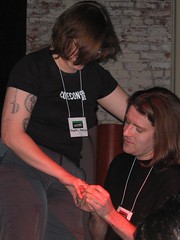
Each morning, CodeCon started later and later. This is not just because us volunteers couldn't get there in time, but also because the attendees would show up more hungover and sleep-deprived as well. Thankfully, it's a hacker conference so we started at about noon. Or 12:30. Which is "morning" for some. We kicked off the day with a talk on Dido which is meant to help you write voice-menu systems. Quinn did a neat demonstration involving a real telephone, which was quite novel. However, since I despise voice-menu systems, I have to hate his project on principle. In the Q&A; period, I nipped over to Bill Pollock's booth. He runs No Starch Press which is absolutely fabulous. He gave me a free mug, some tea, a book, and a T-shirt. In exchange, I had to buy a few books as well. I'm afraid that my book buying habit is starting to get uncontrollable. Every time I return from a trip, I bring five or ten books back. Now I have a copy of madduck's book which I will get him to sign at DebConf 6. I completely zoned out on the Deme presentation. I think I was talking to someone who wanted to convert me to Evil, after hearing that I was a hacker. I'm afraid that I'm too noble for that. But what I did glean from the presentation is that deme is an actual English word. My presentation on UniConf came up next, so I put on my red "Speaker" badge and hopped on to stage. You see, I was at CodeCon as a backup speaker, in case one of the others missed a flight or fell down some stairs. I had to resist doing any of them bodily harm. For my altruism, I gave a talk about how UniConf glues configuration systems together, and why people should use it instead of writing their own. I got a lot of questions afterwards, which was pretty cool. At lunch, [info]wealhtheow and Bill came by to ask me what I'd like on my pizza. Wow! I said that it didn't matter, and thought little of it. Then they showed up with boxes and boxes from the local Costco. Bill had just bought everyone lunch! We organised a queue that would have made the British proud and everyone got a slice to eat. I remember first hearing about Monotone from Graydon, back at GCC Summit. So I was a little surprised to see Graydon sitting on stage looking pretty while Nathaniel was presenting. Monotone has inspired a couple of version control systems but it's never really gotten popular. But one thing it hasn't passed on is its use of Merkle trees to express differences.

Truck
Originally uploaded by sfllaw.
All throughout the conference, I had been selling drinks from behind the bar. Standing for all that time really hurts the feet, so I was sadden to discover that my shoes were not good for this. Still, I had a good time there. I've definitely found a calling in the service industry, if the computer bubble bursts again, I'd make a great bartender. I never knew! You make eye contact, smile and say something friendly. Then you chat as you pour a drink, take an interest in someone, and just be nice. If you give a little extra, smile and wink, like it's secret just between you. I was busy chatting to my customers for the Rhizome presentation. Reading its description, I'm not really sure that I could tell you what it is. And I work with computers! As I was selling drinks, I was also selling CodeCon T-shirts. Very snazzy T-shirts. Every time I sold a drink, I tried to sell a T-shirt along with it. Show off the front, show off the back, offer an appropriately sized shirt. Flattery seems to work very well, as does smiling when the person looks at it. You know they're sold when they're holding a shirt, so you offer to fold it for them and name the price. It was so easy! Daniel came up again to do his Cqual++ presentation. Not only was this piece of software more difficult to write than delta, it's also less popular. Alas! He does some very impressive static dataflow analysis on C++ to find nasty, horrible bugs. But parsing out C++ is scarily difficult! After the presentations were over, we had a very nice set of closing remarks which made all of us blush. And then we tore down all the stuff we put up and packed everything away. This is where I packed my own T-shirt in a box by accident. Jonathan's going to send it to me by post, which is very nice of him. Then I bid sad farewells to gorgeous Wealh eow and charming [info]akashayi who went off to dinner without me. Six of us climbed into a taxi and we went to a sushi restaurant called Osaka, where we met up with [info]breezip. Bree was the friend that the lovely and indefatigable [info]spider88 kept trying to meet, but failed to. We were all quite exhausted from socialising with people since, after all, we are a group of introverts. So we enjoyed an excellent dinner with subdued, but fascinating, conversation. I was treated to the best uni I have tasted in my entire life. I think Bree was quite amused at my sea-urchin ecstacy. After dinner, Len paid with a thick wad of cash, which in conjunction with his suit, made him look like a mob boss. I had a very good night.

23 February 2006

Simon Law: WvDial 1.56

Now that [info]pphaneuf has returned from his journey to France, we have a lot more trouser dropping in the office. To convince people that we actually do work around here, I'd like to point out that I released WvDial 1.56. It has only one change, which is quite embarassing to have had to make.

Erich Schubert: Google got slashdotted...

Google today launched it's Page Creator, offering you some hundred MB of storage for your webpage, and the service promptly was overloaded some time - Slashdot effect? It's back now, I just successfully logged in. ;-)

Simon Law: CodeCon 2006, Day 2


House
Originally uploaded by sfllaw.
I woke up to a breakfast of pancakes, cooked by the wonderful [info]riseorbleed. I don't know about you but waking up to a hot breakfast is heavenly. After some morning ablutions, we hailed a cab and along the way we chatted with the cabbie as I looked out the window. Luxor cabbies are really nice, every time I travelled with them, they had some interesting story to tell and big, broad smiles. Smiling is the way to fatter tips! The weather in San Francisco is supposed to be rather variable. You know how that is, rain one minute and then sun the next. Well, the entire time I was there, it was bright and sunny and gorgeous. San Francisco really put on her best to charm me and she really succeeded. I didn't think that postcard-perfect pictures were possible, but I saw them everywhere. I was happy to walk around without needing a winter coat. And everyone else smirked at how happy I was. Daniel seemed to have recovered from the previous night's revelry. His talk on delta was excellent because he's a very good public speaker. Which is good, because he gave two presentations at CodeCon. When I talked to him on Thursday night, he seemed a little embarassed at how successful delta had become since it such a simple piece of software. But people like GCC use it to fare down their bug reports to the lines of code that reproduce its bugs. Rob and Tristan sidled up to my bar and asked me if I could get them some juice. For their laptops. They were working on their presentation all the way until the last minute, which involved a drunken Tristan stumbling around on stage. Except that Tristan doesn't drink, so his imitation was quite poor. They were presenting Djinni, which is their implementation of a fast simulated-annealing algorithm that takes also pressure into account. Sadly, they didn't explain their algorithm but their talk was entertaining nevertheless.

Shoes
Originally uploaded by sfllaw.
At lunch, Spider snuck me out of the building and she showed me around San Francisco. She pointed out the Eagle Tavern with a glimmer in her eye. I think she's trying to corrupt me. Or she's trying to pimp me out. Then we went to Stompers where she tried on some boots. We were stymied, however, by the fact that a very annoying woman and her husband were trying on every single pair of boots in the entire store. iGlance is a real-world video-conferencing and screen-sharing application that has some fairly good usability built into it. It also has a fairly sensible privacy model and does some NAT punching to boot. Although it's only got a Win32 port for now, it's free software so someone will fix it up. Sometime in the afternoon, the beautiful and fair [info]wealhtheow came behind the bar and surprised me with a hug and a sandwich! I was happy with the random hug from a new friend, but the sandwich was wonderful. I had not eaten lunch on Friday so I was very grateful. She put a huge smile on my face. I munched on the sandwich while listening to the OASIS talk. This technology is a locality-aware server-selection resolver, which is pretty good for distributing servers around the world and finding the fastest one. They implement this as a DNS redirector so that lookups are transparent to normal Internet software. This made me feel a little bad for [info]holdenk, whose SelfDirectedProject happens to be on a very similar topic. It does, however, validate his approach. [info]maradydd's presentation about Query by Example was up next. She did a very good introduction to data-mining, which segued into her hack on PostgreSQL where you can specify examples of things you want to search for. That is not how SQL normally works, where you specify constraints. With QBE, you just specify things similiar to what you want, and things similar to what you don't want.

Proposal
Originally uploaded by sfllaw.
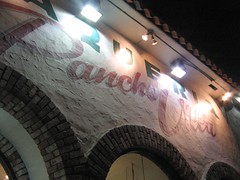
I was chatting with Rob Pascual when I noticed Len lining up in the Q&A; queue. Suddenly, my ears perked up as I sensed something important was going to happen. So I pulled out my camera, stepped on some toes, and got into position. When it was his turn at the microphone, he started saying random stuff that wasn't question at all! Something cheesy like how Meredith had changed his life and how he wanted to be with her. Then he got up on stage and asked The Question. It was beautiful. The audience broke out into cheers and applause, except for the heartless bastards beside me. But who cares about them? This was such an awesome occurance that an interview was taped. After teardown, some people were going to head to a franchise Mexican restaurant. Spider insisted that I get real food, so we walked down to the Mission. We made a detour to Good Vibrations which is a San Francisco landmark if ever there was one. I swear that she's trying to corrupt me. Anyway, as we were walking out, I must have mentioned that I was from Canada. Because Cohen, a Torontonian, came out of nowhere and introduced himself to us. Well, what was I to do but to invite my fellow countryman to dinner? So we set off to find a Taqueria that served nopales. This failed since Californians don't seem to like eating cactus. Instead, we went to Pancho Villa where I ate enchiladas and salsa verde and guacamole and churros and I was so very happy! We bid farewell to Cohen after exchanging contact information and tried to find everyone else. Unfortunately, we couldn't reach anyone by cellphone, so we sat around dejected for a while. Then we realised that we could go to Annie's Social Club where an event was happening. This turned out to be a good and a bad idea.

Taqueria
Originally uploaded by sfllaw.
It was a good idea because we found everyone at CodeCon. It was a bad idea because Annie's Social Club double-booked us with bad karaoke! And then were quite rude when we complained. And then kicked out John Gilmore. So I just want to say that Annie's Social Club hates geeks and freedom. So Len hailed a black stretch limousine, we all climbed into it, invited some reporters along and moved the entire party to the XYZ bar. The XYZ staff were very awesome, accommodating an extra hundred patrons and getting an extra bartender. And they were very nice about it. Unfortunately, the bar was full, so I had to lead a bunch of introverts in the fine art of taking over an establishment. We walked in, started talking, I encouraged people to sit down in empty spots on the couches. They did a very admirable job of taking over the back. I got the stunningly adorable [info]akashayi a seat and a drink, before I taked to the people sitting with us. They were a couple who had moved from Florida to San Francisco, and a man from New York who was quite the boor. The man in the couple knew the New Yorker and seemed quite embarassed about him. After twenty minutes of conversation, they excused themselves and bid us good night. This gave us plenty of seating space to talk about geeky things until the manager kindly kicked us out. I made sure Akasha got safely to her hostel and then took a taxi back to the guest room. It was quite the challenge to direct the cab driver, since I had lost the directions back, but I managed!

21 February 2006

Simon Law: CodeCon 2006, Day 1


SUV Taxi
Originally uploaded by sfllaw.
I woke up on Friday morning and wondered what breakfast would be. Then I remembered that I was staying at the W and decided to forage for food elsewhere. I took a taxicab with [info]spider88, [info]enochsmiles, [info]maradydd. It was a strange hybrid SUV cab that was painted all yellow, I would later learn that Yellow Cab drivers were scary and that I should avoid them. We got to StudioZ and discovered that we didn't know how to get inside. We figured that out eventually and took stock of the situation. I started moving tables about and setting up chairs, because I abhor standing about with my hands in my pockets. Then I helped hang banners from the rafters. After I did that, I tried to see if I could do anything else. Since CodeCon is run on the cheap so that anybody can attend, drinks like coffee are not included in the conference fee. And since the conference was being held in a night club, there was a convenient bar that would be a good place to setup a concessions stand. So I put things in order and stood behind the counter. I got to see people walk in the door and after registering with [info]wealhtheow or Spider, they'd stand in bewilderment in front of my bar. It was a lot of fun to watch all sorts of people come through. And then I'd smile at them and offer to get them something to drink. We started Lance's talk a little late in order to let everyone settle in their seats. I met him the night before where he talked about his Apache module that has heuristics for detecting when a phisher is trying to clone your website. Or when your website has been cloned and the phisher is passing login requests through to you. This kind of thing is totally what financial institutions have to start doing. We got coffee from this place called Cafe Organica, which seems to have some mixed online reviews. Or rather, Jonathan did, in a big messenger bag filled with carafes. Since Jonathan doesn't actually drink coffee, it was left to me to decide whether it was any good. It seemed to be drip coffee that was thick, dark and strong. Very decent for something that was brewed hours ago. The customers didn't seem to mind, as we ran out of coffee every day.

Couch
Originally uploaded by sfllaw.
The next presentation was SiteAdvisor which takes an interesting tack on safely surfing the web. Instead of building security features into your browser, there's a central server that stores information about sites that you're visiting. But what was really interesting was how they got this information. They had an automated tool that went in pretending to be a real person, signed up for some e-mails, downloaded some programs, and examined what happened afterward. I missed the majority of the VidTorrent presentation, because I was busy chatting with people and offering them refreshments. Also, their demo didn't work because the wireless setup at the conference kept on going down. People were abusing the free Wireless network that Cliff was trying to keep up and running. Which is sad, because Cliff had basically volunteered to set that up on his own time. Tom came up after that to present Localhost, which is a unimaginatively named piece of software, but is interesting because it lets you browse a world-wide filesystem of torrents. What's interesting about his filesystem is that it uses a distributed hash table, so that even if there are files with the same name, you'll be able to distinguish the distinct copies. Which is useful if you want to tell whether you're downloading a legitimate and popular file, or some malicious file that someone's injected. The last talk of the day was Truman, which not only demonstrated an interesting piece of technology, but also quite educational. The tool itself is a specialised Linux distribution that can capture what happens inside itself and simulate a public connexion to the Internet. This is advantages, Joe tells us, because modern pieces of malware are smart enough to disable themselves when they detect sandboxed environments. After people filed out, we packed away everything into storage as StudioZ is a nightclub, so it was setting up for its nightclub crowd. Everyone else went next door to Loft11 where a party was being held, sponsored by [info]bramcohen's awesome company I went inside and bumped into Graydon and we tried to go about finding fellow Canadians. This was not so successful on the crowded downstairs floor, so we went upstairs to chat and catch up. I met some people who were at the speaker's reception and successfully remembered their names. Then I met a guy who was at the night club just waiting for his buddy, and I explained CodeCon to him. He thought it was a great idea.

Stack of Macs
Originally uploaded by sfllaw.
Len Sassaman and Bram got up to give a little speech, which I tried to take photographs of. But failed. Instead, I noticed that they were on this awesome glass ceiling which made me want to dance. I didn't do that though, because my feet hurt from standing all day. I poked my head into a room upstairs that was all white, which was very cool. Some people were playing a game of Werewolf which finished with the villagers winning. I hung out with some people like Eric, Pete, and Kelsey who told the story of her pink Barbie backpack. I also met Chloe and her husband, whose name I have forgotten. But Chloe is awesome because she is now independently wealthy so that she can pursue her dream of studying the nitrogen cycle in soil using post-doc maths. Impressive! I also met [info]akashayi who is not a professional computer programmer at all. She teaches martial arts by day, and slings code by night. She drove all the way from Los Angeles to attend CodeCon and was having the time of her life. I wistfully remember when I was that excited about computing, so just hanging out with her was awesome. She promised me a Kempo lesson if I ever made my way to L.A., which is an offer I intend to collect. I found Spider downstairs, sitting on a couch with Daniel. The night was getting long and we were totally exhausted, so we took a taxicab to the W. There, we went up to Enoch's room party where he treated us to $17 cheeseburgers. Now, I didn't think that cheeseburgers that expensive were worth it, but boy oh boy were those good. Spider and I took a cab to [info]kineticphoenix and [info]riseorbleed's place sometime past midnight and we dragged our luggage into their guest room. Which was really more of an awesome guest apartment. Hurray for knowing people in foreign cities! I don't remember much after that. I think I turned on a space heater before passing out.

Jonathan McDowell: Power corrupts

I bought a Belkin F6H500ukUNV from eBuyer (quickfind code 77131). At under £25 including P&P it seemed like a good deal and I've been meaning to get round to having a UPS to allow clean shutdown of my local machine during power problems. Belkin ship Linux and FreeBSD programs to talk to the UPS (though only over the serial interface - it has USB too). It doesn't like xterm it seems; prints Error opening terminal: xterm.. Seems fine with a terminal type of linux. It also puts all its files (config, help, binaries) in /etc/belkin. And it's binary only so I can't fix any of this brokenness. However, the lovely Network UPS Tools exists. Except Belkin have a number of UPS types, all incompatible with each other. After figuring out that I really, really needed to use the Belkin provided cable and not just a generic serial extender cable (grrrr. Why? If it's got a 9 pin D labelled RS232 why not make it a sensible port?) I got the Belkin software working and straced it to see what it did. A bit of looking at the nut source found several drivers that appeared to use the commands Belkin were sending (Q1, I & F). I tried powermust first, with the following /etc/nut/ups.conf:
[belkin]
	driver = powermust
	port = /dev/ttyM2
(I have a 4 port serial card, so /dev/ttyM2 is just a normal serial port, really.) And tada. It works. I can now get output like:
[noodles@pot ~]$ upsc belkin@localhost
battery.charge: 100.0
battery.voltage: 13.8
battery.voltage.nominal: 12.0
driver.name: powermust
driver.parameter.port: /dev/ttyM2
driver.version: 2.0.3
driver.version.internal: 1.1
input.voltage: 227.0
input.voltage.fault: 227.0
input.voltage.maximum: 234.0
input.voltage.minimum: 221.0
output.frequency: 50.0
output.voltage: 227.0
output.voltage.target.battery: 230.0
ups.delay.shutdown: 2
ups.delay.start: 3
ups.load: 0.0
ups.mfr: Mustek
ups.model: PowerMust
ups.serial: unknown
ups.status: OL
I don't know about doing shutdown yet, but ups.status correctly goes to OB (on battery) if I pull the power, which is probably the most important thing. :) At some point I'd like to move over to the USB interface; I have better things to do with my serial ports. Belkin don't appear to have done the sane USB HID power thing; instead it's some odd hid device that doesn't even have a Belkin manufacturer ID:
Bus 003 Device 015: ID 0001:0000 Fry's Electronics 
Device Descriptor:
  bLength                18
  bDescriptorType         1
  bcdUSB               1.00
  bDeviceClass            0 (Defined at Interface level)
  bDeviceSubClass         0 
  bDeviceProtocol         0 
  bMaxPacketSize0         8
  idVendor           0x0001 Fry's Electronics
  idProduct          0x0000 
  bcdDevice            1.00
  iManufacturer           1 MEC
  iProduct                2 MEC0002
  iSerial                 0 
  bNumConfigurations      1
  Configuration Descriptor:
    bLength                 9
    bDescriptorType         2
    wTotalLength           34
    bNumInterfaces          1
    bConfigurationValue     1
    iConfiguration          0 
    bmAttributes         0x80
      (Bus Powered)
    MaxPower              100mA
    Interface Descriptor:
      bLength                 9
      bDescriptorType         4
      bInterfaceNumber        0
      bAlternateSetting       0
      bNumEndpoints           1
      bInterfaceClass         3 Human Interface Devices
      bInterfaceSubClass      0 No Subclass
      bInterfaceProtocol      0 None
      iInterface              0 
        HID Device Descriptor:
          bLength                 9
          bDescriptorType        33
          bcdHID               1.00
          bCountryCode            0 Not supported
          bNumDescriptors         1
          bDescriptorType        34 Report
          wDescriptorLength     624
         Report Descriptors: 
           ** UNAVAILABLE **
      Endpoint Descriptor:
        bLength                 7
        bDescriptorType         5
        bEndpointAddress     0x81  EP 1 IN
        bmAttributes            3
          Transfer Type            Interrupt
          Synch Type               None
          Usage Type               Data
        wMaxPacketSize     0x0008  1x 8 bytes
        bInterval              10
Device Status:     0x0000
  (Bus Powered)
The NUT energizerups driver appears to talk USB and use the Q1/F commands, so I think I'll try that later. Or it's back to usbsnoop and a Windows box I guess.

Wouter Verhelst: Western broken

western, my Sun Ultra10 which I used to use as server/gateway/firewall, broke down last weekend. Since western had only one 9G hard disk which was getting full, I wanted to add another disk. The 80G disk that I had bought for my desktop turned out not to be needed (since there were 2 extra disks hidden in the machine anyway), so I added it to the Ultra. However, it didn't get detected; according to Philip, an Ultra10 has a PIO-only IDE interface, which may be the cause of the problem—it's not that unlikely that the newest IDE disks, such as this 80G one, do not support outdated transfer modes such as PIO anymore. So, I decided to take out one of the disks from rock, my desktop, and put in the 80G one instead. 40G is still plenty for a server which until recently had only 9G. Thank $DEITY for LVM Connected the 80G disk as /dev/hdd to rock, and ran the following commands:
rock:~# cfdisk /dev/hdd
[create a partition]
rock:~# pvcreate /dev/hdd1
rock:~# vgextend rock /dev/hdd1
rock:~# pvmove /dev/hde1
rock:~# vgreduce -a
Now shut down the box again, and remove /dev/hde. And no, the hde part is not a typo: rock has four IDE controllers. Meanwhile, however, I was noticing something peculiar about western: its external network card did not get a DHCP lease anymore, for some reason. That card was a 3com 905, with a slightly loose RJ45 connector; by unplugging or reconnecting the cable, it might be that I moved it a bit too much around and broke it. While it's a pity that I lost that 3c905, it's not really much of a problem: put in a different card, boot again, done. The Realtek ne2k-pci board that I put in next didn't work. It did get a DHCP lease, but it couldn't use the connection for some reason. Ne2k boards are crap, so it could be related. I put in yet another card, and booted the machine again, this time without replacing the cover (in case that card wouldn't work either). After it had been running for about 1 minute, the system suddenly shut itself off for no apparent reason. So I put the cover back on and tried to boot. After 10 seconds, even before silo was loaded, the system shut itself off for no apparent reason. I thought maybe it was the card, and even tried the 3c905 again. The system shut itself off for no apparent reason. It hasn't stopped doing that. I finally, on sunday evening, set up rock as a replacement server and put the 9G disk in there too, so that I could at least access the data and config files. But I'd love to get western to boot again. Stupid thing. Any hints are very welcome. Really. I'll even give you a Free Beer at FOSDEM if you give me the hint that fixes it.

20 February 2006

David Welton: Hecl, Oregon, OFBiz

Hecl I released a new snapshot of Hecl this evening, with a few minor fixes. I'm pleased that the project has picked up a regular contributor, Wolfgang Kechel, who seems to be doing some interesting things with it. He's a bright guy, and it's good to have feedback and someone to talk things over with. I have been sidetracked with Ruby on Rails (more on that in the future) lately, so I haven't dedicated as much time to Hecl as I would have liked to. Oregon I found this brochure about open source in Oregon. It's "marketing materials" kind of stuff, but still... I'm proud to see all the interest in open source in my home state. Almost makes me want to go back, but then I talked with my parents on the phone, who told me about the 24 days of rain in a row, which brought me back to my senses. OFBiz I had been investigating OFBiz as something to use in the company where I'm working, but apparently that's not going to happen for now, which is a pity, because it's well done software, and more importantly, has attracted a bright, diverse group of people to work on it. Indeed, I liked it so much that I'm helping out (I hope!) by acting as a "mentor" for the project as it goes through the process known as incubation at the Apache Software Foundation, which means that it hasn't officially been accepted as part of the ASF, but has the potential to do so if we get all the i's dotted and t's crossed. It's been an interesting experience, as it's about as far away as you can get from my Tcl work at Apache!

19 February 2006

Sergio Talens-Oliag: Shell Scripts Frontend Tool 0.9.2

After my last post about the tool I got some feedback and tonight I've uploaded to Debian the version 0.9.2 with better POSIX support (well, that's what I believe, I have not tested the tool on non Debian machines, but I followed some comments and also reviewed some Documentation), support for kdialog (I prefer zenity, but kdialog is installed with the base KDE packages and if it works, why not?) and, by request, default values support (when reading a string or showing a selection menu the developer can provide default values). I was going to wait until the package leaves NEW before uploading the new version, but as I don't really know if uploading new versions implies any delay on the way to the archive and the previous package was only four days old I decided that I prefer a small wait and not have to care about uploading an updated version just after the package enters into the archive.

18 February 2006

Marc 'Zugschlus' Haber: Updates to clamav-data build process for volatile

I have again worked on the automatic package build, test and publishing process for clamav-data, which runs twice an hour on a volatile.debian.net host. Details of the process are described in VUA 2-2 on debian-volatile-announce The “backup” copy on http://people.debian.org/~zugschlus/clamav-data now has accurate mtimes in the directory, and actually the last three published packages are available from here. The rsync process was previously broken in a way that only the current package and two older ones from middle of July (from before the automatisms were in place) were available there. The publish process now barfs if the specially hacked katie which is used to move the new clamav-data package into volatile.debian.net without a maintainer signature leaves the publication directory (which is to be considered part of queue/unchecked for katie’s environment) in a non-empty stage. This will hopefully catch more katie errors than the parsing of katie’s output, which is of course still being done. After a new package has been built and sucessfully published, the package build directory is cleaned up. All files belonging to changes files older than 60 days are deleted to keep the disk from filling up badly. But that’s an internal matter only which you shouldn’t be noticing at all. Additionally, after the last changes, I have hiked up the verbosity level of the package build process for a while so that I can notice when the new process dies or encounters new challenges. That shouldn’t be noticeable outside my personal mailbox though. One issue that is still left is that the automatic clean up of the Pool doesn’t seem to work for source packages. Binary packages that are not referenced by any Packages file are supposed to be removed after 15 days, but the source packages seem to stay around. I cannot do anything about that, and am targetting aba on this issue.

Martin F. Krafft: Back to Fluxbox

I am following Wouter's example and returning to Fluxbox. I certainly thought ion3 was an interesting approach and it seemed like it would be exactly what I needed when I saw Erinn show it off to me in Helsinki. However, over time I developed too many gripes:
  • I am a great fan of Enrico's software, buffy in particular. I would like to have buffy stick to ever workspace, ideally along the right edge. This seemed not trivially possible in ion3, where I would have had to create a single static workspace with two panes, then put all my other workspaces into the pane next to the one reserved for buffy. Certainly possible, but a major pain to configure and protect against resizing and accidental closing.
  • Applications like Firefox, dia, and especially The Gimp (to name but a few) were just a major pain to use, especially since I never got the hang of the floating workspace model. My favourite example (which is in line with Wouter's experience): try to crop an image in The Gimp; by the time you set the first click, you'll have the crop dialog in your face, which you have to first move out of the way before you can restart. * Certain transients would be locked to a size that made it impossible to fill in all fields, first requiring you to attach the window to a proper frame.
  • The inability to display dock and status bar on the same head.
There were probably a couple of other minor issues that don't pop to mind right now. All that said, there are certain things I now miss in Fluxbox, which had been my window manager of choice before Helsinki, that I know what ion3 can do:
  • The ability to use your keyboard to switch to a bordering window; I had it set up so that Mod5-<arrow key> (Mod5 I tied to Caps_Lock) would transfer focus to the window on the left/right/top/bottom. My xinerama-switcher module (part of ion3-scripts now) would allow that to work across multiple heads and workspaces.
  • Tagging and attaching a window to another pane, or using the attach command directly to summon a window from somewhere else to the current pane.
  • While grun is a worthy replacement for ion3's F3, I have not found something to replace F4, a prompt with autocompletion for SSH targets; I've really grown used to that.
  • The concise and extensible status reporting done by the various modules in the statusbar, like ACPI status (incl. temperature and CPU frequency), current IP address, WLAN status, and the three CPU load values. Dockapps just take way too much screen estate, and I don't need no graphic frills when I want information.
... and possibly more. Maybe it's time to look around again for a lightweight, keyboard-friendly window manager (and only that) that's not WindowMaker?

David Welton: Maximizers, Satisficers and Programming Languages

Whilst ambling around on the web after seeing a post on reddit.com that piqued my curiousity, I happened on some work discussing "maximizers and satisficers", which, put crudely, says that there are two kinds of people. Those who, out of a group of options want the best one - maximizers - and those who just want something that will work - satisficers. Anyone who has been around programming languages more than, say, a week, will instantly recognize the above theme in the endless discussions of "which programming language is best?", or more generally, which "X" is best? I'd be willing to bet that programmers, and especially open source programmers, tend towards the 'maximizers' end of the spectrum - I don't want just any old X, I want the best one, dammit! Sometimes, this can be a good thing, as it leads us to continuously seek to improve things we come into contact with, or try new approaches, it can also be detrimental if your goal is simply to accomplish some task, rather than spending too much time fretting about finding the perfect tools to accomplish the task with. This also has ramifications for people designing or dealing with programming languages. One of the papers (the original?) on the subject (here), actually deals with the fact that maximizers, in their search for perfection tend to be less happy. Where satisficers are happy because they've got something that works, and they can go on to something else, maximizers have lots of room for "fear, uncertainty, and doubt" about their choices. In some instances, actually reducing people's choices makes them happier. Python's "one good way to do it" makes everyone happy, because both maximizers and satisficers know that they're doing things right, and don't have room to worry. Another example that I know well from my involvement in the Tcl community is "object systems for Tcl". For those who don't know Tcl well, it's an extremely flexible, extensible language, both in the language itself and in terms of its C API. So flexible, in fact, that you can write an OO system in Tcl itself, which has been done, or in C, which has also been done several times, leading to a proliferation of OO systems, and a never-ending stream of questions on the newsgroup about which is the best one? Perl's "there's more than one way to do it", despite apparently providing and pushing choice, may actually work well because it encourages people to be satisficers and use whatever works. I'm sure everyone can think of examples where too much choice causes doubts and hesitation. I think the lesson to be learned is that while it's important to encourage experimentation in order to explore possible solutions to problems, at a certain point it makes sense to consolidate and provide one or two recommended ways of doing something. That's not always possible (Linux distributions, for instance), and squashing competing ideas too early might cause friction with people generating innovation, so it can be difficult to accomplish, but I believe it's an important social aspect of software creation to keep in mind.

17 February 2006

Michael Janssen: Debt "consolidation": scam, scum or sweet?

Throughout the last couple of years, I've had some bad decisions. I decided to start using my credit to work for me, and to buy things which I couldn't afford. Partly this was because I had a horrible ex, who I thought I should do things for, and partly because of just living outside of my means for a certain period of time. The long and short of it is, I've gotten myself into a bit of credit card debt. I'm not in any big trouble, just needing to pay it down so that I can get on with using that money for other things. There is a couple of web applications that I have in the works which will help me remind myself, but that's neither here nor there at this point. So, I have all of this credit at high interest rates, surely there is someone out there that will look at my credit and finance it at a lower rate, make some money off of me, right? I'm thinking that what I need is a consolidation loan - something to lump together my credit card debt and give me one monthly payment. What I call this, is debt consolidation. Thinking we are in the age of the internet, I type "debt consolidation" into google and give it a try. This is my first mistake. Apparently "debt consolidation" doesn't mean that you are consolidating your debt, it instead means that you are going into what I would call debt negotiation. This means you decide of your own volition that you are going to stop paying your bills, and try to negotiate with the credit card companies to pay off your debt at a fraction of your actual debt. But I don't know this, so I nievely fill out a couple of forms at "debt consolidation" sites. This gets pretty long, so I put in a break. Read on, MacDuff. The Scam The first people who got in contact with me were some people from Credit Solutions. Let me be clear on this: I'm not making broad generalizations about the company here - I can only speak of my own experiences. The person who I got on the phone went through a whole spiel, "explaining" how it works. He was very high-pressure and very fast talking, just from the start I didn't want to buy anything from him because he seemed like a used car salesman who decided that it was better to make money from nothing than from goods. Here's the explanation he gave me: You've probably been paying your cards down already, so you've paid 70-100% of the cost of your original loan. You stopped paying your cards, wait 3 months, and then they start negotiating with their "powerhouse lawyers". Then they negotiate you to pay your debt at 40-60% of the current balance, and the credit card companies get to take the remaining 40% as a tax loss. Now is when the math gets strange. The man on the phone attempted to say that this meant that the credit card company got 140% of the current balance. This doesn't make sense to me, especially because I'm a smart credit card consumer, and most of my debt is on 0% APR promotional rate cards. This means that they have made at most 3% of the balance from me, based on balance transfer fees. The man on the phone tried to dance around the issue, saying that they actually will get the 40% tax loss and that means they'll still get 140%. 140%? This doesn't make sense - 60% plus 40% is 100%, not 140%. Lets add to this that a tax loss is not the same as profit: a tax loss only gets you like, 30% of your loss. At this point, I've decided that I'm being taken for a ride already, but I ask how it works anyway. Here's how this particular company is setup: I pay into a savings account (of my own), automatically deposit around $200 a month, and they take money out. For the first three months, they take the WHOLE amount. After that, they take half the amount, and leave the other half. They then start negotiating with your creditors, and when they make a deal, they tell you "pay them now". In the end, they take 15% of the settled cost of your debt. On $6k settled debt, this is another $900. I really didn't want to do it now, mostly because of the high cost. The man kept coming back to my objections with "you can't borrow your way out of debt". Of course you can't borrow your way out of debt. That's stupid. I wasn't planning on borrowing money and then ending up with less debt. I was planning on borrowing money so that I'm not paying so much in order to have the debt. Apparently he thought I was an idiot, because he kept repeating it to me. He sent me a little packet of stuff, which laid out the whole plan. After that, he gave me a call back. This is when I got really defensive. I asked him point blank: "What is the worst thing that can happen to me if I go with this plan?" His answer: "You stop paying your bills." On the surface, this is true. The worst thing that can happen is that I stop paying my credit card bills. He neglected to mention the fact that ceasing payment on my credit cards would ruin my credit, cause insane fees for lateness, and possibly send me to forced arbitration with the creditors. Every creditor that I have ever had since 2002 has had an arbitration agreement, which basically would end up in garnishment of wages. The Scum About a week after my first bad experience with a debt "consolidation" company, I got a second call from a completely separate company. They introduced themselves on the phone as "Christian Financial Services" or some such. Basically the same deal, but this was a low-pressure sell instead of a high-pressure sell. He was much more reasonable, and talked me through the whole thing at my own pace, taking his time to lay everything out that I could understand it. It was basically the same deal, 15% and they negotiate for you, but they set up an escrow account instead of you doing it yourself. When I asked the same "worst situation" question, he gave me a realistic outlook, and this company is in a much better standing. If the creditors don't like their negotiation and take you to arbitration, you actually get representation from their company to help you out. I was almost willing to do it. Then I went and looked at their actual company online, and discovered that they are a chamelon of some sorts. They were originally called something similar to "USA Debt Consolidation" or something otherwise patriotic. Apparently they decided that God could be on their side, at least it's good advertising. What good company has to change their name to get religion on their side? A good company would not need to change it's name. The Sweet Some people have gone with these companies, and they have actually negotiated with the creditors in order to pay off your debt at a fraction of the price. If it happens, that's the sweet part of this. Just given an example of $10,000 credit card debt, it is possible to pay around $6,000 and have all of your debt paid off. It's basically saying that you can spend money that you won't have to pay back, ever. There is some hit to your credit rating in the short term, but in the long term, it starts going the other direction. The hard part is finding a company who will do this and who you like. I had an even harder hurdle to surmount - I don't really believe that it is ethical to do this. I spent the money, I should pay it back - that's the deal I made with the company when I signed up for the card. To me, I need to go through with paying them back. Luckily, I came into this with a decent credit rating, and will probably go out with a similarly decent one. Right now, I am a prime target for anyone who wants to give me a large loan at a decent rate - if I can pay less for the money I spent, I'm savvy enough to do it. The Alternative There is one other option which I looked into, and will represent the only company that I will link through this diatribe: Consumer Credit Counseling Services or Money Management International are truly non-profit and have good word-of-mouth from anyone I have talked to. They will not negotiate to settle your debt, but they will work with the creditors to get lower percentage, and help you through your budget. The couple of talks on the phone that I had with these people were very productive, and I got some stuff in the mail to help me out. You pay down the entirety of your debt. The downside is that you get a good size hit on your credit rating. My Choice In my position, I decided that I was on a good track myself already - I'm paying off my cards smartly, taking the highest APR out as quickly as possible. On my current plan, I will be completely debt-free in 3 years, less if I get some windfall of any sort. One of the bonuses of having a good credit rating is that people are willing to loan me money at promotional rates for some amounts of time. When my promos run out, I play financial musical chairs and get the lowest rate on all of my money. That's just for me though, to each his own. The most important part in all of this is that I got control of my budget, and started living within my means. My punishment for living outside of my means for so much time is that now I have to live well within my means. I have to live within the means set upon by having to pay a large chunk of each paycheck to the creditors. Once I'm outside this, it will be much easier for me to have lots of happiness and savings.

Uwe Hermann: Motorola A780 - My Shiny New Linux-Based Smartphone

Motorola A780
Motorola A780 Accessories It seems that I have become quite a gadget-whore lately. I'm spending all my money buying one gadget after the other, no end in sight... Anyways, I finally got one of those fabulous Motorola A780, a Linux-based smartphone. Getting one turned out to be way more complicated (and expensive!) than what I thought it would be. In the beginning, all sounded quite good: my cell phone contract with o2 is two years old soon, so I can get a new (cheap) cell phone. Stupidly enough, o2 doesn't offer the A780 in their shops and there seems to be no way to order one either (they do offer other Motorola phones, though). After asking the same questions in different o2 shops multiple times (and almost giving up), I accidentally saw the A780 in the local Saturn (a German electronics store). And indeed, they sell the phone, and they can even prolong my contract with o2 (there's a dedicated o2 employee working in the Saturn store), so that I can profit in the form of a cheaper phone. Or at least that's the theory... In practive, however, I have a student-contract (saves me some bucks) which has the stupid "feature" that it can only be prolonged in o2 shops. Guess what, the Saturn guys cannot give me the A780 as they can't prolong my contract, and the o2 shop simply doesn't have the A780 at all. Argh! After grumbling, asking around, googling, and even more grumbling, I finally decided to do the following: I got a new "dummy" o2 contract in the Saturn (yes, I'll have to pay that for 2 years) which enables me to get the A780 and to get it cheaper. I'll keep using my old contract and my old SIM card for simplicity and leave the new one untouched. If you take into account the money I'll spend on the new contract it doesn't save me too much money, but at least it's distributed across two years... I'll terminate my (new) o2 contract tomorrow, to make sure I don't forget about it (I don't want to have it any longer than the 2 years I'm forced to live with)... Stupid, stupid world we live in. Nobody should be required to perform such "hacks" in order to get the phone he/she wants... Enough ranting now, here's some juicy details about the phone: For details on the hardware see this wiki page. The only thing which I'm missing is WLAN, but once USB host support works (the hardware does support it), you can easily use a WLAN USB dongle... I'm pretty sure I'll be having lots of fun with this thing, and I'll quite probably be contributing to the OpenEZX project, which was started by Harald Welte (of gpl-violations.org fame) and tries to create the first 100% Free Software GSM-phone using the Motorola A780 and similar phones. Judging from these blog posts by Harald, running your own 2.6 kernel on the phone is not too unrealistic anymore, and telnetting into the phone (via USBnet) seems to work fine already... Expect more spammingblog posts about the A780 in future...

David Nusinow: The March to SHINY

As of a few hours ago, I'm now running our xorg 7.0 packages on my main system. I'm ironing out a few niggling issues with the wonderful help of Zephaniah E. Hull before uploading the remainder of what I've got to experimental. There's still a few minor things left to package, but there's now a solid base that you can actually run and upgrade pretty cleanly from testing and unstable. It's still not for the faint of heart, but things are looking good for a quick move to unstable from experimental. Daniel Stone's previous work is a great base since he's worked out many of the issues beforehand.

As an aside, I know people are hungry to play with Xgl and compiz, and rest assured I'll get them to you ASAP. I haven't even tried to compile them myself yet, let alone run them, but I'll be working on it as soon as the 7.0 packages are in satisfactory shape.

Erich Schubert: SELinux Reference Policy on Debian

So I have now installable packages and tools for the mysterious, wondrous SERefPolicy. You can grab them at http://selinux.alioth.debian.org/experimental Note that I havn't tried using the policy yet. For example, the policy is missing dpkg and apt-get rules. So don't even think of running it on a production system, there is still lots of stuff to do. But I just, for the first time, managed to use "semodule", and actually add and remove modules from the modular policy. Yay! Now we just need to rewrite tons of policy in an even cryptier language, using even more M4 macro hell... ;-) Oh, and then we need to fix that Make bug effecting unstable, so we can actually build the new policy... ;-) We definitely need more people working on SELinux support in Debian.

16 February 2006

Antti-Juhani Kaijanaho: The Belisarius hexalogy by Eric Flint and David Drake

Books in this series (all published by Baen):
  1. An Oblique Approach (1998)
  2. In the Heart of Darkness (1998)
  3. Destiny’s Shield (1999)
  4. Fortune’s Stroke (2000)
  5. The Tide of Victory (2001)
  6. The Dance of Time (2006)
The premise sounds a little silly: a cyborg and a crystalline artificial intelligence travel back through time from the far future into the Sixth Century. The cyborg’s mission: to create a totalitarian world government that will create the perfect future according to one branch of fanatics. The crystal’s mission: to aid the Byzantine general Belisarius to defeat the cyborg. Never mind that premise. Here is another. Gunpowder and associated technologies are introduced in the 6th Century, first in India and second in the (Eastern) Roman Empire. What happens next? Based on an outline for a trilogy by David Drake, Eric Flint has created a masterpiece in this six-volume story. It really is a united story, not a collection of six independent novels; the story starts in the first book and ends in the sixth. There will be no more books in this series (except, perhaps, as a “sequel” series, though the authors have not hinted about this). It is a masterpiece, all right. In an action-adventure story, plot is paramount, and the Belisarius hexalogy has an unusually tight plot for the word count. The characters are well drawn; evidence of this claim is that I wept, much like Belisarius himself, when one of the significant secondary characters died – in battle, yes, but by a fortune’s stroke and not by any enemy’s design. The characterization of the societies and countries involved is suberb in my admittedly history-challenged opinion; India is described vividly, although, as Flint has mentioned, it’s extremely anachronistic (Flint himself considers this appropriate under the circumstances, and describes his portrait of 6th Century India as “impressionistic”). After a slightly slow start – it takes several not so exciting chapters for the premise of the story to be revealed – the story starts climbing like an aeroplane after takeoff, and never stops. The mood in the beginning is downright depressing, with only a tiny bit of hope, but it steadily brightens, and the last book is pure payoff, immensely satisfying to this reader. It was so satisfying, that I haven’t suffered from story world withdrawal after finishing The Dance of Time. This is unusual. I have no other option but to rate this story 5/5.

Next.

Previous.