Search Results: "reg"

29 September 2010

Russ Allbery: Coding styles

I'm one of those people who tries to keep a very consistent coding style across all of my projects, including project documentation and build system layout, and also like reading other coding style guides to look for good ideas and clean ways of organizing packages. I first wrote a coding style guide for INN once I started working on it regularly, then moved and expanded on that guide and added Perl for my work at Stanford. Over time, I wrote a guide for C build systems and package documentation. These guides were all stranded in our old group web pages, which I'm working on retiring, and since they're my personal styles (although largely used by my group at work), it seemed to make the most sense to pull them back into my personal web pages. They're now available in a new coding style section of my technical notes. The build system document is heavily revised, since I originally wrote it before I started using Automake, and the documentation guide now has much more detailed documentation of how I lay out README files. The other documents just have minor revisions.

28 September 2010

Kartik Mistry: apt-get install moksha!

* No, we don t have moksha packaged yet. Sometime ago, Nirav forwarded me query regarding Utkarsh (my project where our goal was to provide complete Gujarati interface in OS) who got CD long time back but facing some issue. Last week, I decided to help and finish this pending task and went to place we decided. It was small laptop (ie EEE PC) for guru of group called, OM Parivar. I installed Ubuntu and customized it for Gujarati interface and required software. Second time, I went to Guruji s place for small training and I was wondering how fast man of 82 years can learn! He was very happy to see me helping and so I m converting more person to Linux. I also explained why I m using Linux and we even discussed about some Free Software philosophy. Next time: Keep Debian Installer with USB boot handy ;)

23 September 2010

Thijs Kinkhorst: Grid authentication made easy: the TCS eScience project

As I'm currently attending the EUgridPMA meeting in Zagreb I thought I'd share a bit of this project I've been working on for the past year: the TCS eScience project. In the scientific world lots of calculations are performed on distributed computing platforms known as grid. Because users of other institutions will be using your hardware, authentication is needed and this problem has been solved with x.509 personal certificates. The problem however, is that these certificates of course have to be issued by some CA. Currently in Europe alone there are over 40 active CA's, even multiple per country, dedicated to this job. They are accredited through the EUgridPMA which meets regularly. For scientists, it's often cumbersome to obtain a certificate: find your local CA, present an ID (probably in person), and sometime later receive your certificate. The process can take days or even weeks. Scientists are not interested in CA's but just want to practice science. Our solution is a central web portal where users can request a certificate and have it delivered in minutes. This leverages the fact that identities of scientists normally have already been vetted at their home institution: users log in to the portal via federated login. Their home institution passes a special attribute that declares "Yes, we have really seen photo ID of this person and the name is correct". This attribute must of course not be passed for guests or test users or role accounts. However, it may still be easy to mass-provision it. In the Netherlands for example, the employer is required by law to verify the identity of each employee, so all employees can be automatically assigned the attribute. After logging in and uploading (or generating) a csr, the request is passed in the back end to the Comodo API. This also means that we do not need to perform the complex operations of running an online CA (with hardware crypto devices, crl's, etc.). The use of Comodo is part of the same deal as the TERENA Certificate Service for host SSL certificates. The Comodo API responds within two minutes with the certificate which the user can download. Currently 10 European countries are involved with the project (nl no se fi dk at cz it fr be), and more have shown interest. The certificates we issue have been accredited by the EUgridPMA so can be used on the grid. A separate but similar service is being set up for 'regular' personal certificates for the academic community, e.g. for s/mime usage. More details are in the presentation and paper by portal software developers Henrik and Thomas at the most recent TNC.

Bernd Zeimetz: monitoring scientific atlanta cable modems with munin

Usually I like to monitor as much as possible. but unfortunately my cable provider does not allow to access the cable modem via SNMP, so I had to find a different way to retrieve at least some basic information. After a bit of googling I figured out how to access the web interface of the Scientific Atlanta modems. The model here is a EPC2203 - seems to work for various models, though. These modems do not only provide access to the traffic within the cable network on their internal networking port (ever tried tcpdump on that?), but they also have their own IP (192.168.100.1). To be able to access the modem you should add something like
post-up ip addr add 192.168.100.2/31 dev extern0   true
to the configuration of the interface which is connected to the cable modem. Make sure you're not using the same network internally - or find a proper way to handle it. If you access http://192.168.100.1/ then, you'll be able to retrieve some basic information form the modem. If you google a bit longer, you might even be able to do more stuff! But to monitor the power levels and signal-to-noise ratio, this is all we need. I'm using Munin usually, as the web interface is just much easier to setup than the collectd CGI (hint, hint!!). Drop the following two scripts into the Munin plugins folder. wget, sed and grep is all they need, so it should be easy to get them working. cablemodem signalnoise.sh
#!/bin/sh
# Copyright (c) 2010 Bernd Zeimetz <bzed@debian.org>
#
# Permission to use, copy, modify, and/or distribute this software for any
# purpose with or without fee is hereby granted, provided that the above
# copyright notice and this permission notice appear in all copies.
#
# THE SOFTWARE IS PROVIDED "AS IS" AND THE AUTHOR DISCLAIMS ALL WARRANTIES
# WITH REGARD TO THIS SOFTWARE INCLUDING ALL IMPLIED WARRANTIES OF
# MERCHANTABILITY AND FITNESS. IN NO EVENT SHALL THE AUTHOR BE LIABLE FOR
# ANY SPECIAL, DIRECT, INDIRECT, OR CONSEQUENTIAL DAMAGES OR ANY DAMAGES
# WHATSOEVER RESULTING FROM LOSS OF USE, DATA OR PROFITS, WHETHER IN AN
# ACTION OF CONTRACT, NEGLIGENCE OR OTHER TORTIOUS ACTION, ARISING OUT OF
# OR IN CONNECTION WITH THE USE OR PERFORMANCE OF THIS SOFTWARE.
PATH=/bin:/sbin:/usr/bin:/usr/sbin
export PATH
if [ "$1" = "config" ]; then
        echo graph_title cable modem signal to noise ratio
        echo 'graph_args --base 1000'
        echo 'graph_vlabel dB'
        echo 'graph_category network'
        echo 'graph_info This graph shows the signal to noise ratio of the Scientific-Atlanta cable modem.'
        echo "signalnoise.label ratio"
        echo "signalnoise.info Signal to noise ratio"
        echo 'signalnoise.draw LINE2'
        echo 'signalnoise.type GAUGE'
        exit 0
fi
wget -q -O - http://192.168.100.1/system.asp  \
     grep 'Signal to Noise'   \
     sed 's,.* ,signalnoise.value ,;s, dB.*,,'
cablemodem powerlevel.sh
#!/bin/sh
# Copyright (c) 2010 Bernd Zeimetz <bzed@debian.org>
#
# Permission to use, copy, modify, and/or distribute this software for any
# purpose with or without fee is hereby granted, provided that the above
# copyright notice and this permission notice appear in all copies.
#
# THE SOFTWARE IS PROVIDED "AS IS" AND THE AUTHOR DISCLAIMS ALL WARRANTIES
# WITH REGARD TO THIS SOFTWARE INCLUDING ALL IMPLIED WARRANTIES OF
# MERCHANTABILITY AND FITNESS. IN NO EVENT SHALL THE AUTHOR BE LIABLE FOR
# ANY SPECIAL, DIRECT, INDIRECT, OR CONSEQUENTIAL DAMAGES OR ANY DAMAGES
# WHATSOEVER RESULTING FROM LOSS OF USE, DATA OR PROFITS, WHETHER IN AN
# ACTION OF CONTRACT, NEGLIGENCE OR OTHER TORTIOUS ACTION, ARISING OUT OF
# OR IN CONNECTION WITH THE USE OR PERFORMANCE OF THIS SOFTWARE
PATH=/bin:/sbin:/usr/bin:/usr/sbin
export PATH
if [ "$1" = "config" ]; then
        echo graph_title cable modem power level
        echo 'graph_args --base 1000'
        echo 'graph_vlabel dBmV'
        echo 'graph_category network'
        echo 'graph_info This graph shows receive and transmit power levels of the Scientific-Atlanta cable modem.'
        echo "receive.label receive"
        echo "receive.info Receive power level"
        echo 'receive.draw LINE2'
        echo 'receive.type GAUGE'
        echo "transmit.label transmit"
        echo "transmit.info Transmit power level"
        echo "transmit.draw LINE2"
        echo "transmit.type GAUGE"
        exit 0
fi
wget -q -O - http://192.168.100.1/system.asp   grep dBmV   \
    sed -e 's,.* ,,;s, dBmV.*,,' \
        -e '1s/^/receive.value /' \
        -e '2s/^/transmit.value /'
Munin plugin cablemodem powerlevel Munin plugin cablemodem signal noise ratio Guess you can easily figure out when I had issues with my cable connection.

22 September 2010

Gunnar Wolf: Damage control: Cleaning up compromised SSH keys

This morning, my laptop was stolen from my parked car while I was jogging. I do not want to make a big deal out of it. Still, even though I am sure it was not targetted at my data (three other people at least were reporting similar facts in the same area), and the laptop's disk will probably just be reformatted, I am trying to limit the possible impact of my cryptographic identification being in somebody else's hands. GPG makes it easy: I had on that machine just my old 1024D key, so it is just matter of generating a revocation certificate. I have done that, and uploaded it to the SKS keyservers - Anyway, here is my revocation certificate:
-----BEGIN PGP PUBLIC KEY BLOCK-----
Version: GnuPG v1.4.10 (GNU/Linux)
Comment: A revocation certificate should follow
iHIEIBEIADIFAkyaOZwrHQJBIGNvbXB1dGVyIGNvbnRhaW5pbmcgdGhpcyBrZXkg
d2FzIHN0b2xlbgAKCRDYDvNai7UnrzWAAKC34eF76JQjxrZqSjNwcC0dU/5VbACg
gMIMmYg91Sl3y8KsZXdGj/rV7UE=
=rdlT
-----END PGP PUBLIC KEY BLOCK-----
But What worries me more is access to the computers my ssh key works for. Yes, the ssh key uses a nontrivial passphrase, but still SSH keys cannot be revoked (and this makes sense, as SSH should not add the delay, or potential impossibility, to check with a remote infrastructure whenever you want to start a session). So, I generated a new key (and stored it at ~/.ssh/id_rsa.new / ~/.ssh/id_rsa.new.pub) and came up with this snippet:
  1. $ OLDKEY=xyHywJuHD3nsfLh03G1TqUEBKSj6NlzMfB1T759haoAQ
  2. $ for host in $(cat .ssh/known_hosts cut -f 1 -d \ cut -f 1 -d ,
  3. sort uniq); do
  4. echo == $host
  5. ssh-copy-id -i .ssh/id_rsa.new.pub $host &&
  6. ssh $host "perl -n -i -e 'next if /$OLDKEY/;print' .ssh/authorized_keys"
  7. done
Points about it you might scratch your head about: Caveats: Oh, by the way: If you noticed me knocking on your SSH ports... please disregard. Possibly at some point I connected to that machine to do something, or it landed in my .ssh/known_hosts for some reason. I currently have 144 hosts registered. I am sure I triggered at least one raised eyebrow. And I will do it from a couple of different computers, to make it less probable that I miss some I have never connected from while at the particular computer I am sitting at right now. So... Any ideas on how to make this better?

20 September 2010

Marco Silva: Handling spam with SpamAssassin + Bogofilter + Procmail + Sup

This is mostly inspired on this article. The main difference is that I talk about sup instead of mutt, and use SpamAssassin together with bogofilter. Having all these utilities installed and the sources for sup configured, you only need to touch procmail and sup configuration files. My ~/.procmailrc contains a lot of comments, but what it does is basicly the following: If the message is smaller than 250 KiB, it calls SpamAssassin with it. This will create the headers X-Spam-Level and X-Spam-Status in this message. Only messages smaller than 250KiB are considered because most spam isn't bigger than that, and considering big messages would overload SpamAssassin. Then, if SpamAssassin consider this message as spam, tell bogofilter about it. Next, call bogofilter, which will add the X-Bogosity header to the message. Now we have to configure sup. We need to tell it to update bogofilter when we manually mark a message as spam. For this we can use ~/.sup/hooks/mark-as-spam.rb. We must consider two cases: the case where bogofilter thought it was not spam, and the case where bogofilter was not sure about its status. In the first case, we must tell it to forget that the message was not spam and to register it as spam now. In the second, just register it as spam. Also, we don't want spam on inbox. So we can edit ~/.sup/hooks/before-add-message.rb to look for the headers generated by SpamAssassin and Bogofilter and remove the :inbox label. It's important to mark unsure messages with a label so that we don't forget to mark it as spam if it is, and as not spam if it's not. So we need a way to mark messages as not spam. I included a new keybinding in ~/.sup/hooks/startup.rb. Unfortunatelly, I don't know how to include a new keybinding in sup without repeating all the keybindings for the mode I'm dealing with, so that's how I've made it. The command removes the :unsure label and mark it as non-spam. It also sets the undo command, unregistering the message in bogofilter. The case where the message was previously marked as spam, and not unsure, is also handled. I'm sure there's a lot of room for improvement, specially in the Ruby part, but it seems to be working.

19 September 2010

Gregor Herrmann: RC bugs 2010/37

thanks to Lucas' recent archive rebuild & bug filing we have new stuff to work on :) my activities in the last week:

Russ Allbery: eyrie.org now with IPv6

I've now enabled IPv6 for both eyrie.org systems and have published corresponding DNS records (although DNS as always may take some time to update). Panix mentioned a while back that they now supported IPv6 (with, as usual, a great admin console interface that made it trivial to turn it on and set up proper reverse DNS), but I knew there were going to be some issues with setting it up so I put it off. Amusingly, it was Debian that finally pushed me into configuring it: I kept getting the AAAA record for security.debian.org first and waiting for the connection to time out before connecting to the IPv4 address, and I got tired of waiting. For the most part, I just had to turn it on and everything simply worked. There were only a couple bits of weirdness:

18 September 2010

Peter Makholm: Reading Twitter with generic RSS reader

For a long time I have mainly been reading Twitter with a generic RSS reader (newsbeuter). Recently this stopped working when twitter.com disabled HTTP Basic Auth in preference of using OAuth. Now I can say a lot of good and bad things about OAuth, but to keep a short story short: It doesn t work with generic RSS readers. Instead of getting the RSS feed from a URL, my RSS reader can run a script that prints an RSS feed. So if I could just write a script that does the OAuth dance to convince twitter.com to give me an RSS feed? Perl to the rescue! Or rather CPAN to the rescue: Net::Twitter::Lite have a nice simple example for setting up OAuth with a desktop application. It also provides access to most of Twitters REST API, but no method for retrieving generic URLs. Using some Jedi mind tricks and reading the source I found a private and undocumented method _oauth_authenticated_request which does exactly what I need. It is quite simple:
  1. Get my script from gist.github.com/585710 and install the dependencies (Net::Twitter:Lite).
  2. Register you own app at dev.twitter.com to get a Consumer Key and Consumer Secret.
  3. Run the script once to setup access and get an Access Token and Access Token Secret.
  4. Run the script with an RSS feed url as parameter to get the RSS feeds.
Most interesting feed to follow is probably http://api.twitter.com/1/statuses/home_timeline.atom, which show the same as the home page on twitter.com would show you, and http://api.twitter.com/1/statuses/mentions.atom, which shows any tweet that mentions you.

17 September 2010

Jo Shields: Mono mythbusting, September 2010 edition

There are corners of the Internest where foolish people congregate, and invent stories. These foolish stories are then read as gospel by trusting people, and reposted, until the original made-up source is concealed from view. As an attempt to stem this flow of disinformation, here are some commonly held but incorrect beliefs about the Mono framework, and an explanation of the reality of the situation, as far as I understand it. The next Mono version is co-developed with Microsoft There is a grain of truth behind this one, but it s a gross mischaracterisation. Mono 2.8, when it ships, will bundle, for convenience, a number of Free Software libraries, which are released by Microsoft under a license considered Free Software by the Free Software Foundation, the Ms-PL. These are: So, to summarise, there are five Free Software libraries written by Microsoft under the Ms-PL included in Mono 2.8 but only two of those five are new, and none of them were co-developed in any meaningful sense. Mono development is dead There have been reports that Mono development has ended, on the basis that no commits have been made to Novell s Subversion server for a few weeks. However, these reports miss one minor detail Mono has moved to Github.com. There were 35 commits from 9 different people to the main mono.git repository (of dozens of repositories under the main Mono project) in the last 2 days, at time of writing far from dead. Mono lacks features found in Microsoft.NET Mono lacks libraries found in Microsoft.NET, such as the Windows Presentation Framework GUI toolkit. In terms of features, i.e. things implemented at a compiler or runtime level, Mono is typically more advanced. This is helped in no small part by Mono s Free Software development model, allowing experimentation and what if changes to the core runtime which a sluggish corporate behemoth like Microsoft cannot accommodate. To give three real-world examples, Mono allows embedding of its compiler as a service, and provides a REPL shell this is a planned feature for .NET 5.0, but has been available for years in Mono; Mono.Simd provides a number of data structures which will run on any version of Mono or Microsoft.NET, but will use optimized CPU extensions like SSE when run on a sufficiently new version of Mono, on an appropriate architecture as far as I m aware, there is nothing like this available or planned for Microsoft.NET. Mono is able to produce fully compiled, static executables which do not need to JIT anything at runtime this is used for iPhone compilation, for example, where JITters are not permitted. There is no comparable feature in Microsoft.NET. Clearly, Microsoft.NET can only be thought of as more featureful if one defines features in terms of does it have lots of libraries? in terms of functionality, Mono is ahead. Mono can sneak onto your system without your knowledge If you don t have the mono-runtime package installed, you can t run Mono apps. It is possible to install some Mono apps alongside the awful-yet-popular mononono equivs package, since the popular equivs script fails to place Conflicts on the correct packages (F-Spot will be blocked, Tomboy will not). No package in Debian or Ubuntu embeds its own copy of the Mono runtime, and we have no plans to make any changes to packaging which would allow execution of any C# application without mono-runtime installed. If one is using a different OS, then things may be different e.g. The Sims 3 for Mac & PC uses embedded Mono, which you wouldn t know about without looking. Canonical are pursuing a pro-Mono agenda, and are responsible for it being pushed in Debian Mono development has been happening in Debian for longer than Canonical has existed the first upload was made in April 2002. Ubuntu is made primarily from software already available in Debian deemed of sufficient quality, and when F-Spot and Tomboy became parts of the default Ubuntu desktop system in 2006, both pieces of software were already available in Debian and deemed of sufficient quality. Nobody working on Mono in Debian is paid by Canonical actually, that s not entirely true, three packages related to accessibility are officially maintained by someone who was hired by Canonical after doing the initial packaging work when he worked for Novell. But the Mono runtime itself, Canonical have no influence over its direction in Debian. As for a pro-Mono agenda , they ve always taken an extremely pragmatic approach to language choice, never showing any real preference for one language or another when it comes to app selection. They don t exhibit any overt anti-Mono policies, which is not the same thing. The names of people contributing to Mono in Debian are not secret check the pkg-mono team page on Alioth. The System.Windows.Forms namespace is protected by Microsoft patents The truth is, nobody knows for sure if SWF, or any other part of Mono, or any other framework such as Vala or Python, is covered by Microsoft patents. The way the US patent system is contrived, it is actively dangerous to check whether something contains any patents when you write it, as you are liable for triple damages should it later emerge that there WAS a patent, even if your searching missed the fact. You cannot patent an API or namespace only a specific implementation of a software concept, in those countries where software patents are permitted. There has never been any evidence shown that Mono s implementation of SWF, or indeed any part of Mono, infringes any Microsoft-held patents, because if that were the case, then the code would be rewritten to avoid the issue much like the approach taken by Linux kernel developers when a patent becomes apparent. The belief within the Mono community is that the core parts of Mono as defined in ECMA334/335 are safe (they are covered by the Microsoft Community Promise patent grant); any of the Ms-PL libraries mentioned above is definitely safe (Ms-PL includes an explicit patent grant); and the rest of the package is likely safe too (on the basis that it is a named component of the Open Innovation Network s list of protected software and on the basis that there s unlikely to be anything patentable in one of many implementations of basic ideas like database connectors). Nobody knows for sure, because that s how the system works. But, again, nobody knows for sure that Microsoft patents don t apply to other frameworks such as Python there is simply a belief and an assumption that they do not. MonoDevelop contributors removed GPL code from MonoDevelop, in an attack on the GPL This is somewhat disingenuous, given MonoDevelop is LGPL. The MonoDevelop team excised the remaining GPL code (and there wasn t much of it) in order to grant greater Freedom to developers. Previously, the entire MonoDevelop IDE was a GPL combination, meaning any add-ins for the IDE also needed to be GPL, regardless of developer choice. Now, any developer can write an add-in for MonoDevelop, using the license of their choice, whether another Free license like the Mozilla Public License, or a proprietary closed-source add-in. They are still welcome to produce GPL add-ins, if they want to, as well. Mono won t run random Microsoft.NET apps anyway, so isn t really cross-platform Actually, this one is often true. When developers write apps for Windows primarily, they rarely take the time to think is this the correct way to do it? and will often plough on with an assumption about the Windows way of doing things. It might be simple things like filesystem assumptions (assuming a case-insensitive filesystem, or assuming a backslash is used to separate directories, not a forward slash). It might be more involved, such as using P/Invokes into Windows-specific C libraries, when a more cross-platform alternative is possible. So, often, random applications for Microsoft.NET won t run on Mono. The reverse is also true F-Spot or GNOME Do are fairly heavily tied to Linux (or to UNIX-like OSes with X11, at any rate), through the libraries they invoke being fairly platform-specific. You can write platform-specific Java, with one quick piece of JNI, too. It should be noted, however, that Mono makes the chance of .NET applications being ported to Linux (and/or Mac) much more likely, since even in the worst case scenario, a company only needs to fix a portion of their source to make it cross-platform. The Mono team have a tool called MoMA, which will scan an application and its libraries, and give you detailed reports on the app s portability. This info is used at both ends by app vendors who want to become more portable, and by the Mono team who want to fill in the most frequently encountered blanks. And, it should be stressed, writing cross-platform apps is entirely possible if one desires it e.g. the IRC client Smuxi is pure cross-platform C#, and the executables compiled on Mono on Linux will run fine on Microsoft.NET on Windows. Portability in this direction is important too consider how many people have been introduced to Free Software thanks to availability of Free apps on Windows like OpenOffice.org, Firefox, Pidgin or GIMP. You can download Tomboy for Windows, and work is ongoing on fixing Banshee portability issues (which are mostly caused by gStreamer). Mono on Android is a terrible idea which will be super slow There are two efforts to enable developers to write Android applications with Mono a paid proprietary product from Novell called MonoDroid, and an untitled porting effort by big-name Android hacker Koushik Dutta. I have no insight into MonoDroid since it hasn t been released yet, but Koush did some benchmarks of his work which exhibited some remarkable figures compared to Dalvik (and even compared to Sun Java for ARM). Those numbers haven t been updated to reflect the Froyo Dalvik JITter, but Mono on Android is still very exciting from a performance perspective. Mono isn t really Free Software The source code is all available under Free Software licenses. So, um, yes it is. We don t need Mono because we have $LANG By the same logic, we don t need $LANG because we have Mono. By all means, use the language of your choice other developers will use the language of their choice too. If you want to use Vala or Python or Java, then by all means, go ahead. It doesn t mean there s no room for more languages, better suited to other usage patterns. Haskell is great for some types of development, so is Fortran, and so is C#. You might not need Mono because of $LANG, but there are others in the world with different needs. Mono apps are all slow, and crash your computer, and stuff No userland app can crash your Linux system, unless there s a bug in the kernel, or you have some severe problems with your hardware. If you ve ever observed a crash as a result of running a Mono app, then it s really coincidence that Mono is tickling whichever part of your system is busted. As for slow startup time may well be slower than for apps written in C or Vala. There s a delay due to the JITter needing to compile all the libraries used by the application (we may AOT the most common libraries in a future Mono package version, at upstream s recommendation). Once an app is running, it should be fast compared to a Python app, and memory-light compared to a Java app. The new garbage collector in Mono 2.8 should also offer significant improvements to performance, especially under heavy workloads. Ubuntu s default GTK+ themes require Mono This is my favourite recent nonsense to emerge from the Internest. There are reports mostly restricted to IRC and blog comments, that (paraphrasing here) removing Mono removes the Ubuntu themes . Here s the reality: in Ubuntu 10.04, a new visual style was implemented throughout the distro. As part of this, small icons (e.g. notification area icons) were set to be black-and-white by default, and colourised when attention is needed (e.g. the power-off icon turns red when a reboot is needed, the messaging indicator turns green when there s a new message). All of these new monochrome icons are in a package named ubuntu-mono . Removing the ubuntu-mono icon package will also remove the new Ubuntu GTK+ themes, in the light-themes package. So there s your explanation: the themes have a dependence on some monochrome icons, not on the Mono framework.

Russell Coker: Preferring Low Quality and Microsoft Software

Is Low Quality in Italian Academia related to the choice of Low Quality Software? Diego Gambetta and Gloria Origgi wrote an interesting paper titled L-worlds: The curious preference for low quality and its norms [1]. The paper describes how in Italian universities (and large portions of Italian life) there are covert agreements that both parties in a transaction (the employee and the employer or the buyer and the seller) will deliver less than agreed while pretending that they are offering the agreed exchange. People who offer high quality in exchanges are discriminated against because they make people who offer low quality in exchange feel guilty. Nathan suggests that this is the explanation for people choosing to pay for inferior software from Microsoft instead of getting superior software for free [2]. Now it does seem quite plausible that someone who is offering low quality goods in the manner of Italian academia would refuse to consider software from any company other than Microsoft, after all the easiest way of selecting software is to phone a MS representative and be told exactly what to buy. But I don t think that this explains even a significant fraction of the people who refuse free software. There is no direct analogy between bilateral agreements to produce low quality and the choice of MS Software because MS Software is quite expensive (they demand what would be considered a high quality trade in the jargon of the paper). If someone was to buy one of the cheaper laptops in Australia (around $650 new) and upgrade to the full version of Windows 7 along with purchasing the home version of MS Office then the cost of software would be almost as much as the cost of hardware. If they wanted one other MS product then the cost of MS software would probably be greater than the cost of hardware. Hardware costs are steadily falling and MS prices are only increasing, for people who use MS software we should expect that soon the MS tax will be the majority of the costs of running a typical PC. Good Reasons for Choosing MS One thing we have to consider is that there are people who have good reasons for using MS software. One example is the companies that depend on proprietary applications which are central to their business. When the entire company s data is stored in an undocumented proprietary database it s really not easy to change to a different application even when everyone in the company knows the software to be of amazingly low quality. If the vendor of the proprietary application in question decides to only support MS Windows then it s customers (victims?) have no choice about which OS to use. One interesting thing to note about such companies that are locked in to proprietary software is that the amount that they spend per year on license and support fees is usually greater than the cost of hiring one good programmer. If a few such companies formed a consortium to develop free software to manage their business where each company paid the salary of one programmer then after a couple of years of development they could move to the free software and reduce their operating expenses. Another category of users who have a good reason to choose MS is the people who play games seriously. If you want to play games then MS Windows does offer some real advantages. The price of games will usually be a fraction of the hardware cost (the serious gamers spend a lot more on hardware than most people) and MS Windows is apparently the best PC OS for commercial games. Personally I ve found that there are more than enough free games on Linux to waste my time, Warzone 2100 [3] is one that I currently play, and I ve tried Battle for Wesnoth [4] in the past and found it too time consuming and addictive. How a Preference for Low Quality could lead to Microsoft I think that everyone who has any significant experience in the computer industry has encountered companies that have large areas of low quality. This generally tends to be in large corporations as small companies can t afford the waste. In some large corporations Linux on the desktop is never considered, even when people are hired as Linux sysadmins and there are obvious productivity benefits to having the same OS on the desktop as on the servers (even if two desktop PCs are required so that proprietary software can be run on MS-Windows). Major wrote a good satire of the corporate IT non-working culture with a comparison to medical work [5], it illustrates the principle of a coalition to ensure low quality. He later documented how he was sacked by the low quality coalition at a company that uses a lot of Microsoft software [6]. So it does seem that when customers don t care at all about the quality of the result it does help drive some sales for Microsoft. But that doesn t explain the market share that they have. It takes a lot of work to get Market Share without Quality Microsoft has spared no effort in gaining market share. Every possible effort including buying out small competitors, aggressively FUDing competition, using all manner of legal attacks (including the threat of patent suits), and deliberately breaking standards has been used. I think it s reasonable to assume that the MS senior management are not entirely stupid, they do so many things that are unethical and possibly illegal because they know that they need to do so to maintain their market share. The result is that the market capitalisation of MS is almost as high as that of Apple and Apple makes vastly superior products. Given the amount of effort that MS uses to keep market share it seems apparent that they aren t just relying on customers not caring about quality. Should users have to Understand Computers? My observation is that most users don t want to know much about how their computers work. The desire to understand computers seems to be about as common as the desire to understand cars, people just want to buy one that looks good and have it work. The difference is that cars are very compatible while computers aren t. Cars have the same controls in the same places and large parts of the design are specified by law so that they can t differ between models. Proprietary software is usually intentionally incompatible with other software (both open and proprietary) to try and gain a competitive advantage. Hardware is often incompatible due to the rapid developments in technology and the requirements for new interfaces to take advantage of new features. In concept it seems reasonable for someone who is about to spend $30,000 on a car and $1000 on a computer (for hardware and software) to spend 30 times longer considering which brand of car to buy. One could argue that more than 30 times as much consideration should be given to the car as most people can t afford to discard a car that they don t like. As people spend a few minutes considering which brand of car to buy they can be excused for spending a few seconds considering which type of computer to buy. But once a choice has been made about which software to use it s very difficult to change to something else, while in comparison it s easy to drive a car that was manufactured by a different company. So a poorly informed choice made at an early stage can have costly long-term affects when buying software. If we had mandated open standards for file formats and data interchange then users would be able to make choices that don t result in their data being locked in to some proprietary format. Such standards could be set through government tender processes, if every government agency was to only buy software that complies with open standards then the proprietary software vendors would scramble to make their products less incompatible. The result would be that bad choices in purchasing software could become learning experiences that result in better purchases in future instead of being a lock on users that forces them to keep using the same software that doesn t satisfy their needs. Conclusion I think that the best thing about the paper by Diego Gambetta and Gloria Origgi is that it highlights the issue of low quality. No-one wants to be considered a loser, so maybe this can encourage people to strive for high quality (or at least try to make their work suck a little less). Regardless of the conclusion they eventually reach, it s probably good for people to occasionally wonder do I suck? .

Alexander Reichle-Schmehl: Some notes about the Debian on the HP Mini 2102

The other day I got the HP mini 2102 Netbook I won at the Release Cricital Bug Contests. Many thanks for it! It works more or less out of the box with Debian Squeeze, including Suspend, Hibernate, external VGA Port. Batterie seems to hold for about 7 hours, which is okay, too. However, it wasn't shipped with Debian pre-installed, as I had been told. After unpacking the Netbook right in the train on may to work after picking it up in the morning, it was quite disapointing to just see Windows 7 installing some software for over two hours, before I could do anything with it! Booting the debian-installer via usb worked, but I couldn't use the keyboard (which BTW doesn't have Page Up/Down, Pos1 and End keys) in the syslinux boot menu. But as the usb-images ship with a setup.exe wich adds the installer to the Windows boot loader, that wasn't a major problem (it just took me a while to find it). The HP mini 2102 is a quite new Netbook, but to my suprise nearly everyhting worked out of the Box. Some minor problems where the battery display. With Kernel 2.6.32 it only showed the current state, but no estimations how long it would hold. Installing Kernel 2.6.35 fixed that. The Synaptics clickpad (which is a touchpad without buttons physically sepperated from the touching area) isn't fully supported. The Kernel driver has already been updated (see #572842), however xorg synaptics driver hasn't been updated to support it. Don't ask me, why there hasn't been a bug report for that package; I asked for it in #597082 and put the packages on my people account. You just need to download and install the xserver-xorg-input-synaptics deb and you should at least have two usable mouse buttons. You can try some fine tunning as described in the Debian wiki, but not everything seems to be supported (e.g. multitouch, emulated third mouse button). The last problem is quite interesting. While the build in wireless adapter works very well, it constantly looses the connection, when I connect it to my Palm Pre in his hotspot-mode. But I have no idea how to debug it, as it works very well with other wireless networks, while my regular notebook works without problems with the Palm Pre. So I don't know, why wpasupplicant constantly looses the connection and reconnects. It someone has some hints about these two issues, an e-mail would be most welcome. Thanks! Update: Oh, I got Pg-Up, Pg-Down, End and Pos1 keys via fn and the cursors keys! Yeah!

16 September 2010

Dirk Eddelbuettel: BLAS, BLASter, BLAStest: Some benchmark results, and a benchmarking framework

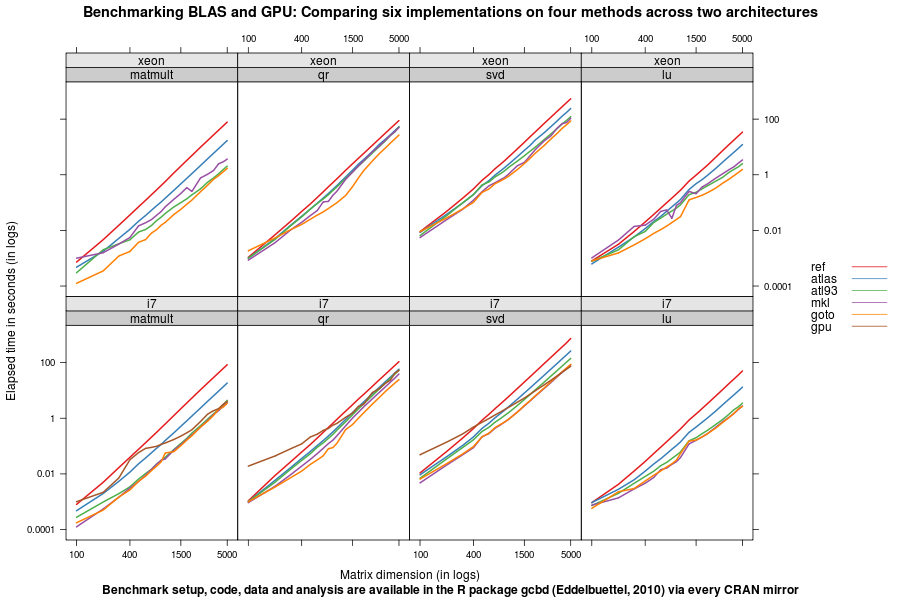
Usage of accelerated BLAS libraries seems to shrouded in some mystery, judging from somewhat regularly recurring requests for help on lists such as r-sig-hpc (gmane version), the R list dedicated to High-Performance Computing. Yet it doesn't have to be; installation can be really simple (on appropriate systems). Another issue that I felt needed addressing was a comparison between the different alternatives available, quite possibly including GPU computing. So a few weeks ago I sat down and wrote a small package to run, collect, analyse and visualize some benchmarks. That package, called gcbd (more about the name below) is now on CRAN as of this morning. The package both facilitates the data collection for the paper it also contains (in the vignette form common among R packages) and provides code to analyse the data---which is also included as a SQLite database. All this is done in the Debian and Ubuntu context by transparently installing and removing suitable packages providing BLAS implementations: that we can fully automate data collection over several competing implementations via a single script (which is also included). Contributions of benchmark results is encouraged---that is the idea of the package. The paper itself describes the background and technical details before presenting the results. The benchmark compares the basic reference BLAS, Atlas (both single- and multithreaded), Goto, Intel MKL and a GPU-based approach. This blog post is not the place to recap all results, so please do see the paper for more details. But one summary chart regrouping the main results fits well here: GPU/CPU Benchmark Results This chart, in a log/log form, shows how reference BLAS lags everything, how multithreaded newer Atlas improves over the standard Atlas package currently still the default in both distros, how the Intel MKL (available via Ubuntu) is fairly good but how Goto wins almost everything. GPU computing is compelling for really large sizes (at double precision) and too costly at small ones. It also illustrates variability and different computational cost across the methods tested: svd is more expensive than level-3 matrix multiplication, and the different implementations are less spread apart. More details are in the paper; code, data etc are in the package gcbd. The larger context is to do something like this benchmarking exercise, but across distributions, operating systems and possibly also GPU cards. Mark and I started to talk about this during and after R/Finance earlier this year and have some ideas. Time permitting, that work should be happening in the GPU/CPU Benchmarks (gdb) project, and that's why this got called gcbd as a simpler GPU/CPU Benchmarks on Debian Systems study.
15 September 2010

Gunnar Wolf: On enjoying history, opposed to what happens around me

Portadas de los discos de Diana Uribe I have always liked learning and understanding history. Since I discovered him, for a couple of years already I always try to catch Javier Garciadiego's program Conversaciones sobre historia, Saturday 9AM in the Horizonte 108 radio station (can be listened to online). This program started by going over the events just before the beginning of the 1910 revolution in Mexico - and along slightly over five years, one hour per week and following different threads, the program has reached the end of the Cristiada, in the early 1930s. Garciadiego has a very nice, followable, amenable way of telling history, and I have recommended his program to many friends. This last June, I spent some days in Guatemala City, for DrupalCamp Centroam rica. I stayed with my good Colombian friend, Dilson, and at his house he had framed a poster of the History of the Civilizations. Of course, I got my nose close to it, guessing as many faces as possible in the lot. And he showed me his last Christmas present: Two books, each of them with 6 CDs. One is Historia de las Civilizaciones, the second one is Historia de las independencias. They are made by Colombia's very well known and well regarded historian Diana Uribe. I copied the CDs in order to listen to them later And wow, was I impressed! Diana Uribe makes a great narrative about topics that to some people would seem boring and dry. As I said, I have always found passion in understanding the human processes that have shaped civilization and brought us all the way to where we stand now. Well, Diana Uribe manages to bring more "normal" people to this passion. While looking for information on her to share in this blog post, I found so many places offering download of her disks, with apparently young people talking about how she has got them all so excited and interested in history... That's, I think, the best "thank you" any academician can get: having non-specialists say how her work has opened up the passion of one of the world's least sexy professions to them. And yes there are so many "thank you" and "I want" commentaries, so much of what I would call "fan mail", that it took me a bit to find an online library carrying both works. And yes, at ~US$50 each, I do intend to buy them. Now, why am I writing this today? Well, yes, because I finished listening to the series today, but besides During this year, most of Latin American countries conmemorate their 200 years of existence. Most of the independentist struggles in the continent started in 1809-1810. And today is the "partying" day in Mexico Says the legend that in the night between September 15 and 16, 1810, a priest who is always painted as old and charismatic called on his small town urging the people to rise and fight for independence, and as a result of that, only 11 years later Mexico was a fully independent country, spanning from Costa Rica to California, and... well, a nice and very idealized myth. A century later, in 1910, after a very long stability and growth period (attained mostly through repression, the same abstract thing named as "the people" rose against the dictator Porfirio D az, who had been Mexico's president for 30 years. The revolution deeply changed the social face of the country, but politically... After ~15 years of fighting, the result was that a 30 year long dictatorship was replaced by a 70 year long one... And our political system still has not evolved beyond that model. Now, comparing what has not improved nor even stayed the same but went backwards... A century ago, the festivities of the hundred years of independence were a time for showing pride, for showing to the guests from more "civilized" countries how ours was by then a modern, thriving country worth believing in, worth investing in: Besides the important, majestic and well built monuments that were erected and still stand today (i.e. the Column of the Independence or Hemiciclo a Ju rez, many institutions that would socially shape the next century even after D az's death, even after he had been declared not the role model we wanted after all were born: The National University (nowadays the most important university in Latin America), the National School for Professors, the Railroad Technical School and many others (see Javier Aranda's note for some more details)... The celebration was well-thought and planned. Of course, it didn't go into some darker corners, the country was as uneven and unfair as it can be for the poorer indigenous population (which back then was a majority), and what not. But this year? Well, we are expecting an impressive show tonight (which I won't see, even though I'd like to, as I no longer have a TV and even if I had wanted to go downtown for the celebration, different government branches are insisting we should just sit and watch it by TV at home as it can be too crowded... so not even that was well thought out Of course not every Mexican can go to the same square and see the same de-facto president do the ritual, but some more redundancy could be thought, spreading acts through all of the city instead of concentrating the festivities all along Reforma. But anyway Leaving aside our current de-facto ruler's inabilities to do anything worthy, which are already well known and documented... I took this opportunity to listen to a great work, and am most happy to do it, and to be able to share it with you.

Matthew Garrett: Thoughts on upstreams

Last month I gave a presentation on the interaction between Android and kernel upstream at Linuxcon. The video for that is now available here (requires registration). Contrary to stories you may have heard, I do not dropkick anyone through a window.

There's some parallels between the Android/upstream scenario and Canonical's approach to upstream. Mark wrote a lengthy defence of Canonical's focus on components that they feel need development, while not putting development effort into things they feel are good enough already. That's pretty consistent with the discussions I had with him at the Ubuntu development meeting in Oxford over six years ago. Back then the focus was on taking all the excellent software that already existed and concentrating on providing it as a single polished and integrated product. It was successful - what's easy to forget now is that the first release of Ubuntu was massively more usable out of the box than any other Linux distribution available at the time, and it's absolutely undeniable that its release spurred increased efforts on the part of competitors. But I don't think the same focus is being applied any more.

The most obvious (and most controversial) example is the Ayatana project. Ayatana's a pretty explicit statement that Canonical don't view the existing Gnome UI as being suitable for their vision of the Linux desktop. That's absolutely fine. However, unlike many of the papercut projects, Ayatana is a set of complete reimplementations of functionality that behave differently to their upstream equivalents. There's no meaningful sense in which that's not a fork of Gnome. And, let me emphasise, I don't think that's a bad thing.

Let's go back to Android. While we talk about how much we'd have preferred it if Google had interacted with upstream before implementing wakelocks, the realistic outcome is that there's no way that we'd have accepted them even if they'd been posted years before hardware shipped. If there'd been a productive outcome to that aspect of the conversation it would have involved Android having a very different power management policy. Sometimes you're not going to convince people that something is better without implementing it and seeing how well it works. The problem with wakelocks is not that they exist or that Google feels they work better than the alternative, but that they end up integrated into drivers in a way that can cause divergence between mainline and Android.

Ayatana potentially has the same outcome. At some level, well-integrated applications have to be aware of the environment in which they're running. The application indicator patches are an example of that. Carrying conditional code increases maintenance burden, reduces test coverage and is a net loss in the long run. If upstream Gnome never gains support for this functionality, and if Ubuntu continues to depend on it, then Canonical have a delta that they'll have to carry forever. That benefits nobody.

Forking because you believe that your approach is better is a completely valid development model, but in the long run can cause problems if you don't have a long-term strategy for how to resolve that fork. For all we criticise Google's ability to get Android code into the mainline kernel, they've put orders of magnitude more effort into doing so than Canonical have in terms of getting Ayatana's code into mainline Gnome. This isn't a function of Google's relative size - the Android kernel team is on the order of 10 people. It's not enough of a difference to explain the disparity.

Canonical would be perceived as much better team players if there was an indication of their long-term plan in terms of Unity and the Ayatana projects and getting that code into mainline Gnome and integrating with the Gnome shell. It's completely unsurprising that they're viewed with distrust until that happens.

Christian Perrier: Paris Marathon 2011

Today, registration for the 2011 Paris Marathon (Apr 10th 2011) and 2011 Paris Half-marathon (March 6th 2011) was opening. I just registered for both. One will note that about 3 hours after the online registration opened, already more than 1200 people registered. As there are "only" 37000 places (plus 3000 for travel agencies and sponsors), people will, as usual, need to hurry (the half-marathon has 28500 places).

14 September 2010

Russell Coker: How to Start Learning Linux

I was asked for advice on how to start learning Linux. Rather than replying via email I m writing a blog post for future people who ask such questions and also to get comments from other people which may provide information I missed. Join a LUG The best thing to do is to start by joining your local Linux Users Group (LUG). Linux International maintains a list of LUGs that is reasonably comprehensive [1]. Even if there isn t a LUG near enough for you to attend meetings you can learn a lot from a mailing list of a LUG that s close to your region. There is usually no great reason not to join the mailing list of a LUG in a different region or country, but a local LUG is that the advice will often be tailored to issues such as the local prices of hardware and the practices of your government. Also note that Linux International doesn t list all LUGs, the MLUG group in Melbourne [2] and the BLUG group in Ballarat [3] aren t listed. Anyone who joins LUG (the group based in Melbourne, Victoria that I m a member of) will be advised of the smaller groups in the region if they ask on the list. As an aside it would probably make sense for the main LUV web page [4] to have links to local LUGs and to the LI page of users groups and for other LUGs to do the same. It s pretty common for a Google search to turn up the web site of a LUG that s near the ideal location but not quite right. Also it would be good if LUV could have a link to the Victorian Linux Users Group in Canada this should reduce the confusion a bit and they have a link to us [5]. Play with Linux Get a spare PC (with no important data) and try installing different distributions of Linux on it. Make sure that it never has anything particularly important so you can freely try things out without worrying about the risk of losing data. Part of the learning process usually involves breaking a system so badly that it needs to be reinstalled. Linux can run on really old hardware, an old system with 64M of RAM will do for learning (but 128M will really be preferred and 256M will be even better). Learn with other Beginners LUV has a very active beginners group, with a beginners mailing list and special beginners meetings. A group that has such things will be more helpful as you can easily learn from other people who are at a similar level to you. Also you can spend time learning Linux with friends, just spend a weekend with some friends who want to learn Linux and play with things you can often learn more by trying things than by reading books etc. Do some Programming One of the advantages of Linux (and other Free Software OSs) is that it comes with a full range of programming languages for free. You can get a much greater understanding of an OS by writing programs for it and a typical Linux distribution gives you all the tools you need. Any other Ideas? Does anyone have any other suggestions? Please leave a comment.

Mohammed Sameer: Twitter OAuth Proxy

I'm using Twitter plugin for Contacts and Conversations to twitter on my N900.

Twitter recently moved to OAuth. Problem is the Maemo package is outdated and seems to be unmaintained.

I did some research and came across a blog entry about exploring OAuth-protected APIs and some code. Nice idea but not usable for me.

I ended up sitting down and writing a small python script that will re-route your HTTP requests to api.twitter.com after adding all the OAuth bills and whistles, read the reply from twitter and send it back. Neat ? :-)

There's also supertweet.net which I've discovered after I finished writing my script but seems they don't support all of the twitter API call while my script does that.

The script is simple without much error checking but it's been working for me for a few days already.

Last thing, I'm not interested in running a service like supertweet. I'll not be implementing the full OAuth protocol. Need to use it ? Register your own application.

Get the code while hot!

git clone git@gitorious.org:twitter-proxy/twitter-proxy.git

Next step: Thinking of maintaining the twitter plugin for Maemo. I already compiled the latest code and it sort of works fine :-) read more

Gregory Colpart: Capture input/output of a process with gdb

My tip of day. When you lose control of a process (for example with a process launched with disown or, another example, when you close your SSH terminal with unsynced mutt), thanks gdb.
$ tty
/dev/pts/13
$ gdb --pid= pidof mutt 
(gdb) call close(0)
(gdb) call close(1)
(gdb) call close(2)
(gdb) call open("/dev/pts/13", 2, 0)
(gdb) call dup(0)
(gdb) call dup(0)
(gdb) detach
Detaching from program: /usr/bin/mutt-org, process 2932
Thanks to this comment on superuser.com for the original idea. Edit: correction on dup() calls. Thanks to Peter Pentchev for his explanation in comments.

Dominique Dumont: Creating a DEP-5 parser with Config::Model

Hello Following a discussion on #debian-perl IRC channel, I ve proposed to provide a script to parse DEP-5 files. The goal is to be able to parse *and* validate DEP-5 files. DEP-5 is a
proposal to make debian/copyright machine-interpretable. This proposal is driven by Lars Wirzenius. With Config::Model, any evolution of DEP-5 specification will
be easy to include in the DEP-5 model read by Config::Model. What DEP-5 model ? To keep a long story short, let s say that DEP-5 model is a description of DEP-5 syntax and semantic that can be used by Config::Model to perform validation. For more detail on how to create a model, please read this doc. In other word, DEP-5 model is DEP-5 document translated into a special format. First step was to directly edit the doc and munge it into a YAML document describing the structure of DEP-5. Here s a small extract of this YAML file (slightly edited to remove most long descriptions) :
 
---
class:
  Debian::Dep5:
    class_description: >
       Machine-readable debian/copyright
    accept:
      name_match: X-.*
      type: leaf
      value_type: string
    element:
      Format-Specification:
        mandatory: 1
        type: leaf
        value_type: uniline
        description: >-
          URI of the format specification, such as ...
      Name:
        type: leaf
        value_type: uniline
      Files:
        type: hash
        index_type: string
        ordered: 1
        cargo:
          type: node
          config_class_name: Debian::Dep5::Content

During this YAML file creation step, the problem raised by the License keyword became obvious because of License properties: Long story short, I had to add to Config::Model the possibility to specify a Parse::RecDescent grammar to validate a value. More on this later. Of course, the first draft of a model in YAML was far from being perfect. So the second step was to load it with config-edit-model. I had to fix a number of YAML errors and then some errors in the model description. Then, I had to write a parser to load the DEP-5 data into Config::Model tree. I first used Rapha l Hertzog s Dpkg::Control::Hash module. But this one is not able to cope with repeated fields without clobbering them. So I had to provide my own parser. The parser is divided in 2 parts:
- the parse function to load DEP-5 data in a simple data structure
- the read function to load the simple data structure into Config::Model s configuration tree You can view the code on Config::Model repository. Then the model is divided in 3 configuration classes: And the full model of Dep-5 can be also read on Config::Model repository: (The models are biggish because they include help text taken from DEP-5 documentation) Now some explanation is required on how is performed the License validation. The trick is that each License used must be listed in Dep5 s license parameter which is specified this way (in YAML syntax):
 
License:
  type: hash
  index_type: string
  allow_keys_matching: '^(?i:Apache Artistic BSD etc... other)[\d\.\-]*\+?$'
  cargo:
     type: leaf
     value_type: string
So this License element contains the list of licenses with their full text and only Licenses whose name matches the regular expression are accepted. Now, let s explain how the files are tied to the declaredlicenses. The Debian::Dep5::Content class had a License element that represent the relation between the files and the License(s). This bond is represented by Debian::Dep5::License configuration class. The abbrev and full_license elements are fairly obvious. The abbrev element is another matter. Here s its declaration (minus the description and help):
 abbrev:
 type: leaf
 value_type: uniline
 default: other
So far, so good. Now the meaty part: the validation requirement based on Parse::RecDescent
grammar: "license (oper license)(s?)
          oper: 'and'   'or'
          license: /[\\w\\-\\.\\+]+/i\n
               # PRD action to check if the license text is provided
               $return = $arg[0]->grab('! License')->defined($item[0]);
               "
This grammar specifies: This way, an abbreviation cannot be used without a proper License statement. This code is the first stab. Some more work is to be done soon: Anyway, I ll soon release Config::Model with this first version of DEP-5 parser. As always feedback are more than welcome. All the best update: added missing Parse::RecDescent link

Next.

Previous.