Search Results: "nic"

4 July 2012

Stefano Zacchiroli: bits from the DPL for June 2012

Monthly DPL bits, fresh from the oven^W^W^W hot from DebConf12, and just posted to d-d-a.
Howdy from DebConf12. It's hot, but it's also time to bother you again with a (not so) brief DPL activity report, this time for June 2012. Time-based freeze: DONE, short freeze: TODO Two highlights for this month. First, you've probably noticed Wheezy is now frozen, YAY. This is huge achievement for the release, but also for the project. It's the first time we do a time-based freeze, and it took some quite heated discussion at the beginning of the release cycle to decide to do this. And we did it properly: respecting the planned month and narrowing down the period later. This exercise has hopefully helped both DDs in their package planning and our upstreams in targeting Wheezy with stable releases of their software. Kudos to the release team for their coordination work! Now we've the second part still TODO: releasing Wheezy, without RC bugs, with a freeze period as short as possible. See the beginning of my last "bits from the DPL" mail for my usual song and dance :-P on how to deliver that, together. DebConf12 A lot of us will attend DebConf12. Enjoy it! ... and take the chance to both have fun and make great plans for Debian's future. But remember that "if it didn't happen on a mailing list, it didn't happen". Not all of us will be lucky enough to attend DebConf (in person or remotely). Make sure that those who don't can take part in your team decisions and get informed of what is going to happen here. Politics Zack's spring tour I spent a significant part of June doing Debian talks ins some sort of "spring tour" between Italy and France. In particular: Many thanks to the organizers of these events for inviting and sponsoring me (as well as other Debian people, in the ESRF case) and for their interest in Debian. Sprints Assets Discussions Some relevant discussions for project evolution has been going on in June and I took part into them. You might want to have a look at them: Misc Cheers.
PS the boring day-to-day activity log for June is available at master:/srv/leader/news/bits-from-the-DPL.txt.201206

3 July 2012

Miriam Ruiz: Scratch in Debian

Scratch has finally reached Debian repositories. Scratch is a programming learning environment created by the Lifelong Kindergarten Group at the MIT Media Lab designed to be accessible by young learners (over 8 years old). Scratch makes it easy to create your own interactive stories, animations, games, music, and art through a visual interface based on blocks. Thus, beginners can get results without having to learn to write syntactically correct code first. It is powerful enough to have even been adopted as an entry-level computer language in computer science programs at different universities. Scratch makes use of pieces of code embedded in different blocks that are shaped like puzzle pieces. That way, programming consists on putting different blocks together, which gives immediate visual feedback to the programmer about the correctness of the syntax: If the pieces fit together, then the expression is valid. Scratch programming system is so nice and easy that has been the inspiration of other systems such as MIT App Inventor or Google Blocky.

Scratch animations consist of sprites that are animated by dragging the corresponent blocks into the Scripts area of the Scratch interface. Multiple sprites can be created and interact with one another. Each of the sprites can have different looks (called costumes in Scratch). You can use built-in sprites, load them from files, or draw your own using a drawing tool integrated in the environment. Scratch itself is coded in Squeak, a Smalltalk implementation derived from Smalltalk-80. The Scratch 1.4 source went GPLv2 on March, but there were some incompatibilites with the Squeak Virtual Machine currently in Wheezy that had to be resolved first. Luckily we were able to solve them, with the help of the Scratch and the Squeak guys, so I m happy to say that Scrach is finally available from Debian repositories. Note: If any Scratch derivatives (such as BYOB or Panther) also need to be ported to the current version of Squeak, they should have a look at the comments in the Scratch ITP, and especially to the script uploaded by Bert Freudenberg, that replaces 90 indexed primitive declarations (removed in later versions of Squeak VM) with their named counterpart. Note 2: This wouldn t have been possible without all the great work and effort made by Amos Blanton and many others. Lots of thanks!

Petter Reinholdtsen: Can Zimbra be told to send autoreplies to the From: address?

In the NUUG FiksGataMi project (Norwegian version of FixMyStreet from mySociety), we have discovered a problem with the municipalities using Zimbra. When FiksGataMi send a problem report to the government, the email From: address is set to the address of the person reporting the problem, while envelope sender is set to the FiksGataMi contact address. The intention is to make sure the municipality send any replies to the person reporting the problem, while any email delivery problems are sent to us in NUUG. This work well in most cases, but not for Karm y municipality using Zimbra. Karm y is using the vacation message function in Zimbra to send an automatic reply to report that the message has been received, and this message is sent to the envelope sender and not the address in the From: header. This causes the automatic message from Karm y to go to NUUGs request-tracker instance instead of to the person reporting the problem. We can not really change the envelope sender address, as this would make it impossible for us to discover when there are problems with the MTAs receiving problem reports. We have been in contact with the people at Karm y municipality, and they are willing to adjust Zimbra if something can be changed there to get a better behaviour. The default behaviour of Zimbra is as far as I can tell according to the specification in RFC 3834, which recommend that vacation messages are sent to the envelope sender and not to the From: address. But I wonder if it is possible to adjust or configure Zimbra to behave differently. Anyone know? Please let us know at fiksgatami (at) nuug.no.

Ryan Kavanagh: Fixing mutt header cache

Every now and then I have to kill mutt, which if done at the wrong time, can leave the header cache in an open state. Then attempting to restart mutt will cause it to hang at the "Selecting INBOX" stage. If mutt is compiled with support for the Tokyo Cabinet header cache backend (as it appears to be in Debian), a quick fix for this issue is to repair the header cache database using the Tokyo Cabinet utility tcbmgr from the tokyocabinet-bin package. Simply running tcbmgr optimize -nl ~/.mutt/cache/headers does the trick, and is much nicer of a fix than deleting the header cache.

2 July 2012

Mehdi Dogguy: Adding useful links on bugreports pages

I'm a heavy user of Debian's Bug Tracking System (especially during this period of the year ;)) and I quite like it. And as a Debian developer, I have to check multiple sources when looking at some source package. Namely, I mainly check the following sources:
All this is great since you can move from the first one to the second one (and vice-versa) just by clicking with your mouse. It becomes less handy when you are looking at any bug report. In fact, the BTS doesn't link back to the previously mentioned services [1]. So, you have to copy/paste the name of the package or start a new tab and write down the address of the desired service. All this is not very nice for a lazy person like me :)

A few days ago, I remembered that I was already using GreaseMonkey and thought : "Hey, it would be nice to hack quickly something using GM to add the missing links". After a few tests, I've come up with a (very simple, yet extremely useful to me) user script that I called Debian BTS extra links [2]. It adds what I've been missing for years. If you are lazy and don't want to install right now, you can check the following pages to see what it adds:
The userscript will add links to PTS, Buildd status pages and Popcon near every pkgreport.cgi?src= link. Simple and useful. I hope you'll enjoy it as much as I do.

Of course, I've submitted a bug (#679282) against the pseudo package bugs.debian.org kindly asking its maintainer to add a link to (for now) the PTS. But I know that they are busy so I'm not expecting a result soon. Fow now, my simple and dumb userscript WFM.

[1] This is partly true since it links back to the PTS on main pages (pages that list all bug reports of a given set of packages).

[2] Only tested with a recent Iceweasel (from experimental) and Chromium (from unstable).

P.S.: If you do wonder, #4300 is the least bug number known to the BTS. Well, or at least, the result of running ls -1 /srv/bugs.debian.org/spool/archive/00/ sort -h head -n1 on bugs.debian.org.

Stefano Zacchiroli: DebConf no sporran 12

It's that time of the year again. No, not only the Debian biyearly freeze that has just happened, again (YAY!). It's DebConf time again. Yesterday night I arrived in Managua, Nicaragua, for DebConf12. I'm still jetlagged a bit, but the first impression is great. And that impression is also very green, shockingly green. The city is gorgeous: full of trees and plants (well, at least compared to my metropolitan European standards), and the campus of Universidad Centroamericana where the conference is hosted is even more so. Also, it's a great pleasure to have DebConf in an university campus where students are still swarming. My only reason for sadness thus far. While I did bring my traditional Debian kilt at DebConf, I discovered this morning that I forgot my sporran at home :-(
So if you don't see me wearing my kilt at this DebConf often, that's why

Raphaël Hertzog: My Debian Activities in June 2012

This is my monthly summary of my Debian related activities. If you re among the people who made a donation to support my work (168.12 , thanks everybody!), then you can learn how I spent your money. Otherwise it s just an interesting status update on my various projects. Dpkg This month, I resumed my work on dpkg. I concentrated my efforts on some polishing of the 3.0 (quilt) format. With the latest version (1.16.6 which was uploaded to unstable shortly before the freeze), dpkg-source restores the source tree in a clean state after a failed patch application (#652970), doesn t overwrite the patch header from the pre-existing automatic patch, updates automatically debian/source/include-binaries during dpkg-source commit, and supports a new no-unapply-patches option for those who dislike the auto-unapplication at the end of the process when the patches were not applied at the start. I wanted to go further and offer a new feature that could insert the automatic patch at the bottom of the quilt series but I have been short on time to complete this feature. I just managed to factorize all the quilt handling in a dedicated Perl module (Dpkg::Source::Quilt) to have cleaner code in the module handling the source format (Dpkg::Source::Package::V3::quilt). For those who wonder, this feature is meant primarily for the X Strike Force team which maintains packages in Git and are doings lots of upstream cherry-picks (to fix regressions, etc.). But they also use quilt on top of that tree to keep some lasting Debian specific changes. With the 1.0 format, the automatic diff is a bit messy but at least it gets smaller automatically when a new upstream release gets out, there s nothing to clean out. I d like them to be able to use 3.0 (quilt) while keeping their workflow. I m leaning towards allowing --auto-commit=first:cherry-picks that would name the automatic patch cherry-picks and put it in the first position in the quilt series. (Opinions welcome on that feature, BTW) Packaging There s been quite some packaging in this last month before the freeze: While doing all this packaging work, I found 2 possible improvements that I filed as bug reports: Debian France Booth at Solutions Linux From June 19th to June 21th, I manned the Debian France booth at Solutions Linux together with Carl Chenet, Tanguy Ortolo and other members of the association. We answered lots of questions, sold all t-shirts and umbrellas that Carl imported from Germany and Switzerland (we really need to get our own merchandising stuff produced in France!), got people to join the association. We also presented a printed copy of the Debian Administrator s Handbook and of the corresponding French book. You can see Carl, me and Tanguy on this picture (click on it to see a bigger picture, thanks to S bastien Dubois of Evolix for this one!):
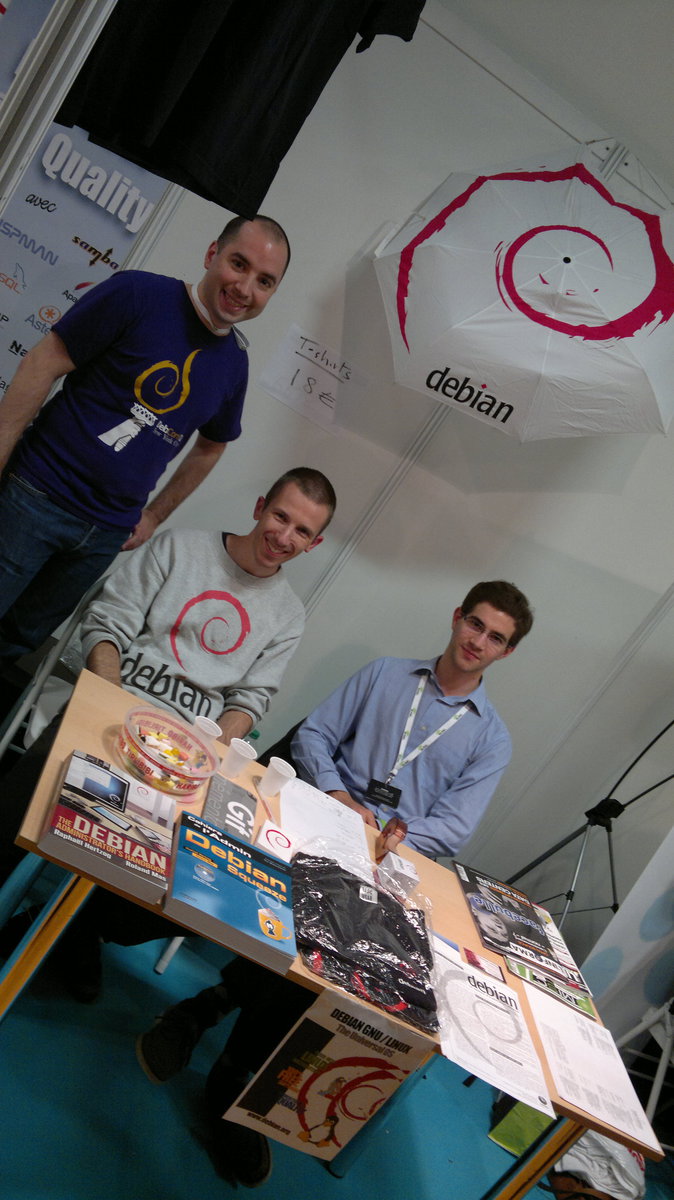
I know lots of people are preparing for Debconf but I decided to not attend this year, the price of the air plane ticket was a bit too hefty for me and it was also in partial conflict with our family vacations. I thought about attending the Libre Software Meeting instead but alas I won t go there either (but Roland Mas will be there!), I have too much work to complete before my own vacation in 2 weeks. Thanks See you next month for a new summary of my activities.

2 comments Liked this article? Click here. My blog is Flattr-enabled.

Julien Danjou: Making the jump: working freelance

For the last 10 years, I've been working on many Free Software projects. From Debian to OpenStack, through awesome, Emacs, XCB and many more. This obviously allowed me to enhance my technical skills, but it also taught me about Free Software and Open Source development processes, and how to work with and close to the community. Working for almost 6 years at Easter-eggs taught me how to work in an autonomous manner, how to lead and manage a project. And how to run a company, thanks to the cooperative status of this great one. These are the reasons why I decided to leave my latest job and run my own company to work as a freelance consultant & developer specialized in Free Software, starting today. Therefore, I am now able and available to provide expertise and development on Free Software, including upstream contribution. Especially on projects I already worked on recently, like OpenStack.

1 July 2012

Lucas Nussbaum: Introducing the Debian Maintainer Dashboard help needed!

The brand new machine for Ultimate Debian Database motivated me to do UDD-related work again, so I implemented an old idea: build a maintainer/team-centric dashboard relying on UDD, the Debian Maintainer Dashboard. The idea is to expose as much useful information as possible about a maintainer s packages, both in the traditional (Developers Packages Overview-like) big table with all the info , but also in a task-oriented listing (to answer the ok, I have two hours for Debian, what should I do now? question). At this point, the Debian Maintainer Dashboard already brings several cool features (try it with my packages or pkg-ruby s packages, or your own!): Of course, as of now, it s pretty ugly: that s the help needed part of the post. I really suck at web design, and would really appreciate if someone would help me to turn it into something nice to use. Besides adding links and colors everywhere, it could probably be nice to add sortable tables, and to create tabs for TODO items , Versions and Bugs (and possibly Lintian, for example). Contact me if you are interested.

Gunnar Wolf: Arrived to Nicaragua. DebCamp has officially started!

Yesterday night, Regina and me arrived to Nicaragua. Ready to greet us, we found quite a good number of good friends. We had a nice pizza+beer dinner at Diana's house, and some of the foreigners among us were distributed among the houses of several locals. This morning, we woke up together with V ctor, Moray and Gaudenz in Norman's brother's beautiful house. We had breakfast with the family, were picked up to go to the hotel that will have the ho(n rr)or to host us all for the following two weeks, and walked to the Universidad Centroamericana (UCA) campus. Contrary to our usual practices... It seems everything is working fine! I mean, I'm sure we will stumble with some unforseen details and what not... But coming on the very first day to the university, to find that food is all sorted out, that we have food tickets (and they are all printed!), that network works (and it's by a fiber connection that was laid out expressly for us), that we have all the hardware I was worried about, that people are arriving and getting accepted at the hotel. I mean, things work! So, I'm quite optimistic this DebCamp will have everything ready to be a success And the DebConf following it as well, of course! If you have not yet arrived - See you soon!

Dirk Eddelbuettel: Getting numpy data into R

The other day, I found myself confronted with a large number of large files. Which were presented in (gzip-)compressed ascii format---which R reads directly via gzfile() connections---as well as (compressed) numpy files. The numpy can be read very efficiently into Python. We can do the same in R via save() and load(), of course. But the trouble is that you need to read them first. And reading hundreds of megabytes from ascii is slow, no matter which language you use. Concerning R, I poked aound scan(), played with the colClasses argument and looked at the recent LaF package written just for this purpose. And all these solutions were still orders of magnitude slower than reading numpy. Which is no surprise as it is really hard to beat binary formats when you have to parse countless ascii tokens. So the obvious next idea was to read the numpy file in Python, and to write a simple binary format. One helpful feature with this data set was that it contained only regular (rectangular) matrices of floats. So we could just store two integers for the dimensions, followed by the total data in either one large binary blob, or a sequence of column vectors. But one minor trouble was that the Intertubes lead to no easy solution to unpack the numpy format. StackOverflow had plenty of question around this topic converned with, say, how to serialize in language-independent way. But no converters. And nobody local knew how to undo the "pickle" format underlying numpy. But a remote friend did: Laurent, well-known for his Rpy2 package, pointed me towards using the struct module and steered me towards the solution shown below. So a shameless plug: if you need a very experienced Python or R consultant for sciece work, consider his consulting firm. Finally, to round out this post, let's show the simple solution we crafted so that the next guy searching the Intertubes will have an easier. Let us start with a minimal Python program writing numpy data to disk:
#!/usr/bin/env python
#
# simple example for creating numpy data to demonstrate converter
import numpy as np
# simple float array
a = np.arange(15).reshape(3,5) * 1.1
outfile = "/tmp/data.npy"
np.save(outfile, a)
Next, the simple Python converter to create a binary file containing two integers for row and column dimension, followed by row times columns of floats:
#!/usr/bin/python
#
# read a numpy file, and write a simple binary file containing
#   two integers 'n' and 'k' for rows and columns
#   n times k floats with the actual matrix
# which can be read by any application or language that can read binary
 
import struct
import numpy as np
inputfile = "/tmp/data.npy"
outputfile = "/tmp/data.bin"
# load from the file
mat = np.load(inputfile)
# create a binary file
binfile = file(outputfile, 'wb')
# and write out two integers with the row and column dimension
header = struct.pack('2I', mat.shape[0], mat.shape[1])
binfile.write(header)
# then loop over columns and write each
for i in range(mat.shape[1]):
    data = struct.pack('%id' % mat.shape[0], *mat[:,i])
    binfile.write(data)
binfile.close()
Lastly, a quick littler script showing how R can read the data in a handful of lines:
#!/usr/bin/r
infile <- "/tmp/data.bin"
con <- file(infile, "rb")
dim <- readBin(con, "integer", 2)
Mat <- matrix( readBin(con, "numeric", prod(dim)), dim[1], dim[2])
close(con)
print(Mat)
That did the job---and I already used to converter to read a few weeks worth of data for further analysis in R. This obviously isn't the last word on possible solutions as the additional temporary file can be wasteful (unless it forms a cache for data read multiple times). If someone has nice solutions, please don't hold back and contact me. Thanks again to Laurent for the winning suggestion concerning struct, and help in getting the examples shown here to work.

30 June 2012

Luca Falavigna: FTP Team stats during Wheezy development

Already chilled by Wheezy freeze? It s been a long ride since the release of Squeeze, and your beloved FTP Team tried to assist our tireless developers and contributors at its best. Here are some hot stats to give you a figure about what happened behind the scenes. Since the release of Squeeze, 7462 .changes files with NEW components were processed by dak, with an average of 14.660 NEW packages per day. On the FTP Team side, we had 6877 accepts (13.511 per day), 641 rejects (1.259 per day) and 280 comments to maintainers (0.550 per day). This table represents the activity by single team member:
Login Accepts Rejects Comments
ansgar 407 accepts (0.800 per day) 71 rejects (0.139 per day) 53 comments (0.104 per day)
dak 12 accepts (0.024 per day) 1 rejects (0.002 per day) 0 comments (0.000 per day)
dktrkranz 4319 accepts (8.485 per day) 381 rejects (0.749 per day) 104 comments (0.204 per day)
joerg 100 accepts (0.196 per day) 12 rejects (0.024 per day) 1 comments (0.002 per day)
mhy 214 accepts (0.420 per day) 14 rejects (0.028 per day) 5 comments (0.010 per day)
stew 67 accepts (0.132 per day) 16 rejects (0.031 per day) 7 comments (0.014 per day)
tolimar 1480 accepts (2.908 per day) 93 rejects (0.183 per day) 84 comments (0.165 per day)
twerner 278 accepts (0.546 per day) 53 rejects (0.104 per day) 26 comments (0.051 per day)


Who were the most prolific maintainers who got a NEW processing? Here is our special top ten:
  1. Debian Perl Group (559 accepts)
  2. Debian Haskell Group (491 accepts)
  3. Debian Ruby Extras Maintainers (285 accepts)
  4. Debian Java Maintainers (257 accepts)
  5. Debian Med Packaging Team (164 accepts)
  6. Debian Multimedia Maintainers (160 accepts)
  7. Debian Fonts Task Force (156 accepts)
  8. Debian Javascript Maintainers (137 accepts)
  9. Debian Python Modules Team (129 accepts)
  10. Debian Qt/KDE Maintainers (98 accepts)
That doesn t reflect the real developers, though. Here s our Changed-By top ten:
  1. Clint Adams (216 accepts)
  2. Jonas Smedegaard (208 accepts)
  3. Ben Hutchings (203 accepts)
  4. Joachim Breitner (153 accepts)
  5. TANIGUCHI Takaki (112 accepts)
  6. Alessio Treglia (101 accepts)
  7. David Paleino (95 accepts)
  8. Nicholas Bamber (76 accepts)
  9. Mathieu Parent (68 accepts)
  10. Jeff Breidenbach (63 accepts)
Clint rocks with tons of Haskell packages, followed by Jonas (mostly Perl packages), and Ben (kernel uploads). Italian cabal stands still, with Alessio and David respectively at 6th and 7th place ;)


How long does a package stay in NEW? Some more, some less, but the average is 3 days, 15 minutes and 21 seconds. Now go and check your dak mails to see whether you had a fast processing or not :) liblog4ada 1.2-1 surely had, as it was accepted after 30 seconds! gsoap 2.7.17-1 was not so lucky, it took 103 days, 8 hours, 20 minutes and 43 seconds to clear NEW, but then made its way to the archive. Better late than never ;)


FTP Team is not just accepting NEW packages, but also removing obsolete ones. Here are some details about this task:

FTP Team also took care of override changes:

Timo Jyrinki: Where computing takes you...

Do you ever have those afternoons you get a great idea and you've all the evening time for that task. The task is a relaxing one and won't need much attention, and you can watch a movie or something. But then, it happens that the evening turns into night as you realize a couple of little details adding complexity to the idea, and the task turns out to be much more invasive to your evening than you thought?

In this example, I got the great idea to upgrade my Debian running NAS device (thanks Martin for everything!) to use ext4 instead of ext3. The kind of idea that takes a long time for relatively little practical benefit, but it just feels like a nice thing do when you've the extra amounts of nerd time available. It's basically just opening the NAS device up, mounting its hard disk to a laptop via external case, running the tune2fs and fsck then putting the disk back. It just takes a long time for the initial fsck (to make sure everything's intact) and then the required fsck run to get ext4 mountable.

Only in this situation, it would have been beneficial to have the ext4 support in the flashed initramfs before the migration. So... before the photo below, I've already:
  1. done the ext4 migration and fsck:s
  2. screwed the disk back to the NAS case, attached cables and found that it doesn't boot
  3. (on the laptop with the hard disk attached again tried manually unpacking initramfs and adding ext4 module... also had time to bind mount everything and chroot into the ARM system to run update-initramfs manually... also tried booting with those... until remembered the simple fact that the /boot partition is only for show and also the initramfs is loaded directly from flash)
  4. copied the main root filesystem content from the original disk to another external disk with ext3 partition
  5. attached the another disk (with same UUID:s) to the QNAP NAS device, booted, double-checked that I have now ext4 specified under /etc/initramfs-tools/modules, reconfigured the linux image that also regenerates initramfs and flashes it
And in the photo, what's happening is that:
  1. I've again the original disk reattached and system booted with the initramfs generated and flashed from the ext3 disk
  2. the NAS device is hanging in the air, cover open, from the closet where I've things stuffed in (normally secured with cable ties), and I need to support it with a knee or one hand since the 2TB disk is much heavier than the small SSD I used as the ext3 disk so the power cable and RJ-45 cable would have pretty heavy load
  3. Since I've only one hand in use and can't use a laptop, I'm logging in via my Nokia N9 and then reflashing the kernel + initramfs from this original disk, just to make sure everything is now alright and also after that flashing it still boots (it does!). Note that I feel like the setup is secure enough for non-interrupted flashing so that I can indeed support the NAS with a knee, use one hand to keep N9 and another hand to take a photo with a camera.

And so we have had a productive and educating afternoon/evening/night once again. Does this ever happen to you?

Andrea Veri: Nagios IRC Notifications

Lately (as I earlier pointed out on my blog) I ve been working on improving GNOME s infrastructure monitoring services. After configuring XMPP it was time to find out a good way for sending out relevant notifications to our IRC channel hosted on GIMPNET. I achieved that with a nice combo: supybot + supybot-notify, all that mixed up with a few grains of Nagios command definitions. But here we go with a little step-by-step guide: Requirements 1. Install supybot and configure a new installation:
apt-get install supybot or yum install supybot
mkdir /home/$user/nagbot && cd /home/$user/nagbot
supybot-wizard (follow the directions to get the bot initially configured)
2. Install and load the supybot-notify plugin by doing:
git clone git://git.fedorahosted.org/supybot-notify.git && cd supybot-notify
mkdir -p /home/$user/nagbot/plugins/notify && cp -r * /home/$user/nagbot/plugins/notify
Finally, load the plugin. (this will require you to authenticate to the bot) Nagios configuration 1. Add the relevant command definitions to the commands.cfg file:
# 'notify-by-ircbot' command definition
define command 
    command_name    notify-by-ircbot
    command_line    /usr/bin/printf "%b" "#channel $NOTIFICATIONTYPE$ - $HOSTALIAS$/$SERVICEDESC$ is $SERVICESTATE$: $SERVICEOUTPUT$ ($$(hostname -s))"   nc -w 1 localhost 5050
     
# 'host-notify-by-ircbot' command definition
define command 
	command_name	host-notify-by-ircbot
	command_line	/usr/bin/printf "%b" "#channel $NOTIFICATIONTYPE$ - $HOSTALIAS$ is $HOSTSTATE$: $HOSTOUTPUT$ ($$(hostname -s))"   nc -w 1 localhost 5050
	 
* adjust the Netcat s host and port to your needs, in my case Supybot and Nagios were running on the same host. In the case of a Supybot running on a different host than Nagios, tweak Iptables to allow the desired port:
-A INPUT -m state --state NEW,ESTABLISHED -m tcp -p tcp --dport 5050 -j ACCEPT
2. Add a new entry on the contacts.cfg file:
define contact 
 	contact_name    nagbot
   	use             generic-contact
        alias		Nagios IRC Bot
        email           example@example.com
        service_notification_commands   notify-by-ircbot
 	host_notification_commands      host-notify-by-ircbot
 
3. Reload Nagios:
sudo /etc/init.d/nagios3 reload
And finally, enjoy the result:
 PROBLEM - $hostalias/load average is CRITICAL: CRITICAL - load average: 30.45, 16.24, 7.16 (nagioshost)
 RECOVERY - $hostalias/load average is OK: OK - load average: 0.06, 0.60, 3.65 (nagioshost)

Raphael Geissert: One week later

It's been over a week since I publicly announced the Debian mirrors redirector.
It was covered in several places, including Linux Magazin and mentioned in the latest Debian Project News.

Thanks to all that, and quite a number of early testers of the wheezy image for the Raspberry Pi, http.debian.net has processed over one million requests from APT clients alone. This figure doesn't count users of apt-cacher/apt-cacher-ng/approx, or those who happen to be mirroring Debian with wget. Oh, and this is only the number of requests since last Sunday, when the logs were rotated.

By the way, if you are going to Debconf12 in Nicaragua, why don't you give http.debian.net a try and forget about switching mirrors?

I'm happy to see how it was welcomed and the many emails, blog comments, IRC messages, and other sorts of messages I've received about it. There are surely some rough edges but the service is still under development and all the feedback helps.

In some cases there appear to be some confusion as to how exactly it chooses the mirrors and why sometimes some mirrors are not used. I'll try to cover some of those topics in this blog, hoping the

P.S. If you've sent me an email about http.d.n and I haven't replied, please rest assured I try to take a quick look at them but I can't reply to every single message fast enough.

Thanks to everyone!

28 June 2012

DebConf team: DebConf12 schedule ready! (Posted by Gunnar Wolf)

The DebConf12 schedule is finally available! As usual, the DebConf conference can only be finalized a couple of days before DebConf itself starts. But hey Take a look at it, and start planning your activities! Not final, never final Remember that, even now that the conference schedule is announced, you can still submit talks to DebConf, following what we call ad-hoc talks. What are the steps to do it?
  1. Check the schedule and find the timeslot (day, hour and room) you want to talk in
  2. Register your event in Pentabarf, and note the generated event ID (the last number in the URL after the submission is accepted)
  3. Send a mail to schedule@debconf.org detailing the event ID, title (just to confirm it), and the requested timeslot
  4. All requests _must_ be received at least 24hr before the requested event for the scheduling team to act accordingly and for the video team to be able to plan on resources to cover the requested session
  5. Video team coverage (event recording plus streaming on a best-effort basis) will be given to activities scheduled on the Aula Magna and Roberto Ter n auditoriums.
  6. We will try to grant requests on a first-come-first-serve basis. If two events are requested for the same timeslot, the first will have precedence, and we will schedule the second as close as possible to it. We will notify the submitters if this happens, of course.
Conference tracks In DebConf12, many talks are organized around the following tracks:
DebianDay
This track is meant for the local (Nicaraguan/Central American) community to be attracted to Debian. It does not usually have technically minded talks; the DebConf general audience is, of course, invited to take part in it, as there will surely be interesting angles on how Debian is used in different use-cases, and there will be interesting Q&A session with the audience.
Getting involved in Debian
Central America is a very special region. It has vibrant Free Software user groups and communities, among which there is an important interest to get involved in Debian.
This track will have some talks in Spanish, some talks in English, explaining different Debian processes and tools, aiming at attracting locals to contribute to Debian.
Debian for the cloud
All about virtualization. Management infrastructure, details on virtual machine engines, insight on how to tweak your kernel for optimum virtualized performance, and of course how to get it all humming perfectly with your Debian packages.
Building and porting
With an every day stronger transit to mobile computing, we are seeing a renaissance of porting. At the same time, we finally have multiarch as part of Debian. And were that not to be enough, we finally have more than one compiler that can be used for most of the software in the archive. Put all this together, and you will have a very interesting track.
Social activities
DebConf is as much about technical stuff as it is about building closer ties within the members of its community. Eating cheese+wine, going on a trip to the guts of a volcano, having a nice banquet Do you want to add an activity to this pseudo-track?
Skills exchange
Knowledge can also be built by all of us putting our grain of sand. We first had explicit skills exchange sessions in Bosnia last year, and they were very well received. Feel free to propose similar sessions!
And Well, three days to DebCamp and counting. See you Real Soon Now in Managua!

Sorina Sandu: Status update

Hello!

First of all: I'm going to DebConf :D and I really want to say a big "Thank you!" to every one who made this possible.


So, here's what I've done recently:

I spent some time putting everything in order for the departure to Nicaragua, things like finding a plane ticket through a route that does not require a Visa, making a new Passport, now all is in order.

I've integrated the changes for listing available ESSIDs, in order to close #637128 [0] into a separate branch , which can be found here [1].

The plan is to have only one new template which lists the available networks and which has a option for entering the ESSID manualy. In order to do so, a simple scan is performed on the wireless interface, and the configuration for a particular network resulted after the scan is kept if that one is chosen. The enter manually situation is treated exactly as it was before.

Furthermore, last week (or the week before) I've done some coding style fixes again in a separate branch [2], nothing very fancy, just trimming trailing white spaces and changing some tabs to spaces, where spaces were mostly used. I've also noticed some inconsistencies, regarding white spaces between functions names and the parenthesis. However I think I'm overreacting a little, those matters are not really that relevant, but when I'll have some free time I'll get to this as well.


Next in line: Issues

Testing is still giving me some troubles, the show essids part is not yet fully tested, so I couldn't say for sure if everything works as planned.

Apart from the classical: write the image to an USB and reboot method, I'm using Virtual Box for testing. I've managed to create a passthrough for the wireless interface, but now I have troubles with some firmware. Hopefully I'll solve this as soon as possible since it would really make my life easier.


Future plans:

I've realized that I've underestimated a little what the project implies and the amount of information that is new to me. I feel that I have learned a lot and that there is still a lot to learn and I'm very happy that it is so. I've now started documenting regarding IPv6, beginning with this [3]. We haven't decided yet what the next task will be exactly.


[0] http://bugs.debian.org/cgi-bin/bugreport.cgi?bug=637128
[1] http://anonscm.debian.org/gitweb/?p=d-i/netcfg.git;a=shortlog;h=refs/heads/people/sorina/show_essids
[2] http://anonscm.debian.org/gitweb/?p=d-i/netcfg.git;a=shortlog;h=refs/heads/people/sorina/coding_style
[3] http://tldp.org/HOWTO/Linux+IPv6-HOWTO/

26 June 2012

Petter Reinholdtsen: Debian Edu interview: Jos Luis Redrejo Rodr guez

I've been too busy at home, but finally I found time to wrap up another interview with the people behind Debian Edu and Skolelinux. This time we get to know Jos Luis Redrejo Rodr guez, one of our great helpers from Spain. His effort was the reason we added support for several desktop types (KDE, Gnome and most recently LXDE) in Debian Edu, and have all of these available in the recently published Debian Edu Squeeze version. Who are you, and how do you spend your days? I'm a father, teacher and engineer who is working for the Education ministry of the Region of Extremadura (Spain) in the implementation of ICT in schools How did you get in contact with the Skolelinux/Debian Edu project? At 2006, I verified that both, we in Extremadura and Skolelinux project, had been working in parallel for some years, doing very similar things, using very similar tools and with similar targets, so I decided it was time to join forces as much as possible. What do you see as the advantages of Skolelinux/Debian Edu? A community of highly skilled experts working together, with a really open schema of collaboration and work. I really love the concepts of Do-ocracy and Merit-ocracy and the way these concepts are been used everyday inside Debian Edu. What do you see as the disadvantages of Skolelinux/Debian Edu? Sometimes the differences in the implementations, laws or economical and technical resources in the different countries don't allow us to agree in the same solution for all of us, and several approaches are needed, what is a waste of effort. Also, there is a lack of more man power to be able to follow the fast evolution of the technologies in school. Which free software do you use daily? Debian, of course, and due to my kind of job I am most of my time between Iceweasel, Geany and Terminator. Which strategy do you believe is the right one to use to get schools to use free software? I think there is not a single strategy because there are very different scenarios: schools with mixed proprietary and free environments, schools using only workstations, other schools using laptops, netbooks, tablets, interactive white-boards, etc. Also the range of ages of the students is very broad and you can not use the same solutions for primary schools and secondary or even universities. So different strategies are needed. But, looking at these differences, and looking back to the things we've done and implemented, and the places were we have spent most of our forces, I think we should focus as much as possible in free multi-platform environments, using only standards tools, and moving more and more to Internet or network solutions that could be deployed using wireless. I think we'll see more and more personal devices in the schools, devices the students and teachers will take home with them, so the solutions must be able to be taken at home and continue working there.

Russ Allbery: Review: Quiet

Review: Quiet, by Susan Cain
Publisher: Crown
Copyright: 2012
ISBN: 0-307-45220-4
Format: Kindle
Pages: 263
I've always been an introvert. This is something that surprises some people when they first meet me since they equate introversion with shyness, and I'm not at all shy. It surprises others because I'm quite vocal and outspoken in meetings, but introversion also doesn't imply a lack of self-confidence. I can run meetings, give presentations, and argue my perspective in front of just about anyone, but I don't like parties, I crave time by myself, and I could happily go for weeks without seeing another human being. I'm an introvert because I find people draining rather than invigorating, written communication far easier and more comfortable than spoken, and superficial social contact more irritating and frustrating than enjoyable. If you think think that means there may be something wrong with me, or that I would be happier if "drawn out of my shell," I wish you would read this book. But I suspect its core audience will be people like me: those who are tired of being pushed to conform with extrovert beliefs about social interaction, those who are deeply disgusted by the word "antisocial" or feel pangs of irrational guilt when hearing it, or those who just want to read an examination of interpersonal interactions that, for once, is written by and about people who like quiet and solitude just like they do. I first encountered Susan Cain via her TED talk, which I think is both the best possible summary of this book and the best advertisement for it. If you've not already seen it, watch it; it's one of the best TED talks I've seen, good enough that I've watched it three times. If you then want more of the same, buy Quiet. Quiet has, I think, three messages. First, it's a tour of the science: what is introversion and extroversion? Is there evidence that these are real physiological differences? (Spoiler: yes.) What do we know about introversion? How do we know those things what experiments have been done and what methods have been used? Here, it's a good general introduction, although Cain is careful to point out that it only scratches the surface and there's much more scientific depth. For example, she touches on the connections between introversion and sensitivity to stimulus and points out that they're two separate, if related, categorizations, but doesn't have the space here to clarify the distinctions and tease them apart. But she lays a reasonable foundation, particularly in defense of introversion as a natural, physiologically grounded, scientifically analyzable, common, and healthy way of interacting with the world. (For those who are curious about the distinctions between introversion and sensitivity, and the argument that most of what Cain says here about introversion is actually about sensitivity, see the blog post by Elaine Aron.) The second message, the one that resonated with me the most, was Cain's passionate defense of introversion. Business culture (at least in the United States, which is what both Cain and I know) is strongly biased towards extroversion; at least faking extroversion seems to be required for some career advancement. Extrovert culture dominates politics and most public discourse. It's common to find people who consider introversion, particularly in children, to be a sign of unhappiness, poor social adjustment, psychological problems, or other issues that should be "cured" or changed. Cain's gentle but firm passion in defense of introversion is a breath of fresh air. She attacks open plan offices, the current obsession with group learning and social school settings, and the modern group-think bias towards collaboration over solitude and concentration, and she does that with a combination of polite frustration and the conclusions of multiple studies. Introverts will be cheering as she constructs solid arguments and musters evidence against things that we've always found miserable and then been told we were wrong, short-sighted, or socially inept for finding miserable. I am so utterly on her side in this argument that I have no way of knowing how persuasive it will be, but it's lovely just to hear someone put into words what I feel. This defense does skew the book. Quiet is not, and does not purport to be, an even-handed presentation of introversion and extroversion. It's written proudly and unabashedly from the introvert's point of view. I'm fine with that: I, like Cain, think the US is saturated in extrovert perspectives and extrovert advice, particularly in the business world, and could use some balancing by activism from the other perspective. But be aware that this is not the book to look to for an objective study of all angles of the introvert/extrovert dichotomy, and I'm not sure her descriptions of extroversion are entirely fair or analogous to those of introversion. The extroversion described here seems somewhat extreme to me. I'm dubious how many extroverts would recognize themselves in it, which partly undermines the argument. The third message of the book, once Cain has won the introvert's heart, is some advice on how to be a proud introvert, to make the space and find the quiet that one desires, and to balance that against places where one may want and need to act like an extrovert for a while. Cain thankfully does not try to make this too much of the book, nor does she hold up any particular approach as The Answer. All the answers are going to be individual. But she does offer some food for thought, particularly around how to be conscious of and make delibrate choices about one's energy expenditures and one's recharge space. She also captures beautifully something that I've not seen explained this well before: the relief that an introvert can feel in the company of an extrovert who helps navigate social situations, make conversation, and keep discussions going until they can reach the depth and comfort level where the introvert can engage. I wish anyone in a position of authority over social situations would read this book, or at least watch the TED talk and be aware of the issues. Particularly managers, since (at least in my relatively limited experience) workplace culture is so far skewed towards extroversion that it can be toxic to introverts. Many of the techniques used by extrovert managers, and the goals and advice they give their employees, are simply wrong for introverts, and even damaging. Cain speaks well to the difficulties of empathy between people with very different interaction preferences, such as the problems with extroverts trying to "draw out" introverts who have hit social overload (or sensitive people who have hit stimulus overload). She also discusses something that I'd previously not thought about, namely how the pressure towards extroversion leads people to act extroverted even when naturally introverted, and how it's therefore very difficult to tell from behavior (and sometimes even to tell internally!) what one's natural interaction style is. But mostly I recommend this book if you're an introvert, if the TED talk linked above speaks to you. Even if we can't convince the world to respect introversion more, or at least stop treating it as abnormal, it's a lovely feeling to read a book from someone who gets it. Who understands. Who fills a book with great stories about introverts and how they construct their worlds and create quiet space in which to be themselves. Rating: 9 out of 10

24 June 2012

Pablo Lorenzzoni: Zotero and note-taking

I was looking for an excuse to try Zotero and the perfect opportunity appeared when I got a whole lot of references to group for a month of Magnetic Ressonance studies I am currently taking. I was also pleased to notice it is packaged to Debian. I am used to note-taking software. Back when I used a Palm m130 (and a Treo 650), I managed a lot of Memos I eventually migrated to Note-Everything in my current Android phone. Zotero, unfortunatelly, is not interfaceable with my phone (or I was still unable to figure out how to do so), but it s powerful in managing references beyond simple note-taking. Is anyone using Zotero in a more ambitious way? I ve read about people using it to keep large researchs to support fiction and non-fiction book-writing I also watched some YouTube videos on it. As far as I went with it, Zotero might become an important piece in my toolbox wrt reference keeping, so I was just trying to figure out how many other niches it can fill

Next.

Previous.



