This is the second post in a series of posts describing a secure alternative to applications like WhatsApp. I started with the following statement:
I believe it is possible to build a system with the simplicity and functionality of WhatsApp or Viber, which provides end-to-end encryption, is built on free software and open protocols, that supports federation and is almost decentralised, and that would allow interested companies to turn a profit without compromising any of these principles.
In this post, I will outline the concepts behind the most critical component of the architecture: the directory service.
Outline
I say this is the most critical component, because here lies what makes this architecture different, but also because this is the weakest link in the whole idea. I expect criticism, specially on some security trade-offs, and I hope that people that know better than me can help me improve it.
The directory service is what allows the users to register easily, without using passwords, to be able to receive calls and messages from other users, even if they are not part of the network, and to do all this with a reasonable security model.
Let's get technical
The directory service is basically a DNSSEC-protected DNS zone serving ENUM records, along with public keys associated with each user identifier.
A TLS-enabled API will enable account creation and validation, DNS records publishing, and encrypted records querying.
Applications not supporting that API use standard ENUM querying, and the user manually uses traditional web-based methods for account and records management. This allows interoperability with any existing clients and SIP services.
The service will authenticate users by using the usual methods to probe ownership of phone numbers: sending an encrypted SMS with a secret that the client application uses then to claim the phone number.
This same method can be used to validate ownership of identifiers that are not phone numbers, like pre-existing SIP or email addresses.
Once the user is authenticated, the directory service will publish the user's public key and SIP address, both associated with the phone number.
When a user wants to place a call or send a message, it uses a DNSSEC-enabled resolver to get securely the other party's public key and SIP address. The user can also perform bulk look-ups, to discover which people on theirs address book is already in the system.
These operations disclose an important amount of private data, and I don't think this can be mitigated in an acceptable manner, and therefore the directory service needs to forget the queries as soon as possible, and not to store any logs of these.
Also, DNS queries are not encrypted, and are thus vulnerable to snooping by third parties. To mitigate this, the service needs to implement an encrypted but anonymous API to perform queries, and thus offer extra privacy to clients that support the API.
The idea is to have more than one service running on different domain names, but not many: they need to keep consistency and replicate among them, and the security and privacy implications of one service not being properly implemented or administered are too big.
Therefore, there must not be more than a handful of these, they need to be properly audited, and must not be operated by any for-profit organisation.
Security
The Web of Trust is hard. End users don't like hard.
Traditional PKI is prohibitely costly, and broken. OTR is good, but is still not hassle-free.
Using one of the proposedextensions to DANE, we can solve this problem: using DNSSEC, we can have each users' public key published where everybody can retrieve it securely.
This published key can then be used for end-to-end encryption and client authentication with all the components of this architecture.
Who creates the key pair? In the simple case, the client application creates the key pair, and stores it in an appropriate container in the mobile device. It then chooses one of many cooperating directory services, and gets the public key associated with the phone number.
If the private key is lost (lost your phone?), a new pair is generated and published, after passing the same checks of number ownership, and the old keys are discarded. This opens the door for some attacks, but those can be mitigated by having the client application verify the public records periodically, and the service requiring extra checks for key replacement. For example, by also using a challenge sent by email.
What if I want to do things my way? Perfect, you create your keys, and then use the same mechanisms to register with the identity service. Also, you use the service to tell other users to connect to your own SIP server when they want to talk to your phone number.
Does this sound like ENUM? It is ENUM, but better. Just by adding DNSSEC, an unified API, and the capability of publishing key material along with the routing information, you got yourself a reasonably secure way of distributing keys and locating users.
Interaction with other components
Once the user records are published, the SIP server can use the public key to authenticate the user, and removes the need for passwords. The same principle applies to account creation: if the user has published key material under a phone number's record, the SIP server must accept account creation requests for the same phone number, provided these are authenticated with the private key.
If the user wants to switch providers, it is as simple as creating a new account in the new provider, and then updating the ENUM record.
The client application queries the service (and possibly other ENUM providers) before placing a call or sending a message. If the peer has keys published, the client can refuse to communicate if the keys don't match, or the peer is not offering call encryption.
When public keys are not found, the client can downgrade to traditional unauthenticated encryption, or unencrypted communications.
To be continued
In the next posts, I will talk about the overseeing organisation, the SIP service providers, and the client application, and how they all fit together. Stay tuned!
I wrote my own init. I didn't mean to, and in the end, it took 2 lines of
code. Here's how.
Propellor has the nice feature of
supporting provisioning of Docker containers. Since Docker normally runs
just one command inside the container, I made the command that docker
runs be propellor, which runs inside the container and takes care of
provisioning it according to its configuration.
For example, here's a real live configuration of a container:
When propellor is run inside this container, it takes care of installing
apache, and since the property states apache should be running, it also starts
the daemon if necessary.
At boot, docker remembers the command that was used to start the container
last time, and runs it again. This time, apache is already installed,
so propellor simply starts the daemon.
This was surprising, but it was just what I wanted too! The only missing
bit to make this otherwise entirely free implementation of init work properly
was two lines of code:
Propellor-as-init also starts up a simple equalivilant of rsh on a named pipe
(for communication between the propellor inside and outside the container),
and also runs a root login shell (so the user can attach to the container and
administer it). Also, running a compiled program from the host system
inside a container, which might use a different distribution or
architecture was an interesting challenge
(solved using the method described in completely linux distribution-independent packaging).
So it wasn't entirely trivial, but as far as init goes, it's probably
one of the simpler implementations out there.
I know that there are various other solutions on the space of an init for
Docker -- personally I'd rather the host's systemd integrated with it
so I could see the status of the container's daemons in systemctl status.
If that does happen, perhaps I'll eventually be able to remove 2 lines of code
from propellor.
Today I released version 0.25 of my console mail client, which is a release focussed upon portability (DragonFly BSD, and MacOSX specifically).
Over the past couple of weeks I've written a fair bit of code, wondering if I want to make the jump to a graphical email client, but the conclusion for the moment has to be no.
With the scripting support built into my client, and even before then using the hooks/hacks that mutt supported, I just process mail so much more quickly than via a GUI system.
I also benefit from reading the mail on the host to which it is delivered - mail gets filtered by something like procmail, and I read it in-situa. IMAP is available if I travel, but I rarely do so.
Having a GUI client might be fun, but it would mean I'd read mail on my desktop - pretty much the only system I don't backup (except for images, videos, and local media). It would also involve running imapsync, or similar, to pull the mail in, and relaying through the remote server to avoid my ISPs poor IP-reputation.
In short I believe if I use a GUI client I'll get slower, and I'll still need the remote host regardless.
It was this time last year when I thought it was functional, but now it is functional, battle-tested, and reliable.
So I guess I'm done with email for the next few years. Maybe in that time somebody will write something better - console based for preference, GUI as a last resort, and certainly not another webmail client.
In other news ..
I had a fun interview on Monday, it went well until they admitted they couldn't afford me - so their goal is to pay a junior member a small salary and hope to get somebody senior to work part-time for a similarly minimal salary. Might work for somebody else, but it wouldn't for me right now, so on that basis I declined.
The most annoying thing about interviewing is the waiting, between the early flirting about duties and expectations, to scheduling meetings, and then awaiting decisions.
On that note I'm half-way through building a new desk which is a nice physical job I can really concentrate upon. I'm currently waiting for the stain to dry on the legs, and then I'll get the damn thing finished. It probably looks more "rustic" than "modern", but it smells nice, so that's the main thing ;)
Expect pictures when it is finished.
Random thoughts of a new contributor
I've started to contribute to Mozilla - and particularly to the Firefox Desktop QA team -
at the end of March, in order to apply for the OPW
with Mozilla as Bug Wrangler.
While being already part of the Free Software world as contributor clearly helps,
it's always difficult to find your way at first in such a big project, no matter how helpful the people you're working with are.
It's about trying to understand how the project is organized and who works on what, what is expected from you
as contributor and the specific style of interaction and contribution accepted in the project.
So, here's a couple of thought about it: the necessary disclaimer is that I'm a long-time Debian contributor meaning that,
inevitably, Debian is my reference model.
Also, everything I'm writing here regards only the specific part of the project I've been working in: Desktop QA and Bugmastering.
Documentation
The first thing that I noticed is the huge amount of documentation. Everything is very well documented
and while this is definitely a plus in my book, it's sometimes difficult to keep track of all this resources.
AFAICT, there are basically three main sources of documentation:
Some of the documents on these three different places are sometimes similar, making them redundant and it's difficult
to remember where you read what. At least for me. My workaround has been to bookmark pages as a mad woman, and also to
make a list on my wikipage of the pages I found more useful.
My top five of useful pages? Here we go!
And speaking of triage, special shout-out for the most useful addon ever for Mozilla triagers/testers: Nightly Tester Tools.
Community interaction
For someone coming from Debian, where everything is done via public mailing lists and/or IRC chans, Mozilla was a bit of a cultural shock.
The mailing lists are not very much used, at least in the QA community (or I'm not subscribed to the right ones ;)).
As for IRC, while there are many channels, they are not very active: meetings and important discussions are held using a proprietary videoconference software (Vidyo), and are mostly restricted to employees (but other people can join if they have a guest URL).
On the other hand, every time I asked for help - even the most stupid question - on IRC, I got a useful reply. And thanks to the folks on #testdays and #qa (especially petruta and Aleksej) I was able to speed up the learning process and understand how things work in the project.
So, while I'd like to see more public meetings, it's also true that the community is working well on interaction among contributors.
Community outreach
This is where I think Debian could borrow a couple of ideas. Mozilla basically got me hooked
thanks to their Bugdays: every Monday and Wednesday are - respectively -
dedicated to Triage and Verification of bugs. The events are open to everyone,
the wikipages for the events provide a good tutorial explaining the workflow in detail, and if you have any doubts
there are always people willing to help you on the dedicated IRC chan.
Every bug worked on during these events is also tagged: so that later it's possible to
check how successful the day was in terms of participation.
Bugzilla and the triaging/verification workflow
About Bugzilla I can only say that I like it. I like how flexible is for search queries, I like the possibility to have custom tags
on the whiteboard (as the [bugday-xxxxxx] one) and the smart way to interact among people in the bug without making the bug go stale (ie,
mostly the needinfo feature).
But beside the software used as BTS, I must admit that I really like the workflow and the whole concept of triaging in Mozilla.
The granularity of rights (everyone, canconfirm, editbugs) and the clear procedure for a permission upgrade; the presence of a team
constantly working on cleaning the incoming bugs, regardless of the product/component, to make easier for the developers the filtering
and the resolution as well; the attention to details of the verification process: each bug marked as Resolved Fixed need
to be Verified, to be sure that it's been actually fixed... All these things are really impressive.
This, obviously, is something that can be done inside an upstream project where there are people doing paid work,
and where the products are not too many. I cannot see how this kind of QA process can be applied to bugs against an entire OS.
But there are some things we (as in Debian) could take inspiration from.
Organizing regular Bugdays, for instance.
Creating a team of triagers to help both with incoming and with very old bugs.
And this, again, is a kind of work that can be done by everyone,
not only coding contributors: meaning that an additional effect would be to increase the diversity in the contributors pool.
As a side note: I'll start my OPW internship next Monday, and will spend three months playing with bugs and learning
how to be a Bug Wrangler! \o/\o/
Did I get your attention with the title? Good. In this post I will outline something that I have been thinking about for some months:
I believe it is possible to build a system with the simplicity and functionality of WhatsApp or Viber, which provides end-to-end encryption, is built on free software and open protocols, that supports federation and is almost decentralised, and that would allow interested companies to turn a profit without compromising any of these principles.
Introduction
This is the first post of a series that I will be publishing in the next few days. Many parts of these posts will be technical, but I expect that the main concepts can be understood by a wider audience.
What I am proposing seems like a bold statement, I know. Maybe there is some fatal flaw somewhere in my thinking, and that is why I am publishing this: I hope to get constructive feedback, and maybe get enough traction to start implementing it Real Soon Now .
I have been thinking about this problem since February, when I discussed this extensively with friends at FOSDEM. I have already published a critique of Telegram, which had way more impact than I ever imagined, showing that there is people out there interested in this kind of stuff. The last posts about DNSSEC and DANE were part of my musings about this, too.
There are many components that need to be built for this to happen. But more importantly, this can only be useful if it gains a critical mass. And that's why I think making this a viable business tool is very important. At the same time, that means I need to think extra carefully to make it impossible for any for-profit company to mutate this effort into Just Another Walled Garden.
My goals for this architecture are:
First and foremost, target the same people that nowadays is using a plethora of walled gardens for their instant communication needs. That is WhatsApp, Viber, Skype, Facebook messenger, etc.
It must focus on mobile, that is what people care about, without forgetting about other use cases.
Creating an account and placing the first call/text message should be as easy as it is currently with the competition.
All communication must be encrypted end-to-end with public-key cryptography; nobody but the user has access to the private keys.
Most components must be decentralised, and allow for competition.
There should be as little trust as possible placed on any part of the system.
Anybody can set up a compatible service provider and offer it to its users, while having full interoperability with other providers.
Compatible services which are not part of the network must be able to interoperate.
Contacting a person should happen even if they are not subscribed to the service. The client application must fall-back seamlessly to using interoperability gateways, PSTN termination, or the mobile network.
Interoperability with the competition is desirable, but possibly is better left to be implemented by the client applications.
Components
I have identified a few components needed for this to work, I will expand on each one later.
A flagship mobile application for Android and iOS, based on Lumicall or CSIPSimple, but with several important modifications.
One or many directory and authentication services, based on ENUM and DNSSEC. These are the most critical piece of this idea, and possibly must only be operated by community-governed non-profits.
One or many service providers, that offer simple account creation, registration, and optionally PSTN termination (which can be the main way of generating profit). An API needs to be defined for operations that are not part of the communications protocol, like account creation, credit purchasing, and balance querying.
A network governing charter, and a trusted non-profit organisation that oversees that any participating parties are following the charter. This organisation defines which directory services are to be trusted (and possibly operates one of them), and which service providers the client application can use to create accounts.
Key points
Some of the issues that need to be solved are:
How to handle and distribute public keys securely without the user understanding anything about security.
How to make registration painless and password-free, while offering an acceptable level of security.
How to fund development of the client application, and maintenance of the directory services.
How to get companies interested in this, so them would bring users to the network.
How to allow the user to migrate from one service provider to another, to improve competition.
How to prevent any party from subverting the spirit of the network.
How to make the client application work everywhere and have reasonably quality.
To be continued
I think I have answers to most of these problems. I will elaborate in the next few days, stay tuned!
Footnotes
The name is something I've chosen a name in less than 2 minutes, while starting this post, so probably is awful.
The distributed part is only half true, as the directory services need to be centralised, but I think it's good enough.
I am aware that Lumicall seems to be trying to build something similar. I only found about that recently, when I was thinking about this design. Sadly, I think it has several shortcomings, but it is definitely one of the building blocks of this project.
Endlich tut mal jemand was gegen die
rechte Hetzpartei! Ein Arbeitskollege fragt, ob man die nicht
einfach mit einem langen Heckenschneider abmachen kann aber sie so
l cherlich zu machen hat auch was
Finally, someone is doing something against this Nazi party!
A coworker wondered whether it s legal to cut them off with a long
tool, but making them ridiculous like this is also funny
(Explanation: the Pro NRW people put their campaign
thingies (sorry, I don t speak English well) up on lamp posts very high,
because they are taken down by other citizens immediately otherwise,
so there s now people making fun of them for using long ladders (to
put them up there, so the offended citizens need equally long ladders
or tools with long arms) in leaning on the saying that lies have long
legs here: ladders.)
Recently I've been seeing lot of posts about DNSSEC on Internet and I
thought I should configure my domain to be secured by DNSSEC.
copyninja.info domain is now secured with DNSSEC you can verify
this by DNSSEC analyzer by Verisign and DNSViz online tool or by
installing DNSSEC validator addon for
your browser.
There are good amount of tutorials and guides available to enable
DNSSEC for your domain, still I want to note down steps I followed to
here for the record (of course it will be helpful for me if I forget
it ;-))
First step will be installing bind9 and dnssec-tools package, if
you use aptitude installing dnssec-tools will pull down the bind9
unless you have configured aptitude to not install the Recommends.
Next setting up the zone file for your domain, for this first make a
copy of /etc/bind/db.local as /etc/bind/db.example.com, replace
example.com with your domain name. Now you need to add your zone
records to the zone file.
Next edit the /etc/bind/named.conf.local file and add following lines
zone "example.com"
    type master;
    file "/etc/bind/db.copyninja.info";
    allow-transfer  secondary; ;
 ;
Here replace secondary with your secondary DNS servers, if you don't
have one you can ommit this but its always recommended to have
secondary DNS servers for a zone, in cases when primary fails. After
this we need to enable DNSSEC on bind, this is done by editing the
file /etc/bind/named.conf.options. Add following lines into
options section.
A more explanation on this can be found on Linux Journal article.
Now its time to create DNSSEC keys and sign your zone, more about
different DNSSEC keys and records can be found in the Linux Journal
Article on implementation.
I used zonesigner utility from dnssec-tools which does job of
signing and including KSK and ZSK keys into bind configuration which
otherwise should be done manually. Here is the command line I used for
generating keys, thanks to Jonas for this.
Here we store our keys into /etc/bind/keys directory, and use
RSASHA256 algorithm for key generation which is more stronger than
the default used RSASHA1 (atleast thats what Jonas told me). This will
create ZSK and KSK for the signing zone and creates a signed zone file
db.example.com.signed in same directory as original zone file. Now all
you need to do is replace the zone file from db.example.com to
db.example.com.signed in file directive with your named.conf.local
file.
Note that this keys expire after 30 days so you need to resign your
zone before 30 days. For resigning just run zonesigner from
/etc/bind/keys. You can setup cron job to do this periodically.
Our signed zone is ready but we are not done yet! For DNSSEC to work
others should trust your signed record for this you need to register
your public keys with registrar for your domain and this can be done
via your domain provider (in my case this is Gandi).
You need to check your domain name providers documentation on how to
do this. For Gandi users there is a nice documentation.
Oracle has demonstrated that implementing an API is effectively the same as copying code from a program. To me, as a non-lawyer programmer, this surprising court decision seems to mutate copyrights into a kind of Software-Patent-Lite(tm) without the benefit of examiners or a 15 year term limit. This seems like a chilling new tool for deep pockets companies like Oracle to go about tormenting people. Thinking more deeply, however, you begin to wonder if Oracle hasn t inadvertently created some kind of Free Software Doomsday weapon.
After all, if simply implementing an API makes you code a derivative work then doesn t that mean the terms of the GPL will apply on any code that implements the API of a GPL d system? Even if you didn t copy code you have implemented that API and according to Oracle that s a derived work. If you ask me, its the most excitingly vauge and contagious information phenomena since the Open Data Base License.
I had a really productive day today actually working on Debian, as planned
for my Mondays.
I'm still working through my list of packages, trying to get them all
vaguely up to date for jessie. It's mostly just addressing Lintian issues
that mostly revolve around old standards versions, with the occasional new
upstream release. I've also been doing bug triage where the bugs aren't
overwhelming.
Today I made uploads for pssh (a new upstream release),
pymetrics (mostly
just a rebuild), rcs-blame (mostly just a rebuild) and
simpleproxy (mostly
just a rebuild).
I need to revisit simpleproxy, because I'm having problems convincing the
resulting binary to be linked correctly for relro. It's weird, because I'm
doing everything I'm supposed to be doing and I can see all the other
hardening flags being passed in except for this one.
I really like simplifying down debian/rules using dh,
that really makes things readable. You can see the useful stuff without
losing it in all the boilerplate. For some reason I was never a fan of CDBS,
but I'm quite liking dh. I think it's because it's less opaque than
CDBS.
For some years LVM (the Linux Logical Volume Manager) has been used in most Linux systems. LVM allows one or more storage devices (either disks, partitions, or RAID sets) to be assigned to a Volume Group (VG) some of which can then allocated to a Logical Volume (LVs) which are equivalent to any other block device, a VG can have many LVs.
One of the significant features of LVM is that you can create snapshots of a LV. One common use is to have multiple snapshots of a LV for online backups and another is to make a snapshot of a filesystem before making a backup to external storage, the snapshot is unchanging so there s no problem of inconsistencies due to backing up a changing data set. When you create a snapshot it will have the same filesystem label and UUID so you should always mount a LVM device by it s name (which will be /dev/$VGNAME/$LVNAME).
One of the problems with the ReiserFS filesystem was that there was no way to know whether a block of storage was a data block, a metadata block, or unused. A reiserfsck --rebuild-tree would find any blocks that appeared to be metadata and treat them as such, deleted files would reappear and file contents which matched metadata (such as a file containing an image of a ReiserFS filesystem) would be treated as metadata. One of the impacts of this was that a hostile user could create a file which would create a SUID root program if the sysadmin ran a --rebuild-tree operation.
BTRFS solves the problem of filesystem images by using a filesystem specific UUID in every metadata block. One impact of this is that if you want to duplicate a BTRFS filesystem image and use both copies on the same system you need to regenerate all the checksums of metadata blocks with the new UUID. The way BTRFS works is that filesystems are identified by UUID so having multiple block devices with the same UUID causes the kernel to get confused. Making an LVM snapshot really isn t a good idea in this situation. It s possible to change BTRFS kernel code to avoid some of the problems of duplicate block devices and it s most likely that something will be done about it in future. But it still seems like a bad idea to use LVM with BTRFS.
The most common use of LVM is to divide the storage of a single disk or RAID array for the use of multiple filesystems. Each filesystem can be enlarged (through extending the LV and making the filesystem use the space) and snapshots can be taken. With BTRFS you can use subvolumes for the snapshots and the best use of BTRFS (IMHO) is to give it all the storage that s available so there is no need to enlarge a filesystem in typical use. BTRFS supports quotas on subvolumes which aren t really usable yet but in the future will remove the need to create multiple filesystems to control disk space use. An important but less common use of LVM is to migrate a live filesystem to a new disk or RAID array, but this can be done by BTRFS too by adding a new partition or disk to a filesystem and then removing the old one.
It doesn t seem that LVM offers any benefits when you use BTRFS. When I first experimented with BTRFS I used LVM but I didn t find any benefit in using LVM and it was only a matter of luck that I didn t use a snapshot and break things.
Snapshots of BTRFS Filesystems
One reason for creating a snapshot of a filesystem (as opposed to a snapshot of a subvolume) is for making backups of virtual machines without support from inside the virtual machine (EG running an old RHEL5 virtual machine that doesn t have the BTRFS utilities). Another is for running training on virtual servers where you want to create one copy of the filesystem for each student. To solve both these problems I am currently using files in a BTRFS subvolume. The BTRFS kernel code won t touch those files unless I create a loop device so I can only create a loop device for one file at a time.
One tip for doing this, don t use names such as /xenstore/vm1 for the files containing filesystem images, use names such as /xenstore/vm1-root. If you try to create a virtual machine named vm1 then Xen will look for a file named vm1 in the current directory before looking in /etc/xen and tries to use a filesystem image as a Xen configuration file. It would be nice if there was a path for Xen configuration files that either didn t include the current directory or included it at the end of the list. Including the current directory in the path is a DOS mistake that should have gone away a long time ago.
Psychology and Block Devices
ZFS has a similar design to BTRFS in many ways and has some similar issues. But one benefit for ZFS is that it manages block devices in a zpool , first you create a zpool with the block devices and after that you can create ZFS filesystems or ZVOL block devices. I think that most sysadmins would regard a zpool as something similar to LVM (which may or may not be correct depending on how you look at it) and immediately rule out the possibility of running a zpool on LVM.
BTRFS looks like a regular Unix filesystem in many ways, you can have a single block device that you mount with the usual mount command. The fact that BTRFS can support multiple block devices in a RAID configuration isn t so obvious and the fact that it implements equivalents to most LVM functionality probably isn t known to most people when they start using it. The most obvious way to start using BTRFS is to use it just like an Ext3/4 filesystem on an LV, and to use LVM snapshots to backup data, this is made even more likely by the fact that there is a program to convert a ext2/3/4 filesystem to BTRFS. This seems likely to cause data loss.
Republished by Slate. Translations available in French (Fran ais), Spanish (Espa ol), Chinese ( )
For almost 15 years, I have run my own email server which I use for all of my non-work correspondence. I do so to keep autonomy, control, and privacy over my email and so that no big company has copies of all of my personal email.
A few years ago, I was surprised to find out that my friend Peter Eckersley a very privacy conscious person who is Technology Projects Director at the EFF used Gmail. I asked him why he would willingly give Google copies of all his email. Peter pointed out that if all of your friends use Gmail, Google has your email anyway. Any time I email somebody who uses Gmail and anytime they email me Google has that email.
Since our conversation, I have often wondered just how much of my email Google really has. This weekend, I wrote a small program to go through all the email I have kept in my personal inbox since April 2004 (when Gmail was started) to find out.
One challenge with answering the question is that many people, like Peter, use Gmail to read, compose, and send email but they configure Gmail to send email from a non-gmail.com From address. To catch these, my program looks through each message s headers that record which computers handled the message on its way to my server and to pick out messages that have traveled through google.com, gmail.com, or googlemail.com. Although I usually filter them, my personal mailbox contains emails sent through a number of mailing lists. Since these mailing lists often hide the true provenance of a message, I exclude all messages that are marked as coming from lists using the (usually invisible) Precedence header.
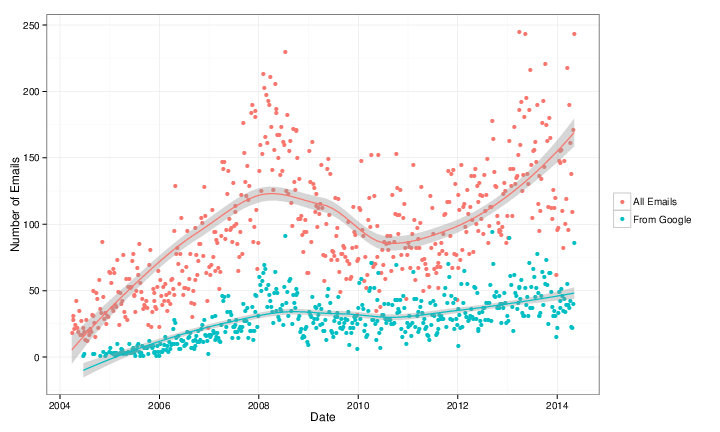
The following graph shows the numbers of emails in my personal inbox each week in red and the subset from Google in blue. Because the number of emails I receive week-to-week tends to vary quite a bit, I ve included a LOESS smoother which shows a moving average over several weeks.
From eyeballing the graph, the answer to seems to be that, although it varies, about a third of the email in my inbox comes from Google!
Keep in mind that this is all of my personal email and includes automatic and computer generated mail from banks and retailers, etc. Although it is true that Google doesn t have these messages, it suggests that the proportion of my truly personal email that comes via Google is probably much higher.
I would also like to know how much of the email I send goes to Google. I can do this by looking at emails in my inbox that I have replied to. This works if I am willing to assume that if I reply to an email sent from Google, it ends up back at Google. In some ways, doing this addresses the problem with the emails from retailers and banks since I am very unlikely to reply to those emails. In this sense, it also reflects a measure of more truly personal email.
I ve broken down the proportions of emails I received that come from Google in the graph below for all email (top) and for emails I have replied to (bottom). In the graphs, the size of the dots represents the total number of emails counted to make that proportion. Once again, I ve included the LOESS moving average.
The answer is surprisingly large. Despite the fact that I spend hundreds of dollars a year and hours of work to host my own email server, Google has about half of my personal email! Last year, Google delivered 57% of the emails in my inbox that I replied to. They have delivered more than a third of all the email I ve replied to every year since 2006 and more than half since 2010. On the upside, there is some indication that the proportion is going down. So far this year, only 51% of the emails I ve replied to arrived from Google.
The numbers are higher than I imagined and reflect somewhat depressing news. They show how it s complicated to think about privacy and autonomy for communication between parties. I m not sure what to do except encourage others to consider, in the wake of the Snowden revelations and everything else, whether you really want Google to have all your email. And half of mine.
If you want to run the analysis on your own, you re welcome to the Python and R code I used to produce the numbers and graphs.
Oracle won their appeal regarding whether APIs are copyrightable. There'll be ongoing argument about whether Google's use of those APIs is fair use or not, and perhaps an appeal to the Supreme Court, but that's the new status quo. This will doubtless result in arguments over whether Oracle's implementation of Linux APIs in Solaris 10 was a violation of copyright or not (and presumably Google are currently checking whether they own any code that Oracle reimplemented), but that's not what I'm going to talk about today.
Oracle own some code called DTrace (Wikipedia has a good overview here - what it actually does isn't especially relevant) that was originally written as part of Solaris. When Solaris was released under the CDDL, so was DTrace. The CDDL is a file-level copyleft license with some restrictions not present in the GPL - as a result, combining GPLed code with CDDLed code will (in the absence of additional permission grants) result in a work that is under an inconsistent license and cannot legally be distributed.
Oracle wanted to make DTrace available for Linux as part of their Unbreakable Linux product. Integrating it directly into the kernel would obviously cause legal issues, so instead they implemented it as a kernel module. The copyright status of kernel modules is somewhat unclear. The GPL covers derivative works, but the definition of derivative works is a function of copyright law and judges. Making use of explicitly exported API may not be sufficient to constitute a derivative work - on the other hand, it might. This is largely untested in court. Oracle appear to believe that they're legitimate, and so have added just enough in-kernel code (and GPLed) to support DTrace, while keeping the CDDLed core of DTrace separate.
The kernel actually has two levels of exposed (non-userspace) API - those exported via EXPORT_SYMBOL() and those exported via EXPORT_SYMBOL_GPL(). Symbols exported via EXPORT_SYMBOL_GPL() may only be used by modules that claim to be GPLed, with the kernel refusing to load them otherwise. There is no technical limitation on the use of symbols exported via EXPORT_SYMBOL().
(Aside: this should not be interpreted as meaning that modules that only use symbols exported via EXPORT_SYMBOL() will not be considered derivative works. Anything exported via EXPORT_SYMBOL_GPL() is considered by the author to be so fundamental to the kernel that using it would be impossible without creating a derivative work. Using something exported via EXPORT_SYMBOL() may result in the creation of a derivative work. Consult lawyers before attempting to release a non-GPLed Linux kernel module)
DTrace integrates very tightly with the host kernel, and one of the things it needs access to is a high-resolution timer that is guaranteed to monotonically increase. Linux provides one in the form of ktime_get(). Unfortunately for Oracle, ktime_get() is only exported via EXPORT_SYMBOL_GPL(). Attempting to call it directly from the DTrace module would fail.
Oracle work around this in their (GPLed) kernel abstraction code. A function called dtrace_gethrtimer() simply returns the value of ktime_get(). dtrace_gethrtimer() is exported via EXPORT_SYMBOL() and therefore can be called from the DTrace module.
So, in the face of a technical mechanism designed to enforce the author's beliefs about the copyright status of callers of this function, Oracle deliberately circumvent that technical mechanism by simply re-exporting the same function under a new name. It should be emphasised that calling an EXPORT_SYMBOL_GPL() function does not inherently cause the caller to become a derivative work of the kernel - it only represents the original author's opinion of whether it would. You'd still need a court case to find out for sure. But if it turns out that the use of ktime_get() does cause a work to become derivative, Oracle would find it fairly difficult to argue that their infringement was accidental.
Of course, as copyright holders of DTrace, Oracle could solve the problem by dual-licensing DTrace under the GPL as well as the CDDL. The fact that they haven't implies that they think there's enough value in keeping it under an incompatible license to risk losing a copyright infringement suit. This might be just the kind of recklessness that Oracle accused Google of back in their last case.
Crowdsourcing ventures with disruptive business models are a regular point of contention these days.
In London, taxi drivers are threatening to create gridlock as part of an anti-Uber protest. In Melbourne, Uber drivers have been issued with $1,700 fines for operating without a taxi license. San Francisco city officials, despite being the birthplace of many of these ventures, are debating whether AirBNB should be regulated.
An orderly society or an old-school protection racket?
Just what exactly is it that established players in these industries are trying to achieve through their protests and lobbying efforts?
In the case of apartment rentals, many people have sympathy for respecting the wishes of neighbourhoods over those of individual landlords. In the case of car pooling schemes, the arguments tend to come not from motorists at large but from those who are afraid of competition.
Without competition, could things be any worse?
Melbourne actually provides the perfect backdrop for this debate. Only a couple of years before Uber came on the scene, the government had made a detailed study into the taxi industry. One of Australia's most prominent economic experts, a former chairman of the Australian Competition and Consumer Commission spent 18 months studying the industry.
One of the highlights of the incumbent system (and the reason I suggest Melbourne is the perfect backdrop for this debate) is the way licenses are issued to taxi drivers. There are a fixed number of licenses issued by the government. The licenses are traded on the open market so prices can go up and down just like real-estate. Under the rules of Australia's pension scheme, people have even been able to use money from their pension fund to purchase a taxi license as an investment. It goes without saying that this has helped rampant speculation and the price of a license is now comparable to the price of a house.
The end result is that no real taxi driver can afford a license: most of them have to rent their license from one of the speculators who bought the license. These fixed rental fees have to be paid every month whether the driver uses their car or not. Consequently, taxi drivers have cut back on other expenses, they are often criticised for failing to keep their cars clean and the industry as a whole is criticised due to the poor quality of drivers who don't even know their way around the city. The reason, of course, is simple: by the time some newly arrived immigrant has learnt his way around Melbourne he has also figured out that the economics of driving a taxi are not in his favor. Realizing there is no way to break even, they take other jobs instead.
It was originally speculated that the government review would dramatically reduce or abolish these speculative practices but ultimately lower license charges have only been used for the issue of 60 new licenses, barely 1% of the taxi fleet in the city today. Furthermore, the new licenses were only available to existing players in the industry.
Uber to the rescue?
Uber drove into the perfect storm as they launched their service in Melbourne in 2013.
Uber drivers get a significant benefit over their competitors in traditional taxis. In particular, as they don't have the fixed monthly payment to rent a taxi license, they don't have to work every day and can even take holidays or take time to clean the cars. These things may simultaneously benefit road safety and passenger comfort.
Meanwhile, those people who speculated on the old taxi licenses have tried hunger strikes and all kinds of other desperate tactics to defer the inevitable loss of their "investment".
The reality is that crowdsourcing is here to stay. Even if Uber is stopped by bullying and intimidation, the inefficiency of Melbourne's taxi system is plain for all to see and both customers and drivers will continue looking for alternatives. Other car-pooling apps based on barter or cost sharing will continue to find ways to operate even if the Uber model is prohibited.
It is interesting to note that the last great reform of Melbourne taxis, under Premier Jeff Kennett in the 1990s, simply resulted in a change of paint with the aim of making them look like those in New York City. Disruptive services like Uber (with their numerous technology-powered innovations to save time and money) appear to be doing far more to improve the lives of passengers and drivers.
The hidden cost
That said, large scale schemes like Uber do also have a down side for customer privacy. Hailing cabs in the street leaves no records of your movements. This new model, however, is leaving a very detailed trail of breadcrumbs that can be used for both marketing purposes or extracted (lawfully or otherwise) by some third party who wishes to monitor a particular customer's past or future movements. This is the trade-off that arises when we benefit from the efficiencies of any cloud-based service.
The DC15 team met Saturday at the Heidelberg
International Youth Hostel to kick
off the organisation of DebConf15. While a handful of team members
unfortunately had to excuse themselves, 18 people showed up, and the spirit
level was high.
Self-contained in beautiful surroundings
The youth hostel is the expected venue for DebConf15, which is slated to take
place in August 2015. It sleeps more than 400 people, and it features two large
conference rooms. Several smaller rooms can be used for team meetings and
impromptu birds-of-a-feather sessions.
The venue is located
a little bit outside of Heidelberg s centre, right on the side of the
Neckar river, north of the Heidelberg Zoo, west of a university
campus, and south of a sports field.
Fantastic, child-friendly DebConf venue
The large cafeteria and the plentiful outside space usable for eating, working,
chatting and playing make it a fantastic venue for DebConf. And far away from
traffic, with a play area, space to run around, and the zoo next door, it s
very suitable to families with children, too.
Become part of the team!
If you are interested in being part of the organisation of our conference, we
welcome you on our mailing
list and look forward to your contributions! There is also the
#debconf15-germany IRC channel on irc.debian.org, and we
have a list of DC15
sub-teams to give you an overview. Feel free to add yourself, or just help
out and someone will add you.
(Photos by Michael Banck and Richard Hartmann, used under the terms of the CC
by-sa licence 3.0)
Debian has recently received a donation of 8 build machines from Marvell. The new machines come with Quad core MV78460 Armada XP CPU's, DDR3 DIMM slot so we can plug in more memory, and speedy sata ports. They replace the well served Marvell MV78200 based builders - ones that have been building debian armel since 2009. We are planning a more detailed announcement, but I'll provide a quick summary: The speed increase provided by MV78460 can viewed by comparing build times on selected builds since early april: Qemu build times. We can now build Qemu in 2h instead of 16h -8x faster than before! Certainly a substantial improvement, so impressive kit from Marvell! But not all packages gain this amount of speedup: webkitgtk build times. This example, webkitgtk, builds barely 3x faster. The explanation is found from debian/rules of webkitgkt:
# Parallel builds are unstable, see #714072 and #722520
# ifneq (,$(filter parallel=%,$(DEB_BUILD_OPTIONS)))
#   NUMJOBS = $(patsubst parallel=%,%,$(filter parallel=%,$(DEB_BUILD_OPTIONS)))
#   MAKEARGUMENTS += -j$(NUMJOBS)
# endif
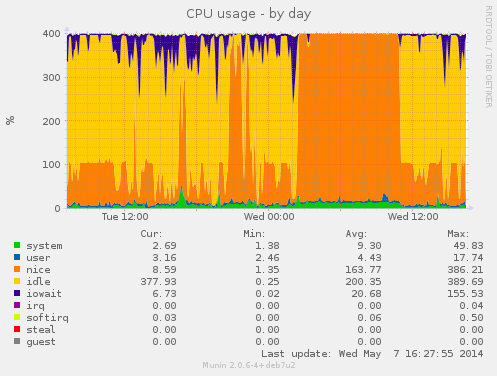
The old builders are single-core[1], so the regardless of parallel building, you can easily max out the cpu. New builders will use only 1 of 4 cores without parallel build support in debian/rules. During this buildd cpu usage graph, we see most time only one CPU is consumed. So for fast package build times.. make sure your packages supports parallel building. For developers, abel.debian.org is porter machine with Armada XP. It has schroot's for both armel and armhf. set "DEB_BUILD_OPTIONS=parallel=4" and off you go. Finally I'd like to thank Thomas Petazzoni, Maen Suleiman, Hector Oron, Steve McIntyre, Adam Conrad and Jon Ward for making the upgrade happen. Meanwhile, we have unrelated trouble - a bunch of disks have broken within a few days apart. I take the warranty just run out... [1] only from Linux's point of view. - mv78200 has actually 2 cores, just not SMP or coherent. You could run an RTOS on the other core while you run Linux on the other.
As promised, today I would like to write a bit about the making of
The Hacker's Guide to Python. It has
been a very interesting experimentation, and I think it is worth sharing it
with you.
The inspiration
All started out at the beginning of August 2013. I was spending my summer,
as the rest of the year, hacking on OpenStack.
As years passed, I got more and more deeply involved in the various tools
that we either built or contributed to within the OpenStack community. And I
somehow got the feeling that my experience with Python, the way we used it
inside OpenStack and other applications during these last years was worth
sharing. Worth writing something bigger than a few blog posts.
The OpenStack project is doing code reviews, and therefore so did I for
almost two years. That inspired a lot of topics, like
the definitive guide to method decorators
that I wrote at the time I started the hacker's guide. Stumbling upon the
same mistakes or misunderstanding over and over is, somehow, inspiring.
I also stumbled upon Nathan Barry's blog and book
Authority which were very helpful to
get started and some sort of guideline.
All of that brought me enough ideas to start writing a book about Python
software development for people already familiar with the language.
The writing
The first thing I started to do is to list all the topics I wanted to write
about. The list turned out to have subjects that had no direct interest for
a practical guide. For example, on one hand, very few developers know in
details how metaclasses work, but on the other hand, I never had to write a
metaclass during these last years. That's the kind of subject I decided not
to write about, dropped all subjects that I felt were not going to help my
reader to be more productive. Even if they could be technically interesting.
Then, I gathered all problems I saw during the code reviews I did during
these last two years. Some of them I only recalled in the days following the
beginning of that project. But I kept adding them to the table of contents,
reorganizing stuff as needed.
After a couple of weeks, I had a pretty good overview of the contents that
there I will write about. All I had to do was to fill in the blank (that
sounds so simple now).
The entire writing of the took hundred hours spread from August to November,
during my spare time. I had to stop all my other side projects for that.
The interviews
While writing the book, I tried to parallelize every thing I could. That
included asking people for interviews to be included in the book. I already
had a pretty good list of the people I wanted to feature in the book, so I
took some time as soon as possible to ask them, and send them detailed
questions.
I discovered two categories of interviewees. Some of them were very fast to
answer ( 1 week), and others were much, much slower. A couple of them even
set up Git repositories to answer the questions, because that probably
looked like an entire project to them. :-) So I had to not lose sight and
kindly ask from time to time if everything was alright, and at some point
started to kindly set some deadline.
In the end, the quality of the answers was awesome, and I like to think that
was because I picked the right people!
The proof-reading
Once the book was finished, I somehow needed to have people proof-reading
it. This was probably the hardest part of this experiment. I needed two
different types of reviews: technical reviews, to check that the content was
correct and interesting, and language review. That one is even more
important since English is not my native language.
Finding technical reviewers seemed easy at first, as I had ton of contacts
that I identified as being able to review the book. I started by asking a
few people if they would be comfortable reading a simple chapter and giving
me feedbacks. I started to do that in September: having the writing and the
reviews done in parallel was important to me in order to minimize latency
and the book's release delay.
All people I contacted answered positively that they would be interested in
doing a technical review of a chapter. So I started to send chapters to
them. But in the end, only 20% replied back. And even after that, a large
portion stopped reviewing after a couple of chapters.
Don't get me wrong: you can't be mad at people not wanting to spend their
spare time in book edition like you do.
However, from the few people that gave their time to review a few chapters,
I got tremendous feedback, at all level. That's something that was very
important and that helped a lot getting confident. Writing a book alone for
months without having anyone taking a look upon your shoulder can make you
doubt that you are creating something worth it.
As far as English proof-reading, I went ahead and used
ODesk to recruit a professional proof-reader. I looked
for people with the right skills: a good English level (being a native
English speaker at least), be able to understand what the book was about,
and being able to work with correct delays. I had mixed results from the
people I hired, but I guess that's normal. The only error I made was not to
parallelize those reviews enough, so I probably lost a couple of months on
that.
The toolchain
While writing the book, I did a few breaks to build a toolchain. What I call
a toolchain is set of tools used to render the final PDF, EPUB and MOBI
files of the guide.
After some research, I decided to settle on
AsciiDoc, using the
DocBook output, which is then being transformed to
LaTeX, and then to PDF, or either to EPUB directly. I realy on
Calibre to convert the EPUB file to MOBI. It
took me a few hours to do what I wanted, using some magic LaTeX tricks to
have a proper render, but it was worth it and I'm particularly happy with
the result.
For the cover design, I asked my talented friend
Nicolas to do something for me, and he
designed the wonderful cover and its little snake!
The publishing
Publishing in an interesting topic people kept asking me about. This is what
I had to answer a few dozens of time:
"Who is your editor?"
"Me."
I never had any plan for asking an editor to publish this book. Nowadays,
asking an editor to publish a book feels to me like asking a major company
to publish a CD. It feels awkward.
However, don't get me wrong: there can be a few upsides of having an editor.
They will find reviewers and review your book for you. Having the book
review handled for you is probably a very good thing, considering how it was
hard to me to get that in place. It can be especially important for a
technical book.
Also, your book may end up in brick and mortar stores and be part of a
collection, both improving visibility. That may improve your book's selling,
though the editor and all the intermediaries are going to keep the largest
amount of the money anyway.
"Oh, you will publish it yourself, great. So you will print it and sell it
to people?"
"Not really."
I've heard good stories about people using Gumroad to
sell electronic contents, so after looking for competitors in that market, I
picked them. I also had the idea to sell the book with Bitcoins, so I
settled on Coinbase, because they have a nice API to
do that.
Setting up everything was quite straight-forward, especially with Gumroad.
It only took me a few hours to do so. Writing the Coinbase application took
a few hours too.
"Oh, you will sell it only as an ebook? That's too bad. You need a paper
version. Many people will want a paper version."
My initial plan was to only sell online an electronic version. On the other
hand, since I kept hearing that a printed version should exist, I decided to
give it a try. I chose to work with Lulu because I knew
people using it, and it was pretty simple to set up.
The launch
Once I had everything ready, I built the selling page and connected
everything between Mailchimp, Gumroad, Coinbase, Google Analytics, etc.
Writing the launch email was really exciting. I used Mailchimp feature to
send the launch mail in several batches, just to have some margin in case of
a sudden last minute problem. But everything went fine. Hurrah!
I distributed around 200 copies of the ebook in the first 48 hours, for
about $5000. That covered all the cost I had from the writing the book, and
even more, so I was already pretty happy with the launch.
Retrospective
In retrospect, something that I didn't do the best way possible is probably
to build a solid mailing list of people interested, and to build an
important anticipation and incentive to buy the book at launch date. My
mailing list counted around 1500 people subscribed because they were
interested in the launch of the book subscribed; in the end, probably only
10-15% of them bought the book during the launch, which is probably a bit
lower than what I could expect.
But more than a month later, I distributed in total almost 500 copies of the
book (including physical units) for more than $10000, so I tend to think
that this was a success. I still sell a few copies of the book each weeks,
but the number are small compared to the launch.
I sold less than 10 copies of the ebook using Bitcoins, and I admit I'm a
bit disappointed and surprised about that.
Physical copies represent 10% of the book distribution. It's probably a lot
lower than most people that pushed me to do it thought it would be. But it
is still higher of what I thought it would be. So I still would advise to
have a paperback version of your book. At least because it's nice to have it
in your library.
I only got positive feedbacks, a few typo notices, and absolutely no refund
demand, which I really find amazing.
The good news is also that I've been contacted with a couple of Korean and
Chinese editors to get the book translated and published in those countries.
If everything goes well, the book should be translated in the upcoming
months and be available on these markets in 2015!
If you didn't get a copy,
it's still time to do so!
I have been looking for an App like this since I got my first iOS device in
december 2011. Finally, it is here! A single-player (bot-driven) poker
app for iOS, THETA Poker Pro, fully accessible and usable with VoiceOver.
AppleVis has a review.
It doesn't happen very often, but App programmers in the iOS Universe
do indeed sometimes think about Accessibility support, and the APIs
provided by Apple are useful enough to allow programmers to write
very accessible apps. You can say about Apple whatever you want,
currently, it is the company providing the best accessibility support on the market.
Why? Because they made accessibility a first-class citizen of their platform(s).
This is where policy helps. If you can dictate top-down that
you support people with disabilities, things actually
start to happen. If you have to ask, hope, and wait, like it is with
free software, things do not really progress as fast as the users need it.
Back to THETA Poker Pro: The default configuration is already very useable with VoiceOver.
However, if you want the cards placed on the board announced to you, so that
you do not have to discover them manually by touch, you can enable the
"Card Announcement" item in the Options menu. You can also set message delay
a bit slower, such that all messages are actually fully spoken and not cut off sometimes.
With these two settings adjusted, and maybe "Animation" set to "Very fast",
the game feels extremely nice. There is actually nothing I would
want to change, which does not happen very often when I test
a program for its accessibility.
With these settings changed, game play is very smooth with VoiceOver, you basically
just have to tap your cards to check, tap the deck to fold, or tap
your chips to raise. Very simple, and these three "buttons" are on
the bottom of the screen, so rather easy and quick to find.
All other activity is automatically announced by VoiceOver.
I have played a few hundred hands already with this App. It is a wonderful
way to pass time. For instance, I don't like to go to my
doctor, because I usually wait up to two or three hours. I had to pay
her a visit on monday. While waiting, I played "a few" hands, and
suddenly, I was already called in. When I came out again, I checked the
time and was rather surprised that yes, I have waited two hours again,
but this time, I didn't notice! :-)
Special thanks go to the author(s) of this app.
It is a good example of an App that was not specially made for the blind,
but which feels like it was. Thanks, you've made my week!
A small rant
OTOH, it makes me sad when I think about my beloved Linux platform and GUI accessibility.
We are stuck since 2004 with a bit of desktop support + a half-working
Firefox. During the D-Bus rewrite, quality of GUI accessibility
has dropped so much that I had to take time off from linux
gui accessibility to stay sane. It is back to where it was in 2006, yay,
but we haven't made a lot of real progress in the last 8 years.
Granted, firefox has improved, but to my taste, not enough.
I still do all my email, shell work, programming and some other things on Linux of course,
but I notice that I do more and more casual stuff
on iOS, it is just sooo much more useable. I do almost all my
surfing with mobile safari, because it just works. Firefox works sometimes, and
some other times working with it feels so slow that I am actually getting
angry.
The scratch-your-own-itch philosophy combined with a very small margin group is
poison for success. We'd need much more funding, and people working
actively on this stuff as their day job, if we ever want to
be competitive with existing solutions.
The recent flurry of activity with neovim have made me wonder if there could be something similar for the other editor, emacs.
If you poke around recent GNU Emacs releases you'll come across random signs that the code carries a lot of baggage:
/usr/share/emacs/23.4/etc/MACHINES
There are special considerations for a variety of this system which
is known as the Yellow Dog [GNU/]Linux'
Yellow Dog [GNU/]Linux has been dead for many years now.
/etc/emacs/site-start.d/50dictionaries-common.el
Contains references to skipping stuff that runs under Emacs 19, 20, 21, & 22.
None of these are huge things, and the core code of Emacs is a pleasure to read in many places, but it does make you think, or not, whichever the case may be it is all good :)
(I do all "real work" in emacs. I write all outgoing emails in vim, and use it for git/mercurial commit messsages, otherwise the only time I use it is for random one-line edits over slow links.)
A new release 4.300 of Armadillo, the templated C++
library for linear algebra, was released by Conrad a few days ago.
As usual, this was rolled up in a new
RcppArmadillo
release 0.4.300.0 which is now on CRAN and in
Debian.
This release brings nice new upstream changes such as faster
find() as well as corresponding functions to find elements which
are either finite or non-finite, based on a suggestion we made. This may
need an RcppArmadillo specific
extension as R extends the IEEE logic to supported NA,
NaN and Inf on floating point variables whereas
standard C++ (and hence Armadillo)
only supports the latter two. We hope to work on this shortly.
Kevin also put in some code to make sure unsigned int vectors
and matrices are converted correctly, and I updated the short configure
script checking for complete LAPACK support to account for the R 3.0.3 or
later case.
Changes in RcppArmadillo version 0.4.300.0 (2014-05-04)
Upgraded to Armadillo release Version 4.300 (Medieval Cornea Scraper)
faster find()
added find_finite() and find_nonfinite() for finding indices of finite and non-finite elements
expressions X=inv(A)*B*C and X=A.i()*B*C are automatically converted to X=solve(A,B*C)
Corrected conversion to unsigned int vectors and matrices
Configure script now checks for R version 3.0.3 or newer to enable complex divide-and-conquer SVD in case of R-supplied LAPACK
I was invited to give a talk at a local conference, OS-UPIITA. I have been invited to this conference before, and will gladly be there again. But I was recently pointed at the invitation poster they are distributing (which I reproduce here for your convenience) And I must make a couple of corrections here:
First and foremost: I don't want to trick anybody. I am not the Director of Debian Mexico. In fact, Debian Mexico does not exist. I am just a humble Debian Developer.
I accept the conference title, because that's what they requested from me. I'm trying to come up with a coherent exposition, but whoever knows me must be perfectly aware that I don't know (nor really care about) how to make money with Free Software. I have lived all of my professional life thanks to Free Software, but I'm against the entrepenurial culture. I will talk about my vision, of course, so if you want to hear me rant, you are invited to join us ;-)
I specifically asked the organizing committee by mid-April, when they gave me the talk title, to replace "Open Source" with "Free Software" in my talk. Even though the conference is called "OS UPIITA" (as it is the Open Source conference in the UPIITA unit of Instituto Polit cnico Nacional), I cannot identify with the Open Source monkier. And if we are talking about a deeply ideological issue, which is the case here, I request to use the name I can relate with. For my talk only, of course.
</rant>
But anyway, I will be very happy to be there, and believe me, am working to come up with a good talk.
OS-UPIITA friends: Please correct your online banners carrying this wrong data.
[update] OS-UPIITA changed the poster! I'm just keeping this one for the memory ;-)
[update 2] I was there, and gave the talk. And it was even a success, yay! \o/ Care to see it? Here is the presented material.
 This is the second post in a series of posts describing a secure alternative to applications like WhatsApp. I started with the following statement:
 I wrote my own
 Today I released version 0.25 of my


 Recently I've been seeing lot of posts about DNSSEC on Internet and I
thought I should configure my domain to be secured by DNSSEC.
copyninja.info domain is now secured with DNSSEC you can verify
this by
 Oracle has demonstrated that implementing an API is effectively the same as copying code from a program. To me, as a non-lawyer programmer, this surprising court decision seems to mutate copyrights into a kind of Software-Patent-Lite(tm) without the benefit of examiners or a 15 year term limit. This seems like a chilling new tool for deep pockets companies like Oracle to go about tormenting people. Thinking more deeply, however, you begin to wonder if Oracle hasn t inadvertently created some kind of Free Software Doomsday weapon.
After all, if simply implementing an API makes you code a derivative work then doesn t that mean the terms of the GPL will apply on any code that implements the API of a GPL d system? Even if you didn t copy code you have implemented that API and according to Oracle that s a derived work. If you ask me, its the most excitingly vauge and contagious information phenomena since the Open Data Base License.
 I had a really productive day today actually working on Debian, as planned
for my Mondays.
I'm still working through my list of packages, trying to get them all
vaguely up to date for jessie. It's mostly just addressing Lintian issues
that mostly revolve around old standards versions, with the occasional new
upstream release. I've also been doing bug triage where the bugs aren't
overwhelming.
Today I made uploads for pssh (a new upstream release),
pymetrics (mostly
just a rebuild), rcs-blame (mostly just a rebuild) and
simpleproxy (mostly
just a rebuild).
I need to revisit simpleproxy, because I'm having problems convincing the
resulting binary to be linked correctly for relro. It's weird, because I'm
doing everything I'm supposed to be doing and I can see all the other
hardening flags being passed in except for this one.
I really like simplifying down debian/rules using dh,
that really makes things readable. You can see the useful stuff without
losing it in all the boilerplate. For some reason I was never a fan of CDBS,
but I'm quite liking dh. I think it's because it's less opaque than
CDBS.


 Oracle

 The end result is that no real taxi driver can afford a license: most of them have to rent their license from one of the speculators who bought the license. These fixed rental fees have to be paid every month whether the driver uses their car or not. Consequently, taxi drivers have cut back on other expenses, they are often criticised for failing to keep their cars clean and the industry as a whole is criticised due to the poor quality of drivers who don't even know their way around the city. The reason, of course, is simple: by the time some newly arrived immigrant has learnt his way around Melbourne he has also figured out that the economics of driving a taxi are not in his favor. Realizing there is no way to break even, they take other jobs instead.
It was originally speculated that the government review





 Debian has recently received a donation of 8 build machines from Marvell. The new machines come with


 During this buildd cpu usage graph, we see most time only one CPU is consumed. So for fast package build times.. make sure your packages supports parallel building. For developers, abel.debian.org is porter machine with Armada XP. It has schroot's for both armel and armhf. set "DEB_BUILD_OPTIONS=parallel=4" and off you go. Finally I'd like to thank Thomas Petazzoni, Maen Suleiman, Hector Oron, Steve McIntyre, Adam Conrad and Jon Ward for making the upgrade happen. Meanwhile, we have unrelated trouble - a bunch of disks have broken within a few days apart. I take the warranty just run out... [1] only from Linux's point of view. - mv78200 has actually 2 cores, just not SMP or coherent. You could run an RTOS on the other core while you run Linux on the other.
 As promised, today I would like to write a bit about the making of


 I have been looking for an App like this since I got my first iOS device in
december 2011. Finally, it is here! A single-player (bot-driven) poker
app for iOS,
 A new release 4.300 of

 I was invited to give a talk at a local conference, OS-UPIITA. I have been invited to this conference before, and will gladly be there again. But I was recently pointed at the invitation poster they are distributing (which I reproduce here for your convenience) And I must make a couple of corrections here: