Sporting a beautiful 10.1 1920x1200 display, the Lenovo IdeaPad Duet
Chromebook or Duet Chromebook, is one of the latest Chromebooks released,
and one of the few slate-style tablets, and it s only about 300 EUR (300 USD).
I ve had one for about 2 weeks now, and here are my thoughts.
Build & Accessories
The tablet is a fairly Pixel-style affair, in that the back has two components,
one softer blue one housing the camera and a metal feeling gray one. Build quality
is fairly good.
The volume and power buttons are located on the right side of the tablet, and
this is one of the main issues: You end up accidentally pressing the power button
when you want to turn your volume lower, despite the power button having a different
texture.
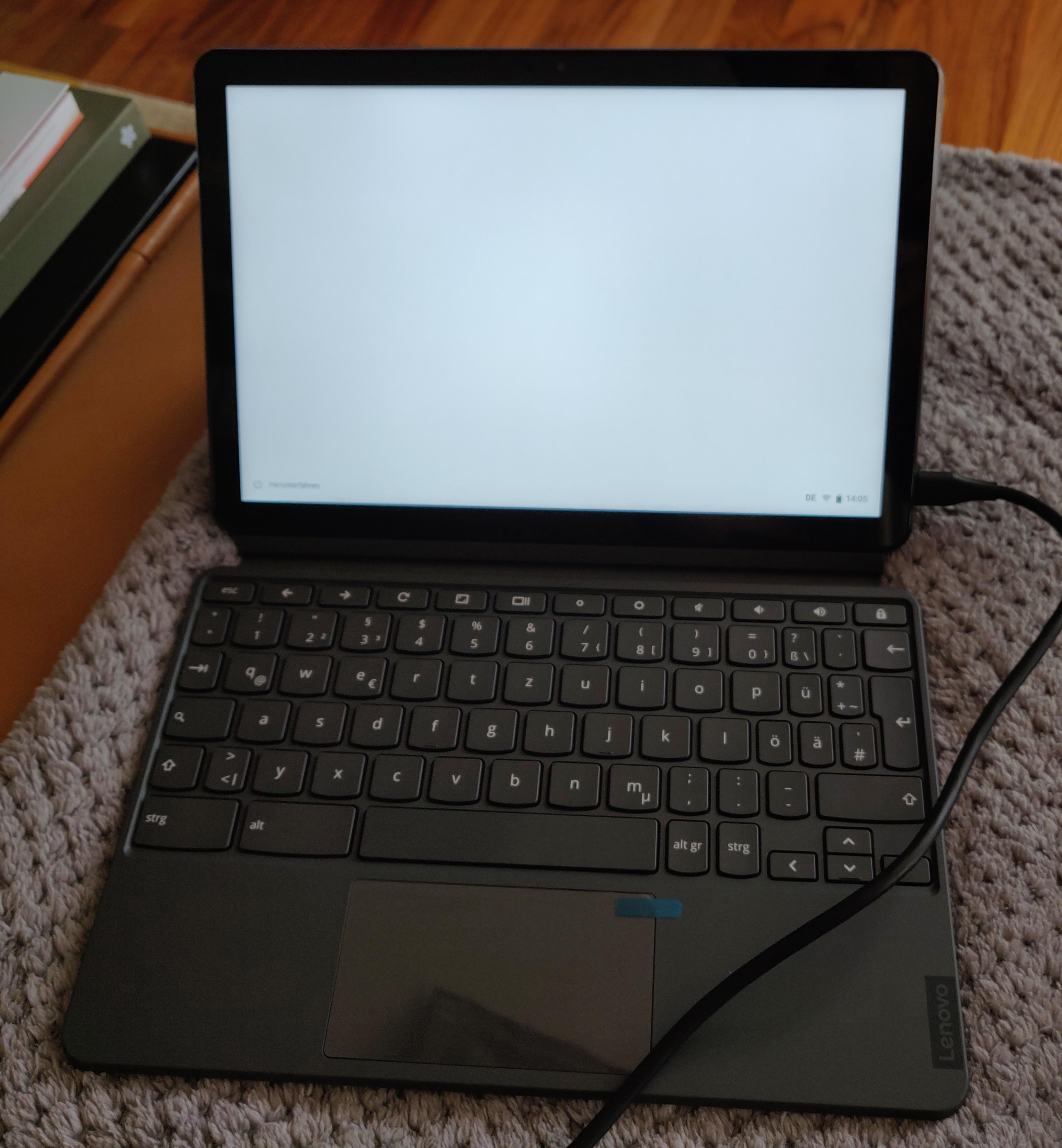
Alongside the tablet, you also find a kickstand with a textile back, and a
keyboard, both of which attach via magnets (and pogo pins for the keyboard).
The keyboard is crammed, with punctuation keys being halfed in size, and it
feels mushed compared to my usual experiences of ThinkPads and Model Ms, but
it s on par with other Chromebooks, which is surprising, given it s a tablet
attachment.
fully assembled chromebook duet
I mostly use the Duet as a tablet, and only attach the keyboard occasionally.
Typing with the keyboard on your lap is suboptimal.
My first Duet had a few bunches of dead pixels, so I returned it, as I had
a second one I could not cancel ordered as well. Oh dear. That one was fine!
Hardware & Connectivity
The Chromebook Duet is powered by a Mediatek Helio P60T SoC, 4GB of RAM,
and a choice of 64 or 128 GB of main storage.
The tablet provides one USB-C port for charging, audio output (a 3.5mm adapter
is provided in the box), USB hub, and video output; though, sadly, the latter
is restricted to a maximum of 1080p30, or 1440x900 at 60 Hz. It can be charged
using the included 10W charger, or use up to I believe 18W from a higher powered
USB-C PD charger. I ve successfully used the Chromebook with a USB-C monitor
with attached keyboard, mouse, and DAC without any issues.
On the wireless side, the tablet provides 2x2 Wifi AC and Bluetooth 4.2. WiFi
reception seemed just fine, though I have not done any speed testing, missing
a sensible connection at the moment. I used Bluetooth to connect to my smartphone
for instant tethering, and my Sony WH1000XM2 headphones, both of which worked
without any issues.
The screen is a bright 400 nit display with excellent viewing angles,
and the speakers do a decent job, meaning you can use easily use this
for watching a movie when you re alone in a room and idling around. It has
a resolution of 1920x1200.
The device supports styluses following the USI standard. As of right now, the
only such stylus I know about is an HP one, and it costs about 70 or so.
Cameras are provided on the front and the rear, but produce terrible images.
Software: The tablet experience
The Chromebook Duet runs Chrome OS, and comes with access to Android apps
using the play store (and sideloading in dev mode) and access to full Linux
environments powered by LXD inside VMs.
The screen which has 1920x1200 is scaled to a ridiculous 1080x675 by default
which is good for being able to tap buttons and stuff, but provides next to no
content. Scaling it to 1350x844 makes things more balanced.
The Linux integration is buggy. Touches register in different places than where
they happened, and the screen is cut off in full screen extremetuxracer, making
it hard to recommend for such uses.
Android apps generally work fine. There are some issues with the back gesture
not registering, but otherwise I have not found issues I can remember.
One major drawback as a portable media consumption device is that Android apps
only work in Widevine level 3, and hence do not have access to HD content, and
the web apps of Netflix and co do not support downloading. Though one of the Duets
actually said L1 in check apps at some point (reported in issue 1090330).
It s also worth
noting that Amazon Prime Video only renders in HD, unless you change your
user agent to say you are Chrome on Windows - bad Amazon!
The tablet experience also lags in some other ways, as the palm rejection is
overly extreme, causing it to reject valid clicks close to the edge of the display
(reported in issue 1090326).
The on screen keyboard is terrible. It only does one language at a time, forcing
me to switch between German and English all the time, and does not behave as you d
expect it when editing existing words - it does not know about them and thinks
you are starting a new one. It does provide a small keyboard that you can
move around, as well as a draw your letters keyboard, which could come in
handy for stylus users, I guess. In any case, it s miles away from gboard on
Android.
Stability is a mixed bag right now. As of Chrome OS 83, sites (well only Disney+
so far ) sometimes get killed with SIGILL or SIGTRAP, and the device rebooted
on its own once or twice. Android apps that use the DRM sometimes do not start,
and the Netflix Android app sometimes reports it cannot connect to the servers.
Performance
Performance is decent to sluggish, with micro stuttering in a lot of places. The
Mediatek CPU is comparable to Intel Atoms, and with only 4GB of RAM, and an entire
Android container running, it s starting to show how weak it is.
I found that Google Docs worked perfectly fine, as did websites such as
Mastodon, Twitter, Facebook. Where the device really struggled was Reddit,
where closing or opening a post, or getting a reply box could take 5 seconds
or more. If you are looking for a Reddit browsing device, this is not for you.
Performance in Netflix was fine, and Disney+ was fairly slow but still usable.
All in all, it s acceptable, and given the price point and the build quality,
probably the compromise you d expect.
Summary
tl;dr:
good: Build quality, bright screen, low price, included accessories
The Chromebook Duet or IdeaPad Duet Chromebook is a decent tablet that is built
well above its price point. It s lackluster performance and DRM woes make it
hard to give a general recommendation, though. It s not a good laptop.
I can see this as the perfect note taking device for students, and as a
cheap tablet for couch surfing, or as your on-the-go laptop replacement,
if you need it only occasionally.
I cannot see anyone using this as their main laptop, although I guess some
people only have phones these days, so: what do I know?
I can see you getting this device if you want to tinker with Linux on ARM, as
Chromebooks are quite nice to tinker with, and a tablet is super nice.
Racism is a free software issue. I gave a talk that touched on this at CopyLeft Conf 2019. I also talked a little bit about it at All Things Open 2019 and FOSDEM 2020 in my talk The Ethics Behind Your IoT. I know statistics, theory, and free software. I don t know about race and racism nearly as well. I might make mistakes I have made some and I will make more. Please, when I do, help me do better.
I want to look at a few particular technologies and think about how they reinforce systemic racism. Worded another way: how is technology racist? How does technology hurt Black Indigenous People of Color (BIPOC)? How does technology keep us racist? How does technology make it easier to be racist?
Breathalyzers
In the United States, Latinx folks are less likely to drink than white people and, overall, less likely to be arrested for DUIs3,4. However, they are more likely to be stopped by police while driving5,6.
Who is being stopped by police is up to the police and they pull over a disproportionate number of Latinx drivers. After someone is pulled over for suspected drunk driving, they are given a breathalyzer test. Breathalyzers are so easy to (un)intentionally mis-calibrate that they have been banned as valid evidence in multiple states. The biases of the police are not canceled out by the technology that should, in theory, let us know whether someone is actually drunk.
Facial Recognition
I could talk about for quite some time and, in fact, have. So have others. Google s image recognition software recognized black people as gorillas and to fix the issue it removed gorillas from it s image-labeling technology.
Facial recognition software does a bad job at recognizing black people. In fact, it s also terrible at identifying indigenous people and other people of color. (Incidentally, it s also not great at recognizing women, but let s not talk about that right now.)
As we use facial recognition technology for more things, from automated store checkouts (even more relevant in the socially distanced age of Covid-19), airport ticketing, phone unlocking, police identification, and a number of other things, it becomes a bigger problem that this software cannot tell the difference between two Asian people.
Targeted Advertising
Black kids see 70% more online ads for food than white kids, and twice as many ads for junk food. In general BIPOC youth are more likely to see junk food advertisements online. This is intentional, and happens after they are identified as BIPOC youth.
Technology Reinforces Racism; Racism Builds Technology
The technology we have developed reinforces racism on a society wide scale because it makes it harder for BIPOC people to interact with this world that is run by computers and software. It s harder to not be racist when the technology around us is being used to perpetuate racist paradigms. For example, if a store implements facial recognition software for checkout, black women are less likely to be identified. They are then more likely to be targeted as trying to steal from the store. We are more likely to take this to mean that black women are more likely to steal. This is how technology builds racism,
People are being excluded largely because they are not building these technologies, because they are not welcome in our spaces. There simply are not enough Black and Hispanic technologists and that is a problem. We need to care about this because when software doesn t work for everyone, it doesn t work. We cannot build on the promise of free and open source software when we are excluding the majority of people.
Armadillo is a powerful and expressive C++ template library for linear algebra aiming towards a good balance between speed and ease of use with a syntax deliberately close to a Matlab. RcppArmadillo integrates this library with the R environment and language and is widely used by (currently) 727 other packages on CRAN.
Conrad recently released a new upstream version 9.900.1 of Armadillo which we packaged and tested as usual first as a release candidate build and then as the release. As usual, logs from reverse-depends runs are in the rcpp-logs repo.
Apart from the new upstream release, we updated Travis use, ornamented the README a little, and smoothed over a rough corner from the recent R 4.0.0 release. All changes in the new release are noted below.
Changes in RcppArmadillo version 0.9.900.1.0 (2020-06-08)
Upgraded to Armadillo release 9.900.1 (Nocturnal Misbehaviour)
faster solve() for under/over-determined systems
faster eig_gen() and eig_pair() for large matrices
expanded eig_gen() and eig_pair() to optionally provide left and right eigenvectors
Switch Travis CI testing to R 4.0.0, use bionic as base distro and test R 3.6.3 and 4.0.0 in a matrix (Dirk in #298).
Add two badges to README for indirect use and the CSDA paper.
Adapt RcppArmadillo.package.skeleton() to a change in R 4.0.0 affecting what it exports in NAMESPACE.
As announced in a few tweets leading up to it, I took the date of what would have been the annual R/Finance conference as an opportunity to hold the one-hour tutorial / workshop with introductory Rcpp material which I often present on the first morning preceding the conference as a self-organized webinar. The live-streaming worked actually reasonably well via obs to youtube (even though the comprehensive software by the latter complained at times about insufficient bitstream rates the joys of living with a (near) monopolistic broadband provider whom I should leave for fiber ). Apparently around seventy people connected to the stream which is more than we usually have in the seminar room at UIC for the R/Finance morning.
The recording is now available here, and has already been seen over 200 times:
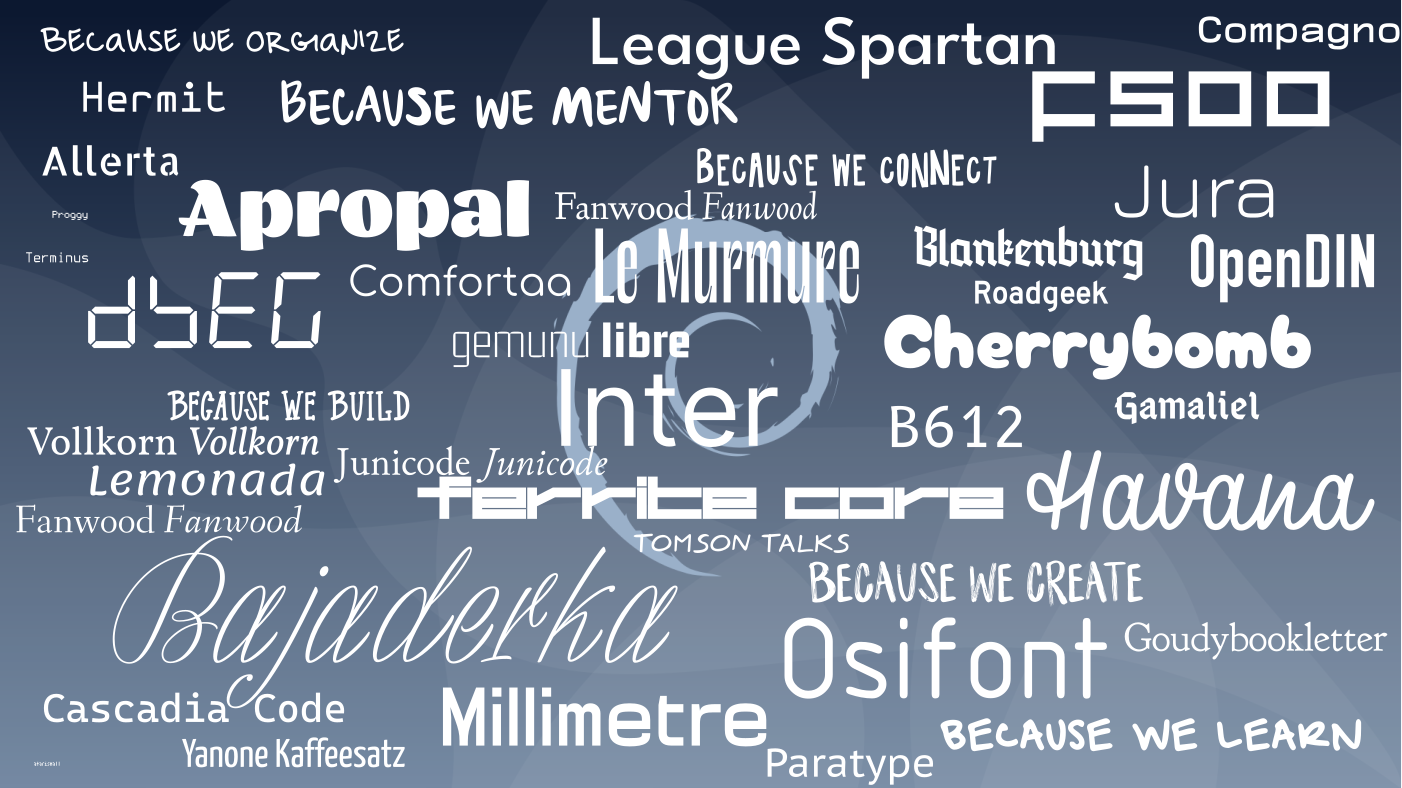
Debian comes with tons of fonts for all kinds of purposes,
you can easily list them all (almost) with: apt-cache search ^fonts-
Above you can see a nice composition with examples of several fonts.
The composition is published under the
MIT (Expat) license
and the source SVG (created with Inkscape) can be downloaded
here.
You will need the fonts to be installed in your system so the SVG is correctly rendered.
If you want to learn more you can have a look at the wiki page about fonts
(https://wiki.debian.org/Fonts),
and if you want to contribute or maintain fonts in Debian,
don't hesitate to join the Fonts Team!
This comic was based on this essay from Augusten Burroughs: How to live
unhappily ever after. In addition to the essay, I highly recommend
reading his books. It's also been described in psychology as flow.
Distributed teams are where people you work with aren t physically co-located, ie. they re at another office building, home or an outsourced company abroad. They re becoming increasingly popular, for DevOps and other teams, due to recruitment, diversity, flexibility and cost savings. Challenges arise due to timezones, language barriers, cultures and ways of working. People actively participating in Open Source communities tend to be effective in distributed teams. This session looks at how to apply core Open Source principles to distributed teams in Enterprise organisations, and the importance of shared purposes/goals, (mis)communication, leading vs managing teams, sharing and learning. We'll also look at practical aspects of what's worked well for others, such as alternatives to daily standups, promoting video conferencing, time management and virtual coffee breaks. This session is relevant for those leading or working in distributed teams, wanting to know how to cultivate an inclusive culture of increased trust and collaboration that leads to increased productivity and performance.
Another video in our T^4 series of video lightning talks with tips, tricks, tools, and toys (where we had seen the announcement, shells sessions one, two, and three, as well as one byobu session) is now up at YouTube. It goes a little deeper in the wonderful byobu and persistent sessions with multiple concurrent accesses illustrating why it is called both a text-based window manager and a terminal multiplexer :
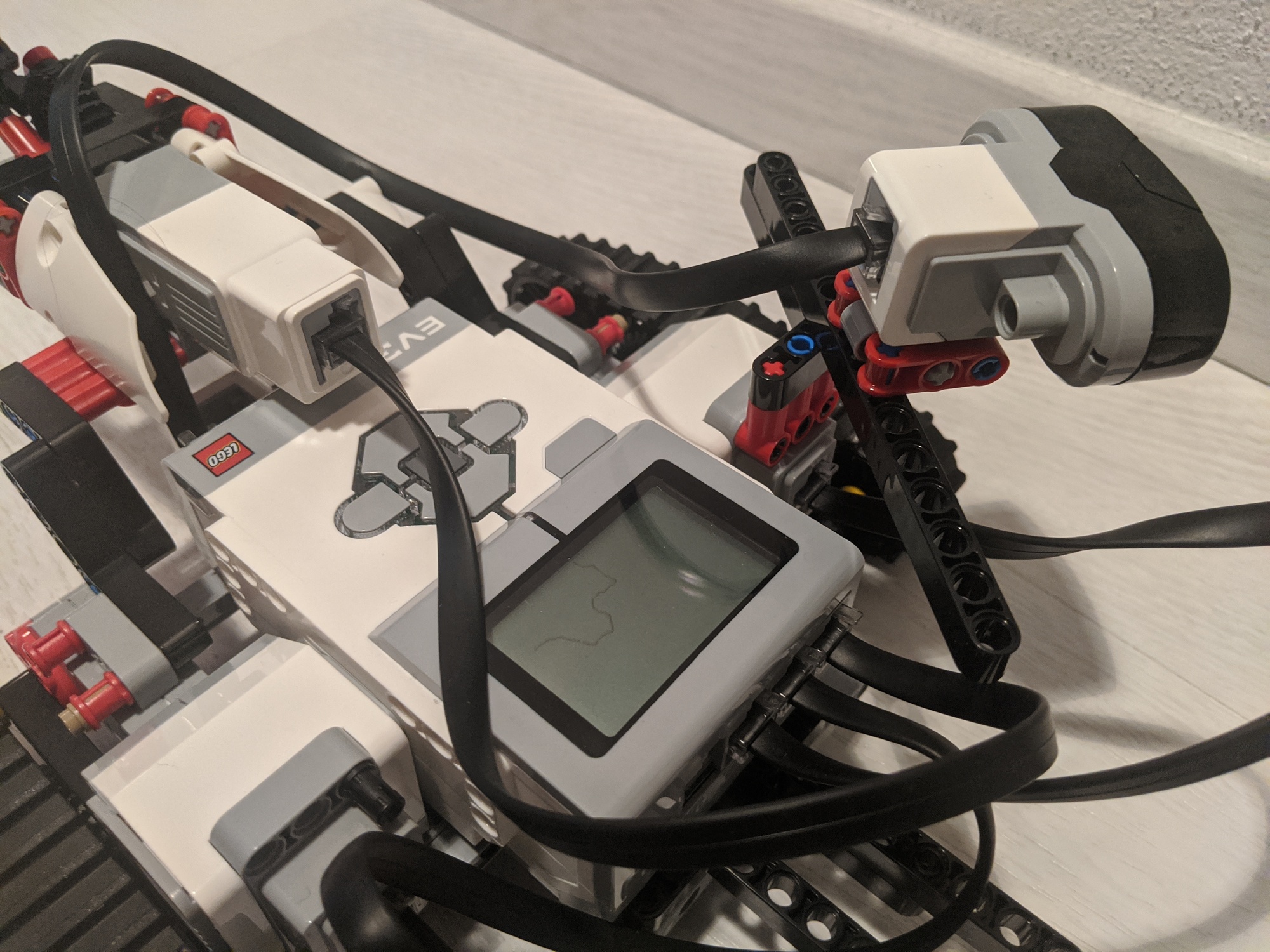
This weekend I had some pretty good uncle time. My eleven year old nephew (after beating me in a fair match of tennis) wanted to play with his Lego Mindstorms set. He never even touches it unless I am around to help him, but then he quiet enjoys. As expected, when I ask him what we should try to build, he tends to come up with completely unrealistic or impossible ideas, and we have to somehow reduce the scope to something doable.
This time round, inspired by their autonomous vacuum cleaner, he wanted to build something like that. That was convenient, because now I could sell him what I wanted to try to do, namely make the robot follow a wall at more or less constant distance, as a useful first step.
We mounted the infra red distance sensor at an 45 angle to the front-left, and then I built a very simple control loop measure the distance, subtract 40, apply a factor, and feed that into the steering input of the drive action, and repeat. I must admit that I was pretty proud to see just how well that very simple circuit worked: The little robot turned sharp corners in both directions, and otherwise drove nicely parallel and with constant distance to the wall.
I was satisfied with that achievement and would have happily ended it here before we might be disappointed by more ambitious and then failing goals.
But my nephew had not forgotten about the vacuum cleaner, and casually asked if I could make the robot draw an outline of its path, and thus of the room, on the display. Ok, where do I begin to explain just how unfeasible that is yes, it seemed one can draw to the display. But how should the robot know where it is? How far it turns? How far it went? This is programming by connecting boxes, and I would not expect such an interface to allow for complex logic (right?). And I would need trigonometry and stuff.
But he didn t quite believe it, and thus got me thinking indeed, the arithmetic block can evaluate more complex formulas, involving sin and cos so maybe if I can somehow keep track of where the robot is heading well, let s give it a try.
So by dragging boxes and connecting wires, I implemented a simple logic (three variables, x and y for current position, alpha for current heading; in each loop add the steering input onto alpha, and add (sin(alpha),cos(alpha)) onto the current position; throw in some linear factors to calibrate; draw pixel at (x, y)). And, to my nephew s joy and my astonishment, the robot was drawing a curvy line that clearly correlates with the taken path!
It wasn t respecting the angles perfectly, a square might not properly close, but half an hour earlier I would have actively bet against that we would pull this off!
After a few turns
I was, I must admit, a bit proud. But not only about the technical nerding, but also about my uncleing: That night, according to his parents, my nephew said that he can t remember ever being so happy!
As a member of the Norwegian Unix
User Group, I have the pleasure of receiving the
USENIX magazine
;login:
several times a year. I rarely have time to read all the articles,
but try to at least skim through them all as there is a lot of nice
knowledge passed on there. I even carry the latest issue with me most
of the time to try to get through all the articles when I have a few
spare minutes.
The other day I came across a nice article titled
"The
Secure Socket API: TLS as an Operating System Service" with a
marvellous idea I hope can make it all the way into the POSIX standard.
The idea is as simple as it is powerful. By introducing a new
socket() option IPPROTO_TLS to use TLS, and a system wide service to
handle setting up TLS connections, one both make it trivial to add TLS
support to any program currently using the POSIX socket API, and gain
system wide control over certificates, TLS versions and encryption
systems used. Instead of doing this:
int socket = socket(PF_INET, SOCK_STREAM, IPPROTO_TCP);
the program code would be doing this:
int socket = socket(PF_INET, SOCK_STREAM, IPPROTO_TLS);
According to the ;login: article, converting a C program to use TLS
would normally modify only 5-10 lines in the code, which is amazing
when compared to using for example the OpenSSL API.
The project has set up the
https://securesocketapi.org/
web site to spread the idea, and the code for a kernel module and the
associated system daemon is available from two github repositories:
ssa and
ssa-daemon.
Unfortunately there is no explicit license information with the code,
so its copyright status is unclear. A
request to solve
this about it has been unsolved since 2018-08-17.
I love the idea of extending socket() to gain TLS support, and
understand why it is an advantage to implement this as a kernel module
and system wide service daemon, but can not help to think that it
would be a lot easier to get projects to move to this way of setting
up TLS if it was done with a user space approach where programs
wanting to use this API approach could just link with a wrapper
library.
I recommend you check out this simple and powerful approach to more
secure network connections. :)
As usual, if you use Bitcoin and want to show your support of my
activities, please send Bitcoin donations to my address
15oWEoG9dUPovwmUL9KWAnYRtNJEkP1u1b.
I just did a quick test of different compression options in Debian. The source file is a 1.1G MySQL dump file. The time is user CPU time on a i7-930 running under KVM, the compression programs may have different levels of optimisation for other CPU families.
Facebook people designed the zstd compression system (here s a page giving an overview of it [1]). It has some interesting new features that can provide real differences at scale (like unusually large windows and pre-defined dictionaries), but I just tested the default mode and the -9 option for more compression. For the SQL file zstd -9 provides significantly better compression than gzip while taking only slightly less CPU time than gzip -9 while zstd with the default option (equivalent to zstd -3 ) gives much faster compression than gzip -9 while also being slightly smaller. For this use case bzip2 is too slow for inline compression of a MySQL dump as the dump process locks tables and can hang clients. The lzma and xz compression algorithms provide significant benefits in size but the time taken is grossly disproportionate.
In a quick check of my collection of files compressed with gzip I was only able to fine 1 fild that got less compression with zstd with default options, and that file got better compression with zstd -9 . So zstd seems to beat gzip everywhere by every measure.
The bzip2 compression seems to be obsolete, zstd -9 is much faster and has slightly smaller output.
Both xz and lzma seem to offer a combination of compression and time taken that zstd can t beat (for this file type at least). The ultra compression mode 22 gives 2% smaller output files but almost 28 minutes of CPU time for compression is a bit ridiculous. There is a threaded mode for zstd that could potentially allow a shorter wall clock time for zstd --ultra -22 than lzma/xz while also giving better compression.
Compression
Time
Size
zstd
5.2s
130m
zstd -9
28.4s
114m
gzip -9
33.4s
141m
bzip2 -9
3m51
119m
lzma
6m20
97m
xz
6m36
97m
zstd -19
9m57
99m
zstd --ultra -22
27m46
95m
Conclusion
For distributions like Debian which have large archives of files that are compressed once and transferred a lot the zstd --ultra -22 compression might be useful with multi-threaded compression. But given that Debian already has xz in use it might not be worth changing until faster CPUs with lots of cores become more commonly available. One could argue that for Debian it doesn t make sense to change from xz as hard drives seem to be getting larger capacity (and also smaller physical size) faster than the Debian archive is growing. One possible reason for adopting zstd in a distribution like Debian is that there are more tuning options for things like memory use. It would be possible to have packages for an architecture like ARM that tends to have less RAM compressed in a way that decreases memory use on decompression.
For general compression such as compressing log files and making backups it seems that zstd is the clear winner. Even bzip2 is far too slow and in my tests zstd clearly beats gzip for every combination of compression and time taken. There may be some corner cases where gzip can compete on compression time due to CPU features, optimisation for CPUs, etc but I expect that in almost all cases zstd will win for compression size and time. As an aside I once noticed the 32bit of gzip compressing faster than the 64bit version on an Opteron system, the 32bit version had assembly optimisation and the 64bit version didn t at that time.
To create a tar archive you can run tar czf or tar cJf to create an archive with gzip or xz compression. To create an archive with zstd compression you have to use tar --zstd -cf , that s 7 extra characters to type. It s likely that for most casual archive creation (EG for copying files around on a LAN or USB stick) saving 7 characters of typing is more of a benefit than saving a small amount of CPU time and storage space. It would be really good if tar got a single character option for zstd compression.
The external dictionary support in zstd would work really well with rsync for backups. Currently rsync only supports zlib, adding zstd support would be a good project for someone (unfortunately I don t have enough spare time).
Now I will change my database backup scripts to use zstd.
Update:
The command tar acvf a.zst filenames will create a zstd compressed tar archive, the a option to GNU tar makes it autodetect the compression type from the file name. Thanks Enrico!
FTP master
This month I accepted 211 packages and rejected only 9. The overall number of packages that got accepted was 228.
Debian LTS
This was my seventy-first month that I did some work for the Debian LTS initiative, started by Raphael Hertzog at Freexian.
This month my all in all workload has been 17.25h. During that time I did LTS uploads of:
[DLA 2196-2] pound regression update
[DLA 2219-1] feh security update for one CVE
[DLA 2218-1] transmission security update for one CVE
[DLA 2220-1] cracklib2 security update for one CVE
[DLA 2224-1] dosfstools security update for two CVEs
[DLA 2225-1] gst-plugins-good0.10 security update for two CVEs
[DLA 2226-1] gst-plugins-ugly0.10 security update for two CVEs
[DLA 2227-1] bind9 security update for two CVEs
I started to work on php5 as well but did not upload a fixed version yet.
Last but not least I did some days of frontdesk duties.
Debian ELTS
This month was the twenty third ELTS month.
During my small allocated time I uploaded:
ELA-230-1 for bind9 fixing two CVEs
ELA-231-1 for php5 fixing one CVE
I also did some days of frontdesk duties.
Other stuff
I improved packaging of
On my Go challenge I uploaded:
golang-github-apparentlymart-go-versions, golang-github-hashicorp-go-slug, golang-github-mozillazg-go-httpheader, golang-github-hashicorp-terraform-json, golang-github-hashicorp-terraform-plugin-test, golang-github-sean pager, golang-github-sean seed, golang-github-timberio-go-datemath,
Corels is now on CRAN! The package was introduced with an initial tweet which pointed to the GitHub repo.
The source code repo has since been relocated from my account to the (upstream) corels org in GitHub. And renamed: as the upstream (C++) repo as well as the existing Python package simply call is corels we now do too. The repo, to be distinguishable as a directory, will remain named rcppcorels.
We also describe the package a little on the corels package page. Some more work should go into along with work in the upstream repos, so please follow whichever GitHub repo you are interested in.
The work on corels is also what is described in the recent arXiv paper on Rcpp and libraries:
If you like this or other open-source work I do, you can now sponsor me at GitHub. For the first year, GitHub will match your contributions.
I ve been less good at taking adequate typing breaks during the
lockdown and I ve become concerned about how much chording my left
hand does on its own during typical Emacs usage, with caps lock
rebound to control, as I ve had it for years.
I thought that now was as good a time as any to do something drastic
about this. Here are my rebindings:
the keys on either side of the spacebar are control
the keys just outside of those are alt/meta
caps lock is Super, Windows or Command depending on OS
move any window manager keybindings which now become one handed
left hand chords such that they are not.
Optional extras:
left control is caps lock
right control is the compose key.
This has the following advantages:
you can easily achieve this rebinding on GNU/Linux,
Windows and macOS
almost every keyboard has enough keys near the spacebar to make it
work, and it s fine to have just one super key since it is not
involved in any one handed chords
does not involve relying on the difference between tapping and
releasing and holding a modifier key, which I find fragile
there are control and alt/meta keys available to both hands, so
there is much less call for one-handed chording
control and alt/meta are pressed by the thumb, the strongest finger,
so when one-handed chording does come up (e.g. C-x C-n without
having to switch between control keys) it s the least harmful form
my plan is to use the control/meta key available to the opposite hand
for the first key of each sequence, and allow some one handed
chording to complete the sequence.
there is some temptation to use a curled up little finger on the
new alt/meta key, I m finding, but I m trying to stop myself from
doing that.
The main disadvantage, aside from an adjustment period when I feel
that someone has inserted a massive marshmellow between me and my
computer, is that Ctrl-Alt combinations are a bit difficult; in Emacs,
C-M-SPC is hard to do without. However I think I ve found a decent
way to do it (thumb on control, curled ring finger on alt, possibly
little finger on shift for Emacs infamous C-M-S-v standard binding).
It's (yet again!) been a while since I blogged last, sorry...
It's been over ten years since I started
in Arm, and nine since I joined
Linaro as an assignee. It was
wonderful working with some excellent people in both companies, but around
the end of last year I started to think that it might be time to look
for something new and different. As is the usual way in Cambridge, I
ended up mentioning this to friends and things happened!
After discussions with a few companies, I decided to accept an
interesting-looking offer from a Norwegian company called Pexip. My good friend Vince had been raving
for a while about how much he enjoyed his job there, which was a very
good sign! He works from his home near Cambridge, and they were very
happy to take me on in a similar way. There will be occasional trips
to the UK office near Reading, or to the Norway HQ in Oslo. But most
of the time I'll be working in my home office with all the home
comforts and occasionally even an office dog!
As is common in the UK for senior staff, I had to give 3 months
notice with my resignation. When I told my boss in Arm
way way back in February that I had decided to leave,
I planned for a couple of weeks of down-time in between jobs. Perfect
timing! The third week of May in Cambridge is the summer Beer
Festival, and my birthday is the week after. All was looking good!
Then the world broke... :-(
As the "novel coronavirus" swept the world, countries closed down
and normal life all-but disappeared for many. I acknowledge I'm very
lucky here - I'm employed as a software engineer. I can effectively
work from home, and indeed I was already in the habit of doing that
anyway. Many people are not so fortunate. :-/ In this period, I've
heard of some people in the middle of job moves where their new
company have struggled and the new job has gone away. Thankfully,
Pexip have continued to grow during this time and were still very keen
to have me. I finally started this week!
So, what does Pexip do? The company develops and supplies a video
conferencing platform, mainly targeting large enterprise customers. We
have some really awesome technology, garnering great reviews from
customers all over the world. See the website for more information!
Where do I fit in? Pexip is a relatively small company with a very
flat setup in engineering, so that's a difficult question to answer!
I'll be starting working in the team developing and maintaining PexOS,
the small Linux-based platform on which other things depend. (No
prizes for guessing which distro it's based on!) But there's lots of
scope to get involved in all kinds of other areas as needs and
interests arise. I can't wait to get stuck in!
Although I'm no longer going to be working on Debian arm port
issues on work time, I'm still planning to help where I can. Let's see
how that works...
Preseeding is a very useful way of installing and pre-configuring a
Debian system in one go. You simply supply lots of the settings that
your new system will need up front, in a preseed
file. The installer will use those settings instead of asking
questions, and it will also pass on any extra settings via the debconf
database so that any further package setup will use them.
There is documentation about how to do this in the Debian wiki
at https://wiki.debian.org/DebianInstaller/Preseed,
and an example preseed file for our current stable release (Debian 10,
"buster") in
the release
notes.
One complaint I've heard is that it can be difficult to work out
exactly the right data to use in a preseed file, as the format is not
the easiest to work with by hand. It's also difficult to find
exactly what settings can be changed in a
preseed.
So, I've written a script to parse all the debconf templates in
each release in the Debian archive and dump all the possible settings
in each. I've put the results up online at
my debian-preseed site in
case it's useful. The data will be updated daily as needed to make
sure it's current.
Updated June 2020 - changed the URL for the
preseed site now I have a domain set up
at https://preseed.debian.net/.
I've been struggling with replacing parts of my old sysadmin
monitoring toolkit (previously built with Nagios, Munin and Smokeping)
with more modern tools (specifically Prometheus, its "exporters" and
Grafana) for a while now.
Replacing Munin with Prometheus and Grafana is fairly straightforward:
the network architecture ("server pulls metrics from all nodes") is
similar and there are lots of exporters. They are a little harder to
write than Munin modules, but that makes them more flexible and
efficient, which was a huge problem in Munin. I wrote a Migrating
from Munin guide that summarizes those differences. Replacing
Nagios is much harder, and I still haven't quite figured out if it's
worth it.
How does Smokeping work
Leaving those two aside for now, I'm left with Smokeping, which I used
in my previous job to diagnose routing issues, using Smokeping as a
decentralized looking glass, which was handy to debug long term
issues. Smokeping is a strange animal: it's fundamentally similar to
Munin, except it's harder to write plugins for it, so most people just
use it for Ping, something for which it excels at.
Its trick is this: instead of doing a single ping and returning this
metrics, it does multiple ones and returns multiple
metrics. Specifically, smokeping will send multiple ICMP packets (20
by default), with a low interval (500ms by default) and a single
retry. It also pings multiple hosts at once which means it can
quickly scan multiple hosts simultaneously. You therefore see network
conditions affecting one host reflected in further hosts down (or up)
the chain. The multiple metrics also mean you can draw graphs with
"error bars" which Smokeping shows as "smoke" (hence the name). You
also get per-metric packet loss.
Basically, smokeping runs this command and collects the output in a
RRD database:
$mininterval is 0.01s (minimum wait interval between any target)
$hostinterval is 1.5s (minimum wait between probes on a single target)
It can also override stuff like the source address and TOS
fields. This probe will complete between 30 and 60 seconds, if my math
is right (0% and 100% packet loss).
How do draw Smokeping graphs in Grafana
A naive implementation of Smokeping in Prometheus/Grafana would be to
use the blackbox exporter and create a dashboard displaying those
metrics. I've done this at home, and then I realized that I was
missing something. Here's what I did.
install the blackbox exporter:
apt install prometheus-blackbox-exporter
make sure to allow capabilities so it can ping:
dpkg-reconfigure prometheus-blackbox-exporter
hook monitoring targets into prometheus.yml (the default blackbox
exporter configuration is fine):
Notice how we lower the scrape_interval to 5 seconds to get more
samples. nexthop.anarc.at was added into DNS to avoid hardcoding
my upstream ISP's IP in my configuration.
use this Grafana panel to graph the results. It was created
with this query:
sum(probe_icmp_duration_seconds phase="rtt" ) by (instance)
Set the Legend field to instance RTT
Set Draw modes to lines and Mode options to staircase
Set the Left Y axis Unit to duration(s)
Show the LegendAs table, with Min, Avg, Max and
Current enabled
Then this query, for packet loss:
1-avg_over_time(probe_success[$__interval])!=0 or null
Set the Legend field to instance packet loss
Set a Add series override to Lines: false, Null point mode:
null, Points: true, Points Radius: 1, Color: deep red,
and, most importantly, Y-axis: 2
Set the Right Y axis Unit to percent (0.0-1.0) and set
Y-max to 1
Then set the entire thing to Repeat, on target,
vertically. And you need to add a target variable like
label_values(probe_success, instance).
The result looks something like this:
Not bad, but not Smokeping
This actually looks pretty good! The resulting dashboard is available
in the Grafana dashboard repository.
What is missing?
Now, that doesn't exactly look like Smokeping, does it. It's pretty
good, but it's not quite what we want. What is missing is variance,
the "smoke" in Smokeping.
There's a good article about replacing Smokeping with
Grafana. They wrote a custom script to write samples into InfluxDB
so unfortunately we can't use it in this case, since we don't have
InfluxDB's query language. I couldn't quite figure out how to do the
same in PromQL. I tried:
The first two give zero for all samples. The latter works, but doesn't
look as good as Smokeping. So there might be something I'm missing.
SuperQ wrote a special exporter for this called
smokeping_prober that came out of this discussion in the blackbox
exporter. Instead of delegating scheduling and target definition
to Prometheus, the targets are set in the exporter.
They also take a different approach than Smokeping: instead of
recording the individual variations, they delegate that to Prometheus,
through the use of "buckets". Then they use a query like this:
Yes, I know about smokeping's bursts of pings. IMO, smokeping's data
model is flawed that way. This is where I intentionally deviated
from the smokeping exact way of doing things. This prober sends a
smooth, regular series of packets in order to be measuring at
regular controlled intervals.
Instead of 20 packets, over 10 seconds, every minute. You send one
packet per second and scrape every 15. This has the same overall
effect, but the measurement is, IMO, more accurate, as it's a
continuous stream. There's no 50 second gap of no metrics about the
ICMP stream.
Also, you don't get back one metric for those 20 packets, you get
several. Min, Max, Avg, StdDev. With the histogram data, you can
calculate much more than just that using the raw data.
For example, IMO, avg and max are not all that useful for continuous
stream monitoring. What I really want to know is the 90th percentile
or 99th percentile.
This smokeping prober is not intended to be a one-to-one replacement
for exactly smokeping's real implementation. But simply provide
similar functionality, using the power of Prometheus and PromQL to
make it better.
[...]
one of the reason I prefer the histogram datatype, is you can use
the heatmap panel type in Grafana, which is superior to the
individual min/max/avg/stddev metrics that come from smokeping.
Say you had two routes, one slow and one fast. And some pings are
sent over one and not the other. Rather than see a wide min/max
equaling a wide stddev, the heatmap would show a "line" for both
routes.
That's an interesting point. I have also ended up adding a heatmap
graph to my dashboard, independently. And it is true it shows those
"lines" much better... So maybe that, if we ignore legacy, we're
actually happy with what we get, even with the plain blackbox
exporter.
So yes, we're missing pretty "fuzz" lines around the main lines, but
maybe that's alright. It would be possible to do the equivalent to
the InfluxDB hack, with queries like:
The output looks something like this:
Looks more like Smokeping!
But there's a problem there: see how the middle graph "dips" sometimes
below 20ms? That's the min_over_time function (incorrectly, IMHO)
returning zero. I haven't quite figured out how to fix that, and I'm
not sure it is better. But it does look more like Smokeping than the
previous graph.
Update: I forgot to mention one big thing that this setup is
missing. Smokeping has this nice feature that you can order and group
probe targets in a "folder"-like hierarchy. It is often used to group
probes by location, which makes it easier to scan a lot of
targets. This is harder to do in this setup. It might be possible to
setup location-specific "jobs" and select based on that, but it's not
exactly the same.
Welcome to the May 2020 report from the Reproducible Builds project.
One of the original promises of open source software is that distributed peer review and transparency of process results in enhanced end-user security. Nonetheless, whilst anyone may inspect the source code of free and open source software for malicious flaws, almost all software today is distributed as pre-compiled binaries. This allows nefarious third-parties to compromise systems by injecting malicious code into seemingly secure software during the various compilation and distribution processes.
In these reports we outline the most important things that we and the rest of the community have been up to over the past month.
Recent years saw a number of supply chain attacks that leverage the increasing use of open source during software development, which is facilitated by dependency managers that automatically resolve, download and install hundreds of open source packages throughout the software life cycle.
In related news, the LineageOS Android distribution announced that a hacker had access to the infrastructure of their servers after exploiting an unpatched vulnerability.
Marcin Jachymiak of the Sia decentralised cloud storage platform posted on their blog that their siac and siad utilities can now be built reproducibly:
This means that anyone can recreate the same binaries produced from our official release process. Now anyone can verify that the release binaries were created using the source code we say they were created from. No single person or computer needs to be trusted when producing the binaries now, which greatly reduces the attack surface for Sia users.
Synchronicity is a distributed build system for Rust build artifacts which have been published to crates.io. The goal of Synchronicity is to provide a distributed binary transparency system which is independent of any central operator.
The Comparison of Linux distributions article on Wikipedia now features a Reproducible Builds column indicating whether distributions approach and progress towards achieving reproducible builds.
Distribution work
In Debian this month:
Paul Wise continued a discussion that was started in February regarding the storing and distribution of build logs and other related artifacts and their relationship to reproducible builds. For example, the binutils package ships its own, unreproducible, log files in its binary packages. It was followed-up by replies from Chris Lamb and Matthias Klose.
diffoscope
Chris Lamb made the changes listed below to diffoscope, our in-depth and content-aware diff utility that can locate and diagnose reproducibility issues. He also prepared and uploaded versions 142, 143, 144, 145 and 146 to Debian, PyPI, etc.
Comparison improvements:
Improve fuzzy matching of JSON files as file now supports recognising JSON data. (#106)
Refactor .changes and .buildinfo handling to show all details (including the GnuPG header and footer components) even when referenced files are not present. (#122)
Use our BuildinfoFile comparator (etc.) regardless of whether the associated files (such as the orig.tar.gz and the .deb) are present. []
Include GnuPG signature data when comparing .buildinfo, .changes, etc. []
Add support for printing Android APK signatures via apksigner(1). (#121)
Identify iOS App Zip archive data as .zip files. (#116)
Don t print a traceback if we pass a single, missing argument to diffoscope (eg. a JSON diff to re-load). []
Correct differences typo in the ApkFile handler. (#127)
Output improvements:
Never emit the same id="foo" anchor reference twice in the HTML output, otherwise identically-named parts will not be able to linked to via a #foo anchor. (#120)
Never emit an empty id anchor either; it is not possible to link to #. []
Don t pretty-print the output when using the --json presenter; it will usually be too complicated to be readable by the human anyway. []
Use the SHA256 over MD5 hash when generating page names for the HTML directory-style presenter. (#124)
Reporting improvements:
Clarify the message when we truncate the number of lines to standard error [] and reduce the number of maximum lines printed to 25 as usually the error is obvious by then [].
Print the amount of free space that we have available in our temporary directory as a debugging message. []
Clarify Command [ ] failed with exit code messages to remove duplicate exited with exit but also to note that diffoscope is interpreting this as an error. []
Don t leak the full path of the temporary directory in Command [ ] exited with 1 messages. (#126)
Clarify the warning message when we cannot import the debian Python module. []
Don t repeat stderr from if both commands emit the same output. []
Clarify that an external command emits for both files, otherwise it can look like we are repeating itself when, in reality, it is being run twice. []
Testsuite improvements:
Prevent apksigner test failures due to lack of binfmt_misc, eg. on Salsa CI and elsewhere. []
Install/remove the build-essential during build so we can install the recommended packages from Git. []
Codebase improvements:
Bump the officially required version of Python from 3.5 to 3.6. (#117)
Drop the (default) shell=False keyword argument to subprocess.Popen so that the potentially-unsafe shell=True is more obvious. []
Perform string normalisation in Black [] and include the Black output in the assertion failure too [].
Inline MissingFile s special handling of deb822 to prevent leaking through abstract layers. [][]
Allow a bare try/except block when cleaning up temporary files with respect to the flake8 quality assurance tool. []
Rename in_dsc_path to dsc_in_same_dir to clarify the use of this variable. []
Abstract out the duplicated parts of the debian_fallback class [] and add descriptions for the file types. []
Various commenting and internal documentation improvements. [][]
Rename the Openssl command class to OpenSSLPKCS7 to accommodate other command names with this prefix. []
Misc:
Rename the --debugger command-line argument to --pdb. []
Normalise filesystem stat(2) birth times (ie. st_birthtime) in the same way we do with the stat(1) command s Access: and Change: times to fix a nondeterministic build failure in GNU Guix. (#74)
Ignore case when ordering our file format descriptions. []
Drop, add and tidy various module imports. [][][][]
In addition:
Jean-Romain Garnier fixed a general issue where, for example, LibarchiveMember s has_same_content method was called regardless of the underlying type of file. []
Daniel Fullmer fixed an issue where some filesystems could only be mounted read-only. (!49)
Emanuel Bronshtein provided a patch to prevent a build of the Docker image containing parts of the build s. (#123)
Mattia Rizzolo added an entry to debian/py3dist-overrides to ensure the rpm-python module is used in package dependencies (#89) and moved to using the new execute_after_* and execute_before_* Debhelper rules [].
Use Jekyll s absolute_url and relative_url where possible [][] and move a number of configuration variables to _config.yml [][].
Upstream patches
The Reproducible Builds project detects, dissects and attempts to fix as many currently-unreproducible packages as possible. We endeavour to send all of our patches upstream where appropriate. This month, we wrote a large number of such patches, including:
mescc-tools: Inherit CFLAGS in a Makefile, allowing -ffile-prefix-map/-fdebug-prefix-map to sanitise build paths (merged upstream).
Other tools
Elsewhere in our tooling:
strip-nondeterminism is our tool to remove specific non-deterministic results from a completed build. In May, Chris Lamb uploaded version 1.8.1-1 to Debian unstable and Bernhard M. Wiedemann fixed an off-by-one error when parsing PNG image modification times. (#16)
In disorderfs, our FUSE-based filesystem that deliberately introduces non-determinism into directory system calls in order to flush out reproducibility issues, Chris Lamb replaced the term dirents in place of directory entries in human-readable output/log messages [] and used the astyle source code formatter with the default settings to the main disorderfs.cpp source file [].
Holger Levsen bumped the debhelper-compat level to 13 in disorderfs [] and reprotest [], and for the GNU Guix distribution Vagrant Cascadian updated the versions of disorderfs to version 0.5.10 [] and diffoscope to version 145 [].
Project documentation & website
Carl Dong:
Clarify some potential confusion around GCC libtool. []
Sort our Academic publications page by publication year [] and add Trusting Trust and Fully Countering Trusting Trust through Diverse Double-Compiling [].
Testing framework
We operate a large and many-featured Jenkins-based testing framework that powers tests.reproducible-builds.org that, amongst many other tasks, tracks the status of our reproducibility efforts as well as identifies any regressions that have been introduced. Holger Levsen made the following changes:
System health status:
Improve page description. []
Add more weight to proxy failures. []
More verbose debug/failure messages. [][][]
Work around strangeness in the Bash shell let VARIABLE=0 exits with an error. []
Fail loudly if there are more than three .buildinfo files with the same name. []
Fix a typo which prevented /usr merge variation on Debian unstable. []
Temporarily ignore PHP s horde](https://www.horde.org/) packages in Debian bullseye. []
Document how to reboot all nodes in parallel, working around molly-guard. []
Further work on a Debian package rebuilder:
Workaround and document various issues in the debrebuild script. [][][][]
Improve output in the case of errors. [][][][]
Improve documentation and future goals [][][][], in particular documentiing two real world tests case for an impossible to recreate build environment [].
Find the right source package to rebuild. []
Increase the frequency we run the script. [][][][]
Improve downloading and selection of the sources to build. [][][]
Improve version string handling.. []
Handle build failures better. []. []. []
Also consider architecture all .buildinfo files. [][]
In addition:
kpcyrd, for Alpine Linux, updated the alpine_schroot.sh script now that a patch for abuild had been released upstream. []
Alexander Couzens of the OpenWrt project renamed the brcm47xx target to bcm47xx. []
Mattia Rizzolo fixed the printing of the build environment during the second build [][][] and made a number of improvements to the script that deploys Jenkins across our infrastructure [][][].
Lastly, Vagrant Cascadian clarified in the documentation that you need to be user jenkins to run the blacklist command [] and the usual build node maintenance was performed was performed by Holger Levsen [][][], Mattia Rizzolo [][] and Vagrant Cascadian [][][].
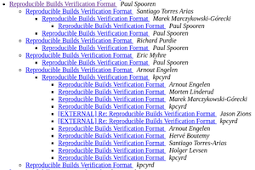
To make the results accessible, storable and create tools around them, they should all follow the same schema, a reproducible builds verification format. The format tries to be as generic as possible to cover all open source projects offering precompiled source code. It stores the rebuilder results of what is reproducible and what not.
Do you own your Bitcoins or do you trust that your app allows you to use your coins while they are actually controlled by them ? Do you have a backup? Do they have a copy they didn t tell you about? Did anybody check the wallet for deliberate backdoors or vulnerabilities? Could anybody check the wallet for those?
Elsewhere, Leo had posted instructions on his attempts to reproduce the binaries for the BlueWallet Bitcoin wallet for iOS and Android platforms.
If you are interested in contributing to the Reproducible Builds project, please visit our Contribute page on our website. However, you can get in touch with us via:
This month s report was written by Bernhard M. Wiedemann, Chris Lamb, Holger Levsen, Jelle van der Waa and Vagrant Cascadian. It was subsequently reviewed by a bunch of Reproducible Builds folks on IRC and the mailing list.
### The blockade has ended! For some introduction..
Back in 2016, Telmex Mexico's foremost communications provider and,
through the brands grouped under the *Am rica M vil* brand, one of
Latin America's most important ISPs set up rules to block connecitons
to (at least) seven of Tor's *directory authorities* (*DirAuths*). We
believe they might have blocked all of them, in an attempt to block
connections from Tor from anywhere in their networks, but Tor is much
more resourceful than that so, the measure was not too effective.
Only... _Some_ blocking did hurt Telmex's users: The ability to play
an active role in Tor. The ability to host Tor relays at home. Why?
Because the *consensus protocol* requires relays to be reachable in
order to be measured from the network's *DirAuths*.
### Technical work to prove the blocking
We dug into the issue as part of the work we carried out in the
project I was happy to lead between 2018 and 2019, *UNAM/DGAPA/PAPIME
PE102718*. In March 2019, I presented a paper titled [Distributed
Detection of Tor Directory Authorities Censorship in
Mexico](https://www.thinkmind.org/index.php?view=article&articleid=icn_2019_6_20_38010)
([alternative download](http://ru.iiec.unam.mx/4538/) in the [Topic on
Internet Censorship and Surveillance (TICS) track](https://tics.site/)
of the XVIII International Conference on Networks.
Then... We had many talks inside our group, but nothing seemed to move
for several months. We did successfully push for increasing the number
of Tor relays in Mexico (we managed to go from two to eleven stable
relays not much in absolute terms, but quite good relatively, even
more considering most users were not technically able to run one!)
Jacobo N jera, journalist participant of our project, didn't leave
things there just lying around waiting magically for justice to
happen. Together with Vasilis Ververis, from the [Magma
Project](https://magma.lavafeld.org/), they presented some weeks ago a
[Case study: Tor Directory Authorities Censorship in
Mexico](https://magma.lavafeld.org/guide/data-analysis.html#case-study-tor-directory-authorities-censorship-in-mexico).
### Pushing to action
But a good part of being a journalist is knowing _how_ and _when_ to
spread the word. Having already two technical studies showing the
blocking in place, Jacobo presented his findings with [an article in
GlobalVoices: *The largest telecommunications operator in Mexico
blocks the secure
network*](https://es.globalvoices.org/2020/05/28/en-mexico-el-mas-grande-operador-de-telecomunicaciones-bloquea-la-internet-segura/). Surprisingly
(to me, at least), this story was picked up by a major Mexican
newspaper: The same evening the story hit GlobalVoices, [Rodrigo
Riquelme](https://www.eleconomista.com.mx/autor/rriquelme) posted an
article, in the Technology section of *El Economista*, titled [Telmex
blocks seven out of ten accesses to the Tor network in
Mexico](https://www.eleconomista.com.mx/tecnologia/Telmex-bloquea-siete-de-10-accesos-a-la-red-Tor-en-Mexico-20200528-0078.html). And
that very same day, Telmex sent a reply I am translating in full (that
is now included at the end of Riquelme's article):
> Mexico City, May 28, 2020
>
> In relation to Tor navigation from TELMEX's network, the company
> informs:
>
> In TELMEX, we are committed to the full respect to navigation
> freedom for all of our users.
>
> TELMEX practices no application-level blocking policies; the Tor
> application, as well as the rest of Internet applications, can be
> freely accessed from our network.
>
> In order to protect the Internauts' information, the seven refered
> nodes were in their time reported because they were associated with
> the distribution of the WannaCry ransomware, which is the reason
> they were filtered, but this does not hamper the use of the Tor
> application.
### So we got an answer...?
Jacobo knew we had to take advantage of this answer, and act fast! He
entered rush-writing mode and, with the help of our good friend and
lawyer Salvador Alc ntar, we wrote [a short letter to Renato Flores
Cartas, Corporative Communication of Am rica
M vil](https://internetanonima.net/respuesta-a-telmex-sobre-la-red-tor-en-mexico/),
and sent it on June 1st.
Next thing I know, this evening Jacobo was asking me if I could
confirm the blocking was lifted. What I could not believe it! But,
yes Today Jacobo published the confirmation that [the seven blocked
IP routes were finally reachable again from ASN 8151 (UNINET / Telmex
/ Am rica
M vil)!](https://internetanonima.net/confirmamos-desbloqueo-de-las-7-direcciones-de-la-red-tor-por-telmex/)
Of course, this story was picked up again by El Economista [Telmex
unblocks IP addresses for the Tor network's directory authority server
IPs in
Mexico](https://www.eleconomista.com.mx/tecnologia/Telmex-desbloquea-direcciones-IP-de-servidores-de-autoridad-de-la-red-Tor-en-Mexico-20200604-0094.html).
### Wrapping up
How can I put this in words? I am very, very, very, *very, very,
very*, **very, very, very** happy we managed to see this through!
Although we have been pushing for increasing the usage of Tor among
users at risk in Mexico Being a journalist, defending human rights,
are still a high-risk profession in my country. We strongly believe in
this, and will continue trying to raise awareness of the usage.
But, just as with free software, *using* network anonymization tools
is not all. We need more people to become active, to become engaged,
to *become active participants* in anonymization. As the adage says,
*anonymity loves company* In order to build strong, sufficient
anonymization capability for everybody that needs it, we need more
people to *provide relay services*. And this is a *huge* step to
improve Mexico's participation in the Tor network!
---
Image credits: [*Seeing My World Through a Keyhole*, by Kate Ter
Haar](https://www.flickr.com/photos/katerha/4592429363) (CC-BY); [Tor
logo (Wikimedia Commons)](https://commons.wikimedia.org/wiki/File:Tor-logo-2011-flat.svg)
First month as DPL
I survived my first month as DPL! I agree with previous DPLs who have described it as starting a whole new job. Fortunately it wasn't very stressful, but it certainly was very
time consuming. On the very first day my inbox exploded with requests. I dealt with this by deferring
anything that wasn't important right away and just started working through it. Fortunately the initial
swell subsided as the month progressed. The bulk of my remaining e-mail backlog are a few media outlets
who wants to do interviews. I'll catch up with those during this month.
Towards the end of the month, most of my focus was on helping to prepare for an online MiniDebConf that we hosted over the last weekend in May. We had lots of fun and we had some great speakers sharing their knowledge and expertise during the weekend.
Activity log
As I do on my own blog for free software activities, I'll attempt to keep a log of DPL activities on this blog. Here's the log for the period 2020-04-21 to 2020-05-21:
2020-04-19: Handover session with Sam, our outgoing DPL. We covered a lot of questions I had and main areas that the DPL works in. Thanks to Sam for having taken the time to do this.
2020-04-21: First day of term! Thank you to everybody who showed support and have offered to help!
2020-04-21: Request feedback from the trademark team on an ongoing trademark dispute.
2020-04-21: Join the GNOME Advisory Board as a representative from Debian.
2020-04-21: Reply on an ongoing community conflict issue.
2020-04-21: Update Debian project summary for SPI annual report.
2020-04-21: Received a great e-mail introduction from Debian France and followed up on that.
2020-04-21: Posted "Bits from the new DPL" to debian-devel-announce.
2020-04-22: Became Debian's OSI Affilliate representative.
2020-04-22: Reply to a bunch of media inquiries for interviews, will do them later when initial priorities are on track.
2020-04-23: Resign as Debian FTP team trainee and mailing list moderator. In both these areas there are enough people taking care of it and I intend to maximise available time for DPL and technical areas in the project.
2020-04-25: Review outgoing mail for trademark team.
2020-04-25: Answer some questions in preparation for DAM/Front Desk delegation updates.
2020-04-26: Initiated wiki documentation for delegation updates process.
2020-04-27: Update delegation for the Debian Front Desk team.
2020-04-29: Schedule video call with Debian treasurer team.
2020-04-29: OSI affiliate call. Learned about some Open Source projects including OpenDev, OpenSourceMatters, FOSS Responders and Democracy Labs.
2020-05-04: Delivered my first talk session as DPL titled "Mixed Bag of Debian" at "Fique Em Casa Use Debian" (Stay at home and use Debian!), organised by Debian Brazil, where they had a different talk every evening during the month of May. Great initiative I hope other local groups consider copying their ideas!
2020-05-05: Had a 2 hour long call with the treasurer team. Feeling optimistic for the future of Debian's financing although it will take some time and a lot of work to get where we want to be.
2020-05-17: Respond to cloud delegation update.
Here's a practical example of applying Template Haskell to reduce
the amount of boilerplate code that is otherwise required. I wrote the below
after following this excellent blog post by Matt Parsons. This post will be much higher-level, read
Matt's blog for the gorier details.
Liquorice
Liquorice is a toy project of mine from a few years ago that lets you
draw 2D geometric structures similar to LOGO. Liquorice offers two interfaces:
pure functions that operate on an explicit Context (the pen location:
existing lines, etc.), and a second "stateful" interface where the input and
output are handled in the background.
I prefix the pure ones P. and the stateful ones S. in this blog post for
clarity.
The stateful interface can be much nicer to use for larger drawings.
Compare example8b.hs,
written in terms of the pure functions, and the stateful equivalent
example8.hs.
The majority of the stateful functions are "wrapped" versions of the pure
functions. For example, the pure function P.step takes two numbers
and moves the pen forward and sideways. Its type signature is
P.step :: Int -> Int -> Context -> Context
Here's the signature and implementation of the stateful equivalent:
S.step :: Int -> Int -> State Context ()
S.step x y = modify (P.step x y)
Writing these wrapped functions for the 29 pure functions is boilerplate that
can be generated automatically with Template Haskell.
Generating the wrapper functions
Given the Name of a function to wrap, we construct an instance of FunD, the
TH data-type representing a function definition. We use the base name of the
incoming function as the name for the new one.
mkWrap fn = do

    let name = mkName (nameBase fn)
    return $ FunD name [ Clause (map VarP args) (NormalB rhs) [] ]
To determine how many arguments the wrapper function needs to accept, we need
to determine the input function's arity. We use Template Haskell's reify
function to get type information about the function, and derive the arity from
that. Matt Parson's covers this exactly in his blog.
info    <- reify fn
let ty   = (\(VarI _ t _ ) -> t) info
let n    = arity ty - 1
args    <- replicateM n (newName "arg")
We can use the list "args" directly in the clause part of the function
definition, as the data-type expects a list. For the right-hand side, we need
to convert from a list of arguments to function application. That's a simple
left-fold:
-- mkFnApp f [a,b,c] => ((f a) b) c => f a b c
mkFnApp = foldl (\e -> appE e . varE)
rhs     <- [  modify $(mkFnApp (varE fn) args) :: State Context ()  ]
We use TH's oxford brackets for the definition of rhs. This permits us
to write real Haskell inside the brackets, and get an expression data-type
outside them. Within we have a splice (the $( )), which does the opposite:
the code is evaluated at compile time and generates an Exp that is then
converted into the equivalent Haskell code and spliced into place.
Finally, we need to apply the above to a list of Names. Sadly, we can't get at
the list of exported names from a Module automatically. There is an open
request for a TH extension for
this. In the meantime,
we export a list of the functions to wrap from the Pure module and operate
on that
Finally, we 'call' wrapPureFunctions at the top level in our state module
and Template Haskell splices all the function definitions into place.
The final code ended up only around 30 lines of code, and saved about the
same number of lines of boilerplate. But in doing this I noticed some missing
functions, and it will pay dividends if more pure functions are added.
Limitations
The current implementation has one significant limitation: it cannot handle
higher-order functions. An example of a pure higher-order function is
place, which moves the pen, performs an operation, and then moves it back:
P.place :: Int -> Int -> (Context -> Context) -> Context -> Context
Wrapping this is not sufficient because the higher-order parameter has
the pure function signature Context -> Context. If we wrapped it, the
stateful version of the function would accept a pure function as the
parameter, but you would expect it to accept another stateful function.
To handle these, at a minimum we would need to detect the function arguments
that have type Context -> Context and replace them with State Context ().
The right-hand side of the wrapped function would also need to do more work to
handle wrapping and unwrapping the parameter. I haven't spent much time
thinking about it but I'm not sure that a general purpose wrapper would work
for all higher-order functions. For the time being I've just re-implemented the
half-dozen of them.
 fully assembled chromebook duet


 Debian comes with tons of fonts for all kinds of purposes,
you can easily list them all (almost) with:
 This weekend I had some pretty good uncle time. My eleven year old nephew (after beating me in a fair match of tennis) wanted to play with his Lego Mindstorms set. He never even touches it unless I am around to help him, but then he quiet enjoys. As expected, when I ask him what we should try to build, he tends to come up with completely unrealistic or impossible ideas, and we have to somehow reduce the scope to something doable.
This time round, inspired by their autonomous vacuum cleaner, he wanted to build something like that. That was convenient, because now I could sell him what I wanted to try to do, namely make the robot follow a wall at more or less constant distance, as a useful first step.
We mounted the infra red distance sensor at an 45 angle to the front-left, and then I built a very simple control loop measure the distance, subtract 40, apply a factor, and feed that into the steering input of the drive action, and repeat. I must admit that I was pretty proud to see just how well that very simple circuit worked: The little robot turned sharp corners in both directions, and otherwise drove nicely parallel and with constant distance to the wall.
I was satisfied with that achievement and would have happily ended it here before we might be disappointed by more ambitious and then failing goals.
But my nephew had not forgotten about the vacuum cleaner, and casually asked if I could make the robot draw an outline of its path, and thus of the room, on the display. Ok, where do I begin to explain just how unfeasible that is yes, it seemed one can draw to the display. But how should the robot know where it is? How far it turns? How far it went? This is programming by connecting boxes, and I would not expect such an interface to allow for complex logic (
 The source code repo has since been relocated from my account to the (upstream)
 If you like this or other open-source work I do, you can now
 I ve been less good at taking adequate typing breaks during the
lockdown and I ve become concerned about how much chording my left
hand does on its own during typical Emacs usage, with caps lock
rebound to control, as I ve had it for years.
I thought that now was as good a time as any to do something drastic
about this. Here are my rebindings:
 It's (yet again!) been a while since I blogged last, sorry...
It's been over ten years since I started
in
 Where do I fit in? Pexip is a relatively small company with a very
flat setup in engineering, so that's a difficult question to answer!
I'll be starting working in the team developing and maintaining PexOS,
the small Linux-based platform on which other things depend. (No
prizes for guessing which distro it's based on!) But there's lots of
scope to get involved in all kinds of other areas as needs and
interests arise. I can't wait to get stuck in!
Although I'm no longer going to be working on Debian arm port
issues on work time, I'm still planning to help where I can. Let's see
how that works...
 Not bad, but not Smokeping
 Looks more like Smokeping!





 ### The blockade has ended! For some introduction..
Back in 2016, Telmex Mexico's foremost communications provider and,
through the brands grouped under the *Am rica M vil* brand, one of
Latin America's most important ISPs set up rules to block connecitons
to (at least) seven of Tor's *directory authorities* (*DirAuths*). We
believe they might have blocked all of them, in an attempt to block
connections from Tor from anywhere in their networks, but Tor is much
more resourceful than that so, the measure was not too effective.
 Only... _Some_ blocking did hurt Telmex's users: The ability to play
an active role in Tor. The ability to host Tor relays at home. Why?
Because the *consensus protocol* requires relays to be reachable in
order to be measured from the network's *DirAuths*.
### Technical work to prove the blocking
We dug into the issue as part of the work we carried out in the
project I was happy to lead between 2018 and 2019, *UNAM/DGAPA/PAPIME
PE102718*. In March 2019, I presented a paper titled [Distributed
Detection of Tor Directory Authorities Censorship in
Mexico](https://www.thinkmind.org/index.php?view=article&articleid=icn_2019_6_20_38010)
([alternative download](http://ru.iiec.unam.mx/4538/) in the [Topic on
Internet Censorship and Surveillance (TICS) track](https://tics.site/)
of the XVIII International Conference on Networks.
Then... We had many talks inside our group, but nothing seemed to move
for several months. We did successfully push for increasing the number
of Tor relays in Mexico (we managed to go from two to eleven stable
relays not much in absolute terms, but quite good relatively, even
more considering most users were not technically able to run one!)

 Here's a practical example of applying
