Search Results: "ean"

16 January 2012

Joey Hess: version numbers

Today I released two entirely different pieces of software with the identical version number 3.20120115. Debian developers also will be soon noticing a piece of software I released with the version number 9.20120115. I expect to move more of my software to this version number scheme over time, unless I find something badly wrong with it. It reflects how I think about versions for my software; there's a kind of continual "now" that development progresses through, in which individual releases have little discrete meaning and at the same time, there can also be significant discontinuities, that require the user to do something to deal with (such as a new debhelper compat version, or a new git-annex repository format). Those two things are really all that I need a version number for my software to communicate. I can do without the rest of the things that version numbers are used for: There is so much software, with so many version numbers that any signal encoded in such version numbers is swamped in the noise. Even on projects that I develop a version number like 2.88 is meaningless to me. All I care about is, how long ago was that version? Has there been a major change breaking compatibility since that version? "2.88" doesn't answer these questions well; "3.20111111" does. It is a little wordy to have the full year in there, and it can be annoying to remember to set the version to the right date on release day (TODO: automate). This is balanced with the version not being so wordy as to include the time of day, which means I might have to do a 3.20120115.1 if I goof up. These minor problems are worth it to instantly know how old a version is when a user pastes it into a bug report. And that is probably all I will ever have to say about version numbers. :)

15 January 2012

Roland Mas: Looking for the ultimate distributed filesystem

(This is not quite a Dear lazyweb post. If anything, it's Dear lazyweb, I've done my homework, now what? ) I'm looking for the ultimate distributed filesystem. Something that's simple to use, redundant, fault-tolerant, and still smart enough to avoid the more obvious performance chokepoints. Ideally, it should work for all of the following sets of files: The requirements on the ultimate distributed filesystem (which I'll call UDFS for short, otherwise you'll get bored and go look at pictures of kittens) are as follows: Quite a few constraints, eh? I have a feeling they are not mutually incompatible though, so I had a look at several candidates. I started with Wikipedia, and I followed the links to Tahoe-LAFS, XtreemFS and Ceph. The following is my evaluation of these candidates based on much reading of docs and websites and wikis, some questioning on IRC, and very little testing. The overall picture seems full of good things scattered across different solutions, but unfortunately none of the existing ones seems to address the whole problem; at least, not my whole problem. It would be good if each focused on one layer and did that layer well, but that seems not to be the case either, so they can't be combined to get the best of all worlds. It may be that I'm missing something, or that I failed to read some docs properly, or that I misunderstood the docs, or that the docs themselves are simply lacking; but my ideal UDFS currently doesn't seem to exist as a turn-key solution. However, the main pieces are available, and implementing the remaining parts may be doable. My humble idea of a way forward would be based on Tahoe-LAFS, with the following three changes: Also nice to have would be a way to work with multiple introducer nodes, but that seems to be in the works already. This would be pretty damn close to my UDFS; read/write performance would certainly be far from what can be obtained on native filesystems stored on local disks, but my use cases involve reasonably small files for which instant access is not compulsory, and the filesystem cache would probably absorb most of the access times. In case anyone is looking for ideas of things to do in their spare time, here are rough sketches of other possible UDFS implementations I thought of. These are wild ideas, and I'm not even sure they could be doable in practice: Such is the state of my research so far. I would welcome feedback, pointers to things I neglected to read, corrections for things I misread or misunderstood, comments on the ideas and so on. I'll probably post an update if my search goes significantly forward. Update: I've already received two pieces of feedback, including a lengthy one with corrections about Tahoe-LAFS. For the sake of fairness, I'll solicit (and wait for) the same from the other candidates I looked at. I was also pointed at HekaFS, GlusterFS and git-annex, which I'll have to look at in more details. Other suggestions are still welcome, but the more I get, the more the full update will be delayed. Thanks already!

14 January 2012

Ben Hutchings: IGMP denial of service in Linux (CVE-2012-0207)

The bug report Simon McVittie reported in Debian bug #654876 that his laptop running Linux 3.0 or 3.1 would sometimes crash (panic) while idle. He initially suspected a driver bug, but the screen did not show any information about where the original fault occurred. However, using netconsole, he was able to capture a full log of the crash. This showed that a packet received through the wireless interface was being processed by IGMP, which then divided by zero. IGMP IGMP is part of the IPv4 protocol suite, supporting multicast routing. Every multicast address corresponds to a dynamic set of hosts, called a multicast group. Multicast routers can send query messages asking which hosts belong to which groups, and hosts using multicast report back at intervals. Routers can then limit forwarding of multicast packets to the interfaces where the group has members. More sophisticated switches can also snoop IGMP and use it to limit their multicast forwarding. There are unfortunately three different versions with semi-compatible message formats. In version 1, the maximum reporting interval (Max Response Time) is fixed as 10 seconds, but from version 2 it is specified in query messages. The Linux IGMP implementation supports all three versions. It distinguishes query messages as specified in RFC 3376 section 7.1: v3 messages are longer than v1 or v2; v2 messages have a non-zero Max Response Time whereas v1 messages always have zero. It is possible to force use of a specific protocol version, but normally if there are multiple multicast routers using different protocol versions it will respond according to the earliest protocol version in use so that all routers can understand its responses. Source and fix for the bug Linux 2.6.36 included two fixes to the version selection logic. Unfortunately, the second of these introduced the bug in question. While v2 query messages cannot possibly have zero Max Response Time (as that would make them v1), v3 query messages can. What this means is unspecified, but the Linux IGMP code previously treated it as the minimum valid value of 1/10 second. But in the case where a v3 query is received and a v2 query has also recently been received, this is no longer done. This results in a reporting interval of 0 seconds and a division by zero when deciding the initial random delay. The fix for this is pretty obvious. It is included in Linux 3.0.17, 3.1.9, 3.2.1, and the Debian package version 3.1.8-2. Security impact This is easily exploitable for denial of service within a local network. Linux does not check the destination address of IGMP queries, so it may also be possible to attack a target through its unicast address from several hops away. The attacker only needs to send a single IGMPv2 query followed by a single IGMPv3 query with zero Max Response Time. All systems running Linux 2.6.36 or later (up to the above fixed versions) with any active IPv4 multicast listeners (other than for the 'all hosts' address) are vulnerable.

13 January 2012

Raphaël Hertzog: People Behind Debian: Steve McIntyre, debian-cd maintainer, former Debian Project Leader

Steve McIntyre has been contributing to Debian since 1996, 2 years before I joined! But I quickly stumbled upon Steve: in 1999, he was struggling with getting his debian-cd script to produce 2 ISO images (it was the first time that Debian did no longer fit on a single CD), I helped him by rewriting debian-cd with a robust system to split packages on as many ISO images as required. I remember those times very well because Steve was very supportive of my efforts and it was a real pleasure to get this done. His friendly nature probably also explains why he got elected Debian Project Leader twice! Anyway, enough history, check out his interview to learn more about the great work he s doing nowadays. My questions are in bold, the rest is by Steve. Raphael: Who are you? Steve: I m a professional software engineer, 37, living in Cambridge (England) with my new wife Jo. I studied for the EIST degree at the University of Cambridge, then (like many people here, it seems) I just forgot to go home again afterwards and settled here. I spent more of my study time playing with Linux than working on my degree, so I guess I m lucky that it worked and I found a career in that area! Raphael: How did you start contributing to Debian? Steve: During my time in college, I started hacking on software in my free time, using Slackware as my first Linux distribution from the middle of 1994. After encountering more and more problems with Slackware, I was encouraged by a number of friends to make the jump over to Debian and in October 1996 I did. The installation process back then was much harder than anything people see today, but after a long weekend I finally had my Debian system up and running. I was already one of the main upstream developers for the Mikmod music player at that time, so that very same weekend I applied to be a DD so I could maintain it in Debian too. Back then, the NM process was much simpler: I just mailed a key to Bruce and he set me up with an account almost immediately! I then found that Joey Hess had beaten me to it and already packaged Mikmod. Grrr! :-) Raphael: What s your biggest achievement within Debian? Steve: Without a doubt, my proudest achievement within Debian is being elected Project Leader for 2 years by the other developers. It s a great feeling to have earned the trust of your friends and peers, and also a great responsibility to go and help Debian where needed: talking to the press about Debian, assisting wherever problems crop up, etc. The DPL job is certainly a lot of hard work, and I have nothing but respect for anybody who volunteers for it.
It s a great feeling to have earned the trust of your friends and peers.
Elsewhere, I ve been leading the Debian CD team for years too, both doing most of the maintenance of the debian-cd package and producing and testing the regular installation CDs and DVDs that we ship to the world. Again, this is a time-consuming job but it needs doing and it s worthwhile. Raphael: You re currently employed by ARM. What are you working on and are they supportive of your Debian involvement? Steve: The situation within ARM is very interesting; I m employed in PDSW (Processor Division, SoftWare), a new group founded just a couple of years back to help improve the state of software on ARM. Most of the people in the group are working on Free Software at this stage (e.g. toolchains, browsers, Linux kernel), which is lovely. Some of the engineers have also been seconded into a new non-profit company Linaro, which is a collaboration between ARM and a number of other companies investing in core Linux software and tools for ARM-based CPUs. I m one of the ARM engineers in Linaro, and I m a Technical Architect in the Office of the CTO. My role includes looking at future projects for Linaro to help with (e.g. ARM servers), but for the last few months I ve been concentrating on the new armhf architecture in Debian, Ubuntu and elsewhere. armhf is a new architecture in Debian and Ubuntu terms, but it s not strictly a new type of hardware. Instead, it s a new ABI. We have two reasons for doing this work:
  1. It targets the latest version of 32-bit ARM CPUs (v7) and makes better use of the hardware, for better performance. Compare targetting i686 instead of i386, for example. We ll still support the older armel port for the foreseeable future for users with older hardware that can t run armhf.
  2. More importantly: we are standardising on the ABI / compiler options / hardware support for future users.
In the past, there has been a huge amount of specialisation (aka fragmentation) in the ARM Linux environment, and that worked OK for specialised devices that only ever ran the software shipped with them. ARM CPUs are now becoming more and more mainstream, so people will expect to be able to install generic software on their machines. That gives a requirement for a standard base platform, and armhf (arm-linux-gnueabihf in GNU triplet terms) is that standard that we are pushing in the community. Debian, Ubuntu, Fedora, Suse and others are all going to use this, making compatibility possible. I ve been working with a small team of people to make armhf happen, helping where needed: putting together build machines; patching Debian packages directly; discussing and fixing toolchain issues with Ubuntu folks; agreeing ABI specifications with people from Fedora; advising people from other distros bootstrapping their new ARM ports. ARM and Linaro are very supportive of this work, and it s been lovely being sponsored to work directly on Free Software like this. It s work that will directly benefit ARM and its partners (of course!), but it s also helping out more generally too: Debian QA work, cross-build support, bootstrapping efforts, multi-arch. More and more of the ARM market is driven by Free Software, and companies are acknowledging that. I should probably also mention that we re hiring ! :-) Raphael: What are your plans for Debian Wheezy? Steve: There are three main tracks here. Obviously, I m interested in seeing armhf release with Wheezy. We ve just been added to Testing last weekend, so that s going well. We ve got over 90% of the archive built now, and we re mopping up the remaining issues. I m the primary maintainer of cdrkit at this point, but I d prefer to have it go away. Xorriso and the associated software in libisoburn is almost capable of replacing all the aging cdrtools-derived software that we have in Debian, The only missing feature that I m aware of is creating the HFS hybrid filesystems that we use for installations on Mac systems. I ve been talking with the upstream folks about this for some time already, and I m hoping we can finish this soon enough that we can get it into Wheezy. Finally, I ve got the ever-growing wishlist of things for debian-cd. We ve got the beginnings of an automated test suite that Mart n Ferrari has written, but it needs integrating and improving. I want to help get regular weekly/daily/release debian-live builds running on the main CD build machine. There s work needed if we want to make good installation media for the new multi-arch world, too. The Emdebian people are asking for help making CD images The list goes on :-) Raphael: The ARM community seems to be very interested in multi-arch. Can you explain why? Steve: There are a number of reasons for ARM people to be interested in multi-arch; two really stand out for me:
This is potentially the killer app for multi-arch: simply install the libraries for the target architecture [ ], install a simple cross-gcc package [ ] and you re all set.
Raphael: What s the biggest problem of Debian? Steve: For me, Debian s biggest problem has been the same for a long time: we are forever short of enough people to do the work that we re trying to do. That might sound like a weird thing to claim when Debian is one of the largest Free Software projects on the planet, but it s more a statement of just how huge our goals are. Many of the largest things in Debian are developed or controlled by very small teams working very hard, and there s always a risk of losing people due to burnout in those situations.
We are forever short of enough people to do the work that we re trying to do.
Some of the tasks that should be easy given our large membership (e.g. large-scale packaging transitions) can often instead take a very long time. We are fortunate to have more people wanting to join in Debian s work all the time, but we also need to be careful to keep on promoting what we re doing and recruiting new contributors, encouraging them to get more and more involved in core work. Debian gets ever bigger in terms of the size and the number of packages we distribute; we re not currently matching that growth rate elsewhere. Raphael: What motivates you to continue to contribute year after year? Steve: This one is much easier to answer! The thing that first attracted me to Debian was the fact that I could help to develop it, help to decide how things could and should be done within it. Instead of being forced to accept what some corporation decided I could do with my computer, I could change the software to suit my needs and preferences. Alongside that, I could get involved with a strong community of similar people all over the world, all with their own strong opinions about how software should work. I joined in and found it was great fun and very rewarding. That hasn t changed for me in the intervening years, and that s why I m still around. I work on Debian because it helps me to get the OS that I want to use. It seems that lots of people around the world find it useful too, and that s awesome. :-) Raphael: Do you believe that Stefano Zacchiroli will be the first DPL who managed to stay 3 consecutive years on the seat? Would you like him to candidate again? Steve: To be honest, I would be very surprised if Zack stood again for DPL this year. He told me himself that he wasn t planning on it, and I can understand that decision. He s been an awesome DPL in my opinion, and I m glad that he took the job. But: it is also a very difficult and time-consuming task that would be enough to wear down anybody. If Zack does decide to stand again, I would support him 100%. But I know that we also have lots of other good people in Debian who would be ready to take up the challenge next. Raphael: Is there someone in Debian that you admire for their contributions? Steve: There are lots of people I admire in Debian, so many so that I almost don t want to list individuals here for fear of missing people out. But :-) Bdale Garbee has been an inspiration to many of us, for many years. He s technically excellent, a great friend to many of us, an endless source of sage advice and (last but not least) he has some wonderful stories to tell about his experiences over the years. On top of that, he s just cool. :-) Christian Perrier is another exceptional developer, in my eyes he s great at co-ordinating people in translations, working tirelessly to make this very important part of Debian work better and better with every release. He s also a really nice guy and we all love him. I also have to mention Joey Hess here, whether he likes it or not. *grin* He s been responsible for so many good things in Debian over the years, even if he did steal my first package Finally, the teams of people who make sure that Debian is always working: the security team and DSA. The rest of us can choose to take time off from Debian to go and do other things, but these people need to cover things every day. That s a major responsibility, and I salute them for taking on that challenge.
Thank you to Steve for the time spent answering my questions. I hope you enjoyed reading his answers as I did. Note that you can find older interviews on http://wiki.debian.org/PeopleBehindDebian.

Subscribe to my newsletter to get my monthly summary of the Debian/Ubuntu news and to not miss further interviews. You can also follow along on Identi.ca, Google+, Twitter and Facebook.

One comment Liked this article? Click here. My blog is Flattr-enabled.

C.J. Adams-Collier: The Very Model of a Poster to CLPM

So, in 2002 I attended my first SPUG meeting. Also in attendance were Randal, Tim, J.P. (I think) and quite a few of the other usual suspects. The guest speaker was the inestimable Dr. Damian Conway. This night might be the single most important event in my career as a builder of the internets. I was already set in my ways regarding my operating system, and I knew enough perl to get by, but I wasn t in touch with any users groups until then. The crown jewel of the night was Damian s recital in full of his poem, I Am The Very Model of A Poster To CLPM (sung to the tune of that song from Pirates of Penzance). I must admit that I d never heard of CLPM and that it all sounded like gobble-de-gook at the time. If I recall correctly, this happened just after he took about 10 minutes to teach us all to pronounce the name of then-Pumpking, Jarkko Hietaniemi. This was the same year that the following video was made <iframe allowfullscreen="allowfullscreen" frameborder="0" height="315" src="http://www.youtube.com/embed/XkU_GQVOCqo" width="420"></iframe> With that in mind, there s one more thing I need to share with you before disclosing the lyrics. This piece was developed during a time when it was common for members of the perl community to flame one another on news feeds, take their anger and frustration out on newbies and generally be the bane of most of the internet. I like to think that it helped to shape me into a kinder, gentler perl programmer, debian user and general netizen over the years. I would also like to think that it will do the same for future members of our communities. And so, without further ado, Damian Conway s
I Am The Very Model of a Poster to CLPM Now everything I need to know about the Perl community
I learned in kindergarten when I was a little lad of three
And in these next few minutes I ll relate those five apothegm
For I am the very model of a poster to c.l.p.m. The first truism I was ever taught upon my mother s knee
Was that our dad s a better dad than their s could ever hope to be.
His name is Larry Wall, and that s determinism nom native
Since of the mural attributes he demonstrates proof positive. He s eight feet tall and ten feet wide; of granite-like solidity.
He wards us from the serpent s tabs and coffee bean s stupidity.
He guards us from that Gallic tower s B&D urbanity,
And makes sure we don t see sharp code that might cut loose our sanity. He watches over each of us, like Odin of the Norse belief
The stern All-Father figure and, at times, the comical relief.
So, if you vaunt our patriarch s supreme linguistic acumen,
You are a model sychophantic poster to c.l.p.m. The second tenet that I learned concerns, of course, the fairer sex
And why they are in short supply, while geek-boy JAPHs are multiplex.
As every schoolboy knows each conversation has single aim:
To raise one s own significance, whilst razing others down in flame. And thus good men and true who hold this principle as sacrosanct
Will all pursue beligerence as though they were from Mars. Or tanked.
It is the tenor of your newgroup posts that she from Venus flies:
Because most threads devolve into comparisons of ..meanness, guys. When every post affronts their own collaborative sorority
It must exasperate them, for it renders the majority
Of female Perl geeks absent, till we re forced to rename blonde Dutch men
To act as female models of a poster to c.l.p.m. The third grand aphorism that was drummed into my youthful head
Was: if you can t say something nice about someone, you should instead
Say every nasty thing you can impart, imagine, or invent
In any public forum that it happens you should both frequent. This goes especially for the young, and new, and shy, and innocent.
To flame a newbie is a joy, t will make you feel omnipotent.
To watch them squirm and bleat and bleed and scurry back into their hole,
The surge of ecstasy it brings is worth the way it eats your soul. So never hesitate to turn the wrath of your vocabul ry
Upon the hapless supplicant for Perl epistomology
And if you flame each FAQ, and every question that s beneath you then
You ll be the very model of curmudg nly R.T.F.M. The next point I should like to make s the obverse of the previous
For while it s true that to be newbie is a sin most grieveous
It ain t as bad as being old and greyed and staid and tedious
And sitting at the keys all day dispensing thoughts invidious. What right have you to tell me not to ask about my CGI???
I thought that Perl was all about website development, and I
Expect that you d extend to me the simple human courtesy
Of dropping everything so you can do this homework now for me. The Internet exists so I need never read the manual
And so my inane questioning can form a stream continual
While pleading for an email since I never read this group, as well
As posting them in jeopardy, in caps, and in HTML. The rule I learned in kinder that explains where this approach springs from
Is fundamental to a certain class of Gen-X hackerdom
The single principle that guides their Internet activity
Is: me, me, me, me, me, me, me, me, me, me, me, me, me, me, ME! So if you are prepared to treat the Net as your god-given right
And suck the newsgroups dry like some goodwill-devouring parasite
And use them as a help-desk and a perldoc substitute, well then
You are the very model clueless poster to c.l.p.m. The final precept that my pre-school inculcated in my head
Is one I would commend as antithetical to all I ve said.
It is a noble concept that once used to garner more elan
The idea that, when I grow up ..I want to be a fireman. The fire-fighter s job s to help, despite the inconvenience
And spare the inexperienced the cost of their own ignorance
And put out fires when the flames ignite the common living space
And through it all maintain an air of competence and skill and grace. And this, my friends, I recommend to all of our community
That rather than a careless match or carefully lit incendiary
You spray out knowledge, patience, and a gentle stream of good advice
And save the newbies from themselves, and oldies from their prejudice. And be yea more as Larry is, a fire-Wall against the threat
Of ignorance and arrogance, with both of which we re still beset.
For if you choose to help your fellow JAPHs instead of scorching them,
You ll be the next burnt offering we spit-roast on c.l.p.m. ;-) [edit]

11 January 2012

Craig Small: MediaServer with Rygel

Rygel XVI

Image by Cayusa via Flickr

Like a lot of people, I have one of those set-top TV boxes that can record TV shows at set times. I made sure that I could get at the files (using a FTP server in this case) and that the files were some sort of common standard (MPEG 4 TS). I also have a bunch of mp3 music files. That s fine when I m on the desktop because the files are local. I wanted to make these available to anyone in the household. DLNA seemed to be a reasonably OK way of doing this, the problem was, how to get it working in Linux? A lot of the problem is that it is hard to find a DLNA only server. Sure MythTV could do it, but it needs a tv tuner or a lot of fiddling around. XMBC can also do it, but it needs to be running a GUI. I even tried mediatomb but could not get the thing to compile as the library calls to mozjs were all using deprecated functions. I just wanted a daemon that served stuff, nothing more; no fancy ui, no need for X just file serving goodness. Rygel is almost that. You could say it is a user server much like a torrent client/server. The nice thing is you can fiddle around with rygel so it becomes close to a real server. This is how I did it. First, I made a rygel user with a home directory, but disabled login. I don t like programs running root if they don t need it and rygel doesn t need it. The home directory needs to be writeable to the rygel user too otherwise the program doesn t work too well. I use /var/local/rygel as its home. For the configuration, copy /etc/rygel.conf to ~rygel/.config/rygel.conf This is the configuration file for rygel. I disabled all of the modules except MediaExport. Make sure you disable Tracker otherwise MediaExport will not work. Tracker is only useful for real users who are logged in and have dbus etc going which this user is certainly not. I made a simple rygeld file in /usr/local/sbin which basically starts the program, forks and grabs the PID to write to a pidfile. This mean it was easier to track the program in the init scripts.
#!/bin/sh
#
# Rygel daemon handling
RYGEL='/usr/bin/rygel'
RYGEL_ARGS=''
su -s /bin/sh -c "nohup $RYGEL $RYGEL_ARGS &gt; /var/local/rygel/rygel.log 2&gt;&amp;1 &amp;"
rygel
EXIT_CODE=$?
if [ $EXIT_CODE != 0 ] ; then
        return $EXIT_CODE
fi
PGROUP= ps --no-headers -o pgrp $$ 
PID= pgrep -g $PGROUP -f $RYGEL 
echo $PID &gt; /var/run/rygel.pid
exit 0
In case you were wondering, the pgrp finds the program group so the pgrep finds the right rygel process that has the same program group as the starting shell. The init script is a standard init script except the exec flag checks for /usr/bin/rygel but the start line starts /usr/local/sbin/rygeld This is because we want to kill the real rygel process but start it with the script. This setup works rather well. You do get some messages in the logfile about dbus not working but it is harmless. I tried disabling the mpris and external plugins but no matter what flag or configuration file option I tried, they would always try to start and fail with no dbus. Rygel is a a reasonably light-weight way of serving media to your home network. It idles 200 MB virtual with 16MB resident and when idle uses almost no CPU.

10 January 2012

Andrew Pollock: [life] Breaking and entering, with permission

I had a bit of an adventure yesterday, which would have taken some explaining if the police had gotten involved. It went a little something like this... My friend and former co-worker Sara was in the US Virgin Islands for the holidays. Her boyfriend, Karl, flew there separately for the tail end of her time there. Yesterday, I received a phone call from Sara, saying that Karl had managed to fly out to the Virgin Islands without his passport. Apparently you can get there without one, but to get back into the mainland US, you need one. She wanted to know if I could get one of my lock-picking co-workers to break into their apartment and retrieve Karl's passport and mail it them. Karl was supposed to fly out the next day. Attempts by Sara to contact her landlord had failed, so they didn't have many other options (apart from mailing me a key, which would have cost them another day). I asked one of my co-workers, Jason, who I knew was into lock picking, if he was up for it, and he offered to put me in touch with another guy who had dominated the recent lock picking night that he'd run. So now I'm talking to David, who's on board with the mission, but doesn't have his lock picking gear on him. No problem, Jason says he'll lend me his, which was at work with him. So we have a plan. Our friends Ian and Melinda are currently in Australia. They've lent us their car because it's leased, and they have some minimum mileage they're supposed to do and they're under it, so I've been driving to work in their car some days. As it happens, I drove to work in it yesterday. So now David and I set out in a car that neither of us own, with a lock picking set that belongs to another person, to break into an apartment of someone who's in the Virgin Islands. What could possibly go wrong? I'm told that it's not illegal to own a lock picking set, but if you're caught with one on your person and you're not a locksmith, you can get into all sorts of trouble. On top of that I'd have a hard time explaining the car I'm driving. We get to Sara and Karl's condo complex. It has a common gate that visitors would normal get buzzed through. Turns out it's not that hard to climb over. It's got some benign-looking spiky things on top, but I could get a leg over from the left hand side of the gate and jump over without impaling myself. Then I let David in and we proceeded upstairs to Sara and Karl's apartment door, where David set to work. Sara said that just the dead bolt was locked. David started at it with Jason's tools, trying to be as discreet as possible. It was about 3:30pm and there was no one around, but we could hear some noises from the neighbouring apartment (the two front doors were right next to each other). After what felt like about half an hour without success (the last pin of the lock was particularly tricky apparently) David was having to resort to more noisy techniques with the lock, so I decided to take the up-front approach and just inform the next door neighbour what we were doing in case he/she (I think it was a she) decided to call the cops on us. I told her through the door why we were there and what we were doing. She didn't seem to care too much. David then proceeded to start "raking" the lock, essentially brute forcing the pins with a lot of jiggling, and finally managed to pick it and we were in. I quickly found Karl's passport where it was suspected to be, and then we pondered how we were going to lock the door again. We could have just locked the door knob instead of the deadbolt and closed the door behind us, but we weren't sure if Sara and Karl had a key to the doorknob (Sara said they always just locked the deadbolt). Sara was fine with leaving the door unlocked until they got home, but weren't so keen on leaving our fingerprints all over the place and then leaving the door unlocked. David tried to re-pick the deadbolt so that he could lock it via the same means as opened it, and I scouted around for a key. I managed to find a key that locked both the deadbolt and the doorknob, so I took that with us and locked up their apartment. In David's defense, the deadbolt was a bit stiff to lock even with the key. I dropped David back at work, collected my stuff (it was now about 4:30pm) and headed to the UPS Store to ship Karl's passport to him as fast as humanly possible. I just made the 5pm pick up. Today I received an SMS from Sara informing me that they had received the passport. I was very impressed with how fast it got to them. So that was all a bit of an adventure. I'm not sure how much longer Karl is going to have to stay in the Virgin Islands as a result. I'm going to suggest that Sara and Karl leave a spare key with someone in future.

John Goerzen: Social Overload

I m finding social media is becoming a bit annoying. I enjoy using it to keep in touch with all sorts of people, but my problem is the proliferation of services that don t integrate well with each other. Right now, I have: So my problems are:
  1. Posting things multiple places. I currently can post on identi.ca, which automatically posts to twitter, which automatically posts to Facebook. But then I d still have to post to Google+, assuming it s something that I d like to share with both my Facebook friends and my Google+ circles it usually is.
  2. The situation is even worse for re-tweeting/re-sharing other people s posts. That is barely possible between platforms and usually involves cutting and pasting. Though this is somewhat more rare.
  3. It s probably possible to make my blog posts automatically generate a tweet, but not to automatically generate a G+ post.
All the hassle of posting things multiple places leads me to just not bother at all some of the time, which is annoying too. There are some tools that would take G+ content and put it on Twitter, but without a character counter on G+, I don t think this would be useful. Anyone else having similar issues? How are you coping?

9 January 2012

Craig Small

Following up from the upstream release of a new procps, the debian packages have also been updated. This upload has a significant change in that, I hope, procps is now multi-arch compliant. To make this happen, the libprocps library is now in it s own package, separate from the binaries. It also means that if you have programs not from procps that link to this library they are now broken. I put in a Breaks: line for the three I know about which will need a recompile with a small tweak in the control file and linked statements. As suggested in the multi arch wiki page, I tested the libprocps0-dev package by compiling something against it, in this case another Debian package xmem. Doing this was very useful for teasing out some bugs on the dev package itself that did not appear while linking the library to the procps binaries. In short, the new procps has a lot fewer patches than the old ones and the next version will have less as I have already included the current changes into the upstream git repository. The main differences are now The three are really bugs, especially the last, which is why the patches will disappear next release.

Craig Small: procps 3.32 Debian packages

Following up from the upstream release of a new procps, the debian packages have also been updated. This upload has a significant change in that, I hope, procps is now multi-arch compliant. To make this happen, the libprocps library is now in it s own package, separate from the binaries. It also means that if you have programs not from procps that link to this library they are now broken. I put in a Breaks: line for the three I know about (xmem, guymager and open-vm-tools) which will need a recompile with a small tweak in the control file and linked statements. As suggested in the multi arch implementation wiki page, I tested the libprocps0-dev package by compiling something against it, in this case another Debian package xmem. Doing this was very useful for teasing out some bugs on the dev package itself that did not appear while linking the library to the procps binaries. In short, the new procps has a lot fewer patches than the old ones and the next version will have less as I have already included the current changes into the upstream git repository. The main differences are now The three are really bugs, especially the last, which is why the patches will disappear next release.

8 January 2012

Niels Thykier: Testing migration and package relations

While looking at the dpkg Breaks-field[0]
$ aptitude show dpkg
Package: dpkg
[...]
Version: 1.16.1.2
[...]
Breaks: apt (< 0.7.7), aptitude (< 0.4.7-1), dpkg-dev (< 1.15.8), libdpkg-perl (< 1.15.8), pinfo (< 0.6.9-3.1), tkinfo (< 2.8-3.1)
it occurred to me that most (all?) of these relations were irrelevant to Britney when she migrated dpkg 1.16.1.2 to testing. Right now, at least the APT relations are only relevant if you are doing something like a distribution upgrade from Lenny/Squeeze to Wheezy. Similarly, the version constraints in a lot of dependency relations (e.g. libc6 (>= 2.11) ) are satisfied in testing and unstable at the same time. Removing the version constrains on dependencies is a rather minor thing as it is basically just a minor constant time optimization on each dependency check. However, removing an entire clause slightly reduces the problem size a bit. Particularly, the Conflicts/Breaks relations tends to be expensive for us. The first task was to identify the relations that can (or cannot) be simplified. In a Britney run we at most 4 versions of the same package per architecture, though usually only 1 or 2[1]. I devised a small set of rules to simplify the relations. These rules are applied to each package in the relation (atomic proposition, if you will).
  1. If the relation is versioned and it involves a virtual package in any suite, then do not change the relation in any way. Rationale: A virtual package cannot satisfy any versioned relation (Policy Manual 7.5)
  2. If the relation is a dependency (i.e. Pre-Depends or Depends) and the package is not available in any suite, then do not change the relation in any way.
  3. If the relation is versioned and the relation is satisfied in all suites (where the relationed-on package is available), then remove the version constrain. Rationale: If all (present) versions satisfy the relation, then version constrain does not change the semantics.
  4. If the relation is a conflict (i.e. Conflicts or Breaks) and relation is unsatisfiable in all suites, then remove the relation. Rationale: If none of the (present) versions satisfy the conflict-relation, then there is no conflict[2].
The rules are rather conservative in some cases and there is room for improvements. However, one has to remember that removing too few relations costs a bit in runtime, removing too many breaks testing and possibly a lot. Obviously, I prefer the former to the latter (especially because I will be a part of the clean up -crew). I tested my implementation of those four rules above against the current master branch. In short, it produces the same result as the master branch in all the tests so far. In the hand-made test-suite, the tests generally do not have any superfluous relations. Thus, it is slightly slower, though usually within 0.1 seconds of the master branch. On the other hand, in the live-data samples I have collected so far it does vastly better. For the longest run (sample from 2011-12-13), it reduces the runtime with ~70 seconds (from ~215 to ~145 seconds). In the other runs, it reduces total runtime with ~35 and ~2 seconds, respectively. In these samples, only the amd64 and i386 packages are considered (and human hints are ignored). For those interested, the code is available in my branch. :) [0] There is perfectly valid reason for doing that. I might get back to that in a later post. [1] One in unstable, testing, testing-proposed-updates and proposed-updates. The latter may seem a bit weird, but [0] [2] This is the rule that prune relations like the one in the dpkg Breaks-field. Edit: 2011-01/09, clarified that we have at most 4 versions per architecture.

7 January 2012

Steve Kemp: Review of the Panasonic Lumix FS-16 camera

Recently I've been wanting to replace my old point and shoot camera, a Canon PowerShot A620. I've got a pair of DLSR cameras and I do frequently carry one of them out with me, but there are undoubtedly occasions where I'd rather not bother, or where I find myself wanting to take a picture without having one to hand. Unfortunately the PowerShot is pretty large itself, although significantly less so than the DSLRS I possess. (I cannot remember the last time I used the PowerShot outside my flat, that is how rarely it goes outdoors). The PowerShot has been a good camera to me for many years and the three features I liked the most: Picking a replacement camera, even with the help of fine comparison websites like snapsort.com is hard. Cameras have moved on and "improved" a lot over the last few years - to the extent that finding one with a built-in viewfinder is hard. Finding one with a built-in viewfinder and running on easily replaceable batteries was virtually impossible. Eventually I settled on the Panasonic Lumix FS16, which omits both: The way that you use the LCD or viewfinder differs pretty significantly, but the LCD wasn't as bad as I'd feared:

ViewFinder
You hold the camera to your eye, and press the appropriate buttons.
LCD
You typically hold the camera at arms length, which means you're prone to shaking your hands/arms and getting blurry shots. Because you're holding the camera relatively far away from your eyes if you have the sun at your back you're liable to need to squint.
The LCD on the Lumix FS-16 isn't amazing, but neither is it horrific and it is better than expected in dark locations. So after a week what do I think? On the whole it is a fine camera, better than the PowerShot in many ways, and while it has draw-backs none are deal-breakers:
Size
The best camera is one you have with you; on that basis this camera is a clear win being smaller, lighter, and more compact than the Canon. I've taken this camera with me, randomly, to several places and returned with useful and interesting images.
Low Light
Low light performance is pretty poor. With only one manual control you see noise if you're shooting in gloomy pubs, and outdoors. With the flash you can get acceptable pictures if you're careful - but its a tricky thing to get right. (To update this a little: Outdoors at night? No. In a pub with poor lighting you'll be alright.)
Manual Controls
The camera features precisely two manual controls:
  • "Flash on" vs. "Flash off".
  • ISO can be changed from: Auto, 100, 200, 400, 800, 1200 and 1600.
There is no notion of shutter speed, nor is there any ability to change the aperture size. (Though both these values are displayed on the screen as you take a picture I wonder why? As you can't change anything you can't use the information in any useful fashion, and presumably a non-camera-person wouldn't understand what these numbers represent.) The lack of these two controls is a little galling, but pretty common for the low-end P&S cameras.
Video Recording
There is no external MIC so sounds aren't great, but they're not horrible either. Video recordings are limited to the smaller of 8 minutes or 2Gb. So no long films, but short ones look fine. Just be aware that once you start recording focus won't change, nor will zooming work. Compared to the canon the quality is improved; but the Canon allowed you to (optically) zoom whilst recording. Here you can only zoom with your feet.
Recharging Time
When I received the camera it took about an hour to charge. The battery life seems reasonable - the level is 2/3 a week later and I've been shooting, reviewing, and deleting regularly. (Note: I never use USB to transfer pictures, I always remove the card and plug it into my PC. Whether this makes a difference to battery life I don't know.)
Controls
Physical controls are reasonable. There is a mechanical slide-switch to turn on/off. I like that, as it is less prone to being knocked by keys, change, etc. There is also a physical slide-switch to change from "shoot" to "review current images/videos". (Same as my Canon) I think this is a mistake, and don't see why it can't be a soft-button.
Full Auto
There are several modes available in the camera (remember the caveat about lack of aperture/shutter speed) I've been using both full-auto and manual modes, and both are good. Full auto would suit most people - it has clever face-tracking.
Focusing Speed
As expected this is not stellar. Walking to the corner shop the other lunchtime I found a cat in the road, I talked to her and she rubbed herself against my ankles. Could I focus fast enough to catch her looking up at me? No. For static scenes, and candid shots of people it'll suffice. For fast action and moving children probably not a chance.
On balance, the upgrade was worthwhile. ObQuote: "I don't mean to lecture and I don't mean to preach. And I know I'm not your father..." - Spider-Man

Christian Perrier: [life] [running] 2011 summary

That time of the year comes where I summarize my running activities. It's now 4.5 years that I resumed running, after nearly 10 years without active sports. Apparently, things continue to improve, though I'm logically reaching my limits in some way. I finally missed the 2500km mark by 14 kilometers, mostly because of a cold I had during the last 2 days of the year. The grand total is thus 2486 kilometers run, in 237 hours (9 days 21hours), at about 10.5km/h. The climbed height difference is 27700 meters, so about three times the altitude of Mount Sagarmatha..:-) This was achieved in 294 "activities". That seems to be a lot (nearly 1 activity per day): indeed, there are days where I have up to 4 activities, when I run to/back work, which means two runs in the morning (3+4km) and two in the evening. If I count the number of days where I had at least one running activity, this lowers to 181. In short, I ran about every 2 days. Indeed, along the year, the biggest timeframe between two runs has been 7 days. In short, I ran at least once every week during this year. The most active month was July with 272km and the less active was September with 163.5. When counted by distance, this summarizes to: When it comes at results, I ran 8 official races during the year : two "ultra" races (70km Le Puy-Firminy in November, by night and 55km Paris Ecotrail), two marathons (Paris, two weeks after Ecotrail, and Berlin in September), one 35km trail race (Trail des Cerfs in May), two half-marathons and one 12km cross-country race in my hometown. The seasons "peaks" were clearly the Ecotrail+Paris Marathon succession in March/April, the Berlin marathon in September and my longest race ever in November. Most were as successful as I expected, except maybe Berlin marathon, were I was secretly hoping to break my record (indeed, I can still be proud of running in the same race than Patrick Makau breaking the world record in 2h03'38"). An injured ankle unfortunately prevented me to prepare it as serously as I was hoping. This year was indeed the first year where I was trying to go beyond the marathon distance as another challenge. And, believe me, ultra distances are really fun (yes, running 9 hours by night *is* fun!). Indeed, I only regret not breaking one of my best times (either half-marathon or marathon). I'll try to do that in 2012. How about next^W this year? Well, my goals are currently being secured: Busy program....I cross fingers for no injury to come and disturb all this.

Craig Small: rpath bites me again

Debian OpenLogo

Image via Wikipedia

It s funny, in bad way, when certain sorts of bugs come back to bite you. People may remember the fun debian had with rpath issues around in the late 90s where some binaries wanted to set the path of where their libraries were located. After much contraversy the consensus was at least in Debian (with some specific exceptions) RPATH is bad and don t use it. I lived through that fun and remember hacking libtool or autoconf or some such file. The horror of those times came back to haunt me today while working on procps 3.3.2 packages. lintian was suddenly complaining that binary-or-shlib-defines-rpath for all my binaries. I ve not seen rpath set for many years and as I m also part of the upstream and never saw it set there it took me a while to work out what was going on. Certainly, my binaries were setting the RPATH, it wasn t lintian getting the wrong idea. You can see this with objdump myfile grep RPATH. If you get a hit, you got RPATH set, an empty result means no RPATH. libtool was definitely setting the rpath, with
cc -Iproc -g -O2 -o \$progdir/\$file pmap.o  ./proc/.libs/libprocps.so \
 -Wl,-rpath -Wl,/home/csmall/debian/procps/procps/proc/.libs \
 -Wl,-rpath -Wl,//usr/lib/x86_64-linux-gnu
That s not one rpath setting but two, for double insult. Configure flags such as disable-rpath wouldn t work. I flicked back to a pure upstream archive and there was no rpath there in either the compile flags or objdump. There was obviously some sort of side-effect going on. The problem, after much testing, was in the debian/rules file:
        ./configure \
          --build=$(DEB_BUILD_GNU_TYPE) \
          --enable-watch8bit --enable-w-from \
          --prefix=/ \
          --mandir=\$$ prefix /usr/share/man  \
          --libdir=\$$ prefix /usr/lib/$(DEB_HOST_MULTIARCH)
The problem is above, and all it was was a / . libtool does some checking to see if the library directory exists and if it doesn t silently turns on rpath. It s not smart enough to know that //usr/lib/x86_64-linux-gnu is the same as /usr/lib/x86_64-linux-gnu and so it enables rpath. Removing the slash before the usr fixed the problem. I d say this is bad behavour on libtools part. It should know that / is // or all the other alternative ways of specifying paths. Hopefully this post will stop someone else wasting their time like I did.

6 January 2012

Steve Kemp: Tonight I've mostly been using Sinatra

This evening I've mostly been using Sinatra to build a little file storage service which uses a REST API. That means I can upload a file:
skx@birthday:~/hg/sinatra$ curl -X PUT -F file=@/etc/fstab http://localhost:4567/
 "id":"dbd1bdc11b5a1a8e80588a135648b4c2edffb49a","path":"/" 
Download that same file:
skx@birthday:~/hg/sinatra$ curl -X GET -F id=dbd1bdc11b5a1a8e80588a135648b4c2edffb49a  \
   http://localhost:4567/
# /etc/fstab: static file system information.
..
/dev/cdrom        /media/cdrom0   udf,iso9660 user,noauto     0       0
Get an index of files:
skx@birthday:~/hg/sinatra$ curl http://localhost:4567/
[ "id":"dbd1bdc11b5a1a8e80588a135648b4c2edffb49a","type":"file" ]
And finally we can delete a file:
skx@birthday:~/hg/sinatra$ curl -X DELETE -F "id=dbd1bdc11b5a1a8e80588a135648b4c2edffb49a" \
  http://localhost:4567/
Removed
We can also upload to different paths so we can replicate a file-system if we wanted to. (I added in "type" to hold either "file" or "directory", though I guess if we were to code up a FUSE client we'd want to store things like ctime, UID, GID, etc. THe list operation will show both files and sub-directories) The code was trivial once I got the hang of Sinatra, and I'm pretty pleased with it so far. I don't yet need to use it for anything, but I'm thinking of unifying the way that I store images on a couple of sites - and fetching them via JSON and Javascript might be an option this was an experiment in that direction. (Though I'd probably want to hook in rsync so we replicated the eventual upload location for safety.) In other news I've been all organized and upgraded the kernel on my guest:
steve@steve:~$ uptime
 22:00:28 up  4:18,  1 user,  load average: 0.14, 0.05, 0.05
steve@steve:~$ uname -r
3.2.0-kvm-hosting.org-i386-20120106
So for once I'm up to date with a cutting edge kernel. Happy times. ObQuote: "How you expect to run with the wolves come night when you spend all day sparring with the puppies? " - The Wire (Omar)

Matthew Garrett: Firmware bugs considered enraging

Part of our work to make it possible to use UEFI Secure Boot on Linux has been to improve our EFI variable support code. Right now this has a hardcoded assumption that variables are 1024 bytes or smaller, which was true in pre-1.0 versions of the EFI spec. Modern implementations allow the maximum variable size to be determined by the hardware, and with implementations using large key sizes and hashes 1024 bytes isn't really going to cut it. My first attempt at this was a little ugly but also fell foul of the fact that sysfs only allows writes of up to the size of a page - so 4KB on most of the platforms we're caring about. So I've now reimplemented it as a filesystem[1], which is trickier but avoids this problem nicely.

Things were almost working fine - I could read variables of arbitrary sizes, and I could write to existing variables. I was just finishing hooking up new variable creation, but in the process accidentally set the contents of the Boot0002 variable to 0xffffffff 0xffffffff 0x00000000. Boot* variables provide the UEFI firmware with the different configured boot devices on the system - they can point either at a raw device or at a bootloader on a device, and they can do so using various different namespaces. They have a defined format, as documented in chapter 9 of the UEFI spec. At boot time the boot manager reads the variables and attempts to boot from them in a configured order as found in the BootOrder variable.

Now, obviously, 0xffffffff 0x00000000 is unlikely to conform to the specification. And when I rebooted the machine, it gave me a flashing cursor and did nothing. Fair enough - I should be able to choose another boot path from the boot manager. Except the boot manager behaves identically, and I get a flashing cursor and nothing else.

I reported this to the EDK2 development list, and Andrew Fish (who invented EFI back in the 90s) pointed me at the code that's probably responsible. It's in the BDS (Boot Device Selection) library that's part of the UEFI reference implementation from Intel, and you can find it here. The relevant function is BdsLibVariableToOption, which is as follows (with irrelevant bits elided):
BdsLibVariableToOption (
  IN OUT LIST_ENTRY                   *BdsCommonOptionList,
  IN  CHAR16                          *VariableName
  )
 
  UINT16                    FilePathSize;
  UINT8                     *Variable;
  UINT8                     *TempPtr;
  UINTN                     VariableSize;
  VOID                      *LoadOptions;
  UINT32                    LoadOptionsSize;
  CHAR16                    *Description;
  //
  // Read the variable. We will never free this data.
  //
  Variable = BdsLibGetVariableAndSize (
              VariableName,
              &gEfiGlobalVariableGuid,
              &VariableSize
              );
  if (Variable == NULL)  
    return NULL;
   
So so far so good - we read the variable from flash and put it in Variable, Variable is now 0xffffffff 0xffffffff 0x00000000. If it hadn't existed we'd have skipped over and continued. VariableSize is 12.
  //
  // Get the option attribute
  //
  TempPtr   =  Variable;
  Attribute =  *(UINT32 *) Variable;
  TempPtr   += sizeof (UINT32);
Attribute is now 0xffffffff and TempPtr points to Variable + 4.
  //
  // Get the option's device path size
  //
  FilePathSize =  *(UINT16 *) TempPtr;
  TempPtr      += sizeof (UINT16);
FilePathSize is 0xffff, TempPtr points to Variable + 6.
  //
  // Get the option's description string size
  //
  TempPtr     += StrSize ((CHAR16 *) TempPtr);
TempPtr points to 0xffff 0x0000, so StrSize (which is basically strlen) will be 4. TempPtr now points to Variable + 10.
  //
  // Get the option's device path
  //
  DevicePath =  (EFI_DEVICE_PATH_PROTOCOL *) TempPtr;
  TempPtr    += FilePathSize;
TempPtr now points to Variable + 65545 (FilePathSize is 0xffff).
  LoadOptions     = TempPtr;
  LoadOptionsSize = (UINT32) (VariableSize - (UINTN) (TempPtr - Variable));
LoadOptionsSize is now 12 - (Variable + 65545 - Variable), or 12 - 65545, or -65533. But it's cast to an unsigned 32 bit integer, so it's actually 4294901763.
  Option->LoadOptions = AllocateZeroPool (LoadOptionsSize);
  ASSERT(Option->LoadOptions != NULL);
We attempt to allocate just under 4GB of RAM. This probably fails - if it does the boot manager exits. This probably means game over. But if it somehow succeeds:
CopyMem (Option->LoadOptions, LoadOptions, LoadOptionsSize);
we then proceed to read almost 4GB of content from uninitialised addresses, and since Variable was probably allocated below 4GB that almost certainly includes all of your PCI space (which is typically still below 4GB) and bits of your hardware probably generate very unhappy signals on the bus and you lose anyway.

So now I have a machine that won't boot, and the clear CMOS jumper doesn't clear the flash contents so I have no idea how to recover from it. And because this code is present in the Intel reference implementation, doing the same thing on most other UEFI machines would probably have the same outcome. Thankfully, it's not something people are likely to do by accident - using any of the standard interfaces will always generate a valid entry, so you could only trigger this when modifying variables by hand. But now I need to set up another test machine.

[1] All code in Linux will evolve until the point where it's implemented as a filesystem.

comment count unavailable comments

Mirco Bauer: Smuxi 0.8.9 "One Giant Leap" Release

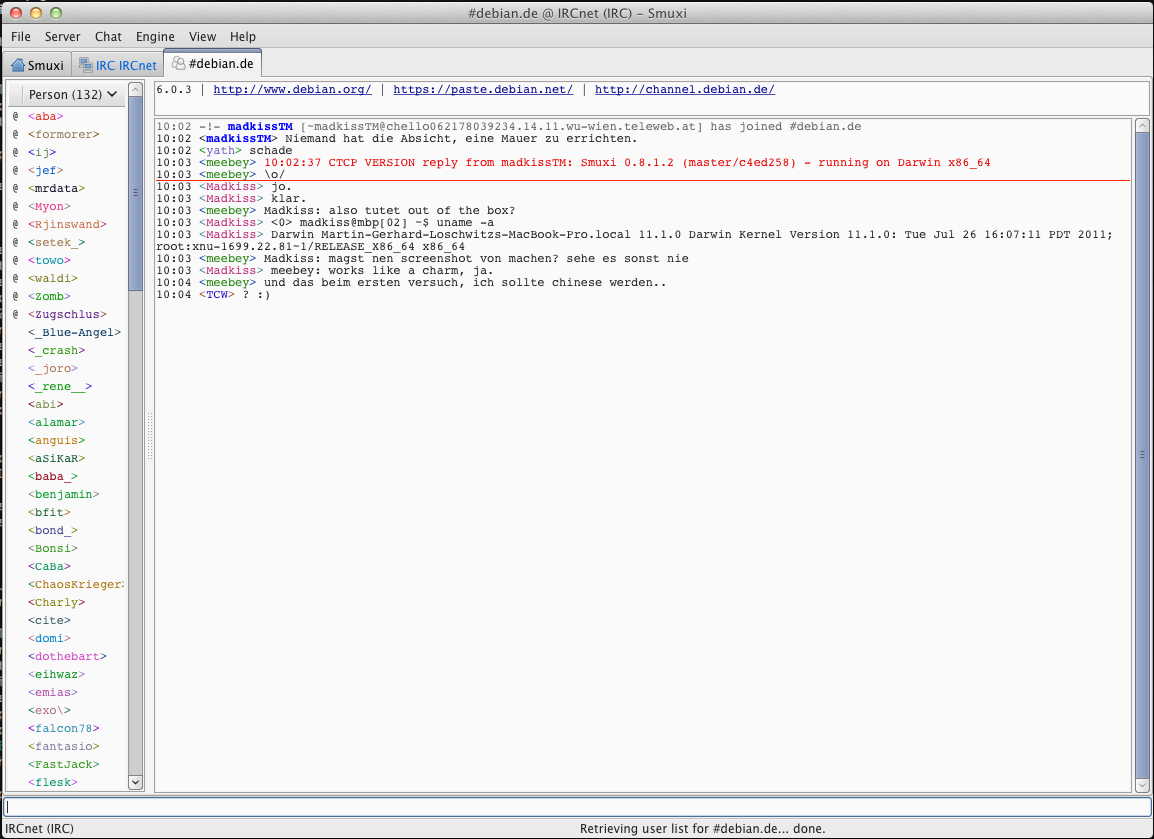
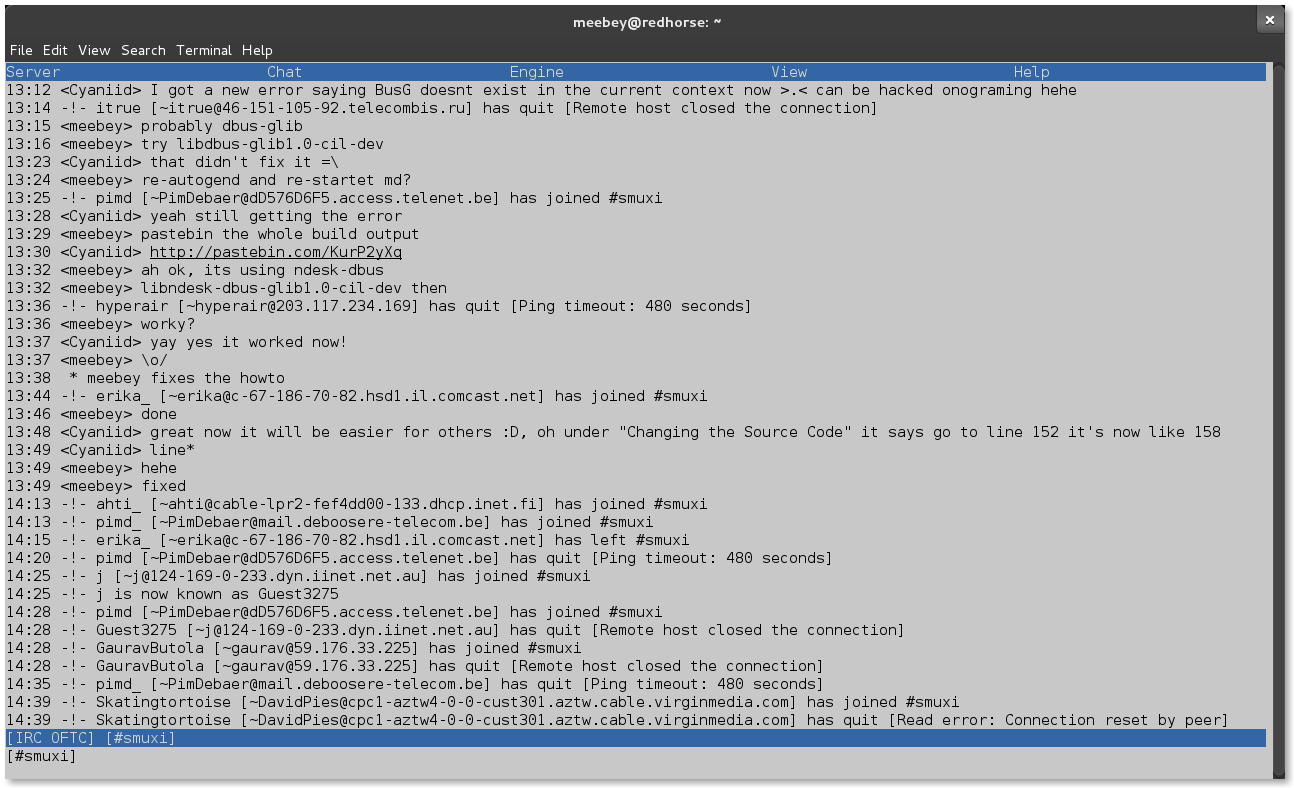
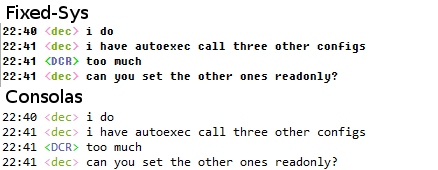
Just in time for 2012 I am very pleased to announce Smuxi 0.8.9 codenamed "One Giant Leap". During the development 56 bug reports and 33 feature requests in 593 commits were worked on making this release a major milestone of the Smuxi project. At the Chaos Communication Congress (28C3) in Berlin I was doing the final development sprint to get 0.8.9 done, which was a very intensive and refreshing experience. Here are the highlights of this release: Development Builds / Rolling Releases After the 0.8 release it became clear that a continious and short development -> test cycle is important to keep the project going quickly. At some point I have received requests if the project is dead while it was more active than ever. The lack of new releases (for about 15 months) lead to this wrong impression. Thus Smuxi can be obtained from development builds now. This includes daily builds for Debian (Squeeze, Wheezy, Sid), Ubuntu (Lucid, Maverick, Natty, Oneiric, Precise) and Windows. Thanks goes to Hannes Tismer for providing the Windows autobuilder and to Canonical for the PPA autobuilder. We invite everyone to use these daily builds to keep track of the latest development of Smuxi. Issues and regressions are fixed in a very short period (usually the same day). Thanks to our users who ran development builds and reported issues which led to many bug fixes prior to this release. On the other hand one of my New Year's resolutions are to "release early, release often" So there should be no nerd left behind... Screenshot of Smuxi 0.8.9 on Mac OS X Mac OS X support With the help of Steven McGrath (Steve[cug]) who created the initial Mac OS X installer for Smuxi we now have official support for Mac OS X. The download page contains the instructions how to obtain and install Smuxi on Mac OS X. This makes the 4th platform where Smuxi can be used on besides Windows, Linux and *BSD. For now Smuxi 0.8.9 doesn't feel as native as it could as it relies on the GTK+ port. We are looking into enhancing the experience though, just stay tuned. Chat History on Disk (Beta) The most exciting feature in this release I think are the "persistent message buffers". With this feature I could solve one of the biggest drawbacks IRC ever had: IRC does not retain any messages you have sent or received. All messages are only relayed to all users. The issue is that if you close your IRC client or even just leave a channel, all your received messages are gone. One workaround in most clients was to create text log files which then contains the chat history, but it is annoying and not user-friendly to open some text file somewhere from your disk to read the history outside of your IRC client. Now with Smuxi 0.8.9 you no longer have this issue, all chat history gets automatically written and read to a message database when you start Smuxi, join channels or open queries! As this feature is not fully stable yet it is not enabled by default. If you want to try it go to: File -> Preferences -> Interface and change "Persistency Type" from "Volatile" to "Persistent", hit OK and restart Smuxi. Now all messages are saved into the database and will automatically be shown. Click here for a screencast of this feature Jabber / XMPP Support (Beta) You probably have friends not on IRC and Twitter, say on Jabber, gTalk or Facebook? This is where the new XMPP engine of Smuxi comes into play. You can send and receive messages to/from them now! The implementation is far from complete, though. It has no buddy list for example and needs only to be treated as a technical preview of what will be coming in future Smuxi releases. Click here for a screencast of this feature Screenshot of Smuxi's Text Interface Text Interface (Alpha) This is the first release that contains a text frontend based on the STFL library. STFL is a library that uses ncurses to draw text based user interface using a markup language (like Glade for GTK+). This frontend is in early alpha state and lacks a lot of interface features and likes to crash. It is still included to attract potential developers who want to enhance this frontend. The frontend can be enabled by passing --enable-frontend-stfl to the configure script and then by executing smuxi-frontend-stfl. NetworkManager Support Everyone with a laptop knows how annoying it can be to suspend and resume when network based applications suddenly go crazy because they have lost the connection and either spew errors or take forever to get back in shape. Smuxi will now detect the network state right away with the help of the new Network Manager support. It automatically reconnects when needed right away for you. Next Generation Internet Support You can now connect to IRC servers using the IPv6 protocol Enhanced Find Group Chat Support Users had real issues to find out how to search for channels, thus Bianca Mix added a neat feature. The /list command will now simply open the Find Group Chat dialog for you. This way everyone used to IRC will find it in no time. Searching for channels on freenode wasn't working correctly, this is now fixed. Smuxi also supports the SAFELIST feature of the IRC protocol now which allows to retrieve a full channel list and do client side search which makes consecutive searches much faster. Enhanced Windows Experience For a long time you could not use Smuxi with the latest GTK# version of 2.12.10 on Windows. The issue was that Smuxi relied on SVG support which 2.12.10 no longer had. Smuxi is no longer using SVG instead it uses pre-scaled PNG images thus it works just fine with GTK# 2.12.10 on Windows now. At the same time the issue that the maximized state of the main window was left when restoring from task bar is fixed with GTK# 2.12.10. Screenshot of Fixed-Sys vs Consolas font Smuxi used by default the FixedSys font on Windows to give it the typical IRC look most people are used to. Since Windows Vista there is a better console-like font available called Consolas. Smuxi will now use the Consolas font instead on Windows Vista or later. Another important enhancement is that Smuxi no longer has issues with multiple GTK+ installs on the same computer, which was getting more common with more popular ported GTK+ applications such as GIMP or Pidgin. SSL for IRC fixed IRC with SSL was only working with the default port of 6697. Thanks to Jo Shields now any port can be used with SSL. Crash Related Issues Desktop notifications could crash Smuxi in case of errors related to the notification system or an absent notification daemon. There was a chance that the crash dialog simply disappeared which made reporting bugs more difficult no longer happens. Rapid use of ctrl+w, /window close (Jimmie Elvenmark) and opening the Find Group Chat dialog on the Smuxi tab do no longer crash. Also number-only network names, /network switch freenode and GTK+ install without SVG support no longer lead into a crash. Enhanced Notice Handling Notices will no longer open query tabs for you instead it will show them on tabs you share with the person who sent it with the server tab as fallback. This also avoids ChanServ, NickServ and spammy IRCop tabs. Twitter fixes Twitter made some changes to their API which broke the Twitter support of Smuxi 0.8. This was taken care of and also a few other issues were solved allowing Smuxi 0.8.9 to work smoothly with Twitter again. Extended Keybindings Smuxi allows now to use the ctrl+tab / ctrl+shift+tab and ctrl+n / ctrl+p keys to switch tabs. The keybindings still work even with a hidden menu bar now. Smuxi Server specific highlights More interactive and much faster synchronization When connecting to a smuxi-server you had to wait till Smuxi finished the synchronization before you could use the interface. Also you could not tell how far the synchronization was and just had to wait till it was completed. With Smuxi 0.8.9 the connect just takes a few seconds and all chats are synchronized in the background with a progress bar so you can use the interface from the first moment on and know how far it is. The speed how much it takes to synchronize all chats also reduced drastictly by 400%! Click here for a screencast of this feature More background communication When using a smuxi-server the interface sometimes had load times like when opening the preferences or when using the nickname completion (Andrew Kannan). These operations are done in the background and no longer blocks the interface. Also when the communication is lost to the smuxi-server the frontend will now automatically reconnect to it in the background. Low Bandwidth Mode When it comes to mobile internet connectivity such as UMTS/HSDPA, Edge and GRPS it can be a real pain to connect to the smuxi-server as it has to transfer all the messages over that. If you just want to ask someone you know then you don't need any old messages to do that. With the "Low Bandwidth Mode" you can now connect to the smuxi-server without loading old messages which makes the connect very quick. You find this option in the engine connect dialog. Stable Protocol Initially I didn't plan to make the protocol of Smuxi stable before the 0.9 release, but as it turned out the 0.8 protocol was good enough to still use it and for that reason Smuxi 0.8.9 is still compatible with 0.8. The 0.8 protocol will see no breakages, instead the next protocol will be on-top or opt-in of the current one. This means future Smuxi versions stay compatible with it. Shutdown Command You can now shutdown the smuxi-server if you like using the /shutdown command. It it safe to use the command, it will do a clean shutdown sequence for you. For example it makes sure all messages are written to disk in the case of enabled persistent message buffers. If you have your smuxi-server daemon monitored (e.g. with runit) it can also automatically be restarted and upgraded this way. Built-in SSH Keyfile Support It is no longer needed to fiddle with the .ssh/config file or pagent to get SSH key authorization working. You can now simply tell Smuxi which SSH keyfile you want to use to connect to your smuxi-server. Updated Translations
  • Catalan (Siegfried-Angel Gevatter Pujals)
  • Danish (Joe Hansen)
  • Finnish (Kalle Kaitala)
  • French (Cl ment Bourgeois)
  • German (Bianca Mix)
  • Italian (Vincenzo Campanella)
  • Portuguese (Americo Monteiro)
  • Spanish (Castilian) (Ricardo A. Hermosilla Carrillo)
New Translations
  • Chinese Simp (Dean Lee)
  • Slovak (Tom Vadina)
  • Swedish (Jimmie Elvenmark)
  • partially Russian (Aleksandr P)
  • partially Turkish (Umut Albayrak)
  • partially Urdu (makki)
Contributors Contributors to this release are the following people:
  • Mirco Bauer (497 commits)
  • Tuukka Hastrup (10 commits)
  • Bianca Mix (10 commits, translations)
  • Cl ment Bourgeois (8 commits, translations)
  • Andrius Bentkus (5 commits)
  • Carlos Mart n Nieto (3 commits)
  • Jimmie Elvenmark (3 commits, translations)
  • Hannes Tismer (1 commit)
  • Jonathan Pryor (1 commit)
  • Jo Shields (1 commit)
  • Siegfried-Angel Gevatter Pujals (translations)
  • Dean Lee (translations)
  • Aleksandr P (translations)
  • Americo Monteiro (translations)
  • Andrew Kannan (translations)
  • Joe Hansen (translations)
  • Kalle Kaitala (translations)
  • makki (translations)
  • Ricardo A. Hermosilla Carrillo (translations)
  • Tom Vadina (translations)
  • Umut Albayrak (translations)
  • Vincenzo Campanella (translations)
Thank you very much for your contributions to Smuxi! After reading this whole pile of text, head over here and grab this smexy stuff!
Posted Sun Jan 1 22:58:29 2012

Craig Small: procps-ng version 3.3.2 released

procps-ng version 3.3.2 was released today. This version fixes some bugs introduced in version 3.3.1 as well as a number of enhancements. Below is the most significant set of changes that 3.3.2 brings. NLS The most visible change is that procps-ng is now international. The NLS changes took a long windy path but we got there in the end. This means all procps-ng programs can now use standard gettext PO files to output in any supported language. While the programs have been enabled for translations, there are no po files as yet but we expect them to follow soon. Library Changes procps always had a closed library, meaning that it wasn t supposed to be used for other non-procps programs. This meant the library was always called libprocps-(version) rather than using a SONAME. Procps 3.3.2 now uses a SONAME of version 0.0.0 The API hasn t changed but it will be in subsequent versions. Patch Backporting Due to the stagnant natute of procps development in the past, there have been a large number of patches each distribution carries for procps. A significant number of patches have been incorportated into procps-ng, giving a more consistent look across the distributions and meaning any subsquent fixes or enhancements are done in one place. A major goal of procps-ng was to reduce the number of distribution specific patches which this change has helped greatly. debian Packages The Debian packages will be worked on soon and will clear up some confusion about the procps binaries and library packages as this will now be split into two. It also means that some programs that depend on libprocps will break, but going on from this point will be able to use the normal shlibs process to manage that, rather than the ugly crunch we will have now.

Robert Collins: Public service announcement: signals implies reentrant code even in Python

This is a tiny PSA prompted by my digging into a deadlock condition in the Launchpad application servers. We were observing a small number of servers stopping cold when we did log rotation, with no particularly rhyme or reason. tl;dr: do not call any non-reentrant code from a Python signal handler. This includes the signal handler itself, queueing tools, multiprocessing, anything with locks (including RLock). Tracking this down I found we were using an RLock from within the signal handler (via a library ) so I filed a bug upstream: http://bugs.python.org/issue13697 Some quick background: when a signal is received by Python, the VM sets a status flag saying that signal X has been received and returns. The next chance that thread 0 gets to run bytecode, (and its always thread 0) the signal handler in Python itself runs. For builtin handlers this is pretty safe e.g. for SIGINT a KeyboardInterrupt is raised. For custom signal handlers, the current frame is pushed and a new stack frame created, which is used to execute the signal handler. Now this means that the previous frame has been interrupted without regard for your code: it might be part way through evaluating a multi-condition if statement, or between receiving the result of a function and storing it in a variable. Its just suspended. If the code you call somehow ends up calling that suspended function (or other methods on the same object, or variations on this theme), there is no guarantee about the state of the object; it becomes very hard to reason about. Consider, for instance, a writelines() call, which you might think is safe. If the internal implementation is for line in lines: foo.write(line) , then a signal handler which also calls writelines, could have what it outputs appear between any two of the lines in writelines. True reentrancy is a step up from multithreading in terms of nastiness, primarily because guarding against it is very hard: a non-reentrant lock around the area needing guarding will force either a deadlock, or an exception from your reentered code; a reentrant lock around it will provide no protection. Both of these things apply because the reentering occurs within the same thread kindof like a generator but without any control or influence on what happens. Safe things to do are: In Launchpad s case, we will be setting a flag variable unconditionally from the signal handler, and the next log write that occurs will lock out other writers, consult the flag, and if needed do a rotation, resetting the flag. Writes after the rotation signal, which don t see the new flag, would be ok. This is the only possible race, if a write to the variable isn t seen by an in-progress or other-thread log write. That is all.

Niels Thykier: Britney in 5 minutes

About 26-28 hours ago in #debian-release on IRC:
<nthykier> damn, a britney run in 5 minutes
<adsb> they happen
<adsb> you've been spoilt by never seeing b1 at her "finest" *cough*
<aba> you mean, running for more than a day?
<Ganneff> adsb wants night-long runs?
<aba> I can remember runs where we had to block certain packages to
      make sure the run could actually end *sometimes*
<adsb> I'm quite happy with just the memory of that sort of run,
       thanks :P
<nthykier> I don't mind being spoiled if it stays at 5 minutes :P
I took the liberty of collecting the resulting data for the Britney test suite. In its reduced state[1] in runs in 30 seconds on my machine. It is already my favourite live data sample in the test suite. :D [1] Only i386 and amd64 are considered, manual hints are ignored etc.

Next.

Previous.