Search Results: "az"

3 August 2006

Biella Coleman: In between pride and anxiety: the state of South Africa

Writing blog entries in South Africa did not come so easily, mainly for technological reasons. While for the first 4 days of my trip I had steady Internet access, most of my time was spent enjoying the Law and Society Summer Institute. Once over, I headed from Joburg to Durban and my access became much spottier, not to mention that Bernard, my indefatigable host, made sure the days were filled seeing the gritty but beautiful urban beach town, hanging with the crew of University of Chicago students/graduates that descended upon the city, and having a go at sufring in the Indian Ocean. In the evenings, I did have some free time, but they were too chilly for me to do much of anything but burrow myself deep under a small mountain of covers and pass out after a day filled with plenty to do and see. The theme of the conference I attended was the intersection of rights and regulations and given the Summer Institute was held in South Africa, it was not all that surprising that much of the conversation centered on one class of rights, those of human rights. Since the end of apartheid, SA has become a particularly-impossible-to-ignore beacon for human rights, and acts as a sort of modern guiding light that has defined the meaning and institutionalization of human rights post-WWII. So if WWII and the Holocaust represent the generative genesis of human rights, South Africa represents a new era of human rights, a place that revisited, rejuvenated the discourse and implementation in a post-Apartheid Constitution that has been touted, world-wide, as exemplary for its generous commitment to equality and other rights. In this respect, one feels, quite everywhere, the collective pride of a nation who managed to end a brutal regime and it did so under the gaze of world who followed the drama on TV screens, college campuses, and newspaper headlines. As SA has moved to another era of picking up pieces and trying to build a more equitable society, many in the world are still eagerly watching. But pride does not stand alone, in isolation, for it mixes with other collective sentiments. The collective admiration and pride of a nation, like the sweet water of a river, visibly and freely mixes with a more salty frustration and anxiety to produce an in-between brackish state of affairs. Pride in other words sits alongside social anxiety, which palpably manifests at different registers and tones, to texture the cultural and political landscapes of SA. The frustration follows from the fact that many are still living in dire poverty and in the last ten years, many steady jobs have vanished. Shantytowns, the symbols and material conditions of apartheid, are still omnipresent (though very well hidden from the middle class and the rich). The ruling government, while having roots in communism and socialism, has to contend with a world-wide regime of neoliberal governance and, thus, must try to balance satisfying commitments with the outside world with delivering promised goods to its population, demands that often run uncomfortably counter to the neoliberal logic of deregulation and financial austerity. Alongside this or perhaps as a manifestation of it, the talk of the town, especially in Johannesburg, is of the rampant crime. As a sign of crime and fear, most middle-class and wealthy houses are adorned with metal fences, barbed wires, electric fences, and a simple sign from private security companies (Chubb being the most common in Johannesburg) that announce they provide armed response security to break-ins. This is serious stuff. And while some of the fear of crime is a self-perpetuation exaggeration of itself (and as my friends explained, before the end of Apartheid the monitoring of crime was not as common, so crime statistic can only go one direction, up), it has in certain parts of cities spiraled out of control. And if there comes a time when the crime abates, the architecture of barbed wire and security services is now really an architecture-in-place and will be hard to dislodge from the mental and physical spaces of SA. So more than anything else, I found that the vibe of SA seesaws between pride and anxiety. As a visitor, you are enveloped in this dyanmic duality. You can’t help share in the pride now enshrined in national monuments and museums. But at the same time, you also are not sure what path the nation is heading in and you too share in the fear of crime and move your body and belongings cautiously through the cities. There is no doubt of the governmental commitment to provide services like health care and housing, a commitment that in places like the United States seems to exist more like an endangered species on the brink of perpetual extinction. And so it was awfully refreshing to be in a place where talk of such things is not seen with a suspicious eye that in the US is often tagged as something that runs counter to the realization of freedom and a just society. But whether these important goals can be brought into the plane of existence is another question, one that is not unique to SA but is something that many other countries, especially Latin American countries, from Venezuela to Bolivia are also asking and trying to answer. Bernard and others reminded me that South Africa is number 4 in terms of producing new millionaires, which is quite a remarkable statistic given how many nations there are in the world. But despite the poverty of the place, this wealth is evident and there was one place in particular that symbolized this: Melorse Arch. Located in Johannesburg, this is a lifestyle compound/gated community that mixes posh residential condos with posh restaurants and bars. To tell you the truth, I have never seen anything like this and it was probably been the most extraordinary thing I saw in South Africa. The United States and Puerto Rico (where I am from) and undoubtedly many parts of the world are no strangers to gated communities. But Melrose Arch took the implementation of them to a whole new, somewhat disturbing, level, in part because the domestic sphere of expensive housing co-mingles so intimately with sites of accentuated consumption, reminding visitors that the point of life, (hence the name lifestyle) is to make money so as to consume, and to do so lavishly. And what brought this really home was that the South African Bond Market was also located here in Melrose Arch. In fact we could see the building clearly from our restaurant, which proudly displayed a large Elephant statute (which, I think, harkens to the large bull in Wall Street NYC). I guess if you are a bond trader, and dislike commuting, and like good places to eat, well this is the place for you as you don’t ever have to leave your complex. Work and play become seamless and thus this place is perhaps one of the most powerful signs that the point of work is to play, is to consume, so that a perfect cycle is reached in which making money is a path for self-pleasure (or at least nuclear-family self-pleasure), a form of life, that does not have to engage with the rest of society, literally. Of course, there are many layers of production that do exist and make a place like Melrose Arch possible yet are well hidden from the visitors and residents of the compound. But Melrose Arch is not fully gated. It is open to outsiders so they can enjoy the fine dining, and if you sit in one of the many outdoor tables, one can fully take in the glittering performance of this social cycle, and for some, undoubtedly it is a measure for and of the good life, the right life, that to which others will aspire. What I find interesting about the place is that it captures, with unmistakable clarity and precision, the point of much of neoliberal economy, especially the love for finance (in which money seemingly is made out of nothing), a robust service economy (the service in the restaurant was unlike anything I have seen, with people bring you ceramic jugs of water to wash your hands, live entertainment, outdoor fires, and blankets, henna painters etc), and consumptive pleasure. To drive home the point, in Melrose Arch, there is not even a supermarket; lest there be any mistake, this place was constructed as a place of consumption, through and through. There were many other posh areas in South Africa, and as I mentioned earlier, the impoverished areas were kept a distance from middle class neighborhoods, so much so, that in some areas, like Cape Town, you really had to go out of your way to see them (again this is very different from many parts of Latin America where, in an instant, poor neighborhoods switch to wealthy). On the other hand, quite visible were things like malls and there were a lot of them. Apparently South Africa has been a testing ground for the modern mall. To get to the malls, there are very good roads to travel (much better than most of Latin America) and other basic services like tap water, and infrastructure like airports and phones, are in excellent condition. So it was somewhat surprising and frustrating that Internet services outside of business are somewhat scant, expensive, and slow. Sure Internet services are the best in Africa and you can get Cable, ADSL etc. at home but you have to pay a pretty Rand for it and on top of it, the access is pretty slow. Now, there are many parts of the world where this is the case (though apparently in a study that compared 12 countries at a similar lever of development to SA, Internet access was 10 times more expensive in SA than the most expensive country which was Chile), but for me, it was the juxtaposition of having such solid infrastructure and wealth mixed with lackluster Internet access that made it somewhat odd. And it also made me realize how much the Internet and access to it had not only saturated my life, but how I have come to see it as a something creeping close (though not the same) as a basic right. Of course, security and self-determination, food, shelter, and health services are for me are the basic architecture of human rights. Without these, existence in the most basic sense becomes difficult. Access to the Internet, though in no way is indispensable to the basic conditions of living, can at least greatly facilitate the type of political work and organizing needed to demand other basic human rights. In this sense, it is more like an extension of or at least serious complement to basic services like clean water, and it seems like once there has been an investment in securing fiber optic (which I am sure is pricey), the cost of maintenance compared to physical infrastructures is so much smaller that it is really worth the initial costs. This bring up some difficult questions and vexing specters related to many of the human rights (in the Universal declaration), which are I think not so much so how to define them in a general sense (I think this has been laid out somewhat well) but how to specify them so as to realistically implement them . On the one hand, the flexibility and vagueness of human rights is what gives it tremendous currency. Folks around the world have wielded the discourse of human rights to make demands that resound strongly and profoundly. But once a proclamation of a human right has been made, like article 25:
Everyone has the right to a standard of living adequate for the health and well-being of himself and of his family, including food, clothing, housing and medical care and necessary social services, and the right to security in the event of unemployment, sickness, disability, widowhood, old age or other lack of livelihood in circumstances beyond his control..
it seems like the real hard work is about specifying and implementation. We may easily agree that an adequate standard of living may not be Melrose Arch but it still does need definition and a plan for implementation. And so there seems to be plenty of room in human rights politics to move from the state of declaration to that of strategies of implementation.

Biella Coleman: Photos from South Africa

I have put a few photos of South Africa up. Some of my favorites are: joburg sunset Bill Gates in Tighty Whitey’s painting of Nelson Mandela with friends at the NSA in Cape Town with Anne-Maria amazing table mountain

2 August 2006

Roland Mas: New blog categories

After large amounts of peer pressure from Rapha l Hertzog and other French Debian Developers, I finally created a new geek-fr category in this blog. The old geek category was renamed to geek-en for consistency, and both are now subcategories of a new geek category. I think that means you'll get articles in both French and English if you just read geek. Same applies for the RSS feeds, so you may like to update your feed readers and aggregators (I already updated Planet Debian). The new geek-fr subcategory will contain articles in French, as you'd expect, and will probably be more related to French-specific events. I'll post another announcement in French in a few minutes.

Aigars Mahinovs: Dell Inpiron XPS M1710

Well, now I am a proud owner of a one of the most powerful laptops available under two grand. Core Duo 2.0 Ghz, 2 Gb RAM, 120 Gb HDD, 1900×1200 17″ screen and NVidia 7900 GS. I am just loving it. It did come with Windows and lots of ther crap which I removed right away. I did reinstall Windows (XP Media Center) to see how it works (it’s been a long time :P ) and for some gaming (HL2: Episode One in particular, it’s been a long time :P ). I also installed Ubuntu Dapper as the primary workspace (as something stable, quick to set up and boringly non-experimental). Debian as the development platform and primary experimentation base and one more 5 Gb partition stayed free so that I can try out other stuff (like Gentoo) when I feel like it.
I must say that installing Ubuntu, Debian and Windows in quick succession was a very, very interesting experience. I am considering repeating that and writing down everything with plenty of unusual screenshots to trully compare the experience. I must say that Ubuntu fared the best with Debian following in a very close second (mostly due to minor laptop problems on installation) and Windows being waaay behind on usability and installlability with all kinds of wierdness.

Isaac Clerencia: Beach, driving license exam, books, Akademy

So I was having these great holidays in the beach with some friends, getting a tan, swimming in the sea, chasing some fish wearing really-big-nose water goggles, drinking beer by the seaside, … but I had to come back to Zaragoza to take my driving license exam. I’ve gone to the driving school today to ask what time was the exam taking place exactly, and I’ve been told that the exam has been moved to Monday (can this happen in any other European country besides Spain?). As I only have holidays this week, I can’t attend my exam next Monday, and thus, the whole thing sucks, specially the getting-back-from-holidays-sooner bit. To keep my karma up and given the fact that I’d some free time to spare as I no longer needed to study for the exam, I’ve visited some bookshops and purchased some books (namely, The Ages of Lulu, Fahrenheit 451, The adventures of Huckleberry Finn and Notes from a Small Island), and then I’ve gone to the park and read for a while (actually, I’ve finished reading Wilt, by Tom Sharpe, which I started reading yesterday in my way back from the beach). I’ve thought about blogging about the books I read, although I’m not sure if I’ll manage to do it. In the end, it has been a nice day and I’ve come home quite relaxed again. With regard to free software stuff, Wesnoth 1.2 is going to be released really soon now, as well as KOffice 1.5.2, I’ve already registered for Akademy 2006 in Dublin, I created my first attempt of flake plugin some days ago, …

Daniel Burrows: Amazing the things you learn when you fiddle

I recently bought a new laptop, specifically a Fujitsu P7120 (based in large part on Joey's plug for it). I'm generally happy with it, but I haven't been able to get the headphone jack to work.

Today I had a few minutes and was fiddling around with it, when I noticed that there was an extra column in alsamixer labelled "headphone jack mode". This isn't a volume bar; it just displayed the text "50". Just on a whim, I tried hitting "up" on it, and quickly cycled through "80", "Line In", and then "Line Out". Jackpot! All of a sudden, sound started piping out of the headphones.

So, just in case anyone else is puzzling over this problem, make sure you've checked ALL the knobs alsa lets you turn!

I still wonder why alsa is defaulting to using a headphone jack as a microphone input...but I'm not so curious to, say, stay up even later trying to figure it out.

John Goerzen: Fire updates

Whew. Lots has been going on the past couple of days.

First, many thanks to all that sent us e-mails, comments, and notes. We appreciate it! It's nice to have people the care.

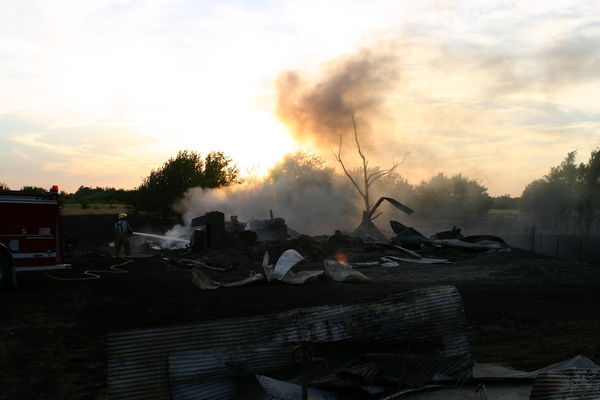
Next, in addition to the first set of fire photos I posted, I have now added more photos: a second set of fire photos. Note that there are two pages to that as well.

I've also added some photos to the Grandpa's Farm set -- this shows what things looked like back in April, before the fire. The buildings that burned are the barn, calf barn, and chicken house.

On to the updates...

Monday I went out to the farm first thing in the morning. Some areas were still smoldering -- basically wherever there was hay. It was a bit concerning. I went up to the 2nd floor in the house and took some photos of the yard.

I headed on in to work. Later in the evening, I went back out to check on things. Two fire fighters were back out there with a fire truck dousing the remaining smoldering areas. Apparently the fire fighters had been checking on the place intermittently all day and had been out there with water earlier as well.

The Goessel Fire Dept. is an all-volunteer department. These people aren't getting paid for this, and they do an EXCELLENT job. Someone was out at 1AM Monday, again at 10AM Monday, then twice more with the truck. They did all this on their own -- I hadn't asked them to. It is amazing how much these people care about the community and taking care of fires.

I also never knew how long bales of hay burn.

Here's one of the new photos:

1 August 2006

John Goerzen: Asterisk: The Software Phone Company

Issue 13 of Free Software Magazine is out, and it includes my article Asterisk: The Software Phone Company. If you're interested in running your own PBX in software, check it out.

Erich Schubert: Recently bought music

My latest music CDs (of course already ripped to my Ogg Vorbis player... CDs suck usability-wise, actually...): Sing when you're swinging
Sing when you're Swinging
Two CDs - the second is titled "(If you can't sing it) You'll have to swing it" - with recordings of the swing era. Some slow, some better for dancing. Rather cheap, and well worth the money unless you have many songs of that era already. Pop Swings
Pop swings
This CD is a mixed bag. It's swing covers of well-known songs of the 70s-90s. Some work great, others don't. A lot is personal taste, depending on the memories you have of the originals or how you liked them. If you didn't like the original, you might like the swing cover. If you loved the original, you'll likely hate the cover, just like any cover. The funniest thing is that one artist, Paul Anka, is on the CD in both roles, as cover artist (Smells like teen spirit) and as original artist (Diana). This is a CD you can't really listen to on-block (thats why CDs suck) or play on a party. You'll usually pick some specific songs. Perfect for parties
Perfect for parties
The full title is
Bear Family
"Perfect for parties
Highlight Album
This CD was the surprise CD. Very cheap, but very convincing. It's odd and fun at the same time. Actually it's probably as much country as it's rockability and swing. But who cares when you can have lots of fun with it? The song I like currently like best is "Burn that candle" by Charline Arthur. Note: above amazon.de links will earn me a tiny commission. It would be nice if you'd use them if you plan to order some of these CDs. Thanks. It will certainly never pay off, but when I set links I can as well set some that might allow me to buy myself a CD from it sometime later, too. ;-)

Gunnar Wolf: Israeli mistakes

Reading Jordi's blog, I cannot but agree with him (in most points): I plainly cannot understand Israel's actions in the last weeks. I can sadly understand how some people defend them, specially people not living in Israel - I was talking with a friend today, a friend who does not share a single political viewpoint with me, but still... The world seems to be completely polarized. Some have the impression that Israelis live under constant shelling, that life is unsustainable in that poor country, the last corner of civilization in that mess called the Middle East, and that the Arab countries (which are huge and petroleum-rich) just want to throw Jews to the sea or worse. The rest of the world think that Israelis are mass-murderers who decided to take a heavily populated bit of land and martyrize its originary population by any possible means, establishing an Apartheid.
Both views are false. But of course, both views hold their bits of truth.
I cannot claim to be neutral on this: Although I lived there in total for ~18 months, I am an Israeli by choice (I adopted the Israeli nationality in 1996 and wanted to live my life there - I came back to Mexico for personal reasons, and I later decided to stay here). I have not been to Israel since then - But I try to keep myself informed. And, living in a Jewish family, it's hard not to be somewhat informed - and of course, shocked at your relatives' opinions. Jews outside Israel tend to be right-wingers. I lived in a kibbutz, and I still sympathyze with Meretz, the most leftwing Zionist party.
I won't restate what Jordi eloquently said. I know not everybody who reads my blog reads Jordi's as well - Please do. If you missed it some lines above, here is the link. I insist: I agree with most of what he wrote. What could Israel do to protect itself from its enemies? The answer is simple: Don't give them a reason to hate you.
One year ago, I was optimistic because Israel was heading the right way. Of all people, Ariel Sharon (one of Israel's most hawkish, right-wing strongmen of all times) decided to withdraw from Gaza, and hinted that areas in the West Bank would follow. No, not the best way possible, not as his predecessor Menahem Begin did with Egypt leading to a strong and long lasting peace, and certainly not in the very notable way Itzhak Rabin did with Jordan, getting peace and even friendship. But at least, Sharon accepted the reality, and seemed he meant to let Palestinians build their state. When he organized a new party which reduced Likud to a shadow of its past, one of Israel's most prominent figures for the peace camp, Shimon Peres, joined. Amazing.
But still, there is too much hatred. Of course, life in Gaza is plainly not sustainable. You can walk the Gaza strip side to side in less than one hour, and North to South it's less than 50 Km long. Still, over 400,000 people live in there. The area is simply unsustainable.
Gaza depends for everything from Israel. Of course, according to the never-stable security status, the border between Gaza and Israel opens or closes every day. When I lived in Zikim, mostly every day there were five or six Arabs working with us... Except for the days when they weren't there. And, of course, Israel also depends on the Arabs for much of its hard labor jobs (as it's always the case when two economically disparate populations live together).
Anyway, back on track: Besides giving the Arabs their slice of land (which in a squeezed area as Israel is always hard; people have fought for such small spaces it's hard to believe), the only thing Israel can do is help them. It has worked before: Israeli Arabs (the Arabs living inside the internationally recognized borders of Israel) are full citizens. Yes, there is racism in the country towards them, and yes, they are not really equal with Jewish Israelis - But they have voting rights, they have the right to be elected, they can optionally join the army (it's not compulsory as it is with the Jewish population), and they get government aid. Arab towns are poorer than Jewish towns, yes, but they have their dignity.
The problem in Gaza and South Lebanon (somewhat less so in the West Bank, but also) is that it's plainly all made up of refugee camps. Refugees that were born there, and whose parents were born there as well. And, let me emphasize this, they are not Israel's fault. The refugees fled the newborn Israel because the Arab states said (in May 1948) they would enter Palestine and butcher everybody, inviting Arab civilians to flee and then get back home - of course, 700,000 (out of 1,300,000 who lived in Palestine by then) Arabs did so. And when the Arabs lost the war, the Palestinians were denied citizenship by all the Arab countries except for Jordan (not surprisingly, the most stable of them all, and with which Israel has the closest relation). They were given refugee camps to live, one over the other. When Egypt signed the peace with Israel, it demanded back every inch of the Sinai - But not an inch of Gaza. And not a single Palestinian refugee.
I agree here with Jordi as well: There is a huge military operation in Gaza, but it's more spectacular in Lebanon today. The media talks about Lebanon, but not about Gaza. And the crisis in Gaza is not easier. But how can it be solved in a permanent way? Israel does neither have land to spare to give to the Palestinians - and even if it did, most of Gaza is surrounded by the Negev, a desert where it would not be easy for them to get anything better than what they have inside Gaza. As desirable as it would be to have a completely independent Palestinian state, Gaza would just remain a concentration camp. There is too much hatred, and neither Arabs nor Israelis want to keep working together, not trusting each other. The only solution I can find to this is to have an agreement with Egypt, where Egypt opens its border with Gaza, gives either nationality or work permits to Gazan Palestinians, and Israel injects capital to develop Northern Sinai, to give some hope of survival to the almost half million people.
The same in Lebanon: Israel was widely applauded to withdraw from South Lebanon in 2000. The area is mostly peaceful - For $ DEITY 's sake, what is the kidnapping of two soldiers in a six year period compared to soldiers being killed in the occupation army every week or two? Israel did well to leave Lebanon. Lebanon was starting an incredible national rebuilding process, as Robert Fisk tells us (Spanish only. I could find only the first paragraphs of the original English version, which appears to require subscription) of the wonders of the rebuilding process, reduced to rubble again. Of course, Israeli and Syrian armies left Lebanon. The Lebanese government and army are plainly too weak to care for the country. Hezbollah (which, indoubtely, is a terrorist entity, no matter how many benefical aspects it does have) have poured tremendous amounts of money to rebuild its area of influence, South Lebanon. Of course, they rebuilt, healed and educated with a strong ideological inclination, and that's not good for Israel. What can Israel do to leasen the Islamist influence? Simple: Send aid. Don't just leave. Don't leave a void, don't invite bad people to loot, don't invite extremist people to recruite future bombers. Turn occupation into aid. Build hospitals. Build houses. Give money, give infrastructure. Do it behind your back, as you gave money to the South Lebanon Army for almost 20 years. But make the people see you don't want to kill and rob them - Make the Lebanese Arabs feel their neighbour as a friend, although different. Bring back the good border. What's that? That's the nickname for the Lebanese border between +- 1950 and 1970 - The only border that was stable, that was not filled with hatred, where Israeli doctors treated Lebanese patients across the fence. And still today, the border is just a simple fence.
How can you convince a people of not killing themselves to kill the invasor? Don't act as an invasor. Act in all your best self-interest - Save them from poverty and from indignity.

31 July 2006

Rob Bradford: Lots of laughs (and not so many)

This weekend was quite a social razzmatazz. On Saturday night myself and two of the other interns I share an office with went to see the Laugh Olympics (they don’t appear to have a website) an English speaking improvisation show. In which the “Eastside” compete against their “Westside” counterparts in a series of improvisation sketches. The referee seeks various suggestions from the audience that are then incorporated into the act, all vaguely reminiscent of Radio 4 panel games. It was a fantastic experience (and very good value too, just 5), I intend to insist on taking everyone who comes to visit me to see it. It is on every Saturday, 9pm just off Rosenthaler Str. Full details can be found in the July edition of New Berlin Magazine. On Sunday we went to see Pirates of the Carribean at the Sony Center at Potsdamer Platz. It was rubbish. Don’t bother. It was just a setup for the third movie, very Matrixesque. After the film I cheered myself up by eating a Teutonic D ner, much much nicer than the British variety. And much much cheaper too ( 1.30- 2.80).

Jordi Mallach: Qana, Lebanon

I've been watching the Lebanese bloodshed since it started. It really makes me sick. I have discussed this with many friends. There was little discussion though: we all thought this is a plain war against civilian targets. I tried discussing with people who could maybe be more supportive of the Israeli points of view. I tried talking to some of my right-winger relatives... and I haven't been able to find anyone that can say a word of support of what Israel is doing in Lebanon. In three weeks, I have seen how Hizbullah killed some Israeli soldiers in some area around the border between Lebanon and Israel. As far as my (as an international online paper reader) judgement can tell, the location where this happened is disputed. Some say it was inside Lebanese territory, the others say it was an Hizbullah incursion into Israeli soldiers. I really don't care. The immediate result of this action was a campaign of air strikes against Beirut and other Lebanese cities aiming to give a measured response (cache, and beware this is explicit) to Hizbulla's aggression. This, apparently, included destroying any vital infrastructure in heavily populated areas of Beirut, including bridges, power plants, hospitals and apparently random buildings. While the Israeli army said the military operations were aimed to get rid of the Hizbullah camps and infrastructures around the border where they fire their rockets against Haifa and other Israeli cities, and their headquarters in Beirut and other southern cities, what the world espectated during the first three or four days of air strikes was pure horror. Hizbullah-controlled areas were like ghost quarters, so any bombing of those were very unlikely to take any Hizbullah victims. On the other hand, the rising number of civilian victims was the first bits of news that I could hear in my radio as I woke up every morning. All of this, with a great amount of cinism and unlimitted cruelty. The Israeli army declared that the civilian population in the South should be leaving their homes (measured response), while they knew they were doing exactly what was needed to prevent this, by locking them up around destroyed bridges, harbours, airport and roads. The first columns of the lucky refugees who could afford fleeing to the North were greeted by Israeli bombs, leaving a good number of scattered bodies. In Spain, the news shocked the public opinion and Zapatero, along with Chirac (IIRC), declared those actions were untolerable and unproportionate, and should be stopped immediately. This brought some local politics fun, when on one side the Israel ambassador in Spain accussed Zapatero of being antisemitic, and the right-wing leader Rajoy called the thousands of people who spontaneously demonstrated against the war in a few cities "clowns" and "ignorant". Watching what the UN has done to stop these warcrimes, I really think it's a great moment to shut down that useless organisation and let some big corporation buy their nice building in New York City to build their offices in it. Once again, when some countries tried to come up with some resolution that forced Israel to stop, the United States waived their vetto flag. Once again, the Security Council has done nothing to put an end to another chapter of violence in the Middle East. The vettoing powers of some of the members is so ridiculous that it makes it totally inoperative. So, as the UK and US governments were not going to do anything to stop the air strikes, Israel had carte blanche to do whatever they wanted for a week. And then, Israel's measured response destroyed one of the UN's buildings in Lebanon, killing four annoying observers, despite their calls warning that the bombs were falling too near their location. Only then, the United States decided to send Condie to have a look around the area, surprise visit to Beirut included. I wonder, what phone number must the innocent women and children who cannot escape their cities and towns dial in order to warn the Israeli army about the proximity of their bombed targets? After two visits of Condie to the region, nothing has changed, as the fourth week of operations starts. This is getting on my nerves. I don't, and won't, justify any of the Hizbullah attacks on civilian targets using Katyushas, or the kidnapping of soldiers, or whatever. What I see is that unless Israel takes a radically different approach to their problem, nothing will change either. Violence isn't at least. Apparently, their military operation isn't going well at all, and is not damaging much of Hizbullah's military capacity. What are they going to do? Will they occupy southern Lebanon for 20 more years? The social movements this kind of actions are generating is also very, very worrying. On one hand, I read that around 85% of the Israeli population approve this war and think this is what their government needs to do to make them safe. This is pretty shocking. On the other hand, everyone still in Lebanon, even the Christian community, are united against the attack, helping each other in their survival quest, while the popular support to Hizbullah is rising, with big concentrations of people cheering them in the streets. This is just two years after similar demonstrations in Beirut forced the Syrian military out of the country. While the Israeli war against Lebanon (I won't buy the "It's against Hizbullah" bullshit), sadly all the media, cameras and journalists have given their back on Gaza, which is under similar, but probably more brutal and savage military operations by Israel, as another soldier was kidnapped just one week before all of the Lebanon stuff started. The press doesn't have any news of how things are going in Gaza. The last thing I remember is that the UN was warning about the threat of a humanitarian disaster due to the lack of any kind of supplies in Palestine. If Palestinian kids are starving, the media are not letting us know. Yesterday, 54 civilians were killed in an improvised underground bomb shelter in Qana, most of them being children. The Lebanese civilian death toll must be well over 500 as of this writing, with a ratio of at least 1:10 compared to Israeli military victims. When will Olmert have enough? The only way I see this will end up for good is when the Israeli public realises being at war in three fronts is quite expensive and damages their home economies. Maybe, at that point, people start hearing what the Meretz party minority in the country have been saying for years. Israel has the right to defend itself. This is the official motto of Israeli and American leaders. When this right is extended and abused to the point the main targets and victims are civilians, Israel walks quickly away from a perdurable solution. Today, hostility against the state of Israel is even greater than last month. Hizbullah in Lebanon, Hamas in Palestine, will probably be the winners of the conflict when the bombings end. Not the best recipe for a peaceful future.

Biella Coleman: South African Plug Adapters

I am in the airport in Amsterdam on my way home to the US after a pretty decent nights sleep on the KLM from South Africa. This trip has been simply amazing, probably because I was taken around by locals, most of them who are U of C anthro students or graduate, all of them from South Africa. I have already started to write a few entries but will finish them when I get back. In the meantime, since I started the trip with an entry about an adapter, here is some more information on them. When I was researching the type of adapter needed for South Africa, much of the information on the web indicated that while South Africa took the M plug, one could get by with the British adapter as that is quite common here. I have to say that I never saw that type of plug at all… There seems to be one and only one type of plug so if you do come here, do purchase the South Africa-specific adapter.

Eric Dorland: Fantasia Roundup

I'm a little behind having seen my last film on Monday, but here we go:

Andres Salomon: my new baby

I bought a new bass today, it sounds incredible. A close-up picture, and the the entire thing. It’s a Warwick Corvette (fretless).

Ian Murdock: Two-way email synchronization without Blackberry Enterprise Server?

I’ve been thinking a lot about software above the level of a single device lately, so I set out this weekend to finally get two-way email synchronization working on my Blackberry. My main goal is to have a single inbox I can access from multiple devices without having to ever deal with the same message twice (i.e., if the message is read/filed/deleted/etc. on one client, it’s marked read/filed/deleted/etc. on all clients), with full support for disconnected operation. (I care much less about the oft ballyhooed push email feature—I’m perfectly content to wait 15-20 minutes for email to be delivered.) Since what I want more or less perfectly describes IMAP, I figured Blackberry Internet Service, which uses standard Internet protocols for mail delivery and supports IMAP, would be sufficient, and that I wouldn’t need Blackberry Enterprise Server, which hooks into Exchange and other “enterprise” messaging systems. Unfortunately, I appear to have been wrong. While messages read and deleted on the Blackberry are reflected on the IMAP server, the reverse is, surprisingly, not true (surprisingly because, unlike POP, which behaves similarly in BIS, IMAP is a bidirectional protocol). In other words, when messages are read or deleted on another client (e.g., the Thunderbird running on my laptop), those changes aren’t reflected on the Blackberry; so, as a result, the Blackberry accumulates every message I receive when it’s not in use, making a periodic “Delete Prior” necessary to get rid of all the accumulated junk (which obviously deletes the useful messages too, like, ahem, the ones with my flight information in it). Worst of all, after several days of trying to figure out why IMAP wasn’t working the way I was expecting it to, I discovered this is the expected behavior (see note 5—”Messages deleted from the source mailbox are not automatically deleted from the device”), rather than a bug. What to do? I could obviously break down and upgrade to Blackberry Enterprise Server. I’m not too keen on setting up an Exchange server just for this (which would cost hundreds of dollars, particularly after the cascading upgrades typical of Microsoft products, e.g., I’d need to get Windows Server too). As an alternative, there appear to be a number of companies that offer a BES hosting service. However, the costs add up pretty quickly—another $10/mo. to T-Mobile to allow BES traffic through (the “business tax”), $10/mo. for BES hosting, and $10-15/mo. for Exchange hosting on top of that (BES hosting is an add-on to Exchange hosting in every plan I’ve seen). That’s a grand total of $35/mo. just to get email marked read or deleted on my Blackberry when I read or delete it in Thunderbird. Hrmmph. Another idea is to find a Blackberry IMAP client, but there seem to be a dearth of these. The main one that comes up both in web searches and that’s described in Blackberry Hacks is from a company called Reqwireless which, tantalizingly, was acquired by Google last year but whose products, frustratingly, are no longer available. In any event, I want something that integrates with the Blackberry’s excellent inbox, which aggregates email, SMS, missed calls, Google Talk messages, etc. in a single stream, and I’m not sure if a separate IMAP client will be able to do that. Other observations: This page says that “two-way [Blackberry] sync is coming soon” to Yahoo Mail. However, “coming soon” doesn’t really help me. Funambol looks very promising, but it’s going to take me a little while to wrap my head around what exactly I need to do to deploy it. Not exactly point and click. Scalix offers Scalix Wireless Solution that works with Blackberry and is integrated with the Enterprise and Small Business Editions. At $60/user with no minimum number of users and a free trial, this looks promising too. Zimbra offers Zimbra Mobile, which “includes the ability to leverage Zimbra’s third party mobile partners that offer two-way sync to Blackberry and other devices” (whatever that means). However, I’m assuming this comes bundled with the Network Edition, which is sold with a minimum of 25 users, and that probably makes it unaffordable to an individual user like me. Any other suggestions?

30 July 2006

Evan Prodromou: 12 Thermidor CCXIV

I agree with Destiny -- this letter from wp:Steely Dan to wp:Luke Wilson is just excellent. If only all creative property disputes were handled this way. tags:

Hot in the City tonight It's been a hot last couple of days in Montreal -- I mean, not hot like wt:California or wt:Europe but hot enough that it feels pretty bad. According to Sacr Blues -- one of my favorite books about wt:Quebec -- Montreal has the highest variation in temperature of any inhabited place on earth -- from highs of 40C in the summer to lows of -40C in the winter. We're at the high part now. Yesterday was my Primary Caregiver ("PCG") day, so I took the opportunity to take the baby for a long walk in Parc La Fontaine, under the gigantic poplars, where it's always cool and fresh. We also went for a nice dip in the baby pool. That kept things pretty nice. Amita in the park

Bonne F te Speaking of hotness, last night was the 30th birthday party for my friend Niko Ritoux. Maj and I took the opportunity to do our first evening out as a couple without the baby -- our great babysitter Julia came by with her boyfriend Antoine and took Amita June to a jazz concert at the Theatre de Verdure in Parc La Fontaine. How great is that? Anyways, we had a good night with Niko. We went to Le 2, the teensy but uber-cool bistro-bar our friend Daran co-owns. It's in possibly the most valuable real estate in all Montreal -- the corner of St. Laurent and Sherbrooke -- but it's unassuming and doesn't have that Lower Main clubbed-out fake tan feel. We had a great dinner of "international tapas" -- the little appetizers that remind me a lot of Toqu -style gourmet micro-meals -- and lots of liquor and good fun. I saw a lot of people I hadn't seen in a while -- P.E. and his girlfriend Ode, who were living in Taiwan for a long time; Fred; Daran and his new friend Annie; Joannie; and our own lovely Italian princess the Other Annie. Daran J.F. P.E. and Joannie Niko After dinner (11:30PM!) we hustled up to Bily Kun on Mont Royal and then Plan B across the street. Nicely, for a Friday night, everything was open and airy -- Montreal bars can get so damn crowded, but in the summer everyone's in Cottage Country and there's plenty of room for dedicated barflies. I'm not sure when I got home, but I think Niko had a good time. tags:

And more time Today I spent my time creating data feeds of Wikitravel content for researchers at the University of Zurich who are doing some sort of work on the reliability and development of online travel information. I can't wait to find out how their research comes out. Maj, Amita June and I went up on the Pont Jacques-Cartier tonight to watch the last event in the International des feux at La Ronde. One of the great things about being in Mtl for the summer is this months-long fireworks festival, in which national teams compete every Saturday and Wednesday night. This is the first time I've been on the bridge for the event, and it was amazing -- much louder and bigger than when we've watched from home. Amita June, of course, was dumbfounded by the fireworks -- she gawked open-mouthed through the whole thing. I thought she'd be scared by the lights and noise and the crowd, but she loved it -- reached out and pointed for each explosion, and even said ooooooooh for the big finale. She conked out on the 8-block walk home, which gave Mama and Papa a little extra rest. tags:

GPLv3 and license compatibility According to this article on Linuxworld.com, compatibility with other licenses like the Apache 2.0 is going to be a major focus of the GPLv3 development process. I say huzzah to that. Trivial differences between licenses are a shameful waste of time and energy for hackers who have better things to do. The world needs too much good Open Source software for us to waste time with license incompatibilities. Hopefully this same philosophy will bleed over into the FDL. Creative Commons made an overture for unilateral compatibility between the Attribution and Attribution-ShareAlike licenses and the FDL, which got stony silence from the FSF. It's time to start thinking of the users and playing nice with each other. tags:

Put one foot in front of the other I nearly forgot to mention: Amita June took her first step today. She's been "cruising" (walking around holding onto furniture) for about 6-8 weeks now, and she loves walking around holding onto Mama or Papa's fingers. And she's been spending longer and longer periods standing on her own -- up to about 20-30 seconds. Today, she was standing up, and she wanted to walk so I held out my finger just a little out of her reach. She extended her arm for it, then took two little steps to get to me. Ta-da! Maj and I took turns getting her to stand up on her own then walk to us. She's only got about 3-4 steps in her right now before she freaks out and sits down, but it's still pretty amazing. tags:

Alexander Sack: new kazehakase package fixes grave bug in sarge

I uploaded a new maintenance release for kazehakase (0.2.7-2.sarge2) which is ment to address a top-crasher bug posted in #345905 to my p.d.o. security archive. Once there has been positive feedback, I will upload this to proposed-updates. This makes we wonder … do package maintainers actually care about sarge? I understand that running sarge is not as much fun as working on your bleeding edge unstable/experimental mix. But that does not mean that you can leave grave bugs in sarge untouched for half a year, right?

29 July 2006

Joerg Jaspert: Little changes

Today aj applied two patches to the dak code running on ftp-master i supplied. One got the part in dak that processes NEW up to reality for non-free (well, non-main) debian-installer components, they are now able to go in. The other, more interesting one, affects the mails people receive when a NEW package is accepted. Those now contain an added paragraph, basically looking like the following:
   Override entries for your package:
   foo.deb - optional devel
   bar.udeb - extra admin
   foo2.0-1.dsc - source interpreters
That means you can now directly see if you have a different opinion of the override entries and change your package, avoiding a “Override disparity” mail with your next upload. And just because it was a nice rainy (and cold!) day today, I also went and rejected those two old packages we had in the queue. rte, real time encoder, was the first, and looks like it wont ever get included in Debian, containing non-free code. The other, more flame-attached package, is mplayer - which may get into the archive in the future, but needs a lot of work before that can actually happen. Now - people only need to stop uploading NEW packages, and we are all fine. :) Update: And after aj applied my fix to my override patch people now get the right data mailed…

Christine Spang: Activism

Copley Square in Boston is a busy place on Fridays, it seems, though I would guess it depends on the Friday. Today there was a whole bunch of people gathering to protest Israel’s recent actions towards Lebanon, a couple hundred people on bikes for Critical Mass (which I was there for), and a couple Green Party members handing out “fruit for free,” “soybeans, cherries, and strawberries in the bag!”, wearing some shirts that said something about voting for Ralph Nader. So, the Green Party handed out food to the bikers while we were circling up and getting ready to head out, and the bikers and protesters cheered each other on as we rode by, in a sort of bizarre, random symbiotic relationship. Today was also the first time I rode through the heart of a thunderstorm. We were passing through Harvard Square when the worst of it hit, though it was really obvious that we were heading into the storm a good deal of time beforehand. Some parts were a little like riding blind into a sheet of pins, but it really made the whole thing just a little more exhilarating. Especially when you get to ride through six inches of runoff on Mass Ave. Mmm, puddles. Luckily, I had the foresight to check the forecast and pack my laptop into a plastic bag since I didn’t go home before riding out with a couple friends from the Media Lab. Really, that’s amazingly lucky on my part. I never think of these things in advance. I think, however, that the laptop was the only thing dry in the bag by the time I got home. The ride petered out in the middle of Brighton somewhere, and a guy from BU and I broke off to head back. Neither of us really knew exactly where we were, or how to get back to our respective residences. There is nothing quite like the feeling of being completely lost at dusk, with the whole night before you to find your way back home. It’s a good feeling. IMHO. Provided you’re not lost in a sketchy neighbourhood. After a little while of based-off-the-sun-setting-in-the-west wandering, I was about to break out the laptop and go wifi hunting. Somehow, we just ended up asking for directions at a 7-11. I love friends made in really weird and random ways.

Next.

Previous.