Search Results: "nate"

21 October 2024

Russ Allbery: California general election

As usual with these every-two-year posts, probably of direct interest only to California residents. Maybe the more obscure things we're voting on will be a minor curiosity to people elsewhere. I'm a bit late this year, although not as late as last year, so a lot of people may have already voted, but I've been doing this for a while and wanted to keep it up. This post will only be about the ballot propositions. I don't have anything useful to say about the candidates that isn't hyper-local. I doubt anyone who has read my posts will be surprised by which candidates I'm voting for. As always with Calfornia ballot propositions, it's worth paying close attention to which propositions were put on the ballot by the legislature, usually because there's some state law requirement (often that I disagree with) that they be voted on by the public, and propositions that were put on the ballot by voter petition. The latter are often poorly written and have hidden problems. As a general rule of thumb, I tend to default to voting against propositions added by petition. This year, one can conveniently distinguish by number: the single-digit propositions were added by the legislature, and the two-digit ones were added by petition. Proposition 2: YES. Issue $10 billion in bonds for public school infrastructure improvements. I generally vote in favor of spending measures like this unless they have some obvious problem. The opposition argument is a deranged rant against immigrants and government debt and fails to point out actual problems. The opposition argument also claims this will result in higher property taxes and, seriously, if only that were true. That would make me even more strongly in favor of it. Proposition 3: YES. Enshrines the right to marriage without regard to sex or race into the California state constitution. This is already the law given US Supreme Court decisions, but fixing California state law is a long-overdue and obvious cleanup step. One of the quixotic things I would do if I were ever in government, which I will never be, would be to try to clean up the laws to make them match reality, repealing all of the dead clauses that were overturned by court decisions or are never enforced. I am in favor of all measures in this direction even when I don't agree with the direction of the change; here, as a bonus, I also strongly agree with the change. Proposition 4: YES. Issue $10 billion in bonds for infrastructure improvements to mitigate climate risk. This is basically the same argument as Proposition 2. The one drawback of this measure is that it's kind of a mixed grab bag of stuff and probably some of it should be supported out of the general budget rather than bonds, but I consider this a minor problem. We definitely need to ramp up climate risk mitigation efforts. Proposition 5: YES. Reduces the required super-majority to pass local bond measures for affordable housing from 67% to 55%. The fact that this requires a supermajority at all is absurd, California desperately needs to build more housing of any kind however we can, and publicly funded housing is an excellent idea. Proposition 6: YES. Eliminates "involuntary servitude" (in other words, "temporary" slavery) as a legally permissible punishment for crimes in the state of California. I'm one of the people who think the 13th Amendment to the US Constitution shouldn't have an exception for punishment for crimes, so obviously I'm in favor of this. This is one very, very tiny step towards improving the absolutely atrocious prison conditions in the state. Proposition 32: YES. Raises the minimum wage to $18 per hour from the current $16 per hour, over two years, and ties it to inflation. This is one of the rare petition-based propositions that I will vote in favor of because it's very straightforward, we clearly should be raising the minimum wage, and living in California is absurdly expensive because we refuse to build more housing (see Propositions 5 and 33). The opposition argument is the standard lie that a higher minimum wage will increase unemployment, which we know from numerous other natural experiments is simply not true. Proposition 33: NO. Repeals Costa-Hawkins, which prohibits local municipalities from enacting rent control on properties built after 1995. This one is going to split the progressive vote rather badly, I suspect. California has a housing crisis caused by not enough housing supply. It is not due to vacant housing, as much as some people would like you to believe that; the numbers just don't add up. There are way more people living here and wanting to live here than there is housing, so we need to build more housing. Rent control serves a valuable social function of providing stability to people who already have housing, but it doesn't help, and can hurt, the project of meeting actual housing demand. Rent control alone creates a two-tier system where people who have housing are protected but people who don't have housing have an even harder time getting housing than they do today. It's therefore quite consistent with the general NIMBY playbook of trying to protect the people who already have housing by making life harder for the people who do not, while keeping the housing supply essentially static. I am in favor of rent control in conjunction with real measures to increase the housing supply. I am therefore opposed to this proposition, which allows rent control without any effort to increase housing supply. I am quite certain that, if this passes, some municipalities will use it to make constructing new high-density housing incredibly difficult by requiring it all be rent-controlled low-income housing, thus cutting off the supply of multi-tenant market-rate housing entirely. This is already a common political goal in the part of California where I live. Local neighborhood groups advocate for exactly this routinely in local political fights. Give me a mandate for new construction that breaks local zoning obstructionism, including new market-rate housing to maintain a healthy lifecycle of housing aging into affordable housing as wealthy people move into new market-rate housing, and I will gladly support rent control measures as part of that package. But rent control on its own just allocates winners and losers without addressing the underlying problem. Proposition 34: NO. This is an excellent example of why I vote against petition propositions by default. This is a law designed to affect exactly one organization in the state of California: the AIDS Healthcare Foundation. The reason for this targeting is disputed; one side claims it's because of the AHF support for Proposition 33, and another side claims it's because AHF is a slumlord abusing California state funding. I have no idea which side of this is true. I also don't care, because I am fundamentally opposed to writing laws this way. Laws should establish general, fair principles that are broadly applicable, not be written with bizarrely specific conditions (health care providers that operate multifamily housing) that will only be met by a single organization. This kind of nonsense creates bad legal codes and the legal equivalent of technical debt. Just don't do this. Proposition 35: YES. I am, reluctantly, voting in favor of this even though it is a petition proposition because it looks like a useful simplification and cleanup of state health care funding, makes an expiring tax permanent, and is supported by a very wide range of organizations that I generally trust to know what they're talking about. No opposition argument was filed, which I think is telling. Proposition 36: NO. I am resigned to voting down attempts to start new "war on drugs" nonsense for the rest of my life because the people who believe in this crap will never, ever, ever stop. This one has bonus shoplifting fear-mongering attached, something that touches on nasty local politics that have included large retail chains manipulating crime report statistics to give the impression that shoplifting is up dramatically. It's yet another round of the truly horrific California "three strikes" criminal penalty obsession, which completely misunderstands both the causes of crime and the (almost nonexistent) effectiveness of harsh punishment as deterrence.

20 October 2024

Bits from Debian: Ada Lovelace Day 2024 - Interview with some Women in Debian

Alt Ada Lovelace portrait Ada Lovelace Day was celebrated on October 8 in 2024, and on this occasion, to celebrate and raise awareness of the contributions of women to the STEM fields we interviewed some of the women in Debian. Here we share their thoughts, comments, and concerns with the hope of inspiring more women to become part of the Sciences, and of course, to work inside of Debian. This article was simulcasted to the debian-women mail list. Beatrice Torracca 1. Who are you? I am Beatrice, I am Italian. Internet technology and everything computer-related is just a hobby for me, not my line of work or the subject of my academic studies. I have too many interests and too little time. I would like to do lots of things and at the same time I am too Oblomovian to do any. 2. How did you get introduced to Debian? As a user I started using newsgroups when I had my first dialup connection and there was always talk about this strange thing called Linux. Since moving from DR DOS to Windows was a shock for me, feeling like I lost the control of my machine, I tried Linux with Debian Potato and I never strayed away from Debian since then for my personal equipment. 3. How long have you been into Debian? Define "into". As a user... since Potato, too many years to count. As a contributor, a similar amount of time, since early 2000 I think. My first archived email about contributing to the translation of the description of Debian packages dates 2001. 4. Are you using Debian in your daily life? If yes, how? Yes!! I use testing. I have it on my desktop PC at home and I have it on my laptop. The desktop is where I have a local IMAP server that fetches all the mails of my email accounts, and where I sync and back up all my data. On both I do day-to-day stuff (from email to online banking, from shopping to taxes), all forms of entertainment, a bit of work if I have to work from home (GNU R for statistics, LibreOffice... the usual suspects). At work I am required to have another OS, sadly, but I am working on setting up a Debian Live system to use there too. Plus if at work we start doing bioinformatics there might be a Linux machine in our future... I will of course suggest and hope for a Debian system. 5. Do you have any suggestions to improve women's participation in Debian? This is a tough one. I am not sure. Maybe, more visibility for the women already in the Debian Project, and make the newcomers feel seen, valued and welcomed. A respectful and safe environment is key too, of course, but I think Debian made huge progress in that aspect with the Code of Conduct. I am a big fan of promoting diversity and inclusion; there is always room for improvement. Ileana Dumitrescu (ildumi) 1. Who are you? I am just a girl in the world who likes cats and packaging Free Software. 2. How did you get introduced to Debian? I was tinkering with a computer running Debian a few years ago, and I decided to learn more about Free Software. After a search or two, I found Debian Women. 3. How long have you been into Debian? I started looking into contributing to Debian in 2021. After contacting Debian Women, I received a lot of information and helpful advice on different ways I could contribute, and I decided package maintenance was the best fit for me. I eventually became a Debian Maintainer in 2023, and I continue to maintain a few packages in my spare time. 4. Are you using Debian in your daily life? If yes, how? Yes, it is my favourite GNU/Linux operating system! I use it for email, chatting, browsing, packaging, etc. 5. Do you have any suggestions to improve women's participation in Debian? The mailing list for Debian Women may attract more participation if it is utilized more. It is where I started, and I imagine participation would increase if it is more engaging. Kathara Sasikumar (kathara) 1. Who are you? I'm Kathara Sasikumar, 22 years old and a recent Debian user turned Maintainer from India. I try to become a creative person through sketching or playing guitar chords, but it doesn't work! xD 2. How did you get introduced to Debian? When I first started college, I was that overly enthusiastic student who signed up for every club and volunteered for anything that crossed my path just like every other fresher. But then, the pandemic hit, and like many, I hit a low point. COVID depression was real, and I was feeling pretty down. Around this time, the FOSS Club at my college suddenly became more active. My friends, knowing I had a love for free software, pushed me to join the club. They thought it might help me lift my spirits and get out of the slump I was in. At first, I joined only out of peer pressure, but once I got involved, the club really took off. FOSS Club became more and more active during the pandemic, and I found myself spending more and more time with it. A year later, we had the opportunity to host a MiniDebConf at our college. Where I got to meet a lot of Debian developers and maintainers, attending their talks and talking with them gave me a wider perspective on Debian, and I loved the Debian philosophy. At that time, I had been distro hopping but never quite settled down. I occasionally used Debian but never stuck around. However, after the MiniDebConf, I found myself using Debian more consistently, and it truly connected with me. The community was incredibly warm and welcoming, which made all the difference. 3. How long have you been into Debian? Now, I've been using Debian as my daily driver for about a year. 4. Are you using Debian in your daily life? If yes, how? It has become my primary distro, and I use it every day for continuous learning and working on various software projects with free and open-source tools. Plus, I've recently become a Debian Maintainer (DM) and have taken on the responsibility of maintaining a few packages. I'm looking forward to contributing more to the Debian community Rhonda D'Vine (rhonda) 1. Who are you? My name is Rhonda, my pronouns are she/her, or per/pers. I'm 51 years old, working in IT. 2. How did you get introduced to Debian? I was already looking into Linux because of university, first it was SuSE. And people played around with gtk. But when they packaged GNOME and it just didn't even install I looked for alternatives. A working colleague from back then gave me a CD of Debian. Though I couldn't install from it because Slink didn't recognize the pcmcia drive. I had to install it via floppy disks, but apart from that it was quite well done. And the early GNOME was working, so I never looked back. 3. How long have you been into Debian? Even before I was more involved, a colleague asked me whether I could help with translating the release documentation. That was my first contribution to Debian, for the slink release in early 1999. And I was using some other software before on my SuSE systems, and I wanted to continue to use them on Debian obviously. So that's how I got involved with packaging in Debian. But I continued to help with translation work, for a long period of time I was almost the only person active for the German part of the website. 4. Are you using Debian in your daily life? If yes, how? Being involved with Debian was a big part of the reason I got into my jobs since a long time now. I always worked with maintaining Debian (or Ubuntu) systems. Privately I run Debian on my laptop, with occasionally switching to Windows in dual boot when (rarely) needed. 5. Do you have any suggestions to improve women's participation in Debian? There are factors that we can't influence, like that a lot of women are pushed into care work because patriarchal structures work that way, and don't have the time nor energy to invest a lot into other things. But we could learn to appreciate smaller contributions better, and not focus so much on the quantity of contributions. When we look at longer discussions on mailing lists, those that write more mails actually don't contribute more to the discussion, they often repeat themselves without adding more substance. Through working on our own discussion patterns this could create a more welcoming environment for a lot of people. Sophie Brun (sophieb) 1. Who are you? I'm a 44 years old French woman. I'm married and I have 2 sons. 2. How did you get introduced to Debian? In 2004 my boyfriend (now my husband) installed Debian on my personal computer to introduce me to Debian. I knew almost nothing about Open Source. During my engineering studies, a professor mentioned the existence of Linux, Red Hat in particular, but without giving any details. I learnt Debian by using and reading (in advance) The Debian Administrator's Handbook. 3. How long have you been into Debian? I've been a user since 2004. But I only started contributing to Debian in 2015: I had quit my job and I wanted to work on something more meaningful. That's why I joined my husband in Freexian, his company. Unlike most people I think, I started contributing to Debian for my work. I only became a DD in 2021 under gentle social pressure and when I felt confident enough. 4. Are you using Debian in your daily life? If yes, how? Of course I use Debian in my professional life for almost all the tasks: from administrative tasks to Debian packaging. I also use Debian in my personal life. I have very basic needs: Firefox, LibreOffice, GnuCash and Rhythmbox are the main applications I need. Sruthi Chandran (srud) 1. Who are you? A feminist, a librarian turned Free Software advocate and a Debian Developer. Part of Debian Outreach team and DebConf Committee. 2. How did you get introduced to Debian? I got introduced to the free software world and Debian through my husband. I attended many Debian events with him. During one such event, out of curiosity, I participated in a Debian packaging workshop. Just after that I visited a Tibetan community in India and they mentioned that there was no proper Tibetan font in GNU/Linux. Tibetan font was my first package in Debian. 3. How long have you been into Debian? I have been contributing to Debian since 2016 and Debian Developer since 2019. 4. Are you using Debian in your daily life? If yes, how? I haven't used any other distro on my laptop since I got introduced to Debian. 5. Do you have any suggestions to improve women's participation in Debian? I was involved with actively mentoring newcomers to Debian since I started contributing myself. I specially work towards reducing the gender gap inside the Debian and Free Software community in general. In my experience, I believe that visibility of already existing women in the community will encourage more women to participate. Also I think we should reintroduce mentoring through debian-women. T ssia Cam es Ara jo (tassia) 1. Who are you? T ssia Cam es Ara jo, a Brazilian living in Canada. I'm a passionate learner who tries to push myself out of my comfort zone and always find something new to learn. I also love to mentor people on their learning journey. But I don't consider myself a typical geek. My challenge has always been to not get distracted by the next project before I finish the one I have in my hands. That said, I love being part of a community of geeks and feel empowered by it. I love Debian for its technical excellence, and it's always reassuring to know that someone is taking care of the things I don't like or can't do. When I'm not around computers, one of my favorite things is to feel the wind on my cheeks, usually while skating or riding a bike; I also love music, and I'm always singing a melody in my head. 2. How did you get introduced to Debian? As a student, I was privileged to be introduced to FLOSS at the same time I was introduced to computer programming. My university could not afford to have labs in the usual proprietary software model, and what seemed like a limitation at the time turned out to be a great learning opportunity for me and my colleagues. I joined this student-led initiative to "liberate" our servers and build LTSP-based labs - where a single powerful computer could power a few dozen diskless thin clients. How revolutionary it was at the time! And what an achievement! From students to students, all using Debian. Most of that group became close friends; I've married one of them, and a few of them also found their way to Debian. 3. How long have you been into Debian? I first used Debian in 2001, but my first real connection with the community was attending DebConf 2004. Since then, going to DebConfs has become a habit. It is that moment in the year when I reconnect with the global community and my motivation to contribute is boosted. And you know, in 20 years I've seen people become parents, grandparents, children grow up; we've had our own child and had the pleasure of introducing him to the community; we've mourned the loss of friends and healed together. I'd say Debian is like family, but not the kind you get at random once you're born, Debian is my family by choice. 4. Are you using Debian in your daily life? If yes, how? These days I teach at Vanier College in Montr al. My favorite course to teach is UNIX, which I have the pleasure of teaching mostly using Debian. I try to inspire my students to discover Debian and other FLOSS projects, and we are happy to run a FLOSS club with participation from students, staff and alumni. I love to see these curious young minds put to the service of FLOSS. It is like recruiting soldiers for a good battle, and one that can change their lives, as it certainly did mine. 5. Do you have any suggestions to improve women's participation in Debian? I think the most effective way to inspire other women is to give visibility to active women in our community. Speaking at conferences, publishing content, being vocal about what we do so that other women can see us and see themselves in those positions in the future. It's not easy, and I don't like being in the spotlight. It took me a long time to get comfortable with public speaking, so I can understand the struggle of those who don't want to expose themselves. But I believe that this space of vulnerability can open the way to new connections. It can inspire trust and ultimately motivate our next generation. It's with this in mind that I publish these lines. Another point we can't neglect is that in Debian we work on a volunteer basis, and this in itself puts us at a great disadvantage. In our societies, women usually take a heavier load than their partners in terms of caretaking and other invisible tasks, so it is hard to afford the free time needed to volunteer. This is one of the reasons why I bring my son to the conferences I attend, and so far I have received all the support I need to attend DebConfs with him. It is a way to share the caregiving burden with our community - it takes a village to raise a child. Besides allowing us to participate, it also serves to show other women (and men) that you can have a family life and still contribute to Debian. My feeling is that we are not doing super well in terms of diversity in Debian at the moment, but that should not discourage us at all. That's the way it is now, but that doesn't mean it will always be that way. I feel like we go through cycles. I remember times when we had many more active female contributors, and I'm confident that we can improve our ratio again in the future. In the meantime, I just try to keep going, do my part, attract those I can, reassure those who are too scared to come closer. Debian is a wonderful community, it is a family, and of course a family cannot do without us, the women. These interviews were conducted via email exchanges in October, 2024. Thanks to all the wonderful women who participated in this interview. We really appreciate your contributions in Debian and to Free/Libre software.

15 October 2024

Dirk Eddelbuettel: qlcal 0.0.13 on CRAN: Small Calendar Update

The thirteenth release of the qlcal package arrivied at CRAN today. qlcal delivers the calendaring parts of QuantLib. It is provided (for the R package) as a set of included files, so the package is self-contained and does not depend on an external QuantLib library (which can be demanding to build). qlcal covers over sixty country / market calendars and can compute holiday lists, its complement (i.e. business day lists) and much more. Examples are in the README at the repository, the package page, and course at the CRAN package page. This releases synchronizes qlcal with the QuantLib release 1.36 (made this week) and contains some minor updates to two calendars.

Changes in version 0.0.13 (2024-10-15)
  • Synchronized with QuantLib 1.36 released yesterday
  • Calendar updates for South Korea and Poland

Courtesy of my CRANberries, there is a diffstat report for this release. See the project page and package documentation for more details, and more examples. If you like this or other open-source work I do, you can sponsor me at GitHub.

This post by Dirk Eddelbuettel originated on his Thinking inside the box blog. Please report excessive re-aggregation in third-party for-profit settings.

Lukas M rdian: Waiting for a Linux system to be online

Designed by Freepik

What is an online system? Networking is a complex topic, and there is lots of confusion around the definition of an online system. Sometimes the boot process gets delayed up to two minutes, because the system still waits for one or more network interfaces to be ready. Systemd provides the network-online.target that other service units can rely on, if they are deemed to require network connectivity. But what does online actually mean in this context, is a link-local IP address enough, do we need a routable gateway and how about DNS name resolution? The requirements for an online network interface depend very much on the services using an interface. For some services it might be good enough to reach their local network segment (e.g. to announce Zeroconf services), while others need to reach domain names (e.g. to mount a NFS share) or reach the global internet to run a web server. On the other hand, the implementation of network-online.target varies, depending on which networking daemon is in use, e.g. systemd-networkd-wait-online.service or NetworkManager-wait-online.service. For Ubuntu, we created a specification that describes what we as a distro expect an online system to be. Having a definition in place, we are able to tackle the network-online-ordering issues that got reported over the years and can work out solutions to avoid delayed boot times on Ubuntu systems. In essence, we want systems to reach the following networking state to be considered online:
  1. Do not wait for optional interfaces to receive network configuration
  2. Have IPv6 and/or IPv4 link-local addresses on every network interface
  3. Have at least one interface with a globally routable connection
  4. Have functional domain name resolution on any routable interface

A common implementation NetworkManager and systemd-networkd are two very common networking daemons used on modern Linux systems. But they originate from different contexts and therefore show different behaviours in certain scenarios, such as wait-online. Luckily, on Ubuntu we already have Netplan as a unification layer on top of those networking daemons, that allows for common network configuration, and can also be used to tweak the wait-online logic. With the recent release of Netplan v1.1 we introduced initial functionality to tweak the behaviour of the systemd-networkd-wait-online.service, as used on Ubuntu Server systems. When Netplan is used to drive the systemd-networkd backend, it will emit an override configuration file in /run/systemd/system/systemd-networkd-wait-online.service.d/10-netplan.conf, listing the specific non-optional interfaces that should receive link-local IP configuration. In parallel to that, it defines a list of network interfaces that Netplan detected to be potential global connections, and waits for any of those interfaces to reach a globally routable state. Such override config file might look like this:
[Unit]
ConditionPathIsSymbolicLink=/run/systemd/generator/network-online.target.wants/systemd-networkd-wait-online.service

[Service]
ExecStart=
ExecStart=/lib/systemd/systemd-networkd-wait-online -i eth99.43:carrier -i lo:carrier -i eth99.42:carrier -i eth99.44:degraded -i bond0:degraded
ExecStart=/lib/systemd/systemd-networkd-wait-online --any -o routable -i eth99.43 -i eth99.45 -i bond0
In addition to the new features implemented in Netplan, we reached out to upstream systemd, proposing an enhancement to the systemd-networkd-wait-online service, integrating it with systemd-resolved to check for the availability of DNS name resolution. Once this is implemented upstream, we re able to fully control the systemd-networkd backend on Ubuntu Server systems, to behave consistently and according to the definition of an online system that was lined out above.

Future work The story doesn t end there, because Ubuntu Desktop systems are using NetworkManager as their networking backend. This daemon provides its very own nm-online utility, utilized by the NetworkManager-wait-online systemd service. It implements a much higher-level approach, looking at the networking daemon in general instead of the individual network interfaces. By default, it considers a system to be online once every autoconnect profile got activated (or failed to activate), meaning that either a IPv4 or IPv6 address got assigned. There are considerable enhancements to be implemented to this tool, for it to be controllable in a fine-granular way similar to systemd-networkd-wait-online, so that it can be instructed to wait for specific networking states on selected interfaces.

A note of caution Making a service depend on network-online.target is considered an antipattern in most cases. This is because networking on Linux systems is very dynamic and the systemd target can only ever reflect the networking state at a single point in time. It cannot guarantee this state to be remained over the uptime of your system and has the potentially to delay the boot process considerably. Cables can be unplugged, wireless connectivity can drop, or remote routers can go down at any time, affecting the connectivity state of your local system. Therefore, instead of wondering what to do about network.target, please just fix your program to be friendly to dynamically changing network configuration. [source].

14 October 2024

Dirk Eddelbuettel: RcppDate 0.0.4: New Upstream Minor

RcppDate wraps the featureful date library written by Howard Hinnant for use with R. This header-only modern C++ library has been in pretty wide-spread use for a while now, and adds to C++11/C++14/C++17 what will be (with minor modifications) the date library in C++20. This release, the first in 3 1/2 years, syncs the code with the recent date 3.0.2 release from a few days ago. It also updates a few packaging details such as URLs, badges or continuous integration.

Changes in version 0.0.4 (2024-10-14)
  • Updated to upstream version 3.0.2 (and adjusting one pragma)
  • Several small updates to overall packaging and testing

Courtesy of my CRANberries, there is also a diffstat report for the most recent release. More information is available at the repository or the package page. If you like this or other open-source work I do, you can sponsor me at GitHub.

This post by Dirk Eddelbuettel originated on his Thinking inside the box blog. Please report excessive re-aggregation in third-party for-profit settings.

11 October 2024

Freexian Collaborators: Monthly report about Debian Long Term Support, September 2024 (by Roberto C. S nchez)

Like each month, have a look at the work funded by Freexian s Debian LTS offering.

Debian LTS contributors In September, 18 contributors have been paid to work on Debian LTS, their reports are available:
  • Abhijith PA did 7.0h (out of 0.0h assigned and 14.0h from previous period), thus carrying over 7.0h to the next month.
  • Adrian Bunk did 51.75h (out of 9.25h assigned and 55.5h from previous period), thus carrying over 13.0h to the next month.
  • Arturo Borrero Gonzalez did 10.0h (out of 0.0h assigned and 10.0h from previous period).
  • Bastien Roucari s did 20.0h (out of 20.0h assigned).
  • Ben Hutchings did 20.0h (out of 12.0h assigned and 12.0h from previous period), thus carrying over 4.0h to the next month.
  • Chris Lamb did 18.0h (out of 18.0h assigned).
  • Daniel Leidert did 23.0h (out of 26.0h assigned), thus carrying over 3.0h to the next month.
  • Emilio Pozuelo Monfort did 23.5h (out of 22.25h assigned and 37.75h from previous period), thus carrying over 36.5h to the next month.
  • Guilhem Moulin did 22.25h (out of 20.0h assigned and 2.5h from previous period), thus carrying over 0.25h to the next month.
  • Lucas Kanashiro did 10.0h (out of 5.0h assigned and 15.0h from previous period), thus carrying over 10.0h to the next month.
  • Markus Koschany did 40.0h (out of 40.0h assigned).
  • Ola Lundqvist did 6.5h (out of 14.5h assigned and 9.5h from previous period), thus carrying over 17.5h to the next month.
  • Roberto C. S nchez did 24.75h (out of 21.0h assigned and 3.75h from previous period).
  • Santiago Ruano Rinc n did 19.0h (out of 19.0h assigned).
  • Sean Whitton did 0.75h (out of 4.0h assigned and 2.0h from previous period), thus carrying over 5.25h to the next month.
  • Sylvain Beucler did 16.0h (out of 42.0h assigned and 18.0h from previous period), thus carrying over 44.0h to the next month.
  • Thorsten Alteholz did 11.0h (out of 11.0h assigned).
  • Tobias Frost did 17.0h (out of 7.5h assigned and 9.5h from previous period).

Evolution of the situation In September, we have released 52 DLAs. September marked the first full month of Debian 11 bullseye under the responsibility of the LTS Team and the team immediately got to work, publishing more than 4 dozen updates. Some notable updates include ruby2.7 (denial-of-service, information leak, and remote code execution), git (various arbitrary code execution vulnerabilities), firefox-esr (multiple issues), gnutls28 (information disclosure), thunderbird (multiple issues), cacti (cross site scripting and SQL injection), redis (unauthorized access, denial of service, and remote code execution), mariadb-10.5 (arbitrary code execution), cups (arbitrary code execution). Several LTS contributors have also contributed package updates which either resulted in a DSA (a Debian Security Announcement, which applies to Debian 12 bookworm) or in an upload that will be published at the next stable point release of Debian 12 bookworm. This list of packages includes cups, cups-filters, booth, nghttp2, puredata, python3.11, sqlite3, and wireshark. This sort of work, contributing fixes to newer Debian releases (and sometimes even to unstable), helps to ensure that upgrades from a release in the LTS phase of its lifecycle to a newer release do not expose users to vulnerabilities which have been closed in the older release. Looking beyond Debian, LTS contributor Bastien Roucari s has worked with the upstream developers of apache2 to address regressions introduced upstream by some recent vulnerability fixes and he has also reached out to the community regarding a newly discovered security issue in the dompurify package. LTS contributor Santiago Ruano Rinc n has undertaken the work of triaging and reproducing nearly 4 dozen CVEs potentially affecting the freeimage package. The upstream development of freeimage appears to be dormant and some of the issues have languished for more than 5 years. It is unclear how much can be done without the aid of upstream, but we will do our best to provide as much help to the community as we can feasibly manage. Finally, it is sometimes necessary to limit or discontinue support for certain packages. The transition of a release from being under the responsibility of the Debian Security Team to that of the LTS Team is an occasion where we assess any pending decisions in this area and formalize them. Please see the announcement for a complete list of packages which have been designated as unsupported.

Thanks to our sponsors Sponsors that joined recently are in bold.

8 October 2024

Thorsten Alteholz: My Debian Activities in September 2024

FTP master This month I accepted 441 and rejected 29 packages. The overall number of packages that got accepted was 448. I couldn t believe my eyes, but this month I really accepted the same number of packages as last month. Debian LTS This was my hundred-twenty-third month that I did some work for the Debian LTS initiative, started by Raphael Hertzog at Freexian. During my allocated time I uploaded or worked on: Despite the announcement the package libppd in Debian is not affected by the CVEs related to CUPS. By pure chance there is an unrelated package with the same name in Debian. I also answered some question about the CUPS related uploads. Due to the CUPS issues, I postponed my work on other packages to October. Last but not least I did a week of FD this month and attended the monthly LTS/ELTS meeting. Debian ELTS This month was the seventy-fourth ELTS month. During my allocated time I uploaded or worked on: I also started to work on updates for cups in Buster, Stretch and Jessie, but their uploads will happen only in October. I also did a week of FD and attended the monthly LTS/ELTS meeting. Debian Printing This month I uploaded Last but not least I tried to prepare an update for hplip. Unfortunately this is a nerve-stretching task and I need some more time. This work is generously funded by Freexian! Debian Matomo This month I even found some time to upload packages that are dependencies of Matomo This work is generously funded by Freexian! Debian Astro This month I uploaded a new upstream or bugfix version of: Most of the uploads were related to package migration to testing. As some of them are in non-free or contrib, one has to build all binary versions. From my point of view handling packages in non-free or contrib could be very much improved, but well, they are not part of Debian Anyway, starting in December there is an Outreachy project that takes care of automatic updates of these packages. So hopefully it will be much easier to keep those package up to date. I will keep you informed. Debian IoT This month I uploaded new upstream or bugfix versions of: Debian Mobcom This month I did source uploads of all the packages that were prepared last month by Nathan and started the transition. It went rather smooth except for a few packages where the new version did not propagate to the tracker and they got stuck in old failing autopkgtest. Anyway, in the end all packages migrated to testing. I also uploaded new upstream releases or fixed bugs in: misc This month I uploaded new upstream or bugfix versions of: Most of those uploads were needed to help packages to migrate to testing.

4 October 2024

Jonathan Dowland: synths

Although I've never written about them, I've been interested in music synthesisers for ages. My colleagues know this. Whilst I've been off sick, they had a whip-round and bought me a voucher for Andertons, a UK-based music store, to cheer me up. I'm absolutely floored by this generosity. And so, I'm now on a quest to buy a synthesizer! Although, not my first one.
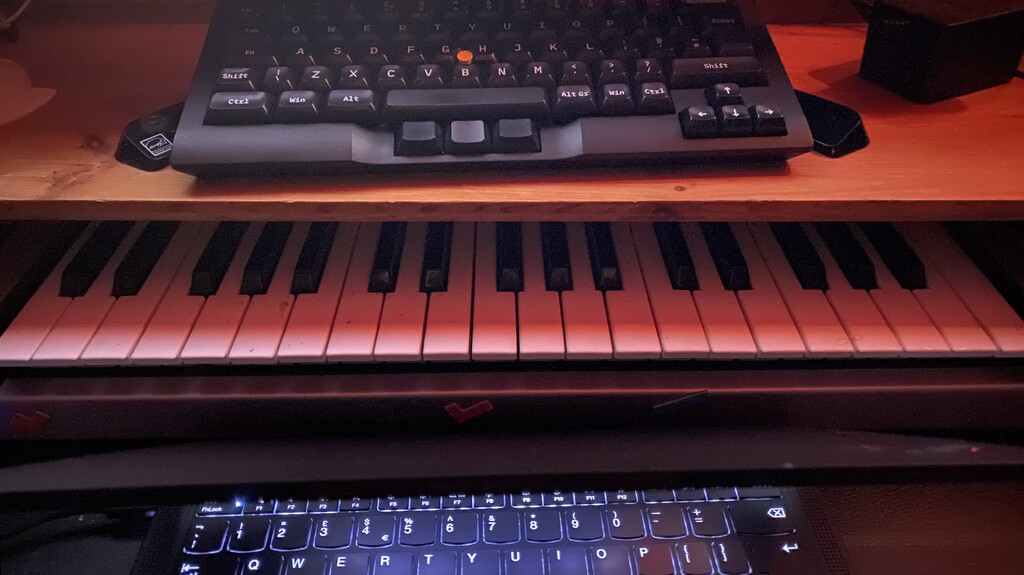
Alesis Micron on my desk, taunting me Alesis Micron on my desk, taunting me
I bought my first synth, an Alesis Micron, from a colleague at $oldjob, 16 years ago. For various reasons, I've struggled to engage with it, and it's mostly been gathering dust on my desk in all that time. (I might write more about the Micron in a later blog post). "Bad Gear" sums it up better than I could:
So, I'm not truly buying my "first" synth, but for all intents and purposes I'm on a similar journey to if I was, and I thought it might be fun to write about it. Goals I want something which has as many of its parameters presented physically, as knobs or sliders etc., as possible. One reason I've failed to engage with the Micron (so far) is it's at the other end of this spectrum, with hundreds of tunable parameters but a small handful of knobs. To change parameters you have to go diving into menus presented on a really old-fashioned, small LCD display. If you know what you are looking for, you can probably find it; but if you just want to experiment and play around, it's off-putting. Secondly, I want something I can use away from a computer, as much as possible. Computers are my day-job, largely dominate my existing hobbies, and are unavoidable even in some of the others (like 3d printing). Most of the computers I interact with run Linux. And for all its strengths, audio management is not one of them. If I'm going to carve out some of my extremely limited leisure time to explore this stuff, I don't to spend any of it (at least now) fighting Pulseaudio/ALSA/Pipewire/JACK/OSS/whatever, or any of the other foibles that might crop up1. Thirdly, I'd like something which, in its soul, is an instrument. You can get some amazing little synth boxes with a huge number of features in them. Something with a limited number of features but which really feels well put together would suit me better. So next time, I'll write about the 2-3 top candidates on my list. Can you guess what they might be?

  1. To give another example. The other day I sat down to try and use the Micron, which had its audio out wired into an external audio interface, in turn plugged into my laptop's Thunderbolt dock. For a while I couldn't figure out why I couldn't hear anything, until I realised the Thunderbolt dock was having "a moment" and not presenting its USB devices to the laptop. Hobby time window gone!

1 October 2024

Colin Watson: Free software activity in September 2024

Almost all of my Debian contributions this month were sponsored by Freexian. You can also support my work directly via Liberapay. Pydantic My main Debian project for the month turned out to be getting Pydantic back into a good state in Debian testing. I ve used Pydantic quite a bit in various projects, most recently in Debusine, so I have an interest in making sure it works well in Debian. However, it had been stalled on 1.10.17 for quite a while due to the complexities of getting 2.x packaged. This was partly making sure everything else could cope with the transition, but in practice mostly sorting out packaging of its new Rust dependencies. Several other people (notably Alexandre Detiste, Andreas Tille, Drew Parsons, and Timo R hling) had made some good progress on this, but nobody had quite got it over the line and it seemed a bit stuck. Learning Rust is on my to-do list, but merely not knowing a language hasn t stopped me before. So I learned how the Debian Rust team s packaging works, upgraded a few packages to new upstream versions (including rust-half and upstream rust-idna test fixes), and packaged rust-jiter. After a lot of waiting around for various things and chasing some failures in other packages I was eventually able to get current versions of both pydantic-core and pydantic into testing. I m looking forward to being able to drop our clunky v1 compatibility code once debusine can rely on running on trixie! OpenSSH I upgraded the Debian packaging to OpenSSH 9.9p1. YubiHSM I upgraded python-yubihsm, yubihsm-connector, and yubihsm-shell to new upstream versions. I noticed that I could enable some tests in python-yubihsm and yubihsm-shell; I d previously thought the whole test suite required a real YubiHSM device, but when I looked closer it turned out that this was only true for some tests. I fixed yubihsm-shell build failures on some 32-bit architectures (upstream PRs #431, #432), and also made it build reproducibly. Thanks to Helmut Grohne, I fixed yubihsm-connector to apply udev rules to existing devices when the package is installed. As usual, bookworm-backports is up to date with all these changes. Python team setuptools 72.0.0 removed the venerable setup.py test command. This caused some fallout in Debian, some of which was quite non-obvious as packaging helpers sometimes fell back to different ways of running test suites that didn t quite work. I fixed django-guardian, manuel, python-autopage, python-flask-seeder, python-pgpdump, python-potr, python-precis-i18n, python-stopit, serpent, straight.plugin, supervisor, and zope.i18nmessageid. As usual for new language versions, the addition of Python 3.13 caused some problems. I fixed psycopg2, python-time-machine, and python-traits. I fixed build/autopkgtest failures in keymapper, python-django-test-migrations, python-rosettasciio, routes, transmissionrpc, and twisted. buildbot was in a bit of a mess due to being incompatible with SQLAlchemy 2.0. Fortunately by the time I got to it upstream had committed a workable set of patches, and the main difficulty was figuring out what to cherry-pick since they haven t made a new upstream release with all of that yet. I figured this out and got us up to 4.0.3. Adrian Bunk asked whether python-zipp should be removed from trixie. I spent some time investigating this and concluded that the answer was no, but looking into it was an interesting exercise anyway. On the other hand, I looked into flask-appbuilder, concluded that it should be removed, and filed a removal request. I upgraded some embedded CSS files in nbconvert. I upgraded importlib-resources, ipywidgets, jsonpickle, pydantic-settings, pylint (fixing a test failure), python-aiohttp-session, python-apptools, python-asyncssh, python-django-celery-beat, python-django-rules, python-limits, python-multidict, python-persistent, python-pkginfo, python-rt, python-spur, python-zipp, stravalib, transmissionrpc, vulture, zodbpickle, zope.exceptions (adopting it), zope.i18nmessageid, zope.proxy, and zope.security to new upstream versions. debmirror The experimental and *-proposed-updates suites used to not have Contents-* files, and a long time ago debmirror was changed to just skip those files in those suites. They were added to the Debian archive some time ago, but debmirror carried on skipping them anyway. Once I realized what was going on, I removed these unnecessary special cases (#819925, #1080168).
29 September 2024

Dirk Eddelbuettel: RApiSerialize 0.1.4 on CRAN: Added C++ Namespace

A new minor release 0.1.5 of RApiSerialize arrived on CRAN today. The RApiSerialize package is used by both my RcppRedis as well as by Travers excellent qs package. This release adds an optional C++ namespace, available when the API header file is included in a C++ source file. And as one often does, the release also brings a few small updates to different aspects of the packaging.

Changes in version 0.1.4 (2024-09-28)
  • Add C++ namespace in API header (Dirk in #9 closing #8)
  • Several packaging updates: switched to Authors@R, README.md badge updates, added .editorconfig and cleanup

Courtesy of my CRANberries, there is a diffstat report relative to previous release. More details are at the RApiSerialize page; code, issue tickets etc at the GitHub repositoryrapiserializerepo. If you like this or other open-source work I do, you can sponsor me at GitHub.

This post by Dirk Eddelbuettel originated on his Thinking inside the box blog. Please report excessive re-aggregation in third-party for-profit settings.

Reproducible Builds: Supporter spotlight: Kees Cook on Linux kernel security

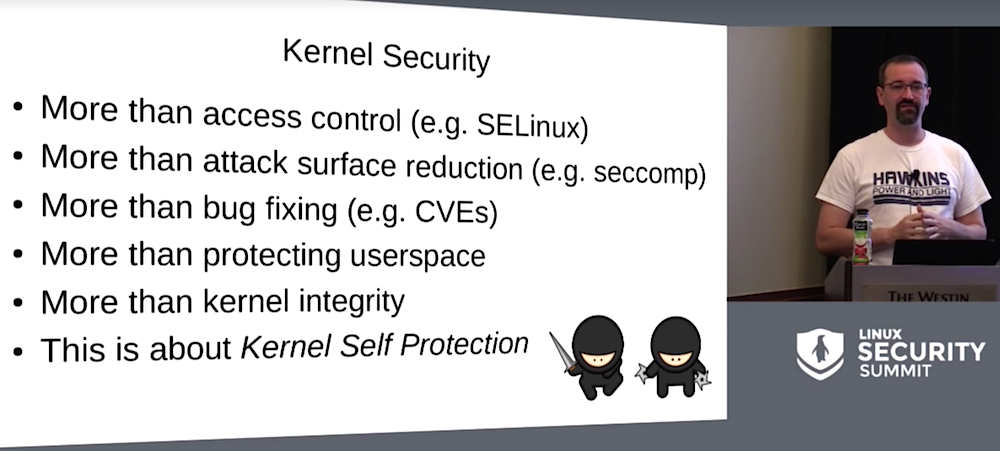
The Reproducible Builds project relies on several projects, supporters and sponsors for financial support, but they are also valued as ambassadors who spread the word about our project and the work that we do. This is the eighth installment in a series featuring the projects, companies and individuals who support the Reproducible Builds project. We started this series by featuring the Civil Infrastructure Platform project, and followed this up with a post about the Ford Foundation as well as recent ones about ARDC, the Google Open Source Security Team (GOSST), Bootstrappable Builds, the F-Droid project, David A. Wheeler and Simon Butler. Today, however, we will be talking with Kees Cook, founder of the Kernel Self-Protection Project.

Vagrant Cascadian: Could you tell me a bit about yourself? What sort of things do you work on? Kees Cook: I m a Free Software junkie living in Portland, Oregon, USA. I have been focusing on the upstream Linux kernel s protection of itself. There is a lot of support that the kernel provides userspace to defend itself, but when I first started focusing on this there was not as much attention given to the kernel protecting itself. As userspace got more hardened the kernel itself became a bigger target. Almost 9 years ago I formally announced the Kernel Self-Protection Project because the work necessary was way more than my time and expertise could do alone. So I just try to get people to help as much as possible; people who understand the ARM architecture, people who understand the memory management subsystem to help, people who understand how to make the kernel less buggy.
Vagrant: Could you describe the path that lead you to working on this sort of thing? Kees: I have always been interested in security through the aspect of exploitable flaws. I always thought it was like a magic trick to make a computer do something that it was very much not designed to do and seeing how easy it is to subvert bugs. I wanted to improve that fragility. In 2006, I started working at Canonical on Ubuntu and was mainly focusing on bringing Debian and Ubuntu up to what was the state of the art for Fedora and Gentoo s security hardening efforts. Both had really pioneered a lot of userspace hardening with compiler flags and ELF stuff and many other things for hardened binaries. On the whole, Debian had not really paid attention to it. Debian s packaging building process at the time was sort of a chaotic free-for-all as there wasn t centralized build methodology for defining things. Luckily that did slowly change over the years. In Ubuntu we had the opportunity to apply top down build rules for hardening all the packages. In 2011 Chrome OS was following along and took advantage of a bunch of the security hardening work as they were based on ebuild out of Gentoo and when they looked for someone to help out they reached out to me. We recognized the Linux kernel was pretty much the weakest link in the Chrome OS security posture and I joined them to help solve that. Their userspace was pretty well handled but the kernel had a lot of weaknesses, so focusing on hardening was the next place to go. When I compared notes with other users of the Linux kernel within Google there were a number of common concerns and desires. Chrome OS already had an upstream first requirement, so I tried to consolidate the concerns and solve them upstream. It was challenging to land anything in other kernel team repos at Google, as they (correctly) wanted to minimize their delta from upstream, so I needed to work on any major improvements entirely in upstream and had a lot of support from Google to do that. As such, my focus shifted further from working directly on Chrome OS into being entirely upstream and being more of a consultant to internal teams, helping with integration or sometimes backporting. Since the volume of needed work was so gigantic I needed to find ways to inspire other developers (both inside and outside of Google) to help. Once I had a budget I tried to get folks paid (or hired) to work on these areas when it wasn t already their job.
Vagrant: So my understanding of some of your recent work is basically defining undefined behavior in the language or compiler? Kees: I ve found the term undefined behavior to have a really strict meaning within the compiler community, so I have tried to redefine my goal as eliminating unexpected behavior or ambiguous language constructs . At the end of the day ambiguity leads to bugs, and bugs lead to exploitable security flaws. I ve been taking a four-pronged approach: supporting the work people are doing to get rid of ambiguity, identify new areas where ambiguity needs to be removed, actually removing that ambiguity from the C language, and then dealing with any needed refactoring in the Linux kernel source to adapt to the new constraints. None of this is particularly novel; people have recognized how dangerous some of these language constructs are for decades and decades but I think it is a combination of hard problems and a lot of refactoring that nobody has the interest/resources to do. So, we have been incrementally going after the lowest hanging fruit. One clear example in recent years was the elimination of C s implicit fall-through in switch statements. The language would just fall through between adjacent cases if a break (or other code flow directive) wasn t present. But this is ambiguous: is the code meant to fall-through, or did the author just forget a break statement? By defining the [[fallthrough]] statement, and requiring its use in Linux, all switch statements now have explicit code flow, and the entire class of bugs disappeared. During our refactoring we actually found that 1 in 10 added [[fallthrough]] statements were actually missing break statements. This was an extraordinarily common bug! So getting rid of that ambiguity is where we have been. Another area I ve been spending a bit of time on lately is looking at how defensive security work has challenges associated with metrics. How do you measure your defensive security impact? You can t say because we installed locks on the doors, 20% fewer break-ins have happened. Much of our signal is always secondary or retrospective, which is frustrating: This class of flaw was used X much over the last decade so, and if we have eliminated that class of flaw and will never see it again, what is the impact? Is the impact infinity? Attackers will just move to the next easiest thing. But it means that exploitation gets incrementally more difficult. As attack surfaces are reduced, the expense of exploitation goes up.

Vagrant: So it is hard to identify how effective this is how bad would it be if people just gave up? Kees: I think it would be pretty bad, because as we have seen, using secondary factors, the work we have done in the industry at large, not just the Linux kernel, has had an impact. What we, Microsoft, Apple, and everyone else is doing for their respective software ecosystems, has shown that the price of functional exploits in the black market has gone up. Especially for really egregious stuff like a zero-click remote code execution. If those were cheap then obviously we are not doing something right, and it becomes clear that it s trivial for anyone to attack the infrastructure that our lives depend on. But thankfully we have seen over the last two decades that prices for exploits keep going up and up into millions of dollars. I think it is important to keep working on that because, as a central piece of modern computer infrastructure, the Linux kernel has a giant target painted on it. If we give up, we have to accept that our computers are not doing what they were designed to do, which I can t accept. The safety of my grandparents shouldn t be any different from the safety of journalists, and political activists, and anyone else who might be the target of attacks. We need to be able to trust our devices otherwise why use them at all?
Vagrant: What has been your biggest success in recent years? Kees: I think with all these things I am not the only actor. Almost everything that we have been successful at has been because of a lot of people s work, and one of the big ones that has been coordinated across the ecosystem and across compilers was initializing stack variables to 0 by default. This feature was added in Clang, GCC, and MSVC across the board even though there were a lot of fears about forking the C language. The worry was that developers would come to depend on zero-initialized stack variables, but this hasn t been the case because we still warn about uninitialized variables when the compiler can figure that out. So you still still get the warnings at compile time but now you can count on the contents of your stack at run-time and we drop an entire class of uninitialized variable flaws. While the exploitation of this class has mostly been around memory content exposure, it has also been used for control flow attacks. So that was politically and technically a large challenge: convincing people it was necessary, showing its utility, and implementing it in a way that everyone would be happy with, resulting in the elimination of a large and persistent class of flaws in C.
Vagrant: In a world where things are generally Reproducible do you see ways in which that might affect your work? Kees: One of the questions I frequently get is, What version of the Linux kernel has feature $foo? If I know how things are built, I can answer with just a version number. In a Reproducible Builds scenario I can count on the compiler version, compiler flags, kernel configuration, etc. all those things are known, so I can actually answer definitively that a certain feature exists. So that is an area where Reproducible Builds affects me most directly. Indirectly, it is just being able to trust the binaries you are running are going to behave the same for the same build environment is critical for sane testing.
Vagrant: Have you used diffoscope? Kees: I have! One subset of tree-wide refactoring that we do when getting rid of ambiguous language usage in the kernel is when we have to make source level changes to satisfy some new compiler requirement but where the binary output is not expected to change at all. It is mostly about getting the compiler to understand what is happening, what is intended in the cases where the old ambiguity does actually match the new unambiguous description of what is intended. The binary shouldn t change. We have used diffoscope to compare the before and after binaries to confirm that yep, there is no change in binary .
Vagrant: You cannot just use checksums for that? Kees: For the most part, we need to only compare the text segments. We try to hold as much stable as we can, following the Reproducible Builds documentation for the kernel, but there are macros in the kernel that are sensitive to source line numbers and as a result those will change the layout of the data segment (and sometimes the text segment too). With diffoscope there s flexibility where I can exclude or include different comparisons. Sometimes I just go look at what diffoscope is doing and do that manually, because I can tweak that a little harder, but diffoscope is definitely the default. Diffoscope is awesome!
Vagrant: Where has reproducible builds affected you? Kees: One of the notable wins of reproducible builds lately was dealing with the fallout of the XZ backdoor and just being able to ask the question is my build environment running the expected code? and to be able to compare the output generated from one install that never had a vulnerable XZ and one that did have a vulnerable XZ and compare the results of what you get. That was important for kernel builds because the XZ threat actor was working to expand their influence and capabilities to include Linux kernel builds, but they didn t finish their work before they were noticed. I think what happened with Debian proving the build infrastructure was not affected is an important example of how people would have needed to verify the kernel builds too.
Vagrant: What do you want to see for the near or distant future in security work? Kees: For reproducible builds in the kernel, in the work that has been going on in the ClangBuiltLinux project, one of the driving forces of code and usability quality has been the continuous integration work. As soon as something breaks, on the kernel side, the Clang side, or something in between the two, we get a fast signal and can chase it and fix the bugs quickly. I would like to see someone with funding to maintain a reproducible kernel build CI. There have been places where there are certain architecture configurations or certain build configuration where we lose reproducibility and right now we have sort of a standard open source development feedback loop where those things get fixed but the time in between introduction and fix can be large. Getting a CI for reproducible kernels would give us the opportunity to shorten that time.
Vagrant: Well, thanks for that! Any last closing thoughts? Kees: I am a big fan of reproducible builds, thank you for all your work. The world is a safer place because of it.
Vagrant: Likewise for your work!


For more information about the Reproducible Builds project, please see our website at reproducible-builds.org. If you are interested in ensuring the ongoing security of the software that underpins our civilisation and wish to sponsor the Reproducible Builds project, please reach out to the project by emailing contact@reproducible-builds.org.

24 September 2024

Dirk Eddelbuettel: RcppFastAD 0.0.4 on CRAN: Updated Again

A new release 0.0.4 of the RcppFastAD package by James Yang and myself is now on CRAN. RcppFastAD wraps the FastAD header-only C++ library by James which provides a C++ implementation of both forward and reverse mode of automatic differentiation. It offers an easy-to-use header library (which we wrapped here) that is both lightweight and performant. With a little of bit of Rcpp glue, it is also easy to use from R in simple C++ applications. This release updates the quick fix in release 0.0.3 from a good week ago. James took a good look and properly disambiguated the statement that lead clang to complain, so we are back to compiling as C++17 under all compilers which makes for a slightly wider reach. The NEWS file for this release follows.

Changes in version 0.0.4 (2024-09-24)
  • The package now properly addresses a clang warning on empty variadic macros arguments and is back to C++17 (James in #10)

Courtesy of my CRANberries, there is also a diffstat report for the most recent release. More information is available at the repository or the package page. If you like this or other open-source work I do, you can sponsor me at GitHub.

This post by Dirk Eddelbuettel originated on his Thinking inside the box blog. Please report excessive re-aggregation in third-party for-profit settings.

23 September 2024

Jonathan McDowell: The (lack of a) return-to-office conspiracy

During COVID companies suddenly found themselves able to offer remote working where it hadn t previously been on offer. That s changed over the past 2 or so years, with most places I m aware of moving back from a fully remote situation to either some sort of hybrid, or even full time office attendance. For example last week Amazon announced a full return to office, having already pulled remote-hired workers in for 3 days a week. I ve seen a lot of folk stating they ll never work in an office again, and that RTO is insanity. Despite being lucky enough to work fully remotely (for a role I d been approached about before, but was never prepared to relocate for), I feel the objections from those who are pro-remote often fail to consider the nuances involved. So let s talk about some of the reasons why companies might want to enforce some sort of RTO.
Real estate value Let s clear this one up first. It s not about real estate value, for most companies. City planners and real estate investors might care, but even if your average company owned their building they d close it in an instant all other things being equal. An unoccupied building costs a lot less to maintain. And plenty of companies rent and would save money even if there s a substantial exit fee.

Occupancy levels That said, once you have anyone in the building the equation changes. If you re having to provide power, heating, internet, security/front desk staff etc, you want to make sure you re getting your money s worth. There s no point heating a building that can seat 100 for only 10 people present. One option is to downsize the building, but that leads to not being able to assign everyone a desk, for example. No one I know likes hot desking. There are also scheduling problems about ensuring there are enough desks for everyone who might turn up on a certain day, and you ve ruled out the option of company/office wide events.

Coexistence builds relationships As a remote worker I wish it wasn t true that most people find it easier to form relationships in person, but it is. Some of this can be worked on with specific teambuilding style events, rather than in office working, but I know plenty of folk who hate those as much as they hate the idea of being in the office. I am lucky in that I work with a bunch of folk who are terminally online, so it s much easier to have those casual conversations even being remote, but I also accept I miss out on some things because I m just not in the office regularly enough. You might not care about this ( I just need to put my head down and code, not talk to people ), but don t discount it as a valid reason why companies might want their workers to be in the office. This often matters even more for folk at the start of their career, where having a bunch of experience folk around to help them learn and figure things out ends up working much better in person (my first job offered to let me go mostly remote when I moved to Norwich, but I said no as I knew I wasn t ready for it yet).

Coexistence allows for unexpected interactions People hate the phrase water cooler chat , and I get that, but it covers the idea of casual conversations that just won t happen the same way when people are remote. I experienced this while running Black Cat; every time Simon and I met up in person we had a bunch of useful conversations even though we were on IRC together normally, and had a VoIP setup that meant we regularly talked too. Equally when I was at Nebulon there were conversations I overheard in the office where I was able to correct a misconception or provide extra context. Some of this can be replicated with the right online chat culture, but I ve found many places end up with folk taking conversations to DMs, or they happen in private channels. It happens more naturally in an office environment.

It s easier for bad managers to manage bad performers Again, this falls into the category of things that shouldn t be true, but are. Remote working has increased the ability for people who want to slack off to do so without being easily detected. Ideally what you want is that these folk, if they fail to perform, are then performance managed out of the organisation. That s hard though, there are (rightly) a bunch of rights workers have (I m writing from a UK perspective) around the procedure that needs to be followed. Managers need organisational support in this to make sure they get it right (and folk are given a chance to improve), which is often lacking.

Summary Look, I get there are strong reasons why offering remote is a great thing from the company perspective, but what I ve tried to outline here is that a return-to-office mandate can have some compelling reasons behind it too. Some of those might be things that wouldn t exist in an ideal world, but unfortunately fixing them is a bigger issue than just changing where folk work from. Not acknowledging that just makes any reaction against office work seem ill-informed, to me.

21 September 2024

Jamie McClelland: How do I warm up an IP Address?

After years on the waiting list, May First was just given a /24 block of IP addresses. Excellent. Now we want to start using them for, among other things, sending email. I haven t added a new IP address to our mail relays in a while and things seems to change regularly in the world of email so I m curious: what s the best 2024 way to warm up IP addresses, particularly using postfix? Sendergrid has a nice page on the topic. It establishes the number of messages to send per day. But I m not entirely sure how to fit messages per day into our setup. We use round robin DNS to direct email to one of several dozen email relay servers using postfix. And unfortunately our DNS software (knot) doesn t have a way to add weights to ensure some IPs show up more often than others (much less limit the specific number of messages a given relay should get). Postfix has some nice knobs for rate limiting, particularly: default_destination_recipient_limit and default_destination_rate_delay If default_destination_recipient_limit is over 1, then default_destination_rate_delay is equal to the minimum delay between sending email to the same domain. So, I m staring our IP addresses out at 30m - which prevents any single domain from receiving more than 2 messages per hour. Sadly, there are a lot of different domain names that deliver to the same set of popular corporate MX servers, so I am not sure I can accurately control how many messages a given provider sees coming from a given IP address. But it s a start. A bigger problem is that messages that exceed the limit hang out in the active queue until they can be sent without violating the rate limit. Since I can t fully control the number of messages a given queue receives (due to my inability to control the DNS round robin weights), a lot of messages are going to be severely delayed, especially ones with an @gmail.com domain name. I know I can temporarily set relayhost to a different queue and flush deferred messages, however, as far as I can tell, it doesn t work with active messages. To help mitigate the problem I m only using our bulk mail queue to warm up IPs, but really, this is not ideal. Suggestions welcome!

Update #1 If you are running postfix in a multi-instance setup and you have instances that are already warmed up, you can move active messages between queues with these steps:
# Put the message on hold in the warming up instance
postsuper -c /etc/postfix-warmingup -h $queueid
# Copy to a warmed up instance
cp --preserve=mode,ownership,timestamp /var/spool/postfix-warmingup/hold/$queueid /var/spool/postfix-warmedup/incoming/
# Queue the message
postqueue -c /etc/postfix-warmedup -i $queueid
# Delete from the original queue.
postsuper -c /etc/postfix-warmingup -d $queueid
After just 12 hours we had thousands of messages piling up. This warm up method was never going to work without the ability to move them to a faster queue. [Additional update: be sure to reload the postfix instance after flushing the queue so messages are drained from the active queue on the correct schedule. See update #4.]

Update #2 After 24 hours, most email is being accepted as far as I can tell. I am still getting a small percentage of email deferred by Yahoo with:
421 4.7.0 [TSS04] Messages from 204.19.241.9 temporarily deferred due to unexpected volume or user complaints - 4.16.55.1; see https://postmaster.yahooinc.com/error-codes (in reply
So I will keep it as 30m for another 24 hours or so and then move to 15m. Now that I can flush the backlog of active messages I am in less of a hurry.

Update #3 Well, this doesn t seem to be working the way I want it to. When a message arrives faster than the designated rate limit, it remains in the active queue. I m entirely sure how the timing is supposed to work, but at this point I m down to a 5m rate delay, and the active messages are just hanging out for a lot longer than 5m. I tried flushing the queue, but that only seems to affect the deferred messages. I finally got them re-tried with systemctl reload. I wonder if there is a setting to control this retry? Or better yet, why can t these messages that exceed the rate delayed be deferred instead?

Update #4 I think I see why I was confused in Update #3 about the timing. I suspect that when I move messages out of the active queue it screws up the timer. Reloading the instance resets the timer. Every time you muck with active messages, you should reload.

18 September 2024

Dirk Eddelbuettel: Rblpapi 0.3.15: Updated and New BLP Library

bloomberg terminal Version 0.3.15 of the Rblpapi package arrived on CRAN today. Rblpapi provides a direct interface between R and the Bloomberg Terminal via the C++ API provided by Bloomberg (but note that a valid Bloomberg license and installation is required). This is the fifteenth release since the package first appeared on CRAN in 2016. This release updates to the current version 3.24.6 of the Bloomberg API, and rounds out a few corners in the packaging from continuous integration to the vignette. The detailed list of changes follow below.

Changes in Rblpapi version 0.3.15 (2024-09-18)
  • A warning is now issued if more than 1000 results are returned (John in #377 addressing #375)
  • A few typos in the rblpapi-intro vignette were corrected (Michael Streatfield in #378)
  • The continuous integration setup was updated (Dirk in #388)
  • Deprecation warnings over char* where C++ class Name is now preferred have been addressed (Dirk in #391)
  • Several package files have been updated (Dirk in #392)
  • The request formation has been corrected, and an example was added (Dirk and John in #394 and #396)
  • The Bloomberg API has been upgraded to release 3.24.6.1 (Dirk in #397)

Courtesy of my CRANberries, there is also a diffstat report for the this release. As always, more detailed information is at the Rblpapi repo or the Rblpapi page. Questions, comments etc should go to the issue tickets system at the GitHub repo. If you like this or other open-source work I do, you can sponsor me at GitHub.

This post by Dirk Eddelbuettel originated on his Thinking inside the box blog. Please report excessive re-aggregation in third-party for-profit settings.

17 September 2024

Jonathan Dowland: ouch, part 3

The debridement operation was a success: nothing bad grew afterwards. I was discharged after a couple of nights with crutches, instructions not to weight-bear, a remarkable, portable negative-pressure "Vac" pump that lived by my side, and some strong painkillers. About two weeks later, I had a skin graft. The surgeon took some skin from my thigh and stitched it over the debridement wound. I was discharged same-day, again with the Vac pump, and again with instructions not to weight-bear, at least for a few days. This time I only kept the Vac pump for a week, and after a dressing change (the first time I saw the graft), I was allowed to walk again. Doing so is strangely awkward, and sometimes a little painful. I have physio exercises to help me regain strength and understanding about what I can do. The donor site remained bandaged for another week before I saw it. I was expecting a stitched cut, but the surgeons have removed the top few layers only, leaving what looks more like a graze or sun-burn. There are four smaller, tentative-looking marks adjacent, suggesting they got it right on the fifth attempt. I'm not sure but I think these will all fade away to near-invisibility with time, and they don't hurt at all. I've now been off work for roughly 12 weeks, but I think I am returning very soon. I am looking forward to returning to some sense of normality. It's been an interesting experience. I thought about writing more about what I've gone through, in particular my experiences in Hospital, dealing with the bureaucracy and things falling "between the gaps". Hanif Kureishi has done a better job than I could. It's clear that the NHS is staffed by incredibly passionate people, but there are a lot of structural problems that interfere with care.

Dirk Eddelbuettel: nanotime 0.3.10 on CRAN: Update

A minor update 0.3.10 for our nanotime package is now on CRAN. nanotime relies on the RcppCCTZ package (as well as the RcppDate package for additional C++ operations) and offers efficient high(er) resolution time parsing and formatting up to nanosecond resolution, using the bit64 package for the actual integer64 arithmetic. Initially implemented using the S3 system, it has benefitted greatly from a rigorous refactoring by Leonardo who not only rejigged nanotime internals in S4 but also added new S4 types for periods, intervals and durations. This release updates one S4 methods to very recent changes in r-devel for which CRAN had reached out. This concerns the setdiff() method when applied to two nanotime objects. As it only affected R 4.5.0, due next April, if rebuilt in the last two or so weeks it will not have been visible to that many users, if any. In any event, it now works again for that setup too, and should be going forward. We also retired one demo function from the very early days, apparently it relied on ggplot2 features that have since moved on. If someone would like to help out and resurrect the demo, please get in touch. We also cleaned out some no longer used tests, and updated DESCRIPTION to what is required now. The NEWS snippet below has the full details.

Changes in version 0.3.10 (2024-09-16)
  • Retire several checks for Solaris in test suite (Dirk in #130)
  • Switch to Authors@R in DESCRIPTION as now required by CRAN
  • Accommodate R-devel change for setdiff (Dirk in #133 fixing #132)
  • No longer ship defunction ggplot2 demo (Dirk fixing #131)

Thanks to my CRANberries, there is a diffstat report for this release. More details and examples are at the nanotime page; code, issue tickets etc at the GitHub repository and all documentation is provided at the nanotime documentation site. If you like this or other open-source work I do, you can sponsor me at GitHub.

This post by Dirk Eddelbuettel originated on his Thinking inside the box blog. Please report excessive re-aggregation in third-party for-profit settings.

16 September 2024

Russ Allbery: Review: The Wings Upon Her Back

Review: The Wings Upon Her Back, by Samantha Mills
Publisher: Tachyon
Copyright: 2024
ISBN: 1-61696-415-4
Format: Kindle
Pages: 394
The Wings Upon Her Back is a political steampunk science fantasy novel. If the author's name sounds familiar, it may be because Samantha Mills's short story "Rabbit Test" won Nebula, Locus, Hugo, and Sturgeon awards. This is her first novel. Winged Zemolai is a soldier of the mecha god and the protege of Mecha Vodaya, the Voice. She has served the city-state of Radezhda by defending it against all enemies, foreign and domestic, for twenty-six years. Despite that, it takes only a moment of errant mercy for her entire life to come crashing down. On a whim, she spares a kitchen worker who was concealing a statue of the scholar god, meaning that he was only pretending to worship the worker god like all workers should. Vodaya is unforgiving and uncompromising, as is the sleeping mecha god. Zemolai's wings are ripped from her back and crushed in the hand of the god, and she's left on the ground to die of mechalin withdrawal. The Wings Upon Her Back is told in two alternating timelines. The main one follows Zemolai after her exile as she is rescued by a young group of revolutionaries who think she may be useful in their plans. The other thread starts with Zemolai's childhood and shows the reader how she became Winged Zemolai: her scholar family, her obsession with flying, her true devotion to the mecha god, and the critical early years when she became Vodaya's protege. Mills maintains the separate timelines through the book and wraps them up in a rather neat piece of symbolic parallelism in the epilogue. I picked up this book on a recommendation from C.L. Clark, and yes, indeed, I can see why she liked this book. It's a story about a political awakening, in which Zemolai slowly realizes that she has been manipulated and lied to and that she may, in fact, be one of the baddies. The Wings Upon Her Back is more personal than some other books with that theme, since Zemolai was specifically (and abusively) groomed for her role by Vodaya. Much of the book is Zemolai trying to pull out the hooks that Vodaya put in her or, in the flashback timeline, the reader watching Vodaya install those hooks. The flashback timeline is difficult reading. I don't think Mills could have left it out, but she says in the afterword that it was the hardest part of the book to write and it was also the hardest part of the book to read. It fills in some interesting bits of world-building and backstory, and Mills does a great job pacing the story revelations so that both threads contribute equally, but mostly it's a story of manipulative abuse. We know from the main storyline that Vodaya's tactics work, which gives those scenes the feel of a slow-motion train wreck. You know what's going to happen, you know it will be bad, and yet you can't look away. It occurred to me while reading this that Emily Tesh's Some Desperate Glory told a similar type of story without the flashback structure, which eliminates the stifling feeling of inevitability. I don't think that would not have worked for this story. If you simply rearranged the chapters of The Wings Upon Her Back into a linear narrative, I would have bailed on the book. Watching Zemolai being manipulated would have been too depressing and awful for me to make it to the payoff without the forward-looking hope of the main timeline. It gave me new appreciation for the difficulty of what Tesh pulled off. Mills uses this interwoven structure well, though. At about 90% through this book I had no idea how it could end in the space remaining, but it reaches a surprising and satisfying conclusion. Mills uses a type of ending that normally bothers me, but she does it by handling the psychological impact so well that I couldn't help but admire it. I'm avoiding specifics because I think it worked better when I wasn't expecting it, but it ties beautifully into the thematic point of the book. I do have one structural objection, though. It's one of those problems I didn't notice while reading, but that started bothering me when I thought back through the story from a political lens. The Wings Upon Her Back is Zemolai's story, her redemption arc, and that means she drives the plot. The band of revolutionaries are great characters (particularly Galiana), but they're supporting characters. Zemolai is older, more experienced, and knows critical information they don't have, and she uses it to effectively take over. As setup for her character arc, I see why Mills did this. As political praxis, I have issues. There is a tendency in politics to believe that political skill is portable and repurposable. Converting opposing operatives to the cause is welcomed not only because they indicate added support, but also because they can use their political skill to help you win instead. To an extent this is not wrong, and is probably the most true of combat skills (which Zemolai has in abundance). But there's an underlying assumption that politics is symmetric, and a critical reason why I hold many of the political positions that I do hold is that I don't think politics is symmetric. If someone has been successfully stoking resentment and xenophobia in support of authoritarians, converts to an anti-authoritarian cause, and then produces propaganda stoking resentment and xenophobia against authoritarians, this is in some sense an improvement. But if one believes that resentment and xenophobia are inherently wrong, if one's politics are aimed at reducing the resentment and xenophobia in the world, then in a way this person has not truly converted. Worse, because this is an effective manipulation tactic, there is a strong tendency to put this type of political convert into a leadership position, where they will, intentionally or not, start turning the anti-authoritarian movement into a copy of the authoritarian movement they left. They haven't actually changed their politics because they haven't understood (or simply don't believe in) the fundamental asymmetry in the positions. It's the same criticism that I have of realpolitik: the ends do not justify the means because the means corrupt the ends. Nothing that happens in this book is as egregious as my example, but the more I thought about the plot structure, the more it bothered me that Zemolai never listens to the revolutionaries she joins long enough to wrestle with why she became an agent of an authoritarian state and they didn't. They got something fundamentally right that she got wrong, and perhaps that should have been reflected in who got to make future decisions. Zemolai made very poor choices and yet continues to be the sole main character of the story, the one whose decisions and actions truly matter. Maybe being wrong about everything should be disqualifying for being the main character, at least for a while, even if you think you've understood why you were wrong. That problem aside, I enjoyed this. Both timelines were compelling and quite difficult to put down, even when they got rather dark. I could have done with less body horror and a few fewer fight scenes, but I'm glad I read it. Science fiction readers should be warned that the world-building, despite having an intricate and fascinating surface, is mostly vibes. I started the book wondering how people with giant metal wings on their back can literally fly, and thought the mentions of neural ports, high-tech materials, and immune-suppressing drugs might mean that we'd get some sort of explanation. We do not: heavier-than-air flight works because it looks really cool and serves some thematic purposes. There are enough hints of technology indistinguishable from magic that you could make up your own explanations if you wanted to, but that's not something this book is interested in. There's not a thing wrong with that, but don't get caught by surprise if you were in the mood for a neat scientific explanation of apparent magic. Recommended if you like somewhat-harrowing character development with a heavy political lens and steampunk vibes, although it's not the sort of book that I'd press into the hands of everyone I know. The Wings Upon Her Back is a complete story in a single novel. Content warning: the main character is a victim of physical and emotional abuse, so some of that is a lot. Also surgical gore, some torture, and genocide. Rating: 7 out of 10

15 September 2024

Dirk Eddelbuettel: RcppFastAD 0.0.3 on CRAN: Updated

A new release 0.0.3 of the RcppFastAD package by James Yang and myself is now on CRAN. RcppFastAD wraps the FastAD header-only C++ library by James which provides a C++ implementation of both forward and reverse mode of automatic differentiation. It offers an easy-to-use header library (which we wrapped here) that is both lightweight and performant. With a little of bit of Rcpp glue, it is also easy to use from R in simple C++ applications. This release turns compilation to the C++20 standard as newer clang++ versions complained about a particular statement (it took to be C++20) when compiled under C++17. So we obliged. The NEWS file for these two initial releases follows.

Changes in version 0.0.3 (2024-09-15)
  • The package now compiles under the C++20 standard to avoid a warning under clang++-18 (Dirk addressing #9)
  • Minor updates to continuous integration and badges have been made as well

Courtesy of my CRANberries, there is also a diffstat report for the most recent release. More information is available at the repository or the package page. If you like this or other open-source work I do, you can sponsor me at GitHub.

This post by Dirk Eddelbuettel originated on his Thinking inside the box blog. Please report excessive re-aggregation in third-party for-profit settings.

12 September 2024

Dirk Eddelbuettel: RcppArmadillo 14.0.2-1 on CRAN: Updates

armadillo image Armadillo is a powerful and expressive C++ template library for linear algebra and scientific computing. It aims towards a good balance between speed and ease of use, has a syntax deliberately close to Matlab, and is useful for algorithm development directly in C++, or quick conversion of research code into production environments. RcppArmadillo integrates this library with the R environment and language and is widely used by (currently) 1164 other packages on CRAN, downloaded 36.1 million times (per the partial logs from the cloud mirrors of CRAN), and the CSDA paper (preprint / vignette) by Conrad and myself has been cited 595 times according to Google Scholar. Conrad released two small incremental releases to version 14.0.0. We did not immediately bring these to CRAN as we have to be mindful of the desired upload cadence of once every one or two months . But as 14.0.2 has been stable for a few weeks, we now decided to bring it to CRAN. Changes since the last CRAN release are summarised below, and overall fairly minimal. On the package side, we reorder what citation() returns, and now follow CRAN requirements via Authors@R.

Changes in RcppArmadillo version 14.0.2-1 (2024-09-11)
  • Upgraded to Armadillo release 14.0.2 (Stochastic Parrot)
    • Optionally use C++20 memory alignment
    • Minor corrections for several corner-cases
  • The order of items displayed by citation() is reversed (Conrad in #449)
  • The DESCRIPTION file now uses an Authors@R field with ORCID IDs

Courtesy of my CRANberries, there is a diffstat report relative to previous release. More detailed information is on the RcppArmadillo page. Questions, comments etc should go to the rcpp-devel mailing list off the Rcpp R-Forge page. If you like this or other open-source work I do, you can sponsor me at GitHub.

This post by Dirk Eddelbuettel originated on his Thinking inside the box blog. Please report excessive re-aggregation in third-party for-profit settings.

Next.

Previous.