Russ Allbery: Review: Space Trucker Jess
| Publisher: | Fairwood Press |
| Copyright: | July 2025 |
| ISBN: | 1-958880-27-2 |
| Format: | Kindle |
| Pages: | 472 |
| Publisher: | Fairwood Press |
| Copyright: | July 2025 |
| ISBN: | 1-958880-27-2 |
| Format: | Kindle |
| Pages: | 472 |
AWS had an outage today and Signal was unavailable for some users for a while. This has confused some people, including Elon Musk, who are concerned that having a dependency on AWS means that Signal could somehow be compromised by anyone with sufficient influence over AWS (it can't). Which means we're back to the richest man in the world recommending his own "X Chat", saying The messages are fully encrypted with no advertising hooks or strange AWS dependencies such that I can t read your messages even if someone put a gun to my head.
Armadillo is a powerful
and expressive C++ template library for linear algebra and scientific
computing. It aims towards a good balance between speed and ease of use,
has a syntax deliberately close to Matlab, and is useful for algorithm
development directly in C++, or quick conversion of research code into
production environments. RcppArmadillo
integrates this library with the R environment and language and is
widely used by (currently) 1270 other packages on CRAN, downloaded 42 million times
(per the partial logs from the cloud mirrors of CRAN), and the CSDA paper (preprint
/ vignette) by Conrad and myself has been cited 650 times according
to Google Scholar.
This versions updates to the 15.2.0 upstream release made today. It
brings a few changes over Armadillo 15.0 (see below for more). It
follows the most recent RcppArmadillo
15.0.2-2 release and the Armadillo
15 upstream transition with its dual focus on moving on from C++11
and deprecation of a number of API access points. As we had a few
releases last month to manage the transition, we will sit this upgrade
out and not upload to CRAN in order to normalize our
update cadence towards the desired about six in six months (that the
CRAN Policy asks for). One can of course install as usual directly from
the GitHub
repository as well as from r-universe
which also offers binaries for all CRAN platforms.
The transition to Armadillo 15 appears to be going slowly but
steadily. We had well over 300 packages with either a need to relax the
C++11 setting and/or update away from now-deprecated API access points.
That number has been cut in half thanks to a lot of work from
a lot of package maintainers which is really appreciated! Of
course, a lot remains to be done. Issues #489 and
#491
contain the over sixty PRs and patches I prepared for all packages with
at least one reverse dependency. Most (but not all) have aided in CRAN updates, some packages are
still outstanding in terms of updates. As before meta-issue #475
regroups all the resources for the transition. If you, dear
reader, have a package that is affected and I could be of assistance
please do reach out.
The other change we made is to greatly simplify the detection and
setup of OpenMP. As before, we rely on configure to attempt
compilation of a minimal OpenMP-using program in order to pass the
success or failure onto Armadillo as a can-or-cannot use OpenMP. In
the year 2025 one of the leading consumer brands still cannot ship an OS
where this works out of the box, so we try to aide there. For all others
systems, R actually covers this pretty well and has a reliable
configuration variable that we rely upon. Just as we recommend for
downstream users of the package. This setup should be robust, but is a
change so by all means if you knowingly rely on OpenMP please test and
report back.
The detailed changes since the last CRAN release follow.
More detailed information is on the RcppArmadillo page. Questions, comments etc should go to the rcpp-devel mailing list off the Rcpp R-Forge page.Changes in RcppArmadillo version 15.2.0-0 (2025-10-20) (GitHub Only)
- Upgraded to Armadillo release 15.2.0 (Medium Roast Deluxe)
- Added
rande()for generating matrices with elements from exponential distributionsshift()has been deprecated in favour ofcircshift(), for consistency with Matlab/Octave- Reworked detection of aliasing, leading to more efficient compiled code
- OpenMP detection in
configurehas been simplified
This post by Dirk Eddelbuettel originated on his Thinking inside the box blog. If you like this or other open-source work I do, you can sponsor me at GitHub.

In Could the XZ backdoor have been detected with better Git and Debian
packaging practices? ,
Otto contrasts git-buildpackage managed git repositories with dgit
managed repositories , saying that the dgit managed repositories cannot
incorporate the upstream git history and are thus less useful for auditing
the full software supply-chain in git .
Otto does qualify this earlier with a package that has not had the
history recorded in dgit earlier , but the last sentence of the section is a
misleading oversimplification. It s true for repositories that have been
synthesized by dgit (which indeed was the focus of that section of Otto s
article), but it s not true in general for repositories that are managed
by dgit.
I suspect this was just slightly unclear writing, so I don t want to nitpick
here, but rather to take the opportunity to try to clear up some
misconceptions around dgit
that I ve often heard at conferences and seen on mailing lists.
I m not a dgit developer, although I m a happy user of it and I ve tried to
help out in various design discussions over the years.
git debpush to push a tag and the tag2upload service deals
with building the source package and uploading it to the archive for you.
This is true regardless of how you put your package s git history together.
(There s currently a wrinkle around pristine-tar support, so at the moment I personally tend to
use dgit push-source for new upstream versions and git debpush for
new Debian revisions, since I haven t yet convinced myself that I see no
remaining value in pristine upstream tarballs.)
dgit clone synthesizes a
repository based on the current contents of the Debian archive, then there s
indeed no useful history there; in that situation it doesn t go back and
import everything from the snapshot archive the way that gbp import-dscs
--debsnap does.
However, if the maintainer uses dgit, then dgit s view will include more
history, and it s absolutely possible for that to include complete upstream
git history as well. Try this:
$ dgit clone man-db canonical suite name for unstable is sid fetching existing git history last upload to archive: specified git info (debian) downloading http://ftp.debian.org/debian//pool/main/m/man-db/man-db_2.13.1.orig.tar.xz... % Total % Received % Xferd Average Speed Time Time Time Current Dload Upload Total Spent Left Speed 100 2060k 100 2060k 0 0 4643k 0 --:--:-- --:--:-- --:--:-- 4652k downloading http://ftp.debian.org/debian//pool/main/m/man-db/man-db_2.13.1.orig.tar.xz.asc... % Total % Received % Xferd Average Speed Time Time Time Current Dload Upload Total Spent Left Speed 100 833 100 833 0 0 16322 0 --:--:-- --:--:-- --:--:-- 16660 HEAD is now at 167835b0 releasing package man-db version 2.13.1-1 dgit ok: ready for work in man-db $ git -C man-db log --graph --oneline head * 167835b0 releasing package man-db version 2.13.1-1 * f7910493 New upstream release (2.13.1) \ * 3073b72e Import man-db_2.13.1.orig.tar.xz \ * 349ce503 Release man-db 2.13.1 * 0d6635c1 Update Russian manual page translation * cbf87caf Update Italian translation * fb5c5017 Update German manual page translation * dae2057b Update Brazilian Portuguese manual page translationThat package uses git-dpm, since I prefer the way it represents patches. But it works fine with git-buildpackage too:
$ dgit clone isort canonical suite name for unstable is sid fetching existing git history last upload to archive: specified git info (debian) downloading http://ftp.debian.org/debian//pool/main/i/isort/isort_7.0.0.orig.tar.gz... % Total % Received % Xferd Average Speed Time Time Time Current Dload Upload Total Spent Left Speed 100 786k 100 786k 0 0 1772k 0 --:--:-- --:--:-- --:--:-- 1774k HEAD is now at f812aae releasing package isort version 7.0.0-1 dgit ok: ready for work in isort $ git -C isort log --graph --oneline head * f812aae releasing package isort version 7.0.0-1 * efde62f Update upstream source from tag 'upstream/7.0.0' \ * 9694f3d New upstream version 7.0.0 * 9cbfe0b releasing package isort version 6.1.0-1 * 5423ffe Mark isort and python3-isort Multi-Arch: foreign * 5eaf5bf Update upstream source from tag 'upstream/6.1.0' \ * edafbfc New upstream version 6.1.0 * aedfd25 Merge branch 'debian/master' into fix992793If you look closely you ll see another difference here: the second only includes one commit representing the new upstream release, and doesn t have complete upstream history. This doesn t represent a difference between git-dpm and git-buildpackage. Both tools can operate in both ways: for example,
git-dpm import-new-upstream --parent and gbp import-orig
--upstream-vcs-tag do broadly similar things, and something like gbp
import-dscs --debsnap --upstream-vcs-tag='%(version)s' can be used to do a
bulk import provided that upstream s tags are named consistently enough.
This is not generally the default because adding complete upstream history
requires extra setup: the maintainer has to add an extra git remote pointing
to upstream and select the correct tag when importing a new version, and
some upstreams forget to push git tags or don t have the sort of consistency
you might want.
The Debian Python team s policy
says that Complete upstream Git history should be avoided in the upstream
branch , which is why the isort history above looks the way it does. I
don t love this because I think the results are less useful, but I
understand why it s there: in a moderately large team maintaining thousands
of packages, getting everyone to have the right git remotes set up would be
a recipe for frustrating inconsistency.
However, in packages I maintain myself, I strongly value having complete
upstream history in order to make it easier to debug problems, and I think
it makes things a bit more transparent to auditors too, so I m willing to go
to a little extra work to make that happen. Doing that is completely
compatible with using dgit.
The discovery of a backdoor in XZ Utils in the spring of 2024 shocked the open source community, raising critical questions about software supply chain security. This post explores whether better Debian packaging practices could have detected this threat, offering a guide to auditing packages and suggesting future improvements.
The XZ backdoor in versions 5.6.0/5.6.1 made its way briefly into many major Linux distributions such as Debian and Fedora, but luckily didn t reach that many actual users, as the backdoored releases were quickly removed thanks to the heroic diligence of Andres Freund. We are all extremely lucky that he detected a half a second performance regression in SSH, cared enough to trace it down, discovered malicious code in the XZ library loaded by SSH, and reported promtly to various security teams for quick coordinated actions.
This episode makes software engineers pondering the following questions:
$ debsnap --verbose --first 5.2.4-1 xz-utils
Getting json https://snapshot.debian.org/mr/package/xz-utils/
...
Getting dsc file xz-utils_5.2.4-1.dsc: https://snapshot.debian.org/file/a98271e4291bed8df795ce04d9dc8e4ce959462d
Getting file xz-utils_5.2.4.orig.tar.xz.asc: https://snapshot.debian.org/file/59ccbfb2405abe510999afef4b374cad30c09275
Getting file xz-utils_5.2.4-1.debian.tar.xz: https://snapshot.debian.org/file/667c14fd9409ca54c397b07d2d70140d6297393f
source-xz-utils/xz-utils_5.2.4-1.dsc:
Good signature found
validating xz-utils_5.2.4.orig.tar.xz
validating xz-utils_5.2.4.orig.tar.xz.asc
validating xz-utils_5.2.4-1.debian.tar.xz
All files validated successfully.source-<package name> with the following types of files:
*.orig.tar.xz: source code from upstream*.orig.tar.xz.asc: detached signature (if upstream signs their releases)*.debian.tar.xz: Debian packaging source, i.e. the debian/ subdirectory contents*.dsc: Debian source control file, including signature by Debian Developer/Maintainer$ ls -1 source-xz-utils/
...
xz-utils_5.6.4.orig.tar.xz
xz-utils_5.6.4.orig.tar.xz.asc
xz-utils_5.6.4-1.debian.tar.xz
xz-utils_5.6.4-1.dsc
xz-utils_5.8.0.orig.tar.xz
xz-utils_5.8.0.orig.tar.xz.asc
xz-utils_5.8.0-1.debian.tar.xz
xz-utils_5.8.0-1.dsc
xz-utils_5.8.1.orig.tar.xz
xz-utils_5.8.1.orig.tar.xz.asc
xz-utils_5.8.1-1.1.debian.tar.xz
xz-utils_5.8.1-1.1.dsc
xz-utils_5.8.1-1.debian.tar.xz
xz-utils_5.8.1-1.dsc
xz-utils_5.8.1-2.debian.tar.xz
xz-utils_5.8.1-2.dscdebsnap, it already automatically verifies that the downloaded files match the OpenPGP signatures. To have full clarity on what files were authenticated with what keys, we should verify the Debian packagers signature with:
$ gpg --verify --auto-key-retrieve --keyserver hkps://keyring.debian.org xz-utils_5.8.1-2.dsc
gpg: Signature made Fri Oct 3 22:04:44 2025 UTC
gpg: using RSA key 57892E705233051337F6FDD105641F175712FA5B
gpg: requesting key 05641F175712FA5B from hkps://keyring.debian.org
gpg: key 7B96E8162A8CF5D1: public key "Sebastian Andrzej Siewior" imported
gpg: Total number processed: 1
gpg: imported: 1
gpg: Good signature from "Sebastian Andrzej Siewior" [unknown]
gpg: aka "Sebastian Andrzej Siewior <bigeasy@linutronix.de>" [unknown]
gpg: aka "Sebastian Andrzej Siewior <sebastian@breakpoint.cc>" [unknown]
gpg: WARNING: This key is not certified with a trusted signature!
gpg: There is no indication that the signature belongs to the owner.
Primary key fingerprint: 6425 4695 FFF0 AA44 66CC 19E6 7B96 E816 2A8C F5D1
Subkey fingerprint: 5789 2E70 5233 0513 37F6 FDD1 0564 1F17 5712 FA5B$ gpg --verify --auto-key-retrieve xz-utils_5.8.1.orig.tar.xz.asc
gpg: assuming signed data in 'xz-utils_5.8.1.orig.tar.xz'
gpg: Signature made Thu Apr 3 11:38:23 2025 UTC
gpg: using RSA key 3690C240CE51B4670D30AD1C38EE757D69184620
gpg: key 38EE757D69184620: public key "Lasse Collin <lasse.collin@tukaani.org>" imported
gpg: Total number processed: 1
gpg: imported: 1
gpg: Good signature from "Lasse Collin <lasse.collin@tukaani.org>" [unknown]
gpg: WARNING: This key is not certified with a trusted signature!
gpg: There is no indication that the signature belongs to the owner.
Primary key fingerprint: 3690 C240 CE51 B467 0D30 AD1C 38EE 757D 6918 4620debian/watch file inside the Debian packaging, which defines where the upstream source is downloaded from. Continuing on the example situation above, we can unpack the latest Debian sources, enter and then run uscan to download:
$ tar xvf xz-utils_5.8.1-2.debian.tar.xz
...
debian/rules
debian/source/format
debian/source.lintian-overrides
debian/symbols
debian/tests/control
debian/tests/testsuite
debian/upstream/signing-key.asc
debian/watch
...
$ uscan --download-current-version --destdir /tmp
Newest version of xz-utils on remote site is 5.8.1, specified download version is 5.8.1
gpgv: Signature made Thu Apr 3 11:38:23 2025 UTC
gpgv: using RSA key 3690C240CE51B4670D30AD1C38EE757D69184620
gpgv: Good signature from "Lasse Collin <lasse.collin@tukaani.org>"
Successfully symlinked /tmp/xz-5.8.1.tar.xz to /tmp/xz-utils_5.8.1.orig.tar.xz./tmp along with the files renamed to follow Debian conventions. Using everything downloaded so far the sha256 checksums can be compared across the files and also to what the .dsc file advertised:
$ ls -1 /tmp/
xz-5.8.1.tar.xz
xz-5.8.1.tar.xz.sig
xz-utils_5.8.1.orig.tar.xz
xz-utils_5.8.1.orig.tar.xz.asc
$ sha256sum xz-utils_5.8.1.orig.tar.xz /tmp/xz-5.8.1.tar.xz
0b54f79df85912504de0b14aec7971e3f964491af1812d83447005807513cd9e xz-utils_5.8.1.orig.tar.xz
0b54f79df85912504de0b14aec7971e3f964491af1812d83447005807513cd9e /tmp/xz-5.8.1.tar.xz
$ grep -A 3 Sha256 xz-utils_5.8.1-2.dsc
Checksums-Sha256:
0b54f79df85912504de0b14aec7971e3f964491af1812d83447005807513cd9e 1461872 xz-utils_5.8.1.orig.tar.xz
4138f4ceca1aa7fd2085fb15a23f6d495d27bca6d3c49c429a8520ea622c27ae 833 xz-utils_5.8.1.orig.tar.xz.asc
3ed458da17e4023ec45b2c398480ed4fe6a7bfc1d108675ec837b5ca9a4b5ccb 24648 xz-utils_5.8.1-2.debian.tar.xz0b54f79df85... is the same across the files, so it is a match.
uscan may in rare cases repackage some upstream sources, for example to exclude files that don t adhere to Debian s copyright and licensing requirements. Those files and paths would be listed under the Files-Excluded section in the debian/copyright file. There are also other situations where the file that represents the upstream sources in Debian isn t bit-by-bit the same as what upstream published. If checksums don t match, an experienced Debian Developer should review all package settings (e.g. debian/source/options) to see if there was a valid and intentional reason for divergence.
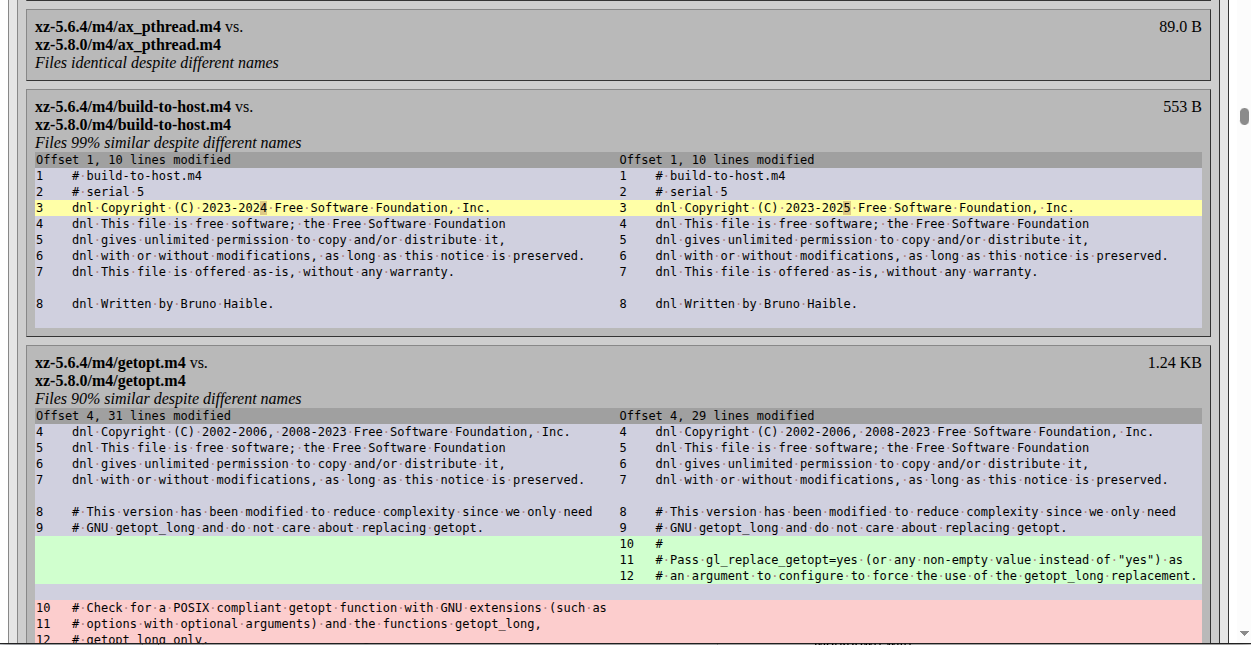
diffoscope --html-dir xz-utils-5.6.4_vs_5.8.0 xz-utils_5.6.4.orig.tar.xz xz-utils_5.8.0.orig.tar.xz
browse xz-utils-5.6.4_vs_5.8.0/index.html
If the changes are extensive, and you want to use a LLM to help spot potential security issues, generate the report of both the upstream and Debian packaging differences in Markdown with:
diffoscope --markdown diffoscope-debian.md xz-utils_5.6.4-1.debian.tar.xz xz-utils_5.8.1-2.debian.tar.xz
diffoscope --markdown diffoscope.md xz-utils_5.6.4.orig.tar.xz xz-utils_5.8.0.orig.tar.xzBased on the attached diffoscope output for a new Debian package version compared with the previous one, list all suspicious changes that might have introduced a backdoor, followed by other potential security issues. If there are none, list a short summary of changes as the conclusion.
Git-Vcs header in the debian/control file. For xz-utils the location is salsa.debian.org/debian/xz-utils.
Note that the Debian policy does not state anything about how Salsa should be used, or what git repository layout or development practices to follow. In practice most packages follow the DEP-14 proposal, and use git-buildpackage as the tool for managing changes and pushing and pulling them between upstream and salsa.debian.org.
To get the XZ Utils source, run:
$ gbp clone https://salsa.debian.org/debian/xz-utils.git
gbp:info: Cloning from 'https://salsa.debian.org/debian/xz-utils.git'$ git log --graph --oneline
* bb787585 (HEAD -> debian/unstable, origin/debian/unstable, origin/HEAD) Prepare 5.8.1-2
* 4b769547 d: Remove the symlinks from -dev package.
* a39f3428 Correct the nocheck build profile
* 1b806b8d Import Debian changes 5.8.1-1.1
* b1cad34b Prepare 5.8.1-1
* a8646015 Import 5.8.1
* 2808ec2d Update upstream source from tag 'upstream/5.8.1'
\
* fa1e8796 (origin/upstream/v5.8, upstream/v5.8) New upstream version 5.8.1
* a522a226 Bump version and soname for 5.8.1
* 1c462c2a Add NEWS for 5.8.1
* 513cabcf Tests: Call lzma_code() in smaller chunks in fuzz_common.h
* 48440e24 Tests: Add a fuzzing target for the multithreaded .xz decoder
* 0c80045a liblzma: mt dec: Fix lack of parallelization in single-shot decoding
* 81880488 liblzma: mt dec: Don't modify thr->in_size in the worker thread
* d5a2ffe4 liblzma: mt dec: Don't free the input buffer too early (CVE-2025-31115)
* c0c83596 liblzma: mt dec: Simplify by removing the THR_STOP state
* 831b55b9 liblzma: mt dec: Fix a comment
* b9d168ee liblzma: Add assertions to lzma_bufcpy()
* c8e0a489 DOS: Update Makefile to fix the build
* 307c02ed sysdefs.h: Avoid <stdalign.h> even with C11 compilers
* 7ce38b31 Update THANKS
* 688e51bd Translations: Update the Croatian translation
* a6b54dde Prepare 5.8.0-1.
* 77d9470f Add 5.8 symbols.
* 9268eb66 Import 5.8.0
* 6f85ef4f Update upstream source from tag 'upstream/5.8.0'
\ \
* afba662b New upstream version 5.8.0
/
* 173fb5c6 doc/SHA256SUMS: Add 5.8.0
* db9258e8 Bump version and soname for 5.8.0
* bfb752a3 Add NEWS for 5.8.0
* 6ccbb904 Translations: Run "make -C po update-po"
* 891a5f05 Translations: Run po4a/update-po
* 4f52e738 Translations: Partially fix overtranslation in Serbian man pages
* ff5d9447 liblzma: Count the extra bytes in LZMA/LZMA2 decoder memory usage
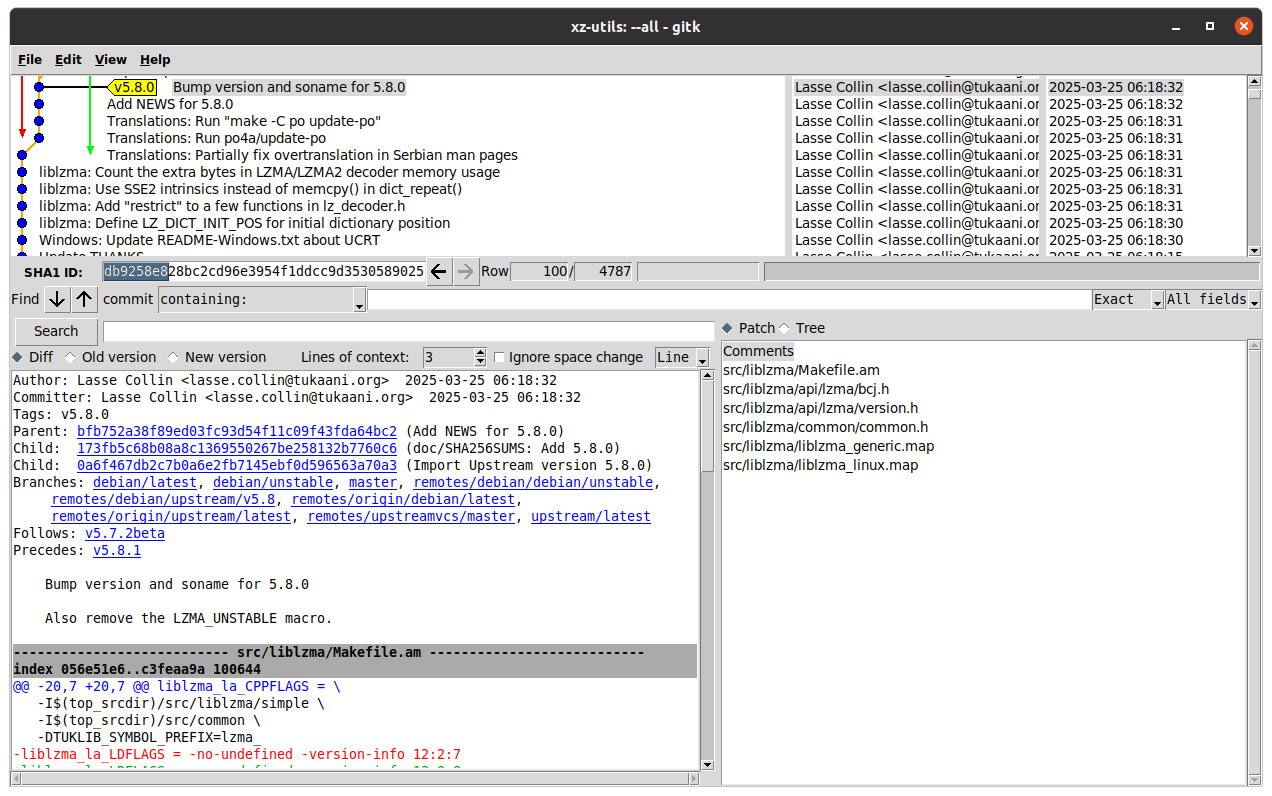
* 943b012d liblzma: Use SSE2 intrinsics instead of memcpy() in dict_repeat()debian/unstable branch as well as the intermediate upstream import branch, and the actual real upstream development branch. See my Debian source packages in git explainer for details of what these branches are used for.
To only view changes on the Debian branch, run git log --graph --oneline --first-parent or git log --graph --oneline -- debian.
The Debian branch should only have changes inside the debian/ subdirectory, which is easy to check with:
$ git diff --stat upstream/v5.8
debian/README.source 16 +++
debian/autogen.sh 32 +++++
debian/changelog 949 ++++++++++++++++++++++++++
...
debian/upstream/signing-key.asc 52 +++++++++
debian/watch 4 +
debian/xz-utils.README.Debian 47 ++++++++
debian/xz-utils.docs 6 +
debian/xz-utils.install 28 +++++
debian/xz-utils.postinst 19 +++
debian/xz-utils.prerm 10 ++
debian/xzdec.docs 6 +
debian/xzdec.install 4 +
33 files changed, 2014 insertions(+)debian/ directory originate from upstream, and for example running git blame on them should show only upstream commits:
$ git blame CMakeLists.txt
22af94128 (Lasse Collin 2024-02-12 17:09:10 +0200 1) # SPDX-License-Identifier: 0BSD
22af94128 (Lasse Collin 2024-02-12 17:09:10 +0200 2)
7e3493d40 (Lasse Collin 2020-02-24 23:38:16 +0200 3) ###############
7e3493d40 (Lasse Collin 2020-02-24 23:38:16 +0200 4) #
426bdc709 (Lasse Collin 2024-02-17 21:45:07 +0200 5) # CMake support for building XZ Utils$ git verify-tag v5.6.2
gpg: Signature made Wed 29 May 2024 09:39:42 AM PDT
gpg: using RSA key 3690C240CE51B4670D30AD1C38EE757D69184620
gpg: issuer "lasse.collin@tukaani.org"
gpg: Good signature from "Lasse Collin <lasse.collin@tukaani.org>" [expired]
gpg: Note: This key has expired!git log --reverse -p afba662b...fa1e8796. However, a far superior way to review changes would be to browse this range using a visual git history viewer, such as gitk. Either way, looking at one code change at a time and reading the git commit message makes the review much easier.
source-xz-utils/xz-utils_5.8.1-2.debian) and the git repository cloned in the previous section (path xz-utils):
$ diff -u source-xz-utils/xz-utils_5.8.1-2.debian/ xz-utils/debian/
diff -u source-xz-utils/xz-utils_5.8.1-2.debian/changelog xz-utils/debian/changelog
--- debsnap/source-xz-utils/xz-utils_5.8.1-2.debian/changelog 2025-10-03 09:32:16.000000000 -0700
+++ xz-utils/debian/changelog 2025-10-12 12:18:04.623054758 -0700
@@ -5,7 +5,7 @@
* Remove the symlinks from -dev, pointing to the lib package.
(Closes: #1109354)
- -- Sebastian Andrzej Siewior <sebastian@breakpoint.cc> Fri, 03 Oct 2025 18:32:16 +0200
+ -- Sebastian Andrzej Siewior <sebastian@breakpoint.cc> Fri, 03 Oct 2025 18:36:59 +0200
diff revealed that the timestamp in the changelog in the version uploaded to Debian is different from what was committed to git. This is not malicious, just a mistake by the maintainer who probably didn t run gbp tag immediately after upload, but instead some dch command and ended up with having a different timestamps in the git compared to what was actually uploaded to Debian.
$ gbp import-dsc --verbose ../source-xz-utils/xz-utils_5.8.1-2.dsc
Version '5.8.1-2' imported under '/home/otto/debian/xz-utils-2025-09-29'gbp import-dsc:
$ git log --graph --oneline
* 86aed07b (HEAD -> debian/unstable, tag: debian/5.8.1-2, origin/debian/unstable) Import Debian changes 5.8.1-2
* f111d93b (tag: debian/5.8.1-1.1) Import Debian changes 5.8.1-1.1
* 1106e19b (tag: debian/5.8.1-1) Import Debian changes 5.8.1-1
\
* 08edbe38 (tag: upstream/5.8.1, origin/upstream/v5.8, upstream/v5.8) Import Upstream version 5.8.1
\
* a522a226 (tag: v5.8.1) Bump version and soname for 5.8.1
* 1c462c2a Add NEWS for 5.8.1
* 513cabcf Tests: Call lzma_code() in smaller chunks in fuzz_common.hgbp import-dsc can be viewed at salsa.debian.org/otto/xz-utils-2025-09-29/-/network/debian%2Funstable
An example repository that was fully crafted using gbp import-dscs can be viewed at salsa.debian.org/otto/xz-utils-gbp-import-dscs-debsnap-generated/-/network/debian%2Flatest.
There exists also dgit, which in a similar way creates a synthetic git history to allow viewing the Debian archive contents via git tools. However, its focus is on producing new package versions, so fetching a package with dgit that has not had the history recorded in dgit earlier will only show the latest versions:
$ dgit clone xz-utils
canonical suite name for unstable is sid
starting new git history
last upload to archive: NO git hash
downloading http://ftp.debian.org/debian//pool/main/x/xz-utils/xz-utils_5.8.1.orig.tar.xz...
downloading http://ftp.debian.org/debian//pool/main/x/xz-utils/xz-utils_5.8.1.orig.tar.xz.asc...
downloading http://ftp.debian.org/debian//pool/main/x/xz-utils/xz-utils_5.8.1-2.debian.tar.xz...
dpkg-source: info: extracting xz-utils in unpacked
dpkg-source: info: unpacking xz-utils_5.8.1.orig.tar.xz
dpkg-source: info: unpacking xz-utils_5.8.1-2.debian.tar.xz
synthesised git commit from .dsc 5.8.1-2
HEAD is now at f9bcaf7 xz-utils (5.8.1-2) unstable; urgency=medium
dgit ok: ready for work in xz-utils
$ dgit/sid git log --graph --oneline
* f9bcaf7 xz-utils (5.8.1-2) unstable; urgency=medium 9 days ago (HEAD -> dgit/sid, dgit/dgit/sid)
\
* 11d3a62 Import xz-utils_5.8.1-2.debian.tar.xz 9 days ago
* 15dcd95 Import xz-utils_5.8.1.orig.tar.xz 6 months ago* b1cad34b Prepare 5.8.1-1
* a8646015 Import 5.8.1
* 2808ec2d Update upstream source from tag 'upstream/5.8.1'
\
* fa1e8796 (debian/upstream/v5.8, upstream/v5.8) New upstream version 5.8.1
* a522a226 (tag: v5.8.1) Bump version and soname for 5.8.1
* 1c462c2a Add NEWS for 5.8.1git import-orig --uscan for Debian packages with the correct settings in debian/gbp.conf. By viewing this commit one can see exactly how the upstream release tarball differs from the upstream git contents (if at all).
In the case of XZ, the difference is substantial, and shown below in full as it is very interesting:
$ git show --stat fa1e8796
commit fa1e8796dabd91a0f667b9e90f9841825225413a
(debian/upstream/v5.8, upstream/v5.8)
Author: Sebastian Andrzej Siewior <sebastian@breakpoint.cc>
Date: Thu Apr 3 22:58:39 2025 +0200
New upstream version 5.8.1
.codespellrc 30 -
.gitattributes 8 -
.github/workflows/ci.yml 163 -
.github/workflows/freebsd.yml 32 -
.github/workflows/netbsd.yml 32 -
.github/workflows/openbsd.yml 35 -
.github/workflows/solaris.yml 32 -
.github/workflows/windows-ci.yml 124 -
.gitignore 113 -
ABOUT-NLS 1 +
ChangeLog 17392 +++++++++++++++++++++
Makefile.in 1097 +++++++
aclocal.m4 1353 ++++++++
build-aux/ci_build.bash 286 --
build-aux/compile 351 ++
build-aux/config.guess 1815 ++++++++++
build-aux/config.rpath 751 +++++
build-aux/config.sub 2354 +++++++++++++
build-aux/depcomp 792 +++++
build-aux/install-sh 541 +++
build-aux/ltmain.sh 11524 ++++++++++++++++++++++
build-aux/missing 236 ++
build-aux/test-driver 160 +
config.h.in 634 ++++
configure 26434 ++++++++++++++++++++++
debug/Makefile.in 756 +++++
doc/SHA256SUMS 236 --
doc/man/txt/lzmainfo.txt 36 +
doc/man/txt/xz.txt 1708 ++++++++++
doc/man/txt/xzdec.txt 76 +
doc/man/txt/xzdiff.txt 39 +
doc/man/txt/xzgrep.txt 70 +
doc/man/txt/xzless.txt 36 +
doc/man/txt/xzmore.txt 31 +
lib/Makefile.in 623 ++++
m4/.gitignore 40 -
m4/build-to-host.m4 274 ++
m4/gettext.m4 392 +++
m4/host-cpu-c-abi.m4 529 +++
m4/iconv.m4 324 ++
m4/intlmacosx.m4 71 +
m4/lib-ld.m4 170 +
m4/lib-link.m4 815 +++++
m4/lib-prefix.m4 334 ++
m4/libtool.m4 8488 +++++++++++++++++++++
m4/ltoptions.m4 467 +++
m4/ltsugar.m4 124 +
m4/ltversion.m4 24 +
m4/lt~obsolete.m4 99 +
m4/nls.m4 33 +
m4/po.m4 456 +++
m4/progtest.m4 92 +
po/.gitignore 31 -
po/Makefile.in.in 517 +++
po/Rules-quot 66 +
po/boldquot.sed 21 +
po/ca.gmo Bin 0 -> 15587 bytes
po/cs.gmo Bin 0 -> 7983 bytes
po/da.gmo Bin 0 -> 9040 bytes
po/de.gmo Bin 0 -> 29882 bytes
po/en@boldquot.header 35 +
po/en@quot.header 32 +
po/eo.gmo Bin 0 -> 15060 bytes
po/es.gmo Bin 0 -> 29228 bytes
po/fi.gmo Bin 0 -> 28225 bytes
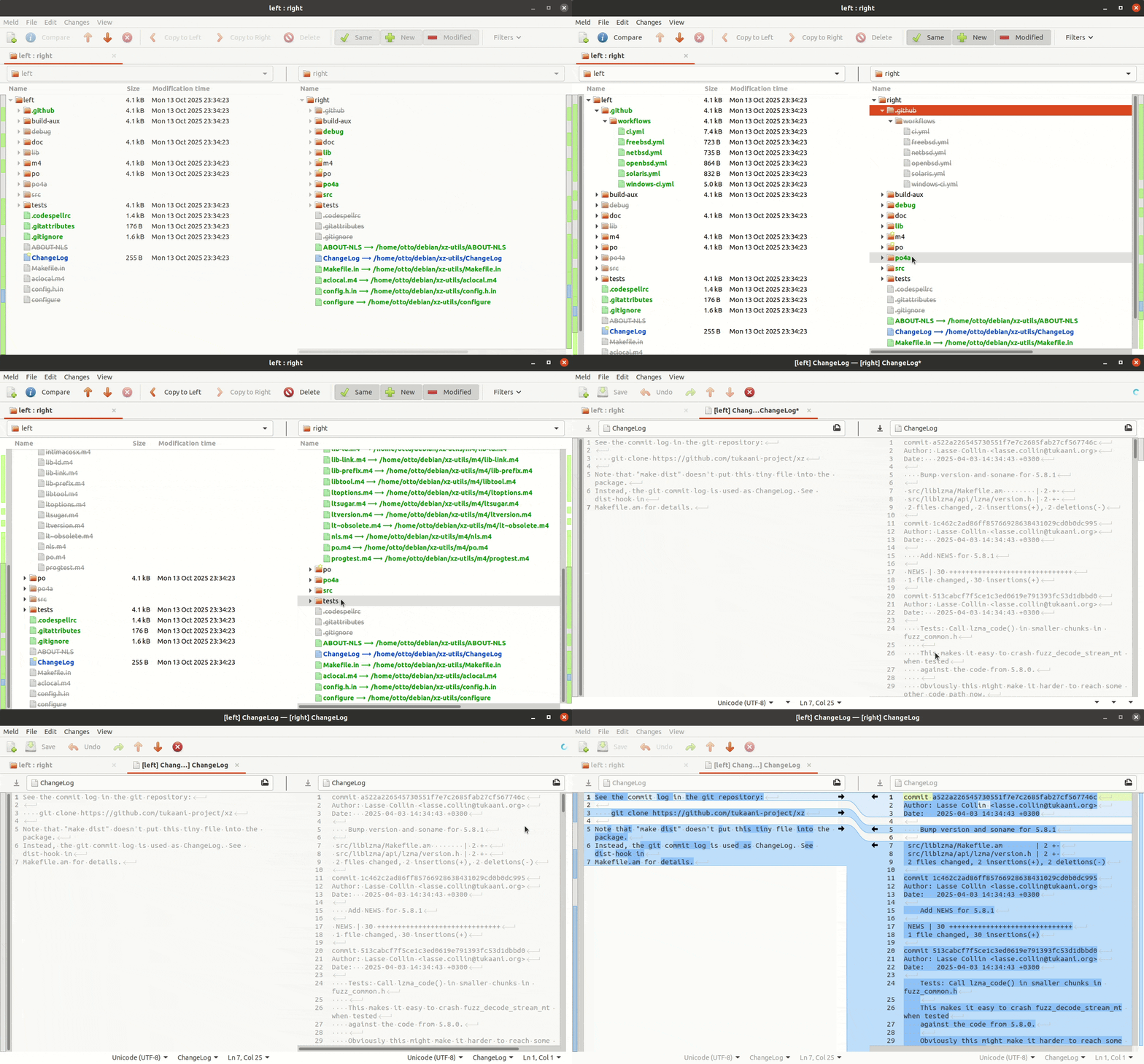
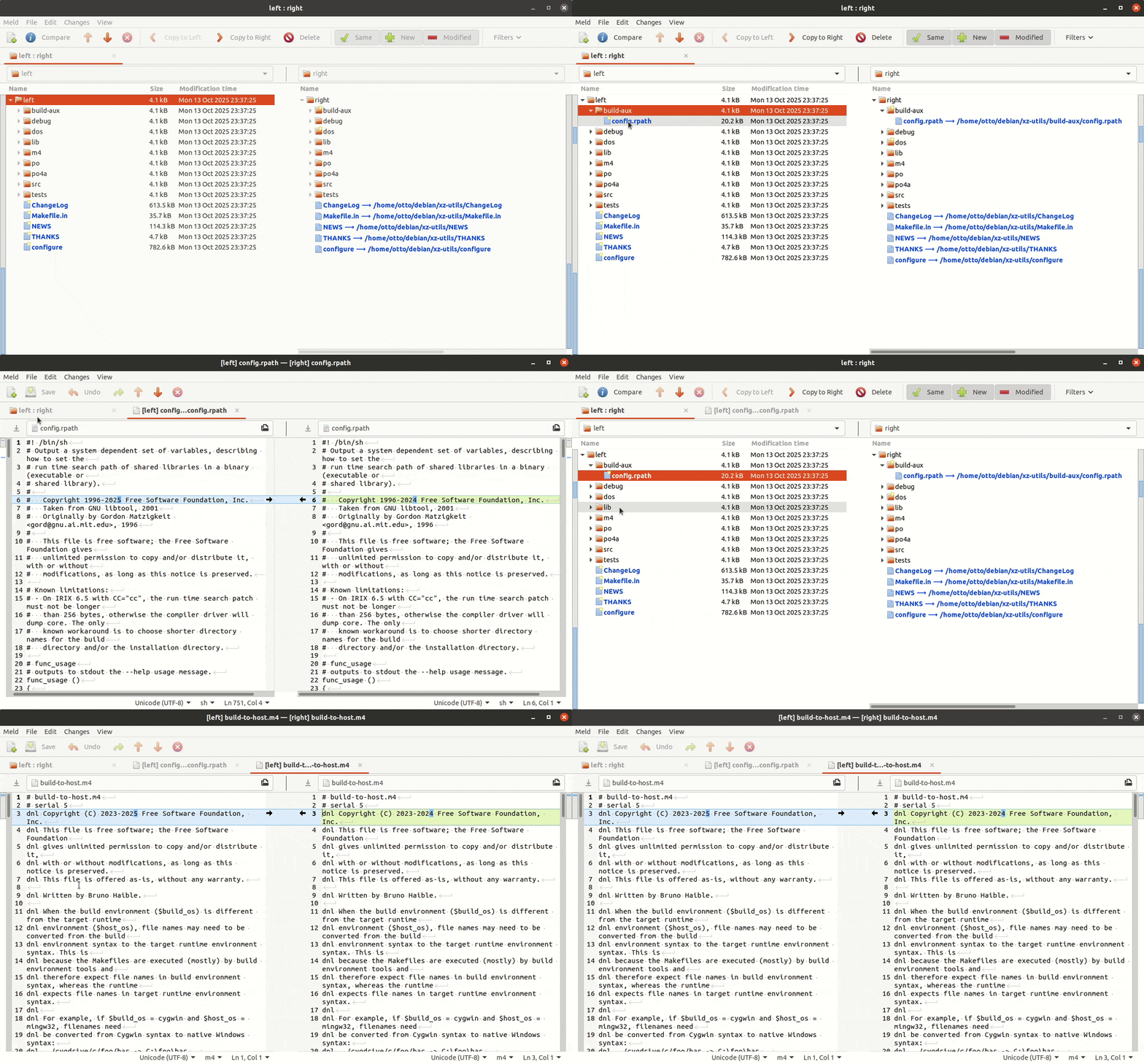
po/fr.gmo Bin 0 -> 10232 bytesgit difftool --dir-diff fa1e8796^..fa1e8796.
To compare changes across the new and old upstream tarball, one would need to compare commits afba662b New upstream version 5.8.0 and fa1e8796 New upstream version 5.8.1 by running git difftool --dir-diff afba662b..fa1e8796.
With all the above tips you can now go and try to audit your own favorite package in Debian and see if it is identical with upstream, and if not, how it differs.
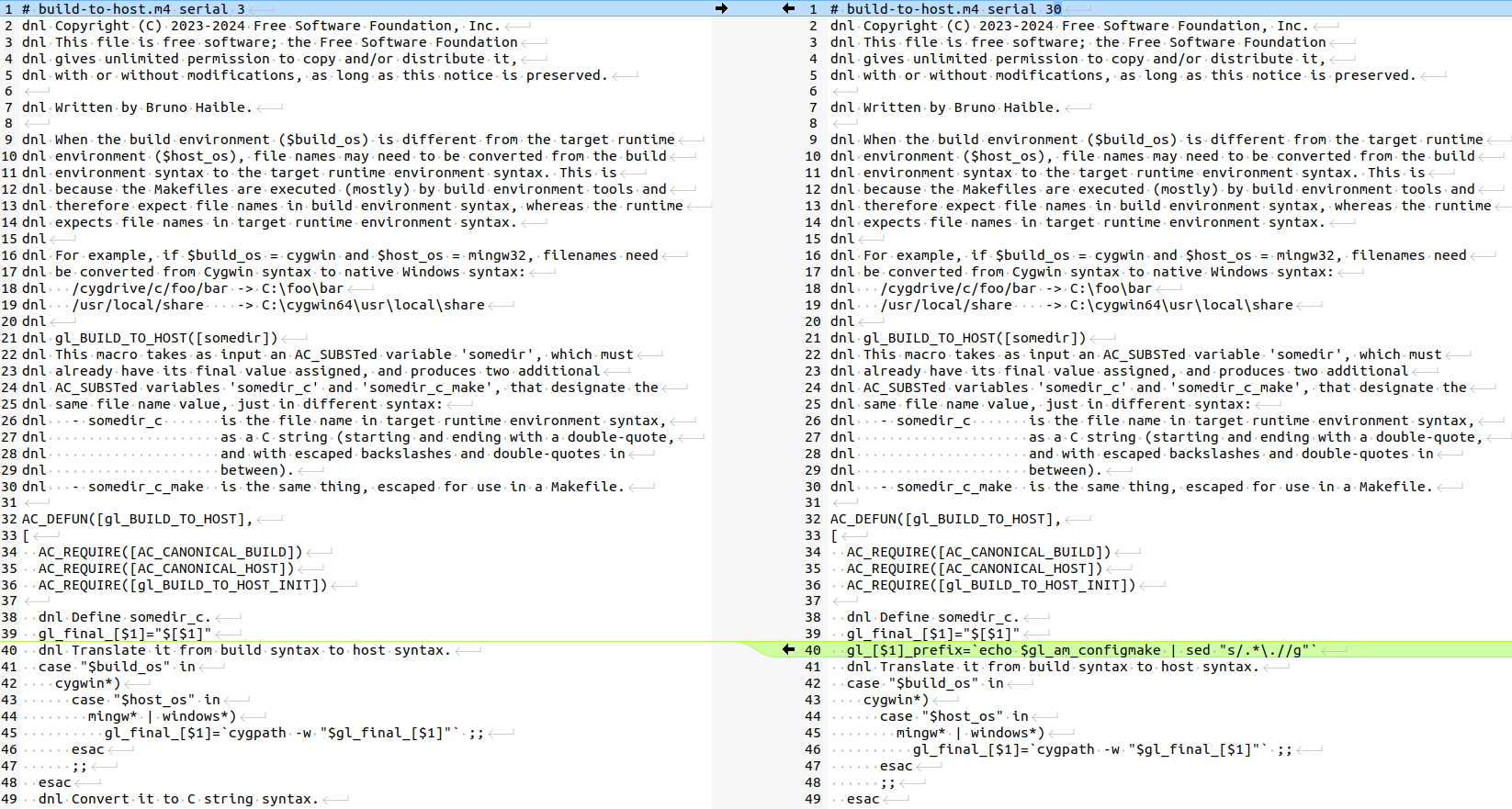
tests/files/bad-3-corrupt_lzma2.xz, tests/files/good-large_compressed.lzma), and a small modification in the build scripts (m4/build-to-host.m4) to extract the backdoor and plant it into the built binary. The build script was not tracked in version control, but generated with GNU Autotools at release time and only shipped as additional files in the release tarball.
The entire reason for me to write this post was to ponder if a diligent engineer using git-buildpackage best practices could have reasonably spotted this while importing the new upstream release into Debian. The short answer is no . The malicious actor here clearly anticipated all the typical ways anyone might inspect both git commits, and release tarball contents, and masqueraded the changes very well and over a long timespan.
First of all, XZ has for legitimate reasons for several carefully crafted .xz files as test data to help catch regressions in the decompression code path. The test files are shipped in the release so users can run the test suite and validate that the binary is built correctly and xz works properly. Debian famously runs massive amounts of testing in its CI and autopkgtest system across tens of thousands of packages to uphold high quality despite frequent upgrades of the build toolchain and while supporting more CPU architectures than any other distro. Test data is useful and should stay.
When git-buildpackage is used correctly, the upstream commits are visible in the Debian packaging for easy review, but the commit cf44e4b that introduced the test files does not deviate enough from regular sloppy coding practices to really stand out. It is unfortunately very common for git commit to lack a message body explaining why the change was done, and to not be properly atomic with test code and test data together in the same commit, and for commits to be pushed directly to mainline without using code reviews (the commit was not part of any PR in this case). Only another upstream developer could have spotted that this change is not on par to what the project expects, and that the test code was never added, only test data, and thus that this commit was not just a sloppy one but potentially malicious.
Secondly, the fact that a new Autotools file appeared (m4/build-to-host.m4) in the XZ Utils 5.6.0 is not suspicious. This is perfectly normal for Autotools. In fact, starting from XZ Utils version 5.8.1 it is now shipping a m4/build-to-host.m4 file that it actually uses now.
Spotting that there is anything fishy is practically impossible by simply reading the code, as Autotools files are full custom m4 syntax interwoven with shell script, and there are plenty of backticks ( ) that spawn subshells and evals that execute variable contents further, which is just normal for Autotools. Russ Cox s XZ post explains how exactly the Autotools code fetched the actual backdoor from the test files and injected it into the build.
There is only one tiny thing that maybe a very experienced Autotools user could potentially have noticed: the serial 30 in the version header is way too high. In theory one could also have noticed this Autotools file deviates from what other packages in Debian ship with the same filename, such as e.g. the serial 3, serial 5a or 5b versions. That would however require and an insane amount extra checking work, and is not something we should plan to start doing. A much simpler solution would be to simply strongly recommend all open source projects to stop using Autotools to eventually get rid of it entirely.
debian/gbp.conf, and thus their package development histories are not always correctly constructed or uniform and easy to compare. The Debian Policy does not mandate git usage at all, and there are many important packages that are not using git at all. Additionally the Debian Policy also allows for non-maintainers to upload new versions to Debian without committing anything in git even for packages where the original maintainer wanted to use git. Uploads that bypass git unfortunately happen surpisingly often.
Because of the situation, I am afraid that we could have multiple similar backdoors lurking that simply haven t been detected yet. More audits, that hopefully also get published openly, would be welcome! More people auditing the contents of the Debian archives would probably also help surface what tools and policies Debian might be missing to make the work easier, and thus help improve the security of Debian s users, and improve trust in Debian.
debian/watch or other configs are incorrect and even cases where maintainers have manually created upstream tarballs as it was easier than configuring automation to work. It is obvious that for those packages the source tarball now in Debian is not at all the same as upstream. I am not aware of any malicious cases though (if I was, I would report them of course).
I am also aware of packages in the Debian repository that are misconfigured to be of type 1.0 (native) packages, mixing the upstream files and debian/ contents and having patches applied, while they actually should be configured as 3.0 (quilt), and not hide what is the true upstream sources. Debian should extend the QA tools to scan for such things. If I find a sponsor, I might build it myself as my next major contribution to Debian.
In addition to better tooling for finding mismatches in the source code, Debian could also have better tooling for tracking in built binaries what their source files were, but solutions like Fraunhofer-AISEC s supply-graph or Sony s ESSTRA are not practical yet. Julien Malka s post about NixOS discusses the role of reproducible builds, which may help in some cases across all distros.
B (= 2) declares a Conflicts: A (= 1) and Replaces: A (= 1), then the removal
is valid. However this is incomplete as well, consider it declares Conflicts: A (< 1)
and Replaces: A (< 1); the solution to remove A rather than upgrade it would still
be wrong.
This indicates that we should only allow removing A if the conflicts could not be solved
by upgrading it.
The other case to explore is package removals. If B is removed, A should be removed as well;
however it there is another package X that Provides: B (= 1) and it is marked for install,
A should not be removed. That said, the solver is not allowed to install X to satisfy the
depends B (= 1) - only to satisfy other dependencies [we do not want to get into endless
loops where we switch between alternatives to keep reverse dependencies installed].
P is sound if either:
v is installed that package-conflicts with B.Q is removed and the installable versions of P package-depends on Q.v is installable if either it is installed,
or it is newer than an installed version of the same package (you may wish to change this to
accomodate downgrades, or require strict pinning, but here be dragons).
Definition (package-depends): A version v package-depends on a package B if either:
v that can be solved by any version of B, orC where v package-depends C and any (c in C) package-depends B (transitivity)v package-conflicts with an installed package B if either:
C where v package-conflicts C,
and b package-depends C for installable versions b.A and when we reach not A, we analyse if the implication graph for not A
constitutes a sound removal, and then replace the assumption A with the assumption
A or "learned reason.
However, while this seems a plausible mechanism for a DPLL solver, for a modern CDCL solver, it s
not immediately evident how to analyse whether not A is sound if the reason for it is a learned
clause, rather than a problem clause.
Instead we propose a static encoding of the rules into a slightly modified SAT solver:
Given c1, , cn that transitive-conflicts A and D1, , Dn that A package-depends on,
introduce the rule:
A unless c1 or c2 or ... cn ... or not D1 or not D2 ... or not Dn
Rules of the form A... unless B... - where A... and B... are CNF - are
intuitively the same as A... or B..., however the semantic here is different:
We are not allowed to select B... to satisfy this clause.
This requires a SAT solver that tracks a reason for each literal being assigned,
such as solver3, rather than a SAT solver like MiniSAT that only tracks reasons across
propagation (solver3 may track A depends B or C as the reason for B without evaluating
C, whereas MiniSAT would only track it as the reason given not C).
A side project I have been working on a little since last winter and
which explores extending duckdb with
mlpack is now public at the duckdb-mlpack
repo.
duckdb is an excellent small (as
in runs as a self-contained binary ) database engine with both a focus
on analytical payloads (OLAP rather than OLTP) and an impressive number
of already bolted-on extensions (for example for cloud data access)
delivered as a single-build C++ executable (or of course as a library
used from other front-ends). mlpack is
an excellent C++ library containing many/most machine learning
algorithms, also built in a self-contained manner (or library) making it
possible to build compact yet powerful binaries, or to embed (as opposed
to other ML framework accessed from powerful but not lightweight
run-times such as Python or R). The compact build aspect as well as the
common build tools (C++, cmake) make these two a natural candidate for
combining them. Moreover, duckdb is a
champion of data access, management and control and the complementary
machine learning insights and predictions offered by mlpack are fully complementary and hence
fit this rather well.
duckdb also has a very robust and
active extension system. To use it, one starts from a template
repository and its use this template button, runs a script and can
then start experimenting. I have now grouped my initial start and test
functions into a separate repository duckdb-example-extension
to keep the duckdb-mlpack
one focused on the extend to mlpack aspect.
duckdb-mlpack
is right an MVP , i.e. a minimally viable product (or demo). It just
runs the adaboost classifier but does so on any dataset
fitting the rectangular setup with columns of features (real valued)
and a final column (integer valued) of labels. I had hope to use two
select queries for both features and then labels but it
turns a table function (returning a table of data from a query) can
only run one select *. So the basic demo, also on the repo
README is now to run the following script (where the
SELECT * FROM mlpack_adaboost((SELECT * FROM D)); is the
key invocation of the added functionality):
#!/bin/bash
cat <<EOF build/release/duckdb
SET autoinstall_known_extensions=1;
SET autoload_known_extensions=1; # for httpfs
CREATE TEMP TABLE Xd AS SELECT * FROM read_csv("https://mlpack.org/datasets/iris.csv");
CREATE TEMP TABLE X AS SELECT row_number() OVER () AS id, * FROM Xd;
CREATE TEMP TABLE Yd AS SELECT * FROM read_csv("https://mlpack.org/datasets/iris_labels.csv");
CREATE TEMP TABLE Y AS SELECT row_number() OVER () AS id, CAST(column0 AS double) as label FROM Yd;
CREATE TEMP TABLE D AS SELECT * FROM X INNER JOIN Y ON X.id = Y.id;
ALTER TABLE D DROP id;
ALTER TABLE D DROP id_1;
CREATE TEMP TABLE A AS SELECT * FROM mlpack_adaboost((SELECT * FROM D));
SELECT COUNT(*) as n, predicted FROM A GROUP BY predicted;
EOFgroup by:
(Note that this requires the httpfs extension. So when
you build from a freshly created extension repository you may be ahead
of the most recent release of duckdb by a few commits. It
is easy to check out the most recent release tag (or maybe the one you
are running for your local duckdb binary) to take advantage
of the extensions you likely already have for that version. So here, and
in the middle of October 2025, I picked v1.4.1 as I run
duckdb version 1.4.1 on my box.)
There are many other neat duckdb
extensions. The core ones are regrouped here
while a list of community extensions is here
and here.
For this (still more minimal) extension, I added a few TODO items to
the README.md:
SELECT from multiple tabels,
or else maybe SELECT into temp. tables and pass temp. table
names into routinemlpack as a git submoduleThis post by Dirk Eddelbuettel originated on his Thinking inside the box blog. If you like this or other open-source work I do, you can now sponsor me at GitHub.
set -x
echo platform > /sys/power/pm_test
echo reboot > /sys/power/disk
rmmod mt76x2u
sleep 2
echo 1 tee /sys/bus/pci/devices/0003:30:00.0/remove
sleep 2
echo 1 tee /sys/bus/pci/devices/0004:41:00.0/remove
sleep 2
echo 1 tee /sys/bus/pci/devices/0004:40:00.0/remove
sleep 2
echo LSPCI:
lspci -t
sleep 2
echo disk > /sys/power/state
sleep 2
echo 1 tee /sys/bus/pci/rescan
sleep 2
modprobe mt76x2u
09868a4f2eb (HEAD -> reform-patches) copy pocket-reform dts from reform-debian-packages
152e2ae8a193 pocket/panel: sleep fix v3
18f65da9681c add-multi-display-panel-driver
$ uname -a
Linux anthia 6.18.0-rc1+ #19 SMP Thu Oct 16 11:32:04 ADT 2025 aarch64 GNU/Linux
[ 424.645109] PM: hibernation: Allocated 361823 pages for snapshot
[ 424.647216] PM: hibernation: Allocated 1447292 kbytes in 3.23 seconds (448.07 MB/s)
[ 424.649321] Freezing remaining freezable tasks
[ 424.654767] Freezing remaining freezable tasks completed (elapsed 0.003 seconds)
[ 424.661070] rk_gmac-dwmac fe1b0000.ethernet end0: Link is Down
[ 424.740716] rockchip-dw-pcie a40c00000.pcie: Failed to receive PME_TO_Ack
[ 424.742041] PM: hibernation: hibernation debug: Waiting for 5 second(s).
[ 430.074757] pci 0004:40:00.0: [1d87:3588] type 01 class 0x060400 PCIe Root Port
F F & Zn [ watchdog: CPU4: Watchdog detected hard LOCKUP on cpu 5
[ 456.039004] Modules linked in: xt_CHECKSUM xt_tcpudp nft_chain_nat xt_MASQUERADE nf_nat nf_conntrack nf_defrag_ipv6 nf_defrag_ipv4 nft_compat x_tables bridge stp llc nf_tables aes_neon_bs aes_neon_blk ccm dwmac_rk binfmt_misc mt76x2_common mt76x02_usb mt76_usb mt76x02_lib mt76 mac80211 rk805_pwrkey snd_soc_tlv320aic31xx snd_soc_simple_card reform2_lpc(OE) libarc4 rockchip_saradc industrialio_triggered_buffer kfifo_buf industrialio cfg80211 rockchip_thermal rockchip_rng hantro_vpu cdc_acm v4l2_vp9 v4l2_jpeg rockchip_rga rfkill snd_soc_rockchip_i2s_tdm videobuf2_dma_sg v4l2_h264 panthor snd_soc_audio_graph_card drm_gpuvm snd_soc_simple_card_utils drm_exec evdev joydev dm_mod nvme_fabrics efi_pstore configfs nfnetlink autofs4 ext4 crc16 mbcache jbd2 btrfs blake2b_generic xor xor_neon raid6_pq mali_dp snd_soc_meson_axg_toddr snd_soc_meson_axg_fifo snd_soc_meson_codec_glue panfrost drm_shmem_helper gpu_sched ao_cec_g12a meson_vdec(C) videobuf2_dma_contig videobuf2_memops v4l2_mem2mem videobuf2_v4l2 videodev
[ 456.039060] videobuf2_common mc dw_hdmi_i2s_audio meson_drm meson_canvas meson_dw_mipi_dsi meson_dw_hdmi mxsfb mux_mmio panel_edp imx_dcss ti_sn65dsi86 nwl_dsi mux_core pwm_imx27 hid_generic usbhid hid xhci_plat_hcd onboard_usb_dev xhci_hcd nvme nvme_core snd_soc_hdmi_codec snd_soc_core nvme_keyring nvme_auth hkdf snd_pcm_dmaengine snd_pcm snd_timer snd soundcore fan53555 rtc_pcf8523 micrel phy_package stmmac_platform stmmac pcs_xpcs rk808_regulator phylink sdhci_of_dwcmshc mdio_devres dw_mmc_rockchip of_mdio sdhci_pltfm phy_rockchip_usbdp fixed_phy dw_mmc_pltfm fwnode_mdio typec phy_rockchip_naneng_combphy phy_rockchip_samsung_hdptx pwm_rockchip sdhci dwc3 libphy dw_wdt dw_mmc ehci_platform rockchip_dfi mdio_bus cqhci ulpi ohci_platform ehci_hcd udc_core ohci_hcd rockchipdrm phy_rockchip_inno_usb2 usbcore dw_hdmi_qp analogix_dp dw_mipi_dsi cpufreq_dt dw_mipi_dsi2 i2c_rk3x usb_common drm_dp_aux_bus [last unloaded: mt76x2u]
[ 456.039111] Sending NMI from CPU 4 to CPUs 5:
[ 471.942262] page_pool_release_retry() stalled pool shutdown: id 9, 2 inflight 60 sec
[ 532.989611] page_pool_release_retry() stalled pool shutdown: id 9, 2 inflight 121 sec
PHY.
b4.
Unfortunately there are too many conflicts now for me to sensibly
resolve.
-std=c17 as compile flags, but this would have just postponed the tasks. As a
result Thorsten uploaded modernized versions of ink, nm2ppa and rlpr for the
Debian printing team.
Build-Depends.
As these packages have become available in trixie , more and more packages add
this extra information and in August, the libtool package
gained
a gfortran-for-host dependency. It was the first package in the essential
build closure to adopt this and required putting the pieces together in
rebootstrap that now has to
build gcc-defaults early on. There still are
hundreds of packages whose dependencies need to be updated
though.
pixman to 0.46.4.guestfs-tools to unblock one.pycparser, beautifulsoup4, platformdirs, pycparser, python-authlib,
python-cffi, python-mitogen, python-resolvelib, python-super-collections,
twine).thin,
passenger, and puma is still WIP).termrec upload to avoid its deletion. This work was paused to give packages
some time to migrate to forky .Recommends. He improved the tooling to detect and report bugs creating
269 bugs
and followed up comments. 37 bugs have been resolved, others acknowledged.
The missing Recommends are a mixture of packages that are gone from Debian,
packages that changed name, typos and also packages that were recommended but
are not packaged in Debian.Suggests only
for packages that used to be in Debian but are removed from it now. No bugs have
been created yet for this case but identified 1320 of them.pull-debian-source) that made O(n) HTTP requests when it could
instead make O(1).
A bit delayed in terms of an announcement, but last month I tagged a new version of onak, my OpenPGP compatible keyserver. It s been 2 years since the last release, and this is largely a bunch of minor fixes to make compilation under Debian trixie with more recent CMake + GCC versions happy.

OpenPGP v6 support, RFC9580, hasn t made it. I ve got a branch which adds it, but a lack of keys to do any proper testing with, and no X448 support implemented, mean I m not ready to include it in a release yet. The plan is that ll land for 0.7.0 (along with some backend work), but no idea when that might be.
Available locally or via GitHub.
0.6.4 - 7th September 2025
- Fix building with CMake 4.0
- Fixes for building with GCC 15
- Rename keyd(ctl) to onak-keyd(ctl)
UPDATE wp_usermeta SET meta_value = 400 WHERE user_id = 2 AND meta_key = 'users_per_page';Deleting the spam users reduced the size of the backup (zstd -9 of a mysql dump) for my blog by 6.5%. Then changing from zstd -9 to -19 reduced it by another 13%. After realising this difference I configured all my mysql backups to be compressed with zstd -19, this will make a difference on the system with over 30G of zstd compressed mysql backups.
Like each month, have a look at the work funded by Freexian s Debian LTS offering.
unable to set gid=5001 or uid=5001 (euid=100): local delivery to [redacted] transport=nncpWeird. Stranger still, when I manually ran the queue with sendmail -qff -v, they all delivered fine. Huh. Well, I thought, it was a one-off weird thing. But then it happened again. Upon investigating, I observed that this issue was happening only on messages submitted by SMTP. Which, on these systems, aren t that many. While trying different things, I tried submitting a message to myself using SMTP. Nothing to do with NNCP at all. But look at this:
jgoerzen@[redacted] R=userforward defer (-1): require_files: error for /home/jgoerzen/.forward: Permission deniedStrraaannnge . All the information I could find about this, even a FAQ entry, said that the problem is that Exim isn t setuid root. But it is:
-rwsr-xr-x 1 root root 1533496 Mar 29 2025 /usr/sbin/exim4This problem started when I upgraded to Debian Trixie. So what changed there? There are a lot of possibilities; this is running in Docker using my docker-debian-base system, which runs a regular Debian in Docker, including systemd. I eventually tracked it down to Exim migrating from init.d to systemd in trixie, and putting a bunch of lockdowns in its service file. After a bunch of trial and error, I determined that I needed to override this set of lockdowns to make it work. These overrides did the trick:
ProtectClock=false PrivateDevices=false RestrictRealtime=false ProtectKernelModules=false ProtectKernelTunables=false ProtectKernelLogs=false ProtectHostname=falseI don t know for sure if the issue is related to setuid. But if it is, there s nothing that immediately jumps out at me about any of these that would indicate a problem with setuid. I also don t know if running in Docker makes any difference. Anyhow, problem fixed, but mystery not solved!
Welcome to the September 2025 report from the Reproducible Builds project!
Welcome to the very latest report from the Reproducible Builds project. Our monthly reports outline what we ve been up to over the past month, and highlight items of news from elsewhere in the increasingly-important area of software supply-chain security. As ever, if you are interested in contributing to the Reproducible Builds project, please see the Contribute page on our website.
In this report:
Please join us at the upcoming Reproducible Builds Summit, set to take place from October 28th 30th 2025 in Vienna, Austria!
We are thrilled to host the eighth edition of this exciting event, following the success of previous summits in various iconic locations around the world, including Venice, Marrakesh, Paris, Berlin, Hamburg and Athens. Our summits are a unique gathering that brings together attendees from diverse projects, united by a shared vision of advancing the Reproducible Builds effort.
During this enriching event, participants will have the opportunity to engage in discussions, establish connections and exchange ideas to drive progress in this vital field. Our aim is to create an inclusive space that fosters collaboration, innovation and problem-solving.
If you re interesting in joining us this year, please make sure to read the event page which has more details about the event and location. Registration is open until 20th September 2025, and we are very much looking forward to seeing many readers of these reports there!
Once the proper measurement points are known, we want to constrain the system such that what it does is simple enough to understand and easy to repeat. It is quite telling that the push for software that enables reproducible builds only really took off after an embarrassing widespread security issue ended up affecting the entire Internet. That there had already been 50 years of software development before anyone thought that introducing a few constraints might be a good idea is, well, let s just say it generates many emotions, none of them happy, fuzzy ones. [ ]
In Debian this month, Johannes Starosta filed a bug against the debian-repro-status package, reporting that it does not work on Debian trixie. (An upstream bug report was also filed.) Furthermore, 17 reviews of Debian packages were added, 10 were updated and 14 were removed this month adding to our knowledge about identified issues.
In March s report, we included the news that Fedora would aim for 99% package reproducibility. This change has now been deferred to Fedora 44 according to Phoronix.
Lastly, Bernhard M. Wiedemann posted another openSUSE monthly update for their work there.
306 was uploaded to Debian unstable by Chris Lamb. It included contributions already covered in previous months as well as some changes by Zbigniew J drzejewski-Szmek to address issues with the fdtump support [ ] and to move away from the deprecated codes.open method. [ ][ ]
strip-nondeterminism version 1.15.0-1 was uploaded to Debian unstable by Chris Lamb. It included a contribution by Matwey Kornilov to add support for inline archive files for Erlang s escript [ ].
kpcyrd has released a new version of rebuilderd. As a quick recap, rebuilderd is an automatic build scheduler that tracks binary packages available in a Linux distribution and attempts to compile the official binary packages from their (purported) source code and dependencies. The code for in-toto attestations has been reworked, and the instances now feature a new endpoint that can be queried to fetch the list of public-keys an instance currently identifies itself by. [ ]
Lastly, Holger Levsen bumped the Standards-Version field of disorderfs, with no changes needed. [ ][ ]
The Reproducible Builds project operates a comprehensive testing framework running primarily at tests.reproducible-builds.org in order to check packages and other artifacts for reproducibility. In August, however, a number of changes were made by Holger Levsen, including:
rebuilderd-worker.conf on a node. [ ]rebuilder-debian.sh script for all hosts. [ ]pull184 branch. [ ][ ][ ][ ][ ]ionos10 node. [ ]armel architecture [ ].rebuilder-debian.sh script. [ ]pull184 branch. [ ][ ][ ][ ]ms-gsl.llama.cpp.python-mcstasscript.rocm-docs-core.octave-optics.g2o.golang-forgejo-forgejo-levelqueue.openrgb.#reproducible-builds on irc.oftc.net.
rb-general@lists.reproducible-builds.org
[2025-10-03 12:37:17,525 - pika.adapters.utils.connection_workflow - ERROR] AMQPConnector - reporting failure: AMQPConnectorSocketConnectError: timeout("TCP connection attempt timed out: ''/(<AddressFamily.AF_INET: 2>, <SocketKind.SOCK_STREAM: 1>, 6, '', ('<IP>', 5672))")
[2025-10-03 12:37:17,526 - pika.adapters.utils.connection_workflow - ERROR] AMQP connection workflow failed: AMQPConnectionWorkflowFailed: 1 exceptions in all; last exception - AMQPConnectorSocketConnectError: timeout("TCP connection attempt timed out: ''/(<AddressFamily.AF_INET: 2>, <SocketKind.SOCK_STREAM: 1>, 6, '', ('<IP>', 5672))"); first exception - None.
[2025-10-03 12:37:17,526 - pika.adapters.utils.connection_workflow - ERROR] AMQPConnectionWorkflow - reporting failure: AMQPConnectionWorkflowFailed: 1 exceptions in all; last exception - AMQPConnectorSocketConnectError: timeout("TCP connection attempt timed out: ''/(<AddressFamily.AF_INET: 2>, <SocketKind.SOCK_STREAM: 1>, 6, '', ('<IP>', 5672))"); first exception - None
At first glance, the issue is simple: the Load Balancer's idle
timeout is shorter than the RabbitMQ heartbeat interval.
The idle timeout is the time at which a downstream or upstream
connection will be terminated if there are no active streams. Heartbeats
generate periodic network traffic to prevent idle TCP connections from
closing prematurely.
Adjusting these timeout settings to align properly solved the
issue.
However, what I want to explore in this post are other similar
scenarios where it's not so obvious that the idle timeout is the
problem. Introducing an extra network layer, such as an Envoy proxy, can
introduce unpredictable behavior across your services, like intermittent
5XX errors.
To make this issue more concrete, let's look at a minimal,
reproducible setup that demonstrates how adding an Envoy proxy can lead
to sporadic errors.
$ docker run \
--name envoy --rm \
--network host \
-v $(pwd)/envoy.yaml:/etc/envoy/envoy.yaml \
envoyproxy/envoy:v1.33-latest
I'll be running experiments with two different
envoy.yaml configurations: one that uses Envoy's TCP proxy,
and another that uses Envoy's HTTP connection manager.
Here's the simplest Envoy TCP proxy setup: a listener on port 8000
forwarding traffic to a backend running on port 8080.
static_resources:
listeners:
- name: go_server_listener
address:
socket_address:
address: 0.0.0.0
port_value: 8000
filter_chains:
- filters:
- name: envoy.filters.network.tcp_proxy
typed_config:
"@type": type.googleapis.com/envoy.extensions.filters.network.tcp_proxy.v3.TcpProxy
stat_prefix: go_server_tcp
cluster: go_server_cluster
clusters:
- name: go_server_cluster
connect_timeout: 1s
type: static
load_assignment:
cluster_name: go_server_cluster
endpoints:
- lb_endpoints:
- endpoint:
address:
socket_address:
address: 127.0.0.1
port_value: 8080package main
import (
"fmt"
"net/http"
"time"
)
func helloHandler(w http.ResponseWriter, r *http.Request)
w.Write([]byte("Hello from Go!"))
func main()
http.HandleFunc("/", helloHandler)
server := http.Server
Addr: ":8080",
IdleTimeout: 3 * time.Second,
fmt.Println("Starting server on :8080")
panic(server.ListenAndServe())
oha is the perfect tool to generate the HTTP
requests for this test. The Load test is not meant to stress this setup,
the idea is to wait long enough so that some requests are closed. The
burst-delay feature will help with that:
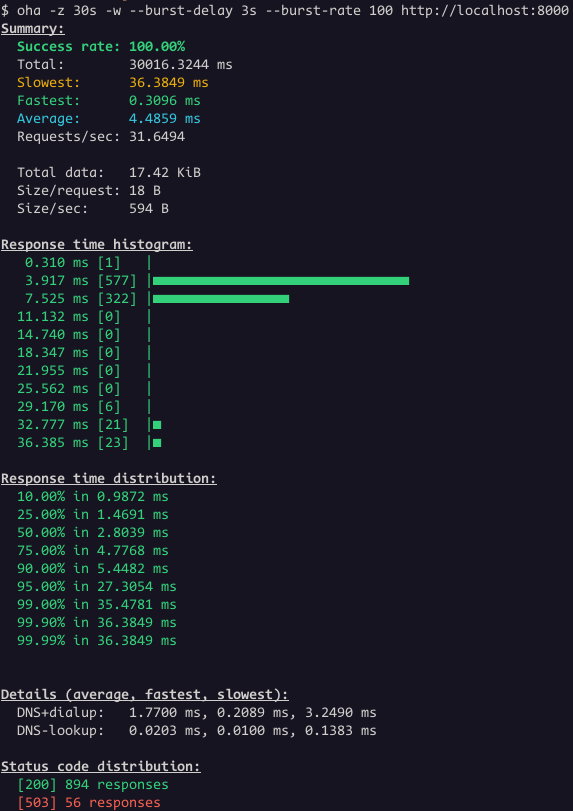
$ oha -z 30s -w --burst-delay 3s --burst-rate 100 http://localhost:8000
I'm running the Load test for 30 seconds, sending 100 requests at
three-second intervals. I also use the -w option to wait
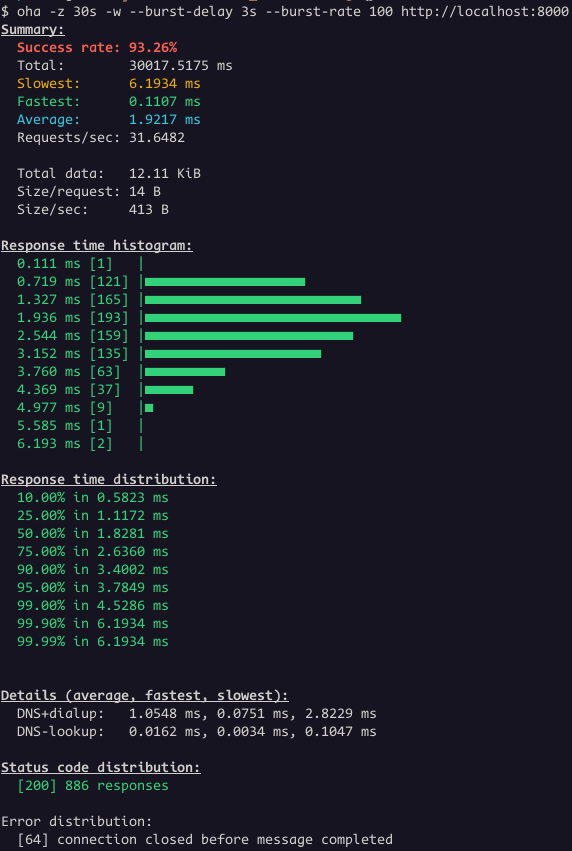
for ongoing requests when the duration is reached. The result looks like
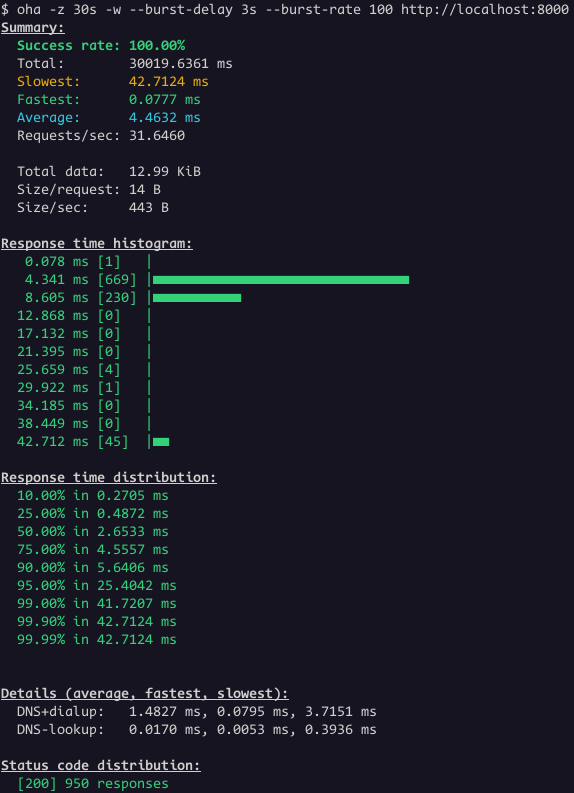
this:
We had 886 responses with status code 200 and 64 connections closed.
The backend terminated 64 connections while the load balancer still had
active requests directed to it.
Let's change the Load Balancer idle_timeout to two
seconds.
filter_chains:
- filters:
- name: envoy.filters.network.tcp_proxy
typed_config:
"@type": type.googleapis.com/envoy.extensions.filters.network.tcp_proxy.v3.TcpProxy
stat_prefix: go_server_tcp
cluster: go_server_cluster
idle_timeout: 2s # <--- NEW LINE
Great! Now all the requests worked.
This is a common issue, not specific to Envoy Proxy or the setup
shown earlier. Major cloud providers have all documented it.
AWS
troubleshoot guide for Application Load Balancers says this:
The target closed the connection with a TCP RST or a TCP FIN while the load balancer had an outstanding request to the target. Check whether the keep-alive duration of the target is shorter than the idle timeout value of the load balancer.
Google
troubleshoot guide for Application Load Balancers mention this as
well:
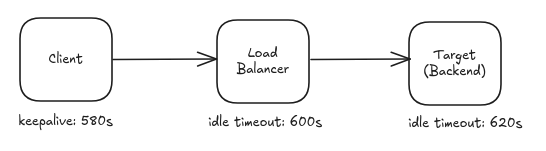
Verify that the keepalive configuration parameter for the HTTP server software running on the backend instance is not less than the keepalive timeout of the load balancer, whose value is fixed at 10 minutes (600 seconds) and is not configurable.
The load balancer generates an HTTP 5XX response code when the connection to the backend has unexpectedly closed while sending the HTTP request or before the complete HTTP response has been received. This can happen because the keepalive configuration parameter for the web server software running on the backend instance is less than the fixed keepalive timeout of the load balancer. Ensure that the keepalive timeout configuration for HTTP server software on each backend is set to slightly greater than 10 minutes (the recommended value is 620 seconds).
RabbitMQ
docs also warn about this:
Certain networking tools (HAproxy, AWS ELB) and equipment (hardware load balancers) may terminate "idle" TCP connections when there is no activity on them for a certain period of time. Most of the time it is not desirable.
Most of them are talking about Application Load Balancers and the
test I did was using a Network Load Balancer. For the sake of
completeness, I will do the same test but using Envoy's HTTP connection
manager.
The updated envoy.yaml:
static_resources:
listeners:
- name: listener
address:
socket_address:
address: 0.0.0.0
port_value: 8000
filter_chains:
- filters:
- name: envoy.filters.network.http_connection_manager
typed_config:
"@type": type.googleapis.com/envoy.extensions.filters.network.http_connection_manager.v3.HttpConnectionManager
stat_prefix: go_server_http
access_log:
- name: envoy.access_loggers.stdout
typed_config:
"@type": type.googleapis.com/envoy.extensions.access_loggers.stream.v3.StdoutAccessLog
http_filters:
- name: envoy.filters.http.router
typed_config:
"@type": type.googleapis.com/envoy.extensions.filters.http.router.v3.Router
route_config:
name: http_route
virtual_hosts:
- name: local_service
domains: ["*"]
routes:
- match:
prefix: "/"
route:
cluster: go_server_cluster
clusters:
- name: go_server_cluster
type: STATIC
load_assignment:
cluster_name: go_server_cluster
endpoints:
- lb_endpoints:
- endpoint:
address:
socket_address:
address: 0.0.0.0
port_value: 8080
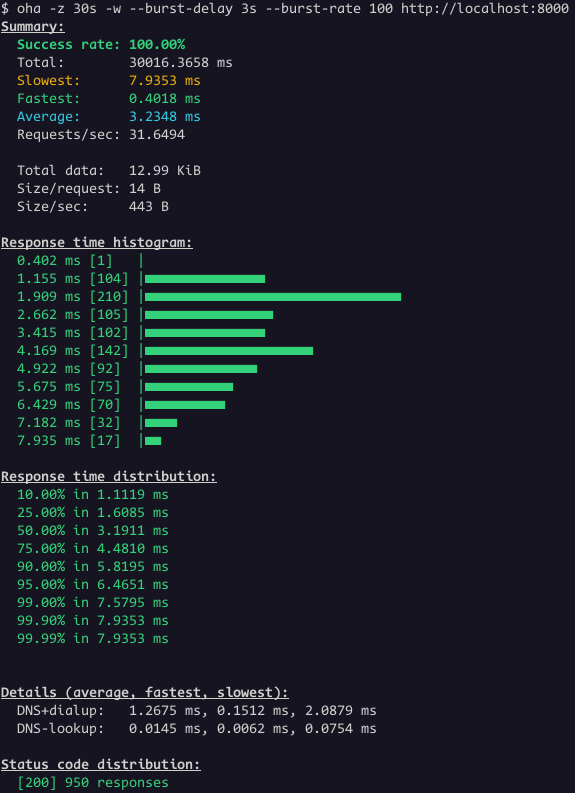
Even thought the success rate is 100%, the status code distribution
show some responses with status code 503. This is the case where is not
that obvious that the problem is related to idle timeout.
However, it's clear when we look the Envoy access logs:
[2025-10-10T13:32:26.617Z] "GET / HTTP/1.1" 503 UC 0 95 0 - "-" "oha/1.10.0" "9b1cb963-449b-41d7-b614-f851ced92c3b" "localhost:8000" "0.0.0.0:8080"
UC is the short name for
UpstreamConnectionTermination. This means the upstream,
which is the golang server, terminated the connection.
To fix this once again, the Load Balancer idle timeout needs to
change:
clusters:
- name: go_server_cluster
type: STATIC
typed_extension_protocol_options: # <--- NEW BLOCK
envoy.extensions.upstreams.http.v3.HttpProtocolOptions:
"@type": type.googleapis.com/envoy.extensions.upstreams.http.v3.HttpProtocolOptions
common_http_protocol_options:
idle_timeout: 2s # <--- NEW VALUE
explicit_http_config:
http_protocol_options:
Key Takeaways:
Armadillo is a powerful
and expressive C++ template library for linear algebra and scientific
computing. It aims towards a good balance between speed and ease of use,
has a syntax deliberately close to Matlab, and is useful for algorithm
development directly in C++, or quick conversion of research code into
production environments. RcppArmadillo
integrates this library with the R environment and language and is
widely used by (currently) 1273 other packages on CRAN, downloaded 41.8 million
times (per the partial logs from the cloud mirrors of CRAN), and the CSDA paper (preprint
/ vignette) by Conrad and myself has been cited 651 times according
to Google Scholar.
Armadillo 15 brought changes. We mentioned these in the 15.0.2-1
and 15.0.2-1
release blog posts:
#definearma::is_finite to std::isfinite) change. I
did not encounter anything much more complicated yet.
The number of affected packages approximated by looking at all
packages with a reverse dependency on RcppArmadillo and having
a deadline can be computed as
suppressMessages(library(data.table))
D <- setDT(tools::CRAN_package_db())
P <- data.table(Package=tools::package_dependencies("RcppArmadillo", reverse=TRUE, db=D)[[1]])
W <- merge(P, D, all.x=TRUE)[is.na(Deadline)==FALSE,c(1:2,38,68)]
W
W[, nrevdep := length(tools::package_dependencies(Package, reverse=TRUE, recursive=TRUE, db=D)[[1]]), by=Package]
W[order(-nrevdep)]This post by Dirk Eddelbuettel originated on his Thinking inside the box blog. If you like this or other open-source work I do, you can sponsor me at GitHub.
Welcome to post 53 in the R4 series.
Continuing with posts #51
from Tuesday and #52
from Wednesday and their stated intent of posting some more here
is another quick one. Earlier today I helped another package developer
who came to the r-package-devel list asking for help with a build error
on the Fedora machine at CRAN running recent / development
clang. In such situations, the best first step is often to
replicate the issue. As I pointed out on the list, the LLVM team behind
clang maintains an apt repo
at apt.llvm.org/ making it a good resource to add to Debian-based
container such as Rocker r-base or the offical r-base (the two
are in fact interchangeable, and I take care of both).
A small pothole, however, is that the documentation at the top of apt.llvm.org site is a bit stale and
behind two aspects that changed on current Debian systems
(i.e. unstable/testing as used for r-base). First,
apt now prefers files ending in .sources (in a
nicer format) and second, it now really requires a key (which is good
practice). As it took me a few minutes to regather how to meet both
requirements, I reckoned I might as well script this.
Et voil the following script does that:
~/.R/Makevars to use that
compilerclang-22 (and clang++-22)
(still using the g++ C++ library)#!/bin/sh
## Update does not hurt but is not strictly needed
#apt update --quiet --quiet
#apt upgrade --yes
## wget -qO- https://apt.llvm.org/llvm-snapshot.gpg.key sudo tee /etc/apt/trusted.gpg.d/apt.llvm.org.asc
## or as we are root in container
wget -qO- https://apt.llvm.org/llvm-snapshot.gpg.key > /etc/apt/trusted.gpg.d/apt.llvm.org.asc
cat <<EOF >/etc/apt/sources.list.d/llvm-dev.sources
Types: deb
URIs: http://apt.llvm.org/unstable/
# for clang-21
# Suites: llvm-toolchain-21
# for current clang
Suites: llvm-toolchain
Components: main
Signed-By: /etc/apt/trusted.gpg.d/apt.llvm.org.asc
EOF
test -d ~/.R mkdir ~/.R
cat <<EOF >~/.R/Makevars
CLANGVER=-22
# CLANGLIB=-stdlib=libc++
CXX=clang++\$(CLANGVER) \$(CLANGLIB)
CXX11=clang++\$(CLANGVER) \$(CLANGLIB)
CXX14=clang++\$(CLANGVER) \$(CLANGLIB)
CXX17=clang++\$(CLANGVER) \$(CLANGLIB)
CXX20=clang++\$(CLANGVER) \$(CLANGLIB)
CC=clang\$(CLANGVER)
SHLIB_CXXLD=clang++\$(CLANGVER) \$(CLANGLIB)
EOF
apt update
apt install --yes clang-22clang-22 and clang++-22. This may help
R package developers. The script is also generic enough for other
development communities who can ignore (or comment-out / delete) the bit
about ~/.R/Makevars and deploy the compiler differently.
Updating the softlink as apt-preferences does is one way
and done in many GitHub Actions recipes. As we only need
wget here a basic Debian container should work, possibly
with the addition of wget. For R users r-base
hits a decent sweet spot.
This post by Dirk Eddelbuettel originated on his Thinking inside the box blog. If you like this or other open-source work I do, you can now sponsor me at GitHub.
There's a new Nine Inch Nails album! That
doesn't happen very often.
There's a new Trent Reznor & Atticus Ross soundtrack! That happens
all the time!
For the first time, they're the same thing.
The new one, Tron: Ares, is very deliberately presented as a Nine Inch Nails
album, and not a TR&AR soundtrack. But is it neither fish nor fowl? 24 tracks,
four with lyrics. Singing is not unheard of on TR&AR soundtracks,
but it's rare (A Minute to Breathe from the excellent Before the Flood
is another). Instrumentals are not rare on NIN albums, either, but this ratio
is very unusual, and has disappointed some fans who were hoping for a more
traditional NIN album.
What does it mean to label something a NIN album anyway? For me, the lines are
now further blurred. One thing for sure is it means a lot of media attention,
and this release, as well as the film it's promoting, are all over the media
at the moment. Posters, trailers, promotional tie-in items, Disney logos
everywhere. The album is hitched to the Disney marketing and promotion machine.
It's a bit weird seeing the NIN logo all over the place advertising the movie.
On to the music. I love TR&AR soundtracks, and some of my favourite NIN tracks
are instrumentals. Despite that, three highlights for me are songs: As Alive
As You Need Me To Be, I Know You Can Feel It and closer Shadow Over Me.
The other stand-out is Building Better Worlds, a short instrumental and
clear nod to Wendy Carlos.
My main complaint here applies to some of the more recent soundtracks as well:
the tracks are too short. They're scored to scenes in the movie, which makes a
lot of sense in that presentation, but less so for independent listening. It's
not a problem that their earlier, lauded soundtracks suffered (The Social Network,
Before the Flood, Bird Box Extended). Perhaps a future remix album will address that.
Next.