Search Results: "jam"

2 April 2013

Russ Allbery: Review: An Election

Review: An Election, by John Scalzi
Publisher: Subterranean
Copyright: 2010
Printing: 2012
ISBN: 1-59606-496-X
Format: Kindle
Pages: 24
This is another story from the Subterranean Scalzi Super Bundle that probably doesn't justify a full review, particularly since this time it's a short story and not even a novelette, but as with the others it's been independently published on the Kindle (and is still available that way for 99 cents). So by my obsessive internal consistency that matters only to me, it gets a full review anyway. I was mildly surprised to find that this was actually my second reading, and now vaguely remember that Subterranean had actually sponsored the story's appearance on Scalzi's blog as an advertising experiment. So I originally read the story from Scalzi's blog, and if you don't really want to pay money for it, you still can as well. Along with a couple of ads that appear to have bit-rotted. The chief feature of An Election is the background: a world in which aliens and humans are intermingled in a political district, going about their lives against a background of rather extreme multispecies diversity. The protagonist, David, decides to run for the upcoming city council special election, despite living in a district that's minority-human and that hasn't seen a human councilor in forty-four years. (David also happens to be a gay man, which goes entirely unremarked in the story and is, in fact, entirely unremarkable given the excitingly diverse characteristics of his alien neighbors. I thought that was a nice touch.) He of course appears to stand no chance, particularly when one of the city bosses decides to run as well, but ends up with a campaign advisor almost by accident and determinedly attempts to connect with his neighbors and earn their votes. This felt quite typical to me of Scalzi's humor writing. The protagonist is a good-hearted person who gets in rather over his head but is still determined to do the right thing, while not taking anything too seriously. The background humor is never particularly threatening and tends towards slapstick and banter. I found it similar in tone to most of Agent to the Stars, although of course much shorter. As usual, Scalzi's grasp of conversational banter is probably the strongest part of the story; the dynamic between David, his husband James, and his campaign advisor brought several chuckles for me. This is slight but enjoyable. I wouldn't go out of my way to read it, but it's a good story to toss into a bundle of other work, and I remember it holding my interest when reading it on-line. (Which is rare; usually I fail to finish any fiction I try to read in a browser unless it's extremely short.) Rating: 6 out of 10

1 April 2013

Benjamin Mako Hill: Mystery Hunt 2013

A few months late, perhaps, but I wanted to mention that my team (Codex) competed, once again, in the MIT Mystery Hunt. The prize for winning is the responsibility of writing the hunt next year. After being on the 2012 writing team I have mixed feelings about the fact that we did not win again. Although I did not walk away with another coin, I did manage to make an appearance in a multimedia story that the MIT Tech shot about the hunt which provides nice introductions to those who are not familiar with it. <iframe allowfullscreen="" frameborder="0" height="315" src="http://www.youtube.com/embed/R-tmBfZ8CwQ" width="560"></iframe> It was fun to reflect a little bit on why I find the hunt so fun. I said:
In my day job, I work on a lot of problems that maybe don t have answers. It s really awesome to work in a space where if you put in 1-5 hours of mental energy, you will have a solution. Someone has test-solved for it, you know that it s solvable; you know that there is an answer and that there was designed to be an answer. There s something really satisfying about being able to do that.
If you re looking for a team to hunt on next year, feel free get in contact codex is generally quite open to new members.

27 March 2013

Benjamin Mako Hill: The Institute for Cultural Diplomacy and Wikipedia

A month ago, Mark Donfried from the Institute for Cultural Diplomacy (ICD) an organization dedicated to promoting open dialogue sent me this letter threatening me with legal action because of contributions I ve made to Wikipedia. Yesterday, he sent me this followup threat. According to the letters, Donfried has threatened me with legal action because I participated in a discussion on Wikipedia that resulted in his organization s article being deleted. It is not anything I wrote in any Wikipedia article that made Donfried so upset although Donfried is also unhappy about at least one off-hand comment I made during the deletion discussion on a now-deleted Wikipedia process page. Donfried is unhappy that my actions, in small part, have resulted in his organization not having an article in Wikipedia. He is able to threaten me personally because unlike many people I edit Wikipedia using my real, full, name. Donfried s letter is the latest step in a saga that has been ongoing since last June. It has been a frustrating learning experience for me that has made me worried about Wikipedia, its processes, and its future. In Wikipedia, debates can be won by stamina. If you care more and argue longer, you will tend to get your way. The result, very often, is that individuals and organizations with a very strong interest in having Wikipedia say a particular thing tend to win out over other editors who just want the encyclopedia to be solid, neutral, and reliable. These less-committed editors simply have less at stake and their attention is more distributed. The ICD is a non-profit organization based in Berlin. According to its own website, a large part of the organization s activities are based around arranging conferences. Its goals peace, cultural interchange, human rights are admirable and close to my heart. Its advisors and affiliates are impressive. I had never heard of the ICD before their founder, Mark Donfried, emailed me in April 2012 asking me to give a keynote address at their conference on The 2012 International Symposium on Cultural Diplomacy & Human Rights. I replied, interested, but puzzled because my own research seems very far afield of both cultural diplomacy (which I had never heard of) and human rights. I replied saying:
What would you like me to talk about I ask because I don t consider myself an expert in (or even particularly knowledgeable about) cultural diplomacy. Did someone else refer you to me?
Donfried replied with a long message seemingly copy and pasted thanking me for considering attending and asking me for details of my talk. I replied again repeating text from my previous email and asking why he was interested in me. Donfried suggested a phone call to talk about details. But by this point, I had looked around the web for information about the ICD and had decided to decline the invitation. Among things I found was a blog post by my friend James Grimmelmann that suggests that, at least in his case, the ICD had a history of sending unsolicited email and an apparently inability to take folks off their email lists even after repeated requests. I also read the Wikipedia article about the ICD. Although the Wikipedia article was long and detailed, it sent off some internal Wikipedian-alarm-bells for me. The page read, to me, like an advertisement or something written by the organization being described; it simply did not read to me like an encyclopedia article written by a neutral third-party. I looked through the history of the article and found that the article had been created by a user called Icd_berlin who had made no other substantive edits to the encyclopedia. Upon further examination, I found that almost all other significant content contributions were from a series of anonymous editors with IP addresses associated with Berlin. I also found that a couple edits had removed criticism when it had been added to the article. The criticism was removed by an anonymous editor from Berlin. Criticisms on the article included links to a website called Inside the ICD which was a website that mostly consisted of comments by anonymous people claiming to be former interns of the ICD complaining about the working conditions at the organization. There were also many very positive descriptions of work at the ICD. A wide array of pseudonymous users on the site accused the negative commenters of being liars and detractors and the positive commenters of being ICD insiders. I also found that there had been evidence on Wikipedia also removed without discussion by an anonymous IP from Berlin of an effort launched by the youth wing of ver.di one of the largest trade unions in Germany to campaign for good internships at the ICD. Although details of the original campaign have been removed from ver.di s website, the campaigned ended after coming to an agreement with the ICD that made explicit a set of expectations and created an Intern Council. Although the article about ICD on Wikipedia had many citations, many were to the ICD s own website. Most of the rest were to articles that only tangentially mentioned the ICD. Many were about people with ICD connections but did not mention the ICD at all. As Wikipedia editor, I was worried that Wikipedia s policies on conflict of interest, advertising, neutrality, and notability were not being served by the article in its state. But as someone with no real experience or knowledge of the ICD, I wasn t sure what to do. I posted a request for help on Wikipedia asking for others to get involved and offer their opinions. It turns out, there were several editors who had tried to improve the article in the past and had been met by pro-ICD editors reverting their changes. Eventually, those editors lost patience or simply moved on to other topics. By raising the issue again, I kicked off a round of discussion about the article. At the termination of that discussion, the article was proposed for deletion under Wikipedia s Articles for Deletion policy. A new Wikipedia editor began working enthusiastically to keep the article by adding links and by arguing that the article should stay. The new user edited the Wikipedia article about me to accuse me of slander and defamation although they removed that claim after I tried to explain that I was only trying to help. I spent quite a bit of time trying to rewrite and improve the article during the deletion discussion and I went link by link through the many dozens of citations. During the deletion discussion, Mark Donfried contacted me over email and explained that his representatives had told him that I was working against the ICD in Wikipedia. He suggested that we meet. We had a tentative plan to meet in Berlin on an afternoon last July but, in the end, I was too busy trying to submit my thesis proposal and neither of us followed up to confirm a particular time within the time window we had set. I have still never met him. My feeling, toward the end of the deletion discussion on Wikipedia, was mostly exasperation. Somewhat reluctantly, I voted to delete the article saying:
Delete This AFD is a complete mess for all the reasons that the article itself is. Basically: there are a small number of people who seem to have a very strong interest in the Institute for Cultural Diplomacy having an article in Wikipedia and, from what I can tell, very little else. Hessin fahem, like all the major contributors to the page, joined Wikipedia in order to participate in this issue. This article has serious problems. I have posted a detailed list of my problems on the article talk page: primary sources, conflict of interest for nearly all substantive contributions and reading like an advert are the biggest issues. My efforts to list these problems were reverted without discussion by an anonymous editor from Berlin. I have seen no evidence that the Institute for Cultural Diplomacy satisfies WP:ORG but I agree that it is possible that it does. I strongly agree with Arxiloxos that articles should always be fixed, and not deleted, if they are fixable. But I also know that Wikipedia does not deserve this article, that I don t know to fix it, and that despite my efforts to address these issues (and I ll keep trying), the old patterns of editing have continued and the article is only getting worse. This ICD seems almost entirely based around a model that involves organizing conferences and then calling and emailing to recruit speakers and attendees. A large number of people will visit this Wikipedia article to find out more about the organization before deciding to pay for a conference or to join to do an internship. What Wikipedia shows to them reads like an advert, links almost exclusively to of pages on the organizations websites and seems very likely to have been written by the organization itself. We are doing an enormous disservice to our readers by keeping this page in its current form. If somebody wants to make a serious effort to improve the article, I will help and will happily reconsider my !vote. But after quite a bit of time trying to raise interest and to get this fixed, I m skeptical this can be addressed and my decision reflects this fact. mako 05:18, 12 June 2012 (UTC)
I concluded that although the organization might be notable according to Wikipedia s policies and although the Wikipedia article about it might be fixable, the pattern of editing gave me no faith that it could be fixed until something changed. When the article was deleted, things became quiet. Several months later a new article was created again, by an anonymous user with no other edit history. Although people tend to look closely at previously deleted new pages, this page was created under a different name: The Institute of Cultural Diplomacy and was not noticed. Deleted Wikipedia articles are only supposed to be recreated after they go through a process called deletion review. Because the article was recreated out of this process, I nominated it for what is called speedy deletion under a policy specifically dealing with recreated articles. It was deleted again. Once again, things were quiet. In January, it seems, the Inside the ICD website was threatened with a lawsuit by the ICD and the maintainers of the site took it down with the following message:
Apparently, the ICD is considering filing a lawsuit against this blog and it will now be taken down. We completely forgot about this blog. Let s hope no one is being sued. Farewell.
On February 25, the Wikipedia article on ICD was recreated once again out of process and by a user with almost no previous edit history. The next day, I received an email from Mark Donfried. In the message, Donfried said:
Please note that the ICD is completely in favor of fostering open dialogue and discussions, even critical ones, however some of your activities are raising serious questions about the motives behind your actions and some even seem to be motives of sabotage, since they resulted in ICD not having any Wikipedia page at all. We are deeply concerned regarding these actions of yours, which are causing us considerable damages. As the person who initiated these actions with Wikipedia and member of the board of Wikipedia [1], we would therefore request your answer regarding our questions below within the next 10 days (by March 6th). If we do not receive your response we will unfortunately have to consider taking further legal actions with these regards against you and other anonymous editors.
I responded to Donfried to say that I did not think it was prudent to speak with him while he was threatening me. Meanwhile, other Wikipedia editors nominated the ICD article for deletion once again and unanimously decided to delete it. And although I did not participate in the discussion, Donfried emailed again with more threats of legal action hours after the ICD article was deleted:
[A]s the case of the ICD and its presentation on the Wikipedia has seriously worsened in recent days, we see no alternative but to forward this case (including all relevant visible and anonymous contributors) to our legal representatives in both USA and Europe/Germany as well as to the authorities and other corresponded organizations in order to find a remedy to this case.
Donfried has made it very clear that his organization really wants a Wikipedia article and that they believe they are being damaged without one. But the fact that he wants one doesn t mean that Wikipedia s policies mean he should have one. Anonymous editors in Berlin and in unknown locations have made it clear that they really want a Wikipedia article about the ICD that does not include criticism. Not only do Wikipedia s policies and principles not guarantee them this, Wikipedia might be hurt as a project when this happens. The ICD claims to want to foster open dialogue and criticism. I think they sound like a pretty nice group working toward issues I care about personally. I wish them success. But there seems to be a disconnect between their goals and the actions of both their leader and proponents. Because I used my real name and was skeptical about the organization on discussion pages on Wikipedia, I was tracked down and threatened. Donfried insinuated that I was motivated to sabotage his organization and threatened legal action if I do not answer his questions. The timing of his first letter the day after the ICD page was recreated means that I was unwilling to act on my commitment to Wikipedia and its policies. I have no problem with the ICD and I deeply regret being dragged into this whole mess simply because I wanted to improve Wikipedia. That said, Donfried s threat has scared me off from attempts to improve the ICD articles. I suspect I will not edit ICD pages in Wikipedia in the future. The saddest part for me is that I recognize that what is in effect bullying is working. There are currently Wikipedia articles about the ICD in many languages. For several years, ICD has had an article on English Wikipedia. For almost all of that period, that article has consisted entirely of universally positive text, without criticism, and has been written almost entirely by anonymous editors who have only contributed to articles related to the ICD. In terms of the ICD and its article on Wikipedia, I still have hope. I encourage Donfried and his representatives to create accounts on Wikipedia with their full names just like I have. I encourage them to engage in open dialogue in public on the wiki. I encourage them go through deletion review, make any conflicts of interest they have unambiguously clear, and to work with demonstrably non-conflicted editors on Wikipedia to establish notability under Wikipedia s policies. The result still can be an awesome, neutral, article about their organization. I have offered both advice on how to do this and help in that process in the past. I have faith this can happen and I will be thrilled when it does. But the general case still worries me deeply. If I can be scared off by threats like these, anybody can. After all, I have friends at the Wikimedia Foundation, a position at Harvard Law School, and am close friends with many of the world s greatest lawyer-experts on both wikis and cyberlaw. And even I am intimidated into not improving the encyclopedia. I am concerned by what I believe is the more common case where those with skin in the game will fight harder and longer than a random Wikipedian. The fact that it s usually not me on the end of the threat gives me lots of reasons to worry about Wikipedia at a time when its importance and readership continues to grow as its editor-base remains stagnant.

[1] It s a minor mistake but worth pointing out that I am not on the board of Wikipedia ; I am on its advisory board which carries no power or responsbility within the organization. Sometimes, the foundation asks for my advice and I happily give it.

25 March 2013

Benjamin Mako Hill: MIT LaTeX Stationery

Color MIT LetterHead Example The MIT graphic identity website provides downloadable stationery templates for letterhead and envelopes. They provide both Microsoft Word and LaTeX templates. But although they provide both black and white and color templates for Word, they only provide the monochrome templates for LaTeX. When writing cover letters for the job market this year, I was not particularly interested in compromising on color and was completely unwilling to compromise on TeX. As a result, I ended up modifying each of the three templates to include color. In the process, I fixed a few bugs and documented one tricky issue. I ve published a git repository with my changes. It includes branches for each version of three of the old black and white templates as well as my my three new color templates. I hope others at MIT find it useful. I ve tried to keep the changes minimal. I ve emailed the folks at MIT Communication Production Services to see if they want to publish my modified versions. Until then, anyone interested can help themselves to the git repository. LaTeX user that you are, you probably prefer that anyway.

21 March 2013

Benjamin Mako Hill: Lookalikes

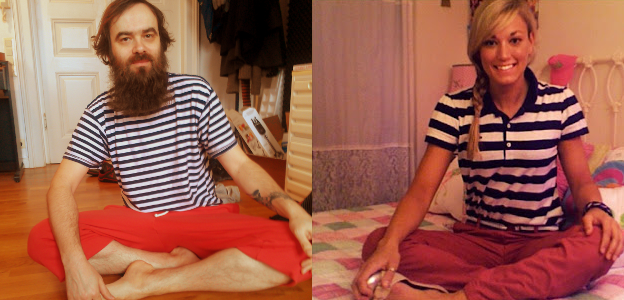
Is Croatian kiberkomunist (i.e., cyber-communist ) artist and hacker Marcell Mars living a secret life as a Nantucket Reds -wearing preppie from the American northeast? Marcell Mars and Nantucket Preppy Lookalikes

18 March 2013

Benjamin Mako Hill: SCARF ACE

Imako_scarf Although I don t mean to brag I have a really great scarf-hood-combination garment. I was wearing said awesome scarf in a rather cold apartment during my remote participation in the Learning Creative Learning class. I would like to think that I said some interesting and insightful things. But if I didn t, I m glad to hear my scarf which now has its very own sub-reddit was able to impress and entertain.

17 March 2013

Benjamin Mako Hill: Conversation on Freedom and Openness in Learning

On Monday, I was a visitor and guest speaker in a session on Open Learning in a class on Learning Creative Learning which aims to offer a course for designers, technologists, and educators. The class is being offered publicly by the combination surprising but very close to my heart of Peer 2 Peer University and the MIT Media Lab. The hour-long session was facilitated by Philipp Schmidt and was mostly structured around a conversation with Audrey Watters and myself. The rest of the course materials and other video lectures are on the course website. You can watch the video on YouTube or below. I thought it was a thought-provoking conversation! <iframe allowfullscreen="" frameborder="0" height="315" src="http://www.youtube.com/embed/l9HM80cv160" width="560"></iframe> If you re interested in alternative approaches to learning and free software philosophy, I would also urge you to check out an essay I wrote in 2002: The Geek Shall Inherit the Earth: My Story of Unlearning. Keep in mind that the essay is probably the most personal thing I have ever published and I wrote it more than a decade ago it as a twenty-one year old undergraduate at Hampshire College. Although I ve grown and learned enormously in the last ten years, and although I would not write the same document today, I am still proud of it.

15 March 2013

Benjamin Mako Hill: Aaron Swartz MIT Memorial

On Tuesday, there was a memorial for Aaron Swartz held at the MIT Media Lab. Unfortunately, I am traveling this week and was unable to attend. As I wrote recently, I was close to Aaron. I am also, more obviously, close to MIT and the lab. It was important to me to participate in the memorial and I found a way to give a short talk with a video. I think the lab plans to post a recording of the whole event but I have put the video of my own remarks below (and online in WebM). If you prefer, you can also read the text of the remarks. <iframe allowfullscreen="" frameborder="0" height="315" src="http://www.youtube.com/embed/uYGoAJdE8jg" width="420"></iframe>

13 March 2013

Russ Allbery: WebAuth 4.4.3

WebAuth is the site-wide web authentication system that we use at Stanford. After a lot of time focusing on things at work other than coding, it's been my primary job for the past nine months or so, which has been a lovely change. I wasn't planning on doing another 4.4 release and instead focusing on 4.5.0 (which is well underway and adds significant new features to multifactor support), but I kept finding bugs, including several that were quite embarassing. So this is another bug-fix release, and hopefully the last one before 4.5.0. WebAuthTrustAuthzIdentity enabled WebAuthDoLogout in the same scope (ever since it was added in 4.4.0). It's horribly embarassing to have been writing C for more than 20 years and still manage to omit a break in a switch statement. Benjamin Coddington found another bug in authorization identity handling where if the user changed their authorization identity to match their authentication identity, their authentication would be rejected. We now detect that case and just discard the authorization identity if it's the same as the authentication identity. There are multiple fixes in the mod_webauth logging of bad app tokens: expired app tokens are now logged with a proper message (and at info level rather than error), empty app tokens (created internally and therefore seen by subqueries before fixup to delete expired app tokens) are now just ignored, and invalid app tokens don't result in spewing binary strings into the Apache error log. mod_webauthldap has, since the beginning, refused to add more than 127 values of a multivalued LDAP attribute to the environment. We ran into that limit with entitlements, so it's now been removed. This runs the risk of overflowing the environnment, but I did some calculations, and it looks like you're going to have to try really hard and have impressively large multivalued attributes to create that problem. If it actually becomes a problem for someone, I'll add a configuration option. There's also a syntax fix to the default WebLogin error template and a variety of minor bug fixes, mostly around error handling conditions, to correct problems caught by clang --analyze. (The current master branch gets a completely clean bill of health from clang --analyze using clang 3.0.) You can get the latest release from the official WebAuth distribution site or from my WebAuth distribution pages.

12 March 2013

Russ Allbery: Review: Commitment Hour

Review: Commitment Hour, by James Alan Gardner
Series: League of Peoples #2
Publisher: Eos
Copyright: April 1998
ISBN: 0-380-79827-1
Format: Mass market
Pages: 343
This is the second book in Gardner's League of Peoples universe, following Expendable, but it is largely unrelated to that novel apart from taking place in the same universe. Expendable follows the portion of humanity that has left Earth and embraced the universe and the advanced technology of the League. Committment Hour is set on Earth, in one of the remaining low-tech settlements that have become a backwater of humanity. Earth is governed by the Spark Lords, who appear to be a sort of scientific artistocracy empowered by the League of Peoples (Gardner gets into this more in later books in the series), but the community in this book is largely left alone. The protagonist of Committment Hour is Fullin, a resident of Tober Cove. The Tober Cove community has a very unusual interaction with gender. Every year, all inhabitants under the age of twenty (starting at the age of two) are taken away by what are viewed locally as gods. When they return, they have the opposite gender. They live their childhoods alternating gender every year, including a mandatory pregnancy (created on one of those trips by the gods) and childbirth. Then, at the age of twenty, rather than being gender-swapped like the other children, they choose the gender that they'll live with for the rest of their life. Fullin is (at least at the start of this book) currently male, but as the book opens on the eve of the day of his final gender committment, he's still undecided on what gender he'll choose. A review of this sort of book immediately requires a significant caveat: this story is all about social constructions of gender and about the implications of one specific transgender scenario. As a cisgender man who fits comfortably within society's normal gender construction, I'm not going to do the best job of judging how well it deals with those issues. It was on the long list for the Tiptree Award, which is a fairly good sign that it does okay, and a quick Internet search didn't uncover any significant dislike, but it's quite possible that I would miss places where it fell short. That said, I found Gardner's presentation of gender fascinating, in large part because Committment Hour is told from deeply inside Fullin's perspective and Gardner treats the Tober Cove gender swapping mostly as the unremarked normal. Fullin and the other inhabitants are quite aware that gender doesn't work for them the way that it does for everyone else, but they consider their gender process entirely sensible and can't imagine how weird life would be without the chance to experience both genders and to have carried a child. And Gardner has several aces up his sleeve that let him, by the end of the book, position Tobin Cove's experience as a very specific and local experience that would not necessarily generalize to gender in society at large, which I thought was an ingenious way to avoid overreaching and excessive generalization. This is not a gender utopia; Fullin's world is rather patriarchal and strongly gender essentialist. The village was, in the past, ruled by a sort of religious fantatic who laid down very firm rules about the roles of men and women, and the village largely stuck to them, but since anyone can choose which gender they want to become, the gender essentialism is also undermined in an interesting way. It becomes more akin to a choice of careers rather than an innate quality, albeit with only two choices and with a permanent decision at the age of 20. Gardner complicates the situation further by introducing a neuter gender (at least that's what the characters call it; by physical description, hermaphrodite would be a more accurate description). People actually have three choices on their twentieth birthday, and although the Patriarch who ruled Tober Cove outlawed and banished all "neuts," it's still a choice. Near the start of Committment Hour one of those who chose the "neut" gender returns to Tober Cove in the company of a Spark Lord (thus making "it" the pronoun used by the natives untouchable and somewhat immune to the normal local prejudice). Committment Hour follows Fullin and his close friend and possible future wife or husband through their last day before their committment hour, a day complicated by the incessant curiosity of the observing Spark Lord and his companion. Gardner has some rather neat world building and some revelations in store; this is the sort of book where, by the end, the curtain has been fully pulled back and the audience gets to peer into the machinery. But most of the book is about the social and societal structure of Tober Cove, about how it feels to swap back and forth between genders (and how specific that is to Tober Cove's unique situation), and how this complicates interpersonal interactions. It's an immersive sort of book that puts the reader in Fullin's head and shows his (and her) comfort with the Tober Cove culture and discomfort with the life choices that he faces as part of committment. As with everything by him I've read, Gardner's tone in writing is unique and can take a bit of getting used to. His stories tend to have a light, almost flippant attitude with frequent touches of absurdist humor, which can give the erroneous impression that he isn't taking his story seriously. But there is depth beneath that tone. Fullin may treat some questions flippantly, but he gives them serious thought and works through the consequences. And I was delighted by how Fullin completely scuttled the Spark Lord's arrogant assumption of superiority around his scientific understanding of things Fullin treats as mythological. Committment Hour is different fare than the typical SF novel, with a lot of focus on an unusual domesticity and small village politics. The technology and the world building are mostly saved for the climax, although are quite satisfying when they finally come. It's primarily a thought-provoking treatment of gender that avoids overreaching by grounding the story in a specific situation. I found it a bit slow in places, and occasionally wanted the characters to stop being stupid and stop dithering, but I ended up enjoying it rather more than I expected. Mildly recommended. Rating: 7 out of 10

11 March 2013

Russ Allbery: Small non-fiction haul

Long time no write. A variety of things, including getting sick with a particularly bad cold (I'm still coughing up phlegm), led to my schedule and general life organization getting turned on its head, and I'm only slowly recovering. Work gets top priority (including a security release of OpenAFS), so I'm afraid non-work things such as reviews and journal posts (and Debian, and non-work-related software development, and conversations with friends...) have been getting second shrift. Hopefully this is finally starting to improve, and I have a block of time for working remotely coming up that should help. In the meantime, more books have, of course, been acquired. This particular order was mostly to get one book (The Making of the Indebted Man), which I'm going to read and discuss as part of a surprisingly fun political discussion about basic income guarantee and, somewhat by extension, Marxist analysis of capitalism. But it's impossible to buy just one book, similar to how it's impossible to eat just one potato chip: Neil Barofsky Bailout (non-fiction)
E. Gabriella Coleman Coding Freedom (non-fiction)
Joshua Foer Moonwalking with Einstein (non-fiction)
Maurizio Lazzarato The Making of the Indebted Man (non-fiction)
Isabel Wilkerson The Warmth of Other Suns (non-fiction) I of course preordered Coding Freedom and am quite looking forward to reading it, although it will surprise no one to hear that I have rather a long queue. The Warmth of Other Suns I picked up based on a recommendation by Ta-Nehisi Coates, whose writing for The Atlantic I wholeheartedly recommend. I have such a large pile of books that I've read but not yet reviewed that I cringe to think about it. But no progress will be made on that this evening (damn you, Benjamin Franklin! *shakes fist*). More tomorrow if I survive five and a half hours of scheduled forced social interaction.

3 March 2013

Petter Reinholdtsen: Frikanalen - Complete TV station organised using the web

Do you want to set up your own TV station, schedule videos and broadcast them on the air? Using free software? With video on demand support using free and open standards? Included a web based video stream as well? And administrate it all in your web browser from anywhere in the world? A few years now the Norwegian public access TV-channel Frikanalen have been building a system to do just this. The source code for the solution is licensed using the GNU LGPL, and available from github. The idea is simple. You upload a video file over the web, and attach meta information to the file. You select a time slot in the program schedule, and when the time come it is played on the air and in the web stream. It is also made available in a video on demand solution for anyone to see it also outside its scheduled time. All you need to run a TV station - using your web browser. There are several parts to this web based solution. I'll mention the three most important ones. The first part is the database of videos and the schedule. This is written in Django and include a REST API. The current database is SQLite, but the plan is to migrate it to PostgreSQL. At the moment this system can be tested on beta.frikanalen.tv. The second part is the video playout, taking the schedule information from the database and providing a video stream to broadcast. This is done using CasparCG from SVT and Media Lovin' Toolkit. Video signal distribution is handled using Open Broadcast Encoder. The third part is the converter, handling the transformation of uploaded video files to a format useful for broadcasting, streaming and video on demand. It is still very much work in progress, so it is not yet decided what it will end up using. Note that the source of the latter two parts are not yet pushed to github. The lead author want to clean them up a bit more first. The development is coordinated on the #frikanalen IRC channel (irc.freenode.net), and discussed on the frikanalen mailing list. The lead developer is Benjamin Bruheim (phed on IRC). Anyone is welcome to participate in the development.

2 March 2013

Russ Allbery: Review: Asimov's, June 2011

Review: Asimov's Science Fiction, June 2011
Editor: Sheila Williams
Issue: Volume 35, No. 6
ISSN: 1065-2698
Pages: 112
Sheila Williams's editorial is about a new ebook-only anthology of Asimov's stories, with some discussion of electronic sales. This sort of business editorial is what she's best at writing, although in this case I'm far enough in my reading that I'm reading it through a bit of a time machine. Silverberg's essay is about popular bubbles and is mildly interesting, although I've read quite a lot about this at greater length. I think he misses the plot at the end, though, where he brings in the 2008 collapse and works on focusing the blame on speculators rather than those selling the fraudulent investments. James Patrick Kelly has a surprisingly graceful introduction to fanfic that does a better job at conveying the underlying enthusiasm than most mainstream coverage. The review column this month is Peter Heck's workman-like survey of recently released books of interest. "The Cold Step Beyond" by Ian R. MacLeod: Most of MacLeod's writing I've read has focused on lush world-building, usually with a mix of magic and industrial revolution. This felt like a departure: a character study of a heavily-modified warrior and monster hunter against a clearly science-fictional background. The protagonist has no memory of her past beyond her training in a religious institution, and is as much machine as woman. She is on one of her first missions to hunt dangerous monsters. But she's given almost no direction, and rather than encountering a monster, she encounters a feral woman with an ancient ray gun. MacLeod has a very SFnal twist waiting in the wings, but what I liked best were the character dynamics and the interplay of duty and self-determination. (8) "All the News That's Fit" by Carol Emshwiller: This story follows Emshwiller's normal pattern of telling the story of an outsider and representative of outsider culture trying to understand a society, but her protagonist here is both more alone and more proactive than her average protagonist. She lives in a distant mountain village only rarely visited by a traveling reporter who brings news from outside. When he doesn't come, she goes out looking for him, at first to rescue him if he ran into trouble and later to find the news herself. Much of the story has the reader worrying nervously for her as she observes the large city while clearly having no idea how to live there. The ending provides an interesting and (at least for me) unexpected twist on the rural person coming to the big city, but it was marred by a level of anger from the protagonist that I never thought was well-motivated. (6) "Walking Stick Fires" by Alan DeNiro: There is a science fiction subgenre that, for lack of a better term, I'll call post-apocalyptic surrealism. This is an entry in that strange subgenre, featuring two alien bikers having mostly unmotivated adventures with strange objects and even stranger creatures on an Earth that's apparently been invaded and mostly devastated by multiple parties. Like a lot of post-apocalyptic surrealism, it never makes much sense. It reminded me of Rucker but with a bit more characterization and less hand-waving math. (4) "Apocalypse Daily" by Felicity Shoulders: I really liked the premise for this story. The protagonist is a concept designer for a social-oriented MMORPG, but one where only scores and resources carry over rather than the whole world. The goal of the game is survival: the world ends regularly, globally or locally, in a huge variety of ways, and one scores points and earns resources for further iterations by finding ways to survive that catastrophe. The game is structured to encourage cooperation, at least at first. But Katrina gets into a mildly paranoid workplace conflict with someone else on her team, leading to some significant changes in the underlying expectations of the game. Unfortunately, while the background and idea are quite solid, the direction the story goes is predictable pessimism, the conclusion doesn't say much that I found interesting, and I ended up detesting the protagonist. I would have preferred a more unique psychological twist. (6) "The Fighter" by Colin P. Davies: This is a rather short story, essentially an idea study in the context of a police stop of a futuristic entertainment fighter. This is another one of those depressing takes on a common SF trope. I didn't entirely follow the world-building, but it was all dark and pointless enough that I didn't really want to dig further. (4) "Kiss Me Twice" by Mary Robinette Kowal: I've read a few police procedurals featuring AIs before, but this is by far the best one I've read. Huang is a detective, and like all the detectives he makes extensive use of the police department AI. Unlike most of the detectives, though, he treats her as a full partner and close to human, and she reciprocates with a Mae West persona and a closer relationship with him than most of the department. They're in the middle of investigating a murder when there is a raid on the police department and the AI herself is stolen. The rest of the story entangles their investigation with the theft of the AI. The police AI is, of course, restored from backup, but that's the first time that's ever happened to her, and she's shaken by it, and more disturbed by the knowledge that there are two copies of her running. The mystery angle of the story is reasonably satisfying, but the AI characterization and Huang's careful feeling-out of their relationship and appropriate behavior on his part is the best part of the story. This is a great story: long, satisfying, and thoroughly excellent. I'd happily read more fiction in this universe. (8) Rating: 7 out of 10

27 February 2013

Sylvain Le Gall: planet.ocaml.org spring cleaning

Hi planet.ocaml.org. Just a quick post to thanks Marek Kubica for his help on the planet.ocaml.org spring cleaning. Here are the feeds that have been removed: http://redlizards.com/blog/feed/?tag=ocaml http://blog.mestan.fr/feed/?cat=16 http://www.sairyx.org/tag/ocaml/feed/ http://blog.dbpatterson.com/rss http://www.nicollet.net/toroidal/ocaml/feed/ http://ocamlhackers.ning.com/profiles/blog/feed?tag=ocaml&xn_auth=no http://eigenclass.org/R2/feeds/rss2/all http://procrastiblog.com/category/ocaml/feed http://savonet.sourceforge.net/liquidsoap.rss Here is the feed that have been added: http://newblog.0branch.com/rss.xml Here are the feeds that have been updated: https://ocaml.janestreet.com/?q=rss.xml http://scattered-thoughts.net/atom.xml http://www.rktmb.org/feed/tag/ocaml/atom http://nleyten.com/feed/tag/ocaml/atom http://www.mega-nerd.com/erikd/Blog/index.rss20 http://y-node.com/blog/feeds/latest/ If you want that we had back your blog, please follow the howto add your feed to planet. We didn't have removed feed on purpose, this was just a way to get rid of a lot of 404, And don't forget, planet.ocamlcore.org is now served by planet.ocaml.org! Update your feed reader.

22 February 2013

Richard Hartmann: Finland II

Second part; bullet points to save time

13 February 2013

Jan Wagner: Searching painting: Strawberry and Man on Pumps with Sparkling wine

We are searching a motive for a painting or a painting itself for a quite while now. This should find it's place in our living room. Unfortunately we didn't found one, which matched our both prospect and/or wasn't compatible with the rest of our living room. Yesterday we stumbled upon a motive which was quite nice, but was too small and it was neighter possible to get it in a bigger size nor to find out who was the origin painter of the picture. Now we are searching for the name of the picture and/or the painter. Any hints appreciated at 'blog - at - waja - dot - info'. A photo with higher resolution can be found here Update: Okay ... an unknown people (many thanks) hinted me, that google image search is the tool that could be very usefull. Google revealed that the painter is Inna Panasenko. P.S. Is it noticeable that I'm in vacation mode? ;)

10 February 2013

Matthew Garrett: Linux Foundation Secure Boot support released - what does it mean?

The UEFI bootloader that the Linux Foundation have been working on has just been released. That means we now have two signed bootloaders available - this one and shim.

Does this mean Linux distributions can now support Secure Boot?They've actually been able to for a while. Ubuntu shipped with Secure Boot support last October, and Fedora shipped with Secure Boot support in January. Both used Shim rather than the Linux Foundation loader, and Shim's also being used by a variety of smaller distributions. The LF loader is a different solution to the same problem.
Is the Linux Foundation the preferred loader for distributions?Probably not in most cases. One of the primary functional differences between Shim and the LF loader is that the LF loader is based around cryptographic hashes rather than signing keys. This means that the user has to explicitly add a hash to the list of permitted binaries whenever a distribution updates their bootloader or kernel. Doing that involves being physically present at the machine, so it's kind of a pain.
Why use it at all, then?Being hash based means that you don't need to maintain any signing infrastructure. This means that distributions can support Secure Boot without having to change their build process at all. Shim already supports this use case (and some distributions are using it), but the LF loader has nicer UI for managing it.
Any other reasons?Actually, yes. Shim implements Secure Boot loading in a less than entirely ideal way - it duplicates the firmware's entire binary loading, validation, relocation and execution code. This is necessary because the UEFI specification doesn't provide any mechanism for adding additional authentication mechanisms. The main downside of this is that the standard UEFI LoadImage() and StartImage() calls don't work under Shim. The LF loader hooks into the low-level security architecture and installs its own handlers, which means the standard UEFI interfaces work. The upshot is that you can use bootloaders like Gummiboot or efilinux without having to modify them to call out to Shim.
Why doesn't Shim do the same?The UEFI architecture is slightly complicated. The UEFI specification itself defines the upper layers of the firmware, basically covering everything that UEFI applications and operating systems need. It doesn't define the lower layers of a UEFI implementation. Those are contained in the UEFI Platform Initialization spec, and that's what defines the security architecture interfaces that the LF loader hooks into. The problem is that it's completely valid to implement the UEFI specification without implementing the Platform Initialization specification, and if anyone does that then the LF loader will fail.
Can't you try both approaches?Yes, and that's actually pretty much the plan now. I'm working on integrating the LF loader's UI and security code into Shim with the aim of producing one loader that'll satisfy the full set of use cases, and James is happy with this.
Which should I use?Depends. If you want to support gummiboot (and aren't willing to patch it to call out to Shim), you'll need to use the LF loader. If you want to use key-based signing setups to avoid forcing re-enrolment on updates, you'll need to use Shim. If you're somewhere in the middle, you can probably use either. Once we've got the code merged, you won't have to make a choice.

comment count unavailable comments

6 February 2013

Aigars Mahinovs: Pensijas prognoze 18.43

Update: I apologise for spamming all the nice people on Planet Debian with this unrelated post in foreign language it got mis-tagged and (although I tried classifying it correctly and removing it from the separate Debian-only RSS feed going to the Debian Planet) Planet software just keeps it around until admins get a spare moment to remove it manually. The basic idea of the post is that there is a e-government service by the Latvian government that provides any citizen a way to check what their pension would be, but it is kinda useless, because it calculates what you pension would be if you decided to retire right now. So in the post below I provide a few simple steps on how to estimate what the real pension could be (in todays currency values) if a person kept paying into the system at the same rate until the normal retirement age. Latvija.lv ir r ks savas n kotnes pensijas prognoz anai, ta u tas ir, maigi izsakoties, bezj dz gs tiem, kas nepl no iet pensij tuv k gada laik . tri apskatoties atteic gos likumus un noteikumus es nonacu pie lietder g kas metodes. Vispirms m s varam dro i ignor t pensiju indeks ciju un visas ar to saist t s pensiju kapit la p rr in anas vai iemaksu palielin anos ir skaidrs, ka gadiem ejot uz priek u b s kaut k ds infl cijas procents, kura d palielin sies algas, palielin sies iemaksas pensiju kapit l un tiks p rr in tas vis das izmaksas, ta u t pati infl cija tie i ietekm s ar to cik v rt gs b s katrs gala pensijas lats taj br d , kad pensija tiks sa emta, l dz ar to infl cijas efekts tiek neitraliz ts, ja m s v rt jam gala ciparu br a cenu kontekst t.i. ja gal san ks, ka pensija b s 400Ls, tad to vai tas ir daudz vai maz j dom br a cen s, nevis m inot izdom t k das b cenas p c 30 gadiem. To visu emot v r pensijas apr ins stipri vienk r ojas:
  1. Pa emam atskaiti no t Latvija.lv pakalpojuma. Tas mums dos uz o br di uzkr to pensijas kapit lu (U) un aptuvenu ciparu par to k ds ir kapit la ikgad jais piaugums (P)
  2. Apr inam cik v l gadi ir paliku i l dz pension an s vecumam (t) t.i. l dz 62 gadiem. Es pat r in tos ar to, ka ap to laiku m r a vecums jau b s 65.
  3. Sar inam to cik b s aptuvenais pensijas kapit ls pension anas vecuma, ja m s turpinam iemaksas k tagad K = U + ( P * t )
  4. Apr inam k da san k ikm ne a pensija no da pensijas kapit la Pensija = K / G / 12, kur G ir emts no pension an s vecumam atbilsto s rindi as MK noteikumos, piem ram 62 gadiem tas ir 18.43
Piez me: G ir statisti u apr in ta prognoze par to cik vid ji gadus Latvijas iedz vot ji nodz vo ja vi i ir sasniegu i attiec go pension an s vecumu, t.i. t ir prognoze par to cik gadus vid ji jums b s tas prieks baud t pensiju. Ja rezult ts san k par k mazs, tad j em v r , ka summa neiek auj dividendes no 2 un 3 pensijas l me a, kas p ris gadu desmitu laik var b t t ri iespaid gs. Da as prognozes ir t das, ka 2ais un 3ais pensijas l menis kop var tu dod v l aptuveni t du pa u pensiju kl t k 1ais l menis. Ta u tas ir stipri atkar gs no fondu tirgus ilglaic gas dinamikas. Man to visu apr inot san k ap 400 Ls pensijas prognoze. Ja piepild s paredz jumi par 2o un 3o pensijas l meni, tad, ja es iedom jos sevi tagad k pension ru ar 600-800 Ls pensiju zin nav ne vainas. :)

5 February 2013

Joey Hess: LCA2013 wrapup

After 27 hours of travel, I'm finally back from my first Linux.conf.au. This was a great conference! Some of my favorite highlights:
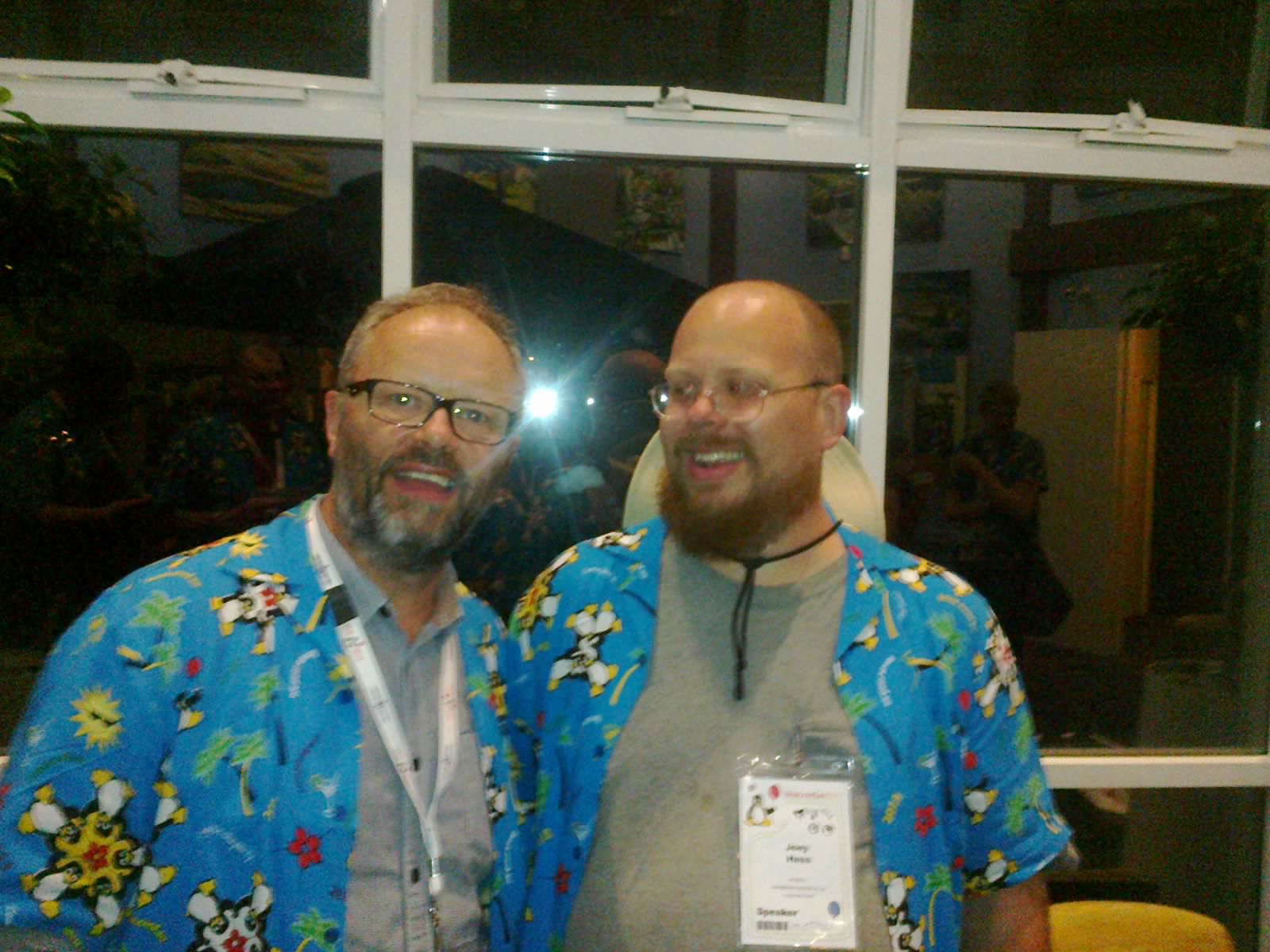
My git-annex talk went ok, despite technical problems with the video output, which the video team did a great job of working around. The first demo went well, and the Q&A was excellent. The demo of the git-annex assistant webapp was marred by, apparently, a bad build of the webapp -- which I ironically used rather than my usual development build because I assumed it'd be less likely to fail. At least I may have a way to reproduce that hang somewhat reliably now, so I can get on with debugging it. I will be redoing a demo of the webapp as a screencast.
Here are some of the best talks I attended. (I have quite a lot more queued up to watch still, and had to cut several due to space.) Click titles for videos, or browse all the videos.

1 February 2013

James Bromberger: LCA 2013

LCA Past Organisers

Previous core organisers of Linux.conf.au, taken at Mt Stromolo Observatory during LCA 2013 (pic by Josh Stewart); except one of these people organised CALU, and another hasn t organised one at all!

Thanks to all the people at LCA2013 in Canberra; it was a blast! So good to see old friends and chat freely on what s hot and happening. Radia (known for STP, TRILL), Sir Tim (the web) and old friend Bdale (Debian, SPI, Freedom Box) were inspiring. As was Robert Llewellyn (Kryten, Red Dwarf), who was a complete pleasure he wandered back and talked for a while with the volunteer video crew. Hats off to Pia for organising the TBL tour, to Mary Gardner for being awarded the Rusty Wrench, and to the team from PLUG (Euan, Jason, Leon, Luke) who stepped up to help with the video team and to Paul who graciously accepted the help. Next up LCA2014 Perth! Y all come back now.. it s been a decade.

Next.

Previous.