Search Results: "ean"

2 February 2025

Dirk Eddelbuettel: RcppUUID 1.1.2 on CRAN: Newly Adopted Package

The RcppUUID package on CRAN has been providing UUIDs (based on the underlying Boost library) for several years. Written by Artem Klemsov and maintained in this gitlab repo, the package is a very nice example of clean and straightforward library binding. When we did our annual BH upgrade to 1.87.0 and check reverse dependencies, we noticed the RcppUUID needed a small and rather minor update which we showed as a short diff in an issue filed. Neither I nor CRAN heard from Artem, so the packaged ended up being archived last week. Which in turn lead me to make this minimal update to 1.1.2 to resurrect it, which CRAN processed more or less like a regular update given this explanation and so it arrived last Friday. Courtesy of my CRANberries, there is also a a new package note (no diffstat report yet). More detailed information is on the RcppUUID page, or the github repo.

This post by Dirk Eddelbuettel originated on his Thinking inside the box blog. If you like this or other open-source work I do, you can sponsor me at GitHub.

Joachim Breitner: Coding on my eInk Tablet

For many years I wished I had a setup that would allow me to work (that is, code) productively outside in the bright sun. It s winter right now, but when its summer again it s always a bit. this weekend I got closer to that goal. TL;DR: Using code-server on a beefy machine seems to be quite neat.
Passively lit coding Passively lit coding

Personal history Looking back at my own old blog entries I find one from 10 years ago describing how I bought a Kobo eBook reader with the intent of using it as an external monitor for my laptop. It seems that I got a proof-of-concept setup working, using VNC, but it was tedious to set up, and I never actually used that. I subsequently noticed that the eBook reader is rather useful to read eBooks, and it has been in heavy use for that every since. Four years ago I gave this old idea another shot and bought an Onyx BOOX Max Lumi. This is an A4-sized tablet running Android and had the very promising feature of an HDMI input. So hopefully I d attach it to my laptop and it just works . Turns out that this never worked as well as I hoped: Even if I set the resolution to exactly the tablet s screen s resolution I got blurry output, and it also drained the battery a lot, so I gave up on this. I subsequently noticed that the tablet is rather useful to take notes, and it has been in sporadic use for that. Going off on this tangent: I later learned that the HDMI input of this device appears to the system like a camera input, and I don t have to use Boox s monitor app but could other apps like FreeDCam as well. This somehow managed to fix the resolution issues, but the setup still wasn t as convenient to be used regularly. I also played around with pure terminal approaches, e.g. SSH ing into a system, but since my usual workflow was never purely text-based (I was at least used to using a window manager instead of a terminal multiplexer like screen or tmux) that never led anywhere either.

VSCode, working remotely Since these attempts I have started a new job working on the Lean theorem prover, and working on or with Lean basically means using VSCode. (There is a very good neovim plugin as well, but I m using VSCode nevertheless, if only to make sure I am dogfooding our default user experience). My colleagues have said good things about using VSCode with the remote SSH extension to work on a beefy machine, so I gave this a try now as well, and while it s not a complete game changer for me, it does make certain tasks (rebuilding everything after a switching branches, running the test suite) very convenient. And it s a bit spooky to run these work loads without the laptop s fan spinning up. In this setup, the workspace is remote, but VSCode still runs locally. But it made me wonder about my old goal of being able to work reasonably efficient on my eInk tablet. Can I replicate this setup there? VSCode itself doesn t run on Android directly. There are project that run a Linux chroot or in termux on the Android system, and then you can VNC to connect to it (e.g. on Andronix) but that did not seem promising. It seemed fiddly, and I probably should take it easy on the tablet s system.

code-server, running remotely A more promising option is code-server. This is a fork of VSCode (actually of VSCodium) that runs completely on the remote machine, and the client machine just needs a browser. I set that up this weekend and found that I was able to do a little bit of work reasonably.

Access With code-server one has to decide how to expose it safely enough. I decided against the tunnel-over-SSH option, as I expected that to be somewhat tedious to set up (both initially and for each session) on the android system, and I liked the idea of being able to use any device to work in my environment. I also decided against the more involved reverse proxy behind proper hostname with SSL setups, because they involve a few extra steps, and some of them I cannot do as I do not have root access on the shared beefy machine I wanted to use. That left me with the option of using a code-server s built-in support for self-signed certificates and a password:
$ cat .config/code-server/config.yaml
bind-addr: 1.2.3.4:8080
auth: password
password: xxxxxxxxxxxxxxxxxxxxxxxx
cert: true
With trust-on-first-use this seems reasonably secure. Update: I noticed that the browsers would forget that I trust this self-signed cert after restarting the browser, and also that I cannot install the page (as a Progressive Web App) unless it has a valid certificate. But since I don t have superuser access to that machine, I can t just follow the official recommendation of using a reverse proxy on port 80 or 431 with automatic certificates. Instead, I pointed a hostname that I control to that machine, obtained a certificate manually on my laptop (using acme.sh) and copied the files over, so the configuration now reads as follows:
bind-addr: 1.2.3.4:3933
auth: password
password: xxxxxxxxxxxxxxxxxxxxxxxx
cert: .acme.sh/foobar.nomeata.de_ecc/foobar.nomeata.de.cer
cert-key: .acme.sh/foobar.nomeata.de_ecc/foobar.nomeata.de.key
(This is getting very specific to my particular needs and constraints, so I ll spare you the details.)

Service To keep code-server running I created a systemd service that s managed by my user s systemd instance:
~ $ cat ~/.config/systemd/user/code-server.service
[Unit]
Description=code-server
After=network-online.target
[Service]
Environment=PATH=/home/joachim/.nix-profile/bin:/nix/var/nix/profiles/default/bin:/usr/local/bin:/usr/bin:/bin:/usr/local/games:/usr/games
ExecStart=/nix/var/nix/profiles/default/bin/nix run nixpkgs#code-server
[Install]
WantedBy=default.target
(I am using nix as a package manager on a Debian system there, hence the additional PATH and complex ExecStart. If you have a more conventional setup then you do not have to worry about Environment and can likely use ExecStart=code-server. For this to survive me logging out I had to ask the system administrator to run loginctl enable-linger joachim, so that systemd allows my jobs to linger.

Git credentials The next issue to be solved was how to access the git repositories. The work is all on public repositories, but I still need a way to push my work. With the classic VSCode-SSH-remote setup from my laptop, this is no problem: My local SSH key is forwarded using the SSH agent, so I can seamlessly use that on the other side. But with code-server there is no SSH key involved. I could create a new SSH key and store it on the server. That did not seem appealing, though, because SSH keys on Github always have full access. It wouldn t be horrible, but I still wondered if I can do better. I thought of creating fine-grained personal access tokens that only me to push code to specific repositories, and nothing else, and just store them permanently on the remote server. Still a neat and convenient option, but creating PATs for our org requires approval and I didn t want to bother anyone on the weekend. So I am experimenting with Github s git-credential-manager now. I have configured it to use git s credential cache with an elevated timeout, so that once I log in, I don t have to again for one workday.
$ nix-env -iA nixpkgs.git-credential-manager
$ git-credential-manager configure
$ git config --global credential.credentialStore cache
$ git config --global credential.cacheOptions "--timeout 36000"
To login, I have to https://github.com/login/device on an authenticated device (e.g. my phone) and enter a 8-character code. Not too shabby in terms of security. I only wish that webpage would not require me to press Tab after each character This still grants rather broad permissions to the code-server, but at least only temporarily

Android setup On the client side I could now open https://host.example.com:8080 in Firefox on my eInk Android tablet, click through the warning about self-signed certificates, log in with the fixed password mentioned above, and start working! I switched to a theme that supposedly is eInk-optimized (eInk by Mufanza). It s not perfect (e.g. git diffs are unhelpful because it is not possible to distinguish deleted from added lines), but it s a start. There are more eInk themes on the official Visual Studio Marketplace, but because code-server is a fork it cannot use that marketplace, and for example this theme isn t on Open-VSX. For some reason the F11 key doesn t work, but going fullscreen is crucial, because screen estate is scarce in this setup. I can go fullscreen using VSCode s command palette (Ctrl-P) and invoking the command there, but Firefox often jumps out of the fullscreen mode, which is annoying. I still have to pay attention to when that s happening; maybe its the Esc key, which I am of course using a lot due to me using vim bindings. A more annoying problem was that on my Boox tablet, sometimes the on-screen keyboard would pop up, which is seriously annoying! It took me a while to track this down: The Boox has two virtual keyboards installed: The usual Google ASOP keyboard, and the Onyx Keyboard. The former is clever enough to stay hidden when there is a physical keyboard attached, but the latter isn t. Moreover, pressing Shift-Ctrl on the physical keyboard rotates through the virtual keyboards. Now, VSCode has many keyboard shortcuts that require Shift-Ctrl (especially on an eInk device, where you really want to avoid using the mouse). And the limited settings exposed by the Boox Android system do not allow you configure that or disable the Onyx keyboard! To solve this, I had to install the KISS Launcher, which would allow me to see more Android settings, and in particular allow me to disable the Onyx keyboard. So this is fixed. I was hoping to improve the experience even more by opening the web page as a Progressive Web App (PWA), as described in the code-server FAQ. Unfortunately, that did not work. Firefox on Android did not recognize the site as a PWA (even though it recognizes a PWA test page). And I couldn t use Chrome either because (unlike Firefox) it would not consider a site with a self-signed certificate as a secure context, and then code-server does not work fully. Maybe this is just some bug that gets fixed in later versions. Now that I use a proper certificate, I can use it as a Progressive Web App, and with Firefox on Android this starts the app in full-screen mode (no system bars, no location bar). The F11 key still does t work, and using the command palette to enter fullscreen does nothing visible, but then Esc leaves that fullscreen mode and I suddenly have the system bars again. But maybe if I just don t do that I get the full screen experience. We ll see. I did not work enough with this yet to assess how much the smaller screen estate, the lack of colors and the slower refresh rate will bother me. I probably need to hide Lean s InfoView more often, and maybe use the Error Lens extension, to avoid having to split my screen vertically. I also cannot easily work on a park bench this way, with a tablet and a separate external keyboard. I d need at least a table, or some additional piece of hardware that turns tablet + keyboard into some laptop-like structure that I can put on my, well, lap. There are cases for Onyx products that include a keyboard, and maybe they work on the lap, but they don t have the Trackpoint that I have on my ThinkPad TrackPoint Keyboard II, and how can you live without that?

Conclusion After this initial setup chances are good that entering and using this environment is convenient enough for me to actually use it; we will see when it gets warmer. A few bits could be better. In particular logging in and authenticating GitHub access could be both more convenient and more safe I could imagine that when I open the page I confirm that on my phone (maybe with a fingerprint), and that temporarily grants access to the code-server and to specific GitHub repositories only. Is that easily possible?

1 February 2025

Guido G nther: Free Software Activities January 2025

Another short status update of what happened on my side last month. Mostly focused on quality of life improvements in phosh and cleaning up and improving phoc this time around (including catching up with wlroots git) but some improvements for other things like phosh-osk-stub happened on the side line too. phosh phoc phosh-osk-stub xdg-desktop-portal-phosh phosh-recipes libcmatrix phrog Debian git-buildpackage livi feedbackd Wayland protocols Wlroots Bug reports Reviews This is not code by me but reviews on other peoples code. The list is incomplete, but I hope to improve on this in the upcoming months. Thanks for the contributions! Help Development If you want to support my work see donations. Comments? Join the Fediverse thread

31 January 2025

Gunnar Wolf: ChatGPT is bullshit

This post is an unpublished review for ChatGPT is bullshit
As people around the world understand how LLMs behave, more and more people wonder as to why these models hallucinate, and what can be done about to reduce it. This provocatively named article by Michael Townsen Hicks, James Humphries and Joe Slater bring is an excellent primer to better understanding how LLMs work and what to expect from them. As humans carrying out our relations using our language as the main tool, we are easily at awe with the apparent ease with which ChatGPT (the first widely available, and to this day probably the best known, LLM-based automated chatbot) simulates human-like understanding and how it helps us to easily carry out even daunting data aggregation tasks. It is common that people ask ChatGPT for an answer and, if it gets part of the answer wrong, they justify it by stating that it s just a hallucination. Townsen et al. invite us to switch from that characterization to a more correct one: LLMs are bullshitting. This term is formally presented by Frankfurt [1]. To Bullshit is not the same as to lie, because lying requires to know (and want to cover) the truth. A bullshitter not necessarily knows the truth, they just have to provide a compelling description, regardless of what is really aligned with truth. After introducing Frankfurt s ideas, the authors explain the fundamental ideas behind LLM-based chatbots such as ChatGPT; a Generative Pre-trained Transformer (GPT) s have as their only goal to produce human-like text, and it is carried out mainly by presenting output that matches the input s high-dimensional abstract vector representation, and probabilistically outputs the next token (word) iteratively with the text produced so far. Clearly, a GPT s ask is not to seek truth or to convey useful information they are built to provide a normal-seeming response to the prompts provided by their user. Core data are not queried to find optimal solutions for the user s requests, but are generated on the requested topic, attempting to mimic the style of document set it was trained with. Erroneous data emitted by a LLM is, thus, not equiparable with what a person could hallucinate with, but appears because the model has no understanding of truth; in a way, this is very fitting with the current state of the world, a time often termed as the age of post-truth [2]. Requesting an LLM to provide truth in its answers is basically impossible, given the difference between intelligence and consciousness: Following Harari s definitions [3], LLM systems, or any AI-based system, can be seen as intelligent, as they have the ability to attain goals in various, flexible ways, but they cannot be seen as conscious, as they have no ability to experience subjectivity. This is, the LLM is, by definition, bullshitting its way towards an answer: their goal is to provide an answer, not to interpret the world in a trustworthy way. The authors close their article with a plea for literature on the topic to adopt the more correct bullshit term instead of the vacuous, anthropomorphizing hallucination . Of course, being the word already loaded with a negative meaning, it is an unlikely request. This is a great article that mixes together Computer Science and Philosophy, and can shed some light on a topic that is hard to grasp for many users. [1] Frankfurt, Harry (2005). On Bullshit. Princeton University Press. [2] Zoglauer, Thomas (2023). Constructed truths: truth and knowledge in a post-truth world. Springer. [3] Harari, Yuval Noah (2023. Nexus: A Brief History of Information Networks From the Stone Age to AI. Random House.

Divine Attah-Ohiemi: Seeking Opportunities: Building a Career in Software Engineering and Beyond

My journey in CS has always been driven by curiosity, determination, and a deep love for understanding software solutions at its tiniest, most complex levels. Taking ALX Africa Software Engineer track after High school was where it all started for me. During the 1-year intensive bootcamp, I delved into the intricacies of Linux programming and low-level programming with C, which solidified my foundational knowledge. This experience not only enhanced my technical skills but also taught me the importance of adaptability and self-directed learning. I discovered how to approach challenges with curiosity, igniting a passion for exploring software solutions in their most intricate forms. Each module pushed me to think critically and creatively, transforming my understanding of technology and its capabilities. Let s just say that I have always been drawn to asking, How does this happen?" And I just go on and on until I find an answer eventually and sometimes I don t but that s okay. That curiosity, combined with a deep commitment to learning, has guided my journey. Debian Webmaster My drive has led me to get involved in open-source contributions, where I can put my knowledge to the test while helping my community. Engaging with real-world experts and learning from my mistakes has been invaluable. One of the highlights of this journey was joining the Debian Webmasters team as an intern through Outreachy. Here, I have the honor of working on redesigning and migrating the old Debian webpages to make them more user-friendly. This experience not only allows me to apply my skills in a practical setting but also deepens my understanding of collaborative software development. Building My Skills: The Foundation of My Experience Throughout my academic and professional journey, I have taken on many roles that have shaped my skills and prepared me for what s ahead I believe. I am definitely not a one-trick pony, and maybe not completely a jack of all trade either but I am a bit diverse I d like to think. Here are the key roles that have defined my journey so far: Volunteer Developer at Yoris Africa (June 2022 - August 2023) I began my career by volunteering at Yoris, where I collaborated with a talented team to design and build the frontend for a mobile app. My contributions extended beyond just the frontend; I also worked on backend solutions and microservices, gaining hands-on experience in full-stack development. This role was instrumental in shaping my understanding of software architecture, allowing me to contribute meaningfully to projects while learning from experienced developers in a dynamic environment. Freelance Academics Software Developer (September 2023 - October 2024) I freelanced as an academic software developer, where I pitched and developed software solutions for universities in my community. One of my most notable projects was creating a Computer-Based Testing (CBT) software for a medical school, which featured a unique questionnaire and scoring system tailored to their specific needs. This experience not only allowed me to apply my technical skills in a real-world setting but also deepened my understanding of educational software requirements and user experience, ultimately enhancing the learning process for students. Open Source Intern at Debian Webmaster Team (November 2024 -) Perhaps the most transformative experience has been my role as an intern at Debian Webmasters. This opportunity allowed me to delve into the fascinating world of open source. As an intern, I have the chance to work on a project where we are redesigning and migrating the Debian webpages to utilize a new and faster technology: Go templates with Hugo. For a detailed look at the work and progress I made during my internship, as well as information on this project and how to get involved, you can check out the wiki. My ultimate goal with this role is to build a vibrant community for Debian in Africa and, if given the chance, to host a debian-cd mirror for faster installations in my region. You can connect with me through LinkedIn, or X (formerly Twitter), or reach out via email.

29 January 2025

Keith Packard: picolibc-i18n

Internationalization support in Picolibc There are two major internationalization APIs in the C library: locales and iconv. Iconv is an isolated component which only performs charset conversion in ways that don't interact with anything else in the library. Locales affect pretty much every API that deals with strings and covers charset conversion along with a huge range of localized information from character classification to formatting of time, money, people's names, addresses and even standard paper sizes. Picolibc inherits it's implementation of both of these from newlib. Given that embedded applications rarely need advanced functionality from either these APIs, I hadn't spent much time exploring this space. Newlib locale code When run on Cygwin, Newlib's locale support is quite complete as it leverages the underlying Windows locale support. Without Windows support, everything aside from charset conversion and character classification data is stubbed out at the bottom of the stack. Because the implementation can support full locale functionality, the implementation is designed for that, with large data structures and lots of code. Charset conversion and character classification data for locales is all built-in; none of that can be loaded at runtime. There is support for all of the ISO-8859 charsets, three JIS variants, a bunch of Windows code pages and a few other single-byte encodings. One oddity in this code is that when using a JIS locale, wide characters are stored in EUC-JP rather than Unicode. Every other locale uses Unicode. This means APIs like wctype are implemented by mapping the JIS-encoded character to Unicode and then using the underlying Unicode character classification tables. One consequence of this is that there isn't any Unicode to JIS mapping provided as it isn't necessary. When testing the charset conversion and Unicode character classification data, I found numerous minor errors and a couple of pretty significant ones. The JIS conversion code had the most serious issue I found; most of the conversions are in a 2d array which is manually indexed with the wrong value for the length of each row. This led to nearly every translated value being incorrect. The charset conversion tables and Unicode classification data are now generated using python charset support and the standard Unicode data files. In addition, tests have been added which compare Picolibc to the system C library for every supported charset. Newlib iconv code The iconv charset support is completely separate from the locale charset support with a much wider range of supported targets. It also supports loading charset data from files at runtime, which reduces the size of application images. Because the iconv and locale implementations are completely separate, the charset support isn't the same. Iconv supports a lot more charsets, but it doesn't support all of those available to locales. For example, Iconv has Big5 support which locale lacks. Conversely, locale has Shift-JIS support which iconv does not. There's also a difference in how charset names are mapped in the two APIs. The locale code has a small fixed set of aliases, which doesn't include things like US-ASCII or ANSI X3.4. In contrast, the iconv code has an extensive database of charset aliases which are compiled into the library. Picolibc has a few tests for the iconv API which verify charset names and perform some translations. Without an external reference, it's hard to know if the results are correct. POSIX vs C internationalization In addition to including the iconv API, POSIX extends locale support in a couple of ways:
  1. Exposing locale objects via the newlocale, uselocale, duplocale and freelocale APIs.
  2. uselocale sets a per-thread locale, rather than the process-wide locale.
Goals for Picolibc internationalization support For charsets, supporting UTF-8 should cover the bulk of embedded application needs, and even that is probably more than what most applications require. Most (all?) compilers use Unicode for wide character and string constants. That means wchar_t needs to be Unicode in every locale. Aside from charset support, the rest of the locale infrastructure is heavily focused on creating human-consumable strings. I don't think it's a stretch to say that none of this is very useful these days, even for systems with sophisticated user interactions. For picolibc, the cost to provide any of this would be high. Having two completely separate charset conversion datasets makes for a confusing and error-prone experience for developers. Replacing iconv with code that leverages the existing locale support for translating between multi-byte and wide-character representations will save a bunch of source code and improve consistency. Embedded systems can be very sensitive to memory usage, both read-only and read-write. Applications not using internationalization capabilities shouldn't pay a heavy premium even when the library binary is built with support. For the most sensitive targets, the library should be configurable to remove unnecessary functionality. Picolibc needs to be conforming with at least the C language standard, and as much of POSIX as makes sense. Fortunately, the requirements for C are modest as it only includes a few locale-related APIs and doesn't include iconv. Finally, picolibc should test these APIs to make sure they conform with relevant standards, especially character set translation and character classification. The easiest way to do this is to reference another implementation of the same API and compare results. Switching to Unicode for JIS wchar_t This involved ripping the JIS to Unicode translations out of all of the wide character APIs and inserting them into the translations between multi-byte and wide-char representations. The missing Unicode to JIS translation was kludged by iterating over all JIS code points until a matching Unicode value was found. That's an obvious place for a performance improvement, but at least it works. Tiny locale This is a minimal implementation of locales which conforms with the C language standard while providing only charset translation and character classification data. It handles all of the existing charsets, but splits things into three levels
  1. ASCII
  2. UTF-8
  3. Extended, including any or all of: a. ISO 8859 b. Windows code pages and other 8-bit encodings c. JIS (JIS, EUC-JP and Shift-JIS)
When built for ASCII-only, all of the locale support is short-circuited, except for error checking. In addition, support in printf and scanf for wide characters is removed by default (it can be re-enabled with the -Dio-wchar=true meson option). This offers the smallest code size. Because the wctype APIs (e.g. iswupper) are all locale-specific, this mode restricts them to ASCII-only, which means they become wrappers on top of the ctype APIs with added range checking. When built for UTF-8, character classification for wide characters uses tables that provide the full Unicode range. Setlocale now selects between two locales, "C" and "C.UTF-8". Any locale name other than "C" selects the UTF-8 version. If the locale name contains "." or "-", then the rest of the locale name is taken to be a charset name and matched against the list of supported charsets. In this mode, only "us_ascii", "ascii" and "utf-8" are recognized. Because a single byte of a utf-8 string with the high-bit set is not a complete character, all of the ctype APIs in this mode can use the same implementation as the ASCII-only mode. This means the small ctype implementation is available. Calling setlocale(LC_ALL, "C.UTF-8") will allow the application to use the APIs which translate between multi-byte and wide-characters to deal with UTF-8 encoded strings. In addition, scanf and printf can read and write UTF-8 strings into wchar_t strings. Locale names are converted into locale IDs, an enumeration which lists the available locales. Each ID implies a specific charset as that's the only thing which differs between them. This means a locale can be encoded in a few bytes rather than an array of strings. In terms of memory usage, applications not using locales and not using the wctype APIs should see only a small increase in code space. That's due to the wchar_t support added to printf and scanf which need to translate between multi-byte and wide-character representations. There aren't any tables required as ASCII and UTF-8 are directly convertible to Unicode. On ARM-v7m, The added code in printf and scanf add up to about 1kB and another 32 bytes of RAM is used. The big difference when enabling extended charset support is that all of the charset conversion and character classification operations become table driven and dependent on the locale. Depending on the extended charsets supported, these can be quite large. With all of the extended charsets included, this adds an additional 30kB of code and static data and uses another 56 bytes of RAM. There are two known gaps in functionality compared with the newlib code:
  1. Locale strings that encode different locales for different categories. That's nominally required by POSIX as LC_ALL is supposed to return a string sufficient to restore the locale, but the only category which actually matters is LC_CTYPE.
  2. No nl_langinfo support. This would be fairly easy to add, returning appropriate constant values for each parameter.
Tiny locale was merged to picolibc main in this PR Tiny iconv Replacing the bulky newlib iconv code was far easier than swapping locale implementations. Essentially all that iconv does is compute two functions, one which maps from multi-byte to wide-char in one locale and another which maps from wide-char to multi-byte in another locale. Once the JIS locales were fixed to use Unicode, the new iconv implementation was straightforward. POSIX doesn't provide any _l version of mbrtowc or wcrtomb, so using standard C APIs would have been clunky. Instead, the implementation uses the internal APIs to compute the correct charset conversion functions. The entire implementation fits in under 200 lines of code. Tiny iconv is in process in this PR Future directions Right now, both of these new bits of code sit in the source tree parallel to the old versions. I'm not seeing any particular reason to keep the old versions around; they have provided a useful point of comparison in developing the new code, but I don't think they offer any compelling benefits going forward.

Sergio Talens-Oliag: Testing DeepSeek with Ollama and Open WebUI

With all the recent buzz about DeepSeek and its capabilities, I ve decided to give it a try using Ollama and Open WebUI on my work laptop which has an NVIDIA GPU:
$ lspci   grep NVIDIA
0000:01:00.0 3D controller: NVIDIA Corporation GA107GLM [RTX A2000 8GB Laptop GPU]
             (rev a1)
For the installation I initially I looked into the approach suggested on this article, but after reviewing it I decided to go for a docker only approach, as it leaves my system clean and updates are easier.

Step 0: Install dockerI already had it on my machine, so nothing to do here.

Step 1: Install the nvidia-container-toolkit packageAs it is needed to use the NVIDIA GPU with docker I followed the instructions to install the package using apt from the NVIDIA website.

Step 2: Run the Open WebUI container bundled with OllamaI could install ollama directly on linux or run it on docker, but I found out that there is a container with Open WebUI bundled with Ollama, so I decided to use it instead. To start the container I ve executed the following command:
docker run -d \
  -e OLLAMA_HOST="0.0.0.0:11434" -p 127.0.0.1:11434:11434 \
  -p 127.0.0.1:3000:8080 \
  -v ollama:/root/.ollama \
  -v open-webui:/app/backend/data \
  --gpus=all --name open-webui --restart always \
  ghcr.io/open-webui/open-webui:ollama
Once the container is up and running, I can access the Open WebUI on http://localhost:3000/ and the Ollama API on http://localhost:11434/ (I added the OLLAMA_HOST environment variable to be bind the server to all the container IPs, as it is needed to export it to the host).

Step 3: Install DeepSeek-R1 model from Open WebUIAfter creating an admin user on the Open WebUI, I went to the select a model button and asked to download the deepseek-r1 model (at the time of writing this it matches version deepseek-r1:7b, which uses 4.7GB of space). After the download was completed I was able to start chatting with the model on my local machine.

Step 4: Ask a questionThe first question I asked was Can you tell me what is Debian? and the answer I got was:
Debian is one of the most popular Linux distributions used worldwide. It is an
open-source operating system that has been around since 1993 and is known for
its stability, security, and reliability. Debian is widely used in servers, data
centers, and enterprise environments because it provides a robust base platform
with excellent documentation, tools, and community support.
### Key Features of Debian:

1. **History**:
   - Debian started as a project called "Pop!!" (Pootle) led by Lars Knutsen, a
     developer from Denmark.
   - It was initially forked from the Linux distribution Red Hat's RH-Debian to
     gain independence and reduce reliance on Red Hat.

2. **Use Cases**:
   - Debian is commonly used as an operating system for servers due to its
     reliability and ease of use in enterprise environments.
   - It is also used for individual user machines (laptops, desktops) because it
     offers a smooth and stable experience.
   - Debian provides the foundation for many popular derivatives like Ubuntu,
     which are designed for consumer use.

3. **Supported Architectures**:
   - Debian supports all major Linux architectures, including 32-bit and 64-bit
     systems, and runs on a wide range of hardware from old servers to modern
     smartphones.

4. **Package Management**:
   - Debian comes with a robust package management system called **Debian Policy
     Language (DPL)**, which allows users to easily install, update, and manage
     software packages.
   - This makes it easy for users to keep their systems up to date without
     needing to download multiple repositories or deal with version conflicts.

5. **Security Focus**:
   - Debian is known for its strong security practices. It has a reputation for
     being one of the most stable Linux distributions, making it a favorite
     among organizations that prioritize security.
   - The distribution regularly updates its software packages to patch
     vulnerabilities and protect against common attacks.

6. **Compatibility with Servers**:
   - Debian is widely used in data centers because it provides a consistent and
     reliable environment for running servers and applications.
   - Many open-source projects are compatible with Debian, making it an ideal
     choice for developers who want to work on servers or distributed systems.

7. **Popularity**:
   - Debian has a large and active community of users and contributors.
   - It is one of the most widely used Linux distributions in the world, with
     many enterprise organizations relying on it as their primary operating
     system.
### Comparison with Other Distributions:
- **Ubuntu**: Ubuntu is based on Debian but adds graphical user interfaces (like
  Gutsy Gibbon), modern tools (like GIMP and LibreOffice), and integrates with
  Microsoft services.
- **RHEL (Red Hat Enterprise Linux)**: RHEL is a derivative of Red Hat's
  distribution, which forked from Debian. It focuses more heavily on enterprise
  security and support compared to Debian.
### Why Debian?
Debian is popular because:
- It is free and open-source, making it accessible to anyone.
- It provides excellent documentation and tools for system administrators.
- It has a strong focus on stability and reliability.
- It supports a wide range of hardware and software needs.
If you're looking for a reliable and flexible Linux distribution that works well
in both personal and enterprise environments, Debian is an excellent choice.
Haven t tried the same question with ChatGPT, but the History, Package Management and Comparison with Other Distributions sections are hilarious, but they provided me with important data:
  • Now I know that APT is the real Debian Project Leader, what don t know is why we have elections each year ;)
  • Linux Distributions are recursive Debian was a fork of Red Hat, which was a fork of Debian, which was a fork of Red Hat,
As everybody is testing the model I will not talk more about the chat and the results, I just thought that this answer was really funny.

Step 5: Install the DeepSeek Coder and DeepSeek Coder v2 models from Open WebUIAs done before, to download the models I went to the select a model button and asked to download the deepseek-coder and deepseek-coder-v2 models (the default version of version one is said to be really quick and small, while version two is supposed to be better but slower and bigger, so I decided to install both for testing).

Step 6: Integrate Ollama with NeovimSince some months ago I ve been using Github Copilot with Neovim; I don t feel it has been very helpful in the general case, but I wanted to try it and it comes handy when you need to perform repetitive tasks when programming. It seems that there are multiple neovim plugins that support ollama, for now I ve installed and configured the codecompanion plugin on my config.lua file using packer:
require('packer').startup(function()
  [...]
  -- Codecompanion plugin
  use  
    "olimorris/codecompanion.nvim",
    requires =  
      "nvim-lua/plenary.nvim",
      "nvim-treesitter/nvim-treesitter",
     
   
  [...]
end)
[...]
-- --------------------------------
-- BEG: Codecompanion configuration
-- --------------------------------
-- Module setup
local codecompanion = require('codecompanion').setup( 
  adapters =  
    ollama = function()
      return require('codecompanion.adapters').extend('ollama',  
        schema =  
          model =  
            default = 'deepseek-coder-v2:latest',
           
         ,
       )
    end,
   ,
  strategies =  
    chat =   adapter = 'ollama',  ,
    inline =   adapter = 'ollama',  ,
   ,
 )
-- --------------------------------
-- END: Codecompanion configuration
-- --------------------------------
I ve tested it a little bit and it seems to work fine, but I ll have to test it more to see if it is really useful, I ll try to do it on future projects.

ConclusionAt a personal level I don t like nor trust AI systems, but as long as they are treated as tools and not as a magical thing you must trust they have their uses and I m happy to see that open source tools like Ollama and models like DeepSeek available for everyone to use.

Russ Allbery: Review: The Sky Road

Review: The Sky Road, by Ken MacLeod
Series: Fall Revolution #4
Publisher: Tor
Copyright: 1999
Printing: August 2001
ISBN: 0-8125-7759-0
Format: Mass market
Pages: 406
The Sky Road is the fourth book in the Fall Revolution series, but it represents an alternate future that diverges after (or during?) the events of The Sky Fraction. You probably want to read that book first, but I'm not sure reading The Stone Canal or The Cassini Division adds anything to this book other than frustration. Much more on that in a moment. Clovis colha Gree is a aspiring doctoral student in history with a summer job as a welder. He works on the platform for the project, which the reader either slowly discovers from the book or quickly discovers from the cover is a rocket to get to orbit. As the story opens, he meets (or, as he describes it) is targeted by a woman named Merrial, a tinker who works on the guidance system. The early chapters provide only a few hints about Clovis's world: a statue of the Deliverer on a horse that forms the backdrop of their meeting, the casual carrying of weapons, hints that tinkers are socially unacceptable, and some division between the white logic and the black logic in programming. Also, because this is a Ken MacLeod novel, everyone is obsessed with smoking and tobacco the way that the protagonists of erotica are obsessed with sex. Clovis's story is one thread of this novel. The other, told in the alternating chapters, is the story of Myra Godwin-Davidova, chair of the governing Council of People's Commissars of the International Scientific and Technical Workers' Republic, a micronation embedded in post-Soviet Kazakhstan. Series readers will remember Myra's former lover, David Reid, as the villain of The Stone Canal and the head of the corporation Mutual Protection, which is using slave labor (sort of) to support a resurgent space movement and its attempt to take control of a balkanized Earth. The ISTWR is in decline and a minor power by all standards except one: They still have nuclear weapons. So, first, we need to talk about the series divergence. I know from reading about this book on-line that The Sky Road is an alternate future that does not follow the events of The Stone Canal and The Cassini Division. I do not know this from the text of the book, which is completely silent about even being part of a series. More annoyingly, while the divergence in the Earth's future compared to The Cassini Division is obvious, I don't know what the Jonbar hinge is. Everything I can find on-line about this book is maddeningly coy. Wikipedia claims the divergence happens at the end of The Sky Fraction. Other reviews and the Wikipedia talk page claim it happens in the middle of The Stone Canal. I do have a guess, but it's an unsatisfying one and I'm not sure how to test its correctness. I suppose I shouldn't care and instead take each of the books on their own terms, but this is the type of thing that my brain obsesses over, and I find it intensely irritating that MacLeod didn't explain it in the books themselves. It's the sort of authorial trick that makes me feel dumb, and books that gratuitously make me feel dumb are less enjoyable to read. The second annoyance I have with this book is also only partly its fault. This series, and this book in particular, is frequently mentioned as good political science fiction that explores different ways of structuring human society. This was true of some of the earlier books in a surprisingly superficial way. Here, I would call it hogwash. This book, or at least the Myra portion of it, is full of people doing politics in a tactical sense, but like the previous books of this series, that politics is mostly embedded in personal grudges and prior romantic relationships. Everyone involved is essentially an authoritarian whose ability to act as they wish is only contested by other authoritarians and is largely unconstrained by such things as persuasion, discussions, elections, or even theory. Myra and most of the people she meets are profoundly cynical and almost contemptuous of any true discussion of political systems. This is the trappings and mechanisms of politics without the intellectual debate or attempt at consensus, turning it into a zero-sum game won by whoever can threaten the others more effectively. Given the glowing reviews I've seen in relatively political SF circles, presumably I am missing something that other people see in MacLeod's approach. Perhaps this level of pettiness and cynicism is an accurate depiction of what it's like inside left-wing political movements. (What an appalling condemnation of left-wing political movements, if so.) But many of the on-line reviews lead me to instead conclude that people's understanding of "political fiction" is stunted and superficial. For example, there is almost nothing Marxist about this book it contains essentially no economic or class analysis whatsoever but MacLeod uses a lot of Marxist terminology and sets half the book in an explicitly communist state, and this seems to be enough for large portions of the on-line commentariat to conclude that it's full of dangerous, radical ideas. I find this sadly hilarious given that MacLeod's societies tend, if anything, towards a low-grade libertarianism that would be at home in a Robert Heinlein novel. Apparently political labels are all that's needed to make political fiction; substance is optional. So much for the politics. What's left in Clovis's sections is a classic science fiction adventure in which the protagonist has a radically different perspective from the reader and the fun lies in figuring out the world-building through the skewed perspective of the characters. This was somewhat enjoyable, but would have been more fun if Clovis had any discernible personality. Sadly he instead seems to be an empty receptacle for the prejudices and perspective of his society, which involve a lot of quasi-religious taboos and an essentially magical view of the world. Merrial is a more interesting character, although as always in this series the romance made absolutely no sense to me and seemed to be conjured by authorial fiat and weirdly instant sexual attraction. Myra's portion of the story was the part I cared more about and was more invested in, aided by the fact that she's attempting to do something more interesting than launch a crewed space vehicle for no obvious reason. She at least faces some true moral challenges with no obviously correct response. It's all a bit depressing, though, and I found Myra's unwillingness to ground her decisions in a more comprehensive moral framework disappointing. If you're going to make a protagonist the ruler of a communist state, even an ironic one, I'd like to hear some real political philosophy, some theory of sociology and economics that she used to justify her decisions. The bits that rise above personal animosity and vibes were, I think, said better in The Cassini Division. This series was disappointing, and I can't say I'm glad to have read it. There is some small pleasure in finishing a set of award-winning genre books so that I can have a meaningful conversation about them, but the awards failed to find me better books to read than I would have found on my own. These aren't bad books, but the amount of enjoyment I got out of them didn't feel worth the frustration. Not recommended, I'm afraid. Rating: 6 out of 10

28 January 2025

Russ Allbery: Review: Moose Madness

Review: Moose Madness, by Mar Delaney
Publisher: Kalikoi
Copyright: May 2021
ASIN: B094HGT1ZB
Format: Kindle
Pages: 68
Moose Madness is a sapphic shifter romance novella (on the short side for a novella) by the same author as Wolf Country. It was originally published in the anthology Her Wild Soulmate, which appears to be very out of print. Maggie (she hates the nickname Moose) grew up in Moose Point, a tiny fictional highway town in (I think) Alaska. (There is, unsurprisingly, an actual Moose Point in Alaska, but it's a geographic feature and not a small town.) She stayed after graduation and is now a waitress in the Moose Point Pub. She's also a shifter; specifically, she is a moose shifter like her mother, the town mayor. (Her father is a fox shifter.) As the story opens, the annual Moose Madness festival is about to turn the entire town into a blizzard of moose kitsch. Fiona Barton was Maggie's nemesis in high school. She was the cool, popular girl, a red-headed wolf shifter whose friend group teased and bullied awkward and uncoordinated Maggie mercilessly. She was also Maggie's impossible crush, although the very idea seemed laughable. Fi left town after graduation, and Maggie hadn't thought about her for years. Then she walks into Moose Point Pub dressed in biker leathers, with piercings and one side of her head shaved, back in town for a wedding in her pack. Much to the shock of both Maggie and Fi, they realize that they're soulmates as soon as their eyes meet. Now what? If you thought I wasn't going to read the moose and wolf shifter romance once I knew it existed, you do not know me very well. I have been saving it for when I needed something light and fun. It seemed like the right palette cleanser after a very disappointing book. Moose Madness takes place in the same universe as Wolf Country, which means there are secret shifters all over Alaska (and presumably elsewhere) and they have the strong magical version of love at first sight. If one is a shifter, one knows immediately as soon as one locks eyes with one's soulmate and this feeling is never wrong. This is not my favorite romance trope, but if I get moose shifter romance out of it, I'll endure. As you can tell from the setup, this is enemies-to-lovers, but the whole soulmate thing shortcuts the enemies to lovers transition rather abruptly. There's a bit of apologizing and air-clearing at the start, but most of the novella covers the period right after enemies have become lovers and are getting to know each other properly. If you like that part of the arc, you will probably enjoy this, but be warned that it's slight and somewhat obvious. There's a bit of tension from protective parents and annoying pack mates, but it's sorted out quickly and easily. If you want the characters to work for the relationship, this is not the novella for you. It's essentially all vibes. I liked the vibes, though! Maggie is easy to like, and Fi does a solid job apologizing. I wish there was quite a bit more moose than we get, but Delaney captures the combination of apparent awkwardness and raw power of a moose and has a good eye for how beautiful large herbivores can be. This is not the sort of book that gives a moment's thought to wolves being predators and moose being, in at least some sense, prey animals, so if you are expecting that to be a plot point, you will be disappointed. As with Wolf Country, Delaney elides most of the messier and more ethically questionable aspects of sometimes being an animal. This is a sweet, short novella about two well-meaning and fundamentally nice people who are figuring out that middle school and high school are shitty and sometimes horrible but don't need to define the rest of one's life. It's very forgettable, but it made me smile, and it was indeed a good palette cleanser. If you are, like me, the sort of person who immediately thought "oh, I have to read that" as soon as you saw the moose shifter romance, keep your expectations low, but I don't think this will disappoint. If you are not that sort of person, you can safely miss this one. Rating: 6 out of 10

27 January 2025

Russ Allbery: Review: The House That Fought

Review: The House That Fought, by Jenny Schwartz
Series: Uncertain Sanctuary #3
Publisher: Jenny Schwartz
Copyright: December 2020
Printing: September 2024
ASIN: B0DBX6GP8Z
Format: Kindle
Pages: 199
The House That Fought is the third and final book of the self-published space fantasy trilogy starting with The House That Walked Between Worlds. I read it as part of the Uncertain Sanctuary omnibus, which is reflected in the sidebar metadata. At the end of the last book, one of Kira's random and vibe-based trust decisions finally went awry. She has been betrayed! She's essentially omnipotent, the betrayal does not hurt her in any way, and, if anything, it helps the plot resolution, but she has to spend some time feeling bad about it first. Eventually, though, the band of House residents return to the problem of Earth's missing magic. By Earth here, I mean our world, which technically isn't called Earth in the confusing world-building of this series. Earth within this universe is an archetypal world that is the origin world for humans, the two types of dinosaurs, and Neanderthals. There are numerous worlds that have split off from it, including Human, the one world where humans are dominant, which is what we think of as Earth and what Kira calls Earth half the time. And by worlds, I mean entire universes (I think?), because traveling between "worlds" is dimensional travel, not space travel. But there is also space travel? The world building started out confusing and has degenerated over the course of the series. Given that the plot, such as it is, revolves around a world-building problem, this is not a good sign. Worse, though, is that the quality of the writing has become unedited, repetitive drivel. I liked the first book and enjoyed a few moments of the second book, but this conclusion is just bad. This is the sort of book that the maxim "show, don't tell" was intended to head off. The dull, thudding description of the justification for every character emotion leaves no room for subtlety or reader curiosity.
Evander was elf and I was human. We weren't the same. I had magic. He had the magic I'd unconsciously locked into his augmentations. We were different and in love. Speaking of our differences could be a trigger. I peeked at him, worried. My customary confidence had taken a hit. "We're different," he answered my unspoken question. "And we work anyway. We'll work to make us work."
There is page after page after page of this sort of thing: facile emotional processing full of cliches and therapy-speak, built on the most superficial of relationships. There's apparently a romance now, which happened with very little build-up, no real discussion or communication between the characters, and only the most trite and obvious relationship work. There is a plot underneath all this, but it's hard to make it suspenseful given that Kira is essentially omnipotent. Schwartz tries to turn the story into a puzzle that requires Kira figure out what's going on before she can act, but this is undermined by the confusing world-building. The loose ends the plot has accumulated over the previous two books are mostly dropped, sometimes in a startlingly casual way. I thought Kira would care who killed her parents, for example; apparently, I was wrong. The previous books caught my attention with a more subtle treatment of politics than I expect from this sort of light space fantasy. The characters had, I thought, a healthy suspicion of powerful people and a willingness to look for manipulation or ulterior motives. Unfortunately, we discover here that this is not due to an appreciation of the complexity of power and motive in governments. Instead, it's a reflexive bias against authority and structured society that sounds like an Internet libertarian complaining about taxes. Powerful people should be distrusted because all governments are corrupt and bad and steal your money in order to waste it. Oh, except for the cops and the military; they're generally good people you should trust. In retrospect, I should have expected this turn given the degree to which Schwartz stressed the independence of sorcerers. I thought that was going somewhere more interesting than sorcerers as self-appointed vigilantes who are above the law and can and should do anything they damn well please. Sadly, it was not. Adding to the lynch mob feeling, the ending of this book is a deeply distasteful bit of magical medieval punishment that I thought was vile, and which is, of course, justified by bad things happening to children. No societal problems were solved, but Kira got her petty revenge and got to be gleeful and smug about it. This is apparently what passes for a happy ending. I don't even know what to say about the bizarre insertion of Christianity, which makes little sense given the rest of the world-building. It's primarily a way for Kira to avoid understanding or thinking about an important part of the plot. As sadly seems to often be the case in books like this, Kira's faith doesn't appear to prompt any moral analysis or thoughtful ethical concern about her unlimited power, just certainty that she's right and everyone else is wrong. This was dire. It is one of those self-published books that I feel a little bad about writing this negative of a review about, because I think most of the problem was that the author's skill was not up to the story that she wanted to tell. This happens a lot in self-published fiction, particularly since Kindle Unlimited has started rewarding quantity over quality. But given how badly the writing quality degraded over the course of the series, and how offensive the ending was, I do want to warn other people off of the series. There is so much better fiction out there. Avoid this one, and probably the rest of the series unless you're willing to stop after the first book. Rating: 2 out of 10

26 January 2025

Otto Kek l inen: 10 habits to help becoming a Debian Maintainer

Featured image of post 10 habits to help becoming a Debian MaintainerBecoming a Debian maintainer is a journey that combines technical expertise, community collaboration, and continuous learning. In this post, I ll share 10 key habits that will both help you navigate the complexities of Debian packaging without getting lost, and also enable you to contribute more effectively to one of the world s largest open source projects.

1. Read and re-read the Debian Policy, the Developer s Reference and the git-buildpackage manual Anyone learning Debian packaging and aspiring to become a Debian maintainer is likely to wade through a lot of documentation, only to realize that much of it is outdated or sometimes outright incorrect. Therefore, it is important to learn right from the start which sources are the most reliable and truly worth reading and re-reading. I recommend these documents, in order of importance:
  • The Debian Policy Manual: Describes the structure of the operating system, the package archive, and requirements for packages to be included in the Debian archive.
  • The Developer s Reference: A collection of best practices and process descriptions Debian packagers are expected to follow while interacting with one another.
  • The git-buildpackage man pages: While the Policy focuses on the end result and is intentionally void of practical instructions on creating or maintaining Debian packages, the Developer s Reference goes into greater detail. However, it too lacks step-by-step instructions. For the exact commands, consult the man pages of git-buildpackage and its subcommands (e.g., gbp clone, gbp import-orig, gbp pq, gbp dch, gbp push). See also my post on Debian source package git branch and tags for an easy to understand diagrams.

2. Make reading man pages a habit In addition to the above, try to make a habit of checking out the man page of every new tool you use to ensure you are using it as intended. The best place to read accurate and up-to-date documentation is manpages.debian.org. The manual pages are maintained alongside the tools by their developers, ensuring greater accuracy than any third-party documentation. If you are using a tool in the way the tool author documented, you can be confident you are doing the right thing, even if it wasn t explicitly mentioned in some third-party guide about Debian packaging best practices.

3. Read and write emails While members of the Debian community have many channels of communication, the mailing lists are by far the most prominent. Asking questions on the appropriate list is a good way to get current advice from other people doing Debian packaging. Staying subscribed to lists of interest is also a good way to read about new developments as they happen. Note that every post is public and archived permanently, so the discussions on the mailing lists also form a body of documentation that can later be searched and referred to. Regularly writing short and well-structured emails on the mailing lists is great practice for improving technical communication skills a useful ability in general. For Debian specifically, being active on mailing lists helps build a reputation that can later attract collaborators and supporters for more complex initiatives.

4. Create and use an OpenPGP key Related to reputation and identity, OpenPGP keys play a central role in the Debian community. OpenPGP is used to various degrees to sign git commits and tags, sign and encrypt email, and most importantly to sign Debian packages so their origin can be verified. The process of becoming a Debian Maintainer and eventually a Debian Developer culminates in getting your OpenPGP key included in the Debian keyring, which is used to control who can upload packages into the Debian archive. The earlier you create a key and start using it to gain reputation for that specific key that is used to sign your work, the better. Note that due to a recent schism in the OpenPGP standards working group, it is safest to create an OpenPGP key using GnuPG version 2.2.x (not 2.4.x), or using Sequoia-PGP.

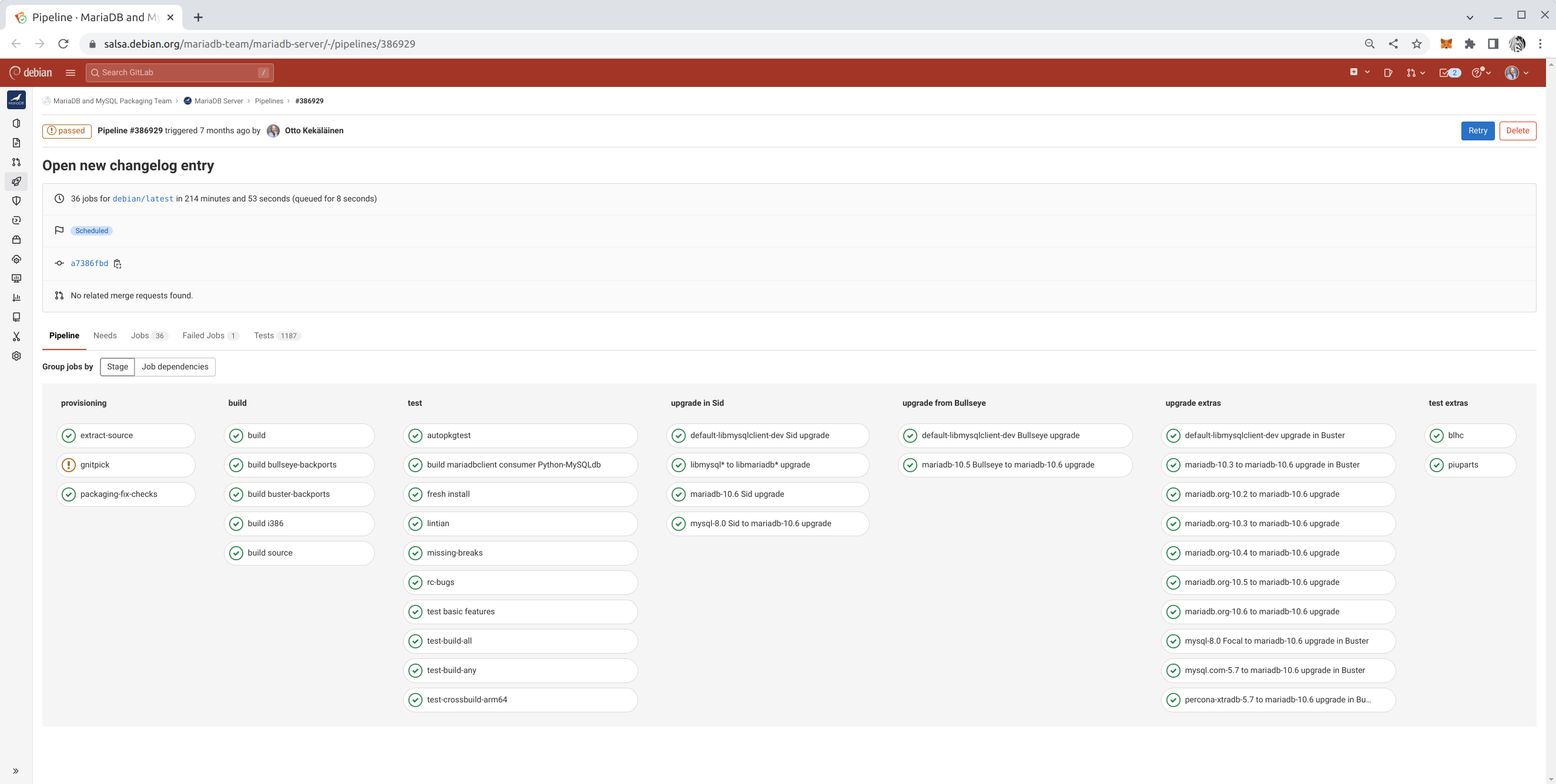
5. Integrate Salsa CI in all work One reason Debian remains popular, even 30 years after its inception, is due to its culture of maintaining high standards. For a newcomer, learning all the quality assurance tools such as Lintian, Piuparts, Adequate, various build variations, and reproducible builds may be overwhelming. However, these tasks are easier to manage thanks to Salsa CI, the continuous integration pipeline in Debian that runs tests on every commit at salsa.debian.org. The earlier you activate Salsa CI in the package repository you are working on, the faster you will achieve high quality in your package with fewer missteps. You can also further customize a package specific salsa-ci.yml to have more testing coverage. Example Salsa CI pipeline with customizations

6. Fork on Salsa and use draft Merge Requests to solicit feedback All modern Debian packages are hosted on salsa.debian.org. If you want to make a change to any package, it is easy to fork, make an initial attempt at the change, and publish it as a draft Merge Request (MR) on Salsa to solicit feedback. People might have surprising reasons to object to the change you propose, or they might need time to get used to the idea before agreeing to it. Also, some people might object to a vague idea out of suspicion but agree once they see the exact implementation. There may also be a surprising number of people supporting your idea, and if there is an MR, they have a place to show their support at. Don t expect every Merge Request to be accepted. However, proposing an idea as running code in an MR is far more effective than raising the idea on a mailing list or in a bug report. Get into the habit of publishing plenty of merge requests to solicit feedback and drive discussions toward consensus.

7. Use git rebase frequently Linear git history is much easier to read. The ease of reading git log and git blame output is vital in Debian, where packages often have updates from multiple people spanning many years even decades. Debian packagers likely spend more time than the average software developer reading git history. Make sure you master git commands such as gitk --all, git citool --amend, git commit -a --fixup <commit id>, git rebase -i --autosquash <target branch>, git cherry-pick <commit id 1> <id 2> <id 3>, and git pull --rebase. If rebasing is not done on your initiative, rest assured others will ask you to do it. Thus, if the commands above are familiar, rebasing will be quick and easy for you.

8. Reviews: give some, get some In open source, the larger a project becomes, the more it attracts contributions, and the bottleneck for its growth isn t how much code developers can create but how much code submissions can be properly reviewed. At the time of writing, the main Salsa group Debian has over 800 open merge requests pending reviews and approvals. Feel free to read and comment on any merge request you find. You don t have to be a subject matter expert to provide valuable feedback. Even if you don t have specific feedback, your comment as another human acknowledging that you read the MR and found no issues is viewed positively by the author. Besides, if you spend enough time reviewing MRs in a specific domain, you will eventually become an expert in it. Code reviews are not just about providing feedback to the submitter; they are also great learning opportunities for the reviewer. As a rule of thumb, you should review at least twice as many merge requests as you submit yourself.

9. Improve Debian by improving upstream It is common that while packaging software for Debian, bugs are uncovered and patched in Debian. Do not forget to submit the fixes upstream, and add a Forwarded field to the file in debian/patches! As the person building and packaging something in Debian, you automatically become an authority on that software, and the upstream is likely glad to receive your improvements. While submitting patches upstream is a bit of work initially, getting improvements merged upstream eventually saves time for everyone and makes packaging in Debian easier, as there will be fewer patches to maintain with each new upstream release.

10. Don t hold any habits too firmly Last but not least: Once people learn a specific way of working, they tend to stick to it for decades. Learning how to create and maintain Debian packages requires significant effort, and people tend to stop learning once they feel they ve reached a sufficient level. This tendency to get stuck in a local optimum is understandable and natural, but try to resist it. It is likely that better techniques will evolve over time, so stay humble and re-evaluate your beliefs and practices every few years. Mastering these habits takes time, but each small step brings you closer to making a meaningful impact on Debian. By staying curious, collaborative, and adaptable, you can ensure your contributions stand the test of time just like Debian itself. Good luck on your journey toward becoming a Debian Maintainer!

25 January 2025

Steve Kemp: The CP/M emulator now works better!

I keep saying I'm "done" with my CP/M emulator, but then I keep overhauling it in significant ways. Today is no exception. In the past the emulator used breakpoints to detect when calls to the system BIOS, or BDOS, were made. That was possible because the BIOS and BDOS entry points are at predictable locations. For example a well-behaved program might make a system call with code like this:
    LD A,42
    LD C,4
    CALL 0x0005
So setting a breakpoint on 0x0005 would let you detect a system-call was being made, inspect the registers to see which system-call was being made and then carry out the appropriate action in your emulator before returning control back to the program. Unfortunately some binaries patch the RAM, changing the contents of the entry points, or changing internal jump-tables, etc. The end result is that sometimes code running at the fixed addresses is not your BIOS at all, but something else. By trapping/faulting/catching execution here you break things, badly. So today's new release fixes that! No more breakpoints. Instead we deploy a "real BDOS" in RAM that will route system-calls to our host emulator via a clever trick. For BDOS functions the C-register will contain the system call to operate, our complete BDOS implementation is:
    OUT (C),C
    RET
The host program can catch writes to output ports, and will know that "OUT (3), 3" means "Invoke system call #3", for example. This means binary patches to entry-points, or any internal jump-tables won't confuse things and so long as control eventually reaches my BIOS or BDOS code areas things will work. I also added a new console-input driver, since I have a notion of pluggable input and output devices, which just reads input from a file. Now I can prove that my code works. Pass the following file to the input-driver and we have automated testing:
A:
ERA HELLO.COM
ERA HELLO.HEX
ERA HELLO.PRN
hello
ASM HELLO
LOAD HELLO
DDT HELLO.com
t
t
t
t
t
t
t
t
t
C-c
EXIT
Here we: I can test the output and confirm there are no regressions. Neat. Anyway new release, today. Happy.

21 January 2025

Ravi Dwivedi: The Arduous Luxembourg Visa Process

In 2024, I was sponsored by The Document Foundation (TDF) to attend the LibreOffice annual conference in Luxembourg from the 10th to the 12th of October. Being an Indian passport holder, I needed a visa to visit Luxembourg. However, due to my Kenya trip coming up in September, I ran into a dilemma: whether to apply before or after the Kenya trip. To obtain a visa, I needed to submit my application with VFS Global (and not with the Luxembourg embassy directly). Therefore, I checked the VFS website for information on processing time, which says:
As a rule, the processing time of an admissible Schengen visa application should not exceed 15 calendar days (from the date the application is received at the Embassy).
It also mentions:
If the application is received less than 15 calendar days before the intended travel date, the Embassy can deem your application inadmissible. If so, your visa application will not be processed by the Embassy and the application will be sent back to VFS along with the passport.
If I applied for the Luxembourg visa before my trip, I would run the risk of not getting my passport back in time, and therefore missing my Kenya flight. On the other hand, if I waited until after returning from Kenya, I would run afoul of the aforementioned 15 working days needed by the embassy to process my application. I had previously applied for a Schengen visa for Austria, which was completed in 7 working days. My friends who had been to France told me they got their visa decision within a week. So, I compared Luxembourg s application numbers with those of other Schengen countries. In 2023, Luxembourg received 3,090 applications from India, while Austria received 39,558, Italy received 52,332 and France received 176,237. Since Luxembourg receives a far fewer number of applications, I expected the process to be quick. Therefore, I submitted my visa application with VFS Global in Delhi on the 5th of August, giving the embassy a month with 18 working days before my Kenya trip. However, I didn t mention my Kenya trip in the Luxembourg visa application. For reference, here is a list of documents I submitted: I submitted flight reservations instead of flight tickets . It is because, in case of visa rejection, I would have lost a significant amount of money if I booked confirmed flight tickets. The embassy also recommends the same. After the submission of documents, my fingerprints were taken. The expenses for the visa application were as follows:
Service Description Amount (INR)
Visa Fee 8,114
VFS Global Fee 1,763
Courier 800
Total 10,677
Going by the emails sent by VFS, my application reached the Luxembourg embassy the next day. Fast-forward to the 27th of August 14th day of my visa application. I had already booked my flight ticket to Nairobi for the 4th of September, but my passport was still with the Luxembourg embassy, and I hadn t heard back. In addition, I also obtained Kenya s eTA and got vaccinated for Yellow Fever, a requirement to travel to Kenya. In order to check on my application status, I gave the embassy a phone call, but missed their calling window, which was easy to miss since it was only 1 hour - 12:00 to 1:00 PM. So, I dropped them an email explaining my situation. At this point, I was already wondering whether to cancel the Kenya trip or the Luxembourg one, if I had to choose. After not getting a response to my email, I called them again the next day. The embassy told me they would look into it and asked me to send my flight tickets over email. One week to go before my flight now. I followed up with the embassy on the 30th by a phone call, and the person who picked up the call told me that my request had already been forwarded to the concerned department and is under process. They asked me to follow up on Monday, 2nd September. During the visa process, I was in touch with three other Indian attendees.1 In the meantime, I got to know that all of them had applied for a Luxembourg visa by the end of the month of August. Back to our story, over the next two days, the embassy closed for the weekend. I began weighing my options. On one hand, I could cancel the Kenya trip and hope that Luxembourg goes through. Even then, Luxembourg wasn t guaranteed as the visa could get rejected, so I might have ended up missing both the trips. On the other hand, I could cancel the Luxembourg visa application and at least be sure of going to Kenya. However, I thought it would make Luxembourg very unlikely because it didn t leave 15 working days for the embassy to process my visa after returning from Kenya. I also badly wanted to attend the LibreOffice conference because I couldn t make it two years ago. Therefore, I chose not to cancel my Luxembourg visa application. I checked with my travel agent and learned that I could cancel my Nairobi flight before September 4th for a cancelation fee of approximately 7,000 INR. On the 2nd of September, I was a bit frustrated because I hadn t heard anything from the embassy regarding my request. Therefore, I called the embassy again. They assured me that they would arrange a call for me from the concerned department that day, which I did receive later that evening. During the call, they offered to return my passport via VFS the next day and asked me to resubmit it after returning from Kenya. I immediately accepted the offer and was overjoyed, as it would enable me to take my flight to Nairobi without canceling my Luxembourg visa application. However, I didn t have the offer in writing, so it wasn t clear to me how I would collect my passport from VFS. The next day, I would receive it when I would be on my way to VFS in the form of an email from the embassy which read:
Dear Mr. Dwivedi, We acknowledge the receipt of your email. As you requested, we are returning your passport exceptionally through VFS, you can collect it directly from VFS Delhi Center between 14:00-17:00 hrs, 03 Sep 2024. Kindly bring the printout of this email along with your VFS deposit receipt and Original ID proof. Once you are back from your trip, you can redeposit the passport with VFS Luxembourg for our processing. With best regards,
Consular Section GRAND DUCHY OF LUXEMBOURG
Embassy in New Delhi
I took a printout of the email and submitted it to VFS to get my passport. This seemed like a miracle - just when I lost all hope of making it to my Kenya flight and was mentally preparing myself to miss it, I got my passport back exceptionally and now I had to mentally prepare again for Kenya. I had never heard of an embassy returning passport before completing the visa process before. The next day, I took my flight to Nairobi as planned. In case you are interested, I have written two blog posts on my Kenya trip - one on the OpenStreetMap conference in Nairobi and the other on my travel experience in Kenya. After returning from Kenya, I resubmitted my passport on the 17th of September. Fast-forward to the 25th of September; I didn t hear anything from the embassy about my application process. So, I checked with TDF to see whether the embassy reached out to them. They told me they confirmed my participation and my hotel booking to the visa authorities on the 19th of September (6 days ago). I was wondering what was taking so long after the verification. On the 1st of October, I received a phone call from the Luxembourg embassy, which turned out to be a surprise interview. They asked me about my work, my income, how I came to know about the conference, whether I had been to Europe before, etc. The call lasted around 10 minutes. At this point, my travel date - 8th of October - was just two working days away as the 2nd of October was off due to Gandhi Jayanti and 5th and 6th October were weekends, leaving only the 3rd and the 4th. I am not sure why the embassy saved this for the last moment, even though I submitted my application 2 months ago. I also got to know that one of the other Indian attendees missed the call due to being in their college lab, where he was not allowed to take phone calls. Therefore, I recommend that the embassy agree on a time slot for the interview call beforehand. Visa decisions for all the above-mentioned Indian attendees were sent by the embassy on the 4th of October, and I received mine on the 5th. For my travel date of 8th October, this was literally the last moment the embassy could send my visa. The parcel contained my passport and a letter. The visa was attached to a page in the passport. I was happy that my visa had been approved. However, the timing made my task challenging. The enclosed letter stated:
Subject: Your Visa Application for Luxembourg
Dear Applicant, We would like to inform you that a Schengen visa has been granted for the 8-day duration from 08/10/2024 to 30/10/2024 for conference purposes in Luxembourg. You are requested to report back to the Embassy of Luxembourg in New Delhi through an email (email address redacted) after your return with the following documents:
  • Immigration Stamps (Entry and Exit of Schengen Area)
  • Restaurant Bills
  • Shopping/Hotel/Accommodation bills
Failure to report to the Embassy after your return will be taken into consideration for any further visa applications.
I understand the embassy wanting to ensure my entry and exit from the Schengen area during the visa validity period, but found the demand for sending shopping bills excessive. Further, not everyone was as lucky as I was as it took a couple of days for one of the Indian attendees to receive their visa, delaying their plan. Another attendee had to send their father to the VFS center to collect their visa in time, rather than wait for the courier to arrive at their home. Foreign travel is complicated, especially for the citizens of countries whose passports and currencies are weak. Embassies issuing visas a day before the travel date doesn t help. For starters, a last-minute visa does not give enough time for obtaining a forex card as banks ask for the visa. Further, getting foreign currency (Euros in our case) in cash with a good exchange rate becomes difficult. As an example, for the Kenya trip, I had to get US Dollars at the airport due to the plan being finalized at the last moment, worsening the exchange rate. Back to the current case, the flight prices went up significantly compared to September, almost doubling. The choice of airlines also got narrowed, as most of the flights got booked by the time I received my visa. With all that said, I think it was still better than an arbitrary rejection. Credits: Contrapunctus, Badri, Fletcher, Benson, and Anirudh for helping with the draft of this post.

  1. Thanks to Sophie, our point of contact for the conference, for putting me in touch with them.

20 January 2025

Jonathan Dowland: dsafilter 20th Anniversary

Happy 20th birthday, dsafilter! dsafilter is a mail filter I wrote two decades ago to solve a problem I had: I was dutifully subscribed to debian-security-announce to learn of new security package updates, but most were not relevant to me. The filter creates a new, summarizing mail, reporting on whether the DSA was applicable to any package installed on the system running the filter, and attached the original DSA mail for reference. Users can then choose to drop mails for packages that aren't relevant. In 2005 I'd been a Debian user for about 6 years, I'd met a few Debian developers in person and I was interested in getting involved. I started my journey to Developer later that same year. I published dsafilter, and I think I sent an announcement to debian-devel, but didn't do a great deal to socialise it, so I suspect nobody else is using it. That said, I have been for the two decades, and I still am! What's notable to me about that is that I haven't had to modify the script at all to keep up with software changes, in particular, from the interpreter. I wrote it as a Ruby script. If I had chosen Perl, it would probably be the same story, but if I'd chosen Python, there's no chance at all that it would still be working today. If it sounds interesting to you, please give it a try. I think it might be due some spring cleaning.

18 January 2025

Dominique Dumont: How we solved storage API throttling on our Azure Kubernetes clusters

Hi This issue was quite puzzling, so I m sharing how we investigated this issue. I hope it can be useful for you. My client informed me that he was no longer able to install new instances of his application. k9s showed that only some pods could not be created, only the ones that created physical volume (PV). The description of these pods showed a HTTP error 429 when creating pods: New PVC could not be created because we were throttled by Azure storage API. This issue was confirmed by Azure diagnostic console on Kubernetes ( menu Diagnose and solve problems Cluster and Control Plane Availability and Performance Azure Resource Request Throttling ). We had a lot of throttling:
2025-01-18_11-01-k8s-throttles.png
Which were explained by the high call rate:
2025-01-18_11-01-k8s-calls.png
The first clue was found at the bottom of Azure diagnostic page:
2025-01-18_11-27-throttles-by-user-agent.png
According, to this page, throttling is done by services whose user agent is:
Go/go1.23.1 (amd64-linux) go-autorest/v14.2.1 Azure-SDK-For-Go/v68.0.0
storage/2021-09-01microsoft.com/aks-operat azsdk-go-armcompute/v1.0.0 (go1.22.3; linux)
The main information is Azure-SDK-For-Go, which means the program making all these calls to storage API is written in Go. All our services are written in Typescript or Rust, so they are not suspect. That leaves controllers running in kube-systems namespace. I could not find anything suspects in the logs of these services. At that point I was convinced that a component in Kubernetes control plane was making all those calls. Unfortunately, AKS is managed by Microsoft and I don t have access to the control plane logs. However, we re realized that we had quite a lot of volumesnapshots that are created in our clusters using k8s-scheduled-volume-snapshotter: We suspected that kubernetes reconciliation loop is throttled when checking the status of all these snapshots. May be so, but we also had the same issues and throttle rates on preprod and prod were the number of snapshots were quite different. We tried to get more information using Azure console on our snapshot account, but it was also broken by the throttling issue. We were so puzzled that we decided to try L odagan s advice (tout cr mer pour repartir sur des bases saines, loosely translated as burn everything down to start from scratch ) and we destroyed piece by piece our dev cluster while checking if the throttling stopped. First, we removed all our applications, no change. Then, all ancillary components like rabbitmq, cert-manager were removed, no change. Then, we tried remove the namespace containing our applications. But, we faced another issue: Kubernetes was unable to remove the namespace because it could not destroy some PVC and volumesnapshots. That was actually good news, because it meant that we were close to the actual issue. We managed to destroy the PVC and volumesnapshots by removing their finalizers. Finalizers are some kind of markers that tell kubernetes that something needs to be done before actually deleting a resource. The finalizers were removed with a command like:
kubectl patch volumesnapshots $ volumesnapshot  \
  -p ' \"metadata\": \"finalizers\":null '  --type merge
Then, we got the first progress : the throttling and high call rate stopped on our dev cluster. To make sure that the snapshots were the issue, we re-installed the ancillary components and our applications. Everything was copacetic. So, the problem was indeed with PVC and snapshots. Even though we have backups outside of Azure, we weren t really thrilled at trying L odagan s method on our prod cluster So we looked for a better fix to try on our preprod cluster. Poking around in PVC and volumesnapshots, I finally found this error message in the description on a volumesnapshotcontents:
Code="ShareSnapshotCountExceeded" Message="The total number of snapshots
for the share is over the limit."
The number of snapshots found in our cluster was not that high. So I wanted to check the snapshots present in our storage account using Azure console, which was still broken. Fortunately, Azure CLI is able to retry HTTP calls when getting 429 errors. I managed to get a list of snapshots with
az storage share list --account-name [redacted] --include-snapshots \
      tee preprod-list.json
There, I found a lot of snapshots dating back from 2024. These were no longer managed by Kubernetes and should have been cleaned up. That was our smoking gun. I guess that we had a chain of events like: To make things worse, k8s-scheduled-volume-snapshotter creates new snapshots when it cannot list the old ones. So we had 4 new snapshots per day instead of one. Since we had the chain of events, fixing the issue was not too difficult (but quite long ):
  1. stop k8s-scheduled-volume-snapshotter by disabling its cron job
  2. delete all volumesnapshots and volume snapshots contents from k8s.
  3. since Azure API was throttled, we also had to remove their finalizers
  4. delete all snapshots from azure using az command and a Perl script (this step took several hours)
  5. re-enable k8s-scheduled-volume-snapshotter
After these steps, preprod was back to normal. I m now applying the same recipe on prod. We still don t know why we had all these stale snapshots. It may have been a human error or a bug in k8s-scheduled-volume-snapshotter. Anyway, to avoid this problem is the future, we will: My name is Dominique Dumont, I m a devops freelance. You can find the devops and audit services I propose on my website or reach out to me on LinkedIn. All the best

17 January 2025

C.J. Collier: Security concerns regarding OpenSSH mac sha1 in Debian

What is HMAC? HMAC stands for Hash-Based Message Authentication Code. It s a specific way to use a cryptographic hash function (like SHA-1, SHA-256, etc.) along with a secret key to produce a unique fingerprint of some data. This fingerprint allows someone else with the same key to verify that the data hasn t been tampered with. How HMAC Works Keyed Hashing: The core idea is to incorporate the secret key into the hashing process. This is done in a specific way to prevent clever attacks that might try to bypass the security.
Inner and Outer Hashing: HMAC uses two rounds of hashing. First, the message and a modified version of the key are hashed together. Then, the result of that hash, along with another modified version of the key, are hashed again. This two-step process adds an extra layer of protection. HMAC in OpenSSH OpenSSH uses HMAC to ensure the integrity of messages sent back and forth during an SSH session. This prevents an attacker from subtly modifying data in transit. HMAC-SHA1 with OpenSSH: Is it Weak? SHA-1 itself is considered cryptographically broken. This means that with enough computing power, it s possible to find collisions (two different messages that produce the same hash). However, HMAC-SHA1 is generally still considered secure for most purposes. This is because exploiting weaknesses in SHA-1 to break HMAC-SHA1 is much more difficult than just finding collisions in SHA-1. Should you use it? While HMAC-SHA1 might still be okay for now, it s best practice to move to stronger alternatives like HMAC-SHA256 or HMAC-SHA512. OpenSSH supports these, and they provide a greater margin of safety against future attacks. In Summary HMAC is a powerful tool for ensuring data integrity. Even though SHA-1 has weaknesses, HMAC-SHA1 in OpenSSH is likely still safe for most users. However, to be on the safe side and prepare for the future, switching to HMAC-SHA256 or HMAC-SHA512 is recommended. Following are instructions for creating dataproc clusters with sha1 mac support removed: I can appreciate an excess of caution, and I can offer you some code to produce Dataproc instances which do not allow HMAC authentication using sha1. Place code similar to this in a startup script or an initialization action that you reference when creating a cluster with gcloud dataproc clusters create:
#!/bin/bash
# remove mac specification from sshd configuration
sed -i -e 's/^macs.*$//' /etc/ssh/sshd_config
# place a new mac specification at the end of the service configuration
ssh -Q mac   perl -e \
  '@mac=grep  chomp; ! /sha1/  ; print("macs ", join(",",@mac), $/)' >> /etc/ssh/sshd_config
# reload the new ssh service configuration
systemctl reload ssh.service
If this code is hosted on GCS, you can refer to it with
--initialization-actions=CLOUD_STORAGE_URI,[...]
or
--metadata startup-script-url=CLOUD_STORAGE_URI,[...]

Russell Coker: Systemd Hardening and Sending Mail

A feature of systemd is the ability to reduce the access that daemons have to the system. The restrictions include access to certain directories, system calls, capabilities, and more. The systemd.exec(5) man page describes them all [1]. To see an overview of the security of daemons run systemd-analyze security and to get details of one particular daemon run a command like systemd-analyze security mon.service . I created a Debian wiki page for a systemd-analyze security goal [2]. At this time release goals aren t a serious thing for Debian so this won t result in release critical bug reports, but it is still something we can aim for. For a simple daemon (EG BIND, dhcpd, and syslogd) this isn t difficult to do. It might be difficult to understand the implications of some changes (especially when restricting system calls) but you can do some quick tests. The functionality of such programs has a limited scope and once you get it basically working it s done. For some daemons it s harder. Network-Manager is one of the well known slightly more difficult cases as it could do things like starting a VPN connection. The larger scope and the use of plugins makes it difficult to test the combinations. The systemd restrictions apply to child processes too unlike restrictions by SE Linux and AppArmor which permit a child process to run in a different security context. The messages when a daemon fails due to systemd restrictions are usually unclear which makes things harder to setup and makes it more important to get it right. My mon package (which I forked upstream as etbe-mon [3] is one of the difficult daemons as local test can involve probing large parts of the system. But I have got that working reasonably well for most cases. I have a bug report about running mon with Exim [4]. The problem with this is that Exim has a single process model which means that the process doing local delivery can be a child of the process that initially received the message. So the main mon process needs all the access for delivering mail (writing to /home etc). This also means that every other child of mon will get such access including programs that receive untrusted data from the Internet. Most of the extra access needed by Exim is not a problem, but /home access is a potential risk. It also means that more effort is needed when reviewing the access control. The problem with this Exim design is that it applies to many daemons. Every daemon that sends email or that potentially could send email in some configuration needs extra access to be granted. Can Exim be configured to have it s sendmail -T type operation just write a file in a spool directory for another program to process? Do we need to grant permissions to most of the system just for Exim?

14 January 2025

Louis-Philippe V ronneau: Montreal Subway Foot Traffic Data, 2024 edition

Another year of data from Soci t de Transport de Montr al, Montreal's transit agency! A few highlights this year:
  1. The closure of the Saint-Michel station had a drastic impact on D'Iberville, the station closest to it.
  2. The opening of the Royalmount shopping center nearly doubled the traffic of the De La Savane station.
  3. The Montreal subway continues to grow, but has not yet recovered from the pandemic. Berri-UQAM station (the largest one) is still below 1 million entries per quarter compared to its pre-pandemic record.
By clicking on a subway station, you'll be redirected to a graph of the station's foot traffic. Licences

13 January 2025

Freexian Collaborators: Monthly report about Debian Long Term Support, December 2024 (by Roberto C. S nchez)

Like each month, have a look at the work funded by Freexian s Debian LTS offering.

Debian LTS contributors In December, 19 contributors have been paid to work on Debian LTS, their reports are available:
  • Abhijith PA did 14.0h (out of 14.0h assigned).
  • Adrian Bunk did 47.75h (out of 53.0h assigned and 47.0h from previous period), thus carrying over 52.25h to the next month.
  • Andrej Shadura did 6.0h (out of 17.0h assigned and -7.0h from previous period after hours given back), thus carrying over 4.0h to the next month.
  • Bastien Roucari s did 22.0h (out of 22.0h assigned).
  • Ben Hutchings did 15.0h (out of 0.0h assigned and 18.0h from previous period), thus carrying over 3.0h to the next month.
  • Chris Lamb did 18.0h (out of 18.0h assigned).
  • Daniel Leidert did 23.0h (out of 17.0h assigned and 9.0h from previous period), thus carrying over 3.0h to the next month.
  • Emilio Pozuelo Monfort did 32.25h (out of 40.5h assigned and 19.5h from previous period), thus carrying over 27.75h to the next month.
  • Guilhem Moulin did 22.5h (out of 9.75h assigned and 12.75h from previous period).
  • Jochen Sprickerhof did 2.0h (out of 3.5h assigned and 6.5h from previous period), thus carrying over 8.0h to the next month.
  • Lee Garrett did 8.5h (out of 14.75h assigned and 45.25h from previous period), thus carrying over 51.5h to the next month.
  • Lucas Kanashiro did 32.0h (out of 10.0h assigned and 54.0h from previous period), thus carrying over 32.0h to the next month.
  • Markus Koschany did 40.0h (out of 20.0h assigned and 20.0h from previous period).
  • Roberto C. S nchez did 13.5h (out of 6.75h assigned and 17.25h from previous period), thus carrying over 10.5h to the next month.
  • Santiago Ruano Rinc n did 18.75h (out of 24.75h assigned and 0.25h from previous period), thus carrying over 6.25h to the next month.
  • Sean Whitton did 6.0h (out of 2.0h assigned and 4.0h from previous period).
  • Sylvain Beucler did 10.5h (out of 21.5h assigned and 38.5h from previous period), thus carrying over 49.5h to the next month.
  • Thorsten Alteholz did 11.0h (out of 11.0h assigned).
  • Tobias Frost did 12.0h (out of 12.0h assigned).

Evolution of the situation In December, we have released 29 DLAs. The LTS Team has published updates to several notable packages. Contributor Guilhem Moulin published an update of php7.4, a widely-used open source general purpose scripting language, which addressed denial of service, authorization bypass, and information disclosure vulnerabilities. Contributor Lucas Kanashiro published an update of clamav, an antivirus toolkit for Unix and Linux, which addressed denial of service and authorization bypass vulnerabilities. Finally, contributor Tobias Frost published an update of intel-microcode, the microcode for Intel microprocessors, which well help to ensure that processor hardware is protected against several local privilege escalation and local denial of service vulnerabilities. Beyond our customary LTS package updates, the LTS Team has made contributions to Debian s stable bookworm release and its experimental section. Notably, contributor Lee Garrett published a stable update of dnsmasq. The LTS update was previously published in November and in December Lee continued working to bring the same fixes (addressing the high profile KeyTrap and NSEC3 vulnerabilities) to the dnsmasq package in Debian bookworm. This package was accepted for inclusion in the Debian 12.9 point release scheduled for January 2025. Addititionally, contributor Sean Whitton provided assistance, via upload sponsorships, to the Debian maintainers of xen. This assistance resulted in two uploads of xen into Debian s experimental section, which will contribute to the next Debian stable release having a version of xen with better longterm support from the upstream development team.

Thanks to our sponsors Sponsors that joined recently are in bold.

12 January 2025

Dirk Eddelbuettel: Rcpp 1.0.14 on CRAN: Regular Semi-Annual Update

rcpp logo The Rcpp Core Team is once again thrilled, pleased, and chuffed (am I doing this right for LinkedIn?) to announce a new release (now at 1.0.14) of the Rcpp package. It arrived on CRAN earlier today, and has since been uploaded to Debian. Windows and macOS builds should appear at CRAN in the next few days, as will builds in different Linux distribution and of course r2u should catch up tomorrow too. The release was only uploaded yesterday, and as always get flagged because of the grandfathered .Call(symbol) as well as for the url to the Rcpp book (which has remained unchanged for years) failing . My email reply was promptly dealt with under European morning hours and by the time I got up the submission was in state waiting over a single reverse-dependency failure which is also spurious, appears on some systems and not others, and also not new. Imagine that: nearly 3000 reverse dependencies and only one (spurious) change to worse. Solid testing seems to help. My thanks as always to the CRAN for responding promptly. This release continues with the six-months January-July cycle started with release 1.0.5 in July 2020. This time we also need a one-off hotfix release 1.0.13-1: we had (accidentally) conditioned an upcoming R change on 4.5.0, but it already came with 4.4.2 so we needed to adjust our code. As a reminder, we do of course make interim snapshot dev or rc releases available via the Rcpp drat repo as well as the r-universe page and repo and strongly encourage their use and testing I run my systems with these versions which tend to work just as well, and are also fully tested against all reverse-dependencies. Rcpp has long established itself as the most popular way of enhancing R with C or C++ code. Right now, 2977 packages on CRAN depend on Rcpp for making analytical code go faster and further. On CRAN, 13.6% of all packages depend (directly) on Rcpp, and 60.8% of all compiled packages do. From the cloud mirror of CRAN (which is but a subset of all CRAN downloads), Rcpp has been downloaded 93.7 million times. The two published papers (also included in the package as preprint vignettes) have, respectively, 1947 (JSS, 2011) and 354 (TAS, 2018) citations, while the the book (Springer useR!, 2013) has another 676. This release is primarily incremental as usual, generally preserving existing capabilities faithfully while smoothing our corners and / or extending slightly, sometimes in response to changing and tightened demands from CRAN or R standards. The move towards a more standardized approach for the C API of R once again to a few changes; Kevin did once again did most of these PRs. Other contributed PRs include G bor permitting builds on yet another BSD variant, Simon Guest correcting sourceCpp() to work on read-only files, Marco Colombo correcting a (surprisingly large) number of vignette typos, I aki rebuilding some documentation files that tickled (false) alerts, and I took care of a number of other maintenance items along the way. The full list below details all changes, their respective PRs and, if applicable, issue tickets. Big thanks from all of us to all contributors!

Changes in Rcpp release version 1.0.14 (2025-01-11)
  • Changes in Rcpp API:
    • Support for user-defined databases has been removed (Kevin in #1314 fixing #1313)
    • The SET_TYPEOF function and macro is no longer used (Kevin in #1315 fixing #1312)
    • An errorneous cast to int affecting large return object has been removed (Dirk in #1335 fixing #1334)
    • Compilation on DragonFlyBSD is now supported (G bor Cs rdi in #1338)
    • Use read-only VECTOR_PTR and STRING_PTR only with with R 4.5.0 or later (Kevin in #1342 fixing #1341)
  • Changes in Rcpp Attributes:
    • The sourceCpp() function can now handle input files with read-only modes (Simon Guest in #1346 fixing #1345)
  • Changes in Rcpp Deployment:
    • One unit tests for arm64 macOS has been adjusted; a macOS continuous integration runner was added (Dirk in #1324)
    • Authors@R is now used in DESCRIPTION as mandated by CRAN, the Rcpp.package.skeleton() function also creates it (Dirk in #1325 and #1327)
    • A single datetime format test has been adjusted to match a change in R-devel (Dirk in #1348 fixing #1347)
  • Changes in Rcpp Documentation:
    • The Rcpp Modules vignette was extended slightly following #1322 (Dirk)
    • Pdf vignettes have been regenerated under Ghostscript 10.03.1 to avoid a false positive by a Windows virus scanner (I aki in #1331)
    • A (large) number of (old) typos have been corrected in the vignettes (Marco Colombo in #1344)

Thanks to my CRANberries, you can also look at a diff to the previous release Questions, comments etc should go to the rcpp-devel mailing list off the R-Forge page. Bugs reports are welcome at the GitHub issue tracker as well (where one can also search among open or closed issues).

This post by Dirk Eddelbuettel originated on his Thinking inside the box blog. If you like this or other open-source work I do, you can sponsor me at GitHub.

Next.

Previous.