Search Results: "dpk"

6 July 2012

Christian Perrier: Debcamp work

It's still good to be at Debcamp before DebConf and I'm not running all day long, contrary to what you might think by reading my posts. Of course, I'm always busy with "social-like" activities such as doing my best for us to have a good Cheese and Wine Party as, now that I'm trapped into it, people expect it to be better and better each year. Or to revive the traditional Assassins game. But Debian is not only about killing cheese with socks and I try to also achieve a few things while being here. As of now, I can already count a few things: The only thing I nearly haven't worked on yet is....the talk I have on Sunday and that is supposed to explain newcomers how to join the crowd of localization fanatics. Oh, and I'm still jetlagged and go to bed daily at 10pm...:-)

2 July 2012

Raphaël Hertzog: My Debian Activities in June 2012

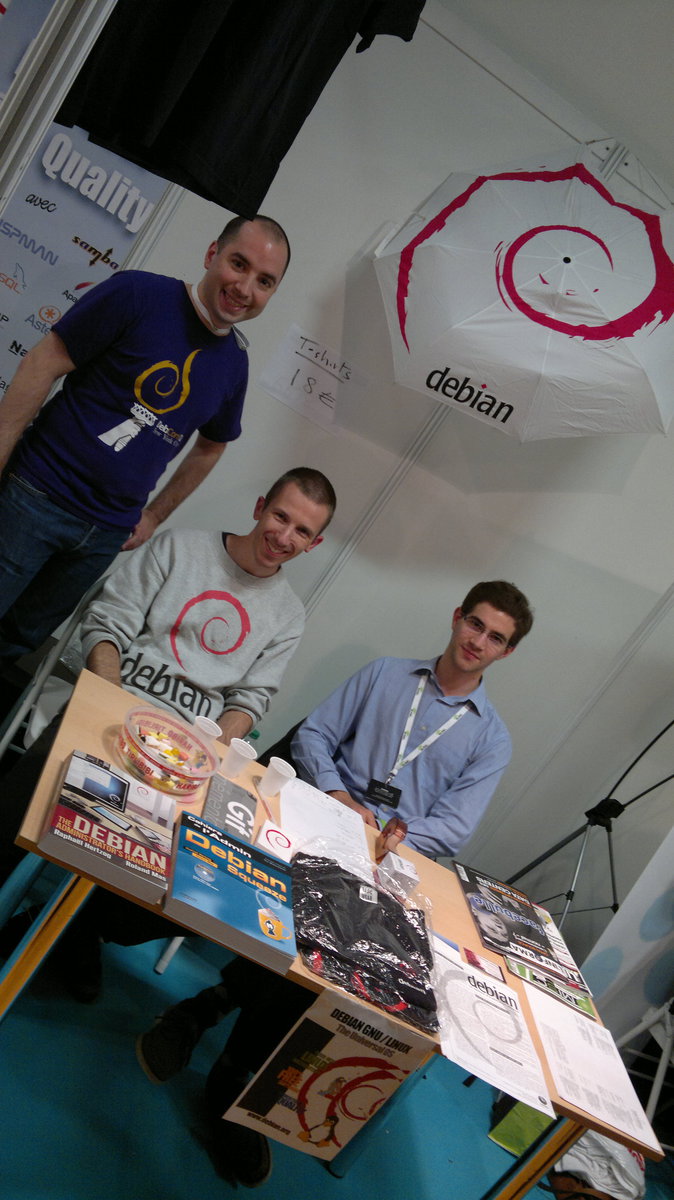
This is my monthly summary of my Debian related activities. If you re among the people who made a donation to support my work (168.12 , thanks everybody!), then you can learn how I spent your money. Otherwise it s just an interesting status update on my various projects. Dpkg This month, I resumed my work on dpkg. I concentrated my efforts on some polishing of the 3.0 (quilt) format. With the latest version (1.16.6 which was uploaded to unstable shortly before the freeze), dpkg-source restores the source tree in a clean state after a failed patch application (#652970), doesn t overwrite the patch header from the pre-existing automatic patch, updates automatically debian/source/include-binaries during dpkg-source commit, and supports a new no-unapply-patches option for those who dislike the auto-unapplication at the end of the process when the patches were not applied at the start. I wanted to go further and offer a new feature that could insert the automatic patch at the bottom of the quilt series but I have been short on time to complete this feature. I just managed to factorize all the quilt handling in a dedicated Perl module (Dpkg::Source::Quilt) to have cleaner code in the module handling the source format (Dpkg::Source::Package::V3::quilt). For those who wonder, this feature is meant primarily for the X Strike Force team which maintains packages in Git and are doings lots of upstream cherry-picks (to fix regressions, etc.). But they also use quilt on top of that tree to keep some lasting Debian specific changes. With the 1.0 format, the automatic diff is a bit messy but at least it gets smaller automatically when a new upstream release gets out, there s nothing to clean out. I d like them to be able to use 3.0 (quilt) while keeping their workflow. I m leaning towards allowing --auto-commit=first:cherry-picks that would name the automatic patch cherry-picks and put it in the first position in the quilt series. (Opinions welcome on that feature, BTW) Packaging There s been quite some packaging in this last month before the freeze: While doing all this packaging work, I found 2 possible improvements that I filed as bug reports: Debian France Booth at Solutions Linux From June 19th to June 21th, I manned the Debian France booth at Solutions Linux together with Carl Chenet, Tanguy Ortolo and other members of the association. We answered lots of questions, sold all t-shirts and umbrellas that Carl imported from Germany and Switzerland (we really need to get our own merchandising stuff produced in France!), got people to join the association. We also presented a printed copy of the Debian Administrator s Handbook and of the corresponding French book. You can see Carl, me and Tanguy on this picture (click on it to see a bigger picture, thanks to S bastien Dubois of Evolix for this one!):
I know lots of people are preparing for Debconf but I decided to not attend this year, the price of the air plane ticket was a bit too hefty for me and it was also in partial conflict with our family vacations. I thought about attending the Libre Software Meeting instead but alas I won t go there either (but Roland Mas will be there!), I have too much work to complete before my own vacation in 2 weeks. Thanks See you next month for a new summary of my activities.

2 comments Liked this article? Click here. My blog is Flattr-enabled.

Thibaut Girka: apt-get install gcc-4.7-arm-linux-gnueabihf

Hi! As you may know, I'm working on multiarch cross-toolchains as part of the Google summer of Code (see my previous post for details), and although there is still a lot to do, the project is doing fairly well, and a cross-gcc is already installable and working. I'll proceed with detailed instructions on how to install the cross-compiler, along with some explanations on multiarch itself, and how to build cross-toolchains from source. Prerequisites First, you need specific versions apt (>= 0.9.6) and dpkg (>= 1.16.5).
This is because the cross-toolchains packages I'm working on depend on specific cross-arch dependencies, such as libc6:armhf. Support for such dependencies has been added in the aforementioned versions of apt and dpkg. This means you should be running unstable, or at least use dpkg from unstable. Adding a foreign architecture Adding a foreign architecture is straightforward, but I've seen users do overcomplicated, or just plain wrong things. So, let's do this step by step (well, there are only two of them), with some explanations.
  1. Tell dpkg to handle an additional architecture by typing dpkg --add-architecture armhf. There isn't much to say. It will only add an architecture to the list of architectures dpkg would accept to handle.
  2. Update APT's database. You need to run apt-get update after adding or removing an architecture to get package lists for all wanted architectures and rebuild APT's database, including the implicit cross-arch dependencies/conflicts brought by multiarch.
And that's it for the common case. Now, a word on architecture restrictions: a common misconception about multiarch seems to be that you have to tell APT which architectures you want from the mirrors by modifying your sources.list file(s). This is not true, as, by default, APT gets the list of accepted architectures from dpkg, and gets the correct package lists from the mirrors configured in the sources.list. You only need to use arch restrictions ( deb [arch=arch1,arch2,...] ... ) when you want to get packages from a mirror only for a subset of your accepted architectures. This is very unlikely, and in the general you do not need to modify your sources.list, at all. Getting the cross-compilers from my repository I provide compiled versions of gcc-4.7-arm-linux-gnueabihf for i386 and amd64 in my repository. If you have followed the previous paragraphs, nothing should be easier than adding a deb http://emdebian.org/~thibg/repo/ sid main line to your sources.list and doing the following:
# apt-get update
[...]
# apt-get --no-install-recommends install gcc-4.7-arm-linux-gnueabihf
Reading package lists... Done
Building dependency tree       
Reading state information... Done
The following extra packages will be installed:
  binutils-arm-linux-gnueabihf cpp-4.7-arm-linux-gnueabihf gcc-4.7-arm-linux-gnueabihf-base gcc-4.7-base:armhf libc6:armhf libgcc1:armhf
  libgmp10 libgomp1:armhf libmpc2 libmpfr4
Suggested packages:
  binutils-doc gcc-4.7-locales libmudflap0-4.7-dev:armhf gcc-4.7-doc libgcc1-dbg:armhf libgomp1-dbg:armhf libitm1-dbg:armhf
  libquadmath-dbg:armhf libmudflap0-dbg:armhf binutils-gold glibc-doc:armhf locales:armhf
Recommended packages:
  libc6-dev:armhf
The following NEW packages will be installed:
  binutils-arm-linux-gnueabihf cpp-4.7-arm-linux-gnueabihf gcc-4.7-arm-linux-gnueabihf gcc-4.7-arm-linux-gnueabihf-base gcc-4.7-base:armhf
  libc6:armhf libgcc1:armhf libgmp10 libgomp1:armhf libmpc2 libmpfr4
0 upgraded, 11 newly installed, 0 to remove and 0 not upgraded.
Need to get 23.5 MB of archives.
After this operation, 57.2 MB of additional disk space will be used.
Do you want to continue [Y/n]?
I've disabled the recommends since, libc6-dev:armhf would recommend gcc:armhf itself, which is not co-installable with your native gcc if you have it installed. Building the cross-toolchain yourselves If you don't trust the repository above, or simply want to rebuild the toolchain yourself, it is rather simple: get my gcc-4.7 patches and:
$ apt-get source binutils
$ cd binutils-*/
$ TARGET=arm-linux-gnueabihf dpkg-buildpackage -uc -us -b
$ cd ../
# dpkg -i binutils*arm-linux-gnueabihf*.deb
$ apt-get source gcc-4.7
$ cd gcc-4.7/
$ for patch in path/to/the/patches/*.patch; do patch -p1 < $patch ; done
$ GCC_TARGET=armhf debian/rules control
$ GCC_TARGET=armhf dpkg-buildpackage -uc -us -b
Using the cross-compiler It's easy, but there is a trick, and dpkg-buildpackage -aarmhf won't work out of the box yet, as gcc-4.7-arm-linux-gnueabihf provides the arm-linux-gnueabihf-gcc-4.7 executable, but no arm-linux-gnueabihf-gcc symlink. So, for the moment:
$ cat > test.c << __EOF__
#include <stdio.h>
int main(void)
 
  printf("Hello world\\n");
  return 0;
 
__EOF__
$ arm-linux-gnueabihf-gcc-4.7 test.c
$ qemu-arm ./a.out 
Hello world
Conclusion The toolchain is not complete yet (there is some more work to do on binutils and libstdc++, and equivalents to the gcc , cpp , and build-essential packages to provide), but it should still be useful to cross-compile C programs. Multi-arch cross-toolchains for wheezy can definitely be hosted at emdebian, and I hope to clean up the build process so that it could get included in the archive for wheezy+1.

25 June 2012

Rapha&#235;l Hertzog: Test Driven Development with CppUTest, now in Debian

I have recently read Test Driven Development with Embedded C by James W. Grenning and published by Pragmatic Programmers. I really enjoyed the book: while I was aware of the huge benefits of having a comprehensive test suite, I never studied seriously the principles behind Test Driven Development (TDD) and this book makes a good introduction to the topic. At the same time it focuses on the C language and contains lots of examples on how you can create tests even for projects which have to interact with hardware or other unpredictable components (the key is to create many abstractions) using all the possibilities that C offers. The author convincingly argues that developing code with TDD forces you to create a modular design that is easier to evolve when the underlying requirements change. He also highlights how the tests serve as reference documentation of the API. James W. Grenning recommends CppUTest as his xUnit test framework of choice. When I wanted to try this test framework, I discovered that it was not available in Debian. I decided to package it because it has some interesting features not offered by the contenders (at least not to my knowledge). It s now available in Debian and in Ubuntu. First, it doesn t require any explicit registration of tests and has a very lightweight syntax. The small downside is that CppUTest requires the usage of C++ for the tests. But C++ is compatible with C so it doesn t matter much if you have a C++ compiler for your target. On the contrary, usage of variables and methods scoped to the test group makes it easy to write clear tests. Here s a short sample of test code:
extern "C"  
#include "timer.h"
#include "timefn.h"
 
 
#include "CppUTest/TestHarness.h"
 
static Time the_time;
static const int start_sec = 123;
static const int start_nsec = 456789000;
static const int delay_sec = 8;
static const int delay_nsec = 111111000; // start_nsec + delay_nsec < 10^9
 
TEST_GROUP(Timer)
 
    /* Class variables available to all tests in the group */
    Timer timer;
    Delay remaining;
 
    /* Standard setup/teardown methods of xUnit tests */
    void setup()  
        timer = timer_new();
        time_set(&the_time, start_sec, start_nsec);
        /* [...] */
     
 
    void teardown()  
        timer_free(timer);
        /* [...] */
     
 
    /* Helper functions specific to the test group */
    void start_timer_with_delay(long sec, long nsec)
     
        timer_set_real_delay(timer, sec, nsec);
        timer_start(timer);
     
 
    void ensure_remaining_is(long sec, long nsec)
     
        CHECK_EQUAL(sec, delay_get_seconds(remaining));
        CHECK_EQUAL(nsec, delay_get_nanoseconds(remaining));
     
 ;
 
TEST(Timer, NewIsNotStarted)
 
    CHECK(!timer->started);
 
/* [...] */
TEST(Timer, GetRemainingTimeWithNanosecondPrecision_ShiftOfSeconds)
 
    start_timer_with_delay(delay_sec, delay_nsec);
    time_set(&the_time, start_sec + delay_sec - 5, start_nsec + delay_nsec + 1000);
 
    remaining = timer_get_remaining_time(timer);
 
    ensure_remaining_is(4, 999999000);
 
To run those tests, you just need this boilerplate code in a main.cpp:
#include "CppUTest/CommandLineTestRunner.h"
 
int main(int argc, char** argv)
 
   return CommandLineTestRunner::RunAllTests(argc, argv);
 
Another interesting feature is its integrated memory leak detection system. Any test that hasn t released allocated memory at the end of the teardown process will be marked as failed. The upstream developers have made some unusual choices (static library only, installation in a private directory) but this will likely change with the switch to an automake and autoconf-based build system. I have reported the oddities that I found and I requested them to provide a pkg-config file to make it easier to compile and link unit tests exploiting CppUTest. I already used CppUTest to develop a small application running on an embedded Linux. At some point, I might try to use CppUTest for dpkg development. I believe that it makes for a good fit. dpkg is already C++ ready since dselect is written in C++ and reuses a good part of dpkg s code. In any case, if you like Test Driven Development and are writing C or C++ based applications, I invite you to try CppUTest.

No comment Liked this article? Click here. My blog is Flattr-enabled.

24 June 2012

Paul Tagliamonte: debian-desktop/7.0.0~exp2 in experimental

Mirroring my post to debian-desktop here:
Howdy, -desktop,
Hopefully we can contain the flame to the other thread.
desktop-base/7.0.0~exp2 has been accepted into experimental, for testing
by y'all (and generally interested folks) for feedback and testing
before pushing to unstable.
I urge y'all to give it a try and provide feedback on issues that you
may run into.
You can overlay experimental on any unstable install, and install
desktop-base by running:
    $ sudo apt-get -t experimental install desktop-base
For more information on using experimental, check out the wiki[1].
If you would care to test out the plymouth bootsplash, here's the short
version of how to get it running:
 1) Install plymouth via apt ($ sudo apt-get install plymouth)
 2) Set the theme to use  joy' ($ sudo /usr/sbin/plymouth-set-default-theme joy)
 3) Edit the file /etc/default/grub, and add
    "splash" to GRUB_CMDLINE_LINUX_DEFAULT
 4) update your initramfs ($ sudo update-initramfs -u)
Here's the full list of changes from the version in unstable:
    desktop-base (7.0.0~exp2) experimental; urgency=low
      * Remove GConf defaults, they are not used anymore.
      * Remove the GDM3 settings, since the configuration format for GDM
        change again, yay.
      * Add a dconf file for the new-style GDM3 configuration.
      * Add a XML file describing the available resolutions for the
        background (for use with GNOME).
      * postinst: use a higher priority for the 1920x1080 background.
      * Cleanup postinst/prerm/postrm.
      * Add a new alternative: desktop-background.xml.
      * Use it from the gsettings override.
      * Reload gdm3 after installation/removal.
      * Drop old libgnome2-common hack.
      * Clean up an alternative that is no longer available.
     -- Josselin Mouette <joss@debian.org>  Sat, 23 Jun 2012 23:28:15 +0200
    desktop-base (7.0.0~exp1) experimental; urgency=low
      [ Paul Tagliamonte ]
      * Adding myself as a maintainer
      * We've got a new theme --  joy' by Adrien Aubourg. Thanks, Adrien!
         - Theme added to backgrounds.
         - Theme added for Grub
         - Background changed for GDM3
         - Theme added for KDM & changed that to default.
         - Theme added for ksplash & changed to default.
      * Standards bump to 3.9.3
      * Pre-Dependency added for dpkg (>= 1.15.7.2~), since we use dpkg helpers
        in our preinst.
      * Add in Jonathan Carter's Plymouth theme.
      [ Jonathan Carter ]
      * Remove splashy theme since it's no longer available in archives
      [ Yves-Alexis Perez ]
      * Install emblem in the correct folder.
     -- Paul Tagliamonte <paultag@ubuntu.com>  Sat, 23 Jun 2012 13:00:47 +0200
I thank all of you dearly for putting up with this,
  Paul
[1]: http://wiki.debian.org/DebianExperimental

19 June 2012

Raphael Geissert: Deferring the execution of a command

More than once, I have found myself running a program that calls a given script multiple times, and sometimes, way too many times. In some cases, for instance, it was only necessary to run the script once in one minute, instead of hundreds of times.
Sounds like I want something like dpkg's deferred triggers, right? pretty much so.

With this need, deferred-run was born. Example:

$ deferred-run -l lock -- echo hello world
$ sleep 3
$ deferred-run -l lock -- echo hello world
[some seconds later...]
hello world

In spite of multiple calls, echo was only called once.
Best part, it only requires sh and flock.

If you are interested in shell trickery, you should take a look at its code.

17 June 2012

Gregor Herrmann: RC bugs 2012/24

here's my weekly list of RC bugs that I've worked on:

Johannes Schauer: port bootstrap build-ordering tool report 2

A copy of this post is sent to soc-coordination@lists.alioth.debian.org as well as to debian-bootstrap@lists.mister-muffin.de. Diary June 4 I added the first version of basenocycles.ml to git. Given an initial set of cross built packages, it tries to compile as much as possible on the resulting system in multiple rounds. June 5 During June 3, I discovered and error in my program that would only come up when using the Debian Sid package lists as the input:
Fatal error: exception Assert_failure("common/edosSolver.ml", 610, 11)
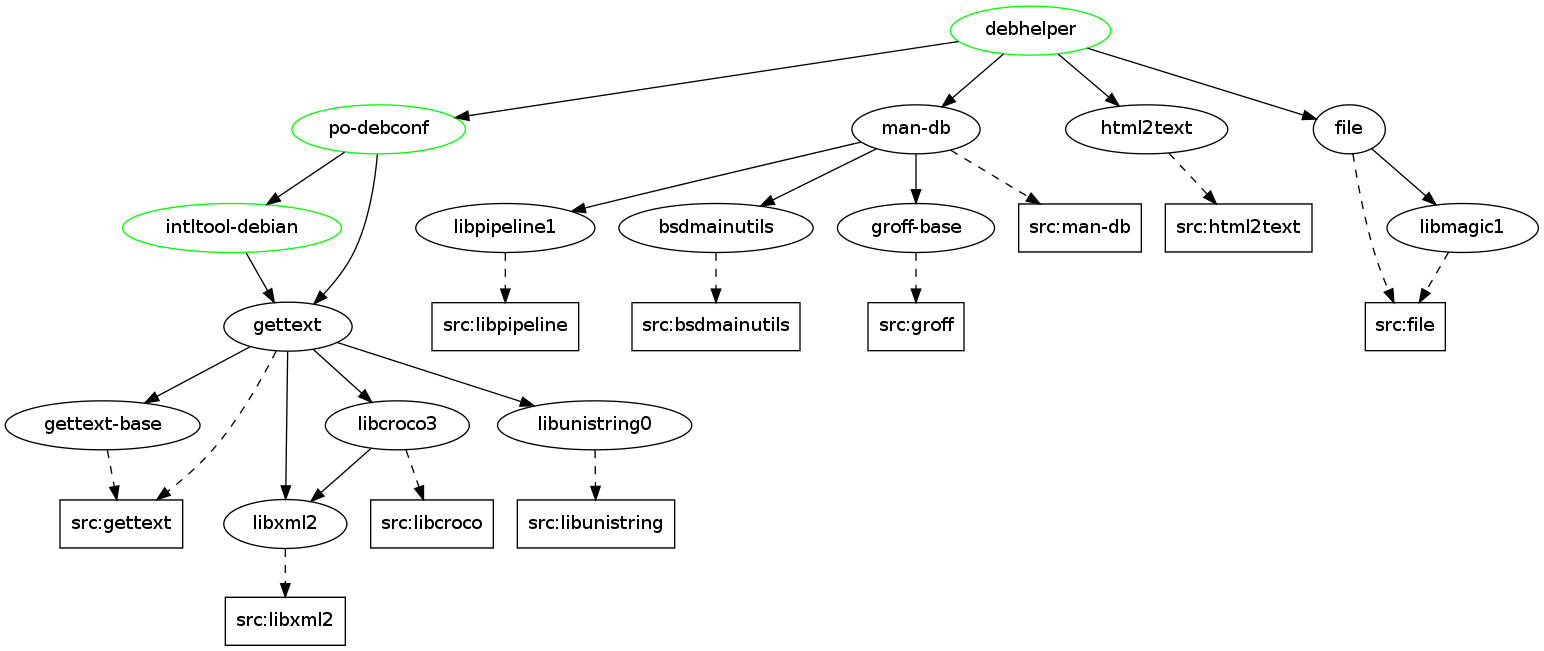
On this day, June 5, I wrote a minimal test case for this problem. The same day, Pietro figured out that this is a bug in dose which will be fixed in the next release. Begin writing code to figure out how important a binary package is for the further build process. Try to use Depsolver.edos_install to find out what packages are needed to make debhelper available. Restructure basenocycles.ml, exclude source packages that already have been built, still trouble with already existing binary packages and Cudf.mem_installed, comment stuff better. June 6 I wrote some crude code (only estimate, not correct, fixed later) that would give a rough overview of how often a given binary package is directly required as a build dependency. Debhelper came out as the most needed package. It is architecture:all, so it does not have to be built but it has unfulfilled runtime dependencies. To make those packages available, 13 (actually 11, fixed later) packages have to be compiled on Ubuntu Natty. But those packages all (except gettext) require debhelper itself to be built. The first dependency cycle. This dependency cycle (actually, the 12 cycles) can be broken by either cross compiling those source packages or by making them build without debhelper. One goal of the program is to help decide what the easier option is, but this is not yet implemented. To play around a bit, I created the possibility to specify a list of packages that are additionally to the minimal set of cross compiled packages also cross compiled. I added the 13 packages found above to the list, thus making the binary packages they build available. This made debhelper available in the system. As a result, 1625 out of 3339 source packages can be built with just a minimal build system (priority:essential packages plus build-essential) and debhelper available. The next package that blocks the most other source packages from being built is cdbs. The next nine packages in that list also require cdbs so it seems to be the next important package to be available. Pietro's suggestions make me:
 - do not open BootstrapCommon but ExtLib, Common, Algo, Debian
 - do proper option parsing and logging
 - use Debcudf.ignore_essential = true
 - do Debcudf.init_tables (binlist@srclist)
 - use @ with shorter list first
 - use more List.rev_append instead of @
 - use CudfAdd.who_provides to find if a package is available
June 7 Pietro and Patrick suggest that for solving the debhelper cycles, one could provide a minimal debhelper version so that the above list of 12 packages can be built without debhelper. I try to figure out how to get a list of packages that are missing to make a package installable/buildable. This functionality should be provided in dose but I fail to find it. June 8 Lacking a solution of the problem of June 7, I write a mail to Pietro. I start my first graphs in ocaml using the ocamlgraph library. The graph I generate, starts off at a binary package. For each binary package it connects new vertices as its runtime dependencies. If a binary package is not arch:all and also not yet otherwise compiled, its source package is also added. The result is a graph in which set of source packages in it will make the initial package available, if those source packages would be cross compiled. The graph is extended further than the source packages. June 9 I refine a couple of functions, make univ_get_pkg_by_name return the package with the highest version number. I wrote a rather lengthy (1027 words) email to the list that explains my status as of this day. I can create graphviz dot files with ocaml, can create node and edge types and create the graph by an imperative pattern that I saw a lot in Pietro's code. Disjunctions are not yet handled correctly (see mail from June 8). The graphs generated look like the following: http://mister-muffin.de/p/8nyc.png June 11 I write a test case which shows how CudfAdd.who_provides doesnt find virtual packages. Automate the process of finding the packages that, if cross compiled, would make another package available. Add more predicates (identifying source packages) and improve input file reading code. Move build_compile_rounds which compiles as many source packages as it can in multiple rounds on a given minimal system a toplevel function and thereby abstract it more. Create a rudimentary text based menu to choose different actions to take for an analysis. Start writing an extended version of simple_dependency_graph for deeper analysis. Use xdot to show graphs from the text menu. Allow saving those graphs to a file. June 12 Move functionality from the extended version of simple_dependency_graph over to the normal version and delete the extended version. Add the new Closure vertex type. Create extended_dependency_graph which is supposed to not contain single binary package vertices but handle a package and its installation set as one vertex. The output of extended_dependency_graph is optionally reduced to the biggest (non degenerate) strongly connected component. User gets the option of choosing the exploration depth. June 13 Pietro replies to my mail from June 8 but apparently I failed to express myself well enough in my last mail, so I rephrase my question. Pietro replies to my email from June 11 and explains how the effect I see is due to "a nuisance of the debian to cudf encoding". As a result I change my code accordingly. June 14 Another lengthy (1130 words) email to the list. I explain what was done in the past days, what parts work and how they work. I list some rationales on why I did things the way I did them. The most important observation is, that after improving my code again and again, I ended up representing the dependency cycle problem in the same (very similar) way that Pietro suggested in the beginning. This is probably a good discovery. Lots of data of that email is now of only little use as of June 16, I make lots of improvements in correctness. As I dont have an answer to my other email to Pietro from June 13, I implement a very crude way to get an answer to the question of what packages are missing for a package to be available/compileable. I called it flatten_vpkgformula_best_effort and it suffers from many faults including disjunctions and package conflicts. Patrick spots a problem. As a result, I make sure that at no point, the source package of an arch:all package can be listed. June 15 As a reply to my mail from June 13, Pietro creates a new branch in the git and adds the code I needed to get a proper installation set. June 16 As a result of Pietro's efforts from June 15, I make great advancements on all fronts. Details of the current status follow in the next section. Results A big leap was made on June 16 due to Pietro's great help on making me understand how Depsolver.listcheck can be used for my purposes. My difficulties in finding the solution myself are rooted in many parts of the dose framework being poorly commented but Pietro did already a couple of documentation commits whenever things were unclear for me. Using Depsolver.listcheck makes it possible to be more distribution agnostic and I dont have to handle vpkgs, virtual packages and constraints myself anymore. The code also doesnt suffer anymore by wrongly analyzed dependencies and conflicts. The only thing that is not yet taken care of, is that Depsolver.listcheck only chooses one out of several possible installation set. A final version should be able to take into account that a different installation set could provide a better solution. Overall, in comparison to two weeks ago, I can now properly build, traverse and analyze graphs, can choose an installation set properly, understand more about dependencies, closures, dose and ocaml in general. Finding the importance of binary packages for building When calculating how many source packages are depending on the availability of a binary package I originally flattened the pkg.Cudf.depends list twice for a rough overview. This is of course wrong due to disjunctions and conflicts and also doesnt provide a deep dependency inspection. The new method is to calculate an installation set that is necessary to compile a source package for every source package. The resulting list of binary packages is then used to find out how often a binary package appears in an installation set. I see three drawbacks though: Removing simple graph The simple graph which contained single binary and source packages was removed. I realized it doesnt really serve any purpose to look at it. As a result, Bin vertices and InstallDep edges are also not part of the graph anymore. Since it was responsible for generating the list of source packages that have to be cross built to make a package available, I created a new function get_cross_source_packages which uses an installation to serve the same purpose. Fix extended_dependency_graph extended_dependency_graph now uses installation sets for generating the list of packages that is needed to compile a source package or install a binary package. The list of build dependencies does not include packages that are already installable. The list of runtime dependencies does not include packages that are otherwise available (cross built, arch:all...). Instead of checking for list membership all the time, I created hash tables for the list of installable as well as for the list of available binary packages. Future There are two big tasks for the next two weeks: Task one is to find a way to give hints on which packages to best consider for having reduced build dependencies. This would then probably finally make use of Pietro's cycle algorithms. Task two is to find a way to break cycles and create a build-DAG from a list of packages that already have staged build dependency information. Patrick is currently working on patching dpkg with Build-Depends-StageN dependencies as making perl cross compilable. If he doesnt need the ability to decide which packages to modify to have staged build dependencies in the near future, then task one is probably less urgent and therefor of less importance right now? On the other hand, I can easily generate fake reduced build dependencies so that doing task two right now would not be a problem. Also, having the solution for task two will make it possible to show the user what effect it would have to add reduced build dependencies to a package. For the reasons above (it's not urgent, task one profits from task two being solved) I will go and implement task two first (if there are no objections from my mentors). Another idea, that I discussed with wookey and Patrick yesterday, was that due to multiarch being used for more and more packages, there should exist a set of packages that is cross compilable without any change to the package. We agreed that I make a list of packages that, if cross compiled, would break dependency cycles and make other packages available. I created such a list of about 160 packages for Ubuntu Natty that, if cross compiled, made it possible to have 87% of Natty available (those numbers have to be treated with caution as I did not yet use the proper way of installation sets when generating that list, but the order of magnitude should be correct). Wookey can then try to cross compile those packages. If some packages of those "crucial" source packages are found to be cross compilable, then they should be cross compiled because it means that no work has to be done to break some cycles. Cross compiling all packages that are cross compilable out of the box is no solution, as only natively compiled packages can go into the archive. This is why the list of potentially additionally cross compiled source packages has to be kept as small as possible.

10 June 2012

C.J. Adams-Collier: Spinning up a telco with Asterisk

Back in 2010 our family moved to an island in an archipelago in the very top left of the US s continental 48. Before moving, we did some research regarding high speed network access. There are a number of ISPs in the county, and even one headquartered on our particular island. But we found that the location where we were moving was in a location that was only serviced by 1.5Mbit DSL. We had been spoiled in our previous two locations and had seen bittorrent swarms reach over 1 megabyte (8Mbit) per second. Our bill said 12 down and 2 up and I wouldn t be surprised if we achieved that. At any rate, we were disappointed by the speeds available and I wanted to do something to increase the availability of higher speed network access. Some of my friends from the North American Network Operators Group (NANOG) told me that one way to improve the infrastructure would be to get involved with telecommunications provisioning as a Competitive Local Exchange Carrier (CLEC). With the above in mind, I did some research and found that in my state, the authority which certifies and regulates telecommunication companies is the Washington Utilities and Transportation Commission (UTC). I found the application forms on their web site, filled them in, filed the appropriate documents with the appropriate departments and received a certificate in the mail shortly thereafter. We have since filed annual reports as required by regulations. And with the regulatory bits out of the way, we re now left with only the technical details. We have established collocation of some equipment near our state s central telecommunications facility at the Westin Building. Technically speaking, the equipment is not in the Westin, but at a facility connected to the Westin by multiple 10Gbit links. Close enough for me. On this equipment, we re running a Debian Squeeze Xen virtual machine and Digium s Asterisk packages:
cjac@sip0:/etc/asterisk$ grep -B1 -A3 Digium /etc/apt/sources.list
#
#  Digium asterisk packages
#
deb http://packages.asterisk.org/deb squeeze main
deb-src http://packages.asterisk.org/deb squeeze main
cjac@sip0:/etc/asterisk$ dpkg -l   grep digium
ii  asterisk                           1:1.8.11.1-1digium1~squeeze  Open Source Private Branch Exchange (PBX)
ii  asterisk-config                    1:1.8.11.1-1digium1~squeeze  Configuration files for Asterisk
ii  asterisk-core-sounds-en-gsm        1.4.21-1digium1~squeeze      asterisk PBX sound files - English/gsm
ii  asterisk-voicemail                 1:1.8.11.1-1digium1~squeeze  simple voicemail support for the Asterisk PBX
We saved up our nickles and dimes to purchase a 24-port analog telephony adapter (ATA). At the recommendation of one of the denizens of the #asterisk IRC channel on Freenode, we decided on the GrandStream GXW4024. It is pretty simple to configure them to register with the Asterisk server using SIP. The only problem we had was getting the RTP streams, and specifically their dynamically negotiated service ports, to traverse the NATting routers. We currently have no public IPv4 address space at the facility which hosts the ATA and so the rest of the internet sees all traffic originating from this facility as sourced from a single IP address. In order for this to work, the edge NAT/router device (in our case, BIG-IP LTM) needs to map its external L4 ports (TCP and UDP) to the ports of internal hosts so that traffic can flow correctly. This works fine for traffic which originates from internal hosts and is destined to hosts on the outside, but does not work so well when hosts on the outside wish to establish connections to hosts on the inside. Call management sessions established with the SIP protocol fall in the former category, but call media (voice, video, txt) sessions established with the RTP protocol fall into the latter; the host and port used to carry the media data are negotiated during the SIP session and the media socket is established out of band. The problem occurs when the call server (on the outside) attempts to establish an RTP stream with the caller (on the inside). The call server attempts to connect to the caller using the IP address from which it connected. The problem is that this address belongs to the NATting router, not the caller, and the router is not expecting the incoming request. To get around the NAT problem, we temporarily configured an OpenVPN tunnel to extend our L2 network segment. Our long-term solution will be to provision an Asterisk server in the same facility as the ATA and then register with it instead of the server in the exterior facility. Calls will then be switched at the local facility and the upstream link will be established using the IAX2 protocol, which does not suffer from the same NAT problems. All of the above provides us with the ability to make voice calls between the 24 channels of the ATA and any other SIP client which happens to be registered with our call server. This is all well and good, but we want to allow our customers to call the rest of the world. Enter our upstream provider, Threshold Communications, Inc. These folks are experienced and professional and have helped us successfully establish both outbound and inbound calling for very reasonable monthly costs. The call quality is indistinguishable from the lines provisioned by the local bell company, and inter-operates flawlessly with the Asterisk call server stack. Because calls transit our Asterisk server, we can add additional features such voicemail, speech to text, DTMF-driven menus, or call forwarding, for instance. We could even theoretically set up autopatch service using amateur frequencies or launch perl scripts to automate arbitrary fancyness. Our next step is to finish configuration of our 12-channel ZyXEL AAM1212 DSLAM modules so that we can deliver ADSL service over the same copper pairs as we deliver voice.

3 June 2012

Aurelien Jarno: How multiarch adds new RC bugs


# dpkg --add-architecture kfreebsd-amd64
# dpkg -i libc0.1-dev_2.13-32_kfreebsd-amd64.deb
Selecting previously unselected package libc0.1-dev.
(Reading database ... 446113 files and directories currently installed.)
Unpacking libc0.1-dev (from libc0.1-dev_2.13-32_kfreebsd-amd64.deb) ...
dpkg: error processing libc0.1-dev_2.13-32_kfreebsd-amd64.deb (--install):
trying to overwrite '/usr/include/_G_config.h', which is also in package libc6-dev 2.13-32
dpkg-deb: error: subprocess paste was killed by signal (Broken pipe)
Errors were encountered while processing:
libc0.1-dev_2.13-32_kfreebsd-amd64.deb
Before multiarch the bug was not existing, and of course none of libc6-dev and libc0.1-dev are marked as Multi-Arch: something. People wanting to delay the release of Wheezy, I am sure you can find much more RC bugs like that.

1 June 2012

Rapha&#235;l Hertzog: My Debian Activities in May 2012

This is my monthly summary of my Debian related activities. If you re among the people who made a donation to support my work (338.26 , thanks everybody!), then you can learn how I spent your money. Otherwise it s just an interesting status update on my various projects. Dpkg Like last month, I did almost nothing concerning dpkg. This will probably change in June now that the book is out The only thing worth noting is that I have helped Carey Underwood who was trying to diagnose why btrfs was performing so badly when unpacking Debian packages (compared to ext4). Apparently this already resulted in some btrfs improvements. But not as much as what could be hoped. The sync_file_range() calls that dpkg are doing only force the writeback of the underlying data and not of the meta-data. So the numerous fsync() that follow still create many journal transactions that would be better handled as one big transaction. As a proof of this, replacing the fsync() with a sync() brings the performance on par with ext4. (Beware this is my own recollection of the discussion, while it should be close to the truth, it s probably not 100% accurate when speaking of the brtfs behaviour) Packaging I uploaded new versions of smarty-gettext and smarty-validate because they were uninstallable after the removal of smarty. The whole history of smarty in Debian/Ubuntu has been a big FAIL since the start. Once upon a time, there was a smarty package and some plugins. Everything was great except that the files were installed in a way that differs from the upstream recommendations. So Ubuntu changed the path in their version of the package and did not check whether it broke anything else (and it did break all the plugins). Despite the brokenness of the plugins, this divergence survived for years. So several packages that were using Smarty were modified to use dpkg-vendor to use the correct path depending on whether it was built on Debian or Ubuntu. In 2010, Smarty 3.0 has been released and instead of upgrading the smarty package to this version, one of the smarty co-maintainers introduced a smarty3 package that used yet another path (despite the fact that smarty 3 had a mode to be compatible with smarty 2).
At some point, I informed him that he had to handle the migration of users of smarty to smarty3 he acknowledged and then lost interest in smarty ( I m no longer using it ) and did nothing. After some more bitrot, smarty has been forcefully orphaned in August 2011 by a member of the security team. And in March this year, it has been removed from unstable despite the fact that it still had reverse dependencies (usually removals only happen when they impact no other packages, I don t know why this wasn t the case here). At least the brokenness attracted some attention to the situation and Mike Gabriel contacted me about it. I offered him to take over the various packages since they all needed a real maintainer and he accepted. I sponsored his uploads of all smarty related packages (bringing in the latest upstream versions at the same time). In the end, the situation is looking better now, except that there s no migration path from users who rely on smarty in Squeeze. They will discover that they need smarty3 in Wheezy and that the various paths have to be adjusted. It s probably acceptable since the new upstream versions are no longer backwards compatible with smarty 2 The Debian Administrator s Handbook At the start of the month, I was busy preparing the release of the book. I introduced the publican-debian package to unstable, it s a Publican brand (aka a set of CSS and XSL stylesheets to tailor the output of Publican) using the Debian colors and using the Debian logo. This brand is used by the book. I also created the debian-handbook package and setup the public Git repository on alioth.debian.org. I was ready or so I thought. A few hours after the announce, the website became unusable because the numerous visitors were exhausting the maximum number of client connections. And I could not increase the limit due to Apache s memory usage (with PHP and WordPress). We quickly off-loaded most of the static files traffic to another machine and we setup bittorrent. The problem was solved for the short term. Thousands of persons downloaded the ebook and to this date, 135 copies of the paperback have been sold. Then I took a one-week vacation. Even though I had no Internet at the place I was, I wandered in the street to find a Freewifi wifi network (customers of the Free ISP can use those freely) to stay on top of incoming email. We quickly received some bug reports and I dealt with the easy ones (typos and the like) on the fly. When I came back at home, I manually placed 54 lulu orders for the people who opted for the paperback as reward during the fundraising campaign. A bit tedious but it had to be done (if only Lulu supported a way to batch many orders at once ). I also wanted a long term solution to avoid the use of an external host to serve static files (should a new traffic spike arrive ). So I installed nginx as a front-end. It serves static files directly, as well as WordPress pages which have been cached by wp-super-cache. Apache is still here listening on a local port and responding to the remaining queries forwarded by nginx. Once I ll migrate to wheezy, I might completely ditch apache in favor of php5-fpm to handle the PHP pages. Last but not least, I wanted to bootstrap the various translations that people offered to contribute. I wrote some documentation for interested translators and blogged about it. It s shaping up nicely check it out if you re interested to help! Thanks See you next month for a new summary of my activities.

No comment Liked this article? Click here. My blog is Flattr-enabled.

31 May 2012

Dominique Dumont: cme fix dpkg now track and display changes

Hello I ve released Config::Model 2.018 which is now able to track the changes done with cme to your configuration data. Thw GUI now features a new menu entry File -> show unsaved change that will give you a list of the changes done since running the command or since the last save (whichever occured last). For instance: This feature is also available in non-graphic mode. As an example, let s refresh the lcdproc package:
$ cme fix dpkg
Fixing...
Reading package lists... Done
Building dependency tree       
Reading state information... Done
Warning in 'control source Standards-Version' value '3.9.2': Current standards version is 3.9.3
Warning in 'copyright Format' value 'http://dep.debian.net/deps/dep5/': Format does not match the recommended URL for DEP-5
Changes:
- control source Standards-Version: '3.9.2' -> '3.9.3' # applied fix
- copyright Format: 'http://dep.debian.net/deps/dep5/' -> 'http://www.debian.org/doc/packaging-manuals/copyright-format/1.0/' # applied fix
The Changes list can be reused to update the changelog, but the author does not dare injecting this directly in debian/changelog Let s check the resulting changes:
$ git diff
diff --git a/debian/control b/debian/control
index 11a5b8a..2b81192 100644
--- a/debian/control
+++ b/debian/control
@@ -20,7 +20,7 @@ Build-Depends: autoconf,
                libxosd-dev,
                pkg-config,
                texinfo
-Standards-Version: 3.9.2
+Standards-Version: 3.9.3
 Vcs-Browser: http://git.debian.org/?p=collab-maint/lcdproc.git;a=summary
 Vcs-Git: git://git.debian.org/collab-maint/lcdproc.git
 Homepage: http://www.lcdproc.org/
diff --git a/debian/copyright b/debian/copyright
index 6cea444..4b48619 100644
--- a/debian/copyright
+++ b/debian/copyright
@@ -1,4 +1,4 @@
-Format: http://dep.debian.net/deps/dep5/
+Format: http://www.debian.org/doc/packaging-manuals/copyright-format/1.0/
 Upstream-Name: lcdproc
 Upstream-Contact: William W. Ferrell 
 Source: http://www.lcdproc.org/
domi@ylum:~/debian-dev/lcdproc-stuff/lcdproc$ 
Last but not least, this track and display changes features is also available for other models, like OpenSsh, lcdproc, multistrap All the best
Tagged: Config::Model, dpkg, Perl

29 May 2012

Niels Thykier: Lintian 2.5.7 and 2.5.8

The new version of Lintian (2.5.8) can pretty much be summed up as:
Its like 2.5.7, only with less false positives and no FTBFS.
Especially people annoyed by the hardening flags will hopefully find that 2.5.8 greatly reduces the number of false positives. I believe this is best demonstrated with an example:
$ lintian --print-version && lintian -q -C binaries amarok_2.5.0-1_i386.deb   wc -l 
2.5.7
94
[...]
$ lintian --print-version && lintian -q -C binaries amarok_2.5.0-1_i386.deb   wc -l
2.5.8
4
However, nothing comes for free. We dropped hardening-no-stackprotector from the default profile (and demoted it to an I tag). For hardening-no-fortify-functions we made a false positive -> false negative trade-off by ignoring binaries if their only unprotected function is memcpy. For more information, please refer to #673112. hardening-no-stackprotector is still available and can be used via the debian/extra-hardening profile (or via the tags argument). For the 2.5.7 behaviour of hardening-no-fortify-functions, you have to use hardening-check directly. But 2.5.7 had other changes besides the myriad of false-positives: A consequence of this is that we no longer warn if you use things like dpkg assert-working-epoch or your postinst creates a usr/doc transition symlink . With all the Lintian modules under the Lintian namespace, we can install them in the standard perl @INC path. Admittedly, I am not certain we are ready to commit to the current API in these modules, which is one of the reasons why they are still installed in /usr/share/lintian. But in a couple of releases things may look differently. :) Lintain 2.5.7 ships over 50 data files of various kinds (usually white- or blacklists of some kind). Before 2.5.7, all data files with a few exceptions would be loaded eagerly (i.e. as soon as the check was run for the first time). A few data files had been special cased with manual laziness . In 2.5.7, Lintian::Data was updated to lazily load the data. So depending on the packages being checked, Lintian may now load fewer data files. While this is not something exclusive to 2.5.7, we have separated quite a few checks from their data tables by now. My personal favorites are the table of known interpreters and (from 2.5.8) the table of known versioned interpreters. I am certainly biased here. But this is probably the most awesome feature in Lintian 2.5.7. It is now possible for vendors to extend or simply shadow the core Lintian data files. Allow me to demonstrate how this can be used:
$ lintian --tags build-depends-on-obsolete-package a2ps_4.14-1.1.dsc 
E: a2ps source: build-depends-on-obsolete-package build-depends: dpatch
$ cat ~/.lintian/profiles/local/main.profile 
Profile: local/main
Extends: debian/main
$ cat  ~/.lintian/vendors/local/main/data/fields/obsolete-packages 
@include-parent
@delete dpatch
bison
$ lintian --profile local/main --tags build-depends-on-obsolete-package a2ps_4.14-1.1.dsc
E: a2ps source: build-depends-on-obsolete-package build-depends: bison
$
It is a toy example, but I believe it is a good demonstration of the feature. The full documentation of Vendor specific data files can be found in the Lintian User manual (in lintian/2.5.7 or newer). It will also be on lintian.debian.org when we find time to update lintian there. :)

28 May 2012

Jonathan McDowell: Go go gadget multiarch

Multiarch has been coming RSN for an extremely lengthy meaning of the word "soon". I remember watching Tollef give a presentation about it at DebConf4 and I'm pretty sure it's been talked about at every DebConf since then as well. Deemed the "correct" answer to the issue of running i386 binaries on x86_64 machines, or old ARM ABI programs on more modern hardware, it's always seemed to be at least another Debian release away. Not so anymore. Through foolishness I ended up buying a Brother HL3040CN when I first moved to the US. It was a cheap networked laser printer and it touted Linux support. Quality wise it's been fine. I don't use it a lot, but unlike an inkjet I don't have to worry about not using it for a month and then needing to print something in a hurry and having to clean print heads etc. Where it falls down is that I failed to check that "Linux support" involved source. No. Instead it involves an i386 binary (at least packaged as a .deb, but in a horrible fashion). Up until now I've mostly been printing from my laptop, so all the drivers are installed there. I've got some guests this week and they needed to print their boarding passes, so I decided it was time to make the house server act as a print server too. It's an AMD64 box and before now I haven't had any need to run i386 code on it, so when I installed the driver deb it failed to work. Normally I'd just install ia32-libs, but this time I decided to try multiarch. So I did:
# dpkg --add-architecture i386
# apt-get update
# apt-get install libc6:i386
and magically I was now able to run the printer driver binary. I know there's a lot more work still to be done (I need to check if I can ditch ia32-libs on my laptop which runs a few more i386 only apps), but this is pretty cool - thanks to all those involved in making it happen! Update: I tried to install all the multiarch bits required for Skype on my laptop but hit an issue with libqtgui4:i386 which ends up pulling in liblcms1:i386 which isn't yet multiarch enabled. There was already a bug, #637732 filed by vorlon, and mhy did the appropriate NMU a week ago, so it should hopefully hit testing in the next week. Thanks guys.

Thibaut Girka: Multiarch Cross-toolchains

Hi! I have been selected to work on multiarch cross-toolchains as part of the Google summer of Code. Although coding officially started last week, I have been busy with exams and other uni stuff at the time. Anyway, let's talk about the project itself, that is, multiarch cross-toolchains. What is multiarch? In order to understand what the project is about, one need to know what multiarch is. I'll quickly describe it, and I invite anyone interested to read the spec (really, it's interesting, and not that long). Basically, multiarch lets you install binary packages for multiple architectures on one system, and let package managers resolve dependencies as one would expect. This works by identifying four sets of packages: Anyway, multiarch is an amazing thing that may be of use in various cases, such as running i386-only software on an amd64 system, running armel software on an armhf system, running i386 software on an armhf system using qemu-user-static and binfmt, cross-grading (switching, for instance, from i386 to amd64 on a running system), and, in our case, easing cross-compilation. State of cross-toolchains in Debian There aren't really cross-toolchains available in Debian (although some can be built from source packages), but they are available in emdebian's repositories. However, those packages predate multiarch, and don't make use of it. Instead, they depend on special packages converted using dpkg-cross. Such packages are merely arch: all versions of foreign packages, with files moved to arch-qualified paths to prevent conflicts with normal packages. Such packages thus have to be generated from real packages, either manually or using some sort of automation. In addition, this additional step brings several issues, like keeping in sync converted packages with real packages from the archive. With multiarch, such packages are rendered useless, and may in fact bring additional problems, since converted and multiarch packages may share the same files, and thus may not be co-installable. Switching from dpkg-cross to cross-arch deps Cross-toolchains packages currently depend on a few packages converted using dpkg-cross (ex: libc6-$ARCH-cross and libc6-dev-$ARCH-cross for some packages). They need to depend on the real package with the right arch (ex: libc6:$ARCH, libc6-dev:$ARCH). The obvious way to do so is by annotating the dependency with a specific arch qualifier (ex: Depends: libc6:armhf ). This is, however, not covered by the multiarch spec. Note that some lib*-$ARCH-cross packages will remain (for instance, libgcc1-armhf-cross). Indeed, those packages are different from the packages mentioned above in that they are of the architecture of the build system and actually part of the toolchain itself.
The above isn't actually true. Indeed, those packages are runtime library cross-built during gcc's build. Likewise, cross-toolchains may build-depend on foreign packages (ex: libc6-dev). Thus, specific arch qualifiers must be handled in the Build-Depends source package field too. Changing dpkg and apt to support that should be fairly straightforward. In fact, I already have a few patches, but I need to refresh them, maybe clean them up a little, and push them a little harder to get them accepted!

23 May 2012

Raphael Geissert: Installed-Size: 0

Redefining the meaning of Installed-Size:

Package: gcipher
Version: 1.1-1
Installed-Size: 0
$ dget gcipher=1.1-1
...
$ dpkg -x gcipher_1.1-1_all.deb gcipher
$ du -hs gcipher
188K gcipher
$ du --apparent-size -hs gcipher
75K gcipher

20 May 2012

Gregor Herrmann: RC bugs 2012/20

I was on vacations for a few days last week, therefor my list of RC bugs is a bit shorter this time. thanks again to everyone who sent patches to the BTS that I could just use.

5 May 2012

Axel Beckert: unburden-home-dir uploaded to Sid

Most popular web browsers cause quite a lot of I/O on a user s home directory and their cache s also take up quite some disk space with Google s Chrome/Chromium you can t even configure how much disk space should be used for the cache. This causes unnecessary network traffic and no more makes sense if the home directory itself comes over the network, e.g. via NFS or Samba. And on laptops it spins up the disks and unnecessarily costs battery power and therefore lowers the potential battery life. Such caches also costs scarce disk space on SSDs or flash cards as common in laptops, netbooks and other mobile devices, and often get backed up without any real use. To take some of this burden off our NFS servers at work I started to develop an Xsession.d hook which moves off such caches to the local disk and puts in symbolic links instead into the user s home directory when the user locally logs in. This hook quickly became a standalone Perl script named unburden-home-dir and the Xsession.d hook just a wrapper around it. Due to some unsolved issues I didn t feel it s good enough for Debian Unstable, so I uploaded it just to Debian Experimental back then. Pietro Abate s recent blog posting about unburden-home-dir on Planet Debian gave me the right kick to make another try to solve the remaining issues. And the mental distance gained over the time indeed helped and I could fix the remaining issues. So I added some polish to the package and uploaded it to Debian Unstable. If you used the previous version from experimental, you have to take care of a few things: You can follow the development of unburden-home-dir also on GitHub and on Gitorious as well as on Ohloh. Enjoy!

1 May 2012

Rapha&#235;l Hertzog: My Debian Activities in April 2012

This is my monthly summary of my Debian related activities. If you re among the people who made a donation to support my work (186.38 , thanks everybody!), then you can learn how I spent your money. Otherwise it s just an interesting status update on my various projects. Dpkg News For the first time since several years, there has been a dpkg release (1.16.3) where the changelog doesn t contain any entry of my own. The 3-4 commits I did were not really worthy of a changelog entry. I must admit that it was easy to put dpkg aside given Guillem s message and given how busy I have been with my other projects. Keeping a low-profile for a while certainly doesn t hurt. But I don t intend to stop contributing to dpkg. Quite on the contrary in fact, it s something that I (usually) enjoy doing. Packaging News I packaged a new upstream release of SQL-Ledger (3.0.0) and later in the month I sponsored the upload of LedgerSMB, a fork of SQL-Ledger which unlike the former is maintained like a typical free software project. I also uploaded version 0.56 of Zim and updated WordPress to version 3.3.2 with its slew of security fixes. The Debian Administrator s Handbook Like several months now, most of my time has been directed towards the Debian Administrator s Handbook. The big news is that the liberation fund has been completed this means that the book will be published under DFSG-free licenses from the start (GPL-2+ / CC-BY-SA 3.0). We hope to publish the book next week (i.e. between May 7th and May 11th). The PDF output for the printed book is almost ready. There s some work left for the HTML/EPUB output and we have to prepare for the release of the sources as well Hopefully everything will work out like planned. Stay tuned! Thanks See you next month for a new summary of my activities.

No comment Liked this article? Click here. My blog is Flattr-enabled.

27 April 2012

Riku Voipio

Cross Compiling with MultiArch Congrats to the Ubuntu Folk for the new LTS release. Incidentally this is also the first release where our work on MultiArch bears fruit. We can now cross-compile relatively easily without resorting to hacks like scratchbox, qemu chroot or dpkg-cross/xdeb. Lets show short practical guide on cross-building Qemu for armhf. The instructions refer to precise, but the goodiness is on the way to Debian as well. Biggest missing piece being the cross-compiler packages, which we have an Summer of Code project. The example is operated in a chroot to avoid potentially messing up your working machine. Qemu-linaro is not a shining example, as cross-building it doesn't work out of box. But that is educational, it allows me to show what kind of issues you can bump into, and how to fix them.

$ sudo debootstrap --variant=buildd precise /srv/precise
Edit the /srv/precise/etc/apt.sources.list to the following (replace amd64 with i386 if you made an i386 chroot)

deb [arch=amd64] http://archive.ubuntu.com/ubuntu precise main universe
deb [arch=armhf] http://ports.ubuntu.com/ubuntu-ports precise main universe
deb-src http://archive.ubuntu.com/ubuntu precise main universe
Edit the /srv/precise/etc/dpkg/dpkg.cfg.d/multiarch by adding the following line:

foreign-architecture armhf
Finally disable install of recommends by editing /srv/precise/etc/apt/apt.conf.d/10local:

APT::Install-Recommends "0";
APT::Install-Suggests "0";
Install the armhf crosscompiler the chroot

$ sudo chroot /srv/precise/
# unset LANG LANGUAGE
# mount -t proc proc /proc
# apt-get update
# apt-get install g++-arm-linux-gnueabihf pkg-config-arm-linux-gnueabihf
Get the sources and try to install the cross-buildeps:

# cd /tmp
# apt-get source qemu-linaro
# cd qemu-linaro-*
# apt-get build-dep -aarmhf qemu-linaro
As we see, the build-dep bombs out ugly, with a them of "perl" being unable to be installed. This is because apt-get can't figure out if we should install and armhf or amd64 version of perl. We don't use the required syntax yet in Build-Dep line, "perl:any", as dpkg and apt in previous released don't support it. Thus back porting would no longer be possible. One way to fix it, would be to drop perl build-dep, as perl is already pulled by other build-deps. But lets instead show howto install it the build-deps manually. First we build system build-deps, then target architecture ones:

# apt-get install debhelper texinfo
# apt-get install zlib1g-dev:armhf libasound2-dev:armhf libsdl1.2-dev:armhf libx11-dev:armhf libpulse-dev:armhf libncurses5-dev:armhf libbrlapi-dev:armhf libcurl4-gnutls-dev:armhf libgnutls-dev:armhf libsasl2-dev:armhf uuid-dev:armhf libvdeplug2-dev:armhf libbluetooth-dev:armhf
And try the build[1]:

# dpkg-buildpackage -aarmhf -B
Which sadly errors out. Turns out the cross-build support in debian/rules is broken. Instead of --cc we need to feed an --cross-prefix to the ./configure of qemu. Edit the debian/rules with replacing

- conf_arch += --cc=$(DEB_HOST_GNU_TYPE)-gcc --cpu=$(QEMU_CPU)
+ conf_arch += --cross-prefix=$(DEB_HOST_GNU_TYPE)-
Optional: Since we are cross-compiling from a multicore machine, lets also add parallel building support, by changing the override_dh_auto_build: rule to have --parallel flags in debian/rules as well:

override_dh_auto_build:
# system build
dh_auto_build -B system-build --parallel
ifeq ($(DEB_HOST_ARCH_OS),linux)
# user build
dh_auto_build -B user-build --parallel

# static user build
dh_auto_build -B user-static-build --parallel

Try the build again:

# export DEB_BUILD_OPTIONS=parallel=4 # I have dual-core hyperthreading machine, build with all four threads
# time dpkg-buildpackage -aarmhf -B
...
dpkg-buildpackage: binary only upload (no source included)

real 18m53.425s
user 65m42.570s
sys 2m50.383s
The Native build of qemu-linaro took 4h 11min. [1] You should not build as root - but to keep instructions short, I'm not explaining howto add and use a unprivileged user in a chroot. Do as I *say*, not as I *do*!

Next.

Previous.