Russ Allbery: Review: The Stone Canal
| Series: | Fall Revolution #2 |
| Publisher: | Tor |
| Copyright: | 1996 |
| Printing: | January 2001 |
| ISBN: | 0-8125-6864-8 |
| Format: | Mass market |
| Pages: | 339 |
| Series: | Fall Revolution #2 |
| Publisher: | Tor |
| Copyright: | 1996 |
| Printing: | January 2001 |
| ISBN: | 0-8125-6864-8 |
| Format: | Mass market |
| Pages: | 339 |
cpanm Mail::Milter::Authentication.
Wah. I m glad I tried this out on a test virtual machine. It took forever! It
ran tests! It compiled things! And, it installed a bunch of perl modules
already packaged in Debian.
I don t think I want to add this command to my ansible playbook.
Next I spent an inordinate amount of time trying to figure out how to list the
dependencies of a given CPAN module. I was looking for something like cpanm --list-dependencies Mail::Milter::Authentication but eventually ended up writing
a perl script that output
perl code, inserting a use " before each dependency and a semicolon and line
break after them. Then, I could execute that script on a clean debian
installation and see which perl modules I needed. For each error, I checked for
the module in Debian (and installed it) or kept a list of modules I would have
to build (and commented out the line).
Once I had a list of modules to build, I used the handy cpan2deb command. It
took some creative ordering but eventually I got it right. Since I will surely
forget how to do this when it s time to upgrade, I wrote a
script.
In total it took me several days to figure this all out, so I once again find
myself very appreciative of all the debian packagers out there - particularly
the perl ones!!
And also if I did this all wrong and there is an easier way I would love to
hear about it in the comments.
Like each month, have a look at the work funded by Freexian s Debian LTS offering.
apt-get source required dpkg-dev to be installed, which ends up
pulling in a lot of other dependencies.dir
command, but finding the proper path to be is usually not trivial,
and you find yourself having to use more complex commands like
set substitute-path, for example.dpkg and make it always use -fdebug-prefix-map when
compiling stuff. This GCC option is used to remap pathnames inside
the DWARF, which is needed because in Debian/Ubuntu we build our
packages inside chroots and the build directories end up containing a
bunch of random cruft (like /build/ayusd-ASDSEA/something/here). So
we need to make sure the path prefix (the /build/ayusd-ASDSEA part)
is uniform across all packages, and that s where -fdebug-prefix-map
helps.
This means that the package must honour dpkg-buildflags during its
build process, otherwise the magic flag won t be passed and your DWARF
will end up with bogus paths. This should not be a big problem,
because most of our packages do honour dpkg-buildflags, and those
who don t should be fixed anyway.
/usr/src/..., that is a good indication that you re
being affected by this bug. Hopefully we should see some progress in
the following weeks.
sntrup761 to strengthen their X25519-based default in their version 8.5 released on 2021-03-03. While there has been a lot of talk about post-quantum crypto generally, my impression has been that there has been a slowdown in implementing and deploying them in the past two years. Why is that? Regardless of the answer, we can try to collaboratively change things, and one effort that appears strangely missing are IETF documents for these algorithms.
Building on some earlier work that added X25519/X448 to SSH, writing a similar document was relatively straight-forward once I had spent a day reading OpenSSH and TinySSH source code to understand how it worked. While I am not perfectly happy with how the final key is derived from the sntrup761/X25519 secrets it is a SHA512 call on the concatenated secrets I think the construct deserves to be better documented, to pave the road for increased confidence or better designs. Also, reusing the RFC5656 4 structs makes for a worse specification (one unnecessary normative reference), but probably a simpler implementation. I have published draft-josefsson-ntruprime-ssh-00 here. Credit here goes to Jan Moj of TinySSH that designed the earlier sntrup4591761x25519-sha512@tinyssh.org in 2018, Markus Friedl who added it to OpenSSH in 2019, and Damien Miller that changed it to sntrup761 in 2020. Does anyone have more to add to the history of this work?
Once I had sharpened my xml2rfc skills, preparing a document describing the hybrid construct between the sntrup761 key-encapsulation mechanism and the X25519 key agreement method in a non-SSH fashion was easy. I do not know if this work is useful, but it may serve as a reference for further study. I published draft-josefsson-ntruprime-hybrid-00 here.
Finally, how about a IETF document on the base Streamlined NTRU Prime? Explaining all the details, and especially the math behind it would be a significant effort. I started doing that, but realized it is a subjective call when to stop explaining things. If we can t assume that the reader knows about lattice math, is a document like this the best place to teach it? I settled for the most minimal approach instead, merely giving an introduction to the algorithm, included SageMath and C reference implementations together with test vectors. The IETF audience rarely understands math, so I think it is better to focus on the bits on the wire and the algorithm interfaces. Everything here was created by the Streamlined NTRU Prime team, I merely modified it a bit hoping I didn t break too much. I have now published draft-josefsson-ntruprime-streamlined-00 here.
I maintain the IETF documents on my ietf-ntruprime GitLab page, feel free to open merge requests or raise issues to help improve them.
To have confidence in the code was working properly, I ended up preparing a branch with sntrup761 for the GNU-project Nettle and have submitted it upstream for review. I had the misfortune of having to understand and implement NIST s DRBG-CTR to compute the sntrup761 known-answer tests, and what a mess it is. Why does a deterministic random generator support re-seeding? Why does it support non-full entropy derivation? What s with the key size vs block size confusion? What s with the optional parameters? What s with having multiple algorithm descriptions? Luckily I was able to extract a minimal but working implementation that is easy to read. I can t locate DRBG-CTR test vectors, anyone? Does anyone have sntrup761 test vectors that doesn t use DRBG-CTR? One final reflection on publishing known-answer tests for an algorithm that uses random data: are the test vectors stable over different ways to implement the algorithm? Just consider of some optimization moved one randomness-extraction call before another, then wouldn t the output be different? Are there other ways to verify correctness of implementations?
As always, happy hacking!
AMD Issues
It s just been couple of hard weeks apparently for AMD. The first has been the TPM (Trusted Platform Module) issue that was shown by couple of security researchers. From what is known, apparently with $200 worth of tools and with sometime you can hack into somebody machine if you have physical access. Ironically, MS made a huge show about TPM and also made it sort of a requirement if a person wanted to have Windows 11. I remember Matthew Garett sharing about TPM and issues with Lenovo laptops. While AMD has acknowledged the issue, its response has been somewhat wishy-washy. But this is not the only issue that has been plaguing AMD. There have been reports of AMD chips literally exploding and again AMD issuing a somewhat wishy-washy response.
Asus though made some changes but is it for Zen4 or only 5 parts, not known. Most people are expecting a recession in I.T. hardware this year as well as next year due to high prices. No idea if things will change, if ever
I do try not to report because right now every other day we see somewhere or the other the Govt. curtailing our rights and most people are mute
Signing out, till later
(Edit 2023-05-10: This has now launched for a subset of Twitter users. The code that existed to notify users that device identities had changed does not appear to have been enabled - as a result, in its current form, Twitter can absolutely MITM conversations and read your messages)
This isn't a book review, although the reason that I am typing this now is
because of a book, You Are Not Alone: from the creator and host of
Griefcast, Cariad Lloyd, ISBN: 978-1526621870 and I include a handful of
quotes from Cariad where there is really no better way of describing things.
Many people experience death for the first time as a child, often relating to a
family pet. Death is universal but every experience of death is unique. One of
the myths of grief is the idea of the Five Stages but this is a
misinterpretation. Denial, Anger, Bargaining, Depression and Acceptance
represent the five stage model of death and have nothing to do with
grief. The five stages were developed from studying those who are
terminally ill, the dying, not those who then grieve for the dead person and
have to go on living without them. Grief is for those who loved the person who
has died and it varies between each of those people just as people vary in how
they love someone. The Five Stages end at the moment of death, grief is what
comes next and most people do not grieve in stages, it can be more like a
tangled knot.
Death has a date and time, so that is why the last stage of the model is
Acceptance. Grief has no timetable, those who grieve will carry that grief for
the rest of their lives. Death starts the process of grief in those who go on
living just as it ends the life of the person who is loved. "Grief eases and
changes and returns but it never disappears.".
I suspect many will have already stopped reading by this point. People do not
talk about death and grief enough and this only adds to the burden of those who
carry their grief. It can be of enormous comfort to those who have carried
grief for some time to talk directly about the dead, not in vague pleasantries
but with specific and strong memories. Find a safe place without distractions
and talk with the person grieving face to face. Name the dead person. Go to
places with strong memories and be there alongside. Talk about the times with
that person before their death. Early on, everything about grief is painful and
sad. It does ease but it remains unpredictable. Closing it away in a box inside
your head (as I did at one point) is like cutting off a damaged limb but
keeping the pain in a box on the shelf. You still miss the limb and eventually,
the box starts leaking.
For me, there were family pets which died but my first job out of university
was to work in hospitals, helping the nurses manage the medication regimen and
providing specialist advice as a pharmacist. It will not be long in that
environment before everyone on the ward gets direct experience of the death of
a person. In some ways, this helped me to separate the process of death from
the process of grief. I cared for these people as patients but these were not
my loved ones. Later, I worked in specialist terminal care units, including
providing potential treatments as part of clinical trials. Here, it was not
expected for any patient to be discharged alive. The more aggressive
chemotherapies had already been tried and had failed, this was about pain
relief, symptom management and helping the loved ones. Palliative care is not
just about the patient, it involves helping the loved ones to accept what is
happening as this provides comfort to the patient by closing the loop.
Grief is stressful. One of the most common causes of personal stress is
bereavement.
The death of your loved one is outside of your control, it has happened, no
amount of regret can change that. Then come all the other stresses, maybe about
money or having somewhere to live as a result of what else has changed after
the death or having to care for other loved ones.
In the early stages, the first two years, I found it helpful to imagine my life
as a box containing a ball and a button. The button triggers new waves of pain
and loss each time it is hit. The ball bounces around the box and hits the
button at random. Initially, the button is large and the ball is enormous, so
the button is hit almost constantly. Over time, both the button and the ball
change size. Starting off at maximum, initially there is only one direction of
change. There are two problems with this analogy. First is that the grief ball
has infinite energy which does not happen in reality. The ball may get smaller
and the button harder to hit but the ball will continue bouncing. Secondly, the
life box is not a predictable shape, so the pattern of movement of the ball is
unpredictable.
A single stress is one thing, but what has happened since has just kept adding
more stress for me. Shortly before my father died 5 years ago now, I had moved
house. Then, I was made redundant on the day of the first anniversary of my
father's death. A year or so later, my long term relationship failed and a few
months after that COVID-19 appeared. As the country eased out of the pandemic
in 2021, my mother died (unrelated to COVID itself). A year after that, I had
to take early retirement. My brother and sister, of course, share a lot of
those stressors. My brother, in particular, took the responsibility for
organising both funerals and did most of the visits to my mother before her
death. The grief is different for each of the surviving family.
Cariad's book helped me understand why I was getting frequent ideas about going
back to visit places which my father and I both knew. My parents encouraged
each of us to work hard to leave Port Talbot (or Pong Toilet locally) behind,
in no small part due to the unrestrained pollution and deprivation that is
common to small industrial towns across Wales, the midlands and the north of
the UK. It wasn't that I wanted to move house back to our ancestral roots. It
was my grief leaking out of the box. Yes, I long for mountains and the sea
because I'm now living in a remorselessly flat and landlocked region after
moving here for employment. However, it was my grief driving those longings -
not for the physical surroundings but out of the shared memories with my
father. I can visit those memories without moving house, I just need to arrange
things so that I can be undisturbed and undistracted.
I am not alone with my grief and I am grateful to my friends who have helped
whilst carrying their own grief. It is necessary for everyone to think and talk
about death and grief. In respect of your own death, no matter how far ahead
that may be, consider Advance Care Planning and Expressions of Wish as well
as your Will.
Help your loved ones cope with your death by describing what you would like to happen.
Document how your life has been arranged so that the executor of your Will can find the right documents to inform:
- your bank,
- your mortgage company,
- your energy company,
- your mobile phone company,
- your house and car insurers and the like.
If you've got a complex home setup with servers and other machines which would be unfamiliar to the executor of your Will, then entrust someone else with the information required to revoke your keys, access your machines etc. and then provide the contact information for that person to your executor.
Arrange for your pets to be looked after.
Describe how you would like your belongings to be handled - do you want every effort made to have your clothes and furnishing recycled instead of going to landfill?
Where are the documents for the oven, the dishwasher and the central heating system so that these can be included in the sale of your property?
If there are loans outstanding, make sure your executor or a trusted person knows where to find the account numbers and company names.
What about organ donation? Make sure your executor knows your wishes and make sure your loved ones either agree or are willing to respect your wishes.
Then the personal stuff, what do you want to happen to your social media accounts, your cloud data, your games, DVD and CD collection, your photos and other media? Some social media companies have explicit settings available in your account to describe if you want the data deleted after a certain amount of time, after a notification from some government service or to set up some kind of memorialised version or hand over control of the account to a trusted person.
guix git authenticate). What is missing is using them for verification by default and/or to improve the signature process to use trustworthy hardware devices, and committing the signatures to transparency logs.
KDE Digikam 8.0.0 Snap
Way back at DebConf16 Gunnar managed to arrange for a number of Next Thing Co. C.H.I.P. boards to be distributed to those who were interested. I was lucky enough to be amongst those who received one, but I have to confess after some initial experimentation it ended up sitting in its box unused.
The reasons for that were varied; partly about not being quite sure what best to do with it, partly due to a number of limitations it had, partly because NTC sadly went insolvent and there was less momentum around the hardware. I ve always meant to go back to it, poking it every now and then but never completing a project. I m finally almost there, and I figure I should write some of it up.
TL;DR: My C.H.I.P. is currently running a mainline Linux 6.3 kernel with only a few DTS patches, an upstream u-boot v2022.1 with a couple of minor patches and an unmodified Debian bullseye armhf userspace.
sunxi-mmc 1c11000.mmc: data error, sending stop command
CONFIG_TOUCHSCREEN_SUN4I) gave temperature readings and seemed to help somewhat with stability, though not completely.
Next I ended up looking at the AXP209 PMIC. There were various scripts still installed (I d started out with the NTC Debian install and slowly upgraded it to bullseye while stripping away the obvious pieces I didn t need) and a start-up script called enable-no-limit. This turned out to not be running (some sort of expectation of i2c-dev being loaded and another failing check), but looking at the script and the data sheet revealed the issue.
The AXP209 can cope with 3 power sources; an external DC source, a Li-battery, and finally a USB port. I was powering my board via the USB port, using a charger rated for 2A. It turns out that the AXP209 defaults to limiting USB current to 900mA, and that with wifi active and the CPU busy the C.H.I.P. can rise above that. At which point the AXP shuts everything down. Armed with that info I was able to understand what the power scripts were doing and which bit I needed - i2cset -f -y 0 0x34 0x30 0x03 to set no limit and disable the auto-power off. Additionally I also discovered that the AXP209 had a built in temperature sensor as well, so I added support for that via iio-hwmon.
diff --git a/arch/arm/dts/sun5i-r8-chip.dts b/arch/arm/dts/sun5i-r8-chip.dts
index 879a4b0f3b..1cb3a754d6 100644
--- a/arch/arm/dts/sun5i-r8-chip.dts
+++ b/arch/arm/dts/sun5i-r8-chip.dts
@@ -84,6 +84,13 @@
reset-gpios = <&pio 2 19 GPIO_ACTIVE_LOW>; /* PC19 */
;
+ mmc2_pins_e: mmc2@0
+ pins = "PE4", "PE5", "PE6", "PE7", "PE8", "PE9";
+ function = "mmc2";
+ drive-strength = <30>;
+ bias-pull-up;
+ ;
+
onewire
compatible = "w1-gpio";
gpios = <&pio 3 2 GPIO_ACTIVE_HIGH>; /* PD2 */
@@ -175,6 +182,16 @@
status = "okay";
;
+&mmc2
+ pinctrl-names = "default";
+ pinctrl-0 = <&mmc2_pins_e>;
+ vmmc-supply = <®_vcc3v3>;
+ vqmmc-supply = <®_vcc3v3>;
+ bus-width = <4>;
+ broken-cd;
+ status = "okay";
+ ;
+
&ohci0
status = "okay";
;
diff --git a/arch/arm/include/asm/arch-sunxi/gpio.h b/arch/arm/include/asm/arch-sunxi/gpio.h
index f3ab1aea0e..c0dfd85a6c 100644
--- a/arch/arm/include/asm/arch-sunxi/gpio.h
+++ b/arch/arm/include/asm/arch-sunxi/gpio.h
@@ -167,6 +167,7 @@ enum sunxi_gpio_number
#define SUN8I_GPE_TWI2 3
#define SUN50I_GPE_TWI2 3
+#define SUNXI_GPE_SDC2 4
#define SUNXI_GPF_SDC0 2
#define SUNXI_GPF_UART0 4
diff --git a/board/sunxi/board.c b/board/sunxi/board.c
index fdbcd40269..f538cb7e20 100644
--- a/board/sunxi/board.c
+++ b/board/sunxi/board.c
@@ -433,9 +433,9 @@ static void mmc_pinmux_setup(int sdc)
sunxi_gpio_set_drv(pin, 2);
#elif defined(CONFIG_MACH_SUN5I)
- /* SDC2: PC6-PC15 */
- for (pin = SUNXI_GPC(6); pin <= SUNXI_GPC(15); pin++)
- sunxi_gpio_set_cfgpin(pin, SUNXI_GPC_SDC2);
+ /* SDC2: PE4-PE9 */
+ for (pin = SUNXI_GPE(4); pin <= SUNXI_GPE(9); pin++)
+ sunxi_gpio_set_cfgpin(pin, SUNXI_GPE_SDC2);
sunxi_gpio_set_pull(pin, SUNXI_GPIO_PULL_UP);
sunxi_gpio_set_drv(pin, 2);
An attacker is able to substitute any component of the device (hardware or software) at any time for any period of time.
kdf_do=required option.
cdi = blake2s(UDS, blake2s(device_app), USS)
cdi = weakprng(UDS , weakprng(device_app), USS)
weakprng is a compromised algorithm that is predictable for the attacker, but still appears random. Everything will work correctly, but the attacker will be able to learn the secrets used by the user, and the user will typically not be able to tell the difference since the CDI is secret and the Ed25519 public key is not self-verifiable.
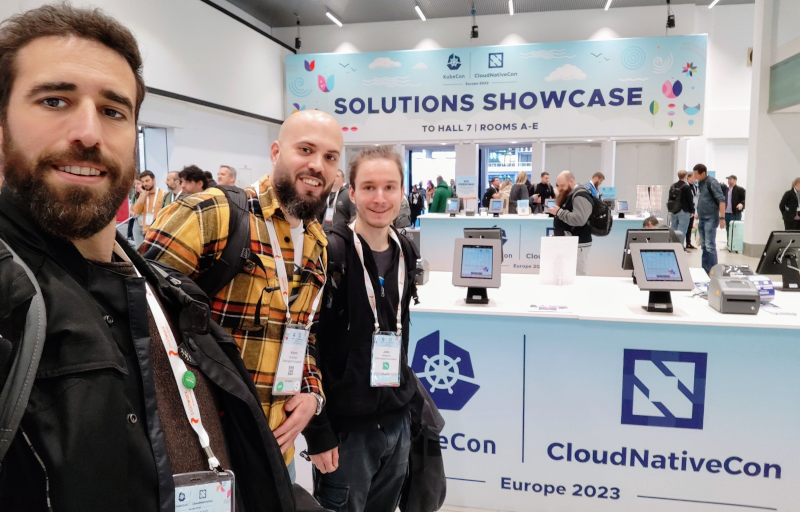
This post serves as a report from my attendance to Kubecon and CloudNativeCon 2023 Europe that took place in
Amsterdam in April 2023. It was my second time physically attending this conference, the first one was in
Austin, Texas (USA) in 2017. I also attended once in a virtual fashion.
The content here is mostly generated for the sake of my own recollection and learnings, and is written from
the notes I took during the event.
The very first session was the opening keynote, which reunited the whole crowd to bootstrap the event and
share the excitement about the days ahead. Some astonishing numbers were announced: there were more than
10.000 people attending, and apparently it could confidently be said that it was the largest open source
technology conference taking place in Europe in recent times.
It was also communicated that the next couple iteration of the event will be run in China in September 2023
and Paris in March 2024.
More numbers, the CNCF was hosting about 159 projects, involving 1300 maintainers and about 200.000
contributors. The cloud-native community is ever-increasing, and there seems to be a strong trend in the
industry for cloud-native technology adoption and all-things related to PaaS and IaaS.
The event program had different tracks, and in each one there was an interesting mix of low-level and higher
level talks for a variety of audience. On many occasions I found that reading the talk title alone was not
enough to know in advance if a talk was a 101 kind of thing or for experienced engineers. But unlike in
previous editions, I didn t have the feeling that the purpose of the conference was to try selling me
anything. Obviously, speakers would make sure to mention, or highlight in a subtle way, the involvement of a
given company in a given solution or piece of the ecosystem. But it was non-invasive and fair enough for me.
On a different note, I found the breakout rooms to be often small. I think there were only a couple of rooms
that could accommodate more than 500 people, which is a fairly small allowance for 10k attendees. I realized
with frustration that the more interesting talks were immediately fully booked, with people waiting in line
some 45 minutes before the session time. Because of this, I missed a few important sessions that I ll
hopefully watch online later.
Finally, on a more technical side, I ve learned many things, that instead of grouping by session I ll group
by topic, given how some subjects were mentioned in several talks.
On gitops and CI/CD pipelines
Most of the mentions went to FluxCD and ArgoCD. At
that point there were no doubts that gitops was a mature approach and both flux and argoCD could do an
excellent job. ArgoCD seemed a bit more over-engineered to be a more general purpose CD pipeline, and flux
felt a bit more tailored for simpler gitops setups. I discovered that both have nice web user interfaces that
I wasn t previously familiar with.
However, in two different talks I got the impression that the initial setup of them was simple, but migrating
your current workflow to gitops could result in a bumpy ride. This is, the challenge is not deploying
flux/argo itself, but moving everything into a state that both humans and flux/argo can understand. I also
saw some curious mentions to the config drifts that can happen in some cases, even if the goal of gitops is
precisely for that to never happen. Such mentions were usually accompanied by some hints on how to operate
the situation by hand.
Worth mentioning, I missed any practical information about one of the key pieces to this whole gitops story:
building container images. Most of the showcased scenarios were using pre-built container images, so in that
sense they were simple. Building and pushing to an image registry is one of the two key points we would need
to solve in Toolforge Kubernetes if adopting gitops.
In general, even if gitops were already in our radar for
Toolforge Kubernetes,
I think it climbed a few steps in my priority list after the conference.
Another learning was this site: https://opengitops.dev/.
On etcd, performance and resource management
I attended a talk focused on etcd performance tuning that was very encouraging. They were basically talking
about the exact
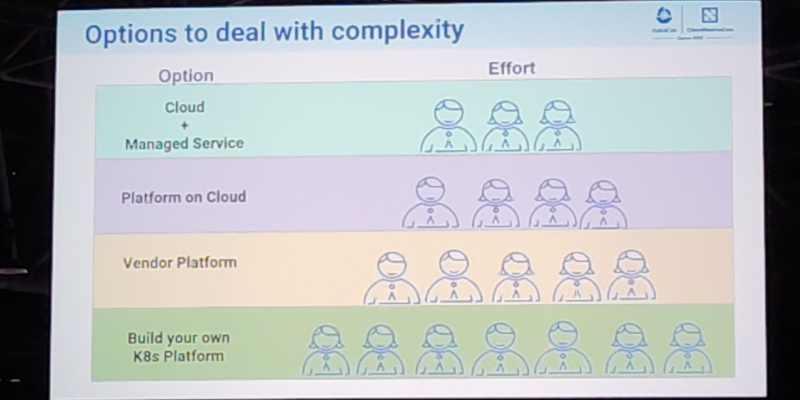
same problems we
have had in Toolforge Kubernetes, like api-server and etcd failure modes, and how sensitive etcd is to disk
latency, IO pressure and network throughput. Even though
Toolforge Kubernetes scale is small compared to other Kubernetes deployments out there, I found it very
interesting to see other s approaches to the same set of challenges.
I learned how most Kubernetes components and apps can overload the api-server. Because even the api-server
talks to itself. Simple things like kubectl may have a completely different impact on the API depending on
usage, for example when listing the whole list of objects (very expensive) vs a single object.
The conclusion was to try avoiding hitting the api-server with LIST calls, and use ResourceVersion which
avoids full-dumps from etcd (which, by the way, is the default when using bare kubectl get calls). I
already knew some of this, and for example the jobs-framework-emailer was already making use of this
ResourceVersion functionality.
There have been a lot of improvements in the performance side of Kubernetes in recent times, or more
specifically, in how resources are managed and used by the system. I saw a review of resource management from
the perspective of the container runtime and kubelet, and plans to support fancy things like topology-aware
scheduling decisions and dynamic resource claims (changing the pod resource claims without
re-defining/re-starting the pods).
On cluster management, bootstrapping and multi-tenancy
I attended a couple of talks that mentioned kubeadm, and one in particular was from the maintainers
themselves. This was of interest to me because as of today we use it for
Toolforge. They shared all
the latest developments and improvements, and the plans and roadmap for the future, with a special mention to
something they called kubeadm operator , apparently capable of auto-upgrading the cluster, auto-renewing
certificates and such.
I also saw a comparison between the different cluster bootstrappers, which to me confirmed that kubeadm was
the best, from the point of view of being a well established and well-known workflow, plus having a very
active contributor base. The kubeadm developers invited the audience to submit feature requests,
so I did.
The different talks confirmed that the basic unit for multi-tenancy in kubernetes is the namespace. Any
serious multi-tenant usage should leverage this. There were some ongoing conversations, in official sessions
and in the hallway, about the right tool to implement K8s-whitin-K8s, and vcluster
was mentioned enough times for me to be convinced it was the right candidate. This was despite of my impression
that multiclusters / multicloud are regarded as hard topics in the general community. I definitely would like to play
with it sometime down the road.
On networking
I attended a couple of basic sessions that served really well to understand how Kubernetes instrumented the
network to achieve its goal. The conference program had sessions to cover topics ranging from network
debugging recommendations, CNI implementations, to IPv6 support. Also, one of the keynote sessions had a
reference to how kube-proxy is not able to perform NAT for SIP connections, which is interesting because I
believe Netfilter Conntrack could do it if properly configured. One of the conclusions on the CNI front was
that Calico has a massive community adoption (in Netfilter mode), which is reassuring, especially considering
it is the one we use for Toolforge Kubernetes.
On jobs
I attended a couple of talks that were related to HPC/grid-like usages of Kubernetes. I was truly impressed
by some folks out there who were using Kubernetes Jobs on massive scales, such as to train machine learning
models and other fancy AI projects.
It is acknowledged in the community that the early implementation of things like Jobs and CronJobs had some
limitations that are now gone, or at least greatly improved. Some new functionalities have been added as
well. Indexed Jobs, for example, enables each Job to have a number (index) and process a chunk of a larger
batch of data based on that index. It would allow for full grid-like features like sequential (or again,
indexed) processing, coordination between Job and more graceful Job restarts. My first reaction was: Is that
something we would like to enable in Toolforge Jobs Framework?
On policy and security
A surprisingly good amount of sessions covered interesting topics related to policy and security. It was nice
to learn two realities:
rust-<name-of-crate> is probably in violation.
There are a number of more detailed problems with the wording.
Values
The policy has all the hallmarks of excessive influence from traditional trademark lawyers and not enough influence from the Free Software community.
I would like to remind the Free Software activists on the inside of this process that the lawyers are there to serve you and the community.
The values embodied in trademark law often conflict with the values of the Free Software community. The Rust Project should adopt a trademark policy which follows the community s values - even if that might weaken our ability to sue evildoers.
Next steps
The Foundation should take a step back and pause the process.
Then, the Foundation should restart the process from a much earlier stage, with much wider publicity. Each stage should be widely advertised to the whole community, with opportunities for feedback.
This should include publishing the results of the August 2022 survey. The Foundation should publish a sketch of the legal advice they have received, publicly say what the plausible options are and what their consequences might be (for the community, for downstreams, and for the Foundation s enforcement ability).
(Some of this will no doubt repeat the work that has been done in the informal trademark working group. That work wasn t widely enough advertised.)
Echoes of a dispute from 2006
Mozilla made a very similar mistake with Firefox in 2006.
The official policy stated that no-one was allowed to distribute Firefox with any patches, unless those patches had been pre-approved by Mozilla.
Debian is committed to Software Freedom. This must includes the freedom to modify the software as one sees fit, even if the original authors don t agree.
Now, overly-restrictive trademark policies are hardly new. Debian often takes the practical view that usually the upstream with such a policy doesn t really mean it.
But Mozilla decided they did mean it. They contacted Debian asking for Debian to get their patches approved.
Since that wasn t acceptable to Debian, they stopped using the word Firefox . For a decade, Debian s Firefox browser was called Iceweasel .
We don t want something similar happening to Rust .
Here's an article from a French anarchist describing how his (encrypted) laptop was seized after he was arrested, and material from the encrypted partition has since been entered as evidence against him. His encryption password was supposedly greater than 20 characters and included a mixture of cases, numbers, and punctuation, so in the absence of any sort of opsec failures this implies that even relatively complex passwords can now be brute forced, and we should be transitioning to even more secure passphrases.apt-get update to only ever use files whose hash checksum have been recorded in the globally immutable tamper-resistance ledger rekor provided by the Sigstore project? Well I thought you d never ask, but now you can, thanks to my new projects apt-verify and apt-sigstore. I have not done proper stable releases yet, so this is work in progress. To try it out, adapt to the modern era of running random stuff from the Internet as root, and run the following commands. Use a container or virtual machine if you have trust issues.
apt-get install -y apt gpg bsdutils wget wget -nv -O/usr/local/bin/rekor-cli 'https://github.com/sigstore/rekor/releases/download/v1.1.0/rekor-cli-linux-amd64' echo afde22f01d9b6f091a7829a6f5d759d185dc0a8f3fd21de22c6ae9463352cf7d /usr/local/bin/rekor-cli sha256sum -c chmod +x /usr/local/bin/rekor-cli wget -nv -O/usr/local/bin/apt-verify-gpgv https://gitlab.com/debdistutils/apt-verify/-/raw/main/apt-verify-gpgv chmod +x /usr/local/bin/apt-verify-gpgv mkdir -p /etc/apt/verify.d ln -s /usr/bin/gpgv /etc/apt/verify.d echo 'APT::Key::gpgvcommand "apt-verify-gpgv";' > /etc/apt/apt.conf.d/75verify wget -nv -O/etc/apt/verify.d/apt-rekor https://gitlab.com/debdistutils/apt-sigstore/-/raw/main/apt-rekor chmod +x /etc/apt/verify.d/apt-rekor apt-get update less /var/log/syslogIf the stars are aligned (and the puppet projects of debdistget and debdistcanary have ran their GitLab CI/CD pipeline recently enough) you will see a successful output from
apt-get update and your syslog will contain debug logs showing the entries from the rekor log for the release index files that you downloaded. See sample outputs in the README.
If you get tired of it, disabling is easy:
chmod -x /etc/apt/verify.d/apt-rekorOur project currently supports Trisquel GNU/Linux 10 (nabia) & 11 (aramo), PureOS 10 (byzantium), Gnuinos chimaera, Ubuntu 20.04 (focal) & 22.04 (jammy), Debian 10 (buster) & 11 (bullseye), and Devuan GNU+Linux 4.0 (chimaera). Others can be supported to, please open an issue about it, although my focus is on FSDG-compliant distributions and their upstreams. This is a continuation of my previous work on apt-canary. I have realized that it was better to separate out the generic part of apt-canary into my new project apt-verify that offers a plugin-based method, and then rewrote apt-canary to be one such plugin. Then apt-sigstore s apt-rekor was my second plugin for
apt-verify.
Due to the design of things, and some current limitations, Ubuntu is the least stable since they push out new signed InRelease files frequently (mostly due to their use of Phased-Update-Percentage) and debdistget and debdistcanary CI/CD runs have a hard time keeping up. If you have insight on how to improve this, please comment me in the issue tracking the race condition.
There are limitations of what additional safety a rekor-based solution actually provides, but I expect that to improve as I get a cosign-based approach up and running. Currently apt-rekor mostly make targeted attacks less deniable. With a cosign-based approach, we could design things such that your machine only downloads updates when they have been publicly archived in an immutable fashion, or submitted for validation by a third-party such as my reproducible build setup for Trisquel GNU/Linux aramo.
What do you think? Happy Hacking!
ssh hostname, where hostname is one of your machines (server, laptop, whatever), and as long as hostname is up, you can reach it, wherever it is, wherever you are.
MulticastInterfaces section in the config), and avoid telling any of your nodes to connect to a public peer. You can set a list of authorized public keys that can connect to your nodes listening interfaces, which you ll probably want to do. You will probably want to either open up some inbound ports (if you can) or set up a node with a known clearnet IP on a place like a $5/mo VPS to help with NAT traversal (again, setting AllowedPublicKeys as appropriate). Yggdrasil doesn t allow filtering multicast clients by public key, only by network interface, so that s why we disable broadcast discovery. You can easily enough teach Yggdrasil about static internal LAN IPs of your nodes and have things work that way. (Or, set up an internal gateway node or two, that the clients just connect to when they re local). But fundamentally, you need to put a bit more thought into this with Yggdrasil than with the other tools here, which are closed-only.
Compared to some of the other tools here, Yggdrasil is better about information leakage; nodes only know details, such as clearnet IPs, of directly-connected peers. You can obtain the list of directly-connected peers of any known node in the mesh but that list is the public keys of the directly-connected peers, not the clearnet IPs.
Some of the other tools contain a limited integrated firewall of sorts (with limited ACLs and such). Yggdrasil does not, but is fully compatible with on-host firewalls. I recommend these anyway even with many other tools.
yggdrasilctl debug_remotegetpeers key=ABC...). I have never experienced a problem with this. Also, since latency is a factor in routing for Yggdrasil, it is highly unlikely that random connections we use are going to be competitive with datacenter peers.
/etc/hosts and leave it at that, but it s up to you.
/etc/resolv.conf on Linux and provides resolution of mesh hostnames and some other features. This is a concept that is pretty slick.
It also is a bit flaky on Linux; dueling programs want to write to /etc/resolv.conf. I can t really say this is entirely Tailscale s fault; they document the problem and some workarounds.
I would love to be able to add custom records to this service; for instance, to override the public IP for a service to use the in-mesh IP. Unfortunately, that s not yet possible. However, MagicDNS can query existing nameservers for certain domains in a split DNS setup.
./nebula-cert sign -name "lighthouse1" -ip "192.168.100.1/24"
./nebula-cert sign -name "laptop" -ip "192.168.100.2/24" -groups "laptop,home,ssh"
./nebula-cert sign -name "server1" -ip "192.168.100.9/24" -groups "servers"
./nebula-cert sign -name "host3" -ip "192.168.100.10/24"
| Tool | iperf3 (default) | iperf3 -P 10 | iperf3 -R |
|---|---|---|---|
| Direct (no VPN) | 2406 | 2406 | 2764 |
| Wireguard (kernel) | 1515 | 1566 | 2027 |
| Yggdrasil | 892 | 1126 | 1105 |
| Tailscale | 950 | 1034 | 1085 |
| Tinc | 296 | 300 | 277 |
genkeys tool that uses more CPU cycles to generate keys that are maximally difficult to collide with.
Tailscale doesn t document their IP assignment algorithm, but I think it is safe to say that the larger subnet you use, the better. If you try to use a /24 for your mesh, it is certainly conceivable that an attacker could remove your trusted node, then just manually add the 240 or so machines it would take to get that IP reassigned. It might be a good idea to use a purely IPv6 mesh with Tailscale to minimize this problem as well.
So, I think the risk is low in the default configurations of both Yggdrasil and Tailscale (certainly lower than with tinc or Zerotier). You can drive the risk even lower with both.
Next.